• About

Seeking and Serving

~ seek and serve Christ in all persons

Seeking and Serving

Tag Archives: perfection

Sermon – Philippians 3.17-4.1, L2, YC, March 16, 2025

18 Wednesday Jun 2025

Posted by jandrewsweckerly in Sermons

≈ Leave a comment

Tags

disciple, failure, imitate, Jesus, learner, Paul, perfection, Sermon, teach, teachers, truth

We are in a season of bold proclamations.  Whether the assertions are about the best ways to govern, the smartest ways to allocate resources, or where responsibility lies for the care of others, the conversations happening in the wider community are marked by bold declarations of what is truth – often asserting truth with a capital “T.”  The most dangerous of these declarations of truth for me are the declarations about what being a Christian means – what being a faithful follower of Jesus entails.  Maybe I am more sensitive to those assertions because of my 9 to 5 job, but I cannot tell you the number of times I have been frustrated, if not angered, lately by those proclaiming truths about the way of Christ that sound very little like the Jesus I know. 

Knowing my defensiveness lately, you will likely be unsurprised by my reaction to our epistle reading today when Paul is acting very Paul-like.  Paul, who has regularly said that followers of Christ should imitate Christ, today says, “Brothers and sisters, join in imitating me, and observe those who live according to the example you have in us.”[i]  Paul’s instruction to imitate him is bold.  Paul does not say, “Do as I say, not as I do.”  Paul says, “Do what I do.”  Modern, defensive skeptics that we are, we immediately assume Paul has developed an inflated ego.  We know that telling people to imitate you is the first step toward a nasty fall.  Such a bold claim is setting Paul up for failure – because none of us are perfect.  Paul’s words immediately remind us of the hundreds of clergy who have fallen – who have embezzled, had affairs, abused children, abused alcohol, and have failed to be faithful pastors.  Surely Paul is setting up himself and the many people who are following him for failure.  Why would he do such a thing and who is he to proclaim perfection?

What we lose in our jaded, skeptical, snarky twenty-first century selves is the reminder of how learning and formation have happened for centuries.  As one scholar explains, both Jesus, and Paul his disciple, “know that true moral and spiritual formation depends on tutelage under a master – learning to follow the habits and practices of one who has become proficient in a particular trade or skill.  Indeed, this is the precise meaning of the word ‘disciple’:  a learner or pupil.”[ii]  In this way, disciples are learning from someone wiser than themselves, and in fact are imitating the teacher’s teacher.[iii]  So when Paul says imitate me, he does not really mean imitate Paul, but imitate Paul, who is imitating Jesus Christ.  Imitate the teacher’s teacher.

What I find assuring, then, is that Paul is not saying he is perfect.  He is not boasting about his perfect imitation of Christ, but only encouraging others to imitate Christ as he tries to imitate Christ.  What Paul knows is that our lives are never perfect.  But if we are not imitating something worth imitation, then we are already losing the battle.  And so, Paul’s imitation and our imitation many years later may be rough versions of Jesus Christ, but our imitation is still rooted in that great teacher who taught so many before us.

How we imitate Paul today is a bit more complicated.  We too must find our teachers who point to The Teacher.  The trick is not to think too remotely.  When asked who our role models are, many of us will name famous people of faith – Martin Luther King, Jr. or St. Patrick who we will celebrate tonight, or, given that it’s Women’s History Month, some of the suffragettes or first female clergy.  And those folks will give us much to ponder about our faith life.  But the problem is, sometimes those people are so removed from our lives that they cannot really teach us how to live our lives as Christians today. 

This is why, in his own day and in his own community, Paul offers himself up as an example.  Not because he is some stellar example of Christ, but because he is in relationship with those with whom he is talking.  Paul realizes that the most powerful person to learn from is someone right in your community.  As professor Dirk Lange says, “Paul is directing the gaze of the community not toward some type of individual perfection, not even toward the supreme perfection of Christ…but to the realization of Christ’s love within the community itself.”[iv]

So, Paul is inviting us to do a couple of things.  First, Paul is inviting us to name our own teachers.  One of my favorite set of teachers is a couple I know from college.  When Rebecca and David were married, they bought a home in North Carolina much larger than what they would need.  The house was a fixer-upper, but they had dreams.  Their dream was to make the house into an intentional Christian community that also serves as a transitional house for families.  So, people who are in-between jobs, a woman who is recently divorced, or really anyone the local pastor recommends is welcome to come live in their home.  They have some house rules about sharing work, community meals, and weekly worship.  But Rebecca, David, and their two sons are imitating Christ in this radical lifestyle.  When I am really wondering how to live a Christ-like life, I look at this family and see how far I have to go.

But even Rebecca and David can be a little too removed.  So sometimes I just look at those around me.  I look at the spiritual disciplines of parishioners here.  I look at the ways that you care for those with physical and mental limitations.  I look at the ways you tend to this property, engage as faithful citizens, or the ways you serve our neighbors in need.  Much like Paul and his community, we are not perfect.  We too struggle to understand how faith is lived right here in Upper James City County.  Our engagement in that struggle is what points us toward Christ.

This leads us to our second invitation from Paul – to recognize the ways in which we are all teachers to others.  When you leave this place every Sunday, you are not just Linda or Dave or Elizabeth.  You are Linda the Christian from Hickory Neck.  You are Dave who shows what being a person of faith is all about:  not because you are perfect, but because you are struggling to be like Christ.  One of my favorite evangelism videos is a video that talks about the top reasons why people do not come to church.  One reason they articulate is that the Church is full of hypocrites.  We know the ways that we feel like hypocrites and the world knows the ways we act like hypocrites.  The video has responses to each person’s fear or hesitancy about Church.  When the person complains that the Church is full of hypocrites, the Christian honestly and humbly says, “And there’s always room for one more.”  That kind of raw honesty is the kind of honesty that leads to trust, that leads to sharing, that leads to opening our doors to others.  That is the kind of honesty that makes others not only want to imitate us and our Teacher, but also to join us and the Teacher.  Paul invites us then to boldly proclaim, “Imitate me,” so that we can figure this journey out together.  Amen.


[i] Italics added by me for emphasis.

[ii] Ralph C. Wood, “Theological Perspective,” Feasting on the Word, Yr. C, Vol. 2 (Louisville: Westminster John Knox Press, 2009), 62.

[iii] Casey Thompson, “Pastoral Perspective,” Feasting on the Word, Yr. C, Vol. 2 (Louisville: Westminster John Knox Press, 2009), 64.

[iv] Dirk G. Lange, “Homiletical Perspective,” Feasting on the Word, Yr. C, Vol. 2 (Louisville: Westminster John Knox Press, 2009), 65.

Sabbatical Journey…On Resetting and Love

27 Tuesday Jun 2023

Posted by jandrewsweckerly in reflection

≈ 1 Comment

Tags

family, frustration, God, hug, invitation, love, peace, perfection, prayer, push, reset, still

Idaho Road (reuse with permission)

In case reading about and seeing pictures from our cross-country adventure make you think we are having a perfect trip with perfectly behaving family members, today reminded me how human we really are.  When you are family, you know each other almost too well:  you know what makes family members laugh and what embarrasses them, you know the quirks of each member and you know teasing is a form of love, you know how far you can push someone until they lose their cool.  But because you love each other unconditionally, sometimes you push anyway.  And when you are in each other’s presence 24/7 for ten days, apparently, the tenth day is when the pushing becomes almost inevitable. 

Despite the dazzling green of Idaho’s countryside, the beautiful rivers of Wyoming, and the stunning mountains across three states, and although there were fun road trip games, stories shared, and conversations had, today I also lost my patience and my ability to exhibit mature parenting responses.  Even with some downtime for all of us, I realized I was snapping too much, and my patience was brittle thin.  What I needed was some unconditional love, and so, as I said goodnight to each family member, I asked for a hug.  Despite having just been bickering not ten minutes earlier, each member to a person gave me a hug without protest.  And suddenly the unease that had settled around me melted away.

Too often – with loved ones, with neighbors, with community leaders, and certainly in church – we forget to reset with love.  I know not everyone is comfortable with physical touch, and I know the pandemic made us anxious about physical contact, but sometimes I think a hug might help us all reset some of the tension between us.  In fact, I know some of us have been frustrated or angry for so long that we are not even sure what we were originally frustrated or angry about. 

When I’m feeling frazzled, one of my favorite prayers is from Psalm 46.10, “Be still and know that I am God.”  I love to pray those words repeatedly, each time, dropping the last word in the phrase.   The first time I pray all eight words.  Then I pray just seven, “Be still and know that I am.”  And then six, and so on, until I just pray the word “be.”  If a hug is not available to you today, or if you want to do your own self work on resetting with love, I commend Psalm 46.10.  Between God’s invitation into stillness, and the stillness one finds in hugs, I pray you find some peace this day.

On Shielding and Sharing Joy…

17 Wednesday Nov 2021

Posted by jandrewsweckerly in reflection

≈ Leave a comment

Tags

complain, compline, God, goodness, grateful, gratitude, imperfection, joy, joyous, perfection, prayer, shield, Thanksgiving

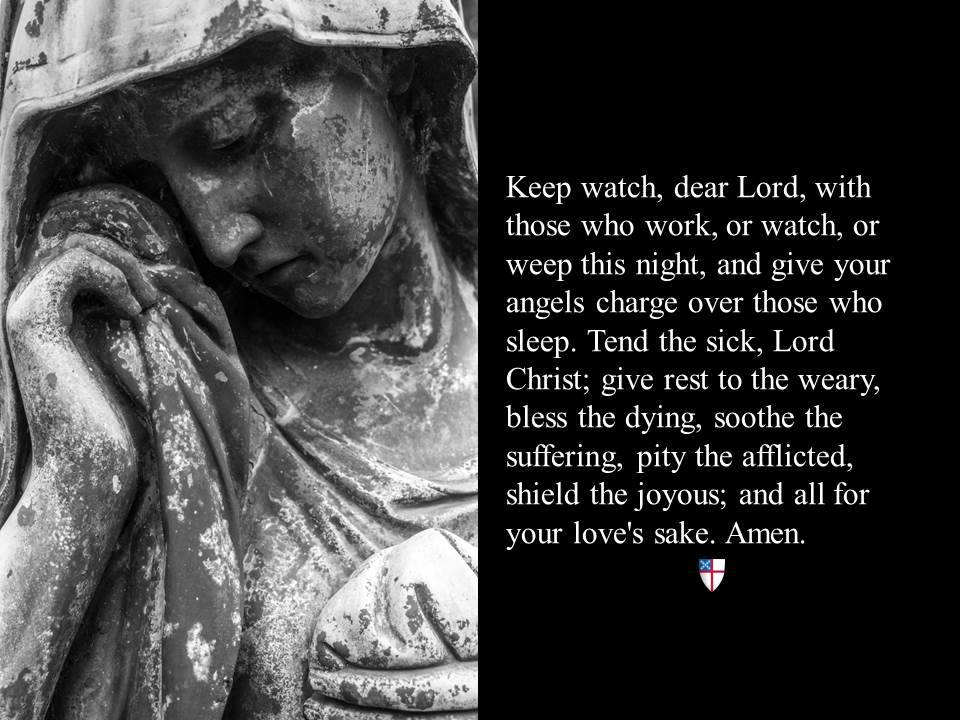
Photo credit: https://www.facebook.com/episcopalian/photos/keep-watch-dear-lord-with-those-who-work-or-watch-or-weep-this-night-and-give-yo/10155444636122925/

This month at Youth Group, before we began our closing prayer, the leader asked us each to name one good thing that had happened in the last week.  Immediately, the brows of each person in the room (adults included) furrowed as we tried to think back about something good in a sea of busyness.  Some of us struggled to remember anything good.  Others immediately burst forth with a fun thing they had gotten to do.  Some shyly shared an accomplishment for which they were proud.  And some were more abstract, like the beauty of the fall foliage.

I was struck by how each one of us in the room had to think quite hard about something good happening in our lives. I do not think we struggled because there is nothing good.  I think we struggled because our brains, or maybe our culture, has wired us to do the opposite – to complain about all the things going wrong, to see only the imperfections in life or in ourselves, to be discouraged by all that could be better in our circles.  A heart of gratitude or joy takes work.  Some of us come by gratitude and joy naturally, but most of us have been enculturated to see where there is want.  That’s why one of our favorite prayers from Compline has a line in its petitions to God for God to “shield the joyous.”[i] 

As we approach Thanksgiving Day next week, I wonder if this year you are still struggling to find the joy.  Maybe you still cannot gather safely with family, maybe you are worried about the safety of the children or the vulnerable in your family, or maybe you are just weary from this time of pandemic.  I suspect many of us are feeling critical of the imperfect and are having a hard time holding on to the perfect(ly good enough). 

My prayer for you this week is that God shields your joy.  But I invite you to consider partnering with God in this endeavor.  Each day until Thanksgiving Day, before you drift off to sleep, think back to one thing for which you grateful, that gave you joy, or was just a good moment.  The goodness does not have to be big or creative.  Start with something basic.  While you engage in this prayerful practice, I will be praying that God shields your joy, and I hope you will share your joy with someone else – so they can be shielded by God too. 


[i] Book of Common Prayer, 134.

Homily – Luke 2.-8-20, Blue Christmas, December 21, 2016

04 Wednesday Jan 2017

Posted by jandrewsweckerly in Sermons, Uncategorized

≈ Leave a comment

Tags

Blue Christmas, Christmas, happy, Holy Family, homily, honest, hope, imperfection, perfect, perfection, real, vulnerable

I can still picture the perfect Christmas in my head.  My cousins were all there, along with my aunts, uncles, and grandparents.  The kids’ table was the coveted spot for dinner – even some the adults offered to make the “sacrifice” of not sitting at the adult table in order to join the kids.  After a dinner with the lamb and asparagus casserole my grandfather always cooked, the cousins challenged the aunts and uncles to a football game in the yard.  I scored a touchdown, which if you know me, was a minor miracle.  It was a perfectly beautiful, chilly day, and I remember being happy.

Of course, I was too young to know what was actually happening.  Marriages were hanging on by a string, and only one would survive.  Anxiety was hidden beneath the surface at the kids’ table as one family member barked at us for various offenses.  At least one family member was struggling with her sexuality.  Cousins would later be caught in the middle of nasty divorces, meaning I would not see them for several years.  Jobs would be lost, and identity would be questioned in the midst of unemployment.  American politics would infect family politics.  Even my own immediate family was heading for all sorts of tumult.

For a long time, I mourned the loss of that perfect Christmas.  I saw other families seeming to hold their Christmases together without effort.  I watched commercials that reminded me more of how things used to be rather than how they were.  I would receive annual Christmas cards and letters from seemingly perfect friends that made me feel like I did not measure up.  Even the pictures of the Holy Family seemed to capture a peace and contentment that I would never have.

But slowly, over the years, the old Biblical narrative seemed to unravel.  Knowing how hard marriage is, I could finally imagine how tense things must have been between Joseph and Mary.  Knowing how hard pregnancy is, I could finally imagine how miserable Mary must have been by the time they arrived in Bethlehem.  Knowing how brutal the Roman rulers were, I could imagine how dehumanizing going back to your hometown to be enrolled in the census must have been.  Knowing that not one family member, friend, or business would take in the Holy Family, leaving them in the most humiliating of situations, I could imagine how panicked and lonely the first-time mom, Mary, must have felt, even in her exhaustion.  Knowing how filthy shepherds usually were, and how Mary and Joseph just wanted a little peace, I could imagine how overwhelmed the Holy Family felt.  Though we like nativity sets, cards, and pageants that depict the Holy Family’s experience as heavenly perfection, the scripture tells a different story.

One of my favorite paintings of Mary is a painting that depicts her, just after birth, splayed, half-dressed, on a rustic bed, with women hovering in the dark background, tending to baby Jesus.[i]  There’s something very real and raw about that painting – the animals and baby are all there, but none of it seems perfect.  That’s what I love about this service too.  We too are tired, overwhelmed, and feeling vulnerable.  We too are lost without our loved ones this year.  We too are terrified of the ambiguity of life, and the sense that we are not in control.  But unlike everywhere else we live and work, this gathering tonight says we do not have to hide; we do not have to stuff our vulnerabilities and weaknesses in a box; we do not need to try to find perfection.

Tonight we are simply invited to be real, vulnerable, and honest about the imperfection of our lives, of ourselves, and of this time of year.  And though some artists might want you to believe that the Holy Family puts forth some sort of perfection standard, if anything, the Holy Family is right there with us.  Sitting among smelly animals and shepherds, settling into itchy hay and drafty stables, and wrapping their child in scraps of simple cloths, the Holy Family invites us into an imperfect Christmas.  Only when we enter fully enter into the imperfection of our Christmases are we able to allow the perfection of Christ to light a small flame of hope in our hearts.  May that light be kindled or stoked tonight, and may that light of hope grow ever strong in the days, weeks, and years to come.

[i] Paul Gauguin, “Te Tamari No Atua (Nativity), 1896,” as found at http://www.jesus-story.net/painting_birth_christ.htm on December 20, 2016.

Sermon – Proverbs 31.10-31, Mark 9.30-37, P20, YB, September 20, 2015

23 Wednesday Sep 2015

Posted by jandrewsweckerly in Uncategorized

≈ Leave a comment

Tags

awe, capable, church, companionship, disciples, fear, God, grace, gratitude, humility, Jesus, joy, Lord, Mark, perfection, power, Proverbs, satisfaction, scolding, scripture, Sermon, strength, warrior-like, wife, woman, wonder

There are some Sundays when the scripture lessons appointed for the day are just right.  They speak truth to power or relate to a spiritual crisis in the community.  They shed light on a current event or they give pastoral words to aching hearts.  On those days, I am so grateful for the ways in which I see the Holy Spirit moving through the Church through the vehicle of scripture.  Today is not one of those days.  I read both our Old Testament and Gospel lessons this week, and my first reaction was, “Really?!?  THIS is what we needed to hear this week, God??”

The Old Testament lesson from Proverbs is actually one of my favorites – even though the lesson takes some deconstructing.  This passage is often referred to as the passage about the capable wife.  Now anytime the church starts talking about how women need to be wives and how those wives need to be “capable” I start getting defensive.  The good news is that the title is more the problem than the lesson itself.  The Hebrew word often translated as “capable” is better translated as powerful, strong, or even warrior-like.  This woman is a superhero.  She rises before dawn; manages a staff, ensuring her family has food and security; she purchases property and plants a vineyard with her own hands; she runs a thriving business, providing fine clothing for her family and the community; she is known for her wisdom and is happy and satisfied; and in her spare time, she is a shining example of philanthropy.  When you think about the traditional role of women in the patriarchal society of the time,[i] this woman is on fire.  She is an empowered woman, an equal partner to her husband, and is the master of both her home and her work outside of the home.[ii]  She is like Martha Stewart on steroids.

In the Gospel lesson, we find the disciples struggling yet again.  Jesus meets with the disciples and explains to them his fate.  And instead of asking Jesus what he means, they remain silent because they are too afraid to ask.  Actually, they do not remain silent.  Instead, they start bickering among themselves about who will be first in the kingdom.  I suppose that if the world is going to end, we might be similarly distracted.  But Jesus catches them arguing and shames them into true silence.  Not only does Jesus tell the disciples that they must strive to be last – servants of all; but also, Jesus tells them that in order to be a part of Jesus’ kingdom, they need to welcome children like they would welcome Jesus (which really could be interpreted as welcoming the poor, widowed, or disenfranchised).  So basically, Jesus tells the disciples they are a mess.  Not only are they not listening, they are distracted by their egos, and they are not attending to the one ministry he has called them to do.

So here is the challenge with these two lessons.  Basically, we take from the lessons that we are all too full of ourselves, we are distracted by the wrong things, we are not doing the work Jesus has called us to do.  And if we want to correct all of that behavior, we need to become warrior women and men – Martha Stewarts on steroids, showing everybody how it’s done.  Now I am not arguing that any of those points are not inherently truthful and are not lovely goals toward which we should strive.  What I am arguing is that I just did not want to hear them this week.  Here we are busting our buns to do the massive amount of work needed to pull off the Fall Fair.  Here we are busy kicking off the program year, with teachers preparing lesson plans, the choir readying music, and all our ministries being back on deck.  Here we are putting together last minute receptions for the bereaved, trying to complete a major construction project, and trying to ensure that we have enough funds to run our operations and enough energy to evangelize in our community.  And that is on top of all the work we are doing to get kids back to school, to reconnect with our community commitments after a summer hiatus, to make sure we are still performing well at work, to get our homes tidy and prepared for fall, and to squeeze in some football games.  In the midst of that chaos, the last thing I need to hear from church today is that my priorities are all wrong and that I need to work harder – a lot harder.  Thanks, but no thanks, Holy Scripture!

The good news is that there is good news.  For all the overwhelming work of the warrior-like woman in Proverbs and for all the scolding the disciples receive, the message from both lessons is clear and surprisingly manageable.  In Proverbs, the lesson concludes, “a woman who fears the Lord is to be praised.”  Now this is not the kind of fear we get when we talk about horror films, phobias, or abject worry.  The fear the passage is talking about is “awe, wonder, gratitude, and reverent humility before the Creator.”[iii]  Now fear of the Lord may sound like one more thing to add to the to-do list, but actually, fear is where the lessons are calling us to start.  You see, the disciples lacked a genuine fear of the Lord.  They were afraid in the more traditional sense – of what Jesus was talking about, of what would happen to them, of how they would ensure their own security.  They got wrapped up in themselves.  But if they had been wrapped up in awe, wonder, gratitude, and humility, all of the things Jesus had to instruct them to do would have come more naturally.  If they were in awe of Jesus, they would have easily been able to see how grateful they should be to have a Messiah who would sacrifice himself for them.  If they had been in wonder of Jesus, they would have simply been happy to be called a disciple, without worrying about their place or status.  If they had been full of gratitude, they would have already been welcoming children – and the poor, and the outcast, and the stranger.  The same sort of reversal is true for the warrior-like woman in Proverbs.  All of those amazing things she seems to accomplish in 24 hours happen only because of her reverence for God.  She is not favored because of all that she does.  She is able to do all that she does because she starts in a place of gratitude.  The rest flows easily out of that vantage point.

Today’s lessons are not about scolding us for how we get everything wrong, or about setting some impossible standard of perfection for us.  Instead, today’s lessons are about checking our baseline.  When our baseline is about awe, wonder, gratitude, and humility, we find living into Jesus’ instructions much easier.  When our baseline is about awe, wonder, gratitude, and humility, those astounding to-do lists and projects do not seem like burdens but gifts.  When our baseline is about awe, wonder, gratitude, and humility, church is not only a place we want to be, church is a place to which we are lovingly drawn.  That’s when that piece you were writing about stewardship doesn’t seem scary or even hard.  That’s when those sacred moments happen in Sunday School when a child or teen says something profound that stays with you all week.  That’s when you are up to your ears in stress about the Fair, and something funny – really funny – happens, and you and the other volunteers laugh so hard that you cry.  Holy Scripture today is not directing us down a path of guilt and shame.  Holy Scripture today is inviting us onto that path less travelled – the one that starts with awe, wonder, gratitude, and humility, and ends with grace, joy, companionship, and satisfaction.  I may not have wanted to hear our scripture lessons today.  But I needed to hear them.  My hope is that you can hear them in the spirit in which they were intended too.  Amen.

[i] Brent A. Strawn, “Commentary on Proverbs 31.10-31,” September 20, 2009, as found at http://www.workingpreacher.org/preaching.aspx?commentary_id=390 on September 18, 2015.

[ii] Telford Work, “Theological Perspective,” Feasting on the Word, Yr. B, vol. 4 (Louisville:  Westminster John Knox Press, 2009), 78.

[iii] Kathleen M. O’Connor, “Exegetical Perspective,” Feasting on the Word, Yr. B, vol. 4 (Louisville:  Westminster John Knox Press, 2009), 79.

Recent Posts

  • On the Myth and Magic of Advent…
  • On Risking Failure and Facing Fear…
  • Sermon – Luke 23.33-43, P29, YC, November 23, 2025
  • On Inhabiting Gratitude…
  • Sermon – Luke 20.27-38, P27, YC, November 9, 2025

Archives

  • December 2025
  • November 2025
  • October 2025
  • September 2025
  • August 2025
  • July 2025
  • June 2025
  • March 2025
  • February 2025
  • December 2024
  • November 2024
  • October 2024
  • September 2024
  • August 2024
  • July 2024
  • June 2024
  • May 2024
  • March 2024
  • February 2024
  • January 2024
  • December 2023
  • November 2023
  • October 2023
  • September 2023
  • August 2023
  • July 2023
  • June 2023
  • May 2023
  • March 2023
  • February 2023
  • January 2023
  • December 2022
  • November 2022
  • October 2022
  • June 2022
  • May 2022
  • January 2022
  • December 2021
  • November 2021
  • October 2021
  • September 2021
  • August 2021
  • June 2021
  • May 2021
  • April 2021
  • March 2021
  • February 2021
  • January 2021
  • December 2020
  • November 2020
  • October 2020
  • September 2020
  • August 2020
  • July 2020
  • June 2020
  • May 2020
  • April 2020
  • March 2020
  • February 2020
  • January 2020
  • December 2019
  • November 2019
  • October 2019
  • September 2019
  • August 2019
  • July 2019
  • June 2019
  • May 2019
  • April 2019
  • March 2019
  • February 2019
  • January 2019
  • December 2018
  • November 2018
  • October 2018
  • September 2018
  • August 2018
  • July 2018
  • June 2018
  • May 2018
  • April 2018
  • March 2018
  • February 2018
  • January 2018
  • December 2017
  • November 2017
  • October 2017
  • September 2017
  • August 2017
  • July 2017
  • June 2017
  • May 2017
  • April 2017
  • March 2017
  • February 2017
  • January 2017
  • December 2016
  • November 2016
  • October 2016
  • September 2016
  • August 2016
  • July 2016
  • June 2016
  • May 2016
  • April 2016
  • March 2016
  • February 2016
  • January 2016
  • December 2015
  • November 2015
  • October 2015
  • September 2015
  • August 2015
  • July 2015
  • June 2015
  • May 2015
  • April 2015
  • March 2015
  • February 2015
  • January 2015
  • December 2014
  • November 2014
  • October 2014
  • September 2014
  • August 2014
  • July 2014
  • June 2014
  • April 2014
  • March 2014
  • February 2014
  • January 2014
  • December 2013
  • November 2013
  • October 2013
  • September 2013
  • August 2013
  • July 2013
  • June 2013
  • May 2013
  • April 2013
  • March 2013
  • February 2013
  • January 2013
  • December 2012
  • November 2012
  • October 2012
  • September 2012

Categories

  • reflection
  • Sermons
  • Uncategorized

Meta

  • Create account
  • Log in
  • Entries feed
  • Comments feed
  • WordPress.com

Blog at WordPress.com.

  • Subscribe Subscribed
    • Seeking and Serving
    • Join 394 other subscribers
    • Already have a WordPress.com account? Log in now.
    • Seeking and Serving
    • Subscribe Subscribed
    • Sign up
    • Log in
    • Report this content
    • View site in Reader
    • Manage subscriptions
    • Collapse this bar
 

Loading Comments...