• About

Seeking and Serving

~ seek and serve Christ in all persons

Seeking and Serving

Tag Archives: suffering

Sermon – Job 42.1-6, 10-17, P25, YB, October 25, 2015

28 Wednesday Oct 2015

Posted by jandrewsweckerly in Uncategorized

≈ Leave a comment

Tags

abundance, faithfulness, gift, God, happily ever after, happy, Job, new normal, opportunity, Sermon, stewardship, suffering, theology of gratitude, transform, wealth

I remember well the reentry experience I had after my first major international mission trip.  A team of about 20 of us traveled to Honduras for ten days, spending seven of those days in a rural, impoverished village.  When I came back to Duke, I came back a changed person.  Suddenly the mounds of food available in the dining hall seemed exorbitant, if not wasteful when I remembered the hungry children of the village.  Although the long, hot showers felt glorious, I also could not help but feeling guilty for using so much water and having that water so ready at my fingertips when I had become so accustomed to having only a bucket of water to bathe with every other day – a bucket that I had to share with someone else.  Even being able to go to the student health center for the stomach bug I brought back with me felt like a luxury after having run a health clinic with meager supplies and only one doctor.

All that would be enough to make me feel out of place.  But what made the experience worse was that I felt like a transformed, confused, vulnerable person in a sea of people going about their everyday lives.  In fact, I was very clear that I was the weird one.  All I had to do was have the basic, “What did you do for Spring Break?” conversation, and I could tell that no one could relate to my new reality.  They had been to Cancun, Cabo, or Costa Rica for Spring Break.  They had stories about partying, pools, and pina coladas.  There biggest stressors were navigating taxis without speaking Spanish, haggling with shop owners about prices, and trying to figure out how much to tip the cabana guys.  My stories about a lack of indoor plumbing, sleeping on cement floors, and boiling water to drink just led to blank stares and quick exits.  Instead, I was left alone, on a campus full of abundance, with students who have never had to worry about money or even their basic needs being met, in a place where my only responsibility was to study and attend classes.  Having seen real poverty, I would never again be able to look at the campus and people and privilege around me and see all of that in the same way again.

I think that is what makes me so uncomfortable about the happily-ever-after ending we get in Job today.  These last few weeks we have been reading through Job.  We hear the confusing conversation between the Adversary and God about how the Adversary will test Job’s righteousness by taking everything away – his children, his livestock, his home.  We remember how his friends try to tell him he must have done something to deserve his suffering.  We hear Job lash out at God, demanding to know why he is suffering so.  And last week we heard God put Job in his place, asking how Job thought he had any right to presume he knew God’s ways.  The today, when Job humbly confesses and submits to God, God suddenly relieves Job of his suffering.  He brings back his wealth – twice as much as he had before.  He blesses Job with children and livestock again.  On the surface, the whole story sounds so simple.  Job has everything taken away, he remains faithful, and then is restored his fortunes.  But something about that ending does not sit well with me.  How could Job ever look at his ten children without remembering the ten he had before?  How could Job ever look at that livestock and wealth without remembering how he once had nothing?  How could Job receive his consoling brothers and sisters without remembering how they had all deserted him and left him to sit with his sores and grief?  For some reason, I just cannot imagine how all that abundance in the face of recent tragedy somehow makes up for all his suffering.

Of course, we all try to make that transition in life.  I know widowers or divorcees who have had countless people ask why they do not start dating – as if a new spouse could ever make them forget the one with whom they shared a lifetime.  I know pet owners who have lost a beloved pet, only to have someone say, “You should just get a new puppy.  A puppy will make you forget your old dog.”  I even know young mothers who have lost a pregnancy or even an infant, only to have someone say, “You’re young.  You can always have another.”  To their credit, I genuinely think our friends and family are trying to say something that they think is helpful.  They are facing the abyss of pain too, and simply want to make everything okay.  And so they, and we, say something that even sounds awful to us coming out of our mouths.  But we do not know what else to say.

As I have thought about Job this week, I realized the end of his story is not a happily-ever-after ending.  The end of his story is a story about the new normal.  The new normal is not just a return to the same – or even a doubling of what was before.  The new normal for Job is learning how to be a person of faith in the midst of abundance.  Job teaches us a lot about living in the new normal.  Job prays for his friends who tried to blame Job’s suffering on Job.  Job eats with his siblings who disappeared during his suffering.  And Job does something radical.  When he has those ten children, three of them are daughters.  The text tells us that he gives the daughters an inheritance along with their brothers.  That kind of action was unheard of in Job’s day.[i]  Women were not given inheritances.  If they wanted security, they got married.  But Job, in his new normal, decides not just to enjoy his wealth, but to make his wealth count for others – for the most vulnerable:  for women.

Though I would never wish Job’s fate on anyone, Job’s suffering and trials teach him something about faithfulness.  Job moves from basically espousing a prosperity gospel – one in which he was blessed with good things because of his faithfulness – to espousing a theology of gratitude.  His wealth is no longer something for him to possess as a reward, but is now a tool for making a difference in the world.  That is not to say that Job is not a righteous man before his trials.  The text tells us he is.  What the text does infer is that Job’s relationship with his wealth is transformed, along with his faith.[ii]

A few weeks ago, Deacon Anthony told us about an experience of a man in New York City that he saw on the website, “Humans of New York.”  The story about the man in his own words goes like this, “Not long ago it looked like I was about to get everything.  I was one of the first employees at a company that sold for a billion dollars.  So I started a new company, and everything seemed to be going perfectly, but suddenly everything came apart.  This has been the toughest year of my adult life.  I went bankrupt, my company failed, and a person I loved died.  I didn’t commit suicide—though I considered it.  But my ideas of myself have definitely died.  I thought I was better than everyone.  I saw my success as the culmination of all my positive merits.  Losing everything forced me to realize how much of my good fortune was due to things that had been given to me.”[iii]  I think that man from New York understood Job’s reality deeply.  His year of tragedy taught him the same thing that Job’s time of tragedy taught him.  Everything is a gift:  our wealth, our abundance, our comfort, our security.  Everything is a gift.  And once we realize that everything is a gift, we are irrevocably changed.  We cannot go back to living life in a haphazard, oblivious way.  Our perspective toward abundance, and our responsibility to manage that abundance, changes.

Job found a way to transform the lives of his daughters with his wealth – even though society would have never have considered asking him, let alone expected him to do so.  Often we talk about wealth being a burden or a responsibility.  All we need to do is think about the lesson we heard recently about the rich getting into heaven being like a camel going through the eye of a needle.  Or we know those familiar words from Luke, “to whom much is given, much is required.”  But Job does not teach us that lesson today.  Wealth is not a burden or a responsibility.  Wealth frees us for opportunity – opportunities to bless, to transform, and to flourish.  Like that man in New York understood, wealth is a gift.  Our invitation this week is to consider how we might use our wealth as a gift.  Instead of seeing this stewardship season as a reminder of the burden we all have to support the operating budget of the church, I invite you to consider this stewardship season as a gift – an invitation to use your wealth to create opportunities to bless, to transform, and to flourish the ministries of this place.  Like Job joyfully watched his daughters experience a new freedom, I wonder what new opportunities your wealth might create in this community.  Amen.

[i] Dale P. Andrews, “Homiletical Perspective,” Feasting on the Word, Yr. B, Vol. 4 (Louisville: Westminster John Knox Press, 2009), 199.

[ii] Kathryn M. Schifferdecker, “Commentary on Job 42:1-6, 10-17,” October 28, 2012, as found at http://www.workingpreacher.org/preaching.aspx?commentary_id=1455 on October 22, 2015.

[iii] Found at “Humans of New York,” October 10, 2015, found at https://www.facebook.com/humansofnewyork/photos/a.102107073196735.4429.102099916530784/1105944539479645/?type=3&fref=nf on October 23, 2015.

Sermon – Mark 4.35-41, P7, YB, June 21, 2015

22 Monday Jun 2015

Posted by jandrewsweckerly in Uncategorized

≈ 2 Comments

Tags

afraid, asleep, boat, care, Charleston, comfort, covenant, disciples, gun control, Jesus, Kingdom, Mark, miracle, oppression, other, racism, relationship, scared, Sermon, storm, suffering, violence

A long time ago, we got on a boat.  We were not really sure what was going to happen while we were out to sea, but we got on the boat because we were curious.  We had an experience, or maybe multiple experiences with a man named Jesus, and something about those experiences compelled us to get on the boat.  Maybe the experience happened as early as Sunday School, maybe the experience happened when we were confirmed, or maybe the experience happened as an adult.  We may not even be able to articulate the reason why we got on the boat.  But all of us, at some point, step onto the boat, however tentatively or boldly, and we sail with Jesus to the other side.

The disciples have that same experience in today’s gospel lesson from Mark.  After a long day of preaching and teaching, during which Jesus pulls them aside and explains parables to them, Jesus says, “Let us go across to the other side.”  Now if the disciples had been smart, they would have asked some questions: “What is on the other side?  What if a storm comes?  Can’t we just stay here and get a good night’s rest?  This place is familiar and comfortable.”  And they should have asked questions.  The “other side” of that body of water is exactly that – other.  The other side is Gentile territory, the land of the Gerasenes.  Jesus is taking his first journey into what might be considered dangerous, and even inappropriate.  Jesus is beginning a ministry beyond just the Jews.[i]  “Let us go across to the other side,” is no “Hey, let’s mix things up this year and go to Cabo.”  Yes, the disciples should have asked a lot more questions.[ii]

But they do not.  Something about this Jesus compels them forward, stepping on and manning that boat without question.  That’s the funny thing about Jesus.  We too got on a boat because of him, probably having no idea what we were getting into.  Suddenly we find ourselves cooking casseroles, watering gardens, and bringing in men’s undergarments for our needy neighbors.  Suddenly we find ourselves getting asked by the Rector to serve on some committee.  Suddenly we find the news of the day is not so simple when we remember all those words we said in our baptismal covenant about seeking and serving Christ, loving our neighbor as ourselves, and sharing the Good News.  We really should have asked more questions before we got on that boat to follow Jesus.

I have been thinking about that boat a lot this week.  You see, some of our fellow disciples were murdered this week – nine to be exact, in Charleston, South Carolina.  They were praying and reading Holy Scripture – just like we do every Thursday.  They even welcomed in a stranger that night – like Jesus always tells us to do.  That very stranger turned out to be crazy, filled with racist rage, and willing to kill nine people before fleeing.  At least that was how I saw the episode at first.  At first, this was another instance of a crazy person, senselessly killing other people.  But then the prophets of our time began to speak.  The prophets reminded me that violence proliferates in our society.  The prophets reminded me that because we cannot agree on a reasonable gun policy, more and more people die in our backyards.  The prophets reminded me that our African-American brothers and sisters in this country experience very fragile and virtually non-existent safety – they cannot even be safe in church.  There was a part of me that wanted to stay on the shore this week and say, “Oh, Jesus, that was just an isolated event by a crazy kid with extremist views.”  But I had already gotten on the boat.  It was too late.  And a storm began to rage.

That storm for me was the storm of our time:  a storm of violence, racism, and suffering.  No longer could I contain each story:  Trayvon Martin, Ferguson, Sandy Hook, Baltimore, Columbine, Selma, Charleston.  One story bled into another, and as I was reminded of each one, I felt the buckets of water dousing my face.  As I thought about every conversation I have had about how racism is not dead, I felt the water creeping up to my waist.  As I thought about the historical shadow of the oppression of others in our country, I wanted to cry out to God.  And all I could think about was Jesus on that stupid boat, asleep on a cushion in the stern.  Who can sleep at a time like this?  Doesn’t Jesus care about us at all?  Why couldn’t we have just stayed on the shore in that comfortable, familiar place instead of getting on the God-forsaken boat with a man who does not seem in the least bit bothered by our suffering?

The disciples know that feeling.  They are experienced at life on a boat.  At least when they get on the boat, they knew how to manage a boat.  They know the dangers and the perils, and have learned to navigate them for the necessity of survival.  But even these experienced fishermen are scared.  They have tried to control the boat, they have scooped out as much water as they can, and they know they have met their match.  And so they go to their last resort.  They wake up Jesus and shout, “Teacher, do you not care that we are perishing?!?”  When they got on that boat, this is not what they were expecting.  They were expecting the fulfillment of a promise – the fulfillment of a different life and a different world:  the kingdom of God here on earth.  Instead they were going down fast with a man who could not even stay awake and fight the good fight with them.

I shouted those words this week too.  Teacher, do you not care that we are perishing?  Maybe we brought all this violence on ourselves, but surely you care?  Surely you did not lure me onto this boat – into this relationship with you – only to watch us perish?  Though I wanted more than anything to think this was an isolated event of a crazy person doing something ungodly, I could not ignore the storm swirling around.

I struggled to find hope today in our gospel lesson.  All I saw was Jesus scolding the disciples for their fear and their lack of faith.  And then I saw disciples even more afraid than before – which is saying something given the awfulness of that storm.  Straining for some strand of hope – some glimmer of redemption – I came back to that invitation from Jesus, “Let us go across to the other side.”  Jesus does not tell the disciples to go to the other side alone.  Jesus does not say, “Go to the other side without me.”  Jesus says, “Let us go to the other side.”[iii]  Whether the disciples felt like Jesus was with them during that storm or not, Jesus was with them.  That may not seem like much, but that may be the biggest miracle of all in this story.  As one scholar writes, “God’s power isn’t in the control of creation or of people, but in being in covenant and relationship with them.  [God’s power] isn’t in imposing the divine will or insisting on its own way but in sojourning with us as we fumble around and make our way in the world.  God’s power is not in miraculous interventions, pre-emptive strikes in the cosmic war against suffering and evil, but in inviting us to build a kingdom out of love, peace, and justice with God.  God’s power is not in the obliterating of what is bad in the world, but in empowering us to build something good in this world.”[iv]

A long time ago, we got on a boat.  We did not know where we were going, what we would see, or who we would encounter.  All we knew was that Jesus was inviting us into a different life, and we felt compelled by this passionate, nonsensical man.  Oh, we had clues.  We knew that the “other side,” was not a place we wanted to go.  We knew that going there might change us, and change our entire worldview.  We knew that getting on that boat would mean stepping away from the familiar, comfortable coastline, and sailing into something different and scary.[v]  But Jesus said he would go with us.  Jesus invited us on a journey with him and something deep inside us, despite the little devil on our shoulder telling us to stay put, told us to step onto that boat.

I am still scared of the storm.  In fact, I am a little afraid of Jesus too.  But what brings me comfort this week is that Jesus is with us.  Jesus does not invite us onto a boat and let us sail alone.  And though Jesus may have an ability to sleep through a storm, with complete confidence in the direction of God, I also know that Jesus will wake up and respond to me when I call out his name.  He may not say what I want to hear.  He may leave me feeling more uncomfortable than getting soaked in a storm.  But he is here.  Jesus is here on our boat, and can make things right.  We just have to be prepared to go to the other side.  Amen.

[i] Beverly Zink-Sawyer, “Homiletical Perspective,” Feasting on the Word, Yr. B, Vol. 2 (Louisville:  Westminster John Knox Press, 2009), 165.

[ii] This train of thought comes from Karoline Lewis’ writing “The Other Side,” June 14, 2015 as found at https://www.workingpreacher.org/craft.aspx?post=3645 on June 18, 2015.

[iii] Lewis.

[iv] David R. Henson, “When God Sleeps through Storms (Lectionary Reflection for Mark 4:35-41),” June 15, 2015 as found at http://www.patheos.com/blogs/davidhenson/2015/06/1804/ on June 18, 2015.

[v] Lewis.

Sermon – Matthew 25.31-46, P29, YA, November 23, 2014

26 Wednesday Nov 2014

Posted by jandrewsweckerly in Uncategorized

≈ Leave a comment

Tags

face, goats, God, Jesus, poor, privilege, Sermon, sheep, suffering

Once upon a time, “there was a cobbler who lived alone in his shop with one window that looked out on the street.  His wife and children had all died and he asked God, “Holy One why have you so long delayed your coming?  I have almost given up hope in seeing you.  Please come to my humble shop this day and show me your face.”

Outside on the street the cold winter brought snow.  Through his window he saw a beggar who shivered in the cold.  The cobbler invited the beggar into the shop to warm him and offer a meager meal from his shrinking larder.  The beggar thanked him and left.

As the day passed, a few customers came with repairs they needed for their shoes and harnesses.  A young boy sought shelter from the cold and snow.  The child’s feet were wrapped in old dirty rags and stuffed with paper.  Into the shop he invited the boy.  After making him some warm milk and a sandwich from the little food he had he went to his closet and found a pair of shoes that [had] belonged to his son.  He fit the shoes to the boy.  Grateful, the boy left with a promise to return to visit him.

It was approaching dusk and the cobbler despaired of a visit from the Lord.  A woman with her young babe appeared in front of the window.  She was dressed in a thin piece of cloth and she looked as if she might freeze to death.  The cobbler invited her into his shop.  Wary of the old man, she hesitated at the door, but feeling the warmth within she stepped across the threshold.  The cobbler made her some tea and went to his closet to find a heavy woolen cloak that [had] belonged to his wife.  Giving her the cloak the woman thanked him and after he shared the rest of his larder with her, she left with the child.

The sun descended and left the cobbler bereft.  “Why didn’t you come and visit me today,” the cobbler asked?  There was a voice that spoke to him in his humble shop:  “But I did come to you.  When you invited in the beggar, the boy, and the mother and her child, I was there with you.  In each of their faces you looked into my eyes.”  [The cobbler] then remembered the scripture: “When did you see me hungry and feed me, alone and naked and clothe me and thirsty and you gave me a drink.”  The visitors who had come to his shop that day had been his master.  In their faces he had looked into the eyes of God.

That night the cobbler slept happy and at peace for the first time in many months.”[i]

Today’s gospel lesson is one of those lessons that we might hear and immediately panic, for fear that we are those goats at God’s left hand.  We can picture all of those homeless persons we passed without a nod or a coin; that nursing home that we go by everyday but fail to stop in for a visit; or that prison that we avoid because passing the prison makes us nervous enough – we cannot imagine actually going inside.  In fact, we are pretty sure that we are the goats of Jesus’ story, and we know that when those goats do not feed the hungry, clothe the naked, welcome the stranger, tend the sick, and visit the prison, they are sent away to eternal punishment.  Talk about a sobering text.

Truthfully, we probably all could use a little sobering from time to time.  But today, I am more intrigued by the ways in which we are sheep.  In fact, St. Margaret’s gives us all kinds of opportunities to be sheep:  when we plant, tend, and pick produce that feeds the hungry in Huntington Station and Hicksville; when we donate money to the Outreach Fund, which provides clothing, gas, food, and toiletries to needy students at JFK High School here in Plainview; when we take communion to the shut-ins, or simply stop by for a visit or drop off a container of soup; or when we clear out our closets for veterans we may never meet.  All of these ways are ways in which St. Margaret’s is seeking and serving Christ in our neighborhood, and inviting us to fully become sheep at God’s right hand.

But as proud as I am of each of us, and as much as I want to assure us that we fall into the sheep category as often as we fall into the goat category[ii], the more important point is that Jesus’ words today are not meant to make us worry about completing a check list that will get us into heaven someday.  Instead, Jesus’ words today are meant to be a different kind of wake up call.  Jesus is saying today [clap], “Hey!  I am right here.  Wake up!”  Jesus does not want you to do all those wonderful things because that is what will get you into heaven.  Jesus wants you to do those wonderful things because that is where we will see his face and he will see ours.  Only when we are in those places of vulnerability, messiness, and desperation will we find each other.

I do not mean to romanticize poverty or helping the less fortunate.  But here is what I do know:  for the person who is in need, asking for help is one of the most humiliating experiences a person can know.  Asking for help means swallowing one’s pride, admitting defeat, and opening up oneself to rejection.  And for the person who is giving aid, giving that help means talking to someone we usually try to ignore, acknowledging our own privilege, and seeing afresh how thin the line is between “us” and “them.”  In that narrow space is where we can hear God say, “But I did come to you.  When you invited in the beggar, the boy, and the mother and her child, I was there with you.  In each of their faces you looked into my eyes.”  That is the invitation of today’s gospel lesson: not to panic in fear, but to step into those narrow spaces where Christ resides, and to see Christ face to face.  Amen.

[i] Leo Tolstoy, “Martin the Cobbler,” as retold by Bob Stuhlmann in “Goat Cheese And Starfish: For November 23, 2014,” posted on November 18, 2014, as found at http://storiesfromapriestlylife.wordpress.com/2014/11/18/goat-cheese-and-starfish-for-november-232014/.

[ii] Mark Douglas, “Theological Perspective,” Feasting on the Word, Year A, Vol. 4 (Louisville: Westminster John Knox Press, 2011), 336.

Sermon – Romans 8.26-39, P12, YA, July 27, 2014

30 Wednesday Jul 2014

Posted by jandrewsweckerly in Uncategorized

≈ 2 Comments

Tags

God, Holy Spirit, Israel, love, Mosul, nothing, pain, Palestine, Paul, refugees, separate, Sermon, sighs, suffering

These last few weeks of following the news have been rough.  As the situation in Palestine and Israel has deteriorated once again, I have listened as story after story of deaths by bombs has been reported.  Even hospitals, which would normally be left as safe havens, have been decimated – with doctors, nurses, and injured peoples killed.  Words keep getting thrown around like “justified,” and “terrorism,” and “power.”  But at the end of the day, people are being killed for the sake of safety and security.  As we imagine each Palestinian mother, father, and child dying, we hear the Spirit interceding with sighs too deep for words.

Then there is the Church in Mosul in Iraq.  As ISIS has moved in, they have demanded that all Christians either convert to Islam, pay a religious tax, or be executed.  As hundreds of Christians have chosen to flee, many have been robbed and abused.  Homes and places of worship are marked with the letter “N” for “Nazarene.”  Those labeled buildings are being destroyed or taken over by ISIS.  The Christian community that had been present for over 1600 years is almost completely gone now.  As we imagine Christians fleeing with only the clothes on their backs, we hear the Spirit interceding with sighs too deep for words.

Finally, much closer to home, children are crossing our own borders in waves.  Thousands and thousands of unaccompanied minors are fleeing violence, abuse, and poverty in the hopes of asylum in our country.  Just to have crossed the border means these children have already been through significant ordeals.  Without parents and sometimes without a word of English, they come in the hopes of safety and security.  While our governmental leaders and even some of us worry about long-term solutions and costs to our country, many religious communities are offering emergency food, shelter, clothing, and medicines.  As we imagine rooms filled with confused, scared, vulnerable children, we hear the Spirit interceding with sighs too deep for words.

There are many things about today’s portion of Paul’s letter to the Romans that I find confusing.  Paul says wonderful things like “…all things work together for good for those who love God,” and “If God is for us, who is against us?” and “Who will separate us from the love of Christ?”  And yet, could any of us utter any of these phrases to a Palestinian, a Christian in Mosul, or a Latino refugee child in Texas?  How can Paul admit that we have deep weaknesses, so strong that the Spirit intercedes for us with sighs too deep for words, and yet still believe that nothing can separate us from God?  Instead Paul’s words come off as pithy to those of us who also groan with the agony of this world, overwhelmed and feeling helpless in a world that bombards us with awful, terrible news of suffering and pain.  If God is for us, we are unsure that God’s team really can win.  We have seen too many things working together for evil to believe that all things work together for good.  And we in fact feel very separated from the love of Christ, especially at times like these.

Many years ago, while I was serving as a chaplain, I met a woman who had been ill for quite some time, and who was wondering whether death might be approaching.  We talked for a long time, and she finally admitted to me that she had stopped praying.  She had stopped praying because she no long knew what to say to God.  She had run out of words, and she was afraid to show any of the anger that was bubbling up inside of her to God for fear that God would abandon her.  She felt alone – isolated both from the world and from God – and that feeling left her bereft.  She could not even pick up the Bible anymore because of Psalms like the one we heard today that begins, “Give thanks to the LORD and call upon his Name…Sing to him, sing praises to him, and speak of all his marvelous works.”  Those words made her angry.  She did not want to give thanks to the LORD, and she resented the Psalms for telling her to do so.

Being a person of faith is not easy.  We often find ourselves in these conundrums.  How are we to trust in the LORD, stake our claim on God’s love, when much of our experiences run counter to the idea of God’s love conquering all or nothing being able to separate us from the love of God in Christ Jesus our Lord?  When our lives have not turned out how we expected, when our loved ones suffer, or when the world seems to be doling out more hatred than our souls can bear, we find leaning on God’s love to be almost impossible.

And yet, that is Paul’s invitation today.  Paul takes our broken selves and heaps piles of love on top of us.  When we are weak, and we do not even know how to pray, Paul says that the Spirit helps us.  The Spirit knows our pain and suffering, and in fact, the Spirit too groans in pain and suffering – with sighs too deep for words.  The “Spirit’s groans are unspeakable words of intercession for those of us who groan in weakness.”[i]  Why does the Spirit think that God might hear?  Because God has made those same groans.  Every time God’s people broke their covenant with God, God groaned with sighs too deep for words.  As God’s son hung on a cross, God groaned in agony over his death.  God knows our groans because God groans too.  God groans when Christians are forced from their homes in Iraq.  God groans when God’s people kill one another in the most holy of lands.  God groans when we turn innocent children into political issues.

And yet, even in those darkest moments of groaning, God loves us.  Hardship, or distress, or persecution, or famine, or nakedness, or peril, or sword cannot separate us from God’s love, Paul tells us.  “Neither death, nor life, nor angels, nor rulers, nor things present, nor things to come, nor powers, nor height, nor depth, nor anything else in all creation, will be able to separate us from the love of God in Christ Jesus our Lord,” says Paul.  Paul, who had persecuted and murdered Christians earlier in his life, turns his life around and embraces love.  Paul who has seen and participated in the worst of life manages to see that the loving embrace of our God never left him; and then he shares that love with others.  He is thoroughly convinced.  Nothing.  Nothing can separate us from the love of God in Christ Jesus our Lord.  Not even death, not even evil rulers, or awful abuses of power, or sinful ways, or wayward people of faith can separate us from the love of God.  Nothing.[ii]

As I have been following the news this week, I have begun to see God’s love percolating.  I listened to an interview with a Jewish teen who is studying in Israel right now.  The interviewer asked the teen how he felt about Israel’s invasion of Gaza, and though the teen initially stated that he supported Israel’s actions, as he talked his way through the complicated issue, he finally confessed that he simply did not want anyone else to have to die – on either side.  As violence continued in Mosul, I watched on Facebook as people changed their profile pictures to the symbol for “N.”  The explanations for the changes are simple.  “I too am a Nazarene.”  As politicians struggle to find the most economical, politically savvy way to handle the children seeking refuge in the United States, I have watched Christians of all stripes advocate for these children – from Catholics and Episcopalians to Evangelical Protestants and Southern Baptists, from Quakers and United Methodists to Unitarian Universalists and Jews.  Russell Moore, of the conservative Southern Baptist Convention was quoted as saying, “These children are made in the image of God, and we ought to respond to them with compassion, not with fear.”[iii]

As I visited with that woman in her hospital bed, we talked about the other Psalms: the ones that invoke God’s wrath and vengeance.  All of the anger and abandonment that she felt was also present in those songs to God.  She was not the first to rail against God.  And she would not be the last to rediscover God’s love for her.  Nothing can separate us from the love of God in Christ Jesus our Lord.  Not hardship, or distress, or persecution, or famine, or nakedness, or peril, or sword.  Neither death, nor life, nor angels, nor rulers, nor things present, nor things to come, nor powers, nor height, nor depth, nor anything else in all creation.  Not bombs or evictions or refugees.  Nothing can separate us from the love of God in Christ Jesus our Lord.  Amen.

[i] J.R. Daniel Kirk, “Commentary on Romans 8.26-39” as found at http://www.workingpreacher.org/preaching.aspx? commentary_id= 2152 on July 25, 2014.

[ii] David M. Greenhaw, “Pastoral Perspective,” Feasting on the Word, Yr. A., Vol. 3 (Louisville: Westminster John Knox Press, 2011), 282.

[iii] Michael Paulson, “U.S. Religious Leaders Embrace Cause of Immigrant Children,” as found at http://www.nytimes.com/2014/07/24/us/us-religious-leaders-embrace-cause-of-immigrant-children.html on July 23, 2014.

Sermon – Genesis 21.8-21, P7, YA, June 22, 2014

25 Wednesday Jun 2014

Posted by jandrewsweckerly in Uncategorized

≈ Leave a comment

Tags

blessing, God, Hagar, hear, Ishmael, promise, relationship, see, Sermon, suffering, understand, wilderness

Alice sat on her bathroom floor crying.  The bathroom was the only place she felt like she could get a moment of privacy.  Her tears were the release she found for what felt like an impossible juncture.  Last summer things had been okay for Alice.  She was coping with her divorce, and managing to feed and care for her son on her own, despite the fact that her income from cleaning houses was so small.  She had managed to work out some government assistance that gave her enough cushion to keep food on the table and a roof over their heads.  Life was not easy, but life could be a lot worse.

But during the last year, her world began to fall apart.  After a work injury, Alice could not clean houses for months.  Being self-employed meant she had no one to fill in at her houses.  After several months, her customers all got new help.  Because she was not working, her government assistance began to lower.  The assistance programs required that clients work to receive assistance.  Alice could not clean houses because of her injury, and she did not have enough education to qualify for any other type of work.  As the money became more and more scarce, Alice began to fear for her son.  Her son was looking thinner and more sickly each day.  He did not understand what was happening, and his deserved frustration and led her to the bathroom to cry.  Things had gone from bad to worse as Alice feared they would have no food, no home, or that she could lose her son.  All that was left to do was to cry:  to cry tears of sorrow, to cry out to God for mercy.

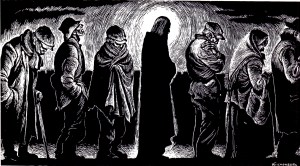
Hagar knows Alice’s tears.  We remember that Hagar is the handmaid for Sarah, Abraham’s wife, whom Sarah had given to Abraham to take as a wife because Sarah was infertile.  Hagar resented this action, and has already suffered a great deal, grappling with her powerlessness and lack over control over her most private, personal space.  Today the text brings us forward a few years in Hagar’s family.  Hagar’s son Ishmael is growing into a young boy, and Sarah has finally conceived her own son.  The birth of Isaac is a joyous occasion that all of the family celebrates.  But just as Hagar has begun to reclaim her personhood, Hagar suffers again.  Sarah sees Ishmael – the son that reminds her of her infertility, who will not represent the blessed line of Abraham – playing with Isaac – her own son, whom she proudly bore and who will mark the blessedness of Abraham’s line.  Sarah turns to Abraham and tells him to send Hagar and Ishmael away.  Although Abraham is crushed by the idea, God supports Sarah’s decision.  For Hagar, the world is against her.  We hear no words from Hagar as Abraham loads water and bread on her shoulders, gives her Ishmael, and sends her out into the wilderness.

Hagar wanders in the desolate wilderness until she runs out of water.  Looking at her son, whose death she imagines is immanent, Hagar puts him under the shade of a bush and walks away.  She walks away and cries out to God.  She cannot watch the death of her son.  Not after all she has been through.  She cries out to God as her last resort.

The tough part of this story is figuring out why this is happening.  Why would Sarah condemn Hagar and Ishmael to death by having them driven out into the wilderness?  Why would God agree with Sarah, especially when Ishmael’s birth was Abraham and Sarah’s choice in the first place?  Why does Abraham give up his first son so easily, without a word to Hagar?  The grief in this passage feels overwhelming, and we are left pointing angry fingers in multiple directions.

Hagar’s wilderness moment is familiar to us today.  We have those times when we feel like everyone is against us, including God.  The wildernesses of our lives are those desolate, lonely, dark places of wandering.  The wilderness is a scary, stark place of solitude that takes us to the depths of our finitude and forces us into encounters with God.  In the wilderness, we experience God in a way that we cannot not experience God elsewhere.  In the dry desert of suffering, which is scorching by day and frigid by night, with little water, we experience a sense of nakedness and vulnerability that we try to mask in our everyday lives.

Despite the darkness in the Genesis text today, there is also incredible hope for the suffering.  The last third of the text we hear today is filled with God’s action for the afflicted.  First, God hears Ishmael.  The text says “And God heard the voice of the boy.”  This word “to hear” is important on many levels.  In the original Hebrew, Ishmael’s name means “God will hear.”[i]  Already, Ishmael’s name – God will hear – comes to fruition.  God hears Ishmael.  Further, the word “to hear” in Hebrew, shamah, connotes more than physical hearing.  As we have talked about before, “to hear” in Hebrew also means “to understand.”  God understands how Ishmael and Hagar cry out.  God hears and understands their pain.

The second action we encounter at the end of this passage is God making a promise.  The angel of God speaks to Hagar about Ishmael saying, “I will make a great nation of him.”  We know from scripture that God does not make promises lightly with God’s people.  God fulfills God’s promises.  If God says that God will make a great nation of Ishmael, Hagar knows to believe God.  No matter how dire things seem, God makes a promise, and God does not disappoint.

The third action we encounter is that God opens Hagar’s eyes.  The text says that “God opened her eyes and she saw a well of water.”  In the opening of Hagar’s eyes, God allows Hagar to perceive God’s presence and action in her suffering.  God lifts the blindness that suffering and desperation create.  God shows Hagar the gift of life that God provides in the well of water.  God’s gift is abundant, and God reveals the gift when Hagar cannot see.

The fourth and final action is that God is with Ishmael.  The text says, “God was with the boy.”  The verb “to be” is one of the most simple and basic of words.  When applied to God, “to be with” has great meaning.  The text says that in all Ishmael does, in all the experiences Ishmael has, in all that Ishmael’s journey entails, God is with him.  God does not abandon Ishmael.  God does not forget.  God is with him.

I am reminded of one of my favorite Gospel hymns.  The hymn is called “He’s an On Time God.”  The song talks about the ways that God always comes to our need just when we need God.  The refrain goes, “He may not come when you want Him, but He’ll be there right on time.  He’s an on-time God, oh yes He is.”  The song describes the Israelites who crossed the Red Sea just before the Sea collapsed on the Egyptians, the relief of Job’s suffering, and the feeding of the 5,000 by Jesus.  What I love about the song is the booming chorus of singers and the repeated affirmation that God is on time.  Of course, the theology of the song is a little trickier.  I think the song misses something by suggesting that God is not always with us.  But the song is on to something.  I might rephrase the refrain to be something like – suffering may not end when you want it, but you will realize God is with you in the suffering right on time.  In this way, God is an on-time God.

We may not understand God’s actions, or why we suffer, but God is with us.  Hagar is a great gift this week for reminding us about what our relationship with God is like.  Hagar reminds us that we have an active relationship with God.  Hagar shows us that we can cry out to God in our suffering.  Hagar demonstrates to us that God is not a far away god who is removed from our daily lives.  By crying out to God, we reveal our earthy, dynamic relationship with God.

Meanwhile, God’s actions toward Hagar show us that God has a reciprocal relationship with us.  God is active in our lives.  God hears us, understands us, and will act in our lives.  God is with us, all of the time, especially in our suffering.  When we enter into that relationship with God, crying out to God, we let go of notions of distance from God or personal control of our lives.  We allow God to open our eyes so that we can see God’s action in our lives.  By opening our eyes, God shows us the blessings God has for us.  God did not tell Hagar and does not tell us what our blessings will look like.  But there will be blessings.  God will open our eyes to reveal the bounty of blessing for us.  As we enter into that holy, vulnerable relationship with God, allowing our eyes to be opened, we see God’s blessings – right on time.  Amen.

[i] Gordon J. Wenham, Word Biblical Commentary, vol. 2 (Dallas: Word Books, 1994), 88.

Homily – Luke 6.17-23, John Johnson Enmegahbowh, June 12, 2014

24 Tuesday Jun 2014

Posted by jandrewsweckerly in Uncategorized

≈ Leave a comment

Tags

blessed, homily, Jesus, John Johnson Enmegahbowh, suffering

Today we honor the life and ministry of John Johnson Enmegahbowh.  John is recognized as the first Native American priest in the Episcopal Church, serving until his death in 1902.  John was an Odawa Indian from Canada who was raised in the traditional healing way of his grandfather and the Christian religion of his mother.  He came to the U.S. as a Methodist missionary in 1832.  At one point, he tried to flee his missionary work and return to Canada, but was turned back by storms on Lake Superior.  He had a Jonah-like vision with God and got back to work among the indigenous in Minnesota.  He was a man known to consistently support peace, even when it made him enemies.  He helped train deacons for the Episcopal Church and was able to use his understanding of Native traditions to spread Christianity and enrich the mission work of the Episcopal Church.

When I think about John Enmegahbowh’s ministry, I imagine a scene much like the scene from our gospel lesson today.  Jesus comes down to the plain, gathering disciples and a great multitude, and teaches the Good News.  “Blessed are you who are poor…Blessed are you who are hungry now…Blessed are you who weep now…Blessed are you who when people hate you, …exclude you, revile you, and defame you…”  Jesus encouraged those gathered with the good news that life in Christ is different – that there is hope and promise. I imagine John Enmegahblowh thought much like Jesus, gathering downtrodden Native Americans, sharing the Good News with them in a similar fashion.

So what about us, who are not from an indigenous group, and who rarely find ourselves surrounded by a multitude of people?  Jesus’ message to us today is two-fold.  First, Jesus’ message is for us.  Though we may not suffer poverty or hunger, we have all known suffering.  Jesus Christ promises that laughter and joy are ours in the Kingdom of God.  Second, Jesus’ message is for others, to be shared by us.  Jesus and John invite us to be teachers in the ways only we can – through our unique stories, our unique gifts, and in our unique lives.  When we live into that call we will know the experience of being blessed.  Amen.

On the in-between…

14 Friday Mar 2014

Posted by jandrewsweckerly in Uncategorized

≈ Leave a comment

Tags

God, holy, pregnancy, ready, suffering, transform, waiting

As I approach my delivery date, many people have asked me whether I am ready.  I think they usually are asking one of two things (or both):  1) Have I accomplished everything I need to do to welcome the baby?, and/or 2) Am I ready to no longer be bearing the physical burden of pregnancy?  It is the second question that has me in a quandary lately.  In many ways, I am so ready to be done with the physical discomfort of these last weeks.  My body is constantly hurting, I cannot seem to get a good night’s sleep, I cannot find a good balance between not enough exercise and too much exercise, and the kicking in the womb lately takes my breath away.  So in that way, I feel so ready to be done with this part of the pregnancy.

But there is another part of me that is quite sad at the prospect of this pregnancy being over.  This is the last time my husband and I expect to be pregnant, and so this is the last time I will ever experience the miracle of having a baby kick me from the inside.  This is the last time I will see my body expand in ways I never imagined possible.  This is the last time that I will be able to enjoy the sacred moment of rubbing my belly and knowing the two of us are sharing in life.  So in that way, I am not at all ready for this to all be over.

Where I struggle is in finding the balance between the two.  More often I find myself wishing days away and complaining than I do soaking in every last moment of pregnancy.  Once I realized the pattern, I began to wonder how often I do that with God.  I pray for some trial to end, I pray to just get through something, or I pray for more knowledge and experience so that I can do better the next time.  The truth is, perhaps I could consider being more grateful for the trying, challenging, painful times, knowing they will transform me into something different and better.  Perhaps I could consider looking for those beacons of hope in the midst of darkness in life – the way suffering can bring me closer to others who suffer; the people God puts in my path who offer comfort – even if I am not good at receiving that comfort; the intimacy I experience with God in the tortured prayers of the experience.

Perhaps what I am talking about sounds trite – consider the silver lining, or when life gives you lemons, make lemonade.  But what I am slowly realizing is that God can sanctify those difficult times, transforming them and us into something entirely different.  But God requires of us many things – to be vulnerable, to be more critically observant, to expect God to be pointing to something small, but something really great.  I do not know if I will ever master this way of being, particularly in difficult times, but I appreciate the reminder this week.  And now, I’m off to go rub my belly and smile some more.

Homily – Hebrews 2.10–18, Frederick Douglass, February 20, 2014

06 Thursday Mar 2014

Posted by jandrewsweckerly in Uncategorized

≈ Leave a comment

Tags

faith, Frederick Douglass, God, help, homily, Jesus, slavery, suffering

Today we honor Frederick Douglass.  Douglass was born as a slave in 1818 and separated from his mother at age eight.  His new owner’s wife tried to teach Douglass to read, but the owner put a stop to the practice.  Douglass learned to read in secret, earning small amounts of money when he could to pay people to teach him.  At the age of fourteen, he experienced a conversion to Christ in the AME Church and the spiritual music sustained him in his struggle for freedom.  In 1838, at age twenty, he escaped slavery.  An outstanding orator, Douglass was sent on speaking tours of the Northern States by the American Anti-Slavery Society.  His renown made him a target for recapture, so in 1845, his friends raised enough money to buy out his master’s legal claim to him.  Douglass was highly critical of churches that did not disassociate themselves from slavery.  He was an advocate of racial integration, and edited a pro-abolition journal.  Douglass died in 1895.

In thinking about Douglass and our country’s relationship with slavery, I have often wondered about the presence of Christianity in the mix with slavery.  Christianity was at times seen as a way to subdue slaves; at other times, Christianity was seen as a threat that could stir rebellion.  Of course, I imagine many slaves were attracted to Jesus and the story of God’s people more deeply than we will ever understand.  The epistle lesson asserts that, “Because Jesus himself was tested by what he suffered, he is able to help those who are being tested.”  Surely that message was both one of comfort and of liberation for slaves in our country.  In fact, Douglass even once said of the old spiritual humans that they followed him, deepened his hatred of slavery, and quickened his sympathies for his fellow slaves in bonds.  For Douglass, his faith strengthened him, emboldened him, and gave him a passion for helping others.

This is the invitation for us as well.  Though we will never fully know the pain of slavery, we do know the power of suffering.  What scripture and Douglass do today is remind us that, first, Jesus Christ suffered as we do to help others, and, second, our faith can strengthen, embolden, and give us a passion for helping others.  We may not affect change on the grand scale of Douglass, but his life reminds us that we still have work to do – that we can be a positive voice for change.  Our suffering will never be as great as Jesus’ or of slaves in this country – but any suffering we encounter can make us agents of change and help us to help others who are suffering.  Amen.

Sermon – Luke 21.5-19, P28, YC, November 17, 2013

27 Wednesday Nov 2013

Posted by jandrewsweckerly in Uncategorized

≈ Leave a comment

Tags

God, Hurricane Sandy, Jesus, Precious Lord, prepare, scripture, Sermon, suffering, testimony, Thomas Dorsey, trust, words

“Blessed Lord, who caused all holy Scriptures to be written for our learning:  Grant us so to hear them, read, mark, learn, and inwardly digest them, that we may embrace and ever hold fast the blessed hope of everlasting life, which you have given us in our Savior Jesus Christ; who lives and reigns with you and the Holy Spirit, one God, for ever and ever.  Amen.”[i]  So on this day, when we celebrate Holy Scripture, praying one of my favorite collects, a day that we hear, read, mark, learn, and inwardly digest, imagine my intense dissatisfaction when I opened up the gospel lesson for this week.  I have been reading, marking, learning, and inwardly digesting all week, and this text still makes me uncomfortable.  On this day of celebrating Scripture, who wants to hear of collapsing houses of worship; false prophets that can lead us astray; wars, natural disasters, famines, and plagues; great persecution, including being betrayed by our very own family members?  And what is our reward for all this suffering?  All of this calamity will give us an opportunity to testify.  I do not know about you, but after having my church destroyed, navigating false prophets, fighting disasters, and dealing with persecution, testifying would be about the last thing on my mind.  In fact, I know a few Episcopalians who might even add testifying as one of the major types of tortuous, painful experiences. 

At Diocesan Convention this weekend, we watched a video about the Diocese of Long Island’s response to Hurricane Sandy one year ago.  The video began with news coverage leading up to the storm, during the storm, and immediately after the storm.  I have no idea why, but I found myself tearing up during the coverage.  I had forgotten all of the anxiety and stress that came from that storm.  I forgot about the utter despair and the feelings of helplessness – having friends try to contact me about how they could help, and yet, not even having power to be able to watch the news and see what was going on all around us.  I remember wanting to know what had happened to churches in the areas most impacted by the storm, but the Diocesan offices being crippled by their own lack of power and employees’ inability to get to work.  I remember wanting to help, but not being sure how to do that without electricity ourselves.  I remember being so cold at night without heat, and yet knowing that I was lucky to have an undamaged roof over my head.  I remember anxiously watching my car’s gas gauge approach empty – knowing the panic of gas lines, and how quickly stations ran out of gas.  The video brought all of those emotions bubbling up to the surface. 

But the video also offered a testimony.  After the storm, churches began opening doors for collections, housing, and powering stations.  Teams from churches headed to devastated areas to help demo and begin repairing homes.  Those too far from the action, offered up their space to electrical workers who had volunteered to help, but had been given no place to stay at night.  Our hospital in the Rockaways treated patients for three weeks solely on generator power.  A year later, people are still being helped as they repair homes, find new places to stay, and deal with the emotional ordeal.  In a time of great darkness, the Episcopal Church on Long Island began to find a way out of the darkness and into the light. 

One of the coordinators of the effort from the Diocese said that one of the things the Church had to learn to do was not to go into areas telling them how they were going to help – but instead had to simply show up and ask what people needed.  The representative said that this model made the work and efforts much more chaotic, but in the end, brought about the change that people really needed.  I could hear echoes of today’s gospel lesson in his words.  Jesus says, “Make up your minds not to prepare your defense in advance, for I will give you words and a wisdom that none of your opponents will be able to withstand or contradict.”  This strange gift of being able to testify is made even stranger by Jesus’ words – not only is our gift to testify in the midst of suffering, we are to force ourselves to not even prepare the testimony on the way – no thinking of anecdotes, no making outlines, no trying to even think about what we might say.  We must simply show up and trust that God will give us the words.

One of my favorite hymns is “Precious Lord.”  “Precious Lord,” is one of those songs that I can close my eyes to and just overflow with love and gratitude toward God.  Of course, my favorite version is not the version sung out of the hymnal, but by the great Al Green.  He breathes a life and joy into the song that we can rarely muster in church.  But this week, my appreciation for this favorite song grew infinitely when I heard the story behind the song.  The song was written by Thomas Dorsey.  Born in 1889 in rural Georgia, Dorsey was a prolific songwriter and excellent gospel and blues musician.  As a young man, he moved to Chicago where he worked as a piano player in churches as well as in clubs and theaters.  After some time, Dorsey finally devoted his talent exclusively to the church.  In August of 1932, Dorsey left his pregnant wife in Chicago and traveled to be the featured soloist at a large revival meeting in St. Louis.  After the first night of the revival, Dorsey received a telegram that simply said, “Your wife just died.”  Dorsey raced home and learned that his wife had given birth to a son before dying in childbirth.  The next day his son died as well.  Dorsey buried his wife and son in the same casket and withdrew in sorrow and agony from his family and friends.  He refused to compose or play music for quite some time. 

While still in the midst of despair, Dorsey said that as he sat in front of a piano, a feeling of peace washed through him.  That night, Dorsey recorded this testimony while in the midst of suffering:

Precious Lord, take my hand,

Lead me on, let me stand;

I am tired, I am weak, I am worn;

Through the storm, through the night,

Lead me on to the light;

Take my hand, precious Lord,

Lead me home.[ii]

In the midst of that darkest of times, Dorsey did not sit at that piano with a song all planned out.  In fact, if you had asked him to testify at that moment, he might have railed at the way that God and the world were treating him.  And yet, empty and vulnerable, God filled Dorsey with words that would touch people eighty years later, and would be sung by countless famous people over the years.

In the midst of darkness – of destruction, pain, suffering, persecution, even betrayal by those we love most – God gives us a testimony too.  And even more than a testimony, Jesus promises that we do not even have to prepare this testimony.  God will provide the words and the wisdom when we need them.  Our only mandate today is to hold fast to God in the midst of trials, to remain open to the movement of the Spirit, and to speak those words of truth and wisdom when we feel them spilling out of our mouths.  That time of testimony may not be before some king or governor demanding to hear about our faith.  But our testimony might spill out with a grieving widow or mother, a traumatized victim of natural disaster, or a friend who has felt disenfranchised by the Church.  We cannot prepare the testimony.  We cannot even try to craft a basic testimony story to be ready whenever we need the story.  Jesus tells us to “make up our minds not to prepare.”  This is perhaps one of the hardest challenges Jesus will give us, and yet, as we see in Dorsey’s testimony and the many other testimonies we have heard, when we yield that power to Christ, the real, vulnerable beauty of our story gives life to others and to us.  Amen.


[i] BCP, 236.

[ii] Story of Dorsey take from Nancy Lynne Westfield, “Pastoral Perspective,” Feasting on the Word, Yr. C, vol. 4 (Louisville: Westminster John Knox Press, 2010), 312.

Sermon – John 14.1-6, Cemetery Christmas Memorial Service, December 22, 2012

23 Sunday Dec 2012

Posted by jandrewsweckerly in Uncategorized

≈ Leave a comment

Tags

blue, Christmas, death, grief, Jesus, Newtown, Sermon, St. Thomas, suffering

Less than two weeks ago, I would have told you that St. Margaret’s was progressing nicely toward Christmas, ready to celebrate the birth of the Christ Child.  We have had a blessed Advent, and have been looking forward to some wonderful liturgies, including this service.  But then tragedy struck Newtown, Connecticut, and since that time, many of our parishioners have been struggling not only to find their “Christmas Spirit” again, but have even been struggling with God in all this.  I have heard all sorts of questions from our parishioners.  “What kind of God allows this to happen?”  “Where was God when those poor children were being slaughtered?”  “How are we to trust God now?”

I imagine the emotional state of those who are active here at St. Margaret’s is a bit close to what many of you have already been struggling with for months or even years.  Christmas is one of the hardest holidays in the face of grief.  Parishes around the country celebrate “Blue Christmas” services because despite what all the media hype tells us, Christmas can be very hard for many of us.  All of the forced happiness and gift giving masks the pain, loneliness, and heartache that Christmas can bring.  When we are blessed to have our family around, we are reminded of the deep dysfunction and hurt that families sometimes create.  When we are away from family, we long for some idealized version of Christmas we have imagined in our heads.  And when we have lost someone to life beyond this life, we are reminded of all the Christmases we had with them, wishing we could have just a few more.  When faced with the kind of death we saw in Newtown, Christmas can be a time when we would rather rage at God than meekly sit at the Christ Child’s feet.

And so, today we gather.  We gather to lift up our “blue” feelings, our pain and our suffering, our anger and our sense of loss back to God.  We come today to lift that back to God, because we really do not know what else to do with all of that “stuff” inside of us.  Of course, we all experience death differently.  For some of us, the death of our loved one is recent, and the pain is as fresh as the day we lost them.  For others, our loved one has been gone for a while, but the hurt still lingers and catches us off guard at times.  And for others, our loved one has been gone for a long time, but the hollow in our heart will never fully close.

We come to God with all of our “stuff” because somewhere in the depths of our beings we know that God – and only God – can handle our “stuff.”  God can handle our anger, our pain, and our grief.  God can take our frustration, our fickleness, and our fears.  God can handle our lost hope, our distant hearts, and our distrust.  We know all of this because we see how Jesus treats Thomas in the gospel lesson we hear today.  Thomas is the one among the disciples who is always brutally honest, saying what no one else is willing to say, even if what he has to say does not portray himself in the best light.  This Thomas is the Thomas who refuses to believe in the risen Christ until he touches his wounds.  And today, in our gospel lesson, this Thomas is the panicked disciple who worries about how to find the way to this spacious dwelling place that Jesus has just described.  Jesus does not rebuke Thomas for his questions or even for his implicit doubts.  Instead, Jesus stays in relationship with Thomas, teaching him patiently what he needs to learn.

Jesus is patient with Thomas because the words that Jesus offers that day are critically important for Thomas to understand.  Jesus is explaining to Thomas and the other disciples gathered what they can now expect about the experience of death.  Through Jesus, they are promised resurrection life.  They are promised a dwelling place with abundant rooms – a place where Jesus will take them himself.  “Do not let your hearts be troubled.”  Jesus words are like the words of a soothing mother, teaching the disciples that the experience of death is changed through the life and death of our savior Jesus Christ.

In times of grief, whether grief over violence against children, or the grief over our own loved ones, Jesus words are what we cling to this holiday season.  If we can hear those words, “Do not let your hearts be troubled,” we may use this as our mantra to get us through this challenging time.  Do not let your hearts be troubled.  But if we cannot hear those words today, then remember Jesus’ presence with Thomas, even in the midst of Thomas’ confusion and pain.  Jesus stays with Thomas, helping him through this news.  So even if we need to be angry with God or are not ready to let our hearts stop being troubled, Jesus will stay with us.  Jesus is infinitely patient, preparing the way for us.  May you find some peace this Christmas season from Christ’s presence with you.  Amen.

← Older posts
Newer posts →

Recent Posts

  • On the Myth and Magic of Advent…
  • On Risking Failure and Facing Fear…
  • Sermon – Luke 23.33-43, P29, YC, November 23, 2025
  • On Inhabiting Gratitude…
  • Sermon – Luke 20.27-38, P27, YC, November 9, 2025

Archives

  • December 2025
  • November 2025
  • October 2025
  • September 2025
  • August 2025
  • July 2025
  • June 2025
  • March 2025
  • February 2025
  • December 2024
  • November 2024
  • October 2024
  • September 2024
  • August 2024
  • July 2024
  • June 2024
  • May 2024
  • March 2024
  • February 2024
  • January 2024
  • December 2023
  • November 2023
  • October 2023
  • September 2023
  • August 2023
  • July 2023
  • June 2023
  • May 2023
  • March 2023
  • February 2023
  • January 2023
  • December 2022
  • November 2022
  • October 2022
  • June 2022
  • May 2022
  • January 2022
  • December 2021
  • November 2021
  • October 2021
  • September 2021
  • August 2021
  • June 2021
  • May 2021
  • April 2021
  • March 2021
  • February 2021
  • January 2021
  • December 2020
  • November 2020
  • October 2020
  • September 2020
  • August 2020
  • July 2020
  • June 2020
  • May 2020
  • April 2020
  • March 2020
  • February 2020
  • January 2020
  • December 2019
  • November 2019
  • October 2019
  • September 2019
  • August 2019
  • July 2019
  • June 2019
  • May 2019
  • April 2019
  • March 2019
  • February 2019
  • January 2019
  • December 2018
  • November 2018
  • October 2018
  • September 2018
  • August 2018
  • July 2018
  • June 2018
  • May 2018
  • April 2018
  • March 2018
  • February 2018
  • January 2018
  • December 2017
  • November 2017
  • October 2017
  • September 2017
  • August 2017
  • July 2017
  • June 2017
  • May 2017
  • April 2017
  • March 2017
  • February 2017
  • January 2017
  • December 2016
  • November 2016
  • October 2016
  • September 2016
  • August 2016
  • July 2016
  • June 2016
  • May 2016
  • April 2016
  • March 2016
  • February 2016
  • January 2016
  • December 2015
  • November 2015
  • October 2015
  • September 2015
  • August 2015
  • July 2015
  • June 2015
  • May 2015
  • April 2015
  • March 2015
  • February 2015
  • January 2015
  • December 2014
  • November 2014
  • October 2014
  • September 2014
  • August 2014
  • July 2014
  • June 2014
  • April 2014
  • March 2014
  • February 2014
  • January 2014
  • December 2013
  • November 2013
  • October 2013
  • September 2013
  • August 2013
  • July 2013
  • June 2013
  • May 2013
  • April 2013
  • March 2013
  • February 2013
  • January 2013
  • December 2012
  • November 2012
  • October 2012
  • September 2012

Categories

  • reflection
  • Sermons
  • Uncategorized

Meta

  • Create account
  • Log in
  • Entries feed
  • Comments feed
  • WordPress.com

Blog at WordPress.com.

  • Subscribe Subscribed
    • Seeking and Serving
    • Join 394 other subscribers
    • Already have a WordPress.com account? Log in now.
    • Seeking and Serving
    • Subscribe Subscribed
    • Sign up
    • Log in
    • Report this content
    • View site in Reader
    • Manage subscriptions
    • Collapse this bar