• About

Seeking and Serving

~ seek and serve Christ in all persons

Seeking and Serving

Tag Archives: Thanksgiving

On Inhabiting Gratitude…

12 Wednesday Nov 2025

Posted by jandrewsweckerly in reflection

≈ Leave a comment

Tags

act, barriers, God, gratitude, incarnate, practice, stewardship, tangible, Thanksgiving

Photo credit: https://www.southernliving.com/culture/what-to-write-in-thank-you-card

November is regularly a month when I talk about gratitude with my parish.  Most of that push comes from the confluence of things that happen in November.  We are almost always closing up our stewardship season in November – a season when we encourage parishioners to let their giving reflect their gratitude toward God.  We are also preparing for the Thanksgiving holiday – which although a secular holiday comes pretty close to being a sacred time of thanksgiving and praise.  And just yesterday we took the day to thank Veterans, honoring the sacrifices their vocations require and the blessings we enjoy because of their work.

This year, to help cultivate my own sense of gratitude, I picked up a calendar one of my favorite non-profits produced call “30 Days of Gratitude.”  Though some of the “activities” are to think about something I am grateful for, like a good memory in my home, most of the “activities” are more hands-on – like expressing gratitude to every member of the household or greeting a neighbor.  What I have loved about the calendar is the shift the calendar has created. 

Often when we talk about gratitude, we feel burdened – like we’re supposed to force ourselves into an emotion.  But what the calendar has done is make gratitude tangible – to act on my gratitude.  What’s beautiful about that shift is that the action is something I can do that has the unintended consequence of feeling gratitude instead of trying to manufacture gratitude out of thin air.  The calendar has made gratitude incarnate – allowed me to inhabit gratitude instead of simply emoting gratitude.  It’s a subtle change, but one that feels much more freeing.

I wonder how you are navigating gratitude during this season.  What are the barriers to you inhabiting gratitude?  What burdens are clouding your gratitude practices, making you more cranky than grateful?  Gratitude is not easy.  If it were, folks wouldn’t be producing gratitude calendars and journals.  I invite you to find the tool, the person, or the community who can help make your gratitude incarnate.

Sermon – Luke 17.11-19, P23, YC, October 12, 2025

15 Wednesday Oct 2025

Posted by jandrewsweckerly in Sermons

≈ Leave a comment

Tags

blessing, duty, God, gratitude, Jesus, lenses, lepers, see, Sermon, sight, stewardship, Thanksgiving

Several years ago, A.J. Jacobs wrote a book called Thanks a Thousand.  Jacobs had decided that he loved his daily cup of coffee from his local coffee shop so much that he wanted to thank every person who made the cup of coffee possible.  His book journals what started out as that simple premise that became a journey around the world.  You see, he could easily thank the barista he saw every morning.  But then he realized he should thank the owner of the shop for the shop existing in the first place.  From there, he realized the owner had a graphics designer who designed the logo, and there was company that made his coffee cup that carried that logo.  He eventually recalled the beans for the coffee came from somewhere – and there were hundreds of people who moved the beans from tree to harvest to packaging to shipping to storage and to distribution.  And that didn’t include those who made sure the city had clean water that was used to combine beautifully with beans to make his daily beloved cup of coffee.  Each thank you – often received with confusion, surprise, mystification, and occasional delight – led to another individual for Jacobs to thank.  Jacobs had read that the practice of gratitude could change your life, and slowly, he began to find that genuine gratitude made him kinder, happier, and gave him the opportunity to make an impact in the world.  Gratitude helped him to see the world differently.

In our gospel lesson today, ten lepers experience a miraculous healing through Jesus.  Jesus sends the lepers to the priests and they become clean along the way.  But only one of the lepers actually sees that he is healed.  We are told that because he sees, he turns back, praises God, and prostrates himself at Jesus’ feet, thanking him.  Now, to be clear, the other nine lepers do nothing wrong.  In fact, they follow Jesus’ instruction explicitly and enjoy being healed.  The promise made to them is fulfilled.  The tenth leper – a Samaritan of all people – though sees.  And when he returns to give thanks, he is blessed a second time.  David Lose explains, “Jesus concludes his exchange by inviting the man to rise and go on his way and saying that his faith has made him not only physically well, but also whole and, indeed, saved.  That’s part of the complex and multivalent meaning of the Greek root word σoζω (transliterated as “sozo” and pronounced “sod-zo”) Jesus uses.”[i]  That second blessing does not happen though without the act of seeing.

The Samaritan leper experienced a second blessing much like A.J. Jacobs experienced a second blessing.  Once Jacobs began his coffee gratitude journey – thanking all those folks who made that perfect cup of daily coffee – he began to see just like the leper.  His eyes were opened to the powerful work of God by the simple act of gratitude.  Scholars across the centuries have noted how deeply faith and gratitude are linked.  “Karl Barth was fond of saying that the basic human response to God is gratitude – not fear and trembling, not guilt and dread, but thanksgiving.  ‘What else can we say to what God gives us but stammer praise?’ [Barth says.]”  C.S. Lewis “also observed the connection between gratitude and personal well-being.  [He said,] ‘I noticed how the humblest and at the same time most balanced minds praised most:  while the cranks, misfits, and malcontents praised least.  Praise almost seems to be inner health made audible.’”[ii]  The entire enterprise of thanking thousands of people for his cup of coffee was A.J. Jacobs’ attempt to correct his vision so that he might cultivate a healthy practice of faith.

The Stewardship team at Hickory Neck this year has been doing the same thing.  They have been working to help us better see God in this place we keep returning to.  Today you will receive a packet of information meant to engage your vision.  In the packet will be testimonies of how much this community has impacted the lives of your fellow parishioners.  You will find a visual representation of how every dollar is stretched to make possible the goodness we experience here.  You will find an invitation to respond to your own gratitude to Jesus for the many blessings in your faith journey by committing your time, your talent, and your treasure –not out of a sense of duty, but because you have seen goodness here, and gratitude is bubbling out of you.  And in case all those invitations into seeing differently are not enough, our Stewardship team will be bringing back to you the stories of your fellow parishioners in their own words.  Each week, you will be sent videos on what they are calling Motivational Mondays and Faithful Fridays – videos of your fellow parishioners describing how their devotion to generosity has richly blessed their faith journey.

In the coming weeks, you may be tempted to do what the nine lepers do – to dutifully follow Jesus’ invitation to go and be healed – and simply open your stewardship packet and return the commitment card and time and talent form.  And doing so would not be wrong at all – in fact, the Stewardship Team and Vestry would be deeply grateful.  But our invitation from today’s gospel lesson goes a little further than duty.  Our invitation is to put on new lenses – to use the tools Hickory Neck is gifting you to better see the overwhelming blessings from the Spirit and to make tangible our gratitude – “gratitude for the gift of life, gratitude for the world, gratitude for the dear people God has given us to enrich and grace our lives.”[iii]  I cannot wait to hear what you see.  Amen.


[i] David Lose, “Second Blessing,” October 7, 2013, as found at https://www.workingpreacher.org/dear-working-preacher/second-blessing on October 10, 2025. 

[ii] John M. Buchanan, “Homiletical Perspective,” Feasting on the Word, Yr. C, Vol. 4 (Louisville:  Westminster John Knox Press, 2010), 165.

[iii] Buchanan, 169.

On Measuring What Matters…

09 Wednesday Oct 2024

Posted by jandrewsweckerly in reflection

≈ Leave a comment

Tags

blessing, celebration, complain, discipline, God, gratitude, Jesus, measuring, negative, positive, practice, Thanksgiving

Photo credit: https://texasleansixsigma.com/measure-what-matters/

This week we’ve been working intentionally on shifting my daughter’s propensity to complain.  She can have the best of days or afternoons, but at some point in the retelling of what happened, she’ll inevitably find something to complain about – what someone said, what someone did, or how she perceived something.  This week I threatened to start a daily tally of everything that came out of her mouth, putting her words in two columns:  positive things and negative things.  I told her we would see which column won at the end of the day.  I was honestly making an empty threat (who has time to monitor every word that comes out of a kid’s mouth?!?), but something about my threat registered with her.  The next morning, she was all positives – thanking me for mundane things, celebrating small victories, noticing the good.  When I picked her up from school that day, she proclaimed, “Actually, today’s been a really good day!”  We celebrated what a wonderful experience both she and I had had that day, noticing what her intentionality had done.

I’ve been thinking about our experiment and have been recalling all the times I have taken on a discipline of gratitude – all the times I have fallen into the very same patterns as my child.  There have been times when I have used my prayer beads, only praying prayers of thanksgiving instead of petition.  There have been times when I have used my journal to find at least three things at the end of the day for which I can give thanks (some days that was harder than others!).  And there have been times when I have read books or heard testimonies about the powerful transformative practice of gratitude.

These last weeks, gratitude has been challenging to come by.  I have been watching helplessly as countless homes, businesses, churches, roads, and whole towns have been washed away by hurricanes – only to be bracing for the impact of another one today.  I have been praying with friends and community members recovering from freakish events:  being hit by car, road rage gun violence, and random violent targeting.  I have listened to the anxieties of parishioners, completely consumed by worry about the presidential election less than a month away. 

This Sunday, our church will kick of stewardship season, as we ponder what really matters in our lives.  As we have already been reflecting this year, we are a community blessed with abundance.  We could certainly go down the road of scarcity, detailing all the things we are longing for or missing.  But instead, we are entering an intentional time of noticing:  noticing the abundance around us, noticing the blessings that embrace us, noticing the goodness and love of God in our lives.  I am looking forward to the gift of a season of gratitude – of celebrating the good and honoring the abundance of our Lord and Savior, Jesus Christ.  I am hopeful that each day in this stewardship season, we can begin to turn our hearts from pain, and find the way, even if in something miniscule, to be able to say, “Actually, today’s been a really good day!”  I invite you to join us in the celebration of what matters!

On Solitude, Gratitude, and Advent…

01 Wednesday Dec 2021

Posted by jandrewsweckerly in reflection

≈ Leave a comment

Tags

Advent, alone, gratitude, hope, hushed, love, meditate, quiet, scarcity, solitude, Thanksgiving, tradition, uncertainty

Photo credit: https://www.horizonviewhealth.com/favorite-autumn-walks/

This Thanksgiving was a bit different for us.  Instead of making a drive, or having family come to us, the four of us had a quiet day punctuated by a traditional meal on the family China.  When I kept referring to Thanksgiving Dinner, even my children protested, “What’s the big deal – it’s just lunch!”  As an extrovert who has spent a lot of the last almost two years with these three other people, I felt a sense of absence for all the people with whom I have enjoyed this traditional day.  But as I watched my beloved introvert revel in the quiet, I began to see a peace among these four people who have come to deepen our trust and love for one another during this pandemic (even if that love is sometimes expressed in short tempers and bickering). 

I suspect we were not alone in our “new normal” Thanksgiving.  Many people from our church community had similar arrangements – couples who stayed home, four neighbors who came together in their “aloneness,” singletons who found joy over Zoom calls.  Even those who gathered in smaller groups commented on the quietness of the day – and a kind of gratitude that can only come from scarcity – scarcity of community, of gathering, of all things normal. 

For me, it was the perfect way to segue into Advent, a similar season of hushed quietness.  As the world whirls around us, we pull back, quietly preparing our homes, knowing the uncertainty of these times, and being grateful for every moment of comfort in this season of waiting.  That’s why I enjoy the Advent practice called “AdventWord.” – a visual way to meditate on a daily word throughout Advent.  It gives me a chance to scroll back through old pictures or turn my gaze to the world around me and snap something anew.  It is a solo, quiet practice that stirs creativity, gratitude, and hope.

What are you doing this Advent to set time apart?  How are you struggling to set time apart?  Maybe you can only find literal moments of peace.  Maybe you can squeeze out a half hour a day.  Maybe you can daily confess your desire for such a practice to the God who sees you in all your commitments.  Whatever you do this Advent, know that you have the support and love of a community who sees you too, and holds on to a desire for peace and comfort for you in this season.

On Shielding and Sharing Joy…

17 Wednesday Nov 2021

Posted by jandrewsweckerly in reflection

≈ Leave a comment

Tags

complain, compline, God, goodness, grateful, gratitude, imperfection, joy, joyous, perfection, prayer, shield, Thanksgiving

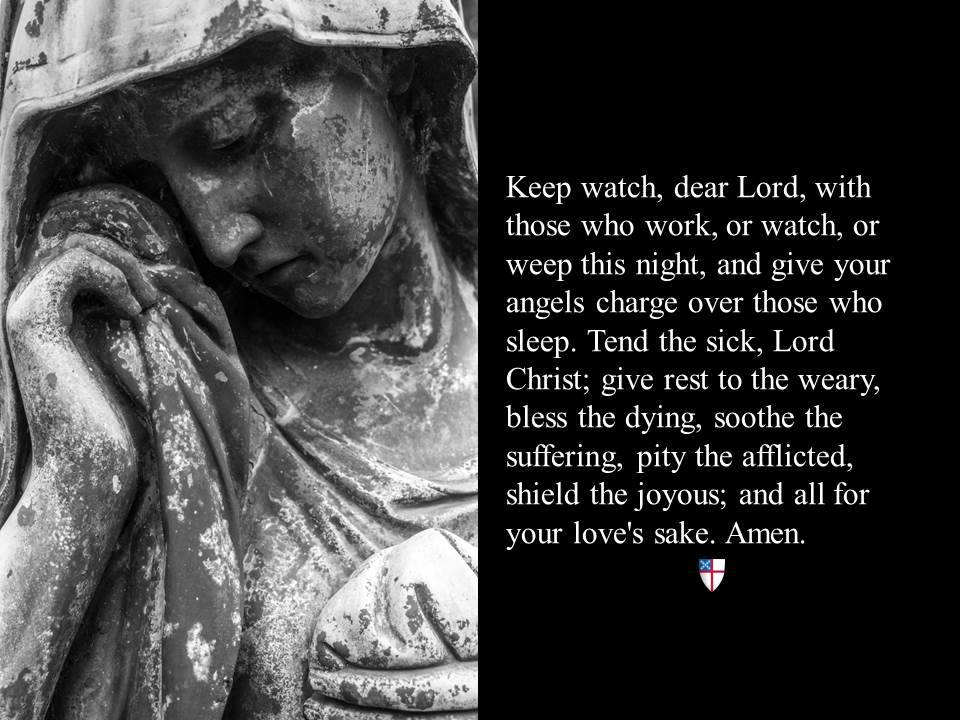
Photo credit: https://www.facebook.com/episcopalian/photos/keep-watch-dear-lord-with-those-who-work-or-watch-or-weep-this-night-and-give-yo/10155444636122925/

This month at Youth Group, before we began our closing prayer, the leader asked us each to name one good thing that had happened in the last week.  Immediately, the brows of each person in the room (adults included) furrowed as we tried to think back about something good in a sea of busyness.  Some of us struggled to remember anything good.  Others immediately burst forth with a fun thing they had gotten to do.  Some shyly shared an accomplishment for which they were proud.  And some were more abstract, like the beauty of the fall foliage.

I was struck by how each one of us in the room had to think quite hard about something good happening in our lives. I do not think we struggled because there is nothing good.  I think we struggled because our brains, or maybe our culture, has wired us to do the opposite – to complain about all the things going wrong, to see only the imperfections in life or in ourselves, to be discouraged by all that could be better in our circles.  A heart of gratitude or joy takes work.  Some of us come by gratitude and joy naturally, but most of us have been enculturated to see where there is want.  That’s why one of our favorite prayers from Compline has a line in its petitions to God for God to “shield the joyous.”[i] 

As we approach Thanksgiving Day next week, I wonder if this year you are still struggling to find the joy.  Maybe you still cannot gather safely with family, maybe you are worried about the safety of the children or the vulnerable in your family, or maybe you are just weary from this time of pandemic.  I suspect many of us are feeling critical of the imperfect and are having a hard time holding on to the perfect(ly good enough). 

My prayer for you this week is that God shields your joy.  But I invite you to consider partnering with God in this endeavor.  Each day until Thanksgiving Day, before you drift off to sleep, think back to one thing for which you grateful, that gave you joy, or was just a good moment.  The goodness does not have to be big or creative.  Start with something basic.  While you engage in this prayerful practice, I will be praying that God shields your joy, and I hope you will share your joy with someone else – so they can be shielded by God too. 


[i] Book of Common Prayer, 134.

Sermon – Matthew 25.31-46, P29, YA, November 22, 2020

17 Thursday Dec 2020

Posted by jandrewsweckerly in Sermons

≈ Leave a comment

Tags

Christ the King, crisis, election, God, Good News, Jesus, mend, pain, pandemic, peace, Sermon, Thanksgiving, weary

Once upon a time, “there was a cobbler who lived alone in his shop with one window that looked out on the street.  His wife and children had all died and he asked God, “Holy One why have you so long delayed your coming?  I have almost given up hope in seeing you.  Please come to my humble shop this day and show me your face.”

Outside on the street the cold winter brought snow.  Through his window he saw a beggar who shivered in the cold.  The cobbler invited the beggar into the shop to warm him and offer a meager meal from his shrinking larder.  The beggar thanked him and left.

As the day passed, a few customers came with repairs they needed for their shoes and harnesses.  A young boy sought shelter from the cold and snow.  The child’s feet were wrapped in old dirty rags and stuffed with paper.  Into the shop he invited the boy.  After making him some warm milk and a sandwich from the little food he had he went to his closet and found a pair of shoes that [had] belonged to his son.  He fit the shoes to the boy.  Grateful, the boy left with a promise to return to visit him.

It was approaching dusk and the cobbler despaired of a visit from the Lord.  A woman with her young babe appeared in front of the window.  She was dressed in a thin piece of cloth and she looked as if she might freeze to death.  The cobbler invited her into his shop.  Wary of the old man, she hesitated at the door, but feeling the warmth within she stepped across the threshold.  The cobbler made her some tea and went to his closet to find a heavy woolen cloak that [had] belonged to his wife.  Giving her the cloak the woman thanked him and after he shared the rest of his larder with her, she left with the child.

The sun descended and left the cobbler bereft.  “Why didn’t you come and visit me today,” the cobbler asked?  There was a voice that spoke to him in his humble shop:  “But I did come to you.  When you invited in the beggar, the boy, and the mother and her child, I was there with you.  In each of their faces you looked into my eyes.”[i]

I don’t know about you, but the last eight months have been exhausting.  Every week I look at the lessons and newspaper and hope for some good news – some glimpse of the face of Jesus.  But every week, the news somehow seems worse.  This week has been no different, with suffering hitting us at both the macro and micro levels.  Our country is in an existential crisis about the Presidential election.  Although many commentators seem to think things will work out, at question is the very foundation of democracy – elections where the votes of the people matter and where the peaceful, respectful exchange of power can happen.  We have managed to successfully do this for over two hundred years, and somehow, this year we cannot seem to hold to our founding principles.  Meanwhile, on the micro level, we are approaching a national holiday of Thanksgiving – a holiday characterized by the gathering of peoples around a table, not unlike our own Eucharistic feast.  And yet, flights are being cancelled, car keys are being put down, and painful calls of cancellation are being made.  Once again, this pandemic is crushing our rituals, forcing us to stay apart from one another.

So, when I picked up the Biblical texts for today, remembering this is Christ the King Sunday, I could not have been more relieved.  I am ready for the shepherd of Ezekiel who seeks out the lost, binds up the wounded, and feeds us on the good pasture – all while destroying the fat sheep and feeding them justice!  I am ready for the Psalmist’s invitation to bow down before the Lord our Maker – the king above all gods, the one in whose hands are the caverns of the earth, the heights of the hills, the sea, and the dry lands!  I want to hear the beauty of the song, King of Glory, King of Peace.  I want a god who will take all of this away – the strife, fighting, suffering, weariness, and make everything better.  I want to see Christ the King!

But nothing is ever easy with Jesus.  When we call out for Jesus, Jesus tells us in the gospel today that he is already here – here with us when we feed the hungry, sate the thirsty, welcome the stranger, clothe the naked, and visit the sick and imprisoned.  To our wearied selves, who just want a victorious king to fix things, our king reminds us today that relief is not found in power grabs and punishments.  As the founder of The Catholic Worker, Peter Maurin, once explained, the social policy Jesus gives us for the renewal of the world is works of mercy.[ii] 

Our lives right now are upended.  Even doing the literal work of the cobbler from that story may not seem possible in these times of social distancing.  But the good news we hear today is peace will not come from powerful, political overpowering.  Peace and relief in these times will come from loving the vulnerable, tending the weak, serving those suffering more deeply than we can imagine.  Like the cobbler in his grief, we may not be able to see those in need in this pandemic.  But they are there, with us, every day.  And it is there, we will see the face of Jesus.  There, God will soothe our pain.  There, the Holy Spirit will mend our weariness.  There is our peace.  Thanks be to God. 


[i] Leo Tolstoy, “Martin the Cobbler,” as retold by Bob Stuhlmann in “Goat Cheese And Starfish: For November 23, 2014,” posted on November 18, 2014, as found at http://storiesfromapriestlylife.wordpress.com/2014/11/18/goat-cheese-and-starfish-for-november-232014/ on November 20, 2020.

[ii] Stanley Hauerwas, Matthew:  Brazos Theological Commentary on the Bible (Grand Rapids:  Brazos Press, 2006), 212.

On Thanksgiving and Imperfection…

04 Wednesday Dec 2019

Posted by jandrewsweckerly in Uncategorized

≈ Leave a comment

Tags

God, gratitude, imperfect, love, messy, perfect, ritual, shadow, sinner, Thanksgiving, Thanksgiving Day

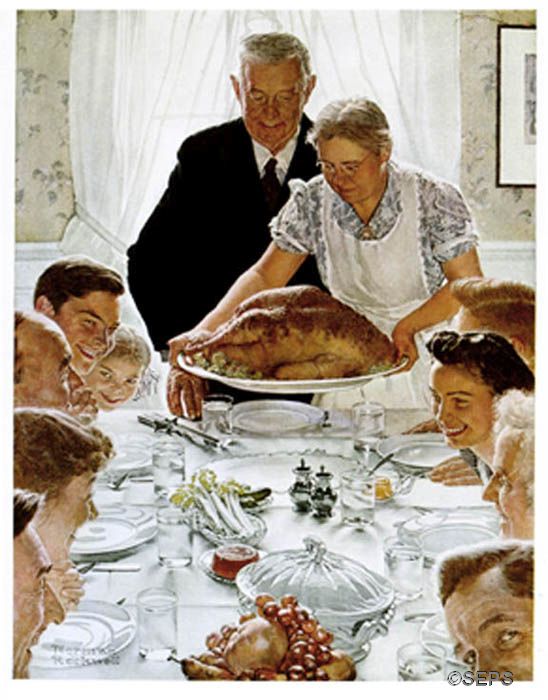
Norman Rockwell Thanksgiving

Photo credit:  https://www.saturdayeveningpost.com/collections/thanksgiving/

The last two weeks have been marked with rituals of thanksgiving:  a community ecumenical Thanksgiving service at the local Roman Catholic Church, Holy Eucharist on Thanksgiving Day at Hickory Neck, dinner and visiting with my dad, and, today, offering the benediction at the 400th anniversary of the first official English Thanksgiving in North America.  The rituals have all been tremendous blessings and ways to center and ground life in gratitude, a practice that can sometimes fall to the wayside in the busyness of life.

However, what has struck me about this season of gratitude is how imperfect it has been.  Often when we think of Thanksgiving Day, we immediately picture Norman Rockwell’s famous painting of the perfect meal.  But as I checked in with people and as I watched those around me, I realized nothing about this season of thanksgiving has been perfect.  I had parishioners who just welcomed a baby a few days before Thanksgiving Day and had resigned themselves to having Chinese so that no one would have to cook or stress about taking the newborn out.  I heard stories of family drama over the menu for the day.  My own family was coming off a few hospitalizations so resigned ourselves to dinner out – which then got foiled by a two-hour wait, with a wait staff that looked like they wanted to be home with their own families.  The music and collaboration of clergy was beautiful last week, but we hold in tension our denominational differences.  Even the anniversary celebration today is consciously honoring the ways in which the histories of American Indians, African-Americans, and English-Americans bring a shadow over our celebration.

As I have been pondering this imperfection, this disconnect between our ideal of perfected thanksgiving rituals and the reality of the messiness of life, I have actually found deep spiritual comfort.  Nothing about our lives is perfect.  We are all sinners, trying to be better versions of ourselves.  Even our offering of thanksgiving is imperfect.  But the love of God is perfect.  God sees our messiness and loves us anyway.  God sees the ways we hurt each other, the ways we argue, the ways we are rude or unkind, the ways that we cannot always honor our rituals, and God loves us anyway.  In fact, I sometimes wonder if God doesn’t prefer our imperfection, for in confessing our imperfection, we are fully honest, fully vulnerable, and fully trusting of God.  We bring our real selves to God, and it is there that we give the most heartfelt thanksgiving.  We feel, know, and experience God most powerfully in those moments of imperfection.

This week, I invite you to continue your practice of gratitude with God and one another.  In our thanksgiving, we are not just thanking one another for appearance’s sake, but we are thanking one another in fullness, in love, and in generosity.  Use this week to find people to thank – for the big things and the very tiny things.  My guess is we may all start working toward the perfection of God’s love with each act of thanksgiving.

On Dreams, Change, and Gratitude…

05 Wednesday Sep 2018

Posted by jandrewsweckerly in Uncategorized

≈ Leave a comment

Tags

baptismal covenant, change, church, community, courage, deferred, dreams, faithfully, Holy Spirit, hope, humility, investment, Jesus, kingdom of God, need, proud, tenacity, Thanksgiving, work

Safe in each others' hands

Photo credit:  http://debragaz.com/2016/10/17/we-can-walk-together/

This week, as the buzz of insects filled the air, the heat reflected off the pavement as the sun rose, and the smell of blooming flowers lingered nearby, I greeted families and watched an age-old tradition of parents dropping off children at school.  Some of the families were rushed, the parents trying to get off to work.  Some families took things more slowly, savoring the goodbye of the day.  Some families were worn down by anxiety and tears – of children and adults.  In the hubbub of greeting these families, reality hit me:  Hickory Neck did it!

You see, over ten years ago, the community of Hickory Neck Episcopal Church had a dream – to turn the blessing of property into a blessing for the community:  meeting a desperate need for childcare in our part of our county.  Countless hours were spent by many church members planning, calculating, and organizing.  It would take a tremendous investment to create a school from scratch, but the passion and vision were there.  Unfortunately, the preparation was complete right before the economic recession hit.  And the dream was deferred.

But the needs did not change – in fact they grew as the presence of young families, especially those transplanted away from extended family, grew in our neighborhood.  Hickory Neck’s dream was what a Search Committee invited me to participate in:  to help them take the dream off the shelf, and live out their baptismal covenant more fully in their particular context.  And so, the work began again.  After months of discernment and honest conversations, we realized Hickory Neck’s dream could still meet the needs of the community.

A year later, on a steamy September morning, I was struck with a sense of awe by the Hickory Neck community.  I have been a part of many congregations, and one thing I have learned is most communities resist change.  They might need change; they might want change; they might even say they are ready for change.  But in the deep recesses of their minds and hearts, they do not really want change.  Change is scary and could disrupt what drew them there in the beginning.  But Hickory Neck is different.  Hickory Neck is a community who has been fluid and flexible, who even when her dream began to morph and change, did not dig in her feet, but instead stepped out into the unknown and said yes to the Holy Spirit.  The humility, boldness, courageousness, creativity, and gumption of Hickory Neck brought me to my knees this week.

I am so proud of our community for trying a brave new way of ministry – one that comes from the congregation, will be nurtured by the congregation, and will eventually feed the congregation.  Though I have helped navigate logistics behind the scenes, the truth is, I feel so incredibly privileged to simply accompany Hickory Neck in the fulfillment of her dream.  In these last two and half years, Hickory Neck has given me hope in the future of the church universal.  If communities of faith can cast a vision that betters the surrounding community, journey through adversity to achieve that dream, and then actually live into that dream faithfully, then I think there is hope beyond measure for the kingdom of God.

A few weeks ago, a county official said to me, “You must be so proud of yourself for doing such good work at Hickory Neck.”  But I shared with him, “No, I’m so proud of Hickory Neck.  They are an inspiration to me every day.”  Today, I thank you, Hickory Neck.  I thank you for your witness of bravery, passion, and hard work.  I thank you for inspiring me to be a better priest.  I thank you for letting me be a part of this fantastic journey, in this fantastic community, doing the fantastic work of Jesus.  I am so proud of what Hickory Neck has already accomplished.  I cannot wait to see where we go next!  Oh, and if you are not already connected to Hickory Neck, I encourage you to stop by.  You are in for an incredible treat.  Don’t worry:  we’ve already saved you a seat!

Sermon – Matthew 25.31-46, P29, YA, November 26, 2017

29 Wednesday Nov 2017

Posted by jandrewsweckerly in Sermons, Uncategorized

≈ Leave a comment

Tags

American, Christ the King, Christian, feeding, God, imprisoned, Jesus, king, kingdom of God, Messiah, naked, politics, Sermon, sick, stranger, Thanksgiving, thirst, vocation

This past weekend we celebrated one of the most significant American holidays.  Thanksgiving has evolved over time, but generally involves people gathering with family, friends, or neighbors over a meal to give thanks for the blessings of life.  The concept sounds rather innocuous, but the meal can be fraught with challenges.  A few days before Thanksgiving this year, I caught the results of a poll.  The poll said almost 70% of people were hoping to avoid talking about politics with their family this Thanksgiving holiday.  According to the survey, the percentage of people wanting to avoid talking about politics is one of the highest in years.  Even though the numbers are unprecedented, the results are probably not a surprise to anyone here.  Politics is one of those topics polite conversations are supposed to avoid anyway.  But given the especially high tensions of our political climate lately, I can totally understand why almost three-fourths of us would want to avoid talking about our country’s deep divisions and political differences.  No need to ruin a day of attempted unity with a conversation about the very thing that divides us most deeply.

So, on the Sunday following the day when everyone wants to avoid talking politics, what are we going to do?  Talk politics.  Now before you get too anxious, do not worry.  We are not invited to talk American politics.  Today, our readings invite us to talk about biblical politics.  Today, we celebrate Christ the King Sunday – the last Sunday in the liturgical year before we start Advent next week.  The feast of Christ the King is not actually that old of a feast.  Pope Pius XI established the feast day in 1925 in response to growing secularism and a deemphasis on the primacy of Christ.  At the time, Europe was seeing a rise in non-Christian dictators, many of whom were seeking to influence authority over the Church.  Pope Pius wanted to remind the Church who was the head of the church, and the primacy of Christ for the Church’s identity.  Establishing Christ the King Sunday was not only a bold move by Pope Pius, the feast day was also needed if the Church were going to remain loyal to its identity.

The historical setting of the creation of the holiday is not all that unique from the biblical struggle with kingship.  If you remember, God is not at all on board when the people ask for a king.  You see, the people of God have already been on a long journey.  Abraham had settled them in a faraway land, which God had promised would be their land.  But famine struck, and the people were forced to flee to Egypt for sustenance, submitting themselves to a pharaoh – a new king of sorts.  For a while, that arrangement was not so bad.  But a new pharaoh meant a harsh life of enslavement.  So, God once again led the people out of the rule of a king, into the wilderness and eventually the promised land.  And what do the people ask for upon their arrival?  A king!  You see, they have been watching the other nations who have kings, and they want their own.  God wants them to see how God is their king.  But eventually God submits, giving them their hearts’ desire.  As predicted, an earthly king does not go well.  Sure, there are moments of enjoyment and blessing.  There are even some kings who do well – king David and Solomon.  But even the good kings come with human flaws.  As time goes on, the bad kings outnumber the good ones, and eventually the kingdom of God is ripped apart, and the peoples are scattered.

That is where we pick up things today in Ezekiel.  Recognizing the earthly kings have not worked so well, God promises to take the throne back, to become the people’s king once again.  God becoming king means the people will be gathered once again in their promised land.  They will have their wounds bound, their stomachs filled, and their thirst quenched.  They will return to an abundant land, with the rule of a comforting shepherd.  The promise to the wearied people of God is assuring and soothing; a balm to a scattered, disheartened people.  Their failures are ever before them:  their insistence on an earthly king have gotten them where they are today.  But admitting failure hardly seems onerous with the promise of redemption by God.

By the time we get to our gospel reading today, the people are yet again under an oppressive rule.  Rome has put her heavy hand on the people of God, and their hoped-for Messiah has not arrived.  The expectation of the Messiah was for a mighty, God-ordained leader who would vindicate the people, and establish a time of prosperity, power, and peace.  There are rumors that Jesus might be that Messiah, but much of what he has to say does not jive with what they are expecting.  Take today’s lesson, for example.  Jesus tells them the reign of God will entail feeding the poor, giving drink to the thirsty, welcoming the stranger, clothing the naked, tending the sick, and visiting the imprisoned.  Those are all certainly good things to do, but they are not exactly what the people are thinking of when they imagine a Messiah.  Though those tasks are noble, they do not indicate a people who have triumphed over oppressive rule.

I suspect we know a little about that sense of disappointment and disorientation.  Now I know I said I was not going to talk about politics, but stay with me for a bit.  You see, no matter who our leader is, we will never be truly happy with an elected, human leader.  Human leaders, like those leaders in the times of Ezekiel are flawed.  Think of your favorite president in American history – the president that really represented the goodness of American ideals.  Think of all the great things he did, the advancements he made, the ways in which he made us a better country.  Now, in balance with all that goodness, think of all the flaws he had.  Every president had them.  For every advancement he made, there was an advancement he neglected.  For every inspiring quote he had, there were things he said that would make us shudder.  For every injustice he corrected, there were injustices he ignored.

That is the funny thing about being both an American and a Christian.  Though we have probably structured the government with the most potential for justice and balanced leadership, we still fall short of the goal – because we are human.  And because nothing we make or conceive or structure will be perfect, we lean into our Christian identity for guidance, comfort, and strength.  You see, the only king who will ever bring about a perfect kingdom is Christ.  And yet, even “perfection” is redefined by Christ.  The kingdom of God is not reproduced through democracy, socialism, monarchy, oligarchy, or totalitarianism.  The perfect system in Christ involves each us feeding the poor, giving water to those who thirst, welcoming the stranger, clothing the naked, tending the sick, and visiting the imprisoned.

I can imagine what you are thinking, because I am thinking the same thing.  Those jobs all sound nice, but how do we ensure justice, safety, and structure?  How do we govern?  The good news is, just as we talked about last week, we all have a vocation.  If feeding, sating, welcoming, clothing, tending, and visiting are the parameters of perfection, we are each to use our gifts to achieve that perfection.  So maybe your vocation is to physically feed the poor and sate the thirsty.  Maybe your vocation is to advocate for those in prison.  Maybe your vocation is to govern with the intention of creating laws that will tend the sick and clothe the naked.  How we approach perfection will vary widely, but that we strive toward perfection is what Christ asks today.  Christ is not actually all that worried about who our king is or what kind of government we choose.  Christ is concerned that our lives reflect his true kingship over us.  Christ wants us to live lives that, upon observation by others, make obvious who is our king.

Our invitation this week is to take stock of our daily living, making sure we have aligned our lives with the kingdom of God.  If you have gotten off track, there is time and support for correcting course.[i]  If you have mastered feeding the hungry, but are not so great at welcoming the stranger, this community is here to help you expand your kingdom work.  And if you are not sure you can get on board with this kingdom work at all, you may need to do what we all avoided this Thanksgiving – get to a table and start talking politics.  Jesus promises to be with us, joining us in the conversation, blessing our ponderings.  With Christ the King on our side, the work does not feel like work, the conversation does not feel like a curse, and the results produce much more for which to be thankful.  Amen.

[i] Stanley Hauerwas, Matthew:  Brazos Theological Commentary on the Bible (Grand Rapids:  Brazos Press, 2006), 212.

On Cultivating Gratitude…

22 Wednesday Nov 2017

Posted by jandrewsweckerly in Uncategorized

≈ Leave a comment

Tags

blessing, cultivate, enrich, God, gratitude, intentional, joy, practices, Spirit, spiritual, Thanksgiving, Thanksgiving Day

Sixty-and-Me_Women-Over-50-Express-their-Gratitude-on-Thanksgiving-Day-740x417

Photo credit:  sixtyandme.com/50-women-over-50-express-their-gratitude-on-thanksgiving-day/

I don’t know about you, but I find my spiritual life has hills and valleys.  There are times when I feel especially close to God, and that closeness leads to a sense of overflowing gratitude.  And there are times when I fill up the extra space in my life with everything but God.  In those valleys, I sometimes feel God is far away – mostly because that is where I pushed God.  In those times, gratitude is often the last thing I experience.  Instead, I can be irritable and short-tempered.

In order to stay out of those valleys of self-absorption, I have found I need intentional practices of gratitude.  Celebrating Thanksgiving Day tomorrow helps put most of us in a spirit of gratitude (assuming we are not in a spiral of menacing traveling conditions, dread about time with challenging family members, or anxiety about food preparations).  But this year, I have found that I am coming into Thanksgiving Day with a full cup.  I am working on a stack of thank you notes for the generous pledges our parishioners have made to our church; the generosity of our parishioners makes writing the notes a joy.  Our church has been negotiating a new partnership which looks like may come to fruition; it is the culmination of a lot of dreams, most of which began before my arrival, and the promise of fulfillment is at times overwhelming.  And our church has two different services for Thanksgiving:  one with our ecumenical brothers and sisters, and a mass on Thanksgiving Day; both are occasions for deep joy and gratitude.

The thing about these events and experiences is they cultivate in me a spirit of gratitude.  When my spirit is primed for thanksgiving, every time I take a walk or hop in my car, I find a breathtaking tree that has hit its peak fall color.  When my spirit is primed for thanksgiving, the little things my family does – an unprompted “thank you,” a cleaning up of the kitchen, a spontaneous hug – all make my heart warmed.  When my spirit is primed for thanksgiving, I see the daily tasks of others that go unnoticed:  the county worker clearing a dead animal from the street, the childcare provider who sees my child being extra clingy and swoops her up in a big, distracting hug, or the administrator who has already thought about the things on my mind and started the projects I need accomplished.

If your spirit has not been primed, there is still time.  Perhaps you can start with tomorrow’s celebration, looking for glimpses of hope and blessing throughout your day (even in the midst of family drama, I promise you can find those glimpses!).  But do not let the thanksgiving end there.  Find ways to enrich your spirit each day:  whether it is putting on lenses of gratitude, taking up a tangible practice, or surrounding yourself with others who are naturally inclined toward an attitude of gratitude.  My suspicion is you will find your cup running over soon, and that overflow can be a blessing to others!

← Older posts

Recent Posts

  • On the Myth and Magic of Advent…
  • On Risking Failure and Facing Fear…
  • Sermon – Luke 23.33-43, P29, YC, November 23, 2025
  • On Inhabiting Gratitude…
  • Sermon – Luke 20.27-38, P27, YC, November 9, 2025

Archives

  • December 2025
  • November 2025
  • October 2025
  • September 2025
  • August 2025
  • July 2025
  • June 2025
  • March 2025
  • February 2025
  • December 2024
  • November 2024
  • October 2024
  • September 2024
  • August 2024
  • July 2024
  • June 2024
  • May 2024
  • March 2024
  • February 2024
  • January 2024
  • December 2023
  • November 2023
  • October 2023
  • September 2023
  • August 2023
  • July 2023
  • June 2023
  • May 2023
  • March 2023
  • February 2023
  • January 2023
  • December 2022
  • November 2022
  • October 2022
  • June 2022
  • May 2022
  • January 2022
  • December 2021
  • November 2021
  • October 2021
  • September 2021
  • August 2021
  • June 2021
  • May 2021
  • April 2021
  • March 2021
  • February 2021
  • January 2021
  • December 2020
  • November 2020
  • October 2020
  • September 2020
  • August 2020
  • July 2020
  • June 2020
  • May 2020
  • April 2020
  • March 2020
  • February 2020
  • January 2020
  • December 2019
  • November 2019
  • October 2019
  • September 2019
  • August 2019
  • July 2019
  • June 2019
  • May 2019
  • April 2019
  • March 2019
  • February 2019
  • January 2019
  • December 2018
  • November 2018
  • October 2018
  • September 2018
  • August 2018
  • July 2018
  • June 2018
  • May 2018
  • April 2018
  • March 2018
  • February 2018
  • January 2018
  • December 2017
  • November 2017
  • October 2017
  • September 2017
  • August 2017
  • July 2017
  • June 2017
  • May 2017
  • April 2017
  • March 2017
  • February 2017
  • January 2017
  • December 2016
  • November 2016
  • October 2016
  • September 2016
  • August 2016
  • July 2016
  • June 2016
  • May 2016
  • April 2016
  • March 2016
  • February 2016
  • January 2016
  • December 2015
  • November 2015
  • October 2015
  • September 2015
  • August 2015
  • July 2015
  • June 2015
  • May 2015
  • April 2015
  • March 2015
  • February 2015
  • January 2015
  • December 2014
  • November 2014
  • October 2014
  • September 2014
  • August 2014
  • July 2014
  • June 2014
  • April 2014
  • March 2014
  • February 2014
  • January 2014
  • December 2013
  • November 2013
  • October 2013
  • September 2013
  • August 2013
  • July 2013
  • June 2013
  • May 2013
  • April 2013
  • March 2013
  • February 2013
  • January 2013
  • December 2012
  • November 2012
  • October 2012
  • September 2012

Categories

  • reflection
  • Sermons
  • Uncategorized

Meta

  • Create account
  • Log in
  • Entries feed
  • Comments feed
  • WordPress.com

Blog at WordPress.com.

  • Subscribe Subscribed
    • Seeking and Serving
    • Join 394 other subscribers
    • Already have a WordPress.com account? Log in now.
    • Seeking and Serving
    • Subscribe Subscribed
    • Sign up
    • Log in
    • Report this content
    • View site in Reader
    • Manage subscriptions
    • Collapse this bar
 

Loading Comments...