• About

Seeking and Serving

~ seek and serve Christ in all persons

Seeking and Serving

Tag Archives: time

Sermon – Mark 4.26-32, P6, YB, June 16, 2024

19 Wednesday Jun 2024

Posted by jandrewsweckerly in Sermons

≈ Leave a comment

Tags

care, familiar, gift, God, Jesus, kingdom of God, memorable, mustard seed, parable, plant, seed, Sermon, steward, stewardship, talent, time, treasure, work

Many of you know that I grew up in the United Methodist Church.  Growing up in the Methodist Church meant that I was steeped a particular set of hymns, many written by John and Charles Wesley themselves – John being attributed with the founding of the Methodist movement.  I can be at a retirement community or an ecumenical service and one of those songs will come up, and I am instantly transported back to the old country church where my dad was the pastor.  There is something about that music that almost feels like the music is a part of my DNA.  So, imagine my surprise when I found out in seminary that much of the music settings for those old timey hymns I love were actually pub songs – tunes that anyone who had spent time at the pub would know, just set to new words about Jesus.  Charles and John did that because they knew it would make the songs deeply familiar, while becoming teaching tools for the church.  No wonder those hymns are so catchy!

In some ways, parables from Jesus are similar.  Jesus uses story to teach truth.  Teaching through parables makes the teaching engaging, accessible, and memorable.  I bet that even today, two thousand years later, when we heard Mark’s gospel today, we probably thought, “Oh yeah!  The one about the mustard seed.  That’s about just having a little faith is all you need!”  And in part, you would be right.  But as catchy as pub songs are and parables seem, unfortunately, Jesus’ parables, while memorable, are not always simple in meaning. 

Our trouble starts with the fact that we have two parables together today – not just the one about the mustard seed.  In the first one, Jesus says the kingdom is like a guy who scatters some seed and then does literally almost nothing – he does not even know how the growing of seeds into plants works.  And then he just goes out to harvest.  So, that’s parable number one.  Parable number two compares the kingdom of God to a tiny little mustard seed that, when planted, grows into a huge bush big enough where birds can make nests.  So, this is not exactly a set of stories about just having a little bit of faith.  And quite frankly, if you take these two together, they seem to be saying that basically we do not really have much of a hand in the fruitfulness of the kingdom – that maybe we do not even understand the kingdom.  So, is that the message?  Just sit back because God does all the work to bring about the kingdom – oh, and the kingdom will be really big?

As much as I would like to send you all home today thinking you can just kick up your feet and sit back while God does the heavy lifting, especially as summer gets into full swing, unfortunately, we have summertime work to do.  You see, in both of these parables, while the miracle of growth happens through God, the planting in both stories has to be done by a person – by us, namely.  Scholar Amy-Jill Levine explains that in these parables, the seed still has to be planted.  She confesses that certainly some things need to be left alone – notice the man in the first parable.  And sometimes we need to get out of the way – notice the planter in the second parable.  But most importantly, Levine argues “The kingdom is present when humanity and nature work together, and we do what we were put here to do – to go out on a limb and provide for others, and ourselves as well.”[i]

That doing something, that lack of passivity in the bringing about of the kingdom, is what we are talking about when we talk about stewardship.  Often when we talk about stewardship, we think of that as the church’s codeword for our money.  But we were made stewards long before there was a church.  Even in the moment of creation way back in the book of Genesis, God created us to steward God’s creation – to tend to the blessings given to us.  Now that may feel daunting – as if not only are we to tend to this church but now we must tend to the whole world! 

But before you panic, let’s go back to that mustard seed parable.  I do not know how many of you have actually been around mustard plants, but mustard plants are a lot like kudzu – they tend to take over an area where they are germinated.  Jesus is telling us all we do is plant one of those teeny-tiny seeds, and suddenly we will have kudzu spreading everywhere.  In other words, our work of stewardship is like kudzu[ii] – we invest our time, our talent, and our treasure here in this place – and the results will spread like wildfire.  Suddenly, we have whole hillsides full the love of Christ, spilling over into the neighbor’s yard, draping everything in goodness.  We do not have to micromanage the growth – we do the planting, and God partners with us to bring the growth – even growth we sometimes do not understand.  Our job is simply to plant.

Our invitation today, then is to ponder what seeds we can plant here at Hickory Neck.  What gift of time can you place here that can spread to your fellow parishioner?  What gift of your unique talent can you plant here that can grow into powerful ministry?  What gift of your financial resources can you gift here that reach beyond these walls to share and spread God’s love?  Jesus’ familiar story reminds us that whatever we give, our giving allows us to participate with God in helping manifest the kingdom of God.[iii]  And God will spread our gifts like kudzu!  Amen.


[i] Amy-Jill Levine, Short Stories by Jesus:  The Enigmatic Parables of a Controversial Rabbi (New York:  Harper One, 2014), 182.

[ii] Ronald J. Allen, “Considering the Text: Week Two, Fourth Sunday After Pentecost, 16 June 2024,” Center for Faith and Giving, 11, as found at centerforfaithandgiving.org, 2.

[iii] Allen, 13.

On Ferry Rides and God…

01 Wednesday May 2024

Posted by jandrewsweckerly in reflection

≈ Leave a comment

Tags

control, ferries, ferry, gift, God, gratitude, Jesus, moment, presence, productive, sacred, senses, thanks, time, travel

Photo credit: https://www.vdot.virginia.gov/about/our-system/ferries/

Yesterday I attended a meeting that requires riding a ferry to attend.  I have always found the ferry a bit of a nuisance.  If timed incorrectly, one can spend almost thirty minutes just waiting to board the ferry.  But even timed correctly, once upon ferry, one must sit for the twenty-minute ride – certainly progressing toward the destination, but not nearly as quickly as it feels when driving.  Something about the taking the ferry feels like a mandatory suspension of time and progress. 

Knowing that reality, I try to plan ahead – with a call to make, emails to read, or a podcast to finish.  I talked to a fellow traveler who has young children at home who used the twenty minutes for a coveted power nap.  And certainly, when I have traveled with my own children, one has the opportunity to go to the upper deck and take in the wonder of creation – an imposed moment of awe and wonder.

Thinking about the various ways one occupies oneself on the ferry had me thinking about the gift of time.  My method of busying myself on the ferry is certainly one of attempting to master control of the uncontrollable.  That mother of young children saw the gift of time as just that – a blessed gift she had not realized she needed.  And my children remind me that every moment is ours to steward – that productivity might include making room for the sacred too – that the sacred might feed my moments of productivity just as much as powering through times of tangible productivity.

I wonder what moments God is gifting you today.  Sometimes our schedules are so full, we may believe that there is no room for a “God moment.”  But that is the funny thing about God.  God permeates all our moments – being there when we are hustling to make a deadline, there when our child is seeking care and compassion – or even just a ride from practice, there when the aging customer in front of us needs a little assistance, and there when a blue bird flutters by seeking the creation we rarely notice.  How might you adjust your senses today to acknowledge the sacred all around you?  How might you give thanks and gratitude for God’s blessings so easily unnoticed?  My prayer is for your awakened senses to the blessing of God’s presence today.

Sermon – Mathew 25.1-13, P27, YA, November 12, 2023

29 Wednesday Nov 2023

Posted by jandrewsweckerly in Sermons

≈ Leave a comment

Tags

abundance, bridesmaids, God, Jesus, parable, poor, prepared, scarcity, Sermon, talent, time, today, treasure, welcome

I have never really liked this parable from Matthew.  Every time I hear it, I think of hundreds of reasons why Jesus gets the story all wrong.  Surely, Jesus does not mean that we should not share our bounty or at least figure out creative solutions to inclusivity.  Just two weeks ago we talked about loving our neighbor as ourselves, and loving means sharing your bounty.  And surely, Jesus does not mean that one moment of being unprepared means being kept from the heavenly banquet.  Even the sinner dying on the cross beside Jesus is gifted eternal life in the kingdom.  And surely, Jesus does not mean to advocate a theology of scarcity.  We are always talking about God’s abundant love, and hoarding our “oil” can only create a cold heart of scarcity that is rigidly stuck on self-preservation.  Nothing of this parable feels remotely like the Jesus I know, and yet here we are, on a Celebration Sunday studying a celebration that seems to be the antithesis of the Good News.

Though Matthew gives us this uncomfortable story, I am reminded of another uncomfortable story in John’s gospel.  Jesus is reclining with his friends, enjoying a relaxing meal.  And Mary, whose brother has recently been raised from the dead, kneels at Jesus’ feet, and pours this really expensive perfume all over Jesus’ feet.  Judas freaks out, exclaiming that the cost of that perfume could have been used to feed the poor – a group of people Jesus deeply cares about and argues that the kingdom of God holds dear.  Now, there is some commentary in John’s gospel about how Judas is a little shady and that he did not actually care about the poor.  But we know Jesus cared about the poor – a lot!  And yet Jesus shushes Judas and basically says there is a time for all things.  Certainly, they will always be time for serving the poor.  But in this moment, they only have Jesus a little longer and Mary’s undivided focus on Jesus is just the right thing to be doing, forsaking all the other good things she could be doing.  

One of my favorite theologians is Stanley Hauerwas.  There are many reasons why I love him – both personally and theologically – but Stanley has always been a theologian who has made uncomfortable arguments for followers of Jesus – always arguing that our lives must be lived radically differently than our capitalistic societies would have us live.  Following Jesus means sacrifice and valuing of the community over the self.  So, when I went to his writings about Matthew’s bridesmaid parable, I thought for sure he would have something to say about these stingy “wise bridesmaids.”  Surely Hauerwas of all people would have encouraged the wise bridesmaids to stand by the foolish ones, letting them benefit from their light.  Or surely Hauerwas would encourage the foolish bridesmaids to not go running around in the night, but to stand firmly before our God of mercy and wait for the abundant, merciful bridegroom to hold wide the door for unprepared sinners.

Sadly, that is not what Hauerwas argues.  Hauerwas says that if the bridesmaids who had thought ahead, “had shared their oil when the bridegroom had come, there would have been no light.  Those who follow Jesus will be expected to lead lives that make it possible for the hungry to be fed and the stranger welcomed, but the practice of charity requires a community prepared to welcome Christ as the bridegroom, for he alone makes possible hospitality to the stranger in the world where there will always be another stranger needing hospitality.”[i]

This parable today is not about us navigating some perceived ethical challenge about caring for the “less than.”  Today’s parable is instead about being prepared for Christ.  I may not like that the foolish bridesmaids return too late to enter the celebration, and I may not like that the groom closes the doors, and I definitely do not like that five women are left out in the cold.  I do not like any of those things, but they happen whether I like them or not.  “Windows close.  Chances fade.  Times runs out…  The opportunity to mend the friendship, forgive the debt, break the habit, write the check, heal the wound, confront the injustice, embrace the church, relinquish the bitterness, closes down.  Opportunities end.”  As Debie Thomas says, “We tell ourselves that there’s always tomorrow.  That we’ll get to it – whatever “it” is – eventually.  Because there will always be more time.” But, “what if there isn’t?  What if this parable is telling us to be alert now, awake now, active now?  What if [this parable is] inviting us to live as if each day – singular and fleeting – is all we have?  Tomorrow, if [tomorrow] comes, will be its own gift, its own miracle, its own challenge.  Don’t presume that [tomorrow] belongs to you.  Do what is needful now.”[ii] 

That is our invitation on this Celebration Sunday.  Hickory Neck offers the vehicle of your time, talent, and treasure to help you see whether you have arranged your resources to reflect your preparation for Christ the bridegroom.  That is likely the most accessible way for us to step back and look at all the things we are holding – that oil for our lamps – and see if we are using that oil in a way that allows us to welcome Christ so that Christ can make possible hospitality to the stranger in the world.  There will always be strangers for us to welcome, but today, our invitation is to ensure that we have first welcomed Christ in our lives in such a powerful way that we are invited to dance into the banquet hall with Christ, ready for the dance that will take its light back out into the world.  Amen.


[i] Stanley Hauerwas, Matthew:  Brazos Theological Commentary on the Bible (Grand Rapids:  Brazos Press, 2006), 209.

[ii] Debie Thomas, Into the Mess and Other Jesus Stories:  Reflections on the Life of Christ (Eugene, OR:  Cascade Books, 2022),162.

On the Power of Yes…

19 Wednesday Oct 2022

Posted by jandrewsweckerly in reflection

≈ 1 Comment

Tags

ask, complicate, expectation, God, inconvenient, invitation, joy, no, opportunity, parenting, plan, talent, time, treasure, unexpected, yes

Photo credit: https://www.psychologytoday.com/us/blog/darwins-subterranean-world/201809/the-power-yes

The last couple of weeks, I have been hit by unexpected asks.  While away on a work-related trip, I got an urgent text from one of my daughters needing help on a homework assignment.  While I was not required to be somewhere else, I certainly had other work plans for that hour that I would need to forego.  Just this past Monday, our unofficial laundry day, my other daughter asked if we could play games after dinner.  I assure you I had a mound of laundry that needed switching out, meaning I would not finish laundry that night.  Meanwhile, a long-time friend is in town and would like to renew his wedding vows at my church this Sunday.  This Sunday already feels like an “overbooked” Sunday with picking up Fall Festival wares, welcoming a new staff member, and hosting a notable guest preacher. 

I tend to be a planner who gets in my head how things are going to go.  Unexpected asks often mean foregoing a plan, shifting expectations, and at a base level, saying no to something else in order to say yes to the ask.  And if I am really being honest, my gut reaction is often to say “no.”  No is easier.  No does not complicate your life, does not require you to do any work, and does not mean having to problem-solve.  There are countless parenting studies that say the best method of parenting is to find as many yeses as you can.  The idea is not to become a parent-doormat, but to build up children’s self-esteem and confidence, improve emotional intelligence, and develop trust in the parent-child bond.  Yes-parenting is a response to research that says parents say no to children about 400 times a day!

I am not saying I have mastered yes-parenting, but I have begun to wonder about the power of yes.  That hour of homework-help last week meant a deeper connection with my daughter at the end of the call and a sense of accomplishment on my own part (trust me, parenting more often makes you feel like a failure than an accomplishment).  That hour of playing games brought back so many fond memories of playing games with my parents and even my children (before technology took hold!).  And those renewed wedding vows are going to make this Sunday one of the most exciting Sundays we have had in a while.  How can I say no to more joy?

I wonder what yeses you are being invited into this week.  Sometimes they are tiny yeses:  agreeing to take a picture for strangers with their cell phone.  Sometimes the yeses are inconvenient:  giving up on your planned activity to help with something else.  And sometimes the yeses are huge:  taking a new job, going on a date with someone new, trying a new activity to meet new friends.  God is constantly offering opportunities for us to say yes:  yeses that involve our time, talent, and treasure.  Our invitation this week is to start saying yes – maybe tiny yeses, but maybe some really big ones.  I cannot wait to hear about your yes adventures!

Sermon – Luke 17.11-19, P23, YC, October 9, 2022

19 Wednesday Oct 2022

Posted by jandrewsweckerly in Sermons

≈ Leave a comment

Tags

blessing, bountiful, faith, goodness, grateful, gratitude, healing, health, Jesus, praise, Sermon, stewardship, talent, thanks, time, treasure, wholeness

Every once in a while, when we are having a particularly whiny, complaining, cranky evening at the Andrews-Weckerly household, I will break out the old, “So, what are you grateful for today?” question.  I cannot claim that our family has mastered some Zen-like practice of gratitude.  In fact, we still have to regularly remind each other simply to say, “Thank you!”  And if I am being honest, my question about what we are grateful for is a question based out frustration not out of a sense of habituated thankfulness.

I think that is why today’s Gospel lesson from Luke makes me so uncomfortable today.  Jesus graciously heals ten lepers at once with barely a word or flourish.  One of them, a Samaritan to be clear, returns, praising God in a loud voice, prostrating himself at Jesus’ feet, and thanking Jesus.  But Jesus’ response is where my guilt resides. “Were not ten made clean?  But the other nine, where are they?  Was none of them found to return and give praise to God except this foreigner?” Jesus asks.  How many times have I been one of the nine?  How many times have I experienced blessing, only to focus on another ill in my life?  How many times have I been surrounded by bountiful abundance only to be able to talk about scarcity?

For Jesus, this is unfathomable.  For Jesus, faith and gratitude go hand in hand.  Scholar Kimberly Long describes the issue thus, “…to ‘have faith’ is to live it, and to live [faith] is to give thanks.  It is living a life of gratitude that constitutes living a life of faith…One might almost say, in fact, that ‘faith’ and ‘gratitude’ are two words for the same thing:  to practice gratitude is to practice faith.”[i]  Some of you may be thinking, “Oh, to be faithful I just have to be thankful?  That’s not so hard!”  But how many of us have started a gratitude journal only to get out of the habit?  How many of us have engaged in the Ignatian practice of closing the day with enumerating the blessings of the day, giving thanks to God, only to slip into watching one more episode of your favorite show or reading one more chapter of a book, only to slip off to sleep before remembering to give thanks?  How many of us have had New Year’s resolutions or Lenten disciplines about gratitude only to drop them after a few weeks?

But here is why gratitude and faith are so intimately connected.  Jesus says at the end of this passage today, “…your faith has made you well.”  Now if we understand faith and gratitude as being synonymous, then Jesus does not mean because the Samaritan believes something he is healed.  He means because the Samaritan has embodied gratitude he has been made well.  But Jesus is not simply referring to being healed of leprosy.  The Samaritan’s life of gratitude has made him whole – has made him “truly and deeply well.”[ii]  C.S. Lewis perhaps captured the relationship of gratitude and wholeness most clearly.  He said, “I noticed how the humblest and at the same time most balanced minds praised most:  while the cranks, misfits, and malcontents praised least.  Praise almost seems to be inner health made audible.”[iii] 

Of course, this should not be news to us.  Luke’s gospel is always featuring praising.  As one professor explains, “Praising/thanking/blessing/glorifying God is a recurring theme in [Luke’s] writings – from the shepherds in the fields (2.20), to Simeon and Anna at the presentation in the temple (2.28, 38), to witnesses of Jesus’ miracles (5.25, 7.16, 18.43, etc.), to the centurion at the foot of the cross (23.47), and to both Jews and Gentiles who witness the growth of the church in Acts (4.21, 11.18, 13.48, etc.).  It seems, therefore, that Luke recounts this story not to distinguish one leper from the others but to emphasize the proper response to any act of grace:  thanks and praise to God.”[iv]

Luckily for you, Hickory Neck actually grounds you in praise every Sunday.  When we celebrate the Eucharistic feast, the celebrant says, “Let us give thanks to the Lord our God,” and you respond, “It is right to give him thanks and praise.” [or in the case of Rite I, we say, It is meet and right so to do.]  And then the celebrant affirms your words, saying, “It is right, and a good and joyful thing, always and everywhere to give thanks to you, Father Almighty, Creator of heaven and earth.”[v]  [“It is very meet, right, and our bounden duty, that we should at all times, and in all places, give thanks unto thee, O Lord, holy Father, almighty, everlasting God.]   In fact, the entire Eucharist Prayer is also referred to as the “Great Thanksgiving.” Our whole purpose of gathering on Sundays is to enter into praise of God – and as Luke tells us, we do that to make our beings whole – to make our beings truly and deeply well. 

And because we know doing something out of habit can make us forget why we are doing what we are doing, this month we enter into what we call stewardship season – or perhaps what should be called gratitude season.  This month we will be talking about the bountiful goodness we all experience in this community – the ways in which Hickory Neck is a blessing to us, the ways in which Hickory Neck feeds and shapes our faith lives, and the ways in which Hickory Neck helps us be a blessing to others.  In this month of praise and thanksgiving, we will be talking about how to make our praise tangible:  how the gift of our time, the offering of our talents, and the presentation of our financial giving might be acts of praise and gratitude.  This community has been a place where most of us have experienced transformative healing and wholeness.  Our invitation is to follow the example of the Samaritan and let our acts of gratitude become reflections of how Hickory Neck is helping us be truly and deeply well.  Amen.    


[i] Kimberly Bracken Long, “Pastoral Perspective,” Feasting on the Word, Yr. C, Vol. 4 (Louisville:  Westminster John Knox Press, 2010), 166.

[ii] Long, 166.

[iii] As quoted by John M. Buchanan, “Homiletical Perspective,” Feasting on the Word, Yr. C, Vol. 4 (Louisville:  Westminster John Knox Press, 2010), 165.

[iv] Oliver Larry Yarbrough, “Exegetical Perspective,” Feasting on the Word, Yr. C, Vol. 4 (Louisville:  Westminster John Knox Press, 2010), 169.

[v] BCP, 361.

On the Power of Every Perfect Gift…

06 Wednesday Oct 2021

Posted by jandrewsweckerly in reflection

≈ Leave a comment

Tags

blessing, church, every perfect gift, gift, giving, God, gratitude, stewardship, talent, team, time, treasure

Photo credit: https://www.tens.org/

Ministry is a funny endeavor because you can have a to-do list planned for any given day, but between drop-ins, unexpected calls, or pastoral events, your to-do list gets completely set aside.  Yesterday I had one of those days where I left the office thinking, “Man!  I only got a couple of things done today!  I’m so frustrated!”  But then I remembered that even though I personally only got a couple of things done, my staff picked up a lot of the floating to-do items and together, we actually got a lot of things done.  Suddenly a seemingly wasted day felt like a day of accomplishment.

The last two years have been years of transition for our staff.  A full-time priest left the staff right as COVID hit and was not replaced.  This past summer, we had an administrative staffing gap.  Suddenly, if things were getting done, they really were dependent upon my personally accomplishing them – which is never a sustainable model.  It was not until yesterday that a wave of gratitude overwhelmed me as I realized how much can be achieved when you are a part of team.

This week, we will kick off our stewardship season at Hickory Neck Episcopal Church, whose theme is Every Perfect Gift.  My experience this week made me remember how even our giving to church is a team effort.  We work hard to do our part – giving a tithe or other generous financial gift, our time, and our talent.  But our part does not sustain the work of ministry.  In order to reflect the fullness of the body of Christ, each of us needs to give Every Perfect Gift – those parts that make the whole better. 

As you think about your giving to the church, maybe your finances are making it such that you cannot give as much as you would like.  Or maybe you are giving in earnest, but feel like you are pulling more weight than others.  Or maybe you are taking a hard look at your budget and time and are considering how you can do more this year.  Just remember two things:  1) your gift is perfect and is a reflection of your gratitude to God for your many blessings – making your giving sacred; and 2) you are a part of a community where everyone does their part – where we all make an impact on our community because when we all share our every perfect gift, our collective effort is stunning.  You are in my prayers this year as you consider how you might share your perfect gifts with Hickory Neck!

Sermon – Matthew 18.21-35, Genesis 50.15-21, P19, YA, September 13, 2020

17 Thursday Sep 2020

Posted by jandrewsweckerly in Sermons

≈ Leave a comment

Tags

cross, defensive, forgiven, forgiveness, God, heal, Jesus, messy, Peter, reconciliation, Sermon, sins, time, unforgiveable

Forgiveness is a funny thing.  Forgiveness is at the heart of our gospel proclamation.  We regularly talk about how Jesus the Christ died for the forgiveness of our sins.  We spend six whole weeks in Lent repenting of our sins, making the long journey toward Good Friday and the empty tomb, where our sins are forgiven.  We want to be forgiven.  We admire others’ displays of forgiveness – retelling stories of victims who should never have to forgive, but somehow valiantly do.  We sometimes condescendingly tell others they should forgive.  We even ardently require our children to accept apologies, without really explaining what forgiveness is.  But when we are facing an injustice, an injury, an event that pierces our heart when remembered, and we are told to forgive, our immediately response is, “Whoa, now!”

Perhaps that reaction is at the heart of Peter’s inquiry today.  The disciples and Jesus have been talking about reconciliation within the community of faith when someone has harmed another.  At the end of that conversation, Peter wisely asks, “Yeah, but how many times do I actually need to forgive someone.  Seven times should be plenty right?  That’s a good, holy number.”  And Jesus says, “Seventy-seven times,” or as some translators say, seventy times seven.[i]  Whichever number we use, Jesus is not just setting some higher number to track; Jesus is saying forgiveness must be offered constantly, in an ongoing way.

The problem when we talk about forgiveness is we can think of endless examples of things that should be unforgiveable.  In our news streams this week, we saw conversations about institutional racism, stemming from the centuries-long practice of slavery in our country; we remembered the horror of September 11th and the thousands of people who died, were traumatized by, or whose health was permanently impacted by that event; we saw cases of abuse by spouses or those in positions of power.  And that is just on the meta-level.  In truth, even on the micro-level, we struggle.  We struggle with those instances where someone hurt us personally – the breaking of our trust or the hurtful things said and done by friends, family, or even strangers.  When we need to be the agents of forgiveness, somehow our gilded concept of forgiveness begins to crack.

Part of the problem is our definition of forgiveness.  When we talk about forgiveness, we forget to talk about what forgiveness is not.  Debie Thomas does an amazing job of walking us through what forgiveness is not.  Forgiveness is not denial:  pretending an offense does not matter, the wound does not hurt, we should just forget, or our merciful God cannot be angered or grieved.  Forgiveness is not a detour or shortcut:  forgiveness cannot be offered without repentance, discipline, and confession – there is no grace without the cross.  Forgiveness is also not synonymous with healing or reconciliation:  healing can take a long time and sometimes reconciliation is not possible – in this way, forgiveness is a beginning, not the end.  Finally, forgiveness is not quick and easy:  forgiveness is a non-linear, messy process, that takes time.[ii]

When we let down our defensiveness about forgiveness, we can see those same lessons in Holy Scripture today.  In our Old Testament lesson, Joseph’s brothers come to him after their father’s death, fearing Joseph will finally enact justified revenge for them selling him into slavery.  Now, Joseph has already forgiven the brothers before his father’s death – and is explicit about his forgiveness.  But the brothers know what we just talked about – forgiveness is not quick and easy.  They fear Joseph’s forgiveness has limits.  And in our Gospel lesson, when Jesus uses a parable to talk to Peter about forgiving seventy times seven, he does not tell a story about someone forgiving again and again.  Instead he tells the story of a man forgiven an unimaginable debt – one he could never have paid off in his lifetime, who then refuses to show forgiveness to another in a much smaller, manageable debt.  The parable highlights how forgiveness is not denial – how God is merciful, but can still be angered by our actions.

As one scholar reminds us, “Forgiveness is hard, really hard.  But the good news is that where God calls, God also equips.  God gives us in Christ the gift of forgiveness and helps us to share that gift with others.  And in doing so, God opens doors that are shut.  God opens a future that is shut.  By forgiving those who have sinned against us, we do not allow the past to dictate our future.  Forgiveness breaks the chains of anger and bitterness and frees us to live new lives.”[iii]  The hard work of forgiveness is no joke.  Forgiveness takes time, is hard, and is a winding path.  But the cross of Christ enables us to keep going, enables us claim love – not a love that relativizes evil or negates the justice that is also of God – but a love that can transform both the oppressor and the oppressed – can heal both us and them.  And Jesus tells us today that despite the fact forgiveness is hard, forgiveness is also work we can do through him.  Thanks be to God.


[i] Lewis R. Donelson, “Exegetical Perspective,” Feasting on the Word, Year A, Vol. 4 (Louisville: Westminster John Knox Press, 2011), 69.

[ii] Debie Thomas, “Unpacking Forgiveness,” September 6, 2020, as found at https://www.journeywithjesus.net/lectionary-essays/current-essay?fbclid=IwAR1uTVaenGNYgJX-mpph8V_97k_S-kIWEbuuSMwkzJKLohX0XbYvuveEk9k on September 11, 2020.

[iii] Kathryn M. Schifferdecker, “Forgiveness is at the Core,” Setpember 6, 2020, as found at http://www.workingpreacher.org/craft.aspx?post=5454 on September 11, 2020.

Sermon – Mt. 13.24-30, 36-43, P11, YA, July 19, 2020

22 Wednesday Jul 2020

Posted by jandrewsweckerly in Sermons, Uncategorized

≈ Leave a comment

Tags

disciples, evil, God, goodness, grace, Jesus, judgment, patient, Sermon, time, weed, wheat

The parable in our gospel lesson today is a story about weeds – actually, one weed in particular, called the darnel.  The darnel is a nasty weed, wrapping its roots around the roots of good wheat, totally indistinguishable from wheat until producing seed, and life-threatening if allowed to mix in with wheat once harvested.[i]  Jesus tells the disciples that this menacing, evil, life-threatening weed is metaphorically planted in the field of the world.  These evil weeds are planted, growing, and thriving side-by-side with the nutritious, filling, wholesome wheat, intimately intertwined, impossible to separate without destruction to both.  And this, Jesus tells the disciples, is our world.  In one short parable, we have the reality of the enemy or devil, the problem of evil in our lives, and an accounting or judgment at the end of life.  Happy Sunday, huh?

In order to find some hint of grace in this parable, we first have to explore the bad news.  The bad news in this parable is like a funnel of evil, which starts out with a wide, removed description of evil, and as the funnel narrows, the evil comes closer and closer to home.  At the wide mouth of the funnel, we find the evil of the world.  We see evil in the world everyday – as people are kidnapped, tortured, and murdered.  We see evil as people are denied basic human rights, work in sweatshops, and are forced to flee from their lands.  We see evil as people live without shelter, food, or medicines.  And although we recognize the outcomes of evil, we get uncomfortable identifying “evil” because we hope for some hint of goodness in everyone and, secretly, we know that we too sometimes participate in the world’s evils.

Our funnel narrows as the master’s field becomes defined as not only the world, but also our church community.  Here is where the notion of “evil” weeds becomes even more uncomfortable.  Jesus experienced evil in the midst of his community, as individuals constantly sought to kill him.  The early Church also experienced evil in the Church’s midst.  And the evil within the Church is still with us today.  There is no perfect church.  I love this parish and the beautiful ways we care for and love one another – but I cannot claim that we are perfectly good.  In fact, each us has at some point been like that nasty weed, capable of choking the nutrients and life-giving water out of true goodness among us – a reality that makes us uncomfortable, both with the idea of judging each other, and with the potential of being exposed ourselves.

Then comes the tightest, most compressed area of the funnel – the spout through which evil finally flows.  The field in which evil is planted is also the field of ourselves.  Paul articulated this evil in his letter to the Romans, “For I do not do the good I want, but the evil I do not want is what I do.”[ii]  Paul’s words perfectly capture the inner turmoil of being human.  Imagining the weeds and the wheat growing up together in our own beings is not difficult.  We are constantly an intertwined field of great deeds and hurtful wrongs.  We pray that the good seed will yield fruit and the weeds will eventually be burned, but we know both weed and wheat are inside of us.  And so, the funnel shows us that evil is in our world among us, in our faith community beside us, and in our very beings.

The grace is that the funnel also works in reverse.  Grace spews out of the same funnel.  When the servants ask the master about whether they should go ahead and pull out the weeds, the master tells them to wait, letting the two grow side by side, entangled and indistinguishable.  This waiting time is the grace for our own selves.  Recognizing that both good and evil are in ourselves, God gives us time:  time to continue to nurture the good; time to avoid killing the good in our efforts to kill the evil in ourselves; and time to allow God’s grace to work in and through us, so that the goodness in us might be gathered into that barn.  As God is patient with us, so we are to be patient with ourselves.

The same grace moves out of the funnel, out of ourselves, and into our Church.  God gives us time as a faith community too.  The gift of time gives us the opportunity to live into God’s grace – witnessing goodness to one another, so that the evil among us might be overwhelmed and eventually discarded.  The gift of time for the Church also allows us to make amends for those times when we are the agents of evil in the church, confessing our faults weekly, repenting and returning to goodness.  The gift of time for the church allows us to learn and grow in God’s goodness, to marvel in the mystery of God’s grace, and to prayerfully lift up the Church to God.  God is patient with the Church just as God is patient with each of us.

Finally, the funnel of goodness spills over into the world through the gift of time.  The gift of time allows us to work on spreading goodness in the world.  We have time to give one more meal to a hungry person, to comfort one more grieving person, to advocate one more time for a just society.  And we realize in this gift of time that we are not responsible for sorting out the weeds and the wheat.  God will do that.  We can only work to cultivate goodness in our lives, in our community, and in the world – and the rest is in God’s hands.

When we realize that each of us is some mixture of wheat and weed, of holy and unholy, of potentially fruitful and potentially destructive, we can then turn away from God’s work of judging, and turn toward our work of attending to that which increases the potential for holiness.[iii]  In other words, the grace for us in this parable is that we can leave the judgment to God, and do our work of promoting goodness in ourselves, in our community, and in the world.  This is our work.  Let anyone with ears listen!

[i] Talitha J. Arnold, “Pastoral Perspective,” Feasting on the Word, Year A, Vol. 3 (Louisville: Westminster John Knox Press, 2011), 260.

[ii] Romans 7.19

[iii] Gary Peluso-Verdend, “Theological Perspective,” Feasting on the Word, Year A, Vol. 3 (Louisville: Westminster John Knox Press, 2011), 264.

On Being Still…

11 Wednesday Dec 2019

Posted by jandrewsweckerly in Uncategorized

≈ Leave a comment

Tags

Advent, church, consume, God, presence, quiet, resources, still, stress, the Lord, time, watch

advent-candles-2-727x409

Photo credit:  https://www.atonementfriars.org/second-week-of-advent-in-home-retreat/

One of the things I regularly try to teach and model for our family and parish is the value of reining in consumerism during Advent.  It is so easy to get caught up in all the things we want to get our loved ones – creative, funny, thoughtful gifts to show our family, colleagues, and friends how much we appreciate them.  But too often we spend too much, straining our budgets and our emotions instead of creating the spirit of joy giving the gifts intended.

This Advent, I have noticed the same pull happens with our time during Advent.  Between shopping, work parties, school-related events, performances, and community events, we could be busy from sunup to sundown every weekend in December, not to mention weeknights.  Just this past weekend in our town, there was a parade in the morning, events all day, a boat show in the evening, and fireworks on the second evening.  There is a constant invitation to allow our time to be consumed, just like there is an invitation to allow our financial resources to be consumed.

So this past weekend, we chose one thing.  Just one out of the four or five things we wanted to do.  And you know what happened?  Nothing!  We reveled in the one event, savoring and enjoying it.  And then we rested.  We came home and trimmed the hearth, spent time together, and took naps.  It was glorious!

Every year, the church invites us into a quiet, reflective Advent.  Every year it sounds awesome.  I get devotions, or activities to center the family, and about half-way through Advent we fizzle out because we are so exhausted from the running and stress.  It wasn’t until this year, having taken the quieter weekend option that I realized what the church (and yes, even me from the pulpit!) has been inviting us to do.  Be still.  Keep watch.  Take rest in the Lord.  Not just for an hour on Sunday, but the whole of Advent.  How might you make space this year, say “no” to a few things, spend less, and just be still, alert for the presence of God acting in your life?  I suspect if you do, your new favorite season might just become Advent!

On the Work of Kindness…

27 Wednesday Mar 2019

Posted by jandrewsweckerly in Uncategorized

≈ Leave a comment

Tags

Acts, challenge, embody, faith, God, intentionality, Jesus, kindness, Lent, radical, time, uncomfortable, work

53283460_2247971941925720_5352232032019677184_o

Photo credit:  Hickory Neck Episcopal Church; reuse with permission 

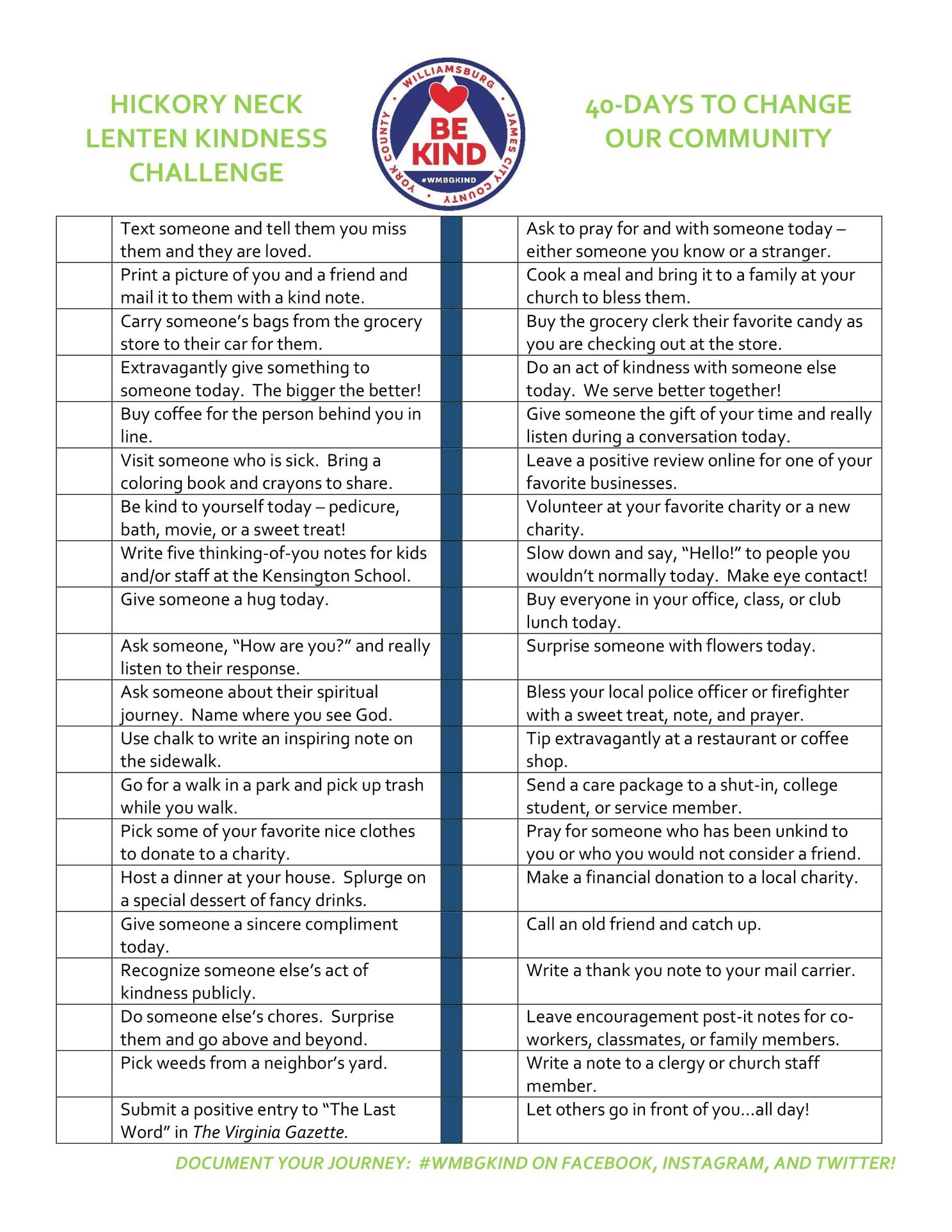
This Lent I decided to join my church in taking up our Lenten Kindness Challenge.  There are forty acts of kindness for the forty days of Lent.  The challenge itself is laid out like a checklist, but we were told we could either do the tasks in order, or pick and choose which acts fit our schedule on a particular day.  I elected to do the latter.  I confess, the kindness challenge began somewhat easily for me.  You see many of the acts of kindness are part and parcel of my job as a priest.  I have visited the sick more times than I can count this Lent.  I have hosted people in my home as part of our new Rector’s Receptions.  I regularly ask people about their faith journey and ask people if I can pray for them.  In some ways, by virtue of my job, I have felt like I am coasting through this kindness challenge.

But about halfway through Lent, I have passed all the “easy” acts, and am now facing all the acts of kindness I skipped because they will take more time or intentionality.  Midway through Lent, this kindness challenge is starting to feel like work – work that will require my time and attention.  On the one hand, I am already dreading the work, trying to figure out when I will have time to write extra notes, or do tasks that are outside of my everyday routine.  On the other hand, I am glad I have hit this point in the kindness challenge.  The work being demanded of me now reminds me that kindness is not just the kindness that we naturally do day in and day out.  Kindness requires something more of us – our time, our forethought, our work.  If it were easy, everyone would be doing it!

This is why I think focusing on kindness is so important for people of faith.  You see, being kind can reference the superficial, polite, everyday way of being that is common for all people – a great thing to be celebrated, but not necessarily the behavior in life that motivates and inspires.  But the kindness people of faith are invited to claim is the kind of kindness we see modeled through God – the kind of kindness we as people of faith embody so that others might see Christ in us.  Jesus was not venerated because he was simply polite – a good Southerner, if you will.  Christ was venerated because he healed the sick, listened to the isolated, and ate meals with the disenfranchised.  The kindness of Jesus was the kind of kindness that made people uncomfortable – that crossed barriers, that pushed people out of comfort zones, and that placed little value on societal norms.  Christ’s kindness was a radical kind of kindness.

I wonder what ways you are being challenged to get a little more radically kind this Lent.  What are things that you can be doing that require more of you than simply being polite?  What are the acts of kindness you can do that will take more time, that will inconvenience you, that might even make you a little uncomfortable?  Perhaps you have already notated which of those challenges are going to be hard for you this Lent.  Or perhaps there are different challenges that are not on our Lenten Kindness Challenge, but are the actions you need take to embody Christ today.  I cannot wait to hear how you are challenging yourself during this second half of Lent!

← Older posts

Recent Posts

  • On the Myth and Magic of Advent…
  • On Risking Failure and Facing Fear…
  • Sermon – Luke 23.33-43, P29, YC, November 23, 2025
  • On Inhabiting Gratitude…
  • Sermon – Luke 20.27-38, P27, YC, November 9, 2025

Archives

  • December 2025
  • November 2025
  • October 2025
  • September 2025
  • August 2025
  • July 2025
  • June 2025
  • March 2025
  • February 2025
  • December 2024
  • November 2024
  • October 2024
  • September 2024
  • August 2024
  • July 2024
  • June 2024
  • May 2024
  • March 2024
  • February 2024
  • January 2024
  • December 2023
  • November 2023
  • October 2023
  • September 2023
  • August 2023
  • July 2023
  • June 2023
  • May 2023
  • March 2023
  • February 2023
  • January 2023
  • December 2022
  • November 2022
  • October 2022
  • June 2022
  • May 2022
  • January 2022
  • December 2021
  • November 2021
  • October 2021
  • September 2021
  • August 2021
  • June 2021
  • May 2021
  • April 2021
  • March 2021
  • February 2021
  • January 2021
  • December 2020
  • November 2020
  • October 2020
  • September 2020
  • August 2020
  • July 2020
  • June 2020
  • May 2020
  • April 2020
  • March 2020
  • February 2020
  • January 2020
  • December 2019
  • November 2019
  • October 2019
  • September 2019
  • August 2019
  • July 2019
  • June 2019
  • May 2019
  • April 2019
  • March 2019
  • February 2019
  • January 2019
  • December 2018
  • November 2018
  • October 2018
  • September 2018
  • August 2018
  • July 2018
  • June 2018
  • May 2018
  • April 2018
  • March 2018
  • February 2018
  • January 2018
  • December 2017
  • November 2017
  • October 2017
  • September 2017
  • August 2017
  • July 2017
  • June 2017
  • May 2017
  • April 2017
  • March 2017
  • February 2017
  • January 2017
  • December 2016
  • November 2016
  • October 2016
  • September 2016
  • August 2016
  • July 2016
  • June 2016
  • May 2016
  • April 2016
  • March 2016
  • February 2016
  • January 2016
  • December 2015
  • November 2015
  • October 2015
  • September 2015
  • August 2015
  • July 2015
  • June 2015
  • May 2015
  • April 2015
  • March 2015
  • February 2015
  • January 2015
  • December 2014
  • November 2014
  • October 2014
  • September 2014
  • August 2014
  • July 2014
  • June 2014
  • April 2014
  • March 2014
  • February 2014
  • January 2014
  • December 2013
  • November 2013
  • October 2013
  • September 2013
  • August 2013
  • July 2013
  • June 2013
  • May 2013
  • April 2013
  • March 2013
  • February 2013
  • January 2013
  • December 2012
  • November 2012
  • October 2012
  • September 2012

Categories

  • reflection
  • Sermons
  • Uncategorized

Meta

  • Create account
  • Log in
  • Entries feed
  • Comments feed
  • WordPress.com

Blog at WordPress.com.

  • Subscribe Subscribed
    • Seeking and Serving
    • Join 394 other subscribers
    • Already have a WordPress.com account? Log in now.
    • Seeking and Serving
    • Subscribe Subscribed
    • Sign up
    • Log in
    • Report this content
    • View site in Reader
    • Manage subscriptions
    • Collapse this bar
 

Loading Comments...