• About

Seeking and Serving

~ seek and serve Christ in all persons

Seeking and Serving

Tag Archives: trust

On worry…

06 Thursday Feb 2014

Posted by jandrewsweckerly in Uncategorized

≈ 2 Comments

Tags

control, God, Jesus, parent, trust, worry

Last week I went to visit my OB for a checkup.  We began to talk about delivery dates, as I am having a cesarean section with our second child.  The doctor selected a date that is about one week before what I expected.  I left the office totally panicked.  I would need to totally readjust my plan for wrapping things up in the office, I would need to contact the supply priest and make sure the Sunday before was still available, and I would need to talk to my mother about flying out earlier to come help us with our four-year old – just to name a few things on my panic list.  Of course, about an hour later, I realized how silly my panic was in the grand scheme of things.  The truth is that I could go into labor at any point, and any “plans” I had made would be thrown out anyway.  The idea that one week was sending me into such a panic was only confirmation that I still hold on to some false idea about the level of control I exert over my life.

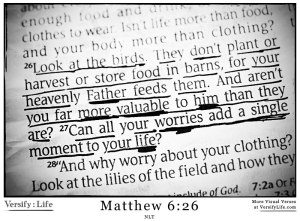
Courtesy of http://www.versifylife.com/category/topical/worry/page/2/

Courtesy of http://www.versifylife.com/category/topical/worry/page/2/

One of my favorite passages of scripture is from Matthew.  “Therefore I tell you, do not worry about your life, what you will eat or what you will drink, or about your body, what you will wear.  Is not life more than food, and the body more than clothing?  Look at the birds of the air; they neither sow nor reap nor gather into barns, and yet your heavenly Father feeds them.  Are you not of more value than they?  And can any of you by worrying add a single hour to your span of life? – Matthew 6:25-27  Although I know the truth of this passage about our relationship between trust and God, I find that I am always returning to it, never fully mastering it.  In fact, I am not even sure that I have partially mastered it.

My only saving grace has been becoming a parent.  I have often joked that God knew what God was doing when God made me a parent.  Perhaps God knew that the only way I would really start to believe that I could trust God was to throw someone in my life whom I have very little control over – a microcosm of the larger world.  That point has been resurfacing several times for me lately.  When school is cancelled because of snow, I have no way of attacking my work in the same way that I would if she were in school.  When the roads become too dangerous for driving on my day off with my daughter (i.e., “errand day”), those groceries that we just cannot live without suddenly become groceries we can live without.  Just today, another school weather-related cancellation day, as I was scrambling around trying to figure out how to busy my daughter while getting a little work done, my daughter asked if she could make Valentine’s Day cards for her classmates.  My immediate thought was, “No, I don’t have time to sit with you and do that.”  But I took a breath and considered her proposal.  One, we would be able to do something together that we would not normally do.  Two, the task would certainly entertain my daughter, which is pretty much golden on a snow day.  Three, making homemade Valentine’s is super cute, and something I never would have made time for otherwise.  So, I exhaled in defeat, and we both gathered the necessary supplies.  And it turns out that making homemade Valentine’s is pretty fun, and can even be a creative outlet for stress reduction.

So today, I am thankful for the God who puts people in my life to force me to be a better person of faith.  I am grateful for God’s awesome and powerful creation, who has certainly taught me a few lessons this winter about the fruitlessness of worry.  And I am blessed by the God who reminds me in small and large ways that I cannot, “worry about tomorrow, for tomorrow will bring worries of its own.  Today’s trouble is enough for today.” – Matthew 6.34

Homily – Matthew 6.25-33, TG, YC November 28, 2013

05 Thursday Dec 2013

Posted by jandrewsweckerly in Uncategorized

≈ Leave a comment

Tags

control, God, gratitude, Jesus, Sermon, Thanksgiving Day, trust, worry

Our gospel lesson today is one of my favorites.  Jesus’ instructions not to worry are a soothing ointment for the constant itch of worry in my life.  His words calm my nerves and remind me of the need for perspective.  I can almost imagine Jesus as a yoga instructor, calmly affirming a room of people who are trying to take in deep breaths and to relax their tight muscles.  As I think about the heavenly Father who knows my every need, I am given a sense of perspective and calm that I can rarely muster on my own.  Because I am a person prone to worry, this passage truly is one of my favorite passages from scripture.

That being said, this passage is also one of my least favorite passages.  We tend to think of ourselves as having a certain amount of responsibility in this life – a responsibility to use the talents God has given us to care for ourselves, and even to care for others.  But who among us has not had times when that was just not possible – either from being laid off or furloughed from work, not being able to find a job in unemployment, or having an injury that has made our work impossible.  Besides, what does Jesus expect us to do?  Just go about life, expecting everything to be handed to us – clothing, food, and drink?  The proposition seems naïve and ultimately frustrating.

But even harder than a basic frustration with Jesus is the underlying message of what Jesus is saying:  that through our behavior of worrying, we are implying that we have ultimate control over life, and that God plays little, or at least a superficial, role in our lives.  The presumption of worry is the presumption that we have the ability to fully control what happens and then fix things when they go awry.  Our worrying is a way of saying to God, “I do not trust you to handle things in my life.  I am not willing to give up that control to you.”  One question from Jesus summarizes this conflict for us, “Can any of you by worrying add a single hour to your span of life?”  Jesus really knows how to get to the heart of the matter, and when he does, his words feel like a stab to the heart.

Truthfully, there really could not be a better lesson for us today on Thanksgiving Day.  I imagine every one of us has had a worry about this day in the past week or more.  Talk about worrying about what you will eat!  We stress about what food to serve, how to accommodate our gluten-free friends in the menu, what items can be prepared in advance, how to get the moistest turkey, and whether we have made enough for those gathered.  Some of us have worried about what outfit to wear, knowing there will be countless photos trying to capture the happiness of this day.  And what to drink?  I know parties where the host has purchased copious amounts of wine, despite delegating wine to guests, for fear that there will not be enough to cover the gathering.  And those worries do not even cover the other worries of the day – how to fit in Eucharist while the turkey is still cooking, whom to sit near our cranky aunt, and what kind of arguments might erupt between family members.  For those hosting meals, many of us barely have a chance to catch our breath after the meal before the clean-up process begins.

But that is the beauty of this lesson today:  like our eternal battle between worry and control, this special day also has the potential for lost focus.  Our country, with all its flaws, gives us a day that is almost sacred in nature – a day set aside for gratitude and thanksgiving; a day when we can pause, and remember the abundant blessings of our lives and the incredible gift of this life.  And if we are at all considering what we are grateful for, our minds inevitably end up with God – the one from whom all blessings flow.  The simple act of thanksgiving melts away tensions, and turns our worry-hardened hearts to hearts overflowing with gratitude.  When we really think about all that we have to be grateful for, the list gets longer and longer – even if we are not even in much of a mood to celebrate.

I was wondering, then, how we might incorporate the lessons we learn today from the gospel and from Thanksgiving Day into a rule of life beyond this day.  Then I remembered the last line of the gospel, “But strive first for the kingdom of God and his righteousness, and all these things will be given to you as well.”  We have been singing these very words since September, “Seek ye first the kingdom of God and his righteousness.  And all these things shall be added unto you.  Alleluia.”  I have been singing these words every Sunday, and I took until today, with today’s gospel and today’s celebration to finally connect the dots.  The answer is not to throw up our hands, naively trusting God to put food on the table.  The answer is changing our pursuit – not pursuing the things that we think we want and need, but instead pursing the kingdom of God.  The rest is just gravy.  Amen.

Sermon – Luke 21.5-19, P28, YC, November 17, 2013

27 Wednesday Nov 2013

Posted by jandrewsweckerly in Uncategorized

≈ Leave a comment

Tags

God, Hurricane Sandy, Jesus, Precious Lord, prepare, scripture, Sermon, suffering, testimony, Thomas Dorsey, trust, words

“Blessed Lord, who caused all holy Scriptures to be written for our learning:  Grant us so to hear them, read, mark, learn, and inwardly digest them, that we may embrace and ever hold fast the blessed hope of everlasting life, which you have given us in our Savior Jesus Christ; who lives and reigns with you and the Holy Spirit, one God, for ever and ever.  Amen.”[i]  So on this day, when we celebrate Holy Scripture, praying one of my favorite collects, a day that we hear, read, mark, learn, and inwardly digest, imagine my intense dissatisfaction when I opened up the gospel lesson for this week.  I have been reading, marking, learning, and inwardly digesting all week, and this text still makes me uncomfortable.  On this day of celebrating Scripture, who wants to hear of collapsing houses of worship; false prophets that can lead us astray; wars, natural disasters, famines, and plagues; great persecution, including being betrayed by our very own family members?  And what is our reward for all this suffering?  All of this calamity will give us an opportunity to testify.  I do not know about you, but after having my church destroyed, navigating false prophets, fighting disasters, and dealing with persecution, testifying would be about the last thing on my mind.  In fact, I know a few Episcopalians who might even add testifying as one of the major types of tortuous, painful experiences. 

At Diocesan Convention this weekend, we watched a video about the Diocese of Long Island’s response to Hurricane Sandy one year ago.  The video began with news coverage leading up to the storm, during the storm, and immediately after the storm.  I have no idea why, but I found myself tearing up during the coverage.  I had forgotten all of the anxiety and stress that came from that storm.  I forgot about the utter despair and the feelings of helplessness – having friends try to contact me about how they could help, and yet, not even having power to be able to watch the news and see what was going on all around us.  I remember wanting to know what had happened to churches in the areas most impacted by the storm, but the Diocesan offices being crippled by their own lack of power and employees’ inability to get to work.  I remember wanting to help, but not being sure how to do that without electricity ourselves.  I remember being so cold at night without heat, and yet knowing that I was lucky to have an undamaged roof over my head.  I remember anxiously watching my car’s gas gauge approach empty – knowing the panic of gas lines, and how quickly stations ran out of gas.  The video brought all of those emotions bubbling up to the surface. 

But the video also offered a testimony.  After the storm, churches began opening doors for collections, housing, and powering stations.  Teams from churches headed to devastated areas to help demo and begin repairing homes.  Those too far from the action, offered up their space to electrical workers who had volunteered to help, but had been given no place to stay at night.  Our hospital in the Rockaways treated patients for three weeks solely on generator power.  A year later, people are still being helped as they repair homes, find new places to stay, and deal with the emotional ordeal.  In a time of great darkness, the Episcopal Church on Long Island began to find a way out of the darkness and into the light. 

One of the coordinators of the effort from the Diocese said that one of the things the Church had to learn to do was not to go into areas telling them how they were going to help – but instead had to simply show up and ask what people needed.  The representative said that this model made the work and efforts much more chaotic, but in the end, brought about the change that people really needed.  I could hear echoes of today’s gospel lesson in his words.  Jesus says, “Make up your minds not to prepare your defense in advance, for I will give you words and a wisdom that none of your opponents will be able to withstand or contradict.”  This strange gift of being able to testify is made even stranger by Jesus’ words – not only is our gift to testify in the midst of suffering, we are to force ourselves to not even prepare the testimony on the way – no thinking of anecdotes, no making outlines, no trying to even think about what we might say.  We must simply show up and trust that God will give us the words.

One of my favorite hymns is “Precious Lord.”  “Precious Lord,” is one of those songs that I can close my eyes to and just overflow with love and gratitude toward God.  Of course, my favorite version is not the version sung out of the hymnal, but by the great Al Green.  He breathes a life and joy into the song that we can rarely muster in church.  But this week, my appreciation for this favorite song grew infinitely when I heard the story behind the song.  The song was written by Thomas Dorsey.  Born in 1889 in rural Georgia, Dorsey was a prolific songwriter and excellent gospel and blues musician.  As a young man, he moved to Chicago where he worked as a piano player in churches as well as in clubs and theaters.  After some time, Dorsey finally devoted his talent exclusively to the church.  In August of 1932, Dorsey left his pregnant wife in Chicago and traveled to be the featured soloist at a large revival meeting in St. Louis.  After the first night of the revival, Dorsey received a telegram that simply said, “Your wife just died.”  Dorsey raced home and learned that his wife had given birth to a son before dying in childbirth.  The next day his son died as well.  Dorsey buried his wife and son in the same casket and withdrew in sorrow and agony from his family and friends.  He refused to compose or play music for quite some time. 

While still in the midst of despair, Dorsey said that as he sat in front of a piano, a feeling of peace washed through him.  That night, Dorsey recorded this testimony while in the midst of suffering:

Precious Lord, take my hand,

Lead me on, let me stand;

I am tired, I am weak, I am worn;

Through the storm, through the night,

Lead me on to the light;

Take my hand, precious Lord,

Lead me home.[ii]

In the midst of that darkest of times, Dorsey did not sit at that piano with a song all planned out.  In fact, if you had asked him to testify at that moment, he might have railed at the way that God and the world were treating him.  And yet, empty and vulnerable, God filled Dorsey with words that would touch people eighty years later, and would be sung by countless famous people over the years.

In the midst of darkness – of destruction, pain, suffering, persecution, even betrayal by those we love most – God gives us a testimony too.  And even more than a testimony, Jesus promises that we do not even have to prepare this testimony.  God will provide the words and the wisdom when we need them.  Our only mandate today is to hold fast to God in the midst of trials, to remain open to the movement of the Spirit, and to speak those words of truth and wisdom when we feel them spilling out of our mouths.  That time of testimony may not be before some king or governor demanding to hear about our faith.  But our testimony might spill out with a grieving widow or mother, a traumatized victim of natural disaster, or a friend who has felt disenfranchised by the Church.  We cannot prepare the testimony.  We cannot even try to craft a basic testimony story to be ready whenever we need the story.  Jesus tells us to “make up our minds not to prepare.”  This is perhaps one of the hardest challenges Jesus will give us, and yet, as we see in Dorsey’s testimony and the many other testimonies we have heard, when we yield that power to Christ, the real, vulnerable beauty of our story gives life to others and to us.  Amen.


[i] BCP, 236.

[ii] Story of Dorsey take from Nancy Lynne Westfield, “Pastoral Perspective,” Feasting on the Word, Yr. C, vol. 4 (Louisville: Westminster John Knox Press, 2010), 312.

Homily – Acts 20.28-32, Samuel Seabury, November 14, 2013

27 Wednesday Nov 2013

Posted by jandrewsweckerly in Uncategorized

≈ Leave a comment

Tags

church, Episcopal, flexibility, God, homily, Samuel Seabury, tenacity, trust

Today we honor the life and work of Samuel Seabury, first American Bishop of the Episcopal Church.  Born in 1729 in Connecticut, and ordained priest in England in 1753, Seabury worked in New Jersey, Long Island, and Westchester County.  During the American Revolution, he remained loyal to the British crown and served as a chaplain to the British army.  After the Revolution, in 1783, Seabury was asked by Connecticut clergymen to seek episcopal consecration in England.  He negotiated for a year, but could not obtain episcopal orders because as an American citizen, he could not swear allegiance to the crown.  He turned to the Episcopal Church in Scotland, which consecrated him bishop.  In Connecticut, he was officially recognized as bishop in 1785.  In 1792, he participated in the first consecration of a bishop on American soil.

I do not know many modern Episcopalian who could have lived the life of Samuel Seabury.  He had to deal with changing national loyalties; travel by boat to ask a people from whom he had just revolted to consecrate him; negotiate for a year; think creatively to involve Scotland; not give up; and establish a new system here in the U.S.  Samuel’s faith life required a certain flexibility, creativity, and tenacity that many of us lack.  I sense that lack even in myself as I hear Episcopalians talk about reinventing our church for this new age.  Can’t we just stay as we are where we are comfortable and just pray it will all work out?

But our lesson from the Acts of the Apostles allows no such hesitancy.  Paul exhorts us to keep watch – over ourselves and over the whole flock.  Our job is to care for the church that “God obtained with the blood of [God’s] Son.”  But Paul does not exhort without encouragement.  He says that God’s grace will build us up and that the Holy Spirit makes us overseers.  We can do our work with flexibility, creativity, tenacity, and change because God’s grace will build us up, and the Holy Spirit empowers us to do the work.  The road may be hard at times, but we have the great cloud of witnesses pushing us forward.  Samuel knows we can do it; we just have to let go and trust.  Amen.

Homily – I Kings 18.20-39, P4, YC, June 2, 2013

05 Wednesday Jun 2013

Posted by jandrewsweckerly in Uncategorized

≈ Leave a comment

Tags

boldness, Elijah, God, homily, trust

Having gotten through Pentecost and Trinity Sunday, we now enter the season the church calls “ordinary time.”  But there is nothing ordinary about the lessons we get during this time.  This Sunday’s Old Testament lesson is a classic example.  King Ahab is one of the worst kings the Israelites have had.  He encourages worship of Baal, the god who is supposed to bring water to fertilize the soil, in addition to the God of Israel.  But there has been a three-year drought in the land, and Elijah is going to use this opportunity to prove the Israelites wrong about Baal.  So he challenges the prophets of Baal to a duel.  Whoever can get their god to rain fire upon the bull sacrifice will be the true God.  So the Baal prophets spend all day praying to Baal, dancing around the altar, going to extremes such as cutting themselves to get Baal to perform.  The whole time Elijah mocks them.  Then Elijah dramatically gets his sacrifice ready, and even has the Israelites pour water all over the wood, just to prove how awesome Yahweh is when Yahweh rains a fire down that consumes the whole thing.  One could argue that Elijah is being a bit rude, if not pompous, in this story.  But what Elijah is actually revealing is an intense, deep trust in God – a trust that is so profound that he is willing to make bold statements without hesitation about God in front of everyone.

One of the things Elijah accuses the people of is limping along with two different opinions – not entirely sure that God will care for them, so investing devotion to Baal just in case.  Too often we are like the Israelites.  We too can be found only sort of trusting God, and putting our trust in other things – just in case.  We lack Elijah’s boldness because we are just not as sure as he is.  I have seen that lack of total trust just in these last several months.  Since I came here about a year and a half ago, we have been working hard, making lots of changes.  But I see the hard work is taking a toll.  We are getting tired and I am not sure we are convinced all our work will pay off.  And so we are beginning to hold back.  I noticed the reaction first in myself.  The questions started bubbling up:  Can we make this work?  Will we have the money?  Will we have the energy?  Do we have the same chutzpah that Elijah has?  I have noticed us starting to eye one another, as we peer over what feels like a cliff.  There is this sort of stand-off:  If you jump, I’ll jump.  We are like the Israelites.  Elijah says to them, “How long will you go limping with two different opinions?  If the LORD is God, follow him; but if Baal, then follow him.”  The text says that the Israelites do not answer him a word.

In contrast to all of this is Elijah.  He has a brazen trust in God.  He is so bold that he mocks others; he has water poured on the wood, not just once, but three times; only then does he call down the fire from God.  Even after three years of draught, Elijah does not doubt that God will give a sign to the people – he trusts that God does not abandon God’s people.

In the midst of our silent stand-off, I see a glimpse of Elijah in all of us too.  Just watching us at the Parade last week gave me hope.  Over twenty of us gathered to walk – even those of us who have told me that they do not feel comfortable with evangelism at all.  And when we gathered, I watched us talking to friends and strangers, having meaningful conversations, handing out our business cards, smiling, and waving.  These are actions that show a bold trust in God.  Our invitation is to hold on to that trust, to stop limping along with two opinions, and to just jump off that cliff with each other.  I am willing to make that jump, and I know that God will enable us to jump together.  And when we do, we will say those same words that the Israelites proclaim when they witness God’s power:  The LORD indeed is God; the LORD indeed is God.  Amen.

Homily – Psalm 71.1-8, Bishop Athanasius, May 2, 2013

10 Friday May 2013

Posted by jandrewsweckerly in Uncategorized

≈ Leave a comment

Tags

Athanasius, exile, God, homily, trust

Today we honor Athanasius, Bishop of Alexandria.  Athanasius is a major figure in Church history and in the theological world.  Rarely in the history of the Church has the course of its development been more significantly determined by one person than by Athanasius in the forth century.  Called “the pillar of the Church” and “the God-given physician of her wounds,” Athanasius was a key voice at the Council of Nicea in 325 as they debated the divinity of Christ.  Athanasius was the one who crafted the words from our Nicene Creed, “of one Being with the Father.”  When he became bishop in 328, he fearlessly defended Nicene Christology – five times he was exiled for his efforts.  We are indebted to Athanasius for his theological work – some of the most accessible I have read – and yet all of that work came at great personal cost.

I wonder if Athanasius ever prayed the Psalm we prayed today, “in you, O LORD, have I taken refuge; let me never be ashamed.  In your righteousness, deliver me and set me free; incline your ear to me and save me.  Be my strong rock, a castle to keep me safe…”  Surely once or twice in exile Athanasius cried out those words to God.

Of course, few of us know the desperation of being exiled from our country for defending a theological truth.  But we do know what it feels like to call out to God – to call out to God when we know we are doing the right thing, but we are paying for it.  When friends cut us off or family members shut us out, we too may have asked God to incline God’s ear to us.  We know what it feels like to only feel assurance through the God that is our strong rock.

What I like about Athanasius’ story is that during this last exile, the Emperor had to bring him back because the citizens threatened insurrection unless Athanasius was returned.  When Athanasius stood his ground, staked his claim on Truth, God, even in exile, was a castle to keep him safe.  What Athanasius’ experience reminds us of is that even in times that seem hopeless (like a fifth exile), God is with us, keeping us safe and making things better all the while.  Our invitation today is to remember that God is our strong rock and to let our mouths be “full of God’s praise and God’s glory all the day long”…even in exile!  Amen.

Newer posts →

Recent Posts

  • On the Myth and Magic of Advent…
  • On Risking Failure and Facing Fear…
  • Sermon – Luke 23.33-43, P29, YC, November 23, 2025
  • On Inhabiting Gratitude…
  • Sermon – Luke 20.27-38, P27, YC, November 9, 2025

Archives

  • December 2025
  • November 2025
  • October 2025
  • September 2025
  • August 2025
  • July 2025
  • June 2025
  • March 2025
  • February 2025
  • December 2024
  • November 2024
  • October 2024
  • September 2024
  • August 2024
  • July 2024
  • June 2024
  • May 2024
  • March 2024
  • February 2024
  • January 2024
  • December 2023
  • November 2023
  • October 2023
  • September 2023
  • August 2023
  • July 2023
  • June 2023
  • May 2023
  • March 2023
  • February 2023
  • January 2023
  • December 2022
  • November 2022
  • October 2022
  • June 2022
  • May 2022
  • January 2022
  • December 2021
  • November 2021
  • October 2021
  • September 2021
  • August 2021
  • June 2021
  • May 2021
  • April 2021
  • March 2021
  • February 2021
  • January 2021
  • December 2020
  • November 2020
  • October 2020
  • September 2020
  • August 2020
  • July 2020
  • June 2020
  • May 2020
  • April 2020
  • March 2020
  • February 2020
  • January 2020
  • December 2019
  • November 2019
  • October 2019
  • September 2019
  • August 2019
  • July 2019
  • June 2019
  • May 2019
  • April 2019
  • March 2019
  • February 2019
  • January 2019
  • December 2018
  • November 2018
  • October 2018
  • September 2018
  • August 2018
  • July 2018
  • June 2018
  • May 2018
  • April 2018
  • March 2018
  • February 2018
  • January 2018
  • December 2017
  • November 2017
  • October 2017
  • September 2017
  • August 2017
  • July 2017
  • June 2017
  • May 2017
  • April 2017
  • March 2017
  • February 2017
  • January 2017
  • December 2016
  • November 2016
  • October 2016
  • September 2016
  • August 2016
  • July 2016
  • June 2016
  • May 2016
  • April 2016
  • March 2016
  • February 2016
  • January 2016
  • December 2015
  • November 2015
  • October 2015
  • September 2015
  • August 2015
  • July 2015
  • June 2015
  • May 2015
  • April 2015
  • March 2015
  • February 2015
  • January 2015
  • December 2014
  • November 2014
  • October 2014
  • September 2014
  • August 2014
  • July 2014
  • June 2014
  • April 2014
  • March 2014
  • February 2014
  • January 2014
  • December 2013
  • November 2013
  • October 2013
  • September 2013
  • August 2013
  • July 2013
  • June 2013
  • May 2013
  • April 2013
  • March 2013
  • February 2013
  • January 2013
  • December 2012
  • November 2012
  • October 2012
  • September 2012

Categories

  • reflection
  • Sermons
  • Uncategorized

Meta

  • Create account
  • Log in
  • Entries feed
  • Comments feed
  • WordPress.com

Blog at WordPress.com.

  • Subscribe Subscribed
    • Seeking and Serving
    • Join 394 other subscribers
    • Already have a WordPress.com account? Log in now.
    • Seeking and Serving
    • Subscribe Subscribed
    • Sign up
    • Log in
    • Report this content
    • View site in Reader
    • Manage subscriptions
    • Collapse this bar
 

Loading Comments...