• About

Seeking and Serving

~ seek and serve Christ in all persons

Seeking and Serving

Tag Archives: women

On the Road to Getting It Right…

03 Wednesday Jul 2024

Posted by jandrewsweckerly in reflection

≈ Leave a comment

Tags

Communion Table, Episcopal Church, exclusion, faith, Holy Spirit, love, ministry, ordination, Philadelphia 11, Philadelphia Eleven, priesthood, question, women

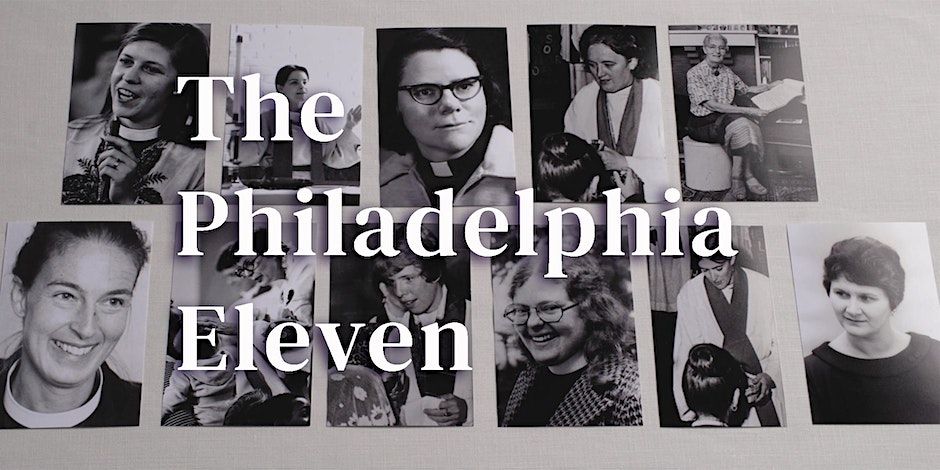
Photo credit: https://azdiocese.org/2023/11/the-philadelphia-eleven-screenings-in-arizona/

This past Sunday, the local Episcopal parishes in my town gathered to watch the documentary, The Philadelphia Eleven.  The film details the history of women’s ordination in the Episcopal Church, and the first eleven women who were “irregularly ordained” in 1974 (i.e. ordained by Episcopal Bishops, but without the church’s General Convention sanctioning the ordination of women).  The question of women’s ordination had come before General Convention many times before, but was always defeated.  So, fifty years ago, a handful of women, along with male allies, decided they could not wait any longer.  The film tells the story of the outrage the eleven women created, the abuse and death threats they faced, and the way that their diverse ministries led to the sanctioning of women’s ordination by General Convention in 1976. 

I came into the Episcopal Church later in life.  Although deeply involved in the United Methodist campus ministry at my college, an ecumenical trip with the Episcopal campus minister was my first real exposure to the liturgy and polity of the Episcopal Church.  That campus minister was a woman, and at that point in my development, that did not seem abnormal.  Then, a couple of years after college, I stumbled into the Episcopal Cathedral, whose dean was a woman.  One of her assisting priests was also a woman.  Those early mentors did not just normalize women’s ordination – it never occurred to me that there was a time when women were not priests.  In fact, I remember an occasion when one of my own daughters as a young child asked me, “Can boys be priests?”

At this year’s General Convention of the Episcopal Church, we took the first steps to authorize the honoring of the Philadelphia Eleven in our set of honored saints we celebrate at weekday Eucharists.  In the same city, where 51 years earlier the General Convention had denied women’s right to ordination, we agreed to honor the saints who pushed us to be better versions of the Church.  All female clergy in the room were invited to stand to a roar of applause.  I looked at the other women, many of whom I know and love, and I looked at the male clergy and laity whose eyes and smiles were full of admiration and respect, and I realized a couple of things.  One, it is always a joy to celebrate when the Church gets something right – even if it takes a long time for the Church to get there.  And two, I can be in ministry as my most authentic self is due to the suffering and courage of men and women I may never meet. 

I share all this not to brag on the Episcopal Church – in fact, we still have a long way to go.  Income disparity between male and female clergy is still a problem, as well as access to comparable positions.  I have been the first female rector both times I have served as rector, and both times, people left the church when a woman was hired.  But I share this story more because I wonder who else have we excluded from the Table.  I share this story because I found myself wondering whether I would have risked being one of the Philadelphia Eleven, knowing the suffering that would come.  I share this story because as someone who really appreciates rules and boundaries, I wonder which of those rules and boundaries the Holy Spirt keeps bumping against.  While these may seem like big questions, or super-Church-nerdy questions, I think these questions are for all of us – an invitation to wonder who we have excluded in the communities of faith we love so much.  The Philadelphia Eleven seem to be still asking us these questions fifty years later.    

Sermon – Exodus 1.8-2.10, P16, YA, August 27, 2023

30 Wednesday Aug 2023

Posted by jandrewsweckerly in Sermons

≈ Leave a comment

Tags

act, chaos, defiance, fear, forefathers, foremothers, God, good, Miriam, Moses, Pharaoh, presence, Puah, Sermon, Shiphrah, women

This likely comes as no surprise to you, but I come from a long line of strong women.  My paternal grandmother, the matriarch of the family, was so intimidating that most of us grandchildren were a little bit afraid of her.  But she was likely the only minister’s wife of her time who refused to play the stereotypical minister’s wife role, teaching one parish after another how to respect her personhood.  My maternal grandmother was widowed when she had five young children.  I knew her as a gentle, kind soul, but I know she must have been tough as nails to survive that time as a struggling single mother in the rural south.  My mother, who had to restart her own business every time my father was assigned to a new church, managed to help her children and herself thrive in every new place she was planted.  I, in my wisdom, married a man who also came from a long line of strong women – independent, fierce, wise women who navigated all sorts of challenges.  I suppose I should be grateful then for the fierce, smart, sometimes annoyingly stubborn young women we are raising in our own home.  I keep reminding myself that they come by their strength honestly.

But the story from Exodus today reminds us that we all come from a long line of strong women.  We all know the story of one of our most prominent forefathers, Moses.  Saved from a ride in a river basket, called by a burning bush, reigning down plagues until God’s people are freed from slavery, walking God’s people through the Red Sea, guiding the Israelite’s to the Promised Land, delivering our foundational Ten Commandments, and even appearing to Jesus on the Mountain of the Transfiguration.  But Moses would not be any of those things but for the strong five women we hear about today.

Before we hear Moses’ story, today we hear the story of his foremothers.  The reading from Exodus starts ominously, “Now a new king arose over Egypt, who did not know Joseph.”  In other words, the new king, the new pharaoh, does not know the story of how Joseph saved Egypt from famine, and began a symbiotic, peaceful relationship with the Israelites.  Now, the new pharaoh only sees the sheer number of foreigners on his land and he is afraid.  He is afraid they will revolt; he is afraid of their strength in numbers; and in his fear he introduces chaos:  enslavement, oppression, and murderous, violent death.[i] 

In the midst of the chaos and violence Pharaoh causes for the Israelites, two midwives, Shiphrah and Puah, change the course of an administration.  Pharoah calls these two women – women who would normally never even meet a man of such power and influence – to conspire with him for evil.  Doing anything other than his wishes would surely result in not only their own deaths, but also maybe the suffering of their families and loved ones.  But Shiphrah and Puah – who if you notice the text lists by name, while leaving the pharaoh unnamed (a biblical signal of importance)[ii] – Shiphrah and Puah decide they will defy the pharaoh, refusing to murder the male children of the Hebrews.  But not only that, when the pharaoh calls them back into his presence, the women do not cave under pressure, or even seem to be afraid of Pharaoh. Instead, they defy Pharaoh again, making up some crafty story about Hebrew women’s vigorous birthing practices, manipulating pharaoh’s stereotypes and fears of the Hebrews to save children’s lives.

But they are not the only women standing up to the power of Pharaoh.  Moses’ mother knows all Egyptians have been told to cast male Hebrew babies into the Nile.  So, she builds a water-tight basket to shield her son, refusing to cast him off without protection.  Meanwhile, Moses’ sister Miriam refuses to stand by idly either.  She follows her brother’s path, ready to defy Pharaoh too.  Even the pharaoh’s own daughter, who acknowledges Moses must be a Hebrew child condemned to death, refuses to participate in her father’s violence and fear.[iii]  When lowly, seemingly powerless Miriam boldly approaches the royal suggesting a Hebrew woman nurse the child, Miriam secures Moses’ well-being and buys their mother 2-3 more years of relationship before Moses will be adopted into safety.[iv]  Miriam, Moses’ mother, and the pharaoh’s daughter all defy Pharaoh in unique ways.  Without any one of these women’s actions, Moses as we know him today would not exist.[v]  In fact, without any of these women’s defiance, none of us as the people of God would exist today. 

I do not know what kind of chaos to which your life is subject.  I do not know in what ways you may be feeling powerless or incapable of making a difference.  I do not know what fears – sometimes legitimate, life-threatening fears – you are facing today.  But what I can tell you is you are not powerless or incapable of making a difference.  Your fears are not experienced without the presence of God.  And your life has the capacity to be history altering – even if you feel like what you are doing is only one tiny act of change or defiance of the power of evil in the world.  Pharaoh underestimates “…the power of God to work deliverance through the vulnerable – and seemingly powerless – on behalf of the vulnerable.”[vi]  But you, you come from a long line of powerful women.  God is with you as you harness their power for good.  Amen.


[i] Terence E. Fretheim, Exodus:  Interpretation:  A Bible Commentary for Teaching and Preaching (Louisville:  John Knox Press, 1991), 28

[ii] Alice Ogden Bellis, Helpmates, Harlots, and Heroes:  Women’s Stories in the Hebrew Bible (Louisville:  Westminster John Knox Press, 1994), 100.

[iii] Jacqueline E. Lapsley, Whispering the Word:  Hearing Women’s Stories in the Old Testament (Louisville:  Westminster John Knox Press, 2005), 77.

[iv] Lapsley, 78.

[v] Bellis, 101.

[vi] Lapsley, 74.

Sermon – Mark 1.29-30, EP5, YB, February 7, 2021

17 Wednesday Feb 2021

Posted by jandrewsweckerly in Sermons

≈ Leave a comment

Tags

Bible, disciples, discipleship, feminist, God, Jesus, mother-in-law, resurrected, Sermon, serve, Simon, theology, women

This morning I want to let you in on a little secret:  I do not actually love all of the Bible.  Now I know, I am a priest.  I am supposed to love all of Holy Scripture, the tome of inspired words from God.  Even in our ordination, priests proclaim, “I do believe the Holy Scriptures of the Old and New Testaments to be the Word of God, and to contain all things necessary to salvation.”[i]  And while I do believe what I said in my ordination about Scripture, there are still things in Holy Scripture that make me cringe, and, quite frankly, make me dread preaching them.

Today’s lesson from Mark is one of those texts.  We read of the miraculous healing of Simon’s mother-in-law, and my immediate reaction is, “Great!  Here we go again! A woman gets healed, and what’s the first thing she does?  Go to the kitchen and make the men some food.”  I was bracing myself this week for how I was going to stand here and talk about a woman being healed – actually, not just healed, but the word in the Greek is “raised” – the same word used for what happens to Jesus in his resurrection in Mark 16.6.[ii]  I was all ready to go with my defensive theology when I read the words of one scholar.  He simply says about the mother-in-law, “Mark introduces the first deacon in the New Testament.”[iii] 

My daughters and I enjoy reading a periodical called Bravery Magazine.  Every quarter a new edition features a woman who has shown bravery in the course of her life.  The one my younger daughter and I are reading now is about Eugenie Clark, a famous marine biologist, sometimes referred to as “The Shark Lady.”  Eugenie broke all kinds of boundaries about what women could do, but throughout our readings about her, one quote from her stuck with me, “I don’t work at something because I think it’s important.  I work at things that, to me, are interesting.”[iv]  In other words, Eugenie did not set out to care for marine life because she wanted to prove women are equal to men.  She set out to love and care for marine life because she found that work interesting – or as we might say, she was living out her call or vocation.

The same can be said about the mother-in-law of Simon.  She is not simply serving Jesus and the men with him.  She is not even “bowing to cultural convention, keeping in her restricted place as a servant.”  She is being a deacon, a “disciple who quietly demonstrates the high honor of service for those who follow Jesus.”[v]  What those labeled as disciples do not understand, and as one scholar reminds us, will not understand until Easter, is being a disciple of Jesus means becoming servants.  These named disciples will fight this reality the entire life of Jesus, in fact, later in Mark vying for primacy and privilege.  But this woman, as scholar Ofelia Ortega says, this resurrected mother-in-law, “has overcome all the selfishness and restrictive teachings and has been close to Jesus; deep down she is already a Christian, diakonisa [deacon], a servant of the church gathered in her son-in-law’s house…her diaconal work is the beginning and announcement of the gospel.”[vi]

As much as I would like to argue we are all like the mother-in-law, no matter what our gender, I think most of us are more like the male disciples, who are still trying to figure out discipleship.  We are still busy trying to rush Jesus out of his time of prayer to do more work, to control or contain the work of the Messiah, and certainly to guard our dignity in our daily lives.  But what the mother-in-law reminds us this week, is that if we wish to seek Jesus, to know and feel the presence of God, to understand our call in this crazy world, our first job is to serve:  to return to our baptismal covenant promise of seeking and serving Christ in all persons.

So how do we do we do this?  How do we shake ourselves out of own sense of control, our own agenda, or even, especially these days, our sense of weariness about this world?  We claim our discipleship, our invitation to serve.  We may start very small.  Maybe we start in our families like the mother-in-law and serve – not begrudgingly emptying that dishwasher while muttering, but joyfully honoring the ways Jesus has raised us up and given us power to serve.  Maybe we start with our neighbors, those feeling lonely or anxious, and send them a card or make them a meal.  Or maybe we start with those unknown to us who are suffering and serve them through advocacy or our labor.  We do not have to fully understand our service, and we will likely fail at doing that servant ministry as faithfully as the mother-in-law.  But Jesus has raised us up so that we can start afresh each new day.  Amen.


[i] BCP, 526.

[ii] Ofelia Ortega, “Theological Perspective,” Feasting on the Word, Yr. B, Vol. 1 (Louisville: Westminster John Knox Press, 2008), 334.

[iii] Gary W. Charles, “Exegetical Perspective,” Feasting on the Word, Yr. B, Vol. 1 (Louisville: Westminster John Knox Press, 2008), 335.

[iv] Beard Elyse, editor, Bravery Magazine:  Eugenie Clark, vol. 13, The Prolific Group, 2020, 4.

[v] Charles, 335.

[vi] Ortega, 334.

The Pilgrim’s Way…Day 2

08 Saturday Feb 2020

Posted by jandrewsweckerly in Uncategorized

≈ Leave a comment

Tags

call, Cathedral, Edith Cavell, faithful, God, Julian of Norwich, pilgrimage, witness, women

85013051_2883674765022098_7674431015430914048_n

Photo credit:  Jennifer Andrews-Weckerly; reuse with permission only

Sixteen pilgrims from Hickory Neck Church traveled to England for 8 days of pilgrimage.  Our focus was on choral music, hearing Evensong or Choral Mass at a Cathedral, Minster, or college everyday.  This is the second entry, initially posted on our church Facebook page.  For those of you who do not follow us on Facebook, I am repeating the journey’s daily entries here.  Enjoy!

Norwich

Today I was struck by the witness of women in the church. First, was Julian of Norwich (1300’s), the first woman to write a book in English, whose spiritual counsel and writing have inspired generations. Then, Edith Cavell, a nurse in WWI, who helped free around 200 allied soldiers before being martyred for her work. Then, seeing the female dean of Norwich Cathedral, bringing the Cathedral community out into the streets in the 21st Century.

I confess, when I saw the Passion of Edith Cavell, my sacrilege antennae went up. But what I began to see as I stared at those paintings was that no matter your gender, no matter your era, no matter your gifts (Julian likely had to learn to write before writing her book), God can, and will, so powerful things through each of us, when we let God. We may not be a Julian or an Edith, but we will be a Sarah, a Lisa, a Lorna, and maybe even a Jennifer. I can’t wait to see you embrace your call and see how your faithful living in the world inspires others. 

84986335_2883674775022097_6091739990671228928_n

Photo credit:  Jennifer Andrews-Weckerly; reuse with permission only

Sermon – 1 Sam 1.4-20, 2.1-10, P28, YB, November 18, 2018

28 Wednesday Nov 2018

Posted by jandrewsweckerly in Sermons, Uncategorized

≈ Leave a comment

Tags

God, Hannah, powerful, Ruth, scripture, Sermon, stories, transformation, women

A little over a year ago, I was talking to a parishioner about my sermon, and he said to me, “Oh yeah, as soon as I heard them talking about a woman in the lessons, I knew that would be what you preached on!”  At first I laughed, because he was not wrong.  In general, I am often drawn to stories of women in scripture.  But the more I thought about his comment, the more I wondered why I am drawn to them.  I suspect most people would assume I am drawn to women in scripture because I am a woman.  There is probably some truth to that assumption.  But the bigger reason I am drawn to women in scripture is because when women are featured in scripture (which is infrequently, and rarely with a name attached), something notable happens.  I am not necessarily drawn to those stories because of a sense of camaraderie; instead, I am drawn to those stories because they are a signal – a signal that we should perk up and listen to what dramatic thing is going to happen.

The last few weeks two women have done that for us:  last week, Ruth captured our imagination, and this week, Hannah captures our attention.  The women capture our attention for different reasons.  Ruth is a loyal daughter-in-law, who sacrifices everything to follow Naomi.  She endures hardship, discrimination, and uncertainty about her future before her life settles into some sense of normalcy.  Hannah, on the other hand struggles with fertility.  For any families who have been through the journey of infertility, Hannah’s story probably rips at the tenuously healed hole left in your heart.  If you have known infertility, then you probably have known people like the brutal second wife, the clumsy, loving husband, and the clueless priest.  For those familiar with grief work, the people in Hannah’s life evoke a basic prayer, “God deliver me from well-meaning friends.”[i]

Now, I could spend all day talking about Hannah’s story this week because her story evokes so many things in us:  the grief and trauma of infertility, the pain of those who taunt us, the frustration of misguided counsel, what prayer means and what we believe about unanswered prayers, and even the sacrifices we make with children.  But this week, something more macrocosmic has been tugging at me.  You see, despite the heart-wrenching, relatable story of Hannah, something much bigger comes out of her story.  The miracle child she is given she dedicates to God.  After all her suffering and pain, and although God restores her to value within the community through her baby boy, Hannah gives Samuel away. We know she does this because she bargained with God to have a child in the first place.  But what is more significant is her child is not just a baby boy.  Samuel is one of the most prominent figures in scripture.  Samuel is the last judge of Israel, who helps God shepherd in the era of the kings.[ii]  And even more prominently, the important king he anoints is the legendary King David.

The same thing happened to Ruth last week.  After her dramatic tale, we learn that she is also blessed with a baby boy, who we learn at the end of the book will become the grandfather of (you guessed it!) King David.  So in the course of two weeks, we meet the great-grandmother of King David and the mother of Samuel, the judge who will anoint King David.  The two women are not contemporaries, but they bear two of the most prominent men in Holy Scripture.

So you may be sitting there thinking, “Okay, we have two stories of two women who produced two important figures in Scripture.  Big deal!”  But that is just it:  this is a very big deal.  Holy Scripture could have started both David and Samuel’s stories differently.  They could have both started with stories that began, “Once upon a time there was a man named…”  But neither of their stories start that way.  Through Ruth’s story and Hannah’s story we learn that their beginning – in fact, sometimes their grandfather’s beginning, matters.  The tales of these two women are not just idle tales.  They are stories with implications that impact generations.

For Ruth, we need to know that David is descendant from Ruth for a few reasons.  One, David’s birth from a foreigner (and not just any foreigner, but the detested Moabites!), tells us that not only is our king from an impure lineage – in fact our Messiah, Jesus Christ, comes from that same lineage.  Later, when we see Jesus’ ministry expanding to all people, we begin to see the expansion not just one of generosity – but based in Jesus’ very genealogy.  Second, Ruth’s parentage is important not just because she is an outsider.  Her parentage is important because she is one of the most righteous, faithful, loyal, self-sacrificial exhibitors of loving-kindness we meet in scripture.  In fact, her loving-kindness, her hesed, is the akin to the loving-kindness embodied by and attributed to God.

For Hannah, we need to know that Samuel comes out of a place of barrenness. You see, by being the last of the judges, he finds the entire people of Israel are in a place of barrenness.  The weight of foreign powers is upon them, they feel a sense of anxiety and abandonment by God, and they long for relief.  Samuel offers them the same relief he offered his mother Hannah.  Likewise, the monarchy being born in such emotion and in such surrender to God is significant.  Samuel’s birth “springs from a place of trust, a place of humility, even a place of mystical union.”[iii]  The conditions surrounding Samuel’s birth will shape the tenor of the entire monarchy.

But perhaps more significantly, the stories of these two women are mirrored in stories we will hear later in Advent.  Elizabeth also shepherds in a messenger of God – John the Baptist.  She bears John in her old age.  And just like faithful Ruth, faithful Mary will bear the child of Jesus – a child descendant from Ruth.  And what’s more, as we heard the canticle of Hannah today, praising God for the revolutionary thing God is doing through Samuel’s birth, so Mary will sing a song almost identical to Hannah’s, proclaiming the revolutionary thing God is doing through Jesus’ birth.

So why have we walked through these women’s stories?  Because our stories matter.  The journey we walk, the suffering we face, the challenges we overcome, the people we encounter, the life we stumble our way through matters.  All of those things not only shape who we are, but they also shape our understanding of God.  That same story also shapes what God does through us.  So when we encounter the person whose parents divorced at the same time in life as our parents divorced, we find ourselves in a place to uniquely witness God’s love.  When we encounter that person who was infertile or lost a pregnancy like we did, we find ourselves in a place to uniquely witness God’s love.  When we encounter that person who lost a parent or a spouse or a child too soon, we find ourselves in a place to uniquely witness God’s love.  Our story matters in the ways in which our story can transforms someone else’s story – and even God’s story here on earth.

But our story matters on an even broader level.  In Hannah’s song or canticle we heard today, and in Mary’s canticle we will hear in late Advent, we see how God transforms stories into global action.  Their canticles are songs of social upheaval, songs of justice.  Both talk about how the poor are raised up and the rich are sent away empty.  Both talk about how the powerless are raised up to power, and the barren are made prolific.  Just a few weeks ago, I talked with our youth about how voting is a Christian action – that our votes as persons of faith reflect our understanding of how the kingdom of God can be enacted on earth.  We acknowledged that two Christians might vote quite differently, but the point is that God is not absent from public life, from justice, and from peace.  Our stories help us transform the world from a place of anger, division, and mistrust, to a place of respect, dignity, and truth.

I do not know what God is doing in your story.  I do not know how God is using you to affect those around you or make an impact more broadly.  But what I do know is that God intends you for goodness and invites you to step into that goodness.  We know that God does not act in our lives meekly:  of the four women we talked about today, we saw barrenness, suffering, isolation, misjudgment, shame, and societal displacement.  But through those dramatic stories, God acted dramatically.  I suspect God can do powerful things through us too when we let God work through our story.  Amen.

[i] Martin B. Copenhaver, “Pastoral Perspective,” Feasting on the Word, Yr. B, vol. 4 (Louisville: Westminster John Knox Press, 2009), 292.

[ii] Thomas D. Parker, “Theological Perspective,” Feasting on the Word, Yr. B, vol. 4 (Louisville: Westminster John Knox Press, 2009), 296.

[iii] Marcia Mount Shoop, “Theological Perspective,” Feasting on the Word, Yr. B, vol. 4 (Louisville: Westminster John Knox Press, 2009), 292.

GC79: On Needing Revival…

18 Wednesday Jul 2018

Posted by jandrewsweckerly in Uncategorized

≈ Leave a comment

Tags

Bible, Bishop Curry, church, Episcopal Church, General Convention, God, God's word, Holy Spirit, interpretation, liberation, love, ordination, protest, revival, role, scripture, women

This week, I continue with more reflections from the General Convention of the Episcopal Church.  Look for posts in the days to come that give some insight into the experiences of the week, the take-home lessons, the pondering questions still ruminating in me.  Thanks for following along!

On Saturday evening of General Convention, we were invited to a revival at a local church.  The revival was powerful and clearly moving to many in the crowd.  Of particular note was the Spanish translator hired to translate for Bishop Curry.  She was poised, animated, and seemed to feed off Bishop Curry’s energy.  I do not know how she did it, but the two of them really seemed to be preaching together – to be dancing in God’s word as they preached a message of love and life.  Even for someone whose Spanish is minimal, I found her translation and presence really made Bishop Curry’s sermon come alive in a new way.

But what has been staying with me about that evening was the protest outside the church.  Members of Westboro Baptist Church gathered to protest what the Episcopal Church has been doing; from their signs, I understand they are mostly upset about the ordination of women, and our inclusion of the LGBTQ community in ordained and married life.  In the course of my life, I have had many conversations about both of those issues, including people confronting me about my own ordination and my theological understanding about the expansiveness of God’s love for all.  Those conversations have sometimes been hard, hurtful, and even anger-inducing.  But ultimately, they were always conversations – things said to my face, debates had between people, disagreements had within the context of relationship.

So the sentiments of the protestors was not new to me (although some of the language used against female pastors would have made many clutch their pearls).  What was heartbreaking was seeing a preteen standing next to her mother with a sign that read, “No Women Preachers – 1 Tim. 2.12.”  I went back and reread 1 Timothy 12, and I confess, a good portion of the chapter is about wives submitting to their husbands, keeping silent, allowing their husbands to lead.  We’ll talk about that in another blog post.  But as I looked at the young girl, I remembered all the times I started asking hard questions about things I had read in the Bible that did not seem to make sense – that did not seem to jive with the wide embrace of God’s love.  I remembered the Sunday School teacher who encouraged us to read the Bible literally, condemning her own current marriage because she had once been divorced.  I remember feeling a sense of discomfort until I found liberation in the Episcopal Church – a church that taught me to ask hard questions, to be uncomfortable in the ambiguity, to be released from the bonds of literal biblical interpretation, and to read the Bible in a new way.

Holding all that in my mind, I grieved for this young woman.  I sorrowed for the mother standing next to her, teaching her to keep silent, and to disrespect every woman who believes God is empowering us with God’s word.  I lamented the hate being inculcated into this young girl.  I mourned the light being limited in her life.  As female preachers poured out of buses for the revival, I found myself wanting to whisper into her ear, “God’s love is bigger than the words in 1 Timothy.”  Holy Scripture has been used time and again to limit God’s love, grace, and mercy.  I am sure I am guilty of a similar sin in one way or another; perhaps even this blog post is an exercise in sinful presumption.  My prayer for all of us is that we have people whispering in our ears words of truth, reconciliation, and peace.  Let not the work of the Holy Spirit be extinguished in us.

IMG_1755

Photo credit:  Jennifer Andrews-Weckerly (permission needed for reuse)

GC79: Prayer and Presence

13 Friday Jul 2018

Posted by jandrewsweckerly in Uncategorized

≈ Leave a comment

Tags

asylum, Detention, families, General Convention, God, Hutto, immigration, isolation, prayer, presence, women

36853368_10157022959522565_1614959607975772160_n

Photo credit:  Jennifer Andrews-Weckerly (reuse with permission)

On Sunday of General Convention, the Convention invited us to step out into the world on issues of injustice.  The Bishops gathered to protest against gun violence in the morning.  At midday, we were all invited not to a protest, but a prayer service – a service of solidarity with our sisters seeking asylum in this country.  I was a bit conflicted about the prayer service.  My parishioners have been trying to reconcile their sense of the injustice of families being torn apart at our borders, but with divergent opinions about how immigration and asylum should work in the United States.  I certainly have my opinions about the matter, but I always try to honor the diversity of our community.

Ultimately, I decided that we can always stand to pray.  And so, with a friend and her one-year old daughter, we drove to the Hutto Detention Center for a prayer service.  The Hutto Detention Center was once a prison in Texas.  It is run by a privately-held, for-profit corporation, and hosts women – some of whom have been separated from their children, but all of whom are awaiting help from lawyers as they process asylum petitions.  The day was sweltering hot, and we were in a field by the Center.  Around 1,200 Episcopalians had gathered, with a line of buses surrounding us that had brought many from Austin.  The former identity as a prison was obvious – small, skinny windows, stark, cold walls, high, barbed fences.  Songs were spontaneous at times:  We Shall Overcome, Amazing Grace, This Little Light of Mine.  There were spoken prayers, and impassioned pleas for justice.

I found myself staring out at the building, wondering about the stories, fear, and suffering inside.  I later learned that there have been high occurrences of sexual assault in the Detention Center.  As the child we were with cooed and chattered, I wondered about the hole in my heart I would feel if my children were stripped from me – children I would protect at all costs.  A portion of the crowd walked to the street to get closer and I felt myself drawn to their path.  I wanted a connection with the women inside so deeply.

As we stopped at the entrance, chants began.  “We see you, God loves you.”  “You are not alone.”  Songs followed.  As tense, cold guards stood in front of us (for whom I was grateful and sympathetic toward), I found my grief increasing.  There were rumors that the guards would have pulled the women away from the windows, so it was possible that they would not even hear us.  But as we began to move back to the field, we saw them – women waving in windows, waiving towels behind tall windows.  Later, we would find out from Grassroots Leadership that, “A woman called from Hutto after today’s prayer and told us they were glued to the windows until the last bus left the detention center.  Women inside were crying, saying they knew they weren’t alone after seeing so many people there.”

I know this is a complicated issue for many of us.  But I have to tell you, prayer, relationship, and empathy would certainly get us a long way.  Those are humans, fleeing violence, degradation, and persecution in their home countries, stuck behind cold walls, being persecuted in another country.  And for that, we could all stand to do a lot more praying.

On the Timelessness of Scripture…

23 Friday Mar 2018

Posted by jandrewsweckerly in Uncategorized

≈ Leave a comment

Tags

#metoo, Apocrypha, Christ, Daniel, dignity, harassment, kingdom of God, love, men, power, respect, scripture, sin, Susanna, women

This reflection is from a book of devotions that our youth group at Hickory Neck created for our parish’s use this Lent.  Each day, parishioners offer their reflections on the text assigned for that day in Lent.  This is my reflection on an apocryphal writing, Susanna 1-9, 15-29, 34-62.  If it is unfamiliar to you, I highly recommend reading it first.  You can find the text here.

**********

I am struck by the timeliness of Susanna’s story.  Because Susana is a book from the Apocrypha, most Christians do not know her story.  But her story joins the chorus of the many #metoo stories of sexual assault and harassment we have discovered in the last six months.  Susanna’s story is a story of the abuse of power.  Though the two elders purport to give Susanna a choice, either choice will leave her devastated.  Though she chooses the option that feels free from sin, her choice will lead to her condemnation and death.  In truth, she has no choice – the men sinfully exert power of her.

What encourages me about Susanna’s story is that there is a man who uses his power for good.  We are told that God stirs up the holy spirit of Daniel, and Daniel (a man of power in his own right), responds, eventually proving Susanna’s innocence.  Daniel’s role in this story reminds us that God longs for us to use our power for good.  The #metoo stories of our day are not just the stories of women.  They are stories about all of us – stories of how we, men and women, are to love as Christ loves, and to respect the dignity of every human being.  How might we be agents of love, using our power today to help those without power?  How might we be agents in bringing about the kingdom of God?

Sermon – Mark 1.29-39, EP5, YB, February 4, 2018

14 Wednesday Feb 2018

Posted by jandrewsweckerly in Sermons, Uncategorized

≈ Leave a comment

Tags

#metoo, Bible, disciples, discipleship, gender, interpret, Jesus, men, reassuring, role, scripture, Sermon, together, uncomfortable, women

One of the things I love about the Bible is that the Bible never makes you feel wholly comfortable.  You can always find a comforting passage – a victorious song from Isaiah, soothing words from a psalm, a story of encouragement or inspiration about a beloved character.  But as you read Holy Scripture, you can almost as equally find passages that make you bristle.  This especially happens when you follow the lectionary, because, much to the chagrin of your preachers, you cannot pick and choose what texts you like.  And so, you open up the assigned text and your modern sensibilities say, “Whoa!  Hey now!”

Today’s lesson from Mark hit me that way at first glance.  Jesus has had a pretty full day.  On the Sabbath, Jesus and the disciples go to the synagogue and Jesus teaches with an authority that amazes those gathered.  He rids a man of an unclean spirit, and the people marvel again.  Jesus leaves the temple and goes to Simon Peter’s house.  Before he can even sit down, the disciples tell him that Simon’s mother-in-law has a fever – which, in those days, is a dangerous condition.  Jesus goes to her, offers her his hand, she rises, and is healed.  And this is the part where I bristle.  The text says, “Then the fever left her, and she began to serve them.”

The timing of this text could not be worse.  Our country is in the middle of a complete reevaluation of the treatment and role of women.  Just a few weeks ago, women around the country, and even here in Williamsburg, marched to protest the ways in which women are being treated and the ways in which legislation is affirming that treatment.  This year, Time Magazine chose the women of the #metoo movement as their “Person of the Year.”  These Silence Breakers are women who have begun to take a stand against sexual harassment and assault.  The magazine’s selection was timely, as story after story continues to break of prominent men are accused of mistreating and assaulting women.  Even our political elections are seeing more women running for office, including three graduates from the Naval Academy.[i]  In this season of women and men calling our country to examine the role and treatment of women, the last thing I wanted to hear was a story about a woman whose immediate reaction to a miraculous healing and resurrection is to go into the kitchen and serve the men.  She does not join the four disciples as part of Jesus’ entourage; she does not sit with Jesus and learn more from his teachings; she does not become an evangelist of the Good News.  The text simply says, “Then the fever left her, and she began to serve them.”

One of the tricky things about reading Holy Scripture is how to interpret scripture in the context of our modern sensibilities.  In my last year of seminary, I decided to write my thesis on the book of Ruth for this same reason.  Here was an entire book on women – a rarity in scripture.  The first three chapters of the book show women of agency and power, who make their way, even in a world where widows have very little power.  Even Ruth is described as a woman of hayil, a Hebrew word reserved almost entirely to describe men of great power and military prowess.  And what happens to this mighty, powerful woman?  In the final chapter of the book, men determine Ruth’s fate, she gets married, has a child, and the child redeems her mother-in-law.  This character who speaks throughout the book is rendered voiceless throughout the last chapter.  It took me a year of wrestling with this book to realize that my modern lens and interpretation of the book of Ruth prevented me from understanding how Ruth’s fate does not mitigate her hayil, her power in the story.  Reading Ruth would never translate the same way to modern ears.  Ruth’s story is still a story of empowerment.  But in order to hear that empowerment, I would need a deeper understanding of the cultural context.  And I would need to be open to other messages from the text – not simply what I wanted to hear and have affirmed to my everyday life.

A similar reality is true in today’s reading from Mark.  This is not a story about a woman’s role or a woman’s expected place with Jesus.  This is not a story about the differences between men and women in the kingdom of God.  This is not a story about gender and discrimination.  This is a story about discipleship.[ii]  The past three weeks we have been talking about discipleship –  how discipleship is discerned within community, how discipleship involves sacrifice and a response to Jesus, how discipleship involves a sense of immediacy.  Today’s lesson reminds us that discipleship is also about service.

Simon’s mother-in-law does not recover from an illness and immediately begin to serve Jesus out of a sense of gendered identity.  She immediately begins to serve Jesus because, through her healing, she understands a key component in discipleship:  service. This is something the disciples will not learn until many chapters later, when Jesus says, “For the Son of Man came not to be served but to serve.”[iii]  Two of the same disciples who are there this night of the mother-in-law’s healing, James and John, after ten chapters of following Jesus think discipleship means power and privilege – sitting at Jesus’ left and right hand.  But Jesus, the mother-in-law, and countless others show the disciples that discipleship is about service.  Discipleship is about what we reaffirm in our baptismal covenant – to seek and serve Christ in all persons, loving our neighbor as ourselves.

This story is not a story about gender and the role of women and men.  This story is about discipleship.  Now, for those of you who may still feel dissatisfied, what is interesting in this story is that in a room full of men, the woman is the one who actually understands what Jesus is all about.  We see that point even more fully when Simon Peter approaches Jesus later as Jesus is praying.  The text says, “In the morning, while it was still very dark, [Jesus] got up and went out to a deserted place, and there he prayed.  And Simon and his companions hunted for him.”  Scholar’s argue that Simon did not simply “hunt for” or look for Jesus.  The implication of the Greek word here is that Simon vigorously looked for and approached Jesus with the intent of forcing Jesus to get back to work.[iv]  Simon misunderstands Jesus and the work of discipleship; Simon’s mother-in-law does not misunderstand.  But taking this story to be a feminist text of the women getting it and not the men is probably reading too much into the text too.  This is a text about one disciple getting it – getting it to strong degree.  In fact, the word used for “service” here, is the same root of the word for deacon.[v]  The service of the mother-in-law is akin to the work of deacons in the church.

I do not know where you find yourself in this text today.  Maybe the text is reassuring because you have made your life of discipleship about the service of the kingdom.  Maybe this text is reassuring because you understand that sometimes you do not always get the message, and yet you can still be disciples.  Or maybe this text is reassuring because you are grateful to be surrounded by disciples on various points of the spectrum, who are all figuring it out.  The point is – this is a reassuring text.  This passage from Mark is not meant to be a text for bristling, for defensiveness (on either side), or for creating a sense of failure.  This is a text which reassuringly reminds us that we are all on a journey to understanding discipleship and becoming more faithful disciples every day.  This text reminds us that we need each other: men and women, old and young, married and single.  Together we help each other walk with Christ.  Together we teach each other the work of discipleship.  Together we do the work of seeking and serving Christ in all persons, loving our neighbors as ourselves.  Amen.

[i] Michael Tackett, “From Annapolis to Congress? These Three Women Know Tough Missions,” January 28, 2018, as found at https://www.nytimes.com/2018/01/29/us/politics/women-annapolis-democrats-congress-trump.html on February 2, 2018.

[ii] Karoline Lewis, “A Call Story,” January 28, 2018, as found at http://www.workingpreacher.org/craft.aspx?post=5052 on February 1, 2018.

[iii] Mark 10.45a.

[iv] Daniel J. Harrington, ed., The Gospel of Mark, Sacra Pagina Series, vol. 2 (Collegeville, MN:  The Liturgical Press, 2002), 87.

[v] Gary W. Charles, “Exegetical Perspective,” Feasting on the Word, Year B, Vol. 1 (Louisville: Westminster John Knox Press, 2008), 335.

Sermon – Genesis 29.15-28, P12, YA, July 30, 2017

02 Wednesday Aug 2017

Posted by jandrewsweckerly in Sermons, Uncategorized

≈ Leave a comment

Tags

dehumanize, God, gospel, hope, Jacob, Jesus, Laban, Leah, light, love, Monticello, power, property, Rachel, redemption, Sermon, sexism, slavery, women

Every week that I am preaching, I start out by listening to a podcast by biblical scholars.  They talk for about twenty minutes on the four lessons, and always have interesting things to say.  Sometimes their insights lead me in a particular direction, and sometimes not.  This week, these most esteemed scholars had one thing to say:  do not preach on the Old Testament lesson.  In all my years of listening to them, I do not think they have ever suggested avoiding a text altogether.  Their reasoning was sound.  They simply felt that this part of the Jacob story – the antics between Laban and Jacob that leave Rachel and Leah voiceless property, objectified and dehumanized – had no good news, no gospel, to offer or preach from this week and should therefore be avoided.

So.  Let’s talk about the gospel in Rachel and Leah’s story.  To get there, you are going to have to hang through some rough stuff first.  Here is the thing about this story:  this story of Laban tricking Jacob to marry Leah before marrying Rachel is often depicted as a story only about Jacob and Laban.  In fact, usually this story is depicted as being the story of how Jacob finally gets what is coming to him.  Perhaps there is some validity to that analysis.  Jacob, the trickster finally gets tricked.[i]  Jacob, the man who weasels his way into the birthright and his father’s blessing, is weaseled out of his desired bride and is tricked into fourteen years of service for her – a price well beyond anything that would be expected in his day, especially of a relative to the bride’s family.[ii]  One could argue that Jacob met his match in his father-in-law Laban – a man equally dishonest, scheming, and self-centered.

And all of that analysis is interesting.  But I do not think that is where the heart of the story is today.  Today I am more interested in Rachel and Leah.  Rachel and Leah have been put at odds probably their entire life.  Though Leah is the older sister, Rachel is the more attractive sister.  And in their day, and ours, being attractive means wielding some power.  Then, Jacob comes along and wants something he cannot really have – a younger sister whose older sister has not yet been married.  Then the two women are thrown around as objects, as though they are non-persons.  We hear nothing of what Leah feels, being veiled and forced to marry a man who does not want her, without his consent or hers, and then to be scorned the next morning.  To make matters worse, a week later, her husband also marries her sister.  And let’s not forget about Rachel.  We assume she desires Jacob as he desires her, but we are never told about her feelings.  Assuming she did want to marry him, she had to stay silent as Leah took what had been promised to her.  Then, in order to get the husband she may or may not have wanted, she had to share him with her much more fertile sister.  Though we do not read about it today, Rachel’s barrenness is just one more way she is the victim in our story.

But all of those questions and ruminations are just speculation.  We know nothing of how either woman felt because the text does not tell us.  The text, the culture, the men in our story treat the women like objects; silent property to be manipulated at their will.  Rachel and Leah are pawns in Jacob and Laban’s twisted, deceptive lives, with no rights, no voice, and no power.  And when we look at their voiceless, powerless, hopeless lives, we may believe, like those scholars, that there seems to be little good news here.  We could even ask the harder question:  where is God?  Where is God when Rachel and Leah are dehumanized and objectified by an entire system and family?

The easy way out of this story would be to suggest that we are lucky because at least we do not live in a society like Rachel and Leah’s.  But the reality of treating some people in society as property has long been a part of our identity – thousands of years ago, hundreds of years ago, and today.  Last weekend, Scott and I had the opportunity to visit Monticello.  I had never been and was excited to learn about a respected founding father.  And what I learned was not disappointing.  Jefferson was a brilliant man:  a scientific genius, a profound wordsmith, with a creative, prolific mind.  But what drew me in was the slave tour at Monticello.  Behind the grandeur of Monticello, the technological advances, and conveniences of the property was the reality of slavery.  Behind all of fascinating parts of Monticello were the voiceless, dehumanized, objectified men, women, and children.  Behind the thrill of advancement and intellectual prowess was the cold, harsh reality of people whose lives were out of their own control.  To be fair, of slaveholders, Jefferson was one of the less physically brutal, and there is a chance that he actually loved at least one of those slaves.  But they were still slaves, ever living under the threat of physical violence, and perhaps worse, separation from their partners and children.

Two stories at Monticello helped me connect with the utter depravity of our story from scripture, as well as the redemption and hope from our story from scripture.  The first was of a slave at Monticello who was “leased” to a local townsman while Jefferson was out of the country.  She came with three sons.  In the course of her time in town, two of her sons came of age and were sold away.  Meanwhile, she and the man began a relationship and she had two daughters with him.  When Jefferson returned to the country, the slave approached Jefferson herself and asked if she and the man could continue to live together with their children.  Jefferson agreed that the man could buy her and the two children they had borne together.  But her remaining son he ordered back to Monticello.  I was struck by how even though Jefferson was somewhat gracious to her, she still lacked power – she lived at the mercy of others, her children treated as property.  Her life was traded like Leah was traded from Laban to Jacob.

But then there was another story.  When Jefferson died, he left behind many debts, so the majority of the slaves were sold.  One slave was able to buy his freedom, but not the freedom of his wife and eight children.  One by one, over time, the former slave bought back his wife and seven children.  But one child remained.  Eventually the remaining son of that slave was to be sold to a plantation far away, and the man could not gather enough funds to purchase him before he was sold.  In solidarity, the former slaves of Monticello pooled their money and were able to help the man finally reunite his entire family.  Even in the midst of the sinful institution of slavery that treated our brothers and sisters as dehumanized property, the powerless were able to scrape up some power and find a sense of agency.  They found some sense of redemption in their collective power.

I like to believe that there is some glimmer of redemption in Rachel and Leah’s story too.  Despite the ways they are objectified, made into commodities to be bartered without input, these two women and their servants give birth to the twelve tribes of Israel – the very fathers of our faith.  God moves in human imperfection, and God’s love overcomes human failure to love.[iii]  In the face of barrenness, God opens wombs.  In the face of oppression, God makes a way out.  In the face of Leah’s lesser status, comes the genealogical line that produces Jesus.[iv]  This voiceless, unwanted, powerless one produces the man who redeems us all.

It is easy to sit in judgment of Jacob and Laban, or to sit in judgment of the institution of slavery.  As biblical scholar Beth Tanner says, “We can sit comfortably on a Sunday morning and condemn their actions and their culture and thank God we have evolved.  But that would mean we miss the point of the narrative completely.  They are not “them.”  They are us.  We are far from perfect.  Families are messy and often broken.  We hurt each other intentionally and unintentionally.  We act in our own best interest and against the greater good of others.  We forget to ask those with less power about decisions that impact their lives.  To look on this family is to look straight into human brokenness.  To look on the culture is to hold up a mirror to our world that still judges individuals on their appearance and treats women as less than men.  [The story of our ancestors] is not cleaned up to impress the neighbors or provide unobtainable role models for moral living.  They are faithful and sinful.  They are blessed by God and cursed by their actions.  Their culture is on display in this text, and it has a good dose of corporate sin in its sexism and treatment of those with less power.”[v]

In that messiness, in that hopelessness, in that depravity is still gospel light.  “Gospel is present because God keeps God’s promises to a sinful humanity.  God is faithful when we are busy managing our lives.  God is faithful even when God is not overtly part of the narrative.  God loves the broken families of the world.  God loves so much God will send [God’s] son to ‘the sons of Israel’ and by extension, to us.”[vi]  I don’t know about you, but when I am staring into acres of land, contemplating the racism and oppression that began hundreds of years ago, or I am facing a text about the powerlessness of women that continues from thousands of years ago, I am grateful for a God who is faithful to us even when we are not faithful to God.  I am beyond humbled by our God who refuses to disown us in our hatefulness, and goes to ultimate lengths to save us from ourselves.  And I am thrilled by a God who can make a great nation out of us, despite ourselves.  We are not beyond God’s redemption.  We are not beyond God’s forgiveness and grace.  This text is our reminder that God’s good news is offered fresh, everyday, throughout time, offering us the opportunity to become co-creators of goodness.  And that is good news to be preached.  Amen.

[i] W. Eugene March, “Exegetical Perspective,” Feasting on the Word, Supplemental Essays, Batch 2, Proper 12, Year A (Louisville:  Westminster John Knox Press, 2011), 6.

[ii] Greg Garrett, “Theological Perspective,” Feasting on the Word, Supplemental Essays, Batch 2, Proper 12, Year A (Louisville:  Westminster John Knox Press, 2011),3.

[iii] Garrett, 5.

[iv] Matthew 1.3.

[v] Beth L. Tanner, “Commentary on Genesis 29:15-28,” July 30, 2017, as found at http://www.workingpreacher.org/preaching.aspx?commentary_id=3353 on July 26, 2017.

[vi] Tanner.

← Older posts

Recent Posts

  • On the Myth and Magic of Advent…
  • On Risking Failure and Facing Fear…
  • Sermon – Luke 23.33-43, P29, YC, November 23, 2025
  • On Inhabiting Gratitude…
  • Sermon – Luke 20.27-38, P27, YC, November 9, 2025

Archives

  • December 2025
  • November 2025
  • October 2025
  • September 2025
  • August 2025
  • July 2025
  • June 2025
  • March 2025
  • February 2025
  • December 2024
  • November 2024
  • October 2024
  • September 2024
  • August 2024
  • July 2024
  • June 2024
  • May 2024
  • March 2024
  • February 2024
  • January 2024
  • December 2023
  • November 2023
  • October 2023
  • September 2023
  • August 2023
  • July 2023
  • June 2023
  • May 2023
  • March 2023
  • February 2023
  • January 2023
  • December 2022
  • November 2022
  • October 2022
  • June 2022
  • May 2022
  • January 2022
  • December 2021
  • November 2021
  • October 2021
  • September 2021
  • August 2021
  • June 2021
  • May 2021
  • April 2021
  • March 2021
  • February 2021
  • January 2021
  • December 2020
  • November 2020
  • October 2020
  • September 2020
  • August 2020
  • July 2020
  • June 2020
  • May 2020
  • April 2020
  • March 2020
  • February 2020
  • January 2020
  • December 2019
  • November 2019
  • October 2019
  • September 2019
  • August 2019
  • July 2019
  • June 2019
  • May 2019
  • April 2019
  • March 2019
  • February 2019
  • January 2019
  • December 2018
  • November 2018
  • October 2018
  • September 2018
  • August 2018
  • July 2018
  • June 2018
  • May 2018
  • April 2018
  • March 2018
  • February 2018
  • January 2018
  • December 2017
  • November 2017
  • October 2017
  • September 2017
  • August 2017
  • July 2017
  • June 2017
  • May 2017
  • April 2017
  • March 2017
  • February 2017
  • January 2017
  • December 2016
  • November 2016
  • October 2016
  • September 2016
  • August 2016
  • July 2016
  • June 2016
  • May 2016
  • April 2016
  • March 2016
  • February 2016
  • January 2016
  • December 2015
  • November 2015
  • October 2015
  • September 2015
  • August 2015
  • July 2015
  • June 2015
  • May 2015
  • April 2015
  • March 2015
  • February 2015
  • January 2015
  • December 2014
  • November 2014
  • October 2014
  • September 2014
  • August 2014
  • July 2014
  • June 2014
  • April 2014
  • March 2014
  • February 2014
  • January 2014
  • December 2013
  • November 2013
  • October 2013
  • September 2013
  • August 2013
  • July 2013
  • June 2013
  • May 2013
  • April 2013
  • March 2013
  • February 2013
  • January 2013
  • December 2012
  • November 2012
  • October 2012
  • September 2012

Categories

  • reflection
  • Sermons
  • Uncategorized

Meta

  • Create account
  • Log in
  • Entries feed
  • Comments feed
  • WordPress.com

Blog at WordPress.com.

  • Subscribe Subscribed
    • Seeking and Serving
    • Join 394 other subscribers
    • Already have a WordPress.com account? Log in now.
    • Seeking and Serving
    • Subscribe Subscribed
    • Sign up
    • Log in
    • Report this content
    • View site in Reader
    • Manage subscriptions
    • Collapse this bar
 

Loading Comments...