
• About

Seeking and Serving

~ seek and serve Christ in all persons

Seeking and Serving

Tag Archives: worry

Sermon – Genesis 15.1-6, Hebrews 11.1-3, 8-16, Luke 12.32-40, P14, YC, August 10, 2025

27 Wednesday Aug 2025

Posted by jandrewsweckerly in Sermons

≈ Leave a comment

Tags

Abraham, abundance, barren, concern, fear, God, good, Jesus, praise, promise, Sarah, Sermon, support, worry

We have been in a season of Vacation Bible School.  As I watched our kids learning songs at Vacation Bible School this week, I found myself reminiscing about all the songs I learned as a kid at VBS – Deep and Wide, Jesus Loves Me, and, probably the most fun and robust, Father Abraham, complete with full-body motions and increasing speed.  Watching the joy of our children, and experiencing my own nostalgia for that innocent time of my life left me so grateful for our continued ministry with the children of our community.

Unfortunately, thinking about Father Abraham and his many sons and the admonishment “Let’s just praise the Lord,” collided with our lectionary readings this week.  Though we talk about God’s abundance with our children, our adult selves know all too well the rest of the story – both for Abraham and for ourselves.  Our lesson from Genesis sets the stage.  Abraham is still Abram at this point, and Abram, faithful follower of God who has been promised bountiful descendants is sitting empty handed with Sarai – who is far too old to be bearing children anyway.  Abram laments with God about his hopelessness that the promised abundance will ever come. 

Later we hear from the letter to the Hebrews a recounting of Abraham’s story as an example of what faithfulness means.  We are reminded that not only do Abraham and Sarah face infertility into old age, Abraham has had to leave everything familiar to him, journey to a place he does not even know, living in tents in a foreign land.  In fact, the letter to the Hebrews describes Abraham as “one as good as dead” – as in, given Abraham’s age, and the length of infertility in his marriage, and the data-based expectation that he would have no children – Abraham is as good as dead because there will be no one to keep his name alive.  Barren was not just the state of Abraham and Sarah – barren would have been a reasonable state of their faith in God.

There are times these days that I relate much more to the barrenness of Abraham and Sarah than to the jubilant songs about praising the Lord.  As I talk to workers whose employment is insecure, being reduced, or eliminated altogether, I hear echoes of Abraham’s complaints about barrenness to God.  As I listen to people of color express their vulnerability in these volatile times, I feel a sense of barrenness in our country.  As I hear stories of anxiety from those needing medical coverage or our nonprofits whose funding cuts threaten the very lives of their clients, I hear the barrenness of those who seem like “one as good as dead.” 

So where do we find hope in the bleakness of the barrenness of life?  How do we join the songs of our children, reminding us to “just praise the Lord”?  Some of that hope comes from scripture today too.  In Luke’s gospel, right at the very beginning, and so fast we might miss his words, Jesus says, “Do not be afraid, little flock, for it is your Father’s good pleasure to give you the kingdom… Do not be afraid, little flock, for it is your Father’s good pleasure to give you the kingdom.”  Of course, we know that truth – God promises Abraham abundance over and over again.  The community of the Hebrews celebrated the abundance of Abraham’s many sons when their own faith waivered.  And Jesus tells his followers the same, “Do not be afraid, little flock, for it is your Father’s good pleasure to give you the kingdom.” 

Now, I know words are easy to say, but sometimes hard to believe – even assurances from Jesus about God’s good pleasure of abundance for us.  So, today we are going to do something totally different and try a little exercise from pastor and theologian David Lose.  When you came in today you received a blank notecard.  I want you to take that out and write on one side these words:  God wants to give you all good things.  Got it? 

Now, I want you to turn the card over and write down one fear or worry or concern you would be willing to share – not aloud, and not with your name attached.  Just one fear, worry, or concern you are carrying right now.  As you are thinking about that and writing that fear, worry, or concern down, I will explain what we are going to do with your notecard:  when we get to the offering, the ushers will pass both the offering plates and a basket for your cards.  When you leave today, we will take those baskets, mix up the cards, and invite you to take out a random one.  Your homework for this “week ahead is simply to pray for whomever wrote down the concern on the card you [receive] on the way out.  You don’t need to know who it is, just that it’s a fellow member of the body of Christ who has this concern.  As you are praying for that person, you [will] also know that someone is praying for you.”

Do you have your fear, worry, or concern written down?  Hang on to your card until the offering.  [The hope today through this small exercise is that] you [will] realize that you are not alone.  We all have the promise that God wants to give us the kingdom; we all have trouble remembering and acting on that promise; [and] we all are praying for and supporting each other.”[i]  This is our tangible work this week – to be a community in prayer for one another, working through our resistance to God’s promise to give us the kingdom, and seeing the abundance that will allow us to “just praise the Lord.”  Amen.


[i] David Lose, “Dear Working Preacher:  The Heart of the Matter,” August 5, 2013, as found at https://www.workingpreacher.org/dear-working-preacher/the-heart-of-the-matter on August 7, 2025.


On Giving Voice to Joy…

01 Wednesday May 2019

Posted by jandrewsweckerly in Uncategorized

≈ Leave a comment

Tags

articulate, child, church, embarrassed, fulfilled, invite, Jesus, joy, longing, worry

How-should-you-pray-Pray-with-Joy

Photo credit:  https://www.triumph30.org/2018/01/11/mastering-the-art-of-joy/

Although I was working this past Sunday, my family elected to take a much-needed post-Holy Week/Easter Sunday break.  I explained the details to our younger daughter on Saturday night, and she threw a fit.  “But I’ll miss Sunday School…and the bread and wine…and the Peace…and Children’s Chapel!”  The more she thought about what she would miss, the more upset she got.  Her disappointment was both heart-breaking and heart-warming.  As a priest, I always hope my children will find meaning in church.  But as a PK (preacher’s kid) myself, I also am fully aware that sometimes you sit in church because that’s part of your role.  Hearing our younger child long for the “stuff” of church filled my heart with joy.

Fortunately, that joy is not limited to PKs.  I talked to another parent on Sunday whose family had been traveling the last couple of weeks.  She relayed that when she told her preschooler that today was a church day, he jumped up a down throughout the house singing, “It’s church day!  It’s church day!”  Combine that with the faces of our children that light up when they reach the altar rail to receive communion, and I know that Hickory Neck is doing something right.  Our teachers and worship leaders are making a big impact – but so is each member who makes them feel welcome, included, and invaluable.

The funny thing is, I think the adults at Hickory Neck feel the same way.  I’m not sure most of them are jumping up and down on Sunday mornings (at least not without coffee), but as I have met and talked with members over the last year, there is a common thread in those conversations:  parishioners come to Hickory Neck each week because they long to be there.  For some, the feeling is easily attributable:  the comfort of music or communion, the connection with fellow church members, or the invitation to step into prayer with others.  For others, they may not even understand why they are drawn to church; they just know they want to be there – something intangible draws them in.

Sometimes I think our inability to articulate our joy and fulfillment we find at church is what holds us back from inviting others to join us.  Perhaps we worry about what negative experiences someone has had and we don’t want to deal with wading through the dark side of church.  Perhaps we worry that we will not explain the experience well enough for someone to want to join us.  Or perhaps we are embarrassed, worried that we will seem more like a child filled with joy than an adult with a persuasive invitation.  Today, I invite you to think about what it is at church that brings you joy – what keeps you coming back every week, and then share an invitation (to Hickory Neck, or to your own church home).  I’ll be sharing some of my joy with you at our Rector’s Forum on Sunday.  I would love to hear yours too!


Sermon – 1 Samuel 8.4-20, 11.14-14, P5, YB, June 10, 2018

13 Wednesday Jun 2018

Posted by jandrewsweckerly in Sermons, Uncategorized

≈ 2 Comments

Tags

choice, covenant, faithfulness, foundation, free will, God, king, leader, redeem, relationship, Sermon, theocracy, trust, worry

Today we encounter one of the most pivotal moments in our faith history.  The story from First Samuel may not seem that momentous.  Surely the Flood, or the crossing of the Red Sea, or the arrival at the Promised Land, or, I don’t know, the birth, ministry, death, and resurrection of Jesus Christ are more pivotal.  But this short piece of scripture contains something quite theologically significant in the covenantal relationship between God and God’s people.  Samuel has been a righteous prophet and judge for the people, but much like his predecessor Eli who we heard about last week, his sons have become corrupt leaders and the people are unhappy.  And so, the people suggest a solution:  a king.  In their minds this is a great solution.  A king could solve their problems, and most certainly would help protect them from enemies.  A king would dispense justice and mercy to foster right relationships among the people, would hold fast to the covenantal law, and would be appointed by God.  And they would still have prophets to act as their system of checks and balances.[i]  Besides, all the other nations have kings, why shouldn’t they?

The request sounds innocent enough.  As twenty-first century Americans, having no governing leader is inconceivable.  For us, the idea of a theocracy is so foreign, we almost have a hard time imagining the concept.  A king, or at least a president, sounds perfectly reasonable.  But for the people of God, a theocracy is all they have ever known.  “Since the time when Israel first became a nation, Israel had been a theocracy, a community guided and protected by YHWH.  They were set apart, distinctive from other nations, and they had no king as others nations did.  Israel was led by various judges whom God raised up in times of need.  These leaders included, among others, Moses, Miriam, Aaron, Deborah, Samson, Gideon, and Samuel, who served not as kings or queens but as mouthpieces for God as they arbitrated disputes, saw that justice was done, or led the people to victory over a threatening enemy.”[ii]  So this request for a king is a huge shift.  As Walter Brueggemann explains, “Their request is nothing less than a change in Israel’s foundational commitments….This request for a king is one more step in [a] continuing performance of mistrust.”[iii]  In other words, the people of God do not trust God, and out of their mistrust, they are willing to change the entire basis of their relationship with God.

Now if you were to ask me about my greatest spiritual struggle, I would likely say worry.  I have told countless people how much the Matthean text about worry has been a spiritual guide for me, “Consider the lilies of the field…do not worry about tomorrow, for tomorrow will bring worries of its own. Today’s trouble is enough for today.”[iv]  My whole life I have thought my greatest struggle was worry.  But in reflecting this week, I am not sure my greatest issue is worry.  My greatest issue might be trust.  I worry because I do not trust – I do not trust God to make a way, so I strive and fail and strive again to make my own way.  I suspect I am not alone.  We all fail to trust God from time to time.  And any logical person would quietly support your lack of trust in God.  Because to trust in God seems naïve, lacks self-responsibility, and discredits our agency in the world.  Most of us read today’s Old Testament lesson, and secretly we agree with the Israelites.  Sure, there is no perfect form of government, but you have to have something!  We may jokingly or even figuratively ask Jesus to take the wheel, but we all know that we still need to drive the car.

But when we step away from a theocracy, when we change the foundational covenantal commitment between us and God, we must face the same fate as the Israelites.  Samuel tells them what having a king will mean.  Having a king will mean giving up their sons for service in battle and for the tending of the king’s fields, giving up their daughters as cooks and sexual servants, giving up their best land, livestock, and produce.  And worst of all – worst of all – they will be the king’s slaves.  Now for a people who have been enslaved before, this should be the ultimate warning.  All they need to do was think back to those days with Pharaoh – no rights, no power, brutal labor, no hope.  But then, God says something even worse.  When the Israelites finally see God is right and that the new king they wanted is a mess (and spoiler alert:  the new kings will be a mess – the kings do all that Samuel predicts and even more horrible things); when the Israelites cry out, God will not answer them.  This critical part of their relationship with God will be over.

These are the words that have haunted me this week, “…in that day you will cry out because of your king, whom you have chosen for yourselves; but the LORD will not answer you in that day.”  Are there things I could do that would make God not answer me?  Is there a chance that on the two millionth time I refuse to trust God, our relationship could finally break?  Is there a chance we could have a government so broken by ego and lack of compassion and compromise that God would refuse to exert God’s power to redeem us?  A couple of years ago, we talked to our pediatrician about discipline and our frustration with our children’s constant pushing of boundaries.  The pediatrician recommended the “Three Rule.”  Instead of threatening punishments and consequences, instead of engaging in lengthy explanations about why behaviors were unacceptable and what the consequence would be, we should follow the “Three Rule.”  When a child does something unacceptable, the parent says, “one.”  No words are exchanged, no threats are made.  Just the number one.  If, or I guess I should say when, the behavior continues, the parent simply says, “two.”  Finally, when the behavior still continues, the parent says, “three,” and the child immediately goes to their room for a period of time commiserate with their age.  But, and here’s the kicker, when their time is up, there is no discussion, no scolding, just a return to normal.

Now I get a little wary of comparing God with a parent, since parents are just as flawed as kings, but here is what I appreciate about God in this text today.  God strikes me as a person who calmly works through the Three Rule.  So, although Samuel breaks the rule by going on an on about the consequences of a king, God does something extraordinary with the people of God’s request.  God says “okay.”  In a wonderful combination of “grace and judgment, the Lord commands Samuel to ‘listen’ to the people but also to ‘warn them and show them the ways of the king.’”  God does not smite the people or abandon the people.  God, as God always does, respects their free-will and allows the people of God to choose their fate – even if their choice is a fundamental altering of the very basis of their relationship with God.  There is something reassuring to me about a God who allows us full agency in our relationship – whose love is not tied to us making good decisions – and who can remain calm even when we are catastrophically proposing a fundamental change in our relationship with God.

But even more than God’s reaction, I am not convinced the judgment of God is as final as Samuel predicts.  We know God is a God who judges.  Lord knows the Israelites do indeed suffer the consequences of taking on a human king – their sons, daughters, and property are decimated, and eventually the kingdom is divided and ultimately destroyed, with the peoples scattered all over the world.  But we know a few things more about God.  We know that God’s mind can be changed.  We saw this reality firsthand when Moses advocated for mercy with the sinful people, or when Nineveh repented of their sins, or when some of those earthly kings changed their ways.  But mostly we know that God sends a Messiah – God’s only Son to redeem us.  Though judgment is a part of our relationship with God, so is redemption, forgiveness, and grace.  I am not sure I will ever master trusting God fully.  Perhaps I am just too human.  But our invitation this week is to keep trying.  Our invitation is to pause in those moments of mistrust and recount the wonderful deeds of our God.  Maybe you start with a scriptural mantra, “Noah, Abraham, Moses, Joshua, Hannah, Jonah, Ruth, Peter, Paul.”  But perhaps more importantly you start your own mantra, “That time when I walked away from God, that time when I blamed God, that time when I…”  We have seen God’s faithfulness, even through the sacrifice of God’s only Son.  But we have also seen God’s faithfulness every day of our earthly life.  Our invitation is to listen, as God listens to God’s people everyday.  Amen.

[i] Carol J. Dempsey, “Theological Perspective,” Feasting on the Word, Supplemental Essays for Year B (Louisville:  Westminster John Knox Press, 2012), 3.

[ii] Marianne Blickenstaff, “Pastoral Perspective,” Feasting on the Word, Supplemental Essays for Year B (Louisville:  Westminster John Knox Press, 2012), 1.

[iii] Walter Brueggemann, Interpretation:  A Biblical Commentary for Teaching and Preach, First and Second Samuel (Louisville:  John Knox Press, 1990), 62.

[iv] Matthew 6.28, 34

Evangelism joy…

28 Thursday May 2015

Posted by jandrewsweckerly in Uncategorized

≈ Leave a comment

Tags

church, evangelism, fear, fun, Good News, joy, parade, worry

This Monday our parish walked in our local Memorial Day Parade.  I did a lot of cajoling to get our parishioners out among the community that day.  But I must admit, that morning all I wanted to do was stay in bed.  I had experienced some sleepless nights with the little one, Monday is normally my day off and walking in the parade would mean losing not just my day off but a holiday too, and it is a rare weekday that I get to have my whole family together.  So despite all my haranguing about our need to evangelize, all I wanted to do was stay in bed (or at least stay in my pajamas, since little ones do not believe in sleeping in around our house).
But as soon as the crowds began to gather, I realized how good God is.  While walking to the parade, we ran into one of my daughter’s friends from kindergarten.  Later, we ran into the clergy and staff of our neighboring Lutheran church and preschool, who had not seen our youngest child since our preschooler graduated last spring.  I found myself introducing St. Margaret’s parishioners to non-church friends.  We managed to gather the largest number of parishioners to ever walk the parade.  And, quite honestly, I had fun.

That’s the funny thing about evangelism.  We get all nervous about what will happen.  We wonder what we will say.  We fret about how people will react when we talk about church.  We worry it will be awkward.  But Monday gave me a renewed spirit for sharing the Good News.  Sharing your joy about church isn’t really all that awkward.  In fact, it tends to segue into other conversations, because joy is contagious.  Thanks for reminding me about my joy, St. Margaret’s!  Let’s do it again soon!

On worry…

06 Thursday Feb 2014

Posted by jandrewsweckerly in Uncategorized

≈ 2 Comments

Tags

control, God, Jesus, parent, trust, worry

Last week I went to visit my OB for a checkup.  We began to talk about delivery dates, as I am having a cesarean section with our second child.  The doctor selected a date that is about one week before what I expected.  I left the office totally panicked.  I would need to totally readjust my plan for wrapping things up in the office, I would need to contact the supply priest and make sure the Sunday before was still available, and I would need to talk to my mother about flying out earlier to come help us with our four-year old – just to name a few things on my panic list.  Of course, about an hour later, I realized how silly my panic was in the grand scheme of things.  The truth is that I could go into labor at any point, and any “plans” I had made would be thrown out anyway.  The idea that one week was sending me into such a panic was only confirmation that I still hold on to some false idea about the level of control I exert over my life.

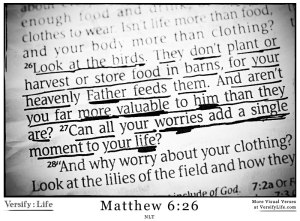
Courtesy of http://www.versifylife.com/category/topical/worry/page/2/

Courtesy of http://www.versifylife.com/category/topical/worry/page/2/

One of my favorite passages of scripture is from Matthew.  “Therefore I tell you, do not worry about your life, what you will eat or what you will drink, or about your body, what you will wear.  Is not life more than food, and the body more than clothing?  Look at the birds of the air; they neither sow nor reap nor gather into barns, and yet your heavenly Father feeds them.  Are you not of more value than they?  And can any of you by worrying add a single hour to your span of life? – Matthew 6:25-27  Although I know the truth of this passage about our relationship between trust and God, I find that I am always returning to it, never fully mastering it.  In fact, I am not even sure that I have partially mastered it.

My only saving grace has been becoming a parent.  I have often joked that God knew what God was doing when God made me a parent.  Perhaps God knew that the only way I would really start to believe that I could trust God was to throw someone in my life whom I have very little control over – a microcosm of the larger world.  That point has been resurfacing several times for me lately.  When school is cancelled because of snow, I have no way of attacking my work in the same way that I would if she were in school.  When the roads become too dangerous for driving on my day off with my daughter (i.e., “errand day”), those groceries that we just cannot live without suddenly become groceries we can live without.  Just today, another school weather-related cancellation day, as I was scrambling around trying to figure out how to busy my daughter while getting a little work done, my daughter asked if she could make Valentine’s Day cards for her classmates.  My immediate thought was, “No, I don’t have time to sit with you and do that.”  But I took a breath and considered her proposal.  One, we would be able to do something together that we would not normally do.  Two, the task would certainly entertain my daughter, which is pretty much golden on a snow day.  Three, making homemade Valentine’s is super cute, and something I never would have made time for otherwise.  So, I exhaled in defeat, and we both gathered the necessary supplies.  And it turns out that making homemade Valentine’s is pretty fun, and can even be a creative outlet for stress reduction.

So today, I am thankful for the God who puts people in my life to force me to be a better person of faith.  I am grateful for God’s awesome and powerful creation, who has certainly taught me a few lessons this winter about the fruitlessness of worry.  And I am blessed by the God who reminds me in small and large ways that I cannot, “worry about tomorrow, for tomorrow will bring worries of its own.  Today’s trouble is enough for today.” – Matthew 6.34

Homily – Matthew 6.25-33, TG, YC November 28, 2013

05 Thursday Dec 2013

Posted by jandrewsweckerly in Uncategorized

≈ Leave a comment

Tags

control, God, gratitude, Jesus, Sermon, Thanksgiving Day, trust, worry

Our gospel lesson today is one of my favorites.  Jesus’ instructions not to worry are a soothing ointment for the constant itch of worry in my life.  His words calm my nerves and remind me of the need for perspective.  I can almost imagine Jesus as a yoga instructor, calmly affirming a room of people who are trying to take in deep breaths and to relax their tight muscles.  As I think about the heavenly Father who knows my every need, I am given a sense of perspective and calm that I can rarely muster on my own.  Because I am a person prone to worry, this passage truly is one of my favorite passages from scripture.

That being said, this passage is also one of my least favorite passages.  We tend to think of ourselves as having a certain amount of responsibility in this life – a responsibility to use the talents God has given us to care for ourselves, and even to care for others.  But who among us has not had times when that was just not possible – either from being laid off or furloughed from work, not being able to find a job in unemployment, or having an injury that has made our work impossible.  Besides, what does Jesus expect us to do?  Just go about life, expecting everything to be handed to us – clothing, food, and drink?  The proposition seems naïve and ultimately frustrating.

But even harder than a basic frustration with Jesus is the underlying message of what Jesus is saying:  that through our behavior of worrying, we are implying that we have ultimate control over life, and that God plays little, or at least a superficial, role in our lives.  The presumption of worry is the presumption that we have the ability to fully control what happens and then fix things when they go awry.  Our worrying is a way of saying to God, “I do not trust you to handle things in my life.  I am not willing to give up that control to you.”  One question from Jesus summarizes this conflict for us, “Can any of you by worrying add a single hour to your span of life?”  Jesus really knows how to get to the heart of the matter, and when he does, his words feel like a stab to the heart.

Truthfully, there really could not be a better lesson for us today on Thanksgiving Day.  I imagine every one of us has had a worry about this day in the past week or more.  Talk about worrying about what you will eat!  We stress about what food to serve, how to accommodate our gluten-free friends in the menu, what items can be prepared in advance, how to get the moistest turkey, and whether we have made enough for those gathered.  Some of us have worried about what outfit to wear, knowing there will be countless photos trying to capture the happiness of this day.  And what to drink?  I know parties where the host has purchased copious amounts of wine, despite delegating wine to guests, for fear that there will not be enough to cover the gathering.  And those worries do not even cover the other worries of the day – how to fit in Eucharist while the turkey is still cooking, whom to sit near our cranky aunt, and what kind of arguments might erupt between family members.  For those hosting meals, many of us barely have a chance to catch our breath after the meal before the clean-up process begins.

But that is the beauty of this lesson today:  like our eternal battle between worry and control, this special day also has the potential for lost focus.  Our country, with all its flaws, gives us a day that is almost sacred in nature – a day set aside for gratitude and thanksgiving; a day when we can pause, and remember the abundant blessings of our lives and the incredible gift of this life.  And if we are at all considering what we are grateful for, our minds inevitably end up with God – the one from whom all blessings flow.  The simple act of thanksgiving melts away tensions, and turns our worry-hardened hearts to hearts overflowing with gratitude.  When we really think about all that we have to be grateful for, the list gets longer and longer – even if we are not even in much of a mood to celebrate.

I was wondering, then, how we might incorporate the lessons we learn today from the gospel and from Thanksgiving Day into a rule of life beyond this day.  Then I remembered the last line of the gospel, “But strive first for the kingdom of God and his righteousness, and all these things will be given to you as well.”  We have been singing these very words since September, “Seek ye first the kingdom of God and his righteousness.  And all these things shall be added unto you.  Alleluia.”  I have been singing these words every Sunday, and I took until today, with today’s gospel and today’s celebration to finally connect the dots.  The answer is not to throw up our hands, naively trusting God to put food on the table.  The answer is changing our pursuit – not pursuing the things that we think we want and need, but instead pursing the kingdom of God.  The rest is just gravy.  Amen.

Sermon – Matthew 6.25-33, Thanksgiving, YB, November 22, 2012

23 Friday Nov 2012

Posted by jandrewsweckerly in Uncategorized

≈ Leave a comment

Tags

anxiety, God, Jesus, Sermon, Thanksgiving, worry

Today is one of those Norman Rockwell days.  We pull out old family recipes, we gather in the kitchen to cook and share in reminiscences.  We watch the Macy’s parade, hoping to sneak a glimpse at The Rockettes.  We map out which football games we will watch.  The table is set in festive ware, and the food is not only delicious, but also brings back the memories of so many other Thanksgiving meals.  We smile, laugh, and our hearts are full of gratitude.  This is the day that the Lord has made.

Or at least that is how we always fantasize Thanksgiving will look.  Instead, we have been scrambling around, making sure we have all the ingredients we need, trying to figure out what to serve to Cousin Sam’s vegan girlfriend.  We worry that Uncle Fred will be as rude and obnoxious as he always is, and whether the kids will get too impatient and cranky before the meal begins.  We worry that the turkey will be dry or that the recipe that we entrusted to our sister will not be as good as Grandma’s.  We struggle to find just the right outfit that is flattering enough for pictures, but comfortable enough for the full belly we will have after the meal.  And quite frankly, having finally mostly recovered from the Hurricane, we have barely had time to turn our thoughts to Thanksgiving, and our nerves are a little frazzled.

So as we rush into Church today, our minds full of to-do lists and worries of the day, what do we hear from Jesus?  “Do not worry about your life, what you will eat or what you will drink, or about your body, what you will wear.  Is not life more than food and the body more than clothing?”  Jesus scolds those who are gathered for that very human experience of anxiety, implying that their worries are rooted in a lack of trust in the God who can just as easily care for birds and lilies as God can care for them.

I have always had a love-hate relationship with this passage.  I discovered this passage as a teen, and have returned to the passage time and again when I felt the waves of anxiety crashing over my head.  The passage is oddly comforting and frustrating at the same time.  The passage has a way of making me feel guilty about my anxiety – as though I should be ashamed of my worries and concerns.  I can almost hear the scolding tenor of Jesus, like a nagging mother.  But like most mothers who know best, the words are simultaneously comforting because I know that they are true at the deepest levels of my being.  I find comfort in these words because they force me out of the mire that is usually self-imposed, and turn my heart to where my heart belongs – to God.

Luckily, we are in good company.  Our modern consumerist society does not make us as different from those in Biblical times as we might think.  Clearly those following Jesus stressed as much as we do about putting food on the table and the latest clothing styles.  In fact, this fear is present throughout scripture.  How many times have we heard that command, “Fear not.”  “The order not to fear is perhaps not only the most reiterated in Scripture, but also the least obeyed.”[i]  What Jesus sees and why Jesus scolds is because Jesus knows that those anxieties pull us away from the work that God has given us to do.  When those doing God’s work get distracted by their worries and fears, they have little time or energy left to actually do God’s work.  This is what Jesus is trying to communicate – to redirect energy from that inner storm of worry, fear, and anxiety, to the productive work of God’s kingdom.  For, as Jesus explains, “Can any of you by worrying add a single hour to your span of life?”  Worry pulls us inward – which is completely the opposite direction that the Church sends us after every Eucharist.

Today, instead of letting myself wallow in guilt or seeing Jesus as a scolding parent, I will think of Jesus as a great yoga instructor.  In yoga, one of the primary goals of the practice is to clear your mind.  Any good yoga instructor will admit that you cannot clear your mind by willing your mind to be clear.  Thoughts and distractions will continue to invade your practice.  The trick is to acknowledge the thought, and let the thought go, returning your focus to your practice.  Uncle Fred worrying you?  Release the fear from your body.  Perfect Thanksgiving meal weighing on you?  Let go of the anxiety from your mind.  Rowdy children and messy dishes stressing you out?  Free your heart to love without limit.  These are the words I imagine Jesus, the yoga instructor, offering us today.  Today is not really about any of those things anyway.  All of those things – food, loved ones, and rest – are gifts from God:  the same God that desires for you to do the work of seeking and serving Christ in others.  The rest is gravy!  Amen.


[i] Jason Byassee, “Theological Perspective,” Feasting on the Word, Yr. A, vol. 1 (Louisville: Westminster John Knox Press, 2010), 406.

Recent Posts

  • On the Myth and Magic of Advent…
  • On Risking Failure and Facing Fear…
  • Sermon – Luke 23.33-43, P29, YC, November 23, 2025
  • On Inhabiting Gratitude…
  • Sermon – Luke 20.27-38, P27, YC, November 9, 2025

Archives

  • December 2025
  • November 2025
  • October 2025
  • September 2025
  • August 2025
  • July 2025
  • June 2025
  • March 2025
  • February 2025
  • December 2024
  • November 2024
  • October 2024
  • September 2024
  • August 2024
  • July 2024
  • June 2024
  • May 2024
  • March 2024
  • February 2024
  • January 2024
  • December 2023
  • November 2023
  • October 2023
  • September 2023
  • August 2023
  • July 2023
  • June 2023
  • May 2023
  • March 2023
  • February 2023
  • January 2023
  • December 2022
  • November 2022
  • October 2022
  • June 2022
  • May 2022
  • January 2022
  • December 2021
  • November 2021
  • October 2021
  • September 2021
  • August 2021
  • June 2021
  • May 2021
  • April 2021
  • March 2021
  • February 2021
  • January 2021
  • December 2020
  • November 2020
  • October 2020
  • September 2020
  • August 2020
  • July 2020
  • June 2020
  • May 2020
  • April 2020
  • March 2020
  • February 2020
  • January 2020
  • December 2019
  • November 2019
  • October 2019
  • September 2019
  • August 2019
  • July 2019
  • June 2019
  • May 2019
  • April 2019
  • March 2019
  • February 2019
  • January 2019
  • December 2018
  • November 2018
  • October 2018
  • September 2018
  • August 2018
  • July 2018
  • June 2018
  • May 2018
  • April 2018
  • March 2018
  • February 2018
  • January 2018
  • December 2017
  • November 2017
  • October 2017
  • September 2017
  • August 2017
  • July 2017
  • June 2017
  • May 2017
  • April 2017
  • March 2017
  • February 2017
  • January 2017
  • December 2016
  • November 2016
  • October 2016
  • September 2016
  • August 2016
  • July 2016
  • June 2016
  • May 2016
  • April 2016
  • March 2016
  • February 2016
  • January 2016
  • December 2015
  • November 2015
  • October 2015
  • September 2015
  • August 2015
  • July 2015
  • June 2015
  • May 2015
  • April 2015
  • March 2015
  • February 2015
  • January 2015
  • December 2014
  • November 2014
  • October 2014
  • September 2014
  • August 2014
  • July 2014
  • June 2014
  • April 2014
  • March 2014
  • February 2014
  • January 2014
  • December 2013
  • November 2013
  • October 2013
  • September 2013
  • August 2013
  • July 2013
  • June 2013
  • May 2013
  • April 2013
  • March 2013
  • February 2013
  • January 2013
  • December 2012
  • November 2012
  • October 2012
  • September 2012

Categories

  • reflection
  • Sermons
  • Uncategorized

Meta

  • Create account
  • Log in
  • Entries feed
  • Comments feed
  • WordPress.com

Blog at WordPress.com.

  • Subscribe Subscribed
    • Seeking and Serving
    • Join 394 other subscribers
    • Already have a WordPress.com account? Log in now.
    • Seeking and Serving
    • Subscribe Subscribed
    • Sign up
    • Log in
    • Report this content
    • View site in Reader
    • Manage subscriptions
    • Collapse this bar
 

Loading Comments...