• About

Seeking and Serving

~ seek and serve Christ in all persons

Seeking and Serving

Monthly Archives: February 2014

On discomfort…

26 Wednesday Feb 2014

Posted by jandrewsweckerly in Uncategorized

≈ 4 Comments

Tags

discomfort, God, Good News, hypocrite, Jesus, need, neighbor, scripture, uncomfortable

I have regularly told people that when I preach, I am preaching to myself.  I find that my messages often resonate with others, but first and foremost, I make sure they resonate with me.  This has led to me needing to be honest about my faith struggles, to be vulnerable about how I still need to grow, and always seeking how God is speaking in fresh ways to me, calling me into deeper relationship with God.

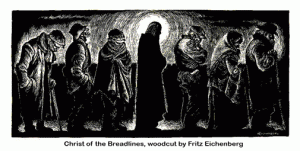
This Sunday though, I found myself with a profound sense of conviction that I have yet to experience.  My sermon was about Matthew 5.38-48, and can be found here.  But what you would not know is that between our 8 am service and our 10 am service, a neighbor in need stopped by to ask if for financial assistance.  I had spoken with this neighbor before, and helped by covering the neighbor’s rent within the last month.  In general, I am able to help neighbors in similar situations because of my discretionary fund – a fund supported by the church and by contributions when I perform weddings or funerals.  But the fund is not large, and so my general policy is to keep within a certain range for each distribution of funds and to only offer assistance to the same family once every six months.  The idea behind the policy is that this allows me to help more families, and keeps enough monies in the fund for emergencies.  So when this neighbor came on Sunday, asking for further assistance, nowhere near the normal six-month wait period, the case seemed cut and dry to me.  I could not offer him what I would not offer to others.  Instead, I gave the neighbor some referrals for additional help, and we lit a prayer candle and prayed together before the neighbor left.

Courtesy of http://catholicworkeraustin.org/mercy.html

Courtesy of http://catholicworkeraustin.org/mercy.html

But the tricky part was getting back in the pulpit at 10 am.  I had just read aloud Jesus’ words from the gospel lesson, “Give to everyone who begs from you, and do not refuse anyone who wants to borrow from you.”  And I preached about seeing others with God’s loving eyes.  And though I felt like I was preaching the right message, and I know that ultimately I did the right thing with our neighbor, I still felt a little sick to my stomach.  As one who proclaims the Gospel, I felt like a hypocrite.  I remember wondering how if our neighbor had stayed for worship, whether the neighbor would have thought I was a hypocrite too.  And yet, I also felt an overwhelming sense that any kind of exceptions I had made that day would have undermined my ministry in our community.

I still have not come to peace about the situation.  I do not have some clean, clear answer that makes the situation feel resolved or redeemable, even if I still feel I made the right decision.  But in these last days, I have been thinking that perhaps my discomfort is the point.  I try regularly to find the Good News in scripture – to find where the hope might be in seemingly challenging or bad news.  But perhaps this week it is okay if I am just uncomfortable.  Perhaps we all need to dwell in the discomfort that the Gospel creates from time to time – only then can we be more authentic followers of Christ.

Sermon – Matthew 4.38-48, E7, YA, February 23, 2014

26 Wednesday Feb 2014

Posted by jandrewsweckerly in Uncategorized

≈ 1 Comment

Tags

enemy, eyes, God, Jesus, love, power, see, Sermon, transformation

Julio Diaz has a daily routine.  Every night, he ends his hour-long subway commute to the Bronx one stop early so he can eat at his favorite diner.  One night, as Diaz stepped off the Number 6 train and onto a nearly empty platform, his evening took an unexpected turn.  He was walking toward the stairs when a teenage boy approached and pulled out a knife.  The boy demanded his money, and Diaz gave him his wallet, simply saying, “Here you go.”  As the teen began to walk away, Diaz shouted out, “Hey, wait a minute.  You forgot something.  If you’re going to be robbing people for the rest of the night, you might as well take my coat to keep you warm.”  The robber gave Diaz a confused look and asked, “Why are you doing this?”  Diaz simply said, “If you’re willing to risk your freedom for a few dollars, then I guess you must really need the money.  I mean, all I wanted to do was get dinner.  If you want to join me … hey, you’re more than welcome.”

The teen tentatively followed Diaz to the diner and they sat in a booth together.  As they sat there, the manager, the dishwashers, and the waiters came by to say hi.  The teen then said, “You know everybody here.  Do you own this place?”  “No, I just eat here a lot,” Diaz replied.  “But you’re even nice to the dishwasher,” the teen said incredulously.  Diaz replied, “Well, haven’t you been taught that you should be nice to everybody?”  “Yea,” responded the teen, “But I didn’t think people actually behaved that way.”

Toward the end of dinner, Diaz asked the teen what he wanted out of life.  The teen reacted with a sad look on his face, but did not respond.  Either he couldn’t answer – or he didn’t want to.  When the bill arrived, Diaz told the teen, “Look, I guess you’re going to have to pay for this bill because you have my money and I can’t pay for this.  So if you give me my wallet back, I’ll gladly treat you.”  Without hesitation, the teen returned the wallet.  Diaz opened his wallet and gave the teen twenty dollars, figuring the money might help him somehow.  However, in return, Diaz asked for the teen’s knife.  The teen gave the knife to him.[i]

Today’s gospel lesson is often taken in a couple of ways.  The words from Jesus about turning the other cheek and loving our enemies either sound so passive that we dismiss them immediately or they sound admirable, but totally impossible.  All we need is the last verse, which says, “Be perfect, therefore, as your heavenly Father is perfect,” before we throw our hands into the air, defeated before we have even begun.  In fact, if we are really listening, we can almost become angry with Jesus’ words.  All we have to think about is a victim of abuse and we bristle at Jesus’ instructions to simply turn the other cheek or go a second mile.  Or maybe we think of a lifetime of pressure to be perfect and all we want to do is angrily add Jesus to the list of people who are perpetually disappointed in us – including ourselves.  Of course we would never say those things aloud because this is supposed to be a beautiful text about loving your neighbor as yourself.  But really, who among us wants to love our enemies or pray for those who persecute us?

We are really good at hating our enemies.  As a country we demonize those with whom we go to war.  And depending on which news outlet you prefer, the Democrats, the Republicans, or the Tea Party are enemies of any progress we want to see in our country.  I am pretty sure the Republicans and Democrats in Congress have not been praying for each other over this past year.  And that does not even compare to the more personal enemies we have.  All we have to think about is that bully at school or work, that family member who is always trying to put you down, let alone that teen who looks like he might be ready to pull a knife on you and demand your wallet.  We are schooled to be empowered people who do not allow ourselves to be doormats.  We are not to turn the other check but to protect ourselves.  We are not to offer more of our stuff to someone threatening to take our stuff.  And we certainly are not schooled to give to every single person asking for a handout.  Surely, in turning the other cheek, we become a victim; in offering our cloak, we are enabling bad behavior; and in giving to beggars, we are simply perpetuating social problems.  We build strong, fortified walls around ourselves in the name of safety, protection, or wisdom.

The challenge for us is seeing what Jesus is really trying to do.  Our way of being demonizes others and simplifies quite complicated relationships.  Jesus way of being invites us to see with God’s loving eyes.  That is what Jesus means when he says to be perfect as God is perfect.  He does not mean for us to achieve some sort of moral or even everyday perfection; Jesus means for us to love as God loves.[ii]  God’s love does not allow us to use labels like “us” and “them.”  God’s love means looking at that enemy who hurts us, threatens us, or even scares us, and seeing the humanity lying beneath those ugly layers.  God’s love means transformation through the simple act of praying for our enemies.  Perhaps your prayer begins without words – just the mental image of the person.  But you may find that as you continue to pray for that individual, slowly you begin to see with God’s eyes.  What should you pray for?  What is redeeming in them?  What could God do to soften them and our relationship with them?

I think of Julio Diaz on that fateful night in the Bronx.  When Diaz told his mom what had happened that night, she said, “Well, you’re the type of kid that if someone asked you for the time, you gave them your watch.”  Clearly Diaz had this “loving your enemies” thing down.  In fact, maybe Diaz saw what Jesus could see – that in God, there are no enemies.  There are just people for us to love.  Diaz does not use Christian language to describe his philosophy.  He simply explains about his story, “I figure if you treat people right, you can only hope that they treat you right.  It’s as simple as it gets in this complicated world.”  Of course we would say, love your neighbor as yourself or do unto others as you would have them do unto you.  Today, Jesus says, “love your enemies and pray for those who persecute you.”

What is not obvious in either Diaz or Jesus’ stories is the subtext of what is happening.  In neither story is passivity the theme.  Instead, both are advocating for active transformation.  What Jesus is talking about is quietly resisting evil.  When he says to turn the other cheek, he is saying startle the person into the decision of whether to hit again.  When someone sues you for your coat, you giving them your cloak actually embarrasses them instead of you.  Though the person suing may have had a right to the coat, your offering your cloak too, being stripped down in front of everyone, humiliates the one suing more than being stripped down humiliates you.  And by walking that second mile, you claim ownership of your own being.  The one forcing you to walk a mile loses her power when you walk the second mile.[iii]  Diaz understood this.  By offering his coat and by inviting the teen to a meal, he shifted the power in the encounter.  By engaging that teen in conversation, and by probing further with him, he began to unravel the mystique of the thief, and found a vulnerable, desperate young man underneath.

The work that Jesus invites us into this week is not easy.  Shouting after a thief on an empty platform, trying to give him your coat and a meal is probably not that instinctive for most of us.  Quiet resistance is a lot harder than passive acceptance or violent retaliation.  Loving your enemies will not feel natural.  So maybe you start with prayer this week.  Maybe you simply start by praying for an enemy and see where the spiritual practice leads you.  That first step will begin the journey to seeing as God sees:  with eyes of love – difficult, radical, transforming love.  Amen.


[i] Story, slightly edited, as told in “A Victim Treats His Mugger Right,” March 28, 2008.  Found at http://www.npr.org/2008/03/28/89164759/a-victim-treats-his-mugger-right on February 21, 2014.

[ii] Barbara J. Essex, “Pastoral Perspective,” Feasting on the Word, Yr. A., Vol. 1 (Louisville: Westminster John Knox Press, 2010), 384.

[iii] Walter Wink, “How Turning the Other Cheek Defies Oppression,” May 4, 2009, as found at http://www.ekklesia.co.uk/node/9385 on February 20, 2014.

Getting back in the game…

21 Friday Feb 2014

Posted by jandrewsweckerly in Uncategorized

≈ Leave a comment

Tags

Carolina, Duke, faith, God, journey, rivalry

Courtesy of http://chapelboro.com/calendars/duke-carolina-the-blue-blood-rivalry-2/

Courtesy of http://chapelboro.com/calendars/duke-carolina-the-blue-blood-rivalry-2/

I am a huge college basketball fan.  Well, actually I am a huge Duke Basketball fan, which means I tend to know more about college basketball than any other sport.  This week is the Duke-Carolina game – one of the biggest rivalries in the country and certainly one of the biggest sporting events all year in my home.  What is so great about the rivalry is that no matter what the rankings are for either team at any point in the season, and whether the game is played at Duke or at Carolina, you never know who will win.  Something about the intensity of the rivalry means that no matter how dominant one team might normally be that season, and no matter what advantages being the “home” team might bring a team, there is very little way to predict how the game will evolve.  Consequently, watching the Duke-Carolina games each season make me intensely nervous and anxious.  In fact, as I have gotten older, I have even turned the TV off when I get so stressed.

I have been thinking about that phenomenon and wondering what in our faith life is like the anomaly of the Duke-Carolina game.  Where in our lives do our normally highly functioning spiritual selves get short circuited?  I have begun to wonder whether my prayer life might be the Duke-Carolina game in my faith journey.  There are times when I feel like my prayer life is solid – I find a practice that I really love and I find that keeping the practice is easy and enriching.  But then I have weeks when I get to the end of several days and cannot remember the last time I prayed.  Or I realize that instead of sitting down in the empty church for a time of prayer each morning, I have just starting praying as I pass through, not feeling like I have the time to really stop.  Sometimes the season – in particular Lent – makes me more disciplined.  But even the steady rhythm of Lent does not guarantee that I am steadfast in my prayer life.

The truth is, whatever the Duke-Carolina hiccup is in your faith journey, I am not sure there is much you can do about it.  Much like neither team can seem to master the intensity of the rivalry, I think we will always have a flawed area in our faith life.  Perhaps knowing that fact will allow us to not be so hard on ourselves and enjoy the ride.  Certainly that does not give us permission to sit back and pretend things are out of our control.  Neither team goes into the Duke-Carolina game resigned to lose.  Our task is to keep on trying, to keep tabs on when we are getting slack, and to slap the floor, and get back in the game!

Sermon – Matthew 5.21-37, E6, YA, February 16, 2014

21 Friday Feb 2014

Posted by jandrewsweckerly in Uncategorized

≈ Leave a comment

Tags

actions, God, intention, Jesus, law, relationship, Sermon, uncomfortable, words

Today is one of those Sundays when you hear the gospel and your response is, “Whoa there, Jesus!”  If there is not something in the gospel lesson that makes you uncomfortable, I would be shocked.  All the hard stuff is here today: conflict between family members and neighbors, lustful thoughts, divorce, and even oaths.  That last one may not sound all that upsetting, but wait until we talk about oaths, and you will start to get uncomfortable about that one too.  As modern-day Christians, there are parts of the Bible that we would just prefer to skim over – those tough lessons that we either do not abide by or totally disagree with – but that we try to ignore so that we can still claim to believe in Holy Scripture.  In fact, just last week in Adult Forum we were talking about how preachers in the Episcopal Church never get to choose the scripture for a given Sunday.  That is both the beauty and the challenge of being an Episcopalian.  By following the assigned lectionary, we hear the beautiful breadth of scripture, and are also forced to deal with the tough stuff of scripture.

Let’s review the tough stuff first.  First Jesus says that before the people of God offer gifts at the altar, they should make sure they are reconciled with their sister or brother.  Now if each of us had to make sure that all of our relationships were reconciled before we came to the Eucharistic table, I would imagine most of us would rarely receive Eucharist.  Think about that family member, that fellow parishioner, or that friend from school or work with whom you just had an argument.  Did you reconcile with them before coming to church today?

Next Jesus tells the people that avoiding adultery is not enough – they must even avoid lustful thoughts because that is as sinful as committing adultery.  You would have to be pretty immune to our entire culture not to face lust today – in advertising, in entertainment, and throughout media.  That does not even account for the lust we experience in spontaneous encounters with strangers, let alone with acquaintances and friends.

Then Jesus adds that anyone who divorces or who marries a divorcee is committing adultery.  With over half of marriages ending in divorce today, each one of us here is impacted by a divorce: if not our own, then the divorce of a family member or a friend.   I have a distinct memory of studying a Bible passage like this in Sunday School was I was in high school.  My teacher at the time had been divorced, but was thriving in a second marriage.  I asked her if we really believe Jesus’ words nowadays, and she insisted that we do.  I demanded to know how that could be since she and her husband were so happy and faithful.  She stated matter-of-factly that she and her husband would be judged for their lives.  To be honest, knowing how faithful she was, and how judged she felt by scripture, I began to question my faith altogether.

Finally Jesus instructs the people of God not to take oaths.  This one may sound a little strange, but basically Jesus is saying that you should never have to swear an oath because people should always be able to trust your word.  Your “yes” should mean yes, and your “no” should mean no.  So when your teacher asks you if you did all the reading or your boss asks you if you have completed a particular task, your “yes” better mean yes.  When you insist that you have not done something, you had better be sure that that “no” can be trusted.  In essence, there should be no need for you to swear at any point in life because your word can always be trusted.  You should not have to promise to not tell anyone else a secret because you have never told another person’s secret.  I do not know about you, but that makes me think a lot harder about what words come out of my mouth, sometimes even out of habit.

So are you uncomfortable yet?  Is your mind spinning from all the ways in which your behavior is contrary to what Jesus instructs today?  The good news is that there is actually good news.  Jesus does not offer these four rules as a way of making faithful living harder than faithful living already is.  As Jesus says in the verses preceding what we hear today, Jesus does not come to abolish the law, but to fulfill the law.  In other words, Jesus is still preaching the law of God, but Jesus is trying to get the people to see the intention behind the law.  So Jesus says, “Yes, do not murder, but really beware of anger altogether.”  Anger erodes not just our relationships with others but anger erodes our relationship with God.  Instead, by being a person who seeks reconciliation, we can be people bringing about the reign of God in our midst.[i]  Jesus longs for us to have the peace that comes in living a life that strives for reconciliation as opposed to the life that is willing to tolerate brokenness.  Of course, God knows relationships are complicated, and that some relationships are downright harmful.  But what Jesus is trying to get at is that longing for peace and reconciliation is the first step in healing not only specific relationships, but in healing the community of faith.

Jesus also affirms the original law about not committing adultery and not coveting; but he adds lust as being equally offensive.  Now I know this one is tricky because we are sexual beings and our sexuality is a gift from God.  But what Jesus wants us to acknowledge is that lingering on lust takes our attention away from healthy, loving relationships.  Furthermore, Jesus also affirms the dignity of every human being by affirming that no one should be treated as a sexual object.  Jesus is not saying deny your sexuality; Jesus is simply reminding us to celebrate healthy expressions of that sexuality.  I am reminded of a couple of music videos put out by pop-star Beyonce recently.  My first response to the videos was that they were pretty sexually explicit.  But when you listen to the words and see that her husband is the male counterpart in the video, you can see that Beyonce is simply celebrating the gift of healthy sexual experiences within the covenant of marriage.  Though the idea might be a stretch, perhaps what Beyonce is trying to communicate is not that she should be an object of sexual desire, but that we all should celebrate the gift of sexuality experienced within covenanted relationships.

Next, what Jesus says about divorce is not much different than what was already understood about divorce.  But what Jesus adds is a sense of accountability, particularly for men, to tend to the well-being of their wives, who are made the most vulnerable in divorce in Jesus’ time.  We all know the devastating effects of divorce; and fortunately, many of us have come through the other side to see the health and wholeness that come from ending unhealthy relationships and even in finding new thriving ones.  But what Jesus is really talking about here is being more attentive to the way that our actions impact the most vulnerable in society.  Our life decisions and actions are not made in a vacuum.  Jesus is encouraging us to be thoughtful and intentional about how we make those decisions and then how we handle their implications.  In the end, that sees to the welfare of a much broader range than simply ourselves.

Finally, what Jesus says about oaths is not as legalistic as it sounds, even though there are faith traditions that refuse to swear oaths.  Ultimately, what Jesus is trying to get us to see is that our words and our integrity matter.  If we are truthful people, then we have no need for oaths.  Jesus’ invitation is for us to be thoughtful about our words, not only being a people who actively tell the truth, but also being people who do not flippantly use words or make promises without considering their implications.

So ultimately, Jesus tells us today that our actions, our words, our relationships matter.  As followers of Christ, we do not get to be independent agents who care only for ourselves – a concept that is pretty counter-cultural in the United States.  Jesus’ words and their implications do put a burden on us and sometimes make us feel uncomfortable.  But in the end, Jesus words and their implications also make for healthier relationships, a healthier community, healthier relationships with God, and ultimately, a healthier version of yourself.  So embrace the uncomfortable, and know that Jesus has your back!  Amen.


[i] Marcia Y. Riggs, “Theological Perspective,” Feasting on the Word, Yr. A., Vol. 1 (Louisville: Westminster John Knox Press, 2010), 358.

Homily – Galatians 2.19-20, Mark 8.34-38, Martyrs of Japan, February 6, 2014

12 Wednesday Feb 2014

Posted by jandrewsweckerly in Uncategorized

≈ Leave a comment

Tags

cross, death, Jesus, life, martyrs, Martyrs of Japan, witness

Today we celebrate the martyrs of Japan.  Christianity was first introduced in Japan in the 1500’s, first by the Jesuits and then by the Franciscans.  By the end of the 1500’s, there were about 300,000 baptized believers in Japan.  But the successes were compromised by both rivalries among religious orders and the interplay of colonial politics.  Eventually, all Christians suffered cruel persecution and suppression.  The first victims, whom we honor today, were six Franciscan friars and 20 converts who were crucified in Nagasaki in 1597.  By 1630, what was left of Christianity was driven underground; yet 250 years later, many men and women, without priests, persevered with their faith.

I have been thinking a lot about those martyrs.  First, I am still a little shocked by the idea of someone being actually crucified almost 1,600 years after Jesus’ death.  I didn’t even think people would do that anymore.  Second, I am astounded by the idea of someone using that form of murder on Christians – crucifixion seems like the ultimate form of insult and torture one could commit that would certainly intimidate and dissuade followers.  What is so sobering to me about the martyrs’ deaths is that the murderers almost seem to be using the faith against the followers, as if to say, “You want to follow Jesus Christ?  Then do what Jesus says in Mark’s gospel and take up your cross.  We may think of “taking up one’s cross” as a description of the suffering for following Jesus – but we often forget that the cross ultimately points to death.  That is an extreme form of witness that few of us would be comfortable assuming.

I think where the gospel, the epistle and even the martyrs are trying to get us to is an emptying of the self and an assuming of total dedication to Christ.  Now we may not be literally crucified in our age, but if we fully embrace the idea of taking up a cross, we fully submit our lives to God.  Certainly there will be dramatic moments – I always remember those kids in Columbine who at gun point were asked to deny their faith.  But more likely, the moments will be small, but tremendous.  Seeing God in the homeless man; saying something uncomfortable among a group of friends because your faith compels you to challenge the direction of the conversation, re-examining your life patterns to assess the ways you have already put your cross down.  Though taking up our crosses now may seem ambiguous, when we take on that work, we will find death – death to our old way of being and life in a new way of being.  Amen.


This homily, along with the several posted immediately after date from December 2013 – February 2014.  When we celebrate Eucharist each Thursday morning at St. Margaret’s, I preach a short homily to celebrate the feast day of whatever saint falls nearest to that day (as appointed by Lesser Feasts and Fasts and Holy Men, Holy Women).  A parishioner helps me to transcribe the homilies so that others can enjoy them too.  We seem to have finally caught up now – enjoy!

Homily – Philippians 4.4–9, John Bosco, January 30, 2014

12 Wednesday Feb 2014

Posted by jandrewsweckerly in Uncategorized

≈ Leave a comment

Tags

gentleness, God, goodness, John Bosco, Lord, rejoice

John Bosco, who we celebrate today, was born in the late 1800s in Italy.  He lost his father at age two, but he managed to retain a sweet, kind disputation.  At age nine, he received a vision of Jesus Christ and the Virgin Mary encouraging him to be kind, obedient, and hardworking – a vision that began his vocation early in life.  Eventually, Bosco went to seminary and became a priest and was assigned as chaplain to a girls’ boarding school.  But before long, Bosco was not satisfied working with well-to-do young women – he was more drawn to the ragamuffin boys outside the school – so much so that he opened an orphanage for them in 1846. Eventually his work led to the formation of the Salesian order, a group of women religious, lay brothers and dedicated laity who operated orphanages, vocational schools, and night-time primary schools for working people.

Having watched the recent State of the Union address, and especially the commentary following, I think we as a country have lost a lot of what Bosco embodied – the sweet, kindness that shows love to one another.  We are so busy being right that we forget what being kind to one another looks like.

We see a difficult invitation from Philippians today, “Let your gentleness be known to everyone.” Gentleness is not one of those virtues we value today – instead we have become rigid upholders of what is right – much as we saw when our government shut down last year.  Showing love sounds good, but showing love is much harder in practice.

So how can we become a people full of love like Bosco’s?  Two things emerge from Philippians: First, the text says, “Rejoice in the Lord always, again I will say, Rejoice.”  Rejoicing in God may seem silly, but having words of adoration for God always on our lips makes loving a lot easier.  Focusing on God somehow takes us out of ourselves and puts us back on track with being agents of love.  Second, the text says, “whatever is true, whatever is honorable, whatever is just, whatever is pure, whatever is pleasing, whatever is commendable, if there is any excellence and if there is anything worthy of praise, think about these things.”  In other words, we have to actively pull our minds out of the messiness of our lives and set our minds on goodness.  Perhaps then we might find our ways to the kindness, generosity, and love we find in people like Bosco.  Amen.

Homily – Ephesians 3.14-21, Phillips Brooks, January 23, 2014

12 Wednesday Feb 2014

Posted by jandrewsweckerly in Uncategorized

≈ Leave a comment

Tags

abundance, God, grace, love, others, Phillips Brooks

We all have someone in our lives who has brought us a little closer to God.  Maybe it was an outstanding preacher, who opened up a connection between your everyday life and Holy Scripture.  Maybe it was a friend who always could see God moving in the midst of everyday events.  Maybe it was a public figure who seemed to live the life of faith in ways we can only dream to do.  For me, it was my Old Testament professor in seminary.  To be honest, I never really liked the Old Testament; I found it to be full of violence, an unfamiliar God, or even just books that were hard or cumbersome to read.  But then I had this professor, who seemed to come alive with every word in the Old Testament.  She overflowed with passion, joy, insight, and light.  She opened up the Hebrew text in ways I had never understood and made me fall in love with a set of books I had written off as irrelevant.

In some ways, Phillips Brooks, who we honor today, offered that same insight to others of his time.  Born in 1835, Brooks served as a priest in Philadelphia and Boston.  He was a dynamic preacher – in fact, he is often called the greatest preacher of the century.  Though his sermons are engaging to read, many say they don’t capture the warmth and vitality of his delivery – in fact, many say that he spoke to his audience as a person might speak to a friend.  Brooks inspired men to enter the ministry, and was able to appeal to conservatives and liberals alike.  In 1891, he was elected bishop of Massachusetts.  His personality and preaching, along with his deep devotion and loyalty, gave that diocese the spiritual leadership they needed.

The joy for God that Brooks seemed to have sounds a lot like Paul in our epistle lesson today.  Paul says, “I pray that you may have the power to comprehend, with all the saints, what is the breadth and length and height and depth, and to know the love of Christ that surpasses knowledge, so that you may be filled with all the fullness of God.”  What Paul wanted for the Ephesians is the same thing that Brooks wanted for the people of Massachusetts and my seminary professor wanted for that community – a taste of the love, grace, and abundance that can be found in our God.

Perhaps you already know this experience of God.  But if you are looking to reconnect with that experience or find that kind of experience with God for the first time, I invite you to take a look at the people God has already placed around you.  One of them, maybe even a stranger for now, is present already to show you the enormity of love that comes from the Lord our God.  Amen.

Homily – 1 John 4.7–12, Richard Meux Benson and Charles Gore, January 16, 2014

12 Wednesday Feb 2014

Posted by jandrewsweckerly in Uncategorized

≈ Leave a comment

Tags

Charles Gore, community, faith, God, journey, Richard Meux Benson

Richard Meux Benson was born in 1824, in England.  He was ordained a priest, and eventually, with two other priests, he founded the Society of St. John the Evangelist (SSJE).  SSJE was to be “a small body to realize and intensify the gifts and energies belonging to the whole church.”  SSJE became the first stable religious community for men in the Anglican Church since the Reformation. Branch houses were established in Boston, India and South Africa.  Benson wrote the original SSJE Rule and served as Superior until 1890.

Gore was born in 1853 (almost 30 years after Benson was born).  He, too, lived in England, and served as a priest and later as a bishop.  He founded the Community of the Resurrection, a community for men that sought to combine the rich traditions of religious life with a lively concern for the demands of ministry in the modern world. He was a writer and promoter of liberal Anglo-Catholicism.  He wanted to both 1) make available to the church the critical scholarship of the age, while 2) pricking the conscience of the church and pleading for a focus on the work of social justice for all.

What both Benson and Gore saw was a need for a more intentional Christian community to shape the spiritual lives of the faithful.  Though none of us live in religious orders, we understand the value of being surrounded by a faith community.  I just had a conversation last night with a parishioner about this very issue.  The parishioner ran into another parishioner who has fallen away from the church lately.  The two had a conversation about how easy getting caught up in the rush of life can be.  Finally the active parishioner asked the other, “But how do you do it? How do you encounter God without being active in the life and worship of the church?”

What this parishioner saw, or what Benson, Gore, and the writer of the First Epistle of John saw, is the value of the other in our faith journey with God.  Whether it is the call to social justice by Gore, the invitation to be formed by the faith community by Benson, or simply the reminder to the beloved to love one another, we experience faith within a community.  The community invites us into something bigger than ourselves, and it reminds us that our individual relationships with God are only enriched by partners in the journey.  That does not mean the journey will be easy – living within a community can be messy and full of its own challenges.  But the reward of our shared journey is closeness to God.  As First John says, “If we love one another, God lives in us, and his love is perfected in us.”  Our communities are never perfect, but when we steep ourselves in them, we can better see and serve God.  Amen.

Homily – Romans 12.6-13, Julia Chester Emery, January 9, 2014

12 Wednesday Feb 2014

Posted by jandrewsweckerly in Uncategorized

≈ Leave a comment

Tags

gifts, God, Julia Chester Emery, ministry

Today we honor Julia Chester Emery.  Julia was born in 1852 in Massachusetts.  In 1876, around age 24, she became the Secretary of the Woman’s Auxiliary of the Board of Missions in the Episcopal Church.  Julia served in that position for 40 years, helping the Church recognize its call to proclaim the gospel both at home and overseas.  During her tenure, she visited every Diocese and missionary district within the United States.  She traveled around the world, visiting missions in remote areas of China, in Japan, Hong Kong, the Philippines, and Hawaii.  Her hope was to open up new occasions for service and acceptance of new tasks.  Through her leadership, the Woman’s Auxiliary emphasized educational programs, raised awareness of social issues, developed leadership among women, and created the United Thank Offering.  Julia’s faith, courage, spirit of adventure, and ability to inspire others made her a leader respected and valued by the whole Church.

It was on Julia’s feast day four years ago that I was ordained a priest.  At an ordination, it is difficult to not get caught up in the moment.  Years and years of meetings, tests, obligations, and evaluations made me feel like I could finally relax – and enjoy the fact that the entire assembly finally confirmed that this ministry was my call.  I remember feeling like I was finally wearing the right shoes as I stepped into my new role.

The truth is, we all have a pair of ministry shoes.  Our epistle lesson from Romans confirms this idea.  “We have gifts that differ according to the grace given to us” – prophecy, ministry, teaching, exhortation, giving generously, leading, being compassionate.  The epistle reminds us that all of us are given a ministry; our job is to live into that ministry – to wear those shoes God gave us.  And when we put on those shoes, we are to not lag in zeal; we are to be ardent in spirit and serve the Lord.

The question for each of us is to not only make sure we have on the right shoes, but to keep checking that they are on.  Some of us might prefer to slip on something less comfortable, but also less demanding.  But Romans reminds us today that when we sport those unique shoes, we not only impact others, we impact our own experiences with God, too.  So check those feet, do not lag in zeal, be ardent in spirit, and of course, serve the Lord.  Amen.

Homily – John 20.24-29, Habakkuk 2.1-4, St. Thomas the Apostle, December 19, 2013

12 Wednesday Feb 2014

Posted by jandrewsweckerly in Uncategorized

≈ Leave a comment

Tags

doubt, homily, Jesus, relationship, Thomas

We hear from Thomas several times in the gospels.  When Jesus insists on going to Judea to visit friends in Bethany, Thomas declares, “Let us also go, that we may die with him.” (John 11:16)  At the Last Supper, as Jesus tries to prepare the disciples for his departure, Thomas interjects, “Lord, we do not know where you are going; how can we know the way?” (John 14.5)  And as we hear today, after Jesus’ resurrection, Thomas will not accept the disciples’ account without seeing Jesus’ wounds.  When he finally does see Jesus, he declares, “My Lord and my God.” Thomas was thoughtful, passionate, and loyal.  But Thomas was also skeptical, had doubts, and asked questions.

Though we often refer to Thomas as “Doubting Thomas,” I actually really love Thomas.  His passion is overwhelming and inspiring.  But even more compelling to me are his questions and his doubts.  Thomas feels very real to me: he openly exposes his doubts and questions – something we all have done at some point in our lives, even if we are not as bold as Thomas to admit it.  Thomas shows me how hard believing was even in the presence of Jesus Christ – how much more reassuring to know that our doubts are that much more to be expected.

But perhaps what I love most about the Thomas stories is Jesus’ reaction to him.  Though Jesus may sound like he is scolding Thomas today, Jesus still comes, knowing that Thomas needs reassurance.  When Thomas asked his panicked questions, Jesus also responds pastorally.  Jesus’ relationship with Thomas is even more inspiring to me than Thomas himself.  We find in their relationship a Godhead who is patient, open to question, giving, and kind.  Of course, Jesus pushes Thomas, too – but any good relationship with God involves both challenge and grace.

In some ways, that relationship is revealed in our Old Testament lesson today.  The author says, “I will stand at my watch post … I will keep watch to see what he will say to me, and what he will answer concerning my complaint.”  God responds, “Write the vision; make it plain …”  Through relationship with God, we know that we have a God who responds – maybe sometimes with grace and sometimes with challenge.  But the promise of a responsive God is ours.  Thanks be to God!  Amen.

← Older posts

Recent Posts

  • On the Myth and Magic of Advent…
  • On Risking Failure and Facing Fear…
  • Sermon – Luke 23.33-43, P29, YC, November 23, 2025
  • On Inhabiting Gratitude…
  • Sermon – Luke 20.27-38, P27, YC, November 9, 2025

Archives

  • December 2025
  • November 2025
  • October 2025
  • September 2025
  • August 2025
  • July 2025
  • June 2025
  • March 2025
  • February 2025
  • December 2024
  • November 2024
  • October 2024
  • September 2024
  • August 2024
  • July 2024
  • June 2024
  • May 2024
  • March 2024
  • February 2024
  • January 2024
  • December 2023
  • November 2023
  • October 2023
  • September 2023
  • August 2023
  • July 2023
  • June 2023
  • May 2023
  • March 2023
  • February 2023
  • January 2023
  • December 2022
  • November 2022
  • October 2022
  • June 2022
  • May 2022
  • January 2022
  • December 2021
  • November 2021
  • October 2021
  • September 2021
  • August 2021
  • June 2021
  • May 2021
  • April 2021
  • March 2021
  • February 2021
  • January 2021
  • December 2020
  • November 2020
  • October 2020
  • September 2020
  • August 2020
  • July 2020
  • June 2020
  • May 2020
  • April 2020
  • March 2020
  • February 2020
  • January 2020
  • December 2019
  • November 2019
  • October 2019
  • September 2019
  • August 2019
  • July 2019
  • June 2019
  • May 2019
  • April 2019
  • March 2019
  • February 2019
  • January 2019
  • December 2018
  • November 2018
  • October 2018
  • September 2018
  • August 2018
  • July 2018
  • June 2018
  • May 2018
  • April 2018
  • March 2018
  • February 2018
  • January 2018
  • December 2017
  • November 2017
  • October 2017
  • September 2017
  • August 2017
  • July 2017
  • June 2017
  • May 2017
  • April 2017
  • March 2017
  • February 2017
  • January 2017
  • December 2016
  • November 2016
  • October 2016
  • September 2016
  • August 2016
  • July 2016
  • June 2016
  • May 2016
  • April 2016
  • March 2016
  • February 2016
  • January 2016
  • December 2015
  • November 2015
  • October 2015
  • September 2015
  • August 2015
  • July 2015
  • June 2015
  • May 2015
  • April 2015
  • March 2015
  • February 2015
  • January 2015
  • December 2014
  • November 2014
  • October 2014
  • September 2014
  • August 2014
  • July 2014
  • June 2014
  • April 2014
  • March 2014
  • February 2014
  • January 2014
  • December 2013
  • November 2013
  • October 2013
  • September 2013
  • August 2013
  • July 2013
  • June 2013
  • May 2013
  • April 2013
  • March 2013
  • February 2013
  • January 2013
  • December 2012
  • November 2012
  • October 2012
  • September 2012

Categories

  • reflection
  • Sermons
  • Uncategorized

Meta

  • Create account
  • Log in
  • Entries feed
  • Comments feed
  • WordPress.com

Blog at WordPress.com.

  • Subscribe Subscribed
    • Seeking and Serving
    • Join 394 other subscribers
    • Already have a WordPress.com account? Log in now.
    • Seeking and Serving
    • Subscribe Subscribed
    • Sign up
    • Log in
    • Report this content
    • View site in Reader
    • Manage subscriptions
    • Collapse this bar
 

Loading Comments...