• About

Seeking and Serving

~ seek and serve Christ in all persons

Seeking and Serving

Monthly Archives: October 2015

Giving and Sharing…

28 Wednesday Oct 2015

Posted by jandrewsweckerly in Uncategorized

≈ Leave a comment

Tags

church, Episcopal, grow, home, memories, money, stewardship, talent

This week we continue a series of guest blog posts by parishioners at the Episcopal Church of St. Margaret in Plainview, NY.  They are reflecting on what stewardship means to them, and how God the Giver has been a part of their lives.  Our guest post this week is from parishioner Mike Hadden.

In this latest season of stewardship, I reflect on the things that I can do to give back to the Episcopal Church that has provided me many fond memories; camps, dances, youth groups, just to name a few. I’ll share one memory. There was a point when I was a kid, growing up in Shelby, NC (Church of the Redeemer), that my father was out of work for an extended period of time. Mom and Dad were always active members in church (they later went on to found an Episcopal Church in Mooresville, NC – St. Patrick’s Mission). They had good friends through church, and participated in many activities. Deep into that employment transition for my Dad, the church vestry had apparently decided to use a portion of the discretionary funds available to cut a check to them, to help pay for our expenses. I’ll never forget the tears rolled down my Dad’s face when he accepted it.

However, stewardship isn’t just about money. It’s about what you can give back to the church through use of your talents – fundraising, maintenance work, etc. My family certainly doesn’t pledge a tremendous amount of money to the church annually. We can’t afford to. What we can – and do – do is give of our time; Mari on the Altar and Flower Guilds and teaching Sunday school; me on Vestry and Stewardship/Fundraising Committee. I firmly believe this Parish has the potential to be great. To grow back into one of the more prominent Episcopal churches on Long Island. We have lots of activities available, and are starting new ones all the time. What we need now is to use that positive momentum to drive forward in growth. The “Town Hall” meeting this Sunday felt like another step forward. Let’s continue that forward push, together.

Thank you all for everything you already do to make St. Margaret’s a great place to call my church home.

Respectfully,  Michael Hadden


Sermon – Job 42.1-6, 10-17, P25, YB, October 25, 2015

28 Wednesday Oct 2015

Posted by jandrewsweckerly in Uncategorized

≈ Leave a comment

Tags

abundance, faithfulness, gift, God, happily ever after, happy, Job, new normal, opportunity, Sermon, stewardship, suffering, theology of gratitude, transform, wealth

I remember well the reentry experience I had after my first major international mission trip.  A team of about 20 of us traveled to Honduras for ten days, spending seven of those days in a rural, impoverished village.  When I came back to Duke, I came back a changed person.  Suddenly the mounds of food available in the dining hall seemed exorbitant, if not wasteful when I remembered the hungry children of the village.  Although the long, hot showers felt glorious, I also could not help but feeling guilty for using so much water and having that water so ready at my fingertips when I had become so accustomed to having only a bucket of water to bathe with every other day – a bucket that I had to share with someone else.  Even being able to go to the student health center for the stomach bug I brought back with me felt like a luxury after having run a health clinic with meager supplies and only one doctor.

All that would be enough to make me feel out of place.  But what made the experience worse was that I felt like a transformed, confused, vulnerable person in a sea of people going about their everyday lives.  In fact, I was very clear that I was the weird one.  All I had to do was have the basic, “What did you do for Spring Break?” conversation, and I could tell that no one could relate to my new reality.  They had been to Cancun, Cabo, or Costa Rica for Spring Break.  They had stories about partying, pools, and pina coladas.  There biggest stressors were navigating taxis without speaking Spanish, haggling with shop owners about prices, and trying to figure out how much to tip the cabana guys.  My stories about a lack of indoor plumbing, sleeping on cement floors, and boiling water to drink just led to blank stares and quick exits.  Instead, I was left alone, on a campus full of abundance, with students who have never had to worry about money or even their basic needs being met, in a place where my only responsibility was to study and attend classes.  Having seen real poverty, I would never again be able to look at the campus and people and privilege around me and see all of that in the same way again.

I think that is what makes me so uncomfortable about the happily-ever-after ending we get in Job today.  These last few weeks we have been reading through Job.  We hear the confusing conversation between the Adversary and God about how the Adversary will test Job’s righteousness by taking everything away – his children, his livestock, his home.  We remember how his friends try to tell him he must have done something to deserve his suffering.  We hear Job lash out at God, demanding to know why he is suffering so.  And last week we heard God put Job in his place, asking how Job thought he had any right to presume he knew God’s ways.  The today, when Job humbly confesses and submits to God, God suddenly relieves Job of his suffering.  He brings back his wealth – twice as much as he had before.  He blesses Job with children and livestock again.  On the surface, the whole story sounds so simple.  Job has everything taken away, he remains faithful, and then is restored his fortunes.  But something about that ending does not sit well with me.  How could Job ever look at his ten children without remembering the ten he had before?  How could Job ever look at that livestock and wealth without remembering how he once had nothing?  How could Job receive his consoling brothers and sisters without remembering how they had all deserted him and left him to sit with his sores and grief?  For some reason, I just cannot imagine how all that abundance in the face of recent tragedy somehow makes up for all his suffering.

Of course, we all try to make that transition in life.  I know widowers or divorcees who have had countless people ask why they do not start dating – as if a new spouse could ever make them forget the one with whom they shared a lifetime.  I know pet owners who have lost a beloved pet, only to have someone say, “You should just get a new puppy.  A puppy will make you forget your old dog.”  I even know young mothers who have lost a pregnancy or even an infant, only to have someone say, “You’re young.  You can always have another.”  To their credit, I genuinely think our friends and family are trying to say something that they think is helpful.  They are facing the abyss of pain too, and simply want to make everything okay.  And so they, and we, say something that even sounds awful to us coming out of our mouths.  But we do not know what else to say.

As I have thought about Job this week, I realized the end of his story is not a happily-ever-after ending.  The end of his story is a story about the new normal.  The new normal is not just a return to the same – or even a doubling of what was before.  The new normal for Job is learning how to be a person of faith in the midst of abundance.  Job teaches us a lot about living in the new normal.  Job prays for his friends who tried to blame Job’s suffering on Job.  Job eats with his siblings who disappeared during his suffering.  And Job does something radical.  When he has those ten children, three of them are daughters.  The text tells us that he gives the daughters an inheritance along with their brothers.  That kind of action was unheard of in Job’s day.[i]  Women were not given inheritances.  If they wanted security, they got married.  But Job, in his new normal, decides not just to enjoy his wealth, but to make his wealth count for others – for the most vulnerable:  for women.

Though I would never wish Job’s fate on anyone, Job’s suffering and trials teach him something about faithfulness.  Job moves from basically espousing a prosperity gospel – one in which he was blessed with good things because of his faithfulness – to espousing a theology of gratitude.  His wealth is no longer something for him to possess as a reward, but is now a tool for making a difference in the world.  That is not to say that Job is not a righteous man before his trials.  The text tells us he is.  What the text does infer is that Job’s relationship with his wealth is transformed, along with his faith.[ii]

A few weeks ago, Deacon Anthony told us about an experience of a man in New York City that he saw on the website, “Humans of New York.”  The story about the man in his own words goes like this, “Not long ago it looked like I was about to get everything.  I was one of the first employees at a company that sold for a billion dollars.  So I started a new company, and everything seemed to be going perfectly, but suddenly everything came apart.  This has been the toughest year of my adult life.  I went bankrupt, my company failed, and a person I loved died.  I didn’t commit suicide—though I considered it.  But my ideas of myself have definitely died.  I thought I was better than everyone.  I saw my success as the culmination of all my positive merits.  Losing everything forced me to realize how much of my good fortune was due to things that had been given to me.”[iii]  I think that man from New York understood Job’s reality deeply.  His year of tragedy taught him the same thing that Job’s time of tragedy taught him.  Everything is a gift:  our wealth, our abundance, our comfort, our security.  Everything is a gift.  And once we realize that everything is a gift, we are irrevocably changed.  We cannot go back to living life in a haphazard, oblivious way.  Our perspective toward abundance, and our responsibility to manage that abundance, changes.

Job found a way to transform the lives of his daughters with his wealth – even though society would have never have considered asking him, let alone expected him to do so.  Often we talk about wealth being a burden or a responsibility.  All we need to do is think about the lesson we heard recently about the rich getting into heaven being like a camel going through the eye of a needle.  Or we know those familiar words from Luke, “to whom much is given, much is required.”  But Job does not teach us that lesson today.  Wealth is not a burden or a responsibility.  Wealth frees us for opportunity – opportunities to bless, to transform, and to flourish.  Like that man in New York understood, wealth is a gift.  Our invitation this week is to consider how we might use our wealth as a gift.  Instead of seeing this stewardship season as a reminder of the burden we all have to support the operating budget of the church, I invite you to consider this stewardship season as a gift – an invitation to use your wealth to create opportunities to bless, to transform, and to flourish the ministries of this place.  Like Job joyfully watched his daughters experience a new freedom, I wonder what new opportunities your wealth might create in this community.  Amen.

[i] Dale P. Andrews, “Homiletical Perspective,” Feasting on the Word, Yr. B, Vol. 4 (Louisville: Westminster John Knox Press, 2009), 199.

[ii] Kathryn M. Schifferdecker, “Commentary on Job 42:1-6, 10-17,” October 28, 2012, as found at http://www.workingpreacher.org/preaching.aspx?commentary_id=1455 on October 22, 2015.

[iii] Found at “Humans of New York,” October 10, 2015, found at https://www.facebook.com/humansofnewyork/photos/a.102107073196735.4429.102099916530784/1105944539479645/?type=3&fref=nf on October 23, 2015.


Gratitude and Giving

23 Friday Oct 2015

Posted by jandrewsweckerly in Uncategorized

≈ Leave a comment

Tags

church, community, encouragement, faith, giving, God, gratitude, pledging, prayer, spiritual, stewardship, upheaval

This week we begin a series of guest blog posts by parishioners at the Episcopal Church of St. Margaret in Plainview, NY.  They are reflecting on what stewardship means to them, and how God the Giver has been a part of their lives.  Our first guest post is from parishioner Phil Russo.

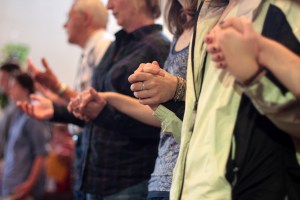
I am grateful for many blessings in my life but most recently I find my gratitude rooted in the support my family has received during times of adversity.  Over the course of the past two years I have encountered two sudden and unexpected upheavals.  The first involved my mom suddenly falling ill, resulting in a long hospital stay, with series of setback after setback.  As we began to grasp the reality and gravity of the situation, my family and I founds ourselves sitting in a hospice facility knowing that the end was near.

Photo credit:  http://newmanec.com/parish/prayers/

Photo credit: http://newmanec.com/parish/prayers/

The second upheaval was even more unexpected and impactful, as my wife Nancy fell seriously ill.  It turned our life upside down as we faced surgery, treatments, and adjusting to a new normal striving to get our lives back.  During both of these ordeals, I found myself praying more often, asking God for help.  At times I labored in trying to understand why these things were happening to me and my family.  As many of you know, these kinds of things can test your faith.  One constant source of support and comfort was knowing that we had a church family at St. Margaret’s praying for us, pulling for us and reaching out with words of encouragement.

St. Margaret’s for me has always been a kind of spiritual anchor, a kind of home base for me and my family in our faith journey.  It made us feel good to be part such a caring church community.  It also underlined the importance of having a spiritual support base to lean on in time of need.  I am grateful and blessed to be part of the St. Margaret’s family.  It just seems logical for me to start from a place of gratitude when I consider my thoughts about Stewardship and pledging financial support.

I am also grateful that I have gotten involved in some of the business aspects that go into keeping St. Margaret’s running.  Unfortunately, St. Margaret’s pledges do not cover expenses and we operate at a loss.  This is not sustainable.  This is an inconvenient truth that many do not realize or may choose to treat with indifference or leave to others to deal with.  It will eventually cause us to make difficult decisions and possibly cut programs near and dear to many.  Therefore, I find it helpful to keep these facts in mind as I consider my annual pledge.  It always starts with gratitude but it is also grounded in an understanding of the financial side of St. Margaret’s.

Submitted by Phil Russo.

Homily – Mark 10.35-45, P24, YB, October 18, 2015

23 Friday Oct 2015

Posted by jandrewsweckerly in Uncategorized

≈ Leave a comment

Tags

blessed, earn, entitlement, gift, giving, God, gratitude, homily, Jesus, ours, ownership, privilege, serving, wealth, Zebedee

Most of you know that father was a Methodist minister.  One of my favorite children’s sermons he gave was about an apple.  He gathered us all around and he had an apple and a carving knife.  He said that the apple represented all the money that our families had.  Then he asked us what were all the things that our family needed that we had to spend our money on.  We all shouted out our answers:  clothes, food, our houses, cars.  With each answer, he cut out a chunk of the apple.  When were down to about 1/3 of the apple, he invited us to answer what else we spend our money on.  We had answers for that too:  toys, games, vacation, movies.  By the time we finished, there was nothing left of the apple.

Suddenly, my father gasped.  “Oh, no!  We forgot something.  We forgot to give some of our money to God!”  There was good news though.  My dad had another apple.  He suggested we try to do things a little differently this time.  “How about we give some of our money…say 10%…to God?  Okay?”  Then we carved out all those things we need.  Then we still had a little left for all the stuff we like – maybe not as much, but there was still some there.

Photo credit:  http://callahandesign.biz/home/

Photo credit: http://callahandesign.biz/home/

Thirty years later, I think the point of his children’s sermon was that if we start by returning some of our wealth to God, we’ll have plenty for everything else.  But as I was thinking about that apple this week, something else occurred to me.  That apple – that apple that represents “our” money that we get to choose how to divvy up – is not really ours.  That apple actually belongs to God entirely.  We have money because we work for it, right?  But how do we get jobs in the first place?  We could argue that we have jobs because we worked hard to get there, or we went to school.  But in Eucharistic Prayer C, one of the things we say is that God blessed us with “memory, reason, and skill.”  So yes, we work hard, but we are able to do that work through the blessings of God.  God blesses us with abilities and talents.  God blesses us with good health and a sense of forbearance.  God blesses us with shelter, food, and clothing so that we can rest, build up strength, and fit in socially at work.  God blesses us with support systems, like friends, neighbors, and family who help us stay emotionally stable enough to do the work God has given us to do.  All that money that is “ours” that we “earn” on our own is not really ours when we are honest.

Now, no one is more uncomfortable with this notion than me.  When I was growing up people always said I was smart, but I always insisted that it was because I was a hard worker.  Nothing came easy to me and I worked for everything I got.  So imagine my discomfort when I had to think about my apple – all my income – and realize I didn’t have that apple because I worked hard to earn that apple.  I had that apple because God blessed me with all the things I needed to be able to work hard and earn.  When I insist that I should get to choose who gets what slices of my apple, I get lost in a sense of entitlement instead of gratitude about where the apple comes from in the first place.

The sons of Zebedee had the same struggle with a sense of entitlement.  In fact, the sons of Zebedee sound almost impish today.  “Teacher, we want you to do for us whatever we ask of you.”  They try to manipulate Jesus into the answer they want before they even ask us the question.  “Jesus, promise us you’ll do this one, tiny little favor.”  And then they ask a most ludicrous question – to be at Jesus’ right and left hand in his glory. In essence, they want the most favored spots in the kingdom of God.  Jesus chides them, “You do not know what you are asking.”  The other disciples are enraged – either because they think the Zebedee brothers are being selfish, or because they are mad that they didn’t think of the idea first.

But at the heart of their request is something bigger – a sense of entitlement.[i]  Their question indicates that they think they are owed such a privilege.  And maybe in their eyes they were owed.  They left everything to follow Jesus.  Jesus keeps talking about how they are going to suffer anyway, so they want some guaranteed reward for that suffering.  And they have already proven themselves – look at how loyal they are to Jesus and the cause.  Their request is not just a reward – they earned those places of honor.

But what Jesus does today is what he always does – he turns everything upside down.  The Zebedee boys will be honored – but not with cushy titles or offices.  They will be honored by enduring the same suffering – sharing in Christ’s cup – that Jesus endures.  Honor, Jesus explains, does not come from earning and amassing wealth.  Honor comes from serving others – from emptying ourselves of wealth and serving others.

This week, I was reading an article about a couple who lives on 6.25% of their income.[ii]  They earn just under $245,000 a year, and yet they live on just over $15,000.  They give about $100,000 to charity.  And not just this year, but every year since 2008.  Now, I don’t know whether this couple is Christian, but I tell you what they do seem to understand – that apple isn’t fully theirs either.  And in fact, giving about 40% of their apple away has brought them a sense of freedom and joy that is hard to find elsewhere.

In these weeks of discernment about your giving to St. Margaret’s, I invite you to consider your own relationship with your wealth – with your apple.  I am not suggesting you need to give 40% of your apple to the Church – though I also would not stop you.  But what I am inviting you to consider is how God – God the Giver – gifted you with that apple.  I am inviting you not just to consider the wealth that the apple represents, but also all the other blessings that even enable you to possess the apple.  My guess is that the more you pray on those blessings, the more and more overwhelmed you will become about the abundance God has showered upon you.  Sit in that spiritual space of being overwhelmed by God’s abundance this week and listen for how the Spirit is calling you to use your apple.  Amen.

[i] Stephen B. Chapman, “Sons of Entitlement,” Christian Century, vol. 123, no. 21, October 17, 2006, 20.

[ii] William MacAskill, “Giving to Receive,” October 9, 2015 as found at http://qz.com/515655/this-couple-lives-on-6-of-their-income-so-they-can-give-100000-a-year-to-charity/ on October 14, 2015.

Waves of Gratitude

16 Friday Oct 2015

Posted by jandrewsweckerly in Uncategorized

≈ Leave a comment

Tags

abundance, blessed, covet, dissatisfied, God, gratitude, greed, humble, stewardship

I don’t really know how it happens.  I am sure we could blame consumerism, capitalism, or competition.  Maybe we could even blame sin.  But somehow, in the midst of our abundance, we find ways to be dissatisfied.  We want more – more stuff, more security, more freedom.  There is something deep inside of us that sees what others have and covets.  Our maybe it is more subtle and quiet.  We look at our current situation, and think, “If I just had that, I would be happy.”  And whatever “that” is, it does not seem like too much to ask in our minds.

The other day, my family and I were driving in the city.  We turned the corner, and right before us loomed an enormous billboard.  But instead of trying to sell something (or convince me that I needed “that”), it simply said, “Gratitude.”  I was stunned.  I do not know who put up the sign or why, but what I can tell you is that it stopped me in my tracks.  Whether I am bustling around with my family or busy at work, I am rarely meditating on gratitude.  I am just not very good at holding gratitude at the center of everything.  For me, that sign was a beckoning back:  a beckoning back to a spirit of gratitude.  So instead of having my mind on wherever we were going that day, suddenly, I looked around the car.  There was my beautiful, loving, precious family.  We were sitting in a car that works, enjoying leisure time.  I was not sick or worried about my housing security.  A wave of gratitude swept through that car that left me stunned.

This week St. Margaret’s kicked off our Stewardship season.  Most of us think about Stewardship season, and we immediately start worrying about what we are going to be able to pledge this year.  But before you start crunching numbers, I invite you to take a moment to be stunned by the prayerful practice of gratitude.  Start at home.  Prayerfully consider your friends and community.  Think about St. Margaret’s and why you pull yourself out of bed every Sunday to be there.  Give thanks for the God that creates us, sustains us, and gives us all that we need.  The further out we move from ourselves, the bigger our gratitude gets.  By the time we get to God, that unfathomable One who is infinitely bigger and more gracious than we can imagine, our longings for anything else disappear.  All we are left with is humble sense of gratitude.

This week, I invite you to meditate not on your checkbook, but on this blessed life God has given you.  If you have to start with something as basic as being able to breathe – being on this side of the ground, then start there.  I imagine no matter how rough or dissatisfying life may feel, you will slowly begin to realize the enormity of abundance surrounding you.  Let that wave of gratitude sweep you into a stunned silence – and join our God who waits there for you.

Journeying in the darkness…

07 Wednesday Oct 2015

Posted by jandrewsweckerly in Uncategorized

≈ 2 Comments

Tags

abundance, church, darkness, grief, light, loss, mourning, pregnancy

October is Pregnancy Loss Awareness Month.  In some ways, it seems like a strange month to choose.  In October, we are often focused on the harvest.  We have harvest-themed door wreaths and table decorations.  We enjoy a taste of the harvest ourselves – picking apples and pumpkins.  This is a time we celebrate abundance, and yet this is also the month when we honor when abundance is taken away.

As a child, I knew very little about pregnancy loss.  I had an aunt who sometimes referred to infant she lost by name, but no one besides her talked about it much, and the subject was so hushed and confusing that I never asked many questions.  As a chaplain, I experienced my first pregnancy loss with a patient.  A whole new world of darkness invaded what had developed in my mind as a world of joy.  I was at the age that my friends were starting to have babies.  But no one had ever talked to me about the dark side of pregnancy.  The darkness still felt very “other.”

Finally, a dear friend – one with whom I had shared many confidences – lost her pregnancy.  We lived far away, but I had just seen her pregnant belly at a reunion of friends for the weekend.  We had laughed and shared dreams about the child.  It had been a weekend of light.  And suddenly, that weekend was washed away with darkness.  We all rallied, sending flowers, meals, and cards.  We prayed and we cried.  And we listened.  My friend was very good about being vocal and honest about her pain.  We journeyed with her through the darkness.

During our mourning period, I shared with a few coworkers about my grief.  Slowly, the stories poured out.  Of pregnancies lost, of an infant loss, and even of the grief of trying to get pregnant.  No longer could I go on pretended that the world of pregnancy and babies was all roses and sunshine.  There is a darkness, a fear, and an uncertainty that haunts every pregnancy.  Most of the time those fears are unrealized, but unfortunately, not always.  And sometimes that darkness crashes down on those who never even realized the darkness was lurking.

We don’t talk about pregnancy loss much in church.  We have a liturgy for blessing a pregnancy.  We have a liturgy for giving thanks for a healthy birth.  And we have a liturgy for an infant baptism.  But the liturgies for infant loss are scattered and hard to find.  They are modified versions of other liturgies, often unauthorized by a liturgical committee.  They are like the darkened corner room of the maternity ward where they try to hide away the mom who has to deliver her stillborn.

Today, I want you to know that I am willing to talk about pregnancy and infant loss.  As a priest in the Church, I am willing to journey with you through the darkness – even if that darkness has been lingering for twenty years or more.  Or if you are trying to get pregnant, or even if you are pregnant and are afraid of the darkness – I am here.  You are not alone.  I will stand in the darkness with you – for however long you need.  And for those of you who are just now becoming aware of this issue and want to be supportive, I recommend this video.  You will find great resources on the website, as well as a link to an amazing book of devotions.  Join me in being the Church – a Church willing to sit in the darkness until we can find the light again together.

Homily – Matthew 11.25-30, St. Francis, October 4, 2015

07 Wednesday Oct 2015

Posted by jandrewsweckerly in Uncategorized

≈ Leave a comment

Tags

burden, comfort, crazy, discomfort, easy, give up, holy, homily, imitate, impossible, inspire, Jesus, life, light, missions, Pope Francis, saint, sanitized, St. Francis, uncomfortable, yoke

I once led a book group that read the book The Prison Angel.  The Prison Angel is the story of Mother Antonio, a woman of privilege from California who had a mid-life crisis, took on the role of a nun, went to the largest prison in Tijuana, Mexico, and began a ministry of transforming guards, inmates, and families connected to the prison.  Her work was amazing – the way that she was able to love everyone equally, the way that she was able to harness resources and get them where they needed to be, and the way that she was able to devote her life to this system – even living in her own prison cell for a while – were all examples of her awesome witness.  As we finished the book, I had hoped that people in our book group would be inspired, and might even consider their own contribution to a prison ministry.  Instead, the response was more like this:  Mother Antonio is truly amazing.  But let’s be honest.  I can’t be like her.  I’m not going to drop everything – my family and life – and become totally devoted to a ministry.  And just like that, I lost them.  No longer was Mother Antonio inspiring.  She was impossible.  And once she was impossible, no one felt compelled to do anything.  I definitely felt like I failed my mission of inspiration leading to action.

As I was preparing for today’s celebration of St. Francis, I ran across this quote:  “Of all the saints, Francis is the most popular and admired, but probably the least imitated.”[i]  You see, we have a sanitized version of Francis in our minds.  He was nice to animals and took care of the poor.  He devoted his life to Christ as a monk.  We even put up statues of Francis in our gardens and outside our churches.  When we think of Francis, we think of a gentle man gingerly allowing a bird to perch on his finger, and we smile.  We like our sanitized version of Francis because the real version is a little scary.  When Francis renounced his rather significant wealth, he stripped naked in front of his father and the bishop.  Francis didn’t just help the poor, he became poor, begging on the streets.  He worked with lepers – people no one wanted to touch, touching them with his bare hands and kissing them.  Barefoot, he preached in the streets about repentance.  He preached to the birds, and is rumored to have negotiated with a wolf.  If we met St. Francis today, most of us would not imitate or venerate him.  We would just see him as another homeless beggar with a serious case of mental illness.

That is the challenge for us when trying to live a holy life.  St. Francis is the obvious example today.  Though we love and admire St. Francis, few of are comfortable with his total identification with poverty, suffering, and care for our creation.  The same can be said of Jesus.  Though we profess that Jesus is our Lord and Savior, we regularly fail to live in the ways that Jesus taught – in fact, some of us have given up even trying.  Even looking toward a modern-day example of holy living trips us up.  When we watched Pope Francis come through last week, we marveled at his radical witness.  We loved what he had to say – except when he had something to say that made us uncomfortable or that we disagreed with.  When thinking about the radical life that is following Jesus – whether through the Pope, through St. Francis, or Jesus himself – most of us stumble and feel like giving up.

Luckily Jesus offers us a promise today.  Jesus says, “Come to me, all you that are weary and are carrying heavy burdens, and I will give you rest.  Take my yoke upon you, and learn from me; for I am gentle and humble in heart, and you will find rest for your souls.  For my yoke is easy, and my burden is light.”  My yoke is easy and my burden is light.  When we look at St. Francis’ witness and we think about the poverty, the preaching, and the penitence, we get nervous.  We like our stuff, we like being comfortable, and we like being Christians without having to be too loud about it.  When we think about St. Francis, we think of a yoke – but not a light one – one that is heavy and onerous.  But Jesus harkens us back to his original words.  My yoke is easy and my burden is light.

One of the reasons I am a proponent of international missions is that they help you experience reality in a totally different way.  When we go on local missions, we can keep our smart phones, we have access to clean, accessible health care, and we can always find a McDonalds for a burger fix.  But when we are in a rural town in a third world country, things change.  We may not get to shower everyday, we may have to boil our water before drinking it, we will eat food that you are not so sure about, and we pray that we don’t get too sick while abroad.  And forget about a cell phone and internet access.  Most of us don’t even take a watch or jewelry to ensure they do not get lost.  Now that may sound like torture to most of you.  But here is what we learn when we are stripped of comforts and living and working in a foreign setting:  We learn to appreciate your massive wealth comparable to the poor in the third world; we learn what hospitality – real hospitality in the face of nothing – really feels like; we forget about email, phone calls, and even stop obsessively checking the time, because those things do not really matter that week; we hear birds and other creatures in a way that we never have before – maybe because of their proximity, or maybe because we normally distract ourselves with a hundred other things; and – now this is the crazy one – we talk about Jesus and no one is uncomfortable (well, except maybe us because we haven’t done that very much).  When stripped of everything familiar, we discover that Jesus’ burden really is easy and his yoke truly is light.  And sometimes we need to be stripped of the familiar so that when we are back in our comfort zone, we can more tangibly remember how easy that burden was and how light that yoke felt.

You may not be able to go on an international mission trip.  But each of you has some experience – a heartfelt expression of gratitude when you cared for the poor, a prayer with someone who was really hurting, or surprisingly easy conversation in a coffee shop about church and your faith.  Though Jesus, St. Francis, and even the Pope sometimes go to extreme measures, they all ultimately are trying to do the same thing.  To remind us that Jesus’ burden is easy and his yoke is light.  And then they all invite us to get comfortable with discomfort or even with the label of being crazy – and to go and do likewise.  Amen.

[i] Holy Men, Holy Women:  Celebrating the Saints (New York:  The Church Pension Fund, 2010), 622.

Recent Posts

  • On the Myth and Magic of Advent…
  • On Risking Failure and Facing Fear…
  • Sermon – Luke 23.33-43, P29, YC, November 23, 2025
  • On Inhabiting Gratitude…
  • Sermon – Luke 20.27-38, P27, YC, November 9, 2025

Archives

  • December 2025
  • November 2025
  • October 2025
  • September 2025
  • August 2025
  • July 2025
  • June 2025
  • March 2025
  • February 2025
  • December 2024
  • November 2024
  • October 2024
  • September 2024
  • August 2024
  • July 2024
  • June 2024
  • May 2024
  • March 2024
  • February 2024
  • January 2024
  • December 2023
  • November 2023
  • October 2023
  • September 2023
  • August 2023
  • July 2023
  • June 2023
  • May 2023
  • March 2023
  • February 2023
  • January 2023
  • December 2022
  • November 2022
  • October 2022
  • June 2022
  • May 2022
  • January 2022
  • December 2021
  • November 2021
  • October 2021
  • September 2021
  • August 2021
  • June 2021
  • May 2021
  • April 2021
  • March 2021
  • February 2021
  • January 2021
  • December 2020
  • November 2020
  • October 2020
  • September 2020
  • August 2020
  • July 2020
  • June 2020
  • May 2020
  • April 2020
  • March 2020
  • February 2020
  • January 2020
  • December 2019
  • November 2019
  • October 2019
  • September 2019
  • August 2019
  • July 2019
  • June 2019
  • May 2019
  • April 2019
  • March 2019
  • February 2019
  • January 2019
  • December 2018
  • November 2018
  • October 2018
  • September 2018
  • August 2018
  • July 2018
  • June 2018
  • May 2018
  • April 2018
  • March 2018
  • February 2018
  • January 2018
  • December 2017
  • November 2017
  • October 2017
  • September 2017
  • August 2017
  • July 2017
  • June 2017
  • May 2017
  • April 2017
  • March 2017
  • February 2017
  • January 2017
  • December 2016
  • November 2016
  • October 2016
  • September 2016
  • August 2016
  • July 2016
  • June 2016
  • May 2016
  • April 2016
  • March 2016
  • February 2016
  • January 2016
  • December 2015
  • November 2015
  • October 2015
  • September 2015
  • August 2015
  • July 2015
  • June 2015
  • May 2015
  • April 2015
  • March 2015
  • February 2015
  • January 2015
  • December 2014
  • November 2014
  • October 2014
  • September 2014
  • August 2014
  • July 2014
  • June 2014
  • April 2014
  • March 2014
  • February 2014
  • January 2014
  • December 2013
  • November 2013
  • October 2013
  • September 2013
  • August 2013
  • July 2013
  • June 2013
  • May 2013
  • April 2013
  • March 2013
  • February 2013
  • January 2013
  • December 2012
  • November 2012
  • October 2012
  • September 2012

Categories

  • reflection
  • Sermons
  • Uncategorized

Meta

  • Create account
  • Log in
  • Entries feed
  • Comments feed
  • WordPress.com

Blog at WordPress.com.

  • Subscribe Subscribed
    • Seeking and Serving
    • Join 394 other subscribers
    • Already have a WordPress.com account? Log in now.
    • Seeking and Serving
    • Subscribe Subscribed
    • Sign up
    • Log in
    • Report this content
    • View site in Reader
    • Manage subscriptions
    • Collapse this bar
 

Loading Comments...