• About

Seeking and Serving

~ seek and serve Christ in all persons

Seeking and Serving

Monthly Archives: May 2018

On Politics at the Table…

30 Wednesday May 2018

Posted by jandrewsweckerly in Uncategorized

≈ Leave a comment

Tags

Bishop Curry, church, Eucharistic Table, God, gospel, hope, Jesus, love, politics, Reclaiming Jesus, table, transformative, truth

Last week I talked about Presiding Bishop Michael Curry’s sermon at the Royal Wedding.  His sermon on the transformative power of love created shock waves – one, because most people weren’t expecting such a powerful sermon on a royal wedding day; but two, because his words resonated so deeply with people.  He created a spark of hope, a sense of clarity of purpose, and a renewed passion for justice and compassion.   The message was not new:  he simply preached the gospel of Jesus, a two-thousand-year old message.  And yet, the gospel, like it does for every generation, spoke a word of truth.

But after appearances on the Today Show, Good Morning America, The View, and countless other programs, it would be easy to soften Bishop Curry’s message, to say, “Yes!  Love is the answer!” and walk away with a warm fuzzy feeling.  The trouble is, Bishop Curry’s sermon was not just about the easy parts of love.  Bishop Curry preached about the action of love.  If we find the message of love compelling, then we have to start living lives of love.  And that is where his powerful message starts getting uncomfortable.
5b0830721a00002700cdfc6f

Photo credit:  https://www.huffingtonpost.com/entry/bishop-michael-curry-joins-christian-march-to-white-house-to-reclaim-jesus_us_5b07261ae4b0fdb2aa51b060

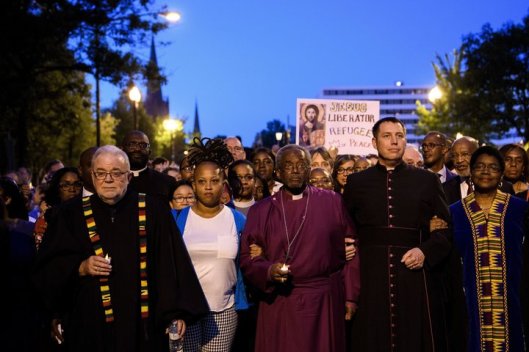
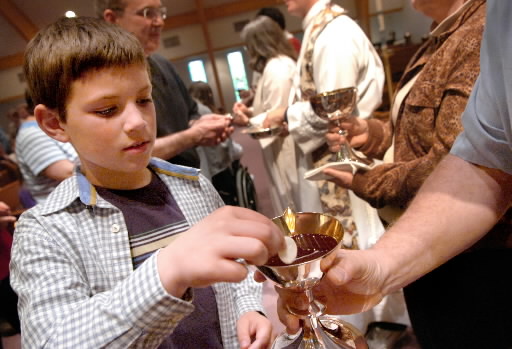
Less than a week after his historic sermon, Bishop Curry joined prominent faith leaders from all over the country in a movement called, “Reclaiming Jesus.”  A video explaining the movement can be found here.  Now if you have spent any time with me, you know that I am very hesitant to talk politics in the pulpit or even publicly.  I have always served in churches that were a wonderfully complicated mixture of political opinions.  The Eucharistic Table is the thing that brings us together, kneeling before God, shoulder to shoulder with fellow church members whose bumper stickers promote the exact opposite opinion of our own.

But just because I do not believe Jesus was a Democrat or a Republican, does not mean that I do no think Jesus and the Gospel are not political.  In fact, Jesus’ very life was ended because he was too “political” – because his message of love made people uncomfortable.  That is what the Reclaiming Jesus movement is about – reminding us that the Church still has a message of love – and that message is not passive or polite but is quite active and alarming.

This week, I am taking the warm, encouraging feelings I had from Bishop Curry’s sermon and listening once again to his words about what love in the world means.  I invite you to join me.  Join me in hearing what in the Reclaiming Jesus message makes you uncomfortable.  Join me in pondering how both political parties get it a little bit wrong and a little bit right.  Join me in remembering that Jesus’ message of love is not the same as an invitation to “avoid politics.”  The question is how we can do politics better.  How can we be an example of what it means to don different bumper stickers and work together for justice, peace, and love?  What Bishop Curry preached at the Royal Wedding sounded beautiful – just like Jesus’ own words.  But what Bishop Curry and Jesus called for was not just beautiful.  It is hard, confusing, challenging work – and even harder to do when we disagree so deeply.  Thank God for the Eucharistic Table!  It is the only promise to me that we can do this – that we can be political agents of love together.  I hope you will join me!
chalice-emhc

Photo credit:  http://www.freerepublic.com/focus/religion/3163266/posts
On Peter, Paul, and Michael…

23 Wednesday May 2018

Posted by jandrewsweckerly in Uncategorized

≈ 1 Comment

Tags

church, disciple, Episcopal, Good News, Jesus, Jesus Movement, love, power, Presiding Bishop Michael Curry, Royal Wedding, Sermon

In seminary, each third-year student preaches a “senior sermon” in front of the entire seminary.  It’s a bit nerve-wracking because seminarians and priests are a pretty tough crowd.  Add that on top of professors who have molded you for three years, and the pressure is pretty intense.  I remember talking to a professor about my nerves and he assured me, “Well, you know what the old hymn says:  If you cannot preach like Peter, if you cannot pray like Paul, you can tell the love of Jesus and say, ‘He died for all.’”

That hymn to which he was referring is, “There is a Balm in Gilead,” which is the same hymn that Presiding Bishop Michael Curry quoted in his sermon at the Royal Wedding.  Of course, preaching after Bishop Curry the next day felt equally daunting.  Lord knows, I cannot preach like Peter, and I certainly cannot preach like Bishop Curry.  But as I was thinking about it, I think what people have loved so much about Bishop Curry’s preaching at the Royal Wedding is:  1) he was authentically himself (which is obviously a bit different culturally from those gathered in the royal family, but his authenticity was infectious), 2) he was passionate about the love of Jesus and its ability to change the world, and 3) he gave the world a glimpse of what is so awesome about the Episcopal Church – a Church who understands the radical power of love and brings together people from all walks of life to thoughtfully, willfully, beautifully engage in doing powerful work in the world through love.

What has been fascinating to me about Bishop Curry’s sermon and the way it has been described as “stealing the show,” is that Bishop Curry was just doing what the Episcopal Church does every Sunday, at every wedding, and at every funeral – we worship God in the beauty of holiness, we teach those gathered, and we equip them to go out into the world sharing the good news of God in Jesus Christ.  What Bishop Curry’s success does is embolden us to live into our identity as disciples of Christ and members of the Episcopal Church.  I suspect you have talked to someone about Bishop Curry’s sermon in the last few days.  How about instead of just marveling about Bishop Curry’s talent as a preacher, you use this event to talk to someone about how you are inspired to be a follower of Jesus?  Keep it authentic:  “He was awesome, wasn’t he?  He reminds me of my church and the amazing things we are doing to harness the power of love.  I’d love to show you!”

What Bishop Curry did on Saturday at the Royal Wedding was be himself – a member of the Jesus Movement, sharing the Good News of God in Christ.  Your invitation is to be yourself and do the same.  You may not preach like Peter, and you may not pray like Paul.  But you can tell the love of Jesus, and say, “He died for all.”  I can’t wait to hear about your adventures!!

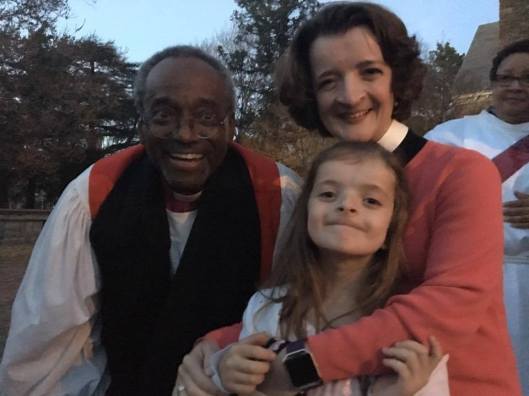
17426137_10155645675302565_2278358373496741633_n

With Presiding Bishop Curry in 2017, Photo credit:  Jennifer Andrews-Weckerly (use only with permission)


Homily – Acts 2.1-21, Pentecost, YB, May 20, 2018

23 Wednesday May 2018

Posted by jandrewsweckerly in Sermons, Uncategorized

≈ Leave a comment

Tags

baptism, baptismal covenant, cacophony, chaos, church, community, God, Jesus, languages, love, Pentecost, Sermon

33092215_1843823495673902_5618488268858327040_o

Photo credit:  John Rothnie (permission to reuse required)

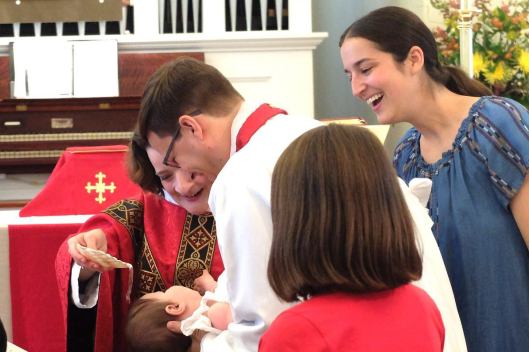
I have been looking forward to this baptism for months.  Olive is one of four babies born at Hickory Neck within a month of each other, and one of five within a five-month period.  Not only did I enjoy watching Olive grow in her mom’s belly, I knew how fun welcoming her to the community would be, and especially how special her baptism would be.  So when the Bauer Family finally settled on Pentecost, I was thrilled – baptizing a baby on feast day adds excitement to an already festive day.

But as the liturgy planning staff met about a month ago, I realized we may have made a huge mistake.  We were talking about the needs for today, and remembered we needed to recruit all our foreign language speakers because Pentecost is the one feast of the year where we really try to simulate the experience of the historically significant day in the life of the faith.  And as we were talking about rotas, translations, and participants, a sudden sense of dread hit me.  “Um, Charlie?” I said.  “Are you sure you want to baptize Olive on Pentecost?  I mean, I love Pentecost, but, especially for strangers to our community, Pentecost is a little weird.  Do you want us to just skip the whole languages part?”  To his credit, Charlie didn’t hesitate.  “What better day to baptize?!?” he said, as though my question were silly.

I have been encouraged by Charlie’s enthusiasm, but the more I thought about his response, the more I questioned his logic.  Don’t get me wrong – I love what we do at Pentecost.  Pentecost is one of the few days of the liturgical year that our scripture really comes to life.  Hearing the cacophony of languages helps you to really imagine yourself there.  But this is the kind of service that I would also say to first-time visitor, “Just so you know, we don’t always do this!”  Because, although I love the cacophony, I wouldn’t want anyone to think today is the norm – that we always break into tongues in the service or that we always like to shock your senses.  Surely if we were going to baptize Olive, we should find a tamer way to welcome her to the community, and not freak out her family and friends from all the ends of the country.

We do this all the time with Church.  If we get the nerve up to ask a friend to Church, and they take us up on the offer, we want them to experience the best of Hickory Neck:  a welcoming environment, beautiful liturgy, a sense of belonging, and a deep connection to the immanent and transcendent God.  But just like when you introduce a new romantic interest to your family, you don’t have them meet everyone in the family at the beginning.  You save crazy Uncle Joe until at least the second or third Christmas, when you know your boy or girlfriend is already in love with you enough to make allowances for the crazy in your family.  The same is true for church – we would much rather you see the beauty of Hickory Neck on a regular Sunday or even on a day like Easter.  There is no need for us to show you some of the really weird parts of our faith, like Pentecost, until you have at least been here for a while.

So why was Charlie so enthusiastic about bringing his extended family to celebrate baptism on this one, crazy, bizarre day in the life of the church?  Was he not thinking this through?  Or was he secretly hoping to ensure his family never comes back?  I started working through why this might be the perfect day for a baptism, thinking through what we learn about the church and membership within.  First, we learn the power of the gospel, of the good news of God in Christ, to reach all peoples, no matter who they are.  Although practically speaking, today’s multilingual reading sounds jarring, what we know about this piece of scripture is that despite the din of noise, everyone heard the good news in their own language.  The gospel is not limited to one group of people or to one tribe or nation; the gospel speak truth to all.  Second, we learn that Jesus’ story is not just for us – Jesus’ story is for all.  Up until this point in our story, Jesus has been keeping his resurrection and ascension to a limited group of people.  But today, that norm implodes.  Jesus’ story is no longer for those nearest and dearest to Jesus – Jesus’ story is for everyone.  Third, we are reminded of our commission from Jesus – to go out into all the world, sharing the good news of God in Christ.  Not just the English-speaking places, not just the places where people look and act like us, not just the places that make us comfortable.  And finally, Pentecost affirms the ways in which God loves us, no matter what.  No matter how loud, crazy, or chaotic our lives become, God is with us, breaking through the din of noise we create and making that noise holy.

Perhaps instead of finding the most proper, polished day to baptize a child of God, today may be the perfect day to teach us all what the life of faith is about.  We all know that when our romantic interest or dear friend finally meets Crazy Uncle Joe, or finally sees us when we are sick or not looking our best, or finally realizes we have some pretty awful flaws, and LOVES US ANYWAY – those are the people we want to keep around.  The same is true for those new to the church or those being initiated into the community of faith – we want you to see us on our craziest days so that you know, no matter what God loves you anyway.  God sees your craziness, your chaos, those parts of yourself that you hide from others, and God not only loves you, God commissions you and makes a way you share that love to the ends of the earth.

That is what we affirm today in our baptismal covenant.  Given the promise of unconditional love from God, we promise in return to live a life in accordance with that unconditional love.  To seek and serve all persons, to strive for justice, to respect the dignity of every human being, to proclaim by word and example the good news of God in Christ, to resist evil and repent, and to keep coming back to the community, breaking bread and joining in the prayers.  The chaos of today, the beauty of baptism today, the reminder of God’s love today are all meant to build us up so that we can get back out into the world.  What better day than today to baptize?!?  Amen.

On Letting Go and Listening…

16 Wednesday May 2018

Posted by jandrewsweckerly in Uncategorized

≈ Leave a comment

Tags

church, control, faithful, God, hear, let go, listen, Pentecost, rain, voice

Our church is currently being blessed with a lot of activity.  This week, the site for the school that will join our property has begun construction.  Footers are ready to be dug and the foundation laid.  Meanwhile, this weekend, we are hosting our second Annual High Fiber Festival.  Volunteers are being recruited, parking layouts are being designed, and signs are being hung for this great event that raises money for outreach ministries.  Both events are wonderful signs of vitality and life at Hickory Neck – and yet both events have been the victim of all sorts of things out of their control.  Permit approvals delayed construction at the school.  Delays in school construction have created challenges for parking at the Festival.  And now rain seems to be threatening progress and success for both.

I have been thinking that both projects seem to be challenging my long-held battle with control.  As I imagine many of us do, I sometimes fall under the illusion that more things are under my control than actually are.  I consider myself a pretty faithful Christian, but when issues like control arise, I realize how far I have to go.  I think that phrase, “Let go and let God,” was written for me!  Lord knows, I cannot control the rain!

That is why I love that we get the Acts lesson for Pentecost this Sunday.  Talk about a people whose life are completely out of control!  If the cross, death, resurrection, and ascension were not enough to make the disciples realize they are not in control, perhaps Pentecost would be.  I imagine the disciples were finally getting their feet on the ground and preparing themselves to take up Jesus’ mantle of spreading the Good News.  But none of them could have prepared for the dramatic event of breaking into tongues all at once.

What I love about Pentecost though is everyone hears in the din of noise.  Despite the chaos and seeming utter loss of control, those gathered can hear clearly.  I wonder if that might be an invitation for us this week – to look at the chaos and situations in our lives that seem out of control and see where we hear God’s voice.  Maybe God’s voice is speaking to us directly.  Maybe God’s voice is speaking to us through a wise friend or confidant.  Maybe God’s voice is speaking to us through strangers or the seeming “coincidences,” of life.  I’d love to hear your stories of where you have heard God this week!

Singing-In-The-Rain-red-umbrella

Photo credit:  https://www.voices.com/blog/4-lessons-singing-in-the-rain/

Sermon – John 17.6-19, Acts 1.15-17, 21-26, E7, YB, May 13, 2018

16 Wednesday May 2018

Posted by jandrewsweckerly in Sermons, Uncategorized

≈ Leave a comment

Tags

Ascension, busy, disciples, Jesus, name, Pentecost, pray, prayer, present, scared, Sermon, wait

I used to belong to a community that had healing prayers every Wednesday at a midday Eucharist.  I never liked to go forward myself, but I was happy to see so many other people go forward for prayers.  Honestly, for the longest time, I did not really understand the whole process.  Were the same people so sick they needed prayers every week?  Were they having prayers for themselves or for other people?  And I had no idea what the priests were saying to them or what they said to the priests.  I was so intimidated by the whole process that I usually just sat in my seat and prayed for those going forward.

Then one day, some stuff was going on in my life I felt overwhelmed by and I finally stood up and got in line with all the other people.  I was so nervous.  I wasn’t sure if I was supposed to tell the priest my whole story, or if I was supposed to ask for something specific, or if I was just supposed to bow my head and wait for the priest to pray.  When I finally reached the priest, he looked at me expectantly.  I mumbled some prayer request that was super short and in no way indicated why I really needed prayers.  But then the priest did something extraordinary.  He prayed for me by name and was able to craft a prayer so thoughtful and generous, that I felt like he could see into my soul and understand what was really weighing me down.  By simply saying my name, I felt known, cared for, understood, and seen – really seen – for the first time in a long time.

I suspect that is what the disciples are looking for at this point in our narrative.  For weeks, Jesus has been making resurrection appearances, teaching the disciples, and talking to them about next steps.  These weeks have been reassuring, lifegiving, and invigorating.  What seemed to be a massive disaster is now a holy victory.  But then, just days ago, Jesus finally leaves them for good as he ascends into heaven.  Before he goes, he tells them to wait for the Spirit to clothe them with power.  We are told they disciples return to the temple, praising God, but in our Acts lesson today, the disciples are busy figuring out their leadership plan.  You see, the establishment of twelve disciples was important to the ancestral roots of the twelve tribes of Israel.  The disciples want to be ready to “witness the messianic kingdom inaugurated by the death and resurrection of Jesus.” [i]

This is what we all do when we are scared.  We busy ourselves.  Jesus tells the disciples to wait for the Holy Spirit, and what do the disciples do?  They start developing a leadership plan, thinking about their presentation to the faith community, and organizing themselves.  None of these things were things Jesus told them to do.  In fact, Jesus told them to wait.  But we are not very good at waiting.  I remember last summer when the Vestry finished our needs assessment about child care and adult day care in Upper James City County, the conclusions were clear.  Both were needed and anything we could do would be a help.  When we finished that final assessment, I remember thinking, “Now what?!?  How in the world are we going to actually do something about either of these issues?”  When we left that meeting, I sensed we all walked away with the same sense of dread.  The community had spoken, but we had no idea how to live into God’s dream for us.  It was like looking over a great chasm with no way to cross over.  I remember wondering what other work we could do to prepare ourselves for something like that.  But I also remember being so clueless about what would come next that I kind of just looked to God with a sense of panic, wondering, “Now what?!?”

That’s why I love the gospel lesson from John today.  The lesson from John does not fit chronologically with where we have been in the Luke-Acts story.  John’s gospel today includes the words of Jesus’ farewell discourse before his passion.  These last verses of John 17 are a part of a prayer that Jesus says after an extensive time of teaching.  The words we hear today are not the words of a desperate prayer said in private by Jesus to God.  The words we hear today are words of prayer said for and about the disciples – said right within their hearing.  The words are not particularly pretty.  In typical John form, they sound circuitous and repetitive – so much so, they can be hard to really hear.  But if we listen closely, Jesus’ words today are an impassioned prayer for the personal care and safety of the disciples, so that the disciples can feel empowered to go out into the world under God’s protection.  “This is not Jesus teaching his disciples how to pray.  This is not only a personal prayer or privatized piety.  After betrayal and predicted denial, after concerned questions and foretold rejection, the disciples do not need another lesson, another miracle, another example.  They need exactly what Jesus does, because Jesus knows — for Jesus to pray for them.”[ii]

Jesus’ prayer is like the priest’s prayer at that healing service.  Jesus sees these scared, confused, anxious disciples and he prays for them by name, reminding them how they are loved, calling down God’s motherly love for the disciples, and asking for a sense of empowerment for each disciple. Although his prayer is not said in those days between the Ascension and Pentecost, the disciples could stand to remember this moment as they wait.  When we steer far from God’s providence, and we start to busy ourselves to hide our anxiety, these are the words we return to to steady ourselves.  Jesus’ words today, called the High Priestly Prayer, are the words of a priest – calling us by name, naming our specific anxieties before God, soothing us by their healing power, and calming us so that we might be able to go out into the world.

But Jesus’ words are not just the words of a priest.  Jesus’ words today are the words of all the faithful – said on behalf of another we name, said in the confidence of a child of God, said in the presence of one receiving prayer.  We can give away the gift of prayer and blessing the disciples needed too.  You may not feel comfortable praying aloud with another person yet.  If so, a prayer, using the person’s name and praying as Jesus does for that person is fine.  But Jesus’ words and actions for the disciples today embolden you to do what Jesus does.  You can ask the other person if you might pray for them – and pray with them right then and there:  whether you are praying for your own child and the concerns they have just voiced to you, whether you are praying for a friend who has finally confessed what is on their heart aloud, or whether you are praying for an acquaintance who cannot express their heart, but who is speaking to you because they know you are a person of faith and they need a priestly prayer from Jesus.  Any of you who have gathered at the side altar for healing prayers, or who have had your name called aloud for prayer knows the power of this work.

Normally, I commission you at the end of every sermon – giving you a task to do out in the world, bringing the good news of God in Christ into the broken world.  But on this Sunday between the Ascension and Pentecost, I invite you to take Jesus word’s seriously:  to pray while you wait for the empowerment of the Spirit.  This is not an invitation to look busy or to use action to cover anxiety this week.  This is an invitation to be present every day, looking around you for those who need your prayer, and then offering that personal, named prayer for those in your path.  As Jesus prayed for the disciples, as the disciples prayed for those with whom they shared the good news, so we continue the age-old practice of deep, personal, abiding prayer with others.  Those prayers for the disciples are prayers for us – Jesus prays for us today.[iii]  Our invitation is to give that comforting, loving, emboldening gift to others.  Your words, your calling another by name, give them power to sit and wait for our God too.  Amen.

[i] David S. Cunningham, “Theological Perspective,” Feasting on the Word, Year B, Vol. 2 (Louisville:  Westminster John Knox Press, 2008), 528.

[ii] Karoline Lewis, “Prayers Needed,” May 6, 2018, as found at http://www.workingpreacher.org/craft.aspx?post=5147 on May 9, 2018.

[iii] David Lose, “Easter 7 B:  Prayer is Love,” May 10, 2018, as found at http://www.davidlose.net/2018/05/easter-7-b-pray-is-love/ on May 10, 2018.

It’s complicated…

09 Wednesday May 2018

Posted by jandrewsweckerly in Uncategorized

≈ Leave a comment

Tags

balance, divine, God, goodness, honor, Mother's Day, mothers, painful, pastoral, sacred, tension

10

Photo credit:  https://www.shutterstock.com/video/search/child-walking

Every once in a while, I have one of those pastoral fails – those moments when I say something that ends up sounding horribly thoughtless and makes me feel disappointed in myself.  Last week, I was talking to a new mom about the struggles of those first weeks of new motherhood.  I was bemoaning how when my mom left two weeks after my first child was born, I cried for hours, not knowing how to raise a child without her help.  Only hours later did I remember that this person’s mom died many years ago, and how insensitive my story sounded in hindsight.

Motherhood is a bit of a minefield.  Some of us are extremely fortunate to have awesome moms and wonderful relationships with those moms.  Some of us have more strained relationships, others of us have cutoff relationships, some had negligent or hurtful mothers, and many are still grieving our mothers who have passed.  Meanwhile, some of us have had amazing experiences being moms ourselves, while others have longed to have children or have lost pregnancies or children.  Motherhood is so complicated that I sometimes find myself caught off guard by my own unexpected emotional response to motherhood.

For a priest, that is why I dread Mother’s Day.  Mother’s Day is a day where I feel split in half – where I both want to honor the goodness and sacredness of motherhood, and I want to honor ways motherhood can be so painful.  This year, I was blessed by a friend who wrote about how to honor the tensions we find on Mother’s Day.  I leave with you a prayer she references found in Women’s Uncommon Prayers, written by the Reverend Leslie Nipps.  May your Mother’s Day find the balance I long for you to find.

On this Mother’s Day, we give thanks to God for the divine gift of motherhood in all its diverse forms. Let us pray for all the mothers among us today; for our own mothers, those living and those who have passed away; for the mothers that loved us and those who feel short of loving us fully; for all who hope to be mothers someday and for those whose hope to have children has been frustrated; for all mothers who have lost children; for all women and men who have mothered others in any way—those who have been our substitute mothers and we who have done so for those in need; and for the earth that bore us and provides us with our sustenance.  We pray this all in the name of God, our great and loving Mother.  Amen. (p. 364)

Sermon – John 15.9-17, E6, YB, May 6, 2018

09 Wednesday May 2018

Posted by jandrewsweckerly in Sermons, Uncategorized

≈ Leave a comment

Tags

Christ, church, fail, forgive, God, hurt, Jesus, life, love, pain, pretty, profound, redefine, Sermon, share

Jesus’ words today from John’s gospel have been beckoning me all week.  “As the Father has loved me, so I have loved you; abide in my love…I have said these things to you so that my joy may be in you, and that your joy may be complete…You are my friends…You did not choose me but I chose you.”  These are words that our weary souls need to hear.  We long for the wide, open embrace of God, the unconditional acceptance, the assurance that everything will be okay.  Jesus’ words today are a warm blanket we crawl into and wrap around ourselves, draping over our feelings of sadness, loneliness, doubt, insecurity, and uncertainty.  Jesus’ invitation to abide in his love is the fulfillment of every longing, aching need in our lives, and today Jesus offers that love freely, abundantly, joyfully, completely.

For some of here today, that is your sermon:  Jesus loves you, chooses you, befriends you, and completes your joy.  The humbling, overwhelming love of God invites you into that warm blanket, and you do not need to speak – just accept the gift and abide with God this week.[i]

For others of us, we may be a little too hardened to fully receive the invitation to abide in God’s love.  I used to serve with a priest whose main sermon, no matter what the text, was God loves us.  She said those words so often I remember I would sometimes stop listening.  My cynical self would start the diatribe, “Yeah, yeah, yeah.  God is love.”  The problem for many of us is love has failed us.  We have been in love, been loved by family or friends, or even have felt God’s love.  But we have also been hurt, rejected, or felt abandoned by all those parties.  And if we feel the failure of love too often, “Abide in my love,” sounds too shallow to have meaning, too romantic to last, too wonderful to be sustained.

For those of us who might roll our eyes at the saccharine nature of love we have experienced in the world, we may need a different sermon today.   Part of our challenge is we have defined love in such a way that we will be disappointed every time.  We watch movies, read books, even gaze at couples in those first dreamy weeks of new love, and think we know what love is.  Love becomes two people who agree all the time, who are always able to look lovingly at another never noticing imperfections, who never experience conflict, and who are always happy.  And if that is our expectation of love, we will always be disappointed.  For those of us in this camp, our sermon today is to redefine love.

A few years ago, Paul and Lucy were such a couple.  They had a romantic beginning – meeting in medical school, Paul was funny, smart, and playful.  As they built a life together, they began to dream and to plan.  When Paul finished his 90-hour workweek rotations, and life got back to normal, they would try to have a baby.  Everything was perfect – at least everything was perfect if you did not look too closely.  And then Paul got the diagnosis – a cancer that would give him two more years of life.  And suddenly everything changed.  Lucy’s life began to become about taking care of Paul, walking him through treatments, holding him in pain.  And Paul’s life became about making sure Lucy could enjoy life beyond him.  At one point, Paul assured Lucy he wanted her to remarry after he died.  The two even agreed to have that baby they had been planning.  Lucy worried having a child would make dying worse for Paul.  “Don’t you think that saying goodbye to a child would make your death more painful?” she asked Paul.  He replied, “Wouldn’t it be great if it did?”[ii]

What Paul and Lucy show us is love is not some sappy, sentimentalized emotion best captured by a romantic comedy with a great soundtrack.  Love is beautiful not because love is perfect, pretty, polished.  Love is beautiful because love is “all in,” ready for the ugliness of life, willing to take on pain and suffering and see that pain as a blessing.  Of course, Jesus describes love in the same way in today’s gospel lesson if we are paying attention.  We find ourselves so tarrying in the comforting love language and we sometimes miss the other love language in the text.  “Keep my commandments…love one another as I have loved you…lay down one’s life for one’s friends…go and bear fruit, fruit that will last.”  Jesus shows us what love looks like throughout his life.  He kneels down and tenderly washes the dirty, worn feet of his companions.  He accepts and welcomes adulterers, oppressors, and outcasts of every kind.  He loves and forgives, even when betrayed by his closest friends.  He gives up his life in the most gruesome, humiliating way.  Jesus’ love is not pretty or polished.  But Jesus’ love is profound.

That kind of love is the kind of love that drove most of us to Hickory Neck.  Maybe we came thinking we wanted a perfect, polished, pretty loving community that would make us feel loved too.  And many times, Hickory Neck is just that.  But other times we find a different kind of love at Hickory Neck – a love that stands by us when spouses die, when marriages fail, and when children stumble into dark places; a love that stands by us when diagnoses come, when tragedy strikes, and when sinfulness overcomes us; a love that stands by us when we disagree, when we hurt one another, and when we fail to meet each other’s expectations.  That kind of love sits next to us when we cry, even when no words are exchanged; that kind of love receives awful news and is able to simply say, “this is awful,”; that kind of love prays for us even when we do not realize we are receiving or need prayer.  The love we often find at Hickory Neck may seem to others to be messy, imperfect, and even difficult.  But the love we find at Hickory Neck is much more akin to the kind of love that mimics God’s love for us, that lays down our lives for one another.

The challenge for us today is in four tiny words from Jesus, “Go and bear fruit.”  Both the unconditional blanket of Christ’s love and the messy, ugly, beautiful love of Christ are for us today.  But that gift of love becomes fullest when shared.  We practice that sharing of love every week here at Hickory Neck – with the people we like, and even the people we may not like as much.  But our practicing is preparation for sharing that love beyond these walls – with the family member who drives us crazy, with the neighbor whose annoying habits reveal a lack of love, with the stranger who makes us uncomfortable.  Now, you may go home today and start thinking to yourself, or your friend might say to you, or even Satan himself may start asking you, “Yeah, but won’t that kind of love hurt?  Won’t you be risking pain and hurt by giving that kind of love?”  Today, Jesus invites you to say, “Wouldn’t it be great if it did?”  Amen.

[i] Karoline Lewis, “Abide in my Love,” April 29, 2018, as found at http://www.workingpreacher.org/craft.aspx?post=5142 on May 2, 2018.

[ii] David Greene, “Inside A Doctor’s Mind At The End Of His Life,” February 12, 2016, as found at https://www.npr.org/templates/transcript/transcript.php?storyId=466189316 on May 3, 2018.

On Bringing the Church and World Together…

02 Wednesday May 2018

Posted by jandrewsweckerly in Uncategorized

≈ Leave a comment

Tags

bless, church, community, fellowship, holy, identity, rogation, sacred, service, welcome, world

img_0160

Photo credit:  http://stas.org/en/media/photos/rogation-days-2016-15612

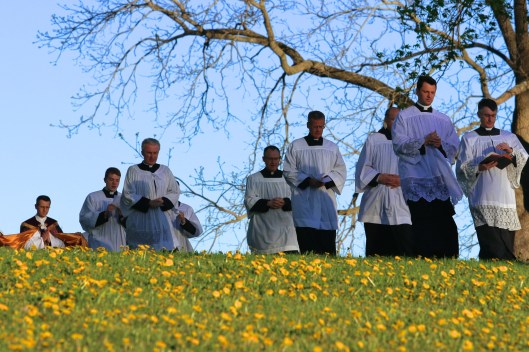
This coming Sunday at Hickory Neck, we will be adding a procession and blessing before our service begins in honor of Rogation Days.  Traditionally, Rogation Days are the three days before Ascension Day during which the litany is said as an act of intercession. In England, Rogation Days were associated with the blessing of the fields at planting, and in the United States they have been associated with rural life, agriculture and fishing, commerce and industry, and the stewardship of creation.[i]  For Hickory Neck, we are using this year’s Rogation Days to give thanks for rainwater collection barrels built for our Community Garden by a Boy Scout in our parish.  We will also bless the Garden, praying for a fruitful harvest for our parishioners and neighbors who use the gardens this year.

What I love about this upcoming event is that it represents a confluence of everything about which the church should be.  Our Community Garden has long been an example of using our property as a way to bless and welcome others.  At the garden, I see strangers become friends, people planting and tending in sacred silence, and the fruits of labor shared with one another.  Meanwhile, it has been a joy to watch our parishioner take leadership of an Eagle Scout project that benefits the church, the community, and his troop.  Watching our parishioner bring his faith community and his service community together has been a tremendous witness to each of us about how to make connections between the various parts of our lives.  And marking Rogation Days with liturgy is the church’s way of making the everyday parts of our lives sacred.  We take the labor of our hands, the fellowship of friends and strangers, the bounty of creation, and we name it all as holy.

Often when people think about church, they think about the building and the people who regularly attend worship services on Sundays.  But the church is much more about what the faith community does outside of the walls of the building, and how the community uses the blessing of its property to bless others.  This Sunday, we celebrate the ways in which we are living into the fullness of our identity, while also challenging ourselves to ever be outwardly-minded in our ministry.  I hope you will join us, but mostly, I hope you will invite a friend as we celebrate the ways in which the blessing of our community flows out into the world!

21463342_1589859034403684_3079109709240303206_n

Rainwater Collection Barrels Installation.  Photo credit:  Paula Simmons.  Permission required for reuse.


[i] Donald S. Armentrout and Robert Boak Slocum, eds., An Episcopal Dictionary of the Church:  A User-Friendly Reference for Episcopalians, “Rogation Days,” as found at https://www.episcopalchurch.org/library/glossary/rogation-days on May 1, 2018.

Recent Posts

  • On the Myth and Magic of Advent…
  • On Risking Failure and Facing Fear…
  • Sermon – Luke 23.33-43, P29, YC, November 23, 2025
  • On Inhabiting Gratitude…
  • Sermon – Luke 20.27-38, P27, YC, November 9, 2025

Archives

  • December 2025
  • November 2025
  • October 2025
  • September 2025
  • August 2025
  • July 2025
  • June 2025
  • March 2025
  • February 2025
  • December 2024
  • November 2024
  • October 2024
  • September 2024
  • August 2024
  • July 2024
  • June 2024
  • May 2024
  • March 2024
  • February 2024
  • January 2024
  • December 2023
  • November 2023
  • October 2023
  • September 2023
  • August 2023
  • July 2023
  • June 2023
  • May 2023
  • March 2023
  • February 2023
  • January 2023
  • December 2022
  • November 2022
  • October 2022
  • June 2022
  • May 2022
  • January 2022
  • December 2021
  • November 2021
  • October 2021
  • September 2021
  • August 2021
  • June 2021
  • May 2021
  • April 2021
  • March 2021
  • February 2021
  • January 2021
  • December 2020
  • November 2020
  • October 2020
  • September 2020
  • August 2020
  • July 2020
  • June 2020
  • May 2020
  • April 2020
  • March 2020
  • February 2020
  • January 2020
  • December 2019
  • November 2019
  • October 2019
  • September 2019
  • August 2019
  • July 2019
  • June 2019
  • May 2019
  • April 2019
  • March 2019
  • February 2019
  • January 2019
  • December 2018
  • November 2018
  • October 2018
  • September 2018
  • August 2018
  • July 2018
  • June 2018
  • May 2018
  • April 2018
  • March 2018
  • February 2018
  • January 2018
  • December 2017
  • November 2017
  • October 2017
  • September 2017
  • August 2017
  • July 2017
  • June 2017
  • May 2017
  • April 2017
  • March 2017
  • February 2017
  • January 2017
  • December 2016
  • November 2016
  • October 2016
  • September 2016
  • August 2016
  • July 2016
  • June 2016
  • May 2016
  • April 2016
  • March 2016
  • February 2016
  • January 2016
  • December 2015
  • November 2015
  • October 2015
  • September 2015
  • August 2015
  • July 2015
  • June 2015
  • May 2015
  • April 2015
  • March 2015
  • February 2015
  • January 2015
  • December 2014
  • November 2014
  • October 2014
  • September 2014
  • August 2014
  • July 2014
  • June 2014
  • April 2014
  • March 2014
  • February 2014
  • January 2014
  • December 2013
  • November 2013
  • October 2013
  • September 2013
  • August 2013
  • July 2013
  • June 2013
  • May 2013
  • April 2013
  • March 2013
  • February 2013
  • January 2013
  • December 2012
  • November 2012
  • October 2012
  • September 2012

Categories

  • reflection
  • Sermons
  • Uncategorized

Meta

  • Create account
  • Log in
  • Entries feed
  • Comments feed
  • WordPress.com

Blog at WordPress.com.

  • Subscribe Subscribed
    • Seeking and Serving
    • Join 394 other subscribers
    • Already have a WordPress.com account? Log in now.
    • Seeking and Serving
    • Subscribe Subscribed
    • Sign up
    • Log in
    • Report this content
    • View site in Reader
    • Manage subscriptions
    • Collapse this bar
 

Loading Comments...