• About

Seeking and Serving

~ seek and serve Christ in all persons

Seeking and Serving

Monthly Archives: March 2019

On the Work of Kindness…

27 Wednesday Mar 2019

Posted by jandrewsweckerly in Uncategorized

≈ Leave a comment

Tags

Acts, challenge, embody, faith, God, intentionality, Jesus, kindness, Lent, radical, time, uncomfortable, work

53283460_2247971941925720_5352232032019677184_o

Photo credit:  Hickory Neck Episcopal Church; reuse with permission 

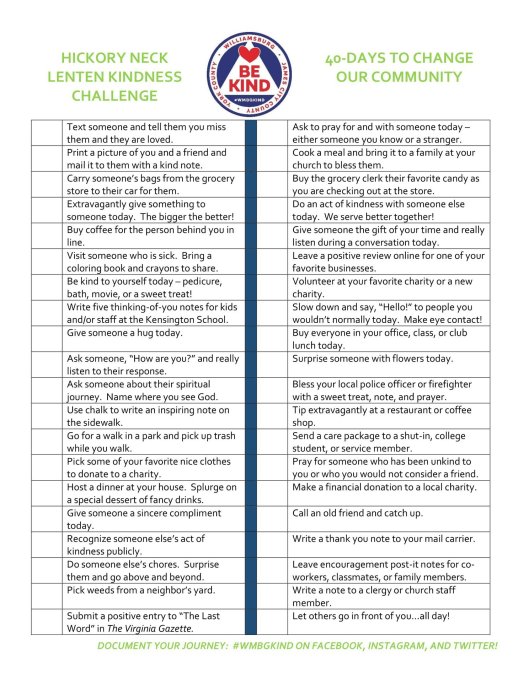
This Lent I decided to join my church in taking up our Lenten Kindness Challenge.  There are forty acts of kindness for the forty days of Lent.  The challenge itself is laid out like a checklist, but we were told we could either do the tasks in order, or pick and choose which acts fit our schedule on a particular day.  I elected to do the latter.  I confess, the kindness challenge began somewhat easily for me.  You see many of the acts of kindness are part and parcel of my job as a priest.  I have visited the sick more times than I can count this Lent.  I have hosted people in my home as part of our new Rector’s Receptions.  I regularly ask people about their faith journey and ask people if I can pray for them.  In some ways, by virtue of my job, I have felt like I am coasting through this kindness challenge.

But about halfway through Lent, I have passed all the “easy” acts, and am now facing all the acts of kindness I skipped because they will take more time or intentionality.  Midway through Lent, this kindness challenge is starting to feel like work – work that will require my time and attention.  On the one hand, I am already dreading the work, trying to figure out when I will have time to write extra notes, or do tasks that are outside of my everyday routine.  On the other hand, I am glad I have hit this point in the kindness challenge.  The work being demanded of me now reminds me that kindness is not just the kindness that we naturally do day in and day out.  Kindness requires something more of us – our time, our forethought, our work.  If it were easy, everyone would be doing it!

This is why I think focusing on kindness is so important for people of faith.  You see, being kind can reference the superficial, polite, everyday way of being that is common for all people – a great thing to be celebrated, but not necessarily the behavior in life that motivates and inspires.  But the kindness people of faith are invited to claim is the kind of kindness we see modeled through God – the kind of kindness we as people of faith embody so that others might see Christ in us.  Jesus was not venerated because he was simply polite – a good Southerner, if you will.  Christ was venerated because he healed the sick, listened to the isolated, and ate meals with the disenfranchised.  The kindness of Jesus was the kind of kindness that made people uncomfortable – that crossed barriers, that pushed people out of comfort zones, and that placed little value on societal norms.  Christ’s kindness was a radical kind of kindness.

I wonder what ways you are being challenged to get a little more radically kind this Lent.  What are things that you can be doing that require more of you than simply being polite?  What are the acts of kindness you can do that will take more time, that will inconvenience you, that might even make you a little uncomfortable?  Perhaps you have already notated which of those challenges are going to be hard for you this Lent.  Or perhaps there are different challenges that are not on our Lenten Kindness Challenge, but are the actions you need take to embody Christ today.  I cannot wait to hear how you are challenging yourself during this second half of Lent!

Sermon – Luke 13.1-9, L3, YC, March 24, 2019

27 Wednesday Mar 2019

Posted by jandrewsweckerly in Sermons, Uncategorized

≈ Leave a comment

Tags

free, fruit, gardener, God, gossip, Jesus, process, repentance, Sermon, shame, sins, theology, worthy

Mrs. Bonita was always there.  Whether we were going to or from school, running to a friend’s house, or picking up snacks from the corner store, Mrs. Bonita was always sitting on her porch, watching the comings and goings of our neighborhood.  The porch was covered, so she was there, rain or shine, hot or cold.  Of course, her complaints increased during the extremes, but they were just interspersed in the real attraction to Mrs. Bonita’s porch:  gossip.  Mrs. Bonita always knew everyone’s business, and she was not afraid to share that business – along with commentary.  She was the one who taught us that a lot of bad things happen when you are “not right with the Lord.”

Invariably, we all found ourselves on Mrs. Bonita’s stoop.  I suppose there was some lure to her commentary.  After an afternoon popsicle on her porch, you could begin to think all the problems of the world were the fault of someone else – Mr. Smith’s smoking habit, Mrs. Jones’ drinking problem, or the Jacobs family’s divorce.  But we all knew sitting on that stoop was a guilty pleasure to be avoided, because sooner or later, whether you wanted her to or not, you would be the topic of Mrs. Bonita’s gossip.  Suddenly, what had felt like a guilty pleasure at other’s expense became a source of shame.

For a long time, I thought Mrs. Bonita teaching us a sense of shame was counter to that “Lord” with whom she was always suggesting we get in line.  I thought shame was counter to what Jesus would have us feel.  But this week I was listening to a podcast interview with Bryan Stevenson, author of Just Mercy, and founder of the Equal Justice Initiative, and he argues quite the opposite.  He suggests we need a lot more shame in our society.  Stevenson argues, “I think the way human beings evolve, the way we get to a consciousness where we no longer do the things we shouldn’t be doing, is we develop a consciousness of shame.”[i]  This shame is the same shame that motivates us to create laws that protect the most vulnerable instead of blaming the victim.  As people of faith, we understand this reality more than anyone.  We know that part of our faith identity is committing to the process of confessing whom we are and what we have done, or left undone, and then making a conscious, albeit imperfect, effort to change – to repent.  As Stevenson says, “There is a role for shame, not as an end, but as a process.”

This is what Jesus is trying to capture in today’s gospel lesson.  Those who have gathered around Jesus are a bit like those who gathered on Mrs. Bonita’s porch.  They begin telling Jesus about the latest gossip in town.  The Galileans who were slaughtered on their pilgrimage to the temple, whose blood was mingled with the blood of the holy sacrifices; or the thirteen who died when the tower of Siloam collapsed.  Those gathered around Jesus were expecting the same verdict Mrs. Bonita often gave, “Those Galileans and those in that tower must not have been living right with God.”  Perhaps they were looking to boost their own pride, or perhaps they were actually looking for a genuine explanation of why bad things happen to good people.  But mostly, they were looking to redirect shame.  And Jesus is not having it today.

Jesus does something in our gospel lesson that Mrs. Bonita never did.  Jesus tells a parable about an unproductive fig tree the vineyard owner wants to cut down, and the gardener who pleads the tree’s case.  His method is a little indirect, as parables often are, but the result is jarring.  When those around Jesus want to gossip and cast shame, Jesus basically says, “I need you to redirect that shame to yourself – not as an end unto itself, but as a process to make yourselves whole before God.”  In other words, Jesus ask those gathered to stop worrying about the big philosophical questions like why bad things happen to good people, and instead ask questions that matter.[ii]  How can I change my own behaviors and patterns so that I not only reflect God’s glory, but I also begin to produce fruit?

The shift Jesus suggests today is both convicting and freeing.  Instead of getting caught up in the business of others, instead of gossiping about the problems of those people, and instead of getting caught up in theological rabbit holes that, while fascinating, ultimately just leave us stuck in our heads, Jesus wants us to look inward – to do the work of repentance that might actually change the world.  Instead of casting shame, Jesus wants us to harness shame, to raise our consciousness, so that we might bear fruit.  The work of repentance is much more productive work than any kind of outward looking and judging.  Besides, as scholar Fred Craddock suggests, “without repentance, all is lost anyway.”[iii]

As an adult looking back, I have often wondered how Mrs. Bonita’s stoop might have been transformed if she had helped fellow gossips turn to repentance.  If after a good gossip session, she might have said, “And now what about you?  I heard you have been up to some shameful stuff too.  What are doing to change?”  Of course, I am not sure Mrs. Bonita would have had as many guests on her porch had she asked those kinds of questions, but she certainly would have done a lot more to transform the neighborhood instead of indirectly hoping our own shame might help us “get right with God.”

The good news is that when we are terrible gardeners for one another, Christ is the gardener we all need.  The gardener in Jesus’ parable tends this same unproductive fig tree for three years, to no avail.  Even the vineyard owner is ready to rip the tree out of the ground and start over.  But not the gardener.  The gardener not only asks for mercy for the tree, the gardener commits to much, much more.  The gardener begs for one more year to aerate the soil, to get his hands dirty with manure to help nourish the tree.  The gardener does not give up on the unproductive tree, but instead offers to double down, to massage the environment in an effort create a total change in this tree.  As one scholar suggests, “The manure around our roots is the very blood of the one who pleads for our justification before God, the one through whom we may offer up the fruits of the kingdom to our Creator.”[iv]

I know repentance is hard.  I know our sins are so overwhelming that we would much prefer to look at someone else’s sins than our own.  I know the temptation of front stoops is to wax about theological questions that really just distract us from our own sinfulness and the need to bear fruit.  My invitation for you this week is to redirect your attention to the gardener, the one who is, at this very moment, aerating your soil, tirelessly fertilizing your roots so that you might let go of the “stuff” of life, and instead, through repentance, bear fruit worthy of our God.  That kind of work will not be as fun or escapist as sitting on a front porch with the local gossip.  But that kind of work will free you from needing to escape in the first place.  Amen.

[i] Bryan Stevenson, “Cohen Testimony & Just Mercy (with Bryan Stevenson),” Stay Tuned with Preet, NPR, February 28, 2019, as found at https://www.npr.org/podcasts/551791730/stay-tuned-with-preet on March 20, 2019.

[ii] David Lose, “Lent 3 C: Now!” …in the Meantime, March 22, 2019, as found at http://www.davidlose.net/2019/03/lent-3-c-now/ on March 22, 2019.

[iii] Fred B. Craddock, Luke, Interpretation:  A Bible Commentary for Teaching and Preaching (Louisville:  John Knox Press, 1990), 169.

[iv] Daniel G. Deffenbaugh, “Theological Perspective,” Feasting on the Word, Yr. C, vol. 2 (Louisville:  Westminster John Knox Press, 2009), 96.

Sermon – Luke 23:33-43, Meditation on Jesus’ Second Last Words, March 13, 2019

27 Wednesday Mar 2019

Posted by jandrewsweckerly in Sermons, Uncategorized

≈ Leave a comment

Tags

Christ, clarity, criminal, crisis, future, God, inclusion, Jesus, Kingdom, paradise, penitent, present, remember, Sermon, Seven Last Words

I preached the following sermon as part of a seven-week ecumenical preaching series on the Seven Last Words of Christ.  This sermon was offered at New Zion Baptist Church, one of the fellow members of the Upper James City County Ministerium, of which Hickory Neck Episcopal Church is a member.  

One of the funny things about life is that when left to our own devices, we can become consumed with things that do not have ultimate significance.  Whether our coworkers are counting on us to fill a shift, we have an important meeting, or we have a long to-do list to get accomplished, we can easily begin to think that the agenda we have set for ourselves is of ultimate importance.  We know this to be a falsehood though:  one phone call from the school nurse saying our child has a fever, or one appointment with the doctor telling us the test results came back positive, or one loved one experiences a car crash, and suddenly everything we thought was so important takes a backseat.  Crisis has a funny way of creating clarity in our lives when nothing else will.

I think that is what happens to the penitent criminal next to Jesus.  In the text we hear tonight, he is called a criminal, but in Matthew and Mark he is called a thief.  The distinction matters because crucifixion was not a crime for petty larceny.  Crucifixion was “…reserved for enemies of the state.  Crucifixion was saved for people the Roman Empire wanted to make examples of – people who had committed crimes like insurrection – civil disobedience – treason.  It’s why Jesus was crucified.”[i]  So presumably, our penitent criminal has been fighting the state too.  I suspect he has been so focused on his work, he sees nothing else, he sees no other way.  Only upon finding himself on a cross – in the midst of crisis – does he find clarity.

In that clarity, the penitent criminal doesn’t ask to be remembered on earth – to have a legacy that lives on.  He asks instead to be remembered – to have his body be re-membered – to be brought along with Jesus to that place that really matters.  The criminal does not ask to be remembered because he fears being nothing.  He confidently asks to be remembered, “because he recognizes the One who can remember.  …[He] is able to see and acknowledge that this is indeed the One to redeem Israel.”[ii]  This criminal could have been fighting the same empire, the same kingdom, that Jesus was fighting.  Except Jesus was bringing about a kingdom that threatens all the kingdoms of this world.[iii]  And in this moment on his cross, the criminal could see the Way.

I worry for us, here in Williamsburg, Virginia, among our ecumenical friends, even during Lent, we do not always have that same clarity.  Two thousand years after Christ’s death, we slip into assumptions that we can control the world around us.  We may even be trying to change our community – fighting injustice, organizing for the poor, rallying for the disenfranchised, and resisting the evil of this kingdom.  But if we are not rooted in Christ’s cross – rooted in helping to bring about the heavenly kingdom – perhaps we too are sitting on our own crosses, not having gained the clarity to simply ask, “Jesus, remember me when you come into your kingdom.”

In college, I spent ten days on a mission trip to Honduras.  We were in a rural village for most of the visit, needing to hike from the main road for about an hour before we arrived.  The week was filled with humbling experiences – seeing the sacrifices the village made to host us, learning about the plight of subsistence farmers who cannot own their land, trying to make an impact, but realizing how little power we really had.  During our ten days together, one of the songs we frequently sang was the Taizé chant, “Jesus, remember me.”  If you do not know the song, the song simply repeats the phrase, “Jesus, remember me, when you come into your kingdom; Jesus, remember me, when you come into your kingdom.”  The song is also quite easily translated into Spanish due to its simplicity.  On one of our last nights as a team, in our closing worship, one of the team leaders was so overwhelmed by our experience that he began to change the words, “Jesus, forget me…” he sang.  His words shocked us.  For him, I think his changing of the words was his way of expressing how unworthy he would ever be to be remembered by Jesus.  Not in a world of such deep injustice.

What my teammate’s version of that song did though was forget what happens in Luke’s gospel when the criminal asks Jesus to remember him.  Jesus says the words we honor tonight, “Truly I tell you, today you will be with me in Paradise.”  As Peter Gomes reminds us, “Jesus doesn’t say, ‘There, there, there, it will be all right, just hold on a little tighter.’  He doesn’t say that; he says, ‘Today’ – now, this instant, as soon as I’m there – ‘you will be there also.’  Jesus claims lordship of the future.”[iv]

Jesus says something powerful today.  This Paradise that Jesus points to is not a place they will go someday, but “a relationship that they entered today…Paradise is whenever, wherever you are with Jesus.”[v]  Now I don’t know about you, but that sounds like Good News to me.  When we get those moments of clarity – hanging from a cross, in the face of our sinfulness that makes us want to be forgotten, Jesus says, right now, right here, you are with me.  Last week, we heard Jesus’ promise of forgiveness, “Father, forgive them, for they do not know what they are doing.”  Today, Jesus moves beyond forgiveness to full inclusion in the kingdom – full, reconciled relationship that changes the here and now.

A few weeks ago, our parish hosted the Emergency Winter Shelter.  We partnered with many of you here, and I know many of you host your own weeks, or partner with other parishes that do.  When we host Winter Shelter Week, we often encourage our people to witness Christ’s love through service of others – to bring Christ’s light to the guests of our shelter.  But what I remembered this year, is that as much as we think of our selves as bearers of God’s light into the darkness, I think what we actually do is not bring Christ’s light, but discover Christ’s light is already there – because that is where God is – at the heart of suffering, illness, and oppression.  We do not bring God to our guests.  God is already with our guests.  We just get to be witnesses to the inbreaking of the kingdom.  When we serve the homeless in our community, we are asking Jesus to remember us – and Jesus reminds us that we are there with him in Paradise.

As much as I love singing “Jesus remember me,” during Lent, I confess that as I reflect on these last words of Jesus, I wonder if instead singing the Taizé song “Ubi Caritas,” might capture the spirit of what Jesus is saying.  The English translation of Ubi Caritas is “Where love and charity are, there is God.”  I think if my friend who simply wanted to be forgotten that night in Honduras had remembered Jesus’ response to those words, he would have remembered that Jesus does not care if we are worthy.  Our acts of charity, of love, of kindness, are where God is.  Today.  Not in the future.  Today, we are in God’s kingdom.  As that defeated revolutionary is hanging on the cross wanting to be remembered, as he and Jesus both long for justice, into that darkness, Jesus proclaims the light already present.  In our community, the light is present too.  Into the face of racism, sexism, xenophobia, homophobia, hatred, hunger, poverty, and oppression; into our divisions right here in Williamsburg, when we fail to love our neighbor; into the denominational differences that pull us apart on Sunday mornings, Jesus’ light is already here.  “Truly I tell you, today…today…TODAY… you…and you…and you…YOU… will be with me in Paradise.”  Amen.


paradise

Photo credit:  https://www.eyekons.com/img/Church/Beerhorst_Cross-Shattered-Christ-CD_Contents.pdf

[i] The Rev. Linda Pepe, “Today You Will Be with Me in Paradise: Luke 22.33-43,” 2013, as found at  http://www.theologicalstew.com/today-you-will-be-with-me-in-paradise-luke-23-33-43.html on March 1, 2019.

[ii] Stanley Hauerwas, Cross-Shattered Christ:  Meditations on the Seven Last Words (Grand Rapids:  Brazos Press, 2004), 42.

[iii] Hauerwas, 42.

[iv] Peter J. Gomes, The Preaching of the Passion:  The Seven Last Words form the Cross (Cincinnati:  Forward Movement, 2002), 27.

[v] William H. Willimon, Thank God It’s Friday:  Encountering the Seven Last Words form the Cross (Nashville:  Abingdon Press, 2006), 20.

On God and Spring…

20 Wednesday Mar 2019

Posted by jandrewsweckerly in Uncategorized

≈ Leave a comment

Tags

beauty, bloom, blossom, color, fresh, glory, God, joy, love, people, spring, surprise, trees, wonder

IMG_6943

Photo credit:  Jennifer Andrews-Weckerly; reuse only with permission

This year, spring has taken me a bit by surprise.  I am mostly surprised because we keep having cold bursts, and yet, the budding trees seem undeterred.  But what has also surprised me is how unprepared I have been for the emergence of color.  You see, in these brisk days, I had become accustomed to bare trees and the dormant brown of the season.  As the trees begin to blossom, though, I have been caught off guard.  I forgot how beautiful these trees can be in spring.  I forgot the soft yellows, purples, pinks, and whites of their blooms, and I had forgotten the beauty they possess.  Despite having watched these same trees blossom year after year, I still find myself surprised by their loveliness.

As I have been surprised by the beautiful emergence of spring this year, I began to wonder if I don’t do the same thing with the people around me.  Sometimes, I think we get so used to our loved ones that we forget to really see them.  We get used to the rote normalcy of life, and we get so accustomed to our routines, we sometimes fail to see the beautiful blooms of the people right in front of us.  We neglect to see the ways the people in our lives are changing and growing, and sparking new life, and we fail to see their blossoming beauty.  We fail to behold their beauty with the wonder it deserves.

I wonder who in your life has been blossoming without your notice.  I wonder whose blossoms are coming into glory and yet you have been too busy to notice.  I invite you this week to take a long look at your loved ones.  Look at them with fresh eyes, expecting to be wowed with something fresh and inspiring.  See them with the eyes of a new acquaintance instead of the eyes of someone who only sees the withered winter version.  And then, tell them what you see.  Share with your loved ones the beauty you see in them, the new life you see budding, and the ways in which their color gives joy to the world around them.

I suspect when you start to embrace this new way of seeing your loved ones you will see them as God sees them – as beautiful creations whose beauty reflects God’s glory.  You can share that gift too – the ways in which you see God’s glory reflected in them.  But beware!  Once you begin to see God’s beauty and glory in others, you might also begin to see it in yourself as well.  If you need a little help seeing the color blooming in yourself, let me know.  I’d be happy to help you see yourself as God sees you!

On Finding and Creating Sabbath…

13 Wednesday Mar 2019

Posted by jandrewsweckerly in Uncategorized

≈ Leave a comment

Tags

church, creative, everyday, God, Holy Spirit, intentional, intentionality, moments, reconnect, rest, sabbath, space, time

IMG_5288

Photo credit:  Elizabeth Shows Caffey; reuse with permission only

“So what do you actually do on your Sabbath?”  It’s a question I have received many times.  Usually, I think people want to make sure I am resting and reenergizing.  Or maybe they are imagining what they would do with a Sabbath day.  Or, maybe just the word “Sabbath” is a little too churchy and weird, and so they are trying to figure it out – does it just mean “day off”?

The truth is, usually my Sabbath day is just that – a day off where I do the same stuff everyone else does on their day off.  I run errands, clean the house, try to go to an exercise class, go to a doctor’s appointment, get my hair cut, or, if I’m lucky, get a nap.  I do not think a single Sabbath has consisted of me “sitting around all day and eating bonbons,” as many have asked.  Luxuriating may happen for an hour, but that is rare, and it never extends to a whole day.  And although I do try to take care of my physical well-being, I can rarely be found praying, meditating, or studying all day.

But this past Monday and Tuesday, I converted my Sabbath to a true Sabbath.  I got away with four other clergy friends, and we took a true Sabbath – not answering work emails (for the most part), not tending to the laundry, not running errands, but just relaxing, sharing stories about our ministries, talking about our dreams, reflecting on our relationships, and even exchanging ideas about leadership.  Of course, there was also yummy food, lots of laughter, sleeping in, and balancing a nice long hike with some comfy time on the couch.  But because we stepped away from the everyday stuff of life and work, we all actually reconnected with the intention of Sabbath – of taking time apart to reconnect with God, with others, and with ourselves.

Now, I know how hard finding true Sabbath time can be.  Lord knows, I am not sure when the last time my “Sabbath day” felt like this much of a Sabbath.  But I suspect that there might be ways that we can create little moments of Sabbath in our lives.  Maybe it’s putting down technology for a few hours.  Maybe it’s mixing up the family’s routine to spend unstructured time together.  Maybe it is neglecting that “to do” list for a few hours to read, pray, or connect with God, others, and/or ourselves.  You will have to be creative to find it – you may even have to just claim it by turning off all stimulation in the car so that the ten minutes of alone time you get is dedicated to Sabbath.  Regardless of the restrictions on your time, Sabbath is actually about intentionality – intentionally creating little blocks of time set apart.  It takes work, but when you intentionally make that space, not only are you restored, and your relationships enriched, but also, you may be able to finally hear the Holy Spirit’s whisper.  I cannot wait to hear about your creative creations of Sabbath, and the new ways your spirit is renewed!

Sermon – Luke 4.1-13, L1, YC, March 10, 2019

13 Wednesday Mar 2019

Posted by jandrewsweckerly in Sermons, Uncategorized

≈ Leave a comment

Tags

beloved, children of God, devil, disciplines, doubt, God, identity, Jesus, Lent, reclaim, relatable, Sermon, temptation, trust

After Ash Wednesday services this week, Father Charlie caught me in my office eating a peanut butter and jelly sandwich.  “Guess we’re not observing that whole fasting thing, huh?” he joked with me.  We then talked about how both of us struggle with fasting.  Prone to being what some call “hangry,” or in my case of low-blood sugar, even faint, neither of us is particularly good at fasting.  When I was finally diagnosed with having low-blood sugar many years ago, a great mystery was solved.  Upon hearing the news, all of my friends would, with relief, say, “Oh!  That explains soooo much!”  Only then did I discover my friends had been involved in a huge coping conspiracy.  Jennifer is acting weird or annoying or cranky – who has food?  I may even be the inspiration behind those Snickers commercials where cranky people are suddenly transformed back to their lovely selves as soon as they get the candy bar.

The trouble with people like me, or maybe even most of us, is that we hear the temptations of Jesus today and we immediately see ourselves in them.  We think about the times we have been hangry or desperate for food, and we know the difficulty of the devil’s temptation to turn stones into bread.  Or maybe we relate more to the temptation of the ego to be all powerful, or to temptation to test God, just to be sure we are secure in God’s protection.  Because the temptations in the gospel lesson are so relatable, we can almost too easily see ourselves in them and miss the point.  You see, the temptations of Jesus aren’t really about bread, power, and safety.  Just like the Lenten disciplines we take up are not really about chocolate, scripture reading, or prayer.  The temptations of Jesus are about something much deeper:  they are about identity.

In Luke’s gospel, Luke has already described Jesus’ baptism by John, when God declares, “You are my Son, the beloved; with you I am well pleased.”  Then, just before this passage, Luke articulates the genealogy of Christ, emphasizing the importance of who Jesus is based on his ancestors.  So, when Jesus goes into the wilderness, the devil is not actually trying to tempt Jesus with bread, power, and safety.  No, Jesus is being tempted to deny his identity.  As Karoline Lewis says, “the identity test for Jesus is not so much a test of who he is, but how he will live out his identity as Son of God.  The devil knows perfectly well who Jesus is.  The devil does not question who Jesus is, but tries to get Jesus to question who he is…”[i]

And that is a temptation we understand all too well.  “…temptation is not so often temptation toward something – usually portrayed as doing something you shouldn’t – but rather is usually the temptation away from something – namely, our relationship with God and the identity we receive in and through that relationship.  Too often Christians have focused on all the things we shouldn’t do, instead of pointing us to the gift and grace of our identity as children of God.”[ii]  In the end, the temptations Jesus faces could be anything.  They could certainly be “Bread, power, and safety.  But [the temptations] just as well might have been youth, beauty, and wealth.  Or confidence, fame, and security.”  The devil does not care about the content of the temptation.  The devil seeks “to shift our allegiance, trust, and confidence away from God and toward some substitute that promises a more secure identity.”[iii]

In part, that is why we take on disciplines during Lent.  We fast, pray, and study Scripture not because we need to imitate Jesus’ temptation.  We give up chocolate, coffee, or wine, or we take up kindness, fitness, or quiet not to simply push ourselves into new patterns.  We take on disciplines in Lent because we need to remind ourselves of our genealogy – to remind ourselves that we too are beloved children of God.  We know that when we claim that blessed status as beloved children of God, the devil will try to make us doubt the abundant, enduring, graceful love of God for each of us.  Because only when we doubt or forget our identity do we really fall into the temptations of this world.

No matter what our spiritual discipline, our invitation this Lent is to reclaim our identity.  Our invitation is to use these forty days to reaffirm, to recover, to reassert we are beloved children of God.  In yoga speak, when we have distracting thoughts, we are encouraged to acknowledge the thought, and then let the thought go.  Our invitation is to do the same this Lent.  As the devil puts distracting thoughts of inadequacy, unworthiness, and insecurity in our minds, we acknowledge them for what they are, and let them go.  Because we are beloved children of God.  Because when we boldly remind the devil that we are beloved children of God, we are empowered to remind others they are beloved too.  Together, affirmed in our identity, renewed in Christ’s love and light, we can do the real work of Lent – not just showing the world we are beloved children of God, but transforming that same world through our beloved status.  Amen.

[i] Karoline Lewis, “Identity Test,” March 3, 2019, as found at http://www.workingpreacher.org/craft.aspx?m=4377&post=5294 on March 7, 2019.

[ii] David Lose, “Lent 1C:  Identity Theft,” March 7, 2019, as found at http://www.davidlose.net/2019/03/lent-1-c-identity-theft/ on March 7, 2019.

[iii] Lose.

Holding on to Joy in Lent…

06 Wednesday Mar 2019

Posted by jandrewsweckerly in Uncategorized

≈ Leave a comment

Tags

Ash Wednesday, Christ, discipline, earthy, holy, identity, joy, kindness, Lent, life, light, love, repent, virtue

IMG_6748

Photo credit:  Jennifer Andrews-Weckerly; reuse only with permission

Last night I had one of the most fun Shrove Tuesday/Mardi Gras celebrations I have ever had.  We had a great crowd, there was a spirit of joy and celebration, the Kensington School hosted an awesome kids’ corner with fun activities, and best of all was the Hickory Neck Talent Show.  I have not laughed so hard and smiled so much in a long time.  I even woke up this morning with an uplifted spirit, the smile still lingering on my face.

While I am so grateful for that blessing, as a priest, it does make entering into Ash Wednesday a bit tricky.  Here I am still coming down from the high of last night, and now I need to enter into a worship service where I tell people to fast, to repent, and to remember their mortality.  It almost feels like emotional or spiritual whip-lash, and I have been struggling this morning to know how to help others with that same abrupt shift.

Where I have landed is that I think the best way to enter into Ash Wednesday and the season of Lent is with that same lingering sense of celebration.  You see, when you have experienced the highs of life, talking about the “lows” of life seems a bit more bearable.  Yes, we are mortal, and yes, we will return to the dust.  But while we are still mortal, we can make this life here on earth one of great joy and love – one of laughter, of community, of togetherness.

I wonder if this might be a way to enter Lent in a healthier way.  Instead of lamenting our sinful nature (and believe me, we do need to lament our sins), perhaps our Ashes today might remind of us the earthy nature of being humans and encourage us to strive for the ways we might live that earthy life in a more holy way.  I plan to do that today by entering into a season of kindness.  I am taking the joy from my community of faith last night and channeling it into forty days of kindness – where my repentance becomes a practice of demonstrating my identity – of living more faithfully the virtue of kindness.  What Lenten discipline are you taking up?  What might be a way for you to joyfully grasp onto this fleeting life and make it a witness to Christ’s light and love?  I can’t wait to hear all about it!!

Ash-Wednesday-1

Photo credit:  https://saintvincents.org/2019/02/25/ash-wednesday-march-6/

Recent Posts

  • On the Myth and Magic of Advent…
  • On Risking Failure and Facing Fear…
  • Sermon – Luke 23.33-43, P29, YC, November 23, 2025
  • On Inhabiting Gratitude…
  • Sermon – Luke 20.27-38, P27, YC, November 9, 2025

Archives

  • December 2025
  • November 2025
  • October 2025
  • September 2025
  • August 2025
  • July 2025
  • June 2025
  • March 2025
  • February 2025
  • December 2024
  • November 2024
  • October 2024
  • September 2024
  • August 2024
  • July 2024
  • June 2024
  • May 2024
  • March 2024
  • February 2024
  • January 2024
  • December 2023
  • November 2023
  • October 2023
  • September 2023
  • August 2023
  • July 2023
  • June 2023
  • May 2023
  • March 2023
  • February 2023
  • January 2023
  • December 2022
  • November 2022
  • October 2022
  • June 2022
  • May 2022
  • January 2022
  • December 2021
  • November 2021
  • October 2021
  • September 2021
  • August 2021
  • June 2021
  • May 2021
  • April 2021
  • March 2021
  • February 2021
  • January 2021
  • December 2020
  • November 2020
  • October 2020
  • September 2020
  • August 2020
  • July 2020
  • June 2020
  • May 2020
  • April 2020
  • March 2020
  • February 2020
  • January 2020
  • December 2019
  • November 2019
  • October 2019
  • September 2019
  • August 2019
  • July 2019
  • June 2019
  • May 2019
  • April 2019
  • March 2019
  • February 2019
  • January 2019
  • December 2018
  • November 2018
  • October 2018
  • September 2018
  • August 2018
  • July 2018
  • June 2018
  • May 2018
  • April 2018
  • March 2018
  • February 2018
  • January 2018
  • December 2017
  • November 2017
  • October 2017
  • September 2017
  • August 2017
  • July 2017
  • June 2017
  • May 2017
  • April 2017
  • March 2017
  • February 2017
  • January 2017
  • December 2016
  • November 2016
  • October 2016
  • September 2016
  • August 2016
  • July 2016
  • June 2016
  • May 2016
  • April 2016
  • March 2016
  • February 2016
  • January 2016
  • December 2015
  • November 2015
  • October 2015
  • September 2015
  • August 2015
  • July 2015
  • June 2015
  • May 2015
  • April 2015
  • March 2015
  • February 2015
  • January 2015
  • December 2014
  • November 2014
  • October 2014
  • September 2014
  • August 2014
  • July 2014
  • June 2014
  • April 2014
  • March 2014
  • February 2014
  • January 2014
  • December 2013
  • November 2013
  • October 2013
  • September 2013
  • August 2013
  • July 2013
  • June 2013
  • May 2013
  • April 2013
  • March 2013
  • February 2013
  • January 2013
  • December 2012
  • November 2012
  • October 2012
  • September 2012

Categories

  • reflection
  • Sermons
  • Uncategorized

Meta

  • Create account
  • Log in
  • Entries feed
  • Comments feed
  • WordPress.com

Blog at WordPress.com.

  • Subscribe Subscribed
    • Seeking and Serving
    • Join 394 other subscribers
    • Already have a WordPress.com account? Log in now.
    • Seeking and Serving
    • Subscribe Subscribed
    • Sign up
    • Log in
    • Report this content
    • View site in Reader
    • Manage subscriptions
    • Collapse this bar
 

Loading Comments...