• About

Seeking and Serving

~ seek and serve Christ in all persons

Seeking and Serving

Monthly Archives: March 2025

On the Risk of Anticipation…

12 Wednesday Mar 2025

Posted by jandrewsweckerly in reflection

≈ Leave a comment

Tags

anticipate, anticipation, control, dance, God, good, Holy Spirit, impact, Lent, movement, planner, spiritual

Photo Credit: https://www.pinterest.com/pin/tango–761882461966749050/

So, what does a Dancing with the Williamsburg Stars competitor do after the competition?  Well, in my case, you get back in the studio!  Before the competition even began, I already knew I wanted to keep dancing.  I was having such a great time stretching my mind and body learning new things that I knew it was a good physical, and spiritual, discipline I wanted to maintain. 

Now, you may be wondering how in the world ballroom dancing can be categorized as a spiritual discipline.  The truth is, I encounter the sacred in ballroom dance all the time.  I talked about it once before HERE.  This week, as I started my first post-competition class, we went back to basics, learning the rumba and cha-cha.  There’s a certain humbling that comes with learning a new dance that I had forgotten from when I started months ago.  As we progressed through the class, I felt like I was slowly getting the hang of the technicalities – that is, until we started turns.  At one point, my instructor said, “Stop anticipating!”  He reminded me that he would show me where to go, but if I anticipated what he was going to do next, I would mess up our unique dance.

Those two words have been rattling around in my head.  Stop anticipating.  You see, I am a planner by nature.  Anticipation is my jam.  I am constantly thinking ahead, wondering about decision trees and the potential impact of each branch.  I like thinking about the larger system and strategically guiding my parish in our next steps.  So, the idea of stopping anticipation seems anathema. 

But the more I thought about it, every good thing that has come about in my ministry was nothing I actually anticipated.  In my current parish, I might have conducted a needs assessment with the community, listened to my parish’s desires, and researched a particular new ministry.  But what I didn’t anticipate was an outside group needing space to do the exact ministry we were contemplating.  I might have envied other parishes with digital ministries, but what I never anticipated was a worldwide pandemic that would launch my church’s own digital ministry.  I might be dreaming with my parish about alternative revenue streams and the repurposing of our spaces, but what I didn’t anticipate was three conversations that fell into my lap in the course of three weeks about potential partnerships.  When I finished the planning and stop anticipating, God happened each time.

I wonder in what ways your anticipation is blocking the movement of the Holy Spirit.  In what ways are you anticipating a left-hand turn, only to discover, God is over the to right, ready for you, if you can just stop anticipating?  For those of you who are lifetime planners, I know this is hard spiritual work.  Perhaps this Lent, you can join me in my prayer, “Lord, help me stop anticipating.” 

On Ashes and Dust…

05 Wednesday Mar 2025

Posted by jandrewsweckerly in reflection

≈ Leave a comment

Tags

Ash Wednesday, ashes, care, community, dust, dusty, finitude, God, healing, mortality, music, organ, spiritual life, vulnerability

Phot credit: https://www.yamaha.com/en/musical_instrument_guide/pipeorgan/maintenance/

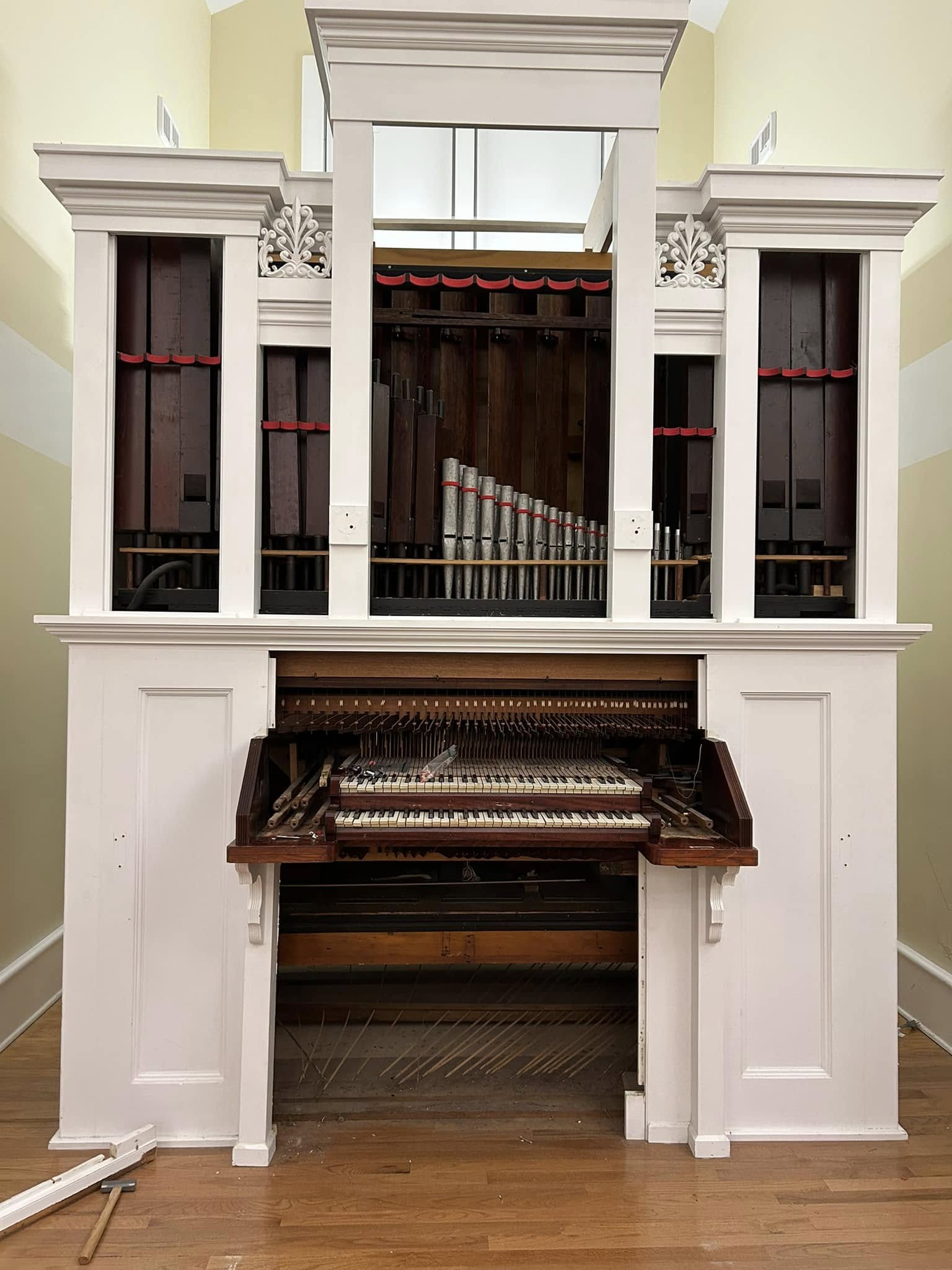
Last year our parish was donated a new pipe organ.  We have been eagerly waiting for the deconstruction of our current organ and the installation of the new one.  The time has finally come, we said a prayer of blessing on the current organ, and we have been waiting and watching as the process begins.  Ideally this wouldn’t be staring just days before Ash Wednesday, but I suppose there is no “perfect” time to deconstruct your worship space.

Knowing we are in a liminal time of deconstruction and reconstruction, I had not thoroughly thought through the impact this time would have on our experience of Ash Wednesday.  But walking into the Chapel this morning, seeing the pipes mostly gone, and the guts of our current organ exposed, I was hit by a sadness I couldn’t quite place.  Almost 20 years of music from that organ has filled our worship space, countless talented individuals have made the organ sing, and even more moments of sacred encounters with God have happened through that instrument.  Seeing the organ exposed today did something that left me unsettled. 

Photo credit: https://annkroeker.com/2011/03/09/there-back-again-my-first-ash-wednesday/

When I necessarily turned my attention to preparing for tonight’s Ashes to Go and Ash Wednesday service, I realized what was so unsettling.  Ash Wednesday is all about reminding us of our mortality, our finitude, and our vulnerability before God.  When those gritty ashes are scraped across my forehead and I am told that I will return to dust, that texture and those words linger with me.  So too, as that organ case sits gaping and open, with dust motes floating in the air, our worship space has suddenly become the perfect metaphor for entering a Holy Lent.

I wonder what gaping holes Ash Wednesday is exposing for you.  I wonder where your spiritual life is feeling dusty and in need of some care.  As always, you are most welcome to engage at Hickory Neck Episcopal Church for some tending – to find a connection with God that might be missing, to heal some holes that have been exposed for too long, and to find a place of belonging, because, believe me, you are not alone.  Welcome to Lent.

Photo credit: Stephen Trumbull; reuse with permission only

Sermon – Luke 9.28-43, TRS, YC, March 2, 2025

05 Wednesday Mar 2025

Posted by jandrewsweckerly in Sermons

≈ Leave a comment

Tags

Christian, church, division, Elijah, follow, formation, identity, Jesus, Lent, love, mission, Moses, prayer, Sermon, spiritual, Transfiguration

As I spend time with parishioners, staff, clergy leaders, and folks outside the community one common question keeps emerging, “What do we do?”  As we watch divisions deepen – something that seemed impossible given how deeply divided we already were, and as we watch a dismantling of how our country has operated for ages, and as we argue about what is best for our country, I have heard us asking, wondering, struggling with that question, “What do we do?”  The question is mirrored in the story of the transfiguration in Luke’s gospel today too.  Sleepy disciples who are supposed to be praying with Jesus on top of a mountain are jolted into alertness upon seeing Jesus in dazzling brightness, talking with long-gone Moses and Elijah, saying something about Jesus departing.  John and James are stunned into silence, but Peter answers his own question of “What do we do?” by proposing they build some dwellings – for surely remaining here in God’s glory is what he thought they should do.

Though we tease Peter about his not fully “getting it” when we wonder what we should do, I find myself mimicking Peter these days.  When I am asked, “What do we do?” my immediate and probably over-simplified answer is “follow Jesus” – not follow Republicans or follow Democrats; not follow supporters or follow opposers; not follow these Christians or follow those Christians.  Simply follow Jesus.  The problem with my answer of following Jesus is that the answer is so simple the answer leaves us with more questions than actual answers. 

That is why I am so grateful for Luke’s gospel today.  What this passage from Luke’s gospel does is tell us that following Jesus means, One, “…we must be clear about our identity;” two, be “resolute in our mission;” and three, be “intentional in our spiritual formation.”[i]  So, clear on our identity, focused on mission, and intentional about our spiritual formation.  Let’s dig in to this passage to find more clarity.

To follow Jesus, we need to be clear about our identity.  As scholar Jeffery Tribble argues, in Luke’s gospel, “The transfiguration bears witness to the identity of Jesus Christ.  By God’s action in the transformation itself and in the words of the voice of heaven, a theological statement is made.  Jesus Christ is declared to be the Chosen Son of God.  The disciples heard the declaration:  ‘Listen to him!’  The Christ event – his incarnation, passion, death, resurrection, ascension, gift of the Holy Spirit, and promised second coming – is the defining script for our local performances of the gospel.”[ii]

So what does that mean?  What is our identity here at Hickory Neck?  We define that identity using the acronym HNEC.  H stands for Hospitality:  We are committed to creating an environment where all experience an on-going sense of welcome, acceptance, and belonging.  Our hospitality is responsive to the unique needs of each generation, creating a community of mutuality, respect, dignity, and connection.  N stands for Nurture:  We are committed to nurturing the unique ministry of every individual so they can fully realize their baptismal covenant and participate in the life of the church, using their God-given gifts both within and outside the parish.  E stands for Engagement and Evangelism:  We are committed to responding to the needs of the wider community, sharing the love of Christ with our neighbors, and shining Christ’s light in the world.  And C stands for Curiosity:  While cherishing our particular history and Anglican identity, we are committed to being open to the movement of the Holy Spirit, being playful with one another and the wider community, while taking joy in one another.  So, our identity is about hospitality, nurture, engagement, and curiosity. 

So, being clear first about our identity, we must secondly be resolute in mission.  The transfiguration reveals the redemptive mission of Jesus Christ.  With Moses’ presence pointing to the exodus event and the communal responsibly to teach the statutes and ordinances, and with Elijah’s presence pointing to the end times, Jesus’ work of continued redemption is clear.  As Tribble says that “…in the transfiguration event Jesus is clear about his mission, which continues the redemptive work of God from the exodus through the end times.”[iii]

What about us, then?  Hickory Neck actually has a mission statement.  The mission statement reads, “We foster a loving, welcoming Christian Community with a uniquely intergenerational approach to worship, fellowship, and formation, helping us to develop a relationship with God and each other.  Nourished in community, we share the love of Christ Jesus by caring for each other, serving neighbors in need, and seeking justice and peace for all people.”  If I had to “make it plain,” I would use these eight words, “Love inside these walls, love outside these walls.”  When we are puzzling our way through what we should be doing in these profound times, our mission is simple:  love inside these walls and love outside these walls.  Now I know that sounds very pie in the sky – I have been known to roll my eyes a few times when someone says, “It’s all about love!”  But here’s the thing:  no matter what political or theological view you have, I can guarantee you that someone in this room disagrees with you.  How will you love them?  And when you are out in the world, all kinds of policies and moves are being made that may feel like they do not matter because they do not impact you directly – at least not yet.  How will you make sure that you and we as wider community are making sure love reigns?  There is a lot happening outside these walls that are done in the name of the redemptive Christ.  Your work is to discern which of those activities are actually following the identity and mission of the Jesus we are talking about this very day.

And that leads us to the third thing we invited to do to follow Jesus:  to be intentional in our spiritual formation.  I don’t know if you noticed, but Jesus took James, John, and Peter up that mountain not to heal, or to work, or even to witness the transfiguration.  Jesus brought them up to pray.  Whether in this passage or in the many verses to come, we know from holy scripture that “throughout his ministry Jesus was faithful in spiritual disciplines that would bring him into the presence of his Father.”[iv]

Tribble reminds us that “Professing faith in Christ in one thing, but living our Christian faith requires greater depth and breadth in our spiritual formation.”[v]  If we are in fact a congregation that doesn’t preach politics but instead preaches Jesus, then our work collectively is to know Jesus.  That means if you are not already in Bible Study, or reading scripture at home, or listening to a podcast about scripture, now is the time to dust off that book (or app) and get going.  That means if you are not one who is too comfortable with prayer, or only use prayer when you have an emergency, now is the time to start flexing your prayer muscles – whether you work your way through the Book of Common Prayer, whether you set aside daily time for prayer, or whether you start using those prayer beads, now is the time to step away with Jesus in prayer.  I remember reading about a conversation between His Holiness the Dalai Lama and Archbishop Desmond Tutu in which the two of them were competing about who got up the earliest for prayer.  Both of these deeply spiritual men knew that the only way they could do any good work was to deepen their spiritual formation.

The good news is that we are heading into a season in the church where all of this work is enriched, supported, and encouraged.  In the season of Lent, we are encouraged to be intentional about our spiritual formation.  In Lent we work to become very clear about our identity.  In Lent we become resolute in our mission.  If you are feeling that overwhelming sense of “What do I do?” in these times, the Church invites you to follow Jesus.  The Church invites you to be focused on identity, mission, and formation.  And this Church specifically creates the structure for you to do just that.  Your invitation is to join us!  Amen.


[i] Jeffery L. Tribble, Sr., “Pastoral Perspective,” Feasting on the Word, Yr. C, Vol. 1 (Louisville:  Westminster John Knox Press, 2009), 452.

[ii] Tribble, 452.

[iii] Tribble, 454.

[iv] Tribble, 454.

[v] Tribble, 456.

Sermon – Luke 6.17-26, Jeremiah 15.5-10, EP6, YC, February 16, 2025

05 Wednesday Mar 2025

Posted by jandrewsweckerly in Sermons

≈ Leave a comment

Tags

blessed, blessing, curse, discipleship, God, Jesus, politics, Sermon, Sermon on the Plain, status quo, trust, vulnerable, woe

One of the things I love about the diversity of parish like Hickory Neck is that I often get to see the fullness of life in just a matter of days – or even hours.  Whether I am talking to a retiree dealing with new health issue, an adult dealing with rigors of parenting, or a kid dealing with the everyday challenges to their identity, the breath of life is ever before me.  But these last weeks have brought a new rawness that I have not seen in a while.  The philosophical arguments of an election year have birthed a new praxis that has everyone on edge – from deep divides about economic and ethical policies, to the questions of how we bound we are to care for our neighbors, to whole livelihoods and vocations coming into question.  We are swimming in a sea of defensiveness, of vulnerability, of righteous indignation – no matter where you find yourself on the political spectrum. 

Into that volatile atmosphere, we get some scripture today that cuts to the bone and leaves all of us standing vulnerably before God who is calling us to task.  The bite starts in Jesus’ Sermon on the Plain in Luke’s gospel.  The blessings alone should bring us up short:  blessed are you who are poor (not poor in Spirit like Matthew says, but the literal poor), who are hungry, who weep, who are reviled.  Jesus’ blessings should be enough to bring us up short about how we are treating the poor, hungry, and oppressed.  But Jesus does not stop there.  Then he begins with the “woes.”  The word “woe” in Greek is translated literally as “woe” – like the sound woe makes as woe comes out of your mouth – like a sigh of “oh man!”  As New Testament scholar Matt Skinner says, that sound is not necessarily a sign of disappointment, but as if Jesus is explaining, “Your vision is so small, so limited,” like Jesus is just giving a “deep sigh.”[i] And all of this blessing and woe would be hard enough in normal times, but the truth is, as many of our own find ourselves in economic insecurity – whether layoffs are coming, or social security may be cut, or loan payments may increase – we’re not even sure which category we are in anymore.

In looking at Luke’s Gospel, professor Mary Hinkle Shore explains, “The difficulty in…this text in a 21st-century American, mainline Christian context is that most of us who will hear this word are not inclined to trust it…  We aim to be rich, full, laughing, and respected.  Hearing the beatitudes from Jesus, we may be tempted to think, ‘I’ll take my chances with the status quo.’   This reaction may be why Jesus adds woes here after his blessings.  No matter how hopeful his words are, some in the crowd have placed their trust elsewhere, and the choices they have made are working for them.  For these, the woes are not curses, but warnings.  It is as if Jesus said, ‘Certain things are worthy of your trust, and other things are sure to betray it.’  When those objects of misplaced loyalty do betray your trust—Lord, have mercy.”[ii]

I think that is why the designers of the lectionary chose Jermiah today.  Jeremiah features blessings and curses too.  But these blessings and curses are almost harder because they are not about economic categories but about our very relationship with God.  Jeremiah pronounces in the text today, “Cursed are those who trust in mere mortals and make mere flesh their strength, whose hearts turn away from the Lord.  They shall be like a shrub in the desert, and shall not see when relief comes.  They shall live in the parched places of the wilderness, in an uninhabited salt land.”  In contrast, Jeremiah goes on to say, “Blessed are those who trust in the Lord, whose trust is the Lord.  They shall be like a tree planted by water, sending out its roots by the stream.”  All of holy scripture seems to be pushing us to deeply examine where we are putting our trust these days.

As many of you know I have been working the last few months on a charity event to raise money for two amazing non-profits in our community – a little event called Dancing with the Williamsburg Stars.  I thought the dance lessons would be fun, and as someone who has danced in the past, I thought I would have a somewhat easier go of things.  And I loved the idea of representing Hickory Neck in such a fun-loving way.  But here’s the funny thing about ballroom dancing – dancing with a partner requires a level of trust I never experienced when dancing in an ensemble.  A few weeks ago, we were practicing a move where I basically lean backwards, held up by my partner.  I thought I was doing a great job until we watched video replays.  I was barely dipping my head back at all.  My partner had to show me where his arms were placed to catch me and how little I was leaning into them.  Then just this week, we were working on another move were I basically fall forward with an extended arm behind me.  My partner explained that if I try to catch myself in the fall, I will make him fall.  I must trust that his hold is steady enough that I won’t slam face-forward to the ground.  And then, just to show me how I still wasn’t fully trusting him, he showed me how even in the turn out from that fall, I was muscling my arm to get up, instead of trusting him to pull me up. 

We are in intricate dance with God right now.  We are vulnerable, on stage, and not at all in control.  Our natural inclination is going to be to muscle our way through, to fight for some modicum of control, to determine what we want (to be rich, full, laughing, and respected) and trusting that that fullness is the ultimate end game.  Into that battle of wills, Jesus sighs a big “woe.”  As we stare out into the audience of that dance, I love what Debie Thomas sees in this text.  When thinking about her relationship with trust and God, Thomas confesses, “I might begin by admitting that Jesus is right.  I might come clean about the fact that most of the time, I am not desperate for God.  I am not keenly aware of God’s active, daily intervention in my life.  I am not on my knees with need, ache, sorrow, longing, gratitude, or love.  After all, why would I be?  I have plenty to eat.  I live in a comfortable home.  My family is safe.  I’m not in dire need of anything.  In short, there isn’t much in my circumstances that leads me to a sense of urgency about ultimate things.  I can go for days without talking to God…Most of the time, it just plain doesn’t occur to me that I would be lost — utterly and wholly lost — without the grace that sustains me.”

Thomas goes on to conclude, “I think what Jesus is saying in this Gospel is that I have something to learn about discipleship that my life circumstances will not teach me.  Something to grasp about the beauty, glory, and freedom of the Christian life that I will never grasp until God becomes my everything, my all, my starting place, and my ending place.”[iii]  In other words, until I let God take the lead, and actually follow, my dance through this life is going to echo the woe’s I have been sighing for the last several weeks.  Blessing comes in placing trust not in earthly things or earthly policies, but in the Lord.  Then, as Jeremiah reminds us, we will be like trees planted by water, roots going down by the stream, and leaves that stay green, not ceasing to bear fruit.  When we are so rooted, growing, and producing, then we can share our fruit, our shade, our refreshment.  God needs us so rooted so that we can stop sighing woes and start being blessings.  Amen.


[i] Matt Skinner, “Sermon Brainwave Podcast:  #1008: Sixth Sunday after Epiphany (C) – Feb. 16, 2025,” February 6, 2025, as found at https://www.workingpreacher.org/podcasts/1008-sixth-sunday-after-epiphany-c-feb-16-2025 on February 12, 2025.

[ii] Mary Hinkle Shore, “Commentary on Luke 6:17-26,” February 16, 2025, as found at https://www.workingpreacher.org/commentaries/revised-common-lectionary/sixth-sunday-after-epiphany-3/commentary-on-luke-617-26-3 on February 14, 2025.

[iii] Debie Thomas, “Leveled,” February 6, 2022, as found at https://www.journeywithjesus.net/essays/3319-leveled on February 14, 2025.


Recent Posts

  • On the Myth and Magic of Advent…
  • On Risking Failure and Facing Fear…
  • Sermon – Luke 23.33-43, P29, YC, November 23, 2025
  • On Inhabiting Gratitude…
  • Sermon – Luke 20.27-38, P27, YC, November 9, 2025

Archives

  • December 2025
  • November 2025
  • October 2025
  • September 2025
  • August 2025
  • July 2025
  • June 2025
  • March 2025
  • February 2025
  • December 2024
  • November 2024
  • October 2024
  • September 2024
  • August 2024
  • July 2024
  • June 2024
  • May 2024
  • March 2024
  • February 2024
  • January 2024
  • December 2023
  • November 2023
  • October 2023
  • September 2023
  • August 2023
  • July 2023
  • June 2023
  • May 2023
  • March 2023
  • February 2023
  • January 2023
  • December 2022
  • November 2022
  • October 2022
  • June 2022
  • May 2022
  • January 2022
  • December 2021
  • November 2021
  • October 2021
  • September 2021
  • August 2021
  • June 2021
  • May 2021
  • April 2021
  • March 2021
  • February 2021
  • January 2021
  • December 2020
  • November 2020
  • October 2020
  • September 2020
  • August 2020
  • July 2020
  • June 2020
  • May 2020
  • April 2020
  • March 2020
  • February 2020
  • January 2020
  • December 2019
  • November 2019
  • October 2019
  • September 2019
  • August 2019
  • July 2019
  • June 2019
  • May 2019
  • April 2019
  • March 2019
  • February 2019
  • January 2019
  • December 2018
  • November 2018
  • October 2018
  • September 2018
  • August 2018
  • July 2018
  • June 2018
  • May 2018
  • April 2018
  • March 2018
  • February 2018
  • January 2018
  • December 2017
  • November 2017
  • October 2017
  • September 2017
  • August 2017
  • July 2017
  • June 2017
  • May 2017
  • April 2017
  • March 2017
  • February 2017
  • January 2017
  • December 2016
  • November 2016
  • October 2016
  • September 2016
  • August 2016
  • July 2016
  • June 2016
  • May 2016
  • April 2016
  • March 2016
  • February 2016
  • January 2016
  • December 2015
  • November 2015
  • October 2015
  • September 2015
  • August 2015
  • July 2015
  • June 2015
  • May 2015
  • April 2015
  • March 2015
  • February 2015
  • January 2015
  • December 2014
  • November 2014
  • October 2014
  • September 2014
  • August 2014
  • July 2014
  • June 2014
  • April 2014
  • March 2014
  • February 2014
  • January 2014
  • December 2013
  • November 2013
  • October 2013
  • September 2013
  • August 2013
  • July 2013
  • June 2013
  • May 2013
  • April 2013
  • March 2013
  • February 2013
  • January 2013
  • December 2012
  • November 2012
  • October 2012
  • September 2012

Categories

  • reflection
  • Sermons
  • Uncategorized

Meta

  • Create account
  • Log in
  • Entries feed
  • Comments feed
  • WordPress.com

Blog at WordPress.com.

  • Subscribe Subscribed
    • Seeking and Serving
    • Join 394 other subscribers
    • Already have a WordPress.com account? Log in now.
    • Seeking and Serving
    • Subscribe Subscribed
    • Sign up
    • Log in
    • Report this content
    • View site in Reader
    • Manage subscriptions
    • Collapse this bar
 

Loading Comments...