• About

Seeking and Serving

~ seek and serve Christ in all persons

Seeking and Serving

Monthly Archives: October 2025

On the Nose…

29 Wednesday Oct 2025

Posted by jandrewsweckerly in reflection

≈ Leave a comment

Tags

broken, Christ, grace, healing, Jesus, love, perfume, recollection, scent

Photo credit: https://www.istockphoto.com/search/2/image-film?phrase=perfume+spray

We recently spent some time with friends who are fragrance aficionados.  Often when we gather, we do a fragrance sampling, noting what we smell and what it evokes – and whether we could imagine wearing the fragrance ourselves.  Our friends are great guides, teaching us tips from the industry, helping us define fragrance-specific terms, and sharing the gracious wisdom that all scent evaluations are subjective.  The sessions are always a delight, sometimes leading us to new fragrances we enjoy.

When I returned home after the visit, I asked one of my daughters whether she liked a particular fragrance I was trying.  She confessed it was nice, but said, “I just prefer your ‘Mom Smell.’”  Through our chuckles, I asked her what she meant about a “Mom Smell.”  She couldn’t quite explain it, and I can only assume she meant a combination of the soap, hair products, or laundry detergent I use.  But I knew what she meant – like scientifically devised fragrances can, any smell can evoke the essence of a person or place we know and love.  It is the gift of recollection that comes through the sense of smell.

Her insight had me wondering if all of life isn’t about leaving behind traces of our scent, unbeknownst to us.  Who had a positive experience or a blessing through me that is recalled when the smell something reminiscent of my “Mom Smell” wafts by?  Who has been in a location far from me and smelled my soap or laundry detergent and remembered something kind and generous I said or did?  We all leave traces of ourselves in this world.  I wonder what gifts you are leaving behind, unbeknownst to you.  I wonder what recollections people have of you that remind them of the grace and love of Christ himself.  I look forward to hearing about what healing scent you are trying to leave for this broken world.

On Commitments and Gratitude…

15 Wednesday Oct 2025

Posted by jandrewsweckerly in reflection

≈ Leave a comment

Tags

blessing, commitment, God, grateful, gratitude, joy, list, positive, sight, stewardship, support

Photo credit: https://medium.com/@mnwieschalla/why-you-should-make-a-gratitude-list-every-night-before-bed-fc4a30196af9

One of the tools I use in my line of work is an executive coach.  The coach helps me examine my leadership and develop tools for higher levels of executive functioning.  Sometimes that means troubleshooting a specific challenge I am facing and sometimes that means skill development work.  Each month that we meet, we monitor progress and reflect on newly emerging needs or unresolved issues.  This month the content of our meeting was a little different.  We spent most of the meeting reflecting on things that were going well – successes to celebrate, progress being made, and joys to honor.  As I shared each positive reflection, I was reminded of other things to celebrate.  It was as if the positive news was multiplying, bubbling up as I recalled each source of thanksgiving.

In many ways, that is what we have been inviting our entire congregation to do in this season of stewardship.  Before asking parishioners to consider how they might support ministry with their time, talent, and treasure, first we have been sharing our joys – what good things are happening in our church, what positive impact we are making inside and outside of our church community, and what goodness is motivating our members.  Each bit of sharing has led to more positive, encouraging reflection:  from the mom who really appreciated the elder member sharing about how much he values the formation of children in our church, to the person who still isn’t sure they are an Episcopalian hearing about someone else’s journey to the Episcopal Church through Hickory Neck, to the parishioner who knows the speaker has different views from them but who finds a similar sense of belonging in this unique place.  We have found the sharing of our gratitude begets more gratitude – opens our eyes to the abundance that seems hard to see lately.

This week, as we begin to think about our commitment of support to our church, I invite all of you to start first with gratitude.  What is bringing you joy in your faith community?  What are you grateful for?  What keeps bringing you back?  Start today with a list of three different things for which you are grateful.  Write them down (or make a note in your phone).  Tomorrow, think about three other items, repeating the process each day.  See how the list grows, and watch how your sight begins to widen.  You’re welcome to have your commitment card and forms nearby (or the link from our website open in your tabs), but first, take some time filling your heart with gratitude before filling out the forms with commitments.  Let your commitments pour out of your grateful heart and your conversation with God before sharing those commitments with the community.  I can’t wait to hear how starting with gratitude changes your sight.

Sermon – Luke 17.11-19, P23, YC, October 12, 2025

15 Wednesday Oct 2025

Posted by jandrewsweckerly in Sermons

≈ Leave a comment

Tags

blessing, duty, God, gratitude, Jesus, lenses, lepers, see, Sermon, sight, stewardship, Thanksgiving

Several years ago, A.J. Jacobs wrote a book called Thanks a Thousand.  Jacobs had decided that he loved his daily cup of coffee from his local coffee shop so much that he wanted to thank every person who made the cup of coffee possible.  His book journals what started out as that simple premise that became a journey around the world.  You see, he could easily thank the barista he saw every morning.  But then he realized he should thank the owner of the shop for the shop existing in the first place.  From there, he realized the owner had a graphics designer who designed the logo, and there was company that made his coffee cup that carried that logo.  He eventually recalled the beans for the coffee came from somewhere – and there were hundreds of people who moved the beans from tree to harvest to packaging to shipping to storage and to distribution.  And that didn’t include those who made sure the city had clean water that was used to combine beautifully with beans to make his daily beloved cup of coffee.  Each thank you – often received with confusion, surprise, mystification, and occasional delight – led to another individual for Jacobs to thank.  Jacobs had read that the practice of gratitude could change your life, and slowly, he began to find that genuine gratitude made him kinder, happier, and gave him the opportunity to make an impact in the world.  Gratitude helped him to see the world differently.

In our gospel lesson today, ten lepers experience a miraculous healing through Jesus.  Jesus sends the lepers to the priests and they become clean along the way.  But only one of the lepers actually sees that he is healed.  We are told that because he sees, he turns back, praises God, and prostrates himself at Jesus’ feet, thanking him.  Now, to be clear, the other nine lepers do nothing wrong.  In fact, they follow Jesus’ instruction explicitly and enjoy being healed.  The promise made to them is fulfilled.  The tenth leper – a Samaritan of all people – though sees.  And when he returns to give thanks, he is blessed a second time.  David Lose explains, “Jesus concludes his exchange by inviting the man to rise and go on his way and saying that his faith has made him not only physically well, but also whole and, indeed, saved.  That’s part of the complex and multivalent meaning of the Greek root word σoζω (transliterated as “sozo” and pronounced “sod-zo”) Jesus uses.”[i]  That second blessing does not happen though without the act of seeing.

The Samaritan leper experienced a second blessing much like A.J. Jacobs experienced a second blessing.  Once Jacobs began his coffee gratitude journey – thanking all those folks who made that perfect cup of daily coffee – he began to see just like the leper.  His eyes were opened to the powerful work of God by the simple act of gratitude.  Scholars across the centuries have noted how deeply faith and gratitude are linked.  “Karl Barth was fond of saying that the basic human response to God is gratitude – not fear and trembling, not guilt and dread, but thanksgiving.  ‘What else can we say to what God gives us but stammer praise?’ [Barth says.]”  C.S. Lewis “also observed the connection between gratitude and personal well-being.  [He said,] ‘I noticed how the humblest and at the same time most balanced minds praised most:  while the cranks, misfits, and malcontents praised least.  Praise almost seems to be inner health made audible.’”[ii]  The entire enterprise of thanking thousands of people for his cup of coffee was A.J. Jacobs’ attempt to correct his vision so that he might cultivate a healthy practice of faith.

The Stewardship team at Hickory Neck this year has been doing the same thing.  They have been working to help us better see God in this place we keep returning to.  Today you will receive a packet of information meant to engage your vision.  In the packet will be testimonies of how much this community has impacted the lives of your fellow parishioners.  You will find a visual representation of how every dollar is stretched to make possible the goodness we experience here.  You will find an invitation to respond to your own gratitude to Jesus for the many blessings in your faith journey by committing your time, your talent, and your treasure –not out of a sense of duty, but because you have seen goodness here, and gratitude is bubbling out of you.  And in case all those invitations into seeing differently are not enough, our Stewardship team will be bringing back to you the stories of your fellow parishioners in their own words.  Each week, you will be sent videos on what they are calling Motivational Mondays and Faithful Fridays – videos of your fellow parishioners describing how their devotion to generosity has richly blessed their faith journey.

In the coming weeks, you may be tempted to do what the nine lepers do – to dutifully follow Jesus’ invitation to go and be healed – and simply open your stewardship packet and return the commitment card and time and talent form.  And doing so would not be wrong at all – in fact, the Stewardship Team and Vestry would be deeply grateful.  But our invitation from today’s gospel lesson goes a little further than duty.  Our invitation is to put on new lenses – to use the tools Hickory Neck is gifting you to better see the overwhelming blessings from the Spirit and to make tangible our gratitude – “gratitude for the gift of life, gratitude for the world, gratitude for the dear people God has given us to enrich and grace our lives.”[iii]  I cannot wait to hear what you see.  Amen.


[i] David Lose, “Second Blessing,” October 7, 2013, as found at https://www.workingpreacher.org/dear-working-preacher/second-blessing on October 10, 2025. 

[ii] John M. Buchanan, “Homiletical Perspective,” Feasting on the Word, Yr. C, Vol. 4 (Louisville:  Westminster John Knox Press, 2010), 165.

[iii] Buchanan, 169.

Sermon – Matthew 11.25-30, St. Francis Feast, YC, October 5, 2025

15 Wednesday Oct 2025

Posted by jandrewsweckerly in Sermons

≈ Leave a comment

Tags

animals, blessing, church, connected, creation, God, Jesus, pets, saint, Sermon, St. Francis, yoked

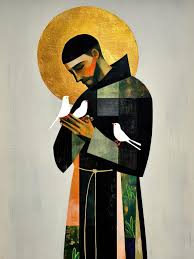
Image credit: https://www.instagram.com/p/CF_31K6sogj/

I was talking to a friend recently who had been on a road trip.  She had stopped for gas and was standing by her car when another car pulled up next to her.  A family piled out of the car, followed by the family’s dog.  My friend was paralyzed in place.  The dog looked exactly like her beloved dog Buddy who had passed away four years ago.  Her eyes immediately watered, and even though four years had passed, an ache appeared in her chest that she thought had long ago gone away forever.  “I just really miss that dog,” she explained later – surprising even herself at how her grief lingered.

I have sometimes wondered if our celebration of St. Francis and the Blessing of the Animals is not a little gimmicky.  We even took our celebration on the road yesterday for the first time, offering to bless animals and their owners whom we have never met, who maybe never harken the door of any church, let alone Hickory Neck’s doors.  But as I thought about my friend’s lingering grief over her dog who had passed, and as I have heard countless stories over the years of cats, horses, Guinea pigs, goats, and even chickens who have been a source of joy, companionship, sometimes consternation, but always love, I understand more fully why we commit to blessing animals and their owners, even if on the surface the practice may seem like a gimmick.

We engage in the blessing of animals because of the inspiration that comes from St. Francis of Assisi.  St. Francis is one of the most beloved saints of the Church.  Most of us think of Francis as the patron saint of animals and creation.  When we think of him, we may think of a St. Francis statue in a garden.  We may think of various images of him preaching to birds.   Some of us may even recall that tale where Francis negotiated peace between a village and a wolf that had been terrorizing the town.  His understanding of animals as his brothers and sisters is why we bless animals on his feast day – the creatures that were so dear to him.  That is also why when we say the Eucharistic prayer [at 10:00 am] today, we will use Prayer C – the one that praises, “the vast expanse of interstellar space, galaxies, suns, and the planets in their courses, and this fragile earth, our island home.”[i]

At the heart of our blessings yesterday and today is an understanding that St. Francis had mastered and we continue to understand – that we are bound to all of the creation God created – to the earth, to the earth’s animals, and to one another – even the other humans or other creation we may not like.  Jesus reminds us of the nature of that bond today in his words about following him.  In Matthew’s gospel, Jesus says, “Come to me, all you that are weary and are carrying heavy burdens, and I will give you rest.  Take my yoke upon you, and learn from me; for I am gentle and humble in heart, and you will find rest for your souls.  For my yoke is easy, and my burden is light.”  Those yokes Jesus talks about were used to harness two animals for work.  The yoke allowed the two not just to double their work, but to rely on one another – if one was tired, the other could push harder; and then the weaker one could later support the stronger one.  Yokes, like Jesus’ work, were easy and made the burden light. 

But beyond the mechanics of a good yoke, the yoke is also a good metaphor for how we see the gospel.  Being yoked to another makes you connected.  And once you are connected, and see how dependent upon one another you are, you begin to see how that connection extends beyond the two of you – that your yoked interconnection is a microcosm of the connectedness of all of God’s creation.  Francis, who was just as known for helping the poor as he was for befriending animals, understood that all humanity is connected.  He learned that the more we spend time seeing the humanity in others – especially the humanity in those we would rather not – then we start to see that our interconnectedness extends even further – to God’s creation, to God’s creatures, to the cosmos.  If we open our hearts to one, we cannot help but to open our hearts to all.  Francis’ love for the poor and Francis’ love for creatures were not two separate things – they were one in the same. 

The invitation for us is to start claiming our yoked nature – yoked to those we love, yoked to our political opponents, yoked to those who have different ethics and values than ourselves, yoked to parents who make different parenting decisions, yoked to those with different skin color or sexual orientation, yoked to those we see as deserving of God’s grace and those who are not.  Our yoked nature allows us to pray [and later sing] the Prayer of St. Francis from our Prayer Book:  “Lord, make us instruments of your peace. Where there is hatred, let us sow love; where there is injury, pardon; where there is discord, union; where there is doubt, faith; where there is despair, hope; where there is darkness, light; where there is sadness, joy. Grant that we may not so much seek to be consoled as to console; to be understood as to understand; to be loved as to love. For it is in giving that we receive; it is in pardoning that we are pardoned; and it is in dying that we are born to eternal life.”[ii]  We can do the work of St. Francis, blessing animals, humans, and all creation, because of the yoke of Jesus.  Thanks be to God.  Amen.


[i] BCP, 370.

[ii] BCP, 833.

On Finding Commonality and Church…

01 Wednesday Oct 2025

Posted by jandrewsweckerly in reflection

≈ Leave a comment

Tags

band, beauty, Christ, church, commonality, community, concert, disparate, healing, meaning, music, unity

Photo credit: https://unsplash.com/s/photos/concert-audience

Last weekend we took one of our daughters to her first concert.  It was not a band or even a genre of music I particularly like.  But she had been obsessing over every concert venue.  When the band came within an hour of our town, coupled with a big birthday this year, we couldn’t refuse.  So, off we went, playing chaperone to one of those fun life milestones.

While I cannot say that I came to fall in love with the band, what did not escape me was the beautiful experience of that night.  Feeling like a total outsider, I watched as everyone around me joined in commonality.  I watched as people belted out memorized lyrics, and they mimicked famous moves and gestures of the band, and as they shared excitement as each new song began.  I watched people who did not know each other exchange comradery and joy with total strangers.  I watched parents smile at the adulation of a younger generation.  I watched many disparate parts come together as one in that singular moment.

Now I would never claim that Church, especially a church in my denomination, has the same electric, communal energy as that night of raw, unfiltered passion caused by music, but I like to dream that some things like that night happen every Sunday.  We gather every Sunday as a disparate group too:  young parents, frazzled by life; retirees, finding their purpose in later life; singletons longing for a place of belonging; couples or families praying they are not alone in their experiences.  Those who are joyous, those who are grieving, those who are anxious, and those who are feeling good gather every week – not for a favorite band per se, but certainly for a favorite activity.  We gather to remember something bigger than ourselves as individuals, to ground ourselves in something better than what sometimes feels like the daily grind, to find oneness in the one bread and one cup.

Though I would never claim my church feels like going to a band’s concert, I do think Church offers a weekly dose of beauty, of commonality, of belonging, and of joyful purpose.  For those who are not regular church-goers, or even for those who have been hurt by the Church, I understand why you would keep your distance.  But when the Church is at her most Christ-like, the Church offers a weekly gift that might be a source of healing from all those hurts, isolations, and divisions of life.  If you ever want to give it a try, know that this community welcomes you here.

Sermon – I Timothy 6.6-19, Luke 16.19-31, P21, YC, September 28, 2025

01 Wednesday Oct 2025

Posted by jandrewsweckerly in Sermons

≈ Leave a comment

Tags

community, faith, God, grasp, lesson, life, money, parenting, Sermon, share, sympathize, value, vocation

Parenting is probably the most difficult of the vocations God has given me – not simply because parenting can be physically, emotionally, and spiritually exhausting, or because of the heftiness of the responsibility of shaping decent human beings who will have an impact on the world, or because parenting forces you to justify every belief and value you hold.  Those alone would be daunting enough.  But parenting is also a difficult vocation because of the way parenting evolves:  from those early days of helping this creature learn the basics for survival, to those young days of helping children wonder and ask the big questions of life, to those middle days of clarifying family, faith, and individual values that will guide their behavior and choices, to those later days of gently reflecting on those ultimate things of life – of what really makes for a life of meaning and purpose.

In many ways, our scripture lessons lately have felt like listening to a parent trying to help us figure out what this whole life thing is all about.  On the surface, our lessons today are straight of central casting for a stewardship talk – we’ve really teed up the parishioner who will share his testimony today with everything he needs.  From Amos who foreshadows what will happen to those who spend their lives luxuriating in lavishness, as if luxuriating is an end in and of itself; to Paul’s letter to Timothy who warns how dangerous a love of money can be, distracting us from things of ultimate significance; to our gospel lesson which starkly depicts the eternal significance of how wealth can make us so blind to the needs of others that we condemn ourselves in the life beyond this life.  The lessons this week seem to serve up the ultimate stewardship sermon:  the place of money in our lives is so fraught with spiritual consequences, you should just give that money to the church so that you do not have to worry about a fate like those in our lessons today!

And while our budget for next year might appreciate such a lesson, much like parenting has varied phases, so does the church’s teaching of us.  The one line of all the weighty lessons on wealth from today that has been hovering in my mind comes from Paul’s first letter to Timothy.  In the last line of the portion of his letter we heard today, Paul says we “are to do good, to be rich in good works, generous, and ready to share, thus storing up for [ourselves] the treasure of a good foundation for the future, so that [we] may take hold of the life that really is life.”  So that we may take hold of the life that really is life.  The verb in the Greek translated as “take hold” is a not a gentle verb – taking hold is better translated as to grasp desperately.[i]  So we are to grasp desperately to the life that really is life. 

This is the phase of parenting where I find myself:  how do I teach my children what the “life that really is life” is?  In a world that very much feels like the passage from Amos, telling us that “life that really is life” is a life so comfortable you can set your goal as luxuriating in peace, or in a world that so values individualism that we are trained not to let our gaze linger on people like Lazarus or to even know their name for that matter, or in a world that seems to jump from one political controversy to the next, destabilizing our moral compass, how are we supposed to even know what the life that really is life is?

Award winning journalist Amy Frykholm, inspired by that simple phrase “the life that really is life,” traveled to a tiny city in southern Mexico, Fortín de las Flores, after reading Sonia Nazario’s book Enrique’s Journey.  The book details the story of a Honduran man trying to make his way into the United States by traveling on top of a freight train.  His story is not all that unique – the 20,000 residents of Fortín see people like him all the time.  What is unusual about Fortín is how they respond to these migrants.  Instead of responding with fear, or with self-protection, or even with a blind eye, the people of Fortín act as a place of mercy.  Actively making their way to the trains to deliver food, water, and supplies every day – food left over from their food trucks which are just barely making enough for their own families to survive, water poured into zipped baggies they can toss them to the tops of trains, and even sweatshirts or winter hats because they know that after the stop in Fortín, the migrants will face the brutal cold of a trip through mountains.  When journalist Frykholm asked them why they cared for these strangers, most of the residents just looked at her like she was asking a silly question.  A resident of Fortín who had lived in the United States understood her confusion.  He said, “‘The central value of this society is compartir,’ [the Spanish word for “sympathize”] …as he carried a bag of oranges toward a train that had briefly stopped not far from the hotel.  ‘Even a business is primarily a place from which to share.’”[ii] 

The wealth the rich man has in our gospel lesson is not bad in and of itself.  The wealthy man is not even an evil man – he does not actively do anything bad to people like Lazarus.  The danger in the wealthy man’s life is how he does not see,[iii] how he presumes his wealth is simply a blessing for him to enjoy from God.  Debie Thomas writes, “It has taken me a long time to recognize how insidious this notion of ‘blessing’ really is.  How contrary [the notion of blessing] is to Jesus’s teachings.  When I was growing up, no one ever told me that by locking human suffering out, I was locking myself in.  Locking myself into a life of superficiality, thin piety, and meaninglessness.  As our reading from [Paul’s letter to Timothy] puts it this week, the refusal to confront my own privilege, the refusal to bear the burdens of those who have less than me, is a refusal ‘to take hold of the life that really is life.’”[iv]

That is our invitation today – to desperately grasp on to the life that really is life.  Fortunately, scripture does not give us this hefty command like a parent sending out their grown child with one last bit of advice.  Paul wrote this letter not just to Timothy but to the community of faith.  Paul wrote this letter to the community of faith because Paul knew they could not grasp desperately to the life that really is life without some companions on the journey – without a village of people whose central value is compartir.  We gather with people every week because we need a community who can hold us accountable to our values and who can challenge us when loose track of what a life that really is life is.  Sometimes the community will do that by looking at us like we are asking a silly question; sometimes the community will do that by inviting us to be generous givers; and sometimes the community will do that by sitting us down to open up wisdom for us.  But mostly, the community will partner with us because each one of us is desperately trying to grasp onto that life that really is life too.  Together, we create our own little Fortín right here in Toano, witnessing with simplicity the life that really is life – together.  Amen.


[i] Stephanie Mar Smith, “Theological Perspective,” Feasting on the Word, Yr. C, Vol. 4 (Louisville:  Westminster John Knox Pres, 2010), 110.

[ii] Amy Frykholm, “Life That Really Is Life,” September 21, 2025, as found at https://journeywithjesus.net/essays/3969-life-that-really-is-life on September 26, 2025

[iii] Charles B. Cousar, “Exegetical Perspective,” Feasting on the Word, Yr. C, Vol. 4 (Louisville:  Westminster John Knox Pres, 2010), 119.

[iv] Debie Thomas, “The Great Chasm,” September 22, 2019, as found at https://journeywithjesus.net/essays/2374-the-great-chasm on September 26, 2025.


Recent Posts

  • On the Myth and Magic of Advent…
  • On Risking Failure and Facing Fear…
  • Sermon – Luke 23.33-43, P29, YC, November 23, 2025
  • On Inhabiting Gratitude…
  • Sermon – Luke 20.27-38, P27, YC, November 9, 2025

Archives

  • December 2025
  • November 2025
  • October 2025
  • September 2025
  • August 2025
  • July 2025
  • June 2025
  • March 2025
  • February 2025
  • December 2024
  • November 2024
  • October 2024
  • September 2024
  • August 2024
  • July 2024
  • June 2024
  • May 2024
  • March 2024
  • February 2024
  • January 2024
  • December 2023
  • November 2023
  • October 2023
  • September 2023
  • August 2023
  • July 2023
  • June 2023
  • May 2023
  • March 2023
  • February 2023
  • January 2023
  • December 2022
  • November 2022
  • October 2022
  • June 2022
  • May 2022
  • January 2022
  • December 2021
  • November 2021
  • October 2021
  • September 2021
  • August 2021
  • June 2021
  • May 2021
  • April 2021
  • March 2021
  • February 2021
  • January 2021
  • December 2020
  • November 2020
  • October 2020
  • September 2020
  • August 2020
  • July 2020
  • June 2020
  • May 2020
  • April 2020
  • March 2020
  • February 2020
  • January 2020
  • December 2019
  • November 2019
  • October 2019
  • September 2019
  • August 2019
  • July 2019
  • June 2019
  • May 2019
  • April 2019
  • March 2019
  • February 2019
  • January 2019
  • December 2018
  • November 2018
  • October 2018
  • September 2018
  • August 2018
  • July 2018
  • June 2018
  • May 2018
  • April 2018
  • March 2018
  • February 2018
  • January 2018
  • December 2017
  • November 2017
  • October 2017
  • September 2017
  • August 2017
  • July 2017
  • June 2017
  • May 2017
  • April 2017
  • March 2017
  • February 2017
  • January 2017
  • December 2016
  • November 2016
  • October 2016
  • September 2016
  • August 2016
  • July 2016
  • June 2016
  • May 2016
  • April 2016
  • March 2016
  • February 2016
  • January 2016
  • December 2015
  • November 2015
  • October 2015
  • September 2015
  • August 2015
  • July 2015
  • June 2015
  • May 2015
  • April 2015
  • March 2015
  • February 2015
  • January 2015
  • December 2014
  • November 2014
  • October 2014
  • September 2014
  • August 2014
  • July 2014
  • June 2014
  • April 2014
  • March 2014
  • February 2014
  • January 2014
  • December 2013
  • November 2013
  • October 2013
  • September 2013
  • August 2013
  • July 2013
  • June 2013
  • May 2013
  • April 2013
  • March 2013
  • February 2013
  • January 2013
  • December 2012
  • November 2012
  • October 2012
  • September 2012

Categories

  • reflection
  • Sermons
  • Uncategorized

Meta

  • Create account
  • Log in
  • Entries feed
  • Comments feed
  • WordPress.com

Blog at WordPress.com.

  • Subscribe Subscribed
    • Seeking and Serving
    • Join 394 other subscribers
    • Already have a WordPress.com account? Log in now.
    • Seeking and Serving
    • Subscribe Subscribed
    • Sign up
    • Log in
    • Report this content
    • View site in Reader
    • Manage subscriptions
    • Collapse this bar
 

Loading Comments...