On Relationships and Lunch…

Tags

, , , , , , , , , , , ,

Today we are hosting our second Retiree Lunch with the Rector at Hickory Neck Episcopal Church.  We kicked off this new event last month.  I threw together the event rather quickly, and expected only 10-15 people to show.  When RSVPs hit 60, I was floored – and ever so grateful for our Parish Life Committee who offered to make some more batches of chili, since my one or two Crock Pots would no longer suffice.  The idea for the lunches came out of my annual review with our Personnel Committee.  They were concerned about longtime and older parishioners feeling a sense of connectivity with me and with one another.  No need for a program, worship service, or class; just some time for all of us to be together.

As I thought about the feedback initially, I was not entirely convinced.  Surely gathering that many people was a lost opportunity for formation or enrichment.  But the more I thought about the feedback, the more I could understand the feedback.  One of the dangers of thinking Sunday worship is sufficient for connectivity is realizing how little personal relationship building happens.  Sure, the liturgy and shared experience of reflecting on scripture and sharing the meal is a central part of shaping our identity.  But the handshake, and the “Everything’s fine!” I get in the receiving line is hardly conducive to relationship building.  Some times you need to just spend time together, and that is what our lunches are trying to do.

I am in the midst of reading Simon Sinek’s Leaders Eat Last.  He argues relationships are core to healthy systems.  Setting visions, doing tasks, and sharing responsibility is great, but in order to get anything done, the members of the system need to be in relationship – to spend time together, simply getting to know each other.  He uses the example of the shift in Congress that happened under Newt Gingrich.  It used to be that Congress members lived in DC, played sports together, ate together, and got to know each other’s families, no matter party differences.  But the shift that happened under Gingrich meant more of a focus on spending time back in the home districts for fundraising.  Once the members weren’t spending time together, they gradually began to be more divided, rallying against “the enemy” – the members of the other party with whom they had little to no relationship.  The absence of relationship led to the absence of collaboration, respect, and productivity – a pattern that continues today.

For some, Retirees with the Rector may feel like a simple lunch.  For me, they feel like a dramatic statement about who and how we are going to be as a community.  We are going to make time to be together – to talk to church members from other services whom we rarely, if ever, see.  We are going to sit with parishioners who have very different political opinions from us and talk about the awesome apple pie someone made.  We are going to share stories, build camaraderie, and reconnect with who we are.  And hopefully we will find ways to take that model beyond our doors.

Who do you need to have lunch with today?  What relationships need tending, conversations need to be had, and laughter needs to be shared?  I suspect that that when we gather with others, with the sole intention of relating, we might find that God is working among us for transformation, reconciliation, and inspiration!

Homily – Advent L&C, A1, YC, December 2, 2018

Tags

, , , , , , , , , , , ,

This school year, our younger daughter’s preschool offers a weekly yoga class.  She has shown me all sorts of fun poses, but my favorite part is the yoga breathing she is learning.  The first time she showed me, I was so excited.  I have wanted to give my children the gift of cleansing breathing since they were born.  That same breathing had gotten me through each pregnancy in my prenatal yoga classes.  I knew how restorative that kind of breathing could be.  But I was not sure the practice would stick – I mean, how many mellow, breath-controlled preschoolers do you know?  So, imagine my surprise a few weeks ago, when my daughter was in the midst of an epic ramp up and all of a sudden, she stopped and said, “Wait!”  I froze, and watched her close her eyes, take in a deep breath, and slowly let the breath out.  “Do you want to do another one?” I tentatively asked, afraid to spoil the magical moment.  She closed her eyes again, drew in a slow breath, and let the breath back out.  She opened her eyes and smiled at me.  Temper tantrum and tension gone, a renewed, calmed child remained.

I do not know about you, but I find myself longing for the deep calming breaths that Advent can offer us too.  Normally, we as a country take a sacred moment at Thanksgiving, gathering with loved ones, sharing a meal, saying prayers of Thanksgiving.  But we only get the one day – sometimes only a half-day.  Because the retail industry wants us to forget about Thanksgiving, and jump right into Christmas shopping.  They lure us in with sales and deals, and they know we either need to occupy all those loved ones who came into town – or we need to escape them, and so we hit the pavement, get bombarded with Christmas tunes, see trees and towns already decorated, and our minds start to cloud with a huge, percolating to-do list.

But this year, with Thanksgiving earlier in November, we got an extra week – an extra Sunday that was not Advent 1, an extra week before we even entered December, and an extra week to breathe before the chaos really begins.  Our secular calendar seems to finally be in sync with our liturgical calendar – the calendar that tells us to use this season of Advent as a time, not of preparing the hearth, distributing the gifts, and attending the parties, but instead, preparing our hearts, distributing acts of grace, and attending the path leading to the Christ Child.  The secular calendar seems to be inviting us to do the same thing the liturgical calendar invites us to do – to take a breath, to ground ourselves, to breathe in some peace.

That is why we start Advent today with Lessons and Carols.  Lessons and Carols is a service different from other Sundays.  We do not introduce the lessons in the same way.  We hear more music.  We squeeze in moments of silence.  We do not receive the holy meal.  The church offers us this totally different service as a way of saying this season is totally different.  And then, the service walks us through all the ways this season is different.  This season is not just baby Jesus in a manger.  This season is remembering Adam and Eve’s sinfulness, remembering the promises God makes over and over to redeem God’s people, remembering the amazing, terrifying moment when a baby in a womb was the worst and best thing to ever happen, and then to remember that in the child we are anticipating, the kingdom of God comes near.  In order to even consider that grand, sweeping narrative, we have to let go of some things – let go of how we always do things so that we can be graced with the way God is doing things.

That is my hope for you this Advent season.  That you might take a cue from the extra week you just received from the secular calendar and use that week as your grounding for a calmer, more intentional, more life-giving, breathing season.  Breathe in the presence of our God, and breathe out the self-doubt, self-criticism, and self-pity.  Breathe in the coming of the Christ Child, and breathe out the busyness, consumerism, and forced good cheer.  Breathe in the calming, unifying Holy Spirit, and breathe out the sins, disrespect, hurtfulness of yesterday.  You might open your eyes and realize the gift of Advent is way better than any gift you will get this Christmas.  Amen.

On Leading with Kindness…

Tags

, , , , , , , , , ,

Recently I have been feeling pretty defeated about the ways we have been treating one another in our country.  It happens in all sorts of ways.  It happens in the tribalism in politics that makes us unable to even listen to alternate perspectives or work toward respectful compromise.  It happens in the ways in which we give ourselves permission to believe stereotypes instead of getting to know individuals.  It happens in the ways in which truth is distorted and disregarded.  It even happens in our wonderful hometown, when people submit hateful, anonymous comments in what our local paper calls “The Last Word.”

I think that is why I have been finding such joy in a new endeavor here in this same hometown.  I am a part of the LEAD Greater Williamsburg program, a community immersion program that provides opportunities for recognized and emergent leaders to collaborate on issues of importance to the region, run through the Greater Williamsburg Chamber and Tourism Alliance.  The issue that our class is working on is kindness.  I know that may sound simple or even too ephemeral, but the more we work on helping the Greater Williamsburg Area become the next Community of Kindness, the more excited I become.

The program will launch on February 1, 2019, but already I am seeing the power of kindness.  First, the LEAD with Kindness program is already uncovering all kinds of efforts by schools, businesses, and non-profit organizations to promote kindness.  Just learning about these efforts has lifted some of that defeatedness I had been feeling.  But it has not stopped there.  The more we talk about promoting, developing, and honoring kindness, the more I have started seeing kindness.  I see it in my parishioners at Hickory Neck, I see it in my family members, and I even see it in that “Last Word” column in the paper.  And the more I see kindness, the more inspired I become to live into kindness – in fact, the more I see the loving-kindness, or hesed, of our God in others.

You will be hearing a lot more from me about this kindness project, my dreams for seeing the Greater Williamsburg area become the next Community of Kindness, and our church’s role in the movement.  But for now, I invite you to try a few things.  First, put on your “kindness glasses,” and just start looking around you for acts of kindness you see every day.  Two, acknowledge the kindness you see around you – whether it’s a high five, a pat on the back, or even a note about how someone’s kindness inspired you.  And three, perform one act of kindness today.  It does not have to be anything grandiose.  Just one small act of kindness.  And then let me know about it.  Let’s let God’s loving-kindness take root in us, transforming our community, our region, and maybe even the world!

Sermon – 1 Sam 1.4-20, 2.1-10, P28, YB, November 18, 2018

Tags

, , , , , , , ,

A little over a year ago, I was talking to a parishioner about my sermon, and he said to me, “Oh yeah, as soon as I heard them talking about a woman in the lessons, I knew that would be what you preached on!”  At first I laughed, because he was not wrong.  In general, I am often drawn to stories of women in scripture.  But the more I thought about his comment, the more I wondered why I am drawn to them.  I suspect most people would assume I am drawn to women in scripture because I am a woman.  There is probably some truth to that assumption.  But the bigger reason I am drawn to women in scripture is because when women are featured in scripture (which is infrequently, and rarely with a name attached), something notable happens.  I am not necessarily drawn to those stories because of a sense of camaraderie; instead, I am drawn to those stories because they are a signal – a signal that we should perk up and listen to what dramatic thing is going to happen.

The last few weeks two women have done that for us:  last week, Ruth captured our imagination, and this week, Hannah captures our attention.  The women capture our attention for different reasons.  Ruth is a loyal daughter-in-law, who sacrifices everything to follow Naomi.  She endures hardship, discrimination, and uncertainty about her future before her life settles into some sense of normalcy.  Hannah, on the other hand struggles with fertility.  For any families who have been through the journey of infertility, Hannah’s story probably rips at the tenuously healed hole left in your heart.  If you have known infertility, then you probably have known people like the brutal second wife, the clumsy, loving husband, and the clueless priest.  For those familiar with grief work, the people in Hannah’s life evoke a basic prayer, “God deliver me from well-meaning friends.”[i]

Now, I could spend all day talking about Hannah’s story this week because her story evokes so many things in us:  the grief and trauma of infertility, the pain of those who taunt us, the frustration of misguided counsel, what prayer means and what we believe about unanswered prayers, and even the sacrifices we make with children.  But this week, something more macrocosmic has been tugging at me.  You see, despite the heart-wrenching, relatable story of Hannah, something much bigger comes out of her story.  The miracle child she is given she dedicates to God.  After all her suffering and pain, and although God restores her to value within the community through her baby boy, Hannah gives Samuel away. We know she does this because she bargained with God to have a child in the first place.  But what is more significant is her child is not just a baby boy.  Samuel is one of the most prominent figures in scripture.  Samuel is the last judge of Israel, who helps God shepherd in the era of the kings.[ii]  And even more prominently, the important king he anoints is the legendary King David.

The same thing happened to Ruth last week.  After her dramatic tale, we learn that she is also blessed with a baby boy, who we learn at the end of the book will become the grandfather of (you guessed it!) King David.  So in the course of two weeks, we meet the great-grandmother of King David and the mother of Samuel, the judge who will anoint King David.  The two women are not contemporaries, but they bear two of the most prominent men in Holy Scripture.

So you may be sitting there thinking, “Okay, we have two stories of two women who produced two important figures in Scripture.  Big deal!”  But that is just it:  this is a very big deal.  Holy Scripture could have started both David and Samuel’s stories differently.  They could have both started with stories that began, “Once upon a time there was a man named…”  But neither of their stories start that way.  Through Ruth’s story and Hannah’s story we learn that their beginning – in fact, sometimes their grandfather’s beginning, matters.  The tales of these two women are not just idle tales.  They are stories with implications that impact generations.

For Ruth, we need to know that David is descendant from Ruth for a few reasons.  One, David’s birth from a foreigner (and not just any foreigner, but the detested Moabites!), tells us that not only is our king from an impure lineage – in fact our Messiah, Jesus Christ, comes from that same lineage.  Later, when we see Jesus’ ministry expanding to all people, we begin to see the expansion not just one of generosity – but based in Jesus’ very genealogy.  Second, Ruth’s parentage is important not just because she is an outsider.  Her parentage is important because she is one of the most righteous, faithful, loyal, self-sacrificial exhibitors of loving-kindness we meet in scripture.  In fact, her loving-kindness, her hesed, is the akin to the loving-kindness embodied by and attributed to God.

For Hannah, we need to know that Samuel comes out of a place of barrenness. You see, by being the last of the judges, he finds the entire people of Israel are in a place of barrenness.  The weight of foreign powers is upon them, they feel a sense of anxiety and abandonment by God, and they long for relief.  Samuel offers them the same relief he offered his mother Hannah.  Likewise, the monarchy being born in such emotion and in such surrender to God is significant.  Samuel’s birth “springs from a place of trust, a place of humility, even a place of mystical union.”[iii]  The conditions surrounding Samuel’s birth will shape the tenor of the entire monarchy.

But perhaps more significantly, the stories of these two women are mirrored in stories we will hear later in Advent.  Elizabeth also shepherds in a messenger of God – John the Baptist.  She bears John in her old age.  And just like faithful Ruth, faithful Mary will bear the child of Jesus – a child descendant from Ruth.  And what’s more, as we heard the canticle of Hannah today, praising God for the revolutionary thing God is doing through Samuel’s birth, so Mary will sing a song almost identical to Hannah’s, proclaiming the revolutionary thing God is doing through Jesus’ birth.

So why have we walked through these women’s stories?  Because our stories matter.  The journey we walk, the suffering we face, the challenges we overcome, the people we encounter, the life we stumble our way through matters.  All of those things not only shape who we are, but they also shape our understanding of God.  That same story also shapes what God does through us.  So when we encounter the person whose parents divorced at the same time in life as our parents divorced, we find ourselves in a place to uniquely witness God’s love.  When we encounter that person who was infertile or lost a pregnancy like we did, we find ourselves in a place to uniquely witness God’s love.  When we encounter that person who lost a parent or a spouse or a child too soon, we find ourselves in a place to uniquely witness God’s love.  Our story matters in the ways in which our story can transforms someone else’s story – and even God’s story here on earth.

But our story matters on an even broader level.  In Hannah’s song or canticle we heard today, and in Mary’s canticle we will hear in late Advent, we see how God transforms stories into global action.  Their canticles are songs of social upheaval, songs of justice.  Both talk about how the poor are raised up and the rich are sent away empty.  Both talk about how the powerless are raised up to power, and the barren are made prolific.  Just a few weeks ago, I talked with our youth about how voting is a Christian action – that our votes as persons of faith reflect our understanding of how the kingdom of God can be enacted on earth.  We acknowledged that two Christians might vote quite differently, but the point is that God is not absent from public life, from justice, and from peace.  Our stories help us transform the world from a place of anger, division, and mistrust, to a place of respect, dignity, and truth.

I do not know what God is doing in your story.  I do not know how God is using you to affect those around you or make an impact more broadly.  But what I do know is that God intends you for goodness and invites you to step into that goodness.  We know that God does not act in our lives meekly:  of the four women we talked about today, we saw barrenness, suffering, isolation, misjudgment, shame, and societal displacement.  But through those dramatic stories, God acted dramatically.  I suspect God can do powerful things through us too when we let God work through our story.  Amen.

[i] Martin B. Copenhaver, “Pastoral Perspective,” Feasting on the Word, Yr. B, vol. 4 (Louisville: Westminster John Knox Press, 2009), 292.


[ii] Thomas D. Parker, “Theological Perspective,” Feasting on the Word, Yr. B, vol. 4 (Louisville: Westminster John Knox Press, 2009), 296.

[iii] Marcia Mount Shoop, “Theological Perspective,” Feasting on the Word, Yr. B, vol. 4 (Louisville: Westminster John Knox Press, 2009), 292.

On Balance and Harmony…

Tags

, , , , , , , , , ,

I recently visited the William & Mary Wellness Center for a presentation on how they help students create a culture of wellness.  After the presentation, someone asked about how to create work-life balance.  The presenter said the Wellness Center does not teach work-life balance, because work-life balance is a myth – something that can never be achieved because we can never perfectly balance our work life and our personal life.  He went a step further to suggest that attempting to achieve work-life balance is quite unhealthy because it places pressure upon us in each arena.  One will never spend an equal amount of time in either arena, and attempts to create a one-for-one balance only create more stress and anxiety.

Instead, what he teaches is work-life harmony.  He knows that we will never achieve, and arguably should never desire, a balance of the two arenas.  But the two arenas can work in harmony in such a way to create a more happy, healthy lifestyle.  As an example, the presenter talked about an orchestra.  If you tried to work on balance within an orchestra, every instrument would sound equally, making for a horrible racket.  But if each instrument plays in harmony with one another – well, then you have a masterpiece!

I have been wondering if the same might be true with our spiritual life.  Now I will be the first admit, I would love to see my parishioners at church every Sunday – partially because I know how healing and life-giving communal worship can be, but also partially because I just like my parishioners so much.  Church is more fun when everyone is there.  But using the harmony model, I think our spiritual life needs a sense of harmony too.  We need to create space for worship, learning, service, and outreach.  We need to find time for fellowship, formation, and evangelism.  We need to be sure we are both being fed and feeding others at church.  But we need to do that in a way that creates harmony in our lives.

Now I imagine some of you are thinking, “Awesome, my rector just said I don’t have to come to church as much so that my life is more in harmony.”  And maybe that is true for you.  But I suspect that the opposite may be true.  My guess is that for many of us, our spiritual life is not in harmony with the rest of life:  we aren’t finding time for formation, for worship, or for service.  The good news is that I am not suggesting you find balance – just harmony.  I remember complaining once to my Spiritual Director that with young children and a busy work life and a desire to be present to my husband, my prayer life was suffering – I just wasn’t praying like I used to.  Gracefully, he suggested that I shouldn’t worry about praying in a certain way – as if only praying the Daily Office everyday is real prayer.  He suggested something much more harmonious in life.  “Perhaps at this stage of life, the best you can expect is a prayer spoken at a stop light, or an exhausted thank you before drifting off to sleep.”  We all struggle with spiritual harmony.  I wonder what solutions are working for you today.  How are you finding harmony with work, life, and God?

Homily – Ruth 3.1-5, 4.13-17, P27, YB, November 11, 2018

Tags

, , , , , , , , , , , , , , , ,

My intention today had been to talk about Emersyn, whose baptism we will celebrate today, and the gift that she is giving us through her baptism.  When we baptize someone into the family of faith, we also take time to remember our own baptismal covenant.  We remember the promises we make about how we will live our lives, promises we just renewed last week at another baptism.  One of our promises is to respect the dignity of every human being – to respect human life.

We respect human life because we learn to do so in Holy Scripture.  Today, Ruth, Naomi, and Boaz teach us how to respect life.  If you remember, Naomi is a widow who has not only lost her husband and her two sons, but who is left shepherding two foreign daughters-in-law; she is so shattered, she asks people to call her Mara, which means bitterness, instead of Naomi, which means pleasantness.  Ruth, one of those daughters-in-law, is equally bereft; having married into a foreign family, widowed herself, she pledges allegiance to a people who point out her foreign identity at every turn – in fact, she is regularly called, “Ruth, the Moabite from Moab” – or in common language, “Ruth, the foreigner from a foreign land (a land the people hated, by the way).  Boaz is an upright man, put into a precarious situation by Naomi, who sends Ruth to lay at his feet so that he might serve as their redeemer.  But despite the fact life is hard, life brings sorrow, and life treats us like a hated foreigner, Ruth, Naomi, and Boaz respect the dignity of each other.  They respect life.

We need people like Emersyn, Ruth, Naomi, and Boaz because we have been doing a pretty horrible job of respecting life lately.  In just the past two weeks, we have had four “soft target” attacks in our country.  “Soft targets” are attacks that happen in simple, everyday life – where people are having a cup of coffee, celebrating with friends over food and drink, picking up groceries, or worshipping in their house of worship.  In the last two weeks, 27 people were slain in soft target areas:  Two shoppers were gunned down in a Kroger parking lot in Kentucky; Eleven people were gunned down while worshiping in a synagogue in Pittsburgh; Two women were gunned down in a yoga studio in Florida; and twelve people were gunned down in a bar in California.[i]  We can pray for the victims, and attempt to find motives behind shootings, and even bemoan the mental health system.  But until we are willing to make concrete changes, we as Americans disrespect life.  We as Christians fail to respect the dignity of every human being when we do nothing to change our culture of acceptance around gun violence.

Our Veterans helped us understand this failure many years ago.  One-hundred years ago, this day was marked not as Veterans Day, but as Armistice Day – the day we were able to stop a war, to stop aggression, to stop the denigration of life on both sides.  Armistice Day was a day to honor the end of World War I, but perhaps even more powerfully, Armistice Day was a day to honor the dignity of every human being.  On that day, after 8.5 million soldiers had been killed, 100,000 of which were American, you could see the sheer joy in people’s faces as they flooded the streets, realizing death would be no more – that human life would be honored once more.[ii]

Today we have the opportunity to celebrate too.  We have the opportunity to honor and respect the sanctity of life – the life of beautiful baby Emersyn, the lives of our Veterans, and the lives of those shattered by unrestrained gun violence.  The question is whether we will accept the invitation.  Scholar Cameron Howard says in the book of Ruth, we do not experience God in the story as some divine physical presence, as a booming voice from heaven, or as a visible mover of events; instead, we experience God through the characters in the book – God is revealed to the world through the actions of the characters of Ruth, Naomi, and Boaz.[iii]  The world is not that much different today.  The world needs to see God through us too.  Emersyn needs to see God through us.  Our community, state, and nation need to see God through us.  The growing population of those scarred by gun violence need to see God through us.  The only question remaining is whether we will say “yes,” to the invitation, or at least, “I will with God’s help.”  I promise God’s help is waiting for you when decide to respect the dignity of every human being through your actions, revealing God’s presence in the world.  Amen.

[i] Eliott C. McLaughlin, “This is the 4th ‘soft target’ Attack in 2 Weeks,” November 8, 2018, as found at https://www.cnn.com/2018/11/08/us/soft-targets-thousand-oaks-bar-shooting/index.html on November 9, 2018.

[ii] Alexis Clark, “In Photos Unpublished for 100 Years, the Joy of War’s End on Armistice Day,” The New York Times, November 9, 2018, as found at https://www.nytimes.com/2018/11/09/world/europe/armistice-day-100th-anniversary-photos.html on November 10, 2018.

[iii] Cameron B.R. Howard, “Commentary on Ruth 3:1-5; 4:13-17,” November 11, 2018, as found at http://www.workingpreacher.org/preaching.aspx?commentary_id=3890 on November 8, 2018.


On the Sanctity of Life…

Tags

, , , , , , , , ,

Life-Is-Sacred-Main-881x496

Photo credit:  https://bigvalleygrace.org/life-is-sacred/

This past Sunday, I was assigned to be the preacher.  I had done my research and preparation, I had incorporated the theme from our stewardship campaign which would be culminating on Sunday, and I had finished the sermon by Saturday morning.  By that evening though, I found out there had been another mass shooting, this time at a synagogue in Pittsburgh.  This one was particularly heart-wrenching because it was at a place of worship, committed by someone who explicitly wanted to persecute people from the Jewish faith – my brothers and sisters.  So, on Saturday night, I had the age-old question of a preacher:  do I need to change my sermon?

Ultimately, I decided to mark the event liturgically with our prayers, but not address the incident in my sermon.  I could not preach about it because I was not ready.  Something about this incident hit me differently, but I could not yet articulate it.  And one of my homiletics professors always told me if you are going to preach something pastorally sensitive, make sure you have carefully constructed your sermons to pastorally address the issue.  And I just wasn’t there.

But in the days since the massacre, and after having a few conversations with parishioners about their frustration that I didn’t mention it, I am finally beginning to be able to articulate why this particular mass shooting is so upsetting.  The problem for me with this shooting was not that it occurred in a place of worship.  Despite the fact that I think those places are sacred places, gunmen and those with bombs have long desecrated houses of worship.  The problem for me was not that the shooting was anti-Semitically motivated.  Christians have long been complicit in anti-Semitism and if we are going to get upset about a shooter, we need to be equally upset about our own culpability in not rooting out that sin.  The problem for me is that this mass shooting was the final straw in helping me see that we as a country, and more importantly, we as a Church, have become complicit with the devaluing of all life – that same very life we claim to be made in God’s image, and created in goodness.

That accusation may feel harsh for you, as you are not likely a person who has ever committed violence with firearms on another person.  But until we as a society, and we as Church, decide that human life is sacred, these incidents will never stop.  The Oklahoma City Bombing happened weeks before I graduated from high school.  The Columbine High School massacre happened weeks before I graduated from college.  Essentially, for my entire adulthood, our country and our Church has not been willing to definitely say, “No, this is not who we will be.  We will make concrete changes so that this doesn’t happen again.”  And so it keeps happening.   At colleges, in schools, at workplaces, in homes, and in houses of worship.  To African-Americans, to immigrants, to the LGBTQ community, to Jews, Christians, and Muslims.  To teachers protecting students, to police officers protecting innocents, to mothers protecting children.  Yes, I am outraged that eleven beautiful children of YHWH were murdered senselessly in their most sacred place of worship.  But I am also outraged that we as a people are unwilling to do something about it.  We are so scared of losing, of sacrificing, of giving up something that we do nothing.  We become complicit, unable to hear from a mother who lost her kindergartener and say, “This will not happen again.”  And so it does.  Again, and again, and again.  Because this is who we are.  In our unwillingness to change, we have become a country who does not value life, who does not stand up for what is sacred, who does not see God in every human being.

My dear readers, I implore you, please take this day or this week or this month to do better.  I know it is hard, and compromise is nearly impossible in our current political climate, and you deserve certain rights.  But when the Lord our God created us in God’s image, God said that it was very good.  Our job while on this earth is to protect that goodness – even if it means not winning, sacrificing, and giving up some things.  Because until we are willing to make a change – any change – this is our reality.  This is our America.  This is our norm.  I don’t want that.  And I suspect you don’t either.  So, crawl with me.  Creep with me.  Scratch with me to make our way back to that blessed place where we hold life as sacred, where we stand in the light with all our brothers and sisters and see the holy in each one of them, where we can look at another person, no matter what political views they have, and say, “it is very good.”  And then help us to live into that goodness.

Sermon – Job 42.1-6, 10-17, Mark 10.46-52, P25, YB, October 28, 2018

Tags

, , , , , , , , , , , , , ,

If ever there was a confluence of people not “getting it,” in holy scripture, today is that day of confluence.  First, we have the Job story.  Many of us are thrilled to hear the victorious ending of Job today.  After weeks of following Job’s story – from the fateful bargain between God and Satan, to Job’s suffering, to those around him cajoling him to give up on God – we finally arrive at the great redemption of Job.  But what I love most about this last chapter of Job is not what we heard, but the verses we skipped.  The verses we skipped are about Job’s friends, his friends who have tried and tried to tell Job what he has done wrong, what he needs to change, why all this bad stuff is happening to him.  In verses 7-9, God expresses God’s anger at Job’s friends, saying, “you have not spoken of me what is right, as my servant Job has.”  At least, the New Revised Standard Version translates the text that way.  But the original Hebrew does not say, “you have not spoken of me,” but “you have not spoken to me.”[i]  In other words, the friends of Job talked and talked to Job – but never to God.  They sat and mourned with Job, but when they opened their mouths, they did not open them in petition to God.  They just ran their mouths, spouting all sorts of unhelpful nonsense.

We could argue the same of the followers of Jesus.  They are faithfully following Jesus toward Jerusalem, presumably the innermost circle of Jesus’ followers.  When blind beggar Bartimaeus shouts out to Jesus, their immediate response is to shut him down.  We are not clear if they are embarrassed by this filthy beggar’s presumptuous cries, or they feel as if the beggar is breaking protocol for appropriate ways to seek healing, or they just think Jesus is above helping this person in need.  Regardless, their immediate reaction is to shut him down, push him aside, shush him into oblivion.  The crowd following Jesus assumes they knew better and they presume to speak for Jesus about when, how, and to whom God offers healing or blessing.  They never speak to Jesus himself.

The summer I spent as a hospital chaplain, I saw this sort of behavior all the time.  Hospitals can be places of deep despair and suffering.  The hospital can be the place where we face our mortality, where a diagnosis changes the course of our lives, or where decisions have to be made that no one ever wants to make.  In that thin place of life and death, all sorts of things are said, much of which is an attempt to make sense of things that do not make sense.  I cannot tell you the number of times a patient was blamed for their fate by a family member, a patient began to question their life choices, or a friend blamed God for the patient’s suffering.  When there was no medical solution, those who were suffering seemed to be looking for something or someone to blame.  Those were the times when devastatingly hurtful things were claimed or God was used as a weapon instead of a companion.

We could easily wag our fingers at the friends of Job or at the followers of Jesus or even those patients and family members in the hospital, saying in exasperation, “When will those people ever get it?!?”  We fancy ourselves as Jobs or Bartimaeuses.  But that is not where God is speaking to us today.  God sees us in the crowds today.  God sees us as we saddle up to friends, and instead of simply listening or affirming someone’s frustrations or sufferings, we offer explanations and answers, we think of hundreds of “if you just would do this” solutions, or we even act as judge, thinking of reasons why maybe they, in fact, deserve this suffering.  God sees us as we scold a panhandler or judge a family living in a motel.  God sees us when we judge someone’s addiction or mental health challenges as if they are not medical conditions.  God sees us secretly wonder about whether someone’s suffering is a result of “bad karma.”

This summer, in the days before General Convention started, the House of Bishops held a listening liturgy for victims of sexual abuse in the church.  The first-person accounts of twelve men and women were read by bishops.  Unlike most of General Convention, where one person after another makes impassioned, but time-limited speeches at a podium, this was an opportunity to simply listen, to let the painful words fall on those gathered, and to make space for painful truth.  The liturgy was made all the more powerful by having male and female bishops in purple clericals saying the words aloud – in essence, taking on the victim’s pain through their own voices, and ultimately, demonstrating the pain of individual victims belongs to the entire church.  Resolutions, covenants, and task forces would follow, but for that hour and a half, everyone stopped and sat in the ashes, not presuming to speak for God, not explaining the suffering away like the friends of Job, or not trying to stifle the voices of the suffering like the crowd around Jesus.

The counter example to the friends of Job and the crowds are Job and Bartimaeus.  Job could easily listen to his friends and turn his suffering inward, accepting his suffering is somehow his own fault or assuming his suffering is God’s way of casting Job out of favor and relationship.  But unlike Job’s friends, who God proclaims refuse to speak to God in the midst of suffering, Job does nothing but speak for about forty chapters.  Instead of abandoning his relationship with God as his friends do, Job does something different.  “In the midst of his dark night, he dares to tell the truth of his life to his Creator.  By lamenting, complaining, and shouting his discontent to the God he believes to be attacking him, he keeps his relationship with God alive.”[ii] As Biblical scholar Kathleen O’Connor explains, “In the midst of his abyss, Job holds fast to God; he argues, yells, and acts up in courage and fidelity; Job clings to his dignity as a human, maintains his integrity, and sets it without qualification before God.”[iii]  Job understands that suffering is not an occasion to walk away from God, but to stay in brutally honest, painful, vulnerable conversation with God.

Bartimaeus seemed to embrace a similar relationship with Jesus.  When Bartimaeus needs healing, he shouts out to Jesus – an uncouth, ugly, socially unacceptable, raw cry to Jesus.  And when the crowd shushes him, he cries out even more loudly.  Where the crowd wanted boundaries around Bartimaeus’ relationship with Jesus, Bartimaeus understands that relationship means staying in conversation, calling God to account, demanding presence with God.

Now the fact that Job is restored to wealth and wholeness and Bartimaeus’ sight is restored is not really the point.  We could easily and cheaply want to say, “all you need to do is cry out to God and you get whatever you want.”  You and I both know from firsthand experience that that is not how God works.  As O’Connor explains, “It is not true that good things always come to good people, but it is true, as Job discovers, that new experience of life requires new ways of speaking to God.”[iv]  What we see today in scripture is a model of how to engage with God throughout all of life’s journeys – the joys, the sorrows, the celebrations, the suffering.  We are not promised a happy ending, but we are promised a transformed life when we stay in active, vulnerable, ugly conversation with God.

Today we are celebrating our blessing to belong to this faith community, and are offering our financial pledges to support the work and ministry of this place that has blessed us beyond measure.  But our invitation today from scripture is to also celebrate the way in which we belong to God.  For some of us, that invitation will be quite easy.  We may be in a place where our love for the Lord is abundant, and we can happily proclaim our love.  For others of us, that celebration may be more difficult, because, quite frankly, we are a bit angry with God, have lost trust in God, or are just trying to make it through this day.  Part of our responsibility as a community who is blessed to belong here at Hickory Neck is embracing each one of us here and wherever we are in that journey with God.  The blessing of this community is that no one here is going to be like the crowd or the friends of Job, telling you to get your relationship right with God.  But we will sit with you in your suffering and celebrate the transformation of your life in Christ.  Because we know part of being blessed to belong here at Hickory Neck means you will do the same for us someday.  And that is a community I want to belong to everyday!  Amen.

[i] Rolf Jacobson, “Sermon Brainwave #629 – Ordinary 30 (Twenty-third Sunday after Pentecost),” October 20, 2018, http://www.workingpreacher.org/brainwave.aspx?podcast_id=1068, as found on October 24, 2018.

[ii] Kathleen M. O’Connor “Theological Perspective,” Feasting on the Word, Yr. B, vol. 4 (Louisville:  Westminster John Knox Press, 2009), 196.

[iii] O’Connor, 198.

[iv] O’Connor, 194.

On Being Blessed to Belong…

Tags

, , , , , , , , , , , ,

Family-Gathering-Main

Photo credit:  https://www.silversneakers.com/blog/activities-for-seniors/

A couple of Sundays ago, something magical happened at our 11:15 service.  As we transitioned from adult formation to setting up for our last service, every time I turned around, someone special had arrived.  First it was an older couple who have limited their driving.  Their daughter was in town and brought them to church.  You should have seen their faces light up as one parishioner after another rejoiced in seeing them back in church.  Then there was the graduate student who we see occasionally, but whose studies keep him super busy.  I was delighted to see him again, and I think he was delighted to be recognized and warmly greeted.  Then there was the couple who have both had health issues.  I noticed early into the service they had quietly sneaked into the back row of the church, and when our eyes met, we both lit up with smiles.  And none of that accounts for those who had returned after vacations, visiting family members of our Choral Scholars, and our regulars who were equally happy to experience the sense of reunion that Sunday.

That overwhelming sense of joy and reunion is at the heart of what has been our stewardship season this fall called, “Blessed to Belong.”  In a world that can feel stressful, isolating, challenging, or discouraging, having a place where you can experience blessing and belonging is a priceless gift.  That sense of belonging creates a sense of protection, comfort, encouragement, and hope.  That sense of belonging creates so much joy you want to share the joy with others.  That sense of belonging is one known through the love of Christ and the fellowship of the Holy Spirit.  Though belonging can connote exclusivity, instead, at church, belonging begets belonging.  The bubbling sense of delight we experience at Hickory Neck cannot help but be shared.

This Sunday, we will gather in our financial pledges for the 2019 budget year.  Even our ingathering is a festive demonstration of belonging, as the community organically rises from their seats and joins the throngs showing their commitment to the work and ministry of Hickory Neck.  The procession in our way of saying, “Yes, I want to belong here, and have my belonging mean something.”  I cannot wait to join you all as we shuffle our way to the altar, blessing our commitment to Christ and Christ’s church, and hugging each other along the way.  Oh Lord, I want to be in that number!  When the saints go marching in!

Homily – Mt. 11.25-30, St. Francis Feast, YB, October 21, 2018

Tags

, , , , , , , , , , , , , , , , ,

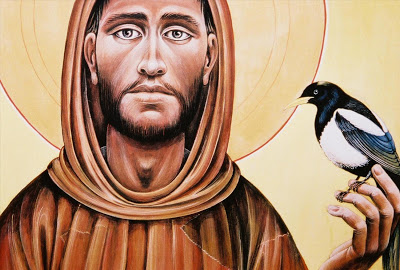
FrancisOfAssisi

Photo credit:  http://thewildreed.blogspot.com/2007/10/st-francis-of-assisi-dancer-rebel.html

Today we honor the life of St. Francis of Assisi.  Francis is one of the most popular and admired saints of all time.  Most of us know the highlights of his story: born the son of a wealthy man in 1182; had a conversion experience and devoted his life to Lady Poverty; shaped monastic and lay devotion; was a friend to all God’s creatures – being known to have preached to the birds.  But the story I like most is the story about St. Francis and the Wolf.

According to legend, there was a wolf that was terrorizing a nearby town, killing and eating animals and people.  The villagers tried to fight back, but they too died at the jaws of the wolf.  Francis had pity on the people and went out to meet the wolf.  When Francis found the wolf, he made the sign of the cross, and said, “Come to me, Brother Wolf.  In the name of Christ, I order you not to hurt anyone.”  The wolf calmly laid down at Francis’ feet.  Francis then went on to explain to the wolf how the wolf was terrorizing the people and other animals – all who were made in the image of God.  The wolf and Francis then made a pact that the wolf would no longer harm the town and the town would no longer try to hurt the wolf.  The two traveled into town to explain the pact they had formed.  The people were amazed as Francis and the wolf walked side-by-side into town.  Francis made the people pledge to feed the wolf and the wolf pledge not to harm anyone else.  From that day on, the wolf went door to door for food.  The wolf hurt no one and no one hurt the wolf; even the dogs did not bark at the wolf.[i]

What I love about this story of St. Francis is that the story is about reconciliation and relationship.  At the beginning of the story the town and the wolf are at an impasse – the wolf is hungry and getting attacked; the people are afraid and are lashing out.  What Francis does for both parties is shock them out of the comfortable.  For the wolf, no one has addressed the wolf kindly – they have either shut the wolf out or actively tried to kill the wolf.  For the people, the wolf has not asked for help – he has simply and violently taken what he needed and wanted.  Francis manages to shock the wolf first – not through violence or force, but with the power of love and blessing.  By giving a blessing in the name of God, Francis is then able to implore the wolf to reciprocate with love.  Francis also manages to shock the village – not with a violent victory, but with a humble display of forgiveness and trust.  By walking into town with a tamed wolf at his side, Francis is able to encourage the town to embrace, forgive, and care for the wolf.  Francis’ actions remind both parties that unless their relationships are reconciled, unrest and division will be the norm.

The funny thing about this story is that the story is pretty ridiculous.  I mean, how many of us go around talking to wild animals, blessing them with the sign of the cross, expecting anything other than being attacked?  We will never really know whether the story is true.  But like any good Biblical story, or even any good midrash, whether the story is true is hardly the point: the point is that the stories point toward “Truth” with a capital “T.”  What this story teaches is that peace and reconciliation only happen through meeting others where they are.  We cannot expect great change unless we are willing to get down in the trenches – to go out and meet that destructive wolf face-to-face.  The other thing this story teaches is relationships are at the heart of reconciliation.  Only when the wolf and the town began to get to know each other and began to form a relationship with one another could they move forward.

This is the way life is under Jesus Christ.  In our gospel lesson today, Jesus says, “Come to me, all you that are weary and are carrying heavy burdens, and I will give you rest.  Take my yoke upon you, and learn from me; for I am gentle and humble in heart, and you will find rest for your souls.  For my yoke is easy, and my burden is light.”  Jesus’ words have layered meaning.  The first meaning we all catch is that Jesus offers us rest and refreshment.  Jesus encourages us to come to him, to cast our burdens and cares upon him, and to take rest, to take Sabbath in Christ.  Our souls will find peace in Christ Jesus.  The second meaning is that peace in Christ Jesus is not without work.  Jesus does not say come unto me and relax forever in happy retirement.  Jesus says we will still have to take on a yoke – the burden of disciple living.  But luckily, that burden of being Christ’s disciple will not be burdensome – it will be light.  Finally, not only will Jesus make the workload “light,” as in not heavy:  Jesus will also make us “light” – as in lights that shine into the darkness and refuse to allow the shadow to overwhelm[ii]; as in lights that shine on this very Holy Hill where Hickory Neck rests.  We become the light when we work for reconciliation in our relationships with others.

That is why we do so many special things today.  Today, we ask for prayers and then exchange signs of peace – that God might help us reconcile the relationships in our life that need healing.  Today, at our 9:00 am service, we ask for blessing on our animals – that God might help our relationship with our pet be one of blessing and light.  Today, we come to Jesus for Sabbath rest – that God might renew us on this Sabbath day, use the rest to fill us with light, and renew our commitment to be agents of reconciliation, gladly putting on Christ’s yoke.  Amen.

[i] John Feister, “Stories about St. Francis and the Animals,” October 4,2005, as found at https://faith32.livejournal.com/61897.html on October 18, 2018.

[ii] Mel Williams, “Let it go…and rest” Faith and Leadership, July 6, 2014 as found at http://www.faithandleadership.com/sermons/mel-williams-let-it-go%E2%80%A6and-rest  on October 18, 2018.