On Resurrection Living…

Tags

, , , , , , , , , , , ,

I have been thinking a lot about death lately.  That probably sounds a bit morbid, but given my profession, should not be much of a surprise.  I think death has been on my mind for lots of reasons:  we celebrated the death of an incredible woman at our parish last week, our Adult Forum series during Eastertide is about death (end of life care, wills, legacy giving, funeral planning), and this Sunday’s lessons, although beloved, are quite common readings for funerals.  Everywhere I turn seems to offer reminders of death, and yet here we are in the season of Easter – a time to honor resurrection – to honor Christ’s victory over death!

One of the reasons we are freed up to talk about death in Eastertide is because death is changed through the resurrection of Christ.  In light of the resurrection, we see our life and death differently.  We proclaim that difference in the Book of Common Prayer at funerals.  “Life is changed, not ended,” we say in the burial office.  Whereas the secular world would have us consume life to its fullest, ignoring the inevitability of death; would have us preserve our bodies and make ourselves look younger to ignore our natural aging; would have us avoid conversations with our loved ones and community about death, the Church says something different.

The Church says Christ’s resurrection changes life so much, talking about death is no longer morbid.  The Church says, the promise of eternal life allows us make those funeral plans with a spirit of joy, not a spirit of dread.  The Church says that our time among the living is meant to bless and honor others, so making that will and designating those legacy gifts to a church are in great congruence with our understanding of resurrection living.  An Adult Forum series on death (or Resurrection Living, as we have called it) or reading lessons from funerals during Eastertide makes perfect sense.  Those exercises free us from seeing death as final, encouraging instead a life of resurrection hope and joy – a life lived in the light of eternal life.  I hope you will join us this week at Hickory Neck as we dive into that new identity and welcome the transformation of life in the light of the resurrection.


Sermon – Luke 24.36b-48, E3, YB, April 15, 2018

Tags

, , , , , , , , , ,

Last month I was talking to Pastor Alex from Stonehouse Presbyterian.  We were walking toward our cars and he complimented my license plate, noting how fun spotting my plate around town has been.  I chuckled and told him the plate had been both a blessing and a curse.  He asked me what I meant, and I explained.  You see, I love the plate for the very reason he mentioned – that I run into people who recognize my plate, that people connect who I am with what I do, that people ask me about my vocation and about Hickory Neck.  But the plate is also a bit of a curse.  If I had to choose any place to be a witness for Christ, I am not sure the car is the best location.  You see, the car is where I leave prayer books, post-its about phone calls, gum wrappers, and coffee cups.  The car is where I cart around children – sometimes singing at the tops of our lungs to a favorite song, and sometimes scowling after an argument about behavior.  The car is where I find a moment to getaway before picking up children, and the car is where I sometimes reveal that I once lived in a region of the country that is known for impatient, sometimes foul-mouthed drivers.  The car is not really home to my best witness for loving Christ.  And yet, there is where a big plate – on both the front and the back – witnesses to the world who and whose I am.

That is what I find so funny about the disciples this week.  Here they are in Luke’s gospel, not unlike what we heard in John’s gospel last week, hiding in a room, afraid, disbelieving, and wondering what to make of all that has happened.  To be fair, life has gotten a bit chaotic of late.  Their whole world has gotten turned upside down since that beautiful, sacred night when Jesus washed their feet.  They had ideas about what was coming in their life, what was going to happen to Jesus, and how the world would be changed.  But Jesus dies, they are outcasts, and God seems to have closed a door – a tomb door.  Then, just days later, their world gets upended again.  The disciples learn from the women that the same closed tomb door is now open.  Two of the disciples have an encounter with the risen Christ on the road to Emmaus.  And as if all of that is not enough, today, Jesus shows up – very much alive, proving his corporality, teaching them, and reminding them they are witnesses.

The disciples certainly have our sympathy and concern.  And yet, the disciples remain holed up in a room – as if they can hide.  As if they can integrate back into the world, with no one realizing who and whose they are.  As if no one will notice the license plate on their car that says, “Jesus’ disciple.”  The disciples are hiding, acting as though no one is watching, no one is making conclusions about them based on their behavior, no one is making conclusions about Christ.  Their hiding is just as much of a witness as going out into the community.  Perhaps they feel being in that room is giving them a break from being witnesses – that no one sees them.  But we know better.  And so does Jesus.  “You are witnesses of these things,” says Jesus.

Sometimes we do the exact same thing.  We too can start to believe that we have hiding places in our lives – places where we do not have to be witnesses.  Maybe yours is a car.  Maybe yours is at work or school because those places seem more removed from what we do here on Sundays.  Maybe yours is at home, on vacation, or when surrounded by friends.  Like the disciples, we too have that same longing to “turn off” our witness.  Maybe we are just tired and feel like being a witness for Christ is exhausting.  Maybe we are upset with or disappointed in God and are not sure communicating those feelings helps our witness of Christ.  Or maybe we are just afraid – that people will notice that we do not live lives that reflect who and whose we are.

But “turning off” our identity as people of faith is not really an option.  Sooner or later we will get caught.  Sometimes being caught can be a very positive thing.  An acquaintance who knows you go to church may ask you to add them to your church’s prayer list because they or their child just received a horrible diagnosis.  But sometimes being caught can be less flattering.  At our Adult Forum series on evangelism this fall, we watched a video about how not to invite people to church.  The video features two neighbors, one who is out gardening in the yard and the other who is clearly just coming home from church.  The neighbor who is out gardening wonders to himself, “I wonder why he never invites me to his church.  I would go if he asked me.”  But sometimes being caught can be even worse.  I had a friend who waited tables during college.  She always moaned when she got her work schedule and discovered she was assigned a Sunday.  I finally asked her why she hated Sundays so much.  She said, “Because that’s when all the churchgoers go out to eat – and they are the worst tippers!”  Somehow, in all her long hours of trying to make a few bucks to pay for books and school fees she had gotten the message that people of faith did not value her.

We know from experience that hiding as a Christian is really an illusion.  Wherever we are, whenever we are, with whomever we are, our identity is always there.  Jesus confirms that today.  As biblical scholar Karoline Lewis says, “Jesus’ address to the disciples is not, ‘you will be witnesses.’ Not, ‘please be witnesses.’ Not, ‘consider being witnesses if you have time.’ No, [Jesus says] ‘you are witnesses of these things.’ We are witnesses.  As it turns out, witnessing is not voluntary, but a state of being.”[i]  Lewis goes on to add, “‘We are witnesses’ does not depend on our acceptance or agreement or approval. ‘We are witnesses’ does not depend on our readiness or recognition or responsiveness. ‘We are witnesses’ just is.”[ii]  The disciples learn that today.  When Jesus says, you are witnesses, he empowers a very scared, uncertain, fearful group of followers to remember who and whose they are.

The good news is that Jesus does not judge the disciples today.  Jesus meets the disciples where they are.[iii]  Jesus’ first words are words of encouragement.  “Peace be with you,” he says.  Then, ever the tender pastor, Jesus asks the question in verse 38, “Why are you frightened, and why do doubts arise in your heart?”  Knowing their confusion, Jesus eats with them to assure them he is really there, not just some ghost or figment of their imagination.  He sits down and teaches them once again, taking them back to their roots, reminding them of how the prophets have taught them all they need to know.  And then, come those fateful words in verse 48, “you are witnesses of these things.”  Jesus meets them where they are, offering comfort, assurance, and affirmation.  But Jesus also encourages them to move beyond where they are.

After September 11th, there were two widows featured on the news.  “Grateful for the outpouring of support they received, they started thinking about the women in Afghanistan who, when widowed, lose status in that society and therefore find their already difficult lives even harder.  They raised money and formed a foundation called Beyond the 11th to support Afghani widows, and even made visits to Afghanistan to meet the widows they were helping.”[iv]  Those widows had lot of options – fear, anger, vengeance, or isolation.  But instead, they remembered how Jesus encourages us to remember our identity as witnesses and to move beyond where we are.  Our invitation today is to reclaim that same identity.  Now I do not know if that means you go put a Hickory Neck bumper sticker on your car, or you start wearing that cross necklace again, or you start tangibly connecting your words and actions to your identity as a witness.  Only you can know the shape your witness will take.  But today Jesus invites us to let go of our hiding places, realizing that even when we think we are hiding, we are still witnessing.  Our invitation is to own who we are, so that others might see the beauty of who and whose we are.  Amen.

[i] Karoline Lewis, “We Are Witnesses,” April 9, 2018, as found at http://www.workingpreacher.org/craft.aspx?post=5126 on April 12, 2018.

[ii] Lewis.

[iii] Nancy R. Blakely, “Pastoral Perspective,” Feasting on the Word, Year B, Vol. 2 (Louisville:  Westminster John Knox Press, 2008), 424.

[iv] Blakely, 428.

On Being Agents of Joy…

Tags

, , , , , , ,

IMG_0325

Photo credit:  Photo taken by Jennifer Andrews-Weckerly on March 25, 2018.  Permission required for reuse.

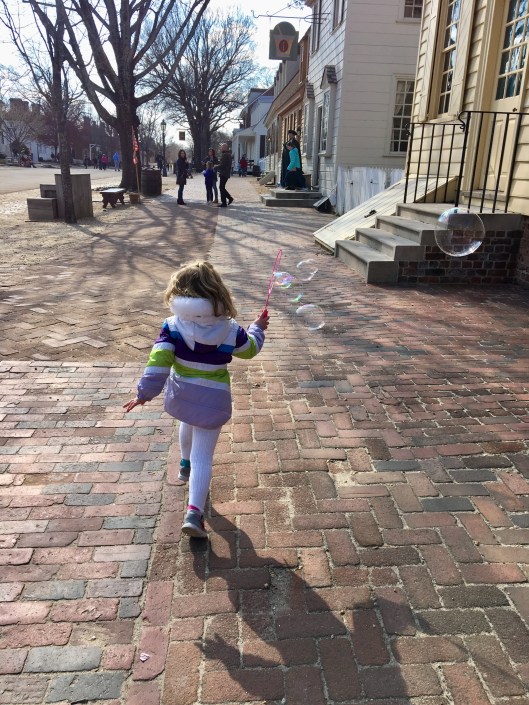
A couple of weeks ago, in the midst of one of the craziest seasons for a clergy family, we found a moment to head down to the historic district of our town.  My daughter had just received a bubble wand as a birthday gift and wanted to take it along.  Somehow, a bubble wand seemed like a bad idea – it being totally out of context in the otherwise historically accurate setting.  But, I was not in the mood for an argument, so I consented.

There we were, in the midst of tourists, costumed interpreters, walking along cobblestoned streets filled with colonial architecture, and my daughter was gleefully running down the sidewalk with her pink princess bubble wand.  Seeing her happy and joyful was enough to bring a smile to my weary face.  But what I had not anticipated was how her bubble-making would bring joy to so many around us.  A large visiting family burst into smiles as she rained bubbles on them.  Little children began tugging on their parents’ clothing, giggling and shouting, “Look!”  A mother wistfully thanked us, explaining that her preteens had been catching and chasing the bubbles behind us.  I saw some teenage girls light up with a long-gone innocence as the bubbles floated toward their laps.  Even a costumed interpreter whispered as she passed, “We all love your bubbles.”

What was so beautiful about that day was the way in which my little four-year old was able to freely and abundantly give away the unexpected gift of joy, laughter, and refreshment.  It was such a powerful thing to witness the strength of her gift; seeing her joy, and the spreading of her joy, brought me unexpected joy.  That kind of innocent, pure, wholesome goodness is so rare in life and my daughter gave it with abandon.

That wave of abundance, generosity, and joy made me wonder what ways we might be invited to be agents of joy.  Perhaps the opportunity could be as simple as bubbles.  I had a friend who kept them in her car for whenever she got caught in traffic (it is hard to stay cranky in traffic when bubbles are floating by).  But it could be something else – sending a card or making a phone call when a person randomly pops into your mind.  Starting a practice of thoughtful, tiny good deeds – little gifts to those whom you know need it, maybe even without credit.  Or maybe a new idea will strike you.  I would love to hear your ideas.  But more so, I would love to hear how it goes when you try it.  Practices of abundant joy are catching.  I can’t wait to hear about the joy you spread this week.

Sermon – John 20.1-18, ED, YB, April 1, 2018

Tags

, , , , , , , , , , , ,

Last weekend, before Holy Week started, our family celebrated my youngest’s fourth birthday.  A dear friend was there and asked me how I was doing, knowing full well that Holy Week and Easter were coming.  I launched into a diatribe about all the things I was juggling – birthday party, work commitments, packing for Spring Break, and the pressures of writing an Easter sermon.  The last complaint caught her attention.  “You’re worried about an Easter sermon?” she asked.  “Oh, yes!” I explained.  “It’s a big day.  The sermon needs to be good!”  She looked at me, dumbfounded, and said to me, in a way that only a best friend can, “You know nobody comes to church on Easter because of the sermon.”

Now as a preacher, you can imagine my ego was a little bruised.  But the more I thought about her observation, the more I realized she was right.  We come to church on Easter for a whole host of reasons.  We come to church on Easter because that is what our family has always done, and the continued observation of Easter somehow connects us to the past, present, and future, creating a sense of belonging and identity.  We come to church on Easter, because we long for a good word – a reminder that even in a tumultuous world, there is the promise of resurrection life, joy, and hope.  We come to church on Easter because we love the music, the flowers, the crowded seats, the Easter attire, and the experience of being a part of community.  And some of us are not sure why we come to church on Easter, but we suspect, or at least hope, we will find something that can revive our weary souls.

I suspect what most of us are hoping for today is an experience like Mary Magdalene’s.  I am not sure Mary knew why she went to the tomb that fateful day.  In John’s gospel, Mary is not there with spices to anoint Jesus’ body.  She does not bring flowers or some memento to leave at the tomb.  In fact, she comes to the tomb in darkness, before the morning light has arisen, perhaps in a fog of knowing she needs something but not sure what that something might be.  And then, not unlike the chaos that may have been your morning to get here on time and half-way presentable, Mary’s life gets thrown into chaos.  An empty tomb means she and the disciples run around like chickens with their heads cut off.  Later, Mary finds herself bemoaning to angels and a stranger alike that she just wants Jesus’ body – a physical reminder of all the horror and love and pain that has happened.  And in the midst of this chaos, a simple, profound thing happens.  Mary is called by her name.[i]  And her world gets turned on its head.

There is something very powerful about being called by your name.  We will frequent restaurants or coffee shops because we love being recognized by name by our favorite barista or shop owner.  If you have ever received a blessing or healing prayer by a person who knew your name, you know the intimacy that is created between the two of you, and the power of hearing your name lifted up to God.  We even try to use nametags here at Hickory Neck because we know how wonderful being known by name feels.  Being known by name creates a feeling of acceptance, affirmation, affection, and acknowledgement.[ii]  I can only imagine the rush of emotions when Jesus calls Mary by name today – not just the recognition of who Jesus is, but the reminder of how much he has loved her.

I suspect we should add that to the list of reasons why we come to church on Easter Sunday.  We want to be known too.  Perhaps we want to literally be called by name.  But perhaps we know just being here creates the same sense of belonging that being known by name creates.  When we sit in these seats today, we know that we are sitting next to someone who is longing for belonging today too – who also rallied to get to church on time – maybe with kids in cute dresses, or maybe just pulling their aching bodies to church.  When we sit in the seats today, we know that we are surrounded by a group of people who also love having their senses overwhelmed – from the smell of fragrant lilies, to the joyous sound of song [brass], to the taste of communion bread and wine, to the sight of fanfare and smiles, to the feel of another hand at the peace.  When we sit in these seats today, we know that we will be offered a word of joy, light, love, hope – and we want our lives to be marked by that same sense of promise.

Now you may feel tempted today to take all that affirmation, encouragement, and joy, and go about the next days on your own personal high – as though the gifts you receive today are solely for you.  But what all this fanfare, acknowledgment, and hope are meant to do is to propel you out into the world.  When Mary is called by name, receiving the blessing of recognition and encouragement, she does not stay at the feet of the resurrected Jesus.  She becomes John’s gospel’s first preacher.  “I have seen the Lord,” Mary says to the disciples.  Now I know some of you will go out from this place today and do just that – you will put on your Facebook page, “Alleluia, Christ is Risen!” or you will hug your neighbor and tell them what a joyous day you just had at church.  But for others of you, sharing today’s joy may take you a little more time, or may look a bit different than proclaiming, “I have seen the Lord,” to your favorite barista.  But what Mary invites us to do today is find our own way of sharing the beautiful gift we receive today – to give someone else the gift of joy and hope, to quietly tell a friend what a cool experience this day was, or to simply call someone else by name – sharing that same sense of belonging and affirmation you receive today.   You came to church this Easter Sunday for something.  Mary invites you to give that something to someone else.  Amen.  Alleluia!

[i] Serene Jones, “Theological Perspective,” Feasting on the Word, Year B, Vol. 2 (Louisville:  Westminster John Knox Press, 2008), 378.

[ii] D. Cameron Murchison, “Pastoral Perspective,” Feasting on the Word, Year B, Vol. 2 (Louisville:  Westminster John Knox Press, 2008), 380.

Homily – Mark 16.1-8, EV, YB, March 31, 2018

Tags

, , , , , , , , ,

I once worked with a parish who wanted to tweak their outreach efforts.  Instead of simply volunteering together with an outreach ministry or donating funds, they wanted to partner outreach and formation – what the secular world would call service learning.  And so, we experimented.  We gathered a team for six weeks in preparation for service with a transitional home for women coming out of prison.  The first week, two clients came to talk to us about their experiences with the ministry we were serving.  We heard stories of abuse, addition, and authority.  We learned about the things within their control and the things outside their control. Then we spent four weeks reading about a woman whose ministry in a prison led to her live and serve among the prisoners, guards, and families affected by the prison.  In the final week, the parishioners served a meal for the women in the transitional house, engaging in meaningful conversation as we ate.  When we gathered after our days of service, each participant felt as though their experience at the transitional home was much richer than the experience would have been had they simply showed up at the house with a hot meal, having never thought much about who they would encounter and why.  With old assumptions gone, parishioners were able to ask meaningful questions, understand how hard the road ahead would be, and share their own journeys.

Easter Vigil is a bit like that service learning group.  You see, we could gather tonight, and ring in Easter, happily celebrating the empty tomb the two Marys discover.  The miracle of that event, and the consequences of Christ’s resurrection are cause enough for a tremendous celebration.  But what we do tonight is not just jump into the resurrection.  First, we learn together why the resurrection is meaningful at all.  We start at the beginning, when the world was a formless void.  We learn about the creative God, who makes order out of a disordered world, who creates the beauty of the world around us, and who trusts us to care for that beauty.  But, of course, we fail at being stewards of God’s creation, and fall into sin so deep that God destroys most of the created order, saving one family from every species.  And God gives us a covenant – to never destroy the world again.  Generations later, as God helps us flee suffering and enslavement, God does the impossible – parts an entire sea so that we might be forever free.  Later, God is able to restore a valley of dry bones to life through God’s prophet Ezekiel.  God teaches us that even death and destruction can be restored.  Even as they are scattered in exile, God once again promises to restore the people.  Story after story after story tells us tonight that we belong to a God who creates us in beauty, stays in relationship, and restores us to wholeness.

When you know the breadth of our walk with God – when you remember all the pieces of what we know about God – then what happens to God’s Son this night makes more sense.  We can move from singing, “this is the night,” to singing, “how wonderful.”  “How wonderful and beyond our knowing, O God, is your mercy and loving-kindness to us, that to redeem a slave, you gave a Son.  How holy is this night, when wickedness is put to flight, and sin is washed away.  It restores innocence to the fallen, and joy to those who mourn.  It casts out pride and hatred, and brings peace and concord.  How blessed is this night, when earth and heaven are joined and man is reconciled to God.”[i]  What is shocking about this night is not just the empty tomb.  What is shocking is the empty tomb in light of all that has gone before – despite our sinfulness, the breaking of covenant after covenant, our unfaithfulness and lack of gratitude, God stays in relationship.  God keeps making creation new.  God goes a step further in the resurrection of Christ Jesus.

That is why I love that we get Mark’s gospel to close our learning tonight.  Ever the succinct writer, Mark describes for us perfectly how overwhelming God’s love and commitment is to us.  Despite all the drama of our relationship with God, despite all the unfaithfulness, and despite all the waywardness of our behavior, God’s love never ends.  That realization leads to the same sort of terror, amazement, and fear that the Marys experience – the experience of a theophany – of an encounter with or a revelation of God.[ii]  The women flee the tomb tonight and remain silent because they are completely overwhelmed by their encounter with God and God’s love.  On Palm Sunday we were silent at the tomb in grief and despair.  Tonight we are silent at the tomb in unspeakable joy.  The women at the tomb give us permission tonight not to describe the experience, but simply to allow the blessing of this night to overwhelm us.  We can go and tell the news to others tomorrow.  But for tonight, hold on to that marvelous, wonderous feeling of knowing that Christ has been raised.  Amen.  Alleluia.

[i] BCP, 287.

[ii] Gail R. O’Day, “Homiletical Perspective,” Feasting on the Word, Year B, Vol. 2 (Louisville:  Westminster John Knox Press, 2008), 357.

On Listening with New Ears…

Tags

, , , , , , , , , , , ,

Every year on Palm Sunday, most Churches read the passion narrative.  We read the story from the night before Jesus’ death, all the way through the cross and the sealed tomb.  Because the story is so long (2-3 pages of text at least), many churches read the narrative as if it is a script, with parts assigned, to break up the reading.  This practice helps keep our attention, but also helps us hear the story differently each year.  As someone who has both listened to passion narratives and participated in them, I know how powerful the experience can be.  I will never forget the first time I was asked to read Jesus’ part.  There is something indescribable about having Jesus’ words in your mouth.  Likewise, hearing other people read parts can be powerful.  Imagine hearing the most faithful church elder say the words of Judas or denying Peter; or imagine how a well-placed pause by the narrator can make you hear differently.

As a priest, knowing the power of the voice in the passion narrative, I work hard to make sure the voices people hear on Palm Sunday are moving for them too.  Of course, I am sometimes limited by the available readers, but whenever I get the list of potential readers, I work hard to create synergy – looking for a mixture of male and female voices, looking for variations in age where possible, and also looking for visuals, like varieties in the physical attributes of the readers.  This year, I happened to have some children and youth offer to read and tried to find unexpected roles for them too.  What I did not anticipate was how powerful their voices would be for me.

You see, this past weekend, children and youth from all over the country and globe took to the streets because they feel afraid and threatened, and they are frustrated that adults are either not listening or are unwilling to find a way forward to make them feel safe.  Now, I know some of us may disagree with some of their proposed actions, but if nothing else, this past weekend made me feel like our inability to listen respectfully to one another and work for change was exposed.  Our children this weekend drew back the curtain on our ugly secret – that we are not acting as agents of love in the public sphere – on either side.

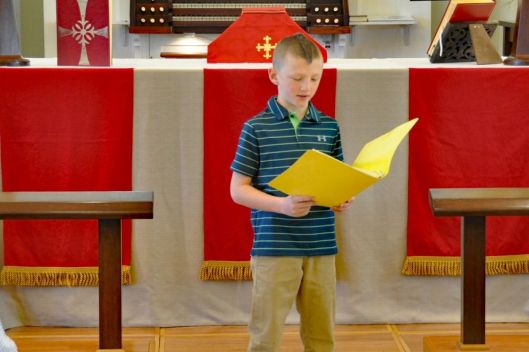
Feeling raw and exposed by Sunday, imagine the wave of emotion that hits when a nine-year old reads the part of Jesus to our church in the passion narrative.  Having a child say, “Are you still sleeping and taking your rest? Enough!” shook me to the core.  As I listened to his clear, steady voice, I began to not only hear the passion differently, but also began to realize that Jesus is speaking to us every day, with voices we may not expect, but voices that speak truth – raw, painful, beautiful truth.  As we continue our Holy Week walk this week, I invite you to listen to the Jesuses speaking to you in your everyday life.  What does God need you to hear this week?  How might hearing a voice that says something you oppose sound differently if you listen with holy ears?  Adjusting your ears will certainly change how you experience Holy Week, but more importantly, adjusting our ears might help to change how we experience humanity in this moment.  Those who have ears, listen.

29064143_1787517344637851_2654805789191048426_o

Photo credit:  Picture taken at Hickory Neck Episcopal Church by John Rothnie, March 25, 2018.  Permission required for reuse.

Homily – Mark 11.1-11, 14.1-15.47, PS, YB, March 25, 2018

Tags

, , , , , , , , , , , , , , , , ,

When I did my AmeriCorps year of service at a food bank in North Carolina, the warehouse manager was from Liberia.  Eugene and I talked about a lot of things, but one favorite topic was the church.  When Holy Week rolled around, I remember Eugene telling me about Good Friday in Liberia.  On the way to church on Good Friday in Liberia, the children lead a procession.  The children carry an effigy of Jesus, and all the children take turns flogging the effigy of Jesus all the way to the church.  I remember being mortified when I learned about this tradition, wondering who in their right mind would invite children to participate in worship in such a gruesome, grotesque way.

The weird thing is, this mortifying tradition is not all that dissimilar to the physicality of our own worship today.  Today, we invite everyone to vigorously wave palms hailing Jesus Christ the king; then we have voices from our parishioners narrate the text, sometimes taking roles of people like Judas, Pilate, or denying Peter; and if that were not bad enough, then we put the words, “Crucify him!” in bold in our bulletins, reminding everyone to shout the words together.  The practice is so visceral that I often notice many people resist participating.  I cannot tell you how many photos I had to scroll through to find a good Hickory Neck Palm Sunday processional photo this year.  In what is supposed to be replica of joyously welcoming the Messiah, Hickory Neck-ers rarely take more than one palm, we hold them upright so as not to seem too zealous, and forget about a smile or look of excited victory.  I do not know if we feel silly or if we know all too well what comes next so we resist, but we struggle to engage in even the joyful part of today’s liturgy.

And I have rarely found an Episcopal Church anywhere who wholeheartedly joins in the chant, “Crucify him!”  We are so uncomfortable with that part of the liturgy.  More often people do not say the words at all, or they embarrassingly mumble the words.  Sometimes I see people tense up if those beside them enthusiastically participate too much.

Our resistance is futile though.  As if we hesitantly wave palms, or if we stay silent while the crowd demands we crucify Christ, we somehow avoid complicity with this humiliating atrocity.  But we are complicit with sin every day, in the most heinous ways.  We are complicit as our neighbors decide between housing, health care, and child care costs.  We are complicit as racism creates separate, unequal experiences for our citizens.  We are complicit as our God invites into a new way and we say “no.”

That is why the church offers us this very tactile, primal service today.  We wave the palms with fervor today because we remember the ways in which we see in part – the ways in which we manage to follow Christ, even if we do not understand what Christ is doing, even if we do not catch how Jesus inverts his triumphal entry on the back of a young donkey.  We fully participate in the words of today’s passion in order to remind us to “stop abusing the image of God revealed in the dignity of every human being.”[i]  And then we let those final words soak in today, as we stand with Mary Magdalene and Mary the mother of Joses, silently at the tomb, seeing where Christ’s body is laid.

What we do in worship today is actually the perfect entry into this most Holy Week in Church.  Now some priests will tell you that we combine the liturgy of the palms with the passion narrative today because the designers of the Prayer Book knew that many of you would come on Palm Sunday, skip the days of worship during Holy Week, and then show up on Easter Sunday without having walked from this triumphal entry into Jerusalem through the cross and tomb.  And maybe they were right (though I know most of you rearranged your schedules this week for Holy Week services).  But more importantly, even if you walk through this journey with Christ this week, the reason we pair the Palms with the Passion is that we could never go from the Palms to the Resurrection without the connection to the cross.  The triumphal entry into Jerusalem makes no sense without the cross; the irony of that festive procession only makes sense when you are standing silently and bleakly at the tomb.

I know today is uncomfortable.  I know today is confusing, and oddly visceral, and may even be a bit overwhelming.  But today, and perhaps all this week if you are able to join us, allow the senses to take over.  Allow the sights, and smells, and touches, and sounds, and tastes to overwhelm you this week.  Allow the ache of standing with Mary Magdalene and Mary the mother of Joses to sink deep into the same body that has waved palms and shouted awful things today.  Because only when our senses are that overwhelmed are we able to see that the cross is not about suffering and death, but rather is about a relationship that holds.  Only then will we find a “love stronger than death, that can withstand whatever the forces of evil do against [love], and that can hold suffering even as [love] struggles to alleviate [suffering].”[ii]  What feels like an empty, guilty ache today instead becomes a sign of how God overcomes terror, enfolds us in Life, and dwells with us forever.[iii]  But until then, stand with the Marys and with one another at the tomb in silence.

[i] Michael Battle, “Pastoral Perspective,” Feasting on the Word, Year B, Vol. 2 (Louisville:  Westminster John Knox Press, 2008), 182.

[ii] Margaret A. Farley, “Theological Perspective,” Feasting on the Word, Year B, Vol. 2 (Louisville:  Westminster John Knox Press, 2008), 182.

[iii] Farley, 184.

On the Timelessness of Scripture…

Tags

, , , , , , , , , , , , , ,

This reflection is from a book of devotions that our youth group at Hickory Neck created for our parish’s use this Lent.  Each day, parishioners offer their reflections on the text assigned for that day in Lent.  This is my reflection on an apocryphal writing, Susanna 1-9, 15-29, 34-62.  If it is unfamiliar to you, I highly recommend reading it first.  You can find the text here.

**********

I am struck by the timeliness of Susanna’s story.  Because Susana is a book from the Apocrypha, most Christians do not know her story.  But her story joins the chorus of the many #metoo stories of sexual assault and harassment we have discovered in the last six months.  Susanna’s story is a story of the abuse of power.  Though the two elders purport to give Susanna a choice, either choice will leave her devastated.  Though she chooses the option that feels free from sin, her choice will lead to her condemnation and death.  In truth, she has no choice – the men sinfully exert power of her.

What encourages me about Susanna’s story is that there is a man who uses his power for good.  We are told that God stirs up the holy spirit of Daniel, and Daniel (a man of power in his own right), responds, eventually proving Susanna’s innocence.  Daniel’s role in this story reminds us that God longs for us to use our power for good.  The #metoo stories of our day are not just the stories of women.  They are stories about all of us – stories of how we, men and women, are to love as Christ loves, and to respect the dignity of every human being.  How might we be agents of love, using our power today to help those without power?  How might we be agents in bringing about the kingdom of God?

Sermon – Daniel 3:14-20,24-28, John 8:31–42, Ecumenical Eucharist, March 21, 2018

Tags

, , , , , , , , , , , ,

This sermon was preached at Our Saviour Lutheran Church in Norge, Virginia.  Each week in Lent, one of the churches from the Upper James City County Ministerium hosts a worship service and welcomes a guest preacher from another church.  It has been a wonderful experience in the exchange of worship, and has made all our church members feel more connected with the community.  

**********

One of my favorite gospel songs is a song called, Jesus Can Work It Out.  There are lots of versions of the song, but the basic tenet of the song is that whenever you have a problem that you cannot seem to solve, you can give the problem over to the Lord and the Lord will work the problem out.  In the version of the song in my iTunes, the lead singer talks about a variety of problems that she has had over her life that, as soon as she gave them over to the Lord, God worked the problems out.  In one example she talks about how she and the choir went on tour and when she came back home, she had a foreclosure notice.  Overcome with grief, she says she turned the situation over to the Lord and the Lord worked it out.

Now I love this song – mostly because not only does the song encourage me to trust God, but also because the song has a way of getting your toes tapping.  But every time I hear the part about the foreclosure, I cannot help thinking, “I mean, I get trusting the Lord, but I am pretty sure you knew you had not paid the mortgage before you decided to go on tour.  I mean there is trust and there is TRUST.”

That is what I think is so interesting about our two readings today.  They represent two different extremes when we talk about the role of trust in our relationship with God.  The first is the vivid and dramatic story of Shadrach, Meshach, and Abednego.  King Nebuchadnezzar has captured the three men and insists they worship his gods and his statue or face a fiery death.  When the three men refuse, the king has them thrown into the furnace, turned up seven times as high as normal.  But much to the king’s surprise, not only do the men survive, they seem to be dancing around in the flames with Yahweh.  When the men come out untouched by the flames, not even smelling of smoke, King Nebuchadnezzar concedes and decides to worship their God instead of his gods. This fantastic story is a story of how, even in the face of persecution and death, faithfulness, trust, and loyalty to our God will make you victorious, even in impossible situations.

Meanwhile, in our gospel text, the faithful are equally trusting of God, but in this instance, their trust and confidence is ill-placed.  You see, Jesus has gathered people who are following him and begins to talk about who he is in relation to God.  When Jesus starts talking about to whom the people belong, and that God is doing a new thing in Jesus Christ, the followers become obstinate.  “We are descendants of Abraham…Abraham is our father,” they protest  What is funny about this exchange between Jesus and the faithful is that on the surface, the faithful are doing the same thing Shadrach, Meshach, and Abednego do.  They are staying true to their God, despite the fact that this new teacher and prophet is asking them to see something new in what God is doing.  But in their case, we can see that Jesus does not see their faithfulness and trust as a virtue, but instead a hinderance to seeing the work of the Holy Spirit in something new.  Unlike Shadrach, Meshach, and Abednego’s story, this story seems to be about how we should hold tightly to what God has taught us, but not so tightly that we lose touch with when God is doing a new thing.  We are to be loyal and trusting, but also discerning and open.

I do not know about you, but I find myself lost in these lessons.  When am I supposed to be so faithful that I am willing to face death (or foreclosure on my mortgage), and when am I supposed to be so faithful that I am willing to abandon what I know about my God and my identity to follow a new way?  When I was figuring out my vocation as a priest, I struggled.  The first step was getting over the hurdle of saying yes to a call to ordained ministry at all.  You see, my dad was a United Methodist minister, and I had sworn that I would never go into the ministry.  But once I finally was able to say yes, then came the hard part.  You see, I was called in the context of the Episcopal Church.  But not only was my father a United Methodist Minister.  His father was a United Methodist Minister.  And my grandfather’s brothers were United Methodist Ministers, and my uncle was a United Methodist Chaplain, and my cousins were United Methodist ministers.  At Annual Conference every year, there was a whole Andrews section.  So what I was dreading was telling my grandmother that I was breaking ranks.  My grandmother is pretty intense.  As a former librarian and English teacher, I was actually pretty intimidated by her most of my childhood.  Eventually I gathered up my nerve and had a talk with her.  As soon as I told her the news she gave out a huff.  And then she leaned in toward me and said, “I was a Lutheran before I married your grandfather.  I never wanted to be a Methodist anyway!”

Here’s the thing about following God – when we follow God, we get confirmation along the way.  I do not think that Jesus was asking his followers to abandon Abraham and trust in him alone.  Instead, I think Jesus was reminding them that if Abraham was their father, they would actually follow Abraham’s example.  Instead of clinging to an old, stable identity, they needed to remember that the main thing Abraham was known for was abandoning his old life and going to a new, scary place, and following God.  Jesus is not mad at his followers because they are clinging to the past.  Jesus is mad at his followers because they are clinging to a distorted version of the past – they are clinging to security instead of remembering the past is what taught them that sometimes they need to get up, drop everything, and go.  Sometimes they need to take a risk and say no to a worldly power who wants them to abandon who they are and what they are called to be.  These two stories are not about examples of total trust versus a lack of trust.  The two stories remind us that trusting God will lead us to uncomfortable places, will challenge our sense that we know God best, and will sometimes make us dance.

Our collect or prayer appointed for this last Wednesday before we begin Holy Week says, “Almighty God our heavenly Father, renew in us the gifts of your mercy; increase our faith, strengthen our hope, enlighten our understanding, widen our charity, and make us ready to serve you; through Jesus Christ our Lord, who lives and reigns with you and the Holy Spirit, one God, for ever and ever. Amen.”  We leave this sacred place tonight, not with a sense that we need to dramatically follow Christ into the flames or be considered faithlessly unwilling to go where God calls us.  Instead, these stories remind us that we can always stand to increase our faith, strengthen our hope, enlighten our understanding, widen our charity, and be made ready to serve.  We all know we need that work because that is the work we have been doing all Lent – working on our faithful walk with Christ.  What these stories remind us of is we have companions along the way – companions who are bold and fearless, companions who have messed up, and companions who may not even go to our own church, but who know our same journey and our same God.  Christ renews us in his mercy tonight, so that we can keep saying yes to God.  Amen.

A Gift from the Church…

Tags

, , , , , , , , , , , , ,

As a former United Methodist and preacher’s kid turned Episcopal priest, I have a pretty wide range of what I find liturgically inspiring.  I was raised on what I would call the “Ol’ Timey Hymns,” I discovered praise and guitar music in college, I found the joy of call-and-response preaching and participatory music at a primarily African-American church where I was a member, I discovered Anglican choral music at the Cathedral that sponsored me for ordination, I was immersed in “high church” worship during seminary where my alb constantly smelled like incense, I discovered the joys of a paid professional choir who could chant choral matins, and I have served in churches with praise bands.  I have been known to crank up the gospel channel on Sunday mornings on my way to church before listening to traditional chant during the services later that morning.

So imagine my joy when I found a church that seemed to capture a good portion of the variety and breadth of my own liturgical experience.  The diversity of worship at Hickory Neck reveals an embarrassment of riches.  We are so blessed with a variety of liturgical and music leaders that I still do not have a favorite service.  Of course, fitting that diversity into one Sunday can be tricky.  That is one of the millions of reasons why I love Holy Week so much, especially at Hickory Neck!  Over the course of a week, we celebrate Palm Sunday, we lead a quiet compline digitally via Facebook live, our Praise Band leads us in a contemplative Taize service, our Congregational Choir and local ecumenical clergy lead us in a healing service, our Choral Scholars lead us in a beautiful foot washing and altar-stripping service, we retreat into quiet on Good Friday midday, but then our youth lead us in a powerful Stations of the Cross service that night, our liturgical team puts together an amazing Easter Vigil, and then the brass rings in Easter Sunday.  In one week, we get the fullness of Hickory Neck on dazzling display.

I do not know what life is like for you these days.  But if you are in the position to give yourself the gift of Holy Week, I highly recommend it.  The full experience allows you to create a sort of pilgrimage, and certainly makes Easter Day a much more powerful experience.  But even if you can only catch a few services, realize that each night’s service is like a carefully crafted gift, meant to create an encounter between you and our Lord and Savior Jesus Christ.  Even if you have been feeling distant from God lately, I know most churches are happy to have you slip into a back pew, take in what you need, and slip back out into the world.  Lord knows I have sometimes showed up at the doors of a church not entirely sure why I was there, but left knowing exactly why the Holy Spirit had drawn me there.  If you do not have a church home and want to join us in the feast of Holy Week, you have a church home at Hickory Neck.  If you are reading from further away, I hope you will share with me your experiences this coming Holy Week.