
On Fathers…

fathers-day-gift-guide_gKka8_54

Photo credit:  breadwinningmama.com/2013/06/14/an-open-letter-to-my-husband-on-fathers-day/

One of the major changes when we moved to Virginia has been the bus stop.  In New York, my daughter was one of two kids who were at the same bus stop.  Now, there are easily 20-25 kids who board the bus.  That means I get to see all kinds of family dynamics.  Parents who have to work, and so entrust a grandparent or nanny to accompany their child.  Children of divorce, whose parents take turns waiting at the bus stop.  Parents who wait in the car so they can jet off to the next obligation, and parents who walk with their kids.  What I have especially liked about the bus stop is watching the dads with their children.  So often, dads get a bad rep.  Historically, the role of fathers was to be the primary income-earner of families.  Whatever time or energy was left to be hands-on with the kids was limited.  But that is not the case with the dads at this bus stop.  I see high-fives, big hugs, and kisses.  I hear pep talks about good behavior, and the words, “I love you.”  There is even one young boy who regularly jumps out of the bus line to run back to his dad for one more hug and an “I love you,” before getting back in line.  I have even seen this same kid shout from the top of the steps a warm, “I love you, Dad!!”

Watching the boys with their dads has really shaken up my concept of what fatherhood can look like (not that I do not have examples of that kind of affection in my own circle – I just do not always see it in other circles).  The challenge is that not everyone gets that kind of dad.  That is probably why Father’s Day is so hard for me.  I do not dislike the holiday because I have ill feelings toward my own father.  In fact, that relationship has been quite positive.  I have even added similarly positive relationships with a step-father, father-in-law, and my husband, who is now a father too.  But being a pastor means I am fully aware of the pastoral implications of such holidays – those for whom Father’s Day this Sunday will be quite difficult.  Whether your father was absent or abusive, your father died recently, or whether you always wanted to be a father but did not get the opportunity, Father’s Day can be a painful day of reminder instead of an occasion for joy.  It can be a reminder of all the times you wanted to say or hear, “I love you,” and were denied the opportunity.

For those of you for whom Father’s Day is a mishmash of emotions, I offer you this prayer.  May it be a source of comfort, encouragement, and compliment.  May love find its way to you this Sunday.

A Pastoral Prayer for Father’s Day[i]

Loving and Merciful God, whose power is beyond our scope and whose wisdom is beyond our understanding, we turn to you in faith assured that you know our every emotion and are aware of our every need.  Our thoughts and prayers today are turned towards our fathers.

For those whose fathers have increased the joy in their lives, we give you thanks.

For those whose father’s presence is greatly missed may we take time to gratefully recall all they have given to us, providing for us in our growing.

For those who have recently lost or who are facing the imminent loss of their own fathers, may they find comfort in their grief, hope in their despair, courage in the love that their fathers have given them.

We give thanks, God, for those good men who sustain and support us in our living, who love us no matter what!  What a blessing they are to all who know them!

We give thanks to you, O God, for all those whose gift for fatherhood is so strong that they have allowed their caring to spill over into the lives of others providing the guidance and stability, the nurture and the love needed.

How distressing it is for us to consider that not all fathers have been good fathers.  We pray, compassionate God, for those whose father has been a source of hurt and pain, for all those for whom one or more members of their family has caused them to suffer.  May their wounds be healed.  May they find in you, in us, in others, the nurturing, sustaining love that is needed for their growth and well-being.

We recall with sadness fathers who are separated from their children through life choices made by them or others.  Give them the insight and wisdom, the courage and perseverance to parent in whatever creative and life-giving ways are open to them.  Give them the courage to make the decisions which allow their children to prevail.

We remember before you single fathers and mothers who struggle to be both parents to their children –to provide all the emotional, physical and spiritual needs without the constant support of a spouse.  May they find the strength, the courage and wisdom for their task.

We pray for those fathers whose relationships with their children have been difficult or disappointing.  We pray, too, for those who have been denied a chance to be fathers, and for those whose years of parenting have been cut short by the loss of a child.  We turn to You, most holy God, knowing, trusting that you can console where consolation seems impossible.  May they receive comfort for their soul and peace and hope for living, that their gifts may not be denied to others.

Finally, O God, we rejoice with you, at the many fine men, who have taken their place as fathers with open hearts, with willingness and joy.

And we join all fathers everywhere in praying that their children may be well and happy, a source of joy for years to come.

Hear our prayers this day, O God, and give to us such assurance of your love that your love may spill from us into the lives of others.  Amen.

[i] The Rev. Jenny Sprong, June 13, 2016, as found at http://dentalmethodist.blogspot.com/2013/06/pastoral-prayer-for-fathers-day.html on June 15, 2016.
Homily – Luke 7.37-8.3, P6, YC, June 12, 2016

Tags

, , , , , , , , , , , , , , ,

Most of you know that before I went off to seminary, I worked with a Habitat for Humanity affiliate.  My time at Habitat taught me a lot about politics, about motivating volunteers, and about organizing people for change.  But some of the more profound lessons came from the homeowners themselves.  The Habitat program includes sending homeowners to financial counseling so that once they purchase the home they are financially stable enough to stay in the home.  I remember getting feedback from one of our financial counselors.  You see, in looking at one particular homeowner’s budget, the counselor realized that the homeowner was giving 10% of her income – a tithe – to her church.  The counselor tried to reason with her – that the 10% could really get her out of the hole – even if she only gave 5% to church, the homeowner would be able to manage some of her debt.  But the homeowner refused.  The Lord had gotten her this far – and there was no way she going to stop giving to the church now, she argued.

Our staff conversations were all over the map about the issue.  We wondered what arguments might convince her – the welfare of her children, the parable of the talents, or something else.  We wondered whether her pastor had guilted her into her tithe.  We wondered how much of the issue was cultural, as most of us were of Caucasian descent, while the homeowner was African-American.  While most of respected her decision, and did not pressure her to give up her tithe, what we never talked about was our own practice around giving.  Being people who work in nonprofit, one might argue that we were already big-hearted people.  But our discomfort with and unwillingness to talk about our own financial generosity probably said more than we ever realized.

That is what is so hard about our gospel lesson today.  The sensationalism of the story tempts us to be distracted from the heart of the story.  I mean, what this woman does with Jesus is scandalous on so many levels.  One, she is a known sinner in the community, so she has no place at the table.  Two, she is showing a level of intimacy that makes us uncomfortable even by today’s standards – kneeling by Jesus, crying on his feet, using her long hair to dry his feet, touching him in a vulnerable way.  Three, she shows no sense of shame – she does this in public, in front of everyone, and she, according to Jesus, does all of this because she knows that she is forgiven[i] – she claims her forgiveness boldly like a slap in the face.

But while our minds are filled with visually stimulating, scandalous images, the real story is happening off stage.  The Pharisee, Simon is exposed as a mess.  He disregards conventional hospitality norms, neglecting to offer Jesus water for his feet, a kiss of greeting, and oil for anointing.  He judges the woman (muttering about her known sinfulness).  He judges Jesus (muttering about his claim to prophecy).  He begrudgingly admits that the answer to Jesus’ parable about the forgiven debts is that the one with bigger debts is more grateful than the one with few debts.  To all this commotion, Jesus says, “the one to whom little is forgiven, loves little.”

This is the turning point in Jesus’ interaction today.  Jesus does not say, “Watch out, Simon, because the one who loves little is forgiven little.”  But rather than render judgment, Jesus instead simply offers a description:  Those who have been forgiven little love very little.”[ii]  Now, it could be that Jesus is not talking about those who are not forgiven, but those who don’t notice their forgiveness.  Or perhaps those who don’t even think they need forgiveness.  If we cannot admit our need, we cannot receive the remedy for our lack, will not experience the gratitude of those who have received, and so are unable to love with abandon.[iii]

If, then, we are people like Jesus says, who need little forgiveness but then risk loving little, what can we do to find a well of gratitude and generosity that goes deep into the soul?  The number one thing we can do is to surround ourselves by people for whom much has been forgiven.  That means not just helping other people or those less fortunate than ourselves, but really getting to know those less fortunate than ourselves.  That means listening to the stories of those whose struggle is not like our own.  That means examining our lives in light of those experiences, and turning our hearts to abundant gratitude too.

I often think back to that experience with the Habitat staff and wonder whether we could have asked each other different questions.  We could have asked each other how much of our own budgets are designated for church giving – and what that says about our priorities.  We could have had longer conversations about what our financial practices say about our lives of faith – where our sweet spot is between trust, responsibility, and faithfulness.  But mostly, we could have trusted the homeowner – perhaps even admired the homeowner.  The implication was that her tithing was foolishness – but perhaps her tithing was extravagant generosity in the face of threat.  Those questions, like the interaction between Jesus and this woman, are going to feel awkward sometimes.  But the tunnel of awkwardness leads to the freedom of abundance.  Amen.

[i] M. Jan Holton, “Pastoral Perspective,” Feasting on the Word, Yr. C, Vol. 3 (Louisville: Westminster John Knox Press, 2010), 144.

[ii] David Lose, “Forgiveness & Gratitude,” June 9, 2013 as found at http://www.workingpreacher.org/craft.aspx?post=2601on June 9, 2016.

[iii] Steven J. Kraftchick, “Theological Perspective,” Feasting on the Word, Yr. C, Vol. 3 (Louisville: Westminster John Knox Press, 2010), 143.

On Big Changes…

Tags

, , , , , , , , ,

4792_115739632564_7119988_n

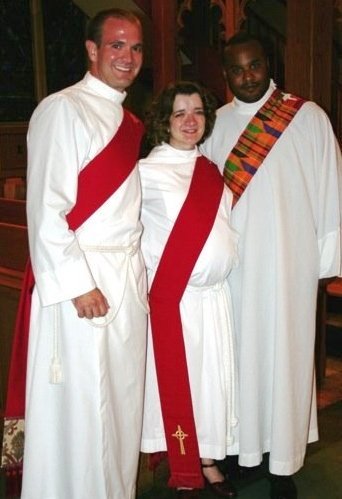
The Reverands Jody Burnett, Jennifer Andrews-Weckerly, and Charles Fischer III, Cathedral Church of St. John, June 24, 2009

Later this month I will celebrate the seven-year anniversary of my ordination.  What most people remember about that day was that I was very pregnant.  I confess that my large belly in an alb and a stole were rather extraordinary.  But what I remember about that day was a brief, but profound encounter.  I had gotten to the Cathedral early to make sure everything was in place and everyone knew where to go.  I was bustling around, managing logistics, when I ran into my boss, who was the rector of the church where I was serving.  She saw that I had my clergy shirt on but that I had not yet put on my collar.  You see, although you are not technically ordained until midway through the liturgy, you put your collar on before the liturgy starts.  The idea seemed strange to me to put it on before the bishop laid hands on me.  And if I am really being honest, I was really nervous about the whole endeavor.  My rector put her hands on my shoulders, looked me square in the eye, and said, “Jennifer, it’s time.  Go put on your collar.”

When we talk about ordination, we talk about the newly ordained experiencing an ontological change – a change in who the person is and in the nature of her existence.  It sounds rather dramatic because the change is dramatic.  When we ordain someone, we forever set them apart for a specific role in the church.

This Saturday, we will join our new curate, Charlie Bauer, as he is ordained to the transitional diaconate.  Charlie will be facing a similar ontological change – committing the rest of his life to this new way of being in and for the church.  Ordained persons do not simply start a new job.  Their whole person and existence is changed.  That is why an ordination is so special – because it is a day set apart for honoring this tremendous change.

Of course, all people in the church have access to ontological change.  Both baptism and confirmation are considered similar ontological changes – something profound happens in those moments, moments that only happen once in a lifetime.  We are marked as something different, and the way that we live our lives changes forever.  Because that change for all of us is so profound, the church sets apart days that we reaffirm our baptismal covenant and ordination vows.  We want to remember those tremendous moments when we put on a collar or stole, when water was poured over our heads, when a bishop placed heavy hands on our heads, and when we felt the Holy Spirit whisk through the room.  I hope you will join us as we celebrate this ontological change with Charlie.  But I especially hope you will take a moment to remember your own change and how the Spirit invites you to reclaim your changed identity.


Sermon – Luke 7.11-17, I Kings 17.8-24, P5, YC, June 5, 2016

Tags

, , , , , , , , , , , ,

The scene that day is pretty chaotic.  Two parades collide – a parade of life and a parade of death.[i]  The parade of life includes Jesus and his disciples, high off the sermon on the plain and the healing of the Centurion’s slave, Jesus’ followers are full of hope and optimism.  People are beginning to talk about who this Jesus might be and the enthusiasm is palpable.  Meanwhile, another parade is underway – a widow has lost her only son.  Widows were already at risk in that day due to their lack of financial stability and support from a husband.  Having a child, especially a male child provided a slight assurance that all hope was not lost.  Not only would the son be able to provide for his widowed mother, he is also the legal heir of his father’s inheritance.  But when he too dies, not only does she mourn his loss, but her safety net is totally gone.  She and the mourners with her wail their way to the cemetery.

Two groups full of noise and energy, but their energy could not be more different.  Into this chaotic scene of wails and cheers, people struggling to carry the lifeless body of promise, and people struggling to lay claim on the messenger of hope something tremendous happens.  The text says, “…the Lord saw her.”  That simple phrase may not sound like much.  The Lord saw her.  But surrounded by a growing crowd of faithful, Jesus could have been distracted by the hype.  On a long journey of travel, Jesus could have seen the coming commotion and steered another way.  Or Jesus could have been in deep thought about the next phases of his own journey.  But in the middle of the chaos, as if in a movie that screeches into slow motion, we see Jesus’ eyes lock on the grieving widow and mother.  The noise of the surroundings disappears and all that is important in this moment is that Jesus sees her.

On Memorial Day, my family and I went out for lunch.  We were managing our own little bubble of chaos:  multiple orders; hungry, cranky children; and the looming, necessary nap time.  As I stepped out of our bubble to throw away a pile of trash, I noticed a veteran sitting by himself at the table beside us.  He was silently sitting with his meal, seemingly in moment of deep quiet.  Seeing him almost made me stumble into halted motion.  I wondered what his story was.  I wondered if he was remembering those who had died by his side while he fought for our country.  I wondered if he was one of the veterans who managed to have reentered after war relatively unscathed or whether he was struggling to get by.  I wondered if Memorial Day meant something more to him than Memorial Day meant to me.  But my seeing him and wondering about him was not the same as Jesus.  You see, I was looking at him, but I was not seeing him – not with the same eyes as Jesus.  I couldn’t even get up the nerve to talk to him that day.

That is what is so profound to me about this story in our gospel lesson today:  Jesus’ ability to see the childless widow.  We actually get two very similar stories about widows in our readings today.  But despite the similarities, the contrasts are more informative about what is powerful about Jesus’ encounter.[ii]  In the lesson from first Kings, the widow of Zarephath also loses her only son.  Her son is also revived by Elijah, but the encounters with the widows have a lot of differences.  First, the encounter between the widow and Elijah is passionate.  The widow in that story accuses Elijah of being at fault for her son’s death.  She is outraged and Elijah panics, pleading with God to save the boy and the family from whom he has taken so much.  But the widow in our gospel lesson and Jesus have no such encounter.  The gospel widow does not talk to Jesus and does not plead her case.  She does not blame others around her – in fact, she does not speak at all in the story.  Were it not for Jesus seeing her and stopping the procession, we can only presume this woman would have slipped into dangerous oblivion.

Next, in the Elijah story, Elijah knows the son who dies.  The three have already bonded over the miracle of food.  So Elijah is intimately familiar with how precarious the family’s situation is.  But Jesus does not encounter the widow in his story until her son is already dead and being processed for burial.  Jesus’ saving action then comes not from relationship, but from seeing the grave nature of the widow’s loss.  No one introduces Jesus to the widow, no one whispers to Jesus that the grieving woman is a widow in addition to being a grieving mother – Jesus manages to see all of the complexity of this woman’s life in one glance.

The final contrast to the Elijah story is the healing itself.  Elijah has to stretch himself over the boy three times and cry out to the Lord for help.  His healing requires great effort and exertion.  Meanwhile Jesus simply touches the funeral bier and commands the young man to arise.  The immediate response of the boy sitting up and speaking demonstrates the extent of Jesus’ power.  Healing comes not by a request from God but from Jesus himself.  Jesus is not simply a prophet through whom God speaks – he is the long awaited one who is to come – the Messiah.[iii]

The differences between Elijah and Jesus teach us something about God.  Jesus’ teaches us that God sees us – sees us when we are most vulnerable, without us ever having to speak or ask for help, and is actively compassionate toward us.  Now that reality may leave us wondering today, “Well then why doesn’t Jesus see my suffering and offer me compassion?  I wanted things to go differently for me and they did not.”  That is why I find those words so powerful today.  “Jesus saw her.”  I do not think the story of the widow today is about how Jesus rescues us from our deepest pain and suffering.  This story is about how Jesus sees us when we are suffering and invites us into a similar vision.

“While we wish for signs and wonders, for the parting of the seas, for the lightning bolt of a Damascus road conversion, we risk missing the miracle of the mundane, says Thomas Lynch.  We miss seeing our friends and family who show up when we need them, ‘the ones who have known us all along.’  [Like those friends of the paralytic who lowered their paralyzed friend down to Jesus], or the widow who helped Elijah, these ordinary, obscure, and unsung people…, ‘do their parts to get us where we need to go, within earshot and arm’s reach of our healing, the earthbound, everyday miracle of forbearance and forgiveness, the help in dark times to light the way; the ones who show up when there is trouble to save us from our hobbled, heart-wrecked selves.’”[iv]  Today’s lessons about healing are not meant to make us question why we cannot receive similar healing.  Today’s lessons encourage us to see God in all the tiny miracles around us every day – the miracles that come in less dazzling forms.[v]  To see as Jesus sees.

When we attempt to see with the eyes of Jesus, something shifts dramatically for us.  What is so powerful about seeing as Jesus sees is that Jesus does not see without action.  When Jesus sees he also acts.  Once we have honed our better sense of vision, Jesus’ invitation to us is not just to see with the eyes of compassion, but to use those compassionate eyes for the service of God.  I have already begun to see the ways in which Hickory Neck is a place where that kind of active vision is in place.  You already see that the homeless man does not simply need food or money – you throw in a pair of socks because you know how hard life is without the decency of clean socks.  You already see the indignity of prison and see how a homemade cookie, while seemingly trivial, provides that miraculous glimpse into the tender care of Christ.  You already see how unexpected medical costs can push a struggling family over the edge and how free, compassionate, quality healthcare gives more dignity than we can imagine.  That is our invitation today:  to see the mundane miracles around us every day and to be reinvigorated to see as Jesus sees – with the eyes of compassion and insight that offer tangible, sometimes small acts of compassion to our brothers and sisters who struggle.  My guess is that when we offer that compassion to others, we will see more clearly how we receive that same compassion from Christ every day in similarly small, mundane, and yet profound ways.  Amen.

[i] Gregory Anderson Love, “Theological Perspective,” Feasting on the Word, Yr. C, Vol. 3 (Louisville: Westminster John Knox Press, 2010), 120

[ii] Steven J. Kraftchick, “Exegetical Perspective,” Feasting on the Word, Yr. C, Vol. 3 (Louisville: Westminster John Knox Press, 2010), 117, 119.

[iii] Kraftchick, 121.

[iv] Dan Clendenin, “The Miracle of the Mundane,” May 29, 2016, as found at http://journeywithjesus.net/lectionary-essays/current-essay on June 2, 2016.

[v] M. Jan Holton, “Pastoral Perspective,” Feasting on the Word, Yr. C, Vol. 3 (Louisville: Westminster John Knox Press, 2010), 120.

On Being Overly Generous…

Tags

, , , , , , ,

stars

Photo credit:  https://gooddayswithkids.com/tag/sticker-charts/

In the last several weeks, our six-year old started a “star chart” for herself.  Any time she helps around the house or with her sister, she can add a sticker to the chart.  We are not really rigid about it, and we have not even designated a reward – the satisfaction of stickers alone seems to be working.  Yesterday, I overheard her talking to herself as she placed stickers on the chart.  Her list of “good deeds” seemed endless – from holding her sister’s hand across the street, to saying thank you for something, to putting clothes in the dirty pile.  As her list got longer, I thought to myself, “Well, that’s being a little overly generous.  Stickers should be for really good things, not just everyday niceties.”

But as I thought about my reaction some more, I wondered if perhaps I had missed something.  I once had a spiritual director who encouraged me to switch up my prayer life.  Instead of praying about my concerns and worries, he suggested I pray about all the things that had gone well that day.  The switch was difficult at first.  I am really good at articulating my worries and stressors.  But I am not always good at celebrating what has gone well – even the smallest things on my to-do list.  Those good things seem negligible somehow – as not being as important as the things not yet done.

I wonder if my spiritual director was trying to capture for me what my daughter has captured in her star chart.  In celebrating the small victories every day, we allow our hearts to fill with a sense of gratitude.  And, like those multiplying stickers, the more goodness we articulate, the more goodness we begin to see.  In some ways, when we begin to see all the little bits of worthiness in ourselves, I imagine we begin to get a glimpse of the way that God sees us – as beautiful creatures who mess up from time to time, but who, day in and day out, do a lot of tremendously good things – both big and small.  If you were to start a star chart with the eyes of God in mind, how might you fill up your chart this week?

Sermon – 1 Kings 18.20-39, Galatians 1.1-12, Luke 7.1-10, P4, YC, May 29, 2016

Tags

, , , , , , , , , , , ,

The older I have become, the more solid my support system has become.  Over time, I have figured out in which friendships to invest my time, and which friendships, while fun, are not necessarily nourishing.  I know which friend to call when I need fashion advice and which friend to call when I need major life decision advice.  I have learned which friend to find when I want to be comforted, and which friend to find when I need to be discomforted.  The discomforting friend is probably the most valuable one any of us has.  That is the friend who will tell you the brutal, ugly, harsh truth – not to be mean to you but to save you from going down a dark path, to snap you out of a rut, or to help you get your act together.  Of course, sometimes we avoid that friend like the plague because we are not ready to hear the truth.  But when we feel ourselves slipping away, when we feel drawn in by temptation, or when we simply feel incapable of doing the right thing, we know we can trust that friend to hold us accountable to being the best version of ourselves – the version God created us to be.

This morning, the lectionary seems to be filled with discomforting friends.  In First Kings, we hear about the ultimate showdown with the prophets of Baal and Elijah, the prophet of the Lord.  The story is dramatic, with Baal’s prophets comically trying to rain down fire to prove Baal’s power, and Elijah showing them up by demonstrating the Lord’s triumph.  But we quickly learn that Elijah is one of those discomforting friends when he says to the people of God, “How long will you go limping with two different opinions?  If the Lord is God, follow him; but if Baal, then follow him.”[i]  Desperate for rain in a three-year drought, the people of God have begun to hedge their bets.  They figure they can worship both Baal and the Lord.  But Elijah will not let them be so divided.  Either they trust in the Lord their God, or they do not.

If Elijah sounds harsh, you should hear Paul this morning.  Paul starts his letter to the Galatians with a traditional greeting, but we can tell from his lack of thanksgiving for the community, that some harsh words are about to come.[ii]  After a quick introduction, Paul cuts to the chase, “I am astonished that you are so quickly deserting the one who called you in the grace of Christ and are turning to a different gospel…”[iii]  At the heart of the issue is whether Gentile converts must adhere to Jewish laws.  The Galatians want to narrow the wideness of the gospel, while Paul wants to expand the reach of the gospel.  So angry and defiant is Paul that he practically shouts, “If I were still pleasing people, I would not be a servant of Christ.”[iv]  In other words, Paul has no interest in soothing feelings in Galatia.  He is only interested in correcting behavior and preserving the abundance of the gospel.[v]

And if Elijah and Paul were not harsh enough this morning, Jesus rounds us out with a scathing indictment of the faithful.  A centurion, a Roman solider, and sometimes enemy of the people of God, sends a message to Jesus.  Despite the fact that he is not Jewish, he sends word to Jesus twice – first, asking Jesus to heal his sick slave, and second, insisting that Jesus not make the journey, but only speak a word of healing from afar.  The text tells us that Jesus, who is very rarely reactive, is “amazed,” and criticizes the faithful of God by saying, “I tell you, not even in Israel have I found such faith.”[vi]  If we think about who is gathered around Jesus, we are not just talking about some delinquent followers.  Jesus says in front of disciples and everyone that none of them has had the same dedication and faith in Jesus as this outsider.  Jesus has no problem being brutally honest about the people’s lack of faith and trust in Jesus.

If you were hoping for a nice, affirming set of lessons today, a time set apart with that friend who always encourages and affirms you, you picked the wrong Sunday.  We might have guessed the brutal honesty was coming when we prayed our collect today.  The collect says, “O God, your never-failing providence sets in order all things both in heaven and earth: Put away from us, we entreat you, all hurtful things, and give us those things which are profitable for us…”[vii]  In other words, we prayed God would not be that comforting friend today – but would be the discomforting friend that we need.

Now you may be sitting here wondering what kind of discomfort I will be dishing out today.  Or you may be wondering on what issue I think we need work.  The good news is that I do not have such a charge today.  I suspect that you already know where you need discomfort.  Your discomfort may need to be from Elijah, who warns about putting idols before God – putting your trust and hope in places and things that will not satisfy.  Or maybe your discomfort needs to come from Paul, who warns about putting restrictions on the wideness of God’s mercy.  Or maybe your discomfort needs to come from Jesus, who can point to non-believers who seem to trust God more than you.  You alone know how the Spirit is speaking to your need for discomfort.

However, even though you alone know how the Spirit is speaking to your need for discomfort, you are not alone in needing that discomfort.  One of my favorite parts of our liturgy is the confession.  One, I find the confession immensely centering because every week, one phrase or part of the confession jumps out at me – whether something I have done or left undone is nagging me; whether I have sinned against God or my neighbor; or whether I have just strayed that week.  Even though we say the confession every week, the confession never ceases to unsettle me.  Two, I find the confession comforting because of all the voices that join me in the confession.  I love hearing young and old voices, male and female voices, and voices with every accent imaginable confessing the same failings that I confess.  The power of that communal act is always humbling and comforting.

Now I know I told you that you should not have come to church today if you were looking for comfort.  But the truth is, I find all the discomfort today wildly comforting.  Whether we are pushed by our discomforting witnesses in scripture, whether we are jolted by something in our communal confession, or whether we realize that we need to call our best discomforting friend immediately after church, I find the reminder that I am not the only one who needs discomfort comforting today.  I am comforted because I know after the discomfort comes, something akin to a fire is lit inside me.  The discomfort is usually just what I need to reinvigorate my walk with Christ and sharply focus on where God is calling me to be.  If that is not good news, I do not know what is.  Amen.

[i] 1 Kings 18.21.

[ii] Audrey West, “Commentary on Galatians 1:1-12,” May 29, 2016, as found at http://www.workingpreacher.org/preaching.aspx?commentary_id=2882 on May 25, 2016.

[iii] Galatians 1.6.

[iv] Galatians 1.10.

[v] Dan Clendenin, “No Other Gospel,” May 22, 2016, as found at http://www.journeywithjesus.net/essays/977-no-other-gospel on May 26, 2016.

[vi] Luke 7.9.

[vii] BCP, 229.

With the Eyes of Compassion…

Tags

, , , , , , , , ,

Heart in the stone fence

Photo credit:  https://jackieleasommers.com/tag/what-does-compassion-to-an-OCD-sufferer-look-like/

As a mother of two girls, I have regularly followed articles and advice columns about “mean girls.”  I avoided meanness like the plague as a child – not necessarily because I was more moral than other kids.  In fact, my avoidance of meanness was more about self-preservation.  I figured if I was never mean to others, then I reduced the risk of someone being mean to me.

Having stayed under the radar, I realize there is a world of “mean girls” that I totally missed.  And I have been surprised at how early some of those tendencies arise in my daughter and her classmates.  There is constant chatter about who is or is no longer one’s best friend.  I am constantly hearing about hurt feelings, someone being mean, or, through inference, hearing when my own daughter seems to be the victim or perpetrator of meanness.  Though I realize we are not even close to the tween and teen years, I see the hints of what is to come.

But last week, I was the chaperone for my daughter’s field trip.  I wondered whether I would see any of that behavior in real time (not just through the stories relayed at bedtime or at the dinner table).  My observations did not lead to any conclusions about my daughter’s experiences.  But what I did see were a bunch of kids who were thrilled to have some attention and affection.  I did not really do much.  I deployed my typical distraction technique of asking lots of questions of the kids.  And before I knew it, I never had an empty hand.  Kids I had never met before wanted to hold my hand and be near me.

As we rode the bus back, my heart was full of sympathy for all the kids.  Though I know they all hurt each other with insults and teasing, at the heart of matter, they are all children of God, who like all of us, long for love.  What made me so grateful about the trip was these kids who sometimes say and do mean things are also kids trying to navigate social systems, kids trying to be tough, and kids who need love.  And if all that is true about kids, how much more so about all of us adults?  This week, I invite you to see those around you with the eyes of compassion – the same eyes with which God sees you.

Sermon – Romans 5.1-5, John 16.12-15, TS, YC, May 22, 2016

Tags

, , , , , , , , , , , , , , , , , , , , ,

In seminary one of my favorite professors was our theology professor.  I did not like her because of the subject she taught.  In fact, her class was one of the classes that gave me the most headaches as I struggled to understand theological arguments.  Instead, what I liked about her was the way that she taught.  She had a dizzying intellect, and yet she had the ability to gently make you feel like you were not an idiot.  Someone in class would ask a question, trying to get their head around a theological concept.  Her soft response would be, “Oh, yes, yes, I could see how you might get to that conclusion.  So-and-so also argued that heresy in the fourth century.”  Or she might answer, “Oh yes, that heresy is one of the church’s favorite,” and then go on to explain how the church struggled to counter the heresy.  What I loved about her responses was she let you know that although you clearly did not understand the theological concept, you were not the first person to struggle to understand and you will not be the last.  Struggling to understand and articulate a cogent theological concept without slipping into a heretical argument is a basic part of being a Christian.

What I loved about the pastoral nature of my professor’s responses was she understood that being able to articulate a definition of God is incredibly difficult.  More important to her than you getting that articulation correct was your engagement with the concept.  Perhaps she understood that theologians for centuries have tried to do the same thing – define who God is and what God means.  That may be why she never seemed bothered by our heresies – because she knew that her role, and in fact the role of the church, is to be involved in the ongoing endeavor of naming God’s activity in our world.[i]  That is the same work that we do every year on the feast of Trinity Sunday – embracing the endeavor of naming God’s activity in our world.

To help us in that endeavor, we get two great pieces of scripture today.  In our gospel lesson from John, Jesus tells the disciples that the Spirit will guide the disciples into all truth.  Jesus’ promise to the disciples tells us those closest to Jesus, those who have been sitting at Jesus’ feet, learning truth from the source, are still going to need help.  The disciples, who will be commissioned to go out into the world to share the Good News, will not do that work alone.  The Spirit will go with them, helping them to continue to learn and grow into the fullness of faith.

I was recently invited to come to Sunday School for a little round of “stump the priest.”  I laughed at the title, but inside I was thinking, “What if they ask a question that really does stump me?!?”  Luckily, a cooler head prevailed.  The truth is they probably will stump me – several times over.  But that will give us a chance to talk about how the Spirit guides us into all truth – in childhood, in young adulthood, and into our older years.  But more importantly, I hope that we get the chance to talk about how the community of faith is a vital part of that learning of all truth.  We are certainly dependent on the Spirit, but we are also dependent on each other, because the Spirit so often speaks to us through people and the words of those around us.[ii]

That is one of the things I love most about being in the Episcopal Church.  The Episcopal Church has always been a place where ambiguity is okay.  As David Lose explains, “…being part of being a Trinitarian community [means] striving to be a place that knows it doesn’t have all the answers, and so consequently makes space for conversation and values those who bring different voices and experiences into its midst.  Conversation, valuing difference, being inclusive – these things aren’t easy, but genuine community, while challenging, is also creative, productive, and enriching.”[iii]

The other great piece of learning today comes from our reading in Romans.  On the surface, this piece of scripture has always troubled me.  Paul’s claim that suffering produces endurance, endurance produces character, and character produces hope, has always sounded a little dismissive about suffering.  But I do not think Paul meant for this formula of suffering leading to hope was not meant to be prescriptive, but descriptive.[iv]  In other words, he is not saying those who are suffering should be grateful.  What he is saying is those who are suffering have the opportunity to not waste the pain.  Peter Steinke says, “We ‘waste’ suffering if we gloss over, deny, avoid, or neglect its message…. If, however, we can learn from pain, [pain] is not wasted but a source of life and health.”[v]  My suspicion is that Paul is trying to capture what we learn from our gospel lesson today.  Even in the midst of suffering the Holy Spirit and the community of faith can guide us into all truth.

I have been a part of parishes that have a communal component to their premarital counseling.  In addition to meeting with the priest, each engaged couple is partnered with a married couple in the parish for mentoring.  One would think that the married couple’s job is to tell the engaged couple how to do everything and give them advice.  But more often, the couples end up talking about how hard marriage is, what struggles they have dealt with, and how they got through the suffering.  The relationships between the mentors and the mentees often last well beyond the wedding.  When done with honesty, vulnerability, and compassion, the couples realize that they gain strength from one another and find a place where they can go when they are looking for truth and guidance.

Our gospel and epistle lessons today weave together an understanding of the Trinity that is both vertical and horizontal.[vi]  Vertically, we learn that our understanding of God is ever changing and dynamic – much like God is ever changing and dynamic.  I think that is why my professor was so open to us stepping into and out of heresies and doctrine.  She knew that every Christian had to take that journey of steps and missteps.  But I think she also understood that truth was ever evolving and that the Spirit was with us in that journey.  She was not worried about us because, “…a critical characteristic of faith is an ever-striving and dynamic making sense of God.  The Trinity [cannot] be the only way to get God.  [That theology] is as limited and finite as our humanity.  [The theology of the Trinity] is one attempt of the church to articulate the being of God in a particular time and place.”[vii]  We will continue to walk toward truth in our own time and place too.

Horizontally, our lessons teach us that we find our way to that truth the Spirit is showing us through the vehicle of those around us – both those in the church, and those outside our walls.  I cannot count the number of times I have learned something profound about God by someone who never harkens the door a church.  Our job is to pay attention:  pay attention to the way that God is using others to show us more about God; pay attention to the ways God invites us to interpret our sufferings with others; pay attention to those who are struggling toward truth along with us.  We will surely step into heresy now and then.  But we will also step into God’s love and grace through the guidance of the Holy Spirit and those around us.  Amen.

[i] Karoline Lewis, “Trinity Talk,” May 15, 2016, as found on http://www.workingpreacher.org/craft.aspx?post=4648 on May 18, 2016.

[ii] David Lose, “Trinity C:  Don’t Mention the Trinity,” May 17, 2016, as found on http://www.davidlose.net/2016/05/trinity-c-shh-dont-mention-the-trinity/ on May 18, 2016.

[iii] Lose.

[iv] Richard L. Sheffield, “Homiletical Perspective,” Feasting on the Word, Yr. C, Vol. 3 (Louisville: Westminster John Knox Press, 2010), 39.

[v][v] Sheffield, 41.

[vi] Lose.

[vii] Lewis.

The Power of Stories

Tags

, , , , , , ,

Story

Photo credit: coolerinsights.com/2016/04/how-to-tell-winning-brand-stories-on-social-media/

Last week we started our Meet and Greets at Hickory Neck.  I knew that I wanted to get to know the people of the parish in a more meaningful way than just shaking hands in the receiving line after church.  And so, we are gathering in small groups of 10-12 people, and taking time to tell our stories.  The gatherings have already been a tremendous blessing.  I am learning about the varied ways that people found their way to Hickory Neck, their loves and passions, and their hopes and dreams.

What I particularly enjoy about the gatherings is the reminder of how powerful our stories are.  Each person in our community has a unique story, with elements that are quite familiar to us, and elements that are totally foreign to us.  I think that fascination with stories is why I have been attracted to efforts like Humans of New York or StoryCorps.  Those efforts are hoping to capture the everyday nature of our stories, while demonstrating the powerful ways that we connect through our stories.  Our stories have the ability to bring others joy, to elicit empathy, to bring us to tears, and to open up new worlds.

Too often, we are tempted to ignore the depth of those stories with strangers.  We are busy about our business, trying to accomplish tasks, or stick to a schedule.  In that routine, we forget that there are people all around us who have rich stories and whose lives may have something to teach us.  From that man who snapped at you in line, to the child who fell asleep in school, to the mom out in public in her pajamas, to the teen engrossed in social media, each person has a story behind their behavior – and the story may be much different than a quick glance allows us to assess.

If you have not joined a Meet and Greet, I encourage you to sign up at church.  In fact, even last night someone commented about how much they were learning about people they had known for quite some time.  But beyond our work within the community, I invite you to start looking at those outside of our community with a different eye:  the eye of someone who sees the unique and sacred stories we all have.  I look forward to hearing how your encounters go.

Sermon – Acts 2.1-21, Pentecost, YC, May 15, 2016

Tags

, , , , , , , , , , , , , ,

Though I often share with people that I grew up in the Methodist Church, what that story fails to capture is my earliest experiences in church.  You see, before my father became a United Methodist minister, he, my mother, and I worshiped at a Pentecostal church.  So my first memories of church are quite different from my current experiences in church.  I remember the pastor putting his hand on a person’s forehead and the person crumbling to the ground, presumably slain in the spirit or healed of a malady.  I remember sitting in the pew once with a friend of my parents’ when the woman leaned over to me and whispered, “I’ll be right back.”  She then proceeded to run up and down the aisle, her hands waving in the air.  I do not remember anyone speaking in tongues, but I would not be surprised if that happened.

I have always found the fact that Episcopalians like Pentecost so much fascinating because we are about as far from Pentecostal as any church could get.  I have yet to find an Episcopal Church that encourages running up and down aisles, speaking in tongues, and being slain in the spirit.  That does not mean we do not move.  In fact, we stand, kneel, sit, cross ourselves, bow, and sometimes even genuflect.  You might find a few of us lift our hands in praise, but most of us keep our hands tightly to our sides.  You might find a few of us who will say an unprompted “Amen!” aloud, but they will likely get a few glares.  We are likely to, rather proudly, wear red on Pentecost.  But that is the extent of most Episcopalians “Pentecostalism.”  We like things much more ordered, predictable, and civilized.  In other words, if we are really being honest, Episcopalians are not all that big on Pentecost.

Our aversion to Pentecostal experiences are not all that unfounded.  All one has to do is look at the first Pentecost that we read about in Acts today.  The day the Holy Spirit comes down from heaven is a pretty disorderly, unpredictable, uncivilized day.  Wind whips through people’s hair, fire bursts into flames on people’s heads, and a cacophony of noise ensues that both makes no sense at all, and yet makes perfect sense to each person there.  Although that chaos may sound very similar to anyone with small children in the house, that chaos is not exactly what we have come to expect as civil Episcopalians.

But if we are to get our heads around Pentecost, we have to understand what was really happening on this feast of Pentecost.  The feast of Pentecost was known to most Jews as the feast of Weeks, or Shavuot.  Shavuot is the third of the three great festivals of Judaism.  Shavuot was a joyful celebration, in which the first fruits of the harvest were offered to God.[i]  But Shavuot was not simply an agricultural festival.  Shavuot, or Pentecost, was fifty days after the Passover.  At Passover, the Jews celebrated the saving of the Israelites from the death that came upon the firstborn of the Egyptians.  Fifty days after that dramatic event, the Israelites arrived at Mt. Sinai to receive the law from Moses.  And so, in addition to thanking God for the first fruits of the harvest, praying that the rest of the harvest might be equally bountiful, Pentecost was also “about God giving to [God’s] redeemed people the way of life by which they must now carry out [God’s] purposes.”[ii]

The parallels in and of themselves are uncanny.  At the Passover, the people of God are saved as death passed over their homes.  In Christ, the people of God are saved once again as Christ our Passover is sacrificed for us.  At Shavuot, the people of God are given the new way of life, specifically through the vehicle of Torah, or the Ten Commandments.  At Pentecost this day, we are reminded of the New Commandment given through Jesus that we love the Lord our God and love our neighbors as ourselves.[iii]

So if this day is all about us being given the way of life that we must now live, what do we learn in this chaotic, uncivilized day?  Most remarkably, we see people speaking in tongues they do not know, and yet, all understanding in their native tongues.  That does not mean that all the languages suddenly became one – like making English the official language of Christianity.  Instead, “Pentecost gives power to the band of Jesus followers to speak the languages of the world, to tell the gospel in every language.  The early church [is] to bear witness to the ends of the earth in the languages of the people of the world.”[iv]

I have been thinking a lot about speaking other people’s languages this past week.  Having just moved from Long Island to Williamsburg, I have been keenly aware of language differences over the last month.  Of course, some of our differences in language are more about dialect than anything else – our vowels sound different, or r’s are sometimes dropped.  But a more poignant difference in our language is around culture.  On Long Island, communication is usually concise and incisive.  That may sound rather appealing, but the first time someone tells you how they really feel about you, and the way that they feel is pretty negative, the language can feel like a slap in the face.  Of course, that is not to say Southerners have the market on ideal communication.  I remember many a time growing up when someone said, “Bless your heart,” and their words had nothing to do with a blessing.

As I have been ruminating on those differences this week, I wondered whether those differences go beyond region and perhaps are at the root of many of our challenges today.  I have wondered if part of our country’s problem in communicating with one another is rooted in the fact that we are not speaking the same language.  Of course, most of us can speak English in this country, but even though we speak the same language, we do not speak from the same cultural reality.  There are experiences that I have as a woman that my male brothers will never fully understand.  There are experiences that my African-American brothers and sisters experience that I will never fully understand.  There are experiences that our young adults are having through technology that us older folks will never fully understand.  In some ways, I wonder if in America, we have become more like the people of Babel than the people of Pentecost.

Luckily, we are not beyond God’s power to make our Babel-like ways right.  There are all sorts of tangible ways we can work toward understanding others’ languages.  We have a pretty incredible collection of young adults in this parish.  Being a part of community means that we can reach out to our young people to hear their stories and trials – just as they can learn about our own stories and trials.  Being a part of community means that we can join any number of the outreach ministries of Hickory Neck and learn quite quickly what language and cultural context poverty creates.  Being a part of a community means that we can read authors whose cultural contexts are completely different from ours and learn more clearly why movements like “Black Lives Matter,” might have arisen in the first place.

That is the true invitation of Pentecost:  to step boldly into the chaos of differing languages, knowing that the Holy Spirit will bring about true understanding.  Of course, stepping into that cacophony is scary.  As N.T. Wright says, stepping into the cacophony means getting “out there in the wind, letting it sweep through your life, your heart, your imagination, your powers of speech, and transform you from a listless or lifeless believer into someone whose heart is on fire with the love of God.”[v]  That kind of transformation may not sound like what you were hoping by wearing red today.  But that kind of transformation offers the promise not of calming the cacophony of language all around us, but helping us hear in the midst of the chaos.  God, whose very existence in the form of the Trinity is three distinct persons, yet one, invites us to live as a community differentiated in persons, but untied in love.[vi]  That Pentecostal community will be loud, messy, and hard.  But that community will be life-giving, renewing, and beautiful.  Our invitation today is to step into the wind of the Spirit.  Amen.

[i] Margaret P. Aymer, “Exegetical Perspective,” Feasting on the Word, Yr. C, Vol. 3 (Louisville: Westminster John Knox Press, 2010), 15.

[ii] N.T. Wright, Acts for Everyone, Part 1, Chapters 1-12 (Louisville: Westminster John Knox Press, 2008), 21.

[iii] Aymer, 17.

[iv] Aymer, 17.

[v] Wright, 22.

[vi] Michael Jinkins, “Pastoral Perspective,” Feasting on the Word, Yr. C, Vol. 3 (Louisville: Westminster John Knox Press, 2010), 18.