

A few of my favorite things…

Tags

, , , ,

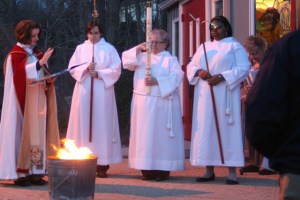
AlleluiaBWWhen I went on a choral pilgrimage in England a couple of years ago, I remember finding that each day I had a new favorite sacred space.  Not once did we visit a place and I say, “Oh, well that one wasn’t as good as yesterday.”  They all blew me away, and I had such a hard time naming a favorite when I returned home.

In some ways, Holy Week this year was like that for me.  Every liturgy of Holy Week brought its own unique gifts and made me feel like the next liturgy could not possibly top the one I had just experienced.  At St. Margaret’s, we began Holy Week a day early with our Cemetery Memorial Service on the Saturday before Palm Sunday.  I am always amazed at how our Cemetery manages to create a community of faith, despite the wide variety of Christian backgrounds present, and I am grateful for the honor of helping that community remember their loved ones every year.

The next day, on Palm Sunday, we began our second service at the Cemetery cross and processed our way into the church.  The sun was shining down on us, and our procession captured some of the joy of that day in Jerusalem for us.  It was the perfect setup for our Passion Narrative.

We came back together Monday night for compline.  I was amazed at how such a brief service could be so profoundly spiritual.  As we chanted “Jesus remember me,” I could hear the echoes of our Passion Narrative from the day before.  The next morning, I renewed my ordination vows with the clergy of our Diocese, and then came home for evensong led by our guitar group.  We hosted the local Lutheran church, and I loved the musical selections of our music leaders.  Their music brought a new flavor to Holy Week.

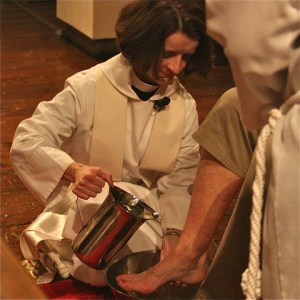
Wednesday, we headed over to the Lutheran church for a healing service.  There is something quite sacred about laying hands on both parishioners and complete strangers that is entirely humbling as a priest.  I really am so blessed to be entrusted with this ministry.  That same humility overwhelmed me during our footwashing service on Thursday.  The experience of both washing and having your feet washed is a profoundly intimate and sacred practice.  Leaving the church with the bare, stripped altar that night brought a deep quiet over me that lasted until Saturday.

Our Good Friday liturgy electrified the experience of silence.  Without music and adornments, the silence left us with nothing but ourselves to face.  Though we did not sing at that service, I could hear the words from that favorite hymn, “sometimes it causes me to tremble, tremble, tremble…”  That night, our confirmands led our Stations of the Cross service.  We used a devotional stations of the cross, and I was so proud of our confirmands.  Despite their initial nerves, they led as confident young adults, and invited us into deeper reflection on Jesus’ journey to death.

Saturday morning, we took a brief break from the solemnity of Holy Week, and welcomed tons of children to our campus for our Easter Egg hunt.  The laughter and enthusiasm of the children – whether with crafts, egg hunting, sack hopping, or simply running around – brought me back to why this life that Christ gives us is so precious.  Their energy brought me back to my favorite liturgy of all time – the Easter Vigil.  I cannot say enough about this service.  From hearing the haunting music and words of the Exultet, to listening to our salvation stories in darkness, to ringing in the alleluias, to feasting once again on the Eucharistic feast, that service is one of the most powerful service the Episcopal Church offers.

And after all of that, you might think Easter would be a let-down.  But looking at those much fuller pews just reminded me that no one can contain Easter joy.  Our alleluias are louder, and our hearts explode with love for Christ and one another.  There is no greater joy for us that day.

So you see, picking a favorite from Holy Week is actually quite difficult.  I think the difficulty in choosing a favorite is that each service captures an experience with God – and no one can rank or rate experiences with God.  They are all special in their unique ways, and would each suffice for spiritual strength for weeks.  So imagine my joy in experiencing them all in one week.  If going away for a pilgrimage is not an option for you, I invite you to consider using Holy Week as your spiritual pilgrimage next year.  I guarantee you, you won’t be able to pick a favorite!
Sermon – John 20.19-31, E2, YC, April 7, 2013

Tags

, , , , , , , ,

As Christians who just celebrated Easter last week, rejoicing in Jesus’ resurrection and all that his resurrection means in our lives, you would think our gospel lesson would be a little more victorious.  You would think the next step after the angels appear saying Christ is not in the tomb but is risen would be the disciples hitting the ground running, doing the work of spreading the good news or at least throwing a raucous party.  Instead, we find the disciples huddled in a locked room, cowering in fear.  They have not taken the good news from Mary Magdalene as reason to celebrate.  Instead, they are paralyzed by fear.

I have often wondered what the disciples were afraid of.  The text says they are afraid of the Jews, perhaps afraid that the same people who killed Jesus would try to kill them too.  But I think there is more to their fear.  I think they are afraid to face others, because they feel as if they have failed.  Perhaps they believe that their pick for Messiah did not seem to be the Messiah after all.  I think they are also behind those locked doors because they are ashamed that they failed to protect Jesus, to keep him alive.[i]  Those locked doors are not just for safety – those locked doors are for hiding the shame, the disappointment, and the fear of facing others that the disciples have.

We know a little about what the disciples feel like.  We all have things about ourselves for which we are ashamed.  There are things about ourselves that we lock away, praying that no one every finds out because we are not who we fully want to be or even who we pretend to be.  Garrison Keillor once said, “We always have a backstage view of ourselves.”[ii]  Most people only see the carefully arranged stage we have assembled for others to see.  But behind the curtain, in that backstage view that only we have, there are all sorts of things hiding: old failures, hurts, guilt, and shame.  And Eastertide is one of the most difficult times for this dichotomy because we feel like we should be at our best – wearing our best clothes, coming to church as perfectly functioning families, showing forth nothing but happy alleluias.  We are working overtime to ensure that our stage is especially carefully arranged at church.

But to this frenzied, harried behavior, what does Jesus say?  Peace be with you.  Jesus comes to those fearful, ashamed, embarrassed disciples, finding them behind their locked doors of protection and offers them peace.  Jesus barges backstage and says, “I see you in your fullness, and I offer you peace.  So forgive yourselves and now go and forgive others.”  This is why Jesus died on the cross – that their sins might be forgiven.  And so, before the disciples get too mired in wallowing in fear, shame, and self-pity, Jesus demands they recognize that they are forgiven – and that they share that good news with others.  For no one should be locked inside a room of shame and fear.  The peace Jesus offers is not some “greeting-card platitude about the sun behind the clouds.  [Jesus’ peace] is the beginning of a new world, the long-awaited world of God’s shalom.  [His peace] comes with freedom from fear, sin, and death.  Jesus opens the door that the disciples had locked…and he shows the way to resurrection reality.”[iii]

This is our invitation today as well.  Our invitation is to offer the same forgiveness to one another that Christ unabashedly offers to us.  In so doing, we invite not only ourselves, but others, to take down the pretty stage trappings, and to recognize that we all have backstage versions of ourselves, which are all in need of Jesus’ love and forgiveness.  This is good news for which we can really shout alleluia.  This is the kind of good news that makes us want to be in church.  Because this sacred space is not sacred because we made our stages look sacred; this sacred space is sacred because we are fully ourselves, and fully forgiven.  Peace be with you.  Amen.


[i] M. Craig Barnes, “Crying Shame,” Christian Century, vol. 121, no. 7, April 6, 2004, 19.

[ii] Barnes, 19.

[iii] Kristen Bargeron Grant, “No Joke,” Christian Century, vol. 120, no. 9, April 19, 2003, 18.

Sermon – John 20.1-18, ED, YC, March 31, 2013

Tags

, , , , , , ,

On that dark, damp, dreary morning, Mary Magdalene comes to the tomb expecting something.  Darkness clings to her like a cloak.  She was there at the foot of the cross two days ago.  She waited, hoping against hope that God would be victorious and Jesus would be miraculously saved.  And then she prayed that God would take Jesus faster, because despair was setting in and his suffering was overwhelming to witness.[i]  She cried so much that night, that her eyes ran dry.  After 48 hours of dazed despair, she drags her lifeless body through the darkness to tend to her beloved Jesus’ body.  Seeing his body one more time will only confirm her grief, but at least she has somewhere to go to mourn; at least his cold body will confirm his death, and begin a journey toward closure.  Mary Magdalene comes to that tomb in darkness expecting something.

We too come to church today expecting something.  Maybe we are expecting a word of joy, the release of the alleluias we have been holding in for weeks.  If we attended the myriad Holy Week services this week, maybe we are expecting a relief from all the darkness of the liturgies during these last holy days.  If we have not been to church in a long time, maybe we are uncertain as to what to expect.  We came here seeking something – some sort of connection, a sense of familiarity, or maybe a place that will accept us as we are, letting us take things as slowly as we need.  Or perhaps you were dragged to church today by a family member, and the most you are expecting is an hour of your time taken away – and that certainly feels like a period of darkness for you too.

If Mary came expecting one thing, what she gets is altogether different.  The absence of Jesus body puts her over the edge.  The first thing she does is run to get the disciples.  But even they only confirm the awful truth that keeps compounding.  Humiliating him, torturing him, and crucifying him were not enough.  Now they have taken his body too?  Having the disciples leave Mary Magdalene alone again starts the downward spiral that seems endless.  This is why she cannot see the angels in their glory – she only mutters a response to them and turns away from the tomb, her vision blurred by her tears again.  This is also why, when a man appears, she desperately begs the man to tell her where he has taken the body.  And then the unexpected happens – or at least perhaps what she had hoped might happen, but would never let herself say aloud.  Rabbouni!  Her teacher is back!

But Jesus only partially fills her expectations.  “Do not hold on to me,” Jesus says.  His words must have felt like a slap to Mary’s fragile self.  In the instant that she recognizes Jesus, a whole new set of expectations arrive.  Surely, they can flee to Galilee again and keep Jesus safe.  But Jesus changes things yet again; Mary Magdalene’s expectations cannot be fulfilled.  Things cannot return to normal.  What Jesus invites is not a return to the way things were, but to a way that is even better than the way things were; a way in which she can develop new expectations for her life in Christ.

When I graduated from college and relocated to Delaware, I was looking for a United Methodist church.  I had experienced a particular style of worship in my hometown, and was looking to replicate that experience.  After six months of frustrated looking, I stumbled into the Episcopal Cathedral.  Parts of my expectations were met – the Cathedral had one of the most diverse populations I had ever seen – racially, socioeconomically, ethnically, by household definitions, and by sexual orientation.  They were doing some incredible urban ministry, and seemed to have an inspiring commitment to the poor.  But the worship killed me.  It was so formal and the music was so uptight, that I wondered how such a progressive church could be so rigid.  I remember hearing an offertory anthem one Sunday that was so good that I said a very loud, “Amen!” at the end.  I realized right away that that was not what was expected of me.  Ultimately, after several Sundays, I decided that I would stay, but only temporarily.  When we moved again, I would just look for another United Methodist church.  But God had other expectations for my life.

That is the funny thing about expectations.  Both the realistic expectations Mary Magdalene has – the expectation to remain in bitter darkness – and the hopeful expectation Mary has – that everything could go back to normal – are not met.  But that does not mean that Jesus does not make a way out of the darkness.  We have heard from the very beginning of John’s gospel about Jesus and the light.  “The light shines in the darkness, and the darkness did not overcome it,” says John’s gospel[ii]  The later, John says, “Again Jesus spoke to them, saying, ‘I am the light of the world. Whoever follows me will never walk in darkness but will have the light of life.’”[iii]  Jesus, then, this light of the world, cannot meet the expectations of Mary; because Mary’s expectations are smaller than God’s.  Mary cannot go back to the way things were.  But the way things are going to be is infinitely better.  “God gives a new kind of life, a life that is still worth living, a new kind of aliveness toward God and the world…”[iv]

Mary’s interaction with Jesus invites us to consider our own expectations of this day.  If we came here today, only seeking joy without transformation, then our expectations might go unmet today.  If we came here expecting to rub out all the darkness of these last days, then our expectations will only be partially met today because we cannot celebrate the resurrection, without the cross ever with us.  If we came here as seekers, expecting to just sit in the pew and then go back to our lives, then our expectations might not be met either.  Once we learn that this room is full of seekers just like us, who want us to enrich their journey, this place cannot be seen in the same way.  Even for those of you who just hoped to survive this hour of forced worship will not have your expectations met.  Because even if you are not touched today by Christ’s light, those who brought you here are being touched by the light; your relationship with them will be changed because they are being changed.

So the polite Southerner in me wants to say, “I am so sorry we did not meet your expectations today.”  But at the end of the day, I am glad that our expectations are not met today.  God is doing bigger and better things than we can imagine.  Our job is to trust that the light of the world will lead the way into the new resurrection journey that awaits us.  Amen.


[i] Joan Gray, “Beyond Rescue,” Journal for Preachers, vol. 22, no. 3, Easter 1999, 51.

[ii] John 1.5

[iii] John 8.12

[iv] Gray, 52.

Sermon – Luke 24.1-12, EV, YC, March 30, 2013

Tags

, , , , , , , ,

IMG_3202Our liturgy tonight operates a bit like a movie whose mode of telling stories is in flashbacks.  We start the movie with the scene we just heard.  Several women are gathered around the empty tomb, their mouths agape, and their minds racing.  And then, the flashbacks begin.
Mary the mother of James recalls that ancient story of creation.  That empty tomb reminds her of those words – tohu wabohu – the formless void.  She vaguely remembers what God said about creating humankind in God’s image.  And she hears those words repeated over and over again, “It was good; ki-tov

Meanwhile, another woman flashes back to when humankind’s sinfulness so angered God that God flooded the earth.  For forty days, Noah knew the nothingness of that empty tomb in front her.  But she also remembers that covenant God made with Noah – that never again will there be a flood to destroy the earth.  Perhaps there is a rainbow in this tomb, and not only the watery floods that she sees.

Joanna looks into that empty tomb and remembers another time her people faced desperation.  She flashes back to the rushing Egyptians who have pinned her people to the Red Sea.  She remembers the panicked screams of her people toward Moses.  She remembers how God saved them then – how God created a way out of no way.  She wonders whether the empty tomb is not unlike that empty seabed – the one that the Israelites used to get to freedom.

Another woman stares into that vacant tomb and she remembers a different tomb.  She remembers the death and hopelessness of those bones in that valley – the thousands of devastated lives.  But then she remembers what God told Ezekiel.  She remembers the rattling of those bones coming together, and the way the breath of God, the ruah of God breathed life into those bones.  She wonders if she hears the faint ruah of God now coming out of that empty tomb.

But Mary Magdalene remembers a different story from Zephaniah.  She hears the words of that song in a fresh way today.  “Sing aloud, O daughter of Zion.”  Is this the day that God will save us?  Can her beloved Jesus be not missing, but raised?  Might Jesus be the one who will restore her fortunes?  She longs for God to be saying to her, “Rejoice and exult with all your heart, O daughter Jerusalem.”  “Please let this empty tomb be an occasion for rejoicing and not for more pain and suffering for my Lord,” Mary Magdalene prayers in her heart.

And then the movie brings us abruptly back to the empty tomb, the sound of silence like so many times before in their history.  The appearance of emptiness threatens their fragile, exhausted psyches.  Their unspoken memories fail to comfort them because they are unable to utter a word of remembrance and assurance to one another.

As outsiders watching this movie, as we watch those looking into the tomb, we begin to connect the various flashbacks.  The answers are there before the angels need to say a word.  God loves us and creates us in God’s image.  And we are not only good – but we are very good – wehineh-tov.  God promises to never destroy us again as God once did.  God promises liberation from oppression.  God promises restoration to our bodies and spirits.  God promises to bring us home.  God promises and God saves us time and again.  And now, with this Messiah who has finally arrived, God saves us once and for all.  What has felt like a defeat is now the reason to rejoice.  The smiles that spread across our faces are exact mirrors of the smiles that spread across the faces of those women at the tomb.  The smiles are smiles that happen as we connect the varied flashbacks, remembering our salvation history, and this final act of salvation through the death and resurrection of our Lord and Savior Jesus Christ.  That tomb is not a formless void, but the holy site where all our salvation narrative culminates.  That empty tomb is in fact not empty at all.  That tomb is full of life.  Tonight is a night for alleluias, for songs of joy, and for dancing.  The light shatters the darkness this night, and we celebrate the greatest victory of all time.  Alleluia! Christ is risen.  The Lord is risen indeed!!

Homily – Philippians 4.4-9, Thomas Ken, March 21, 2013

Tags

, , , , ,

Thomas Ken was the Bishop of Bath and Wells, and served as a priest and chaplain in the late 1600s.  His ministry was marked by his relationships to royalty.  His challenge was that he had a fierce sense of integrity – one that got him into trouble when he refused to condone poor behavior by royals.  His conscience meant that he had to step down from his see for a time, but he refused to let go of his morals.  Given the trials he faced – losing his jobs and being relocated for his opinions and actions, Ken was still able to hold on to his joy, writing many works and hymns – the most popular being our Doxology, “Praise God from whom all blessings flow.”

There are few of us who manage to maintain such a strong sense of integrity and such joy; we like to make things easier for everyone, avoiding conflict if possible.  And whether we are avoiding conflict or are standing our ground like Ken, we can get down in the dumps about our lot in life; this life God has “blessed” us with can make us feel not blessed at all.  The trials and burdens of life are just that, and we more often feel stooped over with the weight of the world than foot-loose and fancy-free.

But what our lessons and what Thomas Ken encourage us to do today is to hang on to joy.  In fact, our Epistle lesson, our Psalm, and Ken’s doxology point us toward joy through song.  From Philippians we hear, “Rejoice in the LORD always; again I will say, Rejoice.”  If you haven’t heard the gospel group Israel Houghton and New Breed sing this refrain, you don’t know the power of these words to revive a soul.  From Psalms we hear, “Taste and see that the LORD is good.”  I have sung these words from our LEVAS hymnal more times that I can count – but the words always bring a soulful smile to my heart.  And who hasn’t been moved by our doxology?  My family sings this at every Andrews gathering, and just the words bring back joyous memories from my childhood and adulthood.

Conflicts and challenges and trouble are inevitable, especially if we hold on to any sense of integrity.  But today we are invited to hold on to joy anyway.  Whether through the testimony of Ken, the words of Scripture, or the power of song, we are invited into the joy that only comes from God and is the only joy that can overcome adversity.  So come to the table – taste and see that the LORD is good.  Amen.

Sermon – John 18.1-19.42, GF, YC, March 29, 2013

Tags

, , , , , , , , ,

Good Friday is one of the most difficult liturgies in the Church year.  The tone of the liturgy alone is stark.  Without our usual adornments and vestments, without music, and without our sacred sacramental feast, we are already feeling bereft.  But added on top of all this starkness is our passion reading from John.  This is one of those stories that gets worse and worse as we read.  Our tendency in the face of such overwhelming grief and failure is to start disassociating ourselves from others, somehow hoping to deny that there is ugliness in each of us that could lead to the exact same results had we been there.

We would like to believe that we would never betray Jesus in the way that Judas does.  Surely nothing could ever lure us into such a treacherous act.  Unless, of course, we think Jesus needs a little motivation.  Many have argued that Judas’ betrayal is caused by his desire to push Jesus into the role of a political Messiah – to assume the military power that rightly belongs to Jesus.[i]  If we believe as Judas does that Jesus is the political Messiah that we had been waiting for, perhaps we too might find some way to give Jesus a push to fight back.  Surely we have all experienced impatience and pushed others along the way.  Judas’ ugliness seeps into even us at times.

If we have to admit that some of Judas is in us, then at least we can imagine that we would not betray Jesus as Peter does.  We all know that Jesus has said following him will lead to death – we would say “Yes,” to that servant girl’s question because, come what may, we would stand with Jesus.  But how many of us have failed ourselves and our friends under similar pressure.  That survival instinct – that desire to protect ourselves takes over all the time – even if only in the form of white lies that cover our interests.  We have to remind ourselves that Peter wants to be a better disciple – he does attempt to protect Jesus with the sword, and he at least follows Jesus into the cold courtyard.  Who knows if we could have done that?  So parts of Peter must be in us too.

If we concede some of Judas and Peter in us, surely we can at least claim that we are not like Caiaphas.  Surely we would never look at Jesus and claim, “It is better for one person to die for the people.”  Surely we always stand on the side of goodness – except, of course, when we are choosing the lesser of two evils, as Caiaphas claims he is doing.  I remember a classic ethics case in seminary.  A group of Jews were hiding from the Nazis.  A baby in the group starts crying.  The ethical question is this:  Do you suffocate the child in order to protect the lives of the whole group, or do you save the child, knowing that the entire group will be discovered because of the crying baby and most likely murdered.  Just because one option is less evil does not make the option good.  Unfortunately, Caiaphas can be found in us also.

Perhaps, then, we can still deny the Pilate in ourselves.  We see in Pilate a man who knows the right thing to do, but who keeps waffling, trying to weasel out of a decision.  But we too have had times of indecision, even when we know what to do; because the right thing is rarely the easy or popular thing.  How do any of us fare when faced with a group who is staunchly opposed to what we know is right?  Yes, Pilate is in us too.

Having experienced many passion narratives where we have been required to say the “crowd” part, “Crucify him,” we would like to believe that we would never be like the chief priests who shout this line.  Surely we would not succumb to that same behavior.  But in the last several years, we have heard enough stories about mob mentality to know the power of the mob to deteriorate morals.  People say and do things they would never do otherwise when egged on by a crowd.  I think about that school bus monitor who was taunted by four boys on a school bus.  When the parents saw the video, they could not believe their children had done such a thing – had fallen in with the group.  We look at those boys and wonder how that could have happened, forgetting the times we have been swept up in anger or pushed to the point of breaking.  Yes, we have some of the chief priests in us.

So if we cannot deny all these individuals, perhaps we can at least deny the behavior of the soldiers.  We would never flog Jesus and mock him in the ways that they do.  We would not nail him to that cross or gamble for his clothes or pierce his side.  But all we have to do is remember those scandalous photos of the military prison in Abu Ghraib less than ten years ago to realize how corrupted judgment can become, especially for those who have to desensitize themselves to violence as soldiers often need to.  We all take on the behaviors of those biblical soldiers from time to time.

This is what makes Good Friday so difficult.  Certainly we are devastated about what happens to Jesus.  But more importantly, we are devastated because we know deep down, in the most sinful parts of ourselves, we too have betrayed Jesus, denied him, judged him, condemned him, rejected him, mocked him, cursed him, flogged him, and killed him.[ii]  What is so painful about this day is not so much Jesus’ painful death, but our own participation in that death.  That is why we leave here in silence, and why we keep watch in the face of our sinfulness.

But even in this most despairing of days, there is one sliver of hope for me.  Just as we can be Judas, Peter, Caiaphas, Pilate, chief priests, and soldiers, perhaps we can also be like Mary and the beloved disciple.  Perhaps we could also find the goodness in ourselves that would take the risk of standing at the foot of that cross.  Perhaps we can find in us the one who keeps watch until Jesus draws his last breath.  Surely we have all done this throughout our lives.  We too have set at the bedside of a loved one in their final hours.  We have fought sleep, given in to grief, rubbed a withered hand, and waited through the ambiguity of those last hours.

This is the image that gives me hope today.  I think of the countless bedsides I have joined, as we loved someone through to death.  We have spoken in hushed voices, patted each other on the back, and shared hugs.  We have shed tears, reminisced with stories, and prayed the prayers and psalms.  We have stumbled through goodbyes, hoping our words and presence show forth our love.  We have simultaneously felt helpless, and felt like we were doing the right thing.

This is our invitation today.  We claim all of the Judas, Peter, Caiaphas, Pilate, chief priests, and soldiers in us, but we also claim those who stand at the foot of the cross in us too.  The beauty is that we can do both – in fact we can stand at the foot of the cross more honestly if we recognize all the parts in us.  And we can stand at the foot of the cross more vigilantly when we look around and see the community of faith who stands there with us.  We can lean on one another, giving one another strength to live into the light over the darkness.  Even as we see him hanging on the cross, we stand as a community unwilling to let the darkness overcome the light.  Recognizing the dark and light in each of us, even on this darkest of days, we can choose to stand at the foot of the cross together, and claim the light.  Amen.


[i] George Arthur Buttrick, Ed., The Interpreter’s Dictionary of the Bible, vol. 2 (New York: Abingdon Press, 1962), 1007.

[ii] Jim Green Somerville, “Pastoral Perspective,” Feasting on the Word, Yr. C, Vol. 2 (Louisville: Westminster John Knox Press, 2009), 302-304.

Sermon – John 13.1-17, 31b-35, MT, YC, March 28, 2013

Tags

, , , , ,

IMG_2898_2Tonight our actions mirror the actions of our gospel lesson.  Like the disciples, we gather around the table.  I imagine our potluck meal was not unlike the meal the disciples had with Jesus that night – an intimate meal with friends who feel like family, sharing stories, laughter, and woes.  We too are a ragtag team of followers, gathered at a meal, who seek to know our Savior better, and who lean on a community of faith to join us in the journey.  As the disciples did that night, we will also have our feet washed.  I imagine our discomfort in having our feet washed, and even our wondering what the foot washing means, are not that different from Peter’s struggles.  Finally, we too will come to the Eucharistic table.  This night was the night that Jesus instituted the sacrament of Eucharist.  Like Jesus shared his last meal with the disciples that night, we too receive the sacred body and blood of Christ for the last time until the Easter Vigil.

In observing the patterns of our gathering this night, we could feel pretty good about ourselves.  We could look at the synchronicity between us and the disciples that night and feel like we have joined them in a great memorial of our brothers in Christ.  But tonight is not just about imitating manual acts.  The entire point of that night – the table fellowship, the washing of feet, the sharing in Christ’s body and blood – is not about the actions themselves.  The point of that night was establishing a way of being.  Jesus establishes the way that the community will be together:  “I give you a new commandment, that you love one another.  Just as I have loved you, you also should love one another.  By this everyone will know that you are my disciples, if you have love for one another.”

This command to love one another is perhaps one of the most difficult commands of Jesus.  All we have to do is look at two people in the room that night to see what Jesus means.  Both Judas and Peter are in the room when Jesus says that they are to love one another.  That means when Judas hands Jesus over to die, and when Peter embarrasses them by three times denying the Savior he claimed to be willing to die for, that the other disciples will have to find a way to love both Judas and Peter later.

For us, that means when our family members, friends, fellow parishioners, and even strangers betray us, we too will have to love each of those individuals.  Love is not an easy act.  Love means that we have to accept the role of servant, the one who kneels down on the floor and washes the dirty feet of another, even a betrayer.  But we also have to be the person who allows him or herself to be cared for in a similar way.  Margaret Guenther once said, “If we love one another as Jesus loves us, we must be ready to put aside our grudges, hurts, and righteous anger.”  Guenther admits, “I tend to love with my fingers crossed.  I’m ready to love almost everyone, but surely I can’t be expected to love the person who has harmed me.  Or who does not wish me well.  Or who seems hopelessly wrong-headed.  Surely I am allowed one holdout, one person whom I may judge unworthy of love.  But the commandment has no loopholes; it demands that we let go of our pet hates, the ones we clutch like teddy bears.”[i]

NPR does a series called StoryCorps.  I will never forget one story I heard about a woman who befriend the boy who killed her son.  At first she was filled with anger at her son’s murderer, but then twelve years later, she went to visit the young man in prison and everything changed.  “He became human to me,” explained the woman.  They departed that day with a hug.  Twenty years after the murder of her son, the woman and the murderer now are neighbors, caring for one another like a mother and son.  She demands the same attention from him a mother would, and he always strives to care for her and earn her approval.  She plans to see him graduate from college – something her own son never got to do.  And maybe someday go to his wedding.[ii]  This is the kind of love that Jesus is talking about on this sacred night.

Luckily, the Church gives us our liturgy tonight to encourage us on the way.  If we want to love as Jesus commands, we can come forward, and be willing to be loved through the washing of our feet.  If we want to love as Jesus commands, we can earnestly confess our sins before others, recommitting ourselves to love.  If we want to love as Jesus commands, we can come to the table one more time, perhaps kneeling by someone with whom we have a grudge, and being renewed into the way of love.  And if we want to love as Jesus commands, we will take all the strength that we gain from this night, and we will walk out those doors a people transformed – transformed into beings who love with abandon, not caring on whom we waste the love or how or whether the love is returned to us.  When we love in this way, we love like Jesus – and everyone will know that we are Jesus’ disciples by our love.  Amen.


[i] Margaret Guenther, “No Exceptions Permitted,” Christian Century, vol. 112, no. 15, May 3, 1995, 479.

Sermon – Luke 19.28-40, PS, YC, March 24, 2013

Tags

, , , , , ,

palm-sunday-australiaWhen I was in third grade, I had one of those classic rite-of-passage moments.  The day started out simply enough.  At school, my friend, Buffy, who normally sat right behind me, was out sick that day.  On the way to lunch, another friend, Holly, lamented how much she missed having Buffy there.  I agreed, but casually mentioned that I was getting more work done because Buffy was not distracting me by talking so much.  The comment was a rare, blatantly honest comment about how, although I loved my friend Buffy, Buffy did tend to talk a little too much.  That moment of rare, brutal honest cost me dearly.  That night, Holly called to tell me how upset Buffy was that I said she talked too much.  I was devastated and embarrassed.  I could not believe Holly had betrayed my confidence and told Buffy what I said.  Now I was forced to call Buffy and figure out how to meaningfully apologize.  This was a tall order for a third grader.
What I remember most about that interaction is the presence of my mother.  Before I got up the courage to call Buffy to apologize, I came to my mother weeping.  I was weeping out of remorse, I was weeping out of embarrassment, and I was weeping because I felt like I had no legitimate excuse for my words.  How could I keep Buffy as a friend with her knowing how I felt about her talking habits?  My mother stood by my side, encouraging me to face my fears, assuring me that everything would eventually be okay.

As I look back at that day now as a parent, I can only imagine how my mother must have felt.  She must have felt awful for me, knowing how painful removing one’s foot from one’s mouth can be.  She must have known that this kind of grievance would take a long time to forgive, and that I would have to maintain a tone of repentance, without the assurance of forgiveness.  She must have anticipated how difficult my apology would be and how vulnerable offering that apology would make me.  But my mother must have also known that all of those experiences are a part of growing up and being in relationship with others.  She could not navigate my mess for me.  She could not take away my discomfort.  She knew I just needed to go through the experience, and would be transformed in the process.  I remember my mother being infinitely supportive; but years later, I imagine my mother must have felt impotent and helpless as I navigated the realities of growing up.

In some ways, I think that Holy Week leaves us with that same sense of impotence and helplessness.  We would love nothing more than to finish our worship today with Jesus’ story on that blessed Palm Sunday.  Everything is there.  The prophecies are being fulfilled:  Zechariah already foretold of how the Messiah would come triumphantly, but humbly, riding on a donkey.[i]  Everyone is already singing those words from the Psalms, “Blessed is the king who comes in the name of the Lord!”  There is no mistaking that the pieces of the puzzle are all present – Jesus is the long awaited Messiah and the people finally get it as they lay down their blankets and celebrate their king.  We should be able to say, “The end,” today and all go home, ready to celebrate again next week.

Unfortunately, we do not get off so easily.  Like a mother who wants to shield her children, we want to shield Jesus and ourselves from the pain that will come this Holy Week.  We want to skip the Passion Narrative – or at least save the narrative for Good Friday – delaying the inevitable.  But our liturgy today does not let us avoid the uncomfortable remainder of the story.  I have long been told that the reason we read the Palm liturgy along with the Passion Narrative is because so few church-goes actually attend Holy Week services.  But I think there is more to today’s liturgy than cramming everything into one Sunday.  I think we hear the Passion Narrative with the Palm liturgy because the Palm liturgy can only be understood in light of the Passion.  If we try to claim victory today with our palms, we miss the work of the Messiah.  We forget the rest of prophecy if we stop with the palms.  The palms simply mark our acknowledgment of Jesus’ identity as the Messiah.  The Passion gives us the consequences of Jesus’ identity as the Messiah.

Using the parenting lens this year has helped me with my normal disappointment in Palm Sunday.  Normally, Palm Sunday makes me feel like a failure.  Here I am in one moment singing, “All Glory, Laud, and Honor,” joining the festival procession with my palms, and the next moment shouting “Crucify him!”  This liturgy has always made me feel like a failure.  But the parenting lens changes things for me.  If I think of this day not as a failure on my part, but as the experience that Jesus must live through in order to free us from our sins, somehow I feel less impotent.  Somehow I am better able to sit with Jesus today, knowing that I cannot change his journey, but also knowing that his painful journey will lead to greater things.  Without the recognition of Jesus’ identity in the palms liturgy, and the shameful death of Jesus in the passion narrative, we cannot get through to the other side – to the Easter resurrection that awaits us.

So today, we take on the role of supportive parent.  We sit in the kitchen, pretending to read a magazine, while intently listening to the painful journey of Jesus.  If we are good parents, we let the drama unfold as the drama needs to unfold.  But we also keep watch, waiting to be called into the fray to offer our love and support.  We cannot control Jesus’ journey, and in the end, that is for the best – because the end of Jesus’ story is much better without our meddling ways anyway.  Amen.


[i] George W. Stroup, “Theological Perspective,” Feasting on the Word, Yr. C, Vol. 2 (Louisville: Westminster John Knox Press, 2009), 152.

Holy mess…

Tags

, , ,

Last week I was officiating a committal service in our cemetery.  It had rained the day before, so not only was the ground very soggy, but also the dirt that I use to throw on the casket during the service was a bit wet too – despite the fact that we tried to keep it covered overnight.  What I did not realize was just how wet the dirt would be.  After I tossed the dirt, my hands we covered with crumbling mud.  Despite my efforts to rub the dirt off my hands, my Prayer Book pages got dirty and even the back of my Prayer Book had smudges on it.

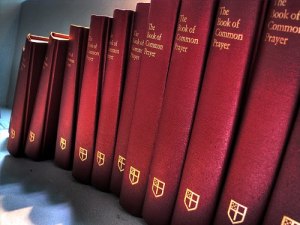
As someone who loves books and likes to show my respect for books by caring for them gently, normally something like this would freak me out.  But my Prayer Book lives a very different life than my other books.  My Prayer Book has been sullied with dirt and sand from funerals and interments.  My Prayer Book has gotten damp from baptisms and the use of an aspergillum.  The pages in my Prayer Book that have the ordination liturgy have oil smears because the bishop anointed my hands so that I may anoint others.  No one could ever argue that my Prayer Book is pristine.

But that is exactly why I love my Prayer Book.  My sullied Prayer Book reminds me of the incarnate life we all live together.  Each dirt smear reminds me of a beloved parishioner, or a family who was completely unknown to me until they came to me for liturgical help.  Each hint of a drop of water reminds me of the babies and young adults I have baptized into the faith.  Those touches of oil remind me of the many times I have said healing prayers with others.  My Prayer Book caries in it the incarnate memories from this blessed vocation I am privileged to live.

As I think about next week – Holy Week in the Church – I am looking forward to more of those incarnate moments with others.  Palms that will be shoved into the back of my Prayer Book, Chrism that I will receive from the Diocese that may drip on those pages, water from the washing of feet that may splash into the book, and wax from the Vigil candles that may drip on a page of my beloved Prayer Book.  The liturgies of Holy Week not only encourage us to remember Jesus’ journey toward the cross and resurrection, but also the liturgies involve our senses, our bodies, and our messy incarnate ways.  I am looking forward to messy memories next week with St. Margaret’s!

Sermon – John 12.1-8, L5, YC, March 17, 2013

Tags

, , , , , , , , , , ,

With Holy Week only a week away, today’s Gospel lesson throws us into preparation for that significant week.  Six days before the Passover – six days before Jesus will sit down with his disciples for their last meal together – Jesus sits down for another significant meal.  Jesus returns to Bethany, to the home of the family he loves – the home of Martha, Mary, and Lazarus.  The foreshadowing is all there.  Lazarus, and the lingering smell of his once-dead body, is at the table as a vivid reminder of the death that awaits Jesus.  The two of them sharing table fellowship together both brings to mind the resurrection of Lazarus, and foreshadows a more important resurrection that is soon to come.  Even Mary is preparing us and Jesus for his death, as she uses costly perfume, nard that she has saved for the day of Jesus’ burial, to anoint Jesus now.  Death is heavy in the room.  What sounds like a simple reunion of friends is actually the foretaste of what is to come in a mere week.

So in the midst of this sacred, significant moment, what does Judas do?  Judas totally misses what is happening in the moment.  On one level, Judas is right.  That bottle of nard – a whole pound of fragrance – would have cost about $20,000 in today’s terms[i].  Judas has spent years with Jesus hearing nothing but Jesus’ preference for the poor.  We cannot fault Judas for seeing the potential good that the same bottle could have done for the poor.  But like any good church member, Judas gets stuck in the ways he has learned.  Judas takes a really good practice – Jesus’ passion for the poor – and makes that practice rigid and lifeless.  This valued practice blinds him to the other realities that are unfolding right before him.

We behave like Judas all of the time.  We too have ideas about what we should do and how that should be done.  Our reasoning might be very informed and, under normal circumstances, deeply rooted in our faith and tradition.  But sometimes we too are off base.  We miss the big picture.  When I went on my mission trip to Honduras, we spent an entire winter and spring preparing for the trip.  One of the many books we read was a book by a woman named Elvia Alvarado.  Elvia was a poor Honduran woman who saw much strife in her country and who slowly became an organizer and advocate for change.  But along the way she tells of many atrocities that happened in Honduras to the poor.  As I read the book, I became more and more outraged and incensed about what was happening to the Honduran poor – so outraged that I wanted to go and do something, to make a difference for the people who could not speak for themselves.  But in her concluding remarks, Elvia says something quite shocking.  Elvia asks every gringo reader (gringos being white people from the United States) not to come to Honduras to solve their problems.  In fact she tells the gringos to stay where we are.  She says that this work is the Hondurans’ work to do.  But what she does charge the gringos with is working on our own stuff.  She asks us to look at the systems in our own country that encourage oppression – governmental trade policies, manufacturing and farming practices, and our own purchasing patterns.  Elvia’s words to me were like a slap in the face.  Elvia basically said to me, “Don’t bring your savior mentality down here and think that you will save us all.  Instead, stay at home and work on the ways that you and your country are a part of the problem.”

Elvia’s words to me and all of us are not unlike Jesus words to Judas that night.  What Elvia taught me is that we do not always have the whole picture.  We may have learned a lot, we may have spent a great deal of time studying our faith or developing our relationship with Christ, and we may feel like we have a pretty good idea about what God calls us to do and be.  But what we forget in our confidence is that God is always on the move, always breaking into the world in new ways, and always opening up new paths for us.  The moment that we think we have God figured out – and particularly the moment that we start telling others what they should and should not do – is the moment that Jesus slaps us in the face with another reality.

So if we are not to be imitating Judas in this story from scripture, what do we glean from Mary’s actions?  I once heard a story about an experience at a stewardship conference whose theme was generosity.  When one of the presenters spoke about offering a gift directly to God, the clergy began to yawn.  The presenter then pulled a $100 bill from his wallet, set it on fire in an ashtray, and prayed, “Lord, I offer this gift to you, and you alone.”  The reaction was electric.  Clergy began to fidget in their chairs, whispering about the legality of burning currency, and murmuring about how they would happily take any more money he felt like burning.  In that nervous room, the speaker asked, “Do you not understand?  I am offering it to God, and that means it is going to cease to be useful for the rest of us.”[ii]

In many ways, Mary “wastes” her perfume on Jesus much like this presenter wasted that $100.  But Jesus does not see Mary’s gift as wasteful.  He declares the gift to be appropriate in that moment, and is gracious enough to receive the gift with gratitude.  He understands that the extravagant gift is rooted in Mary’s confidence in the boundless capacity of God’s love.  “Mary pours out her whole bottle of perfume without regret because she knows it is only a trifle compared to the magnitude of God’s love that she sees in the Messiah before her.  Mary knows that Lazarus will die again, and she knows that Jesus will die, but she believes with even greater passion that Jesus can bring victory over death.”[iii]

This tense interaction between Jesus, Mary, and Judas invites us into another kind of tension.  The story invites us to live into the tension of what we know about God and what is still unfolding.  We need to learn the “rules” or the “law” of this crazy life of faith.  But we also need to learn the “way of being.”  We need to learn when to focus on the details and when to see the big picture.  We need to learn when the time has come to “waste” an extravagance on another.  When Jesus says, “You always have the poor with you,” Jesus is not giving us an out for caring for the poor.  Instead Jesus invites us into a “both-and” tension.  Yes, we are to care for the poor.  That is living into the law of our life together.  And, we also need to have the presence of mind to see when something so significant is happening, such as losing our Savior to the cross, that we pause our other work.  This is the way of being in our life together.

Ultimately, we need both Judas and Mary for our faith journey today.  We need that person in our community who will always remind us of the laws that we live by and who will always remind us of the ways things should be done.  But we also need that person in our community who is the crazy one who will open up for us the lavish ways of God and who will remind us to let go of the law enough to see God’s bigger picture.  Without each person in our community, including those individuals who have not yet come to St. Margaret’s, we only have a portion of the community we need to fully embody the community of faith.  Without the “both” and the “and” we are incomplete.  Sometimes that means we will not agree.  The “boths” and the “ands” of our community will experience a tension so strong that we may hear Jesus shouting, “Leave her alone.”  But both the “boths” and the “ands” need each other.  Jesus gives us all value today, but Jesus also requires us to value one another.  Amen.


[i] George W. Stroup, “Theological Perspective,” Feasting on the Word, Yr. C, Vol. 2 (Louisville: Westminster John Knox Press, 2009), 142.

[ii] William G. Carter, “Pastoral Perspective,” Feasting on the Word, Yr. C, Vol. 2 (Louisville: Westminster John Knox Press, 2009), 142.

[iii] Beth Sanders, “Heaven Scent,” Christian Century, vol. 124, no. 5, March 6, 2007, 19.