Homily – John 4.31-38, James Theodore Holly, March 14, 2013

Tags

, , , , , ,

James Theodore Holly was born a free African-American in D.C. in 1829.  He became an Episcopal priest in 1856, serving as rector in New Haven.  In 1861, he resigned to take a group of African-Americans to settle in Haiti.  His wife, mother, and two children died the first year.  But Holly stayed on with two small sons, believing God was with him.  In 1874, Holly was consecrated as first bishop of Haiti, and the first black man raised to the office of bishop in the Episcopal Church.  During his tenure as bishop, he doubled the size of the diocese, established medical clinics, and took over the Diocese of the Dominican Republic in 1897.  He died in 1911.

In looking at the dates, Holly went to Haiti at the beginning of the Civil War in the U.S.  What a dramatic move; and then what a dramatic experience in Haiti!  Holly must have heard these words from Jesus in a unique way:  “Do you not say, ‘Four months more, then comes the harvest?’  But I tell you, look around you, and see how the fields are ripe for harvesting.”  Holly could have waited until the war was over; he could have bailed when so many in his family died; but he heard the urgency of Jesus’ call, he heard the demand to act now, no matter what.

I think too often we are afraid, paralyzed by fear or some strange sense that certain things have to be in place before we act (four more months, then we will act).  Just hearing our Lenten speaker from St. John’s talk about their church’s garden confirmed this truth.  Instead of months of planning, gathering data, negotiating opinions, he just jumped.  They fought a lot, people had to chip in to make it work, and they made mistakes.  But they also had a harvest to feed the poor, right here in Huntington.

As individuals, I wonder what work we are hindering because of our fears or concerns about propriety?  As a community, I wonder what work we are hindering because of our fears or concerns about propriety?  Our text and Holly’s witness encourage us to let go of our fears and anxieties and jump into the harvest.  Jesus reminds us that God has already sown the field, and has invited us to jump into the work God is doing.  We are the only ones in our way.  Our invitation is to jump.  Amen.

Be still…

Tags

, , , , ,

You may not know this about me, but I am not a natural when it comes to silence.  As an extrovert, silence feels like it should be filled.  When I lead worship that needs a silent moment, I often make myself take a couple of additional breaths before I break the silence, knowing that my own tolerance for silence is much lower than most people’s tolerance.  A couple of summers ago, I was a part of parish that covenanted to pray with scripture for twenty minutes a day for ninety days.  The idea was that a bulk of that twenty minutes was not meant to be spent talking or analyzing biblical scripture, but to be silent in the presence of God’s word, making room for God’s living Word to speak.  As you might imagine, the practice for me was brutally painful.  But I learned a lot about myself and my prayer life that summer, and changed many of my practices as a result of the experience.

That is why I am grateful for “Quiet Days.”  I am grateful for the many communities who have realized that the Church often needs to invite people to come to Church and just be.  Be quiet.  Be still.  Be with God.  Even if it is only for a few hours, the Church and other religious groups often offer mornings or days where people can stop being busy and really make space for God.  I first discovered Quiet Days in seminary, but they have been an active part of my ordained ministry ever since.  They are truly one of the Church’s greatest gifts to us.

This weekend, my own parish is offering a Lenten Quiet Day and I could not be more excited.  I am excited for all of the reasons I just described, but I am also excited because two parishioners offered to lead the meditations for our Quiet Day.  So not only do I get to be a part of a community that has invited everyone into a time of quiet with God, I too will be able to fully enjoy the quiet time with God, hearing how God is moving in through our parishioners’ meditations.  This Quiet Day has not become one more thing on my busy to-do list, but instead has become an invitation for me to come and be still with God.  I grateful to these parishioners who have offered up their gifts, and I hope that if you are nearby, you will join us too.  Come enjoy the gift of quiet in our otherwise busy, loud life.

Sermon – Luke 15.1-3, 11b-32, L4, YC March 10, 2013

Tags

, , , , , , ,

The parable of the prodigal son is one of those beloved parables – the perfect parable for a Lenten journey.  Part of the story’s perfection is that there are so many characters with which to connect.  This year, I have been lingering on the older son.  The older son has every reason to be angry with his father’s lavish forgiveness.  The older son has done what has been expected of him.  He is obedient, hard-working, and would have never insulted his father as deeply as his brother does.  He is the consummate good and faithful servant.  And so when his father, who, by the way, has never given much praise for the older son’s obedience, throws a party for his wayward brother, the older son finally snaps.  He throws a first-class temper tantrum, refusing to come into the party and then yells at his father about the injustice of such a party.

What is so real for us with the older son is that we know his reaction all too well.  Two strong emotions take over the older son.  First, he is struck down with a serious case of envy.  The older son sees the party for his wayward brother, and covets the party.  Never once has he been offered even the smallest of parties for himself and his friends.  The older son has a case of what the Berenstain Bears children’s books call the “Green-Eyed Monster.”  In the Berenstain’s book, The Green-Eyed Monster, Brother Bear is celebrating his birthday, receiving gifts.  Sister Bear is mostly fine with this arrangement, remembering her own birthday party earlier in the year.  That is, until Brother Bear gets the most beautiful, sleek bicycle she has ever seen.  Then the Green-Eyed Monster takes over.  But just so that the adults do not think they are immune, before the story ends, Papa Bear gets a visit from the Green-Eyed Monster too when a neighbor gets a fancy new car.  The point is that envy and jealousy are all too familiar to us.

The other emotion that takes over is self-righteous indignation.  The older son is clearly right about his younger brother.  His younger brother did sin, was disrespectful, behaved selfishly, and disgraced the entire family.  The younger brother does not deserve the reception he receives.  But that is exactly what makes the reception so full of grace.  But the older son is so blinded by his self-righteous indignation, that he cannot see the blessing of his father’s reaction.  As one person describes his situation, the older brother is “standing outside in the dark, perfectly right and perfectly alone.”[i]

When we do premarital counseling, we talk about the ways that spouses and partners behave in disagreements.  Every family and couple has them, and so our counseling is a way to talk about handling disagreements in a healthy way.  I once had a priest tell me that the three most important words for any marriage are, “I.  Am.  Sorry.”  They sound like three words that are simple enough to say.  But somehow we have such a hard time saying them.  Partly I think we struggle with saying them because we think they mean admitting guilt or, even worse, defeat.  And few of us like to lose.  But that same priest told me, the next three most important words are, “You.  Are.  Forgiven.”  As hard as apologizing can be, sometimes forgiving can be even more difficult.  But forgiveness is the only thing that can keep our relationships in balance.  Ideally, by one person saying, “I am sorry,” and the other saying, “You are forgiven,” both parties give up some of their power.  Both parties submit something of themselves to the other.  When one party is unwilling to say one of these things, they become like the older son – perhaps perfectly in the right, but also perfectly alone in their rightness.

What the older brother teaches us is that sometimes we have a choice between being right and being in relationship.  In some ways, much like the younger son has been in a distant country, the older son is also in a distant country.  He has cutoff connection to his brother, to his father, and even to those who have gathered to rejoice over the new life his brother has been given.[ii]  In choosing to be right, he stand out in the darkness, unable to rejoice in another’s joy, closed off the hope of redemption and reconciliation.  In Rembrandt’s The Prodigal Son, the older son stands at a distance, hands crossed in front of him, standing in a darker section of the painting.  His face is lighted, but only to highlight the way in which his distance is important.  Like in the parable, Rembrandt shows the older son, in his rigid, distant body language, as choosing rightness over relationship at that moment.

In the face of this stubborn resistance to forgiveness and grace, the father in the parable shows equal abundance toward his two sons.  According to etiquette of the time, leaving his guests at a party was a breach of social mores.[iii]  But the father ignores social mores for both sons.  The father disregards common practice, and seeks out his older son in the same way that he ran to his younger son upon his return.  The father reminds the older son of the promise that still awaits him.  Then the father invites him into his joy – to celebrate a reconciled relationship – much like the reconciliation the older brother can enjoy if he just comes into the room.

Perhaps why the older son’s story is lingering with me is because we do not know how he responds to the father’s invitation.  The story ends with the ultimate cliffhanger that does not let you know whether the older son remains outside the party or comes inside the party.  Certainly the father’s desire is for him to come in, but we do not know whether the son chooses rightness or relationship.  I have wondered what would happen if the older brother went into the party.  What if the younger brother fell at his brother’s feet too, saying those three hardest words, “I am sorry.”  What if the two men simply embraced – saving words for later.  What if the joy and laughter of that room cracked through the older brother’s tough exterior, and warmth began to seep into his heart.  What if…

In many ways, I think the story ends openly to remind us that we too have a choice.  We too can choose to be right – to hold on to the things in life about which we are justifiably angry and disappointed.  We have every right to protect ourselves and even our family and friends from the kinds of behaviors that hurt us emotionally.  We can be guarded and keep our distance – standing out in the darkness of rightness.  Or we can choose to come into the party, and see what happens.  We may not be able to say “I am sorry,” or even, “You are forgiven,” but we can at least step through the door, into the warm glow of a room that is bursting with abundant grace and love for us and for all – that place where all are forgiven and all are loved.  Amen.


[i] Barbara Brown Taylor, “The Evils of Pride and Self-Righteousness,” Living Pulpit, vol. 1, no. 4, O-D 1992, 39.

[ii] David Lose, “Preaching the Prodigal,” as found on http://www.workingpreacher.org/dear_wp.aspx?article_id=672 on March 8, 2013.

[iii] Leslie J. Hoppe, “Exegetical Perspective,” Feasting on the Word, Yr. C, Vol. 2 (Louisville: Westminster John Knox Press, 2009), 119.

Homily – Matthew 24.9-14, Perpetua and her Companions, March 7, 2013

Tags

, , , , ,

Today we honor Perpetua and her companions, martyrs at Carthage in 202.  Petpetua was a young widow with a small child and several slaves.  Along with other Christians preparing for baptism, they were arrested when they refused to offer sacrifice to the divinity of the Emperor.  They suffered under miserable conditions in a prison.  But Perpetua had these incredible dreams about heaven that encouraged her in her resolve and her insistence on declaring her Christianity.  She and her companions were put in an arena with a leopard, boar, bear, and savage cow.  Perpetua encouraged them, but eventually all were put to death by a sword.

Our lessons today all warn of a similar fate for us.  Jesus tells his disciples they will be tortured and put to death; hated, betrayed and abused.  We know from people like Perpetua and the disciples that this was the reality for many Christians and for many years.  But today, I think martyrs are always a little hard to relate to.  Who among us in risking our lives by telling someone we are Christian?  Who among us will be tortured for our faith or even for being here in this church today?  The life of a martyr is so foreign that we rarely feel connected.

But I think what Pepetua invites us to do today is to consider the ways that our faith puts us in risky situation:  the racist joke someone makes that we refuse to laugh at because we know all people to be children of God; the gun-control march we walk in because we see the violent ways we have turned on one another and we refuse to allow one more child of God to be killed so that we have the right to accumulate assault weapons.  These may not lead to death or even suffering.  If anything, they may lead to disagreements, exclusion from certain social circles, or embarrassment.

When Perpetua and her companions were being mangled by animals, she stated to her friends, “Stand fast in the faith and love one another.”  In order to truly love one another, we will have to take risks, we will have to face discomfort.  Perpetua died in suffering, but her love of God and love of neighbor never died.  We too can let go of our selves and love God and neighbor, even when it is uncomfortable.  Amen.

Homily – 1 Timothy 4.6-16, Cooper and Wright, February 28, 2013

Tags

, , , , ,

Today we celebrate Anna Julia Haywood Cooper and Elizabeth Evelyn Wright.  Cooper was born in 1859 to an enslaved woman and a white man.  She went on to study at St. Augustine’s, and Oberlin College, and eventually became the fourth African-American woman to receive a doctorate.  She was a teacher who insisted on equal education for African-Americans.  She even served as a college president.  Wright was born in 1872 to an African-American father and a mother of Cherokee descent.  She studied at Tuskegee and worked to form schools for rural black children.  Though she faced much opposition, including arson, she started a college for African-American young people that eventually became Voorhees College.  Both of these women were privileged to receive an education when they did.  But they did not keep this gift to themselves – they worked hard to ensure they brought others with them.

One could imagine that both Cooper and Wright, women highly influenced by the Episcopal Church, might have read the epistle lesson we heard today.  “Do not neglect the gift that is in you … put these things into practice, devote yourself to them, so that all may see your progress. Pay close attention to yourself and to your teaching: Continue in these things, for in doing this you will save both yourself and your hearers.”

Many of us may not have been teachers, professionally, but we have at times neglected the gifts that are in us.  For quite some time, I avoided my call.  I avoided.  I tried substituting other things.  I tried doing good work, just not the work I was given to do.  We all do this from time to time; we neglect the gifts God has given us, because we are afraid of where they will take us or how hard the road will be.  But our epistle reminds us that living into a call is not just for us; it’s for others as well.

Cooper and Wright knew this to be true.  Their work was for others, but their work also fed themselves.  Though we may not be teachers like Cooper and Wright, we learn from them and our epistle that we are all teaching others.  When we neglect the gift in ourselves, others notice.  We have to only think of our most admired friends and saints to know that passion inspires passion.  Just by living into our gifts and vocation, we bless others without even realizing it.  God sees the gifts in you.  Your work is to nurture that gift and live into that gift fully before others.  Amen.

Homily – 1 John 4.13-21, John Henry Newman, February 21, 2013

Tags

, , , ,

Today we celebrate the life of John Henry Newman.  Newman was ordained a priest in the Church of England in the 1820s.  He was one of the founders of the Oxford Movement, that movement in the Church of England that sought to get us back to some of our more Roman liturgical heritage.  They were the ones who started what we would call the Anglo-Catholic or High Church movement.  Newman produced many tracts and was an avid scholar, but eventually the church infighting got to him and he left the Church of England to become a Roman Catholic priest and eventually a Cardinal. 

What is interesting is that we get this epistle lesson today about love appointed for Newman’s day: “God is love … we love because he first loved us.  Those who say ‘I love God,’ and hate their brothers and sisters, are liars.”  We often like to focus on the God of love – we say, “it’s all about love.”  But so rarely do we act like it is all about love.  Like the Church of England in the 1800s, we still have denominational infighting.  We have seen how tense things still are in the conversations about a new Pope.  The last couple of weeks, I have heard more trash talk between Romans and Anglicans than I like to admit.

The challenge that Newman and our epistle lesson give us is the challenge to love one another.  The collect for this day says, “God of all wisdom, we thank you for John Henry Newman, whose eloquence bore witness that your church is one, holy, catholic and apostolic …”  We confess this in our profession of faith, but I am not sure we always believe it.  Whatever denomination life has landed us in, Newman and our epistle remind us of the centrality of love.  This is most important in our conversations, our actions, our prayers, and our witness.  The world is not only watching the Roman Catholic Church in this new election of a Pope – the world is watching how all Christians behave, especially toward one another during this process.  For as our epistle says, “those who love God must love their brothers and sisters also.”  Our invitation today is to be a church of love.  Amen.

Soul food…

Tags

, , , , , ,

IMG_1397This year my Lenten discipline has been a lot more ambiguous than in years past.  I have been working on being attentive and more present in my life and in my ministry.  Like I said, ambiguous.  But in some ways, the practice has been quite a blessing.  Instead of busying myself with a practice or suffering through giving something up (and probably complaining about either), this year I have been able to step back and see what is working and what really is not.

The wonderful thing about this practice is the ways in which I see that I am being fed.  At our parish, we have had a series of speakers to prepare us for the construction of a community garden that could feed our neighbors in need.  The speakers have been an incredible blessing to me, showing me the simple ways that we can use our vast property for good, but also the ways that we can be a part of some really incredible ministries that are already thriving.

I also just returned from a great conference that fed me much more than I expected.  So many times in the Episcopal Church we get downhearted about the future of the Church and its leaders.  But I just spent time with about twenty of the Church’s leaders and I was blown away by their passion, intelligence, humility, and enthusiasm.  As opposed to a gathering of competitors (Episcopal priests have a tendency to do this from time to time…), it became a gathering of people truly wanting to learn from one another, to celebrate successes, and learn from failures.  I have not been this hopeful for the Church in a while.  For that I am grateful.

Another source of nourishment this Lent has been the practice of following Lent Madness.  In the first couple of match-ups, I found myself getting indignant when my saints “lost.”  But as the weeks have past, I have found I am worrying less about how many I “win” and how much I am learning.  Last weekend, I was worshiping with a Diocesan group and the lessons for the liturgy were from the feast day of Chad of Litchfield.  Imagine how excited I was to immediately know his story before the Bishop was able to explain it to us.  What was once yet another competition has become a great source of nourishment for me in this Lent.

I hope you are finding sources of nourishment this Lent.  I hope your practices are teaching you something about your relationship with Christ or at least inviting you back into relationship with Christ.  During this season of Lent – a season often marked by fasting – I hope your journey is full of filling nourishment for the soul.

Sermon – Luke 13.1-9, L3, YC, March 3, 2013

Tags

, , , , , , , ,

We are half way through Lent, and this is the time that we begin to take stock.  But we do not always take stock of ourselves, humbly repenting of the ways we are stumbling with our disciplines.  No, we look at everyone else.  When we ask our fellow parishioners how their Lenten disciplines are going, we are not asking out of Christian love.  We are asking because we hope they are failing more miserably than we are.  We need to hear that someone has lapsed in their practice or given up altogether so that our weak attempts to hold on do not seem so weak after all.  We are a judgmental people, and we rarely offer the forgiveness that we so long to receive.

Jesus knows this as he listens to those gathered around him in our Gospel lesson today.  They are lamenting with Jesus about two groups of people who have recently suffered – the Galileans at the hand of Pilate and those near the tower of Siloam.  “Isn’t it horrible, Jesus,” they seem to be saying.  The insinuation is that those in Galilee and in Siloam must have sinned gravely to receive such suffering.  The assumption was a common one among the people of Israel.[i]  We remember the friends of Job who immediately assumed Job must have done something wrong to deserve his severe suffering.  Those gathered around Jesus are hoping that Jesus will confirm their suspicions – that Jesus will turn the spotlight on the sinfulness of those people, so that they can all shake their heads in judgment.

But Jesus will not take the bait.  Instead, Jesus tells this story:  Once upon a time, there was a fig tree that was not bearing fruit, and had not bore fruit for three years.  Fed up, the vineyard owner decided to cut down the unproductive tree.  But before the vineyard owner could touch the tree, the gardener made one last plea.  The gardener asked for one more year.  In that year, the gardener would dig around the tree, spreading manure at the roots of the tree.  If after a year of such care the tree still did not produce fruit, then the owner could chop down the tree.

The message seems to be clear in Jesus’ parable:  repent, change your ways, and start producing fruit, or you will be slaughtered.  But this interpretation of the parable gets all the parts confused.  The people gathered are not the gardeners begging God, the vineyard owner, for one more year to tend our garden.  That version of the parable would be too simple.  Instead, God is the gardener – the one negotiating grace – and they are the unproductive trees.

I have been thinking about life as the unproductive fig tree all week.  An unproductive tree is still very much alive – the tree goes about the business of breathing in and drinking up nutrients.  The tree is surviving, but not thriving.  But the tree is doing about all the tree can do.  The tree cannot fertilize itself.  The tree cannot aerate the tree’s own soil.  In order for the tree to thrive, the tree is dependent upon the gardener for the kind of care that produces fruit.

This is where I got stuck in the parable.  First, Jesus tells the people to repent; but then, Jesus tells the people that they are immobile trees, incapable of changing anything without the help of a gardener.  As someone who likes who likes to do, to be active, to achieve something, this parable is especially difficult.  If Jesus had just said to repent, I would have had a task to do – a job to accomplish.  Repenting, amending my ways, returning to God are all things I can work on and do.  But being a tree that just stands there, waiting for someone to help her, depending on God’s grace feels a lot less comfortable.

This Lent I really struggled with choosing a spiritual discipline.  I have tried all sorts of practices in Lent in the past:  reading a daily devotional, taking up a prayer practice, creating an exercise routine, or even giving up a foul mouth.  I tend to like the practices that add something to your life, rather than take something away.  But this year, nothing seemed to fit.  I talked to my spiritual director about my quandary, and she suggested something radical.  Instead of taking on something or giving up something, she suggested I just commit to just being more aware.  My busybody nature was totally confused and apprehensive.  But my spiritual director encouraged me to just try – to try spending this Lent, not busying myself with a discipline, but daily taking stock of my life patterns and observing.  This non-practice practice has been the most awkward experience for me.  As a person who needs tangibility, I have been left with this intangible practice.  No checklist to consult, no achievements to track:  just a practice of being, of letting God work on me.

I think what my spiritual director has been trying to get me to live into is the tree identity of our parable today.  In naming ourselves as the tree in Jesus’ parable, we are claiming a couple of things.  First, we are claiming that we are utterly incapable of determining our future.  The tree in the parable is not bearing fruit, and nothing the tree does will help the tree change this status.  The tree cannot try harder or behave differently.  The tree is simply a tree planted where the tree is.  Second, in identifying with the tree, we are claiming that we are dependent upon the gardener.  We are dependent upon the gardener’s mercy – the gardener who lobbies for one more year of trying.  We are dependent upon the gardener for determining the kind of nourishment we will receive.  We do not get to consult the gardener about the type of care we think we need.  We must trust the gardener to do what the gardener does best.

What I like about this parable today is that the parable takes us out of our comfort zones and puts us squarely in God’s hands.  First, by telling the people to repent, Jesus takes the people out of a mode of comparing and judging others and puts the people in the mode of tending to themselves.  His instruction to repent is almost Jesus’ way of saying, “Why don’t you stop worrying about what Pilate did and what the people of Siloam did, and why don’t you take stock of your own stuff.”  And then Jesus takes the wind out the sails of the people even further.  His parable tells them that not only do they need to not worry about what everyone else is doing, they need to realize that even the things that they are doing do not matter – because ultimately they are trees dependent upon God’s grace and mercy to thrive.

Now this may not sound like good news to us, but this is a tremendous word of grace for us today.  In the midst of the season of Lent, that season that we are typically kneading the dough of our lives, trying to get ourselves just right for God, Jesus leaves us with a word of grace.  Jesus’ parable today shifts our energy this week.  Instead of desperately grasping to change and amend our lives, Jesus invites us to let go:  to let go of trying so hard, and to remember the God who lovingly offers to do the work of digging in our soil and spreading smelly manure so that we might bear delicious fruit.

As we have been thinking about gardening this Lent, I have been hearing many stories of your own gardens.  For those of you who garden, you have lived this invitation that Jesus offers.  You have lived through a season where the tomatoes did not make it, where the new crop was not planted in the right place, and where critters have come in and destroyed.  And for those of you who are seasoned at this work, the common phrase I hear from you is, “Ah well, we’ll try again next year.”  This is the kind of letting go that Jesus is inviting us into this week.  This is the kind of trust in God that Jesus encourages.  As we come forward for healing prayers today, an old gospel hymn keeps running through head when I think of Jesus’ parable today.  The chorus says, “Your grace and mercy brought me through.  I’m living this moment because of You.  I want to thank you and praise you too.  Your grace and mercy brought me through.”  In the midst of our Lenten journey, we pause today to recognize the ways in which we are simply trees in God’s garden, dependent upon God’s grace and mercy to get us through.  Thanks be to God!  Amen.


[i] Daniel G. Deffenbaugh, “Theological Perspective,” Feasting on the Word, Yr. C, Vol. 2 (Louisville: Westminster John Knox Press, 2009), 92.


Sermon – Philippians 3.17-4.1, L2, YC, February 24, 2013

Tags

, , , , , , ,

When a person is ordained as a priest, they make a series of vows.  One of the scariest ones for me was this question:  Will you do your best to pattern your life and the life of your family in accordance with the teachings of Christ, so that you may be a wholesome example to your people?  The question sounds simple enough:  Will you be an example to others?  But the question is anything but simple.  The question asks whether the priest will shape their lives so that parishioners, neighbors, and the world will understand the teachings of Christ through the priest’s life.  And not only is the priest responsible, the whole family of the priest has to be an example.  So when your three-year old is having a meltdown in Target, and your nerves are shot from a morning of similar tempter tantrums, and your spouse and you have argued about discipline, you and your family are supposed to be emanating Christ in Target.

Of course, the priest is not the only one who is supposed to be living a Christ-like life.  When we are baptized, and every time we affirm our baptismal covenant, those promises we renew are all about living a Christ-like life.  And yet, we rarely walk the walk that we talk.  I think one of the most common retorts to a petulant teen by a parent has been, “Do what I say, not what I do.”  We know the life we are supposed to live – even the life we want to live – and yet we fail miserably at that life everyday.  One of my favorite online videos is a video for Welcome Back Sunday in the fall.  The video talks about the top reasons why people do not come to church.  One of those reasons is that the Church is full of hypocrites.  We know the ways that we feel like hypocrites and the world knows the ways we act like hypocrites.

So, when we read our epistle lesson to the Philippians today, we may be shocked by Paul’s words.  Paul, who has regularly said that followers of Christ should imitate Christ, now says, “Brothers and sisters, join in imitating me, and observe those who live according to the example you have in us.”  Paul’s instruction to imitate him is bold.  Paul does not say, “Do as I say, not as I do.”  Paul says, “Do what I do.”  Modern skeptics that we are, we immediately assume Paul has developed an inflated ego.  We know that telling people to imitate you is the first step toward a nasty fall.  Such a bold claim is setting Paul up for failure – because none of us are perfect.  Paul’s words immediately remind us of the hundreds of clergy who have fallen – who have embezzled, had affairs, abused children, abused alcohol, and have failed to be faithful pastors.  Surely Paul is setting up himself and the many people who are following him for failure.  Why would he do such a thing?

What we lose in our jaded, skeptical, snarky twenty-first century selves is the reminder of how learning and formation have happened for centuries.  Both Jesus, and Paul his disciple, “know that true moral and spiritual formation depends on tutelage under a master – learning to follow the habits and practices of one who has become proficient in a particular trade or skill.  Indeed, this is the precise meaning of the word ‘disciple’:  a learner or pupil.”[i]  In this way, disciples are learning from someone wiser than themselves, and in fact are imitating the teacher’s teacher.[ii]  So when Paul says imitate me, he does not really mean imitate Paul, but imitate Paul, who is imitating Jesus Christ.  Imitate the teacher’s teacher.

What I find comforting then, is that Paul is not saying he is perfect.  He is not boasting about his perfect imitation of Christ, but only encouraging others to imitate Christ as he imitates Christ.  What Paul knows is that our lives are never perfect.  But if we are not imitating something worth imitation, then we are already losing the battle.  And so, Paul’s imitation and our imitation many years later may be rough versions of Jesus Christ, but our imitation is still rooted in that great teacher who taught so many before us.

How we imitate Paul today is a bit more complicated.  We too must find our teachers who point to The Teacher.  The trick is not to think too remotely.  When asked who our role models are, many of us will name famous people of faith – Martin Luther King, Jr. or Mother Teresa.  And those folks will give us much to ponder about our faith life.  But the problem is, sometimes those people are so removed from our lives that they cannot really teach us how to live our lives as Christians.  I did a book study with a group once to prepare us for a prison ministry.  The book was about a woman from California in her fifties who gave up everything and moved into a prison in Tijuana as a nun to become an advocate for the men and families affected by the prison.  She lived in a cell in the prison and she ministered to the guards and the prisoners alike.  She transformed the place into a place of humanity.  She helped everyone equally, and managed to mobilize thousands of Americans to support the desperate needs of the Mexican prison.  Mother Antonia was an amazing role model that we all found incredibly inspiring.  But at the end of the series, one of the group members confessed that despite the fact that she appreciated Mother Antonia, she really would have preferred to have read a book about someone a little more like herself.  Mother Antonia was so dramatically different from her life that she found that instead of being inspired, she was left without a true mentor to imitate.

This is why Paul offers himself up as an example.  Not because he is some stellar example of Christ, but because he is in relationship with those with whom he is talking.  Paul realizes that the most powerful person to learn from is someone right in your community.  “Paul is directing the gaze of the community not toward some type of individual perfection, not even toward the supreme perfection of Christ…but to the realization of Christ’s love within the community itself.”[iii]

So Paul is inviting us to do a couple of things.  First, Paul is inviting to name our own teachers.  One of my favorite set of teachers is a couple I know from college.  When Rebecca and David were married, they bought a home in North Carolina much larger than what they would need.  The house was a fixer-upper, but they had dreams.  Their dream was to make the house into an intentional Christian community that also serves as a transitional house for families.  So, people who are in-between jobs, a woman who is recently divorced, or really anyone the local pastor recommends is welcome to come live in their home.  They have some house rules about sharing work, community meals, and weekly worship.  But Rebecca, David, and their two sons are imitating Christ in this radical lifestyle.  When I am really wondering how to live a Christ-like life, I look at this family and see how far I have to go.

But even Rebecca and David can be a little too removed.  So sometimes I just look at those around me.  I look at the spiritual disciplines of parishioners here.  I look at the ways that you care for those with physical limitations.  I look at the ways you tend to this property or the ways that you serve our neighbors in need.  Much like Paul and his community, we are not perfect.  We too struggle to understand how faith is lived right here in Plainview.  Our engagement in that struggle is what points us toward Christ.

This leads us to our second invitation from Paul – to recognize the ways in which we are all teachers to others.  When you leave this place every Sunday, you are not just Barbara or Bob or Paul.  You are Barbara the Christian from St. Margaret’s.  You are Bob who shows what being a person of faith is all about:  not because you are perfect, but because you are struggling to be like Christ.  That video about why people do not come to church has responses to each person’s fear or hesitancy about Church.  When one person complains that the Church is full of hypocrites, the Christian honestly and humbly says, “And there’s always room for one more.”  That kind of raw honesty is the kind of honesty that leads to trust, that leads to sharing, that leads to opening our doors to others.  That is the kind of honesty that makes others not only want to imitate us, but also to join us.  Paul invites us then to boldly proclaim, “Imitate me,” so that we can figure this journey out together.  Amen.


[i] Ralph C. Wood, “Theological Perspective,” Feasting on the Word, Yr. C, Vol. 2 (Louisville: Westminster John Knox Press, 2009), 62.

[ii] Casey Thompson, “Pastoral Perspective,” Feasting on the Word, Yr. C, Vol. 2 (Louisville: Westminster John Knox Press, 2009), 64.

[iii] Dirk G. Lange, “Homiletical Perspective,” Feasting on the Word, Yr. C, Vol. 2 (Louisville: Westminster John Knox Press, 2009), 65.

Sacred noise…

Tags

, , , ,

kids-in-church

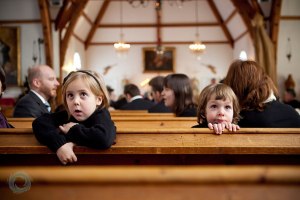
One of my challenges as a priest has been how to encourage parents who are worshiping with their children in church.  I want them to stay in church, but I also want to honor the occasional discomfort of their experience.  Of course, my opinion on this matter has changed dramatically since I became a parent, but what was once distracting noise by children in church has now become the sound of life to me.  A fellow blogger expressed this reality for me quite beautifully here.

But me telling a parent that they are welcome to stay in church does not solve much.  I cannot control the glares or the shh-es from other parishioners.  I cannot control the wave of panic that crashes over a parent when it feels like your child’s noises are as loud as a parade in a library.  I cannot even set an example because I am rarely actually in the pews with my fellow parents.  But I have experienced some of the grace that can happen when people are open to a child in church.  Back in December, I took my three-year old daughter to an ordination at the Cathedral.  She lasted relatively well for the first hour, but then became antsy.  I asked her if we should go after the peace, but she insisted she wanted to stay.  We made it back to the pew, and midway through the bishop’s praying of the Eucharistic prayer, my daughter impatiently asked, quite loudly, “Can I have the body of Christ now?!?”  Everyone around me giggled and I did too.  She broke the tension I had been feeling about her noise.  She probably voiced the fatigue that fellow worshipers around me felt too.  And she showed me that she fully understood what was happening, and was eager to receive the sacrament.  It doesn’t get more awesome than that.

I can’t force parents to stay in church with their kids.  I can’t force parishioners to always be sympathetic or even helpful.  What I can do is continue to hold all parents and children in prayer, thanking God for their presence, and the ways in which they keep me humble.  Thank you, parents, for all that you do to raise our children in the church.  We are blessed by you more than you know and always happy to have you in church.