• About

Seeking and Serving

~ seek and serve Christ in all persons

Seeking and Serving

Tag Archives: Ash Wednesday

Sermon – Matthew 6.1-6, 16-21, AW, YC, March 5, 2025

18 Wednesday Jun 2025

Posted by jandrewsweckerly in Sermons

≈ Leave a comment

Tags

alms, Ash Wednesday, both-and, community, confess, fasting, honest, Jesus, Lent, prayer, real, reconciliation, redemption, reflection, repentance, Sermon, sin, solo, vulnerable

If I were to say to you that there are two services that attract the most non-members each year, which two services would you guess?  Christmas and Easter?  In part, you could be right – there are definitely a lot of guests at Christmas and Easter.  But proportionately, when talking members and non-members, I notice we get more guests at Blue Christmas and Ash Wednesday – especially if we include Ashes to Go in our Ash Wednesday count. 

So what about Blue Christmas or Ash Wednesday is so appealing to someone who doesn’t regularly attend church?  Having just been a part of Ashes to Go in our parking lot with lots of guests, I think there is something very real, honest, and vulnerable about services on Ash Wednesday that do not always happen on a Sunday or especially on festivals like Christmas and Easter.  On Ash Wednesday, the church gives us permission to bring our real, broken, hurting, mortal selves to a space, to acknowledge our fragility and hurt, and to bless the fullness of our selves – the good, the bad, and the ugly. 

Now to some, this may feel a little too self-centered.  As we impose ashes, the choir will chant from Psalm 51 tonight:  “Wash me through and through from my wickedness and cleanse me from my sin.  For I know my transgressions, and my sin is ever before me.  Against you only have I sinned and done what is evil in your sight.  And so you are justified when you speak and upright in your judgment.”  Perhaps that is the appeal of this day – the opportunity to take a moment for the self and really ponder where we are with God and this life.  Those ashes will be grittily spread on my forehead, the penitence and fasting are my work to do, and death is mine alone to face.  Everything about today is about my own journey with God.

Stephen and I were just debating about this reality for Lent in general.  We are making plans for Holy Week and we have a service with gospel songs and meditations.  I was excited about the possibility of the service and Stephen quipped, “It’s a little self-centered, don’t you think?  What about worrying about others and the rest of the world?!?”  The truth is, the season of Lent that we start today and end on Good Friday is sort of a both-and experience.  This is a season we are called into self-examination and repentance.  AND, this is also a season where we examine the sinfulness in the world in which we are complicit.

That both-and experience is what Jesus was worried about in our gospel lesson today.  Jesus talks a great deal about personal piety and not showing off in front of others – to not to let others seeing you give alms, pray, or fast.  But as I studied Matthew again this year, I reread something that brought me up short.  All those warnings Jesus makes, “Beware of practicing your piety before others…whenever you give alms, do not sound a trumpet…when you pray, do not be like the hypocrites…whenever you fast, do not look dismal…”, all of those warnings are not in the singular.  They are actually in the plural.[i]  So the words are more like, beware of practicing you all’s piety.  Or maybe in southern speak, “when all ya’ll pray…” Jesus is not criticizing or singling out you or you or me.  Jesus is singling out the community of the faithful.

That may sound like semantics, but there is something quite dramatic about Jesus speaking in the plural versus the singular.  Every week in Sunday services, we confess our sins.  But we confess them communally.  Communal confession is an extraordinary event.  While we may feel lost or despondent about our inability to live in the light of Christ as individuals, when we communally confess, a room of voices is saying with you, “Me too!”

One of the things I grieved during the pandemic was our inability to gather in person.  I loved that we had and continue to have an online community – especially for our homebound, our busy members, or for those meeting Hickory Neck for the first time.  But our necessary isolation during the pandemic naturally led to a pattern of looking inward – sometimes so much so that we forgot we are not alone – that there is a whole community of faith who is walking this journey with us and struggling just as we are.  There is something quite powerful about listening to the voices of the 7-year-old next to the 77-year-old – the person who looks so put together next to the person who is clearly struggling – the dad with children next to the widow – all confessing together.  Week in and week out, those myriad voices remind us we are not alone.

Tonight’s service very much calls us into reflection and repentance.  But our invitation tonight as we enter Lent is to remember that the act of reconciliation and redemption does not only happen alone.  We all are invited into a holy Lent.  We all are invited into prayer, fasting, and alms giving.  We all are invited to remember we are dust.  In person, online, and hybrid together, we are not only invited into solo, parallel journeys.  But also, our journeys are strengthened and made possible through the companionship of community.  You are not alone.  We are in this together – all y’all.  And Jesus lights the way for us all.  Amen.


[i] Karoline Lewis, as described on the podcast, “Sermon Brainwave:  #889: Ash Wednesday –Rebroadcast from February 22, 2023,” February 25, 2025, as found at https://www.workingpreacher.org/podcasts/889-ash-wednesday-rebroadcast-from-february-22-2023 on March 4, 2025.


On Ashes and Dust…

05 Wednesday Mar 2025

Posted by jandrewsweckerly in reflection

≈ Leave a comment

Tags

Ash Wednesday, ashes, care, community, dust, dusty, finitude, God, healing, mortality, music, organ, spiritual life, vulnerability

Phot credit: https://www.yamaha.com/en/musical_instrument_guide/pipeorgan/maintenance/

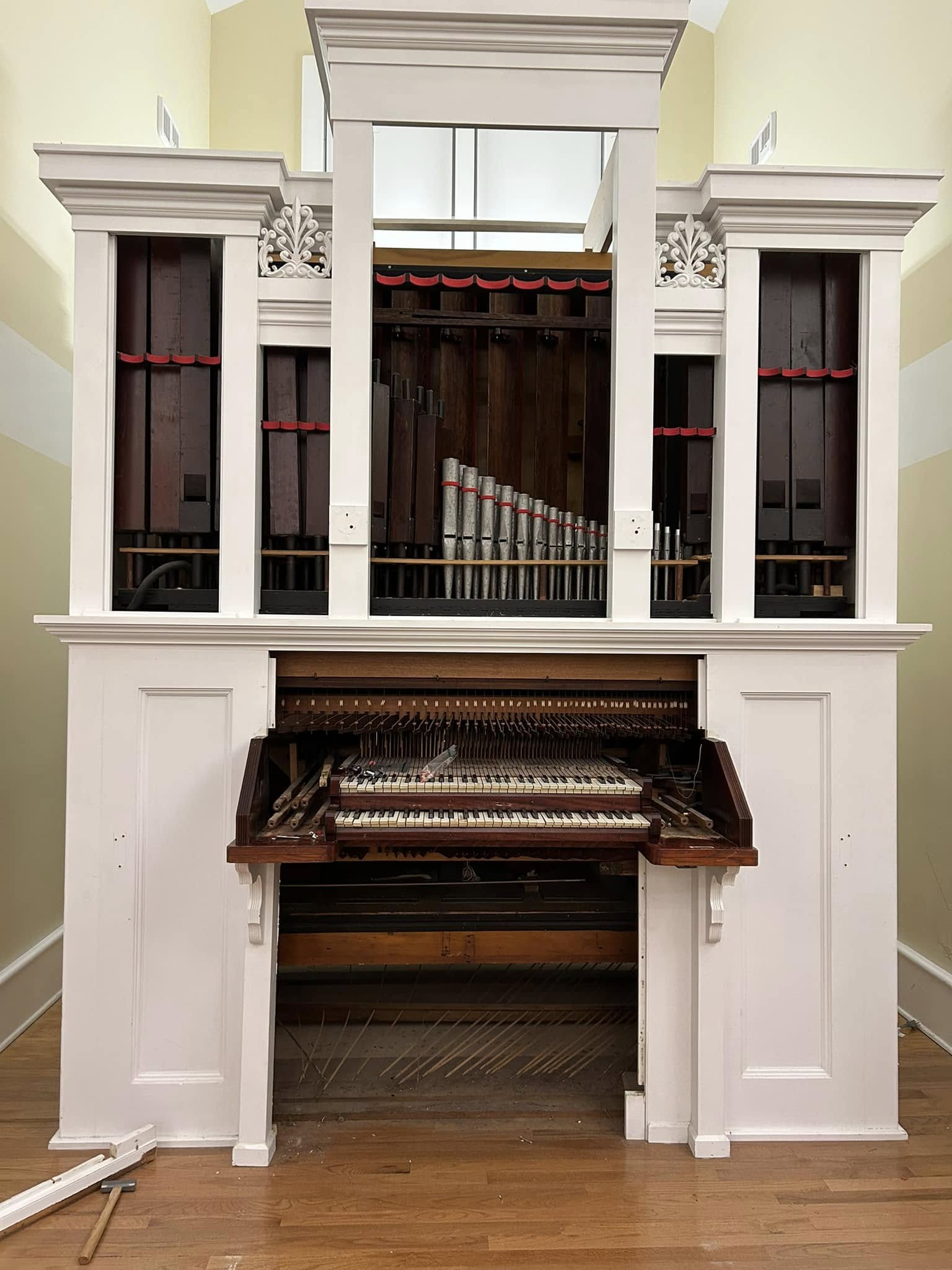
Last year our parish was donated a new pipe organ.  We have been eagerly waiting for the deconstruction of our current organ and the installation of the new one.  The time has finally come, we said a prayer of blessing on the current organ, and we have been waiting and watching as the process begins.  Ideally this wouldn’t be staring just days before Ash Wednesday, but I suppose there is no “perfect” time to deconstruct your worship space.

Knowing we are in a liminal time of deconstruction and reconstruction, I had not thoroughly thought through the impact this time would have on our experience of Ash Wednesday.  But walking into the Chapel this morning, seeing the pipes mostly gone, and the guts of our current organ exposed, I was hit by a sadness I couldn’t quite place.  Almost 20 years of music from that organ has filled our worship space, countless talented individuals have made the organ sing, and even more moments of sacred encounters with God have happened through that instrument.  Seeing the organ exposed today did something that left me unsettled. 

Photo credit: https://annkroeker.com/2011/03/09/there-back-again-my-first-ash-wednesday/

When I necessarily turned my attention to preparing for tonight’s Ashes to Go and Ash Wednesday service, I realized what was so unsettling.  Ash Wednesday is all about reminding us of our mortality, our finitude, and our vulnerability before God.  When those gritty ashes are scraped across my forehead and I am told that I will return to dust, that texture and those words linger with me.  So too, as that organ case sits gaping and open, with dust motes floating in the air, our worship space has suddenly become the perfect metaphor for entering a Holy Lent.

I wonder what gaping holes Ash Wednesday is exposing for you.  I wonder where your spiritual life is feeling dusty and in need of some care.  As always, you are most welcome to engage at Hickory Neck Episcopal Church for some tending – to find a connection with God that might be missing, to heal some holes that have been exposed for too long, and to find a place of belonging, because, believe me, you are not alone.  Welcome to Lent.

Photo credit: Stephen Trumbull; reuse with permission only

Sermon – Mt. 6.1-6, 16-21, AW, YB, February 14, 2024

21 Wednesday Feb 2024

Posted by jandrewsweckerly in Sermons

≈ Leave a comment

Tags

alms giving, Ash Wednesday, church, corrupt, death, fasting, God, Jesus, Lent, life, love, prayer, reconnect, relationship, repentence, Sermon, Valentine's Day

This morning, I got a fun text from a friend.  “Happy Ash Valentine’s Day!” she exclaimed.  I have seen all sorts of humor about the confluence of Valentine’s Day and Ash Wednesday this year.  From questions about whether the clergy might be making the sign of a heart instead of the sign of a cross with our ashes tonight (sorry to disappoint those of you who were hoping that wasn’t just a rumor); to a meme from the National Church that says  “You can’t have VaLENTines with the LENT”; to actual candy conversation hearts that say “U R Dust,” “Ashes 2 Ashes,” or “Repent” instead of the traditional “Be Mine,” “True Love,” or “Kiss Me.”  Even my own daughter petulantly asked me, “Do we always have to celebrate Ash Wednesday on Valentine’s Day??”

Though the humor has been fun, what lurks under the surface is a discomfort with talking about death – especially on a day meant to be for celebrating the happiness of love.  But part of my job as a priest is to bring a certain sobriety about death to the world – no matter the day.  That is not to say that I am a party pooper or that I don’t like a good box of chocolates myself, but my role as a priest is to name the truth about what happens in death – earthly death and reunion with our Lord in eternal life.  In fact, the Church is one of the few places left in the world that openly and regularly talks about death.  In a world that encourages anti-aging treatments, who has desensitized us to death as we have moved away from an agrarian lifestyle, and whose medical advances have extended life much longer than before, we learn that death can be conquered and should be fought at all costs.

Pushing against this secular understanding of death, the Church gives us Ash Wednesday – even on Valentine’s Day.  The Church looks at our flailing efforts to preserve life and as we humbly come to the altar rail, rubs gritty ash on our heads and says, “Remember you are dust and to dust you shall return.”  There is no, “Don’t worry about death; you’ll be fine!”  Instead, those grave words, “Remember you are dust and to dust you shall return,” echo in our heads, haunting our thoughts.  Every year the Church reminds us of the finite amount of time we have on this earth – even on a day seems like we should be talking about love and life.

This is why I love Lent so much.  The Church dedicates forty days to a time where we cut to the chase and honestly assess our relationship with God.  We take a sobering look at our lives, a sobering look that could be reserved only for the time of death, and we discern what manifestation of sinfulness has pulled us away from God.  Our Prayer Book defines sin as “the seeking of our own will instead of the will of God, thus distorting our relationship with God, with other people, and with all creation.”[i]  Lent is the season when we focus on repentance from our sin – not just a feeling guilty about our sinfulness, but eagerly seeking ways to amend those relationships and turn back toward resurrection living.  What most people get only at the time of death, we are given every year at the time of Lent:  a time of sobering realignment. 

This is why we get Matthew’s gospel lesson on Ash Wednesday.  As we begin our sobering Lenten journey, the gospel lesson names disciplines and practices that can help us along the way.  Jesus names those ancient practices that have brought people back to God for ages – giving alms, praying, and fasting.  Each one of these practices has ways of bringing us closer to God by shaking up our normal routines.  Of course, any Lenten practice can have the same effect.  Giving up caffeine, reading a daily devotional, or reconnecting with nature are equally valid ways to shake up our routines enough to notice the ways in which we have become more self-centered than God-centered.  Although Jesus names the disciplines of alms giving, prayer, and fasting, the actual discipline itself is not the issue for Jesus.  The issue is our intentions in our practice. 

This is why we hear Jesus labeling so many people as hypocrites in our gospel lesson today.  Jesus is less concerned about what disciplines we assume and is more concerned about the authenticity behind those disciplines.  Jesus is not arguing that private acts are authentic and public ones are inauthentic by nature.  What matters is the desire and motivation behind these practices.  We have all seen this in action.  One of my favorite comediennes jokes about this very behavior in one of her shows.  She talks about how people sometimes use prayer requests as a means of gossip.  In one of her jokes, she has the gossiper of the church inviting people into a prayer circle so that they can pray for someone in the church who just got pregnant, even though the news was supposed to be private.  We all know the kind of hypocritical behavior Jesus is addressing.  This kind of behavior will never get us to the sobriety we need to right our relationship with God and others.

Of course, any kind of practice we take up this Lent can be corrupted.  The giving up of a particular kind of food can be more for weight loss than a connection to God.  The taking up of a volunteer activity can be to fulfill a requirement for something else.  Whatever we do this Lent, that deprivation or incorporation is meant to help us restore our relationship with God, other people, and all creation.  So, when we give up a food, instead of glorying in the fact that we lost a few pounds, we can see how that food has become an emotional crutch that keeps us from leaning on God and others.  When we take on a new prayer routine, we slowly begin to see how little time we give to God in our daily lives.  Whatever our practice, Jesus is concerned that authenticity be at the heart, so that we can more readily prepare for Good Friday and Easter.[ii] 

And so, in order to shake us out of our self-centered, sinful, distant ways, especially on a day for love, Ash Wednesday gives us death.  Ash Wednesday grittily, messily, publicly reminds us of our death, and then leaves us marked so that we can humbly enter a Lenten reconnection with God.  Ash Wednesday throws death in our faces so that we can wake up in a world that would have us keep striving for longevity of earthly life or superficial happiness instead of striving for intimacy with God here and now.  This Ash Wednesday, our ashes are the outward reminder of the sobering journey we now begin, because only when we consider our own death can we begin to see the resurrection glory that awaits us at Easter.  My prayer is that our journey this Lent is not one of painful guilt or loveless deprivation, but instead one of glorious reconnection with our creator, redeemer, and sustainer.  Amen.      


[i] BCP, 848.

[ii] Lori Brandt Hale, “Theological Perspective,” Feasting on the Word, Yr. C, Vol. 2 (Louisville: Westminster John Knox Press, 2009), 24.

On Ashes, Valentines, and Ultimate Things…

14 Wednesday Feb 2024

Posted by jandrewsweckerly in reflection

≈ Leave a comment

Tags

Ash Wednesday, church, death, God, love, neighbor, relationship, self, ultimate significance, Valentine's Day

Photo credit: https://abidingpresence.net/newsfeed/2018/2/8/holiday-mashup

“Happy Ash Valentine’s Day!” my friend wrote this morning.  At first the greeting made me chuckle, especially given the number of grimaces and eye rolls I have received this year about how the Church has to celebrate Ash Wednesday on a day that is supposed to be about love.  Truth be told, I am not even sure how many faithful will even come to church tonight instead of going out to dinner or staying in for a cozy night with loved ones. 

But what I loved about that greeting today was how it married the two notions:  that you can celebrate love and death all at the same time.  In the same way that the Church soberly says, “Remember you are dust and to dust you shall return,” the secular world, despite the obvious consumerism of the day, uses this day to soberly say, “No really.  I love you:  I love you my friend, I love you my co-worker, I love you my classmate, and I love you, my beloved.”  These two days, at their root, are meant to talk about ultimate things:  love and death.  And as a priest, when I walk individuals and families toward death, there is nothing but love hovering around.

I wonder if the confluence of Ash Valentine’s Day might be an invitation for us this Lent.  How might you use these next forty day to meditate and act on those things of ultimate significance?  How are tending your relationship with God in a way that acknowledges that relationship’s ultimate significance?  How are you loving your neighbor in a way that honors the ultimate significance of their dignity?  How are you caring for yourself in a way that shows the ultimate significance of your identity as a child of God?  I don’t know if you need some silly candy conversation hearts that remind you that you are dust – or if you need ones that remind you that you are truly loved.  Either way, I hope this Ash Valentine’s Day is a day you can enter into Lent with significance, remembering you are loved. 

On Taking Church Outside…

01 Wednesday Mar 2023

Posted by jandrewsweckerly in reflection

≈ Leave a comment

Tags

Ash Wednesday, Ashes to Go, church, God, Lent, liturgy, outside, people, ritual, sacred, story

Photo credit: https://www.cincinnati.com/story/news/2023/02/21/ash-wednesday-2023-why-do-people-wear-ashes-everything-to-know-lent/69927477007/

Once upon a time, I was pretty critical of the concept of “Ashes to Go.”  I worried that by encouraging people to get quick ashes, they would miss the fullness of the liturgy, cheapening the power and importance of what we do on Ash Wednesday.  How could a three minute interaction hold the same power as an hour-long ritual?

This year, I am grateful once again that someone convinced me years ago to try Ashes to Go anyway.  As our church is located in a more suburban area, we do a drive-through ashes experience.  The reasons people stop vary widely.  For some, they do not like to drive at night, so a daytime option fits their schedule.  For others, they have young children and a school night is just too hard to rally for the family.  For others, the reasons are not totally clear, but stories are shared:  about how times are hard for their families, how they haven’t been to church in five years, how they heard about it in the neighborhood and wanted to check it out.  And for others, words fail them, but you see in their eyes how powerful the brief, intimate moment with the sacred means a tremendous amount.

If there are times I wonder if we really need to offer Ashes to Go, every year reminds me of the absolute necessity of meeting people where they are.  In fact, I have been wondering if there are not other ways we can step out of the church walls and meet people where they are.  Surely if something as grim as reminding people they are dust can compel people to drive by for ashes, there must be other ways we can take “liturgy” to the streets.  Ever since the pandemic happened and our parish embraced livestreaming, I have become increasingly aware of the church’s ability to reach people differently – to minister to and offer sacred encounters in all sorts of ways.

As we journey deeper into Lent this year, I invite you to consider where else in your life you can take church with you.  Maybe you can slow down just a bit and listen to the stories of those around you.  Maybe you can reach out to someone who is hurting today.  Or maybe you can share a bit of your own story and how your journey with God is making a difference.  I look forward to hearing how God is showing up outside the church walls this week!

Sermon – Matthew 6.1-6, 16-21, AW, YA, February 22, 2023

01 Wednesday Mar 2023

Posted by jandrewsweckerly in Sermons

≈ Leave a comment

Tags

Ash Wednesday, communal, community, Jesus, plural, reflection, repentance, self, Sermon, sober, together

I have always felt Ash Wednesday is one of the most sobering days of the Church year.  One might think funerals are more sobering, but every burial office is an Easter celebration of resurrection.  On Ash Wednesday, we are pulled out of the hubbub of the ordinary, the busyness of days, and thrust into the stark reality of our sinfulness and inevitable death.  The priest lays out the invitation to a holy Lent; we feel the scrape of ashes on our foreheads with the foreboding words of our beginning and our end – no matter how old we are; we pray a litany of penitence, remembering our grievous sins.  And as if those acts are not enough, we hear from Matthew’s gospel how even when we engage in repentance, we must be careful not to engage in the wrong way.  Ash Wednesday strips us of all pride, confidence, and sense of accomplishment, and lays before us our weaknesses, failings, and vulnerabilities. 

I have always regarded Ash Wednesday and our Lenten experience as the ultimate self-directed season.  The ashes on our foreheads remind us of how we came into this world alone and we will go out alone.  The disciplines we assume this day for the next six weeks are catered to our own journeys, focusing on what we have discerned we personally need to right our own relationship with God.  When I confess, I am struck by memories of grievances I have committed – images and feelings flashing before me as a particular set of words hits close to home.

But as I read Matthew’s convicting gospel this year, something brought me up short.  All those warnings Jesus makes, “Beware of practicing your piety before others…whenever you give alms, do not sound a trumpet…when you pray, do not be like the hypocrites…whenever you fast, do not look dismal…”, all of those warnings are not in the singular.  They are actually in the plural.[i]  So the words are more like, beware of practicing you all’s piety.  Or maybe in southern speak, “when ya’ll pray…” Jesus is not criticizing or singling out you or you or me.  Jesus is singling out the community of the faithful.

That may sound like semantics, but there is something quite dramatic about Jesus speaking in the plural versus the singular.  Every week in Sunday services, we confess our sins.  But we confess them communally.  Communal confession is an extraordinary event.  While we may feel lost or despondent about our inability to live in the light of Christ as individuals, when we communally confess, a room of voices is saying with you, “Me too!”

One of the things I grieved the most during the pandemic was our inability to gather in person.  I loved that we had and continue to have an online community – especially when people write things in the comments, greet one another, or meet Hickory Neck for the first time.  But our necessary isolation during the pandemic naturally led to a pattern of looking inward – sometimes so much so that we forgot we are not alone – that there is a whole community of faith who is walking this journey with us and struggling just as we are.  There is something quite powerful about listening to the voices of 7-year-old next to the 77-year-old – the person who looks so put together next to the person who is clearly struggling – the dad with children next to the widow – all confessing together.  Week in and week out, those myriad voices remind us we are not alone.

Tonight’s service very much calls us into reflection and repentance.  But our invitation tonight as we enter Lent is to remember that the act of reconciliation and redemption does not happen alone.  We all are invited into a holy Lent.  We all are invited into prayer, fasting, and alms giving.  We all are invited to remember we are dust.  In person, online, and hybrid together, we are not invited into solo, parallel journeys.  Our journeys are strengthened and made possible through the companionship of community.  You are not alone.  We are in this together.  And Jesus lights the way for us all.  Amen.


[i] Karoline Lewis, as described on the podcast, “Sermon Brainwave:  #889: Ash Wednesday – February 22, 2023,” February 17, 2023, as found at https://www.workingpreacher.org/podcasts/889-ash-wednesday-february-22-2023 on February 20, 2023.

Sermon – Matthew 6.1-6, 16-21, AW, YC, March 2, 2022

25 Wednesday May 2022

Posted by jandrewsweckerly in Sermons

≈ Leave a comment

Tags

Ash Wednesday, church, disciple, disciplines, honesty, humility, invitation, Jesus, Lent, normal, pandemic, Sermon, vulnerability

For those of you who have known me for some time, you know that Lent has always been my favorite liturgical season.  Lent is a season marked by profound honesty about the brokenness and sinfulness of our lives, the confessing of the darkness of our souls, and the desperate searching for a way back to the unimaginable grace and love that God shows us undeservedly.  Perhaps that description sounds a bit morbid and unappealing, but I find the raw truth of Lent to be refreshing in a world that brushes over and hides imperfection.

Despite my love of the sobering ritual of Lent though, the last two years Lent has felt like too much of a burden to bear.  Being in a pandemic, wading through political divisions, and our country’s institutional racism being exposed felt like too much.  We have been lonely, scared, angry, and, at times, lost.  Both of the last two Lent’s have felt like the “Lentiest Lents we have ever Lented.”  And as your clergy, and as a fellow disciple of Christ, I felt like asking us to waltz into the dance of Lent was just all too much. 

But this year feels different.  I would not say we are on the other side of this pandemic, and I would certainly not say we are back to “normal” – though I am not sure we will ever go back to the old normal.  Instead, I rather feel like we are standing on a board, balanced on a fulcrum.  We are not still climbing our way over this pandemic, and we are also not coming down from the apex of this pandemic.  Instead, we are balancing a foot on each side of the board – steady, but using every muscle in our body to keep balance, wanting to breathe a sigh of relief being at the peak, but not yet able to relax on solid ground.

That is why I am so very grateful for our text from Matthew this Ash Wednesday.  In years past, I always found this text rather sanctimonious.  Here we are at a service where we will spread ashes on our forehead – a very public sign of our faith – listening to a text telling us not to be pious before others, not to give alms in a showy way, and not to pray so as to draw attention to our holiness.  The contradiction between written word and physical act have never felt more at odds than on Ash Wednesday.

But I think I had Matthew’s gospel all wrong before this year.  This text is not really about shaming self-righteous behavior.  This text is about honesty, vulnerability, and humility.  If we are showy with our piety, alms giving, prayer, and fasting, our discipleship becomes about dishonesty.  Instead, Matthew is simply asking us to be real:  real with others, real with ourselves, real with God. 

That is the invitation this Lent.  Not to take on some pious Biblical study (though we will offer that this year on Sunday mornings), not to brag about Lenten disciplines (though we will encourage you into a little light competition this year), and not to commit to something that is so unreachable that you quit within the first two weeks.  Instead, this Lent is about honestly claiming the hurt of these last two years:  of confessing our isolation and the ways that isolation has hurt (perhaps by finding one of the planned opportunities for connection), of facing the mental health strain this pandemic has created and seeking companions on the journey (whether in an upcoming support group or through a new Stephen Minister), of confessing that we are not fine (and coming to church to find those who are also not fine).  Those Lenten disciplines will give us some stability on that wobbly board of pandemic life and may give us the assurance of the presence of God in the midst of life we need to come down the peak of this pandemic.

However you enter this Lent, whatever practices you take up or give up, however you engage in the offerings of formation this Lent, the Church invites you this year to be honest:  be honest in the struggle, be honest in the failings, be honest in the hope.  Your being real this year may just allow someone to experience the realness of Jesus in their own lives.  And we could all use a little more Jesus this year.  Amen.

On Being Apart While Together…

24 Wednesday Feb 2021

Posted by jandrewsweckerly in reflection

≈ Leave a comment

Tags

alone, apart, Ash Wednesday, beautiful, dichotomy, experiment, God, Holy Spirit, Lent, lonely, pandemic, separated, together

Photo credit: https://www.indiatvnews.com/lifestyle/news-living-apart-together-the-new-relationship-trend-in-town-for-older-adults-380624

As a priest, especially a priest in a pandemic, you do not always know how the things you plan are going to go.  Most of the liturgical things we do are about 90 degrees off from what we “normally” do, and we just keep hoping they capture the spirit of the original liturgies.  I am blessed to serve an awesome congregation whose DNA is wired to be creative, playful, and experimental, so I always feel like we are in this together.  But I still find myself holding my breath a bit each time we try something unusual.

Ash Wednesday was no different.  We did our due diligence, made ample opportunity for parishioners and neighbors to get ashes for home use, and we figured out how to synchronize our ashes through livestreaming.  What I did not anticipate was what it would feel like to put ashes on my own head.  Even when I was a solo clergy person, I always had a parishioner put ashes on me after I put ashes on them.  But putting ashes on my own head felt very solitary – suddenly I was very aware of how separated we all are from one another – and how lonely that sometimes feels.

I pondered that reality for a few days before I remembered something else from Ash Wednesday.  We decided in the pandemic to still offer Ashes to Go – a drive through experience at our location.  As we distributed containers of ash, we gave people three options – “ash” themselves as we pray with them, take the ashes home and say a set of prayers we gave them, or take them home and watch our livestream and “ash” with us.  One family drove through and I gave the mom the three options.  She decided I should go ahead and pray as she put ashes on the foreheads of her two preschool children.  As I watched her work – this mom whose story I could all too easily imagine – the stress of parenting for almost a year in a pandemic, making hard decisions about childcare, juggling work, children, and family, trying to precariously hold it together.  Here she was, taking on the work of the spiritual nourishment of her kids too. 

And that is when I realized the truth.  We are very separated, often alone, and sometimes lonely in this pandemic.  But we are all feeling those things together.  When we gather online together, we are together in our apart-ness.  When we swing by the property for drive-through experiences, we are acknowledging our togetherness in our apart-ness.  When things remind us of our apart-ness, we are collectively reminded together.  It is a beautiful, awful dichotomy, only made better by the fact that we are, in fact, together in this.  This Lent, I invite you to pause to look around, and observe the small, sometimes tiny, reminders that we are in this together.  Even in our apart-ness, we are with each other in Spirit.  And the Spirit is enough to hold us together while apart until we can be physically together some day.

Sermon – Mark 6:1-6, 16-21, Isaiah 58:1-12, AW, YB, February 17, 2021

24 Wednesday Feb 2021

Posted by jandrewsweckerly in Sermons

≈ Leave a comment

Tags

Ash Wednesday, ashes, church, fasting, God, holy, invitation, Lent, mirror, pandemic, Sermon, spiritual practices, struggle

I have always thought the Ash Wednesday liturgy offers a strange contrast.  We engage in the very visible sign of having ashes spread across our foreheads.  And yet, our gospel lesson this day speaks very clearly of not showing your piety publicly.  But this year, the contrast of Ash Wednesday feels even more pointed.  Typically on this day, we talk about giving things up for Lent, fasting, and entering into a season of contemplation about not just our mortality, but the sinfulness that separates us from God.  But we have spent the last eleven months fasting – fasting from social gatherings, fasting from touch and uncovered faces, even fasting from receiving the sacred meal.  And for a large portion of those months, we have been in deep contemplation about the exponentially rising death all around us, the brokenness of our common life, the sin of oppression and racism.  The last thing I want to hear from the church today is how I need to give up more.

I think that is why I love the text from Isaiah this year so much.  God offers a mirror to God’s people.  On first glance, God’s people are certainly doing the things that are expected – in fact, the “things” that are often of Lent.  They are fasting and lying in sackcloth and ashes.  They are doing the work of penitence.  But the acts are not the problem – the motivation of the acts are the problem.  They are doing acts of contrition as sort of an exchange:  fasting so that God will give them favor; Sure, their behavior may end in the oppression of others, but they are doing the manual action called for in this moment. 

But God is having nothing of hollow spiritual practices.  If those practices are not leading to the loosening of the bonds of injustice, or the undoing of the thongs of the yoke, or the freeing of the oppressed, they are meaningless.  If the people of God are not sharing their bread with the hungry, bringing the homeless poor into their homes, covering the naked, and caring for their own kin, then fasting is little more than act in futility, an action done without reflection, intention, or love of neighbor. 

So what do the words of Isaiah have to do with living in month eleven of a pandemic?  I am going to say something that might be a little controversial, but here you go:  the church is not asking you to fast this Lent.  Now, in a few moments, I am going to say these very words, “I invite you, therefore, in the name of the Church, to the observance of a holy Lent, …by…fasting, and self-denial…”  But you have already fasted for a whole year.  You have already been in a season of self-denial.  The ashes you will impose on your head later are not a reminder that you are dust and to dust you shall return.  You know that reality all too well now.  Instead, we are going to take a cue from Isaiah tonight.  You have already done the manual acts of Lent.  Now your invitation is the “so that” part of the action.  Our work this Lent is to reflect upon what has been a most difficult year and to ponder together what this past year of fasting is inviting us into.  How has this season of fasting, this season of struggle, this season of brutality transformed our sense of purpose and identity – a people focused on God’s work loosening the bonds of injustice, freeing the oppressed, and sharing our bread?  How has the sobering nature of death, grittily rubbed onto our foreheads tonight, changing our resolve to lean into God, lean into this Christian community, lean into the work of sharing God’s love with those who do not know that love?

The rest of the invitation I will read in a moment says this, “I invite you, therefore, in the name of the Church, to the observance of a holy Lent, by self-examination and repentance; by prayer…and by reading and meditating on God’s holy Word.”  You have done the rituals of fasting and self-denial long enough.  As we look forward to these next forty days together, our work is to spend time with God, scripture, and one another and answer the question, “So what?”  What are we going to do now?  What are we going to claim and what are we going to let go?  How is the grit of ash this year not the sensation of defeat, but of invitation.  I invite you, therefore, in the name of the Church, to the observance of a holy Lent.  Amen.

On Keeping Rituals Anyway…

17 Wednesday Feb 2021

Posted by jandrewsweckerly in reflection

≈ Leave a comment

Tags

Ash Wednesday, community, dust, God, journey, Lent, normalcy, pandemic, ritual, together

Photo credit: https://www.cincinnati.com/story/news/2019/03/06/ash-wednesday-2019-wearing-ashes-marks-beginning-lent/3064920002/

Today is Ash Wednesday.  It is the day we gather to kick off the beginning of Lent.  The main marker of this day are the ashes rubbed on our foreheads in the shape of a cross.  This ritual action is so powerful that churches typically offer multiple services in their buildings and they hang out in train stations, street corners, or parking lots so that people can grab their ashes on the go. 

But this year Ash Wednesday is happening in a surreal setting.  Reminding us we are dust and to dust we shall return seems a little superfluous when death is all around us from this pandemic.  Beginning a season of fasting seems like overkill when we have been doing nothing but fasting for eleven months – fasting from a way of life we once knew.  Asking us to give us something for Lent seems tone deaf when we have been giving up things for almost a year.  And with large communities having lost power for several days, churches still on lock down, and best practices prohibiting us from actually touching ashes to others’ foreheads, the whole idea of this day seems like too much.

So why are we even bothering with Ash Wednesday this year?  A couple of reasons.  One of the base reasons is we need to keep the rituals of life to help us feel some semblance of normalcy – some reminder of the things that have been meaning-giving in our lives.  Two, we need reminders that God is present in the midst of all this mayhem.  Some of us have never felt God’s absence, some of us have felt the abandonment of God in this time, and some of us have just felt so depleted that God feels distant – not absent, but also not vividly present. 

I don’t know how you are holding up this Ash Wednesday.  I don’t know where you are on your journey with God these days.  But what I do know is that the church is here to walk with you, comfort you, and create space for wherever you are on the journey – whether driving through,  watching online, or catching up by email, phone, or text.  We are in this together.    

← Older posts

Recent Posts

  • On the Myth and Magic of Advent…
  • On Risking Failure and Facing Fear…
  • Sermon – Luke 23.33-43, P29, YC, November 23, 2025
  • On Inhabiting Gratitude…
  • Sermon – Luke 20.27-38, P27, YC, November 9, 2025

Archives

  • December 2025
  • November 2025
  • October 2025
  • September 2025
  • August 2025
  • July 2025
  • June 2025
  • March 2025
  • February 2025
  • December 2024
  • November 2024
  • October 2024
  • September 2024
  • August 2024
  • July 2024
  • June 2024
  • May 2024
  • March 2024
  • February 2024
  • January 2024
  • December 2023
  • November 2023
  • October 2023
  • September 2023
  • August 2023
  • July 2023
  • June 2023
  • May 2023
  • March 2023
  • February 2023
  • January 2023
  • December 2022
  • November 2022
  • October 2022
  • June 2022
  • May 2022
  • January 2022
  • December 2021
  • November 2021
  • October 2021
  • September 2021
  • August 2021
  • June 2021
  • May 2021
  • April 2021
  • March 2021
  • February 2021
  • January 2021
  • December 2020
  • November 2020
  • October 2020
  • September 2020
  • August 2020
  • July 2020
  • June 2020
  • May 2020
  • April 2020
  • March 2020
  • February 2020
  • January 2020
  • December 2019
  • November 2019
  • October 2019
  • September 2019
  • August 2019
  • July 2019
  • June 2019
  • May 2019
  • April 2019
  • March 2019
  • February 2019
  • January 2019
  • December 2018
  • November 2018
  • October 2018
  • September 2018
  • August 2018
  • July 2018
  • June 2018
  • May 2018
  • April 2018
  • March 2018
  • February 2018
  • January 2018
  • December 2017
  • November 2017
  • October 2017
  • September 2017
  • August 2017
  • July 2017
  • June 2017
  • May 2017
  • April 2017
  • March 2017
  • February 2017
  • January 2017
  • December 2016
  • November 2016
  • October 2016
  • September 2016
  • August 2016
  • July 2016
  • June 2016
  • May 2016
  • April 2016
  • March 2016
  • February 2016
  • January 2016
  • December 2015
  • November 2015
  • October 2015
  • September 2015
  • August 2015
  • July 2015
  • June 2015
  • May 2015
  • April 2015
  • March 2015
  • February 2015
  • January 2015
  • December 2014
  • November 2014
  • October 2014
  • September 2014
  • August 2014
  • July 2014
  • June 2014
  • April 2014
  • March 2014
  • February 2014
  • January 2014
  • December 2013
  • November 2013
  • October 2013
  • September 2013
  • August 2013
  • July 2013
  • June 2013
  • May 2013
  • April 2013
  • March 2013
  • February 2013
  • January 2013
  • December 2012
  • November 2012
  • October 2012
  • September 2012

Categories

  • reflection
  • Sermons
  • Uncategorized

Meta

  • Create account
  • Log in
  • Entries feed
  • Comments feed
  • WordPress.com

Blog at WordPress.com.

  • Subscribe Subscribed
    • Seeking and Serving
    • Join 394 other subscribers
    • Already have a WordPress.com account? Log in now.
    • Seeking and Serving
    • Subscribe Subscribed
    • Sign up
    • Log in
    • Report this content
    • View site in Reader
    • Manage subscriptions
    • Collapse this bar
 

Loading Comments...