• About

Seeking and Serving

~ seek and serve Christ in all persons

Seeking and Serving

Tag Archives: baptismal covenant

On Children, Questions, and Dignity…

06 Wednesday Dec 2023

Posted by jandrewsweckerly in reflection

≈ Leave a comment

Tags

Advent, baptismal covenant, children, complex, complicated, creation, dignity, faith, God, humanity, image of God, Jesus, questions, respect, scripture, slow down, village

Photo credit: https://www.adl.org/resources/tools-and-strategies/respecting-dignity-words

We have been having lots of “big” conversations around our house the last couple of weeks.  The first happened when my younger child and I went to shop for our Angel Tree gifts – an annual tradition from our church and the Salvation Army.  Our girls tend to prefer to choose someone their age – perhaps because they feel more equipped to imagine what someone their age wants, or because it helps them feel a sense of camaraderie.  This year, the nine-year old we selected ended up being quite different from the nine-year old in our family.  Though the toys she wanted were familiar, the size of clothing needed made it obvious that the two girls could not be more different.  So, in the middle of a store, I found myself having a deep conversation about genetics, systems of poverty, and the blessed nature of all creation.

Later, the conversation turned heavy again.  Something came across the same nine-year old’s radar about Israel and Palestine, and the barrage of questions were endless and increasingly difficult.  We started with why they were fighting, talked about what each side had done, and what the impact of this war has been.  Eventually we got into the murky waters of the religious backgrounds of the warring sides – careful to talk about the interconnectedness of the Abrahamic faiths.  But then came the gut-punch question, “So, who do we want to win?”  Talking about war and peace, death and destruction, and the biblical complicatedness of the Holy Land was not exactly the conversation I was expecting between school, dinner, and various sports practices.

One of the disadvantages of being a “grown up” is we often think we have things figured out:  capable of complicated thought, educated and experienced, we have seen enough of life to understand its complexities and make judgments based on our learnings.  It is one of the many reasons why I am so grateful for the children in our lives – both my own, but also our community’s children.  As part of their village, our work is to responsibly help them see the complicated, often sinful, nature of humanity, and help them love humanity in all its complexity.  In essence, children help us see why one of the main promises in our baptismal covenant is we will respect the dignity of every human being.

As we bustle around the Advent season, tempted to be too busy to handle anything other than our massive to-do lists, I invite you to slow down.  When we run so fast and when our minds are so occupied, we miss the invitations to respect the dignity of every human being:  from our neighbors impacted by poverty, to the frazzled parent just trying to get their children to school, to the person suffering within their body, to the innocent bystanders of war.  Scripture tells us that each person, when they are at their best or their worst, their strongest or their weakest, their most successful or their most failing, are made in the image of God.  Whether we like them or not, Jesus asks us to respect the dignity of that creation every day.  How might you better respect the dignity of the humans around you today?

Sabbatical Journey…On Hope and Humanity

29 Thursday Jun 2023

Posted by jandrewsweckerly in reflection

≈ Leave a comment

Tags

baptismal covenant, bitter, connection, dignity, division, God, hope, humanity, Jesus, reverence, sacred

West Yellowstone (reuse with permission)

I often find myself worried about the state of humanity.  Between our bitter American politics – where the art of compromise seems lost, the nasty interpersonal ways we interact with one another (don’t get me started about my local newspaper’s anonymous section), the way we are almost desensitized to mass violence, and the never-ending presence global warfare, I sometimes find it difficult to see hope or redemption for humanity.

But today was not one of those days.  Today was all about community and shared connection.  It started when we drove through Grand Teton to get to Yellowstone.  We had already had our Teton experience but were hoping to get a last view on our way out of town.  But a thick fog fell on the whole area, and my immediate thought was one of sorrow for all the beautiful sights today’s visitors would miss.  Later, at Old Faithful, we sat waiting for about thirty minutes to see the iconic geyser.  Swarms of people were gathered from all over the country and the world.  But when the geyser finally blew, the united gasp and cheers of joy made me feel like the barriers between strangers were immediately leveled.  Finally, at a community theater in West Yellowstone, we enjoyed a musical in a small venue with a variety of people.  With interaction encouraged, kids invited on stage to sing before the show, laughter, and the love of theater, I felt a true sense of connection to the gathered community.

Of course, I am unlikely to see most of the people I spent time with today again.  So, in the strictest definition, I was not building community.  But what was happening was the fulfilling of my baptismal covenant – where we were all respecting the dignity of every human being.  I think we make that promise in baptism because that is the real first step to building community:  respect, and being able to see the sacred in every person created in the image of God.  When we do that, all that hopelessness about humanity fades away.

If you have not looked at someone today with that kind of reverence, I invite you to give it a try.  Maybe you just watch people a little more gently (remembering days when you were “in a mood,” or when parenting was just super hard).  Maybe you offer a hand or an encouraging word.  Or maybe tonight you pray for someone you never actually met but crossed paths with during the course of the day.  I look forward to seeing how Jesus softens your heart and gifts you renewed hope!

Sermon – Luke 6.27-38, EP7, YC, February 20, 2022

25 Wednesday May 2022

Posted by jandrewsweckerly in Sermons

≈ Leave a comment

Tags

abundance, baptismal covenant, Epiphany, God, Jesus, love, neighbor, Sermon

Last week, we talked about the differences between Matthew’s version of Jesus’ famous beatitudes from the Sermon on the Mount and Luke’s version of the same beatitudes from the Sermon on the Plain.  If you recall, in Luke’s version, Jesus comes down to a level place, and speaks to the disciples eye to eye, conveying an intimacy to his instructions with the disciples.  In Luke’s beatitudes, the epiphany we have is not so much about Jesus’ identity, like in the visitation of the magi, his baptism, or in the wedding of Cana, but instead is an epiphany about what living with Jesus will be like:  loving our neighbor, seeking and serving Christ in others, striving for justice and peace, and respecting the dignity of every human being – the very promises we make in our baptismal covenant.

In today’s lesson, Jesus goes from making eye contact with us to turning our eyes to make eye contact with those around us.  When we love our neighbor, seek and serve Christ in others, strive for justice and peace, and respect the dignity of every human being, Jesus tells us those neighbors and those others must include our enemies.  And this is where this week’s epiphany becomes more difficult.  This passage often hits us in the gut by that simple word, “enemies.”  Our minds go to the worst:  the violent murderer, the manipulative sexual offender, the blatant endorser of racial discrimination, or the oppressive governmental dictator.  But the harder enemies are those “little” enemies much closer to home:  the disruptive neighbor who disrespects common space, the colleague with whom you avoid certain topics of discussion to keep the peace, the student at school who is so subtle with their bullying no one else sees her as a bully, or that anonymous writer in the Last Word whose opinion makes you seethe with anger.  When we consider those “little enemies,” Jesus’ instruction to not judge, not condemn, to forgive, to share, and to love become a checklist of good behavior we are not sure we can keep. 

A few years ago, the Greater Williamsburg area kicked off a commitment to becoming a community of kindness with a rallying event.  The former Mayor of Anaheim, California, Tom Tait, who had run on a campaign of kindness, was the keynote speaker.  Mayor Tait talked about his time on City Council in Anaheim, how part of his work felt like a game of whack-a-mole.  Each month, some crisis or community problem would arise – violence in the community, the prevalence of drugs, problems in the public schools.  And the City Council’s response felt trying to put a Band-Aid on another problem – to whack at the problem to temporarily knock the problem out.  But those solutions never really made a deep impact.  What Mayor Tait saw was all those problems were like symptoms – symptoms of a city that was facing an internal sickness.  The only way to heal the internal sickness was to commit as a city to transform their entire way of operating.  Mayor Tait believed transformation would occur by committing to kindness.  To many, the idea sounded a little too pie-in-the-sky.  But once elected, Mayor Tait was forced to try to live out the reality of kindness.  With every decision, every major action, the community wondered together what would reflect kindness.  And slowly, the illness in the system began to heal.  Kindness was not a Band-Aid, but a system-altering antidote to a host of problems.

In a lot of ways, that is what Jesus is talking about today.  Yes, the things Jesus is talking about are commands – a list of ways to love one another – even our enemies.  But Jesus is not just talking about commands.  As one scholar describes, “Jesus isn’t offering a set of simple rules by which to get by or get ahead in this world but is inviting us into a whole other world.  A world that is not about measuring and counting and weighing and competing and judging and paying back and hating and all the rest.  But instead is about love. Love for those who have loved you.  Love for those who haven’t.  Love even for those who have hated you.  That love gets expressed in all kinds of creative ways, but often come through by caring – extending care and compassion and help and comfort to those in need – and forgiveness – not paying back but instead releasing one’s claim on another and opening up a future where a relationship of …love is still possible.”[i] 

What Jesus is doing is trying to, “inculcate, and illustrate, an attitude of heart, a lightness of spirit in the face of all that the world can throw at you.”  We are to assume this new way of being because “that’s what God is like.  God is generous to all people, generous…to a fault:  [God] provides good things for all to enjoy, the undeserving as well as the deserving.  [God] is astonishingly merciful…”  As N. T. Wright adds, “…this list of instructions is all about which God you believe in – and about the way of life that follows as a result.”[ii]  When we take Jesus seriously, and embrace this new way of being, the way that leads to love, life can be “exuberant, different, astonishing.  People [will] stare.”[iii]

That is our epiphany invitation today:  to loosen our grip on love and allow love to flow as freely as the abundance of God’s love for the world.  This is not an invitation to grin and bear niceness, like a grumbled “bless his heart.”  Instead, this is an invitation to live in way that is contrary to our very human nature.[iv]  As you imagine all those little enemies you may be feeling today’s invitation is impossible.  And on your own, loving those little enemies is impossible.  But you are not on your own.  Not here at Hickory Neck.  You have a community of faithful seekers – of people who long to follow Jesus – and who have just as many little enemies as you – in fact some of them may even be in this room.  But with Christ and this community of the faithful, we leave this place knowing that the Holy Spirit will enable us to let go of our desperate, possessing grip on God’s love, and instead allow that love to flow through us to everyone – because there is more than enough love for us all to share.  Thanks be to God!  Amen.


[i] David Lose, “Epiphany 7 C:  Command or Promise?” February 22, 2019, as found at http://www.davidlose.net/2019/02/epiphany-7-c-command-or-promise/ on February 19, 2022.

[ii] N.T. Wright, Luke for Everyone (Louisville:  Westminster John Knox Press, 2004), 73-74.

[iii] Wright, 74.

[iv] Charles Bugg, “Pastoral Perspective,” Feasting on the Word, Year C, Vol. 1 (Louisville: Westminster John Knox Press, 2009), 384.

On Hope, Sobriety, and Better Angels…

20 Wednesday Jan 2021

Posted by jandrewsweckerly in reflection

≈ Leave a comment

Tags

baptismal covenant, better angels, dignity, God, grace, hope, Inauguration, nation, prayer, president, sober

Photo credit: https://www.juneauempire.com/life/living-growing-the-better-angels-of-our-nature/

We are not enemies, but friends. We must not be enemies. Though passion may have strained it must not break our bonds of affection. The mystic chords of memory, stretching from every battlefield and patriot grave to every living heart and hearthstone all over this broad land, will yet swell the chorus of the Union, when again touched, as surely they will be, by the better angels of our nature.  ~Abraham Lincoln, Inaugural Address, March 4, 1861

This morning, as we await the inauguration of our next President, I find myself equally sober and hopeful.  I am sober today because I am still reeling from the attempted insurrection in our Capitol Building just weeks ago.  That event signaled to me how much damage has been done to the fabric of our nation – how divided we have become, how hateful we have become, and how far we have strayed from our baptismal promise to respect the dignity of every human being.  I am sober because I know simply changing Presidents will not magically solve the division that took many years of cultivation.  We have much truth telling and healing to do. 

But my sobriety is balanced with hope.  Again, I have this hope not because I think our President Elect is the Messiah – we already have one of those!  But I am hopeful because being hopeful is the nature of being made in the image of God.  I am hopeful we will find our way back to our baptismal identity, of seeking and serving Christ in all persons, and striving for justice and peace among all people.  I know we have a long way to go.  Our black brothers and sisters have shown us this year how far we have to go in the movement toward respecting the dignity of every human being.  But somehow, seemingly impossibly, I am hopeful.

I was reminded today of the quote above from Abraham Lincoln’s first inaugural address, given on the brink of Civil War.  He had no idea what the future held and how our nation almost fell apart – and the very long road it would take (and is still taking) to recover.  But even then, on the cusp of some of our darkest times as a nation, Lincoln was convinced that we had better angels of our nature.  Perhaps that is where my hope comes from today too.  I am convinced that we have better angels still, and that, with God’s grace, we will be touched again by the better angels of our nature.  That is my prayer for all of us today!

On the Need for Mirrors…

07 Wednesday Aug 2019

Posted by jandrewsweckerly in Uncategorized

≈ 7 Comments

Tags

advocacy, anger, baptismal covenant, blame, broken, evil, God, God's word, guilt, immigration, judgment, justice, race, shame, values

mirror-reflection-loriental-photography

Photo credit:  https://fineartamerica.com/featured/mirror-reflection-loriental-photography.html?product=art-print

This weekend I was at the pool with our children.  We had the pool to ourselves for a while until a group of kids joined us toward the end of our time.  A few minutes after their arrival, the lifeguard called break, in keeping with the regularly scheduled breaks.  The new kids were justifiably disappointed, but what happened next was not justifiable.  About five minutes into the break, one of the teenagers starts ranting loudly about why a lifeguard should need a break – claiming his job was not all that hard.  She then asked the lifeguard directly how much longer the break would be.  The lifeguard did not seem to totally understand her question (our lifeguards are usually international students here for the summer), and she spoke to him as if he were a child.  I found my anger rising.  Her taunting behavior continued after the break, and another teenager joined her in disrespecting the lifeguard with audible side comments, and ignoring his instructions about safety.  The lifeguard finally blew the whistle, saying the pool was closed, and everyone would have to leave.

Fortunately, we were on our way out already, as the teenagers’ behavior had angered me so much that I was no longer having fun.  The lifeguard apologized profusely on our way out, and I reassured him that I totally supported his decision, given how disrespectful the other guests were being.  As we walked home, my children asked me why I was so mad.   I explained part of my anger – that we never disrespect others the way those teens did, and their behavior made me mad.  But what I didn’t share was I suspected the teens’ behavior was also related to the lifeguard’s ethnicity.  With tensions around race and immigration these days, I suspected the teen felt she was superior in some way to this man, and I wondered why.

But mostly, I was mad at myself.  As the night wore on, I felt nauseated about the fact I had said nothing to that teenager.  Though my body language probably reflected disdain for her behavior, I said nothing to defend the lifeguard.  The more I thought about it, the more I wished I had approached the teen and talked to her about her inappropriate behavior.  In reflection, I could not figure out why I said nothing to her; I just knew I was ashamed by my inaction – so ashamed, I have felt it for days.

As a country and community, I have heard many conversations about how our government is broken and the other side (whomever we view as the other side) is leading us into evil.  This weekend I began to wonder if, instead, we are the ones who are broken.  We have lost the very values we claim in our baptismal covenant – to respect the dignity of every human being, to strive for justice, and to seek and serve Christ in all persons.  I wholeheartedly support advocacy work and protest movements when we see injustice.  But this week, I humbly ask you to join me in the work on ourselves – to shift from being people outraged by injustice and to start doing justice; to shift from being hearers of God’s Word, to being doers of God’s Word; to turn our criticism of others to a constructive criticism of ourselves.  Next time you hear me complaining about the degradation of our morals or values, please ask me what I am doing about it.  I promise to do the same for you in return.  Let’s get started!

Homily – Luke 10:25-37, P10, YC, July 13, 2019

17 Wednesday Jul 2019

Posted by jandrewsweckerly in Sermons, Uncategorized

≈ Leave a comment

Tags

baptism, baptismal covenant, covenant, dignity, faith, God, Good Samaritan, Jesus, kindness, Mr. Rogers, neighbor, sacred, Samaritan, Sermon, unworthy

Last Sunday, a group of parishioners gathered to watch Won’t You Be My Neighbor, the documentary about Fred Rogers.  There were countless things I could tell you about this film, but one thing that really grabbed my attention was toward the end.  The film documented a criticism of Mr. Rogers as raising up a generation of people who feel and act entitled.  You see, one of the primary lessons from Mr. Rogers is he loves each individual, just as they are.  No changes are necessary; no fault is too big.  Mr. Rogers loves you just as you are.  You can hear the words of God in Mr. Rogers’ words – God too loves us unconditionally, and certainly loves us better than any human ever could.  However, Mr. Rogers’ critics would argue if everyone is loved just as they are, then surely they do not need to improve, or earn respect, or work hard.  But the film asserts something quite different.  The film asserts without being recipients of unconditional love, individuals cannot be givers of unconditional love.  In other words, to respect the dignity of every human being, one must first learn how sacred one’s own dignity is – one must be shown how she or he is a person with dignity to be respected in order to know how to respect the dignity of others.

That sense of each person having profound, sacred dignity is one of the main lessons of our gospel today.  The Good Samaritan is one of those stories that is so widely known all I need to do is say, “the Good Samaritan,” and we likely already know the story.  We might automatically recall, “Oh, that’s the story Jesus uses to tell us to be like the Good Samaritan – to be kind to others.”  In one sense, our recollection would be true – at the heart of Jesus’ story is a message to be kind to all.  But what that simple summary misses is the finer details to this story.

You see, those two people who separately pass the victim along the road, are a priest and a Levite.  These two people are not just people of faith – they are keepers of the faith.  They know the laws better than most people of faith.  You may have heard over the years the logic that priests or Levites could not risk being defiled by touching the body of the victim, and so that is why they went around the victim.  But the truth is, their avoidance had nothing to do with defilement – they were heading away from the temple and therefore were not in need of ritual purity, and any good priest or Levite knows they were expected to check on this victim; should he be dead, they should help bury him, and should he be alive, they should tend him.[i]  Basically, these are good, trained people of faith, not fulfilling their duty to love their neighbor as themselves.

But perhaps even more significant is the identity of the Samaritan.  The story does not say, a priest and Levite passed, but another faithful Jew came to the victim’s aid.  The story says, a priest and Levite passed, but a man whose people are mortal enemies of people of faith – who has persecuted, defiled, and subjugated people of faith – is the one who helps.  Saying “The Good Samaritan,” is like saying, “The Good Murderer.”[ii]  That this typically hated man is the one who shows mercy, kindness, and love is shocking.  The hearers of Jesus’ story are shocked, and our ears need to be similarly shocked.  Asking us to respect the dignity of every human being is already a monumental task; respecting the dignity of every human being is inconvenient, is humbling, and involves a willingness to be wrong about others.  Respecting the dignity of every human being means being willing to see how the best of the faithful fail at kindness, and how sometimes our worst enemies are better people of faith than we are.

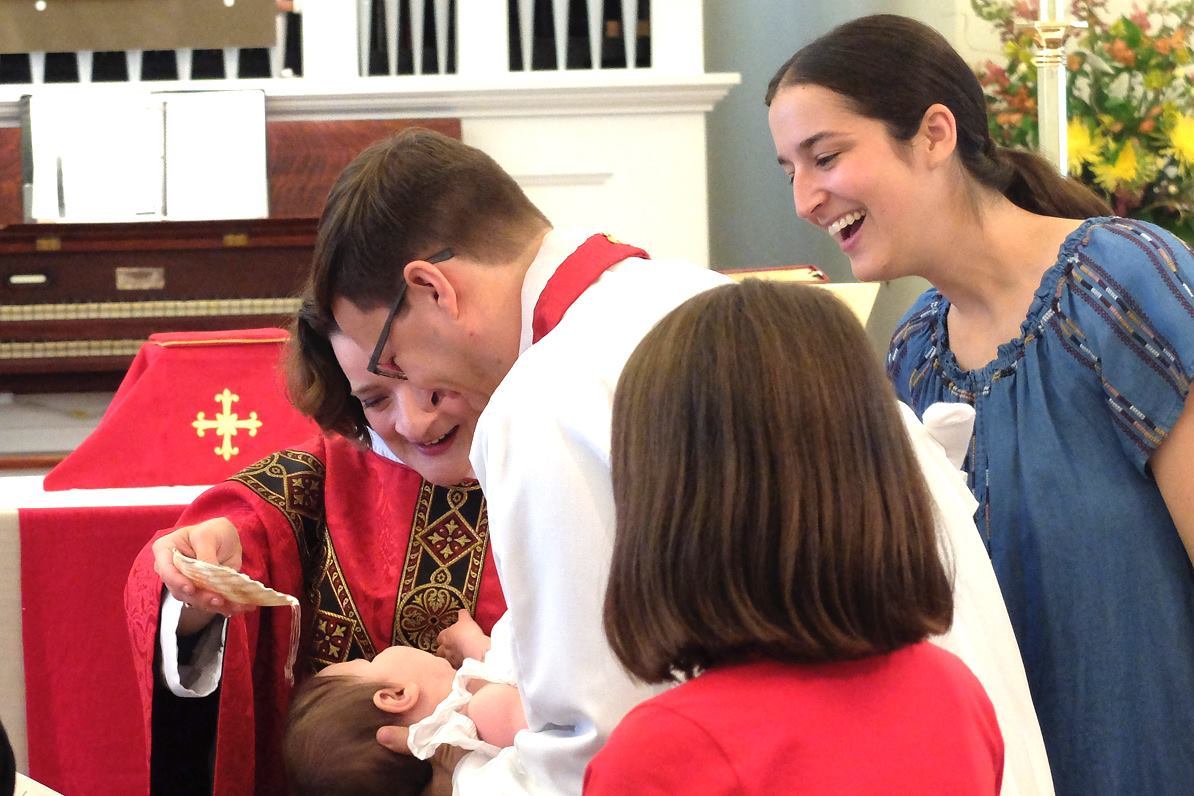
Today we are baptizing a child of God.  Her parents, godmothers, and our community will make promises today – to raise her in the community of faith, to show her to love and respect, to fight for justice and peace, to share the word of God, and to repent when she messes up.  We say those words today as we reaffirm our own baptismal covenants; but sometimes we forget how revolutionary the covenant is.  We are agreeing to teach Selah to live a revolutionary life.  When we say we will teach baby Selah to respect the dignity of every human being, we are saying we will teach her the hard work being inconvenienced and humbled in order to care for others.  When we say we will teach her to love her neighbor as herself, we are saying we will teach her that even her greatest enemies are worthy of love.  When we say we will teach her to repent when she sins, we are saying we will teach her to be willing to admit when people who we have deemed unworthy of love and care show us what true kindness really looks like.

Today, when we hear Christ’s words to “go and do likewise,” we can be encouraged that Jesus empowers us to make some promises.  Today we look at Selah’s precious, innocent face, and we promise to walk with her as she discovers how hard this work of being a faithful follower of Christ really is.  Today, we promise to confess to Selah the times when we have failed to love our neighbors as ourselves.  Today, we promise when those we despise, those who hurt us, those we cast out because they are not like us, those we can no longer see humanity in ask us, “Won’t you be my neighbor,” we will say with Selah, “Yes.  You are my neighbor too.”  Amen.

[i] Amy-Jill Levine, Short Stories by Jesus (New York:  Harper One, 2014), 99-102.

[ii] Levine, 105.

On Dreams, Change, and Gratitude…

05 Wednesday Sep 2018

Posted by jandrewsweckerly in Uncategorized

≈ Leave a comment

Tags

baptismal covenant, change, church, community, courage, deferred, dreams, faithfully, Holy Spirit, hope, humility, investment, Jesus, kingdom of God, need, proud, tenacity, Thanksgiving, work

Safe in each others' hands

Photo credit:  http://debragaz.com/2016/10/17/we-can-walk-together/

This week, as the buzz of insects filled the air, the heat reflected off the pavement as the sun rose, and the smell of blooming flowers lingered nearby, I greeted families and watched an age-old tradition of parents dropping off children at school.  Some of the families were rushed, the parents trying to get off to work.  Some families took things more slowly, savoring the goodbye of the day.  Some families were worn down by anxiety and tears – of children and adults.  In the hubbub of greeting these families, reality hit me:  Hickory Neck did it!

You see, over ten years ago, the community of Hickory Neck Episcopal Church had a dream – to turn the blessing of property into a blessing for the community:  meeting a desperate need for childcare in our part of our county.  Countless hours were spent by many church members planning, calculating, and organizing.  It would take a tremendous investment to create a school from scratch, but the passion and vision were there.  Unfortunately, the preparation was complete right before the economic recession hit.  And the dream was deferred.

But the needs did not change – in fact they grew as the presence of young families, especially those transplanted away from extended family, grew in our neighborhood.  Hickory Neck’s dream was what a Search Committee invited me to participate in:  to help them take the dream off the shelf, and live out their baptismal covenant more fully in their particular context.  And so, the work began again.  After months of discernment and honest conversations, we realized Hickory Neck’s dream could still meet the needs of the community.

A year later, on a steamy September morning, I was struck with a sense of awe by the Hickory Neck community.  I have been a part of many congregations, and one thing I have learned is most communities resist change.  They might need change; they might want change; they might even say they are ready for change.  But in the deep recesses of their minds and hearts, they do not really want change.  Change is scary and could disrupt what drew them there in the beginning.  But Hickory Neck is different.  Hickory Neck is a community who has been fluid and flexible, who even when her dream began to morph and change, did not dig in her feet, but instead stepped out into the unknown and said yes to the Holy Spirit.  The humility, boldness, courageousness, creativity, and gumption of Hickory Neck brought me to my knees this week.

I am so proud of our community for trying a brave new way of ministry – one that comes from the congregation, will be nurtured by the congregation, and will eventually feed the congregation.  Though I have helped navigate logistics behind the scenes, the truth is, I feel so incredibly privileged to simply accompany Hickory Neck in the fulfillment of her dream.  In these last two and half years, Hickory Neck has given me hope in the future of the church universal.  If communities of faith can cast a vision that betters the surrounding community, journey through adversity to achieve that dream, and then actually live into that dream faithfully, then I think there is hope beyond measure for the kingdom of God.

A few weeks ago, a county official said to me, “You must be so proud of yourself for doing such good work at Hickory Neck.”  But I shared with him, “No, I’m so proud of Hickory Neck.  They are an inspiration to me every day.”  Today, I thank you, Hickory Neck.  I thank you for your witness of bravery, passion, and hard work.  I thank you for inspiring me to be a better priest.  I thank you for letting me be a part of this fantastic journey, in this fantastic community, doing the fantastic work of Jesus.  I am so proud of what Hickory Neck has already accomplished.  I cannot wait to see where we go next!  Oh, and if you are not already connected to Hickory Neck, I encourage you to stop by.  You are in for an incredible treat.  Don’t worry:  we’ve already saved you a seat!

Homily – Acts 2.1-21, Pentecost, YB, May 20, 2018

23 Wednesday May 2018

Posted by jandrewsweckerly in Sermons, Uncategorized

≈ Leave a comment

Tags

baptism, baptismal covenant, cacophony, chaos, church, community, God, Jesus, languages, love, Pentecost, Sermon

33092215_1843823495673902_5618488268858327040_o

Photo credit:  John Rothnie (permission to reuse required)

I have been looking forward to this baptism for months.  Olive is one of four babies born at Hickory Neck within a month of each other, and one of five within a five-month period.  Not only did I enjoy watching Olive grow in her mom’s belly, I knew how fun welcoming her to the community would be, and especially how special her baptism would be.  So when the Bauer Family finally settled on Pentecost, I was thrilled – baptizing a baby on feast day adds excitement to an already festive day.

But as the liturgy planning staff met about a month ago, I realized we may have made a huge mistake.  We were talking about the needs for today, and remembered we needed to recruit all our foreign language speakers because Pentecost is the one feast of the year where we really try to simulate the experience of the historically significant day in the life of the faith.  And as we were talking about rotas, translations, and participants, a sudden sense of dread hit me.  “Um, Charlie?” I said.  “Are you sure you want to baptize Olive on Pentecost?  I mean, I love Pentecost, but, especially for strangers to our community, Pentecost is a little weird.  Do you want us to just skip the whole languages part?”  To his credit, Charlie didn’t hesitate.  “What better day to baptize?!?” he said, as though my question were silly.

I have been encouraged by Charlie’s enthusiasm, but the more I thought about his response, the more I questioned his logic.  Don’t get me wrong – I love what we do at Pentecost.  Pentecost is one of the few days of the liturgical year that our scripture really comes to life.  Hearing the cacophony of languages helps you to really imagine yourself there.  But this is the kind of service that I would also say to first-time visitor, “Just so you know, we don’t always do this!”  Because, although I love the cacophony, I wouldn’t want anyone to think today is the norm – that we always break into tongues in the service or that we always like to shock your senses.  Surely if we were going to baptize Olive, we should find a tamer way to welcome her to the community, and not freak out her family and friends from all the ends of the country.

We do this all the time with Church.  If we get the nerve up to ask a friend to Church, and they take us up on the offer, we want them to experience the best of Hickory Neck:  a welcoming environment, beautiful liturgy, a sense of belonging, and a deep connection to the immanent and transcendent God.  But just like when you introduce a new romantic interest to your family, you don’t have them meet everyone in the family at the beginning.  You save crazy Uncle Joe until at least the second or third Christmas, when you know your boy or girlfriend is already in love with you enough to make allowances for the crazy in your family.  The same is true for church – we would much rather you see the beauty of Hickory Neck on a regular Sunday or even on a day like Easter.  There is no need for us to show you some of the really weird parts of our faith, like Pentecost, until you have at least been here for a while.

So why was Charlie so enthusiastic about bringing his extended family to celebrate baptism on this one, crazy, bizarre day in the life of the church?  Was he not thinking this through?  Or was he secretly hoping to ensure his family never comes back?  I started working through why this might be the perfect day for a baptism, thinking through what we learn about the church and membership within.  First, we learn the power of the gospel, of the good news of God in Christ, to reach all peoples, no matter who they are.  Although practically speaking, today’s multilingual reading sounds jarring, what we know about this piece of scripture is that despite the din of noise, everyone heard the good news in their own language.  The gospel is not limited to one group of people or to one tribe or nation; the gospel speak truth to all.  Second, we learn that Jesus’ story is not just for us – Jesus’ story is for all.  Up until this point in our story, Jesus has been keeping his resurrection and ascension to a limited group of people.  But today, that norm implodes.  Jesus’ story is no longer for those nearest and dearest to Jesus – Jesus’ story is for everyone.  Third, we are reminded of our commission from Jesus – to go out into all the world, sharing the good news of God in Christ.  Not just the English-speaking places, not just the places where people look and act like us, not just the places that make us comfortable.  And finally, Pentecost affirms the ways in which God loves us, no matter what.  No matter how loud, crazy, or chaotic our lives become, God is with us, breaking through the din of noise we create and making that noise holy.

Perhaps instead of finding the most proper, polished day to baptize a child of God, today may be the perfect day to teach us all what the life of faith is about.  We all know that when our romantic interest or dear friend finally meets Crazy Uncle Joe, or finally sees us when we are sick or not looking our best, or finally realizes we have some pretty awful flaws, and LOVES US ANYWAY – those are the people we want to keep around.  The same is true for those new to the church or those being initiated into the community of faith – we want you to see us on our craziest days so that you know, no matter what God loves you anyway.  God sees your craziness, your chaos, those parts of yourself that you hide from others, and God not only loves you, God commissions you and makes a way you share that love to the ends of the earth.

That is what we affirm today in our baptismal covenant.  Given the promise of unconditional love from God, we promise in return to live a life in accordance with that unconditional love.  To seek and serve all persons, to strive for justice, to respect the dignity of every human being, to proclaim by word and example the good news of God in Christ, to resist evil and repent, and to keep coming back to the community, breaking bread and joining in the prayers.  The chaos of today, the beauty of baptism today, the reminder of God’s love today are all meant to build us up so that we can get back out into the world.  What better day than today to baptize?!?  Amen.

On homes, humanity, and our hands…

17 Wednesday Jan 2018

Posted by jandrewsweckerly in Uncategorized

≈ Leave a comment

Tags

baptismal covenant, common, dehumanize, dignity, Habitat for Humanity, home, humanity, Jesus, light, other, poor, preferential, respect, story

Web_handsopen

Photo credit:  https://www.mncatholic.org/advocacy-areas/option-for-the-poor-and-vulnerable/

Yesterday, I attended the dedication of a Habitat for Humanity house for which our church had been a financial and volunteer sponsor.  As I watched the family celebrate, it struck me how everyone has a story.  Before becoming a priest, I worked at a Habitat affiliate in Delaware, and I remember that each homeowner’s story varied.  Some had grown up in poverty, and were the first to buy homes in their extended families; some had a health crisis that led to financial and housing problems; some were living in substandard conditions, while others had squeezed their entire families into a friend’s living room.  I do not know the full story of the Fletcher family, except that the matriarch has been working as a nurse for years, has three children, and could not afford to buy a home without Habitat.

What struck me about the Habitat event is how strong our common humanity is.  Get a new Habitat homeowner in the room with a wealthy, privileged person, and I suspect within ten minutes they will be sharing stories of their common humanity.  But get either of them outside of that room, and either person could be seen as an enemy:  someone who oppresses others and does not share their wealth or someone who does not work hard enough and relies too much on outside assistance.  Neither of these characterizations are fair – but we make them all the time.  We forget the story of each individual, and instead create categories that we can then use to generalize – to dehumanize.

I do not usually talk about politics on my blog, but our President’s recent characterization of other countries and their citizens, whom I love, has broken my heart.  The incident itself was not all that surprising.  What put me over the edge was how the comment was so brazenly said and affirmed by others, and how the comment highlighted the ways our country seems to have embraced the practice of dehumanizing others enough that they are able to say things that they would not otherwise say to another human if they were face-to-face.

Our Lord and Savior, Jesus Christ, advocated for a preferential option for the poor.  Time and again, Jesus took the stranger, the outcast, the downtrodden, and healed them, helped them, and loved them.  In fact, “the other,” is a recurring theme in scripture that invites us to examine our own modern designations of “insiders” and “outsiders.”  Our country’s current practice of demonizing and subjugating the “other” is an action in direct conflict with Holy Scripture and the Gospel of Jesus Christ.  We are not living into our baptismal covenant promises of respecting the dignity of every human being, and seeking and serving Christ in all persons.

This week, I invite you to examine our current treatment of the “other” – those for whom Jesus had a particular preference and priority.  Whether you need to spend some time in prayer, have a conversation with someone unlike you, volunteer some time with a charitable organization, write to your governmental representatives, or donate your money to an agency that can affect change – do something.  Do not let your light be hidden under a bushel.  And then share your story with me here, or with a friend on the journey.  I cannot wait to hear how the Holy Spirit uses you.

Sermon – Acts 2.42-47, John 10.1-10, E4, YA, May 7, 2017

10 Wednesday May 2017

Posted by jandrewsweckerly in Sermons, Uncategorized

≈ Leave a comment

Tags

abundance, abundant, baptismal covenant, Christian community, church, communal, community, confirmation, disciples, early, Jesus, life, reception, resurrection, Sermon, uncomfortable

These last weeks since Easter Day, we have been telling the story of what happened after Jesus’ crucifixion.  We heard the wonderful stories of discovery on Easter Day, the news from Mary Magdalene that Christ is risen.  We heard that familiar story of Thomas and the other disciples who were able to see and touch Jesus’ risen body.  We heard that beloved story of the walk to Emmaus, where two disciples were able to walk and talk with Jesus, and were reminded that Jesus is still with them.  And then today, we hear in the Acts story what has happened to the disciples.  They have gathered a community of believers who are growing every day.  People are sharing the holy meal, praying together, living in community, and praising God in the temple.  They are seeing signs and wonders, they are being generous with one another, and they have even sold their possessions like Jesus told them to, and are sharing their resources.  Today’s reading from Acts takes all of good stuff from Jesus’ ministry, all the heartache of Holy Week, and all of the joy of Eastertide, and basically concludes, “And they all lived happily ever after!”

In some ways, I cannot imagine a better text for today.  At our later service, we will be confirming and receiving nine parishioners in the church.  These are parishioners who have been studying Holy Scripture, Church History, the sacraments, Church polity, spirituality, and vocation.  Some are teenagers and some have grandchildren.  Some have spent a lifetime in other Christian traditions, and others were born and raised in the Episcopal Church.  And all of them feel called at this point in their spiritual journey to claim their faith as their own and begin a new phase of their walk with Christ at Hickory Neck.  What better thing than for these reinvigorated Christians to hear than a text about what their life will now look like?  They will be sharing in communion, worshiping God in God’s temple, praying together, living generous lives, and sharing their resources communally.  Is that not the image you have of Hickory Neck?

Well….  Okay, so maybe Hickory Neck does not look exactly like that early Christian community.  We certainly have some things down.  We baptize, are generous with one another, share the Holy meal, and praise God in worship.  But as far as I know, we have yet to enter a relationship with one another where we have sold everything we have and are living communally.  I suspect there would be a stack of cots at the back of the church today since we would all need a place to sleep.  I suspect we would have a roster to indicate who was cooking us lunch after services today and who was on clean-up duty.  I suspect we might have a line of zip cars and bike shares in the parking lot every day for those who work further away from church.  I suspect that our retirees here would be responsible for the children while their parents are out working.  Though Hickory Neck has certainly gotten close to the early Church community, we have a long way to go.

Now some of you may be rolling your eyes right now – wondering if Holy Scripture is trying to make the case for socialism or some hippie compound.  Since you know I try to avoid politics in the pulpit, here’s what I can tell you:  there are some Christian communities that are in fact trying to get much closer to the early church than we have ever considered.  When the housing crisis hit almost ten years ago, there were stories about neighbors who made agreements.  One family would sell their house and move in with another struggling family.  The two families would double up in rooms, figure out childcare sharing, meal sharing, and payment sharing.  They found that although the home felt crowded, the home also felt like a place of support, security, and serenity.[i]  And of course, there are what are called, “intentional Christian communities” all over the country.  I had multiple friends from college who volunteered or took nonprofit jobs out of college and lived in these intentional communities.  They shared rooms in a house, took turns with the household duties, gathered for communal dinners every night, and shared in worship a few times a week.

But I think we all know that this lifestyle is not “normal.”  We are not raised nowadays to live communally with other Christians, sharing our possessions and life.  In fact, when we hear Jesus say today that he came that we might have life and have it abundantly, we often think that means that Jesus came so that we might experience financial stability, good health, and happiness.  We confuse our American sensibilities of achievement and accumulation of wealth, with the kind of abundance that Jesus is talking about.[ii]  The truth is, those crazy hippies in the early church were on to something.  They did have an abundance – but they had the abundance because they shared.  And they were able to share because they listened to the teachings of Jesus through his disciples, they broke break regularly, they worshiped in the temple, and they shared the good news.  Their understanding of abundance changed – not an overwhelming sense of monetary wealth, but an overwhelming sense of community, of belonging, of purpose, and of “enough.”

Now before we get too down on ourselves or start thinking about all our possession that we would need to sell, we know the story takes a twist.  Three chapters later in Acts we learn about two members of the community who keep some of their wealth back – they start hording, hoping no one will know their secret.  So, like any of us, not everyone was on board with the communal living thing.  But the majority of the community entered into a covenant about this new way of being together.

I like that we get this text today because I like how the text makes us all ever so slightly uncomfortable.  I like that our new confirmands and those being received are hearing this today because they will need to struggle with this notion of Christian community with each of us too.  I do not know if we will ever get to the ideal found in the early Church, but we need these days of the newly received to remind us that we are not there yet.  We have not yet lived into the abundant life that Christ intended for us.  We are still on our journey, prayerfully pondering how to open ourselves up to the invitation to live life, and live it more abundantly.

That is why at our later service we will reaffirm our baptismal covenant.  Like we do over and over again throughout the year, we remind ourselves of the promises we made in baptism and in confirmation.  To gather with the community of faith, to repent and return to the Lord when we sin, to share the good news of God in Christ, to seek and serve Christ in all persons, to strive for justice and peace.  That baptismal covenant is our touchstone – that five-part measuring stick that lets us know those areas where we are really thriving in our spiritual journey, and those areas that need some work.  On Sundays like this, we get the questions once again, “Are you all in?  Are you ready for the gift of abundant life in Christ and all of the implications that gift involves?”  That gift is both a promise and a challenge – a blessing and what sometimes feels like a curse.  But we have all seen glimpses of that abundant life, and know how the abundant life is like milk and honey.  We just sometimes need a nudge to get us back on the way.  Amen.

[i] Joanna Goddard, “Two Families Sharing a House (Would You?),” October 26, 2015, as found at https://cupofjo.com/2015/10/communal-house-cohousing-san-francisco/ on May 4, 2017.

[ii] Rolf Jacobson, Karoline Lewis, and Matt Skinner, “Sermon Brainwave Podcast:  #539 – Fourth Sunday of Easter,” April 29, 2017, as found at http://www.workingpreacher.org/brainwave.aspx?podcast_id=880 on May 3, 2017.


 

← Older posts

Recent Posts

  • On the Myth and Magic of Advent…
  • On Risking Failure and Facing Fear…
  • Sermon – Luke 23.33-43, P29, YC, November 23, 2025
  • On Inhabiting Gratitude…
  • Sermon – Luke 20.27-38, P27, YC, November 9, 2025

Archives

  • December 2025
  • November 2025
  • October 2025
  • September 2025
  • August 2025
  • July 2025
  • June 2025
  • March 2025
  • February 2025
  • December 2024
  • November 2024
  • October 2024
  • September 2024
  • August 2024
  • July 2024
  • June 2024
  • May 2024
  • March 2024
  • February 2024
  • January 2024
  • December 2023
  • November 2023
  • October 2023
  • September 2023
  • August 2023
  • July 2023
  • June 2023
  • May 2023
  • March 2023
  • February 2023
  • January 2023
  • December 2022
  • November 2022
  • October 2022
  • June 2022
  • May 2022
  • January 2022
  • December 2021
  • November 2021
  • October 2021
  • September 2021
  • August 2021
  • June 2021
  • May 2021
  • April 2021
  • March 2021
  • February 2021
  • January 2021
  • December 2020
  • November 2020
  • October 2020
  • September 2020
  • August 2020
  • July 2020
  • June 2020
  • May 2020
  • April 2020
  • March 2020
  • February 2020
  • January 2020
  • December 2019
  • November 2019
  • October 2019
  • September 2019
  • August 2019
  • July 2019
  • June 2019
  • May 2019
  • April 2019
  • March 2019
  • February 2019
  • January 2019
  • December 2018
  • November 2018
  • October 2018
  • September 2018
  • August 2018
  • July 2018
  • June 2018
  • May 2018
  • April 2018
  • March 2018
  • February 2018
  • January 2018
  • December 2017
  • November 2017
  • October 2017
  • September 2017
  • August 2017
  • July 2017
  • June 2017
  • May 2017
  • April 2017
  • March 2017
  • February 2017
  • January 2017
  • December 2016
  • November 2016
  • October 2016
  • September 2016
  • August 2016
  • July 2016
  • June 2016
  • May 2016
  • April 2016
  • March 2016
  • February 2016
  • January 2016
  • December 2015
  • November 2015
  • October 2015
  • September 2015
  • August 2015
  • July 2015
  • June 2015
  • May 2015
  • April 2015
  • March 2015
  • February 2015
  • January 2015
  • December 2014
  • November 2014
  • October 2014
  • September 2014
  • August 2014
  • July 2014
  • June 2014
  • April 2014
  • March 2014
  • February 2014
  • January 2014
  • December 2013
  • November 2013
  • October 2013
  • September 2013
  • August 2013
  • July 2013
  • June 2013
  • May 2013
  • April 2013
  • March 2013
  • February 2013
  • January 2013
  • December 2012
  • November 2012
  • October 2012
  • September 2012

Categories

  • reflection
  • Sermons
  • Uncategorized

Meta

  • Create account
  • Log in
  • Entries feed
  • Comments feed
  • WordPress.com

Blog at WordPress.com.

  • Subscribe Subscribed
    • Seeking and Serving
    • Join 394 other subscribers
    • Already have a WordPress.com account? Log in now.
    • Seeking and Serving
    • Subscribe Subscribed
    • Sign up
    • Log in
    • Report this content
    • View site in Reader
    • Manage subscriptions
    • Collapse this bar
 

Loading Comments...