• About

Seeking and Serving

~ seek and serve Christ in all persons

Seeking and Serving

Tag Archives: blessing

On Commitments and Gratitude…

15 Wednesday Oct 2025

Posted by jandrewsweckerly in reflection

≈ Leave a comment

Tags

blessing, commitment, God, grateful, gratitude, joy, list, positive, sight, stewardship, support

Photo credit: https://medium.com/@mnwieschalla/why-you-should-make-a-gratitude-list-every-night-before-bed-fc4a30196af9

One of the tools I use in my line of work is an executive coach.  The coach helps me examine my leadership and develop tools for higher levels of executive functioning.  Sometimes that means troubleshooting a specific challenge I am facing and sometimes that means skill development work.  Each month that we meet, we monitor progress and reflect on newly emerging needs or unresolved issues.  This month the content of our meeting was a little different.  We spent most of the meeting reflecting on things that were going well – successes to celebrate, progress being made, and joys to honor.  As I shared each positive reflection, I was reminded of other things to celebrate.  It was as if the positive news was multiplying, bubbling up as I recalled each source of thanksgiving.

In many ways, that is what we have been inviting our entire congregation to do in this season of stewardship.  Before asking parishioners to consider how they might support ministry with their time, talent, and treasure, first we have been sharing our joys – what good things are happening in our church, what positive impact we are making inside and outside of our church community, and what goodness is motivating our members.  Each bit of sharing has led to more positive, encouraging reflection:  from the mom who really appreciated the elder member sharing about how much he values the formation of children in our church, to the person who still isn’t sure they are an Episcopalian hearing about someone else’s journey to the Episcopal Church through Hickory Neck, to the parishioner who knows the speaker has different views from them but who finds a similar sense of belonging in this unique place.  We have found the sharing of our gratitude begets more gratitude – opens our eyes to the abundance that seems hard to see lately.

This week, as we begin to think about our commitment of support to our church, I invite all of you to start first with gratitude.  What is bringing you joy in your faith community?  What are you grateful for?  What keeps bringing you back?  Start today with a list of three different things for which you are grateful.  Write them down (or make a note in your phone).  Tomorrow, think about three other items, repeating the process each day.  See how the list grows, and watch how your sight begins to widen.  You’re welcome to have your commitment card and forms nearby (or the link from our website open in your tabs), but first, take some time filling your heart with gratitude before filling out the forms with commitments.  Let your commitments pour out of your grateful heart and your conversation with God before sharing those commitments with the community.  I can’t wait to hear how starting with gratitude changes your sight.

Sermon – Luke 17.11-19, P23, YC, October 12, 2025

15 Wednesday Oct 2025

Posted by jandrewsweckerly in Sermons

≈ Leave a comment

Tags

blessing, duty, God, gratitude, Jesus, lenses, lepers, see, Sermon, sight, stewardship, Thanksgiving

Several years ago, A.J. Jacobs wrote a book called Thanks a Thousand.  Jacobs had decided that he loved his daily cup of coffee from his local coffee shop so much that he wanted to thank every person who made the cup of coffee possible.  His book journals what started out as that simple premise that became a journey around the world.  You see, he could easily thank the barista he saw every morning.  But then he realized he should thank the owner of the shop for the shop existing in the first place.  From there, he realized the owner had a graphics designer who designed the logo, and there was company that made his coffee cup that carried that logo.  He eventually recalled the beans for the coffee came from somewhere – and there were hundreds of people who moved the beans from tree to harvest to packaging to shipping to storage and to distribution.  And that didn’t include those who made sure the city had clean water that was used to combine beautifully with beans to make his daily beloved cup of coffee.  Each thank you – often received with confusion, surprise, mystification, and occasional delight – led to another individual for Jacobs to thank.  Jacobs had read that the practice of gratitude could change your life, and slowly, he began to find that genuine gratitude made him kinder, happier, and gave him the opportunity to make an impact in the world.  Gratitude helped him to see the world differently.

In our gospel lesson today, ten lepers experience a miraculous healing through Jesus.  Jesus sends the lepers to the priests and they become clean along the way.  But only one of the lepers actually sees that he is healed.  We are told that because he sees, he turns back, praises God, and prostrates himself at Jesus’ feet, thanking him.  Now, to be clear, the other nine lepers do nothing wrong.  In fact, they follow Jesus’ instruction explicitly and enjoy being healed.  The promise made to them is fulfilled.  The tenth leper – a Samaritan of all people – though sees.  And when he returns to give thanks, he is blessed a second time.  David Lose explains, “Jesus concludes his exchange by inviting the man to rise and go on his way and saying that his faith has made him not only physically well, but also whole and, indeed, saved.  That’s part of the complex and multivalent meaning of the Greek root word σoζω (transliterated as “sozo” and pronounced “sod-zo”) Jesus uses.”[i]  That second blessing does not happen though without the act of seeing.

The Samaritan leper experienced a second blessing much like A.J. Jacobs experienced a second blessing.  Once Jacobs began his coffee gratitude journey – thanking all those folks who made that perfect cup of daily coffee – he began to see just like the leper.  His eyes were opened to the powerful work of God by the simple act of gratitude.  Scholars across the centuries have noted how deeply faith and gratitude are linked.  “Karl Barth was fond of saying that the basic human response to God is gratitude – not fear and trembling, not guilt and dread, but thanksgiving.  ‘What else can we say to what God gives us but stammer praise?’ [Barth says.]”  C.S. Lewis “also observed the connection between gratitude and personal well-being.  [He said,] ‘I noticed how the humblest and at the same time most balanced minds praised most:  while the cranks, misfits, and malcontents praised least.  Praise almost seems to be inner health made audible.’”[ii]  The entire enterprise of thanking thousands of people for his cup of coffee was A.J. Jacobs’ attempt to correct his vision so that he might cultivate a healthy practice of faith.

The Stewardship team at Hickory Neck this year has been doing the same thing.  They have been working to help us better see God in this place we keep returning to.  Today you will receive a packet of information meant to engage your vision.  In the packet will be testimonies of how much this community has impacted the lives of your fellow parishioners.  You will find a visual representation of how every dollar is stretched to make possible the goodness we experience here.  You will find an invitation to respond to your own gratitude to Jesus for the many blessings in your faith journey by committing your time, your talent, and your treasure –not out of a sense of duty, but because you have seen goodness here, and gratitude is bubbling out of you.  And in case all those invitations into seeing differently are not enough, our Stewardship team will be bringing back to you the stories of your fellow parishioners in their own words.  Each week, you will be sent videos on what they are calling Motivational Mondays and Faithful Fridays – videos of your fellow parishioners describing how their devotion to generosity has richly blessed their faith journey.

In the coming weeks, you may be tempted to do what the nine lepers do – to dutifully follow Jesus’ invitation to go and be healed – and simply open your stewardship packet and return the commitment card and time and talent form.  And doing so would not be wrong at all – in fact, the Stewardship Team and Vestry would be deeply grateful.  But our invitation from today’s gospel lesson goes a little further than duty.  Our invitation is to put on new lenses – to use the tools Hickory Neck is gifting you to better see the overwhelming blessings from the Spirit and to make tangible our gratitude – “gratitude for the gift of life, gratitude for the world, gratitude for the dear people God has given us to enrich and grace our lives.”[iii]  I cannot wait to hear what you see.  Amen.


[i] David Lose, “Second Blessing,” October 7, 2013, as found at https://www.workingpreacher.org/dear-working-preacher/second-blessing on October 10, 2025. 

[ii] John M. Buchanan, “Homiletical Perspective,” Feasting on the Word, Yr. C, Vol. 4 (Louisville:  Westminster John Knox Press, 2010), 165.

[iii] Buchanan, 169.

Sermon – Matthew 11.25-30, St. Francis Feast, YC, October 5, 2025

15 Wednesday Oct 2025

Posted by jandrewsweckerly in Sermons

≈ Leave a comment

Tags

animals, blessing, church, connected, creation, God, Jesus, pets, saint, Sermon, St. Francis, yoked

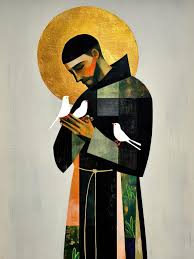
Image credit: https://www.instagram.com/p/CF_31K6sogj/

I was talking to a friend recently who had been on a road trip.  She had stopped for gas and was standing by her car when another car pulled up next to her.  A family piled out of the car, followed by the family’s dog.  My friend was paralyzed in place.  The dog looked exactly like her beloved dog Buddy who had passed away four years ago.  Her eyes immediately watered, and even though four years had passed, an ache appeared in her chest that she thought had long ago gone away forever.  “I just really miss that dog,” she explained later – surprising even herself at how her grief lingered.

I have sometimes wondered if our celebration of St. Francis and the Blessing of the Animals is not a little gimmicky.  We even took our celebration on the road yesterday for the first time, offering to bless animals and their owners whom we have never met, who maybe never harken the door of any church, let alone Hickory Neck’s doors.  But as I thought about my friend’s lingering grief over her dog who had passed, and as I have heard countless stories over the years of cats, horses, Guinea pigs, goats, and even chickens who have been a source of joy, companionship, sometimes consternation, but always love, I understand more fully why we commit to blessing animals and their owners, even if on the surface the practice may seem like a gimmick.

We engage in the blessing of animals because of the inspiration that comes from St. Francis of Assisi.  St. Francis is one of the most beloved saints of the Church.  Most of us think of Francis as the patron saint of animals and creation.  When we think of him, we may think of a St. Francis statue in a garden.  We may think of various images of him preaching to birds.   Some of us may even recall that tale where Francis negotiated peace between a village and a wolf that had been terrorizing the town.  His understanding of animals as his brothers and sisters is why we bless animals on his feast day – the creatures that were so dear to him.  That is also why when we say the Eucharistic prayer [at 10:00 am] today, we will use Prayer C – the one that praises, “the vast expanse of interstellar space, galaxies, suns, and the planets in their courses, and this fragile earth, our island home.”[i]

At the heart of our blessings yesterday and today is an understanding that St. Francis had mastered and we continue to understand – that we are bound to all of the creation God created – to the earth, to the earth’s animals, and to one another – even the other humans or other creation we may not like.  Jesus reminds us of the nature of that bond today in his words about following him.  In Matthew’s gospel, Jesus says, “Come to me, all you that are weary and are carrying heavy burdens, and I will give you rest.  Take my yoke upon you, and learn from me; for I am gentle and humble in heart, and you will find rest for your souls.  For my yoke is easy, and my burden is light.”  Those yokes Jesus talks about were used to harness two animals for work.  The yoke allowed the two not just to double their work, but to rely on one another – if one was tired, the other could push harder; and then the weaker one could later support the stronger one.  Yokes, like Jesus’ work, were easy and made the burden light. 

But beyond the mechanics of a good yoke, the yoke is also a good metaphor for how we see the gospel.  Being yoked to another makes you connected.  And once you are connected, and see how dependent upon one another you are, you begin to see how that connection extends beyond the two of you – that your yoked interconnection is a microcosm of the connectedness of all of God’s creation.  Francis, who was just as known for helping the poor as he was for befriending animals, understood that all humanity is connected.  He learned that the more we spend time seeing the humanity in others – especially the humanity in those we would rather not – then we start to see that our interconnectedness extends even further – to God’s creation, to God’s creatures, to the cosmos.  If we open our hearts to one, we cannot help but to open our hearts to all.  Francis’ love for the poor and Francis’ love for creatures were not two separate things – they were one in the same. 

The invitation for us is to start claiming our yoked nature – yoked to those we love, yoked to our political opponents, yoked to those who have different ethics and values than ourselves, yoked to parents who make different parenting decisions, yoked to those with different skin color or sexual orientation, yoked to those we see as deserving of God’s grace and those who are not.  Our yoked nature allows us to pray [and later sing] the Prayer of St. Francis from our Prayer Book:  “Lord, make us instruments of your peace. Where there is hatred, let us sow love; where there is injury, pardon; where there is discord, union; where there is doubt, faith; where there is despair, hope; where there is darkness, light; where there is sadness, joy. Grant that we may not so much seek to be consoled as to console; to be understood as to understand; to be loved as to love. For it is in giving that we receive; it is in pardoning that we are pardoned; and it is in dying that we are born to eternal life.”[ii]  We can do the work of St. Francis, blessing animals, humans, and all creation, because of the yoke of Jesus.  Thanks be to God.  Amen.


[i] BCP, 370.

[ii] BCP, 833.

Sermon – Luke 6.17-26, Jeremiah 15.5-10, EP6, YC, February 16, 2025

05 Wednesday Mar 2025

Posted by jandrewsweckerly in Sermons

≈ Leave a comment

Tags

blessed, blessing, curse, discipleship, God, Jesus, politics, Sermon, Sermon on the Plain, status quo, trust, vulnerable, woe

One of the things I love about the diversity of parish like Hickory Neck is that I often get to see the fullness of life in just a matter of days – or even hours.  Whether I am talking to a retiree dealing with new health issue, an adult dealing with rigors of parenting, or a kid dealing with the everyday challenges to their identity, the breath of life is ever before me.  But these last weeks have brought a new rawness that I have not seen in a while.  The philosophical arguments of an election year have birthed a new praxis that has everyone on edge – from deep divides about economic and ethical policies, to the questions of how we bound we are to care for our neighbors, to whole livelihoods and vocations coming into question.  We are swimming in a sea of defensiveness, of vulnerability, of righteous indignation – no matter where you find yourself on the political spectrum. 

Into that volatile atmosphere, we get some scripture today that cuts to the bone and leaves all of us standing vulnerably before God who is calling us to task.  The bite starts in Jesus’ Sermon on the Plain in Luke’s gospel.  The blessings alone should bring us up short:  blessed are you who are poor (not poor in Spirit like Matthew says, but the literal poor), who are hungry, who weep, who are reviled.  Jesus’ blessings should be enough to bring us up short about how we are treating the poor, hungry, and oppressed.  But Jesus does not stop there.  Then he begins with the “woes.”  The word “woe” in Greek is translated literally as “woe” – like the sound woe makes as woe comes out of your mouth – like a sigh of “oh man!”  As New Testament scholar Matt Skinner says, that sound is not necessarily a sign of disappointment, but as if Jesus is explaining, “Your vision is so small, so limited,” like Jesus is just giving a “deep sigh.”[i] And all of this blessing and woe would be hard enough in normal times, but the truth is, as many of our own find ourselves in economic insecurity – whether layoffs are coming, or social security may be cut, or loan payments may increase – we’re not even sure which category we are in anymore.

In looking at Luke’s Gospel, professor Mary Hinkle Shore explains, “The difficulty in…this text in a 21st-century American, mainline Christian context is that most of us who will hear this word are not inclined to trust it…  We aim to be rich, full, laughing, and respected.  Hearing the beatitudes from Jesus, we may be tempted to think, ‘I’ll take my chances with the status quo.’   This reaction may be why Jesus adds woes here after his blessings.  No matter how hopeful his words are, some in the crowd have placed their trust elsewhere, and the choices they have made are working for them.  For these, the woes are not curses, but warnings.  It is as if Jesus said, ‘Certain things are worthy of your trust, and other things are sure to betray it.’  When those objects of misplaced loyalty do betray your trust—Lord, have mercy.”[ii]

I think that is why the designers of the lectionary chose Jermiah today.  Jeremiah features blessings and curses too.  But these blessings and curses are almost harder because they are not about economic categories but about our very relationship with God.  Jeremiah pronounces in the text today, “Cursed are those who trust in mere mortals and make mere flesh their strength, whose hearts turn away from the Lord.  They shall be like a shrub in the desert, and shall not see when relief comes.  They shall live in the parched places of the wilderness, in an uninhabited salt land.”  In contrast, Jeremiah goes on to say, “Blessed are those who trust in the Lord, whose trust is the Lord.  They shall be like a tree planted by water, sending out its roots by the stream.”  All of holy scripture seems to be pushing us to deeply examine where we are putting our trust these days.

As many of you know I have been working the last few months on a charity event to raise money for two amazing non-profits in our community – a little event called Dancing with the Williamsburg Stars.  I thought the dance lessons would be fun, and as someone who has danced in the past, I thought I would have a somewhat easier go of things.  And I loved the idea of representing Hickory Neck in such a fun-loving way.  But here’s the funny thing about ballroom dancing – dancing with a partner requires a level of trust I never experienced when dancing in an ensemble.  A few weeks ago, we were practicing a move where I basically lean backwards, held up by my partner.  I thought I was doing a great job until we watched video replays.  I was barely dipping my head back at all.  My partner had to show me where his arms were placed to catch me and how little I was leaning into them.  Then just this week, we were working on another move were I basically fall forward with an extended arm behind me.  My partner explained that if I try to catch myself in the fall, I will make him fall.  I must trust that his hold is steady enough that I won’t slam face-forward to the ground.  And then, just to show me how I still wasn’t fully trusting him, he showed me how even in the turn out from that fall, I was muscling my arm to get up, instead of trusting him to pull me up. 

We are in intricate dance with God right now.  We are vulnerable, on stage, and not at all in control.  Our natural inclination is going to be to muscle our way through, to fight for some modicum of control, to determine what we want (to be rich, full, laughing, and respected) and trusting that that fullness is the ultimate end game.  Into that battle of wills, Jesus sighs a big “woe.”  As we stare out into the audience of that dance, I love what Debie Thomas sees in this text.  When thinking about her relationship with trust and God, Thomas confesses, “I might begin by admitting that Jesus is right.  I might come clean about the fact that most of the time, I am not desperate for God.  I am not keenly aware of God’s active, daily intervention in my life.  I am not on my knees with need, ache, sorrow, longing, gratitude, or love.  After all, why would I be?  I have plenty to eat.  I live in a comfortable home.  My family is safe.  I’m not in dire need of anything.  In short, there isn’t much in my circumstances that leads me to a sense of urgency about ultimate things.  I can go for days without talking to God…Most of the time, it just plain doesn’t occur to me that I would be lost — utterly and wholly lost — without the grace that sustains me.”

Thomas goes on to conclude, “I think what Jesus is saying in this Gospel is that I have something to learn about discipleship that my life circumstances will not teach me.  Something to grasp about the beauty, glory, and freedom of the Christian life that I will never grasp until God becomes my everything, my all, my starting place, and my ending place.”[iii]  In other words, until I let God take the lead, and actually follow, my dance through this life is going to echo the woe’s I have been sighing for the last several weeks.  Blessing comes in placing trust not in earthly things or earthly policies, but in the Lord.  Then, as Jeremiah reminds us, we will be like trees planted by water, roots going down by the stream, and leaves that stay green, not ceasing to bear fruit.  When we are so rooted, growing, and producing, then we can share our fruit, our shade, our refreshment.  God needs us so rooted so that we can stop sighing woes and start being blessings.  Amen.


[i] Matt Skinner, “Sermon Brainwave Podcast:  #1008: Sixth Sunday after Epiphany (C) – Feb. 16, 2025,” February 6, 2025, as found at https://www.workingpreacher.org/podcasts/1008-sixth-sunday-after-epiphany-c-feb-16-2025 on February 12, 2025.

[ii] Mary Hinkle Shore, “Commentary on Luke 6:17-26,” February 16, 2025, as found at https://www.workingpreacher.org/commentaries/revised-common-lectionary/sixth-sunday-after-epiphany-3/commentary-on-luke-617-26-3 on February 14, 2025.

[iii] Debie Thomas, “Leveled,” February 6, 2022, as found at https://www.journeywithjesus.net/essays/3319-leveled on February 14, 2025.

Sermon – 1 Kings 17.8-16, P27, YB, November 10, 2024

13 Wednesday Nov 2024

Posted by jandrewsweckerly in Sermons

≈ Leave a comment

Tags

afraid, blessing, church, consecration, drought, election, Elijah, enough, God, promise, Sermon, stewardship, trust, widow of Zarephath

On this Consecration Sunday, the day we offer and celebrate our gifts to support the ministry of this beloved community, the lectionary seemingly delivers the perfect text – the widow’s mite.  One might guess the lectionary shapers designed the lectionary just for a day like today – so that the sermon might be a nice a tidy story about how you too might give sacrificially.  But that story – and that sermon – are not our gift today.  After the tumultuous election week we have had, our gift lies with another widow – the widow of Zarephath from the first book of Kings. 

The widow of Zarephath is both a woman and widow, and as you know by now, that makes her doubly vulnerable in Elijah’s day.  In fact, although our translation says she is a widow, the original Hebrew actually adds, “…the word ‘woman’ in apposition before ‘widow.’  Verse 9 could literally be translated as, “Rise and go to Zarephath, which belongs to Sidon, and dwell there.  Look, I have commanded a woman, a widow, to sustain you.”[i]   The widow is also the mother of a child who is dependent upon her, so she has needs beyond her own.  If we read a bit further in Kings, we learn she is not normally poor – even as a widow, she owns a home that is large enough for an upper chamber.[ii]  And, we know she lives in Sidon, which means she is a foreigner, and that she likely worships Baal.

But to fully understand this widow we have step back even further.  The reason Elijah wanders into Sidon needing food is because he is fleeing Queen Jezebel, another Sidonian woman who has convinced King Ahab to build temples to Baal, and who threatens to kill Elijah.  So, we already see two different treatments of Elijah by two different Sidonian women.[iii]  But the other big piece of information is there is a drought in the land – and the lack of water means a threat to life – in fact, any poverty the widow of Zarephath faces is because the drought has dried up the food supply.  But drought also has theological significance in this story.  “…the condition of drought is the result of the Israelite King Ahab’s disobedience.”[iv]  As Old Testament Scholar Ellen Davis explains, “Overall, from a biblical perspective, the sustained fertility and habitability of the earth, or more particularly of the land of Israel, is the best index of the health of the covenant relationship.”[v]  In other words, if there is a drought, the people of God have really messed up!

Now sometimes stories from the Bible feel so foreign, that even with context like we just learned, we do not really feel like we can relate.  But if we really think about the widow of Zarephath and her context today, we find much more relatability than we might like to admit.  We certainly know the reality of people of means suffering financially.  In fact, a recent story from Forbes said that over 75% of Americans are living paycheck to paycheck.[vi]  That’s a lot of folks eking out a living with last bits of grain and oil.  We also know something about fighting about authority and ultimate values – where we put our trust.  I would say the dramatically different reactions to the election this week are a classic example – from people who are relieved by the election results to people who feel so marginalized they do not feel like they can even stay in relationship with their neighbors.  Our church too is living donation to donation – with the annual threat of budget deficits – and is now facing the reality of what being a politically diverse community means – how we will not just respect differences but how we will actively serve Christ as one.  I think we are all too familiar with what being in a theological drought is all about.

So, what happens to this woman widow in Zarephath?  As she faces the ludicrous request of Elijah to feed him when she is literally about to feed her son and herself their last meal before they die of starvation, Elijah says, “Do not be afraid.”  I confess, when I first read those four words this week, “Do not be afraid,” I was pretty upset.  That’s God’s answer to this theological drought we are in?  This hurting, deeply divided, seemingly irreparable place?  Do not be afraid?!?  Now, the good news is I stayed in the text.  As I kept studying, I stumbled on a commentary in which Professor Robert Wall said, “‘Do not be afraid,’ is not meant to comfort one facing death but rather to inspire confidence that [Elijah’s] God keeps promises of salvation made.”[vii]  Elijah’s God keeps promises of salvation made.  And as if to support the good professor’s insight, Elijah goes on to say in the text, “For thus says the LORD the God of Israel:  The jar of meal will not be emptied and the jug of oil will not fail until the day that the LORD sends rain on the earth.”[viii]  God never says the jar will be overflowing or we will have so much we will need a second jug.  But God does say we will have enough.

Those words from Elijah, those words that often introduce an oracle of salvation[ix], are words for us too.  Do not be afraid.  I know those four words may feel impossible for some of us today.  Many of you have already told me about your literal fears:  either your fears about the economy before the election or your fears for your rights and dignity after the election.  But those four words are our promise today – that God keeps promises of salvation made.  Like Elijah promises the widow, so God promises to you today that your jar of meal will not be emptied and your jug of oil will not fail until the day that the LORD sends rain on the earth.  So, even in our fears, we make promises to the church about what time, talent, and treasure we can share to ensure our ministries remain vibrant and thriving.  In our fears, we keep coming to church and engaging with neighbors who differ from us more meaningfully than we did before.  In our fears, we trust in our God, no matter what civic leaders are in place.  Because our jar will not be emptied and our jug will not fail, we can trust that we will have enough – enough for ourself, enough for our neighbor, and enough for the church.  We can say yes, just like the widow of Zarephath on the verge of death.  We can say yes.  Do not be afraid.  Amen.


[i] David G. Garber, Jr, “Commentary on 1 Kings 17:8-16,” Working Preacher, November 10, 2024, as found at https://www.workingpreacher.org/commentaries/revised-common-lectionary/ordinary-32-2/commentary-on-1-kings-178-16-9 on November 8, 2024.

[ii] Denise Dombkowski Hopkins, “Exegetical Perspective,” Feasting on the Word Supplemental Essays, Year B, Batch 4 (Louisville:  Westminster John Knox Press, 2012), 6.

[iii] Hopkins, 4.

[iv] Garber.

[v] Ellen F. Davis, Scripture, Culture, and Agriculture: An Agrarian Reading of the Bible (New York: Cambridge University Press, 2009), 8, as quoted by Garber.

[vi] Emily Batdorf , “Living Paycheck To Paycheck Statistics 2024,” Forbes Advisor, April 2, 2024 as found at https://www.forbes.com/advisor/banking/living-paycheck-to-paycheck-statistics-2024/?fbclid=IwY2xjawGcVSVleHRuA2FlbQIxMAABHSkGQLYo1Mye_ETSWURRZckm0B5EKB226F-g1znt-H6_s6kt5j5eFvxjvw_aem_OKcSGHZduH78GmIJSrYAZw on November 8, 2024.

[vii] Robert W. Wall, “Theological Perspective,” Feasting on the Word Supplemental Essays, Year B, Batch 4 (Louisville:  Westminster John Knox Press, 2012), 3.

[viii] 1 Kings 17.14.

[ix] Ronald J. Allen, “Considering the Text: Week Six, Twenty-Fifth Sunday After Pentecost, 10 November 2024”  Center for Faith and Giving, as found at centerforfaithandgiving.org, 41.

On Measuring What Matters…

09 Wednesday Oct 2024

Posted by jandrewsweckerly in reflection

≈ Leave a comment

Tags

blessing, celebration, complain, discipline, God, gratitude, Jesus, measuring, negative, positive, practice, Thanksgiving

Photo credit: https://texasleansixsigma.com/measure-what-matters/

This week we’ve been working intentionally on shifting my daughter’s propensity to complain.  She can have the best of days or afternoons, but at some point in the retelling of what happened, she’ll inevitably find something to complain about – what someone said, what someone did, or how she perceived something.  This week I threatened to start a daily tally of everything that came out of her mouth, putting her words in two columns:  positive things and negative things.  I told her we would see which column won at the end of the day.  I was honestly making an empty threat (who has time to monitor every word that comes out of a kid’s mouth?!?), but something about my threat registered with her.  The next morning, she was all positives – thanking me for mundane things, celebrating small victories, noticing the good.  When I picked her up from school that day, she proclaimed, “Actually, today’s been a really good day!”  We celebrated what a wonderful experience both she and I had had that day, noticing what her intentionality had done.

I’ve been thinking about our experiment and have been recalling all the times I have taken on a discipline of gratitude – all the times I have fallen into the very same patterns as my child.  There have been times when I have used my prayer beads, only praying prayers of thanksgiving instead of petition.  There have been times when I have used my journal to find at least three things at the end of the day for which I can give thanks (some days that was harder than others!).  And there have been times when I have read books or heard testimonies about the powerful transformative practice of gratitude.

These last weeks, gratitude has been challenging to come by.  I have been watching helplessly as countless homes, businesses, churches, roads, and whole towns have been washed away by hurricanes – only to be bracing for the impact of another one today.  I have been praying with friends and community members recovering from freakish events:  being hit by car, road rage gun violence, and random violent targeting.  I have listened to the anxieties of parishioners, completely consumed by worry about the presidential election less than a month away. 

This Sunday, our church will kick of stewardship season, as we ponder what really matters in our lives.  As we have already been reflecting this year, we are a community blessed with abundance.  We could certainly go down the road of scarcity, detailing all the things we are longing for or missing.  But instead, we are entering an intentional time of noticing:  noticing the abundance around us, noticing the blessings that embrace us, noticing the goodness and love of God in our lives.  I am looking forward to the gift of a season of gratitude – of celebrating the good and honoring the abundance of our Lord and Savior, Jesus Christ.  I am hopeful that each day in this stewardship season, we can begin to turn our hearts from pain, and find the way, even if in something miniscule, to be able to say, “Actually, today’s been a really good day!”  I invite you to join us in the celebration of what matters!

Sermon – Matthew 11.25-30, St. Francis Feast, YB, September 29, 2024

02 Wednesday Oct 2024

Posted by jandrewsweckerly in Sermons

≈ Leave a comment

Tags

animals, blessing, interconnected, Jesus, poor, Sermon, St. Francis, stigmata, yoke

Today we honor the life and witness of St. Francis of Assisi.  St. Francis is well-known and beloved for myriad reasons.  Primarily, people tend to appreciate two things about him: his commitment to living in solidarity with the poor, which included dramatically stripping his clothing off, begging for food, and supporting the most needy; and, his affinity for the creatures of God, with stories of preaching to birds, negotiating with a violent wolf to make peace with the local town, and generally valuing the beasts of the earth.  But what we rarely talk about is the stigmata of St. Francis – those marks corresponding to the ones left on Jesus’ body by the crucifixion said to have been impressed by divine favor on devoted followers of Christ.

Here’s what we know about St. Francis’ stigmata.  He was praying on the Feast of the Cross, which falls on September 14.  His prayer that day to Jesus was that he might feel in his body and soul the pain that Jesus felt in the Passion.  But he also prayed to feel in equal measure the excessive love that Jesus felt that allowed him to endure pain for us.  We are told that in his intense prayer session, he saw a vision, and when he emerged, he had what looked like piercings in his hands and feet – or, stigmata.[i]  Now I don’t know how you feel about the existence of stigmata on certain saints, but I’ve always thought it was a little, well, weird – and even more heretical, maybe even unbelievable.

So, why, on this Sunday when all we want to do is bless and celebrate animals or remember the poor, do we need to talk about stigmata?  Believe me or not, there is actually a deep correlation with today’s gospel lesson.  Today, Jesus talks about yokes – those tools used to harness two animals for work.  The yoke allows the two not just to double their work, but to rely on one another – if one is tired, the other can push harder; and then the weaker one can later support the stronger one.  Yokes, like Jesus’ work, are easy and make the burden light. 

But beyond the mechanics of a good yoke, the yoke is also a good metaphor for how we see the gospel.  Being yoked to another makes you connected.  And once you are connected, and see how dependent upon one another you are, you begin to see how that connection extends beyond the two of you – that your yoked interconnection is a microcosm of the connectedness of all of God’s creation.  When Francis prayed fervently to both feel Jesus’ deepest physical pain as well as Jesus’ excessive outpouring of love, his resulting stigmata left a physical reminder of the ways in which, even in pain or great love, we are connected to one another.

Perhaps another example may help.  “Ramakrishna was a mystic who lived in India over a hundred years ago.  One day, as he was walking through the marketplace, he saw a servant boy being whipped by his master.  As he watched that boy being whipped, welts appeared on Ramakrishna’s own body.”  We are told that, “This suggests that this man had such a strong feeling for this boy that he could identify with him in the sufferings that he was enduring.”[ii]  Furthermore, “Like Ramakrishna, who was so at one with God that he could walk through the marketplace and become one with God’s creations, especially this poor servant, Francis so identified with the suffering of Jesus that he took on the wounds himself.”[iii]

What we see in Francis’ stigmata and even in the experience of the mystic Ramakrishna is that when we are living faithfully, we begin to see that we are yoked to one another.  We slowly begin to see all of humanity is connected.  And the more we spend time seeing the humanity in others – especially the humanity in those we would rather not – then we start to see that our interconnectedness extends even further – to God’s creation, to God’s creatures, to the cosmos.  If we open our hearts to one, we cannot help to open our hearts to all.  Francis’ love for the poor, Francis’ love for creatures, and even Francis’ stigmata are not disconnected – they are one in the same. 

In Psalm 148, a psalm sometimes read or sung on St. Francis’ feast day, we hear an invitation to all of God’s creation:  Mountains and all hills, fruit trees and all cedars;  Wild beasts and all cattle, creeping things and winged birds; Kings of the earth and all peoples, princes and all rulers of the world; Young men and maidens, old and young together.[iv]  We bless animals today because Francis reminded us how all of God’s creation is worthy of love and is interconnected.  But the invitation for us today is not just to love on cute dogs, cats, hamsters, and horses.  The invitation for us is to start claiming our yoked nature – yoked to those we love, yoked to our political opponents, yoked to those who have different ethics and values than ourselves, yoked to parents who make different parenting decisions, yoked to those with different skin color or sexual orientation or gender identity, yoked to those we see as deserving of God’s grace and those who are not.  Our yoked nature allows us to pray the Prayer of St. Francis from our Prayer Book:  “Lord, make us instruments of your peace. Where there is hatred, let us sow love; where there is injury, pardon; where there is discord, union; where there is doubt, faith; where there is despair, hope; where there is darkness, light; where there is sadness, joy. Grant that we may not so much seek to be consoled as to console; to be understood as to understand; to be loved as to love. For it is in giving that we receive; it is in pardoning that we are pardoned; and it is in dying that we are born to eternal life.”[v]  We can do the work of St. Francis because of the yoke of Jesus.  Thanks be to God.  Amen.


[i] Hilarion Kistner, O.F.M., The Gospels According to Saint Francis (Cincinnati:  Franciscan Media, 2014), 88-91.

[ii] Kistner, 87-88.

[iii] Kistner, 92.

[iv] Psalm 148.9-12.

[v] BCP, 833.

On the Joy of It Not Being about You…

28 Wednesday Aug 2024

Posted by jandrewsweckerly in reflection

≈ 1 Comment

Tags

blessing, community, death, dementia, gift, God, illness, Jesus, joy, light of Christ, peace, presence, visit

Photo credit: https://wexnermedical.osu.edu/blog/visit-someone-in-hospital

One of the privileges of the work I do are visitations.  On countless occasions I have visited someone approaching death, someone in the throes of dementia, or someone just bone-weary with illness, and the immediate response when I walk in the door is a huge smile and the lightening of their countenance. 

I am very clear what that reaction is not.  It is not about me:  I have come to understand that the reaction is much more about the collar I wear and associations that collar has with a beloved church community.  It is also not about me bringing God to the room:  God is already there – my presence just sometimes helps people remember that fact.  And the reaction is definitely not about what I bring:  my visit will not physically change the pending death, the continued dementia, or the ongoing suffering – my work is much more about helping the individual find peace and a sense of connection to God in what can feel like a desert.

Despite all the things those smiles and lighter countenances are not, there is still a shared joy in them.  As the parishioner is reminded of God’s grace and love, so am I.  I too take joy in how being a part of a community can make me feel whole.  I too marvel at God’s presence that has gone before me.  I too can receive the peace of Christ in those desert places.  The gift of the visitation is not just for the visited.  The gift is also to the visitor.

I wonder what ways God is inviting you to be that smile and lightened countenance for others.  As schools restart, I see overwhelmed, weary parents, children, and teachers trying to adjust.  As individuals struggle financially, I see the defeated feelings that manifest themselves in hunched body postures and the diminished capacity for hope.  As a caretaker sits through another appointment or misses another engagement, I see a fatigue unlike any other.  To whom is God inviting you, in your daily journey, to be the light of Christ – to be the reminder that God is already there, that a community awaits, and that glimpses of peace can be found?  It is not about you, to be sure.  But you will be blessed as you do the work of blessing too. 

Sermon – Jeremiah 31.31-34, Psalm 51.1-13, L5, YB, March 17, 2024

27 Wednesday Mar 2024

Posted by jandrewsweckerly in Sermons

≈ Leave a comment

Tags

blessing, covenant, Easter Vigil, failing, God, heart, Jeremiah, Lent, lovingkindness, salvation narrative, Sermon, share

In just a couple of weeks, Hickory Neck will gather for what is my favorite service of the entire year:  the Easter Vigil.  Now I know, you may be thinking, “But what about Easter Sunday?” or even “But Christmas Eve is the best!”  For me, the very best of the Episcopal Church happens at the Easter Vigil.  The lights are turned down low, a fire erupts as we sing the haunting Exultet, we read stories from scripture that feel like the ones you would tell around a campfire, we baptize new Christians, and then, with bells and singing, the lights come up as we ring in Easter.  The rest of the service feels like celebrating Eucharist for the first time – with the news of the empty tomb and feasting at the family table.

Part of why I love the service so much is those stories we hear by the fire:  what we often refer to as the salvation narrative.  In these stories we hear how we were created in God’s image and made for goodness, and then we hear how time and again we fail to live up to that goodness, but time and again, God meets us where we are, renewing God’s covenantal relationship with us, forgiving us, and getting us back on our feet to serve the world in God’s name.  The repetition of God extending that grace again and again and again, no matter how grave our failings, can make any participant begin to think that maybe, just maybe, we stand invited to receive that hesed or as we translate the Hebrew, that lovingkindness, of God.

Although we do not hear the text from Jeremiah on Easter Vigil night, today, on this fifth Sunday in Lent, just a week before we start the descent into the cross and the grave of Holy Week, we get one last reminder of the kind of redemption that waits on the other side of Easter.  I do not how recently you’ve been reading Jeremiah in your spare time, but just as a refresher, Jeremiah is one of those books that is generally filled with bad news.  Israel disobeyed the law of God, and, as a consequence, they are overthrown by outside forces, the walls of Jerusalem fall, the temple is destroyed, and the Israelites themselves are banished to Babylon.  The situation is bleak, and the prophet Jeremiah has a lot to say in judgment of the people.[i] 

But today, all the way in chapter 31, we get what is called “The Book of Comfort,”[ii] in Jeremiah where, after much shame and judgment, the people are promised a new day where there will be a new covenant between God and the people.  This time, they won’t have to wait for teaching, and they won’t have to store the commandments in a holy place.  The holy word of God will be written on their hearts – able to go with them anywhere, to be not just in their minds or in their temple, but on their very souls – they will be God’s and God’s will be theirs.  For a people utterly destroyed, who have lost their spiritual home in addition to their literal home, this is good news indeed.

When I was in seminary, we went to Chapel everyday – sometimes multiple times a day.  The rhythm of regular worship meant that not only did the liturgy get written into your body, so did the space.  You began to know the particulars of certain seats – which ones experienced more of a draft and which pew had someone’s initials carved in and aged over.  You knew how certain steps would creak when someone would ascend the lectern and you have seen the pulpit sway with a particularly vigorous preacher.  But mostly, you had stared, for years at a time, at the window behind the altar, around which were painted the words, “Go ye into all the world and preach the gospel.”  Consciously and maybe more subconsciously, those words became ingrained in our minds seeing them every day. 

A year and a half after I graduated, that chapel burned down, along with that wall that had been seared into my mind.  I remember feeling bereft – like a part of me had died with the loss of that building.  Even today, when I visit the campus, worshiping in the beautiful new chapel, I still grieve when I see the preserved ruins where an outdoor altar remains.  It took me a long time to realize that although my heart ached for the physical space, those words – those words that Jesus spoke, “Go ye into all the world and preach the gospel,” were gone from the world – but not from my heart.  Though I might miss the building – in the same way so many of us missed the buildings of this campus in those early years of the pandemic, the experience of God is written in my heart.

As we walk this last week of Lent, and as we begin next week to walk steadily through Holy Week, perhaps with sins weighing on our hearts, or feelings of being a failure at faith or at life in general, or even just the restlessness that can come when we find ourselves disconnected from any kind of relationship with God, our worship today is all about renewing that covenantal relationship with God.  Even in our psalm today, we prayed, “Create in me a clean heart, O God, and renew a right spirit within me.” – those same words a priest prays before she consecrates the sacred meal.  The psalm tells us the very nature of our God is “steadfast love and abundant mercy, a God who is eternally ‘for us’ with the endless love of a mother for her child.  The God who is everlasting love will never abandon us, no matter what our guilt says.  Steadfast love and abundant mercy heal us not only of the stain of sin, but also of the lie of our worthlessness.”[iii]  So likewise, Jeremiah confirms that encouragement.  As one scholar explains, “God will write the capacity for keeping the covenant on the inward hearts of the people.  Hope for such transformed wills will lie with God’s grace, not in any hope for human perfection.”[iv]

Your promise today is blessing upon blessing – blessing of belonging, of permanence, of mercy and lovingkindness.  The invitation today is then up to you.  What will you do with that renewed covenantal relationship?  How will walk differently this week with the covenant of God written on your heart?  How will you treat your neighbors differently, yourself differently, and your God differently?  The blessing is yours to keep deep in your soul.  And the blessing is also yours to share with a world that needs that blessing so very deeply.  Your work this week is to find your unique place to share that blessing.  Amen.


[i] Woody Bartlett, “Homiletical Perspective,” Feasting on the Word, Year B, Vol. 2 (Louisville: Westminster John Knox Press, 2008), 123.

[ii] Jon L. Berquist, “Exegetical Perspective,” Feasting on the Word, Year B, Vol. 2 (Louisville: Westminster John Knox Press, 2008), 123.

[iii] Elizabeth Webb, “Commentary on Psalm 51:1-12,” March 17, 2024, as found at https://www.workingpreacher.org/commentaries/revised-common-lectionary/fifth-sunday-in-lent-2/commentary-on-psalm-511-12-6 on March 14, 2024.

[iv] Samuel K. Roberts, “Theological Perspective,” Feasting on the Word, Year B, Vol. 2 (Louisville: Westminster John Knox Press, 2008), 126.

Sermon – Genesis 17.1-7, 15-16, Mark 8.31-38, L2, YB, February 25, 2024

15 Friday Mar 2024

Posted by jandrewsweckerly in Sermons

≈ Leave a comment

Tags

abundant, blessing, control, covenant, God, independence, Jesus, Lent, parent, parenthood, resistance, Sermon, trust

I remember in those first months of parenthood, an older mom and educator shared a bit wisdom with me.  “Remember, that your primary job as a parent,” she told me, “is to foster the independence of your child.”  At the time, her advice seemed a little strange – nothing about making the child feel loved, or reading to them every night, or creating safe space:  just fostering independence.  What I did not realize at the time was how incredibly difficult and grueling the work of fostering independence would be.  For starters, fostering independence in your children means giving up control – something I tend to like having.  And as if that is not hard enough, fostering independence means being the victim of your children’s own desire for control.  I cannot tell you the number of times I have been walking in my house muttering the words, “I am raising independent children.  I am raising independent children.  I am raising independent children.”

I think why this aspect of parenting is so tricky for me is parenting gets to the heart of one of the eternal struggles we have in life – and certainly with God:  our desire for control.  So, we should not at all be surprised to discover that during Lent, that is what both our Old Testament and our Gospel lessons are about:  ceding control.  We can start with Abraham’s story.  This is actually the third time Abraham has been promised a son – or at the beginning of our text, he is still Abram, not Abraham.  But we’ll get to that later.  Abram struggles like we do with control.  When he and Sarai are not pregnant at 75, or 86, or now 99 years old, he’s pretty sure God is not going to make good on God’s promise.[i]  So, Abram takes matters into his own hands and has a child with Hagar, Sarai’s servant, hoping he can make Ishmael the inheritor of God’s promise.  Abram and Sarai just could not trust and cede control to God about becoming pregnant themselves, especially since God’s promise is so ludicrously abundant.  In fact, in the verse immediately following what we read today, we are told Abraham falls on his face and laughs at God.  That is how ludicrously abundant God’s promise is for progeny. 

Of course, Peter is not much better when he needs to trust Jesus.  Jesus tells the disciples in Mark’s gospel that he will suffer and die to fulfill his role as the Messiah.  But Peter, and quietly the other disciples[ii], physically grabs Jesus and rebukes him.  The things Jesus is saying are not the way Peter or the others expected a Messiah to function for good.  As one scholar explains, they signed on for a crown, not a cross.[iii]  But Peter’s grasping rebuke of Jesus is about as literal of resistance as one can get:  an utter unwillingness to cede control of how salvation through the Messiah will work.  And so, Jesus says those stingingly harsh words, “Get behind me Satan!  You are thinking not as God thinks, but as human beings do.”[iv]  Peter and the disciples are no better at trusting and ceding control to God than Abraham is.

In some way or another, I think most of our Lenten disciplines, most of the sinfulness that we are praying about or working on in Lent is rooted in this very issue: our issues with control and trusting in God.  We are so deeply rooted in the American ethic of working hard, achieving your goals, of pulling yourself up by your bootstraps and realizing your own destiny that we leave very little space for God in our lives.  We love being endowed with free will, so the notion that we should just trust God or even give up control to God feels like a fool’s errand.  Having this ethic deeply seeded in our core identity, we, as one scholar argues, arrogantly “assume that we know what must be done, so that even a word from Jesus himself cannot dissuade us.  Blinded by our prejudices, presuppositions, and preconceptions of the way things must be, we would not be convinced otherwise, even were someone to rise from the dead!”[v]

Before we get slapped in the face five weeks from now, when Jesus actually rises from the dead, how might we begin to take a harder look at the illogical nature of our resistance to God?  I like to turn toward Abraham.  I’m going have you do what they do in my mom’s evangelical church, and turn back to the Word of scripture found in your bulletin, and grab a pen (or at least a pen in your imagination).  We’re going to look back over that text and literally or mentally circle every word of abundance in this Genesis text.  We find words like, “exceedingly numerous,” “multitude of nations,” “multitude of nations,” (again) “exceedingly fruitful,” “nations,” “kings,” “throughout their generations,” “everlasting covenant,” “offspring after you,” “bless,” “rise to nations,” “and “kings of peoples.”[vi]  Abram turned Abraham may not have much to say in how this covenant with God will unfold.  But everything we read about this covenant is not just blessing, but abundant blessing.  This covenant is oozing with generosity and indulgence.  The abundance of God’s covenant is embarrassingly, overwhelmingly over the top.  Even Abram’s name change is a marker of this abundance.  The Hebrew for Abram is “father;” the Hebrew for Abraham is “father of a multitude.”[vii]

I do not know what you are holding back from God these days.  I do not know where your lack of trust in God is making you grasp onto a sense of control, as though you know better than the Almighty.  But our texts today are inviting us to let go of the death grip on the way we think things should be, and to make space for the ways God is showing us how things can be.  We will not get our say in the matter necessarily – no amount of struggle will make things better.  But the promise is that when we give our lives over to Christ – when we put our trust in the God whose covenants are not just okay – or even pretty good – but are shockingly, unimaginably abundantly awesome, we are promised very good things indeed.  Some of those good things will be so good we find them laughable.  But that is just because our imagination and our abilities to produce abundant goodness are not like God’s.  But God gifts them to us anyway.  Our invitation is to open our hands and receive them.  Amen.


[i] Barbara Brown Taylor, “Homiletical Perspective,” Feasting on the Word, Yr. C, Vol. 2 (Louisville: Westminster John Knox Press, 2009), 51.

[ii] Jouette M. Bassler, “Exegetical Perspective,” Feasting on the Word, Yr. C, Vol. 2 (Louisville: Westminster John Knox Press, 2009), 71.

[iii] W. Hulitt Gloer, “Homiletical Perspective,” Feasting on the Word, Yr. C, Vol. 2 (Louisville: Westminster John Knox Press, 2009), 71.

[iv] NAB, NJB translations as provided by Bassler, 71.

[v] Gloer, 71.

[vi] This notion of abundance in the text presented by Karoline Lewis in “#950: Second Sunday in Lent – Feb. 25, 2024,” Sermon Brainwave Podcast, February 18, 2024, as found at https://www.workingpreacher.org/podcasts/950-second-sunday-in-lent-feb-25-2024 on February 23, 2024.

[vii] W. Sibley Towner, “Exegetical Perspective,” Feasting on the Word, Yr. C, Vol. 2 (Louisville: Westminster John Knox Press, 2009), 55.

← Older posts

Recent Posts

  • On the Myth and Magic of Advent…
  • On Risking Failure and Facing Fear…
  • Sermon – Luke 23.33-43, P29, YC, November 23, 2025
  • On Inhabiting Gratitude…
  • Sermon – Luke 20.27-38, P27, YC, November 9, 2025

Archives

  • December 2025
  • November 2025
  • October 2025
  • September 2025
  • August 2025
  • July 2025
  • June 2025
  • March 2025
  • February 2025
  • December 2024
  • November 2024
  • October 2024
  • September 2024
  • August 2024
  • July 2024
  • June 2024
  • May 2024
  • March 2024
  • February 2024
  • January 2024
  • December 2023
  • November 2023
  • October 2023
  • September 2023
  • August 2023
  • July 2023
  • June 2023
  • May 2023
  • March 2023
  • February 2023
  • January 2023
  • December 2022
  • November 2022
  • October 2022
  • June 2022
  • May 2022
  • January 2022
  • December 2021
  • November 2021
  • October 2021
  • September 2021
  • August 2021
  • June 2021
  • May 2021
  • April 2021
  • March 2021
  • February 2021
  • January 2021
  • December 2020
  • November 2020
  • October 2020
  • September 2020
  • August 2020
  • July 2020
  • June 2020
  • May 2020
  • April 2020
  • March 2020
  • February 2020
  • January 2020
  • December 2019
  • November 2019
  • October 2019
  • September 2019
  • August 2019
  • July 2019
  • June 2019
  • May 2019
  • April 2019
  • March 2019
  • February 2019
  • January 2019
  • December 2018
  • November 2018
  • October 2018
  • September 2018
  • August 2018
  • July 2018
  • June 2018
  • May 2018
  • April 2018
  • March 2018
  • February 2018
  • January 2018
  • December 2017
  • November 2017
  • October 2017
  • September 2017
  • August 2017
  • July 2017
  • June 2017
  • May 2017
  • April 2017
  • March 2017
  • February 2017
  • January 2017
  • December 2016
  • November 2016
  • October 2016
  • September 2016
  • August 2016
  • July 2016
  • June 2016
  • May 2016
  • April 2016
  • March 2016
  • February 2016
  • January 2016
  • December 2015
  • November 2015
  • October 2015
  • September 2015
  • August 2015
  • July 2015
  • June 2015
  • May 2015
  • April 2015
  • March 2015
  • February 2015
  • January 2015
  • December 2014
  • November 2014
  • October 2014
  • September 2014
  • August 2014
  • July 2014
  • June 2014
  • April 2014
  • March 2014
  • February 2014
  • January 2014
  • December 2013
  • November 2013
  • October 2013
  • September 2013
  • August 2013
  • July 2013
  • June 2013
  • May 2013
  • April 2013
  • March 2013
  • February 2013
  • January 2013
  • December 2012
  • November 2012
  • October 2012
  • September 2012

Categories

  • reflection
  • Sermons
  • Uncategorized

Meta

  • Create account
  • Log in
  • Entries feed
  • Comments feed
  • WordPress.com

Blog at WordPress.com.

  • Subscribe Subscribed
    • Seeking and Serving
    • Join 394 other subscribers
    • Already have a WordPress.com account? Log in now.
    • Seeking and Serving
    • Subscribe Subscribed
    • Sign up
    • Log in
    • Report this content
    • View site in Reader
    • Manage subscriptions
    • Collapse this bar
 

Loading Comments...