• About

Seeking and Serving

~ seek and serve Christ in all persons

Seeking and Serving

Tag Archives: blessing

Sermon – Matthew 11.25-30, St. Francis’ Feast Day, YA, October 5, 2014

08 Wednesday Oct 2014

Posted by jandrewsweckerly in Uncategorized

≈ Leave a comment

Tags

animals, blessing, burden, disciple, Jesus, light, reconciliation, rest, Sermon, St. Francis, wolf

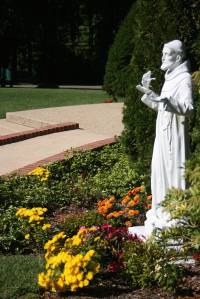
Today we honor the life of St. Francis of Assisi.  Francis is one of the most popular and admired saints of all time.  Most of us know the highlights of his story: born the son of a wealthy man in 1182; had a conversion experience and devoted his life to Lady Poverty; shaped monastic and lay devotion; was a friend to all God’s creatures – being know to have preached to the birds.

But the story I like most is the story about St. Francis and the Wolf.  According to legend, there was a wolf that was terrorizing the town of Gubbio, killing and eating animals and people.  The villagers tried to fight back, but they too died at the jaws of the wolf.  Francis had pity on the townspeople and went out to meet the wolf.  When Francis found the wolf, he made the sign of the cross, and said, “Come to me, Brother Wolf.  In the name of Christ, I order you not to hurt anyone.”  In response, the wolf calmly laid down at Francis’ feet.  Francis then went on to explain to the wolf how he was terrorizing the people and other animals – all who were made in the image of God.  The wolf and Francis then made a pact that he would no longer harm the townspeople and the townspeople would no longer try to hurt the wolf.  The two traveled into town to explain the pact they had formed.  The people were amazed as Francis and the wolf walked side-by-side into town.  Francis made the people pledge to feed the wolf and the wolf pledge not to harm anyone else.  From that day on, the wolf went door to door for food.  The wolf hurt no one and no one hurt the wolf; even the dogs did not bark at the wolf.[i]

What I love about this story of St. Francis is that the story is about reconciliation and relationship.  At the beginning of the story the town and the wolf are at an impasse – the wolf is hungry and getting attacked; the people are afraid and are lashing out.  What Francis does for both parties is shock them out of the comfortable.  For the wolf, no one has addressed the wolf kindly – they have either shut the wolf out or actively tried to kill him.  For the people, the wolf has not asked for help – he has simply and violently taken what he needed and wanted.  Francis manages to shock the wolf first – not through violence or force, but with the power of love and blessing.  By giving a blessing in the name of God, Francis is then able to implore the wolf to reciprocate with love.  Francis also manages to shock the village – not with a violent victory, but with a humble display of forgiveness and trust.  By walking into town with a tamed wolf at his side, Francis is able to encourage the town embrace, forgive, and care for the wolf.  Francis’ actions remind both parties that unless their relationships are reconciled, unrest and division will be the norm.

The funny thing about this story is that the story is pretty ridiculous.  I mean, how many of us go around talking to wild animals, blessing them with the sign of the cross, expecting anything other than being attacked?  We will never really know whether the story is true.  But like any good Biblical story, whether the story is true is hardly the point: the point is that the stories point toward “Truth” with a capital “T.”  What this story teaches is that peace and reconciliation only happen through meeting others where they are.  We cannot expect great change unless we are willing to get down in the trenches – to go out and meet that destructive wolf face-to-face.  The other thing this story teaches is relationships are at the heart of peace work.  Only when the wolf and the town began to get to know each other and began to form a relationship with one another could they move forward.

This is the way life is under Jesus Christ.  In our gospel lesson today, Jesus says, “Come to me, all you that are weary and are carrying heavy burdens, and I will give you rest.  Take my yoke upon you, and learn from me; for I am gentle and humble in heart, and you will find rest for your souls.  For my yoke is easy, and my burden is light.”  Jesus’ words have layered meaning.  The first meaning we all catch is that Jesus offers us rest and refreshment.  Jesus encourages us to come to him, to cast our burdens and cares upon him, and to take rest, to take Sabbath in Christ.  Our souls will find peace in Christ Jesus.  The second meaning is that peace in Christ Jesus is not without work.  Jesus does not say come unto me and relax forever in happy retirement.  Jesus says we will still have to take on a yoke – the burden of disciple living.  But luckily, that burden of being Christ’s disciple will not be burdensome – it will be light.  Finally, not only will Jesus make the workload “light,” as in not heavy.  Jesus will also make us “light” – as in lights that shine into the darkness and refuse to allow the shadow to overwhelm.[ii]  We become the light when we work for reconciliation in our relationships with others.

That is why we do so many special things today.  Today, we ask for healing prayers – that God might help us reconcile the relationships in our life that need healing.  Today, we ask for blessing on our animals – that God might help our relationship with our pet be one of blessing and light.  Today, we come to Jesus for Sabbath rest – that God might renew us on this Sabbath day, use the rest to fill us with light, and renew our commitment to be agents of reconciliation, gladly putting on Christ’s yoke.  Amen.

[i] John Feister, “Stories about St. Francis and the Animals,” as found at http://www.americancatholic.org/features/francis/stories.asp on September 30, 2014.

[ii] Mel Williams, “Let it go…and rest” Faith and Leadership, July 6, 2014 as found at http://www.faithandleadership.com/sermons/mel-williams-let-it-go%E2%80%A6and-rest  on September 30, 2014.

Sermon – Genesis 21.8-21, P7, YA, June 22, 2014

25 Wednesday Jun 2014

Posted by jandrewsweckerly in Uncategorized

≈ Leave a comment

Tags

blessing, God, Hagar, hear, Ishmael, promise, relationship, see, Sermon, suffering, understand, wilderness

Alice sat on her bathroom floor crying.  The bathroom was the only place she felt like she could get a moment of privacy.  Her tears were the release she found for what felt like an impossible juncture.  Last summer things had been okay for Alice.  She was coping with her divorce, and managing to feed and care for her son on her own, despite the fact that her income from cleaning houses was so small.  She had managed to work out some government assistance that gave her enough cushion to keep food on the table and a roof over their heads.  Life was not easy, but life could be a lot worse.

But during the last year, her world began to fall apart.  After a work injury, Alice could not clean houses for months.  Being self-employed meant she had no one to fill in at her houses.  After several months, her customers all got new help.  Because she was not working, her government assistance began to lower.  The assistance programs required that clients work to receive assistance.  Alice could not clean houses because of her injury, and she did not have enough education to qualify for any other type of work.  As the money became more and more scarce, Alice began to fear for her son.  Her son was looking thinner and more sickly each day.  He did not understand what was happening, and his deserved frustration and led her to the bathroom to cry.  Things had gone from bad to worse as Alice feared they would have no food, no home, or that she could lose her son.  All that was left to do was to cry:  to cry tears of sorrow, to cry out to God for mercy.

Hagar knows Alice’s tears.  We remember that Hagar is the handmaid for Sarah, Abraham’s wife, whom Sarah had given to Abraham to take as a wife because Sarah was infertile.  Hagar resented this action, and has already suffered a great deal, grappling with her powerlessness and lack over control over her most private, personal space.  Today the text brings us forward a few years in Hagar’s family.  Hagar’s son Ishmael is growing into a young boy, and Sarah has finally conceived her own son.  The birth of Isaac is a joyous occasion that all of the family celebrates.  But just as Hagar has begun to reclaim her personhood, Hagar suffers again.  Sarah sees Ishmael – the son that reminds her of her infertility, who will not represent the blessed line of Abraham – playing with Isaac – her own son, whom she proudly bore and who will mark the blessedness of Abraham’s line.  Sarah turns to Abraham and tells him to send Hagar and Ishmael away.  Although Abraham is crushed by the idea, God supports Sarah’s decision.  For Hagar, the world is against her.  We hear no words from Hagar as Abraham loads water and bread on her shoulders, gives her Ishmael, and sends her out into the wilderness.

Hagar wanders in the desolate wilderness until she runs out of water.  Looking at her son, whose death she imagines is immanent, Hagar puts him under the shade of a bush and walks away.  She walks away and cries out to God.  She cannot watch the death of her son.  Not after all she has been through.  She cries out to God as her last resort.

The tough part of this story is figuring out why this is happening.  Why would Sarah condemn Hagar and Ishmael to death by having them driven out into the wilderness?  Why would God agree with Sarah, especially when Ishmael’s birth was Abraham and Sarah’s choice in the first place?  Why does Abraham give up his first son so easily, without a word to Hagar?  The grief in this passage feels overwhelming, and we are left pointing angry fingers in multiple directions.

Hagar’s wilderness moment is familiar to us today.  We have those times when we feel like everyone is against us, including God.  The wildernesses of our lives are those desolate, lonely, dark places of wandering.  The wilderness is a scary, stark place of solitude that takes us to the depths of our finitude and forces us into encounters with God.  In the wilderness, we experience God in a way that we cannot not experience God elsewhere.  In the dry desert of suffering, which is scorching by day and frigid by night, with little water, we experience a sense of nakedness and vulnerability that we try to mask in our everyday lives.

Despite the darkness in the Genesis text today, there is also incredible hope for the suffering.  The last third of the text we hear today is filled with God’s action for the afflicted.  First, God hears Ishmael.  The text says “And God heard the voice of the boy.”  This word “to hear” is important on many levels.  In the original Hebrew, Ishmael’s name means “God will hear.”[i]  Already, Ishmael’s name – God will hear – comes to fruition.  God hears Ishmael.  Further, the word “to hear” in Hebrew, shamah, connotes more than physical hearing.  As we have talked about before, “to hear” in Hebrew also means “to understand.”  God understands how Ishmael and Hagar cry out.  God hears and understands their pain.

The second action we encounter at the end of this passage is God making a promise.  The angel of God speaks to Hagar about Ishmael saying, “I will make a great nation of him.”  We know from scripture that God does not make promises lightly with God’s people.  God fulfills God’s promises.  If God says that God will make a great nation of Ishmael, Hagar knows to believe God.  No matter how dire things seem, God makes a promise, and God does not disappoint.

The third action we encounter is that God opens Hagar’s eyes.  The text says that “God opened her eyes and she saw a well of water.”  In the opening of Hagar’s eyes, God allows Hagar to perceive God’s presence and action in her suffering.  God lifts the blindness that suffering and desperation create.  God shows Hagar the gift of life that God provides in the well of water.  God’s gift is abundant, and God reveals the gift when Hagar cannot see.

The fourth and final action is that God is with Ishmael.  The text says, “God was with the boy.”  The verb “to be” is one of the most simple and basic of words.  When applied to God, “to be with” has great meaning.  The text says that in all Ishmael does, in all the experiences Ishmael has, in all that Ishmael’s journey entails, God is with him.  God does not abandon Ishmael.  God does not forget.  God is with him.

I am reminded of one of my favorite Gospel hymns.  The hymn is called “He’s an On Time God.”  The song talks about the ways that God always comes to our need just when we need God.  The refrain goes, “He may not come when you want Him, but He’ll be there right on time.  He’s an on-time God, oh yes He is.”  The song describes the Israelites who crossed the Red Sea just before the Sea collapsed on the Egyptians, the relief of Job’s suffering, and the feeding of the 5,000 by Jesus.  What I love about the song is the booming chorus of singers and the repeated affirmation that God is on time.  Of course, the theology of the song is a little trickier.  I think the song misses something by suggesting that God is not always with us.  But the song is on to something.  I might rephrase the refrain to be something like – suffering may not end when you want it, but you will realize God is with you in the suffering right on time.  In this way, God is an on-time God.

We may not understand God’s actions, or why we suffer, but God is with us.  Hagar is a great gift this week for reminding us about what our relationship with God is like.  Hagar reminds us that we have an active relationship with God.  Hagar shows us that we can cry out to God in our suffering.  Hagar demonstrates to us that God is not a far away god who is removed from our daily lives.  By crying out to God, we reveal our earthy, dynamic relationship with God.

Meanwhile, God’s actions toward Hagar show us that God has a reciprocal relationship with us.  God is active in our lives.  God hears us, understands us, and will act in our lives.  God is with us, all of the time, especially in our suffering.  When we enter into that relationship with God, crying out to God, we let go of notions of distance from God or personal control of our lives.  We allow God to open our eyes so that we can see God’s action in our lives.  By opening our eyes, God shows us the blessings God has for us.  God did not tell Hagar and does not tell us what our blessings will look like.  But there will be blessings.  God will open our eyes to reveal the bounty of blessing for us.  As we enter into that holy, vulnerable relationship with God, allowing our eyes to be opened, we see God’s blessings – right on time.  Amen.

[i] Gordon J. Wenham, Word Biblical Commentary, vol. 2 (Dallas: Word Books, 1994), 88.

Both/and…

11 Wednesday Jun 2014

Posted by jandrewsweckerly in Uncategorized

≈ Leave a comment

Tags

and, blessing, both, Christ, maternity, parenting, priesthood, tension, vocation, work

Courtesy of http://www.vineyardusa.org/site/articles/both-and

Courtesy of http://www.vineyardusa.org/site/articles/both-and

I was fine until my older daughter’s teacher saw me without the baby, realized I had dropped her off at nursery school, and then asked if I was okay.  I really was fine.  But as soon as I tried to tell her how fine I was, my eyes moistened.  I kept my response short for fear that my eyes would overflow.  The truth is that I was not really fine.  I was sad:  sad to lose those moments of just gazing into my infant’s eyes; sad to lose that new experience of trying to get smiles out of her – especially since now her smiles are also accompanied by her whole face scrunching up in joy; sad to lose those moments of quiet rest, her warm body totally relaxed against mine, with no one else around to distract her.  Though there have been many periods of utter exhaustion, most of these weeks of maternity leave have been filled with the joy of the miracle of new life.  I have been thrilled to have the experience of having a newborn one more time, and I have been trying to soak up every moment.  And so, yes, I am sad for that time to be over.

And, I am also thrilled to be returning to work.  I use the word, “and,” and not, “but,” because I feel these emotions simultaneously.  I am sad to be ending maternity leave and my time with my newborn.  And I am happy to be returning to my work.  My work gives me such joy, meaning, and satisfaction.  It challenges me, makes me stronger, teaches me, and blesses me.  It is a tremendous privilege to serve as a priest – one that I am even more aware of having taken time away from it.  Though there are days that drive me crazy in my work, I cannot imagine living out any other vocation than my vocation as an ordained minister of the Church.  My love of being a mother to two wonderful girls does not negate my love of being a pastor to a community seeking, serving, and sharing Christ.

And so I am intentional these days about avoiding the word, “but,” when talking about my feelings about my two callings.  Instead, I am using the words, “both/and.”  I both grieve the loss of time with my children and I rejoice in being able to return to the other work God has given me to do.  Obviously some days the balance of “both/and” happens more smoothly than others.  But that balance is also the fullness of all the work God has given me to do – the work of being a priest, a mother, a wife, a friend, a sister, a member of the community.  My prayer for the coming weeks is that I can resist those moments when the “but” tries to sneak its way into my language, and hold dear to the “both/and” that is the blessing of my life right now.

All shall be well…

19 Wednesday Mar 2014

Posted by jandrewsweckerly in Uncategorized

≈ Leave a comment

Tags

All shall be well, blessing, life, maternity leave, prayer, present

This week marks the beginning of my maternity leave.  My life has already dramatically shifted from getting ready to be away from church for twelve weeks, to getting our family and home ready for a new baby.  It is a time of anticipation, busyness, excitement, and a bit of anxiety.  As I assured my parish, I assure myself:  “All shall be well, all shall be well, and all manner of things shall be well,” as Julian of Norwich would say.

Courtesy of https://www.etsy.com/listing/78048300/inspirational-quote-all-shall-be-well?ref=market

Courtesy of https://www.etsy.com/listing/78048300/inspirational-quote-all-shall-be-well?ref=market

Many of you have asked if I will still be writing while on maternity leave.  I have pondered this myself for quite a while, and I have decided that I will be applying my Lenten discipline to this area of life as well.  This year for Lent, I decided to give myself a break – not to push too hard, but to just try to be present in the moment, knowing that this Lent and Eastertide will be a time of dramatic change for our family and that God is in the midst of it all.  And so I may decide that I need the creative outlet, and will in fact be posting on the blog.  Or I may decide that I just need to be present with my daughter in the limited time that we have before I go back to work.  Either way, I am not putting pressure on myself.  So I suppose my answer is, “I don’t know.  We will see.”

In the meantime, I hope that you will hold me and my family in your prayers.  I know that new life is a sacred gift, and I look forward to sharing that gift with you…eventually.  Many blessings on your journey in the meantime.  I’ll see you soon!

Sermon – Genesis 12.1-4a, L2, YA, March 16, 2014

19 Wednesday Mar 2014

Posted by jandrewsweckerly in Uncategorized

≈ Leave a comment

Tags

Abram, blessing, challenge, go, God, hope, journey, Lent, pain, Sermon

I remember when I got accepted to Duke for my undergraduate education.  The invitation felt like a dream come true.  I was so ready to leave home and start my “adult” life, I was beyond thrilled to be able see Duke basketball games in person, I was eager to start my studies so that I could take on that big job, and I knew I would have a ton of fun.  As I packed my bags, I felt like the world was full of promise and hope and I just knew I was going to have an awesome college career.  And truthfully, my college experience was one of the best experience of my life on so many levels – one where I learned so much more than I expected, I made lifelong friends, I experienced my first sense of call to ministry, and I did in fact enjoy many a basketball game.  But that first year of college was nothing like the picture looking back now.  I had an awful freshman roommate, I struggled with the rigor of classes at first, I had a hard time finding a group of friends I really liked, there were multiple things I either tried out for our wanted to be invited into that I was not, and there were times that I wondered what in the world I was doing there.

As I listened to our Old Testament lesson today, I wondered how much Abram felt the same way about his own journey.  The very short passage from Genesis says, “The Lord said to Abram, ‘Go from your country and your kindred and your father’s house to the land that I will show you.  I will make of you a great nation, and I will bless you, and make your name great, so that you will be a blessing.  I will bless those who bless you, and the one who curses you I will curse; and in you all the families of the earth shall be blessed.’”  At first glance, Abram’s invitation sounds awesome!  He is invited on a journey with God and he is promised that God will bless him, will give him plenteous offspring and power, and that he will essentially be famous.  Who wouldn’t want to pack up their earthly belongings and hit the road with that kind of invitation?  The upcoming journey sounds like one full of promise, hope, and abundant joy.

Of course, there are a few slight indicators of how hard this journey might actually be.  First God tells Abram to leave his country, his kindred, and his father’s house – all without a map of where they will be going.  “In traditional societies the kin group is the source of identity, economic benefit, security, and protection.  To leave such a fundamental social network is to put a great deal at risk.”[i]  And then there is the text that we do not read today.  In the verses immediately preceding this text, we are told that Abram’s father has just died.  We all know what the death of a parent can do to a person, and can at least imagine the intense grief Abram is working under when he says yes to God.  And there is more that we do not read today.  The text immediately after where we stop also tells us that Abram is about 75 years old at this point.  So a man well beyond the prime of life, who is in the midst of grief, who has probably long sense lost hope of bearing any children should be able to guess that this journey would not be all roses and rainbows.

And in fact, we know that the journey is not as hope-filled as our lesson makes the journey out to be today.  This man whom God says will be blessed and be great hits all kinds of bumps along the way.  If you remember, Abram passes off his wife as his sister several times so as to avoid danger to himself.  When he still does not have any offspring, Sarai eventually convinces him to sleep with her handmaiden Hagar.  Though she bears him a son, Abram eventually casts Hagar and Ishmael out into the wilderness when his wife Sarai gets jealous.  And of course, we cannot forget that Abram is also forced to take his one son by Sarai, Isaac, up on a mountain to be sacrificed – believing all along that God intends for Abram to kill his only heir.  Sounds like a real journey of blessing, right?

That is the funny thing about journeys.  We are not often promised that our journeys will be blessed.  But even when we hope that they will be blessed, the blessing never comes immediately and is often masked by long intervals of pain and suffering.  We have lived that life here at St. Margaret’s.  Fifty years ago, God told the people of Plainview to, “Go.  Go from your current town, your church community, and the building you are familiar with to the land that I will show you.  I will make of you a great church, and I will bless you, and make your name great, so that you will be a blessing.”  At least, that is how the histories read about St. Margaret’s.  Full of hope and expectation, large groups of people gathered first in an American Legion Hall and then in a semi-completed church building.  It was a time of anticipation and promise, and the people went.  Of course, no one could know what the next fifty years would hold – a slew of clergy, some staying longer than others; church growth and church decline; building challenges and times of construction to fix old problems; new adventures like a church cemetery; painful arguments with severed relationships; new friendships that will last a lifetime; a young rector who is not only a woman, but who also gets pregnant while she serves.  When God said, “Go,” who would have ever guessed the journey would play out the way the journey has.

Sometimes our Lenten journeys have that same feel.  We fill ourselves with pancakes, and then the next day, kneel with resolve to take on some discipline.  We look forward to the blessings of Lent – the intimacy with God the journey will bring, the learning will we do, the peace we will gain, or even the couple of pounds we might lose.  And when we hear a story like the Old Testament lesson today, we feel pumped up and ready for an exciting journey.  We may even imagine God making similar promises to us:  You will be blessed in this Lenten journey.  And yet, if we think back to any Lent in the past, we might remember how difficult our discipline became by week four or five.  We might remember how that cool discipline we chose did not really turn out to be as great as we imagined.  And depending on how stable we were at the time, that sense of failure could have brought more of a sense of curse than blessing.

How do we know that blessing awaits and what do we do in the meantime?  What do we do when those days come – because they will – when we feel discouraged and lose that sense of promise and hope that God gives today?  If we look to Abram, we see that our only option is to go – to keep putting one foot in front of the other.  The lesson today says, “So Abram went, as the Lord had told him.”  The journey for Abram is risky, full of potholes, and ultimately full of some wild twists that might have turned Abram back at any point.  And yet, “Abram went.”  We are lucky enough to know that Abram becomes Abraham – the man that would eventually become a father of entire people – in fact of several faith traditions.  But Abraham never got to see the fullness of that blessing.  His life was more one of blessing in hindsight, not really an everyday blessing-fest.

In some ways, that is all we can do too.  God constantly calls us into a journey – whether during Lent or in whole phases of life.  God promises to bless us and love us along the way.  But we know the journey will be hard at times, and leave us feeling discouraged.  And when that happens, all we can do is put one foot in front of the other, and keep on going.  Of course, we have each other along the way, much like Abram had Lot.  In fact, the last words of today’s lesson are, “and Lot went with him.”  So whether you are in that blessed state of bliss, or you are already struggling in your steps, God still tells you to go.  Our response is difficult, intimidating, and profound, but also extremely simple.  We go, knowing God is with us.  Amen.


[i] Carol A. Newsom, “Exegetical Perspective,” Feasting on the Word, Yr. A., Vol. 2 (Louisville: Westminster John Knox Press, 2010), 53.

Homily – Luke 19.1-10, P26, YC, November 3, 2013

06 Wednesday Nov 2013

Posted by jandrewsweckerly in Uncategorized

≈ Leave a comment

Tags

blessing, church, generosity, giving, grace, gratitude, homily, Jesus, joy, justice, love, sinner, stewardship, wealth, Zacchaeus

I have always loved the story of Zacchaeus.  I am sure part of my love for Zacchaeus began when I learned that song from Sunday School:  “Zacchaeus was a wee little man, and wee little man was he…”  Perhaps I have also always loved Zacchaeus because I too am a bit “short in stature,” and so I have always felt a sense of kinship with Zacchaeus.  I can totally relate to not being able to see in a crowd.  The one time we went to the Macy’s Day Parade, I could only see the tops of floats as I strained to see on tiptoe.  What I wouldn’t have given for a sycamore tree that day!  Plus, Zacchaeus’ story ends so joyfully, that his story seems like a happy little adventure between Jesus and this eager, short man.

But the more I thought about Zacchaeus this week, the more I began to realize that Zacchaeus is not exactly a sweet, innocent, short man trying to see Jesus.  Zacchaeus is actually a pretty bad guy in the story.  Tax collectors are pretty notorious in those days.  First, they are considered traitors by most Jews because they willingly are employed by the occupying Romans.  Second, and perhaps worse, tax collectors make a great deal of money because part of the arrangement of being a tax collector is being able collect as much as they want over the Roman tax to pad their own wallets.[i]  Considering Jericho is a big city, and major center of taxation, we should not be surprised that Zacchaeus is not just doing well – he is rich.[ii]  We should also not be surprised when the people in the crowd grumble when this man, who betrays his people and extorts money from them, is welcomed so warmly by Jesus.

We know Zacchaeuses in our lives – those guys who always cheat their way to the top and seem to be rewarded for their cheating.  They do not even have to be attractive to get their way – they might even be some short guy with no physical appeal.  We much prefer stories like the man with the bigger barn who dies before he can enjoy his wealth, or the rich man who burns in hell without the help of Lazarus, because we like people to get what they deserve.  We like the stories of ultimate justice because we have some sense of justice as fairness ingrained in us.  So when someone is consistently rich, and consistently the recipient of favoritism, we sense justice is being violated.

Over the years, my understanding of wealth and what it does to people has varied over time.  In general, I think money has the potential to be corrupting, and so we all have to be careful about our relationship with wealth.  But I have also met many wealthy people who give away a LOT of money.  Whether the person is a wealthy alum from my college, a generous board member for a non-profit, or a wealthy parishioner at church, I have come to see the powerful way that the wealthy can turn their blessing into a blessing for others.  We hear in scripture all the time how hard life is for the wealthy, how money can lead to sinfulness, and how money can curse someone to suffering in the afterlife.  So we tend to prejudge the rich as being a group who has a lot of work to do – almost as if they must atone for something.  But what that kind of judgment does is allow us to judge others without seeing what in our lives is separating us from God too.  Money can certainly separate us from God and lead us to sinfulness; but so can envy, lust, jealousy, and drunkenness.

When we can see Zacchaeus as a man – not just a wee, little man or a rich, manipulative man – but simply a man who is a sinner just like each of us, then we can really begin to see the magic of Zacchaeus’ story.  The magic of Zacchaeus’ story is that despite his sinfulness, Jesus’ uncompromising love changes him.  The last part of the gospel today is where we see the magic unfold.  When Jesus shows Zacchaeus unconditional love and acceptance, Zacchaeus is entirely transformed.  Zacchaeus does not simply say he will start living his life in a different way.  Instead, Zacchaeus pledges to give half of his possessions to the poor.  Furthermore, he pledges to repay fourfold anyone whom he has defrauded – which given his position was probably quite a lot of money.  And in return for Zacchaeus’ overflowing generosity and repentance, Jesus’ love flows even more, as he declares Zacchaeus to not only be saved, but to be considered a son of Abraham – a member of the family of God!  The story almost becomes comical as Jesus and Zacchaeus try to one-up each other in showing love and grace, abundance and blessing.

For those of you who have ever given generously to church, you may have experienced this Zacchaeus phenomenon yourself.  Making a generous gift to the church actually feels really great – like you are a part of some cycle of gratitude.  When you give out of blessing and gratitude, you end up somehow receiving even more blessing and gratitude.  And somehow giving that generous amount – whether a tithe or some other amount makes you more generous in other areas too.  Somehow, that request at Christmas for needy Plainview families seems easier to accommodate; giving to charities and institutions outside of church feels like the right thing to do.  And giving your money generously makes you want to give your time generously too – because somehow in the midst of giving, you receive so much more.

This cycle of gratitude between us and Jesus is what we celebrate today.  When we bring our pledge cards forward a little later in the service, we bring them with a light heart, an overwhelming sense of blessedness, and a joy that almost makes us dance down the aisle.  This is Zacchaeus’ gift to us today – to help us reclaim the joy that only comes from generosity.  Zacchaeus’ joy can be your joy today too.  Amen.


[i] Laura S. Sugg, “Pastoral Perspective,” Feasting on the Word, Yr. C, vol. 4 (Louisville: Westminster John Knox Press, 2010), 260.

[ii] E. Elizabeth Johnson, “Exegetical Perspective,” Feasting on the Word, Yr. C, vol. 4 (Louisville: Westminster John Knox Press, 2010), 261.

A Loving and Thankful Heart…

01 Friday Nov 2013

Posted by jandrewsweckerly in Uncategorized

≈ Leave a comment

Tags

blessing, church, faith, flourish, God, heart, stewardship, thankful, tithe

The following post is a guest post from parishioner Barbara Archer:

Courtesy of diapersanddivinity.com.

Courtesy of diapersanddivinity.com.

Our Stewardship Drive for 2014 is quickly drawing to an end and it is my hope that after receiving the Stewardship Committee’s letter and blue-colored pledge card you have been prayerfully considering your pledge to St. Margaret’s Church for the coming year. This year’s theme, “Flourish in Faith,” has a particularly beautiful association for me because it so similarly depicts St. Margaret’s and what has been happening in our parish during the past two years!

Since Jennifer became a part of our church family, as our parish priest, we have seen so many wonderful and overdue changes.  Most importantly, she has encouraged us to Seek, Serve, and Share in numerous ways. This is so important because as the song Day by Day tells us we now, “See thee more clearly, love thee more dearly, and follow thee more nearly, day by day.” To me this is the crux of stewardship: Loving Christ and the Christ that we see and meet in others. I believe that our church family has truly stepped up in their efforts to serve Christ and our collective faith is flourishing! Christ is blessing us with his overwhelming love and in return we want to give thanks to God with an appreciative and thankful heart!

One way that we do this is by giving back ten percent of what He has financially blessed us with.  Many feel that this is a hardship. Some people ask if they have to give all ten percent to the church or can they give to others.  Others say that they can’t give ten percent. To me, this is something between you and Christ, and He knows your heart.  I would only ask you to make your pledge decision after praying and listening to what you are being called to do.

Jesus died on the cross for me and I never forget this. I am very grateful! I am a sinner like each of you but because Christ died on that cross, I have eternal life! This gift of God’s grace to me is priceless! At stewardship time, I give with a loving and thankful heart!

As you put your blue pledge card in the blue envelope and hand it in this Sunday, I have every confidence that with God’s help, our church family will continue to flourish in faith for at least another 50 years because of your generosity!

May God continue to bless you and our St. Margaret’s Church family!

Faithfully in Christ,  Barbara Archer

DON’T FORGET THAT INGATHERING SUNDAY IS THIS SUNDAY, NOV 3RD!

Sermon – Luke 17.11-19, P23, YC, October 13, 2013

17 Thursday Oct 2013

Posted by jandrewsweckerly in Uncategorized

≈ Leave a comment

Tags

blessing, Episcopal, faithful living, gratitude, Jesus, lepers, praise, Samaritan, Sermon, stewardship, tithe

I have never been what I would call physically expressive with my faith.  I remember the last time I worshipped at my mother’s church, I was so uncomfortable with the raised hands and utterances of praise, that I found my arms tightly crossed and my eyes glued to the screens to avoid looking around me.  I remember walking an outdoor labyrinth with a priest friend of mine, who upon reaching the center of the labyrinth raised her arms and her head silently to God and just stood there for a long time.  My pace slowed dramatically as I began to panic about how I would never feel comfortable in such a stance, even if I was all alone.  I remember in the multi-cultural church where I worshipped in college watching parishioners stomp and clap as the choir led a spirit-filled song.  I managed to eek out an “Amen,” or maybe even a quiet, “Yes,” but I was drowned out by the boisterous praise around me.

As Episcopalians (or as many call us, “God’s Frozen Chosen”), I imagine that many of us in this room do not see anything strange about my aversion to physical manifestations of praise.  The most physicality we like to show in worship is through our active alternating between standing, sitting, and kneeling.  But my aversion to praise lately has not simply been physical.  I have noticed that the lack of praise has been missing from my words and actions lately too.  Lately my prayers for the parish have become a long litany of people who are hurting or suffering or who simply could use a sense of God’s presence in their lives.  Rarely do I lift up an equally long litany of things for which I am grateful for in this parish and in your lives.  I am not really sure how I got to this praise-lacking place.  Part of me wants to blame my lack of praise on the endless bad news in our world – the recent government shutdown, the economy, shootings, natural disasters, injustice and oppression, and wars.  But I think a larger part of the lack of praise has to do with something missing in my relationship with God – a focus on what needs work in my life as opposed to a focus on what ways my life is so blessed.

I guess you could say I sympathize with the nine lepers who do not return to Jesus when they are healed.  Of course, those lepers do nothing wrong per se.  In fact, they follow Jesus’ instructions to the letter.  Jesus tells them to go and present themselves to the priests and that they will be healed along the way.  And so, the nine lepers obediently follow directions, and in doing so, live life faithfully.  But when Jesus asks the Samaritan leper where the other nine lepers are, we notice immediately that there might be more to our spiritual journey than simply living life faithfully or following the rules.  The contrast between the lepers is so vivid that you can almost see the story in colors.  The nine lepers who are healed and follow Jesus’ instructions to go to the priests might be depicted in beige or taupe.  They do not lack color, but their color is pretty neutral.  Much like their actions are mundane, so are the colors they merit.  Meanwhile, the Samaritan leper might be depicted in vibrant reds, oranges, and golds.  His return to Jesus and his physically dramatic praise that includes prostrating himself at Jesus feet makes him more vibrant in the story.  He is the man raising his hands in praise, standing in wonder before God in the center of a labyrinth, or stomping his feet and shouting at the top of his lungs in worship.  Of course our eyes might be drawn to the vibrant colors of the Samaritan, but we would rarely pick such vibrant colors ourselves – or if we did, we would only use those colors in accessories – a vibrant bag or pair of shoes, but certainly not an entire vibrant outfit.

What the Samaritan leper shows us is that faithful living is more than just following rules or being relatively well-behaved.  Faithful living is more than trying to be a generally good person, or occasionally dropping a few extra dollars in the offering plate if you have some to spare.  The Samaritan shows us that true faithful living is not a quiet or mild experience.  Faithful living is expressive, passionate, and full of wonder and gratitude.  The Samaritan shows us this reality because not only does he perceive his blessing, he articulates his blessing.[i]  This is what sets the Samaritan apart from the other lepers.  Surely they perceive or see their blessing too.  But the Samaritan then articulates or gives word to his blessing.  We see what this double action of seeing and speaking does – the Samaritan is blessed by Jesus.  All ten of the lepers are healed.  That work is done and given without strings attached.  All are healed.  But the Samaritan gains more.  By articulating his thanksgiving, his blessing is doubled.  His gratitude overwhelms him, which seems to overwhelm God into more blessing.  What a fantastic cycle!

David Lose says, “Gratitude is the noblest emotion.  Gratitude draws us out of ourselves into something larger, bigger, and grander than we could imagine and joins us to the font of blessing itself.  But maybe, just maybe, gratitude is also the most powerful emotion, as it frees us from fear, releases us from anxiety, and emboldens us to do more and dare more than we’d ever imagined.”[ii]  The practice of gratitude changes things.  “When Christians practice gratitude, they come to worship not just to ‘get something out of it,’ but to give thanks and praise to God.  Stewardship is transformed from fundraising to the glad gratitude of joyful givers.  The mission of the church changes from ethical duty to the work of grateful hands and hearts.  Prayer includes not only our intercessions and supplications, but also our thanksgivings at the table.”[iii]

Gratitude is something we have been talking a lot about these past couple of months within the Stewardship Committee.  Today is our official kickoff of stewardship season, and you will be hearing a lot about gratitude over these coming Sundays.  A long time ago, before Scott and I were even married, we talked about the model of stewardship with which I had grown up.  Though United Methodists do not use “pledge” language, they do talk about giving and more specifically about tithing.  Growing up, my family always committed to tithing and talked about that practice regularly.  I always knew money was tight, but no matter what, that ten percent was going back to God on Sundays.  I saw how deeply tithing impacted my parents’ spiritual lives, and Scott and I agreed early in our relationship that we would take on that same spiritual discipline.

So you can imagine my amusement then when I first experienced stewardship in the Episcopal Church.  I heard people making the invitation to give and they used a phrase called the “modern tithe.”  Apparently the modern tithe was the phrase used for giving a percentage of your income to the church – a percentage that you could determine yourselves.  I almost laughed the first time I heard about the modern tithe.  The modern tithe idea sends the message that gratitude is important, but we should decide how much of the tithe we want to give.  The whole idea seemed like a slippery slope to me.  The reason I found the idea strange was because I had lived with the ten percent notion my whole life.  And what I learned about ten percent is that sometimes that ten percent is easy and feels great to give, and sometimes that ten percent feels like it could send you into poverty and despair.  But that is what is great about a sacrificial discipline.  No matter where you are in life, that practice of always giving that percentage is a way of saying, “Lord, this does not feel good right now, but I know you to be faithful and full of blessing, and so I give this to you grudgingly, hoping you can infuse my heart with the gratitude I have felt so many times before.”

I tell you that the Andrews-Weckerlys tithe ten percent not because I want to guilt you into doing the same.  I tell you about our tithing because I want my story to help me reclaim some of that joyful gratitude that the Samaritan has and that I have had at many times in my life.  I confess that lately that monthly pledge check has been hard.  More often I write those numbers with a deep sigh of resignation than with a song of praise.  My hope is that in telling you my story of how I feel like one of the nine lepers, that you might encourage me to be like the one Samaritan leper.  My hope is that in sharing my struggles, you might begin to ponder where you are in your spiritual walk with God and whether your financial giving is a reflection of the deep gratitude you have toward God or instead is the obedient, but joyless following of expectations.  My hope is that in offering up my challenges, we might all have more open, honest conversations at home, with one another, and with God about where we are and where we want to be.  The invitation of that bright, loud, boisterous Samaritan is there for all of us.  Blessings await.  Amen.


[i] David Lose, “Second Blessing,” as found on http://www.workingpreacher.org/craft.aspx?post=2796 on October 11, 2013.

[ii] Lose.

[iii] Kimberly Bracken Long, “Pastoral Perspective,” Feasting on the Word, Yr. C, vol. 4 (Louisville: Westminster John Knox Press, 2010), 168.


Sermon – Luke 12.32-40, P14, YC, August 11, 2013

18 Sunday Aug 2013

Posted by jandrewsweckerly in Uncategorized

≈ Leave a comment

Tags

blessing, Jesus, money, possessions, Sermon, stuff, treasure, uncomfortable

A few weeks ago, a parishioner told me about how he had run into a guy in the parking lot of a grocery store he frequents.  He knew the man to be homeless, and as he was doing his own grocery shopping, he purchased a couple of bags of food for the man.  When he stopped by the car to deliver the bags, the man was overcome with gratitude.  The homeless man’s gushing evoked something in this parishioner, and he found that he just opened his wallet and gave the man all the cash he had too.  That is the funny thing about generosity.  Generosity is kind of addictive.  When we see how much something small means to someone else, we find we want to do more.  And in some strange way, our entire perspective shifts.  Those pennies we were pinching now just seem like pennies:  their value and meaning shift.

This is what Jesus has been trying to get at these last two weeks.  If you remember, last week, Jesus told the parable of a man who was scolded for storing up his excess produce in larger barns, especially since that man would die that very night.  Today, Jesus talks more about the “stuff,” of life.  Jesus says, “Sell your possessions, and give alms.  Make purses for yourselves that do not wear out, an unfailing treasure in heaven, where no thief comes near and no moth destroys.  For where your treasure is, there your heart will be also.”  Now I know:  most of us check out when Jesus says, “Sell your possessions.”  There are very few of us who can truly part with all of our possessions.  But what Jesus is really trying to get at is in the last sentence.  “For where your treasure is, there your heart will be also.”  Jesus wants his followers to see that the stuff of life is neither important nor unimportant.  But our attitude toward our stuff is what is important.

I worked at a parish when I was in seminary that was planning a remodeling of their building.  As different schematics were presented, the number one complaint I heard was, “We need more storage space.”  No matter how many different ways the architect and priest presented new layouts, the complaint about storage space kept arising.  When I finally asked the priest why they did not just put in more storage space into the plans, the priest told me this:  “You know what, Jennifer?  I do not want to put in more storage space because I know they will fill it.”  I was confused at first, wondering whether that might be the point – the parish had stuff they needed to store, hence the request for more space.  But eventually, what I came to see the priest as arguing was that no matter how much space they created, the parish would simply accumulate more stuff to keep storing.  Anyone who has upgraded from a smaller living space to a larger one knows how true this can be.  The more space we have, the more we tend to fill the space with stuff.

The trouble is not inherent in the stuff.  Our stuff is not necessarily evil.  The trouble with our stuff is that much like the land owner last week, when we get so focused on storing and maintaining stuff, our focus or our heart becomes fixed on the stuff and not the potential for the stuff.  Seven years ago, Scott and I moved to a one-bedroom apartment at seminary.  We had more things than could move with us, so we got a storage unit back in Delaware.  When we finally moved to Long Island, we emptied that storage unit.  As I was looking for something in the basement the other day, I realized I have a ton more dishes in the basement than I ever use.  Part of me wanted to get them out and start using them.  But then part of me wondered whether if I could survive for seven years without those casserole dishes and extra glassware, maybe I did not actually need them.  That conclusion has led to some challenging thoughts about the potential for our stuff.

Now I know these texts the last two weeks make us feel uncomfortable.  We do not like talking about money or our stuff in church.  We do not even like talking about those topics in stewardship season, let alone in the comfort of summer!  But we get these texts this time of year because their message is important for us to hear everyday.  When we are so burdened with stress or anxiety about money or our stuff, or even the stuff we want to have but do not have, then our bodies become tense, and our hands tightly closed.  The trouble with those tightly closed hands is that we cannot receive God in the ways that God desires to come to us.  The warnings later in today’s text about being ready are not to “‘Be ready so that you will avoid punishment,’ but, rather, ‘Be ready so that you will receive blessing.’”[i]

That is why Jesus wants us to be aware about where our treasure is.  In fact, we hear his longing in his first words today, “Do not be afraid, little flock, for it is your Father’s good pleasure to give you the kingdom.”  In other words, you do not need store up things or tarry in anxiety about the earthly stuff.  Our God, that loving father, is pleased to give you all the blessings of the kingdom; and not just in the heavenly kingdom, but here and now.

The question for us this week, then, is what “stuff” is getting in our way of receiving God’s blessing?  What are our arms so full of that we cannot have open arms to receive God’s blessing?  For me, I have been working on letting go not just of the physical stuff of life, but more my own emotional stuff.  Just last week, Simone and I went away for a week at the beach where we would share an 11-room house with other families.  I spent the weeks leading up to the trip worrying about what to bring, how I would haul all the beach “stuff” to and from the beach by myself, what toys or videos we would need for entertainment, and how I would manage the different meal schedule – since meals were served about two hours later than in the Andrews-Weckerly house.  Now certainly my weeks of preparation meant that I was well prepared.  But what I missed in all that preparation was that there would be ten other families present.  My concerns about being the sole parent for the week and how I would manage became all about me.  I forgot that God was giving me the blessing of ten other parents and at least two other sets of siblings to help me cope.  People chipped in with entertaining my child, by aiding with discipline, and with finding creative alternatives when the rains came.  I spent weeks trying to figure all this out by myself, when if I had just heard God’s word for me today, “Do not be afraid, little flock, for it is your Father’s good pleasure to give you the kingdom,” I might have been able to open my arms a lot sooner for God’s blessing.

The question is the same for all of us.  We all can stand to think about where our treasure is today.  Because God longs for our hearts to be in the blessings that God already decided to give to us.  What do you need to let go of today in order to open your arms for God’s blessing?  Amen.


[i] Audrey West, “Theological Perspective,” Feasting on the Word, Yr. C, Vol. 3 (Louisville: Westminster John Knox Press, 2010), 336.

Full…

30 Wednesday Jan 2013

Posted by jandrewsweckerly in Uncategorized

≈ Leave a comment

Tags

blessing, church, full, God, Holy Spirit

I am having one of those “full” weeks at church this week.  Full weeks can be stressful and overwhelming, but they can also be wonderfully full of grace and blessing.  So far, this week has been the latter.  It started on Sunday.  We had our usual worship services, and both were filled with real energy and life.  Between the services, I trained a new lector – not only reminding me of the blessing of this particular ministry, but also reminding me of the new members here at St. Margaret’s that becoming incorporated into our family.  After the services, I said a few quick hellos at Coffee Hour, and then was off to a Worship Committee Meeting.  I am so grateful for the mirror that this committee provides, helping me to assess what is working and what needs work.  We added two younger members to the committee and their contributions were especially meaningful.  The committee is full of the Spirit and deeply thoughtful about our worship.  Finally, later that night I came back to church for Confirmation Class.  Our six teens and two mentors are an incredible group, with some thought-provoking questions (topics included hell, sin, and judgment, just to name a few).  I left wishing we had more time to keep feeding our young adults.

The fullness continues this week.  Last night, our Cemetery Committee met.  These passionate parishioners and staff continue to amaze me with their thoughtfulness and care.  Their ministry is a vital part of work here in Plainview.  Tonight, I meet with our Study, Sup, and Serve group, who is discussing Nickel and Dimed, by Barbara Ehrenreich.  So far, our discussions have been inspiring, challenging, and thought-provoking.  I cannot wait to see what the group does tonight.  Tomorrow, I meet with our hard-working Wardens, who always find a way to mix business with humor.  They are a blessing to me in my ministry here, and our meetings are truly a joy.  Finally, we will round out the week with our next installment of “Movies with Margaret.”  This week we are watching Saved, a dark, provocative comedy about a high school student at a Christian High School who accidently gets pregnant and how the pregnancy affects her relationships and faith.  I imagine we will all wince from time to time, but also see a lot hope and encouragement.

So, yes, a full week.  Of course, add in a special trip to the train station with my lovely husband today (his car is getting some regular maintenance), and a “treat” at a favorite doughnut shop today with my awesome daughter, and this week is truly full.  Keeping this kind of pace would not be a good a long-term plan.  Rest is a God-given gift too.  But I am grateful that this week feels full in a grace-full way, not in a stressed-out, stretched-thin kind of way.  I can only attribute that to the Holy Spirit surrounding me on every side and carrying me through this week with a sense of joy instead of burden.  Thank you God for the joyful, crazy, full life you have given me this week!  Help me to hold onto that joyful perspective in the coming weeks!

← Older posts
Newer posts →

Recent Posts

  • On the Myth and Magic of Advent…
  • On Risking Failure and Facing Fear…
  • Sermon – Luke 23.33-43, P29, YC, November 23, 2025
  • On Inhabiting Gratitude…
  • Sermon – Luke 20.27-38, P27, YC, November 9, 2025

Archives

  • December 2025
  • November 2025
  • October 2025
  • September 2025
  • August 2025
  • July 2025
  • June 2025
  • March 2025
  • February 2025
  • December 2024
  • November 2024
  • October 2024
  • September 2024
  • August 2024
  • July 2024
  • June 2024
  • May 2024
  • March 2024
  • February 2024
  • January 2024
  • December 2023
  • November 2023
  • October 2023
  • September 2023
  • August 2023
  • July 2023
  • June 2023
  • May 2023
  • March 2023
  • February 2023
  • January 2023
  • December 2022
  • November 2022
  • October 2022
  • June 2022
  • May 2022
  • January 2022
  • December 2021
  • November 2021
  • October 2021
  • September 2021
  • August 2021
  • June 2021
  • May 2021
  • April 2021
  • March 2021
  • February 2021
  • January 2021
  • December 2020
  • November 2020
  • October 2020
  • September 2020
  • August 2020
  • July 2020
  • June 2020
  • May 2020
  • April 2020
  • March 2020
  • February 2020
  • January 2020
  • December 2019
  • November 2019
  • October 2019
  • September 2019
  • August 2019
  • July 2019
  • June 2019
  • May 2019
  • April 2019
  • March 2019
  • February 2019
  • January 2019
  • December 2018
  • November 2018
  • October 2018
  • September 2018
  • August 2018
  • July 2018
  • June 2018
  • May 2018
  • April 2018
  • March 2018
  • February 2018
  • January 2018
  • December 2017
  • November 2017
  • October 2017
  • September 2017
  • August 2017
  • July 2017
  • June 2017
  • May 2017
  • April 2017
  • March 2017
  • February 2017
  • January 2017
  • December 2016
  • November 2016
  • October 2016
  • September 2016
  • August 2016
  • July 2016
  • June 2016
  • May 2016
  • April 2016
  • March 2016
  • February 2016
  • January 2016
  • December 2015
  • November 2015
  • October 2015
  • September 2015
  • August 2015
  • July 2015
  • June 2015
  • May 2015
  • April 2015
  • March 2015
  • February 2015
  • January 2015
  • December 2014
  • November 2014
  • October 2014
  • September 2014
  • August 2014
  • July 2014
  • June 2014
  • April 2014
  • March 2014
  • February 2014
  • January 2014
  • December 2013
  • November 2013
  • October 2013
  • September 2013
  • August 2013
  • July 2013
  • June 2013
  • May 2013
  • April 2013
  • March 2013
  • February 2013
  • January 2013
  • December 2012
  • November 2012
  • October 2012
  • September 2012

Categories

  • reflection
  • Sermons
  • Uncategorized

Meta

  • Create account
  • Log in
  • Entries feed
  • Comments feed
  • WordPress.com

Blog at WordPress.com.

  • Subscribe Subscribed
    • Seeking and Serving
    • Join 394 other subscribers
    • Already have a WordPress.com account? Log in now.
    • Seeking and Serving
    • Subscribe Subscribed
    • Sign up
    • Log in
    • Report this content
    • View site in Reader
    • Manage subscriptions
    • Collapse this bar
 

Loading Comments...