• About

Seeking and Serving

~ seek and serve Christ in all persons

Seeking and Serving

Tag Archives: care

On Glimpses of Goodness…

17 Wednesday Oct 2018

Posted by jandrewsweckerly in Uncategorized

≈ Leave a comment

Tags

belonging, care, community, fall, festival, glimpse, glory, God, goodness, home, neighbors, witness

festivalHeader

Photo credit:  https://bscomt.org/donate/community-fall-festival/

This weekend our parish is holding its Annual Fall Festival.  I look forward to the event every year because it showcases all the wonderful things about our parish.  All the proceeds of the Festival are used to support outreach ministries in our community.  The Festival is a great way for us to share our property with the community – from time for fellowship and yummy food, to fun activities for children and families, to vendors being able to display their wares, to being able to get an in-depth tour of our historic chapel.  Our “Attic Treasures” section is a wonderful example of being good stewards of creation – allowing one person’s underused items to find new life with someone else (plus all the unpurchased goods get donated to a local ministry).  Our “Amazin’ Grazin’” section allows neighbors to have access to home-baked goods – a privilege that is sometimes lost in this fast-paced, pre-packaged world of consumption.  Even our silent auction is a wonderful example of local businesses and individuals donating their services to benefit the great community.  And that does not even touch the volunteer labor that goes into this one day – both before, during, and after.

If you are paying attention on Saturday, you will learn that Hickory Neck is a community that cares.  We care about our neighbors in need.  We care about children and families, and creating safe, fun places for them.  We care about partnerships and collaboration in the greater Williamsburg area.  We care about the environment, and using our creativity to enrich the earth.  We care about creating a space where a sense of home can be found.  We care about using our time, talent, and treasure to the glory of God.  We care about you.

So, yes, I will be out and about enjoying a festivities of our Fall Festival.  But more than that, I will be thrilled to show you a glimpse into the awesome community of Hickory Neck.  Come join us as we celebrate belonging, believing, and becoming.  The treasure you leave with will be more than just what you purchase; it will be a sense that, for a moment, you are a part of Hickory Neck too.  And if you like how that feels, then come join us again on any given Sunday.  I promise you’ll see more of the same!

On Saints and Community…

01 Wednesday Nov 2017

Posted by jandrewsweckerly in Uncategorized

≈ Leave a comment

Tags

All Hallows' Eve, All Saints Day, care, community, connect, feast, God, good, Halloween, joy, sacred, saints, secular

Halloween-trick-or-treat-hours

Photo credit:  kanecountyconnects.com/2016/10/complete-list-of-halloween-trick-or-treat-hours-in-kane-county-communitys-2016/

I have never been one for promoting the spirituality of All Hallows’ Eve.  I have done children’s liturgies before, but I always suspect that the lure of trick-or-treating is too strong to encourage people to fast on October 31st.  As an adult, I have never been that into Halloween either.  I never dress up or throw big parties.  As a parent, I take the kids out, and we have candy to pass out at our home, but besides the promise of candy being around, I do not get too invested in the holiday.

But last night, something powerful clicked for me.  We live in a neighborhood that is very easy to walk with kids, and our youngest is old enough that she is starting really enjoy door-to-door trick-or-treating.  As we walked, I realized something new was happening.  Everyone in the neighborhood was genuinely engaged.  Adults made eye contact with one another, smiling and greeting with a heartiness I had not seen before.  Older members of our neighborhood were delighting in the children, making connections over costumes and candy.  Most of the time, I think of our neighborhood as being the place where we live.  But last night, our neighborhood felt like a community:  a community of people who care about each other, want to connect with each other, and are happy to share a little bit of joy in a sometimes very disappointing world.

Though our neighborhood was doing something entirely secular, there was something sacred about our interactions last night.  Though we were not fasting for All Hallows’ Day, our honoring of each other was a way of preparing me for today’s feast day.  Our connections last night made me realize how connected we are to the saints:  people who seem totally unlike us, whose lives feel disconnected from our own, and yet, whose stories bring us comfort, encouragement, and assurance.  The communion of saints makes us realize how much larger our “community” really is, and how full of goodness and hope it can be.  If you are longing for that kind of connection to the saints, or even a connection to a modern community, I hope you will join us tonight as we celebrate All Saints Day.  Come feast on the holy meal, share a good word, and look into the eyes of those who see you for what you are:  a beautiful child of God to be honored and celebrated!

On Learning Love…

14 Wednesday Jun 2017

Posted by jandrewsweckerly in Uncategorized

≈ 1 Comment

Tags

care, church, community, hatred, Jesus, learning, LGBTQ, love, love is love, pride, witness

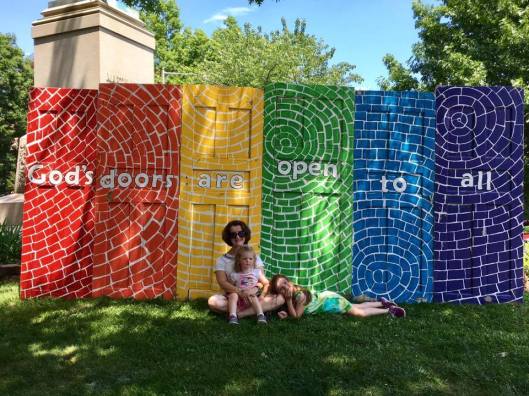
19060191_10155029443210379_5630596855440230652_nThis past weekend, our family was invited to meet up in DC with some friends from California.  They were attending the pride parade that afternoon, so we decided to meet them for a late lunch and then join them for as much of the parade as our little ones could handle.  We did not tell the children much about the visit – just that we would have lunch with friends and watch a parade.  Our oldest had already been a part of a pride parade with my husband’s work last year.  But everything would be new for our youngest.  It would also be my first pride parade.

What struck me about DC that day was the prevalence of invitations to love.  That may sound simple, obvious, or overused.  Perhaps we have become desensitized now that “Love is love,” has become a motto of sorts.  But as I watched all those gathered that day, I was overwhelmed by the outpouring of love.  This is a community which has every reason to embrace defensiveness, anger, and a sense of righteous indignation.  The LGBTQ community has been the victim of judgment, oppression, prejudice, violence, anger, ostracization, and emotional abuse.  They have been the victims of laws that limited their ability to not only be in relationship, but even to be in committed, monogamous, legal marriages.  They have been denied jobs, housing, adoptive rights, and patient rights.  They have every reason to be a community that reflects the hatred they have experienced.

And yet, I felt nothing but love that day.  I felt nothing but a celebration of love, care, and community.  And I cannot tell you how powerful it is to have your children surrounded by strangers who exude that kind of love.  My heart was warmed and I felt humbled by the community’s ability to show love in the face of hate.  As a person of faith, and as a pastor, I was hoping to see the church out, making the LGBTQ community feel welcome.  But after our day together, I wondered if the movement perhaps needed to be in reverse.  Perhaps the Church needs to be inviting the LGBTQ community in to teach us more about the love Christ talks about.  The love I felt that day was nothing short of the kind of love Jesus teaches throughout his ministry.  I was grateful for the wonderful witness of the LGBTQ community.  I just hope the Church can catch up and follow their example.

Sermon – Mark 4.35-41, P7, YB, June 21, 2015

22 Monday Jun 2015

Posted by jandrewsweckerly in Uncategorized

≈ 2 Comments

Tags

afraid, asleep, boat, care, Charleston, comfort, covenant, disciples, gun control, Jesus, Kingdom, Mark, miracle, oppression, other, racism, relationship, scared, Sermon, storm, suffering, violence

A long time ago, we got on a boat.  We were not really sure what was going to happen while we were out to sea, but we got on the boat because we were curious.  We had an experience, or maybe multiple experiences with a man named Jesus, and something about those experiences compelled us to get on the boat.  Maybe the experience happened as early as Sunday School, maybe the experience happened when we were confirmed, or maybe the experience happened as an adult.  We may not even be able to articulate the reason why we got on the boat.  But all of us, at some point, step onto the boat, however tentatively or boldly, and we sail with Jesus to the other side.

The disciples have that same experience in today’s gospel lesson from Mark.  After a long day of preaching and teaching, during which Jesus pulls them aside and explains parables to them, Jesus says, “Let us go across to the other side.”  Now if the disciples had been smart, they would have asked some questions: “What is on the other side?  What if a storm comes?  Can’t we just stay here and get a good night’s rest?  This place is familiar and comfortable.”  And they should have asked questions.  The “other side” of that body of water is exactly that – other.  The other side is Gentile territory, the land of the Gerasenes.  Jesus is taking his first journey into what might be considered dangerous, and even inappropriate.  Jesus is beginning a ministry beyond just the Jews.[i]  “Let us go across to the other side,” is no “Hey, let’s mix things up this year and go to Cabo.”  Yes, the disciples should have asked a lot more questions.[ii]

But they do not.  Something about this Jesus compels them forward, stepping on and manning that boat without question.  That’s the funny thing about Jesus.  We too got on a boat because of him, probably having no idea what we were getting into.  Suddenly we find ourselves cooking casseroles, watering gardens, and bringing in men’s undergarments for our needy neighbors.  Suddenly we find ourselves getting asked by the Rector to serve on some committee.  Suddenly we find the news of the day is not so simple when we remember all those words we said in our baptismal covenant about seeking and serving Christ, loving our neighbor as ourselves, and sharing the Good News.  We really should have asked more questions before we got on that boat to follow Jesus.

I have been thinking about that boat a lot this week.  You see, some of our fellow disciples were murdered this week – nine to be exact, in Charleston, South Carolina.  They were praying and reading Holy Scripture – just like we do every Thursday.  They even welcomed in a stranger that night – like Jesus always tells us to do.  That very stranger turned out to be crazy, filled with racist rage, and willing to kill nine people before fleeing.  At least that was how I saw the episode at first.  At first, this was another instance of a crazy person, senselessly killing other people.  But then the prophets of our time began to speak.  The prophets reminded me that violence proliferates in our society.  The prophets reminded me that because we cannot agree on a reasonable gun policy, more and more people die in our backyards.  The prophets reminded me that our African-American brothers and sisters in this country experience very fragile and virtually non-existent safety – they cannot even be safe in church.  There was a part of me that wanted to stay on the shore this week and say, “Oh, Jesus, that was just an isolated event by a crazy kid with extremist views.”  But I had already gotten on the boat.  It was too late.  And a storm began to rage.

That storm for me was the storm of our time:  a storm of violence, racism, and suffering.  No longer could I contain each story:  Trayvon Martin, Ferguson, Sandy Hook, Baltimore, Columbine, Selma, Charleston.  One story bled into another, and as I was reminded of each one, I felt the buckets of water dousing my face.  As I thought about every conversation I have had about how racism is not dead, I felt the water creeping up to my waist.  As I thought about the historical shadow of the oppression of others in our country, I wanted to cry out to God.  And all I could think about was Jesus on that stupid boat, asleep on a cushion in the stern.  Who can sleep at a time like this?  Doesn’t Jesus care about us at all?  Why couldn’t we have just stayed on the shore in that comfortable, familiar place instead of getting on the God-forsaken boat with a man who does not seem in the least bit bothered by our suffering?

The disciples know that feeling.  They are experienced at life on a boat.  At least when they get on the boat, they knew how to manage a boat.  They know the dangers and the perils, and have learned to navigate them for the necessity of survival.  But even these experienced fishermen are scared.  They have tried to control the boat, they have scooped out as much water as they can, and they know they have met their match.  And so they go to their last resort.  They wake up Jesus and shout, “Teacher, do you not care that we are perishing?!?”  When they got on that boat, this is not what they were expecting.  They were expecting the fulfillment of a promise – the fulfillment of a different life and a different world:  the kingdom of God here on earth.  Instead they were going down fast with a man who could not even stay awake and fight the good fight with them.

I shouted those words this week too.  Teacher, do you not care that we are perishing?  Maybe we brought all this violence on ourselves, but surely you care?  Surely you did not lure me onto this boat – into this relationship with you – only to watch us perish?  Though I wanted more than anything to think this was an isolated event of a crazy person doing something ungodly, I could not ignore the storm swirling around.

I struggled to find hope today in our gospel lesson.  All I saw was Jesus scolding the disciples for their fear and their lack of faith.  And then I saw disciples even more afraid than before – which is saying something given the awfulness of that storm.  Straining for some strand of hope – some glimmer of redemption – I came back to that invitation from Jesus, “Let us go across to the other side.”  Jesus does not tell the disciples to go to the other side alone.  Jesus does not say, “Go to the other side without me.”  Jesus says, “Let us go to the other side.”[iii]  Whether the disciples felt like Jesus was with them during that storm or not, Jesus was with them.  That may not seem like much, but that may be the biggest miracle of all in this story.  As one scholar writes, “God’s power isn’t in the control of creation or of people, but in being in covenant and relationship with them.  [God’s power] isn’t in imposing the divine will or insisting on its own way but in sojourning with us as we fumble around and make our way in the world.  God’s power is not in miraculous interventions, pre-emptive strikes in the cosmic war against suffering and evil, but in inviting us to build a kingdom out of love, peace, and justice with God.  God’s power is not in the obliterating of what is bad in the world, but in empowering us to build something good in this world.”[iv]

A long time ago, we got on a boat.  We did not know where we were going, what we would see, or who we would encounter.  All we knew was that Jesus was inviting us into a different life, and we felt compelled by this passionate, nonsensical man.  Oh, we had clues.  We knew that the “other side,” was not a place we wanted to go.  We knew that going there might change us, and change our entire worldview.  We knew that getting on that boat would mean stepping away from the familiar, comfortable coastline, and sailing into something different and scary.[v]  But Jesus said he would go with us.  Jesus invited us on a journey with him and something deep inside us, despite the little devil on our shoulder telling us to stay put, told us to step onto that boat.

I am still scared of the storm.  In fact, I am a little afraid of Jesus too.  But what brings me comfort this week is that Jesus is with us.  Jesus does not invite us onto a boat and let us sail alone.  And though Jesus may have an ability to sleep through a storm, with complete confidence in the direction of God, I also know that Jesus will wake up and respond to me when I call out his name.  He may not say what I want to hear.  He may leave me feeling more uncomfortable than getting soaked in a storm.  But he is here.  Jesus is here on our boat, and can make things right.  We just have to be prepared to go to the other side.  Amen.

[i] Beverly Zink-Sawyer, “Homiletical Perspective,” Feasting on the Word, Yr. B, Vol. 2 (Louisville:  Westminster John Knox Press, 2009), 165.

[ii] This train of thought comes from Karoline Lewis’ writing “The Other Side,” June 14, 2015 as found at https://www.workingpreacher.org/craft.aspx?post=3645 on June 18, 2015.

[iii] Lewis.

[iv] David R. Henson, “When God Sleeps through Storms (Lectionary Reflection for Mark 4:35-41),” June 15, 2015 as found at http://www.patheos.com/blogs/davidhenson/2015/06/1804/ on June 18, 2015.

[v] Lewis.

On love…

15 Wednesday Apr 2015

Posted by jandrewsweckerly in Uncategorized

≈ Leave a comment

Tags

care, God, honor, love, relationship, self, share, vastness

Photo credit: http://thoughtcatalog.com/david-cain/2012/12/what-love-is-not/

Photo credit: http://thoughtcatalog.com/david-cain/2012/12/what-love-is-not/

This week I have been thinking a lot about love.  It started when I discovered a short film called, “Blind Devotion” by the Jubilee Project.  The film opens with a playful, young couple who seem lovingly devoted to one another.  Unexpectedly, the wife starts to lose her vision and her frustration over the situation begins to pull apart the couple.  She refuses help from her husband and insists on finding a way to maintain her independence.  The husband concedes, but finds that he can’t help himself from helping her in ways that she never notices.  He quickly pushes a tomato toward her while she gropes along the countertop for it.  He follows her to work to ensure that no cars sneak up on her in crosswalks.  He sits a few seats away on her bus just to make sure she gets to work safely.  And then he tiptoes away once he realizes she is comfortably situated at work.  He says that he doesn’t ever want his wife to know how much he does for her because that is how he shows her he loves her – because to him, love is more than just a feeling, it is an action.  And for him, love is not about having the recognition for what he does, but just having the privilege of doing the work.  That kind of selflessness in a relationship reminded me of the love that God showed us through the life and death of Jesus.

Later I stumbled across this blog post.  In it, the author writes what she imagines God would say to working moms.  Basically the letter notes all the ways, big and small, that the mom is constantly trying to care for her family while tending to her work.  The letter is full of affirmation, especially for the small successes, and in the face of what often feel like failures.  As a mom who works outside of the home, I especially appreciated the sentiment.  But I imagine God feels that way about all of us, no matter what familial setting we find ourselves in.  I know that my single brothers and sisters as well as my friends who have partners but no children find similar ways of loving others – and God notices.  God notices because that is the kind of love God hopes that we will show – the same love that God extends to us.

Both the film and the fictional letter got me thinking about two things.  First, I found myself thinking about the myriad ways that people love me and I probably never notice.  Some are more obvious, but I don’t actively acknowledge them:  a short note of encouragement, a phone call, an art project by my child, or help around the house by my husband.  But some of the ways I will probably never know:  the people who pray for me on a regular basis, the people who fill in gaps that I had not even considered, the people who love my child when I am not around.  As I considered the vast possibilities, I was aware of how that vastness pales in comparison to the vastness of God’s love for me.  I am humbled beyond words for the ways in which love envelopes me on every side.

The second thing I realized this week is that I could stand to honor the ways in which I show love.  Too often I beat myself up for the ways I have not said, “I love you,” enough or I have not written that note I wanted to write or made that call I planned to make.  But I began to wonder if instead, I might close each day thinking about the ways I showed love today:  tending to the life of the church and the beautiful parishioners I am privileged to pastor; tending to the daily life of my family, even if my temper gets the best of me sometimes (five year olds can be tough!); and tending to the body that God blessed me with, making sure I treat it like the temple that God made it to be.  Perhaps if I could capture an appreciation for the ways that I love and the ways that I am loved, I could let go a sense of unworthiness and grab hold of the deep love that God has for me – and then share it.

Homily – Luke 12.4–12, Vincent, January 22, 2015

16 Monday Feb 2015

Posted by jandrewsweckerly in Uncategorized

≈ Leave a comment

Tags

call, care, God, grace, homily, Jesus, Moses, unworthy, value, Vincent

This past week I was able to visit the Rite-13 class.  They were discussing the call narrative of Moses.  We talked about the many ways Moses tries to avoid his call and the excuses he gives.  We talked about how God knows Moses well and has intimate conversations with him.  And then an interesting question came up.  We wondered whether God cares about each one of us in the same way God seems to have cared about Moses.  The responses were varied, but the one that stuck with me was the skeptic who wasn’t sure that God really cared about each of us – especially when there are about 6 billion of us in the world.  How could God know and care about each little thing about each one of us?  And then I recalled the gospel lesson we heard today: “even the hairs of your head are all counted.”  When we did the math about the numbers of hairs on all the billions of people in the world, we were all a little stunned into silence.

That is the hard part of our gospel lesson today.  Can we really believe that God is so infused in our lives – and that God cares what is going on with each and every one of us?  The question is one that Christians have been asking for centuries – is our God big enough to really know and love each one of us?  I am sure Vincent, who we honor today, asked that same question.  Vincent was a native of northwestern Spain, born in the late 200s or early 300s.  He was ordained deacon by Valerius, the Bishop of Saragossa.  In those years, the fervent Christian community in Spain suffered great persecution by the Roman emperors Diocletian and Maximus.  The governor of Spain had Bishop Valerius and Deacon Vincent arrested.  According to legend, the bishop had a speech impediment and Vincent often preached for him.  When the two prisoners were challenged to renounce their faith or else be tortured and killed, Vincent turned to his bishop, willing to make a stand.  Vincent’s bishop encouraged him to defend the faith.  Vincent’s passionate defense angered the governor.  The bishop was exiled and Vincent was tortured and finally killed.  Vincent is venerated as a bold and outspoken witness to the truth of the living Christ.

I am sure there were days, especially at the end, that Vincent wondered whether God really knew the hairs on his head.  To Vincent and even to us in our lesser trials, Jesus says, “Do not be afraid, you are of more value than many sparrows.”  Then and now, Jesus affirms that none of us is forgotten by God.  When we question God, when we feel forgotten by God, or even when we forget God, God is still there valuing the hairs of our head.  That is God’s profound promise every day.  Even when we flounder, or when, like Moses, we try to avoid our call or feel unworthy for the work God gives us to do, or when the pain of life feels overwhelming – God is with us, guiding us, valuing us, loving us.  Thanks be to God for God’s abundant care and grace and the reality that we are of more value than many sparrows – each one of us!  Amen.

Sermon – Isaiah 40.1-11, A2, YB, December 7, 2014

10 Wednesday Dec 2014

Posted by jandrewsweckerly in Uncategorized

≈ Leave a comment

Tags

Advent, care, Christmas, church, community, God, Isaiah, preparation, prepare, promise, Sermon, the Lord, work

This sermon was delivered on the occasion of our Annual Meeting. 

This time of year, I do a lot of preparing.  Though the setup takes a lot of work, I particularly love preparing our house for Christmas.  Unpacking and hanging all the ornaments is a tradition I shared with my family, and that I now can share with my girls.  I love telling my oldest daughter the stories behind certain ornaments and helping her decide where they should go.  I also put out our international crèche collection.  They remind me of travels I have made or friends from far away places.  Each inspires something different in me, reflecting the culture and artistry of different countries.  And of course, my daughter loves helping me hide away the baby Jesuses until Christmas day.  We even take down some artwork on our wall to make room for the cards which friends from far and wide send to us.  There is something homey and comforting about the whole process of preparing for Christmas, and I love the way that the preparation makes me feel grounded and joyful.

In our Old Testament lesson today, the text says, “prepare the way of the LORD.”  In this season of Advent, we are to prepare for the arrival of the Christ Child.  Now certainly, unpacking ornaments, advent wreaths, and crèches are one way to prepare.  But God is talking about a different kind of preparation today.  God is not talking about an outward change – like decorating our homes.  God is talking about an inward preparation – an inward change in anticipation of the LORD.  I am reminded of how one of our parishioners just recently prepared himself for the LORD.  Several weeks ago, one of our young parishioners decided to receive his first communion.  He prepared by reading about the Eucharist at home with his family, asking questions, and talking with them about their experiences.  He worked on memorizing the Lord’s Prayer, so that he might fully participate in the prayer life of our community.  And then he sat with me as we walked through the Eucharistic liturgy, talking about what each part means, why that part is significant, and what all those crazy things on the altar are called.  Finally, he chose someone to present him before the entire community, where he and we all declared that he was prepared to be in full communion with this community.  He waited and worked to prepare himself for the consumption of our LORD.  And now, each week that I have placed the body of Christ in his hand since then, I have felt a sweet, deeply abiding satisfaction when he reaches his hands toward me to receive Christ’s body.

The kind of preparation that our young parishioner did is a small taste of the kind of preparation God calls for in our Old Testament today.  Isaiah says that in order to prepare, we need to make straight in the desert a highway for our God, lift up every valley, make low every mountain and hill, level the uneven ground, and make plain the rough places.  This passage is so familiar to us, that many of us miss the magnitude of what God is saying.  When was the last time you tried to fill in a valley or level a mountain?  Of course, God is not telling us to literally take the winding roads of deserts and make them straight.  But in the metaphors, God is telling us that preparing for God is not easy work.  In fact, preparing for the LORD is a monumental task.  Preparing for the LORD is not like preparing our homes for Christmas, where we can make a basic checklist and slowly check the items off the list.  When given the hefty work of preparing ourselves inwardly for God, the task of leveling our valleys and mountains and smoothing out our rough places is much more difficult.

In some ways, I have watched St. Margaret’s do a lot of this interior work.  Over the course of the last year, our Vestry and Buildings and Grounds Committee have made level the mess that had become our Undercroft.  Though taking on an expensive project, they together worked to clean out harmful mold and mildew, solved a drainage problem to prevent that kind of damage again, and reimagined how that space could be utilized by us and our community.  Meanwhile, our educational offerings have been totally made low in this last year.  We revamped our Sunday School program after years of struggling to find the best way to raise our children in the faith.  We reworked our worship schedule so that adults could claim an hour in their busy lives to ponder their faith and make straight paths in the desert.  We have filled in the valleys by marching in parades, sponsoring baseball teams, eating pancakes at local diners, and inviting total strangers into our midst so that they might help us fill in those valleys.  Of course, anyone who knows St. Margaret’s also knows that you are only a stranger here for about one Sunday before our wonderfully welcoming community has made sure they know your whole life story before your coffee cup is empty.

All of those have been wonderfully positive things in our lives, but not easy work.  I cannot tell you the number of people who worried and fretted over our Undercroft expenses, complained about how long the work was taking, and questioned the wisdom of the work.  I cannot tell you the number of times I myself considered whether we should halt educational offerings altogether due to low turnout.  I cannot tell you how many times I needed each one of us to invite someone to church and instead heard someone say, “Oh, well isn’t that what our new website is for?”  We have been making progress toward straightening paths, filling in valleys, and leveling mountains.  But we have also gotten very dirty, been impatient and frustrated with each other, and sometimes have dropped our shovels altogether.  That is what happens when you do this kind of preparation for the LORD.  The work is not easy.  The work is monumental.  The work is, well, work.  And work is what God is inviting us into today.

The good news is that today’s text is one of those “both-and” texts.[i]  Yes, God is inviting us into some hard work today.  As we reflect on another year of service, at the mounds of dirt we have already moved, God is charging us to roll up our sleeves and keep digging.  And yes, God promises that the work of preparing will not be easy work.  But God also makes a promise while we are in the mire of making roads straight.  Our text today from Isaiah says, “He will feed his flock like a shepherd; he will gather the lambs in his arms, and carry them in his bosom, and gently lead the mother sheep.”  This last sentence has been lingering with me this week.  Maybe because I am a nursing mom, or maybe because this is the only time that scripture talks about the work of a mother sheep, but I find myself riveted by these words.

Just this week, I had one of “those” nights at our house.  I do not know whether she was teething or just had a rough day, but I lost count after the fifth time I woke up to my infant’s crying one night.  The next morning, I woke up bleary-eyed, almost falling asleep while eating my morning cereal, spilling my coffee on my computer, and generally having a rough time trying to focus.  That is the life of a mother with young children.  And I assume, the life of a mother sheep is not much easier – constantly using her body to protect and feed her lambs.  To that wearied mother sheep, God says that God will gently lead her.  In fact, not only that, God will gather up her lambs, embracing them in God’s bosom, and then God will gently lead the mother sheep.  I am reminded of the many times someone has scooped up my daughters when they were losing their cool.  I am reminded of the individuals who have forced me to go take a date night while they watched my kids.  I am reminded of the encouraging words and sympathetic nods I have received over these last five years.

That is the kind of care God promises us in the midst of our work.  God says, “Go out there and get dirty filling valleys, leveling mountains, and straitening roads.  And when you are weary from the work, I will scoop up your little ones, and gently lead you by my side.”  As I look forward to the coming year, I hear both a charge and a comfort for us today.  We all have more to learn, more people to serve, more spreading of the gospel to do.  But we also have a shepherd who tenderly encourages and comforts us – and then kicks us right back into the ring.  Thanks be to God!  Amen.

[i] George W. Stroup, “Theological Perspective,” Feasting on the Word, Yr. B, Vol. 1 (Louisville: Westminster John Knox Press, 2008), 28.

Newer posts →

Recent Posts

  • On Sharing the Love…
  • Sermon – Micah 6.1-8, Matthew 5.1-12, EP4, YA, January 30, 2026
  • On Justice, Kindness, Humility, and the Messy Middle…
  • Feast of the Rev. Dr. Martin Luther King, Jr., January 18, 2026
  • On Peace, Love, and Conduits…

Archives

  • February 2026
  • January 2026
  • December 2025
  • November 2025
  • October 2025
  • September 2025
  • August 2025
  • July 2025
  • June 2025
  • March 2025
  • February 2025
  • December 2024
  • November 2024
  • October 2024
  • September 2024
  • August 2024
  • July 2024
  • June 2024
  • May 2024
  • March 2024
  • February 2024
  • January 2024
  • December 2023
  • November 2023
  • October 2023
  • September 2023
  • August 2023
  • July 2023
  • June 2023
  • May 2023
  • March 2023
  • February 2023
  • January 2023
  • December 2022
  • November 2022
  • October 2022
  • June 2022
  • May 2022
  • January 2022
  • December 2021
  • November 2021
  • October 2021
  • September 2021
  • August 2021
  • June 2021
  • May 2021
  • April 2021
  • March 2021
  • February 2021
  • January 2021
  • December 2020
  • November 2020
  • October 2020
  • September 2020
  • August 2020
  • July 2020
  • June 2020
  • May 2020
  • April 2020
  • March 2020
  • February 2020
  • January 2020
  • December 2019
  • November 2019
  • October 2019
  • September 2019
  • August 2019
  • July 2019
  • June 2019
  • May 2019
  • April 2019
  • March 2019
  • February 2019
  • January 2019
  • December 2018
  • November 2018
  • October 2018
  • September 2018
  • August 2018
  • July 2018
  • June 2018
  • May 2018
  • April 2018
  • March 2018
  • February 2018
  • January 2018
  • December 2017
  • November 2017
  • October 2017
  • September 2017
  • August 2017
  • July 2017
  • June 2017
  • May 2017
  • April 2017
  • March 2017
  • February 2017
  • January 2017
  • December 2016
  • November 2016
  • October 2016
  • September 2016
  • August 2016
  • July 2016
  • June 2016
  • May 2016
  • April 2016
  • March 2016
  • February 2016
  • January 2016
  • December 2015
  • November 2015
  • October 2015
  • September 2015
  • August 2015
  • July 2015
  • June 2015
  • May 2015
  • April 2015
  • March 2015
  • February 2015
  • January 2015
  • December 2014
  • November 2014
  • October 2014
  • September 2014
  • August 2014
  • July 2014
  • June 2014
  • April 2014
  • March 2014
  • February 2014
  • January 2014
  • December 2013
  • November 2013
  • October 2013
  • September 2013
  • August 2013
  • July 2013
  • June 2013
  • May 2013
  • April 2013
  • March 2013
  • February 2013
  • January 2013
  • December 2012
  • November 2012
  • October 2012
  • September 2012

Categories

  • reflection
  • Sermons
  • Uncategorized

Meta

  • Create account
  • Log in
  • Entries feed
  • Comments feed
  • WordPress.com

Blog at WordPress.com.

  • Subscribe Subscribed
    • Seeking and Serving
    • Join 395 other subscribers
    • Already have a WordPress.com account? Log in now.
    • Seeking and Serving
    • Subscribe Subscribed
    • Sign up
    • Log in
    • Report this content
    • View site in Reader
    • Manage subscriptions
    • Collapse this bar
 

Loading Comments...