
• About

Seeking and Serving

~ seek and serve Christ in all persons

Seeking and Serving

Tag Archives: church

Sermon – Luke 12.49-56, P15, YC, August 18, 2013

18 Sunday Aug 2013

Posted by jandrewsweckerly in Uncategorized

≈ Leave a comment

Tags

baptism, chaos, church, conflict, division, family, Jesus, journey, peace, Sermon

Once upon a time, I lived in a world where there was such a thing as a “normal family.”  These were the families who could sit around a dinner table and have a pleasant conversation, who never had a disagreement, who never had to deal with passive aggressive behavior, and whose dealings could be taken at face value without any hints of ulterior motives.  In this world, people were happy, holidays were perfect, siblings loved each other, and marriages were unbreakable.  Laughter was pervasive, love overflowed, and peace ruled the day in this world.  And since my life did not resemble this world, surely I would find a life partner whose world was like this.  Surely there would be a way to escape my own reality to find that world where the “normal family” existed.

Of course, once that notion crumbled, I created a new one.  Then I lived in a world where there was such a thing as a “conflict-free church.”  This church was one where people welcomed others warmly, where the love of God poured out of every parishioner, where every meeting unfolded in a peaceful, consensual manner, and where everyone felt at home.  In this church, the people all lived Christ-like lives, and they were so focused on serving others that they never fell into serving themselves.  In this church there was no judgment, no division, and no central source of power.  At this church, people were happy, worship was beautiful, and money was never a concern.  Surely such a church existed, and so if my church was not this way, I would find that “conflict-free church” somewhere.

Jesus takes a blowtorch to these make-believe worlds I envisioned in today’s gospel.  Jesus says, “I came to bring fire to the earth, and how I wish it were already kindled…Do you think that I have come to bring peace to the earth?  No, I tell you, but rather division!”  “Whoa, whoa, whoa, Jesus,” many of us may want to say today.  I thought Jesus was the Prince of Peace – in fact the same person whose name we invoke when we greet one another with, “The peace of the Lord be with you.”  Today’s Jesus is not the sweet, peaceful Jesus in a manger.  Jesus denies peace altogether today and instead rolls out a campaign of conflict.  There is no peace-loving church today.  In fact, Jesus even goes on to say how he will be turning family members against one another.  Father against son, mother against daughter, in-laws against in-laws:  families will be divided against one another.  Not only do we lose the dream of a “conflict-free church” today, any hope of a “normal family” without pain or strife is obliterated today too.

Of course, what is most painful about this gospel lesson today is that we already know the gospel to be true.  What person here today has not faced conflict within their family?  For the lucky among us, that conflict may eventually pass and familial love is relatively easy.  But for pretty much anyone who has had an honest and frank conversation with me, I do not know one single family who has not been touched by divorce, pain, cutoff, abuse, rivalry, anger, manipulation, or division.  Conflict is not the anomaly – conflict is the norm in our families.  And if church is anything like a family, we have known bitter conflict in church too.  Some of us have left churches because of conflict, pain, or suffering.  Most of us have known conflict here in this place – and if we have not yet, we will.  Why this gospel lesson is so hard today is because this gospel holds up a mirror – a mirror to our broken lives, our broken world, and our broken church.  And quite frankly, most of us do not come to church to look in a mirror; or if we do imagine church as a mirror, we hope the mirror is like one of those carnival mirrors that can distort our broken worlds and reflect something much more beautiful or hopeful than the reality we know.

Despite all the seemingly bad news in today’s gospel, some of Jesus’ words reach out to us in hope:  “I have a baptism with which to be baptized, and what stress I am under until it is completed.”  The idea of Jesus’ baptism not being completed has been bouncing around in my head all week.  In the early days of the church, fonts were not the pretty, upright fonts we see now that hold a beautiful bowl of baptismal water.  Fonts were more like pools, with steps leading down and steps leading up on the other side.  The person to be baptized would walk down those steps, be fully immersed in the water, and the come up for air again as they emerged from the water and walked up the exit steps.  The symbolism was rich – baptism looked like the emergence from the watery birth canal, and baptism rightly lived into the name “new birth.”  But also weaved into the symbolism is journey – a journey from a former life, into a watery chaos (not unlike the chaos from which God created the earth), and emerging a new creation and a transformed person.

The idea that Jesus’ baptism is not yet complete somehow makes sense when we think of baptism as a journey.  In the midst of all this talk about conflict and division, Jesus is giving us a picture of what living a baptized life is like.  At our baptism, we make promises – to turn away from sin time and again – and to turn into the way of baptized life – seeking and serving Christ, loving neighbor as self, and striving for justice and peace.  The image of Jesus’ baptism not being complete gives some grounding to what all this conflict and division is all about.  The conflict and division is a necessary component to completely live into our baptismal covenant.  We say that when we fall into sin – not if we fall into sin – we will turn back toward the Lord.  The journey of baptism promises then that we will not have a peaceful, conflict-free road and that our baptism in not a once and for all activity.  Baptism is a journey, of fully living into those baptismal promises, in which the challenging stuff will shape and mold us into better disciples and better servants of Christ.  Jesus knows that our baptism journey will never be one of peace – at least not the superficial peace we long to have.  Our baptism journey will be one of division.  That division will not only be because conflict is a necessary part of life, but because the radical way of Jesus can only be achieved by walking through the watery chaos of baptism – a chaos full of conflict and division – but a journey in which we emerge transformed and renewed.

Once upon a time, I encountered a world where conflict was not a curse word.  In this world, conflict was not an uncomfortable experience to be avoided, but a challenging experience that led to new growth and new life.  In this world, everyone was not happy in a superficial, cheerleader kind of way.  But people were happy in a much deeper, rooted kind of way.  In this world, families still fought, but the fighting led them somewhere new and life-giving.  In this world, parishioners grew to expect conflict – but also grew to expect transformation.  In this world, conflict was not the end of relationship, but instead the tool that drug people through rough times into times of unknown joy and peace.  This is the world that I long to inhabit.  This is the world that gives us life.  This is the world that leads to new birth.  Our invitation today is to step into the watery chaos of division and conflict, so that we might emerge a faith community on the baptism journey.  Amen.

Harboring hope…

10 Wednesday Jul 2013

Posted by jandrewsweckerly in Uncategorized

≈ Leave a comment

Tags

church, God, hope, summer

-Photo courtesy of http://cbfportal.wordpress.com/2012/06/20/hope-beckons-lessons-from-worship-with-bwim/

-Photo courtesy of http://cbfportal.wordpress.com/2012/06/20/hope-beckons-lessons-from-worship-with-bwim/

I have begun to think about summer as a time of hope.  Summer brings a sense of unrestrained possibility.  The days are longer, encouraging us to get out of bed and get busy with life, and then leaving us more time for evening enjoyment.  We tend to take our vacations in the summer, creating a hopeful anticipation of what adventures could await.  We slow down a bit, giving us time to rekindle the hope that we bury in the wintertime.  We reconnect with God’s creation, feeling the freedom that the outdoors brings and feeling a renewed hopefulness about life.

Though summers are often busy in the church, with days full of planning, there is a sense of hopefulness about our faith life that comes this time of the year too.  This is the time that we take to dream and imagine how our life together might be better.  We slow down to read curricula, imagining what transformation might happen among our children and adults.  We look at our calendars, feeling a sense that anything is possible for the program year.  We take time to talk to one another to imagine what opportunities beckon – a process that can only take place once we have slowed down and made space for deep listening.  Once we are in the midst of the program year, much of that hopeful anticipation fades because we are too busy executing our plans to dream up new ideas.  But now, now is a time of simmering hope.

Our invitation is to let this hopefulness fill our beings.  Our invitation is to drink in this hopefulness like a thirst that longs for quenching.  Our invitation is to stoke this hope so that it might burn ever brighter, creating a slow burn that lasts us through the long winter months.  This hopefulness is our summer gift from God, prodding us on to live our faith bigger, brighter, and bolder than ever.

Sermon – Luke 9.51-62, P8, YC, June 30, 2013

03 Wednesday Jul 2013

Posted by jandrewsweckerly in Uncategorized

≈ Leave a comment

Tags

church, control, Fourth of July, home, Jesus, Sermon

This week, most of us will celebrate the fourth of July in some fashion or another.  Though the holiday is filled with words like independence, patriotism, liberty, and fireworks, mostly we are celebrating a sense of “home.”  Our celebration of the Fourth is really a celebration of the place that millions of us commonly call home.  Our songs celebrate this theme:  “God bless America, our home sweet home”; or “and the home of the brave.”  This is a day that we celebrate our home with a sense of pride, of belonging, and of identity.  Like any home, our country has faults and drawbacks, but our country is our home, and nothing else can replace the sense of comfort that home can bring.

Perhaps what we forget in our celebrations is that our “home” did not always feel that way.  Centuries ago, when the original settlers came to this country, the country felt nothing like home.  In fact, those settlers left what they knew as home, with all the comforts home offered, and came to this foreign place.  This was a place of newness and discomfort.  Nothing was familiar, and in fact much of what the settlers experienced was downright scary or dangerous.  Though settlers came here to establish a new home, that home-like feeling took a very long time to create.

Here at St. Margaret’s we have made a similar transition in the last fifty years.  I was just reading the rough draft of our fifty-year history this week, and I was thinking about the contrast of those early years with our experience of St. Margaret’s now.  Fifty years ago, St. Margaret’s was merely a group of people gathering.  We had no building, no clear identity, and certainly no sense of the familiar.  In fact, the story goes that when we would gather for Sunday worship in the American Legion Hall, the smell of smoke and beer lingered from Saturday night events at the Hall.  When people left their church homes to join St. Margaret’s, I am pretty sure smoke and beer on a Sunday morning was not exactly what they were dreaming of for their new home.

So as we Americans prepare to collectively celebrate our home, and as we at St. Margaret’s, in our fiftieth year of ministry, continue to celebrate our home, we find Jesus saying some pretty funny things about home in our gospel lesson today.  When someone along the road says to Jesus, “I will follow you wherever you go,” Jesus says to him, “Foxes have holes, and birds of the air have nests; but the Son of Man has nowhere to lay his head.”  Then, when Jesus calls others to follow him, and they first ask for some basic things, like burying their father or saying goodbye to their loved ones, Jesus refuses.  In other words, Jesus basically tells anyone considering following him that they will lose all sense of home – not only the literal place to lay one’s head, but also all the comforts and familiarity of home.  Following Jesus is a calling into a homelessness of sorts.  Jesus’ calling into homelessness is pretty scary.  Following Jesus means giving up control and trusting that all will be well, which is a lot to ask, considering Jesus has already told them that all will not be well.  Their new “home” will be a place of suffering, persecution, pain, and homelessness.  Jesus’ new home sounds a lot like the home those founding ancestors of our country and those founding members of St. Margaret’s faced years ago.

To be honest, I am not sure I would have been able to follow Jesus as those men and women did so many years ago.  I am sure you already know this about me, but I am a pretty big fan of control – or at least the illusion of control.  I do not like the feeling of things being out of my control.  So when Jesus asks me to let go of control – of a sense of home and familiarity – I am not sure I would have said yes.

The good news is that I do not think Jesus is actually asking us to cede control to him.  Jesus is not really offering the choice of either us being in control or him being in control.  As we well know, Jesus did not head to Jerusalem with the mission of taking control or charge.  Instead, he set his path to Jerusalem to throw himself fully and completely into our out-of-control lives and to come out on the other side.  That is the promise of this Gospel – “not that we can be in control, or even that God is in control, but rather that God in Jesus joins us in our out-of-controlness, holds onto us, and brings us to the other side.”[i]  This is the homelessness Jesus is really inviting us into – this commitment to giving up the illusion of control, to take some risks, and to throw ourselves into this turbulent life and world, trusting that God joins us in the adventure, holds us through the ups and downs, and brings us in time to the other side.  When Jesus offers his hand out to others to journey with him into homelessness, this is the underlining promise – that he is with us in the journey into homelessness and out-of-controlness.

On my mission trip to Burma, we had a day when we were supposed to go see working Elephants in the forest.  We loaded up our truck, crammed in way too close, as usual, and began the bumpy journey.  But an hour into our ride, our truck had some mechanical issues.  We pulled into to what seemed to be a local mechanic, although our version of a mechanic shop and the Burmese version of a mechanic shop are very different.  Sensing that this stop would take a while, our tour guide suggested our team take a walk.  The seven of us followed, happy for a distraction.  During our walk, we came upon a rice paddy, and could see workers out in the field.  Although the team was content to observe from a distance, our guide recommended crossing the dikes to get a closer view.  We found his offer shocking.  We worried about trespassing, encountering swarms of disease-carrying mosquitoes, or falling off the dikes, which looked quite tenuous.  Most of the team looked at the sturdy ground on which we were standing and decided that we should not test the swampy paddy.  When our tour guide realized most of us were not following him, he came back to the place where he jumped to the first dike.  First, he pleaded with the group as a whole.  Then, he called me by name.  “Jennifer, please come with me.  It’s okay.  You can trust me.”  I looked into his dark brown eyes, and saw a sparkle of adventure and joy.  I looked back at the dirty – but dry – road wistfully.  Then I turned back toward our guide and his outstretched hand.  His smile conveyed a sense of confidence and encouragement that warmed my heart, and I found myself jumping across the water to the dike.

We all know that sense of crossing into Jesus’ homelessness.  Certainly our country this week has at many times felt out of control.  Though we call this place home, we have been bitterly divided about Supreme Court decisions and Congressional bills this week.  Those decisions have left us wondering what sort of home we are creating now.  The same could be said for St. Margaret’s.  Though many of us know this place as home, our home seems to be ever changing.  There are new ways of operating, new projects underway, and new invitations.  There is an ambiguity about who we will be and how we will change.  But the promise in all of this, especially in the emerging sense of homelessness in our country and in our church, is that God is right here with us.  God continually promises to be on this crazy ride with us.  That reassurance by God today fills us with hope, and a renewed sense of courage and joy as we journey forward.  Today, as we look into Jesus’ sparkling eyes, he calls us by name, and says, “Come on.  Let’s go be homeless!”  Amen.


[i] David Lose, “Out of Control,” as found on http://www.workingpreacher.org/craft.aspx?post=2614 on June 28, 2013.

A spark…

29 Wednesday May 2013

Posted by jandrewsweckerly in Uncategorized

≈ 2 Comments

Tags

church, conversation, evangelism, God, Good News, grace

One of the things we have been looking at as a parish is how to more intentionally engage in evangelism.  The conversation has not been easy.  We have all been victim of an overzealous religious person who has made us feel uncomfortable.  A few of us have hidden behind closed curtains from someone knocking at our door to share their testimony.  Some of us have crossed on the opposite side of the street from the guy with a Bible, a loud voice, and a handful of tracts.  And of course, we ourselves have begun to overcompensate, avoiding talking about our faith altogether in non-church circles for fear of becoming “that guy.”

But we have been prayerfully working on seeing evangelism not as uncomfortable, out-of-touch haranguing, but as a grace-filled conversation about the goodness and grace of God in our lives.  We have been prayerfully considering how we can create the environment for such conversations.  And we looking at ways to meet people where they are, knowing that we cannot expect to share the Good News if we stay closed up in our church.

Perhaps without even realizing it, this week we did just that.  Last Wednesday, we gathered with people of faith throughout the Plainview-Old Bethpage community and made 495 sandwiches to feed our hungry neighbors.  We shared the work together, we got to know people from other faith traditions and communities, and we prayerfully thought of the men and women whose lives would be touched by our strokes of peanut butter and jelly.

Then, on Monday, over twenty of our parishioners gathered to walk in the Plainview Memorial Day Parade.  I watched as parishioners, clad in St. Margaret’s gear, shook the hands of old friends, had conversations with strangers, and waved with gusto.  As we walked, I overheard onlookers wondering about our Garden of Eatin’ (check out our Facebook page for our fun shirts, props, and banners), talking about where we were located, and not-so-subtly realizing I was the priest.

After the walk, parishioners re-gathered at the church, and planted our Grow to Give Garden.  Our garden is located near the road that our church faces, and I can see that the garden might be a great invitation into our property.  The garden already has brought young and old together.  I am hoping it might also bring parishioner and non-parishioner together too.

handshakeThis week, we started the work of evangelism.  My hope is that the experience gives us some energy around keeping it up.  I am already considering what local establishments I might begin to frequent when I do my sermon preparation.  The Vestry is beginning to ask some of our committees and groups to consider moving off campus to better be seen by and to encounter our community.  Our work is just beginning, but this weekend gave me the spark to keep it up.  See you at a local Starbucks, Cosi, or Panera soon!!

A confession…

01 Wednesday May 2013

Posted by jandrewsweckerly in Uncategorized

≈ 1 Comment

Tags

church, conversation, fear, God, judge, meaningful, teens

One of the things I find fascinating about teenagers, especially as a priest, is how difficult it can sometimes be to have a deep conversation.  I do not know if it is the collar, if I am particularly uncool, or if my timing is off (I suppose right before a Sunday 8:30 am Eucharist might not be the best time!), but there are times when I get one-word answers or blank looks.  Even in our confirmation class this year, I found that the teens were willing to ask big questions, but my responses did not evoke much extended dialogue.

So imagine my pleasant surprise this Sunday to see how our confirmands led worship.  They read scripture, served as ushers and chalicists, prayed the prayers of the people, and preached with confidence.  I was particularly nervous about the sermon because the preacher did not seem to want much guidance from me in her preparation.  But her sermon blew me away.  I found myself nodding at her insightful words, wanting to say aloud, “Yes!”  Her words were prophetic, perceptive, and powerful.

After service on Sunday, my perspective shifted a bit.  First, I began to realize that the way I judge meaning may not be a true indicator of meaning.  Just because I feel like I am not getting the feedback I am looking for from a teen does not mean that something meaningful is not happening.

But second, and much more importantly, I think that teens are getting a bad rep from people like me.  The truth is that I know an equal amount of adults who are unable or unwilling to have deep, meaningful conversations.  We are all a bit guarded about the things that make us uncomfortable, and our faith is probably one of the biggest areas in our lives that make us feel uncomfortable – because we are not sure how to explain some of the things we believe, or we worry someone will point out some basic biblical or theological concept that we do not know.  In fact, one of the major reasons that adults give for not wanting to teach teens is that they are afraid the teens will ask a question that they don’t know how to answer.

multi-generationalIn order for us to have deeper, more meaningful, and more authentic conversations about our faith, our invitation today is to do a little more listening and a lot less judging.  Our invitation today is to let go of the fear we have of embarrassment and be honest about what we are still figuring out about the mystery of God.  Our invitation today is to remember that only through our collective sharing – from our three- to our thirteen- to our thirty- to our sixty-three-year-olds – will we begin to hear the fullness of God’s voice among us.

Be still…

15 Friday Mar 2013

Posted by jandrewsweckerly in Uncategorized

≈ Leave a comment

Tags

church, God, Lent, prayer, quiet, stillness

You may not know this about me, but I am not a natural when it comes to silence.  As an extrovert, silence feels like it should be filled.  When I lead worship that needs a silent moment, I often make myself take a couple of additional breaths before I break the silence, knowing that my own tolerance for silence is much lower than most people’s tolerance.  A couple of summers ago, I was a part of parish that covenanted to pray with scripture for twenty minutes a day for ninety days.  The idea was that a bulk of that twenty minutes was not meant to be spent talking or analyzing biblical scripture, but to be silent in the presence of God’s word, making room for God’s living Word to speak.  As you might imagine, the practice for me was brutally painful.  But I learned a lot about myself and my prayer life that summer, and changed many of my practices as a result of the experience.
That is why I am grateful for “Quiet Days.”  I am grateful for the many communities who have realized that the Church often needs to invite people to come to Church and just be.  Be quiet.  Be still.  Be with God.  Even if it is only for a few hours, the Church and other religious groups often offer mornings or days where people can stop being busy and really make space for God.  I first discovered Quiet Days in seminary, but they have been an active part of my ordained ministry ever since.  They are truly one of the Church’s greatest gifts to us.

This weekend, my own parish is offering a Lenten Quiet Day and I could not be more excited.  I am excited for all of the reasons I just described, but I am also excited because two parishioners offered to lead the meditations for our Quiet Day.  So not only do I get to be a part of a community that has invited everyone into a time of quiet with God, I too will be able to fully enjoy the quiet time with God, hearing how God is moving in through our parishioners’ meditations.  This Quiet Day has not become one more thing on my busy to-do list, but instead has become an invitation for me to come and be still with God.  I grateful to these parishioners who have offered up their gifts, and I hope that if you are nearby, you will join us too.  Come enjoy the gift of quiet in our otherwise busy, loud life.

Homily – 1 John 4.13-21, John Henry Newman, February 21, 2013

14 Thursday Mar 2013

Posted by jandrewsweckerly in Uncategorized

≈ Leave a comment

Tags

church, homily, John Henry Newman, love, pope

Today we celebrate the life of John Henry Newman.  Newman was ordained a priest in the Church of England in the 1820s.  He was one of the founders of the Oxford Movement, that movement in the Church of England that sought to get us back to some of our more Roman liturgical heritage.  They were the ones who started what we would call the Anglo-Catholic or High Church movement.  Newman produced many tracts and was an avid scholar, but eventually the church infighting got to him and he left the Church of England to become a Roman Catholic priest and eventually a Cardinal. 

What is interesting is that we get this epistle lesson today about love appointed for Newman’s day: “God is love … we love because he first loved us.  Those who say ‘I love God,’ and hate their brothers and sisters, are liars.”  We often like to focus on the God of love – we say, “it’s all about love.”  But so rarely do we act like it is all about love.  Like the Church of England in the 1800s, we still have denominational infighting.  We have seen how tense things still are in the conversations about a new Pope.  The last couple of weeks, I have heard more trash talk between Romans and Anglicans than I like to admit.

The challenge that Newman and our epistle lesson give us is the challenge to love one another.  The collect for this day says, “God of all wisdom, we thank you for John Henry Newman, whose eloquence bore witness that your church is one, holy, catholic and apostolic …”  We confess this in our profession of faith, but I am not sure we always believe it.  Whatever denomination life has landed us in, Newman and our epistle remind us of the centrality of love.  This is most important in our conversations, our actions, our prayers, and our witness.  The world is not only watching the Roman Catholic Church in this new election of a Pope – the world is watching how all Christians behave, especially toward one another during this process.  For as our epistle says, “those who love God must love their brothers and sisters also.”  Our invitation today is to be a church of love.  Amen.

Sacred noise…

20 Wednesday Feb 2013

Posted by jandrewsweckerly in Uncategorized

≈ 1 Comment

Tags

children, church, life, noise, thanks

kids-in-church

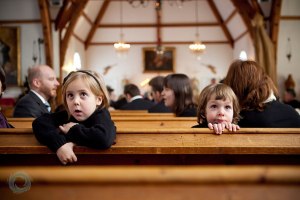
One of my challenges as a priest has been how to encourage parents who are worshiping with their children in church.  I want them to stay in church, but I also want to honor the occasional discomfort of their experience.  Of course, my opinion on this matter has changed dramatically since I became a parent, but what was once distracting noise by children in church has now become the sound of life to me.  A fellow blogger expressed this reality for me quite beautifully here.

But me telling a parent that they are welcome to stay in church does not solve much.  I cannot control the glares or the shh-es from other parishioners.  I cannot control the wave of panic that crashes over a parent when it feels like your child’s noises are as loud as a parade in a library.  I cannot even set an example because I am rarely actually in the pews with my fellow parents.  But I have experienced some of the grace that can happen when people are open to a child in church.  Back in December, I took my three-year old daughter to an ordination at the Cathedral.  She lasted relatively well for the first hour, but then became antsy.  I asked her if we should go after the peace, but she insisted she wanted to stay.  We made it back to the pew, and midway through the bishop’s praying of the Eucharistic prayer, my daughter impatiently asked, quite loudly, “Can I have the body of Christ now?!?”  Everyone around me giggled and I did too.  She broke the tension I had been feeling about her noise.  She probably voiced the fatigue that fellow worshipers around me felt too.  And she showed me that she fully understood what was happening, and was eager to receive the sacrament.  It doesn’t get more awesome than that.

I can’t force parents to stay in church with their kids.  I can’t force parishioners to always be sympathetic or even helpful.  What I can do is continue to hold all parents and children in prayer, thanking God for their presence, and the ways in which they keep me humble.  Thank you, parents, for all that you do to raise our children in the church.  We are blessed by you more than you know and always happy to have you in church.

Full…

30 Wednesday Jan 2013

Posted by jandrewsweckerly in Uncategorized

≈ Leave a comment

Tags

blessing, church, full, God, Holy Spirit

I am having one of those “full” weeks at church this week.  Full weeks can be stressful and overwhelming, but they can also be wonderfully full of grace and blessing.  So far, this week has been the latter.  It started on Sunday.  We had our usual worship services, and both were filled with real energy and life.  Between the services, I trained a new lector – not only reminding me of the blessing of this particular ministry, but also reminding me of the new members here at St. Margaret’s that becoming incorporated into our family.  After the services, I said a few quick hellos at Coffee Hour, and then was off to a Worship Committee Meeting.  I am so grateful for the mirror that this committee provides, helping me to assess what is working and what needs work.  We added two younger members to the committee and their contributions were especially meaningful.  The committee is full of the Spirit and deeply thoughtful about our worship.  Finally, later that night I came back to church for Confirmation Class.  Our six teens and two mentors are an incredible group, with some thought-provoking questions (topics included hell, sin, and judgment, just to name a few).  I left wishing we had more time to keep feeding our young adults.

The fullness continues this week.  Last night, our Cemetery Committee met.  These passionate parishioners and staff continue to amaze me with their thoughtfulness and care.  Their ministry is a vital part of work here in Plainview.  Tonight, I meet with our Study, Sup, and Serve group, who is discussing Nickel and Dimed, by Barbara Ehrenreich.  So far, our discussions have been inspiring, challenging, and thought-provoking.  I cannot wait to see what the group does tonight.  Tomorrow, I meet with our hard-working Wardens, who always find a way to mix business with humor.  They are a blessing to me in my ministry here, and our meetings are truly a joy.  Finally, we will round out the week with our next installment of “Movies with Margaret.”  This week we are watching Saved, a dark, provocative comedy about a high school student at a Christian High School who accidently gets pregnant and how the pregnancy affects her relationships and faith.  I imagine we will all wince from time to time, but also see a lot hope and encouragement.

So, yes, a full week.  Of course, add in a special trip to the train station with my lovely husband today (his car is getting some regular maintenance), and a “treat” at a favorite doughnut shop today with my awesome daughter, and this week is truly full.  Keeping this kind of pace would not be a good a long-term plan.  Rest is a God-given gift too.  But I am grateful that this week feels full in a grace-full way, not in a stressed-out, stretched-thin kind of way.  I can only attribute that to the Holy Spirit surrounding me on every side and carrying me through this week with a sense of joy instead of burden.  Thank you God for the joyful, crazy, full life you have given me this week!  Help me to hold onto that joyful perspective in the coming weeks!

Sermon – 1 Corinthians 12.1-11, EP2, YC, January 20, 2013

23 Wednesday Jan 2013

Posted by jandrewsweckerly in Uncategorized

≈ Leave a comment

Tags

church, Corinth, diverse, gifts, God, Sermon, spiritual gifts

About two thousand years ago, the Christian community that had formed in Corinth was a diverse group.  There were Greeks and Jews, slaves and free people, men and women, rich and poor.  Their only unifying tie was that they all confessed Jesus as Lord.  And like any good church, they were of a divided mind.  We learn from their correspondence with Paul, that they are particularly divided about what spiritual gifts are to be the most highly valued.  The running argument is that the gift of ecstatic speech is the most important, and those displaying that gift should be given higher importance in the community.[i]  Unable to settle this argument among themselves, they turn to Paul.

Unfortunately for those arguing for singling out the gifted, Paul proclaims a different reality – everyone is gifted.  Simply by proclaiming Jesus as Lord, each person is given a gift.  The gifts may be different, and there will be a diversity of gifts.  This diversity of gifts is necessary for the community, making the community richer and helping the community to see the fullness of God.

Paul’s explanation sounds lovely.  Everyone is special and everyone has gifts.  But truthfully, in the depths of our hearts, we do not really agree with Paul.  We have lived in a cutthroat, competitive world too long to know that not all gifts are really valued equally – not even in the Church.  Sure, some people are gifted teachers, or seem especially spiritual – but what we really need are people skilled in finances.  Or maybe we really value people who are wise or people who are good with technology.  Whatever the thing is that we value, the point is that we rank gifts.  And although we might not want to admit the fact, as modern Americans, we tend to roll our eyes at Paul, seeing his explanation on gifts as cute, but not really helpful if a church is going to succeed.

When I was in college I went to a multicultural church in a small city.  The church was primarily African-American and African, but several Anglos from the community and from the local college joined the dynamic parish.  As the parish grew, we often had conversations about what our diversity meant and how we would negotiate each others’ differences.  But one day, the pastor had an idea that he charged ahead with before really getting buy-in from the church.  He invited two local group homes to bring their residents to church on Sundays.  The residents had mental and physical disabilities, and many of them were in wheelchairs.  Some were more verbal than others, but many of those who were verbal could not form clear words.  You could tell right away that the church members were uncomfortable.  We did not know how to handle the outbursts or the behavior of the group home members.  Luckily, the pastor was much more generous than we were.  He noticed that the outbursts were not random.  In fact, sometimes a yell sounded a lot like an “Amen!”  And so in the church’s customary call-and-response format, the pastor engaged the group home members just like he did the rest of the church members.

That church learned relatively quickly what Paul was trying to teach the members of the church in Corinth.  Whereas the church in Corinth sees its own diversity and wants to begin ranking gifts, Paul is trying to explain that their diversity is their gift.  Every person in that community is needed to make the community whole.  The full range of gifts means that the community is richer and can live out the community’s call more fully.  Without the interpreter of tongues, the speaker of tongues is useless.  The healers heal the community.  The miracle workers help the community see God.  The prophets help send the people out beyond the community.  Only together can they live into the fullness of faith.  Each person is indeed gifted – but not for the sake of personal pride.  The gift’s purpose is to edify the entire community.[ii]

Furthermore, what Paul is also trying to explain is the gifts are not just for the person, or for the community.  The diversity of gifts tells them something about God.  The diversity of gifts gives the community a glimpse into the diversity of God.[iii]  Only when all those diverse gifts are being enfleshed does the community in Corinth begin to get a glimpse into the fullness of God.  Paul knows that understanding God fully is impossible – we are made in God’s image, but we are not God.  Only through the diversity of their diverse Corinth church, and through the diversity of their gifts, do they begin to see a glimpse of the diversity of God.

At that church in college, we had been pretty proud of ourselves.  We were a diverse parish in a community with a rough history of racial discrimination.  But those group home members made us realize we were still not living into the fullness of the body of Christ.  Without those group home members pushing us out of our comfort zone, we were keeping our identity within our own parameters, not God’s parameters.  Truthfully, the presence of the group home members made us wonder who else we were excluding.  We did not need long to look around our community and figure out who we had been excluding.  The apartment complex next to the church was clearly inhabited by many Hispanics, a group not present in our community.  Only once the group home members opened our eyes were we able to see how much we had been limiting God and how much richer we could be if we opened our doors to our neighbors.  One could argue that our group home members had the spiritual gift of prophesy.

So why is Paul’s letter so important to St. Margaret’s?  This past Wednesday, about eight St. Margaret’s parishioners went over to Plainview Reformed Church to make sandwiches for the INN.  Most of us had been there before, and we fell into a quick rhythm.  Some of us were good at scooping – which is a delicate skill because if you use too much, we cannot make enough sandwiches.  Some of us were good at spreading – an important skill if you do not want to tear the bread.  Others were good baggers.  Now bagging a sandwich may sound simple to you, but as the activity leaders kept reminding us, a sandwich bag that is messy on the inside or out sends the message that the sandwiches were made without much thought – or even without much love.  Even the youngest children who put stickers on the sandwich bags had an important role.  Without the sticker, the sandwich is just another sandwich.  With the sticker, the bag says that someone made this sandwich, and personalized the sandwich just for you – because you are special and worthy.  As that interfaith community gathered, with people of all ages, shapes, sizes, and abilities, we were a lot like that community in Corinth.

What Paul’s letter and our sandwich-making this week show us is that only when we all engage in ministry are we fully living into the life of faith.  Only when all our skills are being used are we even able to see a glimpse of the fullness of God.  Our invitations this week are several.  First, Paul invites us to discern our spiritual gifts.  Now, because you work in construction, you might have been roped into serving on the Buildings and Grounds Committee.  Or because you have young children, you might have been recruited to teach Sunday School.  But sometimes, what we do professionally does not translate to a spiritual gift.  Our best teachers, our wisest decision-makers, our most spiritual people of prayer might not do those things professionally or obviously.  Today Paul invites each of us to ponder whether we are using our spiritual gifts for the betterment of this community.  Second, Paul invites us to consider how each person here might help us to better see a glimpse of God.  That means that after church or during coffee hour, we might need to sit with someone we do not normally sit with and have a meaningful conversation.  And yes, you can have a meaningful conversation with a three-year old or a sixteen-year old.  Finally, Paul invites us to consider who is not here, helping us know God more deeply.  I have heard time and again how much we want to grow as a community.  For many of us, that desire is more out of a sense of preservation – we need to grow to continue to be a church here in Plainview.  But I wonder if we might instead begin to think of our growth as necessary for us to more fully see God.  We may know all sorts of people in our everyday lives who do not fit the St. Margaret’s mold.  Those are the people we need to invite to Church.  That neighbor you got to know when we all lost electricity during the Hurricane.  That woman with the purple hair who cuts your hair at the salon.  The waiter at your favorite restaurant who you have come to know.  Until we invite those people, we will not experience the fullness of God’s gifts for us.  The invitations from Paul today abound.  I look forward to hearing how your homework goes!  Amen.


[i] Karen Stokes, “Pastoral Perspective,” Feasting on the Word, Yr. C, Vol. 1 (Louisville: Westminster John Knox Press, 2009), 254.

[ii] Lee C. Barrett, “Theological Perspective,” Feasting on the Word, Yr. C, Vol. 1 (Louisville: Westminster John Knox Press, 2009), 256.

[iii] Troy Miller, “Exegetical Perspective,” Feasting on the Word, Yr. C, Vol. 1 (Louisville: Westminster John Knox Press, 2009), 257.

← Older posts
Newer posts →

Recent Posts

  • On Politics, Football, and Love…
  • On Sharing the Love…
  • Sermon – Micah 6.1-8, Matthew 5.1-12, EP4, YA, January 30, 2026
  • On Justice, Kindness, Humility, and the Messy Middle…
  • Feast of the Rev. Dr. Martin Luther King, Jr., January 18, 2026

Archives

  • February 2026
  • January 2026
  • December 2025
  • November 2025
  • October 2025
  • September 2025
  • August 2025
  • July 2025
  • June 2025
  • March 2025
  • February 2025
  • December 2024
  • November 2024
  • October 2024
  • September 2024
  • August 2024
  • July 2024
  • June 2024
  • May 2024
  • March 2024
  • February 2024
  • January 2024
  • December 2023
  • November 2023
  • October 2023
  • September 2023
  • August 2023
  • July 2023
  • June 2023
  • May 2023
  • March 2023
  • February 2023
  • January 2023
  • December 2022
  • November 2022
  • October 2022
  • June 2022
  • May 2022
  • January 2022
  • December 2021
  • November 2021
  • October 2021
  • September 2021
  • August 2021
  • June 2021
  • May 2021
  • April 2021
  • March 2021
  • February 2021
  • January 2021
  • December 2020
  • November 2020
  • October 2020
  • September 2020
  • August 2020
  • July 2020
  • June 2020
  • May 2020
  • April 2020
  • March 2020
  • February 2020
  • January 2020
  • December 2019
  • November 2019
  • October 2019
  • September 2019
  • August 2019
  • July 2019
  • June 2019
  • May 2019
  • April 2019
  • March 2019
  • February 2019
  • January 2019
  • December 2018
  • November 2018
  • October 2018
  • September 2018
  • August 2018
  • July 2018
  • June 2018
  • May 2018
  • April 2018
  • March 2018
  • February 2018
  • January 2018
  • December 2017
  • November 2017
  • October 2017
  • September 2017
  • August 2017
  • July 2017
  • June 2017
  • May 2017
  • April 2017
  • March 2017
  • February 2017
  • January 2017
  • December 2016
  • November 2016
  • October 2016
  • September 2016
  • August 2016
  • July 2016
  • June 2016
  • May 2016
  • April 2016
  • March 2016
  • February 2016
  • January 2016
  • December 2015
  • November 2015
  • October 2015
  • September 2015
  • August 2015
  • July 2015
  • June 2015
  • May 2015
  • April 2015
  • March 2015
  • February 2015
  • January 2015
  • December 2014
  • November 2014
  • October 2014
  • September 2014
  • August 2014
  • July 2014
  • June 2014
  • April 2014
  • March 2014
  • February 2014
  • January 2014
  • December 2013
  • November 2013
  • October 2013
  • September 2013
  • August 2013
  • July 2013
  • June 2013
  • May 2013
  • April 2013
  • March 2013
  • February 2013
  • January 2013
  • December 2012
  • November 2012
  • October 2012
  • September 2012

Categories

  • reflection
  • Sermons
  • Uncategorized

Meta

  • Create account
  • Log in
  • Entries feed
  • Comments feed
  • WordPress.com

Blog at WordPress.com.

  • Subscribe Subscribed
    • Seeking and Serving
    • Join 395 other subscribers
    • Already have a WordPress.com account? Log in now.
    • Seeking and Serving
    • Subscribe Subscribed
    • Sign up
    • Log in
    • Report this content
    • View site in Reader
    • Manage subscriptions
    • Collapse this bar
 

Loading Comments...