• About

Seeking and Serving

~ seek and serve Christ in all persons

Seeking and Serving

Tag Archives: death

On Fragility…

11 Thursday Aug 2016

Posted by jandrewsweckerly in Uncategorized

≈ Leave a comment

Tags

cycle, death, fragile, God, hidden, life, loss, prayer, pregnancy, thin space

green-leaves-with-sunlight

Photo credit:  www.extremetech.com/extreme/191233-new-nanoparticles-get-us-closer-to-artificial-photosynthesis-mass-carbon-capture

I have talked before about how, as a priest, the life cycle is ever present in my work [see post here].  Simultaneously celebrating new life and honoring earthly death can sometimes happen within days or hours.  But this week I have been reminded of how sometimes we do not even see or think about that thin space between life and death because, all too often, we have the privilege of not having to think about it.

This week, one of my close friends celebrated the fifth anniversary of the birth and death of her child.  The baby died in utero around twenty weeks.  That event was formative for our entire community of friends.  Suddenly, pregnancy was no longer a happy, idyllic time, when everything always turns out okay.  We all began to see the dark side of pregnancy, and understand how much we take a “normal pregnancy” for granted.  In thinking about baby Ella this week, and the impact she had on so many of us, I find myself humbled by how much her death gave us.

And like any other cyclical week in the priesthood, what news should I learn but of a friend who was surprised to discover she is pregnant after having lost her first pregnancy over a year ago.  I was equally elated and terrified.  Elated, because I knew how much the couple hoped that maybe, just maybe, they might be blessed with a successful pregnancy and birth.  But terrified because they, and I, know how fragile these next thirty-four weeks will be.

So this week, my prayers are with all of those who walk through the journey of life, death, and pregnancy.  I especially lift them up, because all too often, their joy, grief, and anxiety are hidden.  For fear that life will not be viable, many couples elect to keep their pregnancy quiet for as long as possible.  Whether they share or not, the couple faces consequences.  When everyone knows about a pregnancy that is lost, the couple can have to retell the painful story over and over again.  When no one knows about the pregnancy, the couple can feel isolated and alone in their grief, because to share their story, they have to tell you that they were pregnant and are now no longer pregnant.  There are no easy ways forward, and so for those in our midst walking the path of longing to create new life, fearfully growing new life, birthing new life, and mourning lost life, our prayers are with you.  You live in a fragile reality that we honor and hold with love and that we lift to God.  You are not alone.

The Power of Love…

14 Thursday Jul 2016

Posted by jandrewsweckerly in Uncategorized

≈ 2 Comments

Tags

broad, death, Holy Spirit, Jesus, love, mantle, power, racism, reconciliation

Love_Sign_VA

Photo credit:  blog.claibornehouse.net/2011/06/yes-virginia-we-are-for-lovers.html

Last week, two very opposite realities collided for me.  On the one hand, I was processing all sorts of anger, grief, frustration, and hopelessness.  In the course of one week, two more African-American men were killed at the hands of police officers, and five police officers were killed in retaliation.  Though each case was different, all I could see was blood and death and racism.  By the end of the week, I was despairing, wondering how we could pull our act together to be able to have open, honest, vulnerable conversations about our own participation in the sin of racism without turning to violence and degradation.

On the other hand, as the reports from Dallas were filling TV screens, I was on my way to a weekend getaway – a vacation planned long ago with some dear friends.  The following days involved sun, sand, food, art, yoga, laughter, and joy.  Part of me felt guilty for having so much fun, but part of my soul really needed that time away.  It was cleansing and restorative, and in some ways, could not be better timed.

As I made my way home on Monday, I found myself listening to and seeing stories of reconciliation:  Protestors and counter-protestors hugging; a Police Chief being raw and real about how hard being a police officer is; a surgeon, who worked tirelessly on the same police officers that he, as a black male, fears in daily life.  As I drove home, I passed a rest area that had a simple sign:  LOVE.  I have always loved Virginia’s slogan, “Virginia is for Lovers,” but never have I appreciated how deeply that lesson could go.  Virginia has made a claim on love – the same claim that our Lord and Savior Jesus Christ asks us to claim every day.

And in case I did not receive the message clearly enough, I am blessed with two children who have the capacity to show unbounded love.  Hugs, kisses, giggles, and gentle pats on my face were the tangible reminders of what love can do out in the world.  How each of us makes a claim on love will vary.  But traveling through an airport, seeing all the world’s people crammed into one place is a great way to see how broadly and widely we will need to love if we take up the mantle of Christ.  The good news is that the Spirit is already working to empower us to be agents of love.  Our work is to let the Holy Spirit work on us.

Looking for Love…

22 Wednesday Jun 2016

Posted by jandrewsweckerly in Uncategorized

≈ 4 Comments

Tags

death, God, growth, hesed, love, loving kindness, marriage, plant

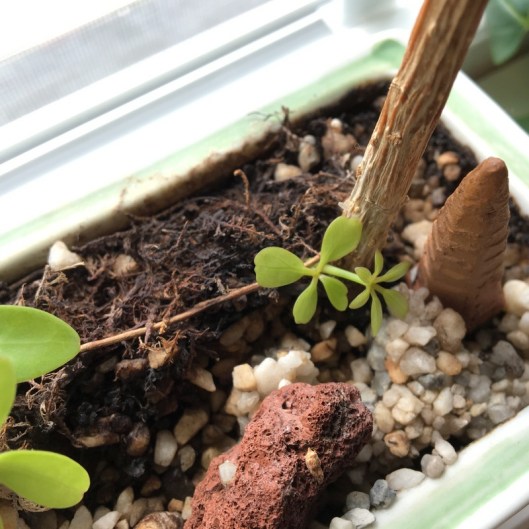
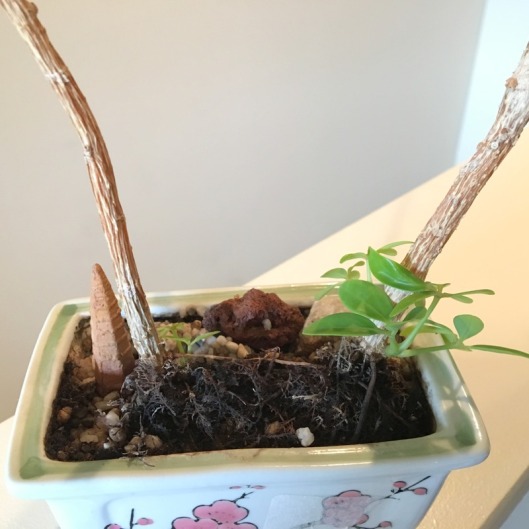
IMG_1797One of the things you may not know about me is that I am terrible with plants.  Though many people have a green thumb, I am a textbook example of a brown thumb.  My instincts and habits are terrible.  Either I water the plant too much or not enough.  I never know how much sun is enough.  I am lucky if a plant lasts more than a month in my house.  If I am really honest, most of my plants suffer from neglect.  I just get too busy and by the time I remember the plant, the plant is past the point of redemption.  One of my former parishioners was convinced she could convert me to a green thumb.  She even regularly put plants on our front porch – right near the water spigot.  I am sure she mourned many a plant on my behalf.

IMG_1794There is, however, one exception to this rule.  It was a plant given to us as a wedding present almost fifteen years ago.  Of course, when we received it, my immediate thought was, “Great!  There goes another plant in the trash!”  But much to my surprise, the plant was hearty.  No matter how long I forgot to water it, it managed to forgive me and perk back up when watered.  No matter how many new places I took it, it kept on going.  I jokingly started referring to the plant as our “love plant.”  It was a reminder of our special day, and like a loving marriage, it held together through thick and thin.

But during our most recent move, I pretty much killed our love plant.  I left the plant in the car.  It was not that warm in April, so I figured it would be okay there.  But I think our love plant just got scorched over the several-day move.  I had never seen the plant look like it did.  Normally the leaves naturally fell off when it was getting thirsty (my number one sign to water it!!).  But these leaves just shriveled and refused to fall or separate from the stem.  One stem seemed salvageable, but the other was totally gone – shriveled and dry.  I was devastated – not only for the plant that lasted almost 15 years with me, but also because of the significance the love plant had assumed.  What did its death mean?  Was it a sign about my marriage?!?IMG_1795

I refused to throw the plant away.  It just broke my heart too much.  So it sat on a window sill and I just let it be a sad reminder of my failure.  But then last week, something incredible happened.  At the bottom of the “barely alive” stem of the plant appeared new foliage.  I almost cried.  The plant has never gotten new foliage at the bottom – only at the top.  I don’t know what it means or if they will just fade too, but the joy I felt for those new little guys was overwhelming.  And then, today, I noticed some new foliage on the “dead” stem too. IMG_1796

I do not know if there is any real symbolism in the new growth, but I have to imagine there is.  My husband and I have started new jobs, our kids have begun new schools, and we have begun a new phase of our life.  Almost fifteen years later, love continues to find new ways to grow in our marriage, even on days when it feels like the love is dried up.  That kind of faithfulness is the same faithfulness we see in God’s hesed, or loving-kindness, for all of us.  Even when we feel like God’s love has abandoned us, we find new springs of life bubbling up where we least expect it.  Today, I encourage you to look for the new growth in your life.  Where is love sneaking in and gifting you with joy?

Homily – John 11.21-27, Cemetery Memorial Service, March 19, 2016

29 Tuesday Mar 2016

Posted by jandrewsweckerly in Sermons, Uncategorized

≈ Leave a comment

Tags

cemetery, darkness, death, Easter, eternal life, grief, homily, if only, Jesus, joy, Lazarus, light, Martha, memorial, resurrection, spring

“Lord, if only you had been here, my brother would not have died.”  These are the words Martha says to Jesus in our gospel lesson today.  The weight of that phrase, “if only,” is heavy.  We all know that weight.  If only he hadn’t caught pneumonia.  If only she hadn’t taken the car out that day. If only we had known about the cancer earlier.  If only they were here now.  We know the sickening power of “if onlys.”

One of my favorite movies is a movie called Sliding Doors.  The movie follows a woman who is fired from her job.  As she makes her way home she has seconds to catch a train.  The movie divides into two at that point.  In one storyline she catches the train home only to find her boyfriend cheating on her at home.  In the other storyline she misses the train and is none the wiser about her boyfriend’s affair.  The two stories unfold in parallel, letting her life unfold from that one moment of a missed or caught train.  Her story is the ultimate “if only” story.

Martha knows the feeling of “if only.”  She knows that if only Jesus had been there, he would have healed Lazarus.  She also knows that if only Jesus had not taken so long, he probably could have made the trip in time.  That phrase, “if only,” hangs in the air for Martha.  But Jesus does not let Martha linger in the past, dreaming about what might have been.  Instead, he points Martha to the future – reminding her that her brother will rise again.  Martha already knows this.  Resurrection life was standard Jewish teaching in their day.  By Martha’s quick response to Jesus, we know that his reminding her about the future of resurrection doesn’t offer Martha much comfort.  But then Jesus does a funny thing.  He twists time all around, telling Martha that “the future is suddenly brought forwards into the present.”[i]

When Jesus says to Martha, “I am the resurrection and the life,” he is not just talking about a doctrine.  He is not just talking about a future fact.  The resurrection is a person, standing here and now in front of Martha.  Jesus invites Martha to exchange her “if only,” for an “if Jesus…”  As one scholar explains, the “if” changes:  “If Jesus is who she is coming to believe he is…If Jesus is the Messiah, the one who was promised by the prophets, the one who was to come into the world…If [Jesus] is God’s own son, the one in whom the living God is strangely and newly present…if [Jesus] is resurrection-in-person, life-come-to-life…”[ii]  You see, when Jesus changes Martha’s mourning to a pondering about what resurrection means, Jesus pulls her out of the past, with an eye on the future, that bursts into the now.

The last time we gathered, we did so in the darkening days of winter.  We watched Christmas approach, and the grief of “if only,” was heavy upon us.  But today, out tone shifts.  Spring is trying to emerge, the days are gifting us with more light, and Easter is approaching.  We have journeyed through a season of darkness.  The Church now invites us to journey toward the light.  The way that we make that transition is not by mourning the “if onlys,” but cultivating the joy of the possibility of “if Jesus.”

Isn’t that how we ever truly face death, though?  That is the eternal gift of our faith in Jesus Christ.  We are promised eternal life through the Savior who came among us, who taught us, loved us, died for us, and rose again.  And through his existence, resurrection is no longer a future longing, but a promise for the here and now.  Our loved ones are celebrating in the resurrection life, because as Jesus says, everyone who believes in Jesus Christ, even though they die, will live and everyone who lives and believes in him will never die.[iii]

As we approach Holy Week and Easter next weekend, I invite you to journey with Christ through the last bits of darkness, holding fast to the promise of the light of Easter – when we shout our joy to the world for the Savior who makes resurrection life possible in the here and now.  The church will journey with us as we loosen our grips on the “if onlys” of life and we attempt to embrace the “if Jesus” ponderings of life.  Today we recognize the ways that the “if onlys” try to haunt us.  But today we also lean on the church for support to hold fast to the “if Jesus” part of our loved ones’ stories.  When we hold on to the power of the future made present, we are able to rejoice this Easter with fullness and joy.  Amen.

[i] N.T. Wright, John for Everyone, Part 2 (Louisville: Westminster John Knox Press, 2004), 6.

[ii] Wright, 7.

[iii] John 11.25-26

Sermon – Luke 15.1-3, 11b-32, L4, YC, March 6, 2016

10 Thursday Mar 2016

Posted by jandrewsweckerly in Sermons, Uncategorized

≈ Leave a comment

Tags

bad, church, death, family, forgiveness, God, good, grace, honor, layers, Lent, love, parable, prodigal son, refreshment, repentance, respect, Rose Sunday, saints, Sermon

Growing up, my Grandfather was considered a saint.  He was kind and funny.  He was a wiz in the kitchen, and he always made you feel good.  He was beloved by all, and was known as a champion for the underdog.  That narrative was affirmed at his funeral as we told stories of his kindness and generosity.  He was without blemish and probably could have remained so had I not asked questions.  But over coffee one day, I had a conversation about the saintliness of my grandfather with my aunt and uncle.  Over the course of our conversation they slowly opened my eyes about how my grandfather was more nuanced that I realized.  What I interpreted as kindness they helped me see as, at times, avoiding conflict to the detriment of others.  What I saw as peacemaking could be interpreted as not standing up to bullies.  Slowly the one-dimensional man I knew developed layers – layers of goodness and weakness; layers of helpfulness and harm; layers of perfection and flaws.

We regularly do the same thing with those who have died – whether canonized saints or beloved family members.  In death, we honor all the goodness about them and gloss over the bad parts.  A classic example is one of my favorite modern-day saints, the Rev. Dr. Martin Luther King, Jr.  He spearheaded a movement with grace, insight, and boldness and inspired generations.  But I remember reading later in life how his treatment of women in the Civil Rights Movement was not always as admirable.  Slowly his layers emerged for me.  Although I still admire his work and writings, his life is more nuanced now.

Now some people will argue that we should not speak ill of the dead – that we should show our respect by letting go of the bad and only honoring the good.  In some respects, I understand why people do not want to dishonor the dead.  But I think telling stories that only make others seem perfect without honoring their flaws hurts us more than helps us.  That is why I love the parable of the two sons from our gospel today.  I resists calling the parable the parable of the prodigal son because I think both sons have something to teach us.[i]  In the parable, we can easily see the two brothers in one-dimensional ways.  The older brother is the good and faithful son for loyally supporting his father and the family business.  The younger brother is the bad son who insults his father, squanders his ill-gotten inheritance, and shamefully asks for more than he deserves.  Those one-dimensional stories are stories we know.  We have friends, family members, or maybe some of us even who are those characters – the responsible older sibling, or the troublemaking younger sibling; the child whom the parent always brags about, or the child about whom the parent seems embarrassed; the child who brings the family honor, or the child who brings the family shame.

But like any good parable, these characters are not as one-dimensional as they seem.  I was thinking about the younger brother this week and I realized we never hear about his impression of the party his father throws.  We suspect he is grateful for his father’s forgiveness, and we honor the humble way the younger son repents, but that party must have been hard.  Everyone at the party knows his sin.  Asking for his portion of his father’s inheritance before his father’s death was tantamount to wishing his father were dead.[ii]  In order for his father to give the younger son the money, he would have had to have sold off some land – a fate even worse for a culture who understood their land to be God’s promised gift.[iii]  Though his father’s forgiveness must have been a relief, I cannot imagine the rest of the town being so gracious.  I wonder whether the son stayed humble and repentant during the party; whether he was able to relax into his newfound forgiveness, laughing and joking; or whether he felt uncomfortable, bristling from his neighbors’ judgment and sideways glances.

Of course, we cannot forget the older brother.  The dutiful, obedient, hardworking brother loses all his perfection in his reaction to this party.  The older brother throws a temper tantrum of epic proportions.  He whines about the abundance his father shows his brother – perhaps rightfully so, since the money and fatted calf used for the party comes from what is left of the older son’s inheritance.[iv]  He complains about how he has never experienced such bounty and celebration.  He resents his father’s lack of gratitude for all the older son’s dutiful work.  Some of the son’s indignation is warranted.  He was, in fact, the good son, and his younger brother had behaved badly.  But the rewards of the story are not playing out so simply.  The older brother overreacts.  You see, his response is equally disgraceful to his father.  In the day of this parable, the host of a party was never to leave his guests.  Going to his older son would have been seen as disrespectful to the guests he had invited.[v]  But just like he goes out to meet his younger son, the father goes out to meet the older son, offering him similar generosity and abundance in the face of his son’s sin.

Part of why we love this parable so much is that we can identify with all the characters.  We are a people of nuanced layers too.  We have our younger son moments and our older son moments.  We have moments when we are bastions of forgiveness and grace, and moments when we withhold that forgiveness and grace.  Those among us who are known as having deep wells of patience have our moments when we snap.  And those among us who are known as being judgmental or stern have our moments of insightful kindness.

Our layers are why we have seasons like Lent and days for healing prayers.  In Lent, we shuffle home from our partying, wastefulness, and self-centeredness and return to our forgiving Lord.  In Lent, we bring our resentfulness, jealousy, and self-righteousness to the altar as we long for another way. In Lent, we bring our judgment of others and our judgment of ourselves and exchange them for freedom for humility and compassion.  Having a healing service in Lent allows us to do those things in a tangible way – not just to pray for physical healing of ourselves and others, but to pray for spiritual healing for those layers that are not as beautiful as others.

In order to honor that work of self-reflection and repentance, the church gives us what is called Rose Sunday, Refreshment Sunday, or even Mothering Sunday.  The idea is that being half-way through Lent, we take a day to break our fasting in these forty days.  In many parishes, to reflect the respite from penitence and fasting, the vestments and paraments change from their usual Lenten array to a beautiful rose-colored array.  On this day, we take a break from wallowing in ashes and our sack cloths, and we find refreshment in our Lord’s forgiveness and redemption.  In England, apprentice boys took this day off to visit their mothers, hence the one designation as Mothering Sunday.  We hear that invitation into gladness today in our psalm, “Happy are they whose transgressions are forgiven, and whose sin is put away!  Happy are they to whom the Lord imputes no guilt, and in whose spirit there is no guile!”[vi]  After weeks of repentance, heaviness, and weight, today the church invites us into forgiveness, lightness, and joy.

Rose Sunday is like the father in our parable today – full of forgiveness, grace, and love for us and all our layers – the good and the not-so-good – because we all have the layers.  Today the church runs out to greet us, leaves a good party, and meets us where we are – and loves us.  Today, the church says, “I see your layers, and I love all the parts of you, fully.”  Today the church is a fool for forgiveness, not wisely teaching us a lesson about humility, but senselessly lavishing upon us grace, love, and freedom from our self-centeredness and self-righteousness.  On this refreshment Sunday, the church invites us to remember that we are beloved children of God, a God who knows all our layers and loves us anyway.

I invite you today to take on the fullness of refreshment this day.  Whatever you have been working on this Lent, whatever guilt you have been harboring, or whatever sinfulness you have been examining, know that your sins are forgiven.  Know that you can come forward for healing prayers, not asking for healing and wholeness, but celebrating the healing and wholeness you have already experienced.  Know that you can come to the Eucharistic table not just for solace only but for strength; not just for pardon only, but for renewal.  As we say in our Rite I prayers, Jesus says to us, “Come unto me, all ye that travail and are heavy laden, and I will refresh you.”[vii]  Amen.

[i] Karoline Lewis, “Perspective Matters,” February 28, 2016, http://www.workingpreacher.org/craft.aspx?post=4553 as found on March 3, 2016.

[ii] N. T. Wright, Luke for Everyone (Louisville:  Westminster John Knox Press, 2004),187.

[iii] Leslie J. Hoppe, “Exegetical Perspective,” Feasting on the Word, Year C, Vol. 2 (Louisville:  Westminster John Knox Press, 2009), 119.

[iv] Barbara Brown Taylor, “The Parable of the Dysfunctional Family,” April 17, 2006, as found at http://www.barbarabrowntaylor.com/newsletter374062.htm on March 3, 2016.

[v] David Lose, “Lent 4 C:  The Prodigal God,” February 28, 2016, as found at http://www.davidlose.net/2016/02/lent-4-c-the-prodigal-god/ on March 3, 2016.

[vi] Psalm 32.1-2.

[vii] Matthew 11.28.  BCP 332.

Sermon – Luke 4.1-13, L1, YC, February 14, 2016

17 Wednesday Feb 2016

Posted by jandrewsweckerly in Sermons, Uncategorized

≈ 2 Comments

Tags

clergy, death, dependence, faithfulness, formation, God, Holy Spirit, hope, Lent, presence, Satan, Sermon, temptation, transition, wilderness

The irony of this being the first Sunday in Lent after the week we have had is not lost on me.  By now our parish should have received a letter from me explaining how I have accepted a call to a new position in Williamsburg, Virginia.  The letter has been met with a variety of reactions, from surprise to disappointment, from understanding to hurt, from confusion to anger.  But no matter what the initial reactions have been, the primary question from all has been, “What does that mean for St. Margaret’s now?”  That question and the news of coming change alone would have been enough for the week.  But then on Friday we lost one of the patriarchs of St. Margaret’s.  Though any death is hard, as a founding member and a perpetual evangelist, Chet will be deeply missed.  Given the week we have had, I cannot think of a better Sunday to talk about the wilderness.

In Luke’s gospel today, Jesus goes from the high of his baptism, where God proclaims Jesus’ identity as God’s son, out to the wilderness where he will be tempted for forty days by Satan.  The people of God are no strangers to the wilderness.  Before the people of Israel entered the land of promise in our Old Testament reading today, first they wandered for forty years in the wilderness.  Those years typify what a wilderness experience is all about:  confusion, fear, wariness, hunger, dissatisfaction, mourning, regret, anger, jealousy, and impatience.  In the wilderness, the people of Israel wondered why they had ever left Egypt, even though Egypt had been a place of slavery.  At least in Egypt they knew from where their next meal would come.  In the wilderness, the people of Israel whined about everything – a lack of food, a lack of water, a lack of direction.  They lost hope in God to provide for them so, in a moment of weakness, they had their priest construct a golden calf for them to worship.  They behaved so badly that a whole generation did not get the chance to see the promised land.  For Jesus, the wilderness is no different.  The wilderness is marked by scarcity and temptation.  Voices try to sway Jesus away from God.  And when Jesus was at his weakest, Satan himself came to tempt Jesus to take matters into his own hands instead of trusting God to stand with Jesus.

Of course, St. Margaret’s is no stranger to wilderness times.  Before we had parish status we went through several vicars, experiencing one transition after another.  When the twenty-year tenure of our first rector ended, many wondered how we would survive.  Clergy transitions can feel much like those wilderness moments for the Israelites.  On the one hand, transitions are full of promise as we imagine what new life a different clergy person might breathe into our community.  On the other hand, there are days when we glorify Egypt, when although our time in Egypt was not perfect and maybe had even become stale, at least we knew what to expect or had the stability of Father so-and-so.  Likewise, we have been through many parish deaths.  Each one hits us in a unique way, and each one makes us wonder what we will do without the person we have lost.  Who will be our warden, our treasurer, our coordinator of ushers, or our major donor?  How will we sing in the choir, laugh at coffee hour, or balance the budget without them?

That is the scary thing about the wilderness.  The wilderness tempts us into thinking and doing all sorts of things.  Although the three specific temptations of Jesus that Luke describes are certainly challenging, what is more unsettling is the underlying nature of temptation itself.  As one scholar argues, “…temptation is not so often temptation toward something – usually portrayed as doing something you shouldn’t – but rather is usually the temptation away from something – namely, our relationship with God and the identity we receive in and through that relationship.”[i]  What the wilderness has the chance to do is undermine our confidence in ourselves and in the community God made us to be.  That is what Satan is trying to do to Jesus:  erode Jesus’ confidence in his identity, in his security, and in his worthiness before God.  Satan did the same thing to the people of Israel for forty years, and Satan will do the same thing to St. Margaret’s if we let him.  Satan will try to erode our confidence that God is still acting and moving in this place and will continue to make this community a place of sacred encounter and experiences with God and God’s people.

As I was thinking about the wilderness of Lent, transition, and death, I kept coming back to the Holy Spirit.  You see, when Jesus goes into the wilderness, he does not go alone.  The text tells us that the Spirit led Jesus into the wilderness.  The Spirit does not just drop Jesus off to fend for himself.  “…the Spirit continues to abide with him, enabling him to grow stronger through this season.”[ii]  Being filled with and accompanied by the Holy Spirit is the only way one gets through the wilderness.[iii]  The Spirit stays with Jesus in the wilderness because being chosen and anointed for one’s mission is not enough.  Jesus must be tested, being led to places of hunger and despair.  Only then does he learn dependence on God, who graciously provides for all our needs in all of life’s seasons.[iv]  The Holy Spirit enables Jesus to journey through the wilderness so that Jesus can learn that lesson about dependence upon the Lord our God.  The Holy Spirit’s company allows Jesus to see the powerful presence and abundance of God in his deepest need.

Thinking about the Holy Spirit this week has shifted my energy.  Instead of thinking about the wilderness with a sense of dread and familiarity, instead of bracing myself for impact, and instead of erecting soaring walls of protection to keep pain out, I found myself asking a different set of questions.  Where have I experienced God’s faithfulness in the wilderness?  How has my relationship with God been transformed?  How strong are the temptations of returning to old ways – to ways of relying on myself?[v]  Somehow, shifting the questions from where has God been absent in the wilderness to where has God or the Holy Spirit been present in the wilderness gave me a sense of hope.  Instead of looking for the bad – the dreariness of Lent, the burden of transition, the grief of death – I found myself wanting to look for the good – the blessing of time set apart with God, the opportunity for new life and growth, the reminder of resurrection promised for us all.

I will not tell you that the next forty days or even forty weeks will be easy.  In fact, I know that many of those days and weeks will be very hard.  But having been through Lents, transitions, and deaths before, and having watched Jesus held up by the Spirit, I can tell you that we have all experienced God’s faithfulness in the wilderness.  Though none of us likes the wilderness, the wilderness is a necessary part of our formation in Christ – like the necessity of wildfires to restore health and wholeness to ecosystems.  Just like those fires can contribute to overall forest health, the wilderness can contribute to our overall spiritual health.  In these next forty days, I invite you to not turn inward toward fear, protection, and isolation.  I invite you to turn to one another for strength and companionship.  I invite you to come to me as we all process what this change means for St. Margaret’s.  But mostly, I invite you to remember the Holy Spirit who is keeping vigil with each one of us.  The wilderness of Lent this year may be more palpable than in years past.  But I invite you to hold on to the hope of God’s promise to be with you in the midst of the wilderness.  Amen.

[i] David Lose, “Lent 1 C: Identity Theft,” February 9, 2016, as found at http://www.davidlose.net/2016/02/lent-1-c-identity-theft/ on February 11, 2016.

[ii] Jeffery L. Tribble, Sr., “Pastoral Perspective,” Feasting on the Word, Yr. C, vol. 2 (Louisville:  Westminster John Knox Press, 2009), 44.

[iii] Karoline Lewis, “Filled With the Holy Spirit,” February 7, 2016 as found at http://www.workingpreacher.org/craft.aspx?post=4291 on February 11, 2016.

[iv] Tribble, 44.

[v] Kimberly M. Van Driel, “Homiletical Perspective,” Feasting on the Word, Yr. C, vol. 2 (Louisville:  Westminster John Knox Press, 2009), 47.

Homily – Isaiah 25.6-9, Cemetery Memorial Service, December 19, 2015

05 Tuesday Jan 2016

Posted by jandrewsweckerly in Uncategorized

≈ Leave a comment

Tags

baby, banquet, celebrate, child, Christ, Christmas, comfort, death, feast, heaven, life, love, Sermon, shadow

One of the little secrets that they don’t tell you about in ministry is that this time of the year is filled with death.  While the rest of the world is running around singing about this being the most wonderful time of the year, priests are bracing themselves for a slew of funerals.  I remember my first year as an ordained person our parish having five or six funerals in December.  I mentioned the oddity to my fellow clergy and they gave me a knowing nod.  “Oh yeah, December always has lots of deaths,” they told me.

A month of concentrated deaths would be strange in and of itself.  But probably what is even more strange is the juxtaposition of death and life in December.  You see, every year we celebrate new birth – in fact one of the most important births of our Christian identity.  And yet every year, in the face of wondrous new birth is the overshadowing of death.  Last year at St. Margaret’s, one of our beloved parishioners died days before Christmas.  On the morning of Christmas Eve, we celebrated his death.  That afternoon we celebrated Christ’s birth.  Life and death seeped into each other, making separating the two realities impossible.

I imagine the reality of death clinging so closely to life is not new to most of you here.  We gather this evening every year to honor the reality of celebrating Christmas in the shadow of death.  We set time apart to honor how fresh the death of our loved ones is at this time of year – whether they died months or weeks ago, or whether they died thirty years ago.  The problem is that no matter when our loved one died, they left a mark on our collective experience of Christmas.  Maybe they cooked Christmas dinner every year.  Maybe we always visited their house and exchanged presents.  Maybe they always told loud, awful jokes or made the holidays a little more bearable.  Whatever their legacy on this time of year, there is some part of our heart that is missing without them here.  Sure, we make new Christmas memories without them.  Eventually, there will be new babies, cousins, and grandchildren who will never know those loved ones we knew.  But for us, those loved ones are never far this time of year, however briefly stealing away some of the joy that this time of year can bring.

I think that is what I love about our Old Testament lesson today.  Isaiah talks about the coming kingdom of God.  Isaiah says, “…the Lord of hosts will make for all peoples a feast of rich food, a feast of well-aged wines, of rich food filled with marrow, of well-aged wines strained clear.”  There is something about that image of a feast that gives me great comfort this time of year.  Maybe the image is comforting because this holiday is often about comfort food – recipes that give us a sense of nostalgia or make us feel safe just through their familiarity.  Maybe the image is comforting because we can imagine that raucous table with a large crowd gathered eating, drinking, laughing, and sharing in each other’s joy.  Or maybe the image is comforting because we can connect our earthly banquets with the heavenly banquet – imagining those sacred moments and places where we really feel like our loved one’s presence is palpable at our Christmas table – a mystical union between the two feasts.

I cannot promise you that Christmas will be easy this year.  In fact, I suspect that those of you whose loved ones passed away years and years ago already know that Christmas will always have a tinge of sadness and loss.  Death and new life will always be oddly intermingled this time of year.  But I also suspect that may be on purpose.  Even though death is inevitable and keeps coming at us, reminding us of our own mortality, we keep celebrating the birth of the Christ Child and the new life and promise of hope he brings.  Nothing quite warms the heart like warmth of a swaddled baby.  Nothing gives us greater hope and wonder than the miracle of new life.  Nothing brings us deeper joy than the innocence and purity of a newborn.  We know that any baby can bring that kind of joy.  But celebrating the Christ Child is about even more – celebrating the Christ Child is a celebration of all that he will bring – the banquet that his life inaugurates and the feast that he creates for us.  Christmas will not be the same without our loved ones.  But Christ promises to keep bringing us new life until we can join our loved ones in that heavenly banquet that never ends.  Amen.

Sermon – John 11.32-44, AS, YB, November 1, 2015

04 Wednesday Nov 2015

Posted by jandrewsweckerly in Uncategorized

≈ Leave a comment

Tags

All Saints, dead, death, Jesus, Lazarus, life, light, live, new life, reborn, resurrection, Sermon

There is a lot about the Lazarus story that I do not understand.  I do not understand why Jesus allows Lazarus to die if he is only going to bring him back to life anyway.  I do not understand why Jesus weeps when he knows he can fix things.  I do not understand why Jesus raises Lazarus from the dead when eventually Lazarus will have to die again.  But mostly I do not understand why we never hear from Lazarus about how he feels about all of this.  The text tells us Lazarus has been dead for three days.  We do not know much about the afterlife, but presumably, after three days, one’s body and soul have already moved beyond this earthly life.  For all we know, Lazarus is at peace, already enjoying eternal rest with God.  Whatever pain and suffering he has endured in life is gone.  Maybe he is relieved to be free of the stress and battles of earthly life, and to be released to enjoy the peace of eternal life.  When he has reached that point of peaceful bliss, why would he want start over – knowing he will eventually have to go through death all over again?[i]

I used to watch the television show Buffy the Vampire Slayer.  For those of you who are unfamiliar with the show, the premise is that throughout time there has always been one young woman in the world chosen to be the Vampire Slayer – a young woman trained and “called” to protect the world from vampires.  In season five, after having prevented at least five apocalypses, Buffy faces one more.  In the episode, the only way to stop the end of the world is for her to sacrifice herself.  She dies and the world is saved.  Of course, the next season, her friends use magic to bring her back from the dead.  But the rest of that season, Buffy struggles.  She finally confesses that she did not want to be brought back from the dead.  She had been happy and at peace.  All of the fighting and struggling against evil was over, and she was finally free from all obligation and strife.  Being brought back was even worse than before.  Not only did she have to continue fighting evil, but also she was now aware of the freedom she could have had.  She didn’t want to be resurrected.

What Buffy eventually discovered, and I am sure Lazarus did too, was that there was still some purpose left in her life.  In fact, she was able to transform the entire vampire slaying industry.  Unfortunately, we never really get to hear what happens to Lazarus – how his resurrection transforms his life.  We eventually read that the chief priests plot against Lazarus because people are beginning to follow Jesus after he raises Lazarus from the dead.  Perhaps there were times when Lazarus would have preferred to have stayed dead than to be raised again and face all the controversy.  But perhaps, Lazarus found new purpose and was able to use whatever additional earthly time he had to do something good.[ii]

When Scott and I first moved to Delaware after graduating from college, we found a church home at the Cathedral.  The Cathedral was a special place for us.  The Cathedral was where we were both confirmed as adults.  The Cathedral was where we had our first experiences serving on Vestry, leading Bible Study, officiating Morning Prayer, and teaching a Rite 13 class.  The Cathedral was the place where I fell in love with Anglican Choral Music and chant.  The Cathedral was where I was ordained as a Deacon in the Church.  So, a few years ago, when the Cathedral closed because the congregation could no longer support the cost of ministry in that space, you can imagine that I and hundreds of others were devastated.  Those pews, those stone walls, that altar rail was the site of transformation and holiness in our lives.  Now, the fate of that sacred space would depend on who bought the Cathedral and what they decided to do with it.

This past week, a story broke about the Cathedral.[iii]  Another non-profit in the same town purchased the property and would be converting the church and all the office and classroom spaces into housing for moderate- to low-income elderly persons.  When the project is done, there will be 53 housing units, housing over 116 residents.  Though I never wanted the Cathedral to die – in fact, I was devastated by its death – I also must admit that the news of the resurrection of this church into a powerful new ministry brought me infinite happiness this week.  What I could see was that something good would be coming out of the Cathedral’s death.  The Cathedral had always been a place of service and mission, bringing Christ’s light into the community.  Once this new residence is completed, the Cathedral will continue its work of bringing Christ’s light into the community.

As I was thinking about the Cathedral and Lazarus this week, what I began to wonder is whether earthly death was necessary for each of them to be reborn into new life.  In many ways, when we do a baptism, that is what we say happens.  As we enter into the waters of baptism, the old self dies and a new self emerges from the waters on the other side.  We die to earthly life and are reborn into the life of faith.  In fact, in ancient days, baptism happened in a pool of water so that the whole body could be immersed in water, signifying the old self being washed away and the new self emerging out of the watery womb of Christ.  But in order to be baptized, in order to have new life, death must first happen.

When we think about All Saints Day, which we celebrate today, that pattern is quite familiar.  Most of the saints that we honor today experienced a death of sorts before their earthly deaths.  I can think of countless saints who renounced their wealth or their privilege in order to begin a new life:  St. Francis, Mother Teresa, and Oscar Romero.  And we know everyday modern saints who experience the same thing:  that young adult who spent thousands of dollars on a University education to go spend two years in the Peace Corps; that person who worked on Wall Street, making millions, who left to start a non-profit; or that well-paid doctor who spends weekends at the community clinic and summers traveling with Doctors Without Borders.  What those ancient saints, famous saints, and everyday saints teach us is that sometimes a part of us has to die in order for us to truly experience resurrection life.

I imagine each of us here has something we have been holding on to – or even clinging on to – that needs to die before something can be reborn in us.  Maybe we need to let go of a memory – the memory of that perfect long-tenured rector or the memory of that painful experience with a rector – so that we can reassess what new life is blooming right in front of us.  Maybe we need to let go of a resistance to change – letting the familiar die so that something new and fresh (and perhaps, just maybe, shockingly better) can be born anew in our community.  Or maybe we need to let go of a theology of scarcity – that fear that I or my church will not have enough – so that we can allow a theology of abundance to grow in us.  In many ways, I see that new life already budding here at St. Margaret’s.  I see those glimpses of resurrection life pushing their way out of our protective arms.  The invitation from the saints today is to let go.  Let death happen so that new life can emerge.  Let that new hope spring out of the tightly sealed containers in which we have hidden budding hope.  And maybe, like Lazarus, when Jesus calls for us to come out of the tomb, we won’t be afraid to take off those binding cloths and to embrace whatever new, scary, uncomfortable, and awesome new life awaits.  Amen.

[i] Suzanne Guthrie, “Back to Life,” Christian Century, vol. 122, no. 5, March 8, 2005, 22.

[ii] Henry Langknecht, “Commentary on John 11.32-44,” November 1, 2009, as found at https://www.workingpreacher.org/preaching.aspx?commentary_id=429 on October 29, 2015.

[iii] Robin Brown, “Historic church complex set to continue ‘Lord’s work’,” October 29, 2015 as found at http://www.delawareonline.com/story/news/2015/10/22/historic-church-complex-set-continue-lords-work/74269674/?hootPostID=ab06f2224fc6ba16ac4e81312a021ffa.

O death…

16 Wednesday Sep 2015

Posted by jandrewsweckerly in Uncategorized

≈ 1 Comment

Tags

abundance, blessing, call, death, different, eternal life, fear, freedom, God, grace, joy, pretend

This past week I have been thinking a lot about death.  It’s probably a function of being a priest, but death is ever a part of my journey.  Many days I can avoid thinking about it.  But I imagine that is not really what God wants.  Just to prove the point, I find that deaths usually come in threes.  No one can avoid thinking about death when they come in threes.

That was the case last week.  Within 24 hours, a parishioner, a family member, and an acquaintance all died.  The parishioner was retired but was living a full life.  She went in to check on some pain and within four months she was gone.  The family member was much older.  She had lived a full life and the journey toward death took a long time.  We were sad, but ready.  The acquaintance was around my age and had three kids at the same nursery school one of my daughters attends.  She got sick and within a week died.  Three children.  My age.

That’s the funny thing about death.  We can pretend it happens only to old people (which we never are – even when we are).  We can pretend it is far away and will come when we are fully prepared and ready to join our God.  We can pretend that death is non-existent.  But we know that is all pretend.  We know that pretending is just our way of masking how scary death is.  For those of us who believe in eternal life, we like to say that life is changed, not ended.  But that is what we say about others.  I wonder how much we can proclaim it for ourselves.

Photo credit:  http://www.oneforall-allforone.net/rssnews/odeath/

Photo credit: http://www.oneforall-allforone.net/rssnews/odeath/

One of my favorite songs from the film “O Brother, Where Art Thou,” soundtrack is called “O Death.”  In the song, the artist sings, “O, death, won’t you spare me over til another year.”  The singer’s voice is haunting.  And while there is a part of us that knows we should not fear death, there is something in that song’s words that resonates with us.  We want one more year.  One more decade.  One more lifetime.

And yet death comes.  Sometimes death comes within a week – within a day.  I wonder what you would do differently with your life if you were willing to let that reality slip over you.  What has God been calling you to do that you have been avoiding?  What have you been meaning to say to someone that you don’t say because you are afraid?  Does the reality of death make you want to move?  Though the questions are heavy, as is the topic, I think there is freedom in the questions too.  We can let go of all that is weighing us down and start living.  The promise of earthly death is a blessing – one that frees us to live this life with abundance, grace, and joy.  How will you start living into that joy today?

Sermon – Mark 1.9-15, L1, YB, February 22, 2015

25 Wednesday Feb 2015

Posted by jandrewsweckerly in Uncategorized

≈ 1 Comment

Tags

Ash Wednesday, church, death, honesty, Jesus, journey, Lent, penitence, pilgrimage, pilgrims, Sermon, sobering, wilderness

Lent is a funny season.  Lent gives us all these seemingly horrible things and calls them gifts.  We kick things off with a bang on Ash Wednesday.  We gather in the church and kneel before God while someone tells us that we are dust and to dust we shall return.  In other words, we come to church to be reminded that death is real, death is unavoidable, and death is coming.  With the exception of people facing severe illness or people beyond a certain age, death is not typically a part of our everyday conversations.  Rarely are you drinking a latte with a friend who casually says, “So you know we are going to die, right?  Maybe today, maybe tomorrow, but we will both die.”  That is because death for us is one of those conversations that we do not really like to entertain because death brings down the mood and makes us feel sad.  And yet, that is how we kick off the season of Lent.  “Happy Lent!  We’re all going to die!”

And if that were not sobering enough, the Church takes the next forty days reminding us of our brokenness, of our sinfulness, and of our failures.  We kneel more, confess more intentionally, and pray to reconnect with God.  The season seems to gather us up, place us sackcloth, and then let us wallow in our own sense of unworthiness.  Why in the world would any of us make a commitment to come to Church in Lent with the promise of such guilt and sobriety?

Actually, I think most of us have a love-hate relationship with the wilderness we find in Lent.  We do not want to do the hard work that Lent requires, and yet we also desperately long for a place that acknowledges the reality of all that is hidden behind our perfectly constructed masks, and invites us to just be still and present with our LORD.  In a world that Photoshops, creates whole lines of anti-aging products, and fights death tooth and nail, the church creates a season where we look at ourselves without enhancements and work towards contentment, peace, and even joy.  Lent is a season of honesty, “when the church reminds us of what our culture denies – that our days are limited, and that we’ve made a mess of things.”[i]

Of course, the church did not really invent Lent per se.  The people of God have been experiencing the same concept for years, most frequently in the wilderness.  We know the stories well:  Noah completing his forty days on a ship, floating in his own, albeit probably very loud, watery wilderness; the people of Israel wandering the desert wilderness for forty years; and, as we hear on this first Sunday in Lent, Jesus, led out to the wilderness by the Spirit for forty days immediately after his life-changing baptism.  Each of those experiences are full of Lenten themes:  being taken out of the comforts of life; wondering whether there will be relief from suffering, whether there is dry land, food in the desert, or Satan himself; and glimpses of hope, whether from an olive branch, manna from heaven, or tending angels.  These wilderness experiences, or Lenten-type journeys, pave the way for renewal and reinvention.

This winter, one of our Movies with Margaret features was called The Way.  In the film, a father and his adult son have become somewhat estranged.  The son decided to travel the world to find himself, and the father scoffs.  Months into his son’s travels, the father gets a call.  His son had decided to walk the Camino – the pilgrim’s path in France and Spain that pilgrims have been walking since the ninth century.  Unfortunately the son died while walking the Camino, and the father now needed to pick up the body.  While going through his son’s hiking pack, the father replays their last conversation – about how his Dad is too rigid and never travels anymore since his wife died.  Untrained and unprepared, the father straps on his son’s pack and begins to walk.  He confesses he has no idea why he is walking, but he walks anyway.

The movie goes on to document what might be described as the father’s own wilderness journey.  He deals with getting lost, trying to sleep in noisy hostels, not being able to get rid of talkative fellow pilgrims, losing his bag briefly in a river, getting arrested, and later having his bag stolen by a gypsy.  When he gets to the end of the journey, he takes his documents to the pilgrimage office to have the paperwork authorized and get a certificate of completion.  Before the official will sign his paperwork, he asks a question that stumps the father.  “What is your reason for walking the Way?”  The father stammers.  He cannot put into words why he grabbed his son’s bag and started walking.  Recalling the last fight he had with his son, the best he can come up with is, “I thought I needed to travel more.”

Mark does not give us many details about Jesus’ journey in the wilderness.  Unlike the other gospels, we do not hear the details of his encounter with Satan.  We do not really understand what happens with those wild beasts – whether they were friends of foes.  We hear about some angels at the end, but we do not know how much they are present.  All we really know is that Jesus is in a wilderness for forty days and that those days happen after he is baptized and proclaimed the beloved and before he can begin his earthly ministry.

We too start a wilderness experience today.  At the beginning of our liturgy we confessed many things.  We confessed blindness of heart, pride, vainglory, hypocrisy, envy, hatred, and malice.  We confessed our inordinate and sinful affections and our fear of dying suddenly and unprepared.  We confessed our loneliness, our suffering, and our ignorance.  And we prayed for our enemies.  The ashes from Ash Wednesday and their message of the inevitability of death still linger in our subconscious.  Like the father in The Way, we put all of those confessions and acknowledgments in a pack, put the pack on our back, and we begin to walk.  None of us knows what will happen on this forty-day journey.  We do not know how our Lenten disciplines will shape us, or what external factors will impact our lives.  But we begin the Lenten journey anyway.

The promise for us is refreshment at the end of the journey.  For me, that refreshment is the Easter Vigil.  At Easter Vigil, I put down my pack full of my forty days’ worth of experiences.  I hear the piercing words of the Exultet and the old stories of our salvation told in the darkness.  I watch candles flicker as we sing hymns.  And then I watch the church explode with light and the sound of bells.  We say the forbidden “A-word” after a forty-day hiatus.  We feast on the Eucharistic meal after fasting from that meal since Maundy Thursday.  And we rejoice in our risen Lord.

In the movie, The Way, the father reaches the end of the pilgrimage and has a sacred moment in the church at the Pilgrim’s mass.  He decides to keep journeying further to spread his son’s ashes into the sea.  And at the end of the film, we see him traveling to other places – finally taking up his son’s challenge to see more of the world.  That’s the funny thing about journeys.  They are not the end of the story.  Our Lenten journey will be a true pilgrim’s journey.  But our journey will not end at the Vigil.  Just like Jesus’ journey did not end with angels tending to him.  As Barbara Brown Taylor says, “Even after he left the wilderness, [Jesus] carried [the wilderness] inside him, and far from fleeing [the wilderness] later in his life he sought [the wilderness] out.  Without the wilderness he might not have been the same person.  Because of the wilderness he was not afraid of anything.”[ii]  We all need the wilderness to shape us and mold us.  Our Lenten pilgrimage will change us, both as individuals and as a community, because in the church, we do not journey alone.  Your fellow pilgrims are here in the pews beside you – perhaps to annoy you, or send you on a detour – but maybe also to bail you out of jail from time to time.  Together we are pilgrims on the way, being transformed for new life beyond Lent.  Amen.

[i] Dan Clendenin, “To See Death Daily,” posted February 16, 2015 at http://www.journeywithjesus.net/Essays/20150216JJ.shtml.

[ii] Barbara Brown Taylor, “Four Stops in the Wilderness,” Journal for Preachers, vol. 24, no. 2, Lent 2001, 4.

← Older posts
Newer posts →

Recent Posts

  • On the Myth and Magic of Advent…
  • On Risking Failure and Facing Fear…
  • Sermon – Luke 23.33-43, P29, YC, November 23, 2025
  • On Inhabiting Gratitude…
  • Sermon – Luke 20.27-38, P27, YC, November 9, 2025

Archives

  • December 2025
  • November 2025
  • October 2025
  • September 2025
  • August 2025
  • July 2025
  • June 2025
  • March 2025
  • February 2025
  • December 2024
  • November 2024
  • October 2024
  • September 2024
  • August 2024
  • July 2024
  • June 2024
  • May 2024
  • March 2024
  • February 2024
  • January 2024
  • December 2023
  • November 2023
  • October 2023
  • September 2023
  • August 2023
  • July 2023
  • June 2023
  • May 2023
  • March 2023
  • February 2023
  • January 2023
  • December 2022
  • November 2022
  • October 2022
  • June 2022
  • May 2022
  • January 2022
  • December 2021
  • November 2021
  • October 2021
  • September 2021
  • August 2021
  • June 2021
  • May 2021
  • April 2021
  • March 2021
  • February 2021
  • January 2021
  • December 2020
  • November 2020
  • October 2020
  • September 2020
  • August 2020
  • July 2020
  • June 2020
  • May 2020
  • April 2020
  • March 2020
  • February 2020
  • January 2020
  • December 2019
  • November 2019
  • October 2019
  • September 2019
  • August 2019
  • July 2019
  • June 2019
  • May 2019
  • April 2019
  • March 2019
  • February 2019
  • January 2019
  • December 2018
  • November 2018
  • October 2018
  • September 2018
  • August 2018
  • July 2018
  • June 2018
  • May 2018
  • April 2018
  • March 2018
  • February 2018
  • January 2018
  • December 2017
  • November 2017
  • October 2017
  • September 2017
  • August 2017
  • July 2017
  • June 2017
  • May 2017
  • April 2017
  • March 2017
  • February 2017
  • January 2017
  • December 2016
  • November 2016
  • October 2016
  • September 2016
  • August 2016
  • July 2016
  • June 2016
  • May 2016
  • April 2016
  • March 2016
  • February 2016
  • January 2016
  • December 2015
  • November 2015
  • October 2015
  • September 2015
  • August 2015
  • July 2015
  • June 2015
  • May 2015
  • April 2015
  • March 2015
  • February 2015
  • January 2015
  • December 2014
  • November 2014
  • October 2014
  • September 2014
  • August 2014
  • July 2014
  • June 2014
  • April 2014
  • March 2014
  • February 2014
  • January 2014
  • December 2013
  • November 2013
  • October 2013
  • September 2013
  • August 2013
  • July 2013
  • June 2013
  • May 2013
  • April 2013
  • March 2013
  • February 2013
  • January 2013
  • December 2012
  • November 2012
  • October 2012
  • September 2012

Categories

  • reflection
  • Sermons
  • Uncategorized

Meta

  • Create account
  • Log in
  • Entries feed
  • Comments feed
  • WordPress.com

Blog at WordPress.com.

  • Subscribe Subscribed
    • Seeking and Serving
    • Join 394 other subscribers
    • Already have a WordPress.com account? Log in now.
    • Seeking and Serving
    • Subscribe Subscribed
    • Sign up
    • Log in
    • Report this content
    • View site in Reader
    • Manage subscriptions
    • Collapse this bar
 

Loading Comments...