• About

Seeking and Serving

~ seek and serve Christ in all persons

Seeking and Serving

Tag Archives: dignity

On Neighbors, Kindness, and Baptism…

10 Wednesday Jul 2019

Posted by jandrewsweckerly in Uncategorized

≈ Leave a comment

Tags

baptism, Christian, church, community, covenant, dignity, Episcopal Church, God, identity, Jesus, justice, kind, kindness, love, neighbor, welcome

wont-you-by-my-neighbor

Photo credit:  https://www.92y.org/event/won-t-you-be-my-neighbor

This weekend our parish’s Faith & Film offering was Won’t You Be my Neighbor, the documentary about Fred Rogers.  My daughter had never seen a documentary before, and I was a bit anxious about her attending for fear she would be bored or the film would be too advanced for her.  Ultimately, it was a risk I was willing to take because although though I knew she had never watched Mr. Rogers, I also knew she would appreciate his message.

But the true test came on the drive home.  As we were riding along, my daughter said, “You know what, Mom?  I think if Mr. Rogers were alive today, he would be a part of WMBGkind.”  Right then, I knew that she got it – that she had been paying attention to the witness of Mr. Rogers and his ministry of teaching children about the dignity of every human being.  That is what kindness is really all about – honoring and respecting the dignity of other human beings – no matter their age, race, ethnicity, gender, sexual identity, socioeconomic status, ability, or even their own ability to show kindness in return.

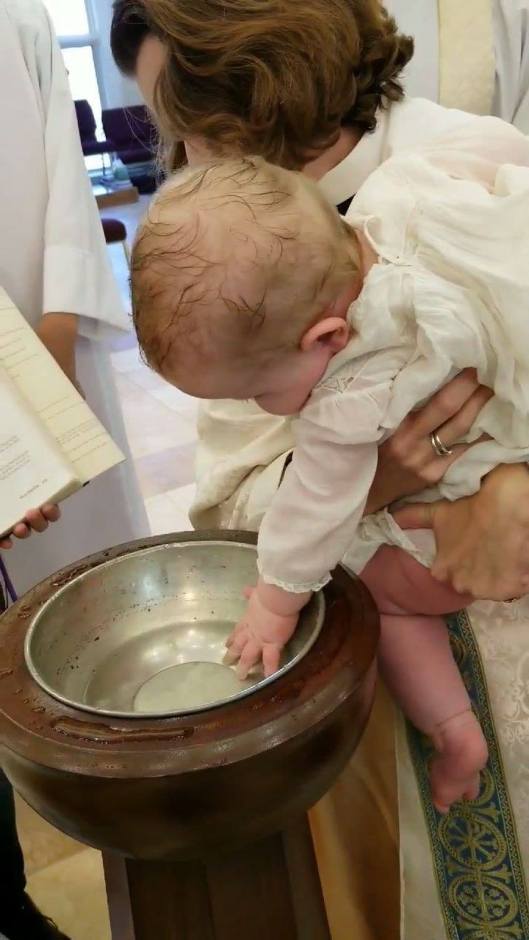
This Sunday, we are baptizing a baby into the household of God.  As part of that ritual, we will make promises about our own spiritual journey.  We will promise to gather regularly in Christian community, breaking bread and praying together; to resist evil, and repent when we fail; to proclaim the Word of God in word and deed; to seek and serve Christ, loving neighbors as ourselves; and to strive for justice and peace, respecting the dignity of every human being.  We promise to do what Christ asked us to do:  love God, love your neighbor, love yourself.

I love that my daughter is affirming her baptismal identity at Hickory Neck – whether she sees Christian witness through Mr. Rogers or through her Sunday School teachers.  I love that our younger children and older youth are learning how to live into their baptismal identity – whether through nursery care providers or youth group leaders.  And I love that our adults are still learning to live into their baptismal identities – through preaching, teaching, and our children’s witness.  At Hickory Neck, we are working across generations to keep loving God, loving our neighbors, and loving ourselves.  If you are in need of a community to help you claim that same identity and purpose, know that you are always welcome here – won’t you be our neighbor?

46040735_2084113391644910_120194659778560_o

Photo credit:  Hickory Neck Episcopal Church; permission to use required

Homily – Ruth 3.1-5, 4.13-17, P27, YB, November 11, 2018

14 Wednesday Nov 2018

Posted by jandrewsweckerly in Sermons, Uncategorized

≈ Leave a comment

Tags

acceptance, Armistice Day, baptism, Boaz, change, covenant, dignity, God, gun violence, honor, life, Naomi, respect, Ruth, sanctity, Sermon, veterans

My intention today had been to talk about Emersyn, whose baptism we will celebrate today, and the gift that she is giving us through her baptism.  When we baptize someone into the family of faith, we also take time to remember our own baptismal covenant.  We remember the promises we make about how we will live our lives, promises we just renewed last week at another baptism.  One of our promises is to respect the dignity of every human being – to respect human life.

We respect human life because we learn to do so in Holy Scripture.  Today, Ruth, Naomi, and Boaz teach us how to respect life.  If you remember, Naomi is a widow who has not only lost her husband and her two sons, but who is left shepherding two foreign daughters-in-law; she is so shattered, she asks people to call her Mara, which means bitterness, instead of Naomi, which means pleasantness.  Ruth, one of those daughters-in-law, is equally bereft; having married into a foreign family, widowed herself, she pledges allegiance to a people who point out her foreign identity at every turn – in fact, she is regularly called, “Ruth, the Moabite from Moab” – or in common language, “Ruth, the foreigner from a foreign land (a land the people hated, by the way).  Boaz is an upright man, put into a precarious situation by Naomi, who sends Ruth to lay at his feet so that he might serve as their redeemer.  But despite the fact life is hard, life brings sorrow, and life treats us like a hated foreigner, Ruth, Naomi, and Boaz respect the dignity of each other.  They respect life.

We need people like Emersyn, Ruth, Naomi, and Boaz because we have been doing a pretty horrible job of respecting life lately.  In just the past two weeks, we have had four “soft target” attacks in our country.  “Soft targets” are attacks that happen in simple, everyday life – where people are having a cup of coffee, celebrating with friends over food and drink, picking up groceries, or worshipping in their house of worship.  In the last two weeks, 27 people were slain in soft target areas:  Two shoppers were gunned down in a Kroger parking lot in Kentucky; Eleven people were gunned down while worshiping in a synagogue in Pittsburgh; Two women were gunned down in a yoga studio in Florida; and twelve people were gunned down in a bar in California.[i]  We can pray for the victims, and attempt to find motives behind shootings, and even bemoan the mental health system.  But until we are willing to make concrete changes, we as Americans disrespect life.  We as Christians fail to respect the dignity of every human being when we do nothing to change our culture of acceptance around gun violence.

Our Veterans helped us understand this failure many years ago.  One-hundred years ago, this day was marked not as Veterans Day, but as Armistice Day – the day we were able to stop a war, to stop aggression, to stop the denigration of life on both sides.  Armistice Day was a day to honor the end of World War I, but perhaps even more powerfully, Armistice Day was a day to honor the dignity of every human being.  On that day, after 8.5 million soldiers had been killed, 100,000 of which were American, you could see the sheer joy in people’s faces as they flooded the streets, realizing death would be no more – that human life would be honored once more.[ii]

Today we have the opportunity to celebrate too.  We have the opportunity to honor and respect the sanctity of life – the life of beautiful baby Emersyn, the lives of our Veterans, and the lives of those shattered by unrestrained gun violence.  The question is whether we will accept the invitation.  Scholar Cameron Howard says in the book of Ruth, we do not experience God in the story as some divine physical presence, as a booming voice from heaven, or as a visible mover of events; instead, we experience God through the characters in the book – God is revealed to the world through the actions of the characters of Ruth, Naomi, and Boaz.[iii]  The world is not that much different today.  The world needs to see God through us too.  Emersyn needs to see God through us.  Our community, state, and nation need to see God through us.  The growing population of those scarred by gun violence need to see God through us.  The only question remaining is whether we will say “yes,” to the invitation, or at least, “I will with God’s help.”  I promise God’s help is waiting for you when decide to respect the dignity of every human being through your actions, revealing God’s presence in the world.  Amen.

[i] Eliott C. McLaughlin, “This is the 4th ‘soft target’ Attack in 2 Weeks,” November 8, 2018, as found at https://www.cnn.com/2018/11/08/us/soft-targets-thousand-oaks-bar-shooting/index.html on November 9, 2018.

[ii] Alexis Clark, “In Photos Unpublished for 100 Years, the Joy of War’s End on Armistice Day,” The New York Times, November 9, 2018, as found at https://www.nytimes.com/2018/11/09/world/europe/armistice-day-100th-anniversary-photos.html on November 10, 2018.

[iii] Cameron B.R. Howard, “Commentary on Ruth 3:1-5; 4:13-17,” November 11, 2018, as found at http://www.workingpreacher.org/preaching.aspx?commentary_id=3890 on November 8, 2018.


GC79: Respecting Dignity

25 Wednesday Jul 2018

Posted by jandrewsweckerly in Uncategorized

≈ Leave a comment

Tags

dignity, Episcopal Church, gender, General Convention, immigration, Jesus, language, outcast, race, respect, sexual orientation

IMG_1851

Photo credit:  Jennifer Andrews-Weckerly (permission for reuse)

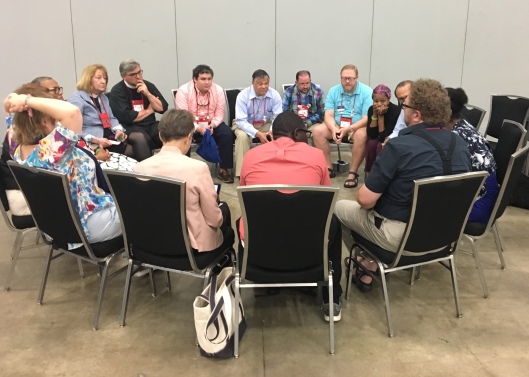
One of the many takeaways from General Convention was the need to tend to those outside of the straight, white, male, able-bodied community.  There was a task force assembled before Convention to address issues raised by the #metoo movement.  Out of that group came many resolutions about sexual harassment and abuse, equality in payment and hiring, parenting accommodations, and eliminating bias in bishop searches.  Our African-American brothers and sisters also called for work on pay equity and broader issues, such as voter suppression.  Our foreign language speakers rallied for more translated liturgies and legislation, as well as increased interpreters throughout Convention.  Our disabled and deaf members lobbied for better accommodations during Convention.  Our LGBTQ members called for broader inclusion and more intentional expansive and inclusive language.  Our immigrant members also called for thoughtfulness about our ordination processes, noting that many dioceses are unwilling to consider entering into a formal discernment process with someone if their immigration status is not settled.

There are probably more issues I am forgetting, but what struck me about each of these movements is that they are not just General Convention issues or wider church issues.  These are issues for every parish.  At our own parish, we are struggling to provide hearing assistance to our hearing-impaired members due to lack of volunteers to run our sound system.  Having served on a Commission on Ministry (COM) in another diocese, I realize now how our restrictions around immigration could have limited the movement of the Holy Spirit.  Even the conversation about breastfeeding on the Convention floor made me realize that we all have work to do about making our worship spaces as welcoming as possible.  Having watched these issues unfold at General Convention, I am convinced that there are issues we are overlooking as well.

Jesus always struck me as someone who saw everyone – especially people that society, religious leaders, and even his disciples overlooked or dismissed.  He had a knack for seeing the marginalized, the oppressed, and those cast out or looked down upon.  He asked their stories, engaged them in conversation and relationship, he often restored them to health and status in the community.  He showed us what it means to respect the dignity of every human being.  When we reaffirm our baptismal covenant, or when we say, “The Episcopal Church Welcomes You,” how might we do a better job of bringing what we say in line with what we do?  General Convention’s work was a way of pointing us back to the work of Jesus.  How might Hickory Neck engage in this same work?  How might you engage in this same work in your everyday life?

On Politics, Priests, and Prayer…

20 Wednesday Jun 2018

Posted by jandrewsweckerly in Uncategorized

≈ 4 Comments

Tags

American, Bible, Christian, communion, dignity, disciple, diversity, Episcopal Church, Eucharist, Good News, gospel, Jesus, policy, politics, prayer, priest, scripture, table

lightstock_99088_medium_david_needham

Photo credit:  https://www.lebanonfbc.org/ministries/power-prayer-pop

One of the hardest parts of being a priest is creating a community in which we can talk about the Gospel of Jesus Christ, hold widely varying political opinions, and yet still gather at the Eucharistic Table – elbow to elbow, as the imperfect, but beloved body of Christ, determined to stay in community.  I say that the work is difficult because I have seen how fragile this work really can be.  During my priestly formation at seminary, congregations and Dioceses were walking away from that common table over the issue of human sexuality.  Although I was proud of what the Episcopal Church did at the time, I also deeply mourned the loss of diversity at the Table – the creation of a more homogenous Church than a Church who was devoted to staying in the tension while honoring the Gospel.

Because of my high value of the uniting force of the Eucharistic Table, my priesthood has taken a slightly different shape than I might have imagined in my early twenties.  If you had asked me then about the primary role of the priest, I might have argued the role of prophet – decrying injustice and leading the people of faith to a more just world.  But as I aged, and as I served diverse parishes, I began to see the role of prophet is one of many roles, one that needs to be used judiciously so as not to alienate parishioners and create an exclusive community of like-minded people.  And so, my priesthood has been marked with great caution around politics.  While many of my colleagues will beat the drum for justice, I find myself trying to carefully walk with my diverse congregations as we discern together how to interpret politics in light of the Gospel – not in light of Democrats or Republicans, but in light of the witness of Jesus Christ.  That doesn’t mean I don’t have strong political opinions; it just means that I try to take focus off the politician or political issue of the moment and try to create disciples who can see and follow Christ.

That being said, this past week, the issue of what is happening to families seeking asylum on our southern border, and the separation of children from parents as a punitive, purportedly deterring action has shifted my normal practice – not because I changed my mind about politics and the Church, but because two agents of our government utilized Holy Scripture to justify those actions.  Here’s the thing:  if this were just another issue where we are divided about policy, where we had a debate about the extents to which we value national security over other values, I would have happily encouraged our parishioners to be faithful Christians in dialogue.  But when Attorney General Jeff Sessions invoked Holy Scripture to justify separating children from parents, he stepped into my area of authority, leaving me no other option but to speak.

Now I could layout a Biblical defense against the small portion of Romans 13 that Attorney General Sessions quoted, giving you the context of the chapter, giving you the verses immediately following what he quoted as a counter to his argument.  I could quote to you chapter and verse for countless other scripture lessons that tell us to love one another, respect the dignity of other human beings, care for the outcast and alien, tend the poor, and honor children.  I could also tell you about how that same bit of scripture was used to justify slavery, Nazis, or apartheid in South Africa.  But the problem with a scripture quoting war is that no one wins.  What is more important is what we know of the canon of Scripture:  that our God is a God of love, that Jesus walked the earth showing us how to be agents of love, healing, and grace, and that the Holy Spirit works through us today to keep spreading that love.

Knowing what I know about the Good News of God in Christ, in my baptismal identity as one who seeks and serves Christ in all persons, respecting the dignity of every human being, I cannot stand idly by or be silent when the Holy Scriptures of Christians are being used to justify political actions that are antithetical to our Christian identity.  As a priest, I invite you this week, especially when a governmental leader is invoking our faith, to reflect on how the Gospel of Christ is informing your view on this issue.  Not as a Republican and not as a Democrat, but as a follower of Christ.  Fortunately, prominent politicians on both sides of the aisle seem to be coming to agreement on this issue – a rarity these days – but also an example to Episcopalians who hold a high view of coming to the Eucharistic Table across our differences.  I am not saying we need to agree on this – in fact, I suspect we will not.  What I am asking is that you live into your identity as a disciple of Christ, as an agent of love, and then respond in conversation, in political advocacy, and in worship as one holding in tension both our American and Christian identities.  I support you in this difficult, hard work.  I love you as you struggle.  I welcome you to the Eucharistic Table.

On the Timelessness of Scripture…

23 Friday Mar 2018

Posted by jandrewsweckerly in Uncategorized

≈ Leave a comment

Tags

#metoo, Apocrypha, Christ, Daniel, dignity, harassment, kingdom of God, love, men, power, respect, scripture, sin, Susanna, women

This reflection is from a book of devotions that our youth group at Hickory Neck created for our parish’s use this Lent.  Each day, parishioners offer their reflections on the text assigned for that day in Lent.  This is my reflection on an apocryphal writing, Susanna 1-9, 15-29, 34-62.  If it is unfamiliar to you, I highly recommend reading it first.  You can find the text here.

**********

I am struck by the timeliness of Susanna’s story.  Because Susana is a book from the Apocrypha, most Christians do not know her story.  But her story joins the chorus of the many #metoo stories of sexual assault and harassment we have discovered in the last six months.  Susanna’s story is a story of the abuse of power.  Though the two elders purport to give Susanna a choice, either choice will leave her devastated.  Though she chooses the option that feels free from sin, her choice will lead to her condemnation and death.  In truth, she has no choice – the men sinfully exert power of her.

What encourages me about Susanna’s story is that there is a man who uses his power for good.  We are told that God stirs up the holy spirit of Daniel, and Daniel (a man of power in his own right), responds, eventually proving Susanna’s innocence.  Daniel’s role in this story reminds us that God longs for us to use our power for good.  The #metoo stories of our day are not just the stories of women.  They are stories about all of us – stories of how we, men and women, are to love as Christ loves, and to respect the dignity of every human being.  How might we be agents of love, using our power today to help those without power?  How might we be agents in bringing about the kingdom of God?

On homes, humanity, and our hands…

17 Wednesday Jan 2018

Posted by jandrewsweckerly in Uncategorized

≈ Leave a comment

Tags

baptismal covenant, common, dehumanize, dignity, Habitat for Humanity, home, humanity, Jesus, light, other, poor, preferential, respect, story

Web_handsopen

Photo credit:  https://www.mncatholic.org/advocacy-areas/option-for-the-poor-and-vulnerable/

Yesterday, I attended the dedication of a Habitat for Humanity house for which our church had been a financial and volunteer sponsor.  As I watched the family celebrate, it struck me how everyone has a story.  Before becoming a priest, I worked at a Habitat affiliate in Delaware, and I remember that each homeowner’s story varied.  Some had grown up in poverty, and were the first to buy homes in their extended families; some had a health crisis that led to financial and housing problems; some were living in substandard conditions, while others had squeezed their entire families into a friend’s living room.  I do not know the full story of the Fletcher family, except that the matriarch has been working as a nurse for years, has three children, and could not afford to buy a home without Habitat.

What struck me about the Habitat event is how strong our common humanity is.  Get a new Habitat homeowner in the room with a wealthy, privileged person, and I suspect within ten minutes they will be sharing stories of their common humanity.  But get either of them outside of that room, and either person could be seen as an enemy:  someone who oppresses others and does not share their wealth or someone who does not work hard enough and relies too much on outside assistance.  Neither of these characterizations are fair – but we make them all the time.  We forget the story of each individual, and instead create categories that we can then use to generalize – to dehumanize.

I do not usually talk about politics on my blog, but our President’s recent characterization of other countries and their citizens, whom I love, has broken my heart.  The incident itself was not all that surprising.  What put me over the edge was how the comment was so brazenly said and affirmed by others, and how the comment highlighted the ways our country seems to have embraced the practice of dehumanizing others enough that they are able to say things that they would not otherwise say to another human if they were face-to-face.

Our Lord and Savior, Jesus Christ, advocated for a preferential option for the poor.  Time and again, Jesus took the stranger, the outcast, the downtrodden, and healed them, helped them, and loved them.  In fact, “the other,” is a recurring theme in scripture that invites us to examine our own modern designations of “insiders” and “outsiders.”  Our country’s current practice of demonizing and subjugating the “other” is an action in direct conflict with Holy Scripture and the Gospel of Jesus Christ.  We are not living into our baptismal covenant promises of respecting the dignity of every human being, and seeking and serving Christ in all persons.

This week, I invite you to examine our current treatment of the “other” – those for whom Jesus had a particular preference and priority.  Whether you need to spend some time in prayer, have a conversation with someone unlike you, volunteer some time with a charitable organization, write to your governmental representatives, or donate your money to an agency that can affect change – do something.  Do not let your light be hidden under a bushel.  And then share your story with me here, or with a friend on the journey.  I cannot wait to hear how the Holy Spirit uses you.

On Seeing Colors…

08 Wednesday Nov 2017

Posted by jandrewsweckerly in Uncategorized

≈ Leave a comment

Tags

beautiful, color, creation, dignity, fall, God, hatred, hope, leaves, love, peace, respect, violence

IMG_7493For those of you who read here regularly or know me personally, you know that fall is my favorite season.  Though I know many people love the flowers and the vibrancy of greens in spring, I find the turning of leaves in fall much more beautiful.  There is something poignantly graceful about a tree making a vibrant show of color before losing everything and going bare for the winter.  Whether it’s an entire tree that is vividly yellow, orange, or red, or whether it’s stumbling across a particularly beautiful fallen leaf, I find my breath being taken away time and again in the fall.

Fall just finally began to show in force this past week where I live.  The colors could not have come sooner.  In a time filled with anger, hatred, and violence, I have found myself struggling to see beauty around me.  Instead of the vibrant red of love, I have seen the ugly color of abuse and subjugation.  Instead of flaming orange of peace, I have seen the frightening colors of war and gun violence.  Instead of the brilliant yellow of respect and dignity, I have seen demoralizing color of sexism and racism.  In such times, I have longed to stumble on a stray leaf of hope.

As my mind has reeled with yet another mass shooting in Texas, more women coming forward to protest assault and harassment, and legislation that seems to value personal gain over the relief of the suffering of the poor, I have been wondering if fall would come at all.  And then I realized, perhaps the leaves of hope I have been looking for are everyday people who come into my path and show me vibrant signs of hope.  I see hope in a neighboring pastor who told me about the prayer tent he set up in a nearby neighborhood after a shooting that occurred the night before.  Children were overjoyed to see his presence as they got off the school bus the next day.  I see hope in the yoga teacher who, sensing a need in our community, approached our church to see if we could provide space for a sliding-fee yoga class for people of all income levels.  I see hope in children who teach me a profound sense of empathy instead of the reverse.

This week, I invite you to take a look around you in God’s creation to see the signs of hope and love that God is giving you to revive your spirit.  And I also invite you to take a look around you at the people who are offering you signs of hope and love this week – even in the small gestures of kindness, generosity, and love.  I suspect you will be overwhelmed by the beauty you see, and hopefully inspired to unfurl your own beautiful colors of love, peace, respect, and dignity.

Sermon – Matthew 18.15-20, P18, YA, September 10, 2017

13 Wednesday Sep 2017

Posted by jandrewsweckerly in Sermons, Uncategorized

≈ Leave a comment

Tags

avoidance, church, community, conflict, dignity, family, gift, healthy, Jesus, love, manage, reconciliation, relationship, Sermon, truth, witness

I have been looking forward to this Sunday for weeks!  After taking successive vacations at the end of the summer, all of our staff are finally back in town.  Many of you have been traveling, spending time away with friends, or simply taking a break to enjoy the last bits of summer.  Our musicians and liturgy team have been planning our return to three services.  Our Stewardship Committee has been organizing our new Discipleship Fair.  Our Parish Life Committee has been organizing our Parish Picnic.  Church members have been inviting friends to join them for church, or maybe you yourself decided today was the day to search for a new church home.  I have felt the anticipation building as this has day approached.

I have been so excited to kick off a new program year, to invite people to engage in their faith journey, and to share an invitation to others to discover the beauty of this vibrant community, and what does the gospel lesson from Matthew offer us?  A text about fighting within the church.  Jesus does not just admit that sometimes, every once in a while, people in the church might experience conflict.  No, Jesus goes into great detail about what to do when you face conflict in the church:  embrace conflict directly, repeatedly, and publicly.  To those of us who were raised in the South, or at least to those of us who were raised in conflict-avoidant families, this text is our worst nightmare!  And this is certainly not the joyful text I was looking for when anticipating this festive day.

Part of what bothers us about this text from Holy Scripture is many of us come to church looking for a break from the conflict that surrounds our everyday life.  Whether we experience conflict in our families, conflict in our workplaces, schools, or service organizations, or conflict in our political lives, the last thing we want to do when we come to church on Sundays is deal with more conflict.  A friend of mine once confessed to me that he was thinking about leaving his current church home over a conflict within the church.  We were both young adults, on our own for the first time since college, and we had images in our minds about what church should be and what we wanted from our church communities.  But instead of bucolic communities of peace, harmony, and justice, we were both finding churches riddled with conflict and disunity.  As we were talking about his frustration, my friend finally confessed, “When I go to church, I just want everyone to get along.  I go to church to escape what is going on in my everyday life, not relive it!”

Now, I could spend the next hour deconstructing his complaint, but there is something powerful at the heart of his complaint, and perhaps at the heart of our own experience of church.  When we talk about church as being like a family, or being like home, what we really mean is we want a place that is a bit unlike our families or homes.  We want a place that is always happy, loving, nurturing, sometimes challenging, but more often comforting.  When we think about the warm, fuzzy feeling we have, the feeling we find at a place like Hickory Neck, the last thing we think is, “Man, I love the way we handle conflict at church!”

Unfortunately, that is exactly what our text is inviting us to do – to celebrate the way that the church teaches us to fight – or to phrase it a little differently, how the church teaches us to deal with conflict in healthy ways.  In order to get to the point where we can see the gift of healthy conflict resolution as a good thing, we need to do a few things.  First, we need to get to the point where we can embrace the inevitability of conflict in the church community.  For some of us, that is not a big hurdle.  For others of us, the assumption of conflict is difficult.  Perhaps you were raised in a family who treated conflict as something to be avoided at all costs.  Or perhaps you grew up in an environment where conflict was so aggressive you created patterns of conflict-avoidance later in life.  Regardless, if we have come to see conflict as the enemy, accepting the inevitability of conflict is going to be our first task.  In Matthew’s gospel today, Jesus says, “For where two or three are gathered in my name, I am there among them.”  But what he implies is that when two are three are gathered in his name, there will be conflict.  Jesus himself was so sure there would be conflict that he developed a whole conflict management plan.  So take a deep breath, let the breath out, and repeat after me, “Conflict is unavoidable in church.”

Now that you are breathing calmly, and accepting the unavoidable, the next thing we need to do is honor the gift of conflict management Jesus gives us in scripture today.  For those of us who are conflict avoidant, Jesus’ conflict management plan is going to seem daunting.  The good news is scholars agree with you.  Many of the scholars who have written about this text say the step-by-step instructions do not necessarily need to be read as a step-by-step guide to solving conflict within a church.[i]  What is most important is what the instructions convey:  conflict in the church is not to be ignored, hidden, or buried.  Theologian Stanley Hauerwas has this to say about conflict, “[Jesus] assumes that conflict is not to be ignored or denied, but rather conflict, which may involve sins, is to be forced into the open.  Christian discipleship requires confrontation because the peace that Jesus has established is not simply the absence of violence.  The peace of Christ is nonviolent precisely because it is based on truth and truth-telling.  Just as love without truth cannot help but be accursed, so peace between the brothers and sisters of Jesus must be without illusion.”[ii]

As Christians, Jesus wants us to behave differently.  Jesus wants us to be truthful with one another.  Jesus wants us to deal with one another face-to-face instead of talking behind each other’s backs.  Jesus wants us to work on reconciliation of relationships instead of letting hurt and pain fester and erode relationships.  For Jesus, being right or wrong is much less important than being in relationship.  Being in right relationship, keeping the family together is much more important.[iii]  Jesus wants us to take a breath in, let the breath out, and repeat after him, “Conflict is not the enemy.  Letting conflict ruin relationships is the enemy.”

Finally, once we have accepted the inevitability of conflict, and once we have agreed to value relationships over the avoidance of discomfort, we are ready to embrace the gift of our gospel lesson today – and perhaps even claim that this might be the perfect lesson for a Rally Sunday.  If you came to church to escape conflict or enter some bubble of blissfully ignorant happiness, Hickory Neck is probably not the right place for you.  But, if you came to Hickory Neck to learn how to transform conflict into something holy, they you may have just found a real home – not a home based on illusion, but a home based on truth, dignity, and respect.  When you accept the inevitability of conflict and the value of meaningful relationship, you receive the tools to work through conflict and land in the reality of reconciliation.

But here is the best part of Jesus’ Conflict Resolution Class today.  If we can stay on the journey through conflict to reconciliation, gaining the tools that this community has to offer us, then we as a community create something much more powerful than can be contained in these walls.  We create a witness for our community.  We create disciples capable of not only working through conflict within the community, but also capable of modeling reconciliation beyond our community.  Anyone who has read a headline in our country in the last year knows that our country needs more models for healthy conflict engagement.  That is what Jesus offers us today:  tools to work on our own issues around conflict, tools to become a loving, honest, and reconciling community, and tools to teach reconciliation beyond these walls.  Jesus has promised to be with us as we do our work.  In fact, Jesus is here with us now as we anxiously try to step on that path toward reconciliation.  So take a deep breath, let the breath out, and repeat after me, “Conflict is a blessing my church teaches me to embrace.  Thank you, Jesus, for the blessing of conflict and the promise of reconciliation.  Help me to share that gift with others.”  Amen.

[i] David Lose, “Pentecost 14 A – Christian Community,” September 6, 2017, as found at http://www.davidlose.net/2017/09/pentecost-14-a-christian-community/ on September 7, 2017.

[ii] Stanley Hauerwas, Matthew:  Brazos Theological Commentary on the Bible (Grand Rapids:  Brazos Press, 2006), 165-166.

[iii] Barbara Brown Taylor, The Seeds of Heaven: Sermons on the Gospel of Matthew (Louisville:  Westminster John Knox Press, 2004), 88-89.

On the Legacies we Leave…

26 Wednesday Jul 2017

Posted by jandrewsweckerly in Uncategorized

≈ Leave a comment

Tags

action, change, dignity, immorality, indignation, legacy, Monticello, righteous, sin, slavery, Thomas Jefferson

IMG_5640This past weekend, my husband and I took a trip to Monticello.  Before I tell you much about my experience, I must confess that I am not a Thomas Jefferson scholar by any means.  I knew his role as a founding father, how revered he is – especially in this part of the country, and more recently, that he was likely the father of several children through a slave he owned.  Though my knowledge was admittedly superficial, that combination of information left me wanting to know more about this prominent man in American history.

Knowing the role Jefferson played in history and his relationship to Sally Hemings, I was surprised to learn Jefferson had written quite a bit about the immorality of slavery.  He found the practice of slavery and the slave trade to be an abomination; and yet, he also found extracting himself from the institution to be insurmountable in his generation.  As I listened to Jefferson’s revolutionary words, I felt myself becoming angry.  If Jefferson was so incensed by the system, feeling morally convicted, why didn’t he do something about it?  Why didn’t he work for change?

Now, I know the counterarguments.  Of slave owners, Jefferson was one of the less brutal ones.  Jefferson was a product of his day – an entire nation and economy caught up in and dependent upon the institution of slavery.  But despite those acknowledgments, I felt frustrated.  Of all the amazing legacies Jefferson left, and with the brilliant mind he had, why not more action against slavery?  And if he could not affect systemic change, why not at least change the system at Monticello, freeing and hiring the slaves he owned?

Luckily, my righteous indignation only lasted a few minutes.  In the midst of my anger at Jefferson, a deeper truth hit me like a ton of bricks.  I realized I am leaving a legacy around the issue of race too.  When relatives look back at my life hundreds of years from now, what will they say about my inaction around racial reconciliation?  Will they look at the violence against and degradation of African-Americans in the twenty-first century and say, “Why didn’t she do more?  If she believed in the dignity of every human being, why didn’t affect change?”  It would be easy to leave Monticello or any discussion about slavery feeling a sense of moral superiority.  Instead, I invite you to join me in reflecting upon our complicity with the sin of racism in our own day, considering how we might change our own legacy.

On Compassion, Fatigue, and Prayer…

10 Wednesday May 2017

Posted by jandrewsweckerly in Uncategorized

≈ Leave a comment

Tags

compassion, compassion fatigue, dignity, God, Jesus, ministry, overwhelmed, prayer, refugees, suffering

EMM_logo

Photo credit:  houseofdeputies.org/episcopal-migration-ministries-shares-the-journey.html

At our Clergy Day yesterday, we had a staff member from Episcopal Migration Ministries talk to us about the Episcopal Church’s work with refugees.  In what has become a heated topic in our current political climate, I was grateful for an explanation about how the process works for someone to come to our country as a refugee.  The demands and expectations were staggering, and the work to become self-sufficient seemed overwhelming and humbling.  One of the biggest take-aways from the presentation was that if we are going to make progress on this issue, we need to be in relationship with those unlike ourselves.

I left the presentation feeling a bit overwhelmed, wondering how I could invest more energy into one more of the world’s ills.  Our parish has been focusing its energy on racial reconciliation.  But we still have a long way to go.  Imagining taking on another area of reconciliation work felt like a tremendous burden.  I have talked about compassion fatigue before (see post here).  I realized today that my capacity for compassion is stretched pretty thinly these days.  Every time I turn around, the poor seemed to pushed further to the fringes, the oppressed are feeling more pressure instead of less, and we as a country seem to be failing at our commitment to respect the dignity of every human being.

Though we rarely use this language, I think Jesus often suffered from compassion fatigue too.  That is why so often we find him retreating with his disciples, longing for a place of quiet and prayer.  Knowing that Jesus suffered compassion fatigue is comforting, but it only gets me so far.  You see, when I suffer compassion fatigue, I find myself burying my head in the sand, trying to block out the news stories that serve to overwhelm instead of inform.  I find myself watching frivolous television, or escaping in a novel.  I find myself simply tired.  Of course, Jesus did not have online streaming television, but there are ways he could have diverted his mind when retreating from his compassion work.  Instead, he goes off to pray.  That is our invitation when faced with compassion fatigue – not to escape, but to retreat into the Lord, listening for God’s guidance, and praying for those suffering when there is little else we can do.  I invite your prayers for refugees – all those fleeing violence, all those who make it to makeshift homes, all those who boldly decide to make a home in a foreign land, and all those who suffer by those who wish to persecute the persecuted further.

← Older posts
Newer posts →

Recent Posts

  • On the Myth and Magic of Advent…
  • On Risking Failure and Facing Fear…
  • Sermon – Luke 23.33-43, P29, YC, November 23, 2025
  • On Inhabiting Gratitude…
  • Sermon – Luke 20.27-38, P27, YC, November 9, 2025

Archives

  • December 2025
  • November 2025
  • October 2025
  • September 2025
  • August 2025
  • July 2025
  • June 2025
  • March 2025
  • February 2025
  • December 2024
  • November 2024
  • October 2024
  • September 2024
  • August 2024
  • July 2024
  • June 2024
  • May 2024
  • March 2024
  • February 2024
  • January 2024
  • December 2023
  • November 2023
  • October 2023
  • September 2023
  • August 2023
  • July 2023
  • June 2023
  • May 2023
  • March 2023
  • February 2023
  • January 2023
  • December 2022
  • November 2022
  • October 2022
  • June 2022
  • May 2022
  • January 2022
  • December 2021
  • November 2021
  • October 2021
  • September 2021
  • August 2021
  • June 2021
  • May 2021
  • April 2021
  • March 2021
  • February 2021
  • January 2021
  • December 2020
  • November 2020
  • October 2020
  • September 2020
  • August 2020
  • July 2020
  • June 2020
  • May 2020
  • April 2020
  • March 2020
  • February 2020
  • January 2020
  • December 2019
  • November 2019
  • October 2019
  • September 2019
  • August 2019
  • July 2019
  • June 2019
  • May 2019
  • April 2019
  • March 2019
  • February 2019
  • January 2019
  • December 2018
  • November 2018
  • October 2018
  • September 2018
  • August 2018
  • July 2018
  • June 2018
  • May 2018
  • April 2018
  • March 2018
  • February 2018
  • January 2018
  • December 2017
  • November 2017
  • October 2017
  • September 2017
  • August 2017
  • July 2017
  • June 2017
  • May 2017
  • April 2017
  • March 2017
  • February 2017
  • January 2017
  • December 2016
  • November 2016
  • October 2016
  • September 2016
  • August 2016
  • July 2016
  • June 2016
  • May 2016
  • April 2016
  • March 2016
  • February 2016
  • January 2016
  • December 2015
  • November 2015
  • October 2015
  • September 2015
  • August 2015
  • July 2015
  • June 2015
  • May 2015
  • April 2015
  • March 2015
  • February 2015
  • January 2015
  • December 2014
  • November 2014
  • October 2014
  • September 2014
  • August 2014
  • July 2014
  • June 2014
  • April 2014
  • March 2014
  • February 2014
  • January 2014
  • December 2013
  • November 2013
  • October 2013
  • September 2013
  • August 2013
  • July 2013
  • June 2013
  • May 2013
  • April 2013
  • March 2013
  • February 2013
  • January 2013
  • December 2012
  • November 2012
  • October 2012
  • September 2012

Categories

  • reflection
  • Sermons
  • Uncategorized

Meta

  • Create account
  • Log in
  • Entries feed
  • Comments feed
  • WordPress.com

Blog at WordPress.com.

  • Subscribe Subscribed
    • Seeking and Serving
    • Join 394 other subscribers
    • Already have a WordPress.com account? Log in now.
    • Seeking and Serving
    • Subscribe Subscribed
    • Sign up
    • Log in
    • Report this content
    • View site in Reader
    • Manage subscriptions
    • Collapse this bar
 

Loading Comments...