• About

Seeking and Serving

~ seek and serve Christ in all persons

Seeking and Serving

Tag Archives: dignity

On the Power of Pancakes…

01 Wednesday Mar 2017

Posted by jandrewsweckerly in Uncategorized

≈ 4 Comments

Tags

community, dignity, feast, homeless, humanity, Jesus, meal, normal, pancakes, parish, profound, Shrove Tuesday, simple

pancakes

Photo credit:  https://stpauls-exton.com/event/shrove-tuesday-pancake-supper/

Last night we had our annual Shrove Tuesday Pancake Supper at Hickory Neck Episcopal Church.  In some ways, the evening was just like every other year:  pancakes, sausage, and cake were in abundance, people donned their beads, and festive music was in the air.  But this year there was one big difference.  We shared the evening with some special guests.  You see, we signed up to host a week of our community’s emergency winter shelter – but without checking the liturgical calendar.  So, we had two options – invite our guests to join us, or find an alternate location for our festivities.  The decision was not an easy one.  We talked for months about the theology of hospitality and service.  We talked about the realities of life for our guests, who are often tired and usually want to get some sleep as soon as possible.  We talked about privacy, fellowship, and discomfort.  In the end, we decided sharing the evening was the most authentic, hospitable way forward, not being entirely sure how the evening would go.

In my mind the evening had two potential outcomes.  The first one I imagined was of a typical middle school dance – the girls on one side of the room and the boys on the other, neither being bold enough to get out there and dance.  I worried that our guests would feel awkward or put on the spot to socialize.  I worried that our parishioners would feel uncomfortable and would avoid contact with our guests.  The other outcome I imagined was a profound evening, where guests and parishioners would mingle with ease, where deep conversations would be had, and where God would be palpably present.  In that scenario, we would see God in the faces of each other, and we would be deeply transformed.

The reality of the evening was neither of my scenarios came to fruition.  Luckily, no one behaved awkwardly or made anyone feel uncomfortable.  But there was also not a sense of deep transformation last night.  Instead, the evening was simple, authentic, and real.  Some of the guests and parishioners kept to themselves or stuck with those like them.  Some of the guests and parishioners shared in conversation over the feast.  Children played with parishioners and guests alike, serving as a great equalizer.  Jokes and laughter were shared, a meal was had in relaxed community, and the evening ended with the goodbyes of old friends.  The only thing profound about the evening was that it was profoundly normal.

As I reflect back, I suppose that is the best outcome we could have had.  Jesus sat with all sorts of people over meals, not necessarily to have contrived, poignant encounters, but to serve as an equalizer with people who were not treated equally.  Jesus knew the power of food to move people toward honoring the dignity of every human being.  That is what we did last night.  We had fun, we feasted until we could feast no more, and we honored our baptismal covenant by seeking and serving Christ in every person, loving our neighbor as our self, and respecting the dignity of other human beings.  Not bad for a Shrove Tuesday Pancake Supper!

On dignity and solidarity…

14 Friday Aug 2015

Posted by jandrewsweckerly in Uncategorized

≈ Leave a comment

Tags

baptismal covenant, community, dignity, food, God, human being, Kingdom, ministry, solidarity, vow

This past year, St. Margaret’s read the book Take This Bread, by Sara Miles.  In it, Miles describes a food ministry that she began at her Episcopal Church in San Francisco.  At St. Gregory’s, their worship is open – roles are more open, the Eucharistic Table is open, and idea flow in the open.  Like Miles was welcomed to the Eucharistic Table without barrier, she wanted to create a food ministry that was without barriers.  She didn’t want to have people register or keep records of how often they had received food.  She just wanted people to come, get what they need and let them go about their lives.  She wanted them to find a sense of dignity and welcome when so few of them experience that in other parts of their lives.

Photo credit:  https://www.finedininglovers.com/blog/news-trends/waste-food-project/

Photo credit: https://www.finedininglovers.com/blog/news-trends/waste-food-project/

I was reminded of her ministry today when I heard an NPR story about a program in Spain called the Solidarity Fridge.  The idea was to create a communal fridge where people who are hungry can come and get what they need.  Local restaurants pack up their leftovers in plastic containers and put them in the Fridge each night.  Even local grandmas make food for those in need.  There are standards in place, including the fact that food cannot stay more than four days.  But the organizers insist that it has never been a problem.  Tapas come in at night and they are gone by the next morning.  There is no monitoring process for the Fridge.  Whomever needs food can just come and get it.  And the food is really good.  Those who are in need find dignity in not being dehumanized by red tape and by being fed superior quality food.

Their program is not unlike a ministry we support at St. Margaret’s called Food Not Bombs.  An empty parking lot is suddenly transformed when volunteers arrive with carloads of food from restaurants, grocery stores, churches, and neighbors.  People fill grocery bags with what they need and leave to feed their families.  When everything is gone, the parking lot empties, without a soul around.  The idea from Food Not Bombs is that there is enough food for everyone – and the only reason people go hungry is because of waste and greed.  So they work to remedy the situation.

As I was thinking about the confluence of these three ministries, I was thinking of how they are living into the baptismal covenant we make – to respect the dignity of every human being.  There are passive ways we can do that – trying not to be judgmental or racist.  There are active ways that we can do that – giving money to charities that feed the hungry.  But there are intentional ways we can do that too – investing ourselves in ministries that specifically want to honor the dignity in others and that will encourage us to do the same.  That is why we make those baptismal promises in the context of community – because we need the community to hold us accountable to the covenant.  This Sunday, we will baptize a child of God and renew our own baptismal covenant.  I encourage you this week to prayerfully consider what ways you might be more intentional about fulfilling those vows.  And if you are struggling, find a member of the community and ask them to work with you.  Together, we can transform this world into the kingdom of God here on earth.

Sermon – Ephesians 4.1-16, 2 Samuel 11.26-12.13a, P13, YB, August 2, 2015

05 Wednesday Aug 2015

Posted by jandrewsweckerly in Uncategorized

≈ Leave a comment

Tags

Bathsheba, Black Lives Matter, body, calling, Christians, David, denigrate, dignity, God, Jesus, Nathan, one, Paul, power, shame, sin, Uriah, women

A short film circulated about a year ago[i] about the role of all religions to protect women.  The film starts out with a young woman, walking along a dirt road with books in her arms.  We presume she is walking to school to further her education.  She walks past two young men who covetously watch her pass by.  The viewer can surmise what is going to happen next.  The two men get up from the wall and start to follow her.  The young woman glances over her shoulder and sees the men following.  She speeds up, but they start running, managing to pass her, and block her way.  She comes up short and starts to back up, calculating how she is going to get away from these two men to safety.

The anxiety and dread of the young woman in that film has reminded me of Bathsheba these past two weeks.  Most of us are familiar with the David and Bathsheba story.  When we started hearing David’s story this summer, we knew this part was coming.  The story starts out in a totally different place.  When we first meet David, he is an unsuspecting, seemingly innocent, wholesome boy.  We watch David bravely take on the giant Goliath with just a bag of stones.  He is the loving friend of Jonathan and Michal, despite the fact that their father Saul tries repeatedly to kill him out of jealousy.  And when David finally becomes king, he joyously dances before God.  David has been towing the “blessed” line for most of the summer.

But these last two weeks, the story changes.  You see, David has gotten complacent and a bit self-important.  When all the other kings are going out to battle, David stays behind, letting others do his fighting.  When the rest of the kingdom is busy working or tending to life, David is lounging around the palace.  That’s where he first spies Bathsheba.  David should not have been there, and he certainly should not have let his eyes linger on a bathing married woman.  And then something awful takes over David.  He sends his men to take Bathsheba, and he sleeps with her.  Though the text never says so, we know the act must be against Bathsheba’s will, given the “enormous power differential between the violator and the violated, the intuitional background in which the crime [is] committed, and the cunning with which it [is] executed.”[ii]  Later, when Bathsheba becomes pregnant, David deepens his shame by trying to trick Bathsheba’s husband to sleep with her so that he will think the baby is his.  When that doesn’t work, David sends him to battle, having him killed in the line of fire.

I know most of us know this story.  Many of us think of this story as David’s little indiscretion.  But for some reason, reading this story this year has enraged me.  I don’t know if I am angered because I have been hearing too many stories lately about the way we treat women.  Or maybe I am angered because I expect more from David – this king who is the ancestor of our Messiah.  Or maybe I am just outraged by one more example of the powerful overpowering the powerless – taking whatever they want, ruining lives along the way.  This story is about more than an indiscretion.  This story is about a violation of the created order – a violation of the body of God.

Today, as Paul is teaching the Ephesians, he holds them to a higher standard.  Paul says, “I…beg you to lead a life worthy of the calling to which you have been called, with all humility and gentleness, with patience, bearing with one another in love, making every effort to maintain the unity of the Spirit in the bond of peace.  There is one body and one Spirit, just as you were called to the one hope of your calling, one Lord, one faith, one baptism, one God and Father of all, who is above all and through all and in all.”  Paul says we are one body.  This calling that we are to live worthily is not the vocation we have.[iii]  The calling Paul is talking about is the calling we have as Christians to be one body in Christ – of being a loving, caring, humble body in the Lord.  Nothing David does today reflects the dignity of every human being or the one body in the Lord.  In fact, David does not even seem to see the humanity in Bathsheba or her husband, Uriah.

I think why I am so angry at David is because I am angry with myself.  As much as I want to chastise and critique David, I know that my judgment of him comes out of deep sense of my own brokenness.  David makes me acutely aware of my own failings to see the dignity of every person, to honor the ways in which we are all a part of the body of Christ.  I have become aware of my own complicity with sin as the campaign “Black Lives Matter,” has arisen over the past few years.  As more and more cases of the oppression black men and women have arisen in our country, and as more and more stories have been told about the separate reality these men and women experience from white men and women, I have been feeling more and more convicted.  If we are all one body, when black lives are denigrated, all of our lives are denigrated.  When parts of our body are shamed, abused, or live in the shadow of fear, the rest of our body is not whole.  When I participate in that abuse, whether consciously or unconsciously, I am a part of that sinful denigration of our collective body.

The same was true for Bathsheba.  When Bathsheba is taken by David, the whole body of God is denigrated.  When David sins, everyone loses favor.  And the only way to correct for sin is repentance.  The initiator of repentance today is not David, but Nathan.  Now Nathan is a smart prophet.[iv]  He does not storm into the palace, wagging his finger at David.  No, he tells a story.  Nathan tells a story of a poor man and his beloved sheep.  Of course, David is drawn in by the story.  As a former shepherd himself, he knows the beloved relationships that can happen with animals for which you care.  And so when David hears of a rich man taking that sole, beloved animal, David is outraged, and proclaims that justice must prevail.  Without hesitation, Nathan now is able to quietly, but pointedly say to David, “You are the man!”  You see, Nathan remembers his calling.  He remembers the way that God taught us to live as a community of faith – that when one of our members sins, we are all denigrated by that sin.  What David would hide, and cover, Nathan exposes and corrects.

In that short film of the two men pursuing the young woman, a turn happens.  As the woman starts to slowly back up, another man is passing by.  He sees what is happening and he quickly runs over to stand between the young woman and the two men.  The two men threaten him, but he stands firm.  A Sikh man in a turban also sees what is happening and joins the protesting man, grabbing his hand and joining him in front of the woman.  A Muslim man comes along and joins hands with the men too.  Then a Christian man joins the other men.  Slowly, eight men join hands together, forming a circle of protection around the woman.  The two pursuing men back away and retreat.  A smile crosses the young woman’s face, and she lifts her head a little higher.

What this short film captures is the power of the body acting as the body.  When Nathan pronounces judgment on David, Nathan is participating in holding up the health of the whole body.  The story at this point could have gone a different way.  Nathan could have been tossed aside, and David could have kept up his deception.  But David’s last words are simple and profound.  “I have sinned against the Lord.”  Truthfully, David sinned against Bathsheba and Uriah.  But what David understands even more profoundly is that when David sins against members of the body, David sins indirectly against the Lord.[v]  We hear his fuller confession in the words of the Psalm we read today.[vi]  But what David’s words teach us is that healing and wholeness are possible.  David does not just say “I am sorry,” but David repents – or as the Hebrew word connotes, David changes his way, and returns to the Lord.  David moves back toward health and wholeness.

The redemption in David’s story for me comes not through David, but through Nathan.  Like those men in that video, Nathan stands up for those without power.  When that action happens, the body is able to move toward wholeness.  When Paul tells us to remember our calling today, Paul is talking about all the parts of us.  For those times when we are Davids, those times when we are pushed to be Nathans, and for those times when we are the Bathshebas and Uriahs, Paul’s words are simple.  “I…beg you to lead a life worthy of the calling to which you have been called….  There is one body and one Spirit, just as you were called to the one hope of your calling, one Lord, one faith, one baptism, one God and Father of all, who is above all and through all and in all.”  There is one body.  I beg you:  lead a life worthy of the calling to which you have been called.  Amen.

[i] “Every Religion Protects Women, Protecting Women Is Religion,” https://www.youtube.com/watch?v=D51_GQqVfSk, July 21, 2014, as found on July 30, 2015.

[ii] Eleazar S. Fernandez, “Theological Perspective,” Feasting on the Word, Supplemental Essays, Yr. B (Louisville:  Westminster John Knox Press, 2012), 9.

[iii] N. T. Wright, Paul for Everyone:  The Prison Letters (Louisville:  Westminster John Knox Press, 2004), 43.

[iv] Lloyd H. Steffan, “On Honesty and Self-Deception:  ‘You Are the Man’,” Christian Century, vol. 104, no. 14, April 29, 1987, 405.

[v] Carol J. Dempsey, OP, “Exegetical Perspective,” Feasting on the Word, Supplemental Essays, Yr. B (Louisville:  Westminster John Knox Press, 2012), 10.

[vi] Kathleen A. Robertson Farmer, “Exegetical Perspective,” Feasting on the Word, Supplemental Essays, Yr. B (Louisville:  Westminster John Knox Press, 2012), 6.

On humanity…

29 Wednesday Jul 2015

Posted by jandrewsweckerly in Uncategorized

≈ Leave a comment

Tags

Bathsheba, community, David, dignity, healthy, honest, human, humanity, humble, king, Nathan, power, sin

This summer I have loved the unfolding of the David story in our lectionary.  I have preached on his story several times because I love how very complicated his story is.  When most of us think of David, we think of the revered king.  He was favored and anointed by God, is celebrated by the people of faith as an exemplary king, and for Christians, he is honored in the lineage that produces Jesus, the Messiah.  Our selective memory of David is not unfounded.  He has very humble beginnings.  As the youngest son of his family, relegated to working in the fields as a shepherd, he is anointed as the favored one.  As a boy, when whole armies feared Goliath, David is considered brave, fighting off the giant Goliath with only a bag of stones.  As a young man he is the beloved friend of Jonathan and Michal.  He survives multiple murder attempts by Saul – even being presented with the opportunity to kill Saul himself, David refrains.  He dances boldly before God when he becomes king, showing proper adoration of the Lord.  He and his son, Solomon, will be the last of the noble kings, before a strain of evil kings runs the people of Israel to the ground.

At least that is what our selective memory holds.  When we proudly proclaim Jesus is descended from the house of David, we sometimes gloss over the other “stuff” about David.  We gloss over the way he cuts off Michal in her grief.  We gloss over the way he rapes Bathsheba, and then has her husband killed when he cannot hide his indiscretion.  Of course, the text does not say David raped her – just that he “lay with her.”  But when a king (who has infinitely more power than a common woman) sends men to your home when your husband is away, and they take you (not asking if you are interested in going) to the king, and the king has sex with you, I am guessing the sex was not consensual.  Later, we gloss over the fact that despite this horrid beginning of a relationship with Bathsheba, Bathsheba is the one who later bares him the son, Solomon.  The list of things we gloss over about David is indeed long.

I think that is why I love the unfolding story of David.  He is beloved and horribly flawed.  He is a revered leader with deep sinfulness.  He is noble king and he is human.  I have great affection for David and I am deeply disappointed by him.  But isn’t that the way with all great people?  I remember when I first learned of how The Rev. Dr. Martin Luther King, Jr. was complicit with the sexism of his time, I finally began to see him as human too.  And of course, David’s humanity forces me to reconcile with my own humanity.

Photo credit:  http://www.artforhumanity.org/

Photo credit: http://www.artforhumanity.org/

But all of that reflection on David overshadows the humanity of Bathsheba.  Like so many characters in the Bible, especially women, we are left with little of her perspective.  And because we have so little information, many of us are hesitant to preach about her story.  And yet, we are a community that has Bathshebas too – women stripped of power and dignity.  I do not know what that means for Sunday’s preaching (when we will get Nathan’s judgment of David for his actions with Bathsheba), especially since I try to be careful about sensitive subjects in the pulpit.  But this week, as we continue to journey with David, I am lingering with Bathsheba.  I am lingering on what it means to be a community of Davids, Bathshebas, and Nathans – and how we do that in a healthy, honest, and humble way.  Stay tuned!

Seeing dignity…

24 Wednesday Jun 2015

Posted by jandrewsweckerly in Uncategorized

≈ Leave a comment

Tags

baptism, brokenness, difficult, dignity, faith, human being, humanity, joy, laughter, The Intouchables

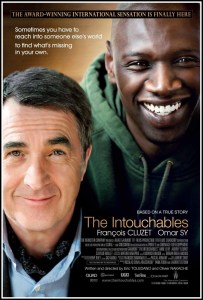
Photo credit: http://ourfaithinaction.net/2012/the-intouchables/the-intouchables-movie-poster-3/

Photo credit: http://ourfaithinaction.net/2012/the-intouchables/the-intouchables-movie-poster-3/

This weekend I finally saw The Intouchables, a 2011 film based on the true story of a French, wealthy quadriplegic who hires a man convicted of petty theft to be his caregiver.  The quadriplegic, Philippe, has been through many caregivers.  He is a widower who lost the use of most of his body in a paragliding accident.  He is bitter and does not like the way that most highly-skilled caregivers treat him more like a patient than a person.  Meanwhile, Driss applies for the job simply to obtain governmental unemployment benefits, assuming that Philippe will never hire him.  Philippe is intrigued by this man who shows him little respect, and hires Driss.  The two begin a relationship that is different than any either of them had known.  Philippe is finally able to rediscover a joy for life and reimagine what his life can be.  Meanwhile, Driss begins to see that he can have value too – that perhaps he can start anew with life, providing for his family and having a new sense of self-worth.

What I loved about this film was two-fold.  First, I had anticipated this being a sober, but triumphal movie.  Instead, I found myself laughing throughout the film – not at a slapstick humor, but at the kind of humor one develops when things get so bad that laughter is both the inappropriate and most appropriate thing to do.  It is an irreverent humor that only two characters who have been pushed to the margins can deeply enjoy, and yet, those outcasts invite us in to our own darkness and bring us out with laughter.  The second thing I loved about this movie is the way in which each character was able to see humanity in one who had been stripped of their humanity.  For Philippe, his physical disability had taken away his ability to full participate in society.  Society struggled to see any value in him beyond his money – which is not a value for which anyone wants to be known.  For Driss, he was a criminal who was unable to hold down a job and be a responsible citizen.  Society struggled to see any value in him, leaving him limited options.  And yet, in Philippe, Driss was able to unearth an adventurous, funny, sarcastic man of compassion and fortitude.  And in Driss, Philippe was able to unearth a sympathetic, strong, talented man of wisdom and grace.  In essence, they could see the humanity in one another.

When we reaffirm our baptismal covenant, one of the promises we make is to respect the dignity of every human being.  Over and over we make that promise, and yet I think it is one of the hardest things we promise to do.  It is very difficult to respect the dignity of the guy who cuts you off in traffic.  It is very difficult to respect the dignity of your family member who constantly puts you down.  It is very difficult to respect the dignity of the man who kills nine Christians in a church because of their race.  This past Sunday, as we were editing the Prayers of the People, I found I had no problem listing the names of the deceased from Charleston.  Where I struggled was adding the killer’s name to our list too.  That action went against every instinct in my body, and yet, some small ache made me feel like I had to add him too.

Respecting the dignity of every human being is not a one-time action.  It takes a lifetime of practice.  We fail at it all the time, but we keep recommitting to the work because we promised we would at our baptism.  What encouraged me about that work this week, was the relationship between Philippe and Driss.  Watching two men, so dramatically different, and yet similar in the way that society treated them as outcasts, heartily laugh from the depths of their souls gave me hope.  They gave me hope that I might see the dignity of others through my own brokenness.  The promise for my work is that I too would find the joy that only hearty, full-bodied laughter can bring.

Homily – Deuteronomy 15.7-11, Charles Freer Andrews, February 12, 2015

11 Wednesday Mar 2015

Posted by jandrewsweckerly in Uncategorized

≈ Leave a comment

Tags

Britain, Charles Freer Andrews, Deuteronomy, dignity, friend, God, homily, human, India, neighbor, poor, social justice

Today we honor Charles Freer Andrews.  Born in Birmingham, England, in 1871, Andrews was ordained a priest in 1897.  Turned on to social justice efforts in college, Andrews became interested in the cause of social justice throughout the British Empire, especially in India.  In 1904, he began to teach philosophy in Delhi, where his students and colleagues began to refer to him by an Indian name which means “Friend of the Poor.”  Andrews openly criticized the racist treatment of the Indian people by British officials, and in 1913 he successfully mediated a cotton worker’s strike which could have become violent.  He travelled to South Africa to help Indians there.  While there, he met Gandhi.  Andrews was impressed by Gandhi’s teaching of non-violence, knowledge of Christian faith and practice of peace.  Andrews and Gandhi worked together to negotiate matters of Indian authority with the British government.  Andrews also took up the Indian cause in Fiji, and eventually returned to England where he taught about social justice and radical discipleship.

I am sure Andrews was no stranger to our text from Deuteronomy today.  The passage is all about the sabbatical year, where debts were forgiven.  The passage warned the faithful against scheming around the rules of the seventh year.  Knowing that year was approaching, people were hesitant to give to those whose debts would be quickly forgiven.  Instead, the people of God are told, “Open your hand to the poor and needy neighbor in your land.”

In many ways, St. Margaret’s is a faithful witness to opening our hands.  We are constantly collecting food and basic toiletries, giving gifts to the less fortunate and growing produce to feed the hungry.  We give liberally and ungrudgingly, as the text suggests.  But in all our good works, I sometimes wonder whether we could be labeled “Friend of the Poor,” as Andrews was.  It is one thing to give good or money to the poor, a necessary and important effort, but giving to the poor is not the same as being their friend.  Being a friend means getting involved, hearing their stories, finding out how they got to where they are today.  That work is much harder and messier, yet more meaningful.

Last week a story broke about Pope Francis and the Vatican opening up a new set of showers and a barber shop for the homeless of Rome.  The facility is beautiful and the homeless are treated with dignity and care.  The Vatican is trying to live into a life that embraces the poor and recognizes their humanity.  Now whether they become “friends of the poor” is something that is yet to be seen.  We all have that same invitation – to see the dignity of every human being and then to try to be their friend.  Good luck with your work!  Amen.

On dignity…

30 Wednesday Jul 2014

Posted by jandrewsweckerly in Uncategorized

≈ 1 Comment

Tags

baptism, dignity, human, humanity, Jesus, laborers

Today I drove by a pharmacy whose property is regularly peppered with “day laborers.”  I have yet to see someone actually out hiring people, but I imagine it must happen since every time I pass by, there are always 5 – 20 men standing around waiting.  Of course there are more men in the mornings and less in the afternoons.  But I consistently see men there, even in the late afternoons.  I have often wondered whether these men actually get hired at such a late hour, but their presence there leads me to believe that they must some days.

As I drove by the men gathered today, I was reminded of Jesus’ parable of the laborers in the vineyard (Matthew 20.1-16).  The landowner goes out at nine, noon, three, and five, each time hiring men from the marketplace.  At the end of the day, the landowner gives a full day’s wages to all the men, regardless of how long each person worked.  The ones who work the longest grumble at how unfair the landowner’s actions seem, but the landowner scolds them for their disdain for landowner’s generosity.

Courtesy of http://intentionaljane.com/tag/dignity/

Courtesy of http://intentionaljane.com/tag/dignity/

What I have always liked about the parable is the way that the landowner sees the humanity in people – recognizes that even though someone did not get the opportunity to work, they may have wanted the dignity that work provides and the security that income can create.  I think we often forget the ways that our society strips people of dignity – either by creating barriers to earning a livable wage, by creating systems meant to help individuals without realizing how hard receiving help can be, or by simply reducing people into issues – “immigrants,” “refuges,” or the “homeless,” as opposed to persons known by name.  One of my new favorite blogs/Facebook pages is called “Humans of New York.”  A photographer collects photos of assorted people from New York and usually includes a quote or a short story about them.  I just love the glimpses into people’s lives – people you might never give a thought or glance to, but who have a story.

We promise in our baptismal covenant to “respect the dignity of every human being.”  I wonder what that looks like in your life.  Just this morning I ran across a video of a man who approaches a homeless man on the street – a person who is virtually ignored by every other person passing by.  The man asks if he can borrow the homeless man’s bucket, and at first the homeless man seems wary and concerned.  But to his surprise, the man uses the bucket and a couple of friends to create an impromptu moment of music, which leads to some extra cash that the man then gives to the homeless man.  Something about the video give me a glimpse into what we mean when we talk about dignity – all three “helpers” sit with the man, they make him a part of something beautiful, and then they let him live in peace.  But especially they seem to be saying, “I see you.  You are not alone.  You are a person and I honor your dignity.”  How might you respect the dignity of every human being today?

Newer posts →

Recent Posts

  • On Sharing the Love…
  • Sermon – Micah 6.1-8, Matthew 5.1-12, EP4, YA, January 30, 2026
  • On Justice, Kindness, Humility, and the Messy Middle…
  • Feast of the Rev. Dr. Martin Luther King, Jr., January 18, 2026
  • On Peace, Love, and Conduits…

Archives

  • February 2026
  • January 2026
  • December 2025
  • November 2025
  • October 2025
  • September 2025
  • August 2025
  • July 2025
  • June 2025
  • March 2025
  • February 2025
  • December 2024
  • November 2024
  • October 2024
  • September 2024
  • August 2024
  • July 2024
  • June 2024
  • May 2024
  • March 2024
  • February 2024
  • January 2024
  • December 2023
  • November 2023
  • October 2023
  • September 2023
  • August 2023
  • July 2023
  • June 2023
  • May 2023
  • March 2023
  • February 2023
  • January 2023
  • December 2022
  • November 2022
  • October 2022
  • June 2022
  • May 2022
  • January 2022
  • December 2021
  • November 2021
  • October 2021
  • September 2021
  • August 2021
  • June 2021
  • May 2021
  • April 2021
  • March 2021
  • February 2021
  • January 2021
  • December 2020
  • November 2020
  • October 2020
  • September 2020
  • August 2020
  • July 2020
  • June 2020
  • May 2020
  • April 2020
  • March 2020
  • February 2020
  • January 2020
  • December 2019
  • November 2019
  • October 2019
  • September 2019
  • August 2019
  • July 2019
  • June 2019
  • May 2019
  • April 2019
  • March 2019
  • February 2019
  • January 2019
  • December 2018
  • November 2018
  • October 2018
  • September 2018
  • August 2018
  • July 2018
  • June 2018
  • May 2018
  • April 2018
  • March 2018
  • February 2018
  • January 2018
  • December 2017
  • November 2017
  • October 2017
  • September 2017
  • August 2017
  • July 2017
  • June 2017
  • May 2017
  • April 2017
  • March 2017
  • February 2017
  • January 2017
  • December 2016
  • November 2016
  • October 2016
  • September 2016
  • August 2016
  • July 2016
  • June 2016
  • May 2016
  • April 2016
  • March 2016
  • February 2016
  • January 2016
  • December 2015
  • November 2015
  • October 2015
  • September 2015
  • August 2015
  • July 2015
  • June 2015
  • May 2015
  • April 2015
  • March 2015
  • February 2015
  • January 2015
  • December 2014
  • November 2014
  • October 2014
  • September 2014
  • August 2014
  • July 2014
  • June 2014
  • April 2014
  • March 2014
  • February 2014
  • January 2014
  • December 2013
  • November 2013
  • October 2013
  • September 2013
  • August 2013
  • July 2013
  • June 2013
  • May 2013
  • April 2013
  • March 2013
  • February 2013
  • January 2013
  • December 2012
  • November 2012
  • October 2012
  • September 2012

Categories

  • reflection
  • Sermons
  • Uncategorized

Meta

  • Create account
  • Log in
  • Entries feed
  • Comments feed
  • WordPress.com

Blog at WordPress.com.

  • Subscribe Subscribed
    • Seeking and Serving
    • Join 395 other subscribers
    • Already have a WordPress.com account? Log in now.
    • Seeking and Serving
    • Subscribe Subscribed
    • Sign up
    • Log in
    • Report this content
    • View site in Reader
    • Manage subscriptions
    • Collapse this bar
 

Loading Comments...