• About

Seeking and Serving

~ seek and serve Christ in all persons

Seeking and Serving

Tag Archives: disciple

On Remembering Roots…

29 Wednesday Mar 2017

Posted by jandrewsweckerly in Uncategorized

≈ Leave a comment

Tags

Campus Ministry, Christ, church, college, community, disciple, discipleship, faithful, formation, fun, Jesus, leadership, love

842x347-WELS-CampusMinistry

Photo credit:  https://wels.net/serving-you/christian-life/campus-ministry/

Last night, as a member of our Diocesan College Ministry Commission, I visited Canterbury at William & Mary.  We had some time with both the students involved in the Episcopal Campus ministry and with the Campus Minister.  It is a vibrant ministry, with a lot of passion and enthusiasm around service, worship, and discipleship.  Canterbury is a place where they can ask questions of their faith, become leaders, serve their community, and forge deep friendships.  They are doing the work began in their baptism, continued in their confirmation, and now affirmed as adults.

As I listened to the students and Campus Minister, I was flooded with a host of memories from my own experience in Campus Ministry at Duke.  Although I was involved in the Wesley Fellowship, the models are quite similar.  Wesley was the place where I came into my own faith, where I engaged my intellect in partnership with professors at the Divinity School, where I first discovered the power of mission trips, and ultimately, where I began to feel a sense of call to ordained ministry.  Wesley created disciples – encouraging us to find a local church community, fostering a personal spirituality, developing deep Christian friendships, and exploring the implications of my faith.  Most of my friends from Wesley took a year or more to volunteer or live in intentional Christian community.  Today, most of the alumni I know are clergy, lay leaders, non-profit workers, social services providers, and are raising up a new generation of faithful disciples.

When I was in college, I thought Wesley was doing something revolutionary.  The community certainly articulated its faith a little differently than my home churches had.  But more than that, we created an intimate, trusting, challenging space that fed me and informed my life path.  As I thought about that experience and the experience of the Canterbury students at Williams & Mary, campus ministry does exactly what Church does – or should do.  We are forming people into faithful disciples, who want to learn and grow in their faith, who want to find ways to serve God and live out their baptismal covenant, who want to develop the deep bonds of Christian community, and who want to have some fun while they are at it!

As a pastor, I often get caught up in the programmatic and administrative work of Church.  I want to create a community that offers the things necessary to produce faithful disciples.  What last night reminded me of is that I need to remember to look around and enjoy what we are creating too.  If you have been looking for a community that can help you find meaning and purpose, can help you grow in unexpected ways, can help you connect with others on the spiritual journey, and can embolden you to live a life full of the love of Christ, come join us at Hickory Neck.  And if you are already a member, invite a friend into this rich experience.  There is good news to share!

Sermon – John 1.43-51, E2, YB, January 18, 2015

21 Wednesday Jan 2015

Posted by jandrewsweckerly in Uncategorized

≈ Leave a comment

Tags

church, come and see, disciple, evangelism, favorite, God, invite, Jesus, Nathanael, passion, Philip, Sermon, share, testimony

I have lots of friends who swear that Wicked is their favorite musical.  They know all the songs, they have seen the show multiple times, and they reference lines from the characters.  The cult around the musical feels just like that – a cult.  When I confessed that I had not ever seen the show, my friends were aghast.  “You HAVE to see the show!” they would exclaim.  To be honest, they were so passionate about Wicked that I had almost decided that there was no way the show could be that good – surely I would be underwhelmed.  But finally, after much cajoling, I went to see the show with some friends.  And all of a sudden, I got it:  the witty humor, the creative back story, the emotional narrative, and the moving music.  I could not stop thinking and talking about the show for weeks.

Though we have all had encounters with people who are passionate about something – the latest show, a newly released movie, or a favorite restaurant – I imagine that few of us are as passionate about church.  We just do not have the same fervor about church as we do about other passions in our life.  Somehow, being publicly passionate about those other things seems more socially acceptable than being publicly passionate about church.  Our initial concerns are usually about social stigma.  We do not want to become that person that people avoid because we are always babbling on about church.  Our fear may also be about what to say.  How do we explain to others what draws us to this place and makes us spend a good portion of our time here?  Or maybe we have lost some of our passion about church.  Perhaps we come to church out of habit or some longing, but we are not so jazzed about church that we are rushing around, telling friends and strangers alike, “You have to come and see my church.  It is awesome!”

Though we may not be running around like excited new Christians, the disciples of Jesus did in the early days.  In our gospel lesson today, we are told that when Philip meets Jesus and begins following him, he finds Nathanael and says, “We have found him about whom Moses in the law and also the prophets wrote, Jesus son of Joseph from Nazareth.”  And when Nathanael scoffs, “Can anything good come out of Nazareth?” Philip is undeterred.  Philip excitedly insists, “Come and see.”  You can almost imagine Philip’s big grin and irresistible enthusiasm.  “Come and see,” he says.  This is his simple invitation.  Come and see.  The words are warm and inviting.  The words are gentle and hospitable.  The words, “Come and see,” are not some forceful demand or even a judgmental threat.[i]  There is no, “or else,” at the end of Philip’s invitation.  His invitation is light and easy:  Come and see.

That is our greatest fear when we talk about evangelism.  Because we have such a meaningful relationship with God and the church, we do not want to be associated with Christians who judge and condemn.  We would never be that Christian on a street corner telling people that they are going to hell unless they repent.  In fact, those are the very people who sometimes make us paranoid to even admit our faith in public.  Or maybe we have friends or family who were hurt by the church, and although we still feel drawn to the church, we want to respect their pain.  I have lost count of the number of my own friends and family who have had those negative experiences:  divorcees who felt judged or downright excluded when they wished to be remarried, women who wanted to be priests but felt that sense of call when the church did not affirm the ordination of women, or lesbian and gay friends who just did not feel welcome or treated as equals in the church.  The list is extensive and even if our church experience is not like that, we fear being associated with “those Christians.”

The challenge for us is that we get so caught up in the “what ifs” of sharing our faith that we forget the really wonderful things about our faith.  Philip reminds us today of the simple joy of our faith and our relationship with Christ.  Take a moment to think about your favorite thing about the life we share in this faith community.[ii]  I do not want you to worry about some elaborate theological explanation of your faith.  I just want you to think about your favorite thing about your experience here at St. Margaret’s.  Maybe your favorite thing is the community, and the warm welcome and inclusion you have felt here.  Maybe your favorite thing is the way that the worship experience connects you to God or opens up new truth for you.  Maybe your favorite thing is the way church is like an oasis, a place where you can breathe in the midst of the chaos of life, and find some sense of peace.  Or maybe your favorite thing is something else altogether.  But think about that favorite thing that keeps you coming back here week after week.

Now, imagine sharing that favorite thing with someone else, and inviting them to come and see for themselves.  Before you panic, I want to reassure you.  I am not asking you to go to someone and persuade them to become a Christian.  I am not even asking you to “prove” the truth of the Christian faith.[iii]  I am simply inviting you to invite someone you know to come and see that aspect of our congregational life that you enjoy.  When we have talked about evangelism before, many of you have told me about how you do not really have any friends you can invite to church.  Actually our excuses are numerous (and yes, I say “our” because I have the same excuses too).  We may worry that our friends live too far away, or maybe they already have a church community, or maybe you just do not like to mix your friends community with your church community.  Many of you have turned to me and either said, “Well, isn’t it the priest’s job to grow the church,” or “That is what our website is for.”  And the answer to those things is yes.  Yes, the rector plays some role in people’s attraction to a church and certainly many seekers find us through our website.  But the number one way that people come to a church is by personal invitation.  Every study I have read says that the number one way to attract people to your parish is through personal invitation.

The good news is that the personal invitation is not as scary as the invitation sounds.  Just look at Philip.  When Nathanael scoffs and says, “Can anything good come out of Nazareth?” Philip could have had any number of responses.  As one person argues, “Philip could have given Nathanael some of his own opinions.  He could have said, ‘This Jesus knows a lot about the Bible.’  Or he might have said, ‘There is something about this man Jesus that draws me to him.’  Even when Nathanael expressed skepticism about ‘anything good coming out of Nazareth,’ Philip might have listed some successful people from Nazareth.”[iv]  But Philip does none of that.  His offer is warm, simple, and gracious.  Come and see.

The beauty of our gospel lesson is that Philip’s testimony to Nathaniel is not that impressive.  His testimony would not win any academic awards or even impress most people.  But his invitation does get Nathanael to in fact, come and see.[v]  And that is what our gospel is inviting us to do today too.  Not to come up with some master plan or some convincing argument.  But to think about the one thing that draws you to this place, and then simply share that one thing with someone else.  Your closing argument will then be easy.  Come and see.  I cannot imagine a better gift that you can give to those you know than to let them see the one thing that gives you life, gives you joy, and gives you passion; and then to invite them to come and see.  Amen.

[i] David Lose, “Epiphany 2B:  Come and See,” January 12, 2015 found at http://www.davidlose.net/2015/01/epiphany-2-b/.

[ii] Lose.

[iii] Michael Rogness, “Commentary on John 1.43-51,” as found at http://www.workingpreacher.org/preaching.aspx?commentary_id=2314 on January 14, 2015.

[iv] Rogness.

[v] Ted A. Smith, “Homiletical Perspective,” Feasting on the Word, Yr. B, Vol. 1 (Louisville: Westminster John Knox Press, 2008), 263.


Sermon – Matthew 11.25-30, St. Francis’ Feast Day, YA, October 5, 2014

08 Wednesday Oct 2014

Posted by jandrewsweckerly in Uncategorized

≈ Leave a comment

Tags

animals, blessing, burden, disciple, Jesus, light, reconciliation, rest, Sermon, St. Francis, wolf

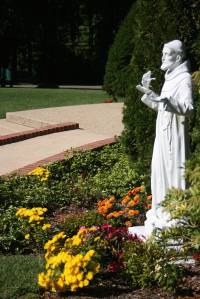
Today we honor the life of St. Francis of Assisi.  Francis is one of the most popular and admired saints of all time.  Most of us know the highlights of his story: born the son of a wealthy man in 1182; had a conversion experience and devoted his life to Lady Poverty; shaped monastic and lay devotion; was a friend to all God’s creatures – being know to have preached to the birds.

But the story I like most is the story about St. Francis and the Wolf.  According to legend, there was a wolf that was terrorizing the town of Gubbio, killing and eating animals and people.  The villagers tried to fight back, but they too died at the jaws of the wolf.  Francis had pity on the townspeople and went out to meet the wolf.  When Francis found the wolf, he made the sign of the cross, and said, “Come to me, Brother Wolf.  In the name of Christ, I order you not to hurt anyone.”  In response, the wolf calmly laid down at Francis’ feet.  Francis then went on to explain to the wolf how he was terrorizing the people and other animals – all who were made in the image of God.  The wolf and Francis then made a pact that he would no longer harm the townspeople and the townspeople would no longer try to hurt the wolf.  The two traveled into town to explain the pact they had formed.  The people were amazed as Francis and the wolf walked side-by-side into town.  Francis made the people pledge to feed the wolf and the wolf pledge not to harm anyone else.  From that day on, the wolf went door to door for food.  The wolf hurt no one and no one hurt the wolf; even the dogs did not bark at the wolf.[i]

What I love about this story of St. Francis is that the story is about reconciliation and relationship.  At the beginning of the story the town and the wolf are at an impasse – the wolf is hungry and getting attacked; the people are afraid and are lashing out.  What Francis does for both parties is shock them out of the comfortable.  For the wolf, no one has addressed the wolf kindly – they have either shut the wolf out or actively tried to kill him.  For the people, the wolf has not asked for help – he has simply and violently taken what he needed and wanted.  Francis manages to shock the wolf first – not through violence or force, but with the power of love and blessing.  By giving a blessing in the name of God, Francis is then able to implore the wolf to reciprocate with love.  Francis also manages to shock the village – not with a violent victory, but with a humble display of forgiveness and trust.  By walking into town with a tamed wolf at his side, Francis is able to encourage the town embrace, forgive, and care for the wolf.  Francis’ actions remind both parties that unless their relationships are reconciled, unrest and division will be the norm.

The funny thing about this story is that the story is pretty ridiculous.  I mean, how many of us go around talking to wild animals, blessing them with the sign of the cross, expecting anything other than being attacked?  We will never really know whether the story is true.  But like any good Biblical story, whether the story is true is hardly the point: the point is that the stories point toward “Truth” with a capital “T.”  What this story teaches is that peace and reconciliation only happen through meeting others where they are.  We cannot expect great change unless we are willing to get down in the trenches – to go out and meet that destructive wolf face-to-face.  The other thing this story teaches is relationships are at the heart of peace work.  Only when the wolf and the town began to get to know each other and began to form a relationship with one another could they move forward.

This is the way life is under Jesus Christ.  In our gospel lesson today, Jesus says, “Come to me, all you that are weary and are carrying heavy burdens, and I will give you rest.  Take my yoke upon you, and learn from me; for I am gentle and humble in heart, and you will find rest for your souls.  For my yoke is easy, and my burden is light.”  Jesus’ words have layered meaning.  The first meaning we all catch is that Jesus offers us rest and refreshment.  Jesus encourages us to come to him, to cast our burdens and cares upon him, and to take rest, to take Sabbath in Christ.  Our souls will find peace in Christ Jesus.  The second meaning is that peace in Christ Jesus is not without work.  Jesus does not say come unto me and relax forever in happy retirement.  Jesus says we will still have to take on a yoke – the burden of disciple living.  But luckily, that burden of being Christ’s disciple will not be burdensome – it will be light.  Finally, not only will Jesus make the workload “light,” as in not heavy.  Jesus will also make us “light” – as in lights that shine into the darkness and refuse to allow the shadow to overwhelm.[ii]  We become the light when we work for reconciliation in our relationships with others.

That is why we do so many special things today.  Today, we ask for healing prayers – that God might help us reconcile the relationships in our life that need healing.  Today, we ask for blessing on our animals – that God might help our relationship with our pet be one of blessing and light.  Today, we come to Jesus for Sabbath rest – that God might renew us on this Sabbath day, use the rest to fill us with light, and renew our commitment to be agents of reconciliation, gladly putting on Christ’s yoke.  Amen.

[i] John Feister, “Stories about St. Francis and the Animals,” as found at http://www.americancatholic.org/features/francis/stories.asp on September 30, 2014.

[ii] Mel Williams, “Let it go…and rest” Faith and Leadership, July 6, 2014 as found at http://www.faithandleadership.com/sermons/mel-williams-let-it-go%E2%80%A6and-rest  on September 30, 2014.

Homily – John 8.31-32, Paul Jones, September 4, 2014

19 Friday Sep 2014

Posted by jandrewsweckerly in Uncategorized

≈ Leave a comment

Tags

Bishop Paul Jones, disciple, free, God, homily, Jesus, love, peace, truth, war

I have struggled with the issue of war and peace.  In my heart, I am anti-war and pro-peace.  I cannot condone killing others because others have killed.  War does terrible things to everyone involved.  And arguments for “just wars” just seem like cop-outs – ways of avoiding the call to be a peaceful people.  That is the argument of my heart.  But when faced with issues of genocide and oppression, my head tends to get in the way.  The recent movement by ISIS in Iraq has me in angst over why we are not doing something to stop the genocide.  And yet that “something” is often assumed to involve more violence or war – certainly not peace.

I wonder what Bishop Jones would have to say about this ethical debate.  Born in 1880, Paul Jones, who we honor today, was born and raised in the Episcopal Church.  He became a priest, serving in Utah as a missionary.  In 1914 he became archdeacon and later Bishop of the Missionary District of Utah.  Bishop Jones did much to expand the church’s mission stations.  But as WWI began, Bishop Jones openly opposed the war.  When he declared war to be “unchristian,” the press went wild.  The House of Bishops investigated and declared that Bishop Jones should resign because of his antiwar sentiments.  Though Bishop Jones finally caved in and resigned, he spent the next 23 years advocating for peace until he died in 1941.

I think Bishop Jones must have embraced Jesus Christ’s words from John’s gospel lesson today.  Jesus Christ says, “If you continue in my word, you are truly my disciples; and you will know the truth, and the truth will make you free.”  For Bishop Jones, he knew Jesus to be a man of peace and love.  For Bishop Jones, his pursuit of peace felt like the “truth” – and in some way resigning as bishop freed him to truly follow the gospel.

For us, I think discerning an ethic of peace verses war is not simple.  Issues of peace are complicated and unsettling – who can really define “truth”?  The good news is – no matter what we believe about war, we know our God is a God of love.  Love is a truth we can comfortably claim.  Once we meditate on love, we can often find a bit more clarity.  We can even come to some clarity about this contested issue of peace.  Today we thank Bishop Jones, Jesus, and all those who encourage us to struggle with injustice in the world – for in the struggle, we find truth – and the truth will set us free.  Amen.

Newer posts →

Recent Posts

  • On the Myth and Magic of Advent…
  • On Risking Failure and Facing Fear…
  • Sermon – Luke 23.33-43, P29, YC, November 23, 2025
  • On Inhabiting Gratitude…
  • Sermon – Luke 20.27-38, P27, YC, November 9, 2025

Archives

  • December 2025
  • November 2025
  • October 2025
  • September 2025
  • August 2025
  • July 2025
  • June 2025
  • March 2025
  • February 2025
  • December 2024
  • November 2024
  • October 2024
  • September 2024
  • August 2024
  • July 2024
  • June 2024
  • May 2024
  • March 2024
  • February 2024
  • January 2024
  • December 2023
  • November 2023
  • October 2023
  • September 2023
  • August 2023
  • July 2023
  • June 2023
  • May 2023
  • March 2023
  • February 2023
  • January 2023
  • December 2022
  • November 2022
  • October 2022
  • June 2022
  • May 2022
  • January 2022
  • December 2021
  • November 2021
  • October 2021
  • September 2021
  • August 2021
  • June 2021
  • May 2021
  • April 2021
  • March 2021
  • February 2021
  • January 2021
  • December 2020
  • November 2020
  • October 2020
  • September 2020
  • August 2020
  • July 2020
  • June 2020
  • May 2020
  • April 2020
  • March 2020
  • February 2020
  • January 2020
  • December 2019
  • November 2019
  • October 2019
  • September 2019
  • August 2019
  • July 2019
  • June 2019
  • May 2019
  • April 2019
  • March 2019
  • February 2019
  • January 2019
  • December 2018
  • November 2018
  • October 2018
  • September 2018
  • August 2018
  • July 2018
  • June 2018
  • May 2018
  • April 2018
  • March 2018
  • February 2018
  • January 2018
  • December 2017
  • November 2017
  • October 2017
  • September 2017
  • August 2017
  • July 2017
  • June 2017
  • May 2017
  • April 2017
  • March 2017
  • February 2017
  • January 2017
  • December 2016
  • November 2016
  • October 2016
  • September 2016
  • August 2016
  • July 2016
  • June 2016
  • May 2016
  • April 2016
  • March 2016
  • February 2016
  • January 2016
  • December 2015
  • November 2015
  • October 2015
  • September 2015
  • August 2015
  • July 2015
  • June 2015
  • May 2015
  • April 2015
  • March 2015
  • February 2015
  • January 2015
  • December 2014
  • November 2014
  • October 2014
  • September 2014
  • August 2014
  • July 2014
  • June 2014
  • April 2014
  • March 2014
  • February 2014
  • January 2014
  • December 2013
  • November 2013
  • October 2013
  • September 2013
  • August 2013
  • July 2013
  • June 2013
  • May 2013
  • April 2013
  • March 2013
  • February 2013
  • January 2013
  • December 2012
  • November 2012
  • October 2012
  • September 2012

Categories

  • reflection
  • Sermons
  • Uncategorized

Meta

  • Create account
  • Log in
  • Entries feed
  • Comments feed
  • WordPress.com

Blog at WordPress.com.

  • Subscribe Subscribed
    • Seeking and Serving
    • Join 394 other subscribers
    • Already have a WordPress.com account? Log in now.
    • Seeking and Serving
    • Subscribe Subscribed
    • Sign up
    • Log in
    • Report this content
    • View site in Reader
    • Manage subscriptions
    • Collapse this bar
 

Loading Comments...