• About

Seeking and Serving

~ seek and serve Christ in all persons

Seeking and Serving

Tag Archives: college

Sermon – Genesis 12.1-4a, L2, YA, March 1, 2026

15 Wednesday Apr 2026

Posted by jandrewsweckerly in Sermons

≈ Leave a comment

Tags

Abram, blessed, college, difficult, discipline, friends, go, God, intimacy, journey, Lent, love, Sermon

We’ve been talking a lot about college in our house.  I recalled my own experience of that first year of college with my older daughter recently.  I was so ready to leave home and start my “adult” life, I was beyond thrilled to be able see Duke basketball games in person, I was eager to start my studies so that I could take on that big job, and I knew I would have a ton of fun.  As I packed my bags, I felt like the world was full of promise and hope and I just knew I was going to have an awesome college career.  In many ways, my college experience was one of the best experiences of my life – one where I learned so much more than I expected, I made lifelong friends, I experienced my first sense of call to ministry, and I did in fact enjoy many a basketball game.  But that first year of college was nothing like the picture looking back now.  I had an awful freshman roommate experience, I struggled with the rigor of classes at first, I had a hard time finding a group of friends I really liked, there were multiple things I either tried out for our wanted to be invited into that I was not, and there were times that I wondered what in the world I was doing there.

As I listened to our Old Testament lesson today, I wondered how much Abram felt the same way about his own journey.  The very short passage from Genesis today says, “The Lord said to Abram, ‘Go from your country and your kindred and your father’s house to the land that I will show you.  I will make of you a great nation, and I will bless you, and make your name great, so that you will be a blessing.  I will bless those who bless you, and the one who curses you I will curse; and in you all the families of the earth shall be blessed.’”  At first glance, Abram’s invitation sounds awesome!  He is invited on a journey with God and he is promised God will bless him, will give him plenteous offspring and power, and he will essentially be famous.  Who wouldn’t want to pack up their earthly belongings and hit the road with that kind of invitation?  The upcoming journey sounds like one full of promise, hope, and abundant joy.

Of course, there are a few slight indicators of how hard this journey might actually be.  First God tells Abram to leave his country, his kindred, and his father’s house – all without a map of where they will be going.  Scholar Carol Newsome reminds us, “In traditional societies the kin group is the source of identity, economic benefit, security, and protection.  To leave such a fundamental social network is to put a great deal at risk.”[i]  And then there is the text we do not read today.  In the verses immediately preceding this text, we are told that Abram’s father has just died.  We all know what the death of a parent can do to a person, and can at least imagine the intense grief Abram is working under when he says yes to God.  And the text immediately after where we stop tells us that Abram is about 75 years old at this point.  So, a man well beyond the prime of life, who is freshly experiencing grief, who has probably long since lost hope of bearing any children should be able to guess that this journey will not be all roses and rainbows.

In fact, we know that the journey is not as hope-filled as our lesson makes the journey out to be today.  This man whom God says will be blessed and be great hits all kinds of bumps along the way.  If you remember, Abram passes off his wife as his sister several times to avoid danger to himself.  When he still does not have any offspring, Sarai eventually convinces him to sleep with her handmaiden Hagar.  Though Hagar bears him a son, Abram eventually casts Hagar and Ishmael out into the wilderness when his wife Sarai gets jealous.  And of course, we cannot forget that Abram is also forced to take his one son by Sarai, Isaac, up on a mountain to be sacrificed – believing all along that God intends for Abram to kill his only heir.  Sounds like a real journey of blessing, right?

That is the funny thing about journeys.  We are not often promised that our journeys will be blessed.  But even when we hope that they will be blessed, the blessing never comes immediately and is often masked by long intervals of pain and suffering.  We have lived that life here at Hickory Neck.  Almost three hundred years ago, people from Williamsburg were told, “Go.  Go from the conveniences of town and settle in a rural, farmland that I will show you.  I will make of you a great church, and I will bless you, and make your name great, so that you will be a blessing.”  At least, that’s how our histories of Hickory Neck read.  We too were a people of hope and expectation – at least until a certain war broke out and our side lost.  The building had its own adventure with students, residents, and injured soldiers.  And then, over 100 years ago, the dream emerged again.  We took a stab at the dream:  first with a small group of families, and then more and more friends, and slowly strangers gathering.  We had lots of clergy – some staying longer than others – some vicars, some rectors, some associates, and deacons.  We built buildings, bought more land.  We experienced church growth and church decline, budget surpluses and budget deficits.  We welcomed new ministries, a school, and joined the digital world.  When God said, “Go,” who would have ever guessed the journey would play out the way the journey has.

Sometimes our Lenten journeys have that same feel.  We fill ourselves with pancakes, and then the next day, kneel with resolve to take on some discipline.  We look forward to the blessings of Lent – the intimacy with God the journey will bring, the learning will we do, the peace we will gain, or even the couple of pounds we might lose.  And when we hear a story like the Old Testament lesson today, we feel pumped up and ready for an exciting journey.  We may even imagine God making similar promises to us:  You will be blessed in this Lenten journey.  And yet, if we think back to any Lent in the past, we might remember how difficult our discipline became by week four or five.  We might remember how that cool discipline we chose did not really turn out to be as great as we imagined.  And depending on how stable we were at the time, that sense of failure could have brought more of a sense of curse than blessing.

How do we know that blessing awaits and what do we do in the meantime?  What do we do when those days come – because they will – when we feel discouraged and lose that sense of promise and hope that God gives today?  If we look to Abram, we see that our only option is to go – to keep putting one foot in front of the other.  The lesson today says, “So Abram went, as the Lord had told him.”  The journey for Abram is risky, full of potholes, and ultimately full of some wild twists that might have turned Abram back at any point.  And yet, “Abram went.”  We are lucky enough to know that Abram becomes Abraham – the man that would eventually become a father of entire people – in fact of several faith traditions.  But Abraham never got to see the fullness of that blessing.  His life was more one of blessing in hindsight, not really an everyday blessing-fest.

In some ways, that is all we can do too.  God constantly calls us into a journey – whether during Lent or in whole phases of life.  God promises to bless us and love us along the way.  But we know the journey will be hard at times, and leave us feeling discouraged.  And when that happens, all we can do is put one foot in front of the other, and keep on going.  Of course, we have each other along the way, much like Abram had Lot.  In fact, the last words of today’s lesson are, “and Lot went with him.”  So, whether you are in that blessed state of bliss, or you are already struggling in your steps, God still tells you to go.  Our response is difficult, intimidating, and profound, but also extremely simple.  We go, knowing the journey will be blessed.  We go, knowing friends will journey with us.  We go, knowing God is with us.  We go.  Amen.


[i] Carol A. Newsom, “Exegetical Perspective,” Feasting on the Word, Yr. A., Vol. 2 (Louisville: Westminster John Knox Press, 2010), 53.

On Discernment and Community…

03 Wednesday Sep 2025

Posted by jandrewsweckerly in reflection

≈ Leave a comment

Tags

college, conversation, discernment, gifts, God, Job, joy, passion, satisfaction, vocation

Photo credit: https://www.linkedin.com/pulse/what-vocation-well-its-job-career-willie-chain/

Our older daughter is starting up the college tour in earnest this school year, and with that search have come conversations about college that were not a part of the conversations I had at a similar age.  Given the astronomical increases in the cost of tuition relative to income, our conversations with our children now include considerations like return on investment, debt management, and employability – topics I never addressed with my parents because going to college, let alone a prestigious college, meant things would fall into place for you – even if you chose a non-traditional path.

I have found this conversation bleeding into other areas of my life too.  The owner of the body shop I recently used and I got into a conversation about how we are guiding our children vocationally.  He shared how there is even a debate in his own vocation about the value of expensive, time-consuming vo-tech schools versus real world experience.  Even NASA has been conducting research about its own young employees who go straight into vocational training versus a traditional four-year college experience – most making six figures in their early twenties.

Of course, all this analysis came to a screeching halt the moment my younger daughter joined me in picking up my car at the body shop.  She was admiring some paint samples when the owner explained to her that he had invented some of the colors himself – some of which have been used by international businesses.  She then asked him a question I had not thought to ask, “What’s the best car you ever worked on?”  It was a simple question, but what her question taught me was something much more basic about vocational discernment: What brings you joy and satisfaction?

That basic question has got me thinking this week about how we value each other.  In his letter to the Ephesians, Paul says that God granted that some are apostles, prophets, evangelists, pastors, and teachers (4.11).  Not only do we need to be helping our children discern what gifts God is nurturing in them, we need to do the good work of celebrating each other’s gifts.  I remember have a case of nerves in seminary about preaching a senior sermon.  Upon hearing I was nervous, a professor quoted to me from the song There is a balm in Gilead.  He recited, “Well, if you cannot preach like Peter, if you cannot pray like Paul, you can tell the love of Jesus, and say ‘He died for all.’”   

This week, I invite you to start looking at others with a different lens – searching for the unique gifts you see in others and celebrating those gifts with them.  Far too often we see the transactional nature of each other – the jobs we do or the roles we play and how those jobs and roles serve a purpose.  But I am much more interested in the vocations that are bringing others joy and satisfaction – a joy and satisfaction that can reinvigorate my own passion for the gifts God has given me.  I can’t wait to hear about the conversations you have this week!

Sabbatical Journey…on Embracing Both-And

06 Thursday Jul 2023

Posted by jandrewsweckerly in reflection

≈ Leave a comment

Tags

both-and, church, college, intellectual, Jesus, Notre Dame, sacred, secular, spiritual

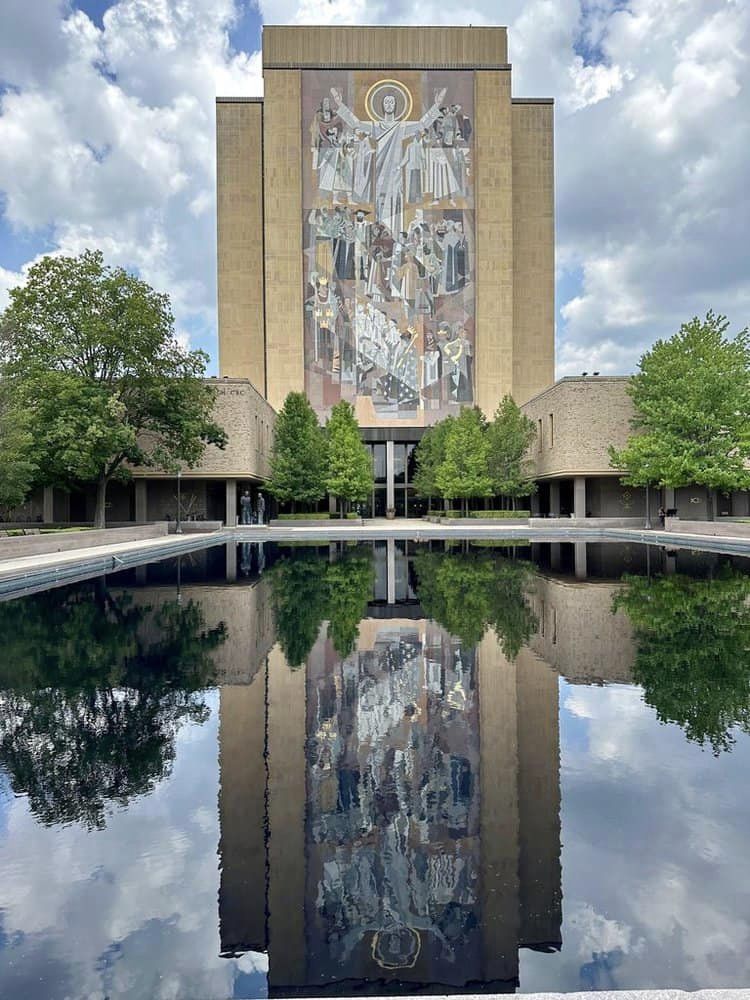
Touchdown Jesus (photo by Emily Liechty; reuse with permission)

In our sabbatical travels today, we met up with friends on the campus of Notre Dame.  None of us knew much about the college except their history of football prowess, their religious roots, and their devoted fans.  But a tour taught us so much about their history and current student experiences.  We learned that about 80% of the current students are Roman Catholic, there are chapels in every dorm, Mass is offered nearly 160 times per week, and we lost count on the number of Marys we saw on campus.  We also learned how many of the art pieces on campus have football references:  Touchdown Jesus, First Down Moses, and Holy Handoff.  But even more intriguing is the equal focus on academics, service, and community.

When I was in college, I quickly realized that being an active person of faith put me in the minority.  Academics were important, as was an active social life.  But religion, despite the prominence of Duke Chapel on campus was sort of an awkward subject.  I found a community among campus ministry, but the idea of chapels in dorms, or regularly offered masses was unimaginable.  Because I was involved in campus ministry, particularly at a university with a Divinity School, I received a balance between faith and intellect.  In fact, that balance is probably what shaped my own call to ministry.  But my experience was certainly not the norm.

Notre Dame seems to have found the art of “both-and.”  Notre Dame is both a religious institution and an institution focused on academic excellence.  Notre Dame has managed to embrace both athletics and the intellect (although, the construction of first stadium had to be funded by the first football coach because the administration thought it was more important to teach young men).  Notre Dame has managed to embrace both religious devotion and self-deprecating humor.

I wonder what lessons the larger Church might take from Notre Dame.  Where might we need a fuller embrace of the “both-and” mentality?  How might we be both fully faithful and fully of the world?  I imagine in order to share the Good News of Jesus in Christ, we might need to hone our ability to embrace the both-and of sacred and secular.


On Hope and Confidence…

22 Wednesday Jul 2020

Posted by jandrewsweckerly in Uncategorized

≈ Leave a comment

Tags

church, college, confidence, decline, Episcopal Church, future, hope, Jesus, leadership, living, mainline church, youth

hook-hope

Photo credit:  https://www.cmalliance.org/hope/

One of the things I have loved about my church has been the Choral Scholars we employ at our 11:15 am service on Sundays.  The eight singers are college students from William & Mary.  They come from all sorts of backgrounds – some grew up singing in their hometown Episcopal Churches, some are Southern Baptists, and a few have even been Jewish.  I have always enjoyed watching their journey through college, but I especially became appreciative of that relationship when this pandemic shut down our church.  Two Choral Scholars immediately became part of our four-person team livestreaming services every week, helping keep music at the center of our digital worship.

I was not sure what to expect, however, once the semester was over in June.  We managed to recruit two other students:  one, an out-of-state college student who grew up in our church and is home for the summer, and another who is also from William & Mary, but has never sung with our Scholars.  As each week has passed, I have slowly learned about their faith journeys and experiences.  And this Sunday, when our Music Director was on vacation, the substitute she procured is an organ student from William & Mary who sings at another local church during the school year, and who led a choral evensong with a campus group at our church last year.

As we sang and played together on Sunday, I had an epiphany.  I realized I was the oldest person in the room by several years.  After years and years of talking about the so-called decline of the mainline church, hearing myriad, often contradictory, reasons why the next generation is not coming to church (for more about this topic, check out this video by Dean Ian Markham), here I was a part of a worship leadership team primarily led by people in their very early twenties.  And they were not just playing supporting roles, like greeting people at the door or handing out bulletins.  They were in charge of the entire musical offering.  They were equals in leadership, and they were doing it with confidence and beauty.

In a few months, one of the high school students I mentored in my curacy will be ordained a priest.  Listening to her hopes for the ways the Episcopal Church can speak afresh to this world, wondering about the future lay leadership of our pre-med summer singer, and imagining the bi-vocational life our substitute organist who hopes to play on Sundays after college graduation while having a weekday career, gives me hope for the future of our Church.  Yes, our Church will continue to evolve and change, living online, living in cafes and bars, living in soup kitchens and childcare centers – but living and thriving.  Our Episcopal liturgies, our openness to the intellect, and our graceful blessing of all walks of life are the things that attract the young (and more seasoned!) people who are leading us today, and they are the strengths that give me hope for the Church of the future.  I have often resisted the doom and gloom of the predictions of the decline of the Church, but have been unsure how to legitimize my hunch.  This week I am grateful for the young people in my life who have given me some language and some confidence that Jesus is not done with us yet.  I hope you can feel that hope today too.

On Remembering Roots…

29 Wednesday Mar 2017

Posted by jandrewsweckerly in Uncategorized

≈ Leave a comment

Tags

Campus Ministry, Christ, church, college, community, disciple, discipleship, faithful, formation, fun, Jesus, leadership, love

842x347-WELS-CampusMinistry

Photo credit:  https://wels.net/serving-you/christian-life/campus-ministry/

Last night, as a member of our Diocesan College Ministry Commission, I visited Canterbury at William & Mary.  We had some time with both the students involved in the Episcopal Campus ministry and with the Campus Minister.  It is a vibrant ministry, with a lot of passion and enthusiasm around service, worship, and discipleship.  Canterbury is a place where they can ask questions of their faith, become leaders, serve their community, and forge deep friendships.  They are doing the work began in their baptism, continued in their confirmation, and now affirmed as adults.

As I listened to the students and Campus Minister, I was flooded with a host of memories from my own experience in Campus Ministry at Duke.  Although I was involved in the Wesley Fellowship, the models are quite similar.  Wesley was the place where I came into my own faith, where I engaged my intellect in partnership with professors at the Divinity School, where I first discovered the power of mission trips, and ultimately, where I began to feel a sense of call to ordained ministry.  Wesley created disciples – encouraging us to find a local church community, fostering a personal spirituality, developing deep Christian friendships, and exploring the implications of my faith.  Most of my friends from Wesley took a year or more to volunteer or live in intentional Christian community.  Today, most of the alumni I know are clergy, lay leaders, non-profit workers, social services providers, and are raising up a new generation of faithful disciples.

When I was in college, I thought Wesley was doing something revolutionary.  The community certainly articulated its faith a little differently than my home churches had.  But more than that, we created an intimate, trusting, challenging space that fed me and informed my life path.  As I thought about that experience and the experience of the Canterbury students at Williams & Mary, campus ministry does exactly what Church does – or should do.  We are forming people into faithful disciples, who want to learn and grow in their faith, who want to find ways to serve God and live out their baptismal covenant, who want to develop the deep bonds of Christian community, and who want to have some fun while they are at it!

As a pastor, I often get caught up in the programmatic and administrative work of Church.  I want to create a community that offers the things necessary to produce faithful disciples.  What last night reminded me of is that I need to remember to look around and enjoy what we are creating too.  If you have been looking for a community that can help you find meaning and purpose, can help you grow in unexpected ways, can help you connect with others on the spiritual journey, and can embolden you to live a life full of the love of Christ, come join us at Hickory Neck.  And if you are already a member, invite a friend into this rich experience.  There is good news to share!

Recent Posts

  • On Redefining Community…
  • On Parenting, Milestones, and Community…
  • Sermon – Acts 2.42-47, E4, YA, April 26, 2026
  • On Seasons of Discernment…
  • Sermon – Luke 24.13-35, E3, YA, April 19, 2026

Archives

  • May 2026
  • April 2026
  • February 2026
  • January 2026
  • December 2025
  • November 2025
  • October 2025
  • September 2025
  • August 2025
  • July 2025
  • June 2025
  • March 2025
  • February 2025
  • December 2024
  • November 2024
  • October 2024
  • September 2024
  • August 2024
  • July 2024
  • June 2024
  • May 2024
  • March 2024
  • February 2024
  • January 2024
  • December 2023
  • November 2023
  • October 2023
  • September 2023
  • August 2023
  • July 2023
  • June 2023
  • May 2023
  • March 2023
  • February 2023
  • January 2023
  • December 2022
  • November 2022
  • October 2022
  • June 2022
  • May 2022
  • January 2022
  • December 2021
  • November 2021
  • October 2021
  • September 2021
  • August 2021
  • June 2021
  • May 2021
  • April 2021
  • March 2021
  • February 2021
  • January 2021
  • December 2020
  • November 2020
  • October 2020
  • September 2020
  • August 2020
  • July 2020
  • June 2020
  • May 2020
  • April 2020
  • March 2020
  • February 2020
  • January 2020
  • December 2019
  • November 2019
  • October 2019
  • September 2019
  • August 2019
  • July 2019
  • June 2019
  • May 2019
  • April 2019
  • March 2019
  • February 2019
  • January 2019
  • December 2018
  • November 2018
  • October 2018
  • September 2018
  • August 2018
  • July 2018
  • June 2018
  • May 2018
  • April 2018
  • March 2018
  • February 2018
  • January 2018
  • December 2017
  • November 2017
  • October 2017
  • September 2017
  • August 2017
  • July 2017
  • June 2017
  • May 2017
  • April 2017
  • March 2017
  • February 2017
  • January 2017
  • December 2016
  • November 2016
  • October 2016
  • September 2016
  • August 2016
  • July 2016
  • June 2016
  • May 2016
  • April 2016
  • March 2016
  • February 2016
  • January 2016
  • December 2015
  • November 2015
  • October 2015
  • September 2015
  • August 2015
  • July 2015
  • June 2015
  • May 2015
  • April 2015
  • March 2015
  • February 2015
  • January 2015
  • December 2014
  • November 2014
  • October 2014
  • September 2014
  • August 2014
  • July 2014
  • June 2014
  • April 2014
  • March 2014
  • February 2014
  • January 2014
  • December 2013
  • November 2013
  • October 2013
  • September 2013
  • August 2013
  • July 2013
  • June 2013
  • May 2013
  • April 2013
  • March 2013
  • February 2013
  • January 2013
  • December 2012
  • November 2012
  • October 2012
  • September 2012

Categories

  • reflection
  • Sermons
  • Uncategorized

Meta

  • Create account
  • Log in
  • Entries feed
  • Comments feed
  • WordPress.com

Blog at WordPress.com.

  • Subscribe Subscribed
    • Seeking and Serving
    • Join 391 other subscribers
    • Already have a WordPress.com account? Log in now.
    • Seeking and Serving
    • Subscribe Subscribed
    • Sign up
    • Log in
    • Report this content
    • View site in Reader
    • Manage subscriptions
    • Collapse this bar

Loading Comments...