• About

Seeking and Serving

~ seek and serve Christ in all persons

Seeking and Serving

Tag Archives: Episcopal Church

On Neighbors, Kindness, and Baptism…

10 Wednesday Jul 2019

Posted by jandrewsweckerly in Uncategorized

≈ Leave a comment

Tags

baptism, Christian, church, community, covenant, dignity, Episcopal Church, God, identity, Jesus, justice, kind, kindness, love, neighbor, welcome

wont-you-by-my-neighbor

Photo credit:  https://www.92y.org/event/won-t-you-be-my-neighbor

This weekend our parish’s Faith & Film offering was Won’t You Be my Neighbor, the documentary about Fred Rogers.  My daughter had never seen a documentary before, and I was a bit anxious about her attending for fear she would be bored or the film would be too advanced for her.  Ultimately, it was a risk I was willing to take because although though I knew she had never watched Mr. Rogers, I also knew she would appreciate his message.

But the true test came on the drive home.  As we were riding along, my daughter said, “You know what, Mom?  I think if Mr. Rogers were alive today, he would be a part of WMBGkind.”  Right then, I knew that she got it – that she had been paying attention to the witness of Mr. Rogers and his ministry of teaching children about the dignity of every human being.  That is what kindness is really all about – honoring and respecting the dignity of other human beings – no matter their age, race, ethnicity, gender, sexual identity, socioeconomic status, ability, or even their own ability to show kindness in return.

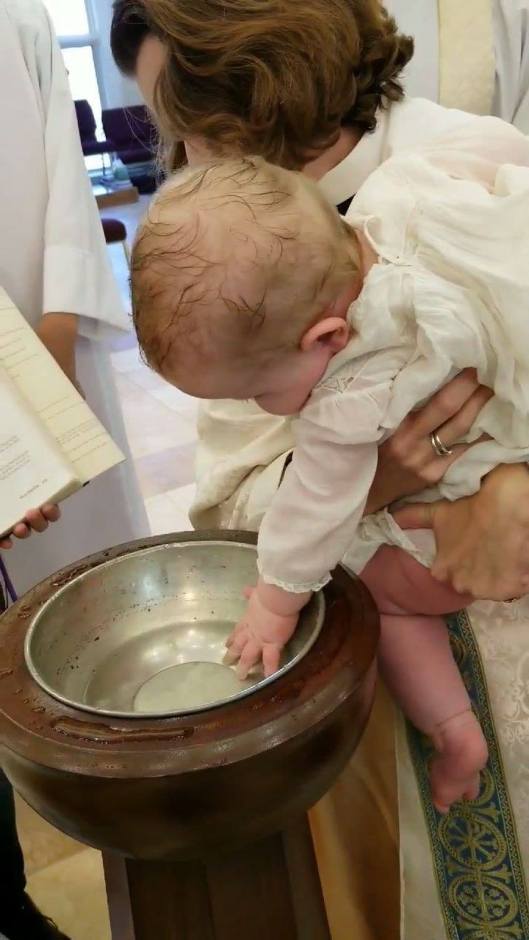
This Sunday, we are baptizing a baby into the household of God.  As part of that ritual, we will make promises about our own spiritual journey.  We will promise to gather regularly in Christian community, breaking bread and praying together; to resist evil, and repent when we fail; to proclaim the Word of God in word and deed; to seek and serve Christ, loving neighbors as ourselves; and to strive for justice and peace, respecting the dignity of every human being.  We promise to do what Christ asked us to do:  love God, love your neighbor, love yourself.

I love that my daughter is affirming her baptismal identity at Hickory Neck – whether she sees Christian witness through Mr. Rogers or through her Sunday School teachers.  I love that our younger children and older youth are learning how to live into their baptismal identity – whether through nursery care providers or youth group leaders.  And I love that our adults are still learning to live into their baptismal identities – through preaching, teaching, and our children’s witness.  At Hickory Neck, we are working across generations to keep loving God, loving our neighbors, and loving ourselves.  If you are in need of a community to help you claim that same identity and purpose, know that you are always welcome here – won’t you be our neighbor?

46040735_2084113391644910_120194659778560_o

Photo credit:  Hickory Neck Episcopal Church; permission to use required

On Liturgy, Love, and the Lord…

19 Wednesday Jun 2019

Posted by jandrewsweckerly in Uncategorized

≈ Leave a comment

Tags

communion, community, Episcopal Church, Eucharist, God, instructed, liturgy, longing, mental, mystery, physical, ritual, spiritual, welcome, wonder

38085329_1940214422701475_4123153700623482880_n

Photo credit:  Hickory Neck Episcopal Church; reuse with permission only.

This past Sunday we celebrated an “Instructed Eucharist,” a worship service in the Episcopal Church narrated to explain how and why we do the things we do in Church.  Though Instructed Eucharists are pretty common in the Episcopal Church, I had never led one myself, and I found I was pretty nervous about how it would go.  I worried the narrative pieces would feel too long and people would start to lose attention.  I worried the worship would feel too disjointed by narration to feel like worship.  I worried the teaching portion would not be particularly meaningful for those gathered.

As in most things, my worries were unfounded.  Many of those gathered shared that the narrative did not make the service too long.  In fact, they were surprised at how seamlessly the narrative flowed, and how engaging the experience was.  Several of those gathered were touched by the parts that are always touching – scripture, music, preaching, the peace, communion, and the dismissal.  And many of those gathered, of all ages, and of all spiritual backgrounds, shared not only did they love the service, but they also learned many new things.

What caught my attention about the feedback was not simply that people liked the experience.  What caught my attention about the feedback was people were excited about worship.  Having learned something about the weekly ritual of worship allowed our worship to shift from the physical (the habits of bowing, kneeling, standing, singing, eating, greeting) to the mental (understanding the theology, history, and spirituality of our worship) to the spiritual (the opening of our bodies and minds creating deeper connection with God).  That kind of excitement is at the heart of what drew most Episcopalians to the Episcopal Church – a ritual that somehow spoke to something deep inside them, and of which they wanted more.  Sometimes that longing could be easily described, but sometimes that longing was too mysterious to capture in words.

If you had that experience this past Sunday, or if you have ever been touched by that mysterious sense of God in the worship within the Episcopal Church, I invite you to share that sense of wonder with someone today.  You may share the first moment you stepped into an Episcopal Church, or a lifetime of practice, or a simple Instructed Eucharist.  Share the wonder and beauty with someone else, and invite them into the same experience that has enlivened your spiritual journey.  And if you have never had that experience in a church before, know you are welcome to join us at Hickory Neck – a place where you can weekly come and participate – whether physically, mentally, or spiritually – in something bigger than yourself, but in something that makes you feel more grounded in yourself – something that allows you to find God within, already there waiting for you, affirmed in the community around you.  You are welcome here.

GC79: Kingdom Work

26 Thursday Jul 2018

Posted by jandrewsweckerly in Uncategorized

≈ Leave a comment

Tags

Episcopal Church, General Convention, God, heaven, hope, Jesus Christ, Kingdom, liberating, life-giving, loving, people

IMG_5342

Photo credit:  Ruth Beresford (reuse only with permission)

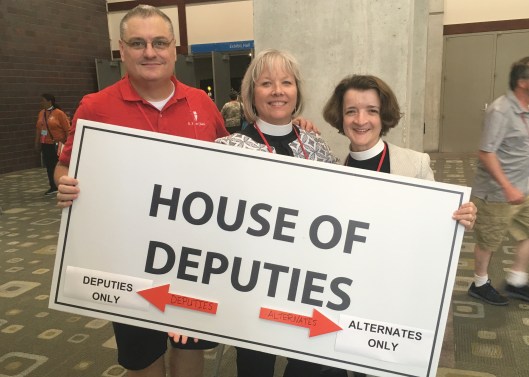
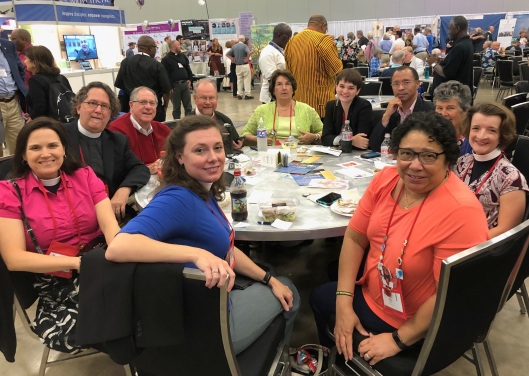
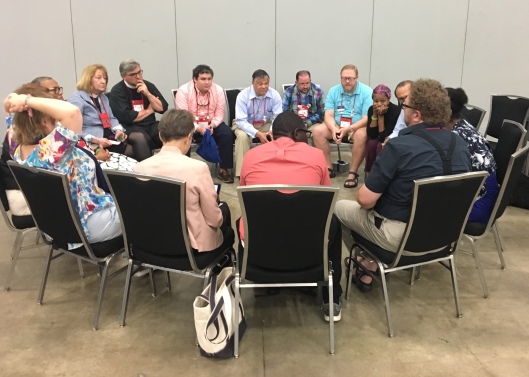
One of the questions I have received about General Convention is what it is like.  What you notice right away is General Convention’s impressive scale.  Every one of the 110 dioceses of the Episcopal Church is able to bring four clergy and four lay deputies.  They may also bring four alternate clergy and four alternate lay deputies.   In total, that’s over 800 people on the floor of the House of Deputies.  All bishops are also present, meeting in the House of Bishops.  Each diocese can have 1 – 3 bishops in place (Diocesan, Suffragan, and Assisting/Assistant).  Visitors from near and far can also attend, as well as media from dioceses, youth observers, and distinguished guests.  The Exhibit Hall also has an extraordinary number of staff and volunteers, and in addition to booths, the seminaries regularly bring in staff or faculty for seminary reunions.  Meanwhile, the entire Convention Center is run by massive amounts of volunteers – covering everything from check-in, monitoring the floor, helping with worship, to the exhibits.  Meanwhile, the ECW holds its annual triennium at the same time, which involves representatives, organizers, and volunteers.  Needless to say, Episcopalians take over the host city (this year coined as the Episcapocalypse).  Even Austin, Texas, which prides itself in being “weird,” I think was a little overwhelmed by our numbers.

IMG_1950

Photo credit:  Chris Girata (reuse only with permission)

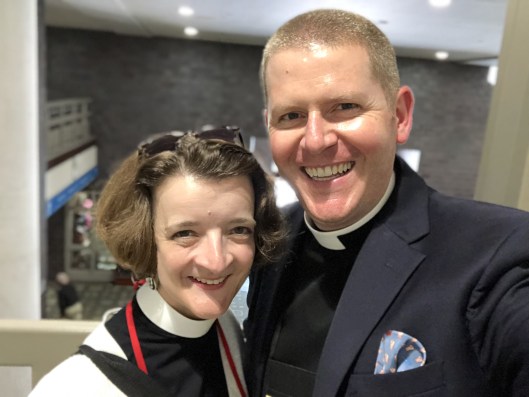
What I particularly enjoyed was getting a taste of what it might be like to enter God’s heavenly kingdom.  People from all walks of my life were present at Convention.  There were people from my time in undergraduate campus ministry, my time working as a lay person, my time in seminary, my time as a curate, my first time as a rector, and my current position.  The joy of greeting one longtime friend or colleague after another was heartwarming.  It also reminded me of how incredibly blessed my life has been to be full of incredible people who have shaped, influenced, and sometimes directed my faith life.  God’s abundance was all around me in the faces of God’s children.

IMG_1885

Photo credit:  Hickman Alexandre (reuse only with permission)

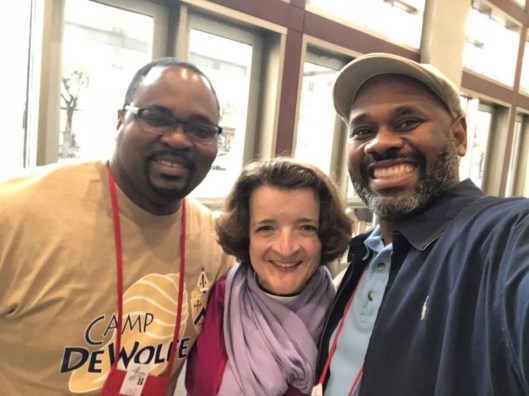
But you could not be at General Convention without meeting other people.  A conversation about something mundane would lead to the realization that we had friends in common.  Waiting in line for something would lead to a conversation about a shared passion.  People you have “met” online through vocational networking you could finally meet in person.  Suddenly, you realized you were making connections from all over the world.  The family of the Episcopal Church is deep and wide.  I leave General Convention feeling hopeful for the future of the Episcopal Church, knowing that it is full of passionate people, doing their part to create a loving, liberating, life-giving world through Jesus Christ.  Thanks be to God!

IMG_1749

Photo credit:  Ann Turner (reuse only with permission)

GC79: Respecting Dignity

25 Wednesday Jul 2018

Posted by jandrewsweckerly in Uncategorized

≈ Leave a comment

Tags

dignity, Episcopal Church, gender, General Convention, immigration, Jesus, language, outcast, race, respect, sexual orientation

IMG_1851

Photo credit:  Jennifer Andrews-Weckerly (permission for reuse)

One of the many takeaways from General Convention was the need to tend to those outside of the straight, white, male, able-bodied community.  There was a task force assembled before Convention to address issues raised by the #metoo movement.  Out of that group came many resolutions about sexual harassment and abuse, equality in payment and hiring, parenting accommodations, and eliminating bias in bishop searches.  Our African-American brothers and sisters also called for work on pay equity and broader issues, such as voter suppression.  Our foreign language speakers rallied for more translated liturgies and legislation, as well as increased interpreters throughout Convention.  Our disabled and deaf members lobbied for better accommodations during Convention.  Our LGBTQ members called for broader inclusion and more intentional expansive and inclusive language.  Our immigrant members also called for thoughtfulness about our ordination processes, noting that many dioceses are unwilling to consider entering into a formal discernment process with someone if their immigration status is not settled.

There are probably more issues I am forgetting, but what struck me about each of these movements is that they are not just General Convention issues or wider church issues.  These are issues for every parish.  At our own parish, we are struggling to provide hearing assistance to our hearing-impaired members due to lack of volunteers to run our sound system.  Having served on a Commission on Ministry (COM) in another diocese, I realize now how our restrictions around immigration could have limited the movement of the Holy Spirit.  Even the conversation about breastfeeding on the Convention floor made me realize that we all have work to do about making our worship spaces as welcoming as possible.  Having watched these issues unfold at General Convention, I am convinced that there are issues we are overlooking as well.

Jesus always struck me as someone who saw everyone – especially people that society, religious leaders, and even his disciples overlooked or dismissed.  He had a knack for seeing the marginalized, the oppressed, and those cast out or looked down upon.  He asked their stories, engaged them in conversation and relationship, he often restored them to health and status in the community.  He showed us what it means to respect the dignity of every human being.  When we reaffirm our baptismal covenant, or when we say, “The Episcopal Church Welcomes You,” how might we do a better job of bringing what we say in line with what we do?  General Convention’s work was a way of pointing us back to the work of Jesus.  How might Hickory Neck engage in this same work?  How might you engage in this same work in your everyday life?

GC79: Reconciliation in Real Time

20 Friday Jul 2018

Posted by jandrewsweckerly in Uncategorized

≈ Leave a comment

Tags

anxiety, bishops, change, cheer, concern, Cuba, Episcopal Church, family, General Convention, God, home, House of Bishops, humbling, mercy, reconciliation, right, wrong

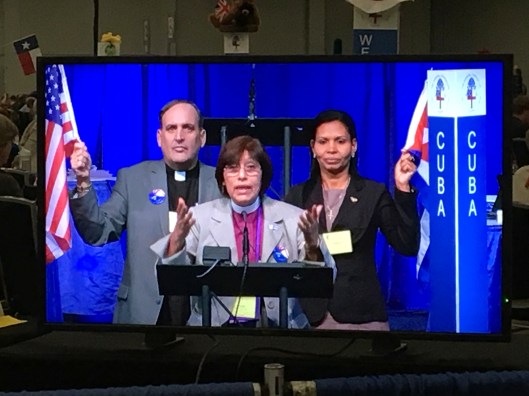
IMG_1927In 1966, in light of the Cuban Revolution and the political response of the United States, the House of Bishops voted to separate from the Diocese of Cuba from the Episcopal Church, leaving it an autonomous diocese without a provincial home.  The clergy scattered, some returning or immigrating to the US, but some who remained in Cuba were imprisoned, executed, or disappeared; priests lost their pensions, and they operated in isolation from the Church.  Cuba officially requested to be reaffiliated with the Episcopal Church and was given a list of requirements before admission.  As of GC79, all of those conditions had been met.  However, leading up to the resolution coming to the floor of both the Deputies and Bishops, there was controversy on what it would mean, how this admission might impact the admission of other Dioceses (or their exit), how to affirm already elected bishops (assuming they had not followed the current practices of approval for bishops in the Episcopal Church), among other concerns.  In other words, there was a desire to right the wrong done 52 years ago, but some anxiety about the implications of the decision.

As an alternate deputy, I had the leisure of observing either House.  On Tuesday, I happened to be observing the House of Bishops when resolution A238 came to the floor.  Each testimony pleaded for righting the wrong done by the House of Bishops in 1966.  Retired bishop Leo Frade from the Diocese of Southeast Florida spoke passionately about the resolution.  As a Cuban American who had been a part of the Church in Cuba, he got quite emotional in his plea for the bishops to do the right thing.  When it came time for the vote, the vote was a unanimous approval for readmittance.  The entire house – bishops and visitors – exploded.  Cheers and clapping filled the room, and the standing ovation lasted several minutes.  Unbeknownst to me, the Bishop of Cuba was present and was invited to approach the platform to address the House.  Bishop Curry embraced her.  The House broke into singing the Doxology.

Bishop Griselda Delgado’s speech was the most humbling.  Despite every reason to feel resentful or hurt, Bishop Delgado communicated nothing but forgiveness and reconciliation.  “We are family,” she insisted.  And although we severed the relationship so many years ago, she insisted, “Cuba never left.”  Her sentiments struck me as the exact way that God sees us.  When we reject God, God never leaves us.  When we abandon God, we do not abandon our familial ties with God.  Bishop Delgado’s profound sense of right relationship, reconciliation, and forgiveness brought the House to tears.  We did not deserve her mercy, and yet there she was, offering mercy.  When Bishop Delgado said, “The Holy Spirit is here,” I knew she was right.  In response, Presiding Bishop Curry said, “The Bishop may take her seat at Table 7.”  Those words were words of righting a wrong – fully, completely, unconditionally.

The experience the next day was equally powerful in the House of Deputies.  They too needed to approve the resolution, and it also passed unanimously.  Bishop Delgado spoke there too, but equally powerful was the triangular sign with the word, “Cuba” written on it.  It was processed to a table, and the deputies from Cuba were seated in the House of Deputies.  “Welcome home,” pronounced President Jennings.

What I loved about the approval of this resolution was seeing how legislation can powerfully effect change.  Sometimes, in the weeds of parliamentary procedure, and canonical revisions, one can wonder if all we are doing is navel gazing.  But on these days, we watched first-hand the commitment to change, the willingness to boldly repent, and the receiving of mercy.  Surely the presence of this Lord has been in this place!

GC79: Compassionate Compromise

19 Thursday Jul 2018

Posted by jandrewsweckerly in Uncategorized

≈ Leave a comment

Tags

Christ, compromise, Episcopal Church, General Convention, LGBTQ, marriage rites, protest, theology, traditional, witness

IMG_1818

Photo Credit:  Jennifer Andrews-Weckerly (reuse with permission)

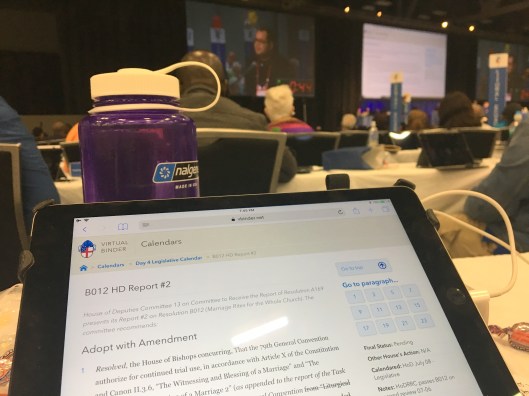
As an alternate to General Convention, I stood ready to fill in when deputies needed a break from the floor.  On the two sessions where I was able to serve as a Deputy, I was able to participate in the debate, revision, and voting on B012, entitled Marriage Rites for the Whole Church.  This resolution came to be because although we authorized marriage rites for same sex couples at the 78th General Convention, there was a provision that allowed bishops who hold a theological position that does not embrace marriage for same-sex couples to forbid his or her priests from conducting such rites.  This left the LGBTQ community in those dioceses unable to be married in their home parishes by their home priests, despite a change in the legal ability to do so.  This was deemed a compromise that could keep everyone at the table despite our theological differences.

However, given the protests of the LGBTQ community and their supporters, B012 proposed an option for priests and their parishes who wanted to conduct marriages for all despite their bishop’s protest to seek the oversight of another bishop in the Episcopal Church.  The resolution allowed for bishops and protesting churches and clergy to hold their ground, while also allowing dissenting clergy and parishes to minister to their community fully.  I talked about the testimonies and debate about this issue earlier.  The resolution was heavily edited as a result of that that testimony, and what came before the House of Deputies seemed like a well-crafted compromise.  But the debate on the floor indicated something quite different.  Our more traditional brothers and sisters felt their theology was being compromised, and many diocese in Province IX, including churches in foreign countries where same-sex marriage is still illegal, were threatening to break from the church.  It was a heart-wrenching debate, and our own deputation was even divided on what to do.

When the vote finally came, we voted by orders – so that the entire house could see how the lay and ordained voted.  As the minutes ticked by, my stomach turned.  I honestly did not know what would be the best outcome, and I feared for our path forward.  When the votes came in, they were overwhelmingly in favor of B012.  I am not sure what changed people’s minds, and I am not sure how people came to see that this was a good compromise.  My only reflection was that everyone was a bit unhappy, not fully getting what they wanted – which is the definition of a good compromise, if you ask me.

I do not know if the passage of B012 will have any negative impact in the future.  What I do know is that the process seemed to model something we have a hard time doing in the United States – compromise.  I have always said that if the Episcopal Church cannot model compromise, respect, and dignity, we cannot expect the world outside to do so.  The passage of B012 in both Houses made me feel like there might be hope for all of us to witness compassionate compromise through Christ to others.

GC79: On Needing Revival…

18 Wednesday Jul 2018

Posted by jandrewsweckerly in Uncategorized

≈ Leave a comment

Tags

Bible, Bishop Curry, church, Episcopal Church, General Convention, God, God's word, Holy Spirit, interpretation, liberation, love, ordination, protest, revival, role, scripture, women

This week, I continue with more reflections from the General Convention of the Episcopal Church.  Look for posts in the days to come that give some insight into the experiences of the week, the take-home lessons, the pondering questions still ruminating in me.  Thanks for following along!

On Saturday evening of General Convention, we were invited to a revival at a local church.  The revival was powerful and clearly moving to many in the crowd.  Of particular note was the Spanish translator hired to translate for Bishop Curry.  She was poised, animated, and seemed to feed off Bishop Curry’s energy.  I do not know how she did it, but the two of them really seemed to be preaching together – to be dancing in God’s word as they preached a message of love and life.  Even for someone whose Spanish is minimal, I found her translation and presence really made Bishop Curry’s sermon come alive in a new way.

But what has been staying with me about that evening was the protest outside the church.  Members of Westboro Baptist Church gathered to protest what the Episcopal Church has been doing; from their signs, I understand they are mostly upset about the ordination of women, and our inclusion of the LGBTQ community in ordained and married life.  In the course of my life, I have had many conversations about both of those issues, including people confronting me about my own ordination and my theological understanding about the expansiveness of God’s love for all.  Those conversations have sometimes been hard, hurtful, and even anger-inducing.  But ultimately, they were always conversations – things said to my face, debates had between people, disagreements had within the context of relationship.

So the sentiments of the protestors was not new to me (although some of the language used against female pastors would have made many clutch their pearls).  What was heartbreaking was seeing a preteen standing next to her mother with a sign that read, “No Women Preachers – 1 Tim. 2.12.”  I went back and reread 1 Timothy 12, and I confess, a good portion of the chapter is about wives submitting to their husbands, keeping silent, allowing their husbands to lead.  We’ll talk about that in another blog post.  But as I looked at the young girl, I remembered all the times I started asking hard questions about things I had read in the Bible that did not seem to make sense – that did not seem to jive with the wide embrace of God’s love.  I remembered the Sunday School teacher who encouraged us to read the Bible literally, condemning her own current marriage because she had once been divorced.  I remember feeling a sense of discomfort until I found liberation in the Episcopal Church – a church that taught me to ask hard questions, to be uncomfortable in the ambiguity, to be released from the bonds of literal biblical interpretation, and to read the Bible in a new way.

Holding all that in my mind, I grieved for this young woman.  I sorrowed for the mother standing next to her, teaching her to keep silent, and to disrespect every woman who believes God is empowering us with God’s word.  I lamented the hate being inculcated into this young girl.  I mourned the light being limited in her life.  As female preachers poured out of buses for the revival, I found myself wanting to whisper into her ear, “God’s love is bigger than the words in 1 Timothy.”  Holy Scripture has been used time and again to limit God’s love, grace, and mercy.  I am sure I am guilty of a similar sin in one way or another; perhaps even this blog post is an exercise in sinful presumption.  My prayer for all of us is that we have people whispering in our ears words of truth, reconciliation, and peace.  Let not the work of the Holy Spirit be extinguished in us.

IMG_1755

Photo credit:  Jennifer Andrews-Weckerly (permission needed for reuse)

On Discipleship and Decisions…

04 Wednesday Jul 2018

Posted by jandrewsweckerly in Uncategorized

≈ 1 Comment

Tags

decisions, disciple, discipleship, Episcopal, Episcopal Church, General Convention, identity, Jesus, prayer

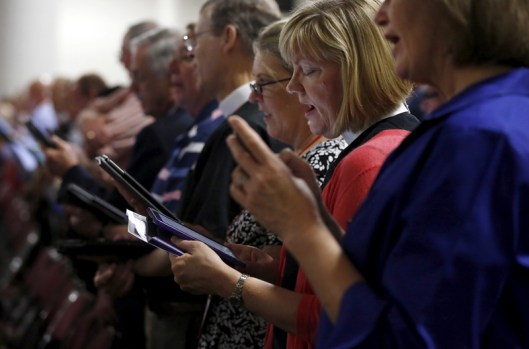
Members sing during a church service during the General Convention of the Episcopal Church in Salt Lake City

Photo credit:  https://religionnews.com/2015/07/02/episcopal-church-expansive-inclusive-thanks-gay-marriage-votes-commentary/

Today, I am traveling to Austin for the General Convention of the Episcopal Church.  General Convention meets every three years and is a bicameral legislature that includes the House of Deputies and the House of Bishops, composed of deputies and bishops from each diocese. During General Convention, deputies and bishops consider a wide range of important matters facing the Church.  Some years the issues have a huge impact (examples include the ordination of women and members of the LGBTQ community, as well as same-sex marriage).  Other years, General Convention works on important issues that are less flashy.  Regardless of the news cycle, the work of General Convention is about continuing to define who and whose we are, and making sure our work reflects our identity.

I am attending this year as an alternate clergy deputy for the Diocese of Southern Virginia.  My work is to support the eight clergy and lay deputies and our bishops, helping them make important decisions, and filling in when breaks are needed.  The official meetings take place July 5-13, but there are already many committee meetings happening.

In talking to a clergy colleague about my participation in General Convention he asked me, “Why in the world did you volunteer?”  I have been thinking (and laughing) about that question, and after reflection, I realized why I was so interested in serving.  One of the things I preach about a lot is about identity – understanding it, naming it, living into it.  In the current climate of the United States, our identity as disciples of Jesus is an anchor.  But just saying we are disciples without critically examining our lives through that lens does little good.  For me, being a part of General Convention is a way of participating in the work of honing our identity as Episcopalians, and where applicable, helping us to better live into that identity.

I look forward to serving the broader church, our Diocese, and ultimately my parish through this work.  This kind of work creates the space for making us all better, and I am hopeful about what the week can bring.  I ask your prayers for the General Convention over the next many days.  Like any family, parish, Diocese, or church who tries to come to consensus across differences, we will need your prayers to listen deeply, speak intentionally, and make decisions thoughtfully and prayerfully.  I look forward to sharing this experience with you!

On Politics, Priests, and Prayer…

20 Wednesday Jun 2018

Posted by jandrewsweckerly in Uncategorized

≈ 4 Comments

Tags

American, Bible, Christian, communion, dignity, disciple, diversity, Episcopal Church, Eucharist, Good News, gospel, Jesus, policy, politics, prayer, priest, scripture, table

lightstock_99088_medium_david_needham

Photo credit:  https://www.lebanonfbc.org/ministries/power-prayer-pop

One of the hardest parts of being a priest is creating a community in which we can talk about the Gospel of Jesus Christ, hold widely varying political opinions, and yet still gather at the Eucharistic Table – elbow to elbow, as the imperfect, but beloved body of Christ, determined to stay in community.  I say that the work is difficult because I have seen how fragile this work really can be.  During my priestly formation at seminary, congregations and Dioceses were walking away from that common table over the issue of human sexuality.  Although I was proud of what the Episcopal Church did at the time, I also deeply mourned the loss of diversity at the Table – the creation of a more homogenous Church than a Church who was devoted to staying in the tension while honoring the Gospel.

Because of my high value of the uniting force of the Eucharistic Table, my priesthood has taken a slightly different shape than I might have imagined in my early twenties.  If you had asked me then about the primary role of the priest, I might have argued the role of prophet – decrying injustice and leading the people of faith to a more just world.  But as I aged, and as I served diverse parishes, I began to see the role of prophet is one of many roles, one that needs to be used judiciously so as not to alienate parishioners and create an exclusive community of like-minded people.  And so, my priesthood has been marked with great caution around politics.  While many of my colleagues will beat the drum for justice, I find myself trying to carefully walk with my diverse congregations as we discern together how to interpret politics in light of the Gospel – not in light of Democrats or Republicans, but in light of the witness of Jesus Christ.  That doesn’t mean I don’t have strong political opinions; it just means that I try to take focus off the politician or political issue of the moment and try to create disciples who can see and follow Christ.

That being said, this past week, the issue of what is happening to families seeking asylum on our southern border, and the separation of children from parents as a punitive, purportedly deterring action has shifted my normal practice – not because I changed my mind about politics and the Church, but because two agents of our government utilized Holy Scripture to justify those actions.  Here’s the thing:  if this were just another issue where we are divided about policy, where we had a debate about the extents to which we value national security over other values, I would have happily encouraged our parishioners to be faithful Christians in dialogue.  But when Attorney General Jeff Sessions invoked Holy Scripture to justify separating children from parents, he stepped into my area of authority, leaving me no other option but to speak.

Now I could layout a Biblical defense against the small portion of Romans 13 that Attorney General Sessions quoted, giving you the context of the chapter, giving you the verses immediately following what he quoted as a counter to his argument.  I could quote to you chapter and verse for countless other scripture lessons that tell us to love one another, respect the dignity of other human beings, care for the outcast and alien, tend the poor, and honor children.  I could also tell you about how that same bit of scripture was used to justify slavery, Nazis, or apartheid in South Africa.  But the problem with a scripture quoting war is that no one wins.  What is more important is what we know of the canon of Scripture:  that our God is a God of love, that Jesus walked the earth showing us how to be agents of love, healing, and grace, and that the Holy Spirit works through us today to keep spreading that love.

Knowing what I know about the Good News of God in Christ, in my baptismal identity as one who seeks and serves Christ in all persons, respecting the dignity of every human being, I cannot stand idly by or be silent when the Holy Scriptures of Christians are being used to justify political actions that are antithetical to our Christian identity.  As a priest, I invite you this week, especially when a governmental leader is invoking our faith, to reflect on how the Gospel of Christ is informing your view on this issue.  Not as a Republican and not as a Democrat, but as a follower of Christ.  Fortunately, prominent politicians on both sides of the aisle seem to be coming to agreement on this issue – a rarity these days – but also an example to Episcopalians who hold a high view of coming to the Eucharistic Table across our differences.  I am not saying we need to agree on this – in fact, I suspect we will not.  What I am asking is that you live into your identity as a disciple of Christ, as an agent of love, and then respond in conversation, in political advocacy, and in worship as one holding in tension both our American and Christian identities.  I support you in this difficult, hard work.  I love you as you struggle.  I welcome you to the Eucharistic Table.

Sermon – Isaiah 40.1-11, A2, YA, Advent Lessons and Carols, December 4, 2016

08 Thursday Dec 2016

Posted by jandrewsweckerly in Sermons, Uncategorized

≈ Leave a comment

Tags

Advent, Christ Child, Christmas, Episcopal Church, hope, Isaiah, Jesse, Jesus, joy, Lessons and Carols, rooting, season, Sermon, song, story

The season of Advent and I have not always been friends.  In fact, the first Advent I experienced in the Episcopal Church almost ended my relationship with the Episcopal Church.  You see, I grew up in a Christian tradition that treated Advent as the beginning of the Christmas season.  Starting on Advent One, we were singing Christmas carols, making our way through all the old favorites.  The tradition felt perfect – instead of focusing on a secularized Christmas, the Christmas hymns during Advent reminded us all of the “reason for the season.”  Besides, there are so many familiar Christmas hymns, that there would be no way to enjoy them all during the short two weeks of Christmastide.  Since our tradition also did not have services on Christmas Eve or Christmas Day, you had to squeeze in all the “Joy to the Worlds,” “Oh Holy Nights,” and “Away in the Mangers,” that you could before the holiday was over.  In that tradition, Advent felt like a family gathering around a fire, singing songs of familiarity and comfort.

Of course, the Episcopal Church we landed in did nothing of the sort.  The songs I heard during that first Advent were dreadful.  They were slow and full of melancholy.  They sounded as though whomever wrote them was hunkered down, alone, in a room without a fireplace.  They had a hollow, haunted feeling to them, and the tunes were difficult to follow.  I remember that first Advent feeling like all the joy had been taken out of Christmas, and all that was left was a sad sense of unfamiliarity.

So, if that were my first experience of Advent in the Episcopal Church, why in the world would I agree to having not just Lessons and Carols today – but Advent Lessons and Carols?  I not only agreed to, but begged for, Advent Lessons and Carols because this service attempts to capture what the whole season of Advent does in the Episcopal tradition.  Advent is not meant to be four weeks of celebrating the birth of the Christ Child.  Advent is meant to be four weeks of helping us understand the enormity of what happens on the fateful night of Christ’s birth.  And so, like the people of faith always have, we go back and tell the story.  We tell our story.  We set the scene of Jesus’ birth by using our story to understand the context of the monumental event of the nativity.

First, we go all the way back to the garden of Eden.  Then, we remember the words of the prophets who told of a messiah, an anointed one from the house of David – and yet, better than David.  We hear words of comfort, words of preparation, and words of promise.  We hear of a young, inexperienced woman and the announcement that she gets of a coming child.  And we even hear from Jesus himself, who tells us of the call for repentance in the face of fulfilled promise.  All of that – from Eden, to failed kings and judges, to wearied exiled people, to scared, young women, to the message of repentance all are needed to remember why that infant in a humble manger is so important.  His story is bigger.   His story starts long before his own story starts.  His story is our story.

I am especially grateful for the rooting that Advent provides this year because I have been feeling pretty rootless lately.  With all the noise of world news lately, we can easily become lost.  We can get caught up in the heat of politics, pandering, and promises and forget to whom we belong.  We can see destruction all around us and wonder whether hope is lost.  Into the face of that loss, destruction, and longing, Isaiah says today, “A shoot shall come out from the stump of Jesse, and a branch shall grow out of his roots.”  At the time of Isaiah’s oracle, the people of God had been in a time of high tensions.  “…The northern kingdom of Israel and the Aramaeans of Damascus tried to force Judah and King Ahaz to join their rebellion against Assyria.  On Isaiah’s advice, Ahaz refused; but then, instead of joining the rebel alliance, he called Assyria to intervene.”[i]  Of course, this led to disaster and eventually the end of the northern kingdom.  You can imagine Isaiah’s frustration with a king who does not trust God, and who only half-way follows God’s instructions.  And with the massive destruction of the northern kingdom, Isaiah could have been tempted to lose hope.  But the text we get today is not a text of damnation or even chastising.  Instead, Isaiah is able to hold on to hope.  In the midst of what feels like total destruction, Isaiah proclaims, “A shoot shall come out from the stump of Jesse, and a branch shall grow out of his roots.”

Those of you who read my blog know I am not all that great with plants.  Most plants survive only a few weeks, maybe months if I am lucky.  The running joke is that I pretty much have a brown thumb instead of a green thumb.  The one exception is a little bonsai plant that my husband and I were given as a wedding present.  Somehow, miracle of all miracles, I have managed to keep that plant alive for the fifteen years since our wedding.  I had taken to calling it our “love plant,” because I surmised that only our love was keeping the plant going.  But when we moved to Williamsburg, having the brown thumb that I do, I assumed that the plant would be just fine sitting in my car for a few days.  When we finally moved into our house, I realized something was wrong.  The heat of the day must have scorched the plant, because every leaf was turning brown.  Within a week of moving in, all the leaves had fallen and even those 15-year old branches were looking withered beyond repair.  I was pretty sure the plant was dead, but I couldn’t bear to toss our love plant.  For some odd reason, I kept watering the plant, hoping something would happen.  But even plant-lovers who saw my plant looked at me with pitying eyes when I showed them the plant.  Two months later, I looked over at our sad, presumably dead plant, and at the base of that bonsai plant were two little new shoots of growth.  I couldn’t believe it!  After a period of mourning, new life was emerging.  Hope emerged that our withered love plant might just have a little more life left.

Isaiah’s promise is similarly powerful.  “Out of something that appears finished, lifeless, left behind, comes the sign of new life – a green sprig.”[ii]  As Christians, we certainly understand the green sprig from the stump of Jesse to be Jesus Christ.  He is the only one who can redeem and bring new life.  He is the one who brings us hope.   In a few weeks, we will not just be celebrating the birth of a cute baby.  We will be celebrating the shoot from the stump of Jesse – a branch that will bring new life out of destruction, pain, and suffering.  In our world of destruction, pain, and suffering, I cannot imagine a better message of hope.

Once I understood the significance of Advent in the greater faith narrative, my years-long loathing of Episcopal Advent began to fade.  The more reserved songs of Advent slowly began to feel less like dirges and more like raw, vulnerable songs of hope.  Suddenly the soprano voices singing the high notes of “Jesus Christ, the Apple Tree,” the phrase, “Most highly favored lady,” and the comforting alleluias of “Let all Mortal Flesh Keep Silence,” became welcome, comforting friends, and not the nemeses I once imagined.  Finally, after years of dread, instead, I found Advent in the Episcopal Church to be a gift – a time set apart to gather around with family and tell the old stories – our story, and prepare our hearts for the new shoot from the root of Jesse.

The telling of our story is not just important for understanding who the Christ Child is.  The telling of our story is also important for understanding who we are in relation to the Christ Child and the world.  When we understand ourselves to be redeemed by the shoot of the stump of Jesse, the way we operate in the world changes.  We look at a world of destruction, pain, and suffering through the lens of hope.  And when we look through the lens of hope, we are not a defeated people, but a people who see promise, even when others cannot see that same promise.  We know what the shoot from the stump of Jesse has done, is doing, and will do.  And that means our whole way of being changes.  Our story changes.  Our song changes.  And we change too.  Thanks be to God!

[i] Bruce C. Birch, “Exegetical Perspective,” Feasting on the Word, Yr. A, Vol. 1 (Louisville:  Westminster John Knox Press, 2010), 27.

[ii] Stacey Simpson Duke, “Pastoral Perspective,” Feasting on the Word, Yr. A, Vol. 1 (Louisville:  Westminster John Knox Press, 2010), 28.

← Older posts
Newer posts →

Recent Posts

  • On the Myth and Magic of Advent…
  • On Risking Failure and Facing Fear…
  • Sermon – Luke 23.33-43, P29, YC, November 23, 2025
  • On Inhabiting Gratitude…
  • Sermon – Luke 20.27-38, P27, YC, November 9, 2025

Archives

  • December 2025
  • November 2025
  • October 2025
  • September 2025
  • August 2025
  • July 2025
  • June 2025
  • March 2025
  • February 2025
  • December 2024
  • November 2024
  • October 2024
  • September 2024
  • August 2024
  • July 2024
  • June 2024
  • May 2024
  • March 2024
  • February 2024
  • January 2024
  • December 2023
  • November 2023
  • October 2023
  • September 2023
  • August 2023
  • July 2023
  • June 2023
  • May 2023
  • March 2023
  • February 2023
  • January 2023
  • December 2022
  • November 2022
  • October 2022
  • June 2022
  • May 2022
  • January 2022
  • December 2021
  • November 2021
  • October 2021
  • September 2021
  • August 2021
  • June 2021
  • May 2021
  • April 2021
  • March 2021
  • February 2021
  • January 2021
  • December 2020
  • November 2020
  • October 2020
  • September 2020
  • August 2020
  • July 2020
  • June 2020
  • May 2020
  • April 2020
  • March 2020
  • February 2020
  • January 2020
  • December 2019
  • November 2019
  • October 2019
  • September 2019
  • August 2019
  • July 2019
  • June 2019
  • May 2019
  • April 2019
  • March 2019
  • February 2019
  • January 2019
  • December 2018
  • November 2018
  • October 2018
  • September 2018
  • August 2018
  • July 2018
  • June 2018
  • May 2018
  • April 2018
  • March 2018
  • February 2018
  • January 2018
  • December 2017
  • November 2017
  • October 2017
  • September 2017
  • August 2017
  • July 2017
  • June 2017
  • May 2017
  • April 2017
  • March 2017
  • February 2017
  • January 2017
  • December 2016
  • November 2016
  • October 2016
  • September 2016
  • August 2016
  • July 2016
  • June 2016
  • May 2016
  • April 2016
  • March 2016
  • February 2016
  • January 2016
  • December 2015
  • November 2015
  • October 2015
  • September 2015
  • August 2015
  • July 2015
  • June 2015
  • May 2015
  • April 2015
  • March 2015
  • February 2015
  • January 2015
  • December 2014
  • November 2014
  • October 2014
  • September 2014
  • August 2014
  • July 2014
  • June 2014
  • April 2014
  • March 2014
  • February 2014
  • January 2014
  • December 2013
  • November 2013
  • October 2013
  • September 2013
  • August 2013
  • July 2013
  • June 2013
  • May 2013
  • April 2013
  • March 2013
  • February 2013
  • January 2013
  • December 2012
  • November 2012
  • October 2012
  • September 2012

Categories

  • reflection
  • Sermons
  • Uncategorized

Meta

  • Create account
  • Log in
  • Entries feed
  • Comments feed
  • WordPress.com

Blog at WordPress.com.

  • Subscribe Subscribed
    • Seeking and Serving
    • Join 394 other subscribers
    • Already have a WordPress.com account? Log in now.
    • Seeking and Serving
    • Subscribe Subscribed
    • Sign up
    • Log in
    • Report this content
    • View site in Reader
    • Manage subscriptions
    • Collapse this bar
 

Loading Comments...