• About

Seeking and Serving

~ seek and serve Christ in all persons

Seeking and Serving

Tag Archives: experience

Sabbatical Journey…On Differences and Experiences

26 Monday Jun 2023

Posted by jandrewsweckerly in reflection

≈ 1 Comment

Tags

church, Church of Latter-Day Saints, differences, Episcopal, experience, faith, question, Salt Lake City, welcome

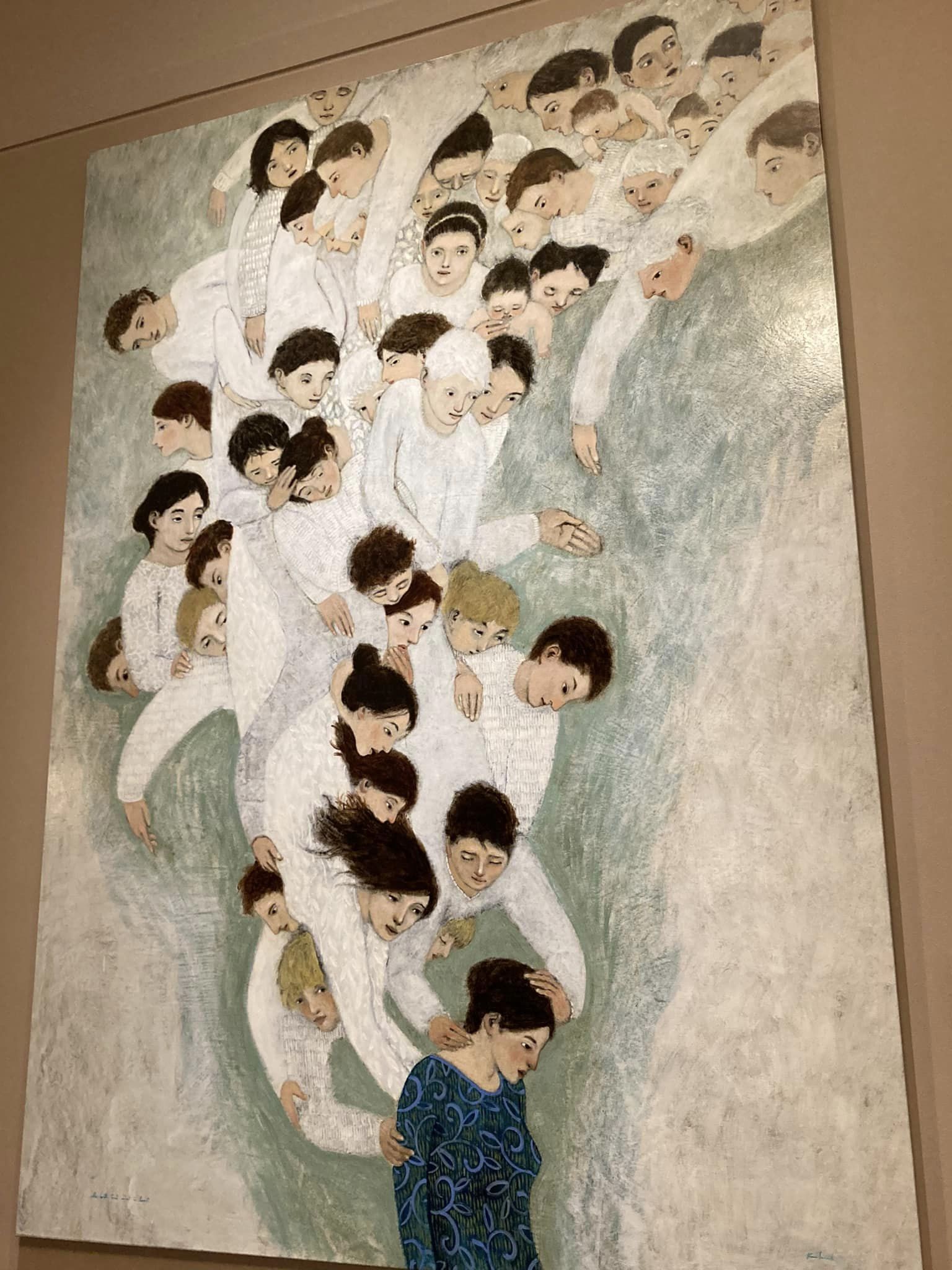
She Will Find What is Lost, by Brian Kershisnik, at the CJCLDS Conference Center (picture taken June 25, 2023)

Today, we toured Salt Lake City with a family friend and her family.  We wanted to learn about Temple Square, and help the kids learn a little more about the Church of Jesus Christ of Latter-Day Saints.  We couldn’t have had a more patient, open, vulnerable tour guide than our friend.  She constantly said all questions were fair game, and she meant it.  We learned about Church structure and governance, liturgical practices, theology, and personal experience.  Her son told us about his Morman mission to Korea and her girls talked about their choice not to take a mission.  We also got to see the 20,000-seat Conference Center, and the Tabernacle with the 11,000-pipe organ.  And we got the real experience of most businesses being closed on Sundays due to the widely respected sabbath day of rest. 

As we were talking with our friend about her faith and considering the differences in practices and theology, I began to realize how strange my faith must sound to the unchurched.  It is tricky enough to navigate and respect differences within the Abrahamic faiths.  But to someone who is unchurched, surely how we interpret scripture, what we practice (and don’t), and all our rules and restrictions must seem so foreign and intimidating.  Trying to figure out the differences between an Episcopalian and a member of the LDS must feel completely befuddling. 

I think we forget that what matters most to the unchurched is not necessarily all those distinctions among us, but how we treat the unchurched.  So much of what we think about church or other faiths is based on our experience of them – not some heady explanation of doctrine.  So, whether we are treated with dignity matters.  Whether we are given freedom to explore and ask questions without judgment matters.  Whether we experience genuine love and acceptance as we are matters.  I have known many an Episcopalian who was drawn to the Episcopal Church because they were frustrated by the doctrine of another denomination or faith.  But what kept them in the Episcopal Church wasn’t the doctrine they were seeking, but the reception they received once they kept coming back to church.

I hope this blog is one small way you might begin to experience the invitation of church another way.  Your questions and your struggles are welcome here.  You pain and hurt, as well as your hopes and joys, are welcome here.  Your skepticism and your hesitancy are welcome here.  Most of us people of faith are still figuring out this whole faith thing too.  You are welcome here.

Sabbatical Journey…On Finding Mystery

25 Sunday Jun 2023

Posted by jandrewsweckerly in reflection

≈ 1 Comment

Tags

Bryce Canyon, divine, experience, faith, God, hoodoo, knowledge, mystery, open, rigidity, science

Inspiration Point at Bryce Canyon (reuse with permission)

Our sabbatical journey got back on the road, heading this time to Bryce Canyon in Utah.  Before we got started, we watched a fabulous introductory video, telling us all about the flora and fauna of the Canyon, how the hoodoos were formed, the history of the Canyon becoming a National Park, and more.  It was a great introduction to what we would see, and what we might miss otherwise.

Despite the very scientific explanation of how the hoodoos (freestanding columns of weathered rock) are formed, I confess that in this one instance, the science leapt out of my mind as soon as I saw the hoodoos myself – or rather the sea of hoodoos.  Truly, one hoodoo alone is magnificent.  But hundreds of thousands of them is mind boggling.  I stood there unable to comprehend how such an unusual sight could be repeated over and over again.  All I could conclude was that it was a mystery. 

Now I know what you are thinking – there is nothing mysterious about rock formations.  I saw the scientist explain the formation process myself!  But knowing the science and experiencing the science are two different things.  As I stared into what seemed like infinite hoodoos, I kept coming back to that word:  mystery.

Sometimes I think we steer clear of the word mystery when it comes to our faith.  Saying something is a mystery seems like a cop out, or a way to shut down an intellectual conversation.  But I think there is enough in all of our lives that has taught us that mystery is indeed a reality.  Labeling some of our experiences, whether in nature or with God, as mystery allows us the freedom to set aside rigidity and open ourselves to things that seem impossible.  I wonder where in your life you are finding mystery and how mystery is deepening your sense of the divine.  

Sermon – Acts 1.6-14, E7, YA, May 21, 2023

30 Tuesday May 2023

Posted by jandrewsweckerly in Sermons

≈ Leave a comment

Tags

absence, anxiety, apostles, Ascension, experience, focus, God, Holy Spirit, intimacy, Jesus, presence, sabbatical, Sermon, staring, temptation

One of my favorite videos on YouTube is an experiment by the group called SoulPancake.  They asked six pairs of individuals, in various stages of relationship (from total strangers to a couple who has been married 55 years) to sit in two chairs facing one another, and without speaking, look into one another’s eyes for four minutes.  At first the couples are a bit uncomfortable – initially unsettled by the forced silence, but ultimately jarred by what they quickly realize is deep intimacy.  Slowly over the four minutes the couples settle in, their faces transforming from discomfort to curious to deep connection.  You can almost see the sparks of love emerging in their eyes, tension draining from their bodies, and invariably smiles of appreciation spreading across their mouths.[i] 

When Willie James Jennings writes about the ascension of Jesus, one his primary concerns is that in focusing on the heavens, where Jesus used to be, the disciples will forget to focus on one another, on the stranger in need of witness, and on the presence of God.  Jennings worries that the disciples are looking “into the heavens concerned by absence rather than looking forward to see presence.”[ii]  The text from the Acts of the Apostles tells us of the last earthly day of Jesus’ post-resurrection life.  Jesus gives the disciples a commission and is lifted up into the clouds and whisked away.  The text tells us the disciples do exactly what you might imagine – they stand there, staring at the heavens.  I imagine that standing and staring had several iterations:  there was likely the stunned awe of the moment; there may have been some not wanting to leave for fear of missing what might happen next; there may be some immediate second guessing about what this all means; there may be some Peter-esque desire to preserve the sacred location of the profound moment; there may be a sense deep grief, or conversely a sense of profound joy.  Whatever those disciples are doing, they are not at all doing they are supposed to do.  Hence the men in white robes asking their very basic question, “Why do you stand looking up toward heaven?”

You and I are about to engage in the profound and infrequent journey of sabbatical.  The temptations in this time are many.  For either of us, we could easily see this as twelve weeks of frozen time – where we will each gaze upon God, and then simply pick up where we left off in August.  For either of us, we could be prepared to happily engage in sabbatical activities, absorbed in our own mountaintop experiences, forgetting the journey of the other.  For either of us, we could be guided by fear, burying our talent like in the parable in Matthew – just hoping not to risk doing sabbatical the “wrong way” instead of investing our talents to see what return we gain. 

But there is danger in looking up in the heavens into absence as opposed to looking forward to presence.  Alan Hirsch tells us, “the biggest blockage to the next experience of God is often the last experience of God, because we get locked into it.”[iii]  [repeat]  What those men in white knew was that if the disciples stood there lost in themselves or even in the ascended Jesus, they would never get their next experience of God – they would get so locked into the mountaintop experience of Jesus’ ascension, that they would never make their way to the next experience of God – in their case the great gift of the Holy Spirit on Pentecost.

That is our invitation today.  As we stand on the precipice of sabbatical, maybe as we are still reveling in the memory of an outstanding parish-wide retreat this weekend, or wondering what sabbatical activities we want to try, or even feeling a bit of anxiety about what is next, a great whispering is happening nearby, “why are you standing looking up toward heaven?”  Our invitation instead is to resist letting our next experience of God be our last experience of God.  Our invitation is to gather in these next weeks in prayer and community, knowing that the Holy Spirit will do a new thing in all of us.  Our invitation is to walk down the mountain and into the valley of witnessing the gospel of Jesus, looking forward not only for the presence of God, but gazing deeply into the eyes of others.[iv]  This time of sabbatical is not a time to marked by absence, but instead is a time looking forward to see presence.  We can only see that presence if we pull our eyes from heaven and gaze into the sacred we find in one another.  The next experience of God promises to be greater still than our last experience of God.  I can’t wait to hear all about your next experience.  Amen.


[i] Georgia Koch, “How To Connect With Anyone,” SoulPancake, February 12, 2015, as found at https://www.youtube.com/watch?v=Xm-T3HCa618 on May 20, 2023.

[ii] Willie James Jennings, Acts:  Belief:  A Theological Commentary on the Bible (Louisville:  Westminster John Knox Press, 2017), 19-20.

[iii]  Alan Hirsch and Rob Kelly, Metanoia: How God Radically Transforms People, Churches, and Organizations From the Inside Out (Cody, Wyoming:  100 Movements Publishing, 2023).

[iv] John S. McClure, “Homiletical Perspective,” Feasting on the Word, Yr. A, Vol. 2 (Louisville:  Westminster John Knox Press, 2010), 525.

The Pilgrim’s Way…Day 6

12 Wednesday Feb 2020

Posted by jandrewsweckerly in Uncategorized

≈ Leave a comment

Tags

Canterbury, Cathedral, disappointment, evensong, experience, God, joy, perfect, pilgrimage, plans, Savior, space, trust

84089251_2891907087532199_5560143380115095552_n

Photo credit:  Jennifer Andrews-Weckerly; reuse with permission only

Sixteen pilgrims from Hickory Neck Church traveled to England for 8 days of pilgrimage.  Our focus was on choral music, hearing Evensong or Choral Mass at a Cathedral, Minster, or college everyday.  This is the sixth entry, initially posted on our church Facebook page.  For those of you who do not follow us on Facebook, I am repeating the journey’s daily entries here.  Enjoy!

Canterbury

When spending over a year planning a pilgrimage for your parish, poring over plans, making amendments to itineraries, and crafting the best spiritual experience you can, you imagine, “There! I have created the perfect pilgrimage experience.” But as soon as you say the words, “I have created,” you have lost. Pilgrimages are not about what I create or even what I plan. Pilgrimages are certainly about working hard – before, during, and after. But pilgrimages are also about making space and then letting God take over.

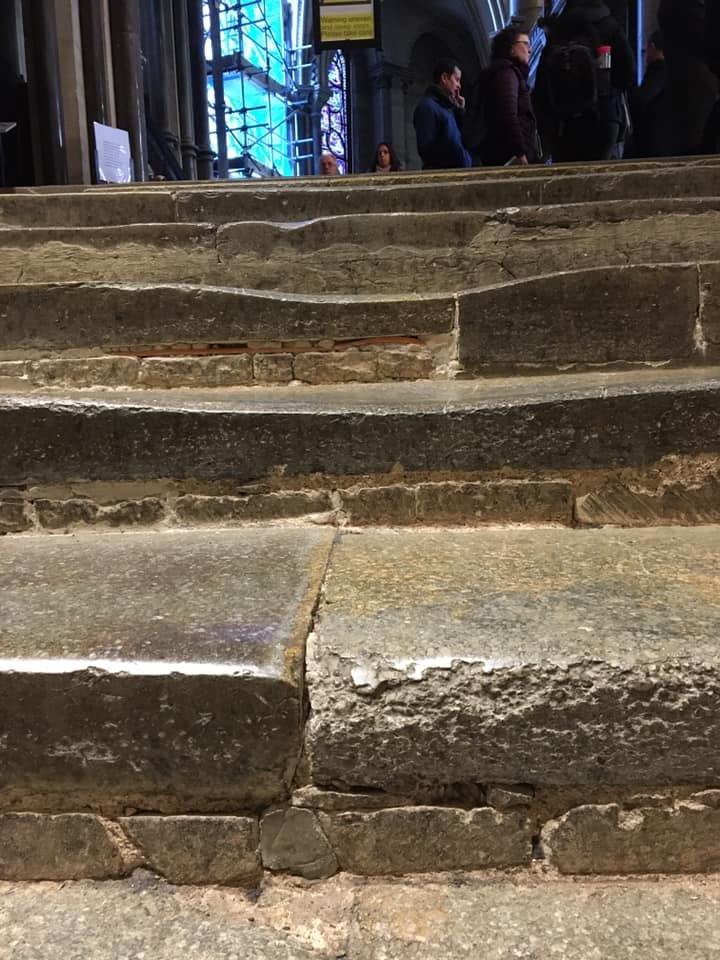
I was acutely aware of that today. All day I had been internally groaning because we were not going to hear the boys and the men singing at Evensong at Canterbury Cathedral. Instead it would just be the gentlemen. I had really wanted our pilgrims to hear the full sound with the boys, and knowing they would be absent felt like a huge disappointment. But as soon as the men opened their mouths, I was transported to another time – a time when Benedictine monks chanted prayers day after day, hour after hour. The simplicity and beauty of their sound made the enormity of fourteen hundred years of Evensongs unfurl before me, like the wafting of incense before my face, lingering in my hair. Suddenly a multitude of heavenly hosts surrounded me – pilgrims, monks, priests, common Christians, seekers, nonbelievers, the sick, the oppressed – all longing for something, all aching for God. And tonight I remembered, in addition to them, God is right here: always has been and always will be, no matter what plans I have made.

Tonight it is my hope that you can find it in yourself to trust a little less in your own hands and a lot more in the loving embrace of your Savior’s hands. I can’t wait to hear about your disappointment and your overwhelming joy!

86627611_2891906947532213_2676576335572238336_n

Photo credit:  Jennifer Andrews-Weckerly; reuse with permission only

Sermon – Isaiah 6.1-8, TS, YB, May 31, 2015

03 Wednesday Jun 2015

Posted by jandrewsweckerly in Uncategorized

≈ Leave a comment

Tags

experience, forgiveness, God, hem, Holy Spirit, Jesus, repentance, robe, Sermon, theology, Trinity, Trinity Sunday, volunteer, worship

“God sat Sunday in her Adirondack deck chair, reading the New York Times and sipping strawberry lemonade, her pink robe flowing down to the ground.  The garment hem was fluff and frill, and it spilled holiness down into the sanctuary, into the cup and the nostrils of the singing people.  One thread trickled loveliness into a funeral rite, as the mourners looked in the face of death, and heard the story of a life truer than goodness.  A torn piece of the robe’s edge flopped onto a war in southern Sudan and caused heartbeats to skip and soldiers looked into themselves deeply.  One threadbare strand of the divine belt almost knocked over a polar bear floating on a loose berg in the warming sea.  One silky string wove its way through Jesus’ cross, and tied itself to desert-parched immigrants with swollen tongues, and a woman with ovarian cancer and two young sons.  You won’t believe this, but a single hair-thin fiber floated onto the yacht of a rich man and he gasped when he saw everything as it really was.  The hem fell to and fro across the universe, filling space and time and gaps between the sub-atomic world, with the effervescent presence of the one who is the is.  And even in the slight space between lovers in bed, the holiness flows and wakes up the body to feel beyond the feeling and know beyond the knowing…”[i]

I stumbled on Michael Coffey’s poem as I struggled with the idea of how to preach about the Holy Trinity on this Trinity Sunday.  And then I realized something:  we understand theology much more through experience than through reading some heady fourth-century theologian.  The concept of the Trinity is not an easy one to understand.  In fact, the concept is so complicated that most of us try not to think about the Trinity at all.  We simply know the Father, the Son, and the Holy Spirit as truth, and do not worry too much about the details.  That approach is probably fine most of the time – until you have to explain the concept of the Trinity to a child or non-believer.  Trying to explain how God, Jesus, and the Holy Spirit are all the same and yet all distinctly separate is not as simple as it sounds.  Then try to explain how all three are co-eternal and I promise you, you will get looks of confusion.  The questions about how Jesus can be born in a particular time and place and yet be co-eternal with the Holy Spirit and God will make anyone stutter.

I have begun to wonder then if part of why we do not often spend time working through the theology of the Trinity is because we do not necessarily need to think about the Trinity – we simply need to have an experience of the Trinity.  That realization became clearest to me this week as I thought about our lesson from Isaiah.  Now you may be wondering how I found an experience of the Trinity in the Old Testament.  Certainly, we need the fullness of the New Testament to really understand the Trinity.  But we have to remember that the Trinity has always been – remember that word “co-eternal”?  Now I must admit, this notion makes me uncomfortable too – reading a New Testament theology into the Hebrew Scriptures is what a lot of purists call anachronistic – a chronological inconsistency where we juxtapose two different time periods incorrectly.  But given our theological understanding of the Trinity as being co-eternal, many theologians argue that seeing the Trinity in our Isaiah text today is not, in fact, anachronistic.[ii]  If you buy that logic, the song the seraphs sing, “Holy, holy, holy is the Lord of hosts…” reminds us of the old hymn, “Holy, Holy, Holy” which contains the line, “God in three persons, blessed Trinity.”  The seraphs’ song hints at the three persons of the Godhead.  And when God wonders what prophet God will send to the sinful people, God says, “Whom shall I send, and who will go for us?”  That “us,” by many scholars, is considered yet another precursor to the concept of the Trinity.[iii]

But all of that is academic to me.  We can certainly debate whether or not the Trinity is hinted at in the Isaiah reading today.  But what is more important to me is that we get a better understanding of the experience of the Trinity through the Isaiah story.  The story starts with Isaiah seeing the Lord sitting on a throne, with that hem that Michael Coffey describes so vividly in his poem.  The text says the hem of God’s robe fills the temple.  Imagine, as Coffey does, the hem of that robe filling this entire church.  Imagine fabric billowing over the pews, draping over the altar rail, spilling out the front door.  Imagine us stumbling over the enormity of that fabric, getting tangled up in the hem’s folds.  And all of that fabric swirling around us is only the hem of the robe – not the whole robe, but the hem of the robe.  Isaiah’s description is of a God that is larger than life, that is incomprehensible in size and vastness.  Just the tip of God’s garment is larger than the greatest Cathedral and certainly overwhelming in a space like our intimate church.

In fact, the experience of God is so overwhelming, that Isaiah is brought down to his knees in fear – not a simple fear of God, but fear because Isaiah realizes he is woefully sinful and unworthy of being in God’s presence.  He even shouts among the folds of fabric that entangle him, “Woe is me!  I am lost, for I am a man of unclean lips…”  That is the second experiential understanding of the Triune God.  First we are overwhelmed by the Trinity’s vast, mysterious incomprehensibility, and second, we are crippled by the shame of our sinfulness in response.  But then, another profound realization happens.  When Isaiah confesses his sinfulness, the seraph simply touches his mouth with a hot altar coal and Isaiah’s sin is blotted out.  That is the third thing we discover about the Trinity.  Father, Son, and Holy Spirit are quick to forgive a repentant heart.  No Hail Mary’s are necessary.  No Our Fathers.  Forgiveness is swift and full – much unlike human capacity for forgiveness.  Finally, we learn yet another interesting thing about the Trinity.  God-in-three-persons needs us.  The Lord says, “Whom shall I send, and who will go for us?”  There is not strategic plan; there is no preordained conception of who should go.  God does not say, “Isaiah, you shall go and be my prophet,” which is unusual because in most of the call stories we hear, God does call people by name.  But not with Isaiah.[iv]  Here, the Trinitarian Godhead is wondering who in the world will go and be the prophet.  That is what we finally see about the Trinity.  The Trinity openly invites – and according to Isaiah’s response, “Here am I: send me!” we learn that the Trinity inspires people to recklessly volunteer for things they probably shouldn’t.

Of course, when we really think about what we learn about the Trinity in Isaiah: that God is vastly other, inspires repentance, readily gives forgiveness, and causes wanton willingness to serve the Lord, then we begin to see that all of those insights are part and parcel of our own experience of the Trinity every week in worship.[v]  Every week, we start our worship in praise.  We praise God in word, song, and prayer.  We marvel at the vastness of God’s hem as we read and reflect on God’s Word.  We profess our Trinitarian faith in the Creed and then we confess.  Like Isaiah, all that praise, wonder, and realization of God’s enormity pulls us down to our knees as each one of us confesses our unworthiness aloud.  A chorus of voices comes together as we each confess our faults and failings over the past week.  And then, just like a snap, the priest delivers God’s forgiveness.  We are offered the Eucharistic meal, which, like the coal on Isaiah’s lips, wets our lips with forgiveness.[vi]  And when the priest tells us to go out into the world rejoicing in the power of the Spirit, we find ourselves overwhelmed with the words, “Here am I; send me!”  We find ourselves jettisoning ourselves into the world, longing to serve the God whose robe knocks us over and whose meal sets us free.

Michael Coffey’s poem brings us full circle to our Trinity Sunday ponderings.  About God’s robe, Coffey concludes, “…And even as we monotheize and trinitize, and speculate and doubt even our doubting, the threads of holiness trickle into our lives.  And the seraphim keep singing “holy, holy, holy”, and flapping their wings like baby birds, and God says: give it a rest a while.  And God takes another sip of her summertime drink, and smiles at the way you are reading this filament now, and hums: It’s a good day to be God.”[vii]  Amen.

[i] Michael Coffey, “God’s Bathrobe,” as posted on May 31, 2012 at http://mccoffey.blogspot.com/2012/05/gods-bathrobe.html as found on May 27, 2015.  Punctuation and formation changed for ease of preaching.  Original structure found on website.

[ii] Donald K. McKim, “Theological Perspective,” Feasting on the Word, Yr. B, vol. 3 (Louisville:  Westminster John Knox Press, 2009), 30.

[iii] McKim, 28.

[iv] Patricia Tull, “Commentary on Isaiah 6.1-8,” found at https://www.workingpreacher.org/preaching.aspx?commentary_id=2458, May 31, 2015, as found on May 27, 2015.

[v] Kristin Emery Saldine, “Pastoral Perspective,” Feasting on the Word, Yr. B, vol. 3 (Louisville:  Westminster John Knox Press, 2009), 28, 30.

[vi] Melinda Quivik, “Commentary on Isaiah 6.1-8,” found at https://www.workingpreacher.org/preaching.aspx?commentary_id=1284, June 3, 2012, as found on May 27, 2015.

[vii] Coffey.

Homily – John 6.57-63, Clement of Alexandria, December 5, 2013

13 Friday Dec 2013

Posted by jandrewsweckerly in Uncategorized

≈ Leave a comment

Tags

Clement of Alexandria, experience, faith, gifts, God, homily, Jesus, questions, sacred, secular

Today we honor Clement of Alexandria, priest and philosopher in the mid-to-late second century.  Clement was originally a Greek philosopher who sought truth in many schools until he met Pantaenus, head of a Christian school in Egypt.  Clement later became head of that school and was for many years an apologist for the Christian faith to both pagans and Christians.  His background and abilities helped him to commend Christianity to the intellectual circles of Alexandria.  He had a liberal approach to secular knowledge and his work prepared the way for Origen, one of the most eminent theologians of Greek Christianity.

We honor Clement today because he did what so many of us simultaneously hope to do and fear to do.  We long to share our faith experiences with both the Christians and non-Christians in our lives.  We have had some incredible encounters with God and we want to share that experience with others.  And yet we fear sharing because we worry that people may ask us questions we cannot answer.  We worry we do not have the intellectual acumen of Clement to tie together our experiences in a logical way.

Perhaps we feel a bit like the disciples in John’s gospel today.  As Jesus explains that he is the bread of life meant to be consumed, the disciples complain, “This teaching is difficult; who can accept it?”  Their complaint is not hard to understand – I am sure any of us hearing Jesus’ metaphor for the first time would be especially baffled.  All we need is one hearty experience trying to explain to a child that a wafer is Jesus’ body and we all get a little nervous about this crazy faith of ours.

In the midst of our hesitancy, we find encouragement through Clement.  Clement gives us permission to interweave our sacred and secular worlds.  Clement used his gift – the gift of a brilliant secular mind – to interpret his faith and make it accessible to the faithful and those without faith.  God gives each of us similar gifts too.  God empowers us with “spirit and life,” as Jesus Christ says.  God gives us a unique spiritual journey that can speak truth because ultimately we, too, are a mixture of sacred and secular: who better to interpret this crazy world and our crazy faith than us?  Clement invites us to share our own truths with others – knowing that our truth is a part of the bigger truth of Jesus Christ.  Though we may not have everything figured out, we have experienced enough of God in us, and we have been given gifts to enable us to share that truth with others.  Amen.

Recent Posts

  • On the Myth and Magic of Advent…
  • On Risking Failure and Facing Fear…
  • Sermon – Luke 23.33-43, P29, YC, November 23, 2025
  • On Inhabiting Gratitude…
  • Sermon – Luke 20.27-38, P27, YC, November 9, 2025

Archives

  • December 2025
  • November 2025
  • October 2025
  • September 2025
  • August 2025
  • July 2025
  • June 2025
  • March 2025
  • February 2025
  • December 2024
  • November 2024
  • October 2024
  • September 2024
  • August 2024
  • July 2024
  • June 2024
  • May 2024
  • March 2024
  • February 2024
  • January 2024
  • December 2023
  • November 2023
  • October 2023
  • September 2023
  • August 2023
  • July 2023
  • June 2023
  • May 2023
  • March 2023
  • February 2023
  • January 2023
  • December 2022
  • November 2022
  • October 2022
  • June 2022
  • May 2022
  • January 2022
  • December 2021
  • November 2021
  • October 2021
  • September 2021
  • August 2021
  • June 2021
  • May 2021
  • April 2021
  • March 2021
  • February 2021
  • January 2021
  • December 2020
  • November 2020
  • October 2020
  • September 2020
  • August 2020
  • July 2020
  • June 2020
  • May 2020
  • April 2020
  • March 2020
  • February 2020
  • January 2020
  • December 2019
  • November 2019
  • October 2019
  • September 2019
  • August 2019
  • July 2019
  • June 2019
  • May 2019
  • April 2019
  • March 2019
  • February 2019
  • January 2019
  • December 2018
  • November 2018
  • October 2018
  • September 2018
  • August 2018
  • July 2018
  • June 2018
  • May 2018
  • April 2018
  • March 2018
  • February 2018
  • January 2018
  • December 2017
  • November 2017
  • October 2017
  • September 2017
  • August 2017
  • July 2017
  • June 2017
  • May 2017
  • April 2017
  • March 2017
  • February 2017
  • January 2017
  • December 2016
  • November 2016
  • October 2016
  • September 2016
  • August 2016
  • July 2016
  • June 2016
  • May 2016
  • April 2016
  • March 2016
  • February 2016
  • January 2016
  • December 2015
  • November 2015
  • October 2015
  • September 2015
  • August 2015
  • July 2015
  • June 2015
  • May 2015
  • April 2015
  • March 2015
  • February 2015
  • January 2015
  • December 2014
  • November 2014
  • October 2014
  • September 2014
  • August 2014
  • July 2014
  • June 2014
  • April 2014
  • March 2014
  • February 2014
  • January 2014
  • December 2013
  • November 2013
  • October 2013
  • September 2013
  • August 2013
  • July 2013
  • June 2013
  • May 2013
  • April 2013
  • March 2013
  • February 2013
  • January 2013
  • December 2012
  • November 2012
  • October 2012
  • September 2012

Categories

  • reflection
  • Sermons
  • Uncategorized

Meta

  • Create account
  • Log in
  • Entries feed
  • Comments feed
  • WordPress.com

Blog at WordPress.com.

  • Subscribe Subscribed
    • Seeking and Serving
    • Join 394 other subscribers
    • Already have a WordPress.com account? Log in now.
    • Seeking and Serving
    • Subscribe Subscribed
    • Sign up
    • Log in
    • Report this content
    • View site in Reader
    • Manage subscriptions
    • Collapse this bar
 

Loading Comments...