
• About

Seeking and Serving

~ seek and serve Christ in all persons

Seeking and Serving

Tag Archives: God

Sermon – Mark 1.4-11, E1, YB, January 11, 2015

15 Thursday Jan 2015

Posted by jandrewsweckerly in Uncategorized

≈ Leave a comment

Tags

baptism, beloved, God, Jesus, sacred, Sermon, water

I have always had an affinity for water.  I am not sure why, but something about water connects to something deep in my soul.  Whether listening to water bubble over rocks in a river, hearing the roar of a waterfall, listening to a lake lap on the shore, or hearing the crashing of waves on the beach, something about the sound of water quiets my mind and connects with some deeper part of me.  Some of my most intimate conversations with God have taken place near water – times when I was facing a big transition, times when I was worried about a major life event, or times when I had run out of things to say and just needed a place to just listen.  Whether a quiet drip or trickle or a roaring rush, somehow the noise of water connects me to the mysterious and transcendent voice of God.

To be honest, I have always thought my connection to the water was a little strange.  But this week, as I studied our lessons, my connection suddenly made sense.  Water has always been a part of our faith narrative.  When we celebrate a baptism, we always retell the biblical story of water.  One denomination retells the biblical story this way, “Eternal Father, when nothing existed but chaos, you swept across the dark waters and brought forth light.  In the days of Noah you saved those on the ark through water.  After the flood, you set in the clouds a rainbow.  When you saw your people as slaves in Egypt you led them to freedom through the sea.  Their children you brought through the Jordan to the land which you promised.  In the fullness of time you sent Jesus, nurtured in the water of a womb.”[i]  Of course we know there are countless other water stories in scripture: Jonah who is thrown into the sea and swallowed by a great fish, Jesus who calms the seas and walks on water, women encountering God as they draw water in wells, and eunuchs running to rivers to be baptized.  Water is everywhere in our biblical narrative, and is where many people see, hear, taste, and feel God in their lives.

Today, we hear one of those ultimate stories of water – in fact, today is a feast day in the Episcopal Church:  Jesus’ baptism in the waters of the river Jordan.  When Jesus comes to be baptized, baptism in the river Jordan has already been transformative for many.  People from all over the Judean countryside have been coming to John to confess their sins, repent, and be baptized into forgiveness.  As if those experiences of conversion were not enough, something even more extraordinary happens in that water.  Jesus comes from Nazareth to be baptized by John, and when he comes up out of the water, the heavens are torn apart and the Spirit descends upon him like a dove.  Then a voice comes from heaven, saying, “You are my Son, the Beloved; with you I am well pleased.”  Just like all those other stories of water in the biblical story, something sacred and transformative happens in water – something so powerful that the heavens are torn apart, the Spirit descends, and the Lord proclaims favor, love, and affection.

Many of us do not remember our own baptism in water.  Though adults and young people are certainly welcome to be baptized later in life, most of us are baptized as infants.  Unless our parents or godparents told us the story of our baptism, we have no idea if we cried or cooed that day.  We have no idea what emotions or thoughts the priest or our sponsors had that day.  We have no idea whether we were inherently changed by the water that was poured over our heads.  For most of us, the holy experience of water at our own baptism is a lost memory.  But the Church does not let us forget the power of baptismal waters.  Every year we celebrate the feast of Jesus’ baptism.  Every year, we reaffirm our baptismal covenant – often multiple times per year.  And depending on the membership of the church, every year we baptize new members into the life of the church.  So even if we do not remember our own baptism, the repetition of the story of baptism, and the experience of reaffirming our vows, creates new memories for us.  That formation is so powerful that many of us will dip our fingers in Holy Water, looking for a blessing and a reminder of another water that was once poured over our heads.

But today is not a day just to celebrate sacred experiences with water.  Today is not just a day when we think back to our own encounters at the font and how holy they were.  Today is not just a day we think back to those biblical stories of water in our faith and marvel at the miracles that have happened through water.  Today is not just a day that we remember those moments by a river, lake, or beach where God seemed to be whispering comfort, truth, or blessing to us.  The danger with the text we hear from Mark today is that we could be tempted to do just that.  Our lesson ends with those words from the voice of heaven that says, “You are my Son, the Beloved; with you I am well pleased.”  We could sit here today and savor those words for Jesus.  In fact, I could tell you today that those words are words for you – that you are God’s beloved and with you God is well pleased.  I could do those things because they are true.  You are God’s beloved and God is well pleased with you.  The baptismal waters should always remind you of that – and others waters, like rivers, waterfalls, and oceans, may do the same.

But today we do not simply celebrate the gift of blessing, beloved-ness, and bounty.  Today is the day when we celebrate the “so what?” of Jesus’ baptism.  As one scholar explains, “Jesus did not receive the Spirit in order to enjoy privately its spiritual benefits, but rather in order to pass it on.”[ii]  In Mark’s gospel, in the immediate next verse, Jesus is driven out into the wilderness to be tempted.  His baptism opens a road that will lead to the cross.  For Jesus, his entire ministry is informed by this moment – this tremendous in-breaking of the Spirit and a declaration of Jesus as being the beloved of God.  But Jesus does not tarry in this moment.  Jesus keeps on moving, holding fast to the moment, but using the moment to change his future.

That is our invitation today too:  to think about the “so what?” of our own baptisms.  When I think about all of those sacred moments I have had near water, a distinct part of that memory is what walking away from those moments felt like.  Sometimes I walked away from that bubbling brook with a sense of peace that God would be with me in the trials that were ahead.  Sometimes I turned from that lapping lake with a sense of empowerment and energy about what new thing God was calling me to do.  And sometimes I walked away from that roaring ocean having no idea what was to come, but knowing that God would help me face whatever came.

Our invitation today is to consider the “so what?” of our own sacred watery moments.  You can come to Jesus’ story today like you would come to a body of water for renewal and refreshment.  You can soak in the blessing and affirmation that come to Jesus and to you.  But you will also need to walk out of those doors today.  In fact, our liturgy does not let you leave this place without a dismissal that sends you out in the world to do the work that God has given you to do.  The question this week is what that work is.  What is God renewing you for?  What is God empowering you to do?  The answers will be different for each of us.  But the answer is there, if you are willing to listen to the sacred sound of water.  Amen.

[i] Barbara Sholis, “A watery solution,” Christian Century, vol. 119, no. 26, December 18-31, 2002, 19.

[ii] Lee Barrett, “Theological Perspective,” Feasting on the Word, Yr. B, Vol. 1 (Louisville: Westminster John Knox Press, 2008), 240.

Sermon – Matthew 2.1-12, Epiphany (transferred), YB, January 4, 2015

15 Thursday Jan 2015

Posted by jandrewsweckerly in Uncategorized

≈ Leave a comment

Tags

change, Christ, Epiphany, eventful, God, Holy Spirit, magi, observant, seeker, Sermon, transform

At St. Margaret’s, one of the things we talk about a lot is being a seeker.  In fact, our motto is that we are a community of faith seeking, serving, and sharing Christ in Plainview.  Though we talk about being seekers or being a people who are seeking Christ, sometimes I am not sure we are all on board about what that actually means.  That is why I love this story of the magi today in our gospel lesson.  Though we may not feel like we have much in common with wise men from the East who have expensive gifts, the gift of the wise men for us today is that they show us what the experience of being a seeker is really like.

First, the magi show us that being a seeker means being observant.[i]  The text from Matthew today says that the wise men observe the king’s star at its rising.  Now, in order to observe a star, one must be paying attention.  One must be on the lookout for the movement of God in order to have an encounter with God.

We have a group within our parish who has taken to looking at the stars too.  Our Praying with the Stars offering is a way for us to connect with God through the observation of the stars.  That offering is one more way that St. Margaret’s helps us seek Christ in creation.  But the truth is that Praying with the Stars is about more than astrology.  Praying with the Stars is about creating space to observe the movement of the Holy Spirit.  If stars are not your thing, that is fine.  Perhaps movies or books or music is more your thing.  The point is that one can never really be a seeker unless one is attuned to the movement of God – or at least creates opportunities to open oneself to the movement of God.  The magi offer us that gentle push to create space in our own spiritual lives for observing, watching, and listening for the movement of the Spirit.

Next, the magi show us that being a seeker means that our journey will be eventful.  In this story alone, the wise men have two very different encounters.  First, they encounter those who are resistant to their journey.  King Herod on the surface seems quite inquisitive and eager to hear about the magi’s journey.  But we learn from the text that Herod acts more out of fear for his own power and control.  What was good news to the wise men was not seen as good news by all.  Second, the wise men experience being overwhelmed by joy.  When they encounter the Christ Child, the wise me are so overwhelmed that they are brought to their knees, pay homage, and pour out abundant gifts.  Experiencing Christ is so overwhelming that these men find themselves doing things they may not have expected.

Many of us know exactly what this experience is like.  We get roped into volunteering for a workday at Habitat for Humanity, and in the middle of the workday, as we are hanging drywall with a prospective homeowner, the homeowner says something that stops us in our tracks.  We are so overwhelmed by the encounter that all we can do is marvel at God working in our midst.  Or we are sitting in worship for the millionth time, hearing the same Eucharistic prayer again, when a word or a phrase catches us up short.  Suddenly, what we are doing at the Eucharistic table takes on a fresh, jarring perspective.  Or maybe we are having a simple conversation with a fellow parishioner about the way that their sacrificial giving has changed their walk with Christ.  The next time we write our pledge check, something is changed in us forever – even the sensation of the pen on the paper of our check feels different.

Finally, the magi show us that being a seeker means that our lives will be changed.  When the wise men are done with their visit with the holy family, they do not simply return home the same way that they came.  They do not even return to Herod as Herod had asked them to return.  No, in the midst of their visit, the wise men have a dream that warns them to go another way.  And so, they return home, but by a way that is not familiar.  The magi teach us that when you meet Christ, “Nothing is ever the same.  You don’t take the old road any longer.  You unfold a new map, and discover an alternate path.”[ii]

For those of us who have assumed the life of the seeker, we know this truth all too well.  If we commit our lives to truly seeking God, not idly going through the motions, we experience things that are just too transformative to leave us the same.  We can no longer be the old selves that we once were.  My friends who are vegetarians all have a story.  Whether they read The Jungle in high school, or they saw Fast Food Nation after college, some experience led them to disavow the eating of meat.  Whatever they learned or experienced, they could not unlearn.  And so they were transformed and their eating life was transformed.  The same is true for us.  When we seek and experience Christ – whether in our experiences with the poor, in our experiences with fellow parishioners, or even as we taste Christ in the holy meal – we too are transformed into something that cannot be undone.

That is the gift of the magi for us today.  They show us how to be seekers:  seekers who are observant, seekers who expect eventfulness, and seekers who realize they will be forever changed.  As the drama of their journey unfolds, they invite us to allow our own spiritual journey of seeking to unfold.  The promise is that the Holy Spirit will transform us, over and over again.  We only need to take the first step.  Amen.

[i] Steve Pankey, “Are You Paying Attention?” December 29, 2014 at https://draughtingtheology.wordpress.com/2014/12/29/are-you-paying-attention/.

[ii] James C. Howell, “Theological Perspective,” Feasting on the Word, Yr. B, Vol. 1 (Louisville: Westminster John Knox Press, 2008), 216.

Sermon – Luke 1.26-38, A4, YB, December 21, 2014

15 Thursday Jan 2015

Posted by jandrewsweckerly in Uncategorized

≈ Leave a comment

Tags

action, Advent, Angel Gabriel, Black Lives Matter, burden, favored, God, Jesus, light, Magnificat, Mary, submission

This week, the song The Angel Gabriel has been running through my mind over and over.  Our choir sang the song at Advent Lessons and Carols a few weeks ago.  The lyrics go, “The angel Gabriel from heaven came, With wings as drifted snow, with eyes as flame:  ‘All hail to thee, O lowly maiden Mary, Most highly favored lady.’  Gloria!”  When sung the song has a soft, gentle feel to it.  You can almost sense the intimacy of the encounter between the Angel Gabriel and Mary.  The lyrics go on to say, “Then gentle Mary meekly bowed her head; ‘To me be as it pleaseth God,’ she said.  ‘My soul shall laud and magnify God’s holy name.’  Most highly favored lady.  Gloria!”  The description of Mary as a “most highly favored lady,” and her humble, bowed acceptance of God’s call all depict a meek and mild version of Mary, someone who obediently follows God’s will at the sacrifice of her own will.

Of course, that path is one that her son will take later in his life.  We remember the scene of Jesus praying in the Garden of Gethsemane.  As Jesus wrestles with God in prayer, he prays, “My Father, if it is possible, let this cup pass from me; yet not what I want but what you want.”  Like his mother who faced the impossibility of a virgin birth at a young age, Jesus faced a violent death.  And both responded with humble submission.  They gave over their lives to God, not knowing what was ahead, but trusting fully in the Lord.

My problem with our scripture this week is that the scripture just does not jive with what is happening in our world.  These last couple of weeks I have been overwhelmed with the sheer volume of stories about violence and degradation:  from the excessive use of force toward persons of color by the police force, to stories of sexual assault on college campuses, to the execution of children by terrorists in Pakistan.  As wave after wave of bad news comes, I keep hearing echoes of Eric Garner’s last words, “I can’t breathe.”  That is how these stories have made me feel – like I cannot breathe.  I ponder how our country has gotten to the point where black people feel like their lives do not matter.  I wrestle with how some of our young men have come to believe that they can exercise power over and violate women.  I am perplexed at how a group of faithful people can use that faith to justify killing others.  With these visceral stories bombarding me from every direction, the last kind of lesson I want to hear about is a lesson about how one should mildly and meekly submit to God.  I do not want to submit to God – I want to act!

What I really wanted to hear from scripture today was not the Angel Gabriel calling Mary a lowly maiden, but instead the Magnificat, Mary’s song that we sang today, which is found just a few verses after the gospel lesson today in Luke.  Right after Gabriel leaves, Mary reunites with Elizabeth.  When they connect over their miracle pregnancies, Mary sings a song of praise called the Magnificat.  In that song she proclaims, “…the Mighty One has done great things for me, and holy is his name.  His mercy is for those who fear him from generation to generation.  He has shown strength with his arm; he has scattered the proud in the thoughts of their hearts.  He has brought down the powerful from their thrones, and lifted up the lowly; he has filled the hungry with good things, and sent the rich away empty.”[i]  This is the kind of song I wanted to hear this week when current events are so dire.  I want the promise of a God who favors the oppressed, the hungry, and the violated.  I want a God who lifts up the poor and scatters the proud.  The Magnificat has all sorts of musical settings because Mary’s song is sung at the service of Evensong throughout the year.  Some of the settings are meek and mild, like our gospel reading today.  But some are actually quite powerful, connoting the strong victory you hear in Mary’s song.  I realized that is what I want to hear from scripture today – not a story of mild submission, but of victorious uprising and justice.

But the more I struggled this week with Luke’s words, the more I realized a deeper truth.  I have been looking to God for answers – some sort of response about how God could let these things happen, and why I feel like our world is falling apart.  But what I realized the more I heard these two competing songs in my mind is that victory for God does not always feel like victory for God’s agent.  So, yes, Jesus is ultimately victorious when he rises from the dead.  But at that moment of Gethsemane, he humbly submits to God, not knowing what evil awaits.  Likewise with Mary:  she will become the venerated mother, the one whom people will pray through for centuries.  God is victorious through her.  And yet, she is still a mother whose son is murdered by the officials.  In fact, being highly favored, as Gabriel claims Mary is, may not feel like being highly favored.  Months later, when Jesus is presented as a baby at the Temple, Simeon confirms this hard truth.  Simeon says to Mary, “This child is destined for the falling and the rising of many in Israel, and to be a sign that will be opposed so that the inner thoughts of many will be revealed – and a sword will pierce your own soul too.”[ii]

Of course, that is the way that being called to serve God usually is.  Though Moses was called by God in a dazzling display of a burning bush, he was also almost murdered by pharaoh and the very people he had saved.  Though David was the blessed and anointed king of Israel, David also had to flee for his life when Saul became jealous of God’s favor for David.  Though Thomas Cranmer was the Archbishop who basically founded and shaped the liturgy of the Church of England, and by association the Episcopal Church, he was also martyred for his commitment to the reformation of the Church.  Though eventually Nelson Mandela became the leader of South Africa and the facilitator for ending apartheid, he was first imprisoned for twenty-seven years.  That is the sad truth of Mary this week.  Favor in God’s eyes does not mean a smooth, satisfied, simple life.  When we accept God’s call, when we humbly submit to God’s invitation to serve in our own lives, we can only expect to journey through trials on the way to glory.  That is the sobering truth Mary offers us today.

But that is not the end of the story.  I think that the reason the songs about Mary have been battling in my head this week is because there will never be one victor.  Being highly favored in God’s sight is neither an invitation to a life of mild obedience and suffering, nor a life of victorious dominance.  Being favored in God’s sight is a bit of both.  So though Mandela suffered, he also came to know and love his prison guards.  He found hope and grace in the midst of darkness and oppression.  I think the same is happening in our current events today.  Despite the destruction caused by riots in Ferguson and the arrests from protests in Staten Island, people across racial lines are encountering one another.  A white police chief in Richmond, CA was photographed standing with other protestors holding a sign that read, “#Black Lives Matter.”  And when two officers were murdered in retaliation for Eric Garner yesterday, the black community immediately spoke out against such violent retaliation.  Despite the flurry of stories about sexual assault on college campuses, college campuses are now taking seriously their handling of the violence.  Despite the horror of students being murdered in Pakistan, advocates for change are beginning to see how desperate the need for change and collaboration is.  In the darkness of our world, God is using God’s favored ones to be light.

That is our invitation today.  Through Mary, we are reminded that answering God’s call on our lives will not be easy or even pleasant at times.  There will be times when serving the Lord will feel like more of a burden than a joy.  But when we submit to our God, God can use us in powerful ways.  God can make us agents of light, in a world that is striving to find a way out of the darkness.  Mary responds to that invitation with the words, “Here am I, the servant of the Lord; let it be with me according to your word.”  You can say those words today too, accepting God’s desire to use you as an agent of light.[iii]  The promise of being highly favored holds many blessings waiting to unfold.  Amen.

[i] Luke 1.49-53

[ii] Luke 2.34-35

[iii] David Lose, “Favored Ones,” December 11, 2011 found at https://www.workingpreacher.org/craft.aspx?post=1611 on December 16, 2014.

Sermon – Luke 2.1-20, YB, CE, December 24, 2014

14 Wednesday Jan 2015

Posted by jandrewsweckerly in Uncategorized

≈ Leave a comment

Tags

change, Christmas Eve, church, comfort, familiarity, God, Grinch, holy, Jesus, peace, Sermon, strength

Most of us have a favorite Christmas movie.  Whether we like “It’s a Wonderful Life,” “A Charlie Brown Christmas,” or “A Christmas Story,” many of us find that until we have watched that special movie, we do not feel like Christmas has really arrived.  My personal favorite is “How the Grinch Stole Christmas” – the animated one, not the newer one with Jim Carrey.  I love the cute little dog that the Grinch dresses up like a reindeer, I love the little girl who sweetly encounters the Grinch dressed as Santa, and I love the songs throughout the movie.  But my favorite part is when the Grinch hears the Whos singing on Christmas morning despite their supposedly ruined Christmases and how the Grinch’s heart is warmed and grows in size.  Part of what I love about the movie is the movie’s wonderful lesson about the true meaning of Christmas – that material goods and abundance do not make Christmas:  only love and community make Christmas.  But I think the real reason I love this movie is its familiarity.  I like that I can watch the movie every Christmas and the movie never changes.  I like that no matter what house I lived in growing up, or where I found myself as an adult, or even how happy or sad I was on a given Christmas, the familiarity of the movie made me feel like I had something to ground me.  When all else in my world was changing, the movie never changes.

I think that is why we find ourselves at Church on a Christmas Eve too.  Every year we find ourselves sitting in a pew hearing the same story of Mary, Joseph, shepherds, angels, and the baby Jesus.  The story is so familiar that we could probably recite the story if pressed.  Whether we are a child or an adult, at home or far away, with loved ones or alone, the story never changes.  That changelessness, that familiarity is something we eagerly anticipate every Christmas and in large part is why we come to Church this night.

Familiarity is something we all long for at Christmas.  When we have lived long enough, we come to know that despite the fact that we celebrate Christmas every year and we try to keep familiar traditions, our celebration is never the same.  Invariably someone has passed away and their absence changes our experience; a family member is not present because of a falling out in the past year; the grandchildren become too old to play silly games or make crafts and the mood is different; or any other number of things have changed – divorce, births, illness, job loss, or moves.  Even if you still gather with your family or a set of friends, change is inevitable at Christmas.  And because we all know how unsettling change can be, we long for something that is unchanging that we can cling to and with which we can ground ourselves.

This Advent we have talked a lot about how much turbulence and change has been happening in our world.  We have watched as the world has erupted in violence.  The atrocities, suffering, and fighting have been so vivid that many of us have stepped away from watching the news.  We have seen unrest in our own country, as issues of race, class, and gender have collided.  And in case any of us were tempted to believe that those issues of race, class, and gender are someone else’s issues, we have only to look at as far as Staten Island to know that we are not yet in a place of peace and justice.  The noise of unrest is so loud that there are times when instead of listening to the news we turn to music, sports, or any other escape we can think of to run from the reality of our world.

The funny thing is that though we turn to our gospel lesson for comfort and familiarity, the same noise that we find in our lives and in our world is present in our reading tonight too.  The very reason that Mary, Joseph, and Jesus end up in a stable is that the Roman Empire has been greedily looking for more ways to bring in money into the empire.  And so peoples are being displaced, making their way back to their hometowns so that the empire can determine whether they have collected enough money from the people.  The Pax Romana is bearing down upon the people, and this nobody couple from Bethlehem is just one more victim of the injustice of the system.[i]

Perhaps that background noise is part of why we love this story so much.  Despite the chaos of that night and of that time, good news comes – to shepherds, to angels, to Mary and Joseph.  We savor the familiar words of goodness that override the story:  “do not be afraid”; “good news of great joy”; “peace among those whom he favors.”  To displaced Mary and Joseph, to disenfranchised shepherds, and to distant little Bethlehem peace, joy, comfort, and hope explode on this very night.  We have learned from hearing Scripture Sunday after Sunday that Scripture can often be hard, challenging, and downright condemning.  We spend much time throughout the Church year struggling with where God is challenging us to live differently and beckoning us to live more Christ-like lives.  But not on this night.  On this night, we get assurance, comfort, and joy.  We get an innocent baby – in fact a baby that will change the world for good.  Like young parents ourselves, we can worry about money, health, and safety later – because on this night of Jesus’ birth, we just want to cling to the Christ Child and all that the child represents.

Now there are times in our lives when clinging to the familiar just for the sake of comfort is a bad thing.  Maybe you yourself have been criticized for living in the past, romanticizing what once was, especially at this time of year.  But this is one of those rare instances when the Church says that we have permission to live in the past and cling to the familiar.  That is because this familiar – this story of Jesus’ birth – is worthy of that kind of devotion.  We are not staking our claim on something superficially good when we come to Church this night – we are not clinging to a romanticized past that can never fulfill us.  We are clinging to an event that happened a long time ago, but whose significance changed things forever.  In this incarnate experience of God, the game changed for all time.  God became flesh and dwelled among us, and we are changed for the better.

So tonight, I invite you accept the gift of familiarity and comfort.  Let this night warm your heart and soul and cling to the familiar story and all that the story means for us.  Hold fast to that comfort, and return to these words whenever you need them.  We have 364 other days to worry about what is going on in the world.  In fact what happens here in Scripture tonight deeply impacts how we will respond to that world the rest of the year.  But that is for another day.  Tonight, take the gift of comfort, joy, and hope and let that gift fill you up and strengthen you for the work God has given you.  Use that gift as fuel, and then let God’s holy meal fill your belly so that you are strengthened for the work ahead.  May God’s peace and joy fill you up and overflow out of you to others.  And then be agents of peace through the Prince of Peace who comforts you tonight.  Amen.

[i] David Lose, “Something More,” December 18, 2011 as found at http://www.workingpreacher.org/craft.aspx?post=1612 on December 20, 2014.

Homily – Isaiah 25.6-9, Cemetery Memorial Service, December 20, 2014

14 Wednesday Jan 2015

Posted by jandrewsweckerly in Uncategorized

≈ Leave a comment

Tags

Christmas, church, God, grief, homily, imperfect, joy, sad

Our Cemetery Memorial Service has become one of my favorite services of the year.  That may sound a little strange to you, but what I like about this service is the service’s honesty.  This time of year, there is a lot of dishonesty floating around:  the notion that buying things can make you happy, the assumption that everyone has abundant food this time of year, and even the idea that there is such a thing as the perfect family, the perfect Christmas, or the perfect life.  We see glossy ads, hear songs about loving, joyful Christmases, and watch movies that package Christmas with a pretty bow.  Though most of us know in the depths of our hearts that there is no such thing as a perfect Christmas experience, no one wants to talk about that reality.  We prefer that everyone stay in their lane, and put on a happy face.  Perhaps we have even convinced ourselves that we can “fake it ‘til we make it.”  In other words, if we say we are happy and that everything is perfect at Christmas, perhaps we and Christmas will become so.

But instead of buying into the Christmas hype, the Church tells another story today.  Simply by gathering us together as mourners, the Church acknowledges the pain and sadness that is often right below the surface at this time of year.  While others are decking the halls, rocking around the Christmas Tree, and having a holly, jolly Christmas, the Church invites us in, and encourages us to acknowledge the other part of Christmas – the part that is hard, sad, or empty.  We make space for grief, for honoring a loved one, and for acknowledging a sense of absence.  I have especially been grateful for that gift this year.  About a month ago, our family lost a grandfather.  He had lived a full, long life, and we know that he is at peace with the Lord.  But his absence is more obvious in the small parts of life.  Upon flying out for the funeral, my husband realized this would be the first time his grandfather would not meet him at the airport.  As we have prepared for holiday treats, we realized that our annual box of chocolates would not be arriving from him this year.  As we send out Christmas cards, I realized I would need one less card this year.  And those are just the things related to our family.  St. Margaret’s also lost a long-time parishioner this month – one who had been a major presence in our ministry here, whose bed I sat next to as we said prayers in his last days.  In addition to the grief of his family, our entire community is mourning the hole that he left.  Add into that grief the grief felt all over the world from violence, war, and hunger, and we come here today with much to offer up to God.

Of course, that is what I bring into this place today.  And each of you has your own story:  of wives, fathers, and daughters lost; of patriarchs in your family and of children whose lives were ended too soon; of lives well-lived and of lives barely lived at all.  To each of us, the Church says today that our mourning and our sadness are okay.  The Church creates this window of time where we can stop, be still, and know that God is with us.  The Church acknowledges the imperfect nature of this holiday, and celebrates anyway.

That is why I love the words we heard from the prophet Isaiah today.  The text says, “On this mountain the LORD of hosts will make for all peoples a feast of rich food, a feast of well-aged wines, of rich food filled with marrow, of well-aged wines strained clear.  And he will destroy on this mountain the shroud that is cast over all peoples, the sheet that is spread over all nations; he will swallow up death forever.  Then the Lord GOD will wipe away the tears from all faces, and the disgrace of his people he will take away from all the earth, for the LORD has spoken.”  What is so inviting about the words from Isaiah today is that they put our experiences in perspective.  Yes, our Christmas meals may not be utter perfection.  But God is preparing a feast for us that is more perfect than anything we could ever prepare ourselves.  Any darkness we feel now will be swallowed up by God.  Any tears we shed will be wiped away by our Lord.  Any sadness we feel at the dinner table will be eclipsed by the pure and holy joy we will find at God’s feast of rich food and well-aged wines.  Our loved ones are already enjoying that feast ahead of us.  Our joy is that we too are promised the opportunity to join them at the heavenly banquet when our time comes.

So this Christmas, give yourself permission to experience Christmas imperfectly.  Give yourself permission to be both joyful and sad.  Give yourself permission to lean into God when you need the strength to carry on.  And know, that maybe, just maybe, if you allow yourself to focus on the much grander feast that is to come and that already is for our loved ones, maybe you will find smiling a little easier.  Maybe you will find moments of joy that shine light into the darkness.  Maybe you will even find the ability to let yourself laugh and sing and to celebrate this imperfect holiday.  That is my wish for each of you.  That the blessing of this night will create a small, steady flame that warms and encourages you in the days and weeks to come.  Amen.

Sermon – Isaiah 40.1-11, A2, YB, December 7, 2014

10 Wednesday Dec 2014

Posted by jandrewsweckerly in Uncategorized

≈ Leave a comment

Tags

Advent, care, Christmas, church, community, God, Isaiah, preparation, prepare, promise, Sermon, the Lord, work

This sermon was delivered on the occasion of our Annual Meeting. 

This time of year, I do a lot of preparing.  Though the setup takes a lot of work, I particularly love preparing our house for Christmas.  Unpacking and hanging all the ornaments is a tradition I shared with my family, and that I now can share with my girls.  I love telling my oldest daughter the stories behind certain ornaments and helping her decide where they should go.  I also put out our international crèche collection.  They remind me of travels I have made or friends from far away places.  Each inspires something different in me, reflecting the culture and artistry of different countries.  And of course, my daughter loves helping me hide away the baby Jesuses until Christmas day.  We even take down some artwork on our wall to make room for the cards which friends from far and wide send to us.  There is something homey and comforting about the whole process of preparing for Christmas, and I love the way that the preparation makes me feel grounded and joyful.

In our Old Testament lesson today, the text says, “prepare the way of the LORD.”  In this season of Advent, we are to prepare for the arrival of the Christ Child.  Now certainly, unpacking ornaments, advent wreaths, and crèches are one way to prepare.  But God is talking about a different kind of preparation today.  God is not talking about an outward change – like decorating our homes.  God is talking about an inward preparation – an inward change in anticipation of the LORD.  I am reminded of how one of our parishioners just recently prepared himself for the LORD.  Several weeks ago, one of our young parishioners decided to receive his first communion.  He prepared by reading about the Eucharist at home with his family, asking questions, and talking with them about their experiences.  He worked on memorizing the Lord’s Prayer, so that he might fully participate in the prayer life of our community.  And then he sat with me as we walked through the Eucharistic liturgy, talking about what each part means, why that part is significant, and what all those crazy things on the altar are called.  Finally, he chose someone to present him before the entire community, where he and we all declared that he was prepared to be in full communion with this community.  He waited and worked to prepare himself for the consumption of our LORD.  And now, each week that I have placed the body of Christ in his hand since then, I have felt a sweet, deeply abiding satisfaction when he reaches his hands toward me to receive Christ’s body.

The kind of preparation that our young parishioner did is a small taste of the kind of preparation God calls for in our Old Testament today.  Isaiah says that in order to prepare, we need to make straight in the desert a highway for our God, lift up every valley, make low every mountain and hill, level the uneven ground, and make plain the rough places.  This passage is so familiar to us, that many of us miss the magnitude of what God is saying.  When was the last time you tried to fill in a valley or level a mountain?  Of course, God is not telling us to literally take the winding roads of deserts and make them straight.  But in the metaphors, God is telling us that preparing for God is not easy work.  In fact, preparing for the LORD is a monumental task.  Preparing for the LORD is not like preparing our homes for Christmas, where we can make a basic checklist and slowly check the items off the list.  When given the hefty work of preparing ourselves inwardly for God, the task of leveling our valleys and mountains and smoothing out our rough places is much more difficult.

In some ways, I have watched St. Margaret’s do a lot of this interior work.  Over the course of the last year, our Vestry and Buildings and Grounds Committee have made level the mess that had become our Undercroft.  Though taking on an expensive project, they together worked to clean out harmful mold and mildew, solved a drainage problem to prevent that kind of damage again, and reimagined how that space could be utilized by us and our community.  Meanwhile, our educational offerings have been totally made low in this last year.  We revamped our Sunday School program after years of struggling to find the best way to raise our children in the faith.  We reworked our worship schedule so that adults could claim an hour in their busy lives to ponder their faith and make straight paths in the desert.  We have filled in the valleys by marching in parades, sponsoring baseball teams, eating pancakes at local diners, and inviting total strangers into our midst so that they might help us fill in those valleys.  Of course, anyone who knows St. Margaret’s also knows that you are only a stranger here for about one Sunday before our wonderfully welcoming community has made sure they know your whole life story before your coffee cup is empty.

All of those have been wonderfully positive things in our lives, but not easy work.  I cannot tell you the number of people who worried and fretted over our Undercroft expenses, complained about how long the work was taking, and questioned the wisdom of the work.  I cannot tell you the number of times I myself considered whether we should halt educational offerings altogether due to low turnout.  I cannot tell you how many times I needed each one of us to invite someone to church and instead heard someone say, “Oh, well isn’t that what our new website is for?”  We have been making progress toward straightening paths, filling in valleys, and leveling mountains.  But we have also gotten very dirty, been impatient and frustrated with each other, and sometimes have dropped our shovels altogether.  That is what happens when you do this kind of preparation for the LORD.  The work is not easy.  The work is monumental.  The work is, well, work.  And work is what God is inviting us into today.

The good news is that today’s text is one of those “both-and” texts.[i]  Yes, God is inviting us into some hard work today.  As we reflect on another year of service, at the mounds of dirt we have already moved, God is charging us to roll up our sleeves and keep digging.  And yes, God promises that the work of preparing will not be easy work.  But God also makes a promise while we are in the mire of making roads straight.  Our text today from Isaiah says, “He will feed his flock like a shepherd; he will gather the lambs in his arms, and carry them in his bosom, and gently lead the mother sheep.”  This last sentence has been lingering with me this week.  Maybe because I am a nursing mom, or maybe because this is the only time that scripture talks about the work of a mother sheep, but I find myself riveted by these words.

Just this week, I had one of “those” nights at our house.  I do not know whether she was teething or just had a rough day, but I lost count after the fifth time I woke up to my infant’s crying one night.  The next morning, I woke up bleary-eyed, almost falling asleep while eating my morning cereal, spilling my coffee on my computer, and generally having a rough time trying to focus.  That is the life of a mother with young children.  And I assume, the life of a mother sheep is not much easier – constantly using her body to protect and feed her lambs.  To that wearied mother sheep, God says that God will gently lead her.  In fact, not only that, God will gather up her lambs, embracing them in God’s bosom, and then God will gently lead the mother sheep.  I am reminded of the many times someone has scooped up my daughters when they were losing their cool.  I am reminded of the individuals who have forced me to go take a date night while they watched my kids.  I am reminded of the encouraging words and sympathetic nods I have received over these last five years.

That is the kind of care God promises us in the midst of our work.  God says, “Go out there and get dirty filling valleys, leveling mountains, and straitening roads.  And when you are weary from the work, I will scoop up your little ones, and gently lead you by my side.”  As I look forward to the coming year, I hear both a charge and a comfort for us today.  We all have more to learn, more people to serve, more spreading of the gospel to do.  But we also have a shepherd who tenderly encourages and comforts us – and then kicks us right back into the ring.  Thanks be to God!  Amen.

[i] George W. Stroup, “Theological Perspective,” Feasting on the Word, Yr. B, Vol. 1 (Louisville: Westminster John Knox Press, 2008), 28.

God and cell phones…

03 Wednesday Dec 2014

Posted by jandrewsweckerly in Uncategorized

≈ Leave a comment

Tags

Advent, connection, disconnected, God, prayer, relationship, technology

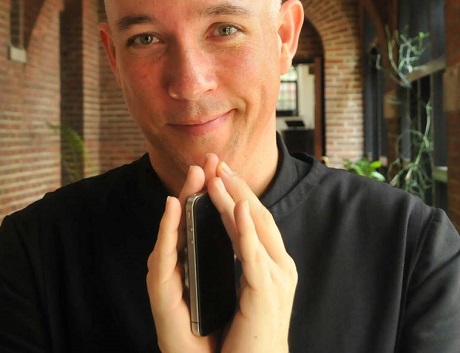
To see me now, you might not guess the initial reluctance I experienced with using a cell phone.  My progress was slow from owning one at all, to learning to text, to using a smart phone, to now using my agile phone.  Part of my reluctance was what such usage would mean – being able to be reached at all times; work emails invading “down time,” making me feel like I am never truly off; decreased patience with others who are not as technologically savvy; and constant usage for everyday needs.  I still try to resist looking at my phone constantly – I put it down during dinner time, I try not to respond to emails on my day off, I sometimes wait to look up something until I am at my computer.  But I still have those moments when my daughter impatiently waits while I finish one quick text or email to someone.  Though I ask her to hold on while I finish, I worry that I am becoming what I feared.

But there are also days when I am really grateful for my phone.  I currently have a parishioner who in the last stages of life.  The family and I know that the parishioner could go at any time, and so we are keep watch, spending time together, and holding each other in prayer.  I am keeping my phone especially close, checking for texted updates or for the dreaded call.  I even keep my phone on my nightstand in case I need to run to the hospital overnight.  That may sound unpleasant to some, but what I have come to see these last few weeks is that my phone is becoming not just a tool for pastoral care (a way for parishioners to reach me for emergencies), but it is also becoming a tool for my prayer life.  When I check my phone and there are no messages about this parishioner, I use the moment as a reminder to pray – pray for the parishioner, the parishioner’s family, and talk with God about the hard stuff of life.  Who would have thought that this little phone – a thing which I had once associated with menace, annoyance, and disconnectedness – could also be a tool for deep connection, prayer, and blessing?

Courtesy of http://episcopaldigitalnetwork.com/ens/2014/11/12/anglicans-invited-to-celebrate-advent-using-your-camera-phones/

Courtesy of http://episcopaldigitalnetwork.com/ens/2014/11/12/anglicans-invited-to-celebrate-advent-using-your-camera-phones/ Check out their website for a concrete way of using technology this Advent!

What I love about this tiny revelation is that it points to a larger truth.  God is constantly working through us in the current age.  It may sound silly, but I think God can work through our technology – through my little cell phone – for good, inviting me back into relationship with God, and working through it to connect us to one another.  The trick is keeping a watchful eye for God when it could otherwise be easy to miss God.  Of course, that is not a new problem.  God has been inviting God’s people into relationship from the beginning of time – and we have regularly been resistant.  The trick for staying connected is finding those things that help us return to the LORD:  whether it is a cell phone, a strategically placed Prayer Book that reminds us to pray, a set of prayer beads that you keep in your pocket, or a regular commitment to church attendance.  I wonder what things in your life might be repurposed to help you reconnect with the holy this week.


Sermon – Mark 13.24-37, A1, YB, November 30, 2014

03 Wednesday Dec 2014

Posted by jandrewsweckerly in Uncategorized

≈ Leave a comment

Tags

Advent, anxiety, awake, Christmas, contrast, discipline, God, loud, noise, quiet, Sermon

I live a very loud life these days.  If any of you have ever visited the Rectory between the hours of five and seven in the evening, you have witnessed the sheer volume of my life.  Between the baby who can only communicate frustration through crying and the kindergartner who is quite verbose nowadays, mixed in with the fatigue they both feel after a long day of school and nursery care, let’s just say these hours are full of a lot of noise.  That is not to say that all of the noise is unpleasant – there is also the noise of laughter, storytelling, and shaking rattles.  But our house in those hours is not the place where you would want set up a yoga mat and try to meditate.

I sometimes blame all the noise in my life on my beloved children.  But the truth is I am as much a cause of the noise as they are.  I am admittedly loud myself – whether barking instructions around the house, singing aloud, or simply talking my husband’s ear off.  But I am not just loud in the house – I am also loud inside my head.  My mind is in constant conversation:  my to-do list, searching for ideas for a blog post, worrying about a sick friend or parishioner, trying to make plans for the weekend, processing a troublesome conversation, or wallowing in guilt for missed exercise or time in prayer.  As loud as my outside world is, my inside world is probably much worse.  Add Christmastime to the mix, and the loudness of my life reaches levels that can be incapacitating.

That is why I love Advent so much.  In the lead-up to Christmas, the outside world bombards us with noise:   Christmas songs on the radio, shopping to complete, parties to attend, gifts to wrap, houses to decorate, gatherings to host, cards to send, and loud relatives or friends to entertain.  In contrast, the Church at this time asks us to do the exact opposite:  slow down, take a breath, light some candles, breath in the fresh greenery, sing quiet, meditative songs, and worship in the soothing purple of anticipation.  When the outside world is telling us, “Do more, buy more, run more, fuss more, stress more,” the Church says, “Do less, worry less, run less, talk less, be busy less.”  The contrast between the two worlds is like night and day, and at a time of high stress, Advent becomes the Church’s greatest gift to us.

Into this contrast, we hear words from Mark’s gospel today.  The text says, “Beware, keep alert; for you do not know when the time will come.  It is like a man going on a journey, when he leaves home and puts his slaves in charge, each with his work, and commands the doorkeeper to be on the watch.  Therefore, keep awake– for you do not know when the master of the house will come, in the evening, or at midnight, or at cockcrow, or at dawn, or else he may find you asleep when he comes suddenly.  And what I say to you I say to all: Keep awake.”  Many of us hear this text today with a sense of anxiety – of needing to keep anxious watch for the Lord.  We might imagine the many apocalyptic movies, predictions, and preachers we have witnessed over the years and wonder whether Jesus really does want us to be more alarmed.  Certainly the outside world would have us also be alert and anxious for the coming Christmas.

But I think the Church is saying something else today.  Instead of an anxious alarm, our gospel lesson sounds like a gentle reminder to me.  Keep awake, for you do not want to miss the quiet beauty of Advent.  Keep awake, for you do not want to miss the gift of time set apart in these four weeks.  Keep awake, for you do not want to miss the lead in to the manger, the dramatic retelling of why the manger is so important, and the grounding for this entire season.[i]  Jesus’ words for us to “keep awake,” are not meant to be one more anxiety to pile on top of a mound of concerns.  Jesus’ words for us to “keep awake,” are meant to help us focus on what is really important.

So make a commitment to come to church each Sunday in Advent and spend those Sundays in quiet worship with your church family.  Grab an Advent calendar or devotional to help you more intentionally mark the days leading up to the manger.  Or set up that Advent wreath at home, so that you might bring the quiet candlelight of prayer and meditation to your home.  Whatever the discipline, choose something this Advent that will help you maintain the quiet peace you find here at Church and carry that quiet peace throughout your weeks leading up to Christmas.  My guess is that noise of life will slowly fade into a quiet hum in the background – which is right where it should be.  Amen.

[i] Lillian Daniel, “Pastoral Perspective,” Feasting on the Word, Yr. B, Vol. 1 (Louisville: Westminster John Knox Press, 2008), 22.

Homily – II Cor. 9.6-15, Thanksgiving Day, YA, November 27, 2014

03 Wednesday Dec 2014

Posted by jandrewsweckerly in Uncategorized

≈ Leave a comment

Tags

abundance, God, homily, sacred, secular, share, thankful, Thanksgiving Day

One of the funny things about being a priest is the way that everyday people interact with me.  The funniest experiences occur when people first find out I am a priest.  I love seeing the raised eyebrows or hearing the stammers as someone panics about any inappropriate things they might have said in the first ten minutes of our conversation.  Parties with strangers or our children’s school gatherings are always fun as people try to figure out how they should modify their behavior in front of me.  In fact, many of my single and dating priest friends have avoided the conversation altogether about what they do for a living, hoping that the other person will get to know them for who they are, not just what they do.  There really is a sort of cultural divide that I forget about until I get in one of these situations and then have work with someone to create a sense of comfort and commonality.

That cultural divide is no more obvious than on a holiday like Thanksgiving Day.  Today we gather to celebrate what is mostly a secular holiday.  This day has become a day about an abundance of food, watching parades and football, enjoying fellowship with friends and family, and post-turkey naps.  This is a day of giving thanks for the good things of life, but often in a secular way.  I know many people who have a tradition of going around the table and saying something for which they are thankful.  But those things are usually listed without a mention of God.  In fact, the non-specific nature of gratitude this day is what makes it a perfect day for interfaith groups, like our own Plainview-Old Bethpage Interfaith Group, to celebrate – because we can all recognize in our own different ways our gratitude and thanks.

But for us Christians, this day is a little different.  We may do all the same activities: feast, fellowship, and fun; but we also root those activities in gratitude toward God – the source of all our blessings.  For us, today is not just a day to be grateful for the good things in life, but to be thankful to God for our blessings.  That may sound like semantics, but I think that, especially today, our language matters.  So we can still go around the table listing our blessing, but we also acknowledge that God is the source of those blessings.  We can still enjoy a feast, but we begin our meal in a prayer that thanks God for the bounty of the earth, the hands that touch our meal in its many stages, and for the privilege and pleasure of good food.  We can still watch the game or the parade, but we are grateful to God for the blessing of shelter and the disposable income to afford that television and cable service.  And we can still enjoy the company of friends and family because we know that God blesses us with companions on our journey.

So why does our naming God today matter?  What difference does our calling this a sacred day have to do with anything?  The difference is that when we name God in the midst of blessing, there is a “so what?” attached.  Our epistle lesson says today, “God is able to provide you with every blessing in abundance, so that by always having enough of everything, you may share abundantly in every good work.”  In other words, when we give thanks today, that is not the end of the story.  When we give thanks today, God is well pleased.  And God also expects us to share that abundance with others.  As the epistle says, our blessing is not strictly for us.  Our blessing is given to us so that our blessing might be a blessing to others.

And that is why we mark this day as a sacred day.  Because if Thanksgiving Day is simply a secular day of being grateful, the day begins and ends with us – our experiences, our gratefulness, our happiness.  But if we celebrate Thanksgiving Day as a sacred day, then the day may begin with us, but the day ends with others – our blessings overflowing to bless others.  That is the true abundance of Thanksgiving Day.  The abundance cannot be contained.  In fact, our epistle lesson says that the more we pass along our abundance, the more that abundance grows, “The one who sows sparingly will also reap sparingly, and the one who sows bountifully will also reap bountifully.”  So, go home and enjoy all the blessings of this day – and then share those blessings bountifully.  Amen.

Thanksgiving…

26 Wednesday Nov 2014

Posted by jandrewsweckerly in Uncategorized

≈ Leave a comment

Tags

conflict, family, God, grace, love, Thanksgiving

My oldest daughter is precocious.  She is five and she comes from a long line of very head-strong women – at least three generations, but I never really knew the women in the generations above that.  So with two ladies in the house who have strong opinions and strong wills, you can imagine that there tends to be a decent amount of conflict in our house.  Truthfully, I would not have it any other way.  I am happy that my daughter already has a strong sense of self, knows how to articulate her wants and needs, and takes on leadership whenever she can.  Despite that realization, there are moments each day where I just feel exasperated by the struggle, and wish we could just have an easy conflict-free relationship.  I have even wondered at times whether my daughter might be equally frustrated with me, already dreaming of adulthood, when she can be her own woman.

The thing that holds us together is the little moments of grace.  I have taken on the daily habit of whispering a secret to my daughter, “I love you.”  I try to say it at different times, and I especially try to say it after we have had a difficult patch.  Sometimes she guesses the secret before I say it.  Sometimes she rolls her eyes.  But every time, she smiles and the tension breaks.  Lately, I have noticed her doing the same for me.  Not actually saying the words, but giving me small gestures of love.  Just yesterday, we had a parent/child project at school.  We were busy working on it, and I was both trying to complete the project with her and keep her focused.  As we were wrapping up, and she seemed to be off to the next thing, she ran back to me and threw her arms around me for an extended hug.  She did not say anything.  But she didn’t have to.

I have often wondered whether the parent-child relationship is a bit like my relationship with God.  I too long for independence and sense of control, and I certainly have conflict with God from time to time.  But we also have these tender moments where we both express love for one another.  Actually, I think God probably expresses love for me all the time – I just am too hard-headed to hear it.  But it is those tender moments where I acknowledge God’s love for me and I express my love for God that sustain me.

Courtesy of http://oneperfectpie.wordpress.com/tag/fall-pie/

Courtesy of http://oneperfectpie.wordpress.com/tag/fall-pie/

As we celebrate Thanksgiving tomorrow, you may be approaching time with your family or friends who are like family.  And with family can also come conflict.  My prayer for you is that your day might be dotted with those little moments of grace and love:  whether it is an inside joke, a shared moment in the kitchen or while watching the parade, or just a simple wordless hug.  May love, grace, and gratitude outshine all else tomorrow – or at least help you get through the day!  Happy Thanksgiving!

← Older posts
Newer posts →

Recent Posts

  • On Politics, Football, and Love…
  • On Sharing the Love…
  • Sermon – Micah 6.1-8, Matthew 5.1-12, EP4, YA, January 30, 2026
  • On Justice, Kindness, Humility, and the Messy Middle…
  • Feast of the Rev. Dr. Martin Luther King, Jr., January 18, 2026

Archives

  • February 2026
  • January 2026
  • December 2025
  • November 2025
  • October 2025
  • September 2025
  • August 2025
  • July 2025
  • June 2025
  • March 2025
  • February 2025
  • December 2024
  • November 2024
  • October 2024
  • September 2024
  • August 2024
  • July 2024
  • June 2024
  • May 2024
  • March 2024
  • February 2024
  • January 2024
  • December 2023
  • November 2023
  • October 2023
  • September 2023
  • August 2023
  • July 2023
  • June 2023
  • May 2023
  • March 2023
  • February 2023
  • January 2023
  • December 2022
  • November 2022
  • October 2022
  • June 2022
  • May 2022
  • January 2022
  • December 2021
  • November 2021
  • October 2021
  • September 2021
  • August 2021
  • June 2021
  • May 2021
  • April 2021
  • March 2021
  • February 2021
  • January 2021
  • December 2020
  • November 2020
  • October 2020
  • September 2020
  • August 2020
  • July 2020
  • June 2020
  • May 2020
  • April 2020
  • March 2020
  • February 2020
  • January 2020
  • December 2019
  • November 2019
  • October 2019
  • September 2019
  • August 2019
  • July 2019
  • June 2019
  • May 2019
  • April 2019
  • March 2019
  • February 2019
  • January 2019
  • December 2018
  • November 2018
  • October 2018
  • September 2018
  • August 2018
  • July 2018
  • June 2018
  • May 2018
  • April 2018
  • March 2018
  • February 2018
  • January 2018
  • December 2017
  • November 2017
  • October 2017
  • September 2017
  • August 2017
  • July 2017
  • June 2017
  • May 2017
  • April 2017
  • March 2017
  • February 2017
  • January 2017
  • December 2016
  • November 2016
  • October 2016
  • September 2016
  • August 2016
  • July 2016
  • June 2016
  • May 2016
  • April 2016
  • March 2016
  • February 2016
  • January 2016
  • December 2015
  • November 2015
  • October 2015
  • September 2015
  • August 2015
  • July 2015
  • June 2015
  • May 2015
  • April 2015
  • March 2015
  • February 2015
  • January 2015
  • December 2014
  • November 2014
  • October 2014
  • September 2014
  • August 2014
  • July 2014
  • June 2014
  • April 2014
  • March 2014
  • February 2014
  • January 2014
  • December 2013
  • November 2013
  • October 2013
  • September 2013
  • August 2013
  • July 2013
  • June 2013
  • May 2013
  • April 2013
  • March 2013
  • February 2013
  • January 2013
  • December 2012
  • November 2012
  • October 2012
  • September 2012

Categories

  • reflection
  • Sermons
  • Uncategorized

Meta

  • Create account
  • Log in
  • Entries feed
  • Comments feed
  • WordPress.com

Blog at WordPress.com.

  • Subscribe Subscribed
    • Seeking and Serving
    • Join 391 other subscribers
    • Already have a WordPress.com account? Log in now.
    • Seeking and Serving
    • Subscribe Subscribed
    • Sign up
    • Log in
    • Report this content
    • View site in Reader
    • Manage subscriptions
    • Collapse this bar
 

Loading Comments...