• About

Seeking and Serving

~ seek and serve Christ in all persons

Seeking and Serving

Tag Archives: God

Advent attention…

05 Thursday Dec 2013

Posted by jandrewsweckerly in Uncategorized

≈ 2 Comments

Tags

Advent, attention, God, music, pilgrimage, sacred, secular

Courtesy of http://www.metmuseum.org/exhibitions/listings/2013/janet-cardiff/slideshow

Courtesy of http://www.metmuseum.org/exhibitions/listings/2013/janet-cardiff/slideshow

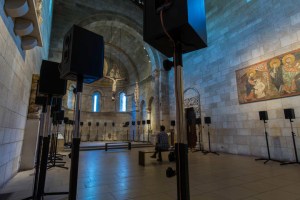
This week, several parishioners and I embarked on a “mini-pilgrimage” to the Cloisters in the City.  Though I loved many parts of the Cloisters, I found that I was most drawn to a sound installation by Janet Cardiff of The Forty Part Motet.  Cardiff positioned forty high-fidelity speakers on stands in a large oval in the middle of the Fuentidueña Chapel.  The motet is a reworking of the forty-part motet Spem in alium (which translates as “In No Other Is My Hope,”) by Thomas Tallis.  One part is played in each speaker in the room, and if you stand in the center and close your eyes, you can almost imagine yourself sitting in the chancel of a Cathedral listening to those beautiful voices.  And because the speakers are setup in the Chapel, which features the late twelfth-century apse from the church of San Martín at Fuentidueña, near Segovia, Spain, you really can transport yourself into sacred beauty of the music.

Part of what I loved about the installation was the way in which it froze me in my path.  No longer was I ready to hustle through the exhibits – instead I was transfixed in one place, just listening.  And even more strange was that I was not the only one – the whole room was filled with people just standing and listening to the incredible sound.  I was fascinated by the way such beautiful music held us captive, arresting our attention.

As I venture into Advent, I wonder how we might hold on to that sense of arrested attention on God.  Advent is a season often co-opted by the world around us.  I can count countless secular things that send us into a flurry – buying gifts, decorating houses, hosting and attending parties, and generally running around chaotically.  But our sacred worlds can keep us just as busy.  I know that in our parish during the month of December we have an Annual Meeting, a Bishop’s Visit, our 50th Anniversary Gala, the decorating our church with greens, and the flurry of Christmas worship services.

Our invitation this week might be to find small ways to commit arrested attention to God.  Maybe our way will be simply stopping for a prayer.  Maybe our way will be dropping everything we had planned and stopping to visit with an elderly person, with someone who is sick, or with a child.  Or maybe it is a more intentional commitment to being fully present wherever you are – putting aside the other forty things that also need to be done immediately, and just giving yourself over to the task or experience at hand fully.  If we can isolate our attention, and arrest our harried selves, maybe we can find our way back to the God who loves us and simply wants a bit of our arrested attention too.

Homily – Matthew 6.25-33, TG, YC November 28, 2013

05 Thursday Dec 2013

Posted by jandrewsweckerly in Uncategorized

≈ Leave a comment

Tags

control, God, gratitude, Jesus, Sermon, Thanksgiving Day, trust, worry

Our gospel lesson today is one of my favorites.  Jesus’ instructions not to worry are a soothing ointment for the constant itch of worry in my life.  His words calm my nerves and remind me of the need for perspective.  I can almost imagine Jesus as a yoga instructor, calmly affirming a room of people who are trying to take in deep breaths and to relax their tight muscles.  As I think about the heavenly Father who knows my every need, I am given a sense of perspective and calm that I can rarely muster on my own.  Because I am a person prone to worry, this passage truly is one of my favorite passages from scripture.

That being said, this passage is also one of my least favorite passages.  We tend to think of ourselves as having a certain amount of responsibility in this life – a responsibility to use the talents God has given us to care for ourselves, and even to care for others.  But who among us has not had times when that was just not possible – either from being laid off or furloughed from work, not being able to find a job in unemployment, or having an injury that has made our work impossible.  Besides, what does Jesus expect us to do?  Just go about life, expecting everything to be handed to us – clothing, food, and drink?  The proposition seems naïve and ultimately frustrating.

But even harder than a basic frustration with Jesus is the underlying message of what Jesus is saying:  that through our behavior of worrying, we are implying that we have ultimate control over life, and that God plays little, or at least a superficial, role in our lives.  The presumption of worry is the presumption that we have the ability to fully control what happens and then fix things when they go awry.  Our worrying is a way of saying to God, “I do not trust you to handle things in my life.  I am not willing to give up that control to you.”  One question from Jesus summarizes this conflict for us, “Can any of you by worrying add a single hour to your span of life?”  Jesus really knows how to get to the heart of the matter, and when he does, his words feel like a stab to the heart.

Truthfully, there really could not be a better lesson for us today on Thanksgiving Day.  I imagine every one of us has had a worry about this day in the past week or more.  Talk about worrying about what you will eat!  We stress about what food to serve, how to accommodate our gluten-free friends in the menu, what items can be prepared in advance, how to get the moistest turkey, and whether we have made enough for those gathered.  Some of us have worried about what outfit to wear, knowing there will be countless photos trying to capture the happiness of this day.  And what to drink?  I know parties where the host has purchased copious amounts of wine, despite delegating wine to guests, for fear that there will not be enough to cover the gathering.  And those worries do not even cover the other worries of the day – how to fit in Eucharist while the turkey is still cooking, whom to sit near our cranky aunt, and what kind of arguments might erupt between family members.  For those hosting meals, many of us barely have a chance to catch our breath after the meal before the clean-up process begins.

But that is the beauty of this lesson today:  like our eternal battle between worry and control, this special day also has the potential for lost focus.  Our country, with all its flaws, gives us a day that is almost sacred in nature – a day set aside for gratitude and thanksgiving; a day when we can pause, and remember the abundant blessings of our lives and the incredible gift of this life.  And if we are at all considering what we are grateful for, our minds inevitably end up with God – the one from whom all blessings flow.  The simple act of thanksgiving melts away tensions, and turns our worry-hardened hearts to hearts overflowing with gratitude.  When we really think about all that we have to be grateful for, the list gets longer and longer – even if we are not even in much of a mood to celebrate.

I was wondering, then, how we might incorporate the lessons we learn today from the gospel and from Thanksgiving Day into a rule of life beyond this day.  Then I remembered the last line of the gospel, “But strive first for the kingdom of God and his righteousness, and all these things will be given to you as well.”  We have been singing these very words since September, “Seek ye first the kingdom of God and his righteousness.  And all these things shall be added unto you.  Alleluia.”  I have been singing these words every Sunday, and I took until today, with today’s gospel and today’s celebration to finally connect the dots.  The answer is not to throw up our hands, naively trusting God to put food on the table.  The answer is changing our pursuit – not pursuing the things that we think we want and need, but instead pursing the kingdom of God.  The rest is just gravy.  Amen.

Giving thanks…

27 Wednesday Nov 2013

Posted by jandrewsweckerly in Uncategorized

≈ Leave a comment

Tags

breath, busy, God, quiet, thanks, Thanksgiving Day, worship

At 6:30 this morning, I got a call from the Chair of my Buildings and Grounds Committee.  He was worried about the amount of water we are getting here and asked if I would run over to the church to make sure the undercroft had not flooded overnight (as his basement at home had).  Luckily I was dressed, but our family was in the morning flurry of getting showers, eating breakfast, and making lunches.  I had hoped to sneak over to the church quietly, but as soon as my daughter found out what I was doing, she wanted to go too.  So we rushed to find her shoes and raincoat, I rushed to grab an umbrella, and we ran out the door.  About half-way to the church, I realized I had forgotten the church keys.  As I quickly tried to rush my 4-year old back to the house, I realized that my lack of church keys meant I also had left my house keys inside the house.  Of course, my husband was in the shower.  Needless to say, there was lots of doorbell ringing over the following five minutes.  Ah, the joys of a crazy, scattered priest and mother.

For this and so many other reasons, I am tremendously grateful that my husband suggested we take this Thanksgiving to just have a quiet holiday alone.  As an extrovert, my immediate response to his request was a bit of sadness and wistfulness – Thanksgiving is supposed to be about loud families or friends and yummy food.  But then I remembered how for the last several weekends in a row I have had multiple church commitments, how last week alone I had three night meetings, and how my husband I have felt like ships passing in the night these last several weeks.  I knew the wisdom behind his request, and so we have gathered a much smaller amount of food, and have plans to just be together as a family this weekend.  Well…and maybe clean the house and unpack some baby stuff.  But at least we are doing that together!

Courtesy of http://metropraise.blogspot.com/2012/11/the-history-of-thanksgiving-in-united.html

Courtesy of http://metropraise.blogspot.com/2012/11/the-history-of-thanksgiving-in-united.html

I know for most of you, Thanksgiving is not really about quiet and retreat.  That may feel like a foreign, if not uncomfortable, concept to you.  But even if you are planning to gather with your loud Uncle Joe or your nagging mother-in-law, I hope that you will take a moment to take a little breath, and remember in the quiet what Thanksgiving is really about.  Maybe you invite your family into prayer before the meal, maybe you invite everyone to share something they are grateful for, or maybe you just do your own self assessment of the bounty surrounding you on every side – of food, of shelter, of clothing, of laughter, of a God who loves and cares for you abundantly.  And if that is the only breath of thanksgiving you can afford on that day, then you have taken a sip of the pool of thanksgiving available to you.  And if you are thirsty for more, find a church holding a Thanksgiving Day service, and give yourself an entire hour of this kind of thankfulness.  It may be the greatest gift you give yourself this holiday season.

St. Margaret’s Church celebrates Holy Eucharist on Thanksgiving Day at 10:00 AM.  All are welcome!

Homily – Interfaith Thanksgiving Service, November 26, 2013

27 Wednesday Nov 2013

Posted by jandrewsweckerly in Uncategorized

≈ Leave a comment

Tags

culture, differences, faith, God, interfaith, praise, sacred, secular, Thanksgiving, Thanksgiving Day

I grew up in the South, where being a person of faith meant you were either a Baptist or a United Methodist.  It was not until well after college that I began to meet and really get to know a few individuals of other faiths – learning about both their cultural and religious experiences.  I even had an interfaith clergy support group back in Delaware – during which much of our time was spent discussing differences and similarities in polity and worship.

So I was thrilled when I heard there was an interfaith group here when we moved from Delaware to Plainview two years ago.  I was looking forward to who would be in the room, and finding an instant support group of fellow persons of faith.  So you can imagine my surprise when I, southerner that I was, went to my first meeting and realized that as a Christian, I was a minority in the room.  I do not think I have ever been in a room of clergy when I felt like there were significant portions of the conversation that I just did not understand – whether it was a particular holiday, a way of doing business, a language barrier, or knowing what to order at Ben’s.  I had always thought that interfaith differences were not that significance – if we are all persons of faith, surely that identity creates enough common ground for us to work together.  But the truth is that among the clergy, and perhaps among you as persons of faith, we are so steeped in our religious identity and culture, that we forget how particular that experience is to us – and how foreign that experience is to others.

That is why I love this service so much.  We have found a holiday that we as Americans can all recognize and celebrate – regardless of our faith background.  And yet, we as a community of faithful people gathered here tonight claim this day not as just a secular day to eat copious amounts and gather with family and friends, or even a day we can all commonly agree upon because we are Americans.  We claim this day as a sacred day – because we know that true thankfulness belongs to God – the source of sustenance and life itself.  In the Episcopal Church, we have a special liturgy set aside for Thanksgiving Day.  I never knew that until I became a priest.  In fact, at my first cure, I remember learning about the service and being totally annoyed, thinking, “What, I have to work on Thanksgiving too?!?”  But after my first Thanksgiving service, I knew why the Episcopal Church had set aside time for worship:  because the world around us tries fill this day with “stuff” other than true thanksgiving.  We slave over food, we fret about misbehaving family members, we jostle for position around the TV for the Macy’s parade or the football game, and some of us even go out shopping, especially as the stores try to lure us out of our homes to spend money.

But the community of faith makes another way for us.  The community of faith says that if we are going to dedicate an entire day to thanksgiving, let’s talk about what giving thanks is really about – to whom we really need to give thanks.  Tonight, we turn to scripture.  The palmist says, “It is good to give thanks unto the Lord, and to sing praises unto Thy name, O Most High.”[i]  We say together, “Praise God!  Bless God’s name!  For God is good; God’s steadfast love, [God’s hesed] is eternal; God’s faithfulness is for all generations.”[ii]

To be honest, praise and thanksgiving is not necessarily something that we are always good at doing.  We are really good at complaining to God, or asking God for things, or worrying to God.  But we often forget to truly praise God, to thank God for God’s abundant love and faithfulness.  I am not sure if our prayers to God tend toward being self-centered or we just are simply a culture who tends to complain or want something from God.  And I am not saying those kind of prayers do not have a time and place.  Our God can take all of that from us and more.  But when we turn our prayers to prayers of thanksgiving, we may be amazed at how we, and all that we are worried about, are transformed.  Centering ourselves in gratitude and thanksgiving puts even the direst of situations in perspective.  We remember not only that God is with us, but we also see those around us differently.  Our hearts grow in love and compassion simply by praising and thanking God.

Of course, there are practical implications to giving thanks to God.  Somehow that annoying uncle or nagging mother seems a lot more lovable when our hearts are rooted in this kind of thanksgiving.  Somehow that fallen soufflé or that dry turkey seems much less important than the fact that we have food at all – let alone shelter, warmth, and electricity.  That is the power of thanksgiving for us as a community of faith.  When we turn to God, from whom all blessings flow, we turn our hearts toward generosity as well.  We find ourselves buying extra food to feed our neighbor.  We find ourselves making time to serve others – whether making peanut butter and jelly sandwiches with our interfaith brothers and sisters, or in some other way.  We find ourselves focusing less on ourselves, and more on the wonderful creation God has given to us – and in turn we find ourselves much more well-taken care of than when we were wrapped up in ourselves.

And so tonight, we set the tone for this national holiday.  We proclaim a true day of Thanksgiving – for the abundance of food, for the privilege of rest, for the blessing of life – but mostly for the God that gives us such life, who cares for us more than we deserve, and who loves us more than we can imagine.  We give thanks for a God beyond our full comprehension or knowing, and we give thanks for the interfaith community who, despite all our differences, collectively reminds us to whom we belong.  May your Thanksgiving holiday be a sacred time with the God who created you, sustains you, and loves you.  Amen.


[i] Ps. 92.1

[ii] Ps. 100.4-5

Homily – Psalm 150, St. Cecilia, November 21, 2013

27 Wednesday Nov 2013

Posted by jandrewsweckerly in Uncategorized

≈ Leave a comment

Tags

Cecilia, God, homily, music, praise, song

Music has a unique power in our lives.  There are those songs that remind us of a romance, those songs that we played over and over in a rough patch in our lives, and those songs that always bring a smile to our faces and make us want to dance.  Music has a similar power in our faith lives too.  There are those songs that always make us cry or remember a loved one, those songs that fill us with joy at the remembrance of a special connection to God on a retreat or revival, and those songs whose words capture what we cannot capture better with hours of trying.  Music helps us connect to the awesome power of God and to express the full range of the emotional journal of walking with God.

Cecilia, who we honor today, reveled in singing passionately the praises of God.  Known as the patron saint of singer, organ builders, musicians and poets, Cecilia is venerated as a martyr.  Of noble birth, Cecilia was betrothed to a pagan, who she eventually converted by her witness – along with his brother.  But because of their conversion and her role with them, all three were eventually martyred around 230 during a time of Roman persecution of Christians.  Cecilia’s life has inspired countless artists and composers over the centuries.

Though we may turn to spiritual music for different seasons of our lives, what Cecilia invites us into today is a passion for praise.  Now I know what you may be thinking – that I am asking you to be some constant ray of sunshine who continually pretends everything is ok.  To be honest I know some people who are like that and I do not get it.  How can anyone be that happy all the time?  Does God really want us to stuff our true emotions, pain, and hurt, and pretend all is well?

That is not what a passion for praise is really about.  The psalm we all read today is full of praise: “Praise God in his holy temple … praise him for his mighty acts … praise him with lyre and harp … with resounding cymbals.”  In these six short verses, we are told to praise God 11 times.  I think what the psalmist gets and what Cecilia got is that praise is the vehicle that gets us through pain to God.  Almost like making yourself smile until the smile becomes real, when we praise God, even if we do not feel like praising, eventually our praise overwhelms us, and we cannot help but be lead closer to joy.  Our invitation today is to a life of praise – annoying, hard, gentle, forgiving, joyful, real praise.  Amen.

Sermon – Luke 21.5-19, P28, YC, November 17, 2013

27 Wednesday Nov 2013

Posted by jandrewsweckerly in Uncategorized

≈ Leave a comment

Tags

God, Hurricane Sandy, Jesus, Precious Lord, prepare, scripture, Sermon, suffering, testimony, Thomas Dorsey, trust, words

“Blessed Lord, who caused all holy Scriptures to be written for our learning:  Grant us so to hear them, read, mark, learn, and inwardly digest them, that we may embrace and ever hold fast the blessed hope of everlasting life, which you have given us in our Savior Jesus Christ; who lives and reigns with you and the Holy Spirit, one God, for ever and ever.  Amen.”[i]  So on this day, when we celebrate Holy Scripture, praying one of my favorite collects, a day that we hear, read, mark, learn, and inwardly digest, imagine my intense dissatisfaction when I opened up the gospel lesson for this week.  I have been reading, marking, learning, and inwardly digesting all week, and this text still makes me uncomfortable.  On this day of celebrating Scripture, who wants to hear of collapsing houses of worship; false prophets that can lead us astray; wars, natural disasters, famines, and plagues; great persecution, including being betrayed by our very own family members?  And what is our reward for all this suffering?  All of this calamity will give us an opportunity to testify.  I do not know about you, but after having my church destroyed, navigating false prophets, fighting disasters, and dealing with persecution, testifying would be about the last thing on my mind.  In fact, I know a few Episcopalians who might even add testifying as one of the major types of tortuous, painful experiences. 

At Diocesan Convention this weekend, we watched a video about the Diocese of Long Island’s response to Hurricane Sandy one year ago.  The video began with news coverage leading up to the storm, during the storm, and immediately after the storm.  I have no idea why, but I found myself tearing up during the coverage.  I had forgotten all of the anxiety and stress that came from that storm.  I forgot about the utter despair and the feelings of helplessness – having friends try to contact me about how they could help, and yet, not even having power to be able to watch the news and see what was going on all around us.  I remember wanting to know what had happened to churches in the areas most impacted by the storm, but the Diocesan offices being crippled by their own lack of power and employees’ inability to get to work.  I remember wanting to help, but not being sure how to do that without electricity ourselves.  I remember being so cold at night without heat, and yet knowing that I was lucky to have an undamaged roof over my head.  I remember anxiously watching my car’s gas gauge approach empty – knowing the panic of gas lines, and how quickly stations ran out of gas.  The video brought all of those emotions bubbling up to the surface. 

But the video also offered a testimony.  After the storm, churches began opening doors for collections, housing, and powering stations.  Teams from churches headed to devastated areas to help demo and begin repairing homes.  Those too far from the action, offered up their space to electrical workers who had volunteered to help, but had been given no place to stay at night.  Our hospital in the Rockaways treated patients for three weeks solely on generator power.  A year later, people are still being helped as they repair homes, find new places to stay, and deal with the emotional ordeal.  In a time of great darkness, the Episcopal Church on Long Island began to find a way out of the darkness and into the light. 

One of the coordinators of the effort from the Diocese said that one of the things the Church had to learn to do was not to go into areas telling them how they were going to help – but instead had to simply show up and ask what people needed.  The representative said that this model made the work and efforts much more chaotic, but in the end, brought about the change that people really needed.  I could hear echoes of today’s gospel lesson in his words.  Jesus says, “Make up your minds not to prepare your defense in advance, for I will give you words and a wisdom that none of your opponents will be able to withstand or contradict.”  This strange gift of being able to testify is made even stranger by Jesus’ words – not only is our gift to testify in the midst of suffering, we are to force ourselves to not even prepare the testimony on the way – no thinking of anecdotes, no making outlines, no trying to even think about what we might say.  We must simply show up and trust that God will give us the words.

One of my favorite hymns is “Precious Lord.”  “Precious Lord,” is one of those songs that I can close my eyes to and just overflow with love and gratitude toward God.  Of course, my favorite version is not the version sung out of the hymnal, but by the great Al Green.  He breathes a life and joy into the song that we can rarely muster in church.  But this week, my appreciation for this favorite song grew infinitely when I heard the story behind the song.  The song was written by Thomas Dorsey.  Born in 1889 in rural Georgia, Dorsey was a prolific songwriter and excellent gospel and blues musician.  As a young man, he moved to Chicago where he worked as a piano player in churches as well as in clubs and theaters.  After some time, Dorsey finally devoted his talent exclusively to the church.  In August of 1932, Dorsey left his pregnant wife in Chicago and traveled to be the featured soloist at a large revival meeting in St. Louis.  After the first night of the revival, Dorsey received a telegram that simply said, “Your wife just died.”  Dorsey raced home and learned that his wife had given birth to a son before dying in childbirth.  The next day his son died as well.  Dorsey buried his wife and son in the same casket and withdrew in sorrow and agony from his family and friends.  He refused to compose or play music for quite some time. 

While still in the midst of despair, Dorsey said that as he sat in front of a piano, a feeling of peace washed through him.  That night, Dorsey recorded this testimony while in the midst of suffering:

Precious Lord, take my hand,

Lead me on, let me stand;

I am tired, I am weak, I am worn;

Through the storm, through the night,

Lead me on to the light;

Take my hand, precious Lord,

Lead me home.[ii]

In the midst of that darkest of times, Dorsey did not sit at that piano with a song all planned out.  In fact, if you had asked him to testify at that moment, he might have railed at the way that God and the world were treating him.  And yet, empty and vulnerable, God filled Dorsey with words that would touch people eighty years later, and would be sung by countless famous people over the years.

In the midst of darkness – of destruction, pain, suffering, persecution, even betrayal by those we love most – God gives us a testimony too.  And even more than a testimony, Jesus promises that we do not even have to prepare this testimony.  God will provide the words and the wisdom when we need them.  Our only mandate today is to hold fast to God in the midst of trials, to remain open to the movement of the Spirit, and to speak those words of truth and wisdom when we feel them spilling out of our mouths.  That time of testimony may not be before some king or governor demanding to hear about our faith.  But our testimony might spill out with a grieving widow or mother, a traumatized victim of natural disaster, or a friend who has felt disenfranchised by the Church.  We cannot prepare the testimony.  We cannot even try to craft a basic testimony story to be ready whenever we need the story.  Jesus tells us to “make up our minds not to prepare.”  This is perhaps one of the hardest challenges Jesus will give us, and yet, as we see in Dorsey’s testimony and the many other testimonies we have heard, when we yield that power to Christ, the real, vulnerable beauty of our story gives life to others and to us.  Amen.


[i] BCP, 236.

[ii] Story of Dorsey take from Nancy Lynne Westfield, “Pastoral Perspective,” Feasting on the Word, Yr. C, vol. 4 (Louisville: Westminster John Knox Press, 2010), 312.

Homily – Acts 20.28-32, Samuel Seabury, November 14, 2013

27 Wednesday Nov 2013

Posted by jandrewsweckerly in Uncategorized

≈ Leave a comment

Tags

church, Episcopal, flexibility, God, homily, Samuel Seabury, tenacity, trust

Today we honor the life and work of Samuel Seabury, first American Bishop of the Episcopal Church.  Born in 1729 in Connecticut, and ordained priest in England in 1753, Seabury worked in New Jersey, Long Island, and Westchester County.  During the American Revolution, he remained loyal to the British crown and served as a chaplain to the British army.  After the Revolution, in 1783, Seabury was asked by Connecticut clergymen to seek episcopal consecration in England.  He negotiated for a year, but could not obtain episcopal orders because as an American citizen, he could not swear allegiance to the crown.  He turned to the Episcopal Church in Scotland, which consecrated him bishop.  In Connecticut, he was officially recognized as bishop in 1785.  In 1792, he participated in the first consecration of a bishop on American soil.

I do not know many modern Episcopalian who could have lived the life of Samuel Seabury.  He had to deal with changing national loyalties; travel by boat to ask a people from whom he had just revolted to consecrate him; negotiate for a year; think creatively to involve Scotland; not give up; and establish a new system here in the U.S.  Samuel’s faith life required a certain flexibility, creativity, and tenacity that many of us lack.  I sense that lack even in myself as I hear Episcopalians talk about reinventing our church for this new age.  Can’t we just stay as we are where we are comfortable and just pray it will all work out?

But our lesson from the Acts of the Apostles allows no such hesitancy.  Paul exhorts us to keep watch – over ourselves and over the whole flock.  Our job is to care for the church that “God obtained with the blood of [God’s] Son.”  But Paul does not exhort without encouragement.  He says that God’s grace will build us up and that the Holy Spirit makes us overseers.  We can do our work with flexibility, creativity, tenacity, and change because God’s grace will build us up, and the Holy Spirit empowers us to do the work.  The road may be hard at times, but we have the great cloud of witnesses pushing us forward.  Samuel knows we can do it; we just have to let go and trust.  Amen.

A Lifelong Process…

14 Thursday Nov 2013

Posted by jandrewsweckerly in Uncategorized

≈ Leave a comment

Tags

alive, church, dreams, flourish, God, hope, living, money, stewardship

This stewardship reflection is offered by St. Margaret’s Parishioner, Kim Irvine.  

Courtesy of http://www.churchleaders.com/pastors/pastor-articles/156872-don-linscott-why-i-m-glad-my-church-needs-money.html

Courtesy of http://www.churchleaders.com/pastors/pastor-articles/156872-don-linscott-why-i-m-glad-my-church-needs-money.html

It seems that people often associate stewardship with feelings of dread, awkwardness, and anxiety, when in fact the goal of a stewardship campaign is to generate excitement and energy about the achievements our church has experienced, and share the hopes and dreams for the future.  We as a community in Christ need to have intentional discussions about the financial standing of our church.  How can we know what the needs of the church are, without having these crucial conversations?  This year let’s try not to view stewardship as a time we have to “get through”, but instead embrace stewardship as a way of life; living each day knowing that all we have is a gift from God, and we are responsible to use what we have been given to the glory of God.

I believe we at St. Margaret’s are witnessing first hand how stewardship results in helping not only the members of our congregation, but also those in our community and beyond.  New programs are being developed, we’ve seen new initiatives launched, and the buildings and grounds we are blessed with are being maintained and improved.  None of this would be possible without your stewardship.  Your pledges and generous contributions are facilitating growth and change within and outside our church.

In doing some research for this blog post I came upon the following quote:

“Have you ever heard anyone say, ‘My church is always asking for money.  I wish I could belong to a church that never needed any money.’  Surely they don’t mean that.  Any church that is alive needs money.  Only dead churches do not call on their members for support.  If anyone should accuse your church of always needing and calling for money, regard it as a compliment.  Invite this person to rejoice with you that you both belong to something that is living and productive for Jesus Christ rather than a dead, stagnant organization from which glory of Christ has departed.”[1]

For me, these words were really eye opening; they made me grateful to be part of a church that is “alive,” and full of God’s love.

Please prayerfully consider your pledge for this year; your continued financial support of St. Margaret’s will propel us to do the amazing things God has planned for us, and keep us flourishing in faith!

Respectfully submitted by Kim Irvine


[1] http://www.tonycooke.org/free_resources/articles_leadership/pastoral_helps/quotes_thoughts.html

Sermon – Luke 20.27-38, P27, YC, November 10, 2013

14 Thursday Nov 2013

Posted by jandrewsweckerly in Uncategorized

≈ Leave a comment

Tags

afterlife, answers, death, God, grace, heaven, Jesus, life, love, mercy, resurrection, Sadducees, Sermon

About a year ago we lost one of our parishioners after a sustained battle with illness.  If you remember, at that time we were still recovering from Hurricane Sandy.  Though many of us finally had our power back, we faced an early snow storm.  The storm delivered just enough snow to knock out power in some of the local schools and to muck up roads that were already struggling to be freed from fallen trees.  My daughter’s school was cancelled, and I had anticipated just trying to stay warm at home for the day.  But when I got the call that Mina had died – I was dumbfounded.  There was no doubt in my mind that I would go join the family for prayers, but I had no idea how to incorporate my daughter into the visit.  With the weather conditions such as they were, there was no way she could stay anywhere else.  And so began a ten minute drive during which I tried to explain to my three-year old daughter what death meant, what heaven is, and what God’s role in all of this is.  Of course, I totally forgot to factor into my explanation the fact that Mina’s body would still be present, and how her body figured into my three-year-old-appropriate explanation of heaven.  Needless to say, a year later, I am still fielding questions about death, heaven, and God.

The truth is that I think adults have as many questions about death, heaven, and God as young children do.  When we hear the complicated question of the Sadducees to Jesus about the woman with seven husbands, we find ourselves morbidly curious too.  What does happen to this woman in the afterlife?  Would she have wanted to be with one over another in heaven?  Of course her scenario makes us think of all the stories of loved ones we know – or even of ourselves.  What happens to the widow who remarries in the resurrection?  What about the couple who divorces and later remarries?  Surely they will not have to be reunited with their exes!  Or what about that abusive father, that mean uncle, or that estranged sister?  Do we face them in the afterlife?  Since we do not really have anyone to give us an insider’s perspective, these are the questions that we really wonder about.  And if we have ever held the hand of a loved one approaching death, we may have asked these questions to God, to our priest, or to a friend.  So when the Sadducees ask this question of Jesus, we perk up, hoping for some real clarity from Jesus, and secretly praying for the answer that we think is best.

The trouble with this text though is that the Sadducees are not really asking Jesus a practical question about what happens in the resurrection.  In fact, the Sadducees do not even believe in the resurrection.  If you remember, the Sadducees are the group of people who believe the Torah – those first five books of the Hebrew Scriptures – to be the only authorized scripture.  None of the other books that we know from scripture – the prophetic writings or the Psalms – are considered valid scripture by the Sadducees.  Because there is neither a doctrine of resurrection of the dead nor a belief in angels in the written Torah, the Sadducees refuse to believe that there is life after this earthly life.  The Pharisees along with Jesus and his disciples, on the other hand, believe in ongoing interpretation of Torah handed down by word of mouth, and so, they have no problem with the ideas of resurrection presented in other Hebrew scriptures.[i]

So this question by the Sadducees about the resurrection is not really a question for which the Sadducees are looking for answers.  Instead, this is a question meant to both ridicule Jesus,[ii] and to trap Jesus in an impossible question.  Though we may feel some sense of camaraderie in shared curiosity, the Sadducees are not simply a curious bunch with a heartfelt question.  They are trying to manipulate Jesus and embarrass him in front of the crowd.  Luckily for us, Jesus offers an answer anyway.  Of course the answer is not as specific as we might like, but the answer does offer hope and mercy in a roundabout way.

What Jesus basically tells the Sadducees and those gathered around him is that the resurrection is not like life here on earth.  Life after earthly life is not “Earthly Life, Part II,” where everything is the same, but better.  In the resurrection life, rules of this life – and in particular, rules that applied to Levirate marriage, like a brother taking on a widowed sister-in-law – are not the same as the rules in the afterlife.  Jesus does not explain exactly what this looks like or how this plays out, and Jesus does not fully satiate our curiosity.  But Jesus does give an answer that is full of mercy and love.  Jesus basically tells those gathered that the beauty of the resurrection is that the strictures and limitations of this life are lifted in the life to come.  Things like women being treated as property to be managed, infertility, and grief are erased in the afterlife.  Things like disappointment in marriage, pressure to be married, and even death itself are no longer present in the afterlife.  Things that define us here, limit or frustrate us, or pain us here in this life are absent in the afterlife.  Jesus will never concede to the Sadducees that resurrection life does not exist.  But Jesus does try to kindly invite the Sadducees into seeing that resurrection life is so much more than they can imagine, and so much more full of true life than this earthly life that they know.  Jesus does not answer their question fully, but Jesus does say that the Creator God of Torah is still revealing truth, and that the truth is full of mercy, grace, and love.

I am reminded of the scene from the movie The Matrix where the main character, Neo, goes to visit a woman called the Oracle to find out if he is “the one,” a messiah-like figure to save the world.  Neo goes to the Oracle with a clear-cut question, “Am I the One?”  But the conversation that ensues is complex and layered with meaning.  She seems to be telling Neo he is not the one, but we later learn in the movie that she was actually telling him that he is not the one if he will not claim his status as the One.  The scene is as complicated as my rudimentary attempts to explain the scene.  But what the scene reminds me of are our conversations with God about ultimate things.  We often come to God with basic questions and concerns that are rarely answered directly.  But that does not mean we do not get a response.  In the end, the response is loving, full of compassion, and ultimately full of truth when we are ready to understand and interpret that truth.

This is all that Jesus can offer us today.  Jesus is not offering an exclusive interview a top news source to tell us everything we want to know about resurrection life.  We will not be able to watch with bated breath as Jesus answers every question we want answered.  Instead, Jesus offers us a promise to take home.  His promise is that we have resurrection life beyond this earthly life.  His promise is that resurrection life is not some two-dimensional repeat of this life, with the limited happiness we can find here, but instead is a three-dimensional life beyond our knowing because of our limited earthly experience.  His promise is that God is ever revealing truth to us, showing us the most important truth:  that God loves us, shows us exquisite mercy, and offers us unfailing grace.  Jesus’ words today may not be the 60-Minute special we were hoping for, but Jesus’ words today give us something to hold on to in the midst of this crazy, chaotic world that is our earthly home.  Hold fast to the Lord who loves you, shows you exquisite mercy, and offers you unfailing grace.  Amen.


[i] Vernon K. Robbins, “Exegetical Perspective,” Feasting on the Word, Yr. C, vol. 4 (Louisville: Westminster John Knox Press, 2010), 285.

[ii] Eberhard Busch, “Theological Perspective,” Feasting on the Word, Yr. C, vol. 4 (Louisville: Westminster John Knox Press, 2010), 286

Sermon – Luke 18.1-8, P24, YC, October 20, 2013

06 Wednesday Nov 2013

Posted by jandrewsweckerly in Uncategorized

≈ Leave a comment

Tags

God, Jesus, judge, persistence, prayer, Sermon, transformation, widow

“Then Jesus told them a parable about their need to pray always and not to lose heart.”  From the very beginning of our gospel lesson, Luke tells us what this funny little parable is all about:  persistent prayer.  That message sounds simple enough, but once we hear the actual parable, the realities of persistent prayer sound like a lot more work than most of us care to think about, let alone do.  The parable today is about an unjust judge, who has no fear of God or respect for people, who is constantly harassed by a widow demanding justice.  The translation we hear today says that the judge finally decides to give the widow her way because he does not want the widow to wear him out by continually coming.  But the literal translation of the original Greek is a little stronger.  One translation reads that the judge gives the widow her way for fear that the widow will “slap me in the face.”[i]  Another translation reads that the judge gives the widow her way because he does not want to “end up beaten black and blue by her pounding.”[ii]  There is something about these more figurative translations that help us see that when Jesus says the disciples’ prayers need to be persistent, he means knock-down-drag-out, stubborn-headed, unrelenting, radically-vigilant persistence.

I don’t know about you, but most people I know do not approach their prayer life with this kind of rigor.  Many people who keep up this type of persistence for any amount of time eventually lose heart, finally concluding that prayer just does not work – or they are not praying the right way.  For those who have prayed without ceasing for months and years only to watch a child, a spouse, a friend, or a mother die, may have begun to question whether prayer is not just what people do to fill the time – not an effective means of healing.  And for those who have faced horrible atrocities, who can find no sense in a world that abuses, oppresses, and starves its people, may have given up not only on prayer, but on God too.

I remember the first time Scott and I tried to get pregnant.  We had been trying for almost a year, when I finally brought the subject up with my spiritual director.  I had not wanted to talk about the issue, but I think my distance from God was too obvious for the spiritual director to ignore.  When she pushed me on the issue, asking whether I had been giving my pain and suffering to God, I admitted to her that God felt dead to me.  I had nothing more to say to God because, quite frankly, God felt absent from my life at the time.  When I shared that sense of absence in my life, my spiritual director suggested another way.  She suggested I start praying through Mary instead.  My first reaction to her suggestion was rage and indignation.  How insensitive could this woman be to suggest that I, unable to conceive, try praying through a woman who was able to conceive without even trying?!  Though I left my session angry with my spiritual director, a few days later, I gave her suggestion a try.  Two things stuck with me about that experience.  One, Mary now holds a very special place for me in my faith and prayer life.  Two, what I realized was that my spiritual director never suggested I stopped being persistent in prayer.  She simply suggested prayer in a different way.

In some ways, I think we lose this understanding of persistence when we hear Jesus telling us to be like a woman who will physically fight her way through prayer.  We imagine Jesus telling us to keep doing the same thing over and over again until that thing works.  But I do not think that is exactly what Jesus means.  Staying persistently in the prayer relationship is essential, yes.  But that does not mean that relationship does not evolve and change over time.  I think about that widow in our parable today.  I am guessing that her approach with the judge was not the same everyday.  I imagine her starting with the traditional way of begging for justice as anyone would.  But when she is refused, I imagine her trying everything else possible.  From just being a constant presence as the judge was judging other cases; to interrupting the judge’s walk to work in the morning; to following behind him on the way home, pleading her case; even situating herself at a nearby table at his favorite lunch spot – maybe even loudly pleading her case in front of other people, so as to embarrass the judge in front of his friends and colleagues.  Perhaps this is what the judge means when he says the widow is wearing him out.

If we think about the widow’s persistent actions, they are not all that different from the actions of God with God’s people.  As our Thursday morning Bible Study group works its way through Genesis, I have been thinking about the persistent pursuit of God toward God’s people.  Adam and Eve sin, and yet God stays in relationship with them.  The whole earth falls into abominable sin, and even after flooding the earth, God forms a new covenant with humanity.  God’s people break covenant after covenant, and God continues to pursue them.  God’s people disrespect, dishonor, and disparage God, and yet God tries again and again to redeem God’s people.  God is so persistent in God’s relationship with us that God even sends a Son to redeem us from our sinful ways – allowing Jesus to die on a cross for us.  If the widow is the consummate example of persistence in prayer, she learned this persistence from the God is ever pursuing us.

So how do God and the woman do it?  How do they manage this kind of vigilant persistence?  I think what both of them experience is that they are changed in the process.  We have heard many times in scripture how God changes God’s mind – how the flood leads God to vow to never destroy the earth again, or how the argument of Abraham makes God tone down God’s judgment, or how the repentance of the people of Nineveh changes God’s mind about punishment.  I imagine the widow is changed too.  With each attempt at convincing the judge she must have become more and more bold.  In the story, she is transformed from a woman who is likely powerless about her own future and the future of her orphaned children to a woman who is almost feared by a powerful judge.  She is transformed through her persistence.

That transformation is what happens in the life of persistent prayer.  “Repeated, habitual prayer gradually tests and sifts what you believe is really important and what is of ephemeral value.”[iii]  I think about the many times I have prayed and prayed over a particular issue, fully aware of how, when, and why I wanted God to intervene.  But slowly, over time, my prayer about the same issue changes.  I may go from wanting a particular outcome, to being willing to accept a positive outcome, to accepting the defeat and being open to God’s will, to simply wanting God to be present in the midst of it all.  That is why persistent prayer is so important.  Our one-time prayers or our perfunctory prayers do not really open us up to God.  Those rote prayers are just our lips moving without our hearts being equally moved.  But when we are persistent in our prayers, constantly evolving our conversation with God, constantly amending our approach toward God, constantly leaning on others to inform our prayer life, slowly our prayers become transformed, leading us to that God who responds to the deepest, most vulnerable versions of ourselves.

I remember a story of a seminarian who studied at General Theological Seminary.  Desmond Tutu was on campus and the seminarian was excited to watch Tutu in action.  He was happy to see Tutu join the students and faculty at Morning Prayer.  Later, on his way to class, he noticed Tutu in the chapel again, praying on his own.  That afternoon, he saw Tutu in the chapel once more praying.  He watched this pattern again and again over three days.  Finally, at evening prayer one day, the seminarian got up the nerve to approach Tutu and ask Tutu how he ever got any work done when he spent so much time praying in the chapel.  Tutu’s response was simple, “Oh I could never do any of my work if my work were not first rooted in prayer throughout the day.”  This is the kind of persistence in prayer Jesus invites us into today:  prayer that takes us out of ourselves, transforms our desires and actions, and reshapes our relationship with God.  Jesus’ instruction to the disciples is the same for us:  pray always and do not lose heart.  Amen.


[i] New Jerusalem Bible.

[ii] The Message.

[iii] Maggi Dawn, “Prayer Acts,” Christian Century, vol. 124, no. 2, October 2, 2007.

← Older posts
Newer posts →

Recent Posts

  • On Politics, Football, and Love…
  • On Sharing the Love…
  • Sermon – Micah 6.1-8, Matthew 5.1-12, EP4, YA, January 30, 2026
  • On Justice, Kindness, Humility, and the Messy Middle…
  • Feast of the Rev. Dr. Martin Luther King, Jr., January 18, 2026

Archives

  • February 2026
  • January 2026
  • December 2025
  • November 2025
  • October 2025
  • September 2025
  • August 2025
  • July 2025
  • June 2025
  • March 2025
  • February 2025
  • December 2024
  • November 2024
  • October 2024
  • September 2024
  • August 2024
  • July 2024
  • June 2024
  • May 2024
  • March 2024
  • February 2024
  • January 2024
  • December 2023
  • November 2023
  • October 2023
  • September 2023
  • August 2023
  • July 2023
  • June 2023
  • May 2023
  • March 2023
  • February 2023
  • January 2023
  • December 2022
  • November 2022
  • October 2022
  • June 2022
  • May 2022
  • January 2022
  • December 2021
  • November 2021
  • October 2021
  • September 2021
  • August 2021
  • June 2021
  • May 2021
  • April 2021
  • March 2021
  • February 2021
  • January 2021
  • December 2020
  • November 2020
  • October 2020
  • September 2020
  • August 2020
  • July 2020
  • June 2020
  • May 2020
  • April 2020
  • March 2020
  • February 2020
  • January 2020
  • December 2019
  • November 2019
  • October 2019
  • September 2019
  • August 2019
  • July 2019
  • June 2019
  • May 2019
  • April 2019
  • March 2019
  • February 2019
  • January 2019
  • December 2018
  • November 2018
  • October 2018
  • September 2018
  • August 2018
  • July 2018
  • June 2018
  • May 2018
  • April 2018
  • March 2018
  • February 2018
  • January 2018
  • December 2017
  • November 2017
  • October 2017
  • September 2017
  • August 2017
  • July 2017
  • June 2017
  • May 2017
  • April 2017
  • March 2017
  • February 2017
  • January 2017
  • December 2016
  • November 2016
  • October 2016
  • September 2016
  • August 2016
  • July 2016
  • June 2016
  • May 2016
  • April 2016
  • March 2016
  • February 2016
  • January 2016
  • December 2015
  • November 2015
  • October 2015
  • September 2015
  • August 2015
  • July 2015
  • June 2015
  • May 2015
  • April 2015
  • March 2015
  • February 2015
  • January 2015
  • December 2014
  • November 2014
  • October 2014
  • September 2014
  • August 2014
  • July 2014
  • June 2014
  • April 2014
  • March 2014
  • February 2014
  • January 2014
  • December 2013
  • November 2013
  • October 2013
  • September 2013
  • August 2013
  • July 2013
  • June 2013
  • May 2013
  • April 2013
  • March 2013
  • February 2013
  • January 2013
  • December 2012
  • November 2012
  • October 2012
  • September 2012

Categories

  • reflection
  • Sermons
  • Uncategorized

Meta

  • Create account
  • Log in
  • Entries feed
  • Comments feed
  • WordPress.com

Blog at WordPress.com.

  • Subscribe Subscribed
    • Seeking and Serving
    • Join 391 other subscribers
    • Already have a WordPress.com account? Log in now.
    • Seeking and Serving
    • Subscribe Subscribed
    • Sign up
    • Log in
    • Report this content
    • View site in Reader
    • Manage subscriptions
    • Collapse this bar
 

Loading Comments...