
• About

Seeking and Serving

~ seek and serve Christ in all persons

Seeking and Serving

Tag Archives: God

Sermon – John 20.1-18, ED, YC, March 31, 2013

10 Wednesday Apr 2013

Posted by jandrewsweckerly in Uncategorized

≈ Leave a comment

Tags

darkness, Easter, expectation, expecting, God, Jesus, Mary Magdalene, Sermon

On that dark, damp, dreary morning, Mary Magdalene comes to the tomb expecting something.  Darkness clings to her like a cloak.  She was there at the foot of the cross two days ago.  She waited, hoping against hope that God would be victorious and Jesus would be miraculously saved.  And then she prayed that God would take Jesus faster, because despair was setting in and his suffering was overwhelming to witness.[i]  She cried so much that night, that her eyes ran dry.  After 48 hours of dazed despair, she drags her lifeless body through the darkness to tend to her beloved Jesus’ body.  Seeing his body one more time will only confirm her grief, but at least she has somewhere to go to mourn; at least his cold body will confirm his death, and begin a journey toward closure.  Mary Magdalene comes to that tomb in darkness expecting something.

We too come to church today expecting something.  Maybe we are expecting a word of joy, the release of the alleluias we have been holding in for weeks.  If we attended the myriad Holy Week services this week, maybe we are expecting a relief from all the darkness of the liturgies during these last holy days.  If we have not been to church in a long time, maybe we are uncertain as to what to expect.  We came here seeking something – some sort of connection, a sense of familiarity, or maybe a place that will accept us as we are, letting us take things as slowly as we need.  Or perhaps you were dragged to church today by a family member, and the most you are expecting is an hour of your time taken away – and that certainly feels like a period of darkness for you too.

If Mary came expecting one thing, what she gets is altogether different.  The absence of Jesus body puts her over the edge.  The first thing she does is run to get the disciples.  But even they only confirm the awful truth that keeps compounding.  Humiliating him, torturing him, and crucifying him were not enough.  Now they have taken his body too?  Having the disciples leave Mary Magdalene alone again starts the downward spiral that seems endless.  This is why she cannot see the angels in their glory – she only mutters a response to them and turns away from the tomb, her vision blurred by her tears again.  This is also why, when a man appears, she desperately begs the man to tell her where he has taken the body.  And then the unexpected happens – or at least perhaps what she had hoped might happen, but would never let herself say aloud.  Rabbouni!  Her teacher is back!

But Jesus only partially fills her expectations.  “Do not hold on to me,” Jesus says.  His words must have felt like a slap to Mary’s fragile self.  In the instant that she recognizes Jesus, a whole new set of expectations arrive.  Surely, they can flee to Galilee again and keep Jesus safe.  But Jesus changes things yet again; Mary Magdalene’s expectations cannot be fulfilled.  Things cannot return to normal.  What Jesus invites is not a return to the way things were, but to a way that is even better than the way things were; a way in which she can develop new expectations for her life in Christ.

When I graduated from college and relocated to Delaware, I was looking for a United Methodist church.  I had experienced a particular style of worship in my hometown, and was looking to replicate that experience.  After six months of frustrated looking, I stumbled into the Episcopal Cathedral.  Parts of my expectations were met – the Cathedral had one of the most diverse populations I had ever seen – racially, socioeconomically, ethnically, by household definitions, and by sexual orientation.  They were doing some incredible urban ministry, and seemed to have an inspiring commitment to the poor.  But the worship killed me.  It was so formal and the music was so uptight, that I wondered how such a progressive church could be so rigid.  I remember hearing an offertory anthem one Sunday that was so good that I said a very loud, “Amen!” at the end.  I realized right away that that was not what was expected of me.  Ultimately, after several Sundays, I decided that I would stay, but only temporarily.  When we moved again, I would just look for another United Methodist church.  But God had other expectations for my life.

That is the funny thing about expectations.  Both the realistic expectations Mary Magdalene has – the expectation to remain in bitter darkness – and the hopeful expectation Mary has – that everything could go back to normal – are not met.  But that does not mean that Jesus does not make a way out of the darkness.  We have heard from the very beginning of John’s gospel about Jesus and the light.  “The light shines in the darkness, and the darkness did not overcome it,” says John’s gospel[ii]  The later, John says, “Again Jesus spoke to them, saying, ‘I am the light of the world. Whoever follows me will never walk in darkness but will have the light of life.’”[iii]  Jesus, then, this light of the world, cannot meet the expectations of Mary; because Mary’s expectations are smaller than God’s.  Mary cannot go back to the way things were.  But the way things are going to be is infinitely better.  “God gives a new kind of life, a life that is still worth living, a new kind of aliveness toward God and the world…”[iv]

Mary’s interaction with Jesus invites us to consider our own expectations of this day.  If we came here today, only seeking joy without transformation, then our expectations might go unmet today.  If we came here expecting to rub out all the darkness of these last days, then our expectations will only be partially met today because we cannot celebrate the resurrection, without the cross ever with us.  If we came here as seekers, expecting to just sit in the pew and then go back to our lives, then our expectations might not be met either.  Once we learn that this room is full of seekers just like us, who want us to enrich their journey, this place cannot be seen in the same way.  Even for those of you who just hoped to survive this hour of forced worship will not have your expectations met.  Because even if you are not touched today by Christ’s light, those who brought you here are being touched by the light; your relationship with them will be changed because they are being changed.

So the polite Southerner in me wants to say, “I am so sorry we did not meet your expectations today.”  But at the end of the day, I am glad that our expectations are not met today.  God is doing bigger and better things than we can imagine.  Our job is to trust that the light of the world will lead the way into the new resurrection journey that awaits us.  Amen.

[i] Joan Gray, “Beyond Rescue,” Journal for Preachers, vol. 22, no. 3, Easter 1999, 51.

[ii] John 1.5

[iii] John 8.12

[iv] Gray, 52.

Sermon – Luke 24.1-12, EV, YC, March 30, 2013

10 Wednesday Apr 2013

Posted by jandrewsweckerly in Uncategorized

≈ Leave a comment

Tags

Easter Vigil, God, light, liturgy, Messiah, movie, salvation, Sermon, tomb

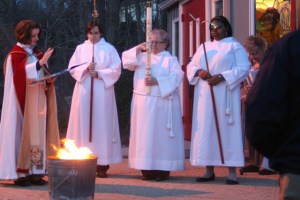
IMG_3202Our liturgy tonight operates a bit like a movie whose mode of telling stories is in flashbacks.  We start the movie with the scene we just heard.  Several women are gathered around the empty tomb, their mouths agape, and their minds racing.  And then, the flashbacks begin.

Mary the mother of James recalls that ancient story of creation.  That empty tomb reminds her of those words – tohu wabohu – the formless void.  She vaguely remembers what God said about creating humankind in God’s image.  And she hears those words repeated over and over again, “It was good; ki-tov”

Meanwhile, another woman flashes back to when humankind’s sinfulness so angered God that God flooded the earth.  For forty days, Noah knew the nothingness of that empty tomb in front her.  But she also remembers that covenant God made with Noah – that never again will there be a flood to destroy the earth.  Perhaps there is a rainbow in this tomb, and not only the watery floods that she sees.

Joanna looks into that empty tomb and remembers another time her people faced desperation.  She flashes back to the rushing Egyptians who have pinned her people to the Red Sea.  She remembers the panicked screams of her people toward Moses.  She remembers how God saved them then – how God created a way out of no way.  She wonders whether the empty tomb is not unlike that empty seabed – the one that the Israelites used to get to freedom.

Another woman stares into that vacant tomb and she remembers a different tomb.  She remembers the death and hopelessness of those bones in that valley – the thousands of devastated lives.  But then she remembers what God told Ezekiel.  She remembers the rattling of those bones coming together, and the way the breath of God, the ruah of God breathed life into those bones.  She wonders if she hears the faint ruah of God now coming out of that empty tomb.

But Mary Magdalene remembers a different story from Zephaniah.  She hears the words of that song in a fresh way today.  “Sing aloud, O daughter of Zion.”  Is this the day that God will save us?  Can her beloved Jesus be not missing, but raised?  Might Jesus be the one who will restore her fortunes?  She longs for God to be saying to her, “Rejoice and exult with all your heart, O daughter Jerusalem.”  “Please let this empty tomb be an occasion for rejoicing and not for more pain and suffering for my Lord,” Mary Magdalene prayers in her heart.

And then the movie brings us abruptly back to the empty tomb, the sound of silence like so many times before in their history.  The appearance of emptiness threatens their fragile, exhausted psyches.  Their unspoken memories fail to comfort them because they are unable to utter a word of remembrance and assurance to one another.

As outsiders watching this movie, as we watch those looking into the tomb, we begin to connect the various flashbacks.  The answers are there before the angels need to say a word.  God loves us and creates us in God’s image.  And we are not only good – but we are very good – wehineh-tov.  God promises to never destroy us again as God once did.  God promises liberation from oppression.  God promises restoration to our bodies and spirits.  God promises to bring us home.  God promises and God saves us time and again.  And now, with this Messiah who has finally arrived, God saves us once and for all.  What has felt like a defeat is now the reason to rejoice.  The smiles that spread across our faces are exact mirrors of the smiles that spread across the faces of those women at the tomb.  The smiles are smiles that happen as we connect the varied flashbacks, remembering our salvation history, and this final act of salvation through the death and resurrection of our Lord and Savior Jesus Christ.  That tomb is not a formless void, but the holy site where all our salvation narrative culminates.  That empty tomb is in fact not empty at all.  That tomb is full of life.  Tonight is a night for alleluias, for songs of joy, and for dancing.  The light shatters the darkness this night, and we celebrate the greatest victory of all time.  Alleluia! Christ is risen.  The Lord is risen indeed!!

Homily – Philippians 4.4-9, Thomas Ken, March 21, 2013

10 Wednesday Apr 2013

Posted by jandrewsweckerly in Uncategorized

≈ Leave a comment

Tags

God, homily, integrity, joy, song, Thomas Ken

Thomas Ken was the Bishop of Bath and Wells, and served as a priest and chaplain in the late 1600s.  His ministry was marked by his relationships to royalty.  His challenge was that he had a fierce sense of integrity – one that got him into trouble when he refused to condone poor behavior by royals.  His conscience meant that he had to step down from his see for a time, but he refused to let go of his morals.  Given the trials he faced – losing his jobs and being relocated for his opinions and actions, Ken was still able to hold on to his joy, writing many works and hymns – the most popular being our Doxology, “Praise God from whom all blessings flow.”

There are few of us who manage to maintain such a strong sense of integrity and such joy; we like to make things easier for everyone, avoiding conflict if possible.  And whether we are avoiding conflict or are standing our ground like Ken, we can get down in the dumps about our lot in life; this life God has “blessed” us with can make us feel not blessed at all.  The trials and burdens of life are just that, and we more often feel stooped over with the weight of the world than foot-loose and fancy-free.

But what our lessons and what Thomas Ken encourage us to do today is to hang on to joy.  In fact, our Epistle lesson, our Psalm, and Ken’s doxology point us toward joy through song.  From Philippians we hear, “Rejoice in the LORD always; again I will say, Rejoice.”  If you haven’t heard the gospel group Israel Houghton and New Breed sing this refrain, you don’t know the power of these words to revive a soul.  From Psalms we hear, “Taste and see that the LORD is good.”  I have sung these words from our LEVAS hymnal more times that I can count – but the words always bring a soulful smile to my heart.  And who hasn’t been moved by our doxology?  My family sings this at every Andrews gathering, and just the words bring back joyous memories from my childhood and adulthood.

Conflicts and challenges and trouble are inevitable, especially if we hold on to any sense of integrity.  But today we are invited to hold on to joy anyway.  Whether through the testimony of Ken, the words of Scripture, or the power of song, we are invited into the joy that only comes from God and is the only joy that can overcome adversity.  So come to the table – taste and see that the LORD is good.  Amen.

Sermon – John 12.1-8, L5, YC, March 17, 2013

20 Wednesday Mar 2013

Posted by jandrewsweckerly in Uncategorized

≈ 2 Comments

Tags

community, death, faith journey, God, Holy Week, Jesus, Judas, Lazarus, Mary, poor, Sermon, tension

With Holy Week only a week away, today’s Gospel lesson throws us into preparation for that significant week.  Six days before the Passover – six days before Jesus will sit down with his disciples for their last meal together – Jesus sits down for another significant meal.  Jesus returns to Bethany, to the home of the family he loves – the home of Martha, Mary, and Lazarus.  The foreshadowing is all there.  Lazarus, and the lingering smell of his once-dead body, is at the table as a vivid reminder of the death that awaits Jesus.  The two of them sharing table fellowship together both brings to mind the resurrection of Lazarus, and foreshadows a more important resurrection that is soon to come.  Even Mary is preparing us and Jesus for his death, as she uses costly perfume, nard that she has saved for the day of Jesus’ burial, to anoint Jesus now.  Death is heavy in the room.  What sounds like a simple reunion of friends is actually the foretaste of what is to come in a mere week.

So in the midst of this sacred, significant moment, what does Judas do?  Judas totally misses what is happening in the moment.  On one level, Judas is right.  That bottle of nard – a whole pound of fragrance – would have cost about $20,000 in today’s terms[i].  Judas has spent years with Jesus hearing nothing but Jesus’ preference for the poor.  We cannot fault Judas for seeing the potential good that the same bottle could have done for the poor.  But like any good church member, Judas gets stuck in the ways he has learned.  Judas takes a really good practice – Jesus’ passion for the poor – and makes that practice rigid and lifeless.  This valued practice blinds him to the other realities that are unfolding right before him.

We behave like Judas all of the time.  We too have ideas about what we should do and how that should be done.  Our reasoning might be very informed and, under normal circumstances, deeply rooted in our faith and tradition.  But sometimes we too are off base.  We miss the big picture.  When I went on my mission trip to Honduras, we spent an entire winter and spring preparing for the trip.  One of the many books we read was a book by a woman named Elvia Alvarado.  Elvia was a poor Honduran woman who saw much strife in her country and who slowly became an organizer and advocate for change.  But along the way she tells of many atrocities that happened in Honduras to the poor.  As I read the book, I became more and more outraged and incensed about what was happening to the Honduran poor – so outraged that I wanted to go and do something, to make a difference for the people who could not speak for themselves.  But in her concluding remarks, Elvia says something quite shocking.  Elvia asks every gringo reader (gringos being white people from the United States) not to come to Honduras to solve their problems.  In fact she tells the gringos to stay where we are.  She says that this work is the Hondurans’ work to do.  But what she does charge the gringos with is working on our own stuff.  She asks us to look at the systems in our own country that encourage oppression – governmental trade policies, manufacturing and farming practices, and our own purchasing patterns.  Elvia’s words to me were like a slap in the face.  Elvia basically said to me, “Don’t bring your savior mentality down here and think that you will save us all.  Instead, stay at home and work on the ways that you and your country are a part of the problem.”

Elvia’s words to me and all of us are not unlike Jesus words to Judas that night.  What Elvia taught me is that we do not always have the whole picture.  We may have learned a lot, we may have spent a great deal of time studying our faith or developing our relationship with Christ, and we may feel like we have a pretty good idea about what God calls us to do and be.  But what we forget in our confidence is that God is always on the move, always breaking into the world in new ways, and always opening up new paths for us.  The moment that we think we have God figured out – and particularly the moment that we start telling others what they should and should not do – is the moment that Jesus slaps us in the face with another reality.

So if we are not to be imitating Judas in this story from scripture, what do we glean from Mary’s actions?  I once heard a story about an experience at a stewardship conference whose theme was generosity.  When one of the presenters spoke about offering a gift directly to God, the clergy began to yawn.  The presenter then pulled a $100 bill from his wallet, set it on fire in an ashtray, and prayed, “Lord, I offer this gift to you, and you alone.”  The reaction was electric.  Clergy began to fidget in their chairs, whispering about the legality of burning currency, and murmuring about how they would happily take any more money he felt like burning.  In that nervous room, the speaker asked, “Do you not understand?  I am offering it to God, and that means it is going to cease to be useful for the rest of us.”[ii]

In many ways, Mary “wastes” her perfume on Jesus much like this presenter wasted that $100.  But Jesus does not see Mary’s gift as wasteful.  He declares the gift to be appropriate in that moment, and is gracious enough to receive the gift with gratitude.  He understands that the extravagant gift is rooted in Mary’s confidence in the boundless capacity of God’s love.  “Mary pours out her whole bottle of perfume without regret because she knows it is only a trifle compared to the magnitude of God’s love that she sees in the Messiah before her.  Mary knows that Lazarus will die again, and she knows that Jesus will die, but she believes with even greater passion that Jesus can bring victory over death.”[iii]

This tense interaction between Jesus, Mary, and Judas invites us into another kind of tension.  The story invites us to live into the tension of what we know about God and what is still unfolding.  We need to learn the “rules” or the “law” of this crazy life of faith.  But we also need to learn the “way of being.”  We need to learn when to focus on the details and when to see the big picture.  We need to learn when the time has come to “waste” an extravagance on another.  When Jesus says, “You always have the poor with you,” Jesus is not giving us an out for caring for the poor.  Instead Jesus invites us into a “both-and” tension.  Yes, we are to care for the poor.  That is living into the law of our life together.  And, we also need to have the presence of mind to see when something so significant is happening, such as losing our Savior to the cross, that we pause our other work.  This is the way of being in our life together.

Ultimately, we need both Judas and Mary for our faith journey today.  We need that person in our community who will always remind us of the laws that we live by and who will always remind us of the ways things should be done.  But we also need that person in our community who is the crazy one who will open up for us the lavish ways of God and who will remind us to let go of the law enough to see God’s bigger picture.  Without each person in our community, including those individuals who have not yet come to St. Margaret’s, we only have a portion of the community we need to fully embody the community of faith.  Without the “both” and the “and” we are incomplete.  Sometimes that means we will not agree.  The “boths” and the “ands” of our community will experience a tension so strong that we may hear Jesus shouting, “Leave her alone.”  But both the “boths” and the “ands” need each other.  Jesus gives us all value today, but Jesus also requires us to value one another.  Amen.


[i] George W. Stroup, “Theological Perspective,” Feasting on the Word, Yr. C, Vol. 2 (Louisville: Westminster John Knox Press, 2009), 142.

[ii] William G. Carter, “Pastoral Perspective,” Feasting on the Word, Yr. C, Vol. 2 (Louisville: Westminster John Knox Press, 2009), 142.

[iii] Beth Sanders, “Heaven Scent,” Christian Century, vol. 124, no. 5, March 6, 2007, 19.

Homily – John 4.31-38, James Theodore Holly, March 14, 2013

16 Saturday Mar 2013

Posted by jandrewsweckerly in Uncategorized

≈ Leave a comment

Tags

fear, God, harvest, homily, James Theodore Holly, Jesus, work

James Theodore Holly was born a free African-American in D.C. in 1829.  He became an Episcopal priest in 1856, serving as rector in New Haven.  In 1861, he resigned to take a group of African-Americans to settle in Haiti.  His wife, mother, and two children died the first year.  But Holly stayed on with two small sons, believing God was with him.  In 1874, Holly was consecrated as first bishop of Haiti, and the first black man raised to the office of bishop in the Episcopal Church.  During his tenure as bishop, he doubled the size of the diocese, established medical clinics, and took over the Diocese of the Dominican Republic in 1897.  He died in 1911.

In looking at the dates, Holly went to Haiti at the beginning of the Civil War in the U.S.  What a dramatic move; and then what a dramatic experience in Haiti!  Holly must have heard these words from Jesus in a unique way:  “Do you not say, ‘Four months more, then comes the harvest?’  But I tell you, look around you, and see how the fields are ripe for harvesting.”  Holly could have waited until the war was over; he could have bailed when so many in his family died; but he heard the urgency of Jesus’ call, he heard the demand to act now, no matter what.

I think too often we are afraid, paralyzed by fear or some strange sense that certain things have to be in place before we act (four more months, then we will act).  Just hearing our Lenten speaker from St. John’s talk about their church’s garden confirmed this truth.  Instead of months of planning, gathering data, negotiating opinions, he just jumped.  They fought a lot, people had to chip in to make it work, and they made mistakes.  But they also had a harvest to feed the poor, right here in Huntington.

As individuals, I wonder what work we are hindering because of our fears or concerns about propriety?  As a community, I wonder what work we are hindering because of our fears or concerns about propriety?  Our text and Holly’s witness encourage us to let go of our fears and anxieties and jump into the harvest.  Jesus reminds us that God has already sown the field, and has invited us to jump into the work God is doing.  We are the only ones in our way.  Our invitation is to jump.  Amen.

Be still…

15 Friday Mar 2013

Posted by jandrewsweckerly in Uncategorized

≈ Leave a comment

Tags

church, God, Lent, prayer, quiet, stillness

You may not know this about me, but I am not a natural when it comes to silence.  As an extrovert, silence feels like it should be filled.  When I lead worship that needs a silent moment, I often make myself take a couple of additional breaths before I break the silence, knowing that my own tolerance for silence is much lower than most people’s tolerance.  A couple of summers ago, I was a part of parish that covenanted to pray with scripture for twenty minutes a day for ninety days.  The idea was that a bulk of that twenty minutes was not meant to be spent talking or analyzing biblical scripture, but to be silent in the presence of God’s word, making room for God’s living Word to speak.  As you might imagine, the practice for me was brutally painful.  But I learned a lot about myself and my prayer life that summer, and changed many of my practices as a result of the experience.

That is why I am grateful for “Quiet Days.”  I am grateful for the many communities who have realized that the Church often needs to invite people to come to Church and just be.  Be quiet.  Be still.  Be with God.  Even if it is only for a few hours, the Church and other religious groups often offer mornings or days where people can stop being busy and really make space for God.  I first discovered Quiet Days in seminary, but they have been an active part of my ordained ministry ever since.  They are truly one of the Church’s greatest gifts to us.

This weekend, my own parish is offering a Lenten Quiet Day and I could not be more excited.  I am excited for all of the reasons I just described, but I am also excited because two parishioners offered to lead the meditations for our Quiet Day.  So not only do I get to be a part of a community that has invited everyone into a time of quiet with God, I too will be able to fully enjoy the quiet time with God, hearing how God is moving in through our parishioners’ meditations.  This Quiet Day has not become one more thing on my busy to-do list, but instead has become an invitation for me to come and be still with God.  I grateful to these parishioners who have offered up their gifts, and I hope that if you are nearby, you will join us too.  Come enjoy the gift of quiet in our otherwise busy, loud life.

Sermon – Luke 15.1-3, 11b-32, L4, YC March 10, 2013

15 Friday Mar 2013

Posted by jandrewsweckerly in Uncategorized

≈ Leave a comment

Tags

envy, forgiveness, God, grace, prodigal son, relationship, self-righteous, Sermon

The parable of the prodigal son is one of those beloved parables – the perfect parable for a Lenten journey.  Part of the story’s perfection is that there are so many characters with which to connect.  This year, I have been lingering on the older son.  The older son has every reason to be angry with his father’s lavish forgiveness.  The older son has done what has been expected of him.  He is obedient, hard-working, and would have never insulted his father as deeply as his brother does.  He is the consummate good and faithful servant.  And so when his father, who, by the way, has never given much praise for the older son’s obedience, throws a party for his wayward brother, the older son finally snaps.  He throws a first-class temper tantrum, refusing to come into the party and then yells at his father about the injustice of such a party.

What is so real for us with the older son is that we know his reaction all too well.  Two strong emotions take over the older son.  First, he is struck down with a serious case of envy.  The older son sees the party for his wayward brother, and covets the party.  Never once has he been offered even the smallest of parties for himself and his friends.  The older son has a case of what the Berenstain Bears children’s books call the “Green-Eyed Monster.”  In the Berenstain’s book, The Green-Eyed Monster, Brother Bear is celebrating his birthday, receiving gifts.  Sister Bear is mostly fine with this arrangement, remembering her own birthday party earlier in the year.  That is, until Brother Bear gets the most beautiful, sleek bicycle she has ever seen.  Then the Green-Eyed Monster takes over.  But just so that the adults do not think they are immune, before the story ends, Papa Bear gets a visit from the Green-Eyed Monster too when a neighbor gets a fancy new car.  The point is that envy and jealousy are all too familiar to us.

The other emotion that takes over is self-righteous indignation.  The older son is clearly right about his younger brother.  His younger brother did sin, was disrespectful, behaved selfishly, and disgraced the entire family.  The younger brother does not deserve the reception he receives.  But that is exactly what makes the reception so full of grace.  But the older son is so blinded by his self-righteous indignation, that he cannot see the blessing of his father’s reaction.  As one person describes his situation, the older brother is “standing outside in the dark, perfectly right and perfectly alone.”[i]

When we do premarital counseling, we talk about the ways that spouses and partners behave in disagreements.  Every family and couple has them, and so our counseling is a way to talk about handling disagreements in a healthy way.  I once had a priest tell me that the three most important words for any marriage are, “I.  Am.  Sorry.”  They sound like three words that are simple enough to say.  But somehow we have such a hard time saying them.  Partly I think we struggle with saying them because we think they mean admitting guilt or, even worse, defeat.  And few of us like to lose.  But that same priest told me, the next three most important words are, “You.  Are.  Forgiven.”  As hard as apologizing can be, sometimes forgiving can be even more difficult.  But forgiveness is the only thing that can keep our relationships in balance.  Ideally, by one person saying, “I am sorry,” and the other saying, “You are forgiven,” both parties give up some of their power.  Both parties submit something of themselves to the other.  When one party is unwilling to say one of these things, they become like the older son – perhaps perfectly in the right, but also perfectly alone in their rightness.

What the older brother teaches us is that sometimes we have a choice between being right and being in relationship.  In some ways, much like the younger son has been in a distant country, the older son is also in a distant country.  He has cutoff connection to his brother, to his father, and even to those who have gathered to rejoice over the new life his brother has been given.[ii]  In choosing to be right, he stand out in the darkness, unable to rejoice in another’s joy, closed off the hope of redemption and reconciliation.  In Rembrandt’s The Prodigal Son, the older son stands at a distance, hands crossed in front of him, standing in a darker section of the painting.  His face is lighted, but only to highlight the way in which his distance is important.  Like in the parable, Rembrandt shows the older son, in his rigid, distant body language, as choosing rightness over relationship at that moment.

In the face of this stubborn resistance to forgiveness and grace, the father in the parable shows equal abundance toward his two sons.  According to etiquette of the time, leaving his guests at a party was a breach of social mores.[iii]  But the father ignores social mores for both sons.  The father disregards common practice, and seeks out his older son in the same way that he ran to his younger son upon his return.  The father reminds the older son of the promise that still awaits him.  Then the father invites him into his joy – to celebrate a reconciled relationship – much like the reconciliation the older brother can enjoy if he just comes into the room.

Perhaps why the older son’s story is lingering with me is because we do not know how he responds to the father’s invitation.  The story ends with the ultimate cliffhanger that does not let you know whether the older son remains outside the party or comes inside the party.  Certainly the father’s desire is for him to come in, but we do not know whether the son chooses rightness or relationship.  I have wondered what would happen if the older brother went into the party.  What if the younger brother fell at his brother’s feet too, saying those three hardest words, “I am sorry.”  What if the two men simply embraced – saving words for later.  What if the joy and laughter of that room cracked through the older brother’s tough exterior, and warmth began to seep into his heart.  What if…

In many ways, I think the story ends openly to remind us that we too have a choice.  We too can choose to be right – to hold on to the things in life about which we are justifiably angry and disappointed.  We have every right to protect ourselves and even our family and friends from the kinds of behaviors that hurt us emotionally.  We can be guarded and keep our distance – standing out in the darkness of rightness.  Or we can choose to come into the party, and see what happens.  We may not be able to say “I am sorry,” or even, “You are forgiven,” but we can at least step through the door, into the warm glow of a room that is bursting with abundant grace and love for us and for all – that place where all are forgiven and all are loved.  Amen.


[i] Barbara Brown Taylor, “The Evils of Pride and Self-Righteousness,” Living Pulpit, vol. 1, no. 4, O-D 1992, 39.

[ii] David Lose, “Preaching the Prodigal,” as found on http://www.workingpreacher.org/dear_wp.aspx?article_id=672 on March 8, 2013.

[iii] Leslie J. Hoppe, “Exegetical Perspective,” Feasting on the Word, Yr. C, Vol. 2 (Louisville: Westminster John Knox Press, 2009), 119.

Homily – 1 Timothy 4.6-16, Cooper and Wright, February 28, 2013

14 Thursday Mar 2013

Posted by jandrewsweckerly in Uncategorized

≈ Leave a comment

Tags

Anna Julia Haywood Cooper, call, Elizabeth Evelyn Wright, gifts, God, homily

Today we celebrate Anna Julia Haywood Cooper and Elizabeth Evelyn Wright.  Cooper was born in 1859 to an enslaved woman and a white man.  She went on to study at St. Augustine’s, and Oberlin College, and eventually became the fourth African-American woman to receive a doctorate.  She was a teacher who insisted on equal education for African-Americans.  She even served as a college president.  Wright was born in 1872 to an African-American father and a mother of Cherokee descent.  She studied at Tuskegee and worked to form schools for rural black children.  Though she faced much opposition, including arson, she started a college for African-American young people that eventually became Voorhees College.  Both of these women were privileged to receive an education when they did.  But they did not keep this gift to themselves – they worked hard to ensure they brought others with them.

One could imagine that both Cooper and Wright, women highly influenced by the Episcopal Church, might have read the epistle lesson we heard today.  “Do not neglect the gift that is in you … put these things into practice, devote yourself to them, so that all may see your progress. Pay close attention to yourself and to your teaching: Continue in these things, for in doing this you will save both yourself and your hearers.”

Many of us may not have been teachers, professionally, but we have at times neglected the gifts that are in us.  For quite some time, I avoided my call.  I avoided.  I tried substituting other things.  I tried doing good work, just not the work I was given to do.  We all do this from time to time; we neglect the gifts God has given us, because we are afraid of where they will take us or how hard the road will be.  But our epistle reminds us that living into a call is not just for us; it’s for others as well.

Cooper and Wright knew this to be true.  Their work was for others, but their work also fed themselves.  Though we may not be teachers like Cooper and Wright, we learn from them and our epistle that we are all teaching others.  When we neglect the gift in ourselves, others notice.  We have to only think of our most admired friends and saints to know that passion inspires passion.  Just by living into our gifts and vocation, we bless others without even realizing it.  God sees the gifts in you.  Your work is to nurture that gift and live into that gift fully before others.  Amen.

Sermon – Luke 13.1-9, L3, YC, March 3, 2013

04 Monday Mar 2013

Posted by jandrewsweckerly in Uncategorized

≈ Leave a comment

Tags

fig tree, God, grace, Jesus, Lent, mercy, parable, repent, Sermon

We are half way through Lent, and this is the time that we begin to take stock.  But we do not always take stock of ourselves, humbly repenting of the ways we are stumbling with our disciplines.  No, we look at everyone else.  When we ask our fellow parishioners how their Lenten disciplines are going, we are not asking out of Christian love.  We are asking because we hope they are failing more miserably than we are.  We need to hear that someone has lapsed in their practice or given up altogether so that our weak attempts to hold on do not seem so weak after all.  We are a judgmental people, and we rarely offer the forgiveness that we so long to receive.

Jesus knows this as he listens to those gathered around him in our Gospel lesson today.  They are lamenting with Jesus about two groups of people who have recently suffered – the Galileans at the hand of Pilate and those near the tower of Siloam.  “Isn’t it horrible, Jesus,” they seem to be saying.  The insinuation is that those in Galilee and in Siloam must have sinned gravely to receive such suffering.  The assumption was a common one among the people of Israel.[i]  We remember the friends of Job who immediately assumed Job must have done something wrong to deserve his severe suffering.  Those gathered around Jesus are hoping that Jesus will confirm their suspicions – that Jesus will turn the spotlight on the sinfulness of those people, so that they can all shake their heads in judgment.

But Jesus will not take the bait.  Instead, Jesus tells this story:  Once upon a time, there was a fig tree that was not bearing fruit, and had not bore fruit for three years.  Fed up, the vineyard owner decided to cut down the unproductive tree.  But before the vineyard owner could touch the tree, the gardener made one last plea.  The gardener asked for one more year.  In that year, the gardener would dig around the tree, spreading manure at the roots of the tree.  If after a year of such care the tree still did not produce fruit, then the owner could chop down the tree.

The message seems to be clear in Jesus’ parable:  repent, change your ways, and start producing fruit, or you will be slaughtered.  But this interpretation of the parable gets all the parts confused.  The people gathered are not the gardeners begging God, the vineyard owner, for one more year to tend our garden.  That version of the parable would be too simple.  Instead, God is the gardener – the one negotiating grace – and they are the unproductive trees.

I have been thinking about life as the unproductive fig tree all week.  An unproductive tree is still very much alive – the tree goes about the business of breathing in and drinking up nutrients.  The tree is surviving, but not thriving.  But the tree is doing about all the tree can do.  The tree cannot fertilize itself.  The tree cannot aerate the tree’s own soil.  In order for the tree to thrive, the tree is dependent upon the gardener for the kind of care that produces fruit.

This is where I got stuck in the parable.  First, Jesus tells the people to repent; but then, Jesus tells the people that they are immobile trees, incapable of changing anything without the help of a gardener.  As someone who likes who likes to do, to be active, to achieve something, this parable is especially difficult.  If Jesus had just said to repent, I would have had a task to do – a job to accomplish.  Repenting, amending my ways, returning to God are all things I can work on and do.  But being a tree that just stands there, waiting for someone to help her, depending on God’s grace feels a lot less comfortable.

This Lent I really struggled with choosing a spiritual discipline.  I have tried all sorts of practices in Lent in the past:  reading a daily devotional, taking up a prayer practice, creating an exercise routine, or even giving up a foul mouth.  I tend to like the practices that add something to your life, rather than take something away.  But this year, nothing seemed to fit.  I talked to my spiritual director about my quandary, and she suggested something radical.  Instead of taking on something or giving up something, she suggested I just commit to just being more aware.  My busybody nature was totally confused and apprehensive.  But my spiritual director encouraged me to just try – to try spending this Lent, not busying myself with a discipline, but daily taking stock of my life patterns and observing.  This non-practice practice has been the most awkward experience for me.  As a person who needs tangibility, I have been left with this intangible practice.  No checklist to consult, no achievements to track:  just a practice of being, of letting God work on me.

I think what my spiritual director has been trying to get me to live into is the tree identity of our parable today.  In naming ourselves as the tree in Jesus’ parable, we are claiming a couple of things.  First, we are claiming that we are utterly incapable of determining our future.  The tree in the parable is not bearing fruit, and nothing the tree does will help the tree change this status.  The tree cannot try harder or behave differently.  The tree is simply a tree planted where the tree is.  Second, in identifying with the tree, we are claiming that we are dependent upon the gardener.  We are dependent upon the gardener’s mercy – the gardener who lobbies for one more year of trying.  We are dependent upon the gardener for determining the kind of nourishment we will receive.  We do not get to consult the gardener about the type of care we think we need.  We must trust the gardener to do what the gardener does best.

What I like about this parable today is that the parable takes us out of our comfort zones and puts us squarely in God’s hands.  First, by telling the people to repent, Jesus takes the people out of a mode of comparing and judging others and puts the people in the mode of tending to themselves.  His instruction to repent is almost Jesus’ way of saying, “Why don’t you stop worrying about what Pilate did and what the people of Siloam did, and why don’t you take stock of your own stuff.”  And then Jesus takes the wind out the sails of the people even further.  His parable tells them that not only do they need to not worry about what everyone else is doing, they need to realize that even the things that they are doing do not matter – because ultimately they are trees dependent upon God’s grace and mercy to thrive.

Now this may not sound like good news to us, but this is a tremendous word of grace for us today.  In the midst of the season of Lent, that season that we are typically kneading the dough of our lives, trying to get ourselves just right for God, Jesus leaves us with a word of grace.  Jesus’ parable today shifts our energy this week.  Instead of desperately grasping to change and amend our lives, Jesus invites us to let go:  to let go of trying so hard, and to remember the God who lovingly offers to do the work of digging in our soil and spreading smelly manure so that we might bear delicious fruit.

As we have been thinking about gardening this Lent, I have been hearing many stories of your own gardens.  For those of you who garden, you have lived this invitation that Jesus offers.  You have lived through a season where the tomatoes did not make it, where the new crop was not planted in the right place, and where critters have come in and destroyed.  And for those of you who are seasoned at this work, the common phrase I hear from you is, “Ah well, we’ll try again next year.”  This is the kind of letting go that Jesus is inviting us into this week.  This is the kind of trust in God that Jesus encourages.  As we come forward for healing prayers today, an old gospel hymn keeps running through head when I think of Jesus’ parable today.  The chorus says, “Your grace and mercy brought me through.  I’m living this moment because of You.  I want to thank you and praise you too.  Your grace and mercy brought me through.”  In the midst of our Lenten journey, we pause today to recognize the ways in which we are simply trees in God’s garden, dependent upon God’s grace and mercy to get us through.  Thanks be to God!  Amen.


[i] Daniel G. Deffenbaugh, “Theological Perspective,” Feasting on the Word, Yr. C, Vol. 2 (Louisville: Westminster John Knox Press, 2009), 92.

Sermon – Matthew 6.1-6, 16-21, AW, YC, February 13, 2013

14 Thursday Feb 2013

Posted by jandrewsweckerly in Uncategorized

≈ Leave a comment

Tags

Ash Wednesday, death, discipline, God, Jesus, journey, Lent, Sermon, sobering

I have been thinking about death a lot lately.  We lost one of our beloved parishioners yesterday, and another parishioner is sick enough that we have been talking about death.  The journeys with those parishioners have made death much more present for me.  Then, last week I was listening to an interview with Oscar-nominee Bradley Cooper who talked about how he nursed his father through to death.  Cooper explained how the death of his father dramatically changed Cooper’s perspective on life – how that last gasp of air by his father was the very moment that Cooper’s entire worldview shifted.  Then, just this weekend I watched a film called 50/50, a dramatic comedy that chronicles the way a 27 year-old deals with a cancer diagnosis that gives him only a fifty percent chance of survival.  At every turn, death seems to be whispering to me.

Part of my job as a priest is to bring a certain sobriety about death as death approaches.  That is not to say that I am a party pooper, but my role is to name the truth that is approaching – earthly death and reunion with our Lord in eternal life.  In fact, the Church is one of the few places left in the world that openly and regularly talks about death.  In a world that encourages anti-aging treatments, who has desensitized us to death as we have moved away from an agricultural lifestyle, and whose medical advances have extended life much longer than before, we learn that death can be conquered and should be fought at all costs.

Pushing against this secular understanding of death, the Church gives us Ash Wednesday.  The Church looks at our flailing efforts to preserve life and as we are humbly kneeling at the altar rail, rubs gritty ash on our heads and says, “Remember you are dust and to dust you shall return.”  There is no, “Don’t worry about death; you’ll be fine!”  Instead those grave words, “Remember you are dust and to dust you shall return,” echo in our heads, haunting our thoughts.  Every year the Church reminds us of the finite amount of time we have on this earth.

This is why I love Lent so much.  The Church dedicates forty days to a time where we cut to the chase and honestly assess our relationship with God.  We take a sobering look at our lives, a sobering look that could be reserved only for the time of death, and we discern what manifestation of sinfulness has pulled us away from God.  Our Prayer Book defines sin as “the seeking of our own will instead of the will of God, thus distorting our relationship with God, with other people, and with all creation.”[i]  Lent is the season when we focus on repentance from our sin – not just a feeling guilty about our sinfulness, but eagerly seeking ways to amend those relationships and turn back toward resurrection living.  What most people get only at the time of death, we are given every year at the time of Lent:  a time of sobering realignment.

This is why we get Matthew’s gospel lesson on Ash Wednesday.  As we begin our sobering Lenten journey, the gospel lesson names disciplines and practices that can help us along the way.  Jesus names those ancient practices that have brought people back to God for ages – giving alms, praying, and fasting.  Each one of these practices has ways of bringing us closer to God by shaking up our normal routines.  Of course, any Lenten practice can have the same effect.  Giving up caffeine, taking on a new fitness regiment, or reconnecting with nature are equally valid ways to shake up our routines enough to notice the ways in which we have become more self-centered than God-centered.  Although Jesus names the disciplines of alms giving, prayer, and fasting, the actual discipline itself is not the issue for Jesus.  The issue is our intentions in our practice.

This is why we hear Jesus labeling so many people as hypocrites in our gospel lesson today.  Jesus is less concerned about what disciplines we assume and is more concerned about the authenticity behind those disciplines.  Jesus is not arguing that private acts are authentic and public ones are inauthentic by nature.  What matters is the desire and motivation behind these practices.  We have all seen this in action.  One of my favorite comediennes jokes about this very behavior in one of her shows.  She talks about how people sometimes use prayer requests as a means of gossip.  In one of her jokes, she has the gossiper of the church inviting people into a prayer circle so that they can pray for someone in the church who just got pregnant, even though the news was supposed to be private.  We all know the kind of hypocritical behavior Jesus is addressing.  This kind of behavior will never get us to the sobriety we need to right our relationship with God and others.

Of course, any kind of practice we take up this Lent can be corrupted.  The giving up of a particular kind of food can be more for weight loss than a connection to God.  The taking up of a volunteer activity can be to fulfill a requirement for something else.  Whatever we do this Lent, that deprivation or incorporation is meant to help us restore our relationship with God, other people, and all creation.  So when we give up a food, instead of glorying in the fact that we lost a few pounds, we can instead see how that food has become an emotional crutch that keeps us from leaning on God and others.  When we take on a new prayer routine, we slowly begin to see how little time we give to God in our daily lives.  Whatever our practice, Jesus is concerned that authenticity be at the heart, so that we can more readily prepare for Good Friday and Easter.[ii]

And so, in order to shake us out of our self-centered, sinful, distant ways, Ash Wednesday gives us death.  Ash Wednesday grittily, messily, publicly reminds us of our death, and then leaves us marked so that we can humbly enter into a Lenten reconnection with God.  Ash Wednesday throws death in our faces so that we can wake up in a world that would have us keep striving for longevity of earthly life instead of striving for intimacy with God here and now.  This Ash Wednesday, our ashes are the outward reminder of the sobering journey we now begin, because only when we consider our own death can we begin to see the resurrection glory that awaits us at Easter.  My prayer is that our journey this Lent is not one of painful guilt, but instead one of glorious reconnection with our creator, redeemer, and sustainer.  Amen.


[i] BCP, 848.

[ii] Lori Brandt Hale, “Theological Perspective,” Feasting on the Word, Yr. C, Vol. 2 (Louisville: Westminster John Knox Press, 2009), 24.

← Older posts
Newer posts →

Recent Posts

  • On Politics, Football, and Love…
  • On Sharing the Love…
  • Sermon – Micah 6.1-8, Matthew 5.1-12, EP4, YA, January 30, 2026
  • On Justice, Kindness, Humility, and the Messy Middle…
  • Feast of the Rev. Dr. Martin Luther King, Jr., January 18, 2026

Archives

  • February 2026
  • January 2026
  • December 2025
  • November 2025
  • October 2025
  • September 2025
  • August 2025
  • July 2025
  • June 2025
  • March 2025
  • February 2025
  • December 2024
  • November 2024
  • October 2024
  • September 2024
  • August 2024
  • July 2024
  • June 2024
  • May 2024
  • March 2024
  • February 2024
  • January 2024
  • December 2023
  • November 2023
  • October 2023
  • September 2023
  • August 2023
  • July 2023
  • June 2023
  • May 2023
  • March 2023
  • February 2023
  • January 2023
  • December 2022
  • November 2022
  • October 2022
  • June 2022
  • May 2022
  • January 2022
  • December 2021
  • November 2021
  • October 2021
  • September 2021
  • August 2021
  • June 2021
  • May 2021
  • April 2021
  • March 2021
  • February 2021
  • January 2021
  • December 2020
  • November 2020
  • October 2020
  • September 2020
  • August 2020
  • July 2020
  • June 2020
  • May 2020
  • April 2020
  • March 2020
  • February 2020
  • January 2020
  • December 2019
  • November 2019
  • October 2019
  • September 2019
  • August 2019
  • July 2019
  • June 2019
  • May 2019
  • April 2019
  • March 2019
  • February 2019
  • January 2019
  • December 2018
  • November 2018
  • October 2018
  • September 2018
  • August 2018
  • July 2018
  • June 2018
  • May 2018
  • April 2018
  • March 2018
  • February 2018
  • January 2018
  • December 2017
  • November 2017
  • October 2017
  • September 2017
  • August 2017
  • July 2017
  • June 2017
  • May 2017
  • April 2017
  • March 2017
  • February 2017
  • January 2017
  • December 2016
  • November 2016
  • October 2016
  • September 2016
  • August 2016
  • July 2016
  • June 2016
  • May 2016
  • April 2016
  • March 2016
  • February 2016
  • January 2016
  • December 2015
  • November 2015
  • October 2015
  • September 2015
  • August 2015
  • July 2015
  • June 2015
  • May 2015
  • April 2015
  • March 2015
  • February 2015
  • January 2015
  • December 2014
  • November 2014
  • October 2014
  • September 2014
  • August 2014
  • July 2014
  • June 2014
  • April 2014
  • March 2014
  • February 2014
  • January 2014
  • December 2013
  • November 2013
  • October 2013
  • September 2013
  • August 2013
  • July 2013
  • June 2013
  • May 2013
  • April 2013
  • March 2013
  • February 2013
  • January 2013
  • December 2012
  • November 2012
  • October 2012
  • September 2012

Categories

  • reflection
  • Sermons
  • Uncategorized

Meta

  • Create account
  • Log in
  • Entries feed
  • Comments feed
  • WordPress.com

Blog at WordPress.com.

  • Subscribe Subscribed
    • Seeking and Serving
    • Join 391 other subscribers
    • Already have a WordPress.com account? Log in now.
    • Seeking and Serving
    • Subscribe Subscribed
    • Sign up
    • Log in
    • Report this content
    • View site in Reader
    • Manage subscriptions
    • Collapse this bar
 

Loading Comments...