• About

Seeking and Serving

~ seek and serve Christ in all persons

Seeking and Serving

Tag Archives: gospel

On Messes, Incarnation, and Sacrament…

27 Wednesday Aug 2025

Posted by jandrewsweckerly in Uncategorized

≈ Leave a comment

Tags

Jesus, incarnation, gospel, Eucharist, communion, mess, sacrament, spill

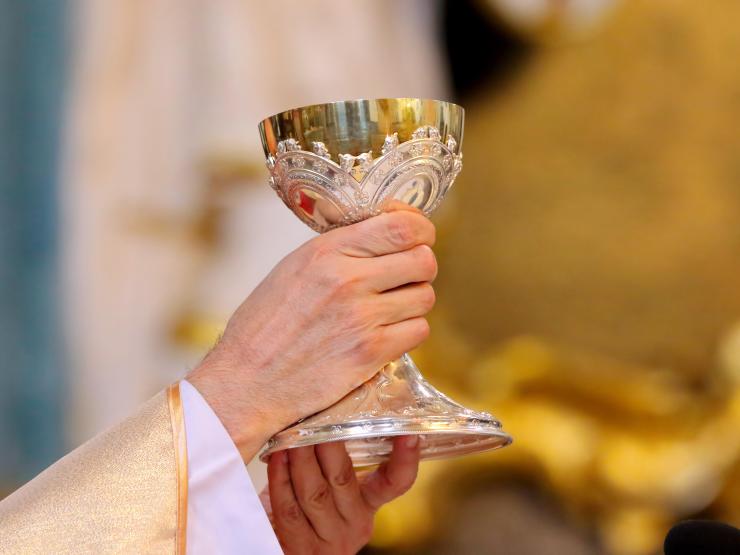
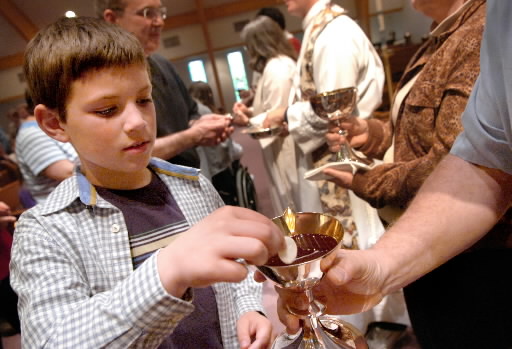
Photo credit: https://premierchristian.news/en/news/article/catholic-priests-allowed-to-offer-holy-communion-from-the-chalice-for-the-first-time-since-2020

Celebrating the sacrament of Holy Eucharist is one of my central jobs as a priest.  I approach the sacrament very seriously and reverently because I know how sacred the privilege of consecrating the Eucharist is and how profound the reception of Holy Communion can be.  In general, my philosophy is to be so graceful and intentional with my celebration that attention is taken off me and turned exclusively and intently to the mystery of the holy meal.

So, imagine my mortification when, after almost 16 years of celebrating Holy Communion multiple times a week, my hand clips the chalice and copious amounts of consecrated wine soak the altar (for those familiar with the terms, the corporal, fair linen, frontal, chasuble, and even my alb were victims).  It was an enormous mess – even the priest host was swimming in wine that landed in the paten.  The gasp was audible when it happened – I’m sure I took in a surprised gasp of air myself.  But I steeled myself and do what we priest always do – I kept going. 

Fortunately, despite the frustration of needing to clear the mess and get linens to the dry cleaners and washing machines, there were lots of laughs and ribbing afterwards.  But the visceral experience of wine flying, landing on silver implements, and making my hands sticky got me thinking.  In the Episcopal Church, we say Jesus’ real presence is in the bread and wine when the priest consecrates it.  There is nothing more incarnational than the messiness of spilt wine.  And we all know that being incarnate means being messy – our bodies naturally make perfection impossible.  But more than that, following Jesus is messy.  Following Jesus means getting into messy relationships with other messy people.  Following Jesus means Jesus sees all our own messiness – even the messiness we hide from others.  And following Jesus makes Jesus very hard to get rid of – there is stickiness to Jesus that lingers with us, much like the stickiness that stayed with me, even after cleaning up. 

I wonder in what ways you’ve been avoiding the messiness of Jesus lately?  In what ways has your desire to control the messiness of the Gospel left you with clean hands, but shallow experiences of the divine?  I look forward to hearing your stories of how the incarnational nature of Jesus is shaking up your life in good and holy ways.  We all need a little more messiness!

Sermon – John 17.20-26, E7, YC, June 1, 2025

18 Wednesday Jun 2025

Posted by jandrewsweckerly in Sermons

≈ Leave a comment

Tags

community, disciples, disunity, faith, gospel, Jesus, John, love, prayer, Sermon, unity

One of my favorite biblical scholars is Karoline Lewis.  She is one of the hosts of a preaching podcast I listen to, and through listening to her over the years I have found her to be insightful, funny, passionate, and deeply attuned to where the Word of God meets our daily lives.  Lewis is a New Testament scholar whose expertise is especially in the gospel of John.  In fact, her commentary on the Gospel of John is my go-to commentary anytime I am exploring John’s gospel.          

The irony in my deep appreciation for Karoline Lewis is that her passion and love for the gospel of John is almost in equal balance to my dislike for the gospel of John.  Where she finds deep beauty and meaning in John, I often find a jumble of words that are so repetitive and circular that I get lost.  Even when I have prepared a sermon for and studied a passage of John for the entire week, when I get to the moment of holding that gospel book and proclaiming John, I find myself second guessing myself, “Wait.  Didn’t I just read that sentence?  That sounds like what I just said a second ago – did I repeat a line?” 

Today’s gospel from John is a classic example.  We find ourselves at the end of Jesus’ farewell address to the disciples before his crucifixion and death, and within that address, at the end of his high priestly prayer.  In this prayer, Jesus prays several phrases in that typical Johannine circular language, “As you, Father, are in me and I am in you, may they also be in us…so that they maybe be one, as we are one, I in them and you in me, that they may become completely one..”  The good news is that Lewis and other scholars seem to agree that what Jesus is praying in his circular, convoluted way for is unity.  As scholar William Herzog suggests, “What matters most for John is that the experience of the indwelling remains available to the community, for the unity of the Johannine community is based not on dogma but on a communal experience of indwelling that is analogous to the relationship between Jesus and the Father.  This is what the community witnesses to the world.  Their mission is to keep this experience of faith alive in the community, so that they can offer it to a broken and fractured world.”[i]

Now, while unity is a theme we can get our heads around, unity is a practice we seldom live or experience.  Disunity is our lived experience.  One look at the deep, seemingly irreconcilable differences between political positions would be enough for any of us to understand how fantastical unity sounds.  But disunity is not just in the wider world.  Just this week in Discovery Class we were talking about how theological differences around the sacraments are what created the array of denominational differences within the Christian body – the reason why some of us are not welcome at the communion table in other denominations.  And that does not even address the differences of opinion the various churches hold on the role and place of women, LGBTQ members, and people of color.  But the lack of unity gets even closer to home right here at Hickory Neck.  I have long touted the unity of Hickory Neck across political and theological differences.  The unifying symbol of us of gathering together around the table has instilled in me a deep belief that if we can be one in communion, surely unity is possible in the world.  But even I, in the last six months have wondered if external pressures would prove that our unity is not as a strong as I think. 

That is why, for this one time in particular, I am grateful for John’s repetitive circular language.  Jesus’ final words of prayer today are, “I made your name known to them, and will make it known, so that the love with which you have loved me may be in them, and I in them.”  As one scholar says, “The last word is love.  Jesus does not call for doctrinal unity, organizational unity, or political unity.  So often, Christ’s prayer for his disciples has been used to sanctify those ends, and even to justify the harsh imposition of artificial unity.  Yet this prayer is for unity that grows out of the love of God, received and shared among his followers, leading to an experience of unity in love between Jesus and his followers, and with the one from whom Christ comes.  In moments of communion, surely the debates about the nature of God and humanity, the questions of whether divine grace or human will is the means of unity, all of these must fade away, leaving only the burning vision of a cross and the words, ‘For God so loved the world…’”[ii]

My fear that the unity I have witnessed at Hickory Neck would unravel was perhaps based on the idea that we could humanly will our unity to stay together.  But John’s gospel today reminds me that the only reason we are not unraveling is not because we have willed our unity, but because the love we have found in Jesus – the same triune love experienced within the three persons of the trinity – is what holds us together.  Jesus’ prayer today is not a prayer for those disciples who heard the prayer.  Jesus’ prayer today was for us – the future generations who would exist only through the love that the divine has given us – that circular, sometimes confusing, but ever convincing love in us and through us.  Our work is in that last part – that love going through us.  The love of Jesus for us in this prayer is not just for us – but is the gift that emanates through us out in the world.  As Lewis says of this prayer, “Jesus is no longer in the world.  The incarnation is over.  Jesus has been resurrected.  He ascended to the Father from whence he came.  But we are still in the world.  Jesus’ works are now in our hands, and Jesus is counting on us to be his presence in the wake of his absence.”[iii]  That charge would be daunting if not for Jesus’ prayer of promise – we can be that presence because the love that was in Jesus is now in us, breathing, transforming, and blessing the world through love.  Amen.


[i] William R. Herzog, II, “Exegetical Perspective,” Feasting on the Word, Yr. C, Vol. 2 (Louisville: Westminster John Knox Press, 2009), 545.

[ii] Peter J.B. Carman, “Theological Perspective, Feasting on the Word, Yr. C, Vol. 2 (Louisville: Westminster John Knox Press, 2009), 544.

[iii] Karoline M. Lewis, John:  Fortress Biblical Preaching Commentaries (Minneapolis:  Fortress Press, 2014),214.

Sermon – Luke 5.1-11, EP5, YC, February 9, 2025

12 Wednesday Feb 2025

Posted by jandrewsweckerly in Sermons

≈ Leave a comment

Tags

abundance, baptism, change, empower, feelings, gospel, Jesus, Kingdom, same, Sermon, wisdom, with, work

On occasions of big life milestones, we tend to be a people who like to offer sage advice.  Whether the advice is about how to approach retirement after decades of work, how to handle parenting to a first-time parent, how to manage marriage, how to navigate divorce, or, like today, how to approach full membership in the body of Christ through the act of baptism.  As parents and godparents tentatively offer their children to the Church, in turn, we as a community offer advice and counsel – sometimes formally through things like the baptismal covenant, and sometimes informally over coffee and cake from our own lived experiences.

As I was reading our gospel lesson this week, I was thinking about one of those loved bits of wisdom that often comes up in the life of the Church.  I cannot tell you the number of times I have heard a parishioner say to me, “You know what they say the definition of insanity is, Jennifer?  Insanity is doing the same thing over and over again and expecting different results.”  Sometimes, when we just cannot get some momentum to overcome a problem at church, I find myself doing an “insanity check” because of that old adage.  So, imagine my surprise when I read today’s gospel and hear Jesus basically asking the disciples to do the exact opposite of what that bit of wisdom suggests about how doing the same thing over and over again never leads to meaningful change. 

Here we are, meeting Simon, James, and John in Luke’s gospel for the first time.  These career fishermen have had a rough day on the job.  They have been out on the water all night long, using all their normal tricks, fishing in all the right spots, and have come to shore, exhausted, disappointed, and likely more than a bit irritated to have nothing to show for their labor.  Into this despondency and frustration, this guy, Jesus, inserts himself and basically says the complete opposite of what that old saying says about doing the same thing over and over.  Jesus says to the soon-to-be disciples, “Go back and fish again.”  To weary, disheartened men, who have just spent all night doing this work, Jesus says, “Do the work again.” 

We do not know why Peter agrees.  But we do know the feeling Peter describes when he basically tells Jesus this is a terrible idea.  We may not be fishermen, but we know “what it’s like to work really hard at something that matters, and have nothing to show for [our] efforts when [we’re] done.  …I imagine we all know what’s it’s like to pour ourselves into a job, a relationship, a ministry, a dream — and come away exhausted, frustrated, thwarted, and done.”[i]  For that matter, after the last month we may be having those feelings right now.  Whether we are weary from watching the chaos and upheaval of these first few weeks of a new administration, or we are weary from having big conversations about church, we know how resistant we would be if Jesus were to tell us, “Just go back out into the world (or to Hickory Neck) and keep doing the same thing!”

But here is the thing:  Jesus doesn’t actually ask Peter to keep doing the same thing.  Though the physical action Jesus is suggesting is the same, something dramatic changes in the scene.  Yes, Peter, James, and John, are using the same nets, in the same waters, in the same location, using all their same gifts.  But this time, this time the text tells us that Jesus gets in the boat with them.  Jesus does not shout from the shore what the disciples should do.  Jesus gets on that weary boat with them, and heads out into the deep, trouble waters with them.  As scholar Debie Thomas says, “This is a promise to cultivate us, not to sever us from what we love.  It’s a promise rooted in gentleness and respect — not violence and coercion.  It’s a promise that when we dare to ‘go deep,’ to do what we know and love with Jesus at our side, God will enliven our efforts in ways we couldn’t have imagined on our own.”[ii]

As I have been looking at the chaos in the political sphere right now, and even as I have been looking at pretty big changes at Hickory Neck, I have been wondering if Jesus’ only words of encouragement are going to be, “Just get back out in the deep waters and keep doing the good work of the Gospel.”  Because lately that has just felt more like “insanity work.”  Instead, what our gospel lesson tells us that when we get back to the work Jesus has given us to do, knowing that Jesus is in the boat with us, it means not only will we not get the same results, we are going to be surprised with abundance.  Now, I’m not saying you have to accept the promise of abundance enthusiastically.  Even Peter protests and then acquiesces half-heartedly.  “Yet if you say so, I will,” Peter tepidly commits.  So Debie Thomas tells us we can commit too.  “Yet if you say so, I will try again.  Yet if you say so, I will be faithful to my vocation.  Yet if you say so, I will go deep rather than remain in the shallows.  Yet if you say so, I will trust that your presence in the boat is more precious than any guarantee of success.  Yet if you say so, I will cast my empty net into the water, and look with hope for your kingdom to come.”[iii]

When we baptize little Arthur today, and we decide what bit of wisdom we want to pass along to him, forget about that whole “insanity” advice.  Maybe instead, our advice can be something more akin to our gospel.  We can tell him, “Sometimes Jesus is going to invite you to do some crazy stuff – to do something that you are certain will lead to the same old results.  But just remember, Jesus does not send without getting in the boat with you.  Jesus does not send you without empowering you to do the work.  Jesus does not send you without the promise that abundance will come.”  Our invitation today is to not to just give the advice to little Arthur – but to hear and embrace the advice for ourselves too.  Amen.


[i] Debie Thomas, “Same Old Same Old,” February 3, 2019 as found at https://www.journeywithjesus.net/essays/2075-same-old-same-old on February 7, 2025.

[ii] Thomas.

[iii] Thomas.

Sermon – Mark 6.14-29, P10, YB, July 14, 2024

17 Wednesday Jul 2024

Posted by jandrewsweckerly in Sermons

≈ Leave a comment

Tags

death, disciple, Good News, gospel, Herod, Jesus, John the Baptist, Kingdom, politics, scripture, Sermon, terror, together, work

Today’s gospel lesson contains one of those iconic stories that is so vivid the story is seared in our minds.  In short, John the Baptist is decapitated by Herod Antipas who serves John’s head on a platter.  On the one hand, the brutal scene, depicted in art for centuries, is one we prefer to acknowledge and move on.  Certainly, this is a cautionary tale for the prophetic life.  John is now dead, and Jesus takes the reins.  But there is so much more to this story.  There is John’s faithfulness to making a way for the inbreaking of the kingdom – including the criticism of Herod Antipas’ marriage to his brother’s wife.  There is the king’s imprisonment of John mingled with his fascination with John, leaving him sitting at John’s feet enthralled by John’s teachings.  There is the vengeance of Herodias, the criticized wife of Antipas, who manipulates her daughter into asking for John’s head.  There is the proud Herod Antipas who makes ridiculous promises to his daughter and spinelessly agrees to kill John despite his knowing better – just to save face in front of his friends.  This is a story so woven in political and ethical intrigue that we do not like to look too closely for fear of seeing modern-day parallels.

But what is perhaps more intriguing about trying to avert our eyes from this brutal, shameful scene is that John’s beheading is not the first time scripture hands us a story like this.   “The story looks like a reprise of 2 Kings 16-21, the story of Queen Jezebel, the enemy of Elijah.  Just as Jezebel manipulated her husband, King Ahab, so Herodias manipulates Antipas.  Just as Elijah indicts Ahab and Jezebel, so John the Baptizer indicts Antipas and Herodias.”[i]  Furthermore, there are parallels to Esther’s story, whose husband also promises her anything she wants, up to half of his kingdom.  Esther uses her promise for good, able to thwart the villain Haman’s plan to kill off her fellow Jewish brothers and sisters.  Reflecting on the canon of scripture, we cannot avoid the ugly truth that scholar Amy-Jill Levine uncovers:  that “Death at the hands of corrupt authorities is the fate of John, and Jesus, and of countless others who have done the right thing, at the cost of their own lives.”[ii]

So, what do we do with this tale of terror laid at our feet today – a tale told time and time again in scripture?  I am intrigued by scholar Matt Skinner’s instruction look at the disciples.[iii]  In the very last line of our text today, Mark says, “When his disciples heard about [John the Baptizer’s murder], they came and took his body, and laid it in a tomb.”[iv]  If you remember, in the text last week, Jesus was shut down in his hometown and unable to perform miracles, instead sending out the twelve in pairs to cast out demons and to heal the sick.  For Jesus and his disciples, they got back to work.  And if we kept reading Mark’s gospel, in the verses that follow today’s story, we will hear how Jesus and disciples go on about their work, with Jesus miraculously feeding five thousand people.  John’s death is horrific, brought about by evil and sinfulness.  And yet, his disciples boldly come forward and bury his body.  Jesus sees John’s death and must know a similar fate awaits him.  And yet, he and his disciples get back to work, doing the good news of God in Christ.

Stories like John’s beheading are indeed graphic, sobering stories of what awaits those who live in the light of God.  And yet, time and again, Elijah, Esther, John the Baptizer, Jesus, and Jesus’ disciples keep going.  They keep doing the next good thing.  There is part of that model that feels unjust – surely, we should be fighting for justice, standing up to those who abuse power, who manipulate authority, whose self-centeredness and pride promote evil.  We revere plenty of saints who did just that kind of work.  And yet today, in the face of brutality, hopelessness, and injustice, the disciples of John and the disciples of Jesus just keep going.  They keep doing the work of the kingdom.

We are in an unprecedented time of political turmoil.  And in the coming weeks and months, given our diverse political backgrounds in this community, we will likely disagree about what our country can and should be doing.  But what brings us to this common table every week is a commitment to the life and ministry of Christ – the bringing about of a kingdom that is not of this world.  We will need each other – sometimes to figure out what the next best thing is, sometimes for the encouragement to do the next best thing, and always as a reminder that we disciples of Jesus need each other to do the next best thing.  We know from John, Jesus, Elijah, and others that doing the next best thing may end in personal suffering.  But we also know that continuing to do that next best thing helps bring us just a little bit closer to that kingdom here on earth.  We go together.  Amen.


[i] Amy-Jill Levine, The Gospel of Mark:  A Beginner’s Guide to the Good News (Nashville:  Abingdon Press, 2023), 38-39.

[ii] Levine, 42.

[iii] Matt Skinner, “Commentary on Mark 6:14-29,” July 14, 2024, as found at https://www.workingpreacher.org/commentaries/revised-common-lectionary/ordinary-15-2/commentary-on-mark-614-29-6 on July 12, 2024.

[iv] Mark 6.29.

On Looking Back to Look Forward…

20 Friday Oct 2023

Posted by jandrewsweckerly in reflection

≈ Leave a comment

Tags

church, Episcopal Church, formation, God, gospel, history, impact, seminary, stewardship

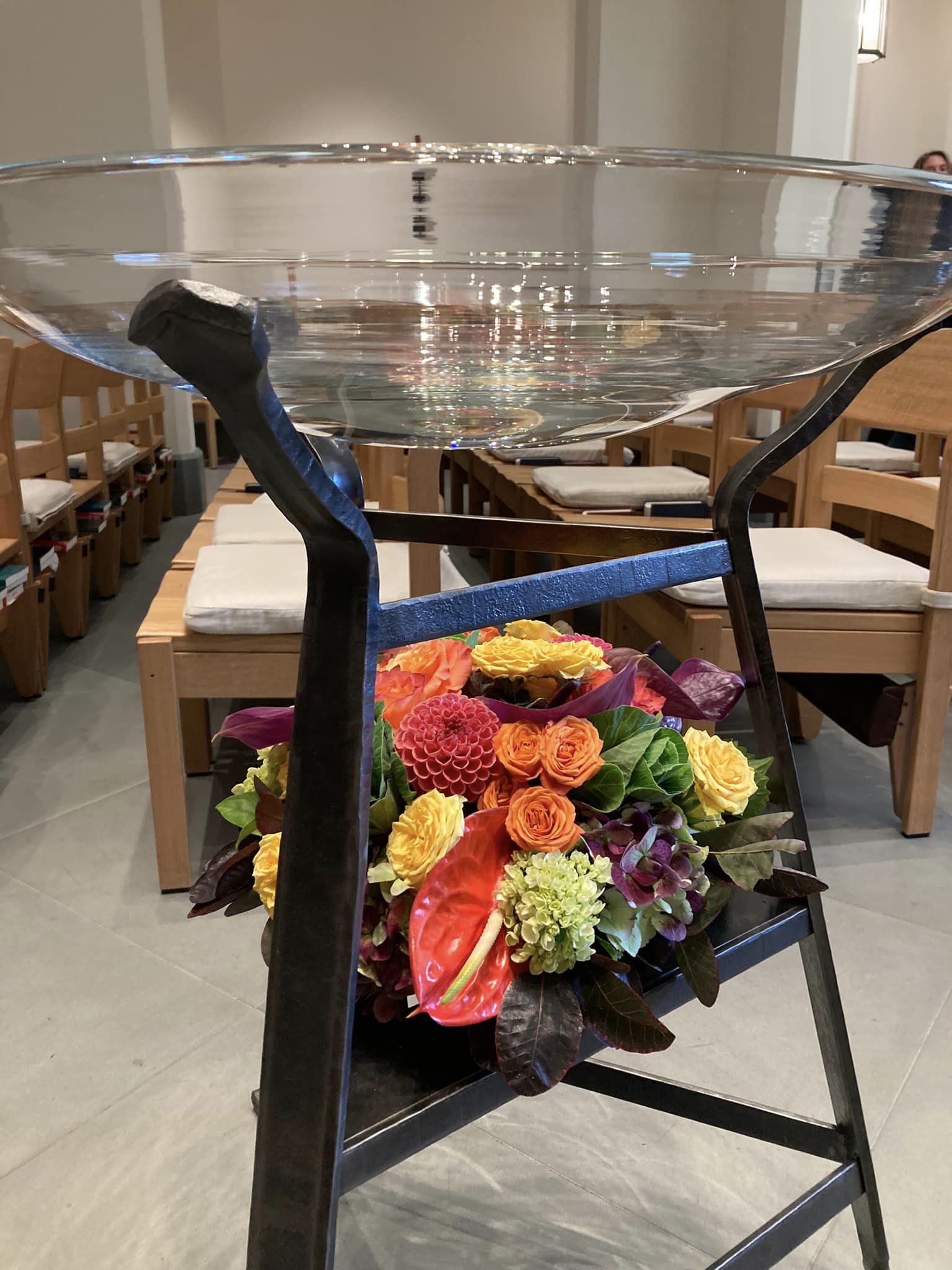
Font at Virginia Theological Seminary

I remember when I was a seminarian, sitting in daily worship, my eyes and mind would sometimes wander.  In particular, I was fascinated by the names or other small mementos carved into the old pews.  I always wondered who the mystery person was who left their mark, how long ago they carved it, and how they managed not to get caught.  What I loved about those small little marks was how they made me feel connected – connected to a long line of priests and lay leaders shaped by the seminary, all with varying gifts and talents, serving God in God’s church around the world.

Last week, my seminary honored 200 years of forming priests in the Episcopal Church.  Though those pews from the old chapel were lost in a fire, what struck me was the massive changes the seminary has seen.  From slaves who helped build and then worked on the property, wars that shaped the context for ministry dramatically for generations, fiduciary decisions that impacted the viability and structure of the seminary, the growing diversity of the student body as the Episcopal Church’s understanding of who can be called to ministry has expanded, and an evolving physical plant that has shifted what the school on the holy hill looks like – all of that change has made for a rich and layered history, of which I am a small part. 

But perhaps what speaks to me most about Virginia Theological Seminary is the ways that it also has a microcosmic impact on the church – namely, the ministry of every graduate from the seminary.  My time at VTS shaped and formed me into the priest I am today – from academic formation to liturgical formation, from learnings on leadership to the development of relationships, from shaping my spirituality to shaping my sense of the wider church.  And for every graduate like me, VTS has shaped thousands of others who go out into the world to preach the gospel.  That reality is what inspires my financial support every year – knowing the future generations I can support.

As my church journeys into stewardship season, a time of discernment about how we will support our church financially and with our time, I am reminded of how we all come to think about the stewardship of our resources.  Supporting my seminary and my church financially are ways I say to those institutions and my community that these institutions are important to me:  they have made an impact in my life, and have inspired me to make an impact on the them.  I would not be the priest, mother, or wife that I am without either my seminary or Hickory Neck Church.  What about you?  How has our church shaped your life?  What stories are the stories that make you eager to be a part of financially supporting ministries of impact?  I can’t wait to hear what inspires your giving!

On Seeing Christ in the Chaos…

08 Wednesday Jan 2020

Posted by jandrewsweckerly in Uncategorized

≈ Leave a comment

Tags

chaos, control, expectations, God, Good News, gospel, holy, Holy Spirit, Jesus, mess, sacred, scripture, story

61002735_2362089520513961_2511345267203112960_o

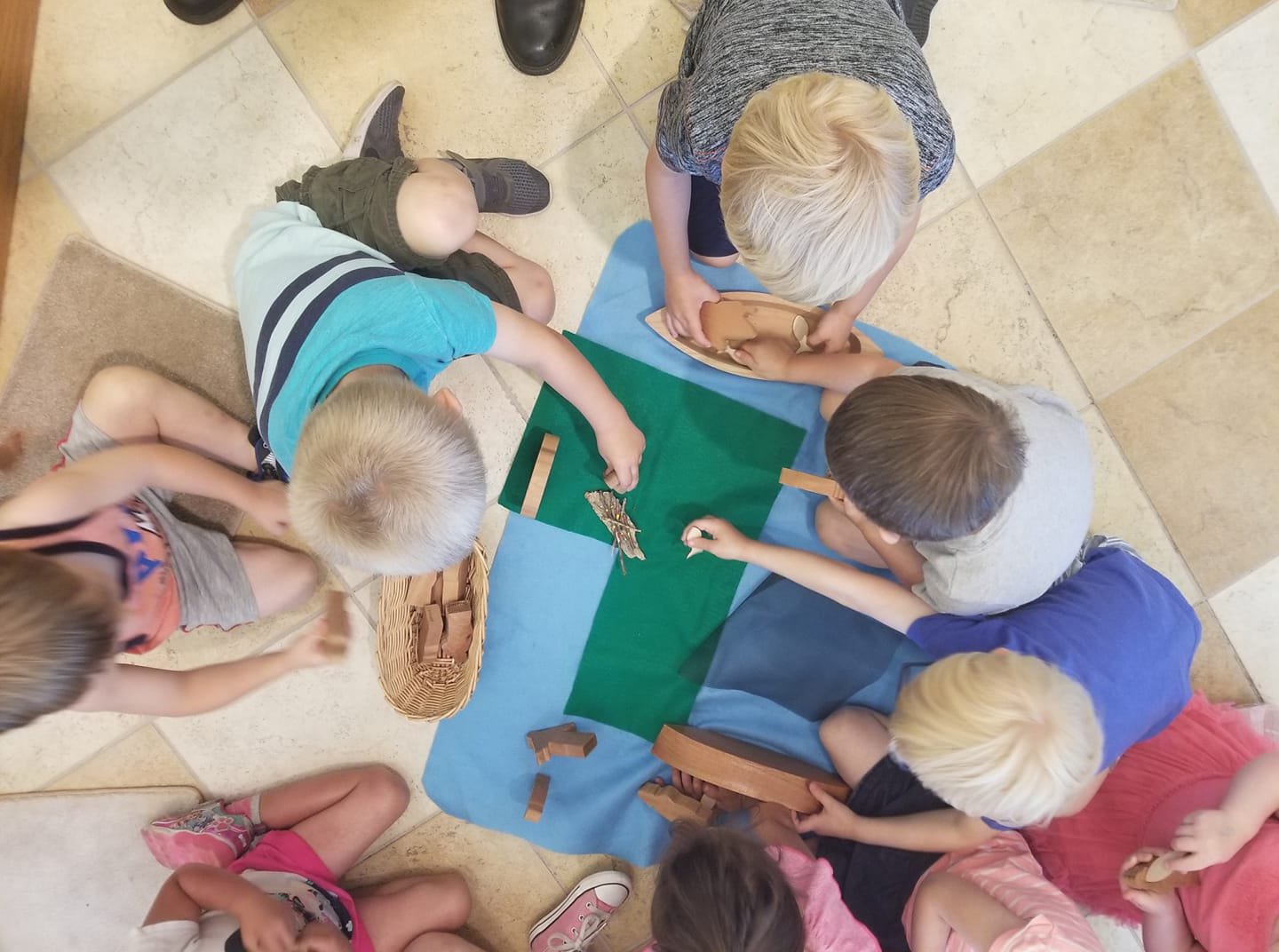
Photo Credit:  Charlie Bauer; reuse with permission only

Yesterday at the Godly Play class Hickory Neck offers at The Kensington School, we finally got to tell the Epiphany story – the story of the magi visiting the Christ Child.  As we reviewed the whole story of Advent and Christmas, out came all the figurines of prophets, Mary, Joseph, Jesus, Angels, Shepherds, various animals, and wise men.  Typically, the teacher tells the story quietly, using the figurines, and then we have the kids retell the story, taking turns with the figurines.  And because the class has become so large, we usually have two sets of figurines so we can break into groups.  I would never say the class is perfectly orderly, but it is much more measured than you might imagine with two- to five-year-olds.

But not yesterday.  I’m not sure whether we, the leaders, were off our game, or the kids were still hyped up from returning from break, but the retelling portion of class was utter chaos.  Taking turns fell apart, quiet redirecting failed miserably, and by the time we regrouped to close the class, there was a mass of wooden, sacred figures in a disordered pile.  As we were making our way out, I looked at the pile sadly, grateful that they were all made out of sturdy wood and nothing more destructible, but somewhat disappointed to see such a holy mess.

But as I was thinking about the mess today, I was thinking perhaps my sadness at the chaos was my own “stuff,” having nothing to do with the success of the class.  Too often, we like our Gospel stories neat and tidy.  Too often we tell familiar scriptural stories expecting them to teach specific lessons.  But when we are honest, we know that is not how the Good News works.  The Good News upends worlds, upends social order, and upends our expectations.  Engaging with Jesus is messy work, and sometimes, in the midst of trying to figure out our faith, we end up with a messy rubble in front of us.

I do not know what you are you struggling with today – what things you wish were under control but are actually a mess, or what things you have been expecting from God that just are not how you expected, or what chaos others are making in your life that makes you feel bereft.  What I can tell you is that Christ is there, maybe a bit mired in the chaos too, but there nonetheless.  And sometimes, the mess is just what you need to shake you up and see the movement of God in a new and fresh way.  I suspect things will not turn out as you expect, but then, the Holy Spirit rarely works in ways we expect.  Sending you prayers today, that you might see Christ in the chaos!

On Being an American and a Christian…

03 Wednesday Jul 2019

Posted by jandrewsweckerly in Uncategorized

≈ 3 Comments

Tags

American, asylum, baptism, children, Christian, complicated, Detention, diverse, faith, God, gospel, immigration, Jesus, politics

6d4151a40a463e26db746895528eb216

Photo credit:  https://www.pinterest.com/pin/439734351090290865/

Last week, several of the interfaith clergy in our community published a litany for children in detention centers.  They requested clergy leaders read the litany in their homes of worship – not in a special vigil, but in the heart of where weekly prayer and formation take place.  The litany was beautiful, and spoke to much of my own sense of despair about our treatment of children.  But I found myself in a quandary.  You see, my parish is a diverse one.  We pride ourselves on being Christians of varying political opinions who respect one another enough to honor our political differences by kneeling as equals at the Lord’s table.  In order to maintain that sense of respect, I am very careful about how I talk about current events.  My goal is always to preach the gospel of Jesus Christ, with the charge that we should engage in politics with the Gospel always in the forefront.

But the issue of children in detention centers tugs at me at two levels.  On the one hand, this is very much an issue of politics – of how we manage the flow of immigrants and those seeking asylum into our country.  I know our parishioners are of a divided mind on this issue – as is most of the country.  The issue of our borders is vastly layered – were it not so, there would be clear, easy answers to very difficult questions.  In addition to being a political, economical, sociological issue, this is a spiritual one as well.  One’s sense of gratitude for our country’s blessings, one’s baptismal covenant to respect the dignity of every human being, and one’s understanding of Christ’s command to love God and love neighbor collide with the realities of limited resources, stretched budgets, and funding priorities.

On the other hand, these are children.  These are eight-year-olds caring for unrelated infants.  These are nursing teen mothers with no diapers or place to lay their heads.  These are toddlers who have no way to wash their hands or clean their soiled clothing.  I look at my own children, who have every comfort they could ever need, and when I imagine them soiled, hungry, deprived of sleep, and so afraid that the color has drained from their faces, my heart shatters.  I know this issue is truly complicated, and I know that philosophically we as a country need to decide how we will manage the treatment of our neighbors.  But when I am hesitant to pray for the welfare of children in detention because it is politically complicated, I realize I am failing to live the Gospel life.

I cannot say I will ever be able to pray the litany presented by my interfaith brothers and sisters.  Though it is beautiful, it is also politically motivated.  But what I can tell you is, as a pastor and baptized child of God, I am praying for those children, praying for their mothers and fathers, and praying for our own souls as we figure out how to reckon politics and human dignity – how to be Americans and Christians.  Given our country’s history, it would seem those two things fit together easily.  But to be a good American and to be a good Christian both take intentionality, discernment, and prayer.  May God bless us all as we seek to harmonize the two.

On Responding to the Gospel…

03 Wednesday Oct 2018

Posted by jandrewsweckerly in Uncategorized

≈ Leave a comment

Tags

community, financial, giving, God, gospel, Jesus, ministry, passion, respond, Sermon, stewardship, talent, time, treasure

4rm9v5wz-1371530696

Photo credit:  http://theconversation.com/giving-the-gift-of-giving-why-children-should-be-taught-philanthropy-13991

This past Sunday we had a visitor at church from out of town.  We were kicking of stewardship season, a time when we talk about our financial giving to the church in preparation for the financial pledges we make for the coming year.  The visitor was an Episcopalian, and no stranger to stewardship in the church.  As he departed he said, “That was a good sermon, by the way…you know, for a stewardship sermon.”

I laughed heartily, and appreciated his honesty.  I suspect he has heard many a stewardship sermon.  As I thought about his feedback, I realized how separate “stewardship season” can feel from other times – how you can pinpoint a stewardship sermon from a regular sermon.  But the more I thought about it, the more I realized stewardship sermons should feel more like the norm than the exception of October every year.  Everything we do in church is tied to our financial giving.  Our financial giving is simply the “so what?” of every experience we have in church.

This month we are in the midst of stewardship parties, having engaging conversations about our experiences and dreams for Hickory Neck.  As a community, part of what we are hoping to help people realize is all that happens at Hickory Neck is tied to how we support our ministries with our treasure.  The dreams we have for the work God has given us to do need not only our time and talent – they need our treasure; and not just any treasure, but a treasure that says, “This community and this work is important to me – so important that I will put my resources back into our work to the glory of God.”

This Sunday, we have a fantastic guest preacher coming.  As I was preparing her for the services, I forewarned her that we would be in stewardship season, and she may want to consider that in her preparation.  She quickly responded, “Oh that’s okay.  Every sermon I preach is a stewardship sermon.  You can’t hear the Gospel without a response!”  I hope our guest preacher, our parties, our parishioner reflections, and the materials you have received are helping you consider how every week Jesus is asking for a response from you.  Our work this month is connecting our passion for this place with our financial support of this place.  I couldn’t be more excited to join you in that response!

On Politics, Priests, and Prayer…

20 Wednesday Jun 2018

Posted by jandrewsweckerly in Uncategorized

≈ 4 Comments

Tags

American, Bible, Christian, communion, dignity, disciple, diversity, Episcopal Church, Eucharist, Good News, gospel, Jesus, policy, politics, prayer, priest, scripture, table

lightstock_99088_medium_david_needham

Photo credit:  https://www.lebanonfbc.org/ministries/power-prayer-pop

One of the hardest parts of being a priest is creating a community in which we can talk about the Gospel of Jesus Christ, hold widely varying political opinions, and yet still gather at the Eucharistic Table – elbow to elbow, as the imperfect, but beloved body of Christ, determined to stay in community.  I say that the work is difficult because I have seen how fragile this work really can be.  During my priestly formation at seminary, congregations and Dioceses were walking away from that common table over the issue of human sexuality.  Although I was proud of what the Episcopal Church did at the time, I also deeply mourned the loss of diversity at the Table – the creation of a more homogenous Church than a Church who was devoted to staying in the tension while honoring the Gospel.

Because of my high value of the uniting force of the Eucharistic Table, my priesthood has taken a slightly different shape than I might have imagined in my early twenties.  If you had asked me then about the primary role of the priest, I might have argued the role of prophet – decrying injustice and leading the people of faith to a more just world.  But as I aged, and as I served diverse parishes, I began to see the role of prophet is one of many roles, one that needs to be used judiciously so as not to alienate parishioners and create an exclusive community of like-minded people.  And so, my priesthood has been marked with great caution around politics.  While many of my colleagues will beat the drum for justice, I find myself trying to carefully walk with my diverse congregations as we discern together how to interpret politics in light of the Gospel – not in light of Democrats or Republicans, but in light of the witness of Jesus Christ.  That doesn’t mean I don’t have strong political opinions; it just means that I try to take focus off the politician or political issue of the moment and try to create disciples who can see and follow Christ.

That being said, this past week, the issue of what is happening to families seeking asylum on our southern border, and the separation of children from parents as a punitive, purportedly deterring action has shifted my normal practice – not because I changed my mind about politics and the Church, but because two agents of our government utilized Holy Scripture to justify those actions.  Here’s the thing:  if this were just another issue where we are divided about policy, where we had a debate about the extents to which we value national security over other values, I would have happily encouraged our parishioners to be faithful Christians in dialogue.  But when Attorney General Jeff Sessions invoked Holy Scripture to justify separating children from parents, he stepped into my area of authority, leaving me no other option but to speak.

Now I could layout a Biblical defense against the small portion of Romans 13 that Attorney General Sessions quoted, giving you the context of the chapter, giving you the verses immediately following what he quoted as a counter to his argument.  I could quote to you chapter and verse for countless other scripture lessons that tell us to love one another, respect the dignity of other human beings, care for the outcast and alien, tend the poor, and honor children.  I could also tell you about how that same bit of scripture was used to justify slavery, Nazis, or apartheid in South Africa.  But the problem with a scripture quoting war is that no one wins.  What is more important is what we know of the canon of Scripture:  that our God is a God of love, that Jesus walked the earth showing us how to be agents of love, healing, and grace, and that the Holy Spirit works through us today to keep spreading that love.

Knowing what I know about the Good News of God in Christ, in my baptismal identity as one who seeks and serves Christ in all persons, respecting the dignity of every human being, I cannot stand idly by or be silent when the Holy Scriptures of Christians are being used to justify political actions that are antithetical to our Christian identity.  As a priest, I invite you this week, especially when a governmental leader is invoking our faith, to reflect on how the Gospel of Christ is informing your view on this issue.  Not as a Republican and not as a Democrat, but as a follower of Christ.  Fortunately, prominent politicians on both sides of the aisle seem to be coming to agreement on this issue – a rarity these days – but also an example to Episcopalians who hold a high view of coming to the Eucharistic Table across our differences.  I am not saying we need to agree on this – in fact, I suspect we will not.  What I am asking is that you live into your identity as a disciple of Christ, as an agent of love, and then respond in conversation, in political advocacy, and in worship as one holding in tension both our American and Christian identities.  I support you in this difficult, hard work.  I love you as you struggle.  I welcome you to the Eucharistic Table.

On Politics at the Table…

30 Wednesday May 2018

Posted by jandrewsweckerly in Uncategorized

≈ Leave a comment

Tags

Bishop Curry, church, Eucharistic Table, God, gospel, hope, Jesus, love, politics, Reclaiming Jesus, table, transformative, truth

Last week I talked about Presiding Bishop Michael Curry’s sermon at the Royal Wedding.  His sermon on the transformative power of love created shock waves – one, because most people weren’t expecting such a powerful sermon on a royal wedding day; but two, because his words resonated so deeply with people.  He created a spark of hope, a sense of clarity of purpose, and a renewed passion for justice and compassion.   The message was not new:  he simply preached the gospel of Jesus, a two-thousand-year old message.  And yet, the gospel, like it does for every generation, spoke a word of truth.

But after appearances on the Today Show, Good Morning America, The View, and countless other programs, it would be easy to soften Bishop Curry’s message, to say, “Yes!  Love is the answer!” and walk away with a warm fuzzy feeling.  The trouble is, Bishop Curry’s sermon was not just about the easy parts of love.  Bishop Curry preached about the action of love.  If we find the message of love compelling, then we have to start living lives of love.  And that is where his powerful message starts getting uncomfortable.

5b0830721a00002700cdfc6f

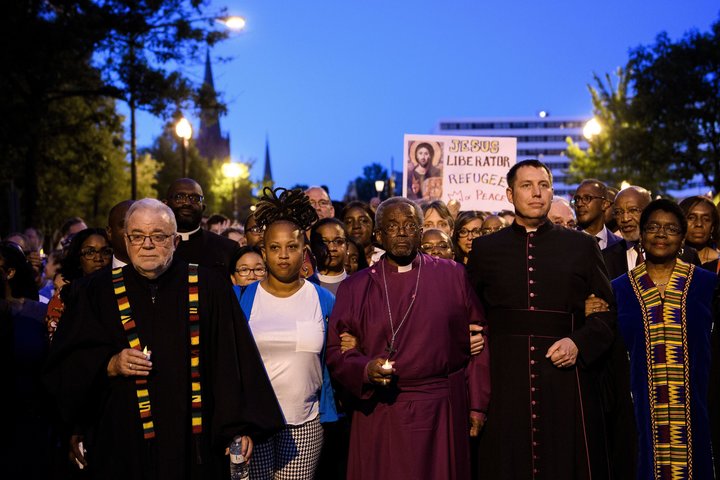
Photo credit:  https://www.huffingtonpost.com/entry/bishop-michael-curry-joins-christian-march-to-white-house-to-reclaim-jesus_us_5b07261ae4b0fdb2aa51b060

Less than a week after his historic sermon, Bishop Curry joined prominent faith leaders from all over the country in a movement called, “Reclaiming Jesus.”  A video explaining the movement can be found here.  Now if you have spent any time with me, you know that I am very hesitant to talk politics in the pulpit or even publicly.  I have always served in churches that were a wonderfully complicated mixture of political opinions.  The Eucharistic Table is the thing that brings us together, kneeling before God, shoulder to shoulder with fellow church members whose bumper stickers promote the exact opposite opinion of our own.

But just because I do not believe Jesus was a Democrat or a Republican, does not mean that I do no think Jesus and the Gospel are not political.  In fact, Jesus’ very life was ended because he was too “political” – because his message of love made people uncomfortable.  That is what the Reclaiming Jesus movement is about – reminding us that the Church still has a message of love – and that message is not passive or polite but is quite active and alarming.

This week, I am taking the warm, encouraging feelings I had from Bishop Curry’s sermon and listening once again to his words about what love in the world means.  I invite you to join me.  Join me in hearing what in the Reclaiming Jesus message makes you uncomfortable.  Join me in pondering how both political parties get it a little bit wrong and a little bit right.  Join me in remembering that Jesus’ message of love is not the same as an invitation to “avoid politics.”  The question is how we can do politics better.  How can we be an example of what it means to don different bumper stickers and work together for justice, peace, and love?  What Bishop Curry preached at the Royal Wedding sounded beautiful – just like Jesus’ own words.  But what Bishop Curry and Jesus called for was not just beautiful.  It is hard, confusing, challenging work – and even harder to do when we disagree so deeply.  Thank God for the Eucharistic Table!  It is the only promise to me that we can do this – that we can be political agents of love together.  I hope you will join me!

chalice-emhc

Photo credit:  http://www.freerepublic.com/focus/religion/3163266/posts

← Older posts

Recent Posts

  • On the Myth and Magic of Advent…
  • On Risking Failure and Facing Fear…
  • Sermon – Luke 23.33-43, P29, YC, November 23, 2025
  • On Inhabiting Gratitude…
  • Sermon – Luke 20.27-38, P27, YC, November 9, 2025

Archives

  • December 2025
  • November 2025
  • October 2025
  • September 2025
  • August 2025
  • July 2025
  • June 2025
  • March 2025
  • February 2025
  • December 2024
  • November 2024
  • October 2024
  • September 2024
  • August 2024
  • July 2024
  • June 2024
  • May 2024
  • March 2024
  • February 2024
  • January 2024
  • December 2023
  • November 2023
  • October 2023
  • September 2023
  • August 2023
  • July 2023
  • June 2023
  • May 2023
  • March 2023
  • February 2023
  • January 2023
  • December 2022
  • November 2022
  • October 2022
  • June 2022
  • May 2022
  • January 2022
  • December 2021
  • November 2021
  • October 2021
  • September 2021
  • August 2021
  • June 2021
  • May 2021
  • April 2021
  • March 2021
  • February 2021
  • January 2021
  • December 2020
  • November 2020
  • October 2020
  • September 2020
  • August 2020
  • July 2020
  • June 2020
  • May 2020
  • April 2020
  • March 2020
  • February 2020
  • January 2020
  • December 2019
  • November 2019
  • October 2019
  • September 2019
  • August 2019
  • July 2019
  • June 2019
  • May 2019
  • April 2019
  • March 2019
  • February 2019
  • January 2019
  • December 2018
  • November 2018
  • October 2018
  • September 2018
  • August 2018
  • July 2018
  • June 2018
  • May 2018
  • April 2018
  • March 2018
  • February 2018
  • January 2018
  • December 2017
  • November 2017
  • October 2017
  • September 2017
  • August 2017
  • July 2017
  • June 2017
  • May 2017
  • April 2017
  • March 2017
  • February 2017
  • January 2017
  • December 2016
  • November 2016
  • October 2016
  • September 2016
  • August 2016
  • July 2016
  • June 2016
  • May 2016
  • April 2016
  • March 2016
  • February 2016
  • January 2016
  • December 2015
  • November 2015
  • October 2015
  • September 2015
  • August 2015
  • July 2015
  • June 2015
  • May 2015
  • April 2015
  • March 2015
  • February 2015
  • January 2015
  • December 2014
  • November 2014
  • October 2014
  • September 2014
  • August 2014
  • July 2014
  • June 2014
  • April 2014
  • March 2014
  • February 2014
  • January 2014
  • December 2013
  • November 2013
  • October 2013
  • September 2013
  • August 2013
  • July 2013
  • June 2013
  • May 2013
  • April 2013
  • March 2013
  • February 2013
  • January 2013
  • December 2012
  • November 2012
  • October 2012
  • September 2012

Categories

  • reflection
  • Sermons
  • Uncategorized

Meta

  • Create account
  • Log in
  • Entries feed
  • Comments feed
  • WordPress.com

Blog at WordPress.com.

  • Subscribe Subscribed
    • Seeking and Serving
    • Join 394 other subscribers
    • Already have a WordPress.com account? Log in now.
    • Seeking and Serving
    • Subscribe Subscribed
    • Sign up
    • Log in
    • Report this content
    • View site in Reader
    • Manage subscriptions
    • Collapse this bar
 

Loading Comments...