• About

Seeking and Serving

~ seek and serve Christ in all persons

Seeking and Serving

Tag Archives: gratitude

In it Together…

06 Friday May 2016

Posted by jandrewsweckerly in Uncategorized

≈ Leave a comment

Tags

alcoholism, both-and, church, compassion, either-or, Eucharist, gratitude, grief, honor, joy, mother, Mother's Day, pain

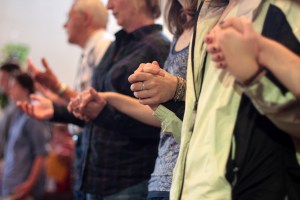
Hands-together

Photo credit:  indianapublicmedia.org/harmonia/offering-hand/

This week I attended our Spring Clergy Day.  Our presenters for the day talked to us about addictions and their impact on families and communities.  As part of our work, we eventually began to talk about how we honor those in our midst who are struggling with the disease of addiction while staying true to ourselves.  One specific issue at hand was how to make room for alcoholics in a Church that serves wine as the blood of Christ.  Although our Bishop was pretty clear that he did not want us to step outside of the rubrics (i.e. using grape juice instead of wine/non-alcoholic wine), several clergy members shared practices they had adopted to make parishioners struggling with alcoholism feel incorporated into the community.  Ultimately, what we decided was that each parish was different, and the important point was that we talked about the issue, especially soliciting the opinions of those who suffer from the disease.

Meanwhile, this Sunday is Mother’s Day.  I have come to dread Mother’s Day because of the many pastoral implications (see my posts here and here).  However, I am in a new parish that longs to honor those mothers and mothering-types who have made a healthy impact in their lives.  I realized the dilemma of trying to honor mothers while honoring those for whom Mother’s Day is a hard day is not unlike the dilemma of trying to honor years of tradition in the Anglican Church and the pastoral sensitivities needed of a modern priest.

In both of these instances, I find myself mostly concerned about making room for both joy and compassion.  How do we honor the struggle of the alcoholic while also honoring the power the taste and tradition of wine has on our spirituality?  How do we honor the amazing mother we have in our lives while also honoring the fact that not everyone is so lucky?  How do we celebrate the pregnancy or birth of a child in our parish while also honoring how difficult hearing about pregnancy is for someone struggling with infertility?

I am hopeful that we can do both.  This Sunday, my parish is going to try to do just that.  We had several parishioners who really wanted to honor the mothers in our midst.  Holding on to that inner tension, we agreed that every female would be offered a flower and a poem that named the inherent challenge of honoring the amazing mothers in our lives and the ways that this day is hard for many of us.  Our hope is that by doing both, we have the opportunity to give thanks and rejoice while also leaving room for grief and intercession.  We know there is no perfect way to do both – but we also know that in doing nothing, we sever any opportunity for joy by simply attending to grief.  Instead, we are electing to go with the both-and instead of the either-or.  Prayers for all of you as you navigate the both-and of this world!

On hollowness and hallowedness…

02 Saturday Apr 2016

Posted by jandrewsweckerly in Uncategorized

≈ 2 Comments

Tags

abundance, empty, God, good, gratitude, grief, hallow, hollow, house, memories, moving, sadness, tradition, transition

Empty-Property

Photo credit:  https://www.nationalpropertytrade.co.uk/dealing-with-empty-property/

As I mentioned recently, I have moved a lot in my lifetime.  If my calculations are correct, I have moved about 15 times (and that’s only counting college once, despite the fact that I moved to a different dorm every year, and twice my junior year).  As you might imagine, the moves have occurred over a lifetime – from as young as one-year old to this move in my late thirties.

At some point over the years of moving I developed a tradition.  When the whole house is empty, the truck fully loaded, and the cars ready to pull out, I quietly slip back into the house and walk through every room.  There is something about the hollowness of an empty home that you have lived in:  the echo of your feet as you walk through the house, the lingering hints of artwork once hung, and even the scents of people or food.  There is an ache that the emptiness causes – a finality like none other.  But there is also the rush of memories:  the child you brought home from the hospital, the sleepless nights as the toddler transitioned to a “big girl bed,” the parties and family celebrations, and the countless visitors.  In the silence of the empty house you can hear the hint of years of laughter, remember the nights of tears shed, feel the warmth of a child rocked to sleep, and see the shadows left by the lamp as you wrote by night.  Though the house is empty, the house has been your home, steeped in love for however long you have been there.  The hollowness reveals the hallowedness of the space.

This week I continued the tradition.  Though I have given myself little time to grieve the phase of my life’s journey, tonight I realized how sad I am to close this chapter.  God has been so very good to us here – four years of marriage and children and work and play is a lot.  We have been blessed by new friends and experiences.  We have grown and changed for the better.  In the quiet of the house, I am deeply grateful for the abundance God has shown us.  God is good.  All the time.

Reconciling Preparedness and Blessedness

31 Thursday Mar 2016

Posted by jandrewsweckerly in Uncategorized

≈ 1 Comment

Tags

blessed, church, God, good, gratitude, moving, packers, plan, prepared, transition, wonderful

MovingDay_081415_main

Photo credit:  www.bestofboston.com/best-of-boston-all-stars-liberty-hotel/

For those of you who know me well, you know that I am not the friend you want nearby in case of an emergency.  I’m not the quickest thinker on my feet.  I could tell you of countless stories involving blood and fire at construction sites to prove my point.  Knowing that weakness, I tend to compensate through preparation.  I will plan, think through various contingencies, and consult experts to make sure that if an emergency comes up, I do not have to think on my feet as much – I’ve already figured out various scenarios.

So for a consummate planner and preparer, you can imagine how this move has put me over the edge.  I, perhaps crazily, decided that my last Sunday at my current parish would be Easter Sunday.  The movers would come later in the week, and then we would head out by week’s end.  I had a plan.  But then I forgot how busy Lent and Holy Week are.  I forgot how challenging dealing with children who are on break can be.  I forgot how many logistics would be necessary for buying a new home, starting new schools, and starting a new job.  I forgot how much time I would need to commit to spending time pastorally with the parishioners who had been in my care for the last four-plus years.  Consequently, when the packers arrived today, I was nowhere near as prepared for them as I had planned.

Now that may not sound like a big deal, but as someone who is a crazy planner and as someone who has moved more times than I can count, this a grave disappointment.  By Wednesday night I was in a panic about how little was done.  I was aghast at my lack of preparation.  All that purging, all that organizing, all those donations, all that cleaning I had planned went mostly undone.  For someone like me, this is the ultimate anxiety-inducing experience.

So this morning, as I sit with packers in a flurry around me, I am working on breathing.  I am working on accepting I have done what I can do.  Despite my inner criticism, I am working on listening to the reassuring voice of God telling me, “Well done, good and faithful servant.”  Instead of concentrating on the list of incomplete things, I am reflecting on all the good and wonderful things of these last weeks:  heartfelt goodbyes, beautiful liturgies, yummy food, laughter and tears, and hugs and kisses.  I am recalling all the blessings of these years with St. Margaret’s and the community of Plainview.  And I am overwhelmed with gratitude for the ways that God has been with me in the midst of it all.  I am gloriously unprepared today – but that lack of preparation has opened a window for the goodness of God to take over.  Thanks be to God!!

Sermon – Luke 22.14-23.56, PS, YC, March 20, 2016

29 Tuesday Mar 2016

Posted by jandrewsweckerly in Sermons, Uncategorized

≈ Leave a comment

Tags

burden, church, depravity, Easter, failure, gift, gratitude, Holy Week, Jesus, liturgy, Palm Sunday, profound, release, Sermon, sin

What strikes me this year about the passion narrative is the profound depth of failure.  We start off today with the glorious action of waving palms and declaring Christ to be the King, only to betray him and to deny that truth over and over again.  Judas, one of Jesus’ faithful disciples, fails Jesus by betraying him to the authorities.  The disciples fail Jesus by getting caught up in an argument about whom among them is the greatest – a self-centered argument on the best of days, but an utter failure of focus on Jesus’ last day.  Later the disciples fail Jesus by falling asleep while he prays in Gethsemane – when he had specifically pleaded with them to pray with him.  One of the disciples fails as he resorts to violence, striking one of the slaves of the high priest.  Peter, one of Jesus’ most loyal and insightful disciples, three times denies having known Jesus before others.  The leadership of the faithful fail over and over as they insist on Jesus’ death out of fear.  Pilate tries three times to release Jesus but succumbs to peer pressure and has Jesus killed despite the fact that he knows Jesus is innocent.  All the people gathered are willing to release a known murderer and insurrectionist in order to kill innocent Jesus.  Hanging in death, one of the two criminals by Jesus’ side derides Jesus to the end.  Even the soldiers mock Jesus as he hangs helplessly approaching death.

Jesus’ death on the cross is a grave enough sin to mourn today.  But when that sin is preceded by failure after failure after failure of the people to right their relationship with God, we see more clearly the deep recesses of human depravity.  The staggeringly long list of sins would be easy enough for us to dismiss as “those peoples’ sin.”  But that is part of the reason that we participate so tangibly in the liturgy today: waving palms, reading parts of the passion narrative, shouting “crucify him!”  We play an active role in the liturgy today so that we can understand how active our role is in the same sin of “those people.”  Listening to the story is heartbreaking – not just because watching others sin is hard to do, but also because we see ourselves in their sinfulness.  We know their failures because we fail too. We fail to honor Christ in our own day, we deny our Lord, we betray our God, we fail to be faithful disciples.[i]  Though there is a part of us that wants to claim we would never have been bystanders or participants in Jesus’ death, the scary reality is that we know we would have.[ii]  Their failure is our failure.

Acknowledging our utter depravity is important today.  We have spent the last six weeks pondering our sinfulness and working on amendment of life.  But perhaps we can never truly amend our lives without recognizing how deeply our sinfulness goes.  Our Lenten disciplines are meant to help us focus on one specific area of life that needs amendment, and in that way, our disciplines are effective means of bringing us closer to God.  But today, the Church reminds us that we have so much further to go.  Even if we managed to see amendment of life this Lent, today we are reminded of how our very nature is one of repetitious sinfulness that knows no bounds.

So why does the Church have us wallow so deeply in our sin today?  The primary reason we journey through the dark tunnel of our sinfulness and failures is so that we can more fully appreciate the enormity of next week.  Next week, our tone and content is almost the opposite – total joy and jubilation that our Lord is risen from the dead.  But in case we were tempted to become jaded by Easter – to be distracted by our new suits and dresses, the festive songs and flowers, or the bountiful meals – the Church wants us to remember how profoundly full of blessing Easter is.  The profound depth of our sinfulness is matched by the profound depth of love and forgiveness offered in Christ’s resurrection next week.  So although the depravity of this day may feel like overkill, that overkill is necessary for us to understand the shocking gift of Christ’s resurrection.  Although today’s sense of failure may feel overwhelming, I invite you to absorb the sobering reality of this day.  Carry that weight with you this week as we journey through the Holy Days.  If you are able to do that, the release of that burden on Easter Day may be more profound than any of the surface trappings of Easter.  And your cries of rejoicing will be born out of a place of deep gratitude and appreciation for the Lord our God, who loves us despite our failings.  As a people who know how little we deserve our Lord, we will rejoice with newfound appreciation of the God of love – the God who gave his only begotten Son, so that all that believe in him might have eternal life:  a tremendous gift indeed!  Amen.

[i] William G. Carter, “Pastoral Perspective,” Feasting on the Word, Year C, Vol. 2 (Louisville:  Westminster John Knox Press, 2009), 182.

[ii] H. Stephen Shoemaker, “Homiletical Perspective,” Feasting on the Word, Year C, Vol. 2 (Louisville:  Westminster John Knox Press, 2009), 181.

Gratitude and Giving

23 Friday Oct 2015

Posted by jandrewsweckerly in Uncategorized

≈ Leave a comment

Tags

church, community, encouragement, faith, giving, God, gratitude, pledging, prayer, spiritual, stewardship, upheaval

This week we begin a series of guest blog posts by parishioners at the Episcopal Church of St. Margaret in Plainview, NY.  They are reflecting on what stewardship means to them, and how God the Giver has been a part of their lives.  Our first guest post is from parishioner Phil Russo.

I am grateful for many blessings in my life but most recently I find my gratitude rooted in the support my family has received during times of adversity.  Over the course of the past two years I have encountered two sudden and unexpected upheavals.  The first involved my mom suddenly falling ill, resulting in a long hospital stay, with series of setback after setback.  As we began to grasp the reality and gravity of the situation, my family and I founds ourselves sitting in a hospice facility knowing that the end was near.

Photo credit:  http://newmanec.com/parish/prayers/

Photo credit: http://newmanec.com/parish/prayers/

The second upheaval was even more unexpected and impactful, as my wife Nancy fell seriously ill.  It turned our life upside down as we faced surgery, treatments, and adjusting to a new normal striving to get our lives back.  During both of these ordeals, I found myself praying more often, asking God for help.  At times I labored in trying to understand why these things were happening to me and my family.  As many of you know, these kinds of things can test your faith.  One constant source of support and comfort was knowing that we had a church family at St. Margaret’s praying for us, pulling for us and reaching out with words of encouragement.

St. Margaret’s for me has always been a kind of spiritual anchor, a kind of home base for me and my family in our faith journey.  It made us feel good to be part such a caring church community.  It also underlined the importance of having a spiritual support base to lean on in time of need.  I am grateful and blessed to be part of the St. Margaret’s family.  It just seems logical for me to start from a place of gratitude when I consider my thoughts about Stewardship and pledging financial support.

I am also grateful that I have gotten involved in some of the business aspects that go into keeping St. Margaret’s running.  Unfortunately, St. Margaret’s pledges do not cover expenses and we operate at a loss.  This is not sustainable.  This is an inconvenient truth that many do not realize or may choose to treat with indifference or leave to others to deal with.  It will eventually cause us to make difficult decisions and possibly cut programs near and dear to many.  Therefore, I find it helpful to keep these facts in mind as I consider my annual pledge.  It always starts with gratitude but it is also grounded in an understanding of the financial side of St. Margaret’s.

Submitted by Phil Russo.

Homily – Mark 10.35-45, P24, YB, October 18, 2015

23 Friday Oct 2015

Posted by jandrewsweckerly in Uncategorized

≈ Leave a comment

Tags

blessed, earn, entitlement, gift, giving, God, gratitude, homily, Jesus, ours, ownership, privilege, serving, wealth, Zebedee

Most of you know that father was a Methodist minister.  One of my favorite children’s sermons he gave was about an apple.  He gathered us all around and he had an apple and a carving knife.  He said that the apple represented all the money that our families had.  Then he asked us what were all the things that our family needed that we had to spend our money on.  We all shouted out our answers:  clothes, food, our houses, cars.  With each answer, he cut out a chunk of the apple.  When were down to about 1/3 of the apple, he invited us to answer what else we spend our money on.  We had answers for that too:  toys, games, vacation, movies.  By the time we finished, there was nothing left of the apple.

Suddenly, my father gasped.  “Oh, no!  We forgot something.  We forgot to give some of our money to God!”  There was good news though.  My dad had another apple.  He suggested we try to do things a little differently this time.  “How about we give some of our money…say 10%…to God?  Okay?”  Then we carved out all those things we need.  Then we still had a little left for all the stuff we like – maybe not as much, but there was still some there.

Photo credit:  http://callahandesign.biz/home/

Photo credit: http://callahandesign.biz/home/

Thirty years later, I think the point of his children’s sermon was that if we start by returning some of our wealth to God, we’ll have plenty for everything else.  But as I was thinking about that apple this week, something else occurred to me.  That apple – that apple that represents “our” money that we get to choose how to divvy up – is not really ours.  That apple actually belongs to God entirely.  We have money because we work for it, right?  But how do we get jobs in the first place?  We could argue that we have jobs because we worked hard to get there, or we went to school.  But in Eucharistic Prayer C, one of the things we say is that God blessed us with “memory, reason, and skill.”  So yes, we work hard, but we are able to do that work through the blessings of God.  God blesses us with abilities and talents.  God blesses us with good health and a sense of forbearance.  God blesses us with shelter, food, and clothing so that we can rest, build up strength, and fit in socially at work.  God blesses us with support systems, like friends, neighbors, and family who help us stay emotionally stable enough to do the work God has given us to do.  All that money that is “ours” that we “earn” on our own is not really ours when we are honest.

Now, no one is more uncomfortable with this notion than me.  When I was growing up people always said I was smart, but I always insisted that it was because I was a hard worker.  Nothing came easy to me and I worked for everything I got.  So imagine my discomfort when I had to think about my apple – all my income – and realize I didn’t have that apple because I worked hard to earn that apple.  I had that apple because God blessed me with all the things I needed to be able to work hard and earn.  When I insist that I should get to choose who gets what slices of my apple, I get lost in a sense of entitlement instead of gratitude about where the apple comes from in the first place.

The sons of Zebedee had the same struggle with a sense of entitlement.  In fact, the sons of Zebedee sound almost impish today.  “Teacher, we want you to do for us whatever we ask of you.”  They try to manipulate Jesus into the answer they want before they even ask us the question.  “Jesus, promise us you’ll do this one, tiny little favor.”  And then they ask a most ludicrous question – to be at Jesus’ right and left hand in his glory. In essence, they want the most favored spots in the kingdom of God.  Jesus chides them, “You do not know what you are asking.”  The other disciples are enraged – either because they think the Zebedee brothers are being selfish, or because they are mad that they didn’t think of the idea first.

But at the heart of their request is something bigger – a sense of entitlement.[i]  Their question indicates that they think they are owed such a privilege.  And maybe in their eyes they were owed.  They left everything to follow Jesus.  Jesus keeps talking about how they are going to suffer anyway, so they want some guaranteed reward for that suffering.  And they have already proven themselves – look at how loyal they are to Jesus and the cause.  Their request is not just a reward – they earned those places of honor.

But what Jesus does today is what he always does – he turns everything upside down.  The Zebedee boys will be honored – but not with cushy titles or offices.  They will be honored by enduring the same suffering – sharing in Christ’s cup – that Jesus endures.  Honor, Jesus explains, does not come from earning and amassing wealth.  Honor comes from serving others – from emptying ourselves of wealth and serving others.

This week, I was reading an article about a couple who lives on 6.25% of their income.[ii]  They earn just under $245,000 a year, and yet they live on just over $15,000.  They give about $100,000 to charity.  And not just this year, but every year since 2008.  Now, I don’t know whether this couple is Christian, but I tell you what they do seem to understand – that apple isn’t fully theirs either.  And in fact, giving about 40% of their apple away has brought them a sense of freedom and joy that is hard to find elsewhere.

In these weeks of discernment about your giving to St. Margaret’s, I invite you to consider your own relationship with your wealth – with your apple.  I am not suggesting you need to give 40% of your apple to the Church – though I also would not stop you.  But what I am inviting you to consider is how God – God the Giver – gifted you with that apple.  I am inviting you not just to consider the wealth that the apple represents, but also all the other blessings that even enable you to possess the apple.  My guess is that the more you pray on those blessings, the more and more overwhelmed you will become about the abundance God has showered upon you.  Sit in that spiritual space of being overwhelmed by God’s abundance this week and listen for how the Spirit is calling you to use your apple.  Amen.

[i] Stephen B. Chapman, “Sons of Entitlement,” Christian Century, vol. 123, no. 21, October 17, 2006, 20.

[ii] William MacAskill, “Giving to Receive,” October 9, 2015 as found at http://qz.com/515655/this-couple-lives-on-6-of-their-income-so-they-can-give-100000-a-year-to-charity/ on October 14, 2015.

Waves of Gratitude

16 Friday Oct 2015

Posted by jandrewsweckerly in Uncategorized

≈ Leave a comment

Tags

abundance, blessed, covet, dissatisfied, God, gratitude, greed, humble, stewardship

I don’t really know how it happens.  I am sure we could blame consumerism, capitalism, or competition.  Maybe we could even blame sin.  But somehow, in the midst of our abundance, we find ways to be dissatisfied.  We want more – more stuff, more security, more freedom.  There is something deep inside of us that sees what others have and covets.  Our maybe it is more subtle and quiet.  We look at our current situation, and think, “If I just had that, I would be happy.”  And whatever “that” is, it does not seem like too much to ask in our minds.

The other day, my family and I were driving in the city.  We turned the corner, and right before us loomed an enormous billboard.  But instead of trying to sell something (or convince me that I needed “that”), it simply said, “Gratitude.”  I was stunned.  I do not know who put up the sign or why, but what I can tell you is that it stopped me in my tracks.  Whether I am bustling around with my family or busy at work, I am rarely meditating on gratitude.  I am just not very good at holding gratitude at the center of everything.  For me, that sign was a beckoning back:  a beckoning back to a spirit of gratitude.  So instead of having my mind on wherever we were going that day, suddenly, I looked around the car.  There was my beautiful, loving, precious family.  We were sitting in a car that works, enjoying leisure time.  I was not sick or worried about my housing security.  A wave of gratitude swept through that car that left me stunned.

This week St. Margaret’s kicked off our Stewardship season.  Most of us think about Stewardship season, and we immediately start worrying about what we are going to be able to pledge this year.  But before you start crunching numbers, I invite you to take a moment to be stunned by the prayerful practice of gratitude.  Start at home.  Prayerfully consider your friends and community.  Think about St. Margaret’s and why you pull yourself out of bed every Sunday to be there.  Give thanks for the God that creates us, sustains us, and gives us all that we need.  The further out we move from ourselves, the bigger our gratitude gets.  By the time we get to God, that unfathomable One who is infinitely bigger and more gracious than we can imagine, our longings for anything else disappear.  All we are left with is humble sense of gratitude.

This week, I invite you to meditate not on your checkbook, but on this blessed life God has given you.  If you have to start with something as basic as being able to breathe – being on this side of the ground, then start there.  I imagine no matter how rough or dissatisfying life may feel, you will slowly begin to realize the enormity of abundance surrounding you.  Let that wave of gratitude sweep you into a stunned silence – and join our God who waits there for you.

Sermon – Proverbs 31.10-31, Mark 9.30-37, P20, YB, September 20, 2015

23 Wednesday Sep 2015

Posted by jandrewsweckerly in Uncategorized

≈ Leave a comment

Tags

awe, capable, church, companionship, disciples, fear, God, grace, gratitude, humility, Jesus, joy, Lord, Mark, perfection, power, Proverbs, satisfaction, scolding, scripture, Sermon, strength, warrior-like, wife, woman, wonder

There are some Sundays when the scripture lessons appointed for the day are just right.  They speak truth to power or relate to a spiritual crisis in the community.  They shed light on a current event or they give pastoral words to aching hearts.  On those days, I am so grateful for the ways in which I see the Holy Spirit moving through the Church through the vehicle of scripture.  Today is not one of those days.  I read both our Old Testament and Gospel lessons this week, and my first reaction was, “Really?!?  THIS is what we needed to hear this week, God??”

The Old Testament lesson from Proverbs is actually one of my favorites – even though the lesson takes some deconstructing.  This passage is often referred to as the passage about the capable wife.  Now anytime the church starts talking about how women need to be wives and how those wives need to be “capable” I start getting defensive.  The good news is that the title is more the problem than the lesson itself.  The Hebrew word often translated as “capable” is better translated as powerful, strong, or even warrior-like.  This woman is a superhero.  She rises before dawn; manages a staff, ensuring her family has food and security; she purchases property and plants a vineyard with her own hands; she runs a thriving business, providing fine clothing for her family and the community; she is known for her wisdom and is happy and satisfied; and in her spare time, she is a shining example of philanthropy.  When you think about the traditional role of women in the patriarchal society of the time,[i] this woman is on fire.  She is an empowered woman, an equal partner to her husband, and is the master of both her home and her work outside of the home.[ii]  She is like Martha Stewart on steroids.

In the Gospel lesson, we find the disciples struggling yet again.  Jesus meets with the disciples and explains to them his fate.  And instead of asking Jesus what he means, they remain silent because they are too afraid to ask.  Actually, they do not remain silent.  Instead, they start bickering among themselves about who will be first in the kingdom.  I suppose that if the world is going to end, we might be similarly distracted.  But Jesus catches them arguing and shames them into true silence.  Not only does Jesus tell the disciples that they must strive to be last – servants of all; but also, Jesus tells them that in order to be a part of Jesus’ kingdom, they need to welcome children like they would welcome Jesus (which really could be interpreted as welcoming the poor, widowed, or disenfranchised).  So basically, Jesus tells the disciples they are a mess.  Not only are they not listening, they are distracted by their egos, and they are not attending to the one ministry he has called them to do.

So here is the challenge with these two lessons.  Basically, we take from the lessons that we are all too full of ourselves, we are distracted by the wrong things, we are not doing the work Jesus has called us to do.  And if we want to correct all of that behavior, we need to become warrior women and men – Martha Stewarts on steroids, showing everybody how it’s done.  Now I am not arguing that any of those points are not inherently truthful and are not lovely goals toward which we should strive.  What I am arguing is that I just did not want to hear them this week.  Here we are busting our buns to do the massive amount of work needed to pull off the Fall Fair.  Here we are busy kicking off the program year, with teachers preparing lesson plans, the choir readying music, and all our ministries being back on deck.  Here we are putting together last minute receptions for the bereaved, trying to complete a major construction project, and trying to ensure that we have enough funds to run our operations and enough energy to evangelize in our community.  And that is on top of all the work we are doing to get kids back to school, to reconnect with our community commitments after a summer hiatus, to make sure we are still performing well at work, to get our homes tidy and prepared for fall, and to squeeze in some football games.  In the midst of that chaos, the last thing I need to hear from church today is that my priorities are all wrong and that I need to work harder – a lot harder.  Thanks, but no thanks, Holy Scripture!

The good news is that there is good news.  For all the overwhelming work of the warrior-like woman in Proverbs and for all the scolding the disciples receive, the message from both lessons is clear and surprisingly manageable.  In Proverbs, the lesson concludes, “a woman who fears the Lord is to be praised.”  Now this is not the kind of fear we get when we talk about horror films, phobias, or abject worry.  The fear the passage is talking about is “awe, wonder, gratitude, and reverent humility before the Creator.”[iii]  Now fear of the Lord may sound like one more thing to add to the to-do list, but actually, fear is where the lessons are calling us to start.  You see, the disciples lacked a genuine fear of the Lord.  They were afraid in the more traditional sense – of what Jesus was talking about, of what would happen to them, of how they would ensure their own security.  They got wrapped up in themselves.  But if they had been wrapped up in awe, wonder, gratitude, and humility, all of the things Jesus had to instruct them to do would have come more naturally.  If they were in awe of Jesus, they would have easily been able to see how grateful they should be to have a Messiah who would sacrifice himself for them.  If they had been in wonder of Jesus, they would have simply been happy to be called a disciple, without worrying about their place or status.  If they had been full of gratitude, they would have already been welcoming children – and the poor, and the outcast, and the stranger.  The same sort of reversal is true for the warrior-like woman in Proverbs.  All of those amazing things she seems to accomplish in 24 hours happen only because of her reverence for God.  She is not favored because of all that she does.  She is able to do all that she does because she starts in a place of gratitude.  The rest flows easily out of that vantage point.

Today’s lessons are not about scolding us for how we get everything wrong, or about setting some impossible standard of perfection for us.  Instead, today’s lessons are about checking our baseline.  When our baseline is about awe, wonder, gratitude, and humility, we find living into Jesus’ instructions much easier.  When our baseline is about awe, wonder, gratitude, and humility, those astounding to-do lists and projects do not seem like burdens but gifts.  When our baseline is about awe, wonder, gratitude, and humility, church is not only a place we want to be, church is a place to which we are lovingly drawn.  That’s when that piece you were writing about stewardship doesn’t seem scary or even hard.  That’s when those sacred moments happen in Sunday School when a child or teen says something profound that stays with you all week.  That’s when you are up to your ears in stress about the Fair, and something funny – really funny – happens, and you and the other volunteers laugh so hard that you cry.  Holy Scripture today is not directing us down a path of guilt and shame.  Holy Scripture today is inviting us onto that path less travelled – the one that starts with awe, wonder, gratitude, and humility, and ends with grace, joy, companionship, and satisfaction.  I may not have wanted to hear our scripture lessons today.  But I needed to hear them.  My hope is that you can hear them in the spirit in which they were intended too.  Amen.

[i] Brent A. Strawn, “Commentary on Proverbs 31.10-31,” September 20, 2009, as found at http://www.workingpreacher.org/preaching.aspx?commentary_id=390 on September 18, 2015.

[ii] Telford Work, “Theological Perspective,” Feasting on the Word, Yr. B, vol. 4 (Louisville:  Westminster John Knox Press, 2009), 78.

[iii] Kathleen M. O’Connor, “Exegetical Perspective,” Feasting on the Word, Yr. B, vol. 4 (Louisville:  Westminster John Knox Press, 2009), 79.

Saintly Shout Out

05 Wednesday Aug 2015

Posted by jandrewsweckerly in Uncategorized

≈ Leave a comment

Tags

God, gratitude, humility, important, lost, prayer, saints, St. Anthony

Yesterday I lost something very dear to me.  Normally, I am not that passionate about material possessions.  I try to stay detached so that I don’t get fixed on the “stuff” of life.  But there are a few things that mean a great deal to me, and this was one of them.  There was a lot of weeping and gnashing of teeth yesterday (literally!), and ultimately, I remembered one of my favorite saints – St. Anthony.

Photo credit:  http://www.stanthonyoakley.com/our-patron-saint.html

Photo credit: http://www.stanthonyoakley.com/our-patron-saint.html

I know a lot of you are not familiar with or even in favor of praying with saints.  It was a practice I discovered in college.  Not having grown up in a tradition that prays with saints, it seemed mildly like praying to idols.  But once someone explained to me that the saints are more like companions in our prayer life – much like a dear friend who you ask to pray for you – I was able to ease my way into praying with saints.  I still think there is a bit of superstition to some of the saints.  St. Anthony is a classic example – he’s the patron saint of lost things.  I mean, it seems a little fishy to expect a saint to magically make your stuff appear.  But when you are desperate, you will try anything.  Hence, the prayers to St. Anthony last night and this morning.

The truth is, I am not sure praying with St. Anthony really helps you find things.  What I do know is that St. Anthony reminds you to pray – which is always a good thing.  If nothing else, when we slow down enough to pray, we find a sense of peace, and are reminded that God is with us, even when we are devastated and may never find the lost things that belong to us.  That prayer time also brings perspective about what is important in life, makes us question why we had not tended to prayer life in so long, and reconnects us with a real sense of gratitude – even in the midst of loss.  And my prayer time with St. Anthony also reminded me of how he might be helpful the next time I lose more important things – “things of the spirit,” as you will see in the prayer below.

The good news is that the item reappeared today and all the angst I felt is gone.  Now, I don’t know if St. Anthony helped.  All I know is that my gratitude is deeper and more humble today, and that I am grateful for a God who sits with me in the ashes.  Whether you pray with saints, with friends, or you just pray the old fashioned way, know that God longs to be in conversation with you.  Slow down, pull up a chair, and draw nearer to your God.

O blessed St. Anthony, the grace of God has made you a powerful advocate in all our needs and the patron for the restoring of things lost or stolen.  I turn to you today with childlike love and deep confidence.  You have helped countless children of God to find the things they have lost, material things, and, more importantly, the things of the spirit: faith, hope, and love.  I come to you with confidence; help me in my present need.  I recommend what I have lost to your care, in the hope that God will restore it to me, if it is His holy Will.  Amen.[i]

[i] http://www.catholicdoors.com/prayers/english/p00557.htm

Sermon – Matthew 20.1-16, P20, YA, September 21, 2014

25 Thursday Sep 2014

Posted by jandrewsweckerly in Uncategorized

≈ Leave a comment

Tags

equality, fair, generous, God, good works, gracious, gratitude, Jesus, judgment, justice, laborer, landowner, love, Sermon, unfair

Having worked in the non-profit sector for almost seven years before going off to seminary, I learned that even when people are trying to be at their best, sometimes ugliness slips in and makes the waters murky.  At Habitat for Humanity, as part of the homeowner application process, each applicant received a home visit before being selected to be in the program.  The home visit enabled us to get to know the homeowners better, to ask clarifying questions, and to get a real sense of how desperate their current housing situation was.  Since volunteers usually did these visits, we had to do a great deal of training – not just on the logistics of a visit, but really on how to be thoughtful visitors.  For example, many of our volunteers would come back to our staff and complain about the applicants.  “They would be a lot better off if they hadn’t bought that big TV and weren’t paying for cable,” some would argue.  Or another complaint often was, “If they weren’t giving so much of their income to church, they might be able to make ends meet.”

Both arguments were true – but they did not capture the full truth.  Yes, that big TV purchase and that cable bill might seem like an extravagance to one of our volunteers.  But if you can never afford going to the movies, eating dinner out, or going to a play or concert, the TV is the only thing that makes you feel connected to the world, offers release from stress, and gives some modicum of entertainment to your children.  Likewise, yes, that weekly donation to their church probably would be better used to pay down credit card debt.  But their relationship with God is probably the only thing that has helped them survive this long.  That contribution gives them a sense of grounding, of priorities, and a feeling like they too are contributing something to the world.  Even though the Habitat volunteers were generously giving of their time, and were generally kind-hearted people, sometimes their judgments got in the way of their good works.

The same can be true about our relationship with God.  We often give lip service to how much we appreciate that our God is a generous, gracious God who is full of love and compassion.  We have experienced that abundance many times in our lives and we strive to incorporate a sense of gratitude in our lives.  But our sense of gratitude often battles with our sense of justice – in a way that brings out the ugliest versions of ourselves.  Jesus knew this reality all too well.  Jesus captures that tension in the parable he tells today.  The parable is familiar.  A landowner goes out to the market five times in one day, hiring additional laborers each time.  The first group, hired at 6:00 a.m. is promised the usual daily wage.  Each subsequent group is promised “whatever is right” as a wage.  But when the time comes to pay the laborers, the landowner pays the group who only worked one hour a full day’s wage.  The group who started twelve hours earlier sees the landowner’s generosity and assumes they may be getting more than the landowner promised.  But when their turn comes, they only get the usual daily wage.  The workers do not like this, and immediately hoist up the “that’s not fair” flag.

The truth is that the twelve-hour workers are right.  The landowner is not fair.  I imagine any of us who saw a glimpse of the pay distribution at our jobs would be pretty miffed if the newest employees were making as much as the employees who had been there many years longer.  Many people have been advocating lately for legislation that helps to equalize pay for women.  And many activists have challenged the ways in which our justice system has a bias towards the wealthy.  We are a people who are passionate about fairness and justice.  Even when someone pushes back with the classic line, “well, life’s not fair,” we still will fight for fairness as much as we can.

The problem in our gospel lesson is that the kingdom of God does not value fairness over all other ethics.  The kingdom of God holds other values before fairness:  the value of love, the value of graciousness, the value of care.  Most of us can admit that when we hear of the landowner’s generous giving to the last round of workers, our immediate thought is how lovely the landowner’s generosity is.  We all love generosity until we see that some are getting more generosity than we are.  Then something awful happens.  The “evil eye” creeps in and starts to distort our view.  This is the very accusation the landowner makes.  The landowner’s response is simple, “Are you envious because I am generous?”  Other translations translate the phrase for “being envious” as “having an evil eye.”  In other words, insidious jealousy, envy, and greed immediately prevent any sense of celebration and goodwill among the workers.  Instead of a pat on the shoulder, or an acknowledgment of the incredible blessing the late workers receive, the early workers start grumbling about fairness and equality.  They forget that they got what they agreed to:  a day’s wage for a day’s work.

What the parable is trying to communicate, albeit a bit harshly, is that the fact that God is so generous is a benefit to all of us at some point in our lives.  For those of us who have ever been at the bottom, we know how blessed we can feel when God reaches out a generous hand to us.  But I think what makes today’s lesson so difficult for many of us is that although we know that God’s preference for generosity can help us when we are down, we do not ever want to actually be down.  We want to be earning our keep, striving for success, and achieving our way to the top.  We do not like the feeling of not being able to achieve our way through life.

I read an article this past summer about a woman who had been firmly ensconced in her middle-class life, making a reasonable amount of money.  She and her husband were pregnant with twins when two things happened in rapid succession.  First, they bought a house at the top of the housing bubble, right before the bubble popped, making their home depreciate in value by about $90,000.  Then, her husband lost his job.  The twins were born premature, necessitating very expensive formula.  The article goes on to explain how this middle-class, successful couple went from comfortable living to trying to make ends meet with assistance from Medicaid, food stamps, and the WIC program.  She describes the judgmental comments and gestures people made, from blaming her for her problems, to criticizing the food she was buying for her family.  She writes, “What I learned…will never leave me.  We didn’t deserve to be poor, any more than we deserved to be rich.  Poverty is a circumstance, not a value judgment.  I still have to remind myself sometimes that I was my harshest critic.  That the judgment of the disadvantaged comes not just from conservative politicians and Internet trolls.  It came from me, even as I was living it.”[i]

The invitation for the laborers in the field, and the invitation for with each of us is to remember the words from that offertory prayer, “All things come of thee, O Lord…”[ii]  When our hearts are set on gratitude for all that we have, instead of wrapped up in our manmade notions of entitlement, then celebrating with the one-hour workers is a lot easier.  Because we know, like that middle-class woman, that we could at any moment be one of those waiting all day for an hour’s worth of work.  As one scholar says, “This parable reminds us that God is a lousy bookkeeper and invites us to transform our pride, envy, and hardness into joy by admiring and celebrating God’s astounding generosity.  The parable calls us to look at ourselves honestly and lovingly, as God looks at us.  [The parable] invites us to turn from holding grudges because things did not go our way, to let go of the stuff of our lives that keeps us from being joy-filled and grateful people.”[iii]  When we accept that invitation, and turn ourselves toward gratitude, we catch a glimpse of the joyous party that is waiting with the landowner in the kingdom of heaven.  Amen.

[i] Darlena Cunha, “This is what happened when I drove my Mercedes to pick up food stamps,” Washington Post, July 8, 2014 found at http://www.washingtonpost.com/posteverything/wp/2014/07/08/this-is-what-happened-when-i-drove-my-mercedes-to-pick-up-food-stamps/.

[ii] 1 Chronicles 29.14.

[iii] Charlotte Dudley Cleghorn, “Pastoral Perspective,” Feasting on the Word, Year A, Vol. 4 (Louisville: Westminster John Knox Press, 2011), 96.

← Older posts
Newer posts →

Recent Posts

  • On the Myth and Magic of Advent…
  • On Risking Failure and Facing Fear…
  • Sermon – Luke 23.33-43, P29, YC, November 23, 2025
  • On Inhabiting Gratitude…
  • Sermon – Luke 20.27-38, P27, YC, November 9, 2025

Archives

  • December 2025
  • November 2025
  • October 2025
  • September 2025
  • August 2025
  • July 2025
  • June 2025
  • March 2025
  • February 2025
  • December 2024
  • November 2024
  • October 2024
  • September 2024
  • August 2024
  • July 2024
  • June 2024
  • May 2024
  • March 2024
  • February 2024
  • January 2024
  • December 2023
  • November 2023
  • October 2023
  • September 2023
  • August 2023
  • July 2023
  • June 2023
  • May 2023
  • March 2023
  • February 2023
  • January 2023
  • December 2022
  • November 2022
  • October 2022
  • June 2022
  • May 2022
  • January 2022
  • December 2021
  • November 2021
  • October 2021
  • September 2021
  • August 2021
  • June 2021
  • May 2021
  • April 2021
  • March 2021
  • February 2021
  • January 2021
  • December 2020
  • November 2020
  • October 2020
  • September 2020
  • August 2020
  • July 2020
  • June 2020
  • May 2020
  • April 2020
  • March 2020
  • February 2020
  • January 2020
  • December 2019
  • November 2019
  • October 2019
  • September 2019
  • August 2019
  • July 2019
  • June 2019
  • May 2019
  • April 2019
  • March 2019
  • February 2019
  • January 2019
  • December 2018
  • November 2018
  • October 2018
  • September 2018
  • August 2018
  • July 2018
  • June 2018
  • May 2018
  • April 2018
  • March 2018
  • February 2018
  • January 2018
  • December 2017
  • November 2017
  • October 2017
  • September 2017
  • August 2017
  • July 2017
  • June 2017
  • May 2017
  • April 2017
  • March 2017
  • February 2017
  • January 2017
  • December 2016
  • November 2016
  • October 2016
  • September 2016
  • August 2016
  • July 2016
  • June 2016
  • May 2016
  • April 2016
  • March 2016
  • February 2016
  • January 2016
  • December 2015
  • November 2015
  • October 2015
  • September 2015
  • August 2015
  • July 2015
  • June 2015
  • May 2015
  • April 2015
  • March 2015
  • February 2015
  • January 2015
  • December 2014
  • November 2014
  • October 2014
  • September 2014
  • August 2014
  • July 2014
  • June 2014
  • April 2014
  • March 2014
  • February 2014
  • January 2014
  • December 2013
  • November 2013
  • October 2013
  • September 2013
  • August 2013
  • July 2013
  • June 2013
  • May 2013
  • April 2013
  • March 2013
  • February 2013
  • January 2013
  • December 2012
  • November 2012
  • October 2012
  • September 2012

Categories

  • reflection
  • Sermons
  • Uncategorized

Meta

  • Create account
  • Log in
  • Entries feed
  • Comments feed
  • WordPress.com

Blog at WordPress.com.

  • Subscribe Subscribed
    • Seeking and Serving
    • Join 394 other subscribers
    • Already have a WordPress.com account? Log in now.
    • Seeking and Serving
    • Subscribe Subscribed
    • Sign up
    • Log in
    • Report this content
    • View site in Reader
    • Manage subscriptions
    • Collapse this bar
 

Loading Comments...