
• About

Seeking and Serving

~ seek and serve Christ in all persons

Seeking and Serving

Tag Archives: guide

Sermon – Acts 8.26-40, E5, YB, May 2, 2021

05 Wednesday May 2021

Posted by jandrewsweckerly in Sermons

≈ Leave a comment

Tags

baptism, Ethiopian eunuch, God, Good News, guide, Holy Spirit, listen, patience, Philip, posture, proclaim, pursuit, question, response, Sermon

As we continue our journey of Eastertide, we continue to explore the consequences of the resurrection on our daily living.  This week, we turn to the Acts of the Apostles, and the vivid story between Philip and the Ethiopian eunuch.  What seems like a simple witness story, the apostle Philip teaching and converting the foreign eunuch, is not simple at all.  In fact, we learn from both characters, in very different ways, what posture toward God we should assume, what our responsibility to each other and the community of faith is, and what our response to the resurrection and one another can be.

Our first lesson from these two characters is what posture toward God we can assume.  Philip shows us the posture of responding to God, no matter what the instruction.  Philip is told by an angel of the Lord to go south.  There is no explanation about why he should go or what the itinerary will be, or why he should take the dangerous wilderness road.  Later, the Holy Spirit tells Philip to approach a quickly-moving chariot, containing a person of influence, who may reject this disheveled disciple.  Both times, Philip responds immediately, sprinting to follow the Spirit.  We see in Philip no complaining or whining to God.  Philip hears God’s word of instruction and Philip responds, no questions asked.

We also learn from the eunuch’s posture toward God.  The eunuch is a man of color, looking distinctly different from any Jew from Israel; he is a court official, a man of importance and wealth[i]; his sexual status has been altered, making him barred from the temple.[ii]  So this man, this unnamed eunuch, has both power and a lack of power.  But despite his exclusion from the temple, he is pursuing God.  And, despite his half-fulfilled experience in Jerusalem, he will not be deterred from seeking God.  This outsider by all other standards shows us the posture of constant, undeterred pursuit of God. 

After Philip and the eunuch teach us about the appropriate postures toward God, the pair teaches us about our responsibilities to one another and to the community of faith.  Philip teaches us of our responsibility to serve as guides to one another.[iii]  Imagine for a moment the best teacher you ever had.  Usually our best teachers are not didactic, but are more guides who are in the learning journey with us.  That is exactly what Philip offers when he sits beside the eunuch in the chariot.  He sits beside the foreign, castrated man, and treats him like an equal in the pursuit of following Jesus.  Philip teaches us that our work is to be guides with one another in this journey of growing to know God.

The eunuch teaches us a lot about our responsibilities toward one another too.  As a person of influence and power, the eunuch could have easily brushed off Philip, telling this dirty disciple to get away from his pristine chariot.  But instead, the eunuch is completely unafraid to ask questions.  He willingly admits he needs a guide, he wants to know how to interpret scripture, and he wants to know if he too can be baptized.  His willingness to question reveals a sense of humility and engagement, and a willingness to trust someone in the community to teach him.

After teaching us about the appropriate posture toward God, the responsibilities to one another and the community of faith, Philip and the eunuch finally teach us about what our work or response to God and one another can be.  Philip responds to God by proclaiming the good news.  This step is often the hardest for us.  When the time for proclaiming the gospel comes, we clam up, fear we are not qualified, or are afraid to come off as pushy or sanctimonious.  But Philip shares the good news by telling the eunuch about Jesus, sharing stories of Jesus’ historical ministry, his love for the poor, his death and resurrection, and then finally, how Jesus’ life can be seen in the whole of the salvation narrative.  Sharing the good news is simply a matter of telling a good story. 

Finally, the eunuch shows us the other requirement of faithful living – responding to the good news.  For the eunuch, he hears the good news, and he immediately responds by asking for baptism.  Our liturgy invites us into the same response every week.  We come together as a community; we hear the word of God – those stories that make up the whole of the good news; and we are sent out into the community – to love and serve the Lord.  Church is not just a place to come and feel good.  Church is also a place to be so filled that your enthusiasm for the good news that sends you out into the world with the work God has given you to do. 

This week, I invite you to take Philip and the Ethiopian eunuch with you out into the world.  Perhaps you will work on your willingness to be open to the voice of the Holy Spirit; perhaps you will allow yourself to say aloud those questions that you hide in the depths of your heart; perhaps you will share the holy stories of the faith with another; or perhaps you will patiently sit with someone who is struggling with their faith this week.  Like Philip and the eunuch, who boldly go down to those baptismal waters, we too hold one another’s hands as we leave this space, facing the challenges of this world together.  Amen.


[i] Paul W. Walaskay, “Exegetical Perspective,” Feasting on the Word, Year B, Vol. 2 (Louisville: Westminster John Knox Press, 2008), 457.

[ii] Walaskay, 457.

[iii] William Brosend, “Unless Someone Guides Me,” Christian Century, vol. 117, no. 15, May 10, 2000, 535.
The Pilgrim’s Way…Day 7

13 Thursday Feb 2020

Posted by jandrewsweckerly in Uncategorized

≈ Leave a comment

Tags

Christ, community, evensong, faith, feel, God, guide, hear, history, London, pilgrimage, profound, space, spiritual, St. Paul's Cathedral, Westminster Abbey

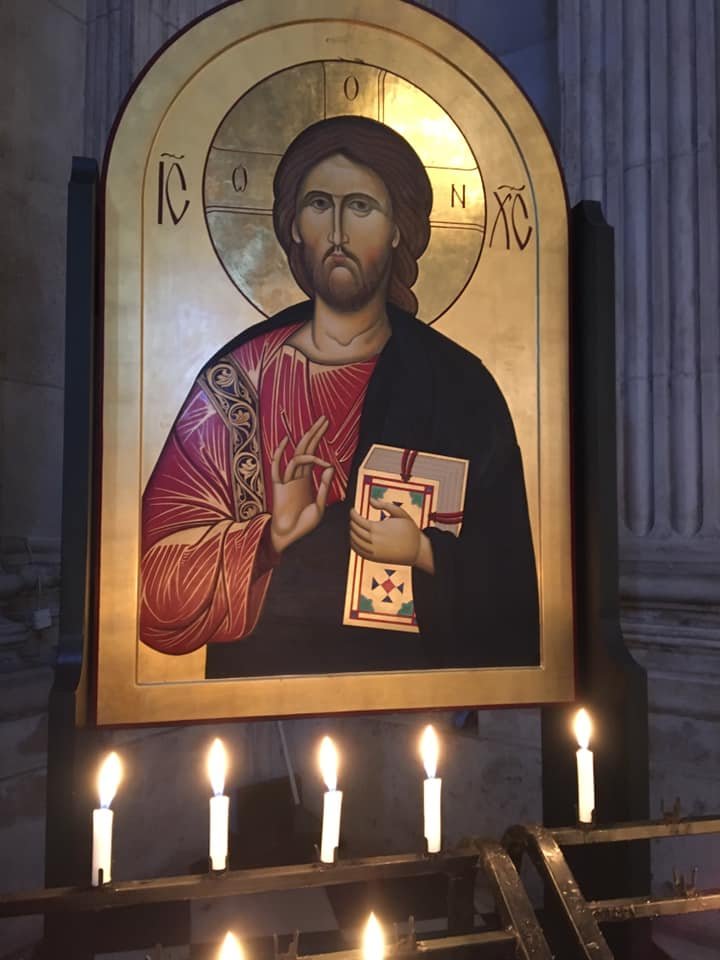
84582427_2894152720640969_3643179195351171072_n

Photo credit:  Jennifer Andrews-Weckerly; reuse with permission only

Sixteen pilgrims from Hickory Neck Church traveled to England for 8 days of pilgrimage.  Our focus was on choral music, hearing Evensong or Choral Mass at a Cathedral, Minster, or college everyday.  This is the seventh entry, initially posted on our church Facebook page.  For those of you who do not follow us on Facebook, I am repeating the journey’s daily entries here.  Enjoy!

London – Westminster Abbey/St. Paul’s Cathedral

Today’s journey highlighted a truth about our spiritual lives in general. One of the tricky dynamics of being a pilgrim in cathedrals, minsters, and colleges is you need a guide to teach you and create a depth of learning and growth. What the naked eye sees only gets you so far. Then you need someone who can explain how many years worship has happened there, why you are only one pilgrim in centuries of pilgrims, and how our history informs our present. Our guides are not just historical guides; they are spiritual guides too.

But the other part of pilgrimage is experience. No three hour lecture can replace the experience of staring at beautiful arches, stained glass windows, modern art, or a flickering prayer candle. No amount of talking can help you hear God more than just sitting and listening. No lesson on the historical period of a composer can help you hear the intricacies of Evensong that can sometimes take your breath away. Sometimes pilgrimage is about making space to hear and feel God in profound ways – in ways that are hard to access in the hubbub of everyday life.

Today was such a day. The morning was full of kings, queens, murder, theft, and a lot of royal history as it relates to the faith. This afternoon was about making room for God. And Evensong was a breath of fresh air – with sounds of comfort, of embracing gentleness, of the maternal nature of God. Today was about finding a spiritual guide and then letting go in order to meet God on your own.

Where are you on your journey? Do you need a guide, or perhaps a faith community, to start enriching your spiritual life? Or do you need to let go of learning for a time and simply bring yourself to God’s house for either new connections to Christ, or to recall richer spiritual times, waiting for enlightenment? I can’t wait to hear about your pilgrimage!

85121020_2894152613974313_5887720260903108608_n

Photo credit:  Jennifer Andrews-Weckerly; reuse with permission only

Sermon – Romans 5.1-5, John 16.12-15, TS, YC, May 22, 2016

25 Wednesday May 2016

Posted by jandrewsweckerly in Sermons, Uncategorized

≈ Leave a comment

Tags

activity, attention, community, disciples, doctrine, faith, God, grace, grow, guide, heresy, Holy Spirit, Jesus, learn, love, seminary, Sermon, suffering, theology, Trinity, Trinity Sunday, world

In seminary one of my favorite professors was our theology professor.  I did not like her because of the subject she taught.  In fact, her class was one of the classes that gave me the most headaches as I struggled to understand theological arguments.  Instead, what I liked about her was the way that she taught.  She had a dizzying intellect, and yet she had the ability to gently make you feel like you were not an idiot.  Someone in class would ask a question, trying to get their head around a theological concept.  Her soft response would be, “Oh, yes, yes, I could see how you might get to that conclusion.  So-and-so also argued that heresy in the fourth century.”  Or she might answer, “Oh yes, that heresy is one of the church’s favorite,” and then go on to explain how the church struggled to counter the heresy.  What I loved about her responses was she let you know that although you clearly did not understand the theological concept, you were not the first person to struggle to understand and you will not be the last.  Struggling to understand and articulate a cogent theological concept without slipping into a heretical argument is a basic part of being a Christian.

What I loved about the pastoral nature of my professor’s responses was she understood that being able to articulate a definition of God is incredibly difficult.  More important to her than you getting that articulation correct was your engagement with the concept.  Perhaps she understood that theologians for centuries have tried to do the same thing – define who God is and what God means.  That may be why she never seemed bothered by our heresies – because she knew that her role, and in fact the role of the church, is to be involved in the ongoing endeavor of naming God’s activity in our world.[i]  That is the same work that we do every year on the feast of Trinity Sunday – embracing the endeavor of naming God’s activity in our world.

To help us in that endeavor, we get two great pieces of scripture today.  In our gospel lesson from John, Jesus tells the disciples that the Spirit will guide the disciples into all truth.  Jesus’ promise to the disciples tells us those closest to Jesus, those who have been sitting at Jesus’ feet, learning truth from the source, are still going to need help.  The disciples, who will be commissioned to go out into the world to share the Good News, will not do that work alone.  The Spirit will go with them, helping them to continue to learn and grow into the fullness of faith.

I was recently invited to come to Sunday School for a little round of “stump the priest.”  I laughed at the title, but inside I was thinking, “What if they ask a question that really does stump me?!?”  Luckily, a cooler head prevailed.  The truth is they probably will stump me – several times over.  But that will give us a chance to talk about how the Spirit guides us into all truth – in childhood, in young adulthood, and into our older years.  But more importantly, I hope that we get the chance to talk about how the community of faith is a vital part of that learning of all truth.  We are certainly dependent on the Spirit, but we are also dependent on each other, because the Spirit so often speaks to us through people and the words of those around us.[ii]

That is one of the things I love most about being in the Episcopal Church.  The Episcopal Church has always been a place where ambiguity is okay.  As David Lose explains, “…being part of being a Trinitarian community [means] striving to be a place that knows it doesn’t have all the answers, and so consequently makes space for conversation and values those who bring different voices and experiences into its midst.  Conversation, valuing difference, being inclusive – these things aren’t easy, but genuine community, while challenging, is also creative, productive, and enriching.”[iii]

The other great piece of learning today comes from our reading in Romans.  On the surface, this piece of scripture has always troubled me.  Paul’s claim that suffering produces endurance, endurance produces character, and character produces hope, has always sounded a little dismissive about suffering.  But I do not think Paul meant for this formula of suffering leading to hope was not meant to be prescriptive, but descriptive.[iv]  In other words, he is not saying those who are suffering should be grateful.  What he is saying is those who are suffering have the opportunity to not waste the pain.  Peter Steinke says, “We ‘waste’ suffering if we gloss over, deny, avoid, or neglect its message…. If, however, we can learn from pain, [pain] is not wasted but a source of life and health.”[v]  My suspicion is that Paul is trying to capture what we learn from our gospel lesson today.  Even in the midst of suffering the Holy Spirit and the community of faith can guide us into all truth.

I have been a part of parishes that have a communal component to their premarital counseling.  In addition to meeting with the priest, each engaged couple is partnered with a married couple in the parish for mentoring.  One would think that the married couple’s job is to tell the engaged couple how to do everything and give them advice.  But more often, the couples end up talking about how hard marriage is, what struggles they have dealt with, and how they got through the suffering.  The relationships between the mentors and the mentees often last well beyond the wedding.  When done with honesty, vulnerability, and compassion, the couples realize that they gain strength from one another and find a place where they can go when they are looking for truth and guidance.

Our gospel and epistle lessons today weave together an understanding of the Trinity that is both vertical and horizontal.[vi]  Vertically, we learn that our understanding of God is ever changing and dynamic – much like God is ever changing and dynamic.  I think that is why my professor was so open to us stepping into and out of heresies and doctrine.  She knew that every Christian had to take that journey of steps and missteps.  But I think she also understood that truth was ever evolving and that the Spirit was with us in that journey.  She was not worried about us because, “…a critical characteristic of faith is an ever-striving and dynamic making sense of God.  The Trinity [cannot] be the only way to get God.  [That theology] is as limited and finite as our humanity.  [The theology of the Trinity] is one attempt of the church to articulate the being of God in a particular time and place.”[vii]  We will continue to walk toward truth in our own time and place too.

Horizontally, our lessons teach us that we find our way to that truth the Spirit is showing us through the vehicle of those around us – both those in the church, and those outside our walls.  I cannot count the number of times I have learned something profound about God by someone who never harkens the door a church.  Our job is to pay attention:  pay attention to the way that God is using others to show us more about God; pay attention to the ways God invites us to interpret our sufferings with others; pay attention to those who are struggling toward truth along with us.  We will surely step into heresy now and then.  But we will also step into God’s love and grace through the guidance of the Holy Spirit and those around us.  Amen.

[i] Karoline Lewis, “Trinity Talk,” May 15, 2016, as found on http://www.workingpreacher.org/craft.aspx?post=4648 on May 18, 2016.

[ii] David Lose, “Trinity C:  Don’t Mention the Trinity,” May 17, 2016, as found on http://www.davidlose.net/2016/05/trinity-c-shh-dont-mention-the-trinity/ on May 18, 2016.

[iii] Lose.

[iv] Richard L. Sheffield, “Homiletical Perspective,” Feasting on the Word, Yr. C, Vol. 3 (Louisville: Westminster John Knox Press, 2010), 39.

[v][v] Sheffield, 41.

[vi] Lose.

[vii] Lewis.

Recent Posts

  • On the Myth and Magic of Advent…
  • On Risking Failure and Facing Fear…
  • Sermon – Luke 23.33-43, P29, YC, November 23, 2025
  • On Inhabiting Gratitude…
  • Sermon – Luke 20.27-38, P27, YC, November 9, 2025

Archives

  • December 2025
  • November 2025
  • October 2025
  • September 2025
  • August 2025
  • July 2025
  • June 2025
  • March 2025
  • February 2025
  • December 2024
  • November 2024
  • October 2024
  • September 2024
  • August 2024
  • July 2024
  • June 2024
  • May 2024
  • March 2024
  • February 2024
  • January 2024
  • December 2023
  • November 2023
  • October 2023
  • September 2023
  • August 2023
  • July 2023
  • June 2023
  • May 2023
  • March 2023
  • February 2023
  • January 2023
  • December 2022
  • November 2022
  • October 2022
  • June 2022
  • May 2022
  • January 2022
  • December 2021
  • November 2021
  • October 2021
  • September 2021
  • August 2021
  • June 2021
  • May 2021
  • April 2021
  • March 2021
  • February 2021
  • January 2021
  • December 2020
  • November 2020
  • October 2020
  • September 2020
  • August 2020
  • July 2020
  • June 2020
  • May 2020
  • April 2020
  • March 2020
  • February 2020
  • January 2020
  • December 2019
  • November 2019
  • October 2019
  • September 2019
  • August 2019
  • July 2019
  • June 2019
  • May 2019
  • April 2019
  • March 2019
  • February 2019
  • January 2019
  • December 2018
  • November 2018
  • October 2018
  • September 2018
  • August 2018
  • July 2018
  • June 2018
  • May 2018
  • April 2018
  • March 2018
  • February 2018
  • January 2018
  • December 2017
  • November 2017
  • October 2017
  • September 2017
  • August 2017
  • July 2017
  • June 2017
  • May 2017
  • April 2017
  • March 2017
  • February 2017
  • January 2017
  • December 2016
  • November 2016
  • October 2016
  • September 2016
  • August 2016
  • July 2016
  • June 2016
  • May 2016
  • April 2016
  • March 2016
  • February 2016
  • January 2016
  • December 2015
  • November 2015
  • October 2015
  • September 2015
  • August 2015
  • July 2015
  • June 2015
  • May 2015
  • April 2015
  • March 2015
  • February 2015
  • January 2015
  • December 2014
  • November 2014
  • October 2014
  • September 2014
  • August 2014
  • July 2014
  • June 2014
  • April 2014
  • March 2014
  • February 2014
  • January 2014
  • December 2013
  • November 2013
  • October 2013
  • September 2013
  • August 2013
  • July 2013
  • June 2013
  • May 2013
  • April 2013
  • March 2013
  • February 2013
  • January 2013
  • December 2012
  • November 2012
  • October 2012
  • September 2012

Categories

  • reflection
  • Sermons
  • Uncategorized

Meta

  • Create account
  • Log in
  • Entries feed
  • Comments feed
  • WordPress.com

Blog at WordPress.com.

  • Subscribe Subscribed
    • Seeking and Serving
    • Join 394 other subscribers
    • Already have a WordPress.com account? Log in now.
    • Seeking and Serving
    • Subscribe Subscribed
    • Sign up
    • Log in
    • Report this content
    • View site in Reader
    • Manage subscriptions
    • Collapse this bar
 

Loading Comments...