• About

Seeking and Serving

~ seek and serve Christ in all persons

Seeking and Serving

Tag Archives: healing

On the Nose…

29 Wednesday Oct 2025

Posted by jandrewsweckerly in reflection

≈ Leave a comment

Tags

broken, Christ, grace, healing, Jesus, love, perfume, recollection, scent

Photo credit: https://www.istockphoto.com/search/2/image-film?phrase=perfume+spray

We recently spent some time with friends who are fragrance aficionados.  Often when we gather, we do a fragrance sampling, noting what we smell and what it evokes – and whether we could imagine wearing the fragrance ourselves.  Our friends are great guides, teaching us tips from the industry, helping us define fragrance-specific terms, and sharing the gracious wisdom that all scent evaluations are subjective.  The sessions are always a delight, sometimes leading us to new fragrances we enjoy.

When I returned home after the visit, I asked one of my daughters whether she liked a particular fragrance I was trying.  She confessed it was nice, but said, “I just prefer your ‘Mom Smell.’”  Through our chuckles, I asked her what she meant about a “Mom Smell.”  She couldn’t quite explain it, and I can only assume she meant a combination of the soap, hair products, or laundry detergent I use.  But I knew what she meant – like scientifically devised fragrances can, any smell can evoke the essence of a person or place we know and love.  It is the gift of recollection that comes through the sense of smell.

Her insight had me wondering if all of life isn’t about leaving behind traces of our scent, unbeknownst to us.  Who had a positive experience or a blessing through me that is recalled when the smell something reminiscent of my “Mom Smell” wafts by?  Who has been in a location far from me and smelled my soap or laundry detergent and remembered something kind and generous I said or did?  We all leave traces of ourselves in this world.  I wonder what gifts you are leaving behind, unbeknownst to you.  I wonder what recollections people have of you that remind them of the grace and love of Christ himself.  I look forward to hearing about what healing scent you are trying to leave for this broken world.

On Finding Commonality and Church…

01 Wednesday Oct 2025

Posted by jandrewsweckerly in reflection

≈ Leave a comment

Tags

band, beauty, Christ, church, commonality, community, concert, disparate, healing, meaning, music, unity

Photo credit: https://unsplash.com/s/photos/concert-audience

Last weekend we took one of our daughters to her first concert.  It was not a band or even a genre of music I particularly like.  But she had been obsessing over every concert venue.  When the band came within an hour of our town, coupled with a big birthday this year, we couldn’t refuse.  So, off we went, playing chaperone to one of those fun life milestones.

While I cannot say that I came to fall in love with the band, what did not escape me was the beautiful experience of that night.  Feeling like a total outsider, I watched as everyone around me joined in commonality.  I watched as people belted out memorized lyrics, and they mimicked famous moves and gestures of the band, and as they shared excitement as each new song began.  I watched people who did not know each other exchange comradery and joy with total strangers.  I watched parents smile at the adulation of a younger generation.  I watched many disparate parts come together as one in that singular moment.

Now I would never claim that Church, especially a church in my denomination, has the same electric, communal energy as that night of raw, unfiltered passion caused by music, but I like to dream that some things like that night happen every Sunday.  We gather every Sunday as a disparate group too:  young parents, frazzled by life; retirees, finding their purpose in later life; singletons longing for a place of belonging; couples or families praying they are not alone in their experiences.  Those who are joyous, those who are grieving, those who are anxious, and those who are feeling good gather every week – not for a favorite band per se, but certainly for a favorite activity.  We gather to remember something bigger than ourselves as individuals, to ground ourselves in something better than what sometimes feels like the daily grind, to find oneness in the one bread and one cup.

Though I would never claim my church feels like going to a band’s concert, I do think Church offers a weekly dose of beauty, of commonality, of belonging, and of joyful purpose.  For those who are not regular church-goers, or even for those who have been hurt by the Church, I understand why you would keep your distance.  But when the Church is at her most Christ-like, the Church offers a weekly gift that might be a source of healing from all those hurts, isolations, and divisions of life.  If you ever want to give it a try, know that this community welcomes you here.

On Ashes and Dust…

05 Wednesday Mar 2025

Posted by jandrewsweckerly in reflection

≈ Leave a comment

Tags

Ash Wednesday, ashes, care, community, dust, dusty, finitude, God, healing, mortality, music, organ, spiritual life, vulnerability

Phot credit: https://www.yamaha.com/en/musical_instrument_guide/pipeorgan/maintenance/

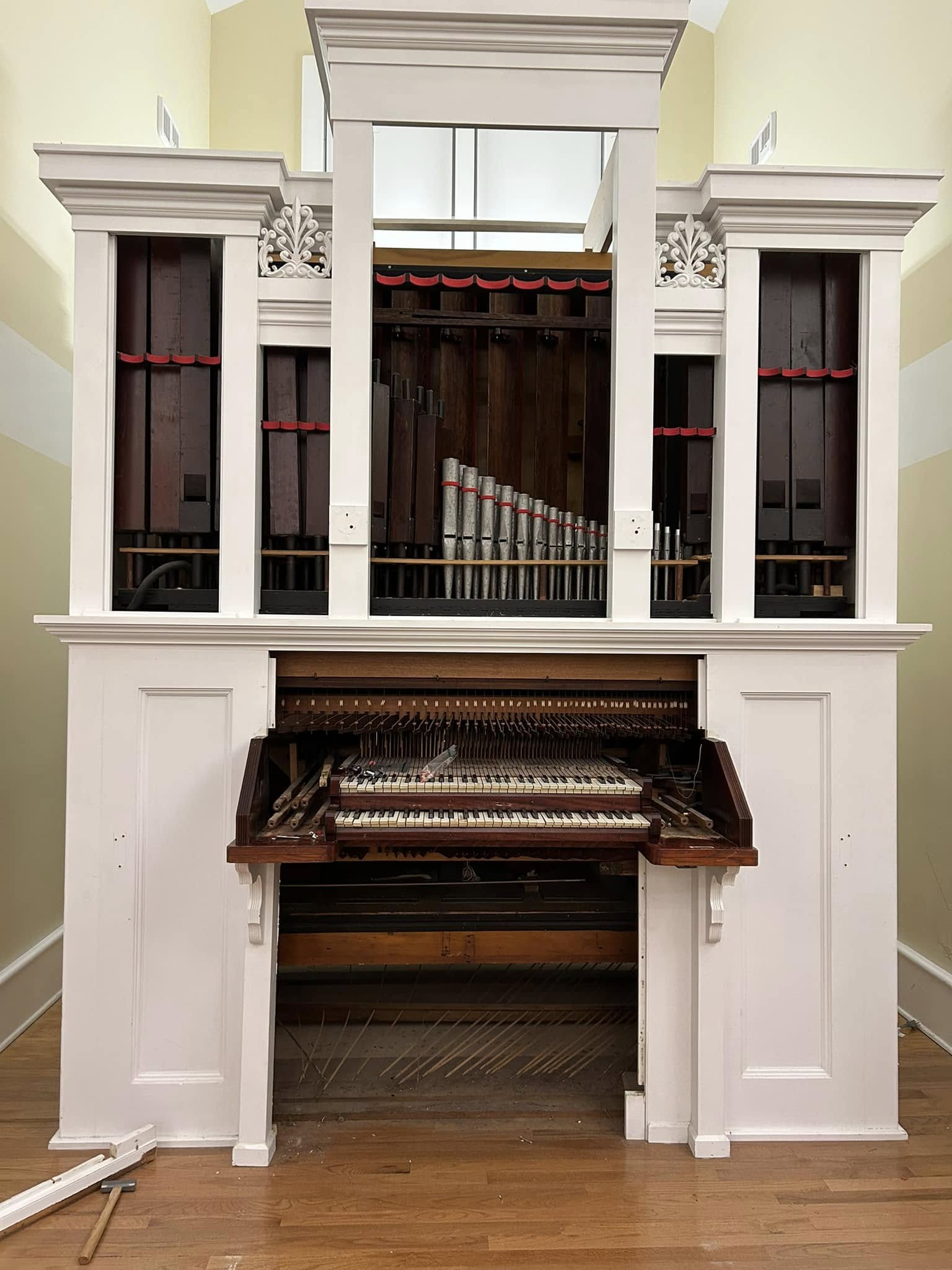
Last year our parish was donated a new pipe organ.  We have been eagerly waiting for the deconstruction of our current organ and the installation of the new one.  The time has finally come, we said a prayer of blessing on the current organ, and we have been waiting and watching as the process begins.  Ideally this wouldn’t be staring just days before Ash Wednesday, but I suppose there is no “perfect” time to deconstruct your worship space.

Knowing we are in a liminal time of deconstruction and reconstruction, I had not thoroughly thought through the impact this time would have on our experience of Ash Wednesday.  But walking into the Chapel this morning, seeing the pipes mostly gone, and the guts of our current organ exposed, I was hit by a sadness I couldn’t quite place.  Almost 20 years of music from that organ has filled our worship space, countless talented individuals have made the organ sing, and even more moments of sacred encounters with God have happened through that instrument.  Seeing the organ exposed today did something that left me unsettled. 

Photo credit: https://annkroeker.com/2011/03/09/there-back-again-my-first-ash-wednesday/

When I necessarily turned my attention to preparing for tonight’s Ashes to Go and Ash Wednesday service, I realized what was so unsettling.  Ash Wednesday is all about reminding us of our mortality, our finitude, and our vulnerability before God.  When those gritty ashes are scraped across my forehead and I am told that I will return to dust, that texture and those words linger with me.  So too, as that organ case sits gaping and open, with dust motes floating in the air, our worship space has suddenly become the perfect metaphor for entering a Holy Lent.

I wonder what gaping holes Ash Wednesday is exposing for you.  I wonder where your spiritual life is feeling dusty and in need of some care.  As always, you are most welcome to engage at Hickory Neck Episcopal Church for some tending – to find a connection with God that might be missing, to heal some holes that have been exposed for too long, and to find a place of belonging, because, believe me, you are not alone.  Welcome to Lent.

Photo credit: Stephen Trumbull; reuse with permission only

Sermon – Acts 1.1-11, AS, YB, May 12, 2024

29 Wednesday May 2024

Posted by jandrewsweckerly in Sermons

≈ Leave a comment

Tags

Ascension, brokenness, church, community, healing, Holy Spirit, Jesus, kingdom of God, lifestyle, money, pivot, relationship, Sermon, sharing, stewardship

Our Stewardship Team gathered throughout the winter and spring and had some meaningful conversations about how we measure what matters in life.  We talked about how stewardship is more than money.  Stewardship is a lifestyle based on a relationship with Jesus Christ and fulfilling our baptismal covenant to provide and participate in the mission and ministry of Hickory Neck Episcopal Church to proclaim the Gospel in word and deed in order to change the world in which we live.  But we also talked about how things can get in the way of our faith journey:  our allegiances, our faith, our compassion, our use of money, our generosity, and our belief that God provides what is necessary for living out our lives.  And so, we agreed.  In order to help us navigate how to be faithful stewards, we would begin a preaching series over the next several months – looking at those challenges to our faith journey and what scripture has to say about them.  Today, the Stewardship team teed me up on this Ascension Sunday to talk about allegiances.

Now I do not know about you, but when I read the text about the Ascension from Acts, I did not really hear anything about stewardship.  Jesus did not lean over his shoulder as he was ascending to heaven and shout, “Don’t forget to tithe 10% to the Church!” So, what does the Ascension have to do with faithful living – with stewardship?  Well, to understand that notion, we have to take a big step back from the event of the Ascension.  You see, the Ascension is sort of a pivot moment in our lives.  Luke, the author of both the gospel of Luke and the Acts of the Apostles, understood history to be “divided into two ages:  the broken old world marked by Satan, idolatry, sin, injustice, exploitation, fractiousness, scarcity, enmity with nature, violence, and death.”  The renewed world where God restores all things to God’s purposes is “marked by true worship, forgiveness, justice, mutuality, community, abundance, blessing between nature and humankind, shalom, and life.”[i]  Jesus’ life and ministry was in witness against the broken world and a shepherding in of the renewed world.  In the process of ascending Jesus gives authority to the disciples to continue the work of the renewed world.  That’s why the whole rest of the book of the Acts of the Apostles will be about how the community of Jesus – the Church – will live:  sharing resources, supporting those in need, living as a community of abundance, mutuality, and justice.

This past Thursday’s Discovery Class was the session where the attendees teach the rest of class on given topics.  One set of our class members focused on the history of the early church in America.  They talked about how the church in the 1600s and 1700s was the governing body of the region – using their resources to care for widows and orphans, tending to those who fell on hard times, basically serving as the social services agency of the region.  Now, they also had clergy appointed by the governor and charged local residents a mandatory levy to help the Church pay for those expenses (an idea I imagine a certain treasurer of ours probably wouldn’t mind) – but for all intents and purposes, the early church of the Americas operated just like the early church in the Acts of the Apostles – living as a community sharing resources, supporting those in need, embracing abundance, mutuality, and justice.  In essence, a community who understood their allegiance to be to the kingdom of God and not to the kingdom of brokenness:  a community of faithful stewardship.

We are told in our reading from the Acts of the Apostles that as the disciples watch Jesus ascend to the heavens they stand there for a moment – frozen in time as their scrambled brains try to figure out what has just happened and what Jesus’ ascension means.  While they are standing there, looking at heaven, two men in white robes appear and ask them a simple question, “Why do you stand looking up toward heaven?”  In other words, God uses these men in white to tell the disciples, “Don’t just stand there – go be the church!  Jesus showed you the way to abundant, faithful stewardship.  Now go bring kingdom living to life!”

That is our invitation today too.  Now you may be thinking, “Yeah, but the Church has changed so much.  We are not the primary social services agency in town – we are not the place responsible for people’s physical, emotional, and spiritual well-being!”  But Jesus tells us today that we are.  That every single member of this community has a part to play – can contribute your financial resources, the gift of your skills and expertise, the offering of your time to make this church a modern expression of the kingdom of God here in Upper James City County.  On this Ascension Sunday, we can choose to carry on the work of Christ, to do our part to turn away from brokenness and be agents of healing and wholeness.  Where will we find the capacity to enliven that abundant life?  In our Eucharistic Prayer today we will pray, “And, that we might live no longer for ourselves, but for him who died and rose for us, he sent the Holy Spirit, his own first gift for those who believe, to complete his work in the world, and to bring to fulfillment the sanctification of all.”[ii]  Not only did Jesus give us the mission, Jesus also gives us the Holy Spirit – that gift we will celebrate next week – so that we might be the faithful stewards of God’s abundance, declaring our allegiance to living in the light – to being the agents of abundance God knows we can be.  Our invitation is stop looking up, and start looking around at the kingdom God has gifted us to tend.  Amen.


[i] Ronald J. Allen, “Considering the Text: Week One, Ascension Sunday, 12 May 2024”  Center for Faith and Giving, as found at centerforfaithandgiving.org, 2.

[ii] BCP, 374.

Sermon – Mark 1.21-28, EP4, YB (Annual Meeting Address), January 28, 2024

14 Wednesday Feb 2024

Posted by jandrewsweckerly in Sermons

≈ Leave a comment

Tags

Annual Meeting, awesome, challenge, church, community, grow, healing, hope, Jesus, laugh, love, relationship, Sermon, teaching

Before our family left for our cross-country trip during this summer’s sabbatical, I had been warned by a fellow parishioner.  “I never really understood the word ‘awesome’ until I saw the Grand Canyon,” she told me.  The word awesome seemed so underwhelming – maybe because we use the word for things that are less than awesome – an awesome movie, an awesome meal, an awesome day.  But as I stood at the rail, overlooking the massiveness of the Grand Canyon my brain scrambled.  It was as if my brain could not comprehend the sheer vastness of the view in front of me – how far does the canyon stretch?  How deep is the bottom?  How long did it take those specks that must be hikers to get there?  Or maybe, more deeply, how did God conceive of such an indescribably beautiful thing.  As tears welled in my eyes at the Grand Canyon’s inconceivability, I finally understood the word:  awesome.

In today’s Gospel, that is the reaction of the crowd to Jesus.  Jesus comes into the temple on the sabbath and teaches like no other teacher has.  The teachers they know “always say, ‘as Moses said,’ or ‘as Rabbi so-and-so said.’  Jesus [speaks] with a quiet but compelling authority all of his own.”[i]  And the people are astonished, awestruck, amazed.  And their amazement does not stop with Jesus’ unique authority in his teaching.  They see his unique words carry with them power to make the unclean clean.[ii]  Like standing on the edge of the Grand Canyon, their minds are scrambled.  They cannot understand this new thing.  They are just beginning to taste what one scholar describes as “One of the salient characteristics of [the Gospel of] Mark…the motif of surprise, wonder, awe, and fear…reactions [that] embrace all aspects of Jesus’ ministry…”[iii]  Those gathered today watch Jesus and can clearly say he is awesome.

This past year of ministry at Hickory Neck has struck me in a similar way.  I have stepped back many a time and looked at this community with a sense of awe.  I have told you repeatedly that one of the core values of Hickory Neck is our sense of curiosity – our willingness to try new things.  I talk about that core value a lot because that core value is extremely uncommon in churches.  Put more simply:  our core value of experimentation and playfulness is awesome.  I watched as your Sabbatical Team and your Vestry this past year embraced the idea of mutual sabbatical with gusto, confidence, and playfulness.  I watched as this parish didn’t just look at sabbatical as an obligation or a burden to bear, but as an opportunity to grow, try on new things, and encounter God in fresh ways.  I watched you learn, laugh, and love.  I watched you push yourselves and encourage one another.  I watched you grow in your relationship with God and one another.  And the view was awesome!

But I also watched you in the hard things this past year.  I watched as you grieved, struggled in your faith, and said goodbye to dear friends – all while embracing and comforting one another.  I watched our Stewardship Team take on a hefty deficit budget and decide to try a new approach to stewardship that felt uncomfortable, unfamiliar, and hard – and yet ended the year not only not incurring a deficit, but only using 8% of the savings we planned to use.  I watched as your Vestry held itself accountable to strategic goals the Vestry set for itself and I watched the Vestry struggle through hard questions of process and systems – and I saw the Vestry grow into the fullness of their leadership.  I watched a community struggle with decreased volunteerism and long-held preferences for the “way we have always done things,” – and I watched our community step boldly into doing things differently.  And I have to tell you, even (and maybe especially) in the hard stuff of ministry, the view has been awesome!

We started 2023 as almost two communities:  those long-timers who have been a part of Hickory Neck for ages but were away during long portions of the pandemic; and those newer members who made their way to Hickory Neck during- and post-pandemic who didn’t have a clue how things had “always been done” but knew they have found something special in this community.  One of our hopes had been that these two communities within a community would use our time of sabbatical to form a new Hickory Neck – to build a new way of being that involved shared leadership, creative ministries, and fresh encounters with the sacred.  I stand here today in wonder as I look at Hickory Neck a year later and I have to tell you:  the view is awesome!

We head into 2024 with some revenue challenges, with some needs for increased participation and leadership, and with the tensions that always exist in a growing church.  But we also head into 2024 with a renewed sense of wonder and awe in all that God is doing in this place.  From reenergized ministries to the wider community:  hosting the homeless, building beds for the children in our community who haven’t had a bed, feeding the hungry, and clothing those who struggle; to fresh, creative ministries that we have never tried before:  a children’s music ministry that will launch this summer with a chorister camp; to invitations to grow closer to that Jesus who is truly awesome – through liturgies, study, and service.  God has incredible things in store for us this year:  and the view is awesome!  Amen.    


[i] N.T. Wright, Mark for Everyone (Louisville:  Westminster John Knox Press, 2001), 11.

[ii] Gary W. Charles, “Exegetical Perspective,” Feasting on the Word, Yr. B, Vol. 1 (Louisville: Westminster John Knox Press, 2008), 311.

[iii] John R. Donahue and Daniel J. Harrington, The Gospel of Mark, Sacra Pagina Series, vol. 2 (Collegeville, MN:  Liturgical Press, 2002), 79.

Sermon – Luke 17.11-19, P23, YC, October 9, 2022

19 Wednesday Oct 2022

Posted by jandrewsweckerly in Sermons

≈ Leave a comment

Tags

blessing, bountiful, faith, goodness, grateful, gratitude, healing, health, Jesus, praise, Sermon, stewardship, talent, thanks, time, treasure, wholeness

Every once in a while, when we are having a particularly whiny, complaining, cranky evening at the Andrews-Weckerly household, I will break out the old, “So, what are you grateful for today?” question.  I cannot claim that our family has mastered some Zen-like practice of gratitude.  In fact, we still have to regularly remind each other simply to say, “Thank you!”  And if I am being honest, my question about what we are grateful for is a question based out frustration not out of a sense of habituated thankfulness.

I think that is why today’s Gospel lesson from Luke makes me so uncomfortable today.  Jesus graciously heals ten lepers at once with barely a word or flourish.  One of them, a Samaritan to be clear, returns, praising God in a loud voice, prostrating himself at Jesus’ feet, and thanking Jesus.  But Jesus’ response is where my guilt resides. “Were not ten made clean?  But the other nine, where are they?  Was none of them found to return and give praise to God except this foreigner?” Jesus asks.  How many times have I been one of the nine?  How many times have I experienced blessing, only to focus on another ill in my life?  How many times have I been surrounded by bountiful abundance only to be able to talk about scarcity?

For Jesus, this is unfathomable.  For Jesus, faith and gratitude go hand in hand.  Scholar Kimberly Long describes the issue thus, “…to ‘have faith’ is to live it, and to live [faith] is to give thanks.  It is living a life of gratitude that constitutes living a life of faith…One might almost say, in fact, that ‘faith’ and ‘gratitude’ are two words for the same thing:  to practice gratitude is to practice faith.”[i]  Some of you may be thinking, “Oh, to be faithful I just have to be thankful?  That’s not so hard!”  But how many of us have started a gratitude journal only to get out of the habit?  How many of us have engaged in the Ignatian practice of closing the day with enumerating the blessings of the day, giving thanks to God, only to slip into watching one more episode of your favorite show or reading one more chapter of a book, only to slip off to sleep before remembering to give thanks?  How many of us have had New Year’s resolutions or Lenten disciplines about gratitude only to drop them after a few weeks?

But here is why gratitude and faith are so intimately connected.  Jesus says at the end of this passage today, “…your faith has made you well.”  Now if we understand faith and gratitude as being synonymous, then Jesus does not mean because the Samaritan believes something he is healed.  He means because the Samaritan has embodied gratitude he has been made well.  But Jesus is not simply referring to being healed of leprosy.  The Samaritan’s life of gratitude has made him whole – has made him “truly and deeply well.”[ii]  C.S. Lewis perhaps captured the relationship of gratitude and wholeness most clearly.  He said, “I noticed how the humblest and at the same time most balanced minds praised most:  while the cranks, misfits, and malcontents praised least.  Praise almost seems to be inner health made audible.”[iii] 

Of course, this should not be news to us.  Luke’s gospel is always featuring praising.  As one professor explains, “Praising/thanking/blessing/glorifying God is a recurring theme in [Luke’s] writings – from the shepherds in the fields (2.20), to Simeon and Anna at the presentation in the temple (2.28, 38), to witnesses of Jesus’ miracles (5.25, 7.16, 18.43, etc.), to the centurion at the foot of the cross (23.47), and to both Jews and Gentiles who witness the growth of the church in Acts (4.21, 11.18, 13.48, etc.).  It seems, therefore, that Luke recounts this story not to distinguish one leper from the others but to emphasize the proper response to any act of grace:  thanks and praise to God.”[iv]

Luckily for you, Hickory Neck actually grounds you in praise every Sunday.  When we celebrate the Eucharistic feast, the celebrant says, “Let us give thanks to the Lord our God,” and you respond, “It is right to give him thanks and praise.” [or in the case of Rite I, we say, It is meet and right so to do.]  And then the celebrant affirms your words, saying, “It is right, and a good and joyful thing, always and everywhere to give thanks to you, Father Almighty, Creator of heaven and earth.”[v]  [“It is very meet, right, and our bounden duty, that we should at all times, and in all places, give thanks unto thee, O Lord, holy Father, almighty, everlasting God.]   In fact, the entire Eucharist Prayer is also referred to as the “Great Thanksgiving.” Our whole purpose of gathering on Sundays is to enter into praise of God – and as Luke tells us, we do that to make our beings whole – to make our beings truly and deeply well. 

And because we know doing something out of habit can make us forget why we are doing what we are doing, this month we enter into what we call stewardship season – or perhaps what should be called gratitude season.  This month we will be talking about the bountiful goodness we all experience in this community – the ways in which Hickory Neck is a blessing to us, the ways in which Hickory Neck feeds and shapes our faith lives, and the ways in which Hickory Neck helps us be a blessing to others.  In this month of praise and thanksgiving, we will be talking about how to make our praise tangible:  how the gift of our time, the offering of our talents, and the presentation of our financial giving might be acts of praise and gratitude.  This community has been a place where most of us have experienced transformative healing and wholeness.  Our invitation is to follow the example of the Samaritan and let our acts of gratitude become reflections of how Hickory Neck is helping us be truly and deeply well.  Amen.    


[i] Kimberly Bracken Long, “Pastoral Perspective,” Feasting on the Word, Yr. C, Vol. 4 (Louisville:  Westminster John Knox Press, 2010), 166.

[ii] Long, 166.

[iii] As quoted by John M. Buchanan, “Homiletical Perspective,” Feasting on the Word, Yr. C, Vol. 4 (Louisville:  Westminster John Knox Press, 2010), 165.

[iv] Oliver Larry Yarbrough, “Exegetical Perspective,” Feasting on the Word, Yr. C, Vol. 4 (Louisville:  Westminster John Knox Press, 2010), 169.

[v] BCP, 361.

Sermon – Luke 8.26-39, P7, YC, June 19, 2022

05 Wednesday Oct 2022

Posted by jandrewsweckerly in Sermons

≈ Leave a comment

Tags

caring, companions, demoniac, fear, Gerasenes, God, goodness, healing, hope, Jesus, love, Sermon, Stephen Ministry

Today we will be commissioning five of our members into a new program at Hickory Neck called Stephen Ministry.  These individuals have gone through six months of training, with over 50 hours of class time, homework, and practice preparing for this new role.  Stephen Ministry uses the tagline, “Christ caring for people through people.” The idea is that a parishioner going through crisis or a major transition can be assigned a trained Stephen Minister, a person who will meet with them regularly for a season to offer support, care, and listening ear.  The Stephen Minister does not solve issues, but is a companion on the journey.  Care receivers may be looking for this confidential support through an illness, the death of a loved one, divorce or a job loss, or any number of painful life experiences.  The Stephen Minister walks with us, prays with us, listens and hears us, reminding us that we are all broken, and through Jesus we can be made whole.

I think that is why I love that we get the wonderfully bizarre story of the Gerasenes today.  The Gerasenes have become care providers of sorts, but in today’s lesson we learn they are scared.  They have developed a system for dealing with the possessed man of their village.  They know when to bind him and when to abandon him.  They know he is dangerous, and unclean, but they have figured out how to keep the town safe.  He is the identified patient of the town – the one who has the “real” problems.  By identifying the demoniac as the patient, no one else has to look at their own demons – the ways in which each of them are “vulnerable to forces that seek to take [them] over, to bind [their] mouths, to take away [their] true names, and to separate [them] from God and from each other.”[i]  So, when Jesus casts out the impossible demons, and sends them to their death through their herd of swine, and the townspeople find the demoniac healed, clothed, and sitting in his right mind at the feet of Jesus, they do not celebrate or thank God for healing.  Instead, they stand afraid of the power of God.  Now that the demoniac is healed, they are afraid this Jesus will see their demons or challenge their feigned health.  In response, they do not ask for an explanation, but ask Jesus to leave.  Their fear leads to paralysis.

To be fair, fear is a natural and sometimes necessary emotion.  Fear helps us develop a healthy sense of preservation.  Fear allows us to make necessarily cautious decisions.  Fear can keep us safe.  But fear can also lead to paralysis, and perhaps more importantly, to a lack of trust.  And when we are talking about God, a lack of trust evolving from fear gets us into trouble.  We start doubting the graciousness we know God intends for us.  We start avoiding the very work that will give us joy and fulfillment.  We start losing our sense of connection to God – who happily emboldens us when we allow God to do so. 

We see in the Gerasenes’ story the goodness that can happen when we work through our fear.  Despite the fact the townspeople are fearful of Jesus’ power, Jesus brings about healing anyway.  And knowing the people of Gerasene may continue to be fearful, Jesus has the former demoniac stay behind so he can testify to the salvific work of God.  As one scholar points out, “The story ends with Jesus commissioning the healed man to stay where he is and serve as the first missionary to his townspeople — the same townspeople who feared, shunned, trapped, and shackled him for years.”[ii]  Jesus does not scold, shun, or shame when he is asked to leave.  Jesus keeps holding out hope in the face of fear – Jesus holds hope that the townspeople might be healed like the demoniac is healed.  Jesus loves graciously and expects transformation in the face of hopeless fear.      

We commission lay ministers today who are more like the healed demoniac than the Gerasenes.  They have experienced brokenness and pain in their lives, and they stand in the light of Christ’s healing, ready to walk with us Gerasenes in our fear.  Maybe our fear is in acknowledging our brokenness, when we would much rather just ask Jesus to leave.  Maybe our fear is sharing our vulnerability, especially when we feel like we are coping “just fine, thank you very much.”  Or maybe our fear is the unknown path of what we may need to go through to get to healing, health, and wholeness.  If a man possessed with legions of demons can come out the other side whole and healed, sitting at the feet of Jesus, surely Jesus stands ready to handle whatever demons we have.  Whether we take a Stephen Minister along that journey with us, or we simply hear God longs to wash us with grace, kindness, compassion, and love, our invitation today is let go of all the scary brokenness around and in us.  Yes, letting go is scary.  But God shows us over and over again how when we let go of our fear, God is there with abundant, wonderful, powerful love.  And just in case we doubt that love, God offers us companions on the journey.  Amen.


[i] Debie Thomas, “Legion,” June 16, 2019, as found at https://www.journeywithjesus.net/essays/2259-legion, on June 18, 2022.

[ii] Thomas.

On Wrestling with Healing…

19 Wednesday Aug 2020

Posted by jandrewsweckerly in Uncategorized

≈ Leave a comment

Tags

Bible, disciple, gift, healing, Jesus, ministry, power, scripture, vocation

healing hands

Photo credit: https://www.womansday.com/life/g25224950/healing-prayers/

This summer, my parish is participating in a 90-Day Bible Reading Challenge.  It’s been a powerful journey and companion during this pandemic time.  One of the lessons we have already learned this summer is reading the Bible at a rapid pace is different than in-depth Bible Study.  You tend to get the big picture of God and the people of faith, see patterns more easily, and catch things by reading the books in order as opposed to hearing snippets, like we do on Sundays.

As we have been reading through Matthew, something caught my attention this time.  From the beginning of Jesus’ ministry, he is constantly healing people.  Not just one or two famous stories we may remember, but constantly healing, sometimes healing whole crowds of sick people.  In chapter ten, when Jesus sends out his twelve disciples, he doesn’t tell them to teach people or preach the gospel.  He gives them authority to drive out evil spirits and to heal every disease and sickness.  Jesus also does a lot of teaching in Matthew, but I was surprised to remember how ubiquitous Jesus’ healing ministry is.

Reading Matthew’s Gospel in a rapid, big-picture way, I have been reminded how much Jesus’ healing ministry makes me a bit uncomfortable.  I am generally comfortable with preaching and teaching, but, as one of Jesus’ disciples, healing is not a power I would ever claim.  Additionally, as modern readers, I think healing and miracles are one of those things that lead to all sorts of questions.  Does Jesus really heal people?  When we think of healing, do we soften the words, making the healing more figurative than literal?  If Jesus heals all those people in his time, what do we do with all the people who are not healed in our time, especially as we face a worldwide pandemic?  Shouldn’t healing just be limited to medical professionals and those gifted with the charism of healing, as opposed to all of us as followers of Christ?

Here’s what I do know.  The healing Jesus does allows individuals to reenter communal life, fully participating in the community, and being restored as an equal.  Also, the healing Jesus does clears the way for those individuals to do good with their lives, not only helping others, but also showing others the way to Christ.  As I think about those who are suffering in our communities, part of the healing that is needed is the healing that will restore them to full participation in life – eliminating poverty, hunger, homelessness, and discrimination of any kind.  Making health care, childcare, affordable food, and affordable housing accessible to all.  We may not have the vocation of physical or mental healing, but we all have the vocation of healing our society, respecting the dignity of every human being, and striving for justice and peace among all people.  Perhaps when Jesus sent out those disciples to heal, they all healed others in the ways they knew how.  But they all went out to heal.  We can go and do likewise – healing this world that needs healing so much!

On the Infertilities of Life…

31 Wednesday Jul 2019

Posted by jandrewsweckerly in Uncategorized

≈ Leave a comment

Tags

calling, church, community, God, healing, infertility, limitless, limits, meaning, share, spiritual, story, struggle

tree-of-life

Photo credit:  https://cbsipandpaint.com/event/tree-of-life/

One of things I am working on this summer is helping our parish leaders plan our fall Women’s Retreat.  In interviewing guest facilitators, one of the facilitators talked about the scriptural theme of infertility.  Having some amazing people in my life who are or have struggled with infertility over the years, I immediately connected with the idea.  But the facilitator expands the definition of infertility as being unable to do the thing you felt you were created to do.

As I have been thinking about this expanded definition of infertility, I have seen that spiritual struggle all around me.  Certainly, I have been aching for those who struggle with literal infertility, knowing what a crushing experience that can be.  But I have also seen that same sense of infertility happen vocationally for people who really thought they would end up in a certain career, only to find their restrictive geography, their family responsibilities, or their inability to take on the time or financial commitment needed to pursue their dream making them unable to do the thing they felt created to do.  As our diocese is looking at electing a new bishop, I am aware that all four of the current candidates have discerned they feel created to serve in this new role, and yet only one of them will be invited into that ministry.

But infertility strikes us in other ways too.  This week I was listening to Kate Bowler’s podcast Everything Happens, and she and her guest were talking about palliative care and mortality.  The two of them talked about how one of the disadvantages of our American culture is a sense of limitless – that we can do anything we want in life.  And what both of them has seen, as a person in recovery from cancer, and a palliative care doctor, is the falsehood, or even the sinfulness, of the notion of limitlessness.  When we think we can do anything our heart desires, we are inevitably disappointed when our bodies, our mortality, or other things outside our control, throw limits around our dreams.  Part of their work has been helping people work through the sense of infertility that comes from that experience, and helping them find hope, healing, and new meaning in life.

As I have been thinking about literal and figurative infertility, I have been wondering whether sharing those stories might be a part of the healing process.  Something about naming the struggle and sharing the journey has power to not only help you move toward invitations to new vocations, but also has the power to encourage others to name their infertilities, destigmatize them, and transform them into something else that can be lifegiving.  If you are looking for a safe place to do that, I invite you to join our community of faith – a place where wounded souls are heard, broken hearts are mended, and new paths are celebrated.  You are not alone.  We would be honored to walk with you.   I suspect we need you as much as you may need us.

On Kindness and Holy Healing…

06 Wednesday Feb 2019

Posted by jandrewsweckerly in Uncategorized

≈ Leave a comment

Tags

baptism, body, church, community, faith, God, healing, holy, Jesus, kindness, Mayor Tait, symptom, wholeness, Williamsburg

KINDlogo_final-01This past Friday, our LEAD Greater Williamsburg Class launched our kindness initiative.  About 200 people from Williamsburg, James City County, and York County gathered to learn how they could commit to kindness.  One of the highlights was keynote speaker former Mayor Tom Tait.  Mayor Tait served for many years on City Council in Anaheim, California.  He described his work with City Council as a game of “Whack-a-Mole,” where they were constantly trying to snuff out “symptoms,” whether they be drug abuse, homelessness, or violence.  What he slowly came to realize was this model of treating the symptoms was not getting to the root of the problem – the fact that the whole body was sick.  And so, he ran for Mayor on a campaign of kindness.  He believed kindness would transform the entire body, or system, in such a way that the symptoms would go away – because the entire body would learn to operate in a healthier way.

After the event, as I spoke with clergy about the theology of kindness, we came to a few conclusions.  First, we agreed that embodying kindness is one way that people of faith can embody God – the same God that is regularly described as showing loving-kindness, or hesed, in Hebrew.  Our acts of kindness help us to show forth and experience God in our community.  But as we talked about Mayor Tait’s analogy, we realized that showing kindness gets to the root of Jesus’ work.  Jesus was often seen healing what may be seen as symptoms – leprosy, blindness, hemorrhaging.  But what Jesus was really doing was healing entire systems.  Each healed person was restored to wholeness in the community, with no barriers to full membership in the community.  Christ was concerned about the presenting symptoms and suffering of individuals – but what his work was really about was restoring the entire body to wholeness.

The kindness campaign #WMBGkind is an incredible movement because it seeks to do just the same thing – transform our entire community from one that can be divided or cynical, to being a community transformed to wholeness through kindness.  As members of the faith community of Greater Williamsburg, we have an opportunity to be leaders in that transformative work:  because we were commissioned through our baptism to be agents of healing and wholeness, because we can be a powerful witness of God’s love through our kindness, and because, as members of the “body” of our community, we will be transformed too.  This Sunday at Hickory Neck, you will be invited into this commitment to kindness – or as we as persons of faith would call it, into doing acts consistent with our baptismal identity.  I look forward to seeing you then, as we work toward transforming our community, one act of kindness at a time!

← Older posts

Recent Posts

  • On the Myth and Magic of Advent…
  • On Risking Failure and Facing Fear…
  • Sermon – Luke 23.33-43, P29, YC, November 23, 2025
  • On Inhabiting Gratitude…
  • Sermon – Luke 20.27-38, P27, YC, November 9, 2025

Archives

  • December 2025
  • November 2025
  • October 2025
  • September 2025
  • August 2025
  • July 2025
  • June 2025
  • March 2025
  • February 2025
  • December 2024
  • November 2024
  • October 2024
  • September 2024
  • August 2024
  • July 2024
  • June 2024
  • May 2024
  • March 2024
  • February 2024
  • January 2024
  • December 2023
  • November 2023
  • October 2023
  • September 2023
  • August 2023
  • July 2023
  • June 2023
  • May 2023
  • March 2023
  • February 2023
  • January 2023
  • December 2022
  • November 2022
  • October 2022
  • June 2022
  • May 2022
  • January 2022
  • December 2021
  • November 2021
  • October 2021
  • September 2021
  • August 2021
  • June 2021
  • May 2021
  • April 2021
  • March 2021
  • February 2021
  • January 2021
  • December 2020
  • November 2020
  • October 2020
  • September 2020
  • August 2020
  • July 2020
  • June 2020
  • May 2020
  • April 2020
  • March 2020
  • February 2020
  • January 2020
  • December 2019
  • November 2019
  • October 2019
  • September 2019
  • August 2019
  • July 2019
  • June 2019
  • May 2019
  • April 2019
  • March 2019
  • February 2019
  • January 2019
  • December 2018
  • November 2018
  • October 2018
  • September 2018
  • August 2018
  • July 2018
  • June 2018
  • May 2018
  • April 2018
  • March 2018
  • February 2018
  • January 2018
  • December 2017
  • November 2017
  • October 2017
  • September 2017
  • August 2017
  • July 2017
  • June 2017
  • May 2017
  • April 2017
  • March 2017
  • February 2017
  • January 2017
  • December 2016
  • November 2016
  • October 2016
  • September 2016
  • August 2016
  • July 2016
  • June 2016
  • May 2016
  • April 2016
  • March 2016
  • February 2016
  • January 2016
  • December 2015
  • November 2015
  • October 2015
  • September 2015
  • August 2015
  • July 2015
  • June 2015
  • May 2015
  • April 2015
  • March 2015
  • February 2015
  • January 2015
  • December 2014
  • November 2014
  • October 2014
  • September 2014
  • August 2014
  • July 2014
  • June 2014
  • April 2014
  • March 2014
  • February 2014
  • January 2014
  • December 2013
  • November 2013
  • October 2013
  • September 2013
  • August 2013
  • July 2013
  • June 2013
  • May 2013
  • April 2013
  • March 2013
  • February 2013
  • January 2013
  • December 2012
  • November 2012
  • October 2012
  • September 2012

Categories

  • reflection
  • Sermons
  • Uncategorized

Meta

  • Create account
  • Log in
  • Entries feed
  • Comments feed
  • WordPress.com

Blog at WordPress.com.

  • Subscribe Subscribed
    • Seeking and Serving
    • Join 394 other subscribers
    • Already have a WordPress.com account? Log in now.
    • Seeking and Serving
    • Subscribe Subscribed
    • Sign up
    • Log in
    • Report this content
    • View site in Reader
    • Manage subscriptions
    • Collapse this bar
 

Loading Comments...