• About

Seeking and Serving

~ seek and serve Christ in all persons

Seeking and Serving

Tag Archives: holy

On Seeking and Seeing Sacred Ground…

29 Wednesday May 2024

Posted by jandrewsweckerly in reflection

≈ Leave a comment

Tags

barre class, Bible, burning bush, Christianity, church, faith, God, holiness, holy, Jesus, Moses, reverence, sacred, sacred ground, shoes, Spirit

Photo credit: https://medium.com/koinonia/dont-wait-for-a-burning-bush-f8c7435489ae

One of my fitness routines includes attending “barre” – a class that combines yoga, Pilates, and ballet.  When you enter the studio, you remove your shoes and put on special socks to prevent slipping during the class.  You then enter the actual classroom and procure any fitness aides required for the class, such as hand weights, bands, or balls, and proceed to setup up your space at the barre.  I tend to take classes in the 5:30 am hour, so most of the time I am pretty groggy and operating on auto pilot as I prepare my space for class. 

Knowing my routine for class, imagine my surprise the other day when, as I somewhat sleepily entered the classroom, I found myself bowing.  I was immediately shocked and a little embarrassed by my body’s instinctual movement.  As a priest, I bow all the time – as I reverence at the altar, as the processional cross passes me, at certain points in the Creed, or at the name of Jesus in the liturgy.  But I have never reverenced an exercise classroom.

The strange appearance of such an out-of-context movement got me thinking about Holy Scripture.  In Exodus, we hear how Moses receives his call at the site of a burning bush.  When God calls out to Moses amid the flames, God says, “Come no closer!  Remove the sandals from your feet, for the place on which you are standing is holy ground.”[i]  Now I am not sure I would call the barre classroom sacred ground – though the Lord’s name is often called upon, especially during long plank series.  But something about that room made my body respond to its holiness the same way I respond to the holiness of Church.  So how exactly do we define a holy place – or sacred ground?

In the instance of barre class, perhaps what my body was responding to was the way I do find holiness – in the care and compassion of teachers, in the camaraderie of classmates on a shared journey of health and wholeness, in the individual experience at the barre when you feel like you cannot go on and something or someone pulls you through doubt.  Though I think the sacred ground of worship space is unrivaled as a place of encounter with God, the community of Jesus, and the movement of the Spirit, I certainly have found other sacred places – the mountain community where my family gathered every summer with the wider church; the edge of crashing waves, where the vastness of the Creator is palpable; the coffee shop where someone pours out their heart’s burdens to another and blessing is proclaimed.  Perhaps regularly attending Church, with its preserved sacred ground, is what allows us to see and hear God on the sites of sacred ground all around us.  Where are you finding unexpected sacred ground these days?  Where is God inviting you to take off your shoes and give reverence to the mightiness of our God?


[i] Exodus 3.5

Sermon – Luke 2.1-20, CE, YB, December 24, 2023

03 Wednesday Jan 2024

Posted by jandrewsweckerly in Sermons

≈ Leave a comment

Tags

Bethlehem, chaos, Christmas, Christmas Eve, devastation, God, good, holy, Holy Land, incarnate, Jesus, Mary, messy, political, Sermon, silent

Sometimes on Christmas Eve, we hear a bunch of strange words.  And instead of paying too much attention to them, our minds simply get cued that Christmas has begun.  But those funny words [that Chloe read so beautifully] – of Emperors, registrations, censuses, some guy named Quirinius, a bunch of town names, something about the line of David, and of a pregnant woman who isn’t quite yet married – all those words matter.  They matter because they set the stage for the birth of the Christ Child.  We often think of that birth as this simplified, sacred moment, where everything gets really still.  We’ll even sing Silent Night tonight.  But nothing about that night was remotely silent.  Joseph and a very pregnant Mary have journeyed over 90 miles[i] by donkey and foot.  The Emperor has created political chaos by forcing people from their residences to their ancestral homes – all likely in an effort to extort more money from strained peoples.  Into that upheaval and manipulation, we find the Bread of Life being born in the town, Bethlehem, whose name means House of Bread, in a bed that was literally used to feed. 

This year, I am especially grateful for the reminder that Jesus was born into the chaos of political manipulation, suffering, and tension.  Over the last many weeks, we have all been watching as the Holy Land has yet again fallen into chaos – as leaders fight over land, disregard human dignity, and desecrate all that is holy.  The images have been horrific:  from children standing in long lines with makeshift bowls hoping for enough soup to stave off starvation for themselves and maybe a little for their parents; to hospitals and other places that should be safe zones being decimated; to the Lutheran Church in Bethlehem whose creche this year placed the baby Jesus in a pile of rubble.[ii]  And although we associate Christmas with shiny lights, joyous songs, and abundant food and blessings, the reality of that first Christmas was much more similar to Christmas in the Holy Land this year.

Just this week, I read that Christmas in Bethlehem is cancelled – the very place that welcomed Jesus into the manger has once again had to close its doors to the Holy Family.  As Sophia Lee reports, “Typically, Bethlehem—a Palestinian city of about 30,000 people in the Israeli-occupied West Bank—is jammed with more than 3 million visitors coming from all over the world to celebrate the birth of the Messiah.  Marching bands and carol singers and dancers and fireworks would fill the city with loud cheer and festive energy.  Thousands would pack the Church of the Nativity, golden lights would twinkle across Star Street, and a giant tree with a ruby star would illuminate Manger Square.  Instead, the streets are dark and hushed.”  Christian leaders in Bethlehem report, “It will be a silent night this Christmas—but it’ll still be a holy night… Stripping Christmas of all its extraneous decorations and Western traditions,” they say, “will help them focus on the true meaning of Christmas.”  One pastor explained, “…if you look at the real story of Christmas, it was a story of pure hardship.  But God didn’t leave Mary and Joseph.  And they didn’t leave God.”[iii]

For weeks, I have been feeling like we would have to forego everything good and holy about Christmas – that celebrating this Christmas just did not feel appropriate or respectful of the devastation in the very land we are celebrating.  But the clergy of the Holy Land are paving the way to our Christmas celebrations this year.  Truth be told, Christmas was never about shiny lights, boisterous parties, and lots of presents.  Christmas was and always has been about the miracle of the incarnation – God taking on human form in order to bring us redemption and salvation.  And when God does something, God never does that something half-way.  If God was going to become human, God was going to become incarnate in super fleshy ways – not in shiny, idealized human ways, but in raw, earthy, messy ways.  Jesus came among us – not to the polished versions of ourselves we present to the outside world, but to the real, gritty versions of ourselves who actually need an incarnate God.  And I cannot think of better news than that.  This Christmas, in the midst of censuses, registrations, and funnily named places; in the midst of bombings, bloodshed, and loss; in the midst of anxiety, loneliness, and dissatisfaction, Jesus comes among us.  Jesus does not leave Mary and Joseph.  Jesus does not leave Palestinian or Jew.  Jesus does not leave you or me.  And that is good news for a merry Christmas.  Amen.     


[i] Timothy L. Adkins-Jones, “Commentary on Luke 2:1-14 [15-20],” December 24, 2023, as found at https://www.workingpreacher.org/commentaries/revised-common-lectionary/christmas-eve-nativity-of-our-lord/commentary-on-luke-21-14-15-20-24 on December 20, 2023.

[ii] As found at https://www.facebook.com/christmaslutheranchurch on December 21, 2023.

[iii] Sophia Lee, “Bethlehem Cancels Christmas, But Local Pastors Still Expect a Holy Night,” Christianity Today, December 20, 2023, as found at https://www.christianitytoday.com/news/2023/december/bethlehem-cancel-christmas-christian-pastors-church-nativit.html on December 21, 2023.

Sermon – Matthew 5.1-12, AS, YA, November 5, 2023

29 Wednesday Nov 2023

Posted by jandrewsweckerly in Sermons

≈ Leave a comment

Tags

All Saints, Beatitudes, bless, blessed, communion of saints, disciples, faith journey, faithful, holy, Jesus, right road, saints, unattainable

I once served at a church that decided to support a ministry for women exiting prison.  We decided to prepare ourselves for our engagement in the ministry by reading the book The Prison Angel, about a wealthy divorcee in California who has an epiphany about her call, and eventually becomes a nun that lives in the notorious prisons of Tiajuana, Mexico, serving the men and their families.  We spent weeks reading the book, reflecting on Mother Antonia’s stories, slowly grasping the realities of prison life and those who serve them.  I was feeling energized by how well prepared our book study group would be when we finally began serving our local ministry.  But on the last day of our study, one of our participants shared, “I don’t know.  I don’t think I could ever be as self-sacrificial as Mother Antonia.  She’s sort of superhuman and I just cannot imagine living that kind of life.”  I remember feeling completely deflated – here I was trying to inspire servanthood and instead, I had made servanthood feel unattainable.

Sometimes I fear All Saints Sunday does the same thing.  Certainly, that can happen as we think of those significant saints of the church, like St. Peter, St. Francis, or Mother Teresa.  But our feelings of inadequacy can happen with the personal saints of our lives – the souls of beloved parents, lovers, children, and friends.  We remember the faithful ways they lived and only see our own failings.  And then we go and read the Beatitudes from Matthew’s gospel, we can become downright despondent.  Maybe I have mourned or felt poor in spirit.   But do I hunger and thirst for righteousness?  Am I pure in heart?  As we grieve the violence in the Middle East, have I done anything tangible to be considered peacemaking?  Has anyone ever reviled or persecuted me for the sake of Jesus?  Instead of inspiring and uplifting us today, this feast day with Matthew’s gospel has the potential to leave us feeling unworthy and unmotivated in our journey to live faithfully.

I can assure you that is not the lectionary’s intent.  In fact, after weeks of stories about discipleship in Matthew, the lectionary takes us back to the fifth chapter of Matthew for a purpose.  Perhaps we should look at what the Beatitudes are not doing today before we look at what they are doing.  The Beatitudes are not “to do” items.  As scholar Debie Thomas explains, these are not suggestions, instructions, or commandments.  There is no sense of “should,” “must,” or “ought” in these words.  We are not to walk away from these words thinking we should “try very hard to be poorer, sadder, meeker, hungrier, thirstier, purer, more peaceable, and more persecuted…”[i]  Likewise, the Beatitudes are not meant to shame us.  Jesus is not attempting to make us feel like overprivileged wretches worthy of self-condemnation.  Likewise, Jesus is not telling us to grit our teeth through whatever suffering we are living through, knowing that relief comes after death.[ii]

Instead, the Beatitudes are redefining what our modern culture might define as “#blessed.”  When we talk about being blessed, we are usually referring to our bounty or at the very least, the goodness we see in an otherwise hard world.  Instead, theologian Stanley Hauerwas explains that by declaring the poor in spirit, the mourning, the meek, the merciful, and the peacemakers as blessed, Jesus is indicating the transformed world of the kingdom of God has begun.  “Each of the Beatitudes names a gift, but it is not presumed that everyone who is a follower of Jesus will possess each beatitude.  Rather, the gifts named in the Beatitudes suggest that the diversity of these gifts will be present in the community of those who have heard Jesus’s call to discipleship.  Indeed, to learn to be a disciple is to learn why we are dependent on those who mourn or who are meek, though we may not possess that gift ourselves.”[iii]

What is particularly helpful as we read these familiar words, then, is to clarify what we me by the literal word “blessed.”  Going back to the Hebrew scriptures here will help.  There are two words for “blessing” in Hebrew:  ’ashar and barak.  Barak means to “bow or stoop.”  For example, in Psalm 103, when we say “Bless the Lord my soul,” we mean “Bow to the Lord.”  But ’ashar literally means, “to find the right road.”  So, if we go back to Beatitudes, we instead hear “You are on the right road when you are poor in spirit; You are on the right road when you hunger and thirst for righteousness; you are on the right road when you are persecuted.”  Jesus is calling his disciples to hear and walk in the way of his will for our lives.[iv]

As we remember those saints who inspire us, as we recall those loved ones who taught us about how to live faithfully, as we hear Jesus’ beautiful blessings of all kinds of experiences in life, we are reminded today not to feel guilted into a more holy life.  We simply remember that the people sitting next to you today are all different points of the faith journey, with different blessings or things that feel like curses.  Because we choose to walk together, we will learn to be faithful people that, someday, someone else will remember – that someone else will tie a ribbon onto this altar rail to remember the ways you taught them what being “#blessed” really means.  Our invitation today is to celebrate the right road, knowing the fullness of that road is only visible through the communion of saints who walk the right road together.  Amen.


[i] Debie Thomas, Into the Mess and Other Jesus Stories:  Reflections on the Life of Christ (Eugene, OR:  Cascade Books, 2022),120.

[ii] Thomas, 120-121.

[iii] Stanley Hauerwas, Matthew:  Brazos Theological Commentary on the Bible (Grand Rapids:  Brazos Press, 2006), 63

[iv] Earl F. Palmer, “Pastoral Perspective,” Feasting on the Word, Yr. A, Vol. 4 (Louisville:  Westminster John Knox Press, 2011), 238

On Finding God in the Busyness…

06 Wednesday Sep 2023

Posted by jandrewsweckerly in reflection

≈ Leave a comment

Tags

blessing, busyness, celebrate, church, God, holy, renewal, rest, sabbath, sabbatical

Photo credit: https://www.theladders.com/career-advice/overcoming-business-our-cultural-addiction

One of the questions I received before heading off on sabbatical was whether my sabbatical was too full.  I chuckled at the question because on paper, my sabbatical did have a great deal of movement and activity.  But I also knew that as an extrovert who was longing to reconnect after a pandemic that forced a period of disconnection, I would be just fine.  What I was more surprised about was my own parish’s response to their sabbatical.  When I have asked them “How was your sabbatical?” many people have responded, “It was busy!” or “That was one of the busiest summers we’ve had!”  Upon further inquiry, to a person, the follow-up comment was how although the summer of sabbatical was busy, it was full of meaningful, powerful, enriching things – none of which they would have missed or wanted to omit from the schedule. 

I often talk about the temptations of busyness – how busyness can keep us from noticing God, or how busyness can make us feel like we’re accomplishing something even if that accomplishment is purposeless movement or busyness for busyness’ sake.  But I never really thought about how busyness filled with the work of God or with encounters with God in community can be tremendously life giving.  In essence, the difference seems to be how we define sabbath or sabbatical.  For many of us, sabbath or sabbatical should mean rest or a slowing down of all things so that we can take in God’s creation and blessing.  And for many, both physical rest and spiritual rest are necessary.  But for anyone who has wasted a day away binge-watching a series, we know that not all “rest” is created equal.  That’s why we talk so much about sabbatical or sabbath being about renewal – about the feeding of our souls.  That renewal might be found in the busyness of yoga classes, labyrinth walks, meditation classes, or movie and game nights.  Renewal might be about surrounding yourself with laughter, storytelling, and dancing.  And renewal might also be about sitting on a bench in solitude, listening to the sounds of God’s creation.

As the school year gets underway, church gets back into its program year, and busyness starts to bubble up in our lives, I hope what we take from our time of sabbatical into our post-sabbatical time is a pattern of making our busyness holy.  Where are you finding God on the football field, gymnastics mat, or the horse stables?  Where are finding God in the lunch meetings, PTA events, or church calendar?  Where are you finding God in phone call to a grieving friend, the meal made for someone recovering from surgery, or the backpack purchased for a neighbor?  Our busyness does not have to be inherently pulling us away from God.  Our invitation is to look for and celebrate God in the midst of the busyness. 

On the Sacred and Bus Stops…

08 Wednesday Sep 2021

Posted by jandrewsweckerly in reflection

≈ Leave a comment

Tags

action, bus, children, compassion, empathy, holy, prayer, ritual, sacred, transition, world

Photo credit: https://www.longislandpress.com/2019/12/13/school-bus-stop-arm-cameras-coming-soon-to-long-island/

For years now, I have walked my children to the school bus stop.  It has been precious time – holding hands, talking about expectations and hopes for the day, noticing nature’s wonders, playing games while we wait.  We have goodbye rituals too:  the four instructions they get everyday (have fun, be kind, learn lots, and do your best), waving and making heart signs from the bus, waiting until the bus pulls away.  They are rituals that are often taken for granted as the day’s to-do list creeps into one’s mind.  But when one pays attention, one realizes these are sacred rituals.

As you can imagine, the transition to the new rituals of Middle School has been a bit rough.  I am still allowed to drive my child to the bus stop, but definitely not allowed to get out of the car.  We still talk about hopes and expectations, except when a friend finally shows up and becomes the priority.  We are in that journey to adulthood where my child’s primary influences are changing from me to her peers:  and this is good and holy too. 

And so, I am creating new practices for myself.  When my child leaves the safe space of the car and boards the bus with twenty other kids, I have been surprised to find myself praying.  Praying for my own child, certainly:  that she will be safe from this pandemic, that she will cultivate friendships that are life-giving, that she will be inspired by the gift of learning.  But as I watch the other children board the bus, I find myself praying for them too:  for the ways in which Middle School can be so brutal, for the struggles at home they may be experiencing, for the pressures they face as they define their identity.  I even pray for the bus driver, and the ways in which he is the guardian of our children, even if only for a couple of hours a day.

I imagine there are opportunities for expanding prayer for all of us in everyday life.  Where have you found yourself worryingly praying for a loved one?  Who in their immediate field can you pray for too:  their coworkers, teammates, doctors and nurses?  Who are the shepherds who need your prayers too:  their bosses, coaches, ministers?  This week, in your prayers, I invite you to let your prayers expand – fan out a little further than the immediate concern on your heart.  Observe how your fanning prayers expand something inside of you too:  a larger worldview, a bit more compassion, a lot more empathy.  Then, maybe add an action:  send a note to someone, make a phone call, send a text.  I would love to hear how your expanding prayers and actions help expand your experiences with the sacred.

Sermon – Isaiah 6.1-8, TS, YB, May 30, 2021

03 Thursday Jun 2021

Posted by jandrewsweckerly in Sermons

≈ Leave a comment

Tags

call, doctrine, God, Here am I, holy, Holy Spirit, Isaiah, Jesus, send, Sermon, Trinity, Trinity Sunday, vocation

To understand the lessons we have heard today, we have to look at where we have been over the last liturgical year.  We started in Advent, anticipating the birth of the Messiah.  Then we journeyed through the actual birth narrative at Christmas, and continued to celebrate Christ’s identity as the Messiah throughout the season of Epiphany.  In Lent, we journeyed through the temptation of Christ, and narrated the reason for our need for a Messiah.  That journey continued through Holy Week as we walked through the crucifixion and death of Jesus, remembering how the story of Jesus is rooted in the historical salvation narrative from the beginning of creation, ending on the joyous resurrection of Jesus and the seven weeks of celebrating what the resurrection and ascension means for our everyday lives.  Last week, we welcomed the manifestation of the Holy Spirit among the disciples of Christ, that joyous, cacophonous celebration.  Finally, after that long journey we arrive at today, Trinity Sunday.

For many Trinity Sunday is one of the weirder Sundays of the Church.  Trinity Sunday is the only Sunday in our calendar year dedicated to a theological concept.  Furthermore, the theological concept is one of the hardest in our faith.  Whole gatherings, like the one in Nicea, have happened just to hash out what having a triune God means, people have been labeled as heretics when they do not get it quite right, and authors have spent myriad pages trying to explain a concept that sometimes feels beyond words.  And that does not even include the number of parents and Sunday School teachers who have tried to make the concept of the trinity understandable to our youngest members – because, quite frankly, the concept is hard even for us adults!  And yet, at the conclusion of the long journey in the liturgical calendar – from Advent and Christmas, Epiphany and Lent, all the way to Easter and Pentecost – the church stops today and designates a day to celebrate the triune nature of God.  

Part of why we honor the Trinity this day is to give meaning to this seven-month journey – to answer the “so what?” of all we have learned.  Into that question, we read Isaiah’s call narrative from chapter six of Isaiah.  Now some scholars argue we hear Isaiah’s call story today because this passage was used in the early Church’s development of the doctrine of the Trinity.[i]  For me, that is not the most important reason we hear this lesson today.  Certainly, I want us as faithful disciples to understand the doctrine of the Trinity because the doctrine is unique among other faiths to our understanding of God.  But I am always more concerned about what you do with understanding than that you simply attain the understanding.  That is why I like this very human story about a reaction to God.  In Isaiah’s story, he is confronted with appearance of God – the majesty of God alone would be enough, but the appearance of seraphs, these winged snake-like figures – and the earth-shattering noise[ii] of their “Qadosh, qadosh, qadosh…Holy, holy, holy,” and the appearance and smell of smoke leave Isaiah utterly awestruck and keenly aware of his unworthiness.  Into that posture, and into Isaiah’s forgiveness, Isaiah has no other response when God asks, “whom shall I send to go out for us?”  The answer is simple.  Send me.

That is the “so what?” of Trinity Sunday.  Telling Isaiah’s story today helps us see the cosmically important reason why our own call or vocation is so important – not just that we have a job or purpose – but that our job or purpose is in response to the awesomeness of the Holy, Undivided Trinity – the fearsome, incarnate, mysterious revelation of the Godhead – three in one and one in three.  Every Sunday we send each person here and those gathered around the world through their screens out into the world to do the work God has given us to do.  That instruction is a commissioning and a blessing.  But today, we also honor how that work is a response to the awesomeness of our God.  We take all those powerful, sacred, quiet ah-ha moments we have had with God, and we take all those proddings from the Holy Spirit when we have felt like our gifts can and are being used for a great purpose, and we respond in the words of that old hymn, “Holy, holy, holy!  Lord God Almighty!  God in three persons, blessed Trinity,” and we have no other words but, “Here am I; send me.”  Amen.


[i] Donald K. McKim, “Theological Perspective,” Feasting on the Word, Year B, Vol. 3 (Louisville: Westminster John Knox Press, 2009), 28.

[ii] Rolf Jacobson explains this understanding of the Hebrew words in the podcast, “SB607 – Holy Trinity,” May 19, 2018, found at https://www.workingpreacher.org/podcasts/sb607-holy-trinity, as found on May 27, 2021.

Sermon – Mark 6:1-6, 16-21, Isaiah 58:1-12, AW, YB, February 17, 2021

24 Wednesday Feb 2021

Posted by jandrewsweckerly in Sermons

≈ Leave a comment

Tags

Ash Wednesday, ashes, church, fasting, God, holy, invitation, Lent, mirror, pandemic, Sermon, spiritual practices, struggle

I have always thought the Ash Wednesday liturgy offers a strange contrast.  We engage in the very visible sign of having ashes spread across our foreheads.  And yet, our gospel lesson this day speaks very clearly of not showing your piety publicly.  But this year, the contrast of Ash Wednesday feels even more pointed.  Typically on this day, we talk about giving things up for Lent, fasting, and entering into a season of contemplation about not just our mortality, but the sinfulness that separates us from God.  But we have spent the last eleven months fasting – fasting from social gatherings, fasting from touch and uncovered faces, even fasting from receiving the sacred meal.  And for a large portion of those months, we have been in deep contemplation about the exponentially rising death all around us, the brokenness of our common life, the sin of oppression and racism.  The last thing I want to hear from the church today is how I need to give up more.

I think that is why I love the text from Isaiah this year so much.  God offers a mirror to God’s people.  On first glance, God’s people are certainly doing the things that are expected – in fact, the “things” that are often of Lent.  They are fasting and lying in sackcloth and ashes.  They are doing the work of penitence.  But the acts are not the problem – the motivation of the acts are the problem.  They are doing acts of contrition as sort of an exchange:  fasting so that God will give them favor; Sure, their behavior may end in the oppression of others, but they are doing the manual action called for in this moment. 

But God is having nothing of hollow spiritual practices.  If those practices are not leading to the loosening of the bonds of injustice, or the undoing of the thongs of the yoke, or the freeing of the oppressed, they are meaningless.  If the people of God are not sharing their bread with the hungry, bringing the homeless poor into their homes, covering the naked, and caring for their own kin, then fasting is little more than act in futility, an action done without reflection, intention, or love of neighbor. 

So what do the words of Isaiah have to do with living in month eleven of a pandemic?  I am going to say something that might be a little controversial, but here you go:  the church is not asking you to fast this Lent.  Now, in a few moments, I am going to say these very words, “I invite you, therefore, in the name of the Church, to the observance of a holy Lent, …by…fasting, and self-denial…”  But you have already fasted for a whole year.  You have already been in a season of self-denial.  The ashes you will impose on your head later are not a reminder that you are dust and to dust you shall return.  You know that reality all too well now.  Instead, we are going to take a cue from Isaiah tonight.  You have already done the manual acts of Lent.  Now your invitation is the “so that” part of the action.  Our work this Lent is to reflect upon what has been a most difficult year and to ponder together what this past year of fasting is inviting us into.  How has this season of fasting, this season of struggle, this season of brutality transformed our sense of purpose and identity – a people focused on God’s work loosening the bonds of injustice, freeing the oppressed, and sharing our bread?  How has the sobering nature of death, grittily rubbed onto our foreheads tonight, changing our resolve to lean into God, lean into this Christian community, lean into the work of sharing God’s love with those who do not know that love?

The rest of the invitation I will read in a moment says this, “I invite you, therefore, in the name of the Church, to the observance of a holy Lent, by self-examination and repentance; by prayer…and by reading and meditating on God’s holy Word.”  You have done the rituals of fasting and self-denial long enough.  As we look forward to these next forty days together, our work is to spend time with God, scripture, and one another and answer the question, “So what?”  What are we going to do now?  What are we going to claim and what are we going to let go?  How is the grit of ash this year not the sensation of defeat, but of invitation.  I invite you, therefore, in the name of the Church, to the observance of a holy Lent.  Amen.

On Sacred Ground and Stories…

23 Wednesday Sep 2020

Posted by jandrewsweckerly in Uncategorized

≈ Leave a comment

Tags

God, holy, Moses, power, sacred, sacred ground, story, struggle, tender

Photo credit: https://gracechurchanderson.com/2017/09/holy-ground/

Last week, our parish kicked off a program called “Sacred Ground.”  The program comes out of the Episcopal Church and is meant to be a program to help Caucasians begin (or continue) to wrestle with the issue of racism.  As part of the introductory materials, Bishop Michael Curry retells Moses’ call narrative.  If you remember, God tells Moses to take off his shoes beside the burning bush because he is standing on holy ground.  Bishop Curry submits that the ground is holy not because of the fire but because it is the place where God tells God’s story.  Curry further suggests that anytime someone shares their story, we are standing on sacred ground with them.

As our group began to tell our stories, I began to realize perhaps this is why we are struggling as a country and community these days.  So often we assume we know people’s stories based on their political stances, their social media posts, or even our chitchat with them on a daily basis.  But every person has a story – a journey of joys and sorrows, a path of successes and failures, and a walk of pride and shame.  And until we make space to hear that story, we will judge, assume, and desecrate the holiness of others.

This week I came across a story of a project in Denmark called the Human Library.  People go to public libraries and instead of borrowing books they “borrow” people.  Each person is given a “title,” such as “Unemployed,” “Refugee,” or “Bipolar.”  When you borrow the person, you sit with them for thirty minutes and hear their story.  The idea is to break down prejudice through the power of story.

This week I invite you to reach out to someone you do not know much about – someone you only know superficially, someone different from you, or someone you already know will rub you the wrong way and ask if you can hear their story.  In this time of social distancing, maybe you start with projects like Humans of New York or StoryCorps.  But maybe you use a phone, FaceTime, or outdoor coffee as your method to connect with someone local.  Either way, this week I invite you to take off your shoes and stand on some holy ground with one another and your God.  Perhaps once we all have our shoes off, we will find ourselves walking much more tenderly with one another.

On Seeing Christ in the Chaos…

08 Wednesday Jan 2020

Posted by jandrewsweckerly in Uncategorized

≈ Leave a comment

Tags

chaos, control, expectations, God, Good News, gospel, holy, Holy Spirit, Jesus, mess, sacred, scripture, story

61002735_2362089520513961_2511345267203112960_o

Photo Credit:  Charlie Bauer; reuse with permission only

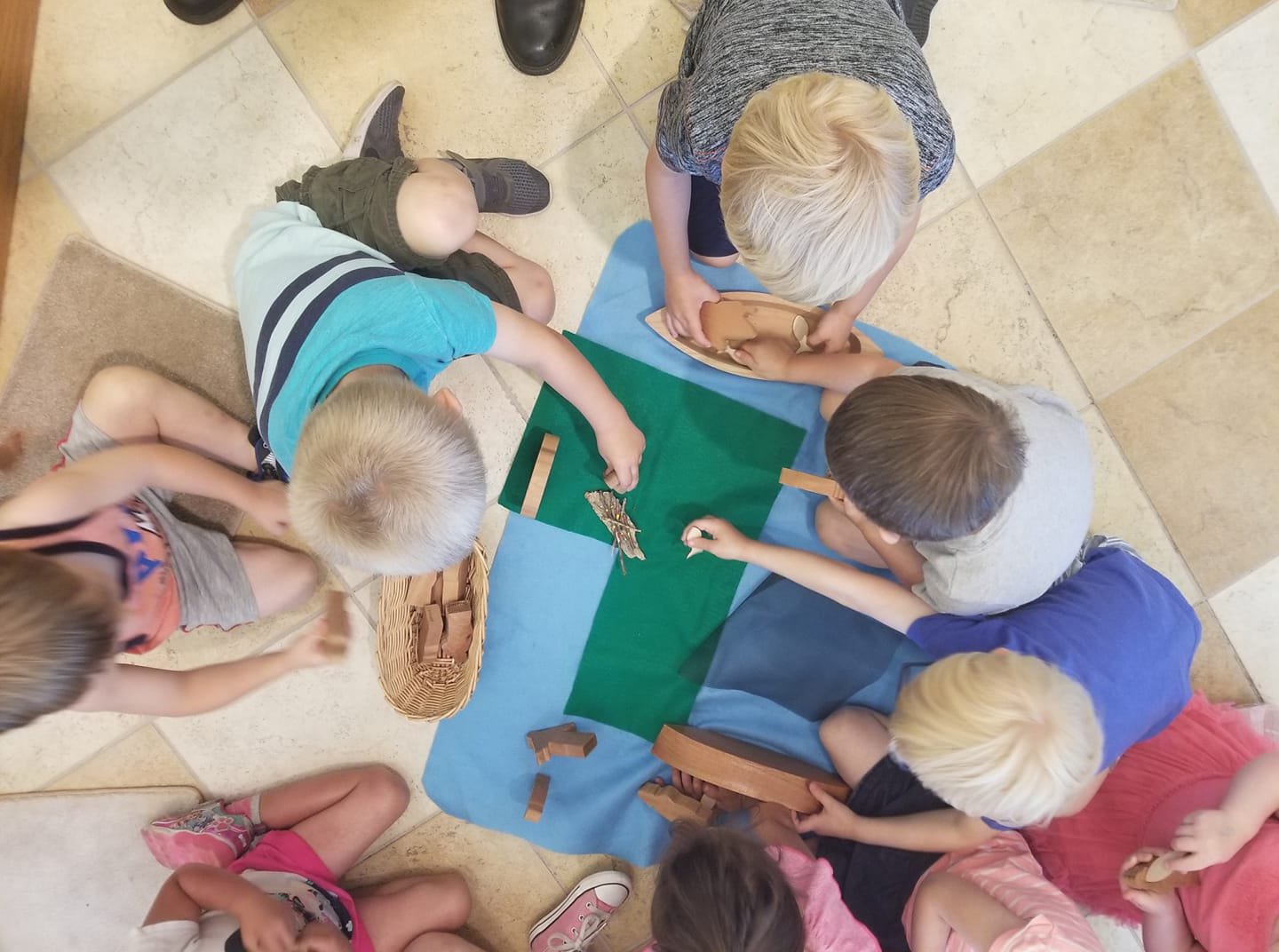
Yesterday at the Godly Play class Hickory Neck offers at The Kensington School, we finally got to tell the Epiphany story – the story of the magi visiting the Christ Child.  As we reviewed the whole story of Advent and Christmas, out came all the figurines of prophets, Mary, Joseph, Jesus, Angels, Shepherds, various animals, and wise men.  Typically, the teacher tells the story quietly, using the figurines, and then we have the kids retell the story, taking turns with the figurines.  And because the class has become so large, we usually have two sets of figurines so we can break into groups.  I would never say the class is perfectly orderly, but it is much more measured than you might imagine with two- to five-year-olds.

But not yesterday.  I’m not sure whether we, the leaders, were off our game, or the kids were still hyped up from returning from break, but the retelling portion of class was utter chaos.  Taking turns fell apart, quiet redirecting failed miserably, and by the time we regrouped to close the class, there was a mass of wooden, sacred figures in a disordered pile.  As we were making our way out, I looked at the pile sadly, grateful that they were all made out of sturdy wood and nothing more destructible, but somewhat disappointed to see such a holy mess.

But as I was thinking about the mess today, I was thinking perhaps my sadness at the chaos was my own “stuff,” having nothing to do with the success of the class.  Too often, we like our Gospel stories neat and tidy.  Too often we tell familiar scriptural stories expecting them to teach specific lessons.  But when we are honest, we know that is not how the Good News works.  The Good News upends worlds, upends social order, and upends our expectations.  Engaging with Jesus is messy work, and sometimes, in the midst of trying to figure out our faith, we end up with a messy rubble in front of us.

I do not know what you are you struggling with today – what things you wish were under control but are actually a mess, or what things you have been expecting from God that just are not how you expected, or what chaos others are making in your life that makes you feel bereft.  What I can tell you is that Christ is there, maybe a bit mired in the chaos too, but there nonetheless.  And sometimes, the mess is just what you need to shake you up and see the movement of God in a new and fresh way.  I suspect things will not turn out as you expect, but then, the Holy Spirit rarely works in ways we expect.  Sending you prayers today, that you might see Christ in the chaos!

Holding on to Joy in Lent…

06 Wednesday Mar 2019

Posted by jandrewsweckerly in Uncategorized

≈ Leave a comment

Tags

Ash Wednesday, Christ, discipline, earthy, holy, identity, joy, kindness, Lent, life, light, love, repent, virtue

IMG_6748

Photo credit:  Jennifer Andrews-Weckerly; reuse only with permission

Last night I had one of the most fun Shrove Tuesday/Mardi Gras celebrations I have ever had.  We had a great crowd, there was a spirit of joy and celebration, the Kensington School hosted an awesome kids’ corner with fun activities, and best of all was the Hickory Neck Talent Show.  I have not laughed so hard and smiled so much in a long time.  I even woke up this morning with an uplifted spirit, the smile still lingering on my face.

While I am so grateful for that blessing, as a priest, it does make entering into Ash Wednesday a bit tricky.  Here I am still coming down from the high of last night, and now I need to enter into a worship service where I tell people to fast, to repent, and to remember their mortality.  It almost feels like emotional or spiritual whip-lash, and I have been struggling this morning to know how to help others with that same abrupt shift.

Where I have landed is that I think the best way to enter into Ash Wednesday and the season of Lent is with that same lingering sense of celebration.  You see, when you have experienced the highs of life, talking about the “lows” of life seems a bit more bearable.  Yes, we are mortal, and yes, we will return to the dust.  But while we are still mortal, we can make this life here on earth one of great joy and love – one of laughter, of community, of togetherness.

I wonder if this might be a way to enter Lent in a healthier way.  Instead of lamenting our sinful nature (and believe me, we do need to lament our sins), perhaps our Ashes today might remind of us the earthy nature of being humans and encourage us to strive for the ways we might live that earthy life in a more holy way.  I plan to do that today by entering into a season of kindness.  I am taking the joy from my community of faith last night and channeling it into forty days of kindness – where my repentance becomes a practice of demonstrating my identity – of living more faithfully the virtue of kindness.  What Lenten discipline are you taking up?  What might be a way for you to joyfully grasp onto this fleeting life and make it a witness to Christ’s light and love?  I can’t wait to hear all about it!!

Ash-Wednesday-1

Photo credit:  https://saintvincents.org/2019/02/25/ash-wednesday-march-6/

← Older posts

Recent Posts

  • On the Myth and Magic of Advent…
  • On Risking Failure and Facing Fear…
  • Sermon – Luke 23.33-43, P29, YC, November 23, 2025
  • On Inhabiting Gratitude…
  • Sermon – Luke 20.27-38, P27, YC, November 9, 2025

Archives

  • December 2025
  • November 2025
  • October 2025
  • September 2025
  • August 2025
  • July 2025
  • June 2025
  • March 2025
  • February 2025
  • December 2024
  • November 2024
  • October 2024
  • September 2024
  • August 2024
  • July 2024
  • June 2024
  • May 2024
  • March 2024
  • February 2024
  • January 2024
  • December 2023
  • November 2023
  • October 2023
  • September 2023
  • August 2023
  • July 2023
  • June 2023
  • May 2023
  • March 2023
  • February 2023
  • January 2023
  • December 2022
  • November 2022
  • October 2022
  • June 2022
  • May 2022
  • January 2022
  • December 2021
  • November 2021
  • October 2021
  • September 2021
  • August 2021
  • June 2021
  • May 2021
  • April 2021
  • March 2021
  • February 2021
  • January 2021
  • December 2020
  • November 2020
  • October 2020
  • September 2020
  • August 2020
  • July 2020
  • June 2020
  • May 2020
  • April 2020
  • March 2020
  • February 2020
  • January 2020
  • December 2019
  • November 2019
  • October 2019
  • September 2019
  • August 2019
  • July 2019
  • June 2019
  • May 2019
  • April 2019
  • March 2019
  • February 2019
  • January 2019
  • December 2018
  • November 2018
  • October 2018
  • September 2018
  • August 2018
  • July 2018
  • June 2018
  • May 2018
  • April 2018
  • March 2018
  • February 2018
  • January 2018
  • December 2017
  • November 2017
  • October 2017
  • September 2017
  • August 2017
  • July 2017
  • June 2017
  • May 2017
  • April 2017
  • March 2017
  • February 2017
  • January 2017
  • December 2016
  • November 2016
  • October 2016
  • September 2016
  • August 2016
  • July 2016
  • June 2016
  • May 2016
  • April 2016
  • March 2016
  • February 2016
  • January 2016
  • December 2015
  • November 2015
  • October 2015
  • September 2015
  • August 2015
  • July 2015
  • June 2015
  • May 2015
  • April 2015
  • March 2015
  • February 2015
  • January 2015
  • December 2014
  • November 2014
  • October 2014
  • September 2014
  • August 2014
  • July 2014
  • June 2014
  • April 2014
  • March 2014
  • February 2014
  • January 2014
  • December 2013
  • November 2013
  • October 2013
  • September 2013
  • August 2013
  • July 2013
  • June 2013
  • May 2013
  • April 2013
  • March 2013
  • February 2013
  • January 2013
  • December 2012
  • November 2012
  • October 2012
  • September 2012

Categories

  • reflection
  • Sermons
  • Uncategorized

Meta

  • Create account
  • Log in
  • Entries feed
  • Comments feed
  • WordPress.com

Blog at WordPress.com.

  • Subscribe Subscribed
    • Seeking and Serving
    • Join 394 other subscribers
    • Already have a WordPress.com account? Log in now.
    • Seeking and Serving
    • Subscribe Subscribed
    • Sign up
    • Log in
    • Report this content
    • View site in Reader
    • Manage subscriptions
    • Collapse this bar
 

Loading Comments...