• About

Seeking and Serving

~ seek and serve Christ in all persons

Seeking and Serving

Tag Archives: homily

Homily – John 20.24-29, Habakkuk 2.1-4, St. Thomas the Apostle, December 19, 2013

12 Wednesday Feb 2014

Posted by jandrewsweckerly in Uncategorized

≈ Leave a comment

Tags

doubt, homily, Jesus, relationship, Thomas

We hear from Thomas several times in the gospels.  When Jesus insists on going to Judea to visit friends in Bethany, Thomas declares, “Let us also go, that we may die with him.” (John 11:16)  At the Last Supper, as Jesus tries to prepare the disciples for his departure, Thomas interjects, “Lord, we do not know where you are going; how can we know the way?” (John 14.5)  And as we hear today, after Jesus’ resurrection, Thomas will not accept the disciples’ account without seeing Jesus’ wounds.  When he finally does see Jesus, he declares, “My Lord and my God.” Thomas was thoughtful, passionate, and loyal.  But Thomas was also skeptical, had doubts, and asked questions.

Though we often refer to Thomas as “Doubting Thomas,” I actually really love Thomas.  His passion is overwhelming and inspiring.  But even more compelling to me are his questions and his doubts.  Thomas feels very real to me: he openly exposes his doubts and questions – something we all have done at some point in our lives, even if we are not as bold as Thomas to admit it.  Thomas shows me how hard believing was even in the presence of Jesus Christ – how much more reassuring to know that our doubts are that much more to be expected.

But perhaps what I love most about the Thomas stories is Jesus’ reaction to him.  Though Jesus may sound like he is scolding Thomas today, Jesus still comes, knowing that Thomas needs reassurance.  When Thomas asked his panicked questions, Jesus also responds pastorally.  Jesus’ relationship with Thomas is even more inspiring to me than Thomas himself.  We find in their relationship a Godhead who is patient, open to question, giving, and kind.  Of course, Jesus pushes Thomas, too – but any good relationship with God involves both challenge and grace.

In some ways, that relationship is revealed in our Old Testament lesson today.  The author says, “I will stand at my watch post … I will keep watch to see what he will say to me, and what he will answer concerning my complaint.”  God responds, “Write the vision; make it plain …”  Through relationship with God, we know that we have a God who responds – maybe sometimes with grace and sometimes with challenge.  But the promise of a responsive God is ours.  Thanks be to God!  Amen.

Homily – Colossians 4.2–6, John of the Cross, December 12, 2013

19 Thursday Dec 2013

Posted by jandrewsweckerly in Uncategorized

≈ Leave a comment

Tags

Advent, darkness, God, homily, John of the Cross, light, prayer

Today we honor Juan de la Cruz, or John of the Cross.  Though he died in 1591, John was widely unknown until more recently.  Born in 1542 in Spain, his father died when he was three.  His mother and siblings were thrown into poverty.  He received early education in an orphanage, but by 17 he had learned carpentry, tailoring, sculpting, and painting through apprenticeships.  He was able to do his university studies with the Jesuits; after school he joined the Carmelite order.  In 1567, he was ordained to the priesthood and recruited by Teresa of Avila to reform the Carmelite order.  He studied extensively, was a spiritual director, and devoted himself to the search for God.  Because of his attempts to dramatically reform the Carmelites, he was eventually imprisoned.  There he wrote poetry as a comfort.  His “Dark Night of the Soul” became his most famous piece.  As John of the Cross has been rediscovered, he has become known as “the church’s safest mystical theologian” and “the poet’s poet.”

I was thinking John must have known a lot about the dark night of the soul.  He had a rough childhood, fought to get an education, and then found incredible resistance when he tried to make the devotion of the Carmelites better; his prison cell must have felt like a dark night.  I am reading an Advent devotional right now, and it has felt pretty dark at times.  I can tell the author has experienced some rough times, though she never specifies what they are in her poetry.  But the darkness of her soul pervades her writing.  I have wondered as I read why she is putting such darkness in our Advent devotional – a season of light.  But then I thought about the realities of this season – the pain the season can bring of lost loved ones, of unfulfilled dreams, of unmet expectations, of pressure and anxiety.  Perhaps the author, like John of the Cross, is willing to expose the dark night that can live in the soul.

So where is the light for us to grasp in Advent?  I appreciate those words of instruction in Colossians: “Devote yourselves to prayer.”  Prayer is one of the places that we can dump darkness and discover light.  Prayer is the conversation in which we can struggle vulnerably and honestly with God, and eventually end up on the other side renewed and refreshed.  This is one of our Advent invitations:  devote yourselves to prayer.  Whether you already feel bathed in light or you are longing for the light, prayer is the place where we meet God and we find strength for the journey.  Amen.

Homily – John 6.57-63, Clement of Alexandria, December 5, 2013

13 Friday Dec 2013

Posted by jandrewsweckerly in Uncategorized

≈ Leave a comment

Tags

Clement of Alexandria, experience, faith, gifts, God, homily, Jesus, questions, sacred, secular

Today we honor Clement of Alexandria, priest and philosopher in the mid-to-late second century.  Clement was originally a Greek philosopher who sought truth in many schools until he met Pantaenus, head of a Christian school in Egypt.  Clement later became head of that school and was for many years an apologist for the Christian faith to both pagans and Christians.  His background and abilities helped him to commend Christianity to the intellectual circles of Alexandria.  He had a liberal approach to secular knowledge and his work prepared the way for Origen, one of the most eminent theologians of Greek Christianity.

We honor Clement today because he did what so many of us simultaneously hope to do and fear to do.  We long to share our faith experiences with both the Christians and non-Christians in our lives.  We have had some incredible encounters with God and we want to share that experience with others.  And yet we fear sharing because we worry that people may ask us questions we cannot answer.  We worry we do not have the intellectual acumen of Clement to tie together our experiences in a logical way.

Perhaps we feel a bit like the disciples in John’s gospel today.  As Jesus explains that he is the bread of life meant to be consumed, the disciples complain, “This teaching is difficult; who can accept it?”  Their complaint is not hard to understand – I am sure any of us hearing Jesus’ metaphor for the first time would be especially baffled.  All we need is one hearty experience trying to explain to a child that a wafer is Jesus’ body and we all get a little nervous about this crazy faith of ours.

In the midst of our hesitancy, we find encouragement through Clement.  Clement gives us permission to interweave our sacred and secular worlds.  Clement used his gift – the gift of a brilliant secular mind – to interpret his faith and make it accessible to the faithful and those without faith.  God gives each of us similar gifts too.  God empowers us with “spirit and life,” as Jesus Christ says.  God gives us a unique spiritual journey that can speak truth because ultimately we, too, are a mixture of sacred and secular: who better to interpret this crazy world and our crazy faith than us?  Clement invites us to share our own truths with others – knowing that our truth is a part of the bigger truth of Jesus Christ.  Though we may not have everything figured out, we have experienced enough of God in us, and we have been given gifts to enable us to share that truth with others.  Amen.

Homily – Psalm 150, St. Cecilia, November 21, 2013

27 Wednesday Nov 2013

Posted by jandrewsweckerly in Uncategorized

≈ Leave a comment

Tags

Cecilia, God, homily, music, praise, song

Music has a unique power in our lives.  There are those songs that remind us of a romance, those songs that we played over and over in a rough patch in our lives, and those songs that always bring a smile to our faces and make us want to dance.  Music has a similar power in our faith lives too.  There are those songs that always make us cry or remember a loved one, those songs that fill us with joy at the remembrance of a special connection to God on a retreat or revival, and those songs whose words capture what we cannot capture better with hours of trying.  Music helps us connect to the awesome power of God and to express the full range of the emotional journal of walking with God.

Cecilia, who we honor today, reveled in singing passionately the praises of God.  Known as the patron saint of singer, organ builders, musicians and poets, Cecilia is venerated as a martyr.  Of noble birth, Cecilia was betrothed to a pagan, who she eventually converted by her witness – along with his brother.  But because of their conversion and her role with them, all three were eventually martyred around 230 during a time of Roman persecution of Christians.  Cecilia’s life has inspired countless artists and composers over the centuries.

Though we may turn to spiritual music for different seasons of our lives, what Cecilia invites us into today is a passion for praise.  Now I know what you may be thinking – that I am asking you to be some constant ray of sunshine who continually pretends everything is ok.  To be honest I know some people who are like that and I do not get it.  How can anyone be that happy all the time?  Does God really want us to stuff our true emotions, pain, and hurt, and pretend all is well?

That is not what a passion for praise is really about.  The psalm we all read today is full of praise: “Praise God in his holy temple … praise him for his mighty acts … praise him with lyre and harp … with resounding cymbals.”  In these six short verses, we are told to praise God 11 times.  I think what the psalmist gets and what Cecilia got is that praise is the vehicle that gets us through pain to God.  Almost like making yourself smile until the smile becomes real, when we praise God, even if we do not feel like praising, eventually our praise overwhelms us, and we cannot help but be lead closer to joy.  Our invitation today is to a life of praise – annoying, hard, gentle, forgiving, joyful, real praise.  Amen.

Homily – Acts 20.28-32, Samuel Seabury, November 14, 2013

27 Wednesday Nov 2013

Posted by jandrewsweckerly in Uncategorized

≈ Leave a comment

Tags

church, Episcopal, flexibility, God, homily, Samuel Seabury, tenacity, trust

Today we honor the life and work of Samuel Seabury, first American Bishop of the Episcopal Church.  Born in 1729 in Connecticut, and ordained priest in England in 1753, Seabury worked in New Jersey, Long Island, and Westchester County.  During the American Revolution, he remained loyal to the British crown and served as a chaplain to the British army.  After the Revolution, in 1783, Seabury was asked by Connecticut clergymen to seek episcopal consecration in England.  He negotiated for a year, but could not obtain episcopal orders because as an American citizen, he could not swear allegiance to the crown.  He turned to the Episcopal Church in Scotland, which consecrated him bishop.  In Connecticut, he was officially recognized as bishop in 1785.  In 1792, he participated in the first consecration of a bishop on American soil.

I do not know many modern Episcopalian who could have lived the life of Samuel Seabury.  He had to deal with changing national loyalties; travel by boat to ask a people from whom he had just revolted to consecrate him; negotiate for a year; think creatively to involve Scotland; not give up; and establish a new system here in the U.S.  Samuel’s faith life required a certain flexibility, creativity, and tenacity that many of us lack.  I sense that lack even in myself as I hear Episcopalians talk about reinventing our church for this new age.  Can’t we just stay as we are where we are comfortable and just pray it will all work out?

But our lesson from the Acts of the Apostles allows no such hesitancy.  Paul exhorts us to keep watch – over ourselves and over the whole flock.  Our job is to care for the church that “God obtained with the blood of [God’s] Son.”  But Paul does not exhort without encouragement.  He says that God’s grace will build us up and that the Holy Spirit makes us overseers.  We can do our work with flexibility, creativity, tenacity, and change because God’s grace will build us up, and the Holy Spirit empowers us to do the work.  The road may be hard at times, but we have the great cloud of witnesses pushing us forward.  Samuel knows we can do it; we just have to let go and trust.  Amen.

Homily – Luke 19.1-10, P26, YC, November 3, 2013

06 Wednesday Nov 2013

Posted by jandrewsweckerly in Uncategorized

≈ Leave a comment

Tags

blessing, church, generosity, giving, grace, gratitude, homily, Jesus, joy, justice, love, sinner, stewardship, wealth, Zacchaeus

I have always loved the story of Zacchaeus.  I am sure part of my love for Zacchaeus began when I learned that song from Sunday School:  “Zacchaeus was a wee little man, and wee little man was he…”  Perhaps I have also always loved Zacchaeus because I too am a bit “short in stature,” and so I have always felt a sense of kinship with Zacchaeus.  I can totally relate to not being able to see in a crowd.  The one time we went to the Macy’s Day Parade, I could only see the tops of floats as I strained to see on tiptoe.  What I wouldn’t have given for a sycamore tree that day!  Plus, Zacchaeus’ story ends so joyfully, that his story seems like a happy little adventure between Jesus and this eager, short man.

But the more I thought about Zacchaeus this week, the more I began to realize that Zacchaeus is not exactly a sweet, innocent, short man trying to see Jesus.  Zacchaeus is actually a pretty bad guy in the story.  Tax collectors are pretty notorious in those days.  First, they are considered traitors by most Jews because they willingly are employed by the occupying Romans.  Second, and perhaps worse, tax collectors make a great deal of money because part of the arrangement of being a tax collector is being able collect as much as they want over the Roman tax to pad their own wallets.[i]  Considering Jericho is a big city, and major center of taxation, we should not be surprised that Zacchaeus is not just doing well – he is rich.[ii]  We should also not be surprised when the people in the crowd grumble when this man, who betrays his people and extorts money from them, is welcomed so warmly by Jesus.

We know Zacchaeuses in our lives – those guys who always cheat their way to the top and seem to be rewarded for their cheating.  They do not even have to be attractive to get their way – they might even be some short guy with no physical appeal.  We much prefer stories like the man with the bigger barn who dies before he can enjoy his wealth, or the rich man who burns in hell without the help of Lazarus, because we like people to get what they deserve.  We like the stories of ultimate justice because we have some sense of justice as fairness ingrained in us.  So when someone is consistently rich, and consistently the recipient of favoritism, we sense justice is being violated.

Over the years, my understanding of wealth and what it does to people has varied over time.  In general, I think money has the potential to be corrupting, and so we all have to be careful about our relationship with wealth.  But I have also met many wealthy people who give away a LOT of money.  Whether the person is a wealthy alum from my college, a generous board member for a non-profit, or a wealthy parishioner at church, I have come to see the powerful way that the wealthy can turn their blessing into a blessing for others.  We hear in scripture all the time how hard life is for the wealthy, how money can lead to sinfulness, and how money can curse someone to suffering in the afterlife.  So we tend to prejudge the rich as being a group who has a lot of work to do – almost as if they must atone for something.  But what that kind of judgment does is allow us to judge others without seeing what in our lives is separating us from God too.  Money can certainly separate us from God and lead us to sinfulness; but so can envy, lust, jealousy, and drunkenness.

When we can see Zacchaeus as a man – not just a wee, little man or a rich, manipulative man – but simply a man who is a sinner just like each of us, then we can really begin to see the magic of Zacchaeus’ story.  The magic of Zacchaeus’ story is that despite his sinfulness, Jesus’ uncompromising love changes him.  The last part of the gospel today is where we see the magic unfold.  When Jesus shows Zacchaeus unconditional love and acceptance, Zacchaeus is entirely transformed.  Zacchaeus does not simply say he will start living his life in a different way.  Instead, Zacchaeus pledges to give half of his possessions to the poor.  Furthermore, he pledges to repay fourfold anyone whom he has defrauded – which given his position was probably quite a lot of money.  And in return for Zacchaeus’ overflowing generosity and repentance, Jesus’ love flows even more, as he declares Zacchaeus to not only be saved, but to be considered a son of Abraham – a member of the family of God!  The story almost becomes comical as Jesus and Zacchaeus try to one-up each other in showing love and grace, abundance and blessing.

For those of you who have ever given generously to church, you may have experienced this Zacchaeus phenomenon yourself.  Making a generous gift to the church actually feels really great – like you are a part of some cycle of gratitude.  When you give out of blessing and gratitude, you end up somehow receiving even more blessing and gratitude.  And somehow giving that generous amount – whether a tithe or some other amount makes you more generous in other areas too.  Somehow, that request at Christmas for needy Plainview families seems easier to accommodate; giving to charities and institutions outside of church feels like the right thing to do.  And giving your money generously makes you want to give your time generously too – because somehow in the midst of giving, you receive so much more.

This cycle of gratitude between us and Jesus is what we celebrate today.  When we bring our pledge cards forward a little later in the service, we bring them with a light heart, an overwhelming sense of blessedness, and a joy that almost makes us dance down the aisle.  This is Zacchaeus’ gift to us today – to help us reclaim the joy that only comes from generosity.  Zacchaeus’ joy can be your joy today too.  Amen.


[i] Laura S. Sugg, “Pastoral Perspective,” Feasting on the Word, Yr. C, vol. 4 (Louisville: Westminster John Knox Press, 2010), 260.

[ii] E. Elizabeth Johnson, “Exegetical Perspective,” Feasting on the Word, Yr. C, vol. 4 (Louisville: Westminster John Knox Press, 2010), 261.

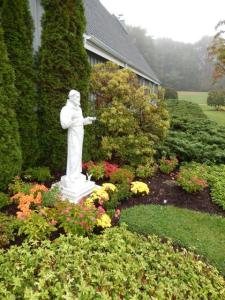
Homily – Ezekiel 34:22-31, Paul Sasaki and Philip Tsen, October 31, 2013

06 Wednesday Nov 2013

Posted by jandrewsweckerly in Uncategorized

≈ Leave a comment

Tags

abundance, beliefs, challenges, God's promise, homily, least resistance, Paul Sasaki, Philip Tsen

Today we honor Paul Sasaki and Philip Tsen, bishops in Japan and China in the mid-1900s.  Bishop Sasaki, from Japan, was persecuted and imprisoned for his support of the independence of the Anglican Church during Word War II.  Missionaries from the Episcopal Church first came to the area in 1859; it was the first church in the Anglican Communion not composed primarily of British expatriates.  The Episcopal Church there elected its first bishops in 1923.  But when WWII came, with Japan opposing the West, the Japanese government ordered all Christians into a “united church.”  Bishop Sasaki refused to be merged, and inspired most of the church to stay together and faithful to their Anglican heritage.  Bishop Sasaki was tortured and imprisoned for his actions, but his witness rallied the church after the war.

Bishop Tsen was raised by Episcopal Church missionaries.  After his ordination, he worked closely with Canadian missionaries in China.  During the Sino-Japanese War, he worked to sustain the people of his area, eventually becoming the leader of the Chinese Anglican Church.  But upon his return from the 1948 Lambeth Conference, he was put under house arrest by the Communist authorities.

When I was in Burma, learning about the Episcopal Church there, I sometimes wondered how they did it – and honestly, why they chose their path.  Their lives would be so much easier if not for the Christian identity.  They could earn more money, avoid persecution, stay out of the watchful eye of the government.  I wonder if Bishop Sasaki or Bishop Tsen did not feel the same way at times.  Though we often encourage standing up for our beliefs, the path of least resistance would certainly be easier.  Surely, we have all had even some small instances when we have either caved or wanted to cave when faced with ethical challenges to our faith.  We knew what we should have done, but the path of least resistance was just too easy.

I think the way Bishops Sasaki and Tsen overcame those challenges was by believing in the promise of Holy Scripture.  We hear the words of promise in Ezekiel today.  God promises a shepherd, security, rains for produce, abundant yield, freedom from invasion, release from poverty and hunger.  These must have been words of promise for these bishops in tumultuous times.

These are words for us in tumultuous times, too.  Whenever we are feeling overwhelmed by the powers of evil or are feeling tempted to take an easy way over what feels like the hard way – Ezekiel reminds us that the way of God is full of abundant promise.  That kind of promise is the kind of promise we can lean on, no matter how hard something is – for we are the sheep of God’s promise, and the LORD God is our God.  Amen.

Homily – Isaiah 11.1-10, Vida Dutton Scudder, October 10, 2013

06 Wednesday Nov 2013

Posted by jandrewsweckerly in Uncategorized

≈ Leave a comment

Tags

activism, Congress, homily, Jesus, Kingdom, politics, prayer, Vida Dutton Scudder

Today we honor the work of Vida Dutton Scudder.  Born in 1861 to Congregationalist missionaries in India, Scudder and her mother were later confirmed in the Episcopal Church in the United States.  She studied English Literature in college and eventually became a professor at Wellesley.  But her love of scholarship was matched by her social conscience and deep spirituality.  She joined both Christian Socialist groups and the Society of the Companions of the Holy Cross, a community devoted to intercessory prayer.  As s socialist, she supported immigrants, workers’ strikes, and eventually, after WWI, became a pacifist.  But her activism was also deeply rooted in prayer.  She said, “If prayer is the deep secret creative force that Jesus tells us it is, we should be very busy with it.”  She added there was one sure way “of directly helping out the Kingdom of God.  That way is prayer.  Social intercession may be the mightiest force in the world.”

As our Congress continues to shut down government, arguing over debt and health care, while crumbling all sorts of services and parts of the economy, I have been wondering where God is in all this.  We get caught up in labels like Democrat, Republican, Tea Party, and heaven forbid, Socialist, and we use those labels as curse words.  But I have always thought Jesus was not only a man of prayer, but a bit of a socialist – probably not unlike Scudder.  You can imagine how excited I was this week when prayer and Congress started colliding in the news.  The chaplain for the Senate has been offering some fiery prayers these last weeks, and his words seem to be not only reaching our Representatives, but also reaching across America.

What this chaplain, Scudder and Jesus all point to is the hope we see in our vision from Isaiah:  a world where the wolf can live with the lamb, the cow and bear can graze together, and a nursing child can play over the hole of the asp.  This is the Kingdom vision.  But we do not have to wait for the Kingdom after death.  Scudder’s witness reminds us that we can take steps to realize the Kingdom here and now.

Now, how we get there is a bigger question.  We could be here all day fighting over whose party can do that best.  But that is where Scudder’s life points us most helpfully – to the life of prayer.  Scudder invites us to stop name-calling or stewing and to start praying.  If we can be very busy with prayer, as Scudder suggests, perhaps we might liberate our feet to take those first steps toward the Kingdom here and now.  Amen.

Homily – Matthew 11.25-30, St. Francis, October 6, 2013

10 Thursday Oct 2013

Posted by jandrewsweckerly in Uncategorized

≈ Leave a comment

Tags

creator, gift, God, gratitude, homily, Jesus, life, possessions, St. Francis, stewardship, stuff, yoke

Today we honor the life and work of St. Francis of Assisi.  Francis was born in 1182, and was the son of prosperous merchant.  But later in life, he was moved by the beggars and lepers he saw and decided to devote his life to a life of poverty – despite his father’s intense opposition.  Francis gathered a community together – although his ideal of strict and absolute poverty was so stark that almost no one could maintain the ideal.  But what Francis was trying to get the brothers to see was that “stuff” got in the way of life with Christ.  Once he renounced his “stuff” he was better able to see – see his neighbors’ poverty and suffering.  And giving up his “stuff” allowed Francis to take in a bigger view of God’s creation.  Though we sometimes narrow in on Francis’ love of animals, St. Francis had a much larger sense of the creative God and God’s created world.  Francis reveled in the creator God, who time and again during the creation process saw that, “it was good.”

Our Sunday School children have been working on the creation story this Fall.  They are learning about the vast expanse of interstellar space, as well as this fragile earth, our island home.  They are learning about how God created plants and every living creature.  They are also learning about how we are created in God’s image and we are to be stewards of God’s creation.  They are learning how we are designed for goodness and generosity, and that all of life is a gift – that we do not own any of it.  St. Francis knew this well.  His understanding of life as a gift is why he could give up everything.

But we struggle – we clutch to our resources and we use words like “earned,” and “deserve” and forget words like “gift” and “generosity.”  St. Francis’ life is all well and good, but when we really look at our resources, we more often find our hands clenched around our possessions than our hands openly giving them away.  I invite us to ponder this contrast not to make us feel guilty, but to invite us to live into God’s generosity.  That is what St. Francis wanted too.  He did not want to guilt people, but to welcome people into the freedom of knowing that all we have is gift, and to live a life in celebration of that gift.  Francis had experienced this radical way of living into the people God calls us to be, and he wanted to share that blessing with others.

Our Gospel lesson today gives us some clues about what all this means in practice.  Jesus says, “Come to me, all you that are weary and are carrying heavy burdens, and I will give you rest.  Take my yoke upon you, and learn from me; for I am gentle and humble in heart, and you will find rest for your souls. For my yoke is easy, and my burden is light.”  Those words from Jesus are echoed in St. Francis’ life and witness.  We may not be able to walk around shoeless in the depths of winter like Francis, or even beg for our food, but when we enter into relationship with God with a greater sense of God’s invitation into the life of generosity, we can image and experience the light yoke.  This is the reflection work we will be doing throughout our stewardship season this fall – but Francis and Jesus give us a little preview about what stewardship really looks like.  So take a moment to start today.  Take in the beautiful creation of our property, as its Fall glory begins to unfold.  If you are an animal lover, look at the generous love of your pet.  Look at one another, remembering the vulnerable beauty of each person here – even those who annoy you the most.  Let this wonder and gratitude fill you up – so that you can slip on that light yoke of generosity and live into the goodness that God has created for you and has created you for.  Amen.

Homily – Isaiah 60.1-5, John Raleigh Mott, October 3, 2013

05 Saturday Oct 2013

Posted by jandrewsweckerly in Uncategorized

≈ Leave a comment

Tags

gospel, homily, Jesus, John Raleigh Mott, joy, light

Today we celebrate John Raleigh Mott.  John was born in 1865 and was known as an evangelist and ecumenical pioneer.  As a young man he worked with various organizations including the World Student Christian Federation and the YMCA.  He helped organize the International Missionary Conference in 1910 – one of the broadest gatherings of Christians up to that point.  Of Christian mission he said, “It is a startling and solemnizing fact that even as late as the 20th century, the Great Command of Jesus Christ to carry the Gospel to all mankind is still so largely unfulfilled … the Church is confronted today, as in no preceding generation, with a literally worldwide opportunity to make Christ known.”  His work developing the ecumenical movement continued, and in 1946 he received the Nobel Peace Prize for his work establishing and strengthening international organizations that worked for peace. 

What is interesting about John’s comments from the early 1900s is that they seem to ring true 100 years later.  We, too, are not fulfilling Jesus Christ’s command to carry the Gospel to all mankind.  Forget around the world – we don’t even want to talk to our next-door neighbors about Jesus.  We get so caught up in not wanting to offend that we can’t even share the story in our lives that brings us such joy.  So where do we find inspiration despite our fears?

I think our lesson from Isaiah helps with this.  “Arise, shine; for your light has come, and the glory of the LORD has risen upon you … Nations shall come to your light, and kings to the brightness of your dawn.”  We forget that our joy, our story of faith when told honestly and vulnerably, shines before others.  I have seen that light in each of you here as you share your faith stories.  Joy inspires joy, and makes us radiant.  We even hear the same in the Gospel lesson.  The joy from seeing Jesus interact with the widow causes people to spread the word throughout the surrounding area – their joy became a light to the nations.

Joy is why we celebrate John Raleigh Mott, too.  His joy drew people in and propelled him out into the world to share that joy.  John invites us today to remember that same joy in ourselves.  We will find, like him, that as we go out, people also come to us.  Nations shall come to your light – our invitation is to share that light!  Amen.

← Older posts
Newer posts →

Recent Posts

  • On the Myth and Magic of Advent…
  • On Risking Failure and Facing Fear…
  • Sermon – Luke 23.33-43, P29, YC, November 23, 2025
  • On Inhabiting Gratitude…
  • Sermon – Luke 20.27-38, P27, YC, November 9, 2025

Archives

  • December 2025
  • November 2025
  • October 2025
  • September 2025
  • August 2025
  • July 2025
  • June 2025
  • March 2025
  • February 2025
  • December 2024
  • November 2024
  • October 2024
  • September 2024
  • August 2024
  • July 2024
  • June 2024
  • May 2024
  • March 2024
  • February 2024
  • January 2024
  • December 2023
  • November 2023
  • October 2023
  • September 2023
  • August 2023
  • July 2023
  • June 2023
  • May 2023
  • March 2023
  • February 2023
  • January 2023
  • December 2022
  • November 2022
  • October 2022
  • June 2022
  • May 2022
  • January 2022
  • December 2021
  • November 2021
  • October 2021
  • September 2021
  • August 2021
  • June 2021
  • May 2021
  • April 2021
  • March 2021
  • February 2021
  • January 2021
  • December 2020
  • November 2020
  • October 2020
  • September 2020
  • August 2020
  • July 2020
  • June 2020
  • May 2020
  • April 2020
  • March 2020
  • February 2020
  • January 2020
  • December 2019
  • November 2019
  • October 2019
  • September 2019
  • August 2019
  • July 2019
  • June 2019
  • May 2019
  • April 2019
  • March 2019
  • February 2019
  • January 2019
  • December 2018
  • November 2018
  • October 2018
  • September 2018
  • August 2018
  • July 2018
  • June 2018
  • May 2018
  • April 2018
  • March 2018
  • February 2018
  • January 2018
  • December 2017
  • November 2017
  • October 2017
  • September 2017
  • August 2017
  • July 2017
  • June 2017
  • May 2017
  • April 2017
  • March 2017
  • February 2017
  • January 2017
  • December 2016
  • November 2016
  • October 2016
  • September 2016
  • August 2016
  • July 2016
  • June 2016
  • May 2016
  • April 2016
  • March 2016
  • February 2016
  • January 2016
  • December 2015
  • November 2015
  • October 2015
  • September 2015
  • August 2015
  • July 2015
  • June 2015
  • May 2015
  • April 2015
  • March 2015
  • February 2015
  • January 2015
  • December 2014
  • November 2014
  • October 2014
  • September 2014
  • August 2014
  • July 2014
  • June 2014
  • April 2014
  • March 2014
  • February 2014
  • January 2014
  • December 2013
  • November 2013
  • October 2013
  • September 2013
  • August 2013
  • July 2013
  • June 2013
  • May 2013
  • April 2013
  • March 2013
  • February 2013
  • January 2013
  • December 2012
  • November 2012
  • October 2012
  • September 2012

Categories

  • reflection
  • Sermons
  • Uncategorized

Meta

  • Create account
  • Log in
  • Entries feed
  • Comments feed
  • WordPress.com

Blog at WordPress.com.

  • Subscribe Subscribed
    • Seeking and Serving
    • Join 394 other subscribers
    • Already have a WordPress.com account? Log in now.
    • Seeking and Serving
    • Subscribe Subscribed
    • Sign up
    • Log in
    • Report this content
    • View site in Reader
    • Manage subscriptions
    • Collapse this bar
 

Loading Comments...