• About

Seeking and Serving

~ seek and serve Christ in all persons

Seeking and Serving

Tag Archives: incarnation

On Messes, Incarnation, and Sacrament…

27 Wednesday Aug 2025

Posted by jandrewsweckerly in Uncategorized

≈ Leave a comment

Tags

Jesus, incarnation, gospel, Eucharist, communion, mess, sacrament, spill

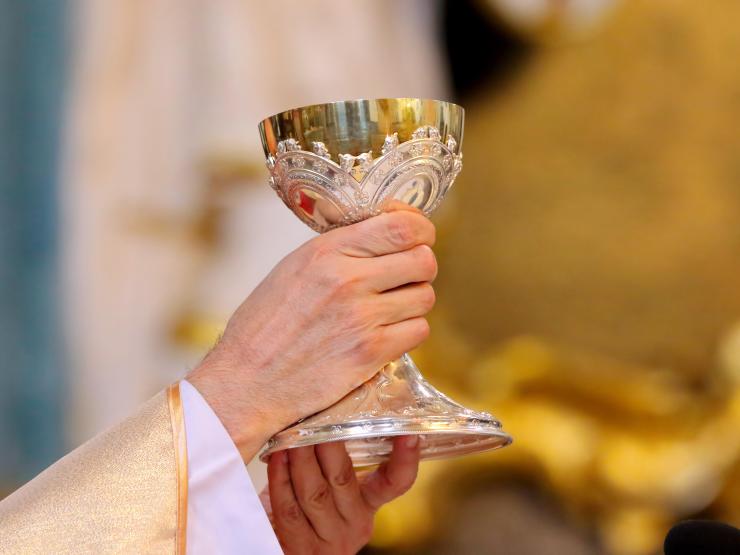
Photo credit: https://premierchristian.news/en/news/article/catholic-priests-allowed-to-offer-holy-communion-from-the-chalice-for-the-first-time-since-2020

Celebrating the sacrament of Holy Eucharist is one of my central jobs as a priest.  I approach the sacrament very seriously and reverently because I know how sacred the privilege of consecrating the Eucharist is and how profound the reception of Holy Communion can be.  In general, my philosophy is to be so graceful and intentional with my celebration that attention is taken off me and turned exclusively and intently to the mystery of the holy meal.

So, imagine my mortification when, after almost 16 years of celebrating Holy Communion multiple times a week, my hand clips the chalice and copious amounts of consecrated wine soak the altar (for those familiar with the terms, the corporal, fair linen, frontal, chasuble, and even my alb were victims).  It was an enormous mess – even the priest host was swimming in wine that landed in the paten.  The gasp was audible when it happened – I’m sure I took in a surprised gasp of air myself.  But I steeled myself and do what we priest always do – I kept going. 

Fortunately, despite the frustration of needing to clear the mess and get linens to the dry cleaners and washing machines, there were lots of laughs and ribbing afterwards.  But the visceral experience of wine flying, landing on silver implements, and making my hands sticky got me thinking.  In the Episcopal Church, we say Jesus’ real presence is in the bread and wine when the priest consecrates it.  There is nothing more incarnational than the messiness of spilt wine.  And we all know that being incarnate means being messy – our bodies naturally make perfection impossible.  But more than that, following Jesus is messy.  Following Jesus means getting into messy relationships with other messy people.  Following Jesus means Jesus sees all our own messiness – even the messiness we hide from others.  And following Jesus makes Jesus very hard to get rid of – there is stickiness to Jesus that lingers with us, much like the stickiness that stayed with me, even after cleaning up. 

I wonder in what ways you’ve been avoiding the messiness of Jesus lately?  In what ways has your desire to control the messiness of the Gospel left you with clean hands, but shallow experiences of the divine?  I look forward to hearing your stories of how the incarnational nature of Jesus is shaking up your life in good and holy ways.  We all need a little more messiness!

Sermon – John 20.19-31, E2, YB, April 7, 2024

01 Wednesday May 2024

Posted by jandrewsweckerly in Sermons

≈ Leave a comment

Tags

baptism, belief, community, doubt, Doubting Thomas, Eastertide, faith, fear, God, incarnation, intimacy, Jesus, relationship, Sermon

Photo credit: Hickory Neck Episcopal Church. Reuse with permission only.

For those of you who have worked with me for a while now, you know that I am easily excited by new ideas.  So, when Ed and Tyler suggested the Sunday after Easter for Quinton’s baptism, I excitedly said, “Yes!”  I knew we would be still experiencing the high of Holy Week and Easter from last week, I knew that baptisms are traditionally celebrated throughout Eastertide, and I knew having another reason to celebrate this Sunday would be fun.  What I failed to double-check was the lectionary.  As soon as I saw the gospel for today, I groaned.  Who wants to talk about Doubting Thomas when we are performing a sacrament of belief and belonging?!?

At first glance, John’s Gospel text today, is in fact, a terrible text for baptism.  First of all, the disciples are making a very poor showing about what the community of faith is supposed to look like.  You would think after seeing the empty tomb and hearing Mary Magdalene’s testimony, “I have seen the Lord,” the disciples would be hitting the ground running, doing the work of spreading the good news, or at least throwing a raucous party.  Instead, we find the disciples huddled in a locked room, cowering in fear.  The text says they are afraid of the Jewish leaders, perhaps afraid the same people who killed Jesus would try to kill them too.  But I think there is more to their fear.  I think they are afraid to face others, because they feel they have failed.  Perhaps they believe their pick for Messiah did not seem to be the Messiah after all.  I think they are also behind those locked doors because they are ashamed that they failed to protect Jesus, to keep him alive.[i]   Those locked doors are not just for safety – those locked doors are for hiding the shame, the disappointment, and the fear of facing others that the disciples have. 

And then we have the famous Doubting Thomas.  That we even call him “Doubting Thomas” is indication enough of the communal disapproval of his behavior.  Why couldn’t he just believe?  If not Mary Magdalene, at least his fellow disciples, who use the same words as Mary’s own testimony, “We have seen the Lord.”[ii]  Even Jesus seems to disapprove when he asks, “Have you believed because you have seen me?  Blessed are those who have not seen and yet have come to believe.”[iii]  We do not exactly seem to be setting the stage well for little Quinton, or anyone new to the Church today.

But the more I thought about this text, and the more I read, the more I realized this is actually the perfect text for someone new to the community of faith.  As little Quinton grows up, I do not want him to think that faith is about perfectly believing, perfectly behaving Christians, who perfectly go to Church.  And although I want Quinton to know about doubt and to have a super healthy sense of curiosity and questioning, the truth is our labeling of Thomas as “Doubting Thomas,” gets in the way of what John is trying to teach new believers.  Instead, New Testament scholar Karoline Lewis explains, “The primary definition of the term doubt, however, has to do with uncertainty.  Uncertainty, as a category of belief, does not really exist in the Fourth Gospel.  One is either certain or not certain; in the light or in the dark.  Jesus invites Thomas to move from darkness to light, from lack of relationship to intimacy.  There is no middle ground with it comes to believing in Jesus.”[iv] 

Now, stay with me on this, because I realize that dichotomy sounds even worse than doubting.  Instead, what John’s gospel is doing is not about exclusion, but about radical inclusion.  John is not conveying something about belief but about incarnation:  “to be incarnated demands relationship.  As a result, you are either in one community or another, but you cannot be not in community.  Life, especially abundant life, is dependent on the reality of multiple expressions of connectivity and belonging, whether that be on-on-one or in various sizes of communities…Even God was not alone in the beginning…”  So, when Thomas says, “My Lord and my God,” he is not talking about his own belief or even an individualized theology, but rather “the intimacy this Gospel imagines between believer and Jesus…”  As Lewis goes on to say, “To give witness to a personal relationship with Jesus is immediately to enter into a community of intimacy between Jesus, God, the Paraclete (a fancy word for Holy Spirit[v]), and the believer and between the believer and the new community, the flock, that Jesus as the Word made flesh has made possible for the world.”[vi]

One this day, when Thomas the Twin teaches us all about what belief really means – that is, incarnate, intimate relationship with God and with one another – I cannot imagine a better word for us today.  When we baptize Quinton today, we invite him into the relationships already present in this community – the real ones that sometimes cower in shame and doubt – but also the ones that lead to abundant life and blessing.  When we pour water over his head and rub oil on his forehead and commit to supporting him and one another in this journey of faith, we are claiming him not as someone who will always have things figured out – because we do not always have things figured out.  But we do commit to the intimacy of relationship:  with the three persons of the Godhead, with one another, and with the community of faith.  I cannot think of a better reminder on this second Sunday in Easter as we deepen our own intimacy with the risen Lord than to baptize and reaffirm our baptisms – as we acclaim today, “I will! (with God’s help).”  Amen.


[i] M. Craig Barnes, “Crying Shame,” Christian Century, vol. 121, no. 7, April 6, 2004, 19. 

[ii] Karoline M. Lewis, John:  Fortress Biblical Preaching Commentaries (Minneapolis:  Fortress Press, 2014), 248.

[iii] John 20.29.

[iv] Lewis, 249.

[v] My words, not Lewis’ words.

[vi] Lewis, 250.

Sermon – John 4.5-42, L3, YA, March 15, 2020

19 Thursday Mar 2020

Posted by jandrewsweckerly in Sermons, Uncategorized

≈ Leave a comment

Tags

anxiety, Caronavirus, flesh, God, human, incarnate, incarnation, intimate, Jesus, Messiah, relationship, Samaritan, Sermon, vulnerable, well, woman

Today’s gospel lesson is one of those lessons that can be so full of intrigue that we miss what is happening in the text.  Most of us have heard this lesson hundreds of times, and have probably lingered on the part of the conversation where Jesus calls out the woman for living with someone who is not her husband, after already having had five husbands.  The conversation sounds straight out of Jerry Springer or Dr. Phil, where in the next scene we expect the other husbands to arrive, and a fight to break loose.

The problem with that kind of reading is we have the tone all wrong.  By narrowing in on what sounds like a “gotcha!” statement from Jesus right in the middle of about 40 verses, we forget all of the words and actions surrounding this event in the middle.  We have clues all along in the reading:  Jesus going through Samaria (when most Jews avoid Samaria); a woman appearing at a well at noon (when most of the woman have come and gone); Jesus (a Jew) talking to a Samaritan woman in broad daylight (a triple no-no); disciples appearing and engaging in conversation that sounds like The Three Stooges; talk of prophets, messiahs, disciples, and evangelism.

When we step back and take the broad view of this lesson, we are able to not be distracted by the sweep of the narrative, the scandalous and the absurd details, and the confusing stream of thought.  When seen broadly, we find a story that illuminates what having an incarnate God really looks like.  Too often, when we talk of the incarnation, we think of the baby Jesus, or the bodily, gruesome crucifixion.  But we sometimes forget the everydayness of the incarnation:  the fact that Jesus is thirsty and needs something from another, namely this Samaritan woman; the fact that Jesus initiates an intimate relationship, where two people can talk about the pain, suffering, and societal rejection of a widow and/or divorcee, who is simply trying to get by in a community that ostracizes her, even from drawing water from the well in the cool of morning; the fact that Jesus understands barrenness and empowers her to instead birth new believers.[i]  As Karoline Lewis says, says, “To take the incarnation seriously, to give it the fullest extent and expression, demands that no aspect of what it means to be human be overlooked.  To do so would truncate the principal theological claim of [John’s] Gospel.  At stake for the fourth evangelist is that Jesus is truly God in the flesh and every aspect of what humanity entails God now knows.”[ii]

I find this reading immensely meaningful today, because we are living in a moment when being flesh and bone is particularly precarious and unnerving.  A pandemic has gone all over the world and landed in our schools, our churches, our gathering places, and our homes.  Our lives have been upended by the threat of the Coronavirus, knowing the vulnerability of some in our community, and understanding suddenly how intricately intwined our lives are, even at a time when we have opined about how socially distanced we are.  This is a time when we feel very fleshy and vulnerable and here is Jesus talking to a vulnerable woman about his own fleshiness.

I don’t know about you, but I find this strange, circuitous conversation very comforting today.  In a time of anxiety, fear, and upheaval, Jesus is right there, in the midst of everyday messiness, and saying, “I feel you.  I understand.  I, your God, am incarnate, and I see and know you.”  And in response, the woman who is seen, known, and heard in turn goes to her community and becomes Jesus for others.  As Lewis says, “The woman at the well is not only a witness.  She is Jesus, the ‘I AM’ in the world, for her people.”[iii]

This is our invitation today too.  In the midst of upheaval, of disorientation, of anxiety, we are invited to be fully enfleshed Jesuses for others – to see their pain, their suffering, their uncertainty, and offer solidarity, comfort, and encouragement.  Even in a time of physical separation, we are invited into intimate relationship with one another, into relationships that honor the holy in one another, and help us all move forward.  This is what the Messiah does for us.  This is what we can do for one another.  Amen.

[i] Karoline M. Lewis, John:  Fortress Biblical Preaching Commentaries (Minneapolis: Fortress Press, 2014), 64.

[ii] Lewis, 55.

[iii] Lewis, 65.

Sermon – Matthew 2.1-12, Isaiah 60.1-6, EP, YA, January 5, 2020

08 Wednesday Jan 2020

Posted by jandrewsweckerly in Sermons, Uncategorized

≈ Leave a comment

Tags

abundance, Bethlehem, Christ, control, Epiphany, God, grace, hide, ignore, incarnation, Jerusalem, light, love, magi, mystery, need, pageant, power, promise, Sermon

At our 9:00 am service today, we honor the feast of Epiphany with our annual Epiphany Pageant.  Every year I love watching the children and youth bring the Christmas story alive one more time.  Part of what makes the service special is hearing the story with fresh ears – not from a clergy person reading from the aisle like every other Sunday, but with a variety of voices narrating and enlivening the words, making the incarnation story more incarnate.  I love how the pageant keeps us in the Christmas moment one more week, and I love how the story brings all our Christmas characters under one roof, reminding us of the continual unfolding of the mystery of the incarnation.  Though there is something certainly endearing about the whole experience of a pageant, there is also something quite profound in a pageant too.

But what pageants can sometimes do is focus our attention so intently on the manger – on Jesus and his family – that we forget what happens outside the manger is just as important as what happens at the manger.  Even our beloved carol “We Three Kings,” draws us to the experience of the magi’s adoration in Bethlehem, without insight into what happens in Jerusalem.  This year, after hearing of registrations, of humble births, of angel choruses, of everyday shepherds spreading the Gospel, and of cosmic explanations of the incarnation, we turn our attention to Jerusalem.  Isaiah gives us some clue about where our attention is drawn.  “Arise, shine; for your light has come, and the glory of the LORD has risen upon you…Lift up your eyes and look around…”[i]  The instruction in Isaiah is not for Bethlehem, but the city of Jerusalem[ii] – the city where Jesus’ journey will end, the city for whom Jesus weeps, the city of eventual redemption and salvation.  There, Isaiah foretells of the incarnation, how the people of God are to reflect the light of Christ, and to pay attention to what is happening around them, to God incarnate.

Those words, “lift up your eyes and look around,” have been lingering with me this week.  Instead of looking deep into the scene at the manger or with the holy family, I am drawn by what is happening in Jerusalem.  Three things happen there.  One, we learn more about the magi.  The testimony of the magi is what most of us associate with Epiphany.  Foreigners set out on a quest, more attuned to the cosmic nature of the incarnation than the people of faith.  Their astrological findings do not simply fascinate them, but inspire action – a long, uncomfortable journey to see the incarnation for themselves.  As profound as their witness is, they are not able to complete the journey alone.  They stop in Jerusalem for guidance.  They know they are on the right path, they just cannot quite get to the proper place. And so, the magi stop and ask for help along the way.  They know something significant has happened, but they need guidance from people of faith to fully realize their journey.[iii]

The magi’s insightful question, “Where is the child who has been born king of the Jews?” is a question that brings in the second action.  The chief priests and scribes, the ultimate insiders of the faithful, those who hold the revelation of scripture and interpret scripture for the people of God, are given news that should be earth shattering.  When asked about the birth of the Messiah, the religious leaders recall what they know of the Messiah:  the Messiah is to be born of Bethlehem and is to shepherd and rule the people of God.  The religious leaders offer the key – the prophecy of scripture about the coming Messiah.  And yet, even though they have this scriptural foundation, they do not react to the news of the magi.  Even though these wise people profess this awaited Messiah has been born, the religious leaders do not drop everything.  They do not even ask to go with the Magi, just to check and see if this story might have something.  They may be versed in scripture, but their inaction shows that even insiders sometimes need outsiders to be faithful.[iv]

Finally, the third thing that happens are the actions of Herod.  Herod is probably the most fascinating to me.  He is wise too, even if he uses his wisdom for his own nefarious purposes.  Herod knows the announcement, even if from an outsider of a new king being born means his own kingship is threatened, and shows how fragile his rule is.[v]  But instead of acting impulsively, he manipulates those around him.  First, he calls in the religious leaders.  You see, Herod is not a Jew – in fact, he is a Roman, serving at the leisure of the kingdom.  But his subjects are Jewish, and so he is wise enough to seek their counsel on what a king, what a Messiah, might look like.  But instead of sending his religious leaders to check things out in Bethlehem, knowing they might discover a true king among them, he secretly sends the foreigners, hoping to manipulate them into doing the work of finding the king, knowing he will get news from them so he can kill this new king.  Herod is only worried about himself and his power, and he will do whatever is needed to maintain that power.

The foreign magi are so unfamiliar with the people of God, they do not initially understand the weight of their question about the new king.  The scribes and religious leaders are so buried in their scripture, and so keen to keep balance with secular power, they do not realize the messianic fulfillment right in front of them.  And Herod is so bent on keeping his power, he does not fully understand the power of God working all around him.  All three of these agents in our story need the words of Isaiah today – all three need to lift up their eyes and look around.

We are not unlike the characters in our story today.  How often are we so mired in our own power – as people of privilege and comfort, as Americans with power more globally, as members and advocates in this community – how often does a word about the movement of God, the promise of change, and the possibility of giving up some of our power to allow that fulfillment, make us just as nefarious as Herod – just as willing to manipulate the world around us?  Or how often have we steeped ourselves in scripture, scouring God’s Holy Word, longing for some sort of guidance or truth, not realizing truth is being spoken through another right to our faces?  Or how often have we been so intent on a mission, so focused on what we sense God calling us to do, we ignore the consequences of our actions, forget the power of our words?

Today’s scripture reading is certainly about the gift of the magi to us – the revelation of the incarnation, the insight of foreigners, and the abundance and homage the incarnation inspires.  But today’s scripture reading is also an invitation to consider our own response to that incarnation in the modern era, considering the ways in which we have not lifted our eyes and looked around.  Taking up Isaiah’s invitation to self-critique is important because there is also a promise in Isaiah.  You see, when we lift our eyes and look around, we acknowledge the narrowness in our lives, or we acknowledge the ways in which we are blind to our own power, or we discover the ways in which we even hide behind our faith, we are then able to see the promise in Isaiah.  Isaiah tells us to look around because glory of the LORD has risen upon us.  Isaiah says in verse five, “Nations shall come to your light, and kings to the brightness of your dawn.”  When we talk about shining our light on this holy hill here at Hickory Neck, this is what we mean.  The gift of the magi to us is not news that is frightening.  When we are not hoarding power or hiding behind our intellect or comfort zones, the news of the magi is news for rejoicing.  And that rejoicing is light that draws nations, and kings, and neighbors, and strangers, and family members, and friends.  The gift of the magi is the invitation to let go of the things that feel under our control, and embrace the thing in no way we control, but in every way brings us grace, love, and abundance.  That is the kind of living that shines light from this hill and brings others to Christ’s light.  That is the light offered to us today in the magi.  That is the kind of good news worthy of pageants and proclamation today.  Amen.

[i] Isaiah 60.1, 4a

[ii] Rolf Jacobson, “Sermon Brainwave #701 – Day of Epiphany,” December 29, 2019, as found at http://www.workingpreacher.org/brainwave.aspx?podcast_id=1216 on January 3, 2019.

[iii] R. Alan Culpepper, “Exegetical Perspective,” Feasting on the Word, Yr. A, Vol. 1 (Louisville:  Westminster John Knox Press, 2010), 217.

[iv] Culpepper, 217.

[v] Stanley Hauerwas, Matthew (Grand Rapids:  Brazos Press, 2006), 38-39.
On Cellos, Love, and the Incarnation…

18 Wednesday Dec 2019

Posted by jandrewsweckerly in Uncategorized

≈ Leave a comment

Tags

awe, cello, child, Christmas, God, good, incarnation, Jesus, love, Mary, parent, wonder

cello-v4r-1483624458-editorial-long-form-0

Photo credit:  https://www.classicfm.com/discover-music/instruments/cello/

Yesterday, my elder child performed in the school’s Christmas concert.  She had been pretty excited and anxious about the concert for weeks.  They worked very hard in class, and she had been practicing daily at home.  She was determined to learn the special songs so she could play them.  Over these last months, she has asked me to sit nearby occasionally and listen; other times, I could hear the songs of the cello floating down the stairs.  But none of that prepared me for what I saw yesterday.  Yesterday, she sat tall in her chair, attentive, and calm.  Suddenly, her arms look graceful and light.  Her movements were like that of a dancer, able to beautifully coax out a tune from her curved instrument.  I was stunned by her beauty, having never fully seen it before as she plugged away at home.  My heart warmed, and was filled with love for the nimble creature – a child who certainly gives me a run for my money in fierceness, stubbornness, and independence, but also who I keep discovering I love more than I even understand.

As I have been thinking about that surge of love and awe for my child, I began to wonder if that was what Mary felt on that night Jesus was born.  Her pregnancy was so fraught.  From her bizarre conception story, to working out marital details with Joseph, to the encounter with her cousin Elizabeth, to the government’s census that forced her to travel while very pregnant, to replaying the conversation with the Angel Gabriel, knowing wondrous, awful, amazing things were to happen with her child.  Though she seemed to embrace her role fully, I sometimes wonder whether she was able to feel love for the child who had brought so much chaos to her life – at least not until she laid eyes on him.  I suspect only then, did her sense of purpose become intertwined with a sense of deep love – a sense of awe bigger than herself.

I think that is how God loves us.  At times, I suspect God, like any parent, has a wicked eye roll and has mastered a deep sigh in response to our behavior.  But I also imagine God has this deep sense of awe, wonder, and love for us – for the ways in which we can be beautiful to one another, the ways in which we use our gifts for good, and the ways in which we glorify God.  I believe the entire Incarnation is due to this deep love – a love even deeper than we experience in those fleeting moments of insight with our children and one another.  That realization is how I head into Christmas this year.  Not thinking about cute babies, or crazy birth narratives necessarily, but in humbled awe of how much God loves us.  When we catch a glimpse of that love, we do not really need anything else this Christmas.  In this last week before Christmas, I invite you to consider the best gift that is waiting for you this year.  Everything else is just trimming.

incarnation

Photo credit:  https://thefellowshipoftheking.net/2015/12/24/lovely-lady-dressed-in-blue-marys-role-in-the-incarnation/

Sermon – John 2.13-22, Exodus 20.1-17, L3, YB, March 4, 2018

07 Wednesday Mar 2018

Posted by jandrewsweckerly in Sermons, Uncategorized

≈ Leave a comment

Tags

beautiful, bless, body, flesh, God, good, honor, incarnation, Jesus, Lent, ministry, repentance, righteous anger, sacred, Sermon, sinful, temple

Today’s gospel lesson is one of those lessons in Scripture that is so vivid we find looking away difficult.  All four of the gospels have this story, and three of the gospels use this story to convey Jesus’ righteous anger about how the practice around temple worship and obligatory sacrifice has led to monetary abuses.  Matthew and Luke even have Jesus calling the whole enterprise a den of robbers.  The story evokes images of Jesus flipping tables, or in today’s version, swinging around a whip like Indiana Jones.  We often recall this text when looking for evidence of Jesus’ righteous anger at injustice.  We are so familiar with this text we can almost hear the sermon about a call to justice in our heads.

But this week, the gospel has been speaking a different sermon to me.  You see, John’s version of this story is a bit different from the other three gospels.  First, John places this story in a very different place in his narrative.[i]  Unlike the other gospels who place this story toward the end of Jesus’ earthly ministry, John places this incident in the second chapter, right after the miracle in Cana.  And in John’s version, Jesus does not lay into the moneychangers in quite the same way.  Instead of financial injustice, Jesus seems more concerned that those gathered have missed something critical – in the obligatory administering of sacrifices at the physical temple, they have missed the fact that God is no longer tied to the location of the temple – and instead is found in the temple of Jesus’ body.  For John, the incarnation, the word becoming flesh and dwelling among us, is central to the entirety of the good news and in this story specifically.

I realized this week that when I think about the Incarnation, I immediately think of the baby Jesus.  Somehow, like a child you do not see for a few years, my image of Jesus incarnate gets stuck in the manger.  And because the adult Jesus sometimes feels so superhuman, I forget about the earthy, gritty flesh of his body – the body that touches to heal, stoops down to wash feet, eats and drinks with others, cries wet tears, and breathes a last breath of the cross.  In coming to know the Messiah who heals, teaches, brings about justice, and is transfigured before the disciples, I forget the enfleshed Jesus – the human body in which God dwells – the only temple we need to draw nearer to our God.

We are in a season of flesh.  Lent is that season when we experience Jesus in deeply enfleshed ways.  What our disciplines or our practices do for us in Lent is help us remember that we are a people of flesh and our God was willing to take on that flesh to transform our lives.  We do not often talk about the profound reality of an enfleshed God, but I stumbled on a hymn this week that opened up the reality.  Brian Wren’s hymn Good is the Flesh says, “Good is the flesh that the Word has become, good is the birthing, the milk in the breast, good is the feeding, caressing and rest, good is the body for knowing the world, Good is the flesh that the Word has become.”  The hymn goes on to say, “Good is the body, from cradle to grave, growing and aging, arousing, impaired, happy in clothing, or lovingly bared, good is the pleasure of God in our flesh, Good is the flesh that the Word has become.”[ii]  Now I do not know about your own spiritual journey, but I do not think I have ever heard Jesus’ flesh being described so vividly.  The closest I have come has been in imagining the vulnerability of that enfleshed body in the cradle.  But capturing what being enfleshed means for all of life – from cradle to grave – somehow opened up John’s words about the temple of Jesus’ body.  God takes something we often associate with sinfulness – and transforms that flesh into something good.  “Good is the pleasure of God in our flesh,” are powerful words that shift how we experience the fullness of Christ’s humanity.

Once we reconnect with the goodness of God’s flesh – the incarnation of Christ – then we begin to see all of Jesus’ ministry not stuck in a manger but immersed in the flesh of life.  Karoline Lewis reminds us Jesus’ fleshy life was important, “Because a woman at a well, whose body was rejected for the barren body it was, experiences the truth of neither on this mountain nor in Jerusalem; because a man ill for 38 years, his entire life to be exact, whose body has only known life on the ground, is now able to imagine his ascended life; because a man born blind, is then able to see, and to see himself as a sheep of Jesus’ own fold; because Lazarus, whose body was dead and starting to decay, found himself reclining on Jesus, eating and drinking, and with his sisters, sharing a meal once again.”[iii]  Not only is Jesus’ incarnation good, making flesh good, Jesus’ ministry is about blessing, healing, and restoring physical bodies.

Once we connect with the goodness of God’s flesh, and the power of Jesus’ fleshy ministry, we are forced to see something we do not always feel comfortable with – the goodness of our own flesh.  Now I do not know about you, but my experience in church has not been one in which the church tells me how good my body is.  In fact, today’s inclusion of the ten commandments usually reminds me of the opposite – of the myriad ways my body is sinful:  from the words that come out of my mouth, to the ways in which I hurt others and take things with my body, to the ways in which I covet things and other bodies.  And those sins do not even touch the ways in which I learn the message that my body is imperfect – how my body is not the right height or shape or gender, how my body is not fit or strong enough, how my skin color, hair, or nails are not quite the ideal.  But if God takes on flesh and says, “Good is the flesh,” and if that enfleshed God engages in a ministry of blessing flesh, then surely part of what we remember today is how good and blessed our own flesh is – how God made our flesh for good.

Now, here comes the tricky part.  Once we realize “Good is the flesh,” that ministered to the flesh, that our flesh is beautiful and revered, then we are forced to make yet another leap – that the flesh of others is also beautiful.  Those bodies we would like to subjugate, regulate, and decimate are no longer able to be separated from the goodness of God’s flesh or our own flesh.  Barbara Brown Taylor argues in An Altar in the World, “‘One of the truer things about bodies is that it is just about impossible to increase the reverence I show mine without also increasing the reverence I show yours.’  In other words, once I value my own body as God’s temple, as a site of God’s pleasure, delight, and grace, how can I stand by while other bodies suffer exploitation, poverty, discrimination, or abuse?”[iv]

This week, we enter that kind of work.  As we welcome guests through the Winter Shelter, we affirm the goodness of all flesh – of God’s flesh, of our flesh, and especially the flesh of those who have no shelter, who work hard all day but cannot secure housing, who live lives of uncertainty, of insecurity, of scarcity.  Once we recall the incarnation of Christ, the dignity of our own incarnation, our work immediately becomes to honor the incarnation of others.  We certainly accomplish the work of honoring flesh this week through the Winter Shelter.  But as we keep walking our Lenten journey, we will struggle with our bodies.  Even our collect today says, “we have no power in ourselves to help ourselves: Keep us both outwardly in our bodies and inwardly in our souls, that we may be defended from all adversities which may happen to the body, and from all evil thoughts which may assault and hurt the soul.”  But our invitation this Lent is to also struggle with claiming our body as good – and using the goodness of the flesh to bless other flesh.  Our repentance this week is not just of the sinfulness of the flesh, but we repent this week of the ways in which we do not honor how “Good is the flesh that the Word has become.”  Amen.


[i] Joseph D. Small, “Theological Perspective,” Feasting on the Word, Year B, Vol. 2 (Louisville:  Westminster John Knox Press, 2008), 92.

[ii] I found this hymn in the commentary by Debie Thomas, “The Temple of His Body” February 28, 2018, https://www.journeywithjesus.net/lectionary-essays/current-essay?id=1675 as found on March 1, 2018.

[iii] Karoline Lewis, “Body Zeal,” February 26, 2018, http://www.workingpreacher.org/craft.aspx?post=5071 as found on March 1, 2018.

[iv] Thomas.

On hope…

15 Thursday Jan 2015

Posted by jandrewsweckerly in Uncategorized

≈ Leave a comment

Tags

baby, emotion, Epiphany, God, hope, incarnation, infant, Jesus

One of the things I had forgotten about having babies is how incredibly transformative they can be.  People totally change around babies.  They ooh and ahh around babies.  Their faces light up and they seem uncontrollably drawn toward infants.  Their whole demeanor shifts at the sight of a baby.  I have even brought my infant to meetings before, and I am amazed about how the whole mood of the room changes.  Work still gets done, but not without laughter, smiles, and joy.  Even a crying child makes people sympathetic and tender.

Courtesy of http://danielleshroyer.com/2014/12/01/moltmann-monday-hope-poor-advent-hope/

Courtesy of http://danielleshroyer.com/2014/12/01/moltmann-monday-hope-poor-advent-hope/

For a long time, I wondered what it was about babies that could turn even the sternest person to mush.  Then I realized what it was:  hope.  Because babies have little control or ability to assert their own (often contradictory) will, there is hope for all that the baby can be.  Their innocence and simplicity are a refreshing break from the complicated nature of life.  They truly are a gift to families, communities, and even strangers who sometimes have truly lost what it means to be a people of hope.

When our little one played baby Jesus in the Epiphany Pageant this year, I was not surprised at all then that the adult playing Mary teared up during the pageant.  I have not spoken to her about what was going on that made her teary, but watching the emotion bubble up in her was something that I knew only an infant could do.  Her emotional response made me see and hear the entire pageant differently – seeing the children in a different way, hearing the words of scripture in a different way, and singing the familiar Christmas songs in a different way.

In that moment of emotion, something else also became clear to me in a totally different way.  The human reality of Jesus as a baby became much more tangible in that moment.  It suddenly made sense to me how angels, shepherd, and wise men could reverence a child.  It made sense to me how Mary and Joseph were completely perplexed, but also completely hopeful about this new thing that was happening through their child.  It made sense to me the tremendous gift and miracle of God taking on flesh for us truly was.

Those moments of utter clarity are a bit rare in my life.  I know the biblical stories and our liturgies so well that sometimes they become rote.  I believe them all; I just do not always feel them.  That morning, I felt it.  I felt the wonder.  I felt the overwhelming gratitude.  I felt the hope.  My guess is that opportunities for those feelings are more present than we ever recognize.  Our challenge is honing the skill of perceiving when God is breaking into our routines and giving us hope.

Holy chaos…

08 Wednesday Jan 2014

Posted by jandrewsweckerly in Uncategorized

≈ Leave a comment

Tags

chaos, children, Christ Child, Christmas, church, Epiphany, holy, incarnation, Jesus, life, liturgy, messy, pageant

Courtesy of http://saintansgar.blogspot.com/2010/11/joint-childrens-christmas-pageant-and.html

Courtesy of http://saintansgar.blogspot.com/2010/11/joint-childrens-christmas-pageant-and.html

This past Sunday, our church held its annual Epiphany Pageant.  Since the pageant involves using Scripture and hymns to retell the entirety of Jesus’ birth narratives, the pageant replaces most of the Liturgy of the Word (the part of the service when we traditionally read/chant the four lessons and then hear a sermon).  Though part of what we love about the pageant is the kids’ presence, we also love being invited into the familiar – rehearing the story of the Christ’s birth and incarnation and singing the hymns that we look forward to all year.

Inevitably, the pageant is a bit messy and chaotic – children forget where to go, costumes do not quite fit, or attention spans are just not long enough.  Situating the pageant within the context of worship also means that the entire worship experience that morning is loud and a bit difficult to stay fully engaged in – especially if you are looking for a quiet, contemplative reflection on the incarnation.

But to be honest, that is what I love about the pageant – the holy chaos of it all.  We often think about the birth of the Christ Child as a clean story, much like many of the two-dimensional artistic renderings we see of what looks like quiet adoration at a manger.  But the whole concept of the incarnation is messy:  from Jesus’ scandalous conception, to what had to have been an unsanitary birth among hay and animals, to stinky visitors like the shepherds, to the visit of three foreign men who act strangely and probably raise more suspicion than excitement.  The birth of Jesus is a bit of a holy mess, not to mention the rest of Jesus’ incarnate life, which involves hanging with those of ill-repute, with smelly fishermen, and with the seriously infected and ill.  Nothing about Jesus’ birth or life is sanitary, controlled, or predictable.

Later on Sunday morning in worship, as I distributed communion, I gave the body of Christ to the young girl who had just played Mary in the pageant.  In that moment, the chaos of the day disappeared, and the miracle of the incarnation became much more real to me.  Mary, the mother of Jesus, was just a woman, trying to live faithfully, caught in the holy chaos of life.  I found myself wondering what receiving the body of Christ, the body of her son, would have been like, especially once he was gone.  And just like Mary was just a woman, each one of us in church – the young girl, the middle-aged man, the aging woman – are all just people, caught in the holy chaos of life, trying to make sense of it all, but also eternally grateful for a God who takes on human flesh for us.  That is why Church is so incredible to me.  In the midst of contemplative prayer, and even in the midst of what feels like a loud, crazy liturgy, God can break through and speak truth to us.  I am grateful to our children for reminding me that God is incarnate in the midst of all of life – in the beautiful and quiet, but especially in the messy, loud, chaos of life.

Sermon – John 1.1-14, CD, YA, December 25, 2013

08 Wednesday Jan 2014

Posted by jandrewsweckerly in Uncategorized

≈ Leave a comment

Tags

Christmas, darkness, death, God, incarnation, Jesus, John, light, prologue, resurrection

I must admit that I have always been a little wary of John’s prologue at Christmas time.  I tend to prefer the earthy stories of Jesus in a manger, of dramatic angelic appearances, of messy shepherds, and of a baffled holy family.  I like that I can picture the events in my mind and ponder their meaning.  I like that I could imagine myself there and even wonder what the events mean to me two thousand years later.  My love of these stories is only accentuated by the songs we sing on Christmas Eve, and the nostalgia the music brings to me.

But today, on Christmas Day, we get none of that.  We sing no songs, we hear no romantic, familiar stories, and we do not get lost in the ancient narrative.  Instead, on this busy, often loud day, we come into a totally different space – a place of quiet reverence – and we hear a totally different text.  John does not go back to the beginning of Jesus’ story – he goes back to the beginning of all our stories.  “In the beginning was the Word, and the Word was with God, and the Word was God.”  Our minds drift not back to a stable, but to the beginning of creation, when the earth was a formless void – tohu wavohu.  Whereas our synoptic gospels try to tell us about who Jesus is by giving a story about his birth narrative, John’s gospel takes an even wider lens to try to explain who Jesus is.

In some ways the contrast between Christmas Eve’s stories about the stable and Christmas Day’s quiet reflection on the beginning of time is quite appropriate.  On Christmas Eve we are full of giddiness and excitement.  We break the long anticipation of Advent with a festive celebration of Jesus’ birth.  We share in jubilation, as if we are a crowd of people gathered at the maternity ward, sharing cigars and bear hugs.  But today, like a crew that has come in to clean up after a late-night party, we gather in these pews with a bit more sobriety, deeply pondering what all this incarnation stuff means.  For that kind of work, John’s gospel is the perfect gift.  John almost seems to say, “Yes, all those stories you know and love about Jesus are true and are to be celebrated.  But do not get swept away in the excitement and forget what this really means.”

For John, he begins his gospel starting not with details of the event of the incarnation, but with details about the significance of the incarnation.  For John, he is not interested in the sentimentality of a cute baby.  John is interested in the astounding fact that God became incarnate – took on flesh, lived among us, took on our dirty, gritty lives, and faced rejection and suffering – all so that we might live.  The God of creation – that same creative God we know from Genesis – is the same God who comes among us.  The Word has always been, and yet the Word also enters into human history to give life and light to the people.  When we talk about this kind of momentous significance, it is no wonder that we gather here in quiet awe of our God, soberly realizing the tremendous, salvific gift of the Word made flesh coming to dwell among us.

In some ways, the contrast between Christmas Eve and Christmas Day are hitting home a little more vividly this year.  On the one hand, I have a four-year old, who really gets Christmas this year, who is excited beyond belief about baby Jesus, St. Nicholas, presents, and visiting family.  Her enthusiasm is infectious, and I want to cultivate that joy.  I am reminded of that collect from compline that asks God to “shield the joyous.”  But on the other hand, death has been heavy around me these last few days.  A dear friend from Delaware died this weekend, St. Margaret’s Cemetery helped a young couple from a neighboring church bury an 8-month stillborn child on Monday, and just two days ago, a St. Margaret’s parishioner lost his mother.  In light of the grief of those around me, I am grateful for a sober reminder of the awesomeness of our God, the salvation and promise of resurrection that is only made possible through the incarnation – that Word made flesh who lived among us, and who is full of grace and truth.  In the end, there is hope on both sides – hope for the happily joyous this season and hope for the soberly mournful this season.  I thank God for a Church who tends to both sets of needs, but mostly I thank God for taking on our earthly flesh, for giving us the Word who knew both joy and sorrow, and for promising us that the light shines in the darkness, and the darkness does not overcome it.  Amen.

As a child…

09 Wednesday Jan 2013

Posted by jandrewsweckerly in Uncategorized

≈ Leave a comment

Tags

children, Christmas, Epiphany, God, incarnation, Jesus, reverance

Diverse kidsI never really spent time around young children growing up.  I was never a babysitter.  As I became older, my friends often speculated lightheartedly that I would never survive as a mother, since when kids were around I was either like a deer in headlights or was a bit disdainful with the mess, noise, and general chaos.  Even when my own child was born, I had never changed a diaper.  So when Jesus says, “Whoever does not receive the kingdom of God as a little child will never enter it,” I have often worried how serious he really was about that.

But this Christmas and Epiphany, I slowly began to see the wisdom in Jesus words.  My own daughter really opened up the incarnation for me this year in a fresh way.  Over the holidays, we made our way to St. Mary the Virgin Episcopal Church in Times Square.  After Eucharist, while looking at the many side altars, my daughter found a crèche.  She immediately ran up to the small crèche, and knelt on her knees to look at the figures.  I was shocked at the peaceful calm that came over her as she knelt at Jesus’ manger, and was immediately reminded of the way the magi too were brought to their knees in the presence of Jesus.  Her small body kneeling at the feet of Jesus gave me a small window into Jesus’ words about how children guide us into the kingdom.

But my daughter was not the only child who opened up the incarnation for me this year.  Our confirmation class of six teens got word from a parishioner of families in a local hospital who would not be able to afford Christmas gifts this year.  So, the class agreed to take up their December class time (adding in another class sometime this spring as a make-up) to go together and shop for gifts, using their own money.  The pile of gifts the next day blew me away.  Without even thinking, our confirmands demonstrated Christ’s love incarnate in a season that can typically be very self-centered.

Finally, this past Sunday, our young people offered an Epiphany Pageant in the context of worship.  Because they were helping lead worship that day, I asked the children and youth to pray with me the same prayer that I pray with our choir and acolytes before we lead worship.  And although we had the typical smiles and photo ops, the children seemed to really get it – they were leading worship.  And as the pageant closed, with all the kings, shepherds, angels, Mary and Joseph kneeling at the feet of the Christ Child, the incarnation came alive once again.  I could feel the reverence of our children, and they drew me out of my smiles about their “cuteness” and reminded me of my own need for a posture of reverence at our Lord’s feet.

So today I am grateful for the tremendous life and witness of our children.  They are teaching me everyday new and deeply meaningful ways to enter the kingdom of God.  Thank you for your witness to me and to the people of faith.

← Older posts

Recent Posts

  • On the Myth and Magic of Advent…
  • On Risking Failure and Facing Fear…
  • Sermon – Luke 23.33-43, P29, YC, November 23, 2025
  • On Inhabiting Gratitude…
  • Sermon – Luke 20.27-38, P27, YC, November 9, 2025

Archives

  • December 2025
  • November 2025
  • October 2025
  • September 2025
  • August 2025
  • July 2025
  • June 2025
  • March 2025
  • February 2025
  • December 2024
  • November 2024
  • October 2024
  • September 2024
  • August 2024
  • July 2024
  • June 2024
  • May 2024
  • March 2024
  • February 2024
  • January 2024
  • December 2023
  • November 2023
  • October 2023
  • September 2023
  • August 2023
  • July 2023
  • June 2023
  • May 2023
  • March 2023
  • February 2023
  • January 2023
  • December 2022
  • November 2022
  • October 2022
  • June 2022
  • May 2022
  • January 2022
  • December 2021
  • November 2021
  • October 2021
  • September 2021
  • August 2021
  • June 2021
  • May 2021
  • April 2021
  • March 2021
  • February 2021
  • January 2021
  • December 2020
  • November 2020
  • October 2020
  • September 2020
  • August 2020
  • July 2020
  • June 2020
  • May 2020
  • April 2020
  • March 2020
  • February 2020
  • January 2020
  • December 2019
  • November 2019
  • October 2019
  • September 2019
  • August 2019
  • July 2019
  • June 2019
  • May 2019
  • April 2019
  • March 2019
  • February 2019
  • January 2019
  • December 2018
  • November 2018
  • October 2018
  • September 2018
  • August 2018
  • July 2018
  • June 2018
  • May 2018
  • April 2018
  • March 2018
  • February 2018
  • January 2018
  • December 2017
  • November 2017
  • October 2017
  • September 2017
  • August 2017
  • July 2017
  • June 2017
  • May 2017
  • April 2017
  • March 2017
  • February 2017
  • January 2017
  • December 2016
  • November 2016
  • October 2016
  • September 2016
  • August 2016
  • July 2016
  • June 2016
  • May 2016
  • April 2016
  • March 2016
  • February 2016
  • January 2016
  • December 2015
  • November 2015
  • October 2015
  • September 2015
  • August 2015
  • July 2015
  • June 2015
  • May 2015
  • April 2015
  • March 2015
  • February 2015
  • January 2015
  • December 2014
  • November 2014
  • October 2014
  • September 2014
  • August 2014
  • July 2014
  • June 2014
  • April 2014
  • March 2014
  • February 2014
  • January 2014
  • December 2013
  • November 2013
  • October 2013
  • September 2013
  • August 2013
  • July 2013
  • June 2013
  • May 2013
  • April 2013
  • March 2013
  • February 2013
  • January 2013
  • December 2012
  • November 2012
  • October 2012
  • September 2012

Categories

  • reflection
  • Sermons
  • Uncategorized

Meta

  • Create account
  • Log in
  • Entries feed
  • Comments feed
  • WordPress.com

Blog at WordPress.com.

  • Subscribe Subscribed
    • Seeking and Serving
    • Join 394 other subscribers
    • Already have a WordPress.com account? Log in now.
    • Seeking and Serving
    • Subscribe Subscribed
    • Sign up
    • Log in
    • Report this content
    • View site in Reader
    • Manage subscriptions
    • Collapse this bar
 

Loading Comments...