• About

Seeking and Serving

~ seek and serve Christ in all persons

Seeking and Serving

Tag Archives: Jesus

Sermon – Luke 21.25-36, A1, YC, November 29, 2015

03 Thursday Dec 2015

Posted by jandrewsweckerly in Uncategorized

≈ Leave a comment

Tags

alert, armor, Christ Child, darkness, fear, hope, Jesus, light, on guard, second coming, Sermon, waiting

Many years ago, when my husband and I were driving from our honeymoon in the Outer Banks back home to Delaware, we decided to take the scenic route.  At the time, the idea of a scenic drive sounded romantic.  We were excited to take the Chesapeake Bay Bridge-Tunnel.  And of course, as newlyweds, we were just excited to have more time together.  But by hour ten, I thought I was going to lose my mind.  I devolved into a whiny mess who could not keep still and who huffed and puffed in frustration.  I kept shifting around and fidgeting in my seat, and I am pretty sure I groaned at some point, “Are we there yet?!?”  Any notion of a romantic journey was lost – all I wanted was to get home immediately.

Truthfully, I feel similarly about Advent.  As a priest well-trained in preaching from the lectionary, I know I am supposed to be appreciative of the intentional ways in which the lectionary shapes, prepares, and teaches us.  But as soon as Advent starts, I get overly excited.  I think about the Advent candles, the purple vestments, and the greenery.  And because I know what is waiting for us on December 24th, I turn into that car-trapped honeymooner, complaining, “Are we there yet?!?”  Since I know a baby is coming, all I want to think about is Mary’s pregnancy, her relationship with Joseph, and the long journey to Bethlehem.  I am not saying I need to celebrate baby Jesus right away, but I at least would like to throw a baby shower or see Mary’s baby bump.

But that is not how Advent is presented to us in the beginning of Advent.  Instead of talking about the first coming of the Christ child, we talk about the second coming of Christ.  Instead of giddy, romantic stories about lovers making it work with an unexpected pregnancy, we get dark, foreboding tales of earthly disorder and destruction.  Instead of happy expectation, we get somber warnings to prepare ourselves and to stand guard.  Normally, I do not mind these texts at the beginning of Advent.  Theologically, I understand the concept of framing the first coming of Christ within the second coming.[i]  I understand that in order to appreciate Christ’s birth I need to remember what his birth means many years later.  I understand the need for a warning about being on guard for the second coming – a reminder that I do not get to enjoy all the fun stuff of Christ’s birth without realizing the significance of Christ’s death and return as well.  But emotionally, I am tired of being on guard.  I am tired of earthly destruction.  I am tired of feeling like the end is upon us.

That is what is so hard about Advent this year.  We are already on guard this Advent.  With terrorism striking worldwide, with gun violence in our own country, and with debates about welcoming refugees, we are already “alert at all times,” as Jesus demands.  I know people who are avoiding shopping in Manhattan this year because they are afraid of potential threats.  There are rumors of out-of-state school field trips getting canceled due to fear of danger. And some states have shut down their borders to refugees because of suspicions of terrorists in refugee disguise.  We know all too well the reality of living in fear, guardedness, and preparation for the darkness of this world.  And quite frankly, when we come to church, especially in this season of preparing for the Christ Child, the last thing we want to do is dwell on the darkness.  We want a little bit of light from Christ too.

Last weekend, the final movie in The Hunger Games series premiered.  For those of you unfamiliar with the series, the movie features a dystopian future after a failed revolution.  As punishment for revolting against the Capitol, the Capitol designs what is called The Hunger Games – a battle to the death in which two children from each of twelve districts faces one another in an arena.  Not unlike ancient practices in Rome, and yet uncannily familiar to modern times, the residents of the Capitol watch the games with a detached sense of enjoyment as they cheer for their favorites.  In the first film, President Snow talks to the head of the Games about why they have the games and a winner in the first place.  “Hope:” he explains, “It is the only thing stronger than fear.”  He goes on to say, “A little hope is effective.  A lot of hope is dangerous.”  You see, the President wants to keep people oppressed.  He knows that the people need to fear him – but he balances that fear with a tiny bit of hope so that they do not revolt again:  if they can believe that there is hope for a slightly better life while keeping the status quo, then they will strive to stay in line.  But the hope most be managed so that the hope does not liberate people from submission to the Capitol.

We could easily live lives of fear when hearing Jesus’ words today about the Second Coming.  We could worry about natural disasters, about violence, and about destruction.  We could hear Jesus’ words about being on guard, being alert at all times, and standing up to raise our heads, and be worried about the burden of constant vigilance.  But Jesus is not trying to scare us into preparation.  Jesus does not want us to live in fear.[ii]  Quite the opposite, Jesus wants to give us a big dose of hope today.  Unlike President Snow, Jesus does not manipulate us by only giving us a small amount of hope.  Though today’s text can feel full of gloom, Jesus, in his weird Jesus way, is actually trying to give a large dose of hope today.  Instead of asking us to cower in fearful anticipation, he is inviting us to stand tall, raise our heads in certainty, and be people of sober, joyful expectation.

In our collect today, we prayed these words, “…give us grace to cast away the works of darkness, and put on the armor of light…”[iii]  Many of us may question whether we can put on an armor of light in such a despairing world.  Perhaps we worry about sounding like Pollyannas or being insensitive to the suffering of the world and our communities.  But putting on the armor of light is not putting on the armor of denial or dismissiveness.  Putting on the armor of light is an act of seeing and experiencing the deep groaning of our time and proclaiming that God works as an agent of light despite what feels like overwhelming darkness.  By putting on our armor of light, we are acknowledging that “God in Christ is coming because God loves us – because God wants to redeem us.”[iv]  Putting on the armor of light means that despite all that is falling apart in our lives, our communities, and the world around us, we claim hope over despair.

Now some of us may think that putting on armor is preparing us for battle – that we are going to be issued lightsabers like the Jedi fighters of Star Wars.  But the armor of light is a bit different.  The armor of light requires us to stand tall as beacons of light in the world – much like the lighthouses that line our shores on Long Island.  Now, I do not mean putting on that armor is a passive act.  In fact, as N.T. Wright explains, our armor is not for an “exciting battle, with adrenalin flowing and banners flying, but the steady tread, of prayer and hope and scripture and sacrament and witness, day by day and week by week.”[v]  Knowing that we are slowly, steadily treading toward Jesus’ return, we need that armor of light more than ever:  to protect us from allowing fear to overcoming us, and to remind ourselves of how we are grounded in liberating hope.

And just in case you are not convinced that you can survive a long, steady tread, the community of faith gathers here every week to witness and wear that armor of light with you.  We are like those freedom fighters from the Civil Rights movement, who steadily marched – from Selma to Montgomery, through the streets of Washington, D.C., and anywhere else where fear was reigning.  Their power was in their numbers, their fortitude, and their hope.  They wore the same armor that we don today.  Yes, we will get to celebrate the birth of the Christ Child soon enough.  But before he comes, when he comes, and after he comes, we will still need to stand up, raise our heads, and be agents of light and hope.  The world needs our light – and so do we.  Amen.

[i] Mariam J. Kamell, “Theological Perspective,” Feasting on the Word, Yr. C, Vol. 1 (Louisville:  Westminster John Knox Press, 2009), 21.

[ii] David Lose, “Advent 1 C: Stand Up and Raise Your Heads!” November 23, 2015, as found at http://www.davidlose.net/2015/11/advent-1-c-stand-up-and-raise-your-heads/ on November 25, 2015.

[iii] BCP, 211.

[iv] Kathy Beach-Verhey, “Homiletical Perspective,” Feasting on the Word, Yr. C, Vol. 1 (Louisville:  Westminster John Knox Press, 2009), 25.

[v] N. T. Wright, Luke for Everyone (Louisville: Westminster John Knox Press, 2004), 260.
More…

25 Wednesday Nov 2015

Posted by jandrewsweckerly in Uncategorized

≈ 1 Comment

Tags

clergy, God, Good News, interfaith, Jesus, life, love, mercy, ministry, more, Thanksgiving, Transgender, wideness, witness, worship

Every once in a while, I have experiences in ministry when I think, “Well I never would have imagined that happening!”  I admit that the experience is rare.  There is not a lot that surprises me anymore in this line of work.  Though I am relatively young, I still feel like I have seen it all.

But that has not been the case this week.  This week I found myself in two situations I would have never anticipated.  On Sunday night, our parish hosted the Long Island Transgender Day of Remembrance.  I had no role in crafting the liturgy or planning the evening.  I simply offered our space and was asked to give an opening and closing prayer.  In fact, the planning committee warned me that this would not be like a “church service” – so I should not get my hopes up!  But as I sat in my pew, watching testimonial after testimonial, listening to over eighty names of those who were murdered because of their transgender identity, and hearing beautiful music about the wideness of God’s love and the call to love “the other” – I tell you, I experienced “Church.”  You see, Church is supposed to be about worshiping our God who shows mercy and compassion, who calls us to love the outcast and the oppressed, and who compels us to go out and witness the Good News of God in Christ.  Sunday night, I felt like the Good News came back inside and witnessed to me.

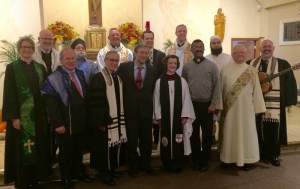
Plainview-Old Bethpage Interfaith Clergy, November 24, 2015

On Tuesday night, I participated in my fourth Plainview-Old Bethpage Interfaith Thanksgiving Service.  Every year I find the service moving. I am grateful for a holiday that we can all honor without fear of stepping on each other’s toes.  But as I sat there last night, I became acutely aware of my surroundings.  On my left sat the Mufti from the local Muslim community and on my right sat the priest from the local Roman Catholic parish.  It occurred to me in that moment that the Mufti usually only says prayers with men.  The women pray separately.  And yet, there we were, side by side, giving thanks to God.  It also occurred to me that although the priest has been warm and affirming, his Church does not recognize my ordination as appropriately apostolic – especially given my gender.  And yet, there we were, as equal leaders in our respective communities.  Despite having had long relationships with the fellow clergy leaders, this was the first time I realized how radical our relationships are – to sit next to each other despite profound differences – and yet still be able to praise, lead, and worship together.

Truthfully, I do not know what God is doing this week.  On a basic level, I suspect God is reminding me that I am not even close to having “seen it all.”  But on a deeper level, I also suspect that God is inviting me to go further, to delve deeper, and to see more widely.  Perhaps a disadvantage to my profession is a naïve sense that I have a hold on who this God is that we worship and serve.  This week, God has humbled me by reminding me that God is so much more. As I anticipate celebrating Eucharist on Thanksgiving Day, I expect to approach the Table with keener sense of wonder, gratitude, and awe for the ways in which God is so much more.  What a blessed gift this week has been.  Thanks be to God for being more than I could ask for or imagine!

Sermon – John 18.33-37, P29, YB, November 22, 2015

25 Wednesday Nov 2015

Posted by jandrewsweckerly in Uncategorized

≈ Leave a comment

Tags

ambiguity, angst, bizarre, Christ the King, communion, divinity, Eucharist, evil, faith, follow, Jesus, king, mystery, Pilate, Sermon, terrorism, uncomfortable, violence

Every once in a while, I am reminded of how bizarre our faith can sound to others.  When a child asks a seemingly basic question, or when a non-believing stranger asks me a question that is not easy to explain, I can imagine how strange my responses sound.  But having been raised in the faith, the strangeness never bothered me.  And if I really was not sure about something, I found myself comfortable with the explanation, “It’s a mystery.”

But lately, I have been barraged by incidents where “It’s a mystery,” just does not cut it!  The first instance was the First Holy Communion class I did with David and William a few weeks ago.  David and William actually went pretty easy on me.  But those classes are always challenging because they do not allow you to simply experience Holy Eucharist – I have to explain Holy Eucharist:  from why we process and reverence an instrument of death (the cross had the same purpose as our modern-day electric chair); to what to do when we don’t necessarily believe everything in the Nicene Creed; to why the priest holds out her hands during the Eucharistic prayer.  The second instance of “It’s a mystery,” not cutting it was in Bible Study class last week.  The group is reading John and John’s rather gory discussion of eating flesh and drinking blood.  The group wanted to know what Episcopalians believe about what happens to the bread and wine when the priest consecrates the elements – and how that differs from what other denominations believe.  I am fairly certain that if I had told the group that what happens in Eucharist is a mystery, they would not have let me off the hook so easily.  The final instance of “It’s a mystery,” not cutting it has been in reading the book, The Year of Living Biblically.  In this past week’s assignment, our author, A.J. Jacobs finally makes his way into the New Testament.  As an agnostic Jew, the author discusses his fears about trying to live the Bible literally if he cannot get behind the idea of Jesus as the Messiah and the idea of Jesus being both human and divine.  As a cynical New Yorker who confesses he has no desire to convert, I am sure my “It’s a mystery,” explanation would get him nowhere.

The challenges of our faith are not limited to worship, Eucharist, and Jesus’ divinity.  Today we celebrate yet another bizarre element of our faith – Christ the King Sunday.  On this last Sunday of Pentecost, before we enter into the season of Advent, we declare Christ as our King.  On the surface, that is not a bizarre claim, I realize.  Many communities have kings, and the way we venerate Christ is not unlike the way many kingdoms venerate their kings.  Given the familiarity of that image, we might imagine that Christ the King Sunday is about regal processions, festive adornments, and praise-worthy songs.  In fact, we will do some of that today.  The problem though with Christ the King Sunday is not that Jesus is our King.  The problem is what kind of king Jesus is.

We have seen evidence of what kind of king Jesus is.  Most famously would be the Palm Sunday procession.  Jesus does not ride into Jerusalem on horseback with a sword and an army.  No, he rides into town on a borrowed donkey, accompanied by a little crowd – nothing newsworthy really.  There are other clues too.  There is that time when the Samaritans refuse housing to Jesus and his disciples.  The disciples ask, “Lord, do you want us to command fire to come down from heaven and consume them?”[i]  But Jesus just rebukes the disciples and keeps on going.  Even when Jesus knows Judas is going to betray him, he does not stop Judas.  Instead of stopping Judas or outing Judas, Jesus quietly lets Judas leave to betray him.

So we should not be surprised today at the interaction between Pilate and Jesus and why this passage, of all passages, should be selected for Christ the King Sunday.  Pilate is perplexed by this man who is being labeled (or more accurately, is being accused of having claimed to be) the king of the Jews.  So Pilate asks repeatedly whether Jesus is indeed the king of the Jews.  Jesus mockingly explains that if he were a traditional king, his people would be fighting to save him – which they are decidedly not doing.  Jesus cryptically further explains that his kingship does not look like kingship in the traditional sense – and in fact, his version of kingship is the only kind of kingship that can save anyone.  Violence, retaliation, and revenge will not work.[ii]  A battle of wills will not win control.  The only thing that will win is sacrifice, selflessness, and ceding.  Jesus will not overcome the evil of the world by matching wills with rulers like Pilate.  Jesus will only overcome by allowing himself to be overcome.  When we really think about Jesus’ kingship, his kingship is yet another bizarre thing about our faith.  Who pins their faith on a weak, non-violent, forgiving man?

Given the multiple terrorist attacks we have witnessed over the past week, the irony of Christ the King Sunday is not lost on me.  Just this past week, at Lunch Bunch, we were discussing the challenges of engaging in war to stop terrorism verses isolationism.  The discussion we had was the same discussion that hundreds of theologians have had for centuries.  I have even witnessed top scholars debate the ethics of intervention versus non-violence.  We watch Jesus turn the other cheek – in fact, Jesus tells us to turn the other cheek, give away our tunics, go a second mile, give to borrowers, and love our enemies.[iii]  But we watched what happened in World War II when we stayed out of the war as long as possible – a genocide happened.  And we have seen what sanctions do in foreign countries – though they are non-violent, the brunt of the restrictions hit the poorest of the country.  And yet, we are also only one country.  We cannot possibly fight every force of evil, have troops in every country, and wage war every time evil emerges.

This is one of those times when I would love to say, “It’s a mystery!”  We say that phrase because the answer is beyond our knowing – or because we just do not know the answer.  Any kind of guessing about “What Would Jesus Do,” is not likely to get us very far.  We know that Jesus does not fight Pilate today, and has no intention of answering evil for evil.  But we also know that Jesus is wholly other – the Messiah, the Savior, the sacrifice for our sins.  His death is different from our deaths, and the kingdom he brings is both already and not yet.

Despite the fact that I cannot give you answers about what we should do about ISIS, about terrorism, or about violence, what I can tell you is that the ambiguity of Jesus’ identity as Christ the King is actually good news today.  Now I know ambiguity does not sound like a gift.  But in this instance, I believe ambiguity is where we can put our faith today.  Ambiguity is a gift today because ambiguity makes us uncomfortable.  Because we do not have definitive answers, we are forced to stay in prayer and keep discerning God’s will in this chaotic world.  Because we do not have a king who answers violence for violence (which is quite frankly, a very easy black-and-white formula to replicate), we are forced to contemplate our faith in light of the world.  Because we follow Christ the King, we do not get to say, “It’s a mystery,” as an excuse not to wrestle.

As I think about the conversations I have had with David and William, with our Thursday Bible Study Group, and even the conversation I would have with A.J. Jacobs, I realize ambiguity is the most honest, vulnerable, real way we can start any conversation about faith and Jesus Christ.  And if we ever want a young person, a non-believer, or even someone wise beyond their years to trust that they can have an authentic, meaningful conversation with us about faith, then we have to be willing to step into the ambiguity of faith.  One of Jacobs’ advisors talks about the “glory of following things we can’t explain.”[iv]  That is what Christ the King offers us today – the opportunity to follow things we cannot always explain.  Jesus invites us share our ponderings and struggles with knowing this king who is sometimes counterintuitive.  He invites us to relinquish our angst about the ambiguity, and instead to celebrate the King of ambiguity.  Amen.

[i] Luke 9.54.

[ii] David Lose, “Christ the King B:  Not of this World,” November 16, 2015 as found at http://www.davidlose.net/2015/chirst-the-king-b-not-of-this-world/ on November 19, 2015.

[iii] Matthew 5.39-48.

[iv] A. J. Jacobs, The Year of Living Biblically (London:  Arrow Books, 2009), 203.

You did it to me…

19 Thursday Nov 2015

Posted by jandrewsweckerly in Uncategorized

≈ Leave a comment

Tags

compassion, doing, Elizabeth, exhaustion, fatigue, feeling, Jesus, refugees, suffering, thinking, violence

I have been struggling with what to say in the face of recent acts of violence, the American debate about welcoming Syrian refugees, and an overwhelming sense of compassion fatigue and confusion about what is the “right” thing to do when considering war and peace, good and evil, life and death.  Theoretical conversations only get us so far.  Real life is where our theology is truly tested.  This week, instead of being fired up and ready for action, I find myself exhausted – exhausted by our continual ability to treat each other inhumanely, exhausted by an overwhelming sense impotence in the face of suffering and evil, and exhausted by oversimplifications and generalizations that end up justifying our behavior.

In the midst of my exhaustion, fatigue, and inability to articulate anything coherent this week, I celebrated the life and witness of Elizabeth, Princess of Hungary at Eucharist today.  For those of you who do not know her story, she was born in the early 1200s and was married by age fourteen.  She had a passion for the poor; so much so, that her husband allowed her to use her dowry to tend the sick and poor.  When a famine struck the land, she sold her jewels to build a hospital to care for others and she opened the royal granary.  When her husband died, she was kicked out by the court for her “extravagances.”  But she dedicated her life to the sick and poor anyway, and died at age 24 from exhaustion.

Photo credit:  http://maxwellheightschurch.com/serving-the-world/

Photo credit: http://maxwellheightschurch.com/serving-the-world/

As I celebrate another year this month (many more than Elizabeth got to enjoy), I am struck by how much she did in so little time.  I am exhausted from thinking and feeling so much.  Elizabeth was exhausted from doing so much.  And as if I needed any further reminder of what Jesus is calling me to do than Elizabeth’s witness, the gospel lesson assigned today comes from Matthew.  Jesus says, “I was hungry and you gave me food, I was thirsty and you gave me something to drink, I was a stranger and you welcomed me, I was naked and you gave me clothing, I was sick and you took care of me, I was in prison and you visited me…Truly I tell you, just as you did it to one of the least of these who are members of my family, you did it to me.”  (Matthew 25.31-40)

While my exhausted heart, mind, and soul are wondering what to make of all of this, Jesus is clear and strong.  I was hungry and you gave me food, I was thirsty and you gave me something to drink, I was a stranger and you welcomed me.  When I feed, slake, or welcome others, not only am I loving them, but also I am loving Christ Jesus.  I am sure Jesus is moved when our hearts and minds pondering these things.  But today, Jesus is also inviting us to do.  To feed, slake, welcome, clothe, tend, and visit.  Because when we do those things, we do them to Jesus.

Sermon – John 11.32-44, AS, YB, November 1, 2015

04 Wednesday Nov 2015

Posted by jandrewsweckerly in Uncategorized

≈ Leave a comment

Tags

All Saints, dead, death, Jesus, Lazarus, life, light, live, new life, reborn, resurrection, Sermon

There is a lot about the Lazarus story that I do not understand.  I do not understand why Jesus allows Lazarus to die if he is only going to bring him back to life anyway.  I do not understand why Jesus weeps when he knows he can fix things.  I do not understand why Jesus raises Lazarus from the dead when eventually Lazarus will have to die again.  But mostly I do not understand why we never hear from Lazarus about how he feels about all of this.  The text tells us Lazarus has been dead for three days.  We do not know much about the afterlife, but presumably, after three days, one’s body and soul have already moved beyond this earthly life.  For all we know, Lazarus is at peace, already enjoying eternal rest with God.  Whatever pain and suffering he has endured in life is gone.  Maybe he is relieved to be free of the stress and battles of earthly life, and to be released to enjoy the peace of eternal life.  When he has reached that point of peaceful bliss, why would he want start over – knowing he will eventually have to go through death all over again?[i]

I used to watch the television show Buffy the Vampire Slayer.  For those of you who are unfamiliar with the show, the premise is that throughout time there has always been one young woman in the world chosen to be the Vampire Slayer – a young woman trained and “called” to protect the world from vampires.  In season five, after having prevented at least five apocalypses, Buffy faces one more.  In the episode, the only way to stop the end of the world is for her to sacrifice herself.  She dies and the world is saved.  Of course, the next season, her friends use magic to bring her back from the dead.  But the rest of that season, Buffy struggles.  She finally confesses that she did not want to be brought back from the dead.  She had been happy and at peace.  All of the fighting and struggling against evil was over, and she was finally free from all obligation and strife.  Being brought back was even worse than before.  Not only did she have to continue fighting evil, but also she was now aware of the freedom she could have had.  She didn’t want to be resurrected.

What Buffy eventually discovered, and I am sure Lazarus did too, was that there was still some purpose left in her life.  In fact, she was able to transform the entire vampire slaying industry.  Unfortunately, we never really get to hear what happens to Lazarus – how his resurrection transforms his life.  We eventually read that the chief priests plot against Lazarus because people are beginning to follow Jesus after he raises Lazarus from the dead.  Perhaps there were times when Lazarus would have preferred to have stayed dead than to be raised again and face all the controversy.  But perhaps, Lazarus found new purpose and was able to use whatever additional earthly time he had to do something good.[ii]

When Scott and I first moved to Delaware after graduating from college, we found a church home at the Cathedral.  The Cathedral was a special place for us.  The Cathedral was where we were both confirmed as adults.  The Cathedral was where we had our first experiences serving on Vestry, leading Bible Study, officiating Morning Prayer, and teaching a Rite 13 class.  The Cathedral was the place where I fell in love with Anglican Choral Music and chant.  The Cathedral was where I was ordained as a Deacon in the Church.  So, a few years ago, when the Cathedral closed because the congregation could no longer support the cost of ministry in that space, you can imagine that I and hundreds of others were devastated.  Those pews, those stone walls, that altar rail was the site of transformation and holiness in our lives.  Now, the fate of that sacred space would depend on who bought the Cathedral and what they decided to do with it.

This past week, a story broke about the Cathedral.[iii]  Another non-profit in the same town purchased the property and would be converting the church and all the office and classroom spaces into housing for moderate- to low-income elderly persons.  When the project is done, there will be 53 housing units, housing over 116 residents.  Though I never wanted the Cathedral to die – in fact, I was devastated by its death – I also must admit that the news of the resurrection of this church into a powerful new ministry brought me infinite happiness this week.  What I could see was that something good would be coming out of the Cathedral’s death.  The Cathedral had always been a place of service and mission, bringing Christ’s light into the community.  Once this new residence is completed, the Cathedral will continue its work of bringing Christ’s light into the community.

As I was thinking about the Cathedral and Lazarus this week, what I began to wonder is whether earthly death was necessary for each of them to be reborn into new life.  In many ways, when we do a baptism, that is what we say happens.  As we enter into the waters of baptism, the old self dies and a new self emerges from the waters on the other side.  We die to earthly life and are reborn into the life of faith.  In fact, in ancient days, baptism happened in a pool of water so that the whole body could be immersed in water, signifying the old self being washed away and the new self emerging out of the watery womb of Christ.  But in order to be baptized, in order to have new life, death must first happen.

When we think about All Saints Day, which we celebrate today, that pattern is quite familiar.  Most of the saints that we honor today experienced a death of sorts before their earthly deaths.  I can think of countless saints who renounced their wealth or their privilege in order to begin a new life:  St. Francis, Mother Teresa, and Oscar Romero.  And we know everyday modern saints who experience the same thing:  that young adult who spent thousands of dollars on a University education to go spend two years in the Peace Corps; that person who worked on Wall Street, making millions, who left to start a non-profit; or that well-paid doctor who spends weekends at the community clinic and summers traveling with Doctors Without Borders.  What those ancient saints, famous saints, and everyday saints teach us is that sometimes a part of us has to die in order for us to truly experience resurrection life.

I imagine each of us here has something we have been holding on to – or even clinging on to – that needs to die before something can be reborn in us.  Maybe we need to let go of a memory – the memory of that perfect long-tenured rector or the memory of that painful experience with a rector – so that we can reassess what new life is blooming right in front of us.  Maybe we need to let go of a resistance to change – letting the familiar die so that something new and fresh (and perhaps, just maybe, shockingly better) can be born anew in our community.  Or maybe we need to let go of a theology of scarcity – that fear that I or my church will not have enough – so that we can allow a theology of abundance to grow in us.  In many ways, I see that new life already budding here at St. Margaret’s.  I see those glimpses of resurrection life pushing their way out of our protective arms.  The invitation from the saints today is to let go.  Let death happen so that new life can emerge.  Let that new hope spring out of the tightly sealed containers in which we have hidden budding hope.  And maybe, like Lazarus, when Jesus calls for us to come out of the tomb, we won’t be afraid to take off those binding cloths and to embrace whatever new, scary, uncomfortable, and awesome new life awaits.  Amen.

[i] Suzanne Guthrie, “Back to Life,” Christian Century, vol. 122, no. 5, March 8, 2005, 22.

[ii] Henry Langknecht, “Commentary on John 11.32-44,” November 1, 2009, as found at https://www.workingpreacher.org/preaching.aspx?commentary_id=429 on October 29, 2015.

[iii] Robin Brown, “Historic church complex set to continue ‘Lord’s work’,” October 29, 2015 as found at http://www.delawareonline.com/story/news/2015/10/22/historic-church-complex-set-continue-lords-work/74269674/?hootPostID=ab06f2224fc6ba16ac4e81312a021ffa.

Homily – Mark 10.35-45, P24, YB, October 18, 2015

23 Friday Oct 2015

Posted by jandrewsweckerly in Uncategorized

≈ Leave a comment

Tags

blessed, earn, entitlement, gift, giving, God, gratitude, homily, Jesus, ours, ownership, privilege, serving, wealth, Zebedee

Most of you know that father was a Methodist minister.  One of my favorite children’s sermons he gave was about an apple.  He gathered us all around and he had an apple and a carving knife.  He said that the apple represented all the money that our families had.  Then he asked us what were all the things that our family needed that we had to spend our money on.  We all shouted out our answers:  clothes, food, our houses, cars.  With each answer, he cut out a chunk of the apple.  When were down to about 1/3 of the apple, he invited us to answer what else we spend our money on.  We had answers for that too:  toys, games, vacation, movies.  By the time we finished, there was nothing left of the apple.

Suddenly, my father gasped.  “Oh, no!  We forgot something.  We forgot to give some of our money to God!”  There was good news though.  My dad had another apple.  He suggested we try to do things a little differently this time.  “How about we give some of our money…say 10%…to God?  Okay?”  Then we carved out all those things we need.  Then we still had a little left for all the stuff we like – maybe not as much, but there was still some there.

Photo credit:  http://callahandesign.biz/home/

Photo credit: http://callahandesign.biz/home/

Thirty years later, I think the point of his children’s sermon was that if we start by returning some of our wealth to God, we’ll have plenty for everything else.  But as I was thinking about that apple this week, something else occurred to me.  That apple – that apple that represents “our” money that we get to choose how to divvy up – is not really ours.  That apple actually belongs to God entirely.  We have money because we work for it, right?  But how do we get jobs in the first place?  We could argue that we have jobs because we worked hard to get there, or we went to school.  But in Eucharistic Prayer C, one of the things we say is that God blessed us with “memory, reason, and skill.”  So yes, we work hard, but we are able to do that work through the blessings of God.  God blesses us with abilities and talents.  God blesses us with good health and a sense of forbearance.  God blesses us with shelter, food, and clothing so that we can rest, build up strength, and fit in socially at work.  God blesses us with support systems, like friends, neighbors, and family who help us stay emotionally stable enough to do the work God has given us to do.  All that money that is “ours” that we “earn” on our own is not really ours when we are honest.

Now, no one is more uncomfortable with this notion than me.  When I was growing up people always said I was smart, but I always insisted that it was because I was a hard worker.  Nothing came easy to me and I worked for everything I got.  So imagine my discomfort when I had to think about my apple – all my income – and realize I didn’t have that apple because I worked hard to earn that apple.  I had that apple because God blessed me with all the things I needed to be able to work hard and earn.  When I insist that I should get to choose who gets what slices of my apple, I get lost in a sense of entitlement instead of gratitude about where the apple comes from in the first place.

The sons of Zebedee had the same struggle with a sense of entitlement.  In fact, the sons of Zebedee sound almost impish today.  “Teacher, we want you to do for us whatever we ask of you.”  They try to manipulate Jesus into the answer they want before they even ask us the question.  “Jesus, promise us you’ll do this one, tiny little favor.”  And then they ask a most ludicrous question – to be at Jesus’ right and left hand in his glory. In essence, they want the most favored spots in the kingdom of God.  Jesus chides them, “You do not know what you are asking.”  The other disciples are enraged – either because they think the Zebedee brothers are being selfish, or because they are mad that they didn’t think of the idea first.

But at the heart of their request is something bigger – a sense of entitlement.[i]  Their question indicates that they think they are owed such a privilege.  And maybe in their eyes they were owed.  They left everything to follow Jesus.  Jesus keeps talking about how they are going to suffer anyway, so they want some guaranteed reward for that suffering.  And they have already proven themselves – look at how loyal they are to Jesus and the cause.  Their request is not just a reward – they earned those places of honor.

But what Jesus does today is what he always does – he turns everything upside down.  The Zebedee boys will be honored – but not with cushy titles or offices.  They will be honored by enduring the same suffering – sharing in Christ’s cup – that Jesus endures.  Honor, Jesus explains, does not come from earning and amassing wealth.  Honor comes from serving others – from emptying ourselves of wealth and serving others.

This week, I was reading an article about a couple who lives on 6.25% of their income.[ii]  They earn just under $245,000 a year, and yet they live on just over $15,000.  They give about $100,000 to charity.  And not just this year, but every year since 2008.  Now, I don’t know whether this couple is Christian, but I tell you what they do seem to understand – that apple isn’t fully theirs either.  And in fact, giving about 40% of their apple away has brought them a sense of freedom and joy that is hard to find elsewhere.

In these weeks of discernment about your giving to St. Margaret’s, I invite you to consider your own relationship with your wealth – with your apple.  I am not suggesting you need to give 40% of your apple to the Church – though I also would not stop you.  But what I am inviting you to consider is how God – God the Giver – gifted you with that apple.  I am inviting you not just to consider the wealth that the apple represents, but also all the other blessings that even enable you to possess the apple.  My guess is that the more you pray on those blessings, the more and more overwhelmed you will become about the abundance God has showered upon you.  Sit in that spiritual space of being overwhelmed by God’s abundance this week and listen for how the Spirit is calling you to use your apple.  Amen.

[i] Stephen B. Chapman, “Sons of Entitlement,” Christian Century, vol. 123, no. 21, October 17, 2006, 20.

[ii] William MacAskill, “Giving to Receive,” October 9, 2015 as found at http://qz.com/515655/this-couple-lives-on-6-of-their-income-so-they-can-give-100000-a-year-to-charity/ on October 14, 2015.

Homily – Matthew 11.25-30, St. Francis, October 4, 2015

07 Wednesday Oct 2015

Posted by jandrewsweckerly in Uncategorized

≈ Leave a comment

Tags

burden, comfort, crazy, discomfort, easy, give up, holy, homily, imitate, impossible, inspire, Jesus, life, light, missions, Pope Francis, saint, sanitized, St. Francis, uncomfortable, yoke

I once led a book group that read the book The Prison Angel.  The Prison Angel is the story of Mother Antonio, a woman of privilege from California who had a mid-life crisis, took on the role of a nun, went to the largest prison in Tijuana, Mexico, and began a ministry of transforming guards, inmates, and families connected to the prison.  Her work was amazing – the way that she was able to love everyone equally, the way that she was able to harness resources and get them where they needed to be, and the way that she was able to devote her life to this system – even living in her own prison cell for a while – were all examples of her awesome witness.  As we finished the book, I had hoped that people in our book group would be inspired, and might even consider their own contribution to a prison ministry.  Instead, the response was more like this:  Mother Antonio is truly amazing.  But let’s be honest.  I can’t be like her.  I’m not going to drop everything – my family and life – and become totally devoted to a ministry.  And just like that, I lost them.  No longer was Mother Antonio inspiring.  She was impossible.  And once she was impossible, no one felt compelled to do anything.  I definitely felt like I failed my mission of inspiration leading to action.

As I was preparing for today’s celebration of St. Francis, I ran across this quote:  “Of all the saints, Francis is the most popular and admired, but probably the least imitated.”[i]  You see, we have a sanitized version of Francis in our minds.  He was nice to animals and took care of the poor.  He devoted his life to Christ as a monk.  We even put up statues of Francis in our gardens and outside our churches.  When we think of Francis, we think of a gentle man gingerly allowing a bird to perch on his finger, and we smile.  We like our sanitized version of Francis because the real version is a little scary.  When Francis renounced his rather significant wealth, he stripped naked in front of his father and the bishop.  Francis didn’t just help the poor, he became poor, begging on the streets.  He worked with lepers – people no one wanted to touch, touching them with his bare hands and kissing them.  Barefoot, he preached in the streets about repentance.  He preached to the birds, and is rumored to have negotiated with a wolf.  If we met St. Francis today, most of us would not imitate or venerate him.  We would just see him as another homeless beggar with a serious case of mental illness.

That is the challenge for us when trying to live a holy life.  St. Francis is the obvious example today.  Though we love and admire St. Francis, few of are comfortable with his total identification with poverty, suffering, and care for our creation.  The same can be said of Jesus.  Though we profess that Jesus is our Lord and Savior, we regularly fail to live in the ways that Jesus taught – in fact, some of us have given up even trying.  Even looking toward a modern-day example of holy living trips us up.  When we watched Pope Francis come through last week, we marveled at his radical witness.  We loved what he had to say – except when he had something to say that made us uncomfortable or that we disagreed with.  When thinking about the radical life that is following Jesus – whether through the Pope, through St. Francis, or Jesus himself – most of us stumble and feel like giving up.

Luckily Jesus offers us a promise today.  Jesus says, “Come to me, all you that are weary and are carrying heavy burdens, and I will give you rest.  Take my yoke upon you, and learn from me; for I am gentle and humble in heart, and you will find rest for your souls.  For my yoke is easy, and my burden is light.”  My yoke is easy and my burden is light.  When we look at St. Francis’ witness and we think about the poverty, the preaching, and the penitence, we get nervous.  We like our stuff, we like being comfortable, and we like being Christians without having to be too loud about it.  When we think about St. Francis, we think of a yoke – but not a light one – one that is heavy and onerous.  But Jesus harkens us back to his original words.  My yoke is easy and my burden is light.

One of the reasons I am a proponent of international missions is that they help you experience reality in a totally different way.  When we go on local missions, we can keep our smart phones, we have access to clean, accessible health care, and we can always find a McDonalds for a burger fix.  But when we are in a rural town in a third world country, things change.  We may not get to shower everyday, we may have to boil our water before drinking it, we will eat food that you are not so sure about, and we pray that we don’t get too sick while abroad.  And forget about a cell phone and internet access.  Most of us don’t even take a watch or jewelry to ensure they do not get lost.  Now that may sound like torture to most of you.  But here is what we learn when we are stripped of comforts and living and working in a foreign setting:  We learn to appreciate your massive wealth comparable to the poor in the third world; we learn what hospitality – real hospitality in the face of nothing – really feels like; we forget about email, phone calls, and even stop obsessively checking the time, because those things do not really matter that week; we hear birds and other creatures in a way that we never have before – maybe because of their proximity, or maybe because we normally distract ourselves with a hundred other things; and – now this is the crazy one – we talk about Jesus and no one is uncomfortable (well, except maybe us because we haven’t done that very much).  When stripped of everything familiar, we discover that Jesus’ burden really is easy and his yoke truly is light.  And sometimes we need to be stripped of the familiar so that when we are back in our comfort zone, we can more tangibly remember how easy that burden was and how light that yoke felt.

You may not be able to go on an international mission trip.  But each of you has some experience – a heartfelt expression of gratitude when you cared for the poor, a prayer with someone who was really hurting, or surprisingly easy conversation in a coffee shop about church and your faith.  Though Jesus, St. Francis, and even the Pope sometimes go to extreme measures, they all ultimately are trying to do the same thing.  To remind us that Jesus’ burden is easy and his yoke is light.  And then they all invite us to get comfortable with discomfort or even with the label of being crazy – and to go and do likewise.  Amen.

[i] Holy Men, Holy Women:  Celebrating the Saints (New York:  The Church Pension Fund, 2010), 622.

On Progress and Outstanding Work…

30 Wednesday Sep 2015

Posted by jandrewsweckerly in Uncategorized

≈ Leave a comment

Tags

boundaries, Christian, church, conflicted, Episcopal, Eucharist, excitement, exclusion, God, Jesus, love, open table, Pope Francis, Roman Catholic, Spirit, table, unity

Photo credit: http://www.wusa9.com/story/life/faith/pope-coverage/2015/08/20/poll-pope-francis/32052555/

Photo credit: http://www.wusa9.com/story/life/faith/pope-coverage/2015/08/20/poll-pope-francis/32052555/

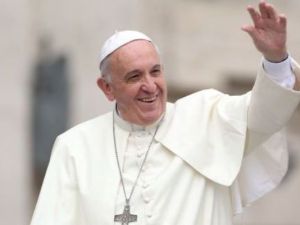
I must admit, the Pope’s visit to the United States last week was awesome.  Though I have been happy for the Roman Catholic Church since Pope Francis was elected, last week I realized his witness is good for all Christians.  Too often people professing to be Christian make Christians look bad.  Their hatred and exclusion in no way reflects the love and inclusion expressed by Jesus Christ.  But not Pope Francis.  He continues to challenge all of us to get back to the work Jesus gave us to do – to love and care for the poor, disenfranchised, and unjustly treated.  He beckons us toward lives of making peace and justice.  In essence, he reminds us to live as Christ called us to live.  And in starkly obvious ways, he reminded us that Jesus was not a Democrat or a Republican.  In fact, Jesus made, and continues to make, everyone uncomfortable.  Pope Francis did the same thing.  Though we all loved what he did for the Church and Christians in general last week, he likely made each of us feel uncomfortable at some point during his visit.  But I think we could all respect that he was trying to get us back to our true identity – he is a Christian who made us proud, not embarrassed, to be Christians.

Coming off the high of the Pope’s visit, I attended a funeral mass this week at the local Roman Catholic Church.  I was there to support a parishioner who had lost his mother (a Roman Catholic).  I wore my collar, but sat in the pew.  I prayed with the priest, cried with the family, and reverenced during the Eucharist.  But when the Eucharist was distributed, I stayed in my seat.  To his credit, the priest did not disinvite any non-RC attendees.  But he did not actively invite them either.  So instead of risking offense, I stayed in my seat, as I have been well-trained by many other RC priests that I am not to receive Eucharist as a non-RC.  I knew the moment would come and I was mentally prepared to stay in that seat.  But I must admit, my heart ached in that moment.  I felt a sharp pain in my chest as others walked around me to go forward for the heavenly meal.  For all the unity, the love, and the excitement of last week, I realized in that moment that we have a long way to go.

Of course, that work is not limited to the Roman Catholic Church.  Last week I preached about how much the Episcopal Church does its own work of excluding people – even from the Table, if you are not baptized.  In fact, I remember writing a paper in my liturgics class in seminary defending the practice of limiting the Eucharist to those who are baptized.  I don’t remember my argument at the time, but it was good, well-thought out, and prayerfully constructed.  But sitting in that pew yesterday, not receiving the comfort of the holy meal made me rethink the whole concept of an open table.  I do not really know if I am ready to make any changes right away, but the experience was a powerful lesson in the realities of constructing boundaries around the Table.  I do not want anyone’s heart to hurt the way mine did yesterday.  What about you?  What boundaries the church has constructed make you feel conflicted?  What might compel you to reconsider your position?  I invite us to pray about these conflicts as a community and see where the Spirit is leading.

Sermon – Mark 9.38-50, P21, YB, September 27, 2015

30 Wednesday Sep 2015

Posted by jandrewsweckerly in Uncategorized

≈ Leave a comment

Tags

barrier, boundaries, call, church, division, Episcopal, exclusivity, God, hospital, in, Jesus, out, prayer, priest, Roman Catholic, rules, sent, Sermon

“Are you the priest they sent?”  That was the question he asked me.  I was confused at first, but realized one of the nurses must have called an on-call priest.  I also knew from experience that if he was looking for the “priest they sent” he was not looking for me.  You see, I’m a priest, but I’m also a woman.  When people at hospitals are looking for priests, the majority of the time they mean a Roman Catholic priest.  But he seemed desperate, so I delicately said “No, I’m actually here to see a parishioner.”  But I stayed and talked to him a bit more about what was going on and whether the chaplain’s office had been called.  His wife joined us as we talked.  Then the inevitable question came.  She asked what church affiliation I had.  I told them I was a priest in the Episcopal Church, and that they were welcome to wait for a Catholic priest.  She insisted it didn’t matter – they just wanted a priest to say prayers.

Honestly, I was floored.  That had never happened to me.  Usually when I tell a Roman Catholic person that I am not a Roman Catholic priest, they reveal (subtly or not so subtly) that I am not the kind of priest they want.  And truthfully, I am totally fine with that.  I totally understand and would never assert any differently, especially to someone in crisis at the hospital.  We ended the conversation with the agreement that we would go to our separate rooms.  When I was done, if they still didn’t have their Roman Catholic priest, I would be happy to say prayers.  I went on to my visit, fully anticipating the “real” priest to show up for them while I was elsewhere.

That division among the Church, among the faithful of God, is not unique to Roman Catholics.  We all make boundaries and distinctions about who is in and who is out.  Episcopalians are only in full communion with the Evangelical Lutheran Church of America.  So if I ever wanted to have a United Methodist Minister or Presbyterian pastor celebrate Eucharist, I would not be allowed.  We also make rules around the communion rail.  Most Episcopal Churches say that all baptized Christians are welcome to the table – meaning if you have not been baptized, you should not receive.  Even to serve on Vestry we have boundaries.  All Vestry members have to be financial supporters of the parish, are expected to be present regularly in worship and parish events, and are asked to contribute to at least one ministry of the church.  If the Vestry member is unwilling to make those commitments, they cannot serve on Vestry.  We often think of Roman Catholics as having lots of boundaries – from no women at the altar, to no married clergy, to no communion unless you are Roman Catholic.  But the reality is that, as Episcopalians, we have an equal number of boundaries that keep people in and out of our community.

The good news is that we come by our exclusivity honestly.  In our gospel lesson from Mark today, we are told about an encounter between the disciples and Jesus.  John comes up to Jesus and says, “Teacher, we saw someone casting out demons in your name, and we tried to stop him, because he was not following us.”  John is so confident of his authority that he almost sounds like he is boasting to Jesus.  “Hey, Jesus, there’s some dude who is trying to do our work and he keeps using your name.  But don’t worry – we shut him down.”  You can almost imagine John expecting Jesus to give him a chug on the shoulder and say, “Good work, John!”  But that is not how the story unfolds.  Instead, Jesus says the total opposite, “Do not stop him; for no one who does a deed of power in my name will be able soon afterward to speak evil of me.  Whoever is not against us is for us.”  You can imagine the disciples’ confusion.  Jesus is constantly pulling them aside and only telling them how to interpret his parables.  When Jesus commissions people, he commissions the disciples, and no one else.  And although people are often following Jesus in droves, his crew, or his posse, is made up of the disciples.  In the disciples’ minds, Jesus is implicitly telling them that they are the insiders, with special privileges, and everyone else is an outsider.  The disciples are in; everyone else is out.  And anyone who tries to break those boundaries is going against the will of Jesus – and, ergo, the will of God.

Despite the fact that Jesus shuts down the notion of insiders and outsiders, the Christian community has been struggling with boundaries since Jesus’ death.  Who is a Christian?  Who can have communion?  What are the rules and what are the consequences of breaking the rules?  Now, boundaries are not necessarily bad.  Boundaries help us define who we are and what behavior is acceptable.  Boundaries help us uphold values and create meaning.  Boundaries can even help us make an informed choice about belonging to a community.[i]  Clearly Jesus created some boundaries.  When he says, “Whoever is not against us is for us,” he implies that there are people who are in fact against them.  Jesus himself creates a group of insiders and outsiders.  What Jesus is trying to communicate is not that boundaries are bad.  What Jesus is trying to communicate is that we are capable of getting so wrapped up in our boundaries that we exclude people from the love of Christ.  And nothing could be more harmful, or even sinful, than making someone feel that they are cut off from the love of Christ.

I had a friend who started going to therapy to help him cope with a spouse suffering from depression.  He imagined that the therapist would share her knowledge of persons suffering from depression and teach him some coping skills.  But after a lengthy explanation about what was wrong with his spouse, the first question the therapist asked was about him.  The therapist wanted to know what his issues were.  My friend interrupted, “No, no, no, I’m not here for me, I’m here to learn more about dealing with my spouse.”  The therapist wisely said, “Yes.  But before we get to your spouse, let’s talk about you.”  That therapist did what Jesus does with the disciples.  Jesus redirects the disciples concern about others by telling them to worry about their own problems – those hands, feet, and eyes that cause them to sin.  You see, Jesus is very clever.  What he realizes is that when the disciples start sorting through their own sinfulness, their own “stuff,” they do not have time to worry about boundaries and rules and barriers.[ii]  And when they let go of those boundaries, rules, and barriers, something incredible can happen – the love of God and the fellowship of Christ can grow and thrive.

By the time I finished my visit with my parishioner, the Catholic on-call priest had still not arrived.  I went into the room of the family and realized they needed more than a prayer.  They were going to be removing life support and wanted someone to offer the patient Last Rites.  I again reminded them that I was an Episcopal Priest.  The wife of the couple said, “It’s still Last Rites though, right?”  “Yes,” I replied.  “Okay, then.”  That was all.  Here I was bringing up boundaries again and again, and this person, who normally has even more boundaries than I do, insisted that I let go of my boundaries and help her family have an experience with God.  The first words the husband had asked me were, “Are you the priest they sent?”  My first answer was correct.  I was not.  But my answer was not complete.  I was not the priest that “they” sent.  But I was the priest that God sent.  You see, God has a call on me – and in fact God has a call on each person here.  God sends us everyday – to our workplaces, to our schools, to our friends, and to strangers.  Everyday we have the choice to get tangled up in boundaries and rules and limitations.  But we also have the choice to remember the ways that Jesus wants us to love God and love our neighbors.  Those are the only two boundaries Jesus really cares about anyway.

That is our invitation this week:  to consider how God is calling you and also to consider how you are getting in the way of God’s call.  The boundaries and the rules really are not as complicated as they sound.  If the Pope can say, “Who am I to judge?” surely we can start letting go and embracing love.  Then, the next time someone asks you, “Are you the person that was sent?” you can reply, “Yes.  Yes, I am.”  Amen.

[i] Harry B. Adams, “Pastoral Perspective,” Feasting on the Word, Yr. B, vol. 4 (Louisville:  Westminster John Knox Press, 2009), 116, 118.

[ii] Amy Oden, “Commentary on Mark 9.38-50,” September 30, 2012, as found at http://www.workingpreacher.org/preaching.aspx?commentary_id=1357 on September 25, 2015.

Showing forth love and light…

23 Wednesday Sep 2015

Posted by jandrewsweckerly in Uncategorized

≈ Leave a comment

Tags

assumptions, charity, community, feet, generosity, gift, God, hands, Jesus, light, love, need

Photo credit:  http://www.kiss925.com/2015/07/16/watch-man-surprises-strangers-by-paying-for-their-groceries/

Photo credit: http://www.kiss925.com/2015/07/16/watch-man-surprises-strangers-by-paying-for-their-groceries/

This week I stumbled on a video published this summer about a guy who goes to a local grocery store and surprises customers by paying for their groceries.  The video portrays a series of about ten encounters.  The mystery man, walks up to the customer, looks at the total due on the cash register, gives the amount to the cashier, and walks off.  He doesn’t engage in conversation.  He pats a few people on the back, telling them to have a good day.  For the few people who ask him why, his response is, “God is good.”  The conversations that happen between the customers and the cashier are incredible.  Most end up having a conversation about God.  Many are shocked, some laugh, and several cry.

What I found most fascinating about the piece is who the man helps.  The first few customers looked like they could use the help – of course I say that recognizing my own stereotypes about class and race.  But one customer surprised me.  He was a white male, who looked middle-class, without much wear and tear.  When the mystery giver left, the man and the cashier had a conversation.  He confesses how nice the gesture was, especially considering he was just mugged the week before.  As they talk further, he confesses that he was held at gun point in front of his home.

What shook me up about the encounter were my own assumptions.  There have been several times at stores when I noticed someone using their WIC voucher or EBT card and could sense the tension as they managed how much money they had to spend.  It makes perfect sense to help someone like that.  But what does it mean to help others:  those whose need is not obvious to us?  How often do I cut short God’s work when my assumptions get in the way of how and when I help?  What this mystery giver was giving was not necessarily charity per se.  What he was giving was a chance to have an encounter with God.  The customers received a variety of things that day – a lightened spirit through the gift of generosity, a desire to share the gift with others (one customer actually said, “I’m going to do that for someone else!”), and a deep and profound encounter with God – a God that they could only see through the vehicle of the giver.  In essence, this giver became the hands and feet of Jesus.

I’m not sure this video is calling me to go out and do the exact same thing.  But what the video is inviting me to do is to see my brothers and sisters through the eyes of Christ.  To honor those around me who are probably going through things I know nothing about, who may be in a dark place, or who may actually have more to give me than I have to give them.  At St. Margaret’s, we already know there are needs in our community – in fact, we helped four families this month purchase the school supplies they needed to send their children back to school.  But there are needs beyond financial – there are needs for people to experience love and to experience our Lord and Savior Jesus Christ.  Those are things that they may not experience unless we are willing to offer those gifts.  How might you show forth God’s love and light this week?

← Older posts
Newer posts →

Recent Posts

  • On Politics, Football, and Love…
  • On Sharing the Love…
  • Sermon – Micah 6.1-8, Matthew 5.1-12, EP4, YA, January 30, 2026
  • On Justice, Kindness, Humility, and the Messy Middle…
  • Feast of the Rev. Dr. Martin Luther King, Jr., January 18, 2026

Archives

  • February 2026
  • January 2026
  • December 2025
  • November 2025
  • October 2025
  • September 2025
  • August 2025
  • July 2025
  • June 2025
  • March 2025
  • February 2025
  • December 2024
  • November 2024
  • October 2024
  • September 2024
  • August 2024
  • July 2024
  • June 2024
  • May 2024
  • March 2024
  • February 2024
  • January 2024
  • December 2023
  • November 2023
  • October 2023
  • September 2023
  • August 2023
  • July 2023
  • June 2023
  • May 2023
  • March 2023
  • February 2023
  • January 2023
  • December 2022
  • November 2022
  • October 2022
  • June 2022
  • May 2022
  • January 2022
  • December 2021
  • November 2021
  • October 2021
  • September 2021
  • August 2021
  • June 2021
  • May 2021
  • April 2021
  • March 2021
  • February 2021
  • January 2021
  • December 2020
  • November 2020
  • October 2020
  • September 2020
  • August 2020
  • July 2020
  • June 2020
  • May 2020
  • April 2020
  • March 2020
  • February 2020
  • January 2020
  • December 2019
  • November 2019
  • October 2019
  • September 2019
  • August 2019
  • July 2019
  • June 2019
  • May 2019
  • April 2019
  • March 2019
  • February 2019
  • January 2019
  • December 2018
  • November 2018
  • October 2018
  • September 2018
  • August 2018
  • July 2018
  • June 2018
  • May 2018
  • April 2018
  • March 2018
  • February 2018
  • January 2018
  • December 2017
  • November 2017
  • October 2017
  • September 2017
  • August 2017
  • July 2017
  • June 2017
  • May 2017
  • April 2017
  • March 2017
  • February 2017
  • January 2017
  • December 2016
  • November 2016
  • October 2016
  • September 2016
  • August 2016
  • July 2016
  • June 2016
  • May 2016
  • April 2016
  • March 2016
  • February 2016
  • January 2016
  • December 2015
  • November 2015
  • October 2015
  • September 2015
  • August 2015
  • July 2015
  • June 2015
  • May 2015
  • April 2015
  • March 2015
  • February 2015
  • January 2015
  • December 2014
  • November 2014
  • October 2014
  • September 2014
  • August 2014
  • July 2014
  • June 2014
  • April 2014
  • March 2014
  • February 2014
  • January 2014
  • December 2013
  • November 2013
  • October 2013
  • September 2013
  • August 2013
  • July 2013
  • June 2013
  • May 2013
  • April 2013
  • March 2013
  • February 2013
  • January 2013
  • December 2012
  • November 2012
  • October 2012
  • September 2012

Categories

  • reflection
  • Sermons
  • Uncategorized

Meta

  • Create account
  • Log in
  • Entries feed
  • Comments feed
  • WordPress.com

Blog at WordPress.com.

  • Subscribe Subscribed
    • Seeking and Serving
    • Join 395 other subscribers
    • Already have a WordPress.com account? Log in now.
    • Seeking and Serving
    • Subscribe Subscribed
    • Sign up
    • Log in
    • Report this content
    • View site in Reader
    • Manage subscriptions
    • Collapse this bar
 

Loading Comments...