• About

Seeking and Serving

~ seek and serve Christ in all persons

Seeking and Serving

Tag Archives: Jesus

Homily – Galatians 2.19-20, Mark 8.34-38, Martyrs of Japan, February 6, 2014

12 Wednesday Feb 2014

Posted by jandrewsweckerly in Uncategorized

≈ Leave a comment

Tags

cross, death, Jesus, life, martyrs, Martyrs of Japan, witness

Today we celebrate the martyrs of Japan.  Christianity was first introduced in Japan in the 1500’s, first by the Jesuits and then by the Franciscans.  By the end of the 1500’s, there were about 300,000 baptized believers in Japan.  But the successes were compromised by both rivalries among religious orders and the interplay of colonial politics.  Eventually, all Christians suffered cruel persecution and suppression.  The first victims, whom we honor today, were six Franciscan friars and 20 converts who were crucified in Nagasaki in 1597.  By 1630, what was left of Christianity was driven underground; yet 250 years later, many men and women, without priests, persevered with their faith.

I have been thinking a lot about those martyrs.  First, I am still a little shocked by the idea of someone being actually crucified almost 1,600 years after Jesus’ death.  I didn’t even think people would do that anymore.  Second, I am astounded by the idea of someone using that form of murder on Christians – crucifixion seems like the ultimate form of insult and torture one could commit that would certainly intimidate and dissuade followers.  What is so sobering to me about the martyrs’ deaths is that the murderers almost seem to be using the faith against the followers, as if to say, “You want to follow Jesus Christ?  Then do what Jesus says in Mark’s gospel and take up your cross.  We may think of “taking up one’s cross” as a description of the suffering for following Jesus – but we often forget that the cross ultimately points to death.  That is an extreme form of witness that few of us would be comfortable assuming.

I think where the gospel, the epistle and even the martyrs are trying to get us to is an emptying of the self and an assuming of total dedication to Christ.  Now we may not be literally crucified in our age, but if we fully embrace the idea of taking up a cross, we fully submit our lives to God.  Certainly there will be dramatic moments – I always remember those kids in Columbine who at gun point were asked to deny their faith.  But more likely, the moments will be small, but tremendous.  Seeing God in the homeless man; saying something uncomfortable among a group of friends because your faith compels you to challenge the direction of the conversation, re-examining your life patterns to assess the ways you have already put your cross down.  Though taking up our crosses now may seem ambiguous, when we take on that work, we will find death – death to our old way of being and life in a new way of being.  Amen.


This homily, along with the several posted immediately after date from December 2013 – February 2014.  When we celebrate Eucharist each Thursday morning at St. Margaret’s, I preach a short homily to celebrate the feast day of whatever saint falls nearest to that day (as appointed by Lesser Feasts and Fasts and Holy Men, Holy Women).  A parishioner helps me to transcribe the homilies so that others can enjoy them too.  We seem to have finally caught up now – enjoy!

Homily – John 20.24-29, Habakkuk 2.1-4, St. Thomas the Apostle, December 19, 2013

12 Wednesday Feb 2014

Posted by jandrewsweckerly in Uncategorized

≈ Leave a comment

Tags

doubt, homily, Jesus, relationship, Thomas

We hear from Thomas several times in the gospels.  When Jesus insists on going to Judea to visit friends in Bethany, Thomas declares, “Let us also go, that we may die with him.” (John 11:16)  At the Last Supper, as Jesus tries to prepare the disciples for his departure, Thomas interjects, “Lord, we do not know where you are going; how can we know the way?” (John 14.5)  And as we hear today, after Jesus’ resurrection, Thomas will not accept the disciples’ account without seeing Jesus’ wounds.  When he finally does see Jesus, he declares, “My Lord and my God.” Thomas was thoughtful, passionate, and loyal.  But Thomas was also skeptical, had doubts, and asked questions.

Though we often refer to Thomas as “Doubting Thomas,” I actually really love Thomas.  His passion is overwhelming and inspiring.  But even more compelling to me are his questions and his doubts.  Thomas feels very real to me: he openly exposes his doubts and questions – something we all have done at some point in our lives, even if we are not as bold as Thomas to admit it.  Thomas shows me how hard believing was even in the presence of Jesus Christ – how much more reassuring to know that our doubts are that much more to be expected.

But perhaps what I love most about the Thomas stories is Jesus’ reaction to him.  Though Jesus may sound like he is scolding Thomas today, Jesus still comes, knowing that Thomas needs reassurance.  When Thomas asked his panicked questions, Jesus also responds pastorally.  Jesus’ relationship with Thomas is even more inspiring to me than Thomas himself.  We find in their relationship a Godhead who is patient, open to question, giving, and kind.  Of course, Jesus pushes Thomas, too – but any good relationship with God involves both challenge and grace.

In some ways, that relationship is revealed in our Old Testament lesson today.  The author says, “I will stand at my watch post … I will keep watch to see what he will say to me, and what he will answer concerning my complaint.”  God responds, “Write the vision; make it plain …”  Through relationship with God, we know that we have a God who responds – maybe sometimes with grace and sometimes with challenge.  But the promise of a responsive God is ours.  Thanks be to God!  Amen.

Sermon – Matthew 5.13-20, E5, YA, February 9, 2014

12 Wednesday Feb 2014

Posted by jandrewsweckerly in Uncategorized

≈ 1 Comment

Tags

generous, God, Jesus, light, public, shine

Today we are going to try something a little different.  The text that we just heard from Matthew was in the New Revised Standard Version.  The text says, “You are the light of the world.  A city built on a hill cannot be hid.  No one after lighting a lamp puts it under the bushel basket, but on the lampstand, and it gives light to all in the house.  In the same way, let your light shine before others, so that they may see your good works and give glory to your Father in heaven.”  The New Revised Standard Version is lovely, giving us the beautiful metaphor about us being light; and that by shining our light, we allow others to give glory to God.  But sometimes, we hear scripture so often that the language becomes stale.  I can almost imagine the inner monologue of many of us in the room, “Yeah, yeah, yeah, Jesus.  I know the song, ‘This little light of mine.’”  Or maybe you have some mental image of the super chipper, always happy person, whose face seems to radiate light, and whose life seems so perfect that just remaining friends with them is a challenge.

So in order to get you out of your “This little light of mine,” rut, I want you to hear the same text from a paraphrase version of the Bible called The Message.  “Here’s another way to put it: You’re here to be light, bringing out the God-colors in the world.  God is not a secret to be kept.  We’re going public with this, as public as a city on a hill.  If I make you light-bearers, you don’t think I’m going to hide you under a bucket, do you?  I’m putting you on a light stand.  Now that I’ve put you there on a hilltop, on a light stand—shine! Keep open house; be generous with your lives.  By opening up to others, you’ll prompt people to open up with God, this generous Father in heaven.”  Something about this version of Jesus’ words makes me much more excited about the idea of being light.  This version of Jesus is a little like the cool teacher from school, who wants to break it down for you so you can understand and act.

Let’s take the passage line by line.  First Jesus says, “You’re here to be light, bringing out the God-colors in the world.”  We learn two things from this first line.  First, we have a purpose in life – to be light.  If ever you are floundering with who you are or what you are meant to do with your life, Jesus reminds us that we are here to be light.  Second, being light means we will bring out the God-colors in the world.  Just this past week, I have found light in all sorts of fun places:  the sunset catching a wall of tall trees whose limbs were all frozen, making the light sparkle in the sunset; the afternoon sun that shines through our stained glass windows, making a beautiful mosaic of color in the Narthex; the morning sun that peaks through the trees, warming not only my cold body, but also reminding me that there is still hope in the bleak midwinter.  But God-colors are not just experiences with light; they are also the full range of the goodness of God – the red of God’s love, the yellow of God’s mercy, the green of God’s refreshment, the blue of God’s forgiveness, and the purple of God’s grace

So if our purpose is to be light that brings out the God-colors of the world, are we allowed to hold that knowledge and comfort in ourselves?  Not according to Jesus.  Next he says, “God is not a secret to be kept.  We’re going public with this, as public as a city on a hill.”  Now I know we have been talking a lot about evangelism this past year.  We have been talking about sharing our stories with our neighbors, and listening for and naming God in the world.  And for many of us, including me at times, this has made us wary or anxious.  But Jesus words in this paraphrase sound like a hype-man who makes us want to get out there.  We’re going public!  We’re going to get out there, and show some love and light!  I don’t know about you, but this gets me much more excited about Jesus’ metaphor.

So as Jesus gets us hyped up, telling us he wouldn’t dare hide us under a bucket, Jesus gives us a simple task: Shine!  You are already light, a light that points to the beautiful God-colors in the world.  Our only remaining job?  To shine!  Be the light that God created you to be.

Now, you might be wondering, okay, shining sounds simple enough, but what does that really mean?  Jesus gives us more: “Keep open house; be generous with your lives.”  Now certainly generosity means sharing our earthly possessions.  But the kind of generosity Jesus is talking about is also hospitality.  When I was in college, I befriended a campus minister who had a family of five.  They had a guest room downstairs connected to a bathroom.  For as long as I knew her, someone was always in that guest room.  Whether the room was used by a seminarian, a recent college graduate looking for work, or someone doing volunteer service for a year, that room was always in use.  This is what Jesus means when he says to be generous with your lives.  Share that guest room.  Take time out of your day to visit a shut-in or someone who is sick and stay longer than you really want to.  Stop for that person asking for a handout and hear a bit of their story.  Be generous with your life.

And why do we need to do all of this?  Jesus says, “By opening up to others, you’ll prompt people to open up with God, this generous Father in heaven.”  Here’s the funny twist at the end.  Jesus basically says both “it is all about you,” and “it is not at all about you.”  The “all about you” is the need to open up to other.  Maybe for you that means being more vulnerable than feels comfortable.  Maybe for you that means being present with someone you would rather not be present with.  Maybe for you that means trying something that takes you out of your comfort zone.  And why do we have to focus on opening up to others?  That’s the “it’s not all about you” part.  Your opening up to others encourages others to open up to God.  At the end of the day, that is what all of this hype and vulnerability and shining is all about – about helping others to see and know and open up to the God whom we find so incredible.  By putting ourselves out there, we become a doorway for others to God.  What a fine privilege!  So be a light that shines.  Get out in the world.  Keep open house.  Be generous.  Open up to others.  Your work allows the rest of the world “in” on the secret:  because we’re going public!  Amen.

On worry…

06 Thursday Feb 2014

Posted by jandrewsweckerly in Uncategorized

≈ 2 Comments

Tags

control, God, Jesus, parent, trust, worry

Last week I went to visit my OB for a checkup.  We began to talk about delivery dates, as I am having a cesarean section with our second child.  The doctor selected a date that is about one week before what I expected.  I left the office totally panicked.  I would need to totally readjust my plan for wrapping things up in the office, I would need to contact the supply priest and make sure the Sunday before was still available, and I would need to talk to my mother about flying out earlier to come help us with our four-year old – just to name a few things on my panic list.  Of course, about an hour later, I realized how silly my panic was in the grand scheme of things.  The truth is that I could go into labor at any point, and any “plans” I had made would be thrown out anyway.  The idea that one week was sending me into such a panic was only confirmation that I still hold on to some false idea about the level of control I exert over my life.

Courtesy of http://www.versifylife.com/category/topical/worry/page/2/

Courtesy of http://www.versifylife.com/category/topical/worry/page/2/

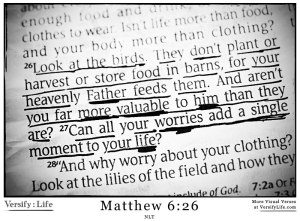
One of my favorite passages of scripture is from Matthew.  “Therefore I tell you, do not worry about your life, what you will eat or what you will drink, or about your body, what you will wear.  Is not life more than food, and the body more than clothing?  Look at the birds of the air; they neither sow nor reap nor gather into barns, and yet your heavenly Father feeds them.  Are you not of more value than they?  And can any of you by worrying add a single hour to your span of life? – Matthew 6:25-27  Although I know the truth of this passage about our relationship between trust and God, I find that I am always returning to it, never fully mastering it.  In fact, I am not even sure that I have partially mastered it.

My only saving grace has been becoming a parent.  I have often joked that God knew what God was doing when God made me a parent.  Perhaps God knew that the only way I would really start to believe that I could trust God was to throw someone in my life whom I have very little control over – a microcosm of the larger world.  That point has been resurfacing several times for me lately.  When school is cancelled because of snow, I have no way of attacking my work in the same way that I would if she were in school.  When the roads become too dangerous for driving on my day off with my daughter (i.e., “errand day”), those groceries that we just cannot live without suddenly become groceries we can live without.  Just today, another school weather-related cancellation day, as I was scrambling around trying to figure out how to busy my daughter while getting a little work done, my daughter asked if she could make Valentine’s Day cards for her classmates.  My immediate thought was, “No, I don’t have time to sit with you and do that.”  But I took a breath and considered her proposal.  One, we would be able to do something together that we would not normally do.  Two, the task would certainly entertain my daughter, which is pretty much golden on a snow day.  Three, making homemade Valentine’s is super cute, and something I never would have made time for otherwise.  So, I exhaled in defeat, and we both gathered the necessary supplies.  And it turns out that making homemade Valentine’s is pretty fun, and can even be a creative outlet for stress reduction.

So today, I am thankful for the God who puts people in my life to force me to be a better person of faith.  I am grateful for God’s awesome and powerful creation, who has certainly taught me a few lessons this winter about the fruitlessness of worry.  And I am blessed by the God who reminds me in small and large ways that I cannot, “worry about tomorrow, for tomorrow will bring worries of its own.  Today’s trouble is enough for today.” – Matthew 6.34

Sermon – Luke 2.22-40, Feast of the Presentation, YA, February 2, 2014

06 Thursday Feb 2014

Posted by jandrewsweckerly in Uncategorized

≈ Leave a comment

Tags

Anna, church, community, differences, diversity, Holy Family, home, incarnational, Jesus, presentation, Sermon, Simeon

Throughout my time in parishes, I have been reminded again and again how different the varied groups are in church.  In one parish I served, the Twenties and Thirties group was struggling because the events that appealed to the single Twenties and Thirties members were not as appealing or convenient for the married Twenties and Thirties members – let alone the ones with children.  At another parish where I served, I remember trying to plan an event for a diverse group of families.  I suggested a particular time of day, keeping in mind the bedtime needs for our new infant.  After much debate, one of the other staff reminded me that families with older children do not need to start bedtime nearly as early as our family did.  I served in one parish that had Holy Eucharist on a weekday at 6:30 am, followed by Bible Study from 7:00 – 8:00 am.  As a sleep-deprived parent of a young child, the arrangement was hideous for me; but for those who worked in the City and needed to be there by 9:00, or for seniors who were up and fed well before 6:30 am, the timing was perfect.  And almost every parish I have been a part of has had youth lock-ins.  It is a special adult who is willing to supervise youth overnight, knowing that they may get little to no sleep, may need to navigate the energy and sexuality of teens, and are willing to be pretty silly and playful when they otherwise would like to be snuggling into a warm, comfortable bed for the night.

That is the funny thing about churches.  Though we all arrive on Sunday on time, relatively speaking, to do the same thing together, we all enter those doors with vast differences.  There are the basic differences – gender, age, marital status, and phase of life.  There are the personality differences – introverts or extroverts; morning or night people; spiritually expressive or quiet and contemplative.  And then there is what we bring in the door with us on any particular day.  Perhaps you just barely managed to dress and wrangle kids into the car to get them here today, probably running out of time to do much tending to yourself to get ready for church.  Perhaps you woke up with aches and pains today, but willed yourself to come anyway.  Perhaps you had a fight with a loved one recently, or even with a fellow parishioner, and you are not even sure if you are in the right mindset for church.  When we take into account all those widely diverse features of any particular gathered group, we begin to see how amazing the idea is that we even gather together at all.

I see a similar dynamic on the day that the holy family went to the temple for purification.  Mary needed to offer sacrifice in thanksgiving for a safe childbirth and sacrifice needed to be offered for Jesus as the firstborn son of the family.[i]  The family has already been through a great ordeal these past 40 days.  They managed to make their way to Bethlehem, had an eventful birth experience in a stable, had strange shepherd visitors, and are now back home.  I imagine at 40 days old, Jesus is still not sleeping through the night, Mary and Joseph are still figuring out this first-time parenting thing, and we can tell from their sacrifice of two turtledoves or young pigeons that the young couple is still struggling financially.[ii]  That this family made it to the temple for this traditional religious experience is a minor miracle.  We all know couples who have been in that stage of life at one point or another.

Meanwhile, we have Simeon.  He is a bit up in age, and has been waiting for a long time for the fulfillment of a promise.  The Holy Spirit had revealed to him that he would not see death until he had seen the Lord’s Messiah.  That means that Simeon has spent a lot of time at the temple, just waiting for that long-anticipated day.  We know that Simeon is righteous and devout, and that the presence of the Holy Spirit is strong in him.  He is a man wise beyond his years, who has been taught to look for just the right thing.  We also know that he is a man of song.  When he finally sees Jesus, he breaks into a song of praise that is now known worldwide, sung at Evensongs and said at Compline or after Eucharists.  We know too that he is not afraid to tell the cold, hard truth, as he warns Mary what hardship is to come her way through her relationship with her son.  We all know a gentleman or two from church who both show forth a Spirit-filled life, yet is never afraid to speak truth – no matter how stinging that truth might be.

Finally, we meet Anna.  Anna is in her eighties.  She has been a widow for about sixty of those years, so we know she has had a rough life.  We also know that she spends every waking hour at the temple, worshiping, praying, and fasting.  Her whole life is centered on being in the temple.  We also learn that Anna is a talker.  When she sees Jesus for the first time, not only does she praise God, but she also talks about the child to anyone who will listen.  Surely we have met that older church gossip, who is always full of church news.

So we have this beautiful scene set before us:  the frazzled young family, struggling both physically and financially to just get by; the wise, righteous older man who is filled with the Spirit, but holds nothing back – not even if maybe he should; and the older prophet whose whole life is at the temple, and who has no problem catching people up on temple news.  In truth the scene is a bit comical.  Though the scene is meant to be another Epiphanytide manifestation of the identity of Jesus Christ, the scene is almost absurd in reality.

As I pondered this scene this week, I could not help to think about our community of faith, and how absurd we probably seem to outsiders.  We have all sorts of parents with children of various ages – many of whom have confessed their own frazzled lives to me on Sundays.  We have teens who struggled to get out of bed to come to church, but who are listening and will ask really hard questions from time to time.  We have empty-nesters who are so overjoyed to have a new lease on life that they are equally likely to be found at some exciting location as they are to be found at church.  We have retirees who are deeply spiritual, who will also give you a piece of their mind.  We have members who love when the guitar team plays and members who avoid church when the guitar team plays.  We have members who will come to every Holy Week service, and other members who are lucky to make it to church on Easter Sunday.

If you look at our wide diversity, you might wonder how in the world we all call the same community home; and yet we all do, and most of us cannot imagine life without this community.  That is the joy of church.  Though that older member might take you to task on something, you also know that they often speak with the love of someone who knows you can take it and you need to hear it.  Though there are Sundays when families feel like the behavior of their children has made their worship experience a complete bust, there are members around you who only get a glimpse of joy that week by being near your child and getting to know their beautiful personalities.  Though that church gossip might frustrate you at times, she is also the same one who has been praying for you and brought you a meal when you were sick.

That is what I love about the text this Sunday and the reality of Church.  Both the text and Church are extremely incarnational – they show us the depths of our messiness, but the beauty that can only emerge from that messiness.  Both show us how no matter how wacky the people are, God shows up, and reveals joy, hope, and grace.  Both show us that no matter how challenging our community might be at times, at its best, our faith community shows us how to better love God, love ourselves, and love our neighbors.  No matter what stage of life we are in, what personality we bring to the table, or what hurdles we overcame to get here today, we need each other because God needs and uses each of us.  For that messy, challenging, incarnate community of faith, I am forever grateful.  That is the good news we celebrate today, and the good news that we invite all our messy, challenging, incarnate friends into as well.  Amen.


[i] Lauren F. Winner, “Simeon’s Faithful Proclamation,” December 26, 2011, as found at http://thq.wearesparkhouse.org/yearb/christmas1gospel-2/ on January 29, 2014.

[ii] William R. Herzog, II, “Exegetical Perspective,” Feasting on the Word, Yr. B., Vol. 1 (Louisville: Westminster John Knox Press, 2008), 167.

Sermon – Matthew 4.12-23, E3, YA, January 26, 2014

29 Wednesday Jan 2014

Posted by jandrewsweckerly in Uncategorized

≈ Leave a comment

Tags

call, extraordinary, fishers of people, God, immediately, Jesus, ministry, ordinary, relationship, transformative

The first time I sensed a call to ordained ministry was in my last year of college.  The sense of call was strong and I felt like I could hear God’s word to me as clear as a bell.  And so what did I do?  I ran the other way…for a long time.  I remember thinking, “Oh, no.  I can’t do that.  How about I choose how I will serve God?”  And so off I went to my first my position after college.  When that was done, I knew the position was not quite the right fit, so I tried something a little closer to what felt like my call.  And of course, within a year or two, that did not quite feel right either.  And so I began to try to figure out how else God might be calling me.  Around and around I went with this game until finally someone just said straight out, “I think you ought to become an Episcopal priest.”  Even with that direct, irrefutable statement from a live person, I still could not say yes.  I took another whole year in discernment before I was finally ready to say yes to God. 

Needless to say, my response to God’s call was nothing like the response of the disciples in today’s Gospel.  Matthew says that Peter and Andrew immediately left their nets and followed Jesus.  Immediately they left.  The Message translation of this verse says, “They didn’t ask questions, but simply dropped their nets and followed.”  I do not know about you, but the idea of following Jesus immediately, and especially following Jesus without asking any questions seems ludicrous to me.  That act of leaving immediately is equally shocking in Jesus’ day too.  The disciples follow Jesus without qualification or questions.  They leave behind their entire profession, which is quite likely a lucrative business at the time.  All of this without any assurances that they will be provided for or have the ability to improve their financial standing by following Jesus.  Finally, following Jesus immediately means leaving behind families.[i]  This last shocker is perhaps the most unsettling because this is all happening in a time when family connections are “a primary source both of identity and honor,” and at a time when caring for one’s parents is “rooted both in cultural custom and in biblical law.”[ii]  This call narrative is as shocking then as the narrative is shocking now.

In our Adult Forum series last week, we talked about discerning God’s call in our lives.  We opened by reading this text from Isaiah 42, “Here is my servant, whom I uphold, my chosen, in whom my soul delights; I have put my spirit upon him; he will bring forth justice to the nations.  He will not cry or lift up his voice, or make it heard in the street; a bruised reed he will not break, and a dimly burning wick he will not quench; he will faithfully bring forth justice.”[iii]  Our class then reread the Isaiah passage, inserting our names in the passage.  So we heard statements like, “Kurt will bring forth justice to the nations,” or “I have put my spirit upon Barbara.”  We realized two things once we put our own names into the passage.  One, when we hear the words, “called to ministry,” we often think of clergy, missionaries, or people from scripture – not everyday people from Long Island.  Second, many of us do not think of ourselves as being called to a ministry.  We may volunteer at church or help out others, but we rarely use “call” language to describe what we do with our time, especially if our secular work does not feel particularly tied to our sacred beliefs.  But then we read the Catechism in the back of the Prayer Book.  The first persons listed as being ministers of the Church are lay persons, and according to the Catechism, the ministry of the laity, “…is to represent Christ and his Church; to bear witness to him wherever they may be; and, according to the gifts given them, to carry on Christ’s work of reconciliation in the world.”[iv]  So not only were we grappling with the idea of being ministers, we were grappling with the idea that those call stories are not just for someone else – we have a call story too.

Once we come around to the idea that we are all called by God, the big question then becomes, can we imagine responding to God’s call immediately like the disciples do with Jesus today?  Do we hear God’s invitation into ministry or a new vocation and immediately drop our nets, without question or delay?  Perhaps a better place to begin is to look back at Matthew’s text and see exactly what Jesus calls those first disciples to do.  Jesus says to follow him and he will make them fishers of people.  I have always read that invitation and basically translated the invitation as Jesus is going to teach them to be evangelists, converting others to Christ.  But as I read this week, I stumbled across a new interpretation of that phrase.  One scholar suggests that inviting the disciples to be fishers of people is an invitation to be in relationship – with Jesus, with each other, and with all the various people they will meet over the next few years, or perhaps even over the rest of their lives. 

If being fishers of people means being in relationship, what does that actually look like?  Exploring Jesus’ relationship with his disciples gives us some clues.  Being fishers of people means “bearing each other’s burdens, caring for each other and especially the vulnerable, holding onto each other through thick and thin, always with the hope and promise of God’s abundant grace.”[v]  Why would Jesus call people into relationship in this way?  Because by calling ordinary people in the midst of their ordinary lives into relationship with the ordinary people all around them, extraordinary things happen. 

So what does that look like here at St. Margaret’s?  In some ways many of us are already fishers of people.  We care for one another in this community, visit one another especially in crisis or illness.  But we also are in relationship with our neighbors – the staff at the local high school who connects us with those in need; our interfaith brothers and sisters as we make sandwiches together for the hungry; the people we meet, both at local ministries, but even our AHRC neighbors as we grow vegetables together.  And the invitation to be fishers of people keeps finding new manifestations here.  Our Outreach Committee is exploring a relationship with a community in Haiti – one facilitated by our relationship with another local parish here in Nassau County.  Though I know many of us are hesitant about international service, imagine what our dropping our nets without question and following Jesus might look like in that relationship.  Meanwhile, as we consider the possibility of a pilgrimage, we consider the ways that we will forge new relationships – with God, with one another, and certainly with people we have never met before.  Even something as simple as our new sponsorship of a Plainview Little League team this year has the potential for being a place to be fishers of people – where we can meet local parents while taking in a game and rooting for our team. 

These very real invitations into new relationships are scary or perhaps seem frivolous to us now.  But the power of Jesus’ invitation to be fishers of people is transformative.  First, accepting the invitation to be fishers of people transforms us.  When we enter into relationships with others, those interactions change us forever.  They help us see God in new ways, they help us reshape our worldview, and they help us to better understand our calling – that ministry that we all have.  Being fishers of people transforms not just us, but also transforms those with whom we are in relationship.  For many years, the staff at AHRC saw St. Margaret’s as distant, if not even inhospitable neighbors.  But now, the staff knows our names, sees new hope in our relationship, and perhaps even sees the love of Jesus through us.  Finally, being fishers of people transforms not just us and those with whom we are in relationship; being fishers of people transforms the kingdom of God here and now.  Our relationships have an impact way beyond the relationships themselves.  Others see the quality of our relationships and they see something intriguing, something inviting, and something inclusive.  Through those relationships, we invite others in, and the kingdom of earth begins to look a lot more like the kingdom of God.  You may not be able to drop your nets immediately today to follow Jesus.  But if you cannot drop them today, know that Jesus’ invitation to follow him is waiting for you and that God will empower you to say yes when you are ready.  Amen.


[i] Troy A. Miller, “Exegetical Perspective,” Feasting on the Word, Yr. A., Vol. 1 (Louisville: Westminster John Knox Press, 2010), 289.

[ii] Judith Jones, “Commentary on Matthew 4.12-23,” as found at http://www.workingpreacher.org/preaching.aspx? commentary_id=1972 on January 23, 2014.

[iii] Isaiah 42.1-3 

[iv] BCP, 855.

[v] David Lose, “Fishers of People,” as found at http://www.workingpreacher.org/craft.aspx?post=3018 on January 23, 2014.

Sermon – Matthew 3.13-17, E1, YA, January 12, 2014

16 Thursday Jan 2014

Posted by jandrewsweckerly in Uncategorized

≈ Leave a comment

Tags

baptism, consent, covenant, God, Jesus, John, prevent

Today we celebrate the baptism of Jesus.  All three synoptic gospels have an account of Jesus’ baptism, but Matthew’s version that we hear today is the only one that has a dialogue between the John and Jesus.  Though there is debate about why the conversation is present in Matthew’s gospel[i], I find much more interesting the content of their conversation.  When Jesus comes to John to be baptized, John tries to prevent Jesus from doing so, saying, “I need to be baptized by you, and do you come to me?”  Jesus responds to John, by saying, “Let it be so now; for it is proper for us in this way to fulfill all righteousness.”

John has been out in the wilderness for a while now, and has been preaching all along about the Messiah.  I imagine he has a pretty set idea of who this Messiah is how the Messiah will behave.  So, when Jesus comes, asking John to baptize him, John pushes back.  We are not sure exactly what John expects Jesus to do or say, but we can tell by the way he actively tries to prevent Jesus from being baptized that Jesus’ actions do not fit in John’s mental image of how things are supposed to go.  In fact, John feels so strongly that he does not just protest or argue with Jesus.  The text says John tries to physically prevent Jesus from being baptized.

What I love about this interaction is how very human and familiar John’s response to Jesus is.  I can think of hundred of times we have equally tried to get in Jesus’ way.  We couldn’t possibly invite our unchurched friend to church because we have heard their tirades about religion and those who go to church.  We cannot imagine going on a foreign mission trip because we cannot get the time off, we don’t speak the native language, we love hot showers too much, or mission trips just simply aren’t our thing.  We refuse to take our problems up with God in prayer because we think we can solve the issue on our own, that God is too busy for our minor issues, or we have yet to hear the answer we want from God.  We cannot possibly take on that new ministry invitation because we do not have the time, we cannot imagine what good the ministry will do, or we just simply do not like change.  Like John the Baptist, over and over again we prove ourselves to be experts in attempting to prevent Jesus from doing something in our lives.

When we were preparing for Church in the fall, we shared several videos on our Facebook page meant to spark some thought and conversation about how we invite people to church.  Most of the videos were funny, using satire to highlight our discomfort with inviting others to church.  My favorite is one where two guys meet in their yards after church.  One has his Bible in his hand, having just returned from church.  The other is working in the yard, tending his garden.  As the two chat, you can hear the inner monologue of the gardener, wondering why his neighbor never asks him to go to church.  He even admits, in his thoughts, that he would totally go if he were invited.  But instead, the best the churchgoer can do is to invite his neighbor over for lunch.  You can see the disappointment in the neighbor, but how both men try to skirt the issue.  Essentially the churchgoer prevents his neighbor from feeling truly welcome to church.

To John, and to us, Jesus’ response is simple.  Jesus basically tells John, “Just trust me and do this now.”  Jesus does not explain why John must get out of the way or how baptizing him will somehow fulfill all righteousness.  Jesus does not tell John what will happen when Jesus is baptized.  Jesus does not even really offer reassuring words.  To this dearth of reassurance, how does John respond?  The text simply says, “And John consented.”  But more fascinating than John acquiescing is that John really does have a choice.  Like Moses, Samuel, Mary, and Joseph, God always offers the choice to respond.  There is always the choice of saying no.  I am reminded of the story of Naomi and her daughters-in-law.  She gives them the choice of returning to their homelands when her sons, their husbands, die.  Orpah chooses to go home; Ruth chooses to stay with Naomi.  That is the beauty of our relationship with God – the affirmation of our freewill and the mutuality of the relationship is always present.

Today, like we do multiple times during the year, the Church will invite you to make a choice in your relationship with God.  We turn back to our own baptisms and we reaffirm the choices that were first made on our behalf, but we have now promised for ourselves every time we renew our baptismal vows.  Those promises include proclaiming the Good News of God in Christ, seeking and serving Christ in all persons, and striving for justice and peace.  Those promises are not promises the church created from its own imagination.  Those promises come out of invitations from Jesus’ life and ministry.  Like Jesus asked John to just trust him and act, so Jesus invites us to trust him and act through our own baptism.  Our invitation is to be a people who consent.

Now some of you may be like John, Mary, or Joseph who receive a challenging invitation from God and respond with a hearty, “Here I am Lord,” or a simple consent.  Others of you may be more like Samuel, who hear God’s invitation but do not quite understand the invitation – like when Samuel goes to Eli in the temple multiple times thinking Eli is calling him in the middle of the night instead of God.  Or maybe you identify more with Moses – who argues with God in myriad ways, trying to convince God to ask someone else, anyone else, to take on God’s invitation.

Luckily our baptismal vows give us some clue about how we can manage to consent to God.  “Will you continue in the apostles’ teaching and fellowship, in the breaking of the bread, and in the prayers?” is the question you will hear today.  The more you steep yourself in Scripture and the fellowship of this community, the more you will be empowered to proclaim the Good News of God in Christ.  The more you consume the body and blood of our Savior, the more you will be able to see and then serve Christ in others.  The more you immerse yourself in a life of prayer, the more you will find opportunities for striving for justice and peace among all people.  Today you choose, you consent, to live your life within the community of faith – and that choice will have an impact not just on you, but on others.  But Jesus cannot do the work alone.  The choice is yours to consent.  Amen.


[i] Troy A. Miller, “Exegetical Perspective,” Feasting on the Word, Yr. A., Vol. 1 (Louisville: Westminster John Knox Press, 2010), 239.

Holy chaos…

08 Wednesday Jan 2014

Posted by jandrewsweckerly in Uncategorized

≈ Leave a comment

Tags

chaos, children, Christ Child, Christmas, church, Epiphany, holy, incarnation, Jesus, life, liturgy, messy, pageant

Courtesy of http://saintansgar.blogspot.com/2010/11/joint-childrens-christmas-pageant-and.html

Courtesy of http://saintansgar.blogspot.com/2010/11/joint-childrens-christmas-pageant-and.html

This past Sunday, our church held its annual Epiphany Pageant.  Since the pageant involves using Scripture and hymns to retell the entirety of Jesus’ birth narratives, the pageant replaces most of the Liturgy of the Word (the part of the service when we traditionally read/chant the four lessons and then hear a sermon).  Though part of what we love about the pageant is the kids’ presence, we also love being invited into the familiar – rehearing the story of the Christ’s birth and incarnation and singing the hymns that we look forward to all year.

Inevitably, the pageant is a bit messy and chaotic – children forget where to go, costumes do not quite fit, or attention spans are just not long enough.  Situating the pageant within the context of worship also means that the entire worship experience that morning is loud and a bit difficult to stay fully engaged in – especially if you are looking for a quiet, contemplative reflection on the incarnation.

But to be honest, that is what I love about the pageant – the holy chaos of it all.  We often think about the birth of the Christ Child as a clean story, much like many of the two-dimensional artistic renderings we see of what looks like quiet adoration at a manger.  But the whole concept of the incarnation is messy:  from Jesus’ scandalous conception, to what had to have been an unsanitary birth among hay and animals, to stinky visitors like the shepherds, to the visit of three foreign men who act strangely and probably raise more suspicion than excitement.  The birth of Jesus is a bit of a holy mess, not to mention the rest of Jesus’ incarnate life, which involves hanging with those of ill-repute, with smelly fishermen, and with the seriously infected and ill.  Nothing about Jesus’ birth or life is sanitary, controlled, or predictable.

Later on Sunday morning in worship, as I distributed communion, I gave the body of Christ to the young girl who had just played Mary in the pageant.  In that moment, the chaos of the day disappeared, and the miracle of the incarnation became much more real to me.  Mary, the mother of Jesus, was just a woman, trying to live faithfully, caught in the holy chaos of life.  I found myself wondering what receiving the body of Christ, the body of her son, would have been like, especially once he was gone.  And just like Mary was just a woman, each one of us in church – the young girl, the middle-aged man, the aging woman – are all just people, caught in the holy chaos of life, trying to make sense of it all, but also eternally grateful for a God who takes on human flesh for us.  That is why Church is so incredible to me.  In the midst of contemplative prayer, and even in the midst of what feels like a loud, crazy liturgy, God can break through and speak truth to us.  I am grateful to our children for reminding me that God is incarnate in the midst of all of life – in the beautiful and quiet, but especially in the messy, loud, chaos of life.

Sermon – John 1.1-18, C1, YA, December 29, 2013

08 Wednesday Jan 2014

Posted by jandrewsweckerly in Uncategorized

≈ Leave a comment

Tags

Christmas, God, Holy Family, Jesus, John, Mary, miracle, prologue, Rembrandt, scripture

A couple of days after Christmas, the all-Christmas-music radio stations have switched back to their normal formats.  At local stores, the Christmas rack of cards had been transformed to a rack of Valentine’s Day cards.  In our neighborhoods and among our friends and family, we have switched our greeting from, “Merry Christmas!” to, “Happy New Year!”  The world has moved on from Christmas, and yet, the Church is still dwelling in Christmastide – in fact we celebrate not just one day, but the famous twelve days of Christmas.  Our celebrations continue until those wise men arrive on the 6th, when we transition to Epiphanytide.  Today, after stories of shepherd, angels, and the holy family, we find ourselves not wondering what is next, but instead still pondering what has just happened.

For a reflection on what happens in Jesus’ birth, what better text than John’s prologue?  John takes us out of the stable, and invites us not to just consider the miracle of that holy night, but to consider the miracle of a God who takes on human flesh for us.  And so, instead of telling us about the earthly beginning of Jesus’ life, John takes us all the way back to the beginning of all things – that creative moment when the Word and God are together, making all life come into being.  “In the beginning was the Word, and the Word was with God, and the Word was God.”  The words sound beautiful, and John’s text is rich with meaning and interpretation.  But John’s words are also a little circuitous, repetitive, and a bit difficult to understand without reading them multiple times over.  The familiarity and beauty of the words may be soothing, but the meaning of those words sometimes eludes us.

As I sat pondering these words this week, I found myself drawn again to Rembrandt’s painting, “Holy Family,”[i]  In the foreground of the painting, Mary, who is bathed in light, has a well-worn book, perhaps scriptures, lying on her lap, held in place by one hand, as though she has been reading the book intently.  Her face, however is turned away from the weathered book, as her other hand lifts a blanket that is covering a cradle, revealing a sleeping, contented Jesus.  Behind Mary and Jesus, in much fainter light, Joseph is standing over a piece of wood that he is intently planing.  Meanwhile, in the top left corner of the painting, young cherubim are hovering around the scene with outstretched arms.

What I like so much about the painting is that Mary gives us a clue about how we are to understand John’s beautiful, but convoluted words today.  First, I am intrigued by the way Mary clutches her well-worn book.  In looking at her book’s worn edges, I am reminded of the Bible I used for my Education for Ministry class several years ago.  In EFM, you spend two years reading through the Old and New Testaments.  I remember how my homework for the class instructed me to highlight certain passages in different colors so I could track the different contributors to a text.  I remember writing notes in the margins of passages that stood out, held particular meaning, or raised questions.  I remember certain pages being soiled by the meal I tried to cram in while finishing my assigned reading for a particular session.  That Bible looked like a Bible someone actually lived with as opposed to the clean, commemorative ones I have on many of my shelves.

That is the way I imagine Mary treating her worn book.  As the one who ponders things in her heart, I imagine Mary also ponders scripture in her heart.  I imagine she pours over the texts as she looks for words to explain her experiences with Jesus or as she simply longs for words to describe her feelings toward the God who had done something so tremendous in her life.  As Mary seeks to understand the Word made flesh, perhaps she returns again and again to the words of scripture, trying to discern their meaning.  And given that she is a faithful Jew, she probably also does that pouring over scripture with her faith community, as they seek to always hear God’s word for the people.  Her community probably turns back to that creation narrative over and over again.  Her community probably turns back to the Law of Moses over and over again.  Her community probably turns back to the prophets over and over again.

Given her longing for scriptural insight, Mary likely would have appreciated John’s text today, even though John’s gospel was not written until about 60 years after Jesus’ death.  She would have already known the stories of Luke and Matthew because they are her story.  But our text by John today is an attempt to help all of us understand the magnificence of what happens when God takes on human flesh.  In fact, if Mary had been reading John, I imagine that the last line we hear is what draws her attention away from her well-worn book to look at the Christ Child himself in Rembrandt’s painting.  John writes, “No one has ever seen God.  It is God the only Son, who is close to the Father’s heart, who has made him known.”

Perhaps this text is why Rembrandt depicts Mary’s eyes wandering back to that cradle, her hand pulling back the blanket, and her mind not just worrying like any mother does over an infant, but her mind also worrying about what God is doing in this child of hers.  She wants to do more than read the words on the paper – she wants to read the Word, with a capital “W,” in her life.  She wants to gaze at the Word made flesh, who shines light into that dimly lit room and into the world.  She wants to not only know the Law of Moses, but to know the grace and truth that comes directly from the Word incarnate.

What Rembrandt depicts in his painting is perhaps where we find our invitation from John’s gospel lesson today.  In order to understand John’s language, we too are invited to create our own dialogue between the Word of Scriptures and the Word made flesh.  Studying both Holy Scripture and the Holy Child is how we come to understand challenging texts like John’s gospel.  For some of us, that invitation may seem as muddy as John’s gospel.  But what Mary does in Rembrandt’s painting is available for us today too.  We can “develop a richer, fuller faith by tending both to the Word through words and to the Word made flesh, the Christ who is with us in the sacraments, with us in prayer, with us in our church, with us in our friends, with us in the stranger, and with us in creation, since ‘all things came into being through him, and without him not one thing came into being.’”[ii]

For those of you still wondering what this life pattern still looks like, consider the ways in which we already live into this balance.  When we reach into our pockets a little deeper for those families in our neighborhood who are just struggling to put gas in the car and food on the table, honoring the holy in one another, we then turn back to Holy Scripture that tell us to care for the poor.  When we care for one another in this community, sharing our deepest pains and struggles, we then turn to back to Holy Scripture as we struggle to find words to verbalize our understanding of God in that pain and struggle.  When we come to this table, and consume the body of Christ in the bread, we then turn to Holy Scripture to understand what the Word became flesh means.  We gather today as a community of faith, both clutching the Word in Holy Scripture, and clutching Word in the Christ Child, knowing that we can never fully understand one without the other.  Amen.


[i] C. 1645.

[ii] Thomas H. Troeger, “Homliletical Perspective,” Feasting on the Word, Yr. A., Vol. 1 (Louisville: Westminster John Knox Press, 2010), 193.

Sermon – John 1.1-14, CD, YA, December 25, 2013

08 Wednesday Jan 2014

Posted by jandrewsweckerly in Uncategorized

≈ Leave a comment

Tags

Christmas, darkness, death, God, incarnation, Jesus, John, light, prologue, resurrection

I must admit that I have always been a little wary of John’s prologue at Christmas time.  I tend to prefer the earthy stories of Jesus in a manger, of dramatic angelic appearances, of messy shepherds, and of a baffled holy family.  I like that I can picture the events in my mind and ponder their meaning.  I like that I could imagine myself there and even wonder what the events mean to me two thousand years later.  My love of these stories is only accentuated by the songs we sing on Christmas Eve, and the nostalgia the music brings to me.

But today, on Christmas Day, we get none of that.  We sing no songs, we hear no romantic, familiar stories, and we do not get lost in the ancient narrative.  Instead, on this busy, often loud day, we come into a totally different space – a place of quiet reverence – and we hear a totally different text.  John does not go back to the beginning of Jesus’ story – he goes back to the beginning of all our stories.  “In the beginning was the Word, and the Word was with God, and the Word was God.”  Our minds drift not back to a stable, but to the beginning of creation, when the earth was a formless void – tohu wavohu.  Whereas our synoptic gospels try to tell us about who Jesus is by giving a story about his birth narrative, John’s gospel takes an even wider lens to try to explain who Jesus is.

In some ways the contrast between Christmas Eve’s stories about the stable and Christmas Day’s quiet reflection on the beginning of time is quite appropriate.  On Christmas Eve we are full of giddiness and excitement.  We break the long anticipation of Advent with a festive celebration of Jesus’ birth.  We share in jubilation, as if we are a crowd of people gathered at the maternity ward, sharing cigars and bear hugs.  But today, like a crew that has come in to clean up after a late-night party, we gather in these pews with a bit more sobriety, deeply pondering what all this incarnation stuff means.  For that kind of work, John’s gospel is the perfect gift.  John almost seems to say, “Yes, all those stories you know and love about Jesus are true and are to be celebrated.  But do not get swept away in the excitement and forget what this really means.”

For John, he begins his gospel starting not with details of the event of the incarnation, but with details about the significance of the incarnation.  For John, he is not interested in the sentimentality of a cute baby.  John is interested in the astounding fact that God became incarnate – took on flesh, lived among us, took on our dirty, gritty lives, and faced rejection and suffering – all so that we might live.  The God of creation – that same creative God we know from Genesis – is the same God who comes among us.  The Word has always been, and yet the Word also enters into human history to give life and light to the people.  When we talk about this kind of momentous significance, it is no wonder that we gather here in quiet awe of our God, soberly realizing the tremendous, salvific gift of the Word made flesh coming to dwell among us.

In some ways, the contrast between Christmas Eve and Christmas Day are hitting home a little more vividly this year.  On the one hand, I have a four-year old, who really gets Christmas this year, who is excited beyond belief about baby Jesus, St. Nicholas, presents, and visiting family.  Her enthusiasm is infectious, and I want to cultivate that joy.  I am reminded of that collect from compline that asks God to “shield the joyous.”  But on the other hand, death has been heavy around me these last few days.  A dear friend from Delaware died this weekend, St. Margaret’s Cemetery helped a young couple from a neighboring church bury an 8-month stillborn child on Monday, and just two days ago, a St. Margaret’s parishioner lost his mother.  In light of the grief of those around me, I am grateful for a sober reminder of the awesomeness of our God, the salvation and promise of resurrection that is only made possible through the incarnation – that Word made flesh who lived among us, and who is full of grace and truth.  In the end, there is hope on both sides – hope for the happily joyous this season and hope for the soberly mournful this season.  I thank God for a Church who tends to both sets of needs, but mostly I thank God for taking on our earthly flesh, for giving us the Word who knew both joy and sorrow, and for promising us that the light shines in the darkness, and the darkness does not overcome it.  Amen.

← Older posts
Newer posts →

Recent Posts

  • On Politics, Football, and Love…
  • On Sharing the Love…
  • Sermon – Micah 6.1-8, Matthew 5.1-12, EP4, YA, January 30, 2026
  • On Justice, Kindness, Humility, and the Messy Middle…
  • Feast of the Rev. Dr. Martin Luther King, Jr., January 18, 2026

Archives

  • February 2026
  • January 2026
  • December 2025
  • November 2025
  • October 2025
  • September 2025
  • August 2025
  • July 2025
  • June 2025
  • March 2025
  • February 2025
  • December 2024
  • November 2024
  • October 2024
  • September 2024
  • August 2024
  • July 2024
  • June 2024
  • May 2024
  • March 2024
  • February 2024
  • January 2024
  • December 2023
  • November 2023
  • October 2023
  • September 2023
  • August 2023
  • July 2023
  • June 2023
  • May 2023
  • March 2023
  • February 2023
  • January 2023
  • December 2022
  • November 2022
  • October 2022
  • June 2022
  • May 2022
  • January 2022
  • December 2021
  • November 2021
  • October 2021
  • September 2021
  • August 2021
  • June 2021
  • May 2021
  • April 2021
  • March 2021
  • February 2021
  • January 2021
  • December 2020
  • November 2020
  • October 2020
  • September 2020
  • August 2020
  • July 2020
  • June 2020
  • May 2020
  • April 2020
  • March 2020
  • February 2020
  • January 2020
  • December 2019
  • November 2019
  • October 2019
  • September 2019
  • August 2019
  • July 2019
  • June 2019
  • May 2019
  • April 2019
  • March 2019
  • February 2019
  • January 2019
  • December 2018
  • November 2018
  • October 2018
  • September 2018
  • August 2018
  • July 2018
  • June 2018
  • May 2018
  • April 2018
  • March 2018
  • February 2018
  • January 2018
  • December 2017
  • November 2017
  • October 2017
  • September 2017
  • August 2017
  • July 2017
  • June 2017
  • May 2017
  • April 2017
  • March 2017
  • February 2017
  • January 2017
  • December 2016
  • November 2016
  • October 2016
  • September 2016
  • August 2016
  • July 2016
  • June 2016
  • May 2016
  • April 2016
  • March 2016
  • February 2016
  • January 2016
  • December 2015
  • November 2015
  • October 2015
  • September 2015
  • August 2015
  • July 2015
  • June 2015
  • May 2015
  • April 2015
  • March 2015
  • February 2015
  • January 2015
  • December 2014
  • November 2014
  • October 2014
  • September 2014
  • August 2014
  • July 2014
  • June 2014
  • April 2014
  • March 2014
  • February 2014
  • January 2014
  • December 2013
  • November 2013
  • October 2013
  • September 2013
  • August 2013
  • July 2013
  • June 2013
  • May 2013
  • April 2013
  • March 2013
  • February 2013
  • January 2013
  • December 2012
  • November 2012
  • October 2012
  • September 2012

Categories

  • reflection
  • Sermons
  • Uncategorized

Meta

  • Create account
  • Log in
  • Entries feed
  • Comments feed
  • WordPress.com

Blog at WordPress.com.

  • Subscribe Subscribed
    • Seeking and Serving
    • Join 395 other subscribers
    • Already have a WordPress.com account? Log in now.
    • Seeking and Serving
    • Subscribe Subscribed
    • Sign up
    • Log in
    • Report this content
    • View site in Reader
    • Manage subscriptions
    • Collapse this bar
 

Loading Comments...