• About

Seeking and Serving

~ seek and serve Christ in all persons

Seeking and Serving

Tag Archives: justice

Sermon – Luke 6.20-31, AS, YC, November 2, 2025

05 Wednesday Nov 2025

Posted by jandrewsweckerly in Sermons

≈ Leave a comment

Tags

All Saints Sunday, Beatitudes, compassion, faithful, fragrance, God, Golden Rule, Jesus, justice, love, saint, scent, sensory, Sermon, witness

On the blog this week, I shared about friends of ours who are fragrance aficionados.  When we spend time together, we’ve taken to doing fragrance samplings with them – sort of like wine tastings, but with the focus on the sense of smell.  Invariably, I find a new fragrance I like that I had never heard of, but that brings me a sense of playful joy.  This past week I was sharing one of those fragrances with one of our daughters and she said, “It’s okay, but I prefer your ‘Mom smell.’”  While I wish there was a more attractive label to that particular fragrance, and while I suspect that “Mom smell” is some combination of the scents of my soap, hair products, and laundry detergent, I get what my daughter meant.  Just like fragrances can evoke memories of special places, fragrances can also recall to us people in our lives.  One whiff, and we are transported to another time and place, remembering what someone meant to us.

On this All Saints Sunday, we engage in a similar kind of sensory recalling.  In our case at Hickory Neck, instead of the sense of smell, we invoke the sense of touch – the feel of smooth or ridged ribbons running through our fingers as we tie them to the altar rail in memory of a saint of God, the feel of droplets of water landing on our heads and bodies as we recall our baptismal identity and the baptisms of saints who have died, and the feel of the wafer in our hands and mouth or the feel of the priest’s thumb as they rub a blessing on our forehead, as we engage in the earthly banquet, reminiscent of the heavenly banquet our loved ones are enjoying.

But just like scents have the power to remind us of beloved memories, so scents can remind us of painful memories.  While some of us may have a “Mom scent” we recall with love and affection or wistful memory, others of us didn’t have such beloved memories or experiences – and unfortunately, smells can recall those memories too.  As I was reading Luke’s gospel for today, that’s where I landed – that all of us – all of us saints of God – have the opportunity to live lives of good or ill – to leave behind fragrances that help or harm.  And since Luke’s language is entirely literal and not at all the flowery, spiritual language of Matthew’s beatitudes[i], we are very clear on Jesus’ words and meaning.  The blessings and woes of Luke’s beatitudes are straightforward and simple.  As one scholar puts it, “If you want anything to do with Jesus or the God who sent him, Luke says, you had better go find the poor, the hungry, the captives, the blind, and the outcast, and join Jesus, as Jesus cares for them.  The way we know who Jesus is, is to go where Jesus is, with the poor, the hungry, and the oppressed.”[ii]

While All Saints Sunday can take us to place of remembering loved ones and the saints of the church, tempting us to get lost in those memories, what All Saints Sunday ultimately hopes to impart is that the lives we live matter.  We remember the saints of the church and the lives of our loved ones we miss because they showed us what living lives that matter looked like.  We do not honor them because they were rich or well fed or joyful or respected.  We honor them because they loved their enemies, they did good to those who hated them, they blessed those who cursed them, and prayed for those who hurt them.  We honor them because they were nonviolent, because they gave sacrificially of their wealth, because they understood that poverty makes people desperate – and because they did to others as they would have them do to them.

We could easily leave here today with the commission to “go and do likewise,” as if Jesus’ words are a simple commission.  But nothing about what Jesus is saying is simple or easy.  Several years ago, I was talking to our children about the Golden Rule – those words we hear today about doing unto others as you would have them do unto you.  To my great shock, my children did not see the wisdom of the words at all.  Instead, their desires were rooted in a sense of justice or fairness.  “No way!” one said.  “I’ll do unto others what they do to me.”  What I had understood as simple, universal wisdom that is shared among faith traditions totally flies in the face of secular, American ideals.  Even Professor Johnson says about Luke’s text today, “It is not only greed that jeopardizes the wealthy Christian’s relationship with God, but the simple – and subtle – temptation to think we can take care of ourselves.”[iii]

Luke leaves us, then, with a challenging invitation.  As you tie on a ribbon to remember a loved one today, you can certainly recall whatever fragrance of theirs you miss.  But Luke asks you to go further – to recall the witness they left to you about living a faithful life, and be emboldened to start leaving your own faithful fragrance behind too.  Lean into those who have gone before to encourage your own witness of love, compassion, and justice.  Lean into the faithful who gather beside you in person every Sunday who struggle to live that Golden Rule with gusto instead of resentment.  Lean into Jesus, who walked before us in incarnate form, leaving behind the fragrance of incense – the fragrance of humility, compassion, and sacrificial love.  With them, you can then begin to create a signature fragrance of your own that will help draw others to God.  Amen. 


[i] Marjorie Procter-Smith, “Homiletical Perspective,” Feasting on the Word, Yr. C, Vol. 4 (Louisville:  Westminster John Knox Press, 2010), 239.

[ii] E. Elizabeth Johnson, “Exegetical Perspective,” Feasting on the Word, Yr. C, Vol. 4 (Louisville:  Westminster John Knox Press, 2010), 239.

[iii] Johnson, 241.

Sabbatical Journey…on Choosing Unity

05 Wednesday Jul 2023

Posted by jandrewsweckerly in reflection

≈ Leave a comment

Tags

beauty, choice, country, disagree, diversity, division, forbearance, God, image of God, Jesus, July 4th, justice, respect, united, unity

License Plate Game (reuse with permission)

As we celebrate the 4th of July today, I cannot think of a more appropriate activity than to be on a cross-country trip.  Our trip so far has given me a renewed appreciation for the vastness of our country, the unique topographical beauty in each state, and the tremendous diversity of people.  Though we call ourselves the United States of America, sometimes I think we forget what an improbable arrangement we have – that these fifty states, in all their glorious diversity, are united as one.

Traveling through the country these last eighteen days, I have seen both signs of our political divisions as well as indicators that there is more in common between us than different.  I have also seen that experiencing each other in our own settings, learning about each other’s heritage, remembering that the creation of this country was done on the backs of so many oppressed peoples, helps me remember that being united states takes work.

Often when I am doing premarital counseling, I will tell couples that marriage is a choice – not made one day in beautiful attire with all your family and friends – but a choice made every day, over and over again.  Only when we make that daily commitment do marriages thrive and can be filled with love.  What I appreciate about the Fourth of July is that it is our annual reminder that we have to choose to be united over and over again, so that we might thrive and be filled with love.  I realize that may sound overly romantic, and in our current political times even impossible, but that we live in such a place that allows for differences and disagreements is a true gift that can help in the midst of our divisions.

As fireworks go off tonight, my prayer is that we renew our commitment to care for one another and respect the dignity of every human being in this country.  We know that we are all made in the image of God – even those folks with whom we disagree.  I offer the following prayer from the Book of Common Prayer for you tonight.  May we take up the mantle of being united once again.

Lord God Almighty, you have made all the peoples of the earth for your glory, to serve you in freedom and in peace:  Give to the people of our country a zeal for justice and the strength of forbearance, that we may use our liberty in accordance with your gracious will; through Jesus Christ our Lord, who lives and reigns with you and the Holy Spirit, one God, for ever and ever. Amen.  (Book of Common Prayer, 258)

Sabbatical Journey…on Butterflies and Beauty

19 Monday Jun 2023

Posted by jandrewsweckerly in reflection

≈ Leave a comment

Tags

beauty, butterfly, church, disruption, future, God, journey, justice, Little Rock Central High School, old, success

Photo credit: https://www.history.com/topics/black-history/central-high-school-integration

Our second day of travels landed us in Little Rock, Arkansas.  We had mostly planned to get here and head straight to the hotel, but traffic was forgiving, and gave us a little extra time.  So, we hopped over to the Little Rock Central High School National Park Site.  As a refresher, in 1957, Central High became the epicenter of confrontation and the catalyst for change in enforcing the decision of Brown v. Board to integrate schools.  Three years after the Supreme Court decision, the “Little Rock Nine,” were denied entrance to the school, and President Dwight D. Eisenhour had to federalize the Arkansas National Guard to safely enable the Little Rock Nine to successfully attend school. 

As I was looking at the photos at the National Park, I noticed a butterfly flitted past me and landed right next to a picture of those National Guardsmen protecting those students.  I was reminded of how even in the darkest times, one can find beauty.  I do not know the stories of those men who protected those students.  Maybe they did it because they were obligated to help by order of the President.  Maybe they did it because they felt a desire to right an injustice.  Maybe they had feelings that changed before, during, and after the event.  What I do know is those from Little Rock during that time were transformed in that event.  And like that butterfly, their transformation flitted on throughout the country as we made our way toward justice – as we continue to make our way toward justice.

Commemorative Garden. Note butterfly in photo. (Photo credit: Jennifer Andrews-Weckerly)

In the Commemorative Garden at the site, there is an inscription about the school.  It reads that Central High School, “…has survived, indeed not just survived but succeeded beyond anyone’s belief, becoming once again Arkansas’ premier high school.”  The inscription goes on to say, “It has achieved this not by returning to its old form merely showing its pretty face, but by modeling the diversity and pluralism that caused the original storm of protest.”

Post-pandemic, and indeed, in the modern era of Church, I think many are hoping to simply return to our old form, merely showing the Church’s pretty face.  But the massive disruption of the pandemic has convinced me that this is our opportunity not to become simply familiar again, but to become something excellent because of our evolution into the goodness God created us to be.  I wonder what new goodness God has invited you into in this post-pandemic season?  Where are butterflies beckoning your attention to see beauty not in what once was, but what is now, and in what can be?  I can’t wait to hear how you are seeing butterflies in your journey!

Sermon – Luke 23.33-43, CKS, YC, November 20, 2022

23 Wednesday Nov 2022

Posted by jandrewsweckerly in Sermons

≈ Leave a comment

Tags

Christ the King, crucifixion, despair, hope, Jesus, justice, king, leadership, Messiah, Sermon, victory, way

If the foyer of our house is a painting of the crucifixion by an artist from Tanzania.  The painting is hauntingly beautiful, with deep reds, purples, and blacks.  For some reason this week, our younger daughter noticed the painting and asked who the other two men on crosses were.  “Why are there three crosses?  Wasn’t just Jesus on a cross?” she asked.  I offered a short explanation, including why people were crucified in Jesus’ time.  Her rage was immediate.  “That’s not fair!  We should crucify those people who crucified others!”

I confess her reaction was not what I expected and led to a rather pedantic conversation about The Golden Rule.  But the more I thought about her reaction, the more I though she was simply reflecting those base feelings we all have.  In her mind, justice is retribution:  a consequence equal to the offense.  Her reaction is why twenty-seven states still have the death penalty.  In fact, there are whole political science courses on the concept of what constitutes justice. 

That’s why today’s feast day, Christ the King Sunday, is tricky.  The people of Jesus’ day had notions of what a king should be – in particular, what the messianic king should be.  The messianic king was to be about justice – righting the wrongs of a people who have been subjugated by the Romans, establishing power, authority, and control, and running out anyone opposed to the rule of the Lord.  Suddenly why Jesus is on a cross is more obvious – the Messiah whose “triumphal entry into Jerusalem,” instead involves riding into town on a lowly donkey, who seems more focused on healing people than on establishing a new political order, who questions the authority and motives of the religious leaders.  This is why a mocking sign, “King of the Jews” hangs over his head, this is why religious leaders and soldiers are taunting him, this is why a thief condemned to the same fate, hanging in agony, channels his anger toward Jesus.

And yet, here we are, reading this text of seemingly failed leadership while simultaneously celebrating the crucified Christ as the king.  We modern Americans know what successful leadership looks like.  We have spent the last two weeks anxiously awaiting who will control the House and Senate in Congress.  Presidential hopefuls are revealing themselves.  Political pundits have been explaining the consequences of split leadership, and what we can anticipate in the next two years.  Given the chaos of the times, a traditional messianic king might be kind of nice.

But here’s how we know why we prefer Jesus’ version of kingship.  In the midst of this chaos are those two men my daughter saw in that painting.  According to tradition, the one on the right, who defends Jesus, is named Dismas; the one on the left, who insults Jesus, is named Gestas.[i]  Both men are likely political criminals, since crucifixion was reserved for the most extreme political crimes.  And since they are both on a cross, we can imagine that both their political dreams did not come to fruition.  And so Gestas, bitter and angry mocks Jesus.  He’s often called the “bad” or “unrepentant thief,” so we have our cues about how to judge his behavior.  But who among us, especially when our dreams or political hopes have been dashed, is not bitter?

Meanwhile, Dismas is equally defeated.  He does not presume to plead his case to Jesus – he has surrendered his dream.  He asks the only thing left to ask, “Remember me when you come into your kingdom.”[ii]  His plea is a defeated, vulnerable plea.  But here’s where the beauty of Jesus’ version of kingship comes in.  Jesus, as scholar Debie Thomas says, “tolerates the terrible tension between despair and hope, absorbing both into his heart…”  Jesus offers, “a hope so paradoxical, [the hope] transforms our suffering and changes our lives.”  “Today,” he says to Dismas, “You will be with me in Paradise.”[iii]

Today we celebrate the king who remembers us, who hangs “in the gap between our hope and despair…who carries our dreams to the grave and beyond.”[iv]  No matter what is happening in our political lives, Christ the King Sunday invites us to follow this third way of Jesus.  We will not always feel like victors.  In fact, our defeats may be the only thing that help us see the way out of the world’s suffering.  The way is not on gallant horse, flag in hand, proclaiming victory.  Ours is the quiet victory of a man who hangs in the midst of hurts and declares a new way of the cross.  Our invitation is to follow that kind of king.  Because today – today – we can realize the kingdom with Christ our King.  Amen.


[i] Debie Thomas, Into the Mess & Other Jesus Stories:  Reflections on the Life of Christ (Eugene, OR:  Cascade Books, 2022), 184.

[ii] Luke 23.42

[iii] Thomas, 184-185.

[iv] Thomas, 186.

Sermon – Jonah 3.10-4.11, Matthew 20.1-16, P20, YA, September 20, 2020

23 Wednesday Sep 2020

Posted by jandrewsweckerly in Sermons

≈ Leave a comment

Tags

anger, angry, emotions, God, grace, Jesus, Jonah, justice, laborers, mercy, parable, prophet, Sermon, steadfast love

Today, we hear some of the most fabulous stories in scripture.  The first is one of my favorites – the complete and utter temper tantrum of Jonah.  Jonah, the “anti-prophet”[i] who runs from God’s call so vigorously he risks an entire boat’s crew, and is swallowed and regurgitated by a large fish before doing what God tells him to do.  He finally goes to Nineveh, preaching the shortest, most reluctant sermon ever, and when the people repent and God relents from punishment, Jonah loses his mind.  Maybe Jonah hoped that Nineveh, home of the Assyrians who have battled and ruined the Northern empire of Israel, would finally get what they deserve.  Instead they get God’s mercy and grace.  Jonah is angry because he loathes the very nature of God – the God who is gracious, merciful, slow to anger, and abounding in steadfast love.  Jonah only wants that kind of God for himself – not for his people’s mortal enemies.  Jonah is angry.  In his tempter-tantrum-throwing words, “Angry enough to die!”

The characters in Matthew are not much different.  After laboring in the fields all day, as various workers are brought in from the marketplace, even up until the last hour, the day laborers are distributed their pay.  When the landowner gives those who worked an hour the same as those who worked all day – even though technically, the longest working laborers received exactly what the landowner promised – a living wage that can feed their families – the longest working laborers cannot see and praise the landowner’s generosity toward others.  No, they grumble – a pastime of God’s people from the beginning of time.[ii]  Everyone wants a gracious God – until that grace is extended in ways that violate our precarious notions of justice.  The problem, as once scholar submits, is “Justice and grace cannot be reconciled with one another.”  And yet, “they are both part of the character of God.”[iii]

Now I would love to stand here with you today and patronize these characters.  But those kinds of sentiments let us off all too easily.  If we have not acknowledged our own Jonah-like temper tantrums or our grumbled against God’s gracious mercy in the last six months, we are not paying attention.  Everything about our nation’s conversations right now are about justice, mercy, and grace:  conversations about race and privilege; anger at foreign countries where not only a pandemic originated, but where economic policies are cutting us off at the ankles; an election that has us so polarized we no longer see the humanity in our political enemies; an economy where the rich are either getting richer or are tending to their own, especially when related to the education of their children, while the poor are simply praying to keep their jobs and their homes where their kids are struggling to learn; where the death of an iconic judicial leader has us not just grieving, but taking up arms about the process of electing the next Supreme Court Justice before we’ve even uttered the words, “Rest in Peace.”  The list goes on and on, and I am sure at some point in the last six months we have all been “angry enough to die.”

I understand our emotions are raw right now.  Lord knows, I think every person in my household burst into tears about something this week.  Even the notion of singing the psalmist’s words today feels impossible when we think of “the other.”  But we have to remember when we say, “The Lord is gracious and merciful, slow to anger and abounding in steadfast love,”[iv] those words are for us too.  As much as Jonah runs, deceives, puts others in danger, resists God, half-heartedly does his work, stomps away from God, shows his anger, God keeps pursuing him.  Over and over, despite Jonah’s not deserving, God is gracious with him, full of mercy and steadfast love.  And despite the longest laborers’ grumbling, God provides them with their daily needs.  In God’s question to Jonah, “Is it right for you to be angry about the bush?” are a host of modern-day questions, articulated by a scholar.  She asks, “Could it be any more obvious that we — all of us, every single one of us — are wholly dependent on each other for our survival and well-being?  That the future of Creation itself depends on human beings recognizing our fundamental interconnectedness, and acting in concert for the good of all?  That what’s “fair” for me isn’t good enough if it leaves you in the darkness to die?  That my sense of “justice” is not just if it mocks the tender, weeping heart of God?  That the vineyards of this world thrive only when everyone — everyone — has a place of dignity and purpose within them?  That the time for all selfish and stingy notions of fairness is over?”[v]

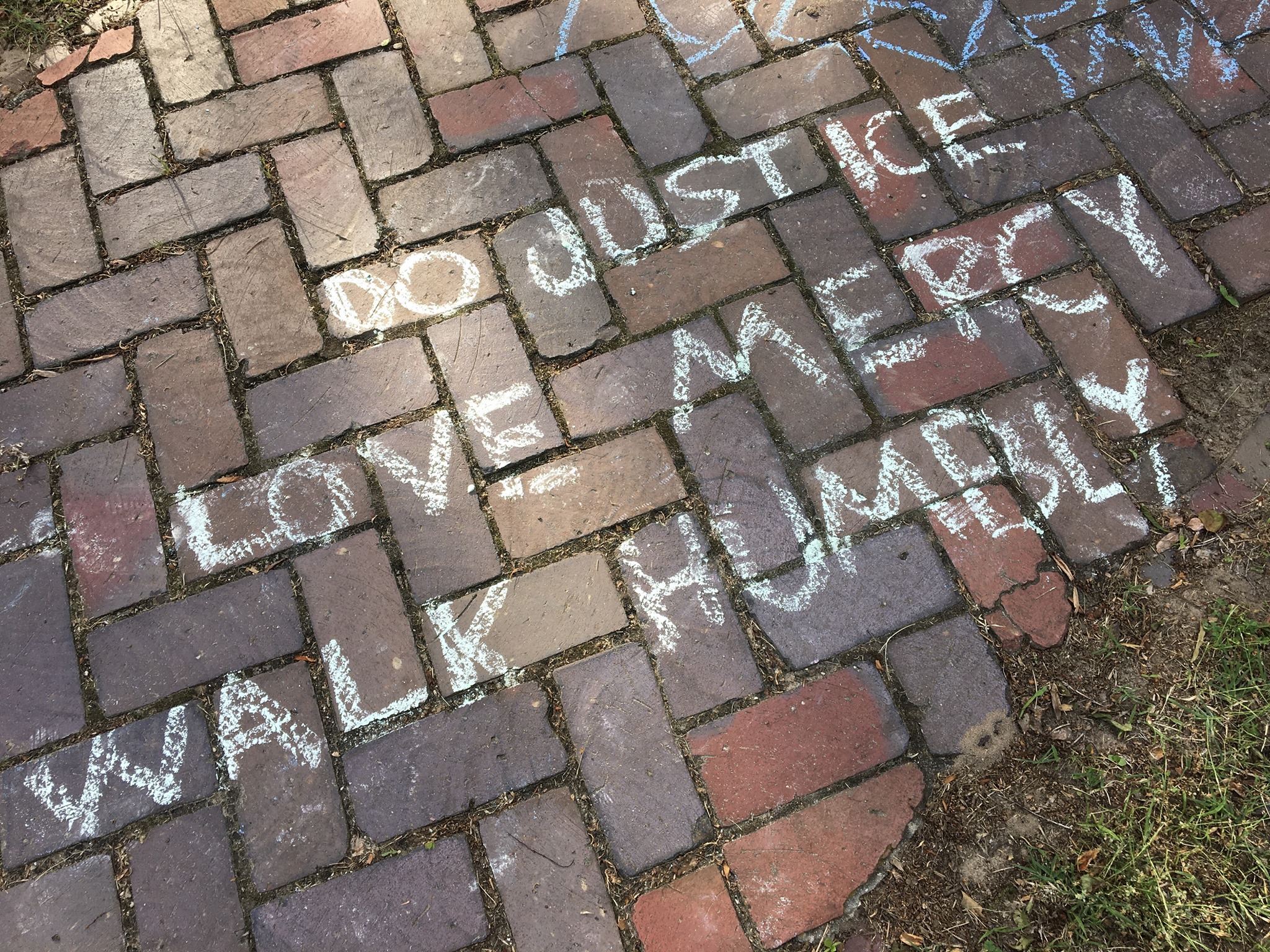
I know today’s lessons are hard.  But when we allow ourselves to be fully consumed by God’s grace, mercy, and abundantly steadfast love, our hearts soften a bit – maybe just a tiny sliver.  That sliver is God’s gift to you this week – the gift that will enable us all to see we are all in this together.  God needs me, you, us, and them – however you are defining “them” this week.  God is not asking us to roll over and stop fighting for justice.  But God is inviting us to remember each other’s humanity while doing justice, loving mercy, and walking humbly with our God.  Today’s lessons remind us we can – we can see with the eyes of God’s grace, mercy, and love because we have experienced that same grace, mercy, and love.  When we start seeing with God’s eyes, we will be empowered to find a way forward despite ourselves.  Thanks be to God.


[i] C. Davis Hankins, “Exegetical Perspective,” Feasting on the Word, Year A, Vol. 4 (Louisville: Westminster John Knox Press, 2011), 75.

[ii] Kathryn D. Blanchard, “Theological Perspective,” Feasting on the Word, Year A, Vol. 4 (Louisville: Westminster John Knox Press, 2011), 94.

[iii] Lewis R. Donelson, “Exegetical Perspective,” Feasting on the Word, Year A, Vol. 4 (Louisville: Westminster John Knox Press, 2011), 97.

[iv] Psalm 145.8

[v] Debie Thomas, “On Fairness,” September 13, 2020, as found at https://www.journeywithjesus.net/lectionary-essays/current-essay?fbclid=IwAR1uTVaenGNYgJX-mpph8V_97k_S-kIWEbuuSMwkzJKLohX0XbYvuveEk9k on September 17, 2020.

Sermon – Matthew 9.35-10.23, P6, YA, June 14, 2020

17 Wednesday Jun 2020

Posted by jandrewsweckerly in Sermons, Uncategorized

≈ Leave a comment

Tags

African-American, compassion, disciples, empower, God, harassed, helpless, Jesus, justice, love, mercy, police, protest, racism, rally, Sermon, Spirit, truth, witness

Last Sunday afternoon, I attended a rally in Colonial Williamsburg to renew the covenant between our Historical area police departments and the African-American community.  Established just three years ago, initiated by faith leaders in the African-American community, the covenant was established to proactively create collaborative relationships with our local police in order to prevent some of the racial divides that have occurred in other cities.  Although I was there to witness the support of the local clergy for this covenant, what I heard was the testimony of a community of people who have been harassed and feel helpless right here in our community.  Though we may have avoided some of the violence we have seen elsewhere in our country, the African-American community here in Williamsburg still feels the heel of racism pushing down on her neck.

Last week, we heard Matthew’s Great Commission, and we talked about the juxtaposition of civil unrest exploding around the issue of systemic racism and Jesus’ call to go out into the world doing works of justice, mercy, and love.  As some of the heat from protests simmered down a bit this past week, we could easily come to church today and long to turn down the heat too.  But our collect appointed for today, which you will hear later, holds our feet to the fire.  The collect says, “Keep, O Lord, your household the Church in your steadfast faith and love, that through your grace we may proclaim your truth with boldness, and minister your justice with compassion…”  Now the Collect of the Day is not just a random prayer, meant to sound good.  The Collect of the Day pulls themes from the scripture lessons appointed for the day – in essence, the Collect of the Day tries to articulate the thesis of our lessons.

After watching weeks of protests (maybe attending some yourself), hearing countless stories about unrest, reading articles or starting books about systemic racism, and praying diligently for peace, you may have come to church today hoping for some respite or reassurance.  But Jesus’ message to “Go!” from the Great Commission last week does not fade today.  Instead, Jesus’ words from Matthew’s gospel from almost 20 chapters earlier shows us our work is ever before us, beckoning us out into the world.

Years before his cross, resurrection, and ascension, we find Jesus teaching, healing, and proclaiming the good news to crowds of people.  In the midst of this work, we are told Jesus looks at the crowd and has compassion for them because they are harassed and helpless.  When Jesus sees the harassed and helpless, he does not simply fix the problem or strike down the system with godly power.  Instead, he turns to his disciples with a charge.  Jesus calls the twelve disciples by name (Simon Peter, Andrew, James, John, Philip, Bartholomew, Thomas, Matthew, James, Thaddaeus, Simon, and Judas), those who have been following him, learning from him, studying and praying with him, and sends them out, telling them how hard the work of showing compassion will be:  they will go without financial support, will be dependent upon the hospitality of strangers – some of whom will show them scorn rather than hospitality, will be persecuted and beaten, and will be betrayed even by their closest relatives.  This is the sobering work of love – of proclaiming God’s truth with boldness, and ministering God’s justice with compassion.

So how do the disciples hear such a sobering commission and still take the first step?  They take the first step because Jesus empowers the disciples.  Jesus gives the disciples power to heal and care for the oppressed; Jesus teaches them how to dust off their feet when they are scorned; Jesus promises when they need words, the Spirit of God will speak through them.  In other words, they just need to go, and God will take care of the rest.

Several of you have reached out to me over these last two weeks, longing for something to do in the midst of this important moment.  We have exchanged ideas and resources, and many of you have already begun to take specific action.  The content of how we respond in the coming weeks and months will vary widely, given our different gifts and abilities.  But our Collect today is not a prayer asking God to empower others to do the work of love or for God to just “fix it.”  Our Collect today is a request to God to help each one of us – called by name (Sue, John, Linda, Bob, Lisa, Bill, Tori, Don, Terri, Jim, Beth, and Dave) – to proclaim God’s truth with boldness, and minister God’s justice with compassion.  Jesus has already given us everything we need to do this work.  God is already keeping us in God’s steadfast faith and love; through God’s grace we can proclaim God’s truth with boldness, and minister God’s justice with compassion.  Amen.

Sermon – Luke 23.33-43, P29, YC, November 24, 2019

27 Wednesday Nov 2019

Posted by jandrewsweckerly in Sermons, Uncategorized

≈ Leave a comment

Tags

Christ the King, cross, fairness, humility, image, Jesus, justice, king, Mr. Rogers, need, Sermon, victory, want

Fifty-one years ago, Mister Rogers Neighborhood debuted on public television.  Many people criticized the show, saying the show was too slow and too boring to keep children engaged.  For critics, children’s programming needed to be loud, action-packed, full of silly gimmicks, perhaps with a few characters that were made fun of or teased.  Knowing how frenetic young children can be, television producers had decided to mirror young children’s behavior in their television programming.  But not Mr. Rogers.  In the midst of frenetic behavior, Mr. Rogers sought a different environment for his show – something slower and more thoughtful, something kind and engaging, something simple and attentive.  Critics said the show would never last, that Mister Rogers Neighborhood was not what children wanted.

On this Christ the King Sunday, the final Sunday of the Church year, this Sunday of jubilant triumph, we find a similar conundrum.  As we read from Luke’s gospel, we do not find Christ the King on a throne – we find him on a cross, leaders scoffing at him, soldiers mocking him, a criminal deriding him, and a crowd of people just standing there watching.  Nothing about today’s lesson connotes victory or royalty.  Jesus’ critics put a sign over his head that read, “This is the King of the Jews.”  The inscription is written as a declarative statement, but I wonder if there should have been a question mark at the end of that sentence.  This is the King of the Jews?  This is what royalty looks like?  This is what a savior is to you?

Of course, I am not sure the people of God were any surer about what having a king should be like.  The people of God never really had a king until they reached the Promised Land.  They saw the neighboring countries with their armies and their admirable kings, and they wanted one for themselves.  That was their first mistake.  God granted them a king to rule over them, but inevitably, the kings, like all humans, were flawed – some more than others.  Hence, there are four books in the Hebrew Scriptures about the kings who ruled and the judges who tried to correct their behavior.  Most of the kings were corrupted by power, money, and greed.  Many abused the people.  Even the most revered king, King David, was a mess.  He was the one who coveted Bathsheba, slept with her, and then killed her husband when he got her pregnant and realized he would not be able to get away with it.

Having been through a horrible patch of awful kings, the prophets predicted the coming of a Messiah – the king of kings and Lord of lords.  This king would be triumphant and would make the people of Israel dominant at last.  You can imagine that with such a great promise, the people of Israel are not too pleased with the man who finally claimed be the Messiah.  Nothing about Jesus says “king.”  He is nonviolent, hangs out with sinners of all sorts, and travels with a sorry band of misfits.  Even his grand entrance into Jerusalem where he is heralded as a king is not so grand – he rides in on a donkey, for goodness sake!  This could not possibly be the king Yahweh had promised them.

And yet, this is exactly the king God sends.  The Lord, who never wanted God’s people to have an earthly king anyway, makes a king that represents everything that is kingly:  a man who loves the poor and cares for the sick, a man who sees through the pretenses of the temple and calls for authenticity, a man who loves deeply and forgives infinitely.  So why are the people of God not excited about this king?  Why can they not love this countercultural king as much as the king they think they need?

In talking to a William & Mary student a couple of weeks ago, I was reminded of one of the first Political Science classes I took in college called Political Theory.  When we started reading the first book in our Political Theory class, I knew I was in trouble.  We read John Rawls’ A Theory of Justice.  In the book, he presents the best way to create a just political system.  He imagines gathering a random, diverse group of people who are essentially blindfolded about what their lot in life will be.  They have no guarantees about whether they will be old or young, rich or poor, male or female, member of a minority group or not.  In the midst of this blindness, the people gathered are given the task to create a set of rules to govern society.  Rawls’ basic argument is that if those people are truly blind about what their lot in life will be, they will be more likely to come up with a system of governance that is the fairest for all – since no one would want to take a chance on being the one victimized by an unfair system.  Although I appreciated what Rawls was saying, I was immediately annoyed at his argument.  How could we ever recreate a system of justice from scratch, and truly blind anyone enough to create such a system?  The entire premise seemed impossible, and thoroughly frustrating.  Needless to say, my focus in Political Science did not become Political Theory!

That being said, many years later, I think I may finally understand what Rawls was trying to communicate.  Our political system, or even this earthly life in general, is governed by a set of human-made standards that do not look out for the poor, create injustices, and benefit very few.  This is why so many of us get frustrated when we talk about justice or trying to make a difference – we see the system of injustice that fights against us and we can end up feeling helpless.  This is the very injustice that our king – Jesus – comes to fight.  Maybe Rawls saw this too.  Perhaps this world we can only achieve through blindness is the same world Jesus could see through God’s eyes.

In Rawls’ argument, when the blinded people make the rules, and then have their blindfolds removed, some are relieved to be well-off and others are dismayed to see themselves in poverty or at a disadvantage.  But all have some sense of acceptance because the rules they made do not make rich-life as advantageous and do not make poor-life as unbearable.  This is the kind of fairness into which Jesus invites us.  Jesus shows us a world where a humiliated man can look at his persecutors and forgive them.  Jesus shows a world where a man is willing to suffer for the salvation of others.  Jesus shows us a world where even a criminal can see truth in the last hour, can admit his guilt, and turn to Christ for leniency.

This is why we celebrate Christ as King today:  not because he is victorious in putting us in control over others, but because he invites us into a life that evens the playing field – the life of the kingdom of God.  There are certainly going to be days when we wish Jesus would just mount a mighty horse and triumph over evil.  Lord knows, in these days of political strife, of country-wide division and derision, of a time in our country where we say nasty things to one another, and the actions of the other side (whichever side we see as “the other”) are seen as the cause of all our troubles, we could use a Messiah, a king to come in and just “fix it” – to be a decisive, strong, powerful king to clean the slate.  But what Christ the King Sunday invites us to remember is we do not need a king on a throne; we need a king on a cross who enables us to create a world of fairness here and now – a world that is much more similar to the kingdom of God than the kingdom of humankind.

So why do we honor this not-so-kingly king today on the last day of the liturgical year?  I think the very best reason we close one year and prepare to start another with today’s gospel lesson is so that as we can more humbly approach the Christ Child.  If we can imagine ourselves gathered around that manger on that most holy of nights, not eager for vindication, but instead humbled by the path we will all walk with this king, then we enter into Advent with more reverence, less arrogance, and a healthy dose of gratitude.  This king – Christ the King – is the most sobering, challenging, merciful, joyous, steadying king for which we could hope.  He is not the king we always want, but he is certainly the king we always need.  Today we celebrate the wise gift by God of a true King – a king who makes us all better versions of ourselves, who helps us see there are no easy solutions, and who encourages us to embrace justice as fairness, not justice as vindication.  Our invitation today is to take a seat at the foot of the cross, to prepare our place in the hay surrounding the manger, to change out our shoes, to take off our jackets and zip up our cardigans, and to make a calm, quieter space for ourselves to hear how a real king can help us create not the kingdom we may want, but certainly the kingdom we need.  Amen.

On the Need for Mirrors…

07 Wednesday Aug 2019

Posted by jandrewsweckerly in Uncategorized

≈ 7 Comments

Tags

advocacy, anger, baptismal covenant, blame, broken, evil, God, God's word, guilt, immigration, judgment, justice, race, shame, values

mirror-reflection-loriental-photography

Photo credit:  https://fineartamerica.com/featured/mirror-reflection-loriental-photography.html?product=art-print

This weekend I was at the pool with our children.  We had the pool to ourselves for a while until a group of kids joined us toward the end of our time.  A few minutes after their arrival, the lifeguard called break, in keeping with the regularly scheduled breaks.  The new kids were justifiably disappointed, but what happened next was not justifiable.  About five minutes into the break, one of the teenagers starts ranting loudly about why a lifeguard should need a break – claiming his job was not all that hard.  She then asked the lifeguard directly how much longer the break would be.  The lifeguard did not seem to totally understand her question (our lifeguards are usually international students here for the summer), and she spoke to him as if he were a child.  I found my anger rising.  Her taunting behavior continued after the break, and another teenager joined her in disrespecting the lifeguard with audible side comments, and ignoring his instructions about safety.  The lifeguard finally blew the whistle, saying the pool was closed, and everyone would have to leave.

Fortunately, we were on our way out already, as the teenagers’ behavior had angered me so much that I was no longer having fun.  The lifeguard apologized profusely on our way out, and I reassured him that I totally supported his decision, given how disrespectful the other guests were being.  As we walked home, my children asked me why I was so mad.   I explained part of my anger – that we never disrespect others the way those teens did, and their behavior made me mad.  But what I didn’t share was I suspected the teens’ behavior was also related to the lifeguard’s ethnicity.  With tensions around race and immigration these days, I suspected the teen felt she was superior in some way to this man, and I wondered why.

But mostly, I was mad at myself.  As the night wore on, I felt nauseated about the fact I had said nothing to that teenager.  Though my body language probably reflected disdain for her behavior, I said nothing to defend the lifeguard.  The more I thought about it, the more I wished I had approached the teen and talked to her about her inappropriate behavior.  In reflection, I could not figure out why I said nothing to her; I just knew I was ashamed by my inaction – so ashamed, I have felt it for days.

As a country and community, I have heard many conversations about how our government is broken and the other side (whomever we view as the other side) is leading us into evil.  This weekend I began to wonder if, instead, we are the ones who are broken.  We have lost the very values we claim in our baptismal covenant – to respect the dignity of every human being, to strive for justice, and to seek and serve Christ in all persons.  I wholeheartedly support advocacy work and protest movements when we see injustice.  But this week, I humbly ask you to join me in the work on ourselves – to shift from being people outraged by injustice and to start doing justice; to shift from being hearers of God’s Word, to being doers of God’s Word; to turn our criticism of others to a constructive criticism of ourselves.  Next time you hear me complaining about the degradation of our morals or values, please ask me what I am doing about it.  I promise to do the same for you in return.  Let’s get started!

On Neighbors, Kindness, and Baptism…

10 Wednesday Jul 2019

Posted by jandrewsweckerly in Uncategorized

≈ Leave a comment

Tags

baptism, Christian, church, community, covenant, dignity, Episcopal Church, God, identity, Jesus, justice, kind, kindness, love, neighbor, welcome

wont-you-by-my-neighbor

Photo credit:  https://www.92y.org/event/won-t-you-be-my-neighbor

This weekend our parish’s Faith & Film offering was Won’t You Be my Neighbor, the documentary about Fred Rogers.  My daughter had never seen a documentary before, and I was a bit anxious about her attending for fear she would be bored or the film would be too advanced for her.  Ultimately, it was a risk I was willing to take because although though I knew she had never watched Mr. Rogers, I also knew she would appreciate his message.

But the true test came on the drive home.  As we were riding along, my daughter said, “You know what, Mom?  I think if Mr. Rogers were alive today, he would be a part of WMBGkind.”  Right then, I knew that she got it – that she had been paying attention to the witness of Mr. Rogers and his ministry of teaching children about the dignity of every human being.  That is what kindness is really all about – honoring and respecting the dignity of other human beings – no matter their age, race, ethnicity, gender, sexual identity, socioeconomic status, ability, or even their own ability to show kindness in return.

This Sunday, we are baptizing a baby into the household of God.  As part of that ritual, we will make promises about our own spiritual journey.  We will promise to gather regularly in Christian community, breaking bread and praying together; to resist evil, and repent when we fail; to proclaim the Word of God in word and deed; to seek and serve Christ, loving neighbors as ourselves; and to strive for justice and peace, respecting the dignity of every human being.  We promise to do what Christ asked us to do:  love God, love your neighbor, love yourself.

I love that my daughter is affirming her baptismal identity at Hickory Neck – whether she sees Christian witness through Mr. Rogers or through her Sunday School teachers.  I love that our younger children and older youth are learning how to live into their baptismal identity – whether through nursery care providers or youth group leaders.  And I love that our adults are still learning to live into their baptismal identities – through preaching, teaching, and our children’s witness.  At Hickory Neck, we are working across generations to keep loving God, loving our neighbors, and loving ourselves.  If you are in need of a community to help you claim that same identity and purpose, know that you are always welcome here – won’t you be our neighbor?

46040735_2084113391644910_120194659778560_o

Photo credit:  Hickory Neck Episcopal Church; permission to use required

GC79: When People Start Getting Real…

07 Saturday Jul 2018

Posted by jandrewsweckerly in Uncategorized

≈ Leave a comment

Tags

apathy, children of God, compromise, conversation, Episcopal, General Convention, Jesus, justice, prayer, relationship, truth, uncomfortable

36768122_10157017520522565_436164541772988416_o

General Convention, July 6, 2018.  Photo credit: Jennifer Andrews-Weckerly (reuse with permission)

One of the things that I am finding powerful about General Convention is a willingness to enter into a time of truth-telling.  Before I arrived, the House of Bishops hosted a listening session of stories from women who have been sexually harassed or abused in the context of the church.  From what I hear it was a powerful experience of honesty and vulnerability, and I believe many of the bishops (most of whom are male) were moved by the experience.

Last night, I sat in on a hearing for people to offer their testimonies about a couple of resolutions involving marriage rights, particularly same-sex marriages.  Much of the conversation was about a resolution put forth involving a compromise (B012).  According to the resolution, bishops can still make decisions with their conscious for their priests and diocese, but would give permission for any priests who feel called to celebrate same-sex marriages to do so with the oversight of another bishop of the Church.  The testimonies lasted for almost two hours (not including the two hours earlier in the day), and many things became abundantly clear.  Our LGBTQ brothers and sisters are hurting and longing to be treated as equal children of God.  And our more conservative brothers and sisters are fearful about not being able to be faithful to their understanding of Scripture and tradition.  The tension was high.  But also present was a spirit of graciousness.  People of opposing views were sitting beside one another, able to make eye contact and stay in the room.  I came away realizing that what I was seeing was what compromise looks like – no one fully happy, but a path forward for now.  And in a county that seems incapable of compromise, it was a gift to see the Church moving in that direction.

And then today, we spent time together talking about Racial Reconciliation – a topic that my conversation partner said has been a topic for twenty years of General Conventions – which means we haven’t gotten there yet.  It was an inspiring, beautiful, hard time, but a time I was glad to see us have.  One of my favorite speakers, the Rev. Nancy Frausto, had this to say, “This society has been contaminated by the plague of apathy.”  In other words, in a political environment where injustice is rampant, we cannot afford to let apathy infect us.

I do not know where these conversations will lead.  I suspect we will not solve the world’s ills at this Convention.  But what we are starting to do is show the world what it means to be a diverse people who stay together, find a compromise, and love and lead together.  It is not easy.  In fact, it’s pretty uncomfortable. But following Jesus is pretty uncomfortable too.  If the Church can’t do it, I’m not sure we can ask anyone else to do that work.  I’m proud of the Episcopal Church tonight.  And I will continue to hold her in my prayers.

← Older posts

Recent Posts

  • On the Myth and Magic of Advent…
  • On Risking Failure and Facing Fear…
  • Sermon – Luke 23.33-43, P29, YC, November 23, 2025
  • On Inhabiting Gratitude…
  • Sermon – Luke 20.27-38, P27, YC, November 9, 2025

Archives

  • December 2025
  • November 2025
  • October 2025
  • September 2025
  • August 2025
  • July 2025
  • June 2025
  • March 2025
  • February 2025
  • December 2024
  • November 2024
  • October 2024
  • September 2024
  • August 2024
  • July 2024
  • June 2024
  • May 2024
  • March 2024
  • February 2024
  • January 2024
  • December 2023
  • November 2023
  • October 2023
  • September 2023
  • August 2023
  • July 2023
  • June 2023
  • May 2023
  • March 2023
  • February 2023
  • January 2023
  • December 2022
  • November 2022
  • October 2022
  • June 2022
  • May 2022
  • January 2022
  • December 2021
  • November 2021
  • October 2021
  • September 2021
  • August 2021
  • June 2021
  • May 2021
  • April 2021
  • March 2021
  • February 2021
  • January 2021
  • December 2020
  • November 2020
  • October 2020
  • September 2020
  • August 2020
  • July 2020
  • June 2020
  • May 2020
  • April 2020
  • March 2020
  • February 2020
  • January 2020
  • December 2019
  • November 2019
  • October 2019
  • September 2019
  • August 2019
  • July 2019
  • June 2019
  • May 2019
  • April 2019
  • March 2019
  • February 2019
  • January 2019
  • December 2018
  • November 2018
  • October 2018
  • September 2018
  • August 2018
  • July 2018
  • June 2018
  • May 2018
  • April 2018
  • March 2018
  • February 2018
  • January 2018
  • December 2017
  • November 2017
  • October 2017
  • September 2017
  • August 2017
  • July 2017
  • June 2017
  • May 2017
  • April 2017
  • March 2017
  • February 2017
  • January 2017
  • December 2016
  • November 2016
  • October 2016
  • September 2016
  • August 2016
  • July 2016
  • June 2016
  • May 2016
  • April 2016
  • March 2016
  • February 2016
  • January 2016
  • December 2015
  • November 2015
  • October 2015
  • September 2015
  • August 2015
  • July 2015
  • June 2015
  • May 2015
  • April 2015
  • March 2015
  • February 2015
  • January 2015
  • December 2014
  • November 2014
  • October 2014
  • September 2014
  • August 2014
  • July 2014
  • June 2014
  • April 2014
  • March 2014
  • February 2014
  • January 2014
  • December 2013
  • November 2013
  • October 2013
  • September 2013
  • August 2013
  • July 2013
  • June 2013
  • May 2013
  • April 2013
  • March 2013
  • February 2013
  • January 2013
  • December 2012
  • November 2012
  • October 2012
  • September 2012

Categories

  • reflection
  • Sermons
  • Uncategorized

Meta

  • Create account
  • Log in
  • Entries feed
  • Comments feed
  • WordPress.com

Blog at WordPress.com.

  • Subscribe Subscribed
    • Seeking and Serving
    • Join 394 other subscribers
    • Already have a WordPress.com account? Log in now.
    • Seeking and Serving
    • Subscribe Subscribed
    • Sign up
    • Log in
    • Report this content
    • View site in Reader
    • Manage subscriptions
    • Collapse this bar
 

Loading Comments...