• About

Seeking and Serving

~ seek and serve Christ in all persons

Seeking and Serving

Tag Archives: kindness

On Practicing Daily Love…

15 Wednesday Feb 2023

Posted by jandrewsweckerly in reflection

≈ Leave a comment

Tags

daily, eyesight, fault, generous, God, goodness, kindness, love, thoughtful, Valentine's Day

Photo credit: https://www.foodandwine.com/news/most-popular-valentines-day-candy-every-state-2022

As our girls age, they take on more independence.  Recently, that took the form of preparing Valentines to exchange with classmates.  Our younger daughter had already done this for years, so she knew the drill.  In fact, I came downstairs to find her packaging the Valentines kits we had procured.  As she wrapped up, she explained to me she was leaving one Valentine undone for the new kid in her class.  “I don’t know him well enough yet.”  I asked her why that would prevent her from addressing a Valentine to him, and she explained how each person was receiving a personalized note from her.  “Dear X, You are kind.  Happy Valentine’s Day.”  Or, “Dear Y, I like your laugh.”  And another, “Dear Z, You are fun to play with.” 

Yesterday, as she packaged up the completed Valentines, I asked her what she wrote for the new student.  She settled on, “Dear W, I like how calm you are.”  I sent her off to school in awe, wishing I could claim credit for the thoughtful, generous kid she has become, but knowing I could not claim credit for her Valentine kindness.

The more I thought about her notes, the more I thought how my daughter has internalized the loving eyes of God.  Thinking of faults in others is easy.  Somedays we can think of nothing but those faults.  But thinking of goodness in each person is actually harder than it seems – especially for that coworker whose moods drive you crazy, that committee member who always stirs the pot in meetings, or that family member who is always criticizing you or your choices.  I can attest to the fact that as lovely as my daughter’s notes were, she has registered complaints about almost every classmate of hers at some point in the school year.

Instead of dwelling on the glory (or lack) of romantic love in your life this February, I invite you instead to adopt the practice of daily love.  Maybe you start with the people in your life who bring you joy.  Let them know which of their attributes you really appreciate.  But then try daily love with the hard ones in your life:  the curmudgeon, the nagger, the expert in passive aggression.  Even if you cannot immediately say the words aloud, challenge yourself to think of one lovely thing about that person.  When you finally gain the courage, then find a way to share that loving regard – maybe aloud, maybe in a quick email or text, maybe in an old-fashioned card.  I can’t wait to hear how the practice of daily loves starts shifting your eyesight!

On Stories, Remembering, and Healing…

11 Wednesday Sep 2019

Posted by jandrewsweckerly in Uncategorized

≈ Leave a comment

Tags

darkness, dignity, God, heal, honor, human being, intimacy, kindness, light, love, people, power, pryaer, reclaim, remember, respect, September 11, share, story

Story Corps

Photo credit:  https://storycorps.org/discover/september-11th/

Today marks the eighteenth anniversary of September 11, 2001 – a fateful day in the United States.  Even eighteen years later, this is a day where we as a country remember – remember where we were that day, remember the people who were touched by tragedy that day, remember how a single day could transform a nation and the world.  This day hangs heavy in our consciousness each year, the weight never quite lifting even with the passage of time.

I think part of why this day is so heavy for us as a people is because of the people this day touched.  Certainly, we could look at the death toll, and recall the names of the almost 3,000 people who died that day, most without the opportunity to say goodbye to their loved ones.  But September 11’s reach went beyond those who died.  The ripple of that day is mind-blowing:  those who were physically injured, those who were bereaved, those who were supposed to be in those buildings and somehow life’s circumstances kept them away, those whose health continues to be poor from living nearby or helping with the cleanup efforts, those who walked for hours fleeing danger, those who made hard decisions that day – some leading to life and some leading to death.

Four years after that fateful day, NPR’s StoryCorps launched their September 11th Initiative.  A program built around having people tell their stories, StoryCorps launched an effort to record the stories of that specific day – of the man who traded shifts that day and whose mentor died because he had volunteered to take his shift; of the man who consoled his wailing two-year old and had to wait four months before his wife’s body was finally identified; to the woman who sifted through bones and debris in a hanger months later, trying to help people find closure; to the airline employee who checked in the terrorists that day at the gate; the father who lost both sons, one a firefighter and one a police officer, in the line of duty that day.  Every story, every single one is gut-wrenching and tear-evoking.  And every one gives a tiny glimpse into the magnitude of the ripple effect this one day had on all of us.

This day, I invite you to honor September 11 with stories.  Talk to your neighbors, friends, and strangers about their experiences.  Listen to stories like the ones on StoryCorps.  Read whatever stories you can find.  When we engage in one another’s stories, we engage in honoring the dignity of every human being, something we pledge to do in our baptismal covenant.  We allow the depth of this day to do something to us.  And somewhere in that intimacy of story, we begin to hear an invitation – an invitation to honor life today.  Whether it is an act of kindness (maybe even the kindness of simply asking someone to tell their story), or whether it is a time of prayer to honor all that has been, or whether it is a commitment to reclaiming love so that hatred can never win in such a powerful way as it did that day.  May our stories help us connect to the cosmic story of a God who loves us and gives us light in the darkness.

Homily – Luke 10:25-37, P10, YC, July 13, 2019

17 Wednesday Jul 2019

Posted by jandrewsweckerly in Sermons, Uncategorized

≈ Leave a comment

Tags

baptism, baptismal covenant, covenant, dignity, faith, God, Good Samaritan, Jesus, kindness, Mr. Rogers, neighbor, sacred, Samaritan, Sermon, unworthy

Last Sunday, a group of parishioners gathered to watch Won’t You Be My Neighbor, the documentary about Fred Rogers.  There were countless things I could tell you about this film, but one thing that really grabbed my attention was toward the end.  The film documented a criticism of Mr. Rogers as raising up a generation of people who feel and act entitled.  You see, one of the primary lessons from Mr. Rogers is he loves each individual, just as they are.  No changes are necessary; no fault is too big.  Mr. Rogers loves you just as you are.  You can hear the words of God in Mr. Rogers’ words – God too loves us unconditionally, and certainly loves us better than any human ever could.  However, Mr. Rogers’ critics would argue if everyone is loved just as they are, then surely they do not need to improve, or earn respect, or work hard.  But the film asserts something quite different.  The film asserts without being recipients of unconditional love, individuals cannot be givers of unconditional love.  In other words, to respect the dignity of every human being, one must first learn how sacred one’s own dignity is – one must be shown how she or he is a person with dignity to be respected in order to know how to respect the dignity of others.

That sense of each person having profound, sacred dignity is one of the main lessons of our gospel today.  The Good Samaritan is one of those stories that is so widely known all I need to do is say, “the Good Samaritan,” and we likely already know the story.  We might automatically recall, “Oh, that’s the story Jesus uses to tell us to be like the Good Samaritan – to be kind to others.”  In one sense, our recollection would be true – at the heart of Jesus’ story is a message to be kind to all.  But what that simple summary misses is the finer details to this story.

You see, those two people who separately pass the victim along the road, are a priest and a Levite.  These two people are not just people of faith – they are keepers of the faith.  They know the laws better than most people of faith.  You may have heard over the years the logic that priests or Levites could not risk being defiled by touching the body of the victim, and so that is why they went around the victim.  But the truth is, their avoidance had nothing to do with defilement – they were heading away from the temple and therefore were not in need of ritual purity, and any good priest or Levite knows they were expected to check on this victim; should he be dead, they should help bury him, and should he be alive, they should tend him.[i]  Basically, these are good, trained people of faith, not fulfilling their duty to love their neighbor as themselves.

But perhaps even more significant is the identity of the Samaritan.  The story does not say, a priest and Levite passed, but another faithful Jew came to the victim’s aid.  The story says, a priest and Levite passed, but a man whose people are mortal enemies of people of faith – who has persecuted, defiled, and subjugated people of faith – is the one who helps.  Saying “The Good Samaritan,” is like saying, “The Good Murderer.”[ii]  That this typically hated man is the one who shows mercy, kindness, and love is shocking.  The hearers of Jesus’ story are shocked, and our ears need to be similarly shocked.  Asking us to respect the dignity of every human being is already a monumental task; respecting the dignity of every human being is inconvenient, is humbling, and involves a willingness to be wrong about others.  Respecting the dignity of every human being means being willing to see how the best of the faithful fail at kindness, and how sometimes our worst enemies are better people of faith than we are.

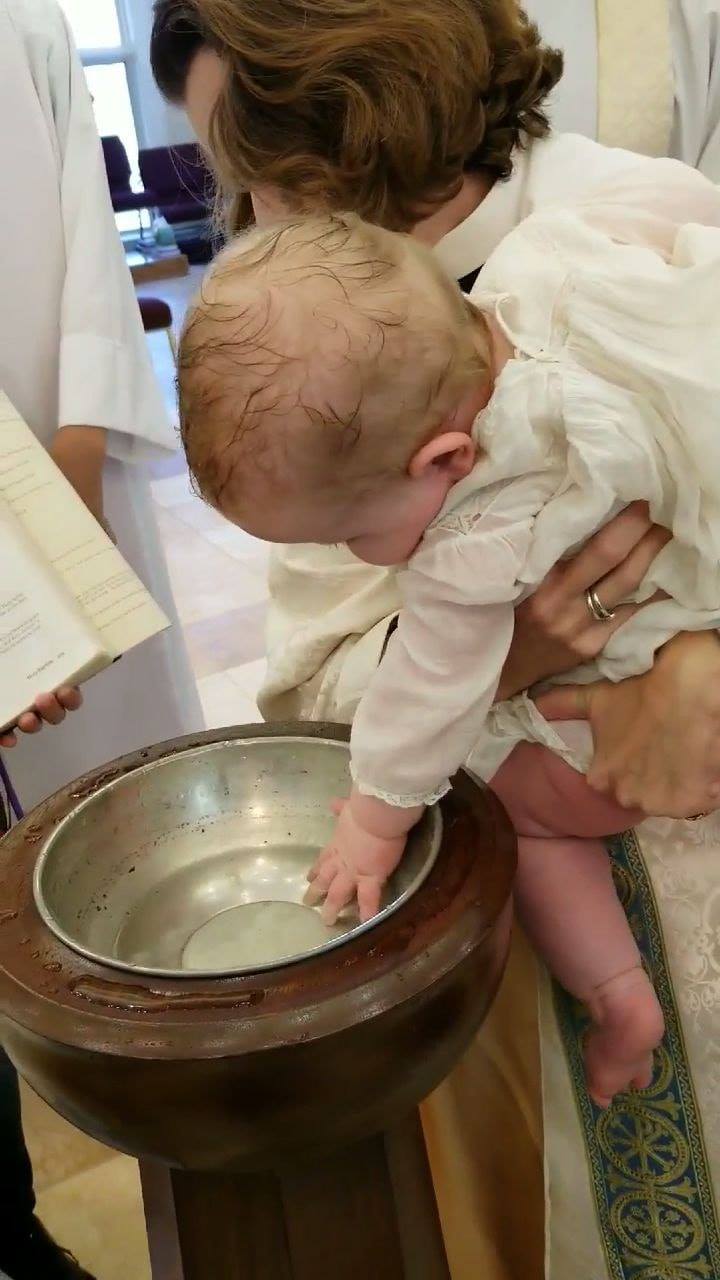
Today we are baptizing a child of God.  Her parents, godmothers, and our community will make promises today – to raise her in the community of faith, to show her to love and respect, to fight for justice and peace, to share the word of God, and to repent when she messes up.  We say those words today as we reaffirm our own baptismal covenants; but sometimes we forget how revolutionary the covenant is.  We are agreeing to teach Selah to live a revolutionary life.  When we say we will teach baby Selah to respect the dignity of every human being, we are saying we will teach her the hard work being inconvenienced and humbled in order to care for others.  When we say we will teach her to love her neighbor as herself, we are saying we will teach her that even her greatest enemies are worthy of love.  When we say we will teach her to repent when she sins, we are saying we will teach her to be willing to admit when people who we have deemed unworthy of love and care show us what true kindness really looks like.

Today, when we hear Christ’s words to “go and do likewise,” we can be encouraged that Jesus empowers us to make some promises.  Today we look at Selah’s precious, innocent face, and we promise to walk with her as she discovers how hard this work of being a faithful follower of Christ really is.  Today, we promise to confess to Selah the times when we have failed to love our neighbors as ourselves.  Today, we promise when those we despise, those who hurt us, those we cast out because they are not like us, those we can no longer see humanity in ask us, “Won’t you be my neighbor,” we will say with Selah, “Yes.  You are my neighbor too.”  Amen.

[i] Amy-Jill Levine, Short Stories by Jesus (New York:  Harper One, 2014), 99-102.

[ii] Levine, 105.

On Neighbors, Kindness, and Baptism…

10 Wednesday Jul 2019

Posted by jandrewsweckerly in Uncategorized

≈ Leave a comment

Tags

baptism, Christian, church, community, covenant, dignity, Episcopal Church, God, identity, Jesus, justice, kind, kindness, love, neighbor, welcome

wont-you-by-my-neighbor

Photo credit:  https://www.92y.org/event/won-t-you-be-my-neighbor

This weekend our parish’s Faith & Film offering was Won’t You Be my Neighbor, the documentary about Fred Rogers.  My daughter had never seen a documentary before, and I was a bit anxious about her attending for fear she would be bored or the film would be too advanced for her.  Ultimately, it was a risk I was willing to take because although though I knew she had never watched Mr. Rogers, I also knew she would appreciate his message.

But the true test came on the drive home.  As we were riding along, my daughter said, “You know what, Mom?  I think if Mr. Rogers were alive today, he would be a part of WMBGkind.”  Right then, I knew that she got it – that she had been paying attention to the witness of Mr. Rogers and his ministry of teaching children about the dignity of every human being.  That is what kindness is really all about – honoring and respecting the dignity of other human beings – no matter their age, race, ethnicity, gender, sexual identity, socioeconomic status, ability, or even their own ability to show kindness in return.

This Sunday, we are baptizing a baby into the household of God.  As part of that ritual, we will make promises about our own spiritual journey.  We will promise to gather regularly in Christian community, breaking bread and praying together; to resist evil, and repent when we fail; to proclaim the Word of God in word and deed; to seek and serve Christ, loving neighbors as ourselves; and to strive for justice and peace, respecting the dignity of every human being.  We promise to do what Christ asked us to do:  love God, love your neighbor, love yourself.

I love that my daughter is affirming her baptismal identity at Hickory Neck – whether she sees Christian witness through Mr. Rogers or through her Sunday School teachers.  I love that our younger children and older youth are learning how to live into their baptismal identity – whether through nursery care providers or youth group leaders.  And I love that our adults are still learning to live into their baptismal identities – through preaching, teaching, and our children’s witness.  At Hickory Neck, we are working across generations to keep loving God, loving our neighbors, and loving ourselves.  If you are in need of a community to help you claim that same identity and purpose, know that you are always welcome here – won’t you be our neighbor?

46040735_2084113391644910_120194659778560_o

Photo credit:  Hickory Neck Episcopal Church; permission to use required

On the Work of Kindness…

27 Wednesday Mar 2019

Posted by jandrewsweckerly in Uncategorized

≈ Leave a comment

Tags

Acts, challenge, embody, faith, God, intentionality, Jesus, kindness, Lent, radical, time, uncomfortable, work

53283460_2247971941925720_5352232032019677184_o

Photo credit:  Hickory Neck Episcopal Church; reuse with permission 

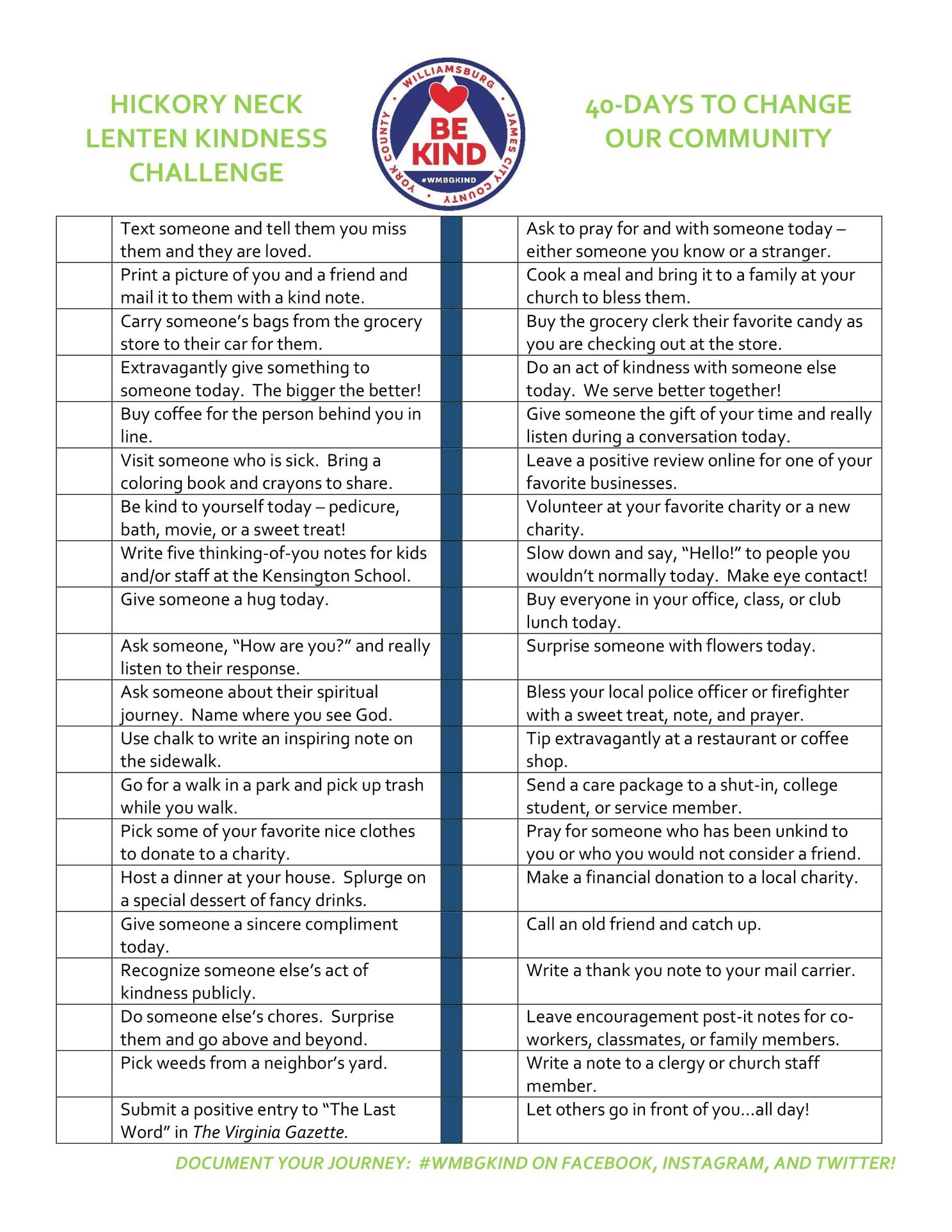
This Lent I decided to join my church in taking up our Lenten Kindness Challenge.  There are forty acts of kindness for the forty days of Lent.  The challenge itself is laid out like a checklist, but we were told we could either do the tasks in order, or pick and choose which acts fit our schedule on a particular day.  I elected to do the latter.  I confess, the kindness challenge began somewhat easily for me.  You see many of the acts of kindness are part and parcel of my job as a priest.  I have visited the sick more times than I can count this Lent.  I have hosted people in my home as part of our new Rector’s Receptions.  I regularly ask people about their faith journey and ask people if I can pray for them.  In some ways, by virtue of my job, I have felt like I am coasting through this kindness challenge.

But about halfway through Lent, I have passed all the “easy” acts, and am now facing all the acts of kindness I skipped because they will take more time or intentionality.  Midway through Lent, this kindness challenge is starting to feel like work – work that will require my time and attention.  On the one hand, I am already dreading the work, trying to figure out when I will have time to write extra notes, or do tasks that are outside of my everyday routine.  On the other hand, I am glad I have hit this point in the kindness challenge.  The work being demanded of me now reminds me that kindness is not just the kindness that we naturally do day in and day out.  Kindness requires something more of us – our time, our forethought, our work.  If it were easy, everyone would be doing it!

This is why I think focusing on kindness is so important for people of faith.  You see, being kind can reference the superficial, polite, everyday way of being that is common for all people – a great thing to be celebrated, but not necessarily the behavior in life that motivates and inspires.  But the kindness people of faith are invited to claim is the kind of kindness we see modeled through God – the kind of kindness we as people of faith embody so that others might see Christ in us.  Jesus was not venerated because he was simply polite – a good Southerner, if you will.  Christ was venerated because he healed the sick, listened to the isolated, and ate meals with the disenfranchised.  The kindness of Jesus was the kind of kindness that made people uncomfortable – that crossed barriers, that pushed people out of comfort zones, and that placed little value on societal norms.  Christ’s kindness was a radical kind of kindness.

I wonder what ways you are being challenged to get a little more radically kind this Lent.  What are things that you can be doing that require more of you than simply being polite?  What are the acts of kindness you can do that will take more time, that will inconvenience you, that might even make you a little uncomfortable?  Perhaps you have already notated which of those challenges are going to be hard for you this Lent.  Or perhaps there are different challenges that are not on our Lenten Kindness Challenge, but are the actions you need take to embody Christ today.  I cannot wait to hear how you are challenging yourself during this second half of Lent!

Holding on to Joy in Lent…

06 Wednesday Mar 2019

Posted by jandrewsweckerly in Uncategorized

≈ Leave a comment

Tags

Ash Wednesday, Christ, discipline, earthy, holy, identity, joy, kindness, Lent, life, light, love, repent, virtue

IMG_6748

Photo credit:  Jennifer Andrews-Weckerly; reuse only with permission

Last night I had one of the most fun Shrove Tuesday/Mardi Gras celebrations I have ever had.  We had a great crowd, there was a spirit of joy and celebration, the Kensington School hosted an awesome kids’ corner with fun activities, and best of all was the Hickory Neck Talent Show.  I have not laughed so hard and smiled so much in a long time.  I even woke up this morning with an uplifted spirit, the smile still lingering on my face.

While I am so grateful for that blessing, as a priest, it does make entering into Ash Wednesday a bit tricky.  Here I am still coming down from the high of last night, and now I need to enter into a worship service where I tell people to fast, to repent, and to remember their mortality.  It almost feels like emotional or spiritual whip-lash, and I have been struggling this morning to know how to help others with that same abrupt shift.

Where I have landed is that I think the best way to enter into Ash Wednesday and the season of Lent is with that same lingering sense of celebration.  You see, when you have experienced the highs of life, talking about the “lows” of life seems a bit more bearable.  Yes, we are mortal, and yes, we will return to the dust.  But while we are still mortal, we can make this life here on earth one of great joy and love – one of laughter, of community, of togetherness.

I wonder if this might be a way to enter Lent in a healthier way.  Instead of lamenting our sinful nature (and believe me, we do need to lament our sins), perhaps our Ashes today might remind of us the earthy nature of being humans and encourage us to strive for the ways we might live that earthy life in a more holy way.  I plan to do that today by entering into a season of kindness.  I am taking the joy from my community of faith last night and channeling it into forty days of kindness – where my repentance becomes a practice of demonstrating my identity – of living more faithfully the virtue of kindness.  What Lenten discipline are you taking up?  What might be a way for you to joyfully grasp onto this fleeting life and make it a witness to Christ’s light and love?  I can’t wait to hear all about it!!

Ash-Wednesday-1

Photo credit:  https://saintvincents.org/2019/02/25/ash-wednesday-march-6/

Sermon – Luke 6.27-38, EP7, YC, February 24, 2019

27 Wednesday Feb 2019

Posted by jandrewsweckerly in Sermons, Uncategorized

≈ Leave a comment

Tags

change, commands, discipleship, God, hard, intentional, Jesus, kindness, love, loving kindness, mercy, Sermon, shelter, sickness, symptoms, system

Last week, we joined the entire community of Williamsburg in performing acts of kindness.  When we issued the charge two weeks ago to go out and perform three acts of kindness, the reactions were pretty wide-ranging at Hickory Neck.  Several parishioners addressed me with concern, “I have to do three?  Can’t I just do one act before next Sunday?”  Other parishioners took on the challenge with gusto – with several parishioners plotting out what they were going to do before they even got back to the parking lot.  While other parishioners noted during the week and the days afterwards how shockingly easy the challenge was.  “I felt silly writing down my acts of kindness.  I mean, I do acts of kindness every week,” shared one parishioner.

I am not sure which perspective was predominant, but I can tell you that Hickory Neck performed over 100 acts of kindness that week.  There were some simple acts:  holding doors for strangers, paying people compliments, and writing thank you notes.  Some were a little more labor intensive:  volunteering at a food pantry, helping out at your child’s school, going through your closet to donate clothes.  Others showed some real effort:  listening to a stranger who seemed to need a friend, making Valentines for the whole class – even the kids you do not like, visiting someone in the hospital – even though you hate hospitals.

Now I know several parishioners who thought our challenge was a bit silly or who felt uncomfortable with the idea of drawing attention to our own good works.  Surely we should just be doing acts of kindness every week.  But for those of you who jumped in with both feet, my hope is that you got a tiny glimpse into what can happen when you start living out kindness more intentionally:  your whole way of being starts to shift.  When you do acts of kindness, the more opportunities for additional kindness seem to appear.  The more you think about kindness, the more you start to notice kindness all around you.  And the more you engage in kindness, the more your whole demeanor shifts – from one of staying in your lane, attending to your daily routine, to lifting up you head and noticing how you can shift the community around you.

That seismic shift is what Jesus is talking about in Luke’s gospel today.  Many of us hear the instructions from Jesus as a list of commands or a checklist of duties:  love your enemies, do good to those who hate you, bless those who curse you, pray for those who abuse you; do not judge, do not condemn, forgive, and give.  If we look at today as a list of commands from Jesus, then we might as well consider this week as Week Two of an acts of kindness challenge – except this time, Jesus asks us to do acts of kindness for those to whom showing kindness is the hardest.  When we read Jesus’ words like a weighty list of to-do items, this gospel feels just that – full of weight and guilt with no promise of hope or encouragement.  And part of what Jesus is saying is just that:  showing kindness is actually pretty hard when we show kindness to those who are hardest to love.  We do not mind showing kindness to friends, and we do not even really mind showing kindness to strangers.  But asking us to show kindness to those who we actively dislike or to those who have hurt us?  Now Jesus is pushing us way out of our comfort zones!

At the beginning of February, the Greater Williamsburg area kicked off a commitment to becoming a community of kindness with a rallying event.  The former Mayor of Anaheim, California, Tom Tait, who had run on a campaign of kindness, was the keynote speaker.  Mayor Tait talked about his time on City Council in Anaheim, how part of his work felt like a game of whack-a-mole.  Each month, some crisis or community problem would arise – violence in the community, the prevalence of drugs, problems in the public schools.  And the City Council’s response felt like trying to whack at the problem to temporarily knock the problem out.  But those solutions never really made a deep impact.  What Mayor Tait saw was all those problems were like symptoms – symptoms of a city that was facing an internal sickness.  The only way to heal the internal sickness was to commit as a city to transform its entire way of operating.  Mayor Tait believed transformation would occur by committing to kindness.  To many, the idea sounded a little too pie-in-the-sky.  But once elected, Mayor Tait was forced to try to live out the reality of kindness.  With every decision, every major action, the community wondered together what would reflect kindness.  And slowly, the illness in the system began to heal.  Kindness was not a Band-Aid, but a system-altering antidote to a host of problems.

In a lot of ways, that is what Jesus is talking about today.  Yes, the things Jesus is talking about are commands – a list of ways to be kind, even to the persons to whom being kind is most difficult.  But Jesus is not just talking about commands.  As one scholar describes, “Jesus isn’t offering a set of simple rules by which to get by or get ahead in this world but is inviting us into a whole other world.  A world that is not about measuring and counting and weighing and competing and judging and paying back and hating and all the rest.  But instead is about love. Love for those who have loved you.  Love for those who haven’t.  Love even for those who have hated you.  That love gets expressed in all kinds of creative ways, but often come through by caring – extending care and compassion and help and comfort to those in need – and forgiveness – not paying back but instead releasing one’s claim on another and opening up a future where a relationship of …love is still possible.”[i]

What Jesus is doing is trying to, “inculcate, and illustrate, an attitude of heart, a lightness of spirit in the face of all that the world can throw at you.”  We are to assume this new way of being because “that’s what God is like.  God is generous to all people, generous…to a fault:  [God] provides good things for all to enjoy, the undeserving as well as the deserving.  [God] is astonishingly merciful…”  As N. T. Wright adds, “…this list of instructions is all about which God you believe in – and about the way of life that follows as a result.”[ii]  When we take Jesus seriously, and embrace this new way of being, the way of kindness that leads to love, life can be “exuberant, different, astonishing.  People [will] stare.”[iii]

In a lot of ways, what Jesus does to today is saying, “I see your week of kindness, and I raise you to life of loving-kindness.”  In other words, keep going.  Now, fortunately for us, Hickory Neck has set up the perfect set of circumstances for you to try on this new life of loving-kindness.  Tonight, we open our doors to strangers.  Tonight, we open our doors to some people we will find easy to love, and some people that will make us uncomfortable.  Tonight, we open our doors to some late nights, really early mornings, and hard labor.  But tonight, we also open our doors to a new way of being – a way of opening ourselves to live exuberantly, differently, astonishingly – to live like God.

Now I know one week (or even the one shift or duty you signed up for at the Winter Shelter, or even the financial contribution you made) may not change the world necessarily.  Jesus is talking about a seismic change in the way we live our lives every day.  But the Winter Shelter is a pretty good start.  And the good news for you, is Lent is coming, and we’ve set up all kinds of tools for you to embrace this way of loving-kindness.  Instead of a week of kindness, we have a whole 40-day kindness challenge.  We have a devotional set of readings that reflect on kindness, story, and scripture for forty days.  We will be studying kindness in scripture.  Hickory Neck has assembled the tools to help you not just try simple deeds for a week, or not just try the hard stuff of relationship with the homeless for a week – but instead to try on a new way of being – to take on the way of God.  Part of what Hickory Neck is all about is empowering discipleship – empowering you to go out into the world and live as faithful witnesses of Christ.  This is what discipleship is all about.  And Hickory Neck is here to help – to walk with you, to lift you up when you fall, to hold your hand in the hard parts, and to revel in the joy of watching love win.  We cannot wait to enter in to this most sacred time of loving-kindness with you!  Amen.

[i] David Lose, “Epiphany 7 C:  Command or Promise?” February 22, 2019, as found at http://www.davidlose.net/2019/02/epiphany-7-c-command-or-promise/ on February 22, 2019.

[ii] N.T. Wright, Luke for Everyone (Louisville:  Westminster John Knox Press, 2004), 73-74.

[iii] Wright, 74.

On Walking toward Christ through Kindness…

13 Wednesday Feb 2019

Posted by jandrewsweckerly in Uncategorized

≈ Leave a comment

Tags

Acts, Christ, faith, grace, humility, kindness, life, love, model, patience, receive, student, teacher, transform

walking

Photo credit:  https://www.truefaithcogic.org/put-on-the-lord-jesus-christ/

Many people I encounter, both church-going and non-church-going, tend to think my role as a priest is to teach people how to live holy lives.  The expectation is not unfounded.  When I was ordained, the bishop asked me several questions in front of the congregation.  One of them was, “Will you do your best to pattern your life and that of your family in accordance with the teachings of Christ, so that you may be a wholesome example to your people?”  Not only does the Church anticipate I will teach my community how to live holy lives, the Church expects me to exemplify how to live a holy life.

The reality of that expectation sneaks up on me sometimes.  This week has been one of those times.  On Sunday, I challenged our church community to participate in Random Acts of Kindness Week, doing at least three acts of kindness this week, and reporting back next Sunday.  Just a few days in, two funny things have struck me.  One, I have felt a pressure to do kind acts myself.  As a servant leader, I need to set the tone with my own behavior.  And so, I have been plugging away – purchasing food for our local food pantry, collecting prom dresses and accessories for a program that helps low-income teens, and writing some kind notes.  But planned acts are almost easy.  It is the everyday inculcation of kindness that I am not as sure about.  Just two Sundays ago we heard the passage from 1 Corinthians, “Love is patient, love is kind.  Love is not envious or boastful or arrogant or rude.  It does not insist on its own way; it is not irritable or resentful; it does not rejoice in wrongdoing, but rejoices in the truth.  It bears all things, believes all things, hopes all things, endures all things. Love never ends.”[i]  Although I may be performing kind acts, I have a bit further to go before I am living a life of kindness:  of patience, humility, flexibility, and generosity.

The second thing that struck me this week is how often I have been the recipient of kindness since we started honoring this week.  Already a parishioner has offered to cook me and my family a meal – just because.  Another parishioner sent me a thank you note for my kindness and work on behalf of the church.  Two classmates came to support me on Sunday, even though they have their own church homes.  And the kindness is not limited to people I know.  I have noticed people holding doors for me, waiting patiently for me as a pull out of a parking space, asking how I am doing (and really wanting to know).  I am not sure if people are inspired by this week, or if they are already living faithful lives of loving-kindness.  Either way, I find myself inspired by those around me, who are managing to be kind in the mundane parts of life.

If anything, this week is teaching me that the work of modeling faithful living will go way beyond a week.  And although the intentional acts I am doing this week are great, they are just a small part of transforming my entire life into a model of kindness and graciousness.  The other thing I am learning is that all of the modeling does not have to come from me.  In fact, I am also a student of Christ, still on the path to learning how to walk in Christ’s path.  The good news is that I have more than a week to master this transformation.  In fact, Hickory Neck will be taking up a Lenten kindness challenge this year.  I am so excited to see what forty days of living a life of kindness might teach me.  If they are as powerful as this first seven, then Hickory Neck is in for some incredible inspiration.  I cannot wait to hear what you are learning about this week too!

[i] 1 Corinthians 13.1.13

On Kindness and Holy Healing…

06 Wednesday Feb 2019

Posted by jandrewsweckerly in Uncategorized

≈ Leave a comment

Tags

baptism, body, church, community, faith, God, healing, holy, Jesus, kindness, Mayor Tait, symptom, wholeness, Williamsburg

KINDlogo_final-01This past Friday, our LEAD Greater Williamsburg Class launched our kindness initiative.  About 200 people from Williamsburg, James City County, and York County gathered to learn how they could commit to kindness.  One of the highlights was keynote speaker former Mayor Tom Tait.  Mayor Tait served for many years on City Council in Anaheim, California.  He described his work with City Council as a game of “Whack-a-Mole,” where they were constantly trying to snuff out “symptoms,” whether they be drug abuse, homelessness, or violence.  What he slowly came to realize was this model of treating the symptoms was not getting to the root of the problem – the fact that the whole body was sick.  And so, he ran for Mayor on a campaign of kindness.  He believed kindness would transform the entire body, or system, in such a way that the symptoms would go away – because the entire body would learn to operate in a healthier way.

After the event, as I spoke with clergy about the theology of kindness, we came to a few conclusions.  First, we agreed that embodying kindness is one way that people of faith can embody God – the same God that is regularly described as showing loving-kindness, or hesed, in Hebrew.  Our acts of kindness help us to show forth and experience God in our community.  But as we talked about Mayor Tait’s analogy, we realized that showing kindness gets to the root of Jesus’ work.  Jesus was often seen healing what may be seen as symptoms – leprosy, blindness, hemorrhaging.  But what Jesus was really doing was healing entire systems.  Each healed person was restored to wholeness in the community, with no barriers to full membership in the community.  Christ was concerned about the presenting symptoms and suffering of individuals – but what his work was really about was restoring the entire body to wholeness.

The kindness campaign #WMBGkind is an incredible movement because it seeks to do just the same thing – transform our entire community from one that can be divided or cynical, to being a community transformed to wholeness through kindness.  As members of the faith community of Greater Williamsburg, we have an opportunity to be leaders in that transformative work:  because we were commissioned through our baptism to be agents of healing and wholeness, because we can be a powerful witness of God’s love through our kindness, and because, as members of the “body” of our community, we will be transformed too.  This Sunday at Hickory Neck, you will be invited into this commitment to kindness – or as we as persons of faith would call it, into doing acts consistent with our baptismal identity.  I look forward to seeing you then, as we work toward transforming our community, one act of kindness at a time!

Sermon – Luke 2.1-14, CE, YC, December 24, 2018

02 Wednesday Jan 2019

Posted by jandrewsweckerly in Sermons, Uncategorized

≈ Leave a comment

Tags

action, birth, Christmas, Christmas Eve, comfort, God, Grinch, imitate, incarnate, Jesus, kindness, lesson, movie, Sermon, story, teach

One of the things I love about Christmas are Christmas movies.  I know we all have our favorites, and some are related to our generation.  My two favorites are The Grinch Who Stole Christmas (the original, not the Jim Carey one) and Home Alone.  What is fun about Christmas movies is we watch them over and over again because we like something about their message.  The movies teach us something.

This year, I introduced my younger daughter to The Grinch Who Stole Christmas.  She was fascinated by the movie, asking all sorts of questions – why they play bad music when the Grinch is around, why he stole all their presents, and why he hits his dog.  But the question she asks most frequently has been about the Grinch’s heart.  For those of you not familiar with the story, the Grinch tries to ruin Christmas for Whoville by stealing all their presents, decorations, and feast items.  But when Whoville does not cry and wail about all that is lost, and instead returns to the town center to sing as a community, without their “stuff,” the Grinch’s heart is strangely warmed, growing three times the size the heart was.  My daughter keeps asking me about the Grinch’s growing heart, and her questions have allowed us to talk about what Christmas is really about, and why someone’s heart might grow.

Every year we watch our favorite Christmas movies and cartoons because we enjoy revisiting the lessons the movies teach us.  But what is interesting about those movies is, over time, the lesson the movie teaches us takes on new meaning.  We meet new Grinches over our lifetime – or sometimes we become them!  We get to know presumably creepy or scary neighbors who we eventually learn are beautiful human beings.  We experience Christmases where everything goes wrong, but we find joy in the unexpected.  We know part of what the story is teaching us, but as we age and mature, the movies speak to us in new and fresh ways.

We tell the story of Jesus’ birth every single Christmas for a similar reason.  We tell the same story every year because God did this amazing thing.  God is all powerful, and conceivably could do anything God wants – and has:  from kicking Adam and Eve out of the garden, to flooding the earth, to cursing generations for one person’s sins.   God can rule and govern and do anything God wants, and yet the one thing God does is become human.  God becoming incarnate is such an amazing thing that when we say the Creed, many people bow or genuflect during the part of the Creed that talks about God becoming incarnate from the Virgin Mary, being made man.  Becoming human is God’s ultimate expression of God’s lovingkindness, that hesed, we have been talking a lot about lately.  Becoming incarnate is the way God shows God’s love for us.

I am a part of group that is creating a kindness initiative in 2019 in the Greater Williamsburg area.  We will be encouraging the faith community, business community, local schools, and nonprofits to engage in acts of kindness, with the ultimate goal of making Greater Williamsburg the next community of kindness.  I like the initiative because I know doing acts of kindness helps me get a small glimpse into God’s lovingkindness; doing acts of kindness helps me honor God, and embody God to others.  When we talk about shining Christ’s light in the world, or being Jesus to others, we are often talking about doing acts of kindness.  The ultimate form of flattery or honoring someone else is when we do acts of kindness.  When we, as persons of faith, do acts of kindness, we honor God by imitating God’s lovingkindness.  Any of you who has a sibling knows that siblings often copy what we do.  How many times have you heard the complaint, “He’s copying me!” or “She’s keeps stealing my clothes.”?  The reasons our siblings do this, besides to annoy us, is because they want to be like us – they want to honor us by imitating us – just like we imitate God.  Of course, they would never admit that reality to your face, but the truth is, imitation is the best form of flattery.

Tonight, we tell the story of Mary and Joseph, of innkeepers and registrations, of shepherds and angels because we love the story.  The story makes us feel safe, loved, and reassured.  And sometimes we really need opportunities to feel good about life, ourselves, and our God.  But we also tell the story because the story is formative – the story shapes who we are and how we behave.  Over the years, different parts of the story touch us, and as we grow and change, the lesson grows and changes.  So we listen to the story to remember who we have been and who we are.  But we also listen to this familiar story to remind us of what we will do tomorrow.  This story invites us to share God’s lovingkindness like the shepherds.  This story invites us to ponder God’s amazing love like Mary.  This story invites us to sing loudly like the angels, shouting our love for God and the world like an army of kindness.  I cannot wait to learn what hearing the story this year leads you to do in the days, weeks, and months to come!  May this favored story not just be a story of comfort, but also a story of action.  Amen.

← Older posts

Recent Posts

  • On the Myth and Magic of Advent…
  • On Risking Failure and Facing Fear…
  • Sermon – Luke 23.33-43, P29, YC, November 23, 2025
  • On Inhabiting Gratitude…
  • Sermon – Luke 20.27-38, P27, YC, November 9, 2025

Archives

  • December 2025
  • November 2025
  • October 2025
  • September 2025
  • August 2025
  • July 2025
  • June 2025
  • March 2025
  • February 2025
  • December 2024
  • November 2024
  • October 2024
  • September 2024
  • August 2024
  • July 2024
  • June 2024
  • May 2024
  • March 2024
  • February 2024
  • January 2024
  • December 2023
  • November 2023
  • October 2023
  • September 2023
  • August 2023
  • July 2023
  • June 2023
  • May 2023
  • March 2023
  • February 2023
  • January 2023
  • December 2022
  • November 2022
  • October 2022
  • June 2022
  • May 2022
  • January 2022
  • December 2021
  • November 2021
  • October 2021
  • September 2021
  • August 2021
  • June 2021
  • May 2021
  • April 2021
  • March 2021
  • February 2021
  • January 2021
  • December 2020
  • November 2020
  • October 2020
  • September 2020
  • August 2020
  • July 2020
  • June 2020
  • May 2020
  • April 2020
  • March 2020
  • February 2020
  • January 2020
  • December 2019
  • November 2019
  • October 2019
  • September 2019
  • August 2019
  • July 2019
  • June 2019
  • May 2019
  • April 2019
  • March 2019
  • February 2019
  • January 2019
  • December 2018
  • November 2018
  • October 2018
  • September 2018
  • August 2018
  • July 2018
  • June 2018
  • May 2018
  • April 2018
  • March 2018
  • February 2018
  • January 2018
  • December 2017
  • November 2017
  • October 2017
  • September 2017
  • August 2017
  • July 2017
  • June 2017
  • May 2017
  • April 2017
  • March 2017
  • February 2017
  • January 2017
  • December 2016
  • November 2016
  • October 2016
  • September 2016
  • August 2016
  • July 2016
  • June 2016
  • May 2016
  • April 2016
  • March 2016
  • February 2016
  • January 2016
  • December 2015
  • November 2015
  • October 2015
  • September 2015
  • August 2015
  • July 2015
  • June 2015
  • May 2015
  • April 2015
  • March 2015
  • February 2015
  • January 2015
  • December 2014
  • November 2014
  • October 2014
  • September 2014
  • August 2014
  • July 2014
  • June 2014
  • April 2014
  • March 2014
  • February 2014
  • January 2014
  • December 2013
  • November 2013
  • October 2013
  • September 2013
  • August 2013
  • July 2013
  • June 2013
  • May 2013
  • April 2013
  • March 2013
  • February 2013
  • January 2013
  • December 2012
  • November 2012
  • October 2012
  • September 2012

Categories

  • reflection
  • Sermons
  • Uncategorized

Meta

  • Create account
  • Log in
  • Entries feed
  • Comments feed
  • WordPress.com

Blog at WordPress.com.

  • Subscribe Subscribed
    • Seeking and Serving
    • Join 394 other subscribers
    • Already have a WordPress.com account? Log in now.
    • Seeking and Serving
    • Subscribe Subscribed
    • Sign up
    • Log in
    • Report this content
    • View site in Reader
    • Manage subscriptions
    • Collapse this bar
 

Loading Comments...