• About

Seeking and Serving

~ seek and serve Christ in all persons

Seeking and Serving

Tag Archives: love

On Sharing the Love…

04 Wednesday Feb 2026

Posted by jandrewsweckerly in reflection

≈ Leave a comment

Tags

community, give, gratitude, heart, holy, honor, Jesus, kindness, love, receive, valentine, Valentine's Day

Photo credit: https://www.thebearandthefox.com/easy-peasy-valentine-garland/

With Valentine’s Day approaching, my daughter’s dance studio has welcomed back their “Spread the Love” month.  Paper hearts are cut out and students are invited to write something kind about another student and paste them around the studio.  It sounds very simple, but I loved watching the impact last year.  I was impressed by how eager kids were to write something kind about one of their peers.  But even more noteworthy was watching the kids read something kind about themselves.  As humans, we are often reticent to celebrate our own gifts and talents; and culturally, we do not regularly make time to compliment the giftedness we see in others.  The simple invitation to celebrate each other becomes a profound experience. 

Personally, I have never loved Valentine’s Day, as its focus on romantic love and paired couples creates an environment for uncoupled folks to feel inadequate, lonely, or less than.  The reframing of a day about love like the one at our dance studio reminds me of the kind of love that Jesus asks us to show everyday – not just on Valentine’s Day.  By focusing on spreading love and kindness, the entire community shifts and benefits as both givers and receivers of love.  It is a beautiful expression of the holiest of activities.

So this month, I invite you to spread the love too.  You can certainly cut out some hearts if you like, but whether it’s a text, a phone call, a conversation, an email, or an old school “valentine,” I encourage you to look around at the people in your life – both those people you know and love, and those people who happen into your path.  Take a long look at them and then let them know what about them is special to you – what gifts, or kindnesses do they share with the world for which you are grateful?  Find your mode of communication and then start sharing the love.  I suspect you will find great joy in honoring others. And even if you do not receive similar “valentines” in return, the love will return to you ten-fold.

Feast of the Rev. Dr. Martin Luther King, Jr., January 18, 2026

28 Wednesday Jan 2026

Posted by jandrewsweckerly in Sermons

≈ Leave a comment

Tags

beloved community, darkness, enemy, forgive, hate, Jesus, light, love, Martin Luther King, MLK, Sermon

Artwork by Nip Rogers, created for Learning for Justice.

The following sermon was delivered in multiple voices at Hickory Neck Episcopal Church in honor of the feast of the Rev. Dr. Martin Luther King Jr. The text is exclusively Dr. King’s, and consists of excerpts from Loving your Enemies, from a sermon delivered at Dexter Avenue Baptist Church, Montgomery, Alabama, on November, 17 1957, and from Chapter Five of Strength to Love, © 1963 by Martin Luther King, Jr.

“Probably no admonition of Jesus has been more difficult to follow than the command to “love our enemies…”

“…I am certain that Jesus understood the difficulty inherent in the act of loving one’s enemy. He never joined the ranks of those who talk glibly about the easiness of the moral life. He realized that every genuine expression of love grows out of a consistent and total surrender to God…Our responsibility…is to discover the meaning of this command and seek passionately to live it out”

“…How do we love our enemies?

First, we must develop and maintain the capacity to forgive. He who is devoid of the power to forgive is devoid of the power to love. It is impossible even to begin the act of loving one’s enemies without the prior acceptance of the necessity, over and over again, of forgiving those who inflict evil and injury upon us. It is also necessary to realize that the forgiving act must always be initiated by the person who has been wronged…”

“…Forgiveness does not mean ignoring what has been done…It means, rather, that the evil act no longer remains as a barrier to the relationship…Certainly one can never forget, if that means erasing it totally from his mind. But…we forget in the sense that the evil deed is no longer a mental block impeding a new relationship…Forgiveness means reconciliation…The degree to which we are able to forgive determines the degree to which we are able to love our enemies.”

“Second, we must recognize that the evil deed of the enemy-neighbor…never quite expresses all that he is. An element of goodness may be found even in our worst enemy…This simply means that is some good in the worst of us and some evil in the best of us. When we discover this, we are less prone to hate our enemies…We recognize that…hate grows out of fear, pride, ignorance, prejudice, and misunderstanding, but in spite of this, we know God’s image is ineffably etched in (them).”

“Third, we must not seek to defeat or humiliate the enemy, but to win his friendship and understanding…Every word and deed must contribute to an understanding with the enemy and release those vast reservoirs of goodwill that have been blocked by impenetrable walls of  hate.”

“The meaning of love is not to be confused with some sentimental outpouring…In the Greek New Testament are three words for love.  The word eros is a sort of aesthetic or romantic love…philia, a reciprocal love and the intimate affection and friendship between friends. We love those whom we like, and we love because we are loved. The third word is agape, understanding and creative, redemptive goodwill for all…An overflowing love which seeks nothing in return…the love of God operating in the human heart…When Jesus bids us to love our enemies…he is speaking of agape, understanding and creative, redemptive goodwill for all…”

“Why should we love our enemies?

(First) …Returning hate for hate multiplies hate adding deeper darkness to a night already devoid of stars. Darkness cannot drive out darkness; only light can do that. Hate cannot drive out hate; only love can do that. Hate multiplies hate, violence multiplies violence, and toughness multiplies toughness in a descending spiral of destruction. So when Jesus says ‘Love your enemies,’ he is setting forth a profound and ultimately inescapable admonition. Have we not come to such an impasse in the modern world that we must love our enemies—or else?”

“Another reason why we must love our enemies is that hate scars the soul and distorts the personality. Mindful that hate is an evil and dangerous force, we too often think of what is does to the hated…But there is another side which we must not overlook. Hate is just as injurious to the person who hates. Like an unchecked cancer, hate corrodes the personality and eats away its vital unity. Hate destroys…(the) sense of values and objectivity.  It causes (one) to describe the beautiful as ugly and the ugly as beautiful, and to confuse the true with the false and the false with the true.”

“A third reason why we should love our enemies is that love is the only force capable of transforming an enemy into a friend. We never get rid of an enemy by meeting hate with hate; we get rid of an enemy by getting rid of enmity. By its very nature, hate destroys and tears down; by its very nature, love creates and builds up. Love transforms with redemptive power.”

“…An even more basic reason why we are commanded to love is expressed explicitly in Jesus’ words, ‘Love your enemies that you may be children of your father which is in heaven.’ …We must love our enemies because only by loving them can we know God and experience the beauty of his holiness. Of course, this is not practical. Life is a matter of dog eat dog. Am I saying that  Jesus commands us to love those who hurt and oppress us? Do I sound like most preachers – idealistic and impractical? My friends, we have followed the so-called practical way for too long a time now, and it has led inexorably to deeper confusion and chaos. For the salvation of our nation and the salvation of humankind, we must follow another way. This is the only way to create the beloved community.

On Peace, Love, and Conduits…

14 Wednesday Jan 2026

Posted by jandrewsweckerly in reflection

≈ Leave a comment

Tags

chang, change, conduit, conflict, division, faith, grace, Jesus, love, tension, understanding

Photo credit: Ken Hicks, as found at https://www.facebook.com/groups/sagingnotaging/posts/25680765434890871/

This past Sunday a parishioner told me about how she had been following the Walk for Peace[i] movement – a 120-day 2,300-mile journey by Buddhist monks walking from Fort Worth, Texas to Washington, DC to raise awareness of peace, loving kindness, and compassion across America and the world.  The parishioner is hoping to see them as they pass a town near us.  I had not heard about the group, and have been fascinated to learn about their journey.  They are not asking for money, do not offer selfies, and ask that no political statements accompany their journey.

Meanwhile, in response to the death of Minneapolis resident Renee Good, the Episcopal Church in Minnesota held an online prayer vigil last night open to the entire country to lament violent immigration enforcement in the Twin Cities area.  Over 3,400 people joined the prayers online, as those gathered offered their fatigue, anger, and heartbrokenness to God.  The bishop in that diocese invited those gathered to “turn the world upside down by mobilizing for love.”[ii]

As I have been thinking about the tumult of theses days and the tensions in our country, I have often felt helpless – as though the division is so deeply embedded and hardening between us that there is little to effect substantive change.  But as I thought about these two groups – simply walking without taking sides, or responding to division with prayer and love – I found myself wondering if I might more intentionally lean into my own faith tradition’s gifts too.

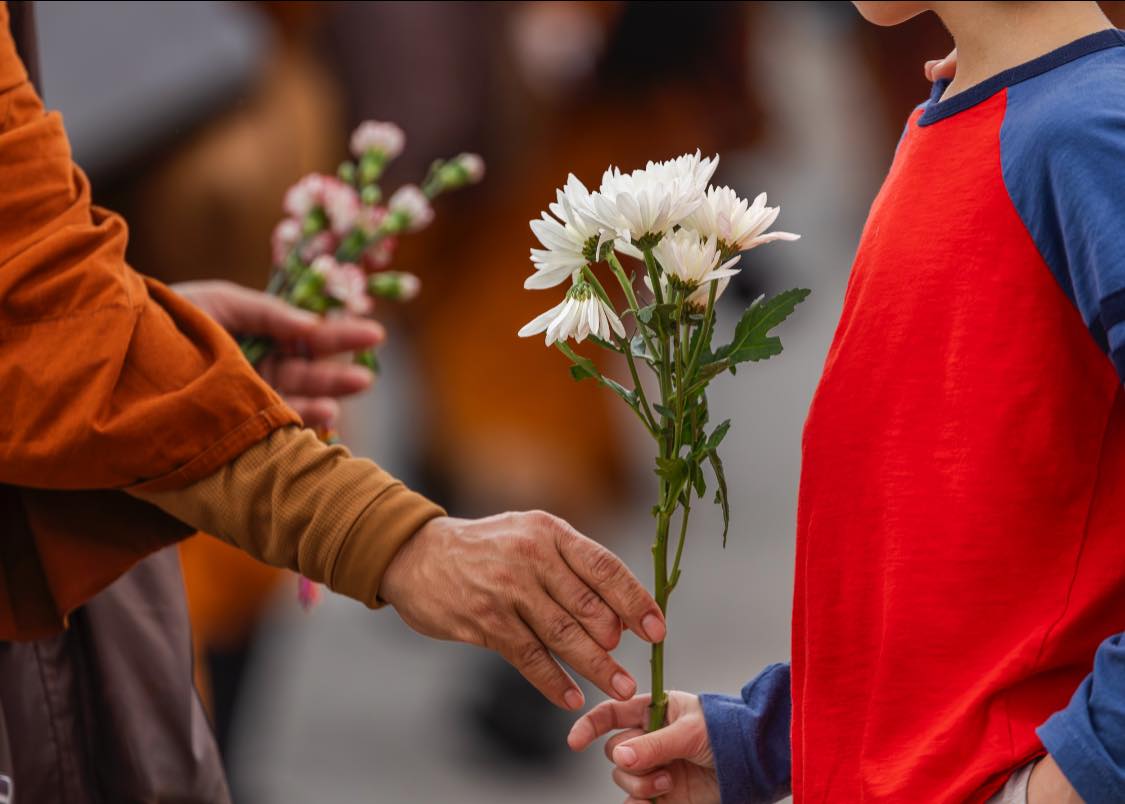
As I was reading about the monks, I saw that the only gift they “allow” in their walk is the gift of flowers.  Later I learned that they receive these flowers as gifts, but then they gift those flowers to people along their walk.  Conceivably, those flowers could be changing hands with people who do not agree on political issues, but who can pass along flowers to one another in gestures of peace. 

This coming Sunday, our church will be honoring Martin Luther King, Jr.’s feast day.  This year, our clergy will be reading excerpts from one of his sermons.  As clergy, we have been amazed at how, decades later, King’s words still resonate powerfully with what feels like problems unique to our generation.  I wonder if his words can be a conduit like those flowers that might pass peace and understanding and grace and love to our community and beyond.  I invite you to consider what conduits might be in your path today, or what conduits you might offer to begin slow, steady change.


[i] https://www.facebook.com/walkforpeaceusa/

[ii] Shireen Korkzan, “Thousands join Episcopal Church vigil to lament violent immigration enforcement actions, unite in pursuing justice,” January 14, 2026, as found at https://episcopalnewsservice.org/2026/01/14/thousands-join-episcopal-church-vigil-to-lament-violent-immigration-enforcement-unite-in-pursuing-justice/

Sermon – Luke 2.1-20, CE, YA, December 24, 2025

07 Wednesday Jan 2026

Posted by jandrewsweckerly in Sermons

≈ Leave a comment

Tags

anxiety, carol, Christmas Eve, church, clarity, God, grace, humanity, Jesus, love, noise, Sermon, silent, Silent Night, stress, truth

Ten Christmases ago – my very first Christmas at Hickory Neck – we gathered near midnight in the Historic Chapel, mesmerized by the flickering of candlelight and eager to experience our first Christmas together.  It started out as an idyllic night.  And then, right as I began my sermon, a car alarm went off.  Now I am a consummate professional, so I kept going.  But I noticed how, after the alarm kept beeping and beeping, one parishioner at a time snuck out of the church to ensure the beeping was not coming from their car.  I swear that beeping went on for 5 minutes before we found the right clicker to shut the noise down.  Recovering, we moved forward with the service, overcoming other minor hiccups as I figured out how to best celebrate in the beautiful space by candlelight.  And then, right as we proclaimed the dismissal, we heard the blaring roar of fire trucks right outside the church.  We all looked confused as there was not fire in the space where we were worshiping.  We later learned that one of the candles got a little too smokey and the fire station down the hill had been silently alerted.  We were able to send them back to the station, but the night was anything but a Silent Night at Hickory Neck.

I have always found the fact that we sing Silent Night on Christmas Eve to be a humorous contradiction.  Nothing about the night of Jesus’ birth was silent.  His parents entered Bethlehem amidst the chaos of the census, where they finally found space in an inn among the animals.  I do not know how much you have been around animals, but they are not particularly silent – even while sleeping.  Then there is the act of giving birth.  I know Mary is the Blessed Mother, but I do not know of any woman who is silent in childbirth – let alone a newborn who is silent after the trauma of entering the world.  And although the shepherds keeping watch over their flocks by night might have been enjoying some relative quiet, those angels sure are not quiet.  I am pretty sure a multitude of the heavenly host praising God is really loud. 

So, what inspired the author of hymn Silent Night?  Well, we’ve cobbled together a bit about the formation of the hymn.  “Joseph Mohr worked as a country priest serving a small village in present-day Austria.  His father had abandoned the family prior to his birth, and Joseph relied on the encouragement and support of the local church for his education.  He was active in the choir, learned violin and guitar, and went on to seminary and full-time ministry.  While a parish priest, Joseph penned Silent Night and asked his friend, a local schoolmaster, to compose the melody for a Christmas Eve service.”[i]  Varying sources say he wrote the words while walking in the quiet snow-covered town, and that the night of Christmas Eve that year in 1818, the organ had broken, so the organist, Franz Gruber, figured out how to play the tune on the guitar.[ii]  There was something magical about the carol, though, because Joseph Mohr’s hymn spread around the world over time, being translated into over 300 languages.

But perhaps the most famous thing about the song happened almost 100 years later amid brutal trench war in World War I.  On December 24, 1914, “…as Christmas Eve night drew in, British soldiers watched in surprise as German troops began to place makeshift Christmas trees on the ridge of the German trenches.  Soon after enemy soldiers waved to each other and shouted Christmas greetings.  Then a few German soldiers came gingerly over the top of the trenches to retrieve their dead and wounded comrades from the battlefield.  British soldiers followed their example, until ‘No Man’s Land’ was cleared of the dead and dying.  Although the pause in fighting had brought a welcome sense of calm, both sides were still divided.  Then through the cold, starry night a German soldier began to sing ‘Stille Nacht,’ [or Silent Night].  What followed was both sides singing more well- known carols, some sung at the same time in both German and English.  Then soldiers ventured over the top of the trenches again, this time to exchange smiles, show photographs of loved ones, and even play football together.”[iii] 

As I have been thinking about the well-loved, seemingly universally healing and appealing carol of Silent Night, despite the obvious contrast in that actual, quite noisy night and the night described in the carol, I have begun to wonder what we mean by the word “silent.”  I wonder if instead of the absence of noise, we might mean a sense of hyperfocus.  When Mohr composed about that silent night, I wonder if he meant the silence that only comes with profound clarity where the world truly seems to stop as truth is revealed to you.  One can image how time seems to freeze, the distractions of crying children, or noisy uncles, or cranky pets suddenly mute, as profound truth makes sense for us.  On that snowy night in the World War I trenches, the profound truth was in the humanity of the formerly faceless enemy.  On that night in Bethlehem, the profound truth was that a Savior was born – not a generic savior but a savior born “to you,” the text tells the lowly shepherds.  On that night for that parish priest, with a broken organ on the biggest night of the Church year, the profound truth was “…not just a baby in a manger, but love’s pure light, …[where] we too can encounter God’s redeeming grace.”[iv]            

That is the church’s gift to you tonight too.  I cannot take away the noise of children (or adults who act like children), or the noise of anxiety and stress, or even the noise of seemingly unending political strife.  But the church can offer you the silence that comes from the truth of love’s pure light, radiant beams, and God’s redeeming grace.  Even if the noise only momentarily fades into nothing, in that silence the incarnate God whispers to you the only gift you need tonight – love’s pure light, radiant beams, and redeeming grace.  God gifts you with the grounding truth of this night, so that on all the other nights, all the other hours, all the other minutes, you have the silent night to help you brave the noise.  Amen.


[i] David Chavez, “Advent Devotional,” as found at https://www.cslewisinstitute.org/christmas-carol-silent-night/ on December 23, 2025.

[ii] “A Weary World Rejoices.  Silent Night: God’s Inadvertent Ways” St. Luke’s UMC, December 24, 2020, as found at chrome-extension://efaidnbmnnnibpcajpcglclefindmkaj/https://www.stlukesumc.com/GetFile.ashx?guid=f669184e-bb9b-4641-a7a9-e75da96a5d4a on December 23, 2025.

[iii] “Silent Night:  A Reflection,” as found at chrome-extension://efaidnbmnnnibpcajpcglclefindmkaj/https://missio.org.uk/wp-content/uploads/2018/11/Silent-Night-a-reflection-notes.pdf on December 23, 2025.

[iv] Chavez.

On the Myth and Magic of Advent…

10 Wednesday Dec 2025

Posted by jandrewsweckerly in reflection

≈ 1 Comment

Tags

Advent, busy, Christ, Christmas, God, Jesus, life, love, productive, quiet, sacred, schedule, spiritual, stillness

Photo credit: https://christchurchofaustin.org/announcement2/

As a pastor, I am constantly preaching about savoring the quiet anticipation of Advent.  We even offer Advent Lessons and Carols, which has a more contemplative note than its celebratory sibling, Christmas Lessons and Carols.  But in everyday life, I am just as vulnerable as anyone else to the secular chaos in which Advent lives.  I find myself running kids around to obligations and performances, juggling calendar conflicts with all the special holiday offerings, and even add commitments myself because I want to maintain annual traditions.  Nothing about life outside of church feels quiet and centered.

I think is why I was so grateful for the gift of a minimally scheduled Saturday this past weekend.  Both professionally and personally the calendar was mostly clear – I even reserved the TV for watching a basketball game which I rarely can do.  As my daughter and I settled in, she proposed doing a puzzle together – an activity we always say we’ll do but somehow never get around to doing.  And so evolved an afternoon of sports watching, puzzle assembling, and the kind of conversation that can only happen when you make unstructured space for it.  When I got to close of the day, I realized that while a part of me felt guilty for not being particularly “productive” (no catching up on work, no doing household chores, no addressing Christmas cards), I marveled at how spiritually and emotionally productive the day felt with my daughter.

I know finding even moments of quiet anticipation in Advent can feel impossible these days.  There are so many things vying for our attention – many of them quite good and important.  But I wonder if you might be able to carve out some unscheduled time in these weeks left of Advent.  They may have to be in the car on your way to something, or while walking on the treadmill, or saying goodnight to the children.  Maybe it means making your way to church even if you have other invitations. Whenever you can find that sacred space, I promise the life and love of Christ is waiting for you in the stillness.  God is already there.  You are invited to say hello.

Sermon – Luke 23.33-43, P29, YC, November 23, 2025

03 Wednesday Dec 2025

Posted by jandrewsweckerly in Sermons

≈ Leave a comment

Tags

Christ the King, fatigue, forgiveness, God, hope, Jesus, king, kingdom of God, light, love, Messiah, Sermon, tired

Today I have a confession.  I am tired.  After watching the debacle of the longest ever government shutdown, only to jump into the next political scandal, struggling to understand how vastly different the kingdom of God is from the kingdom of man, I find myself not emboldened, but just tired.  Now, as person of faith, I am always looking for hope.  In fact, even this week, your Vestry and I spent time taking a step back and looking at all the goodness happening in this place – the signs of vitality and vibrancy, the things that are bringing us joy, moments and ministries that are giving us life.  But I confess, even with all that energy and goodness to celebrate, one look back out into the world, and my spirit is dampened and I am just…tired.

As I turned to our gospel lesson for today, I was hoping for some bit of encouragement – some promise that everything would be okay.  Knowing today is Christ the King Sunday, the last Sunday in the liturgical year whose text should bring into focus the point of a year of journeying with Christ, I had hoped that there would be some sort of rallying text that would invigorate me and shake me out of my exhaustion.  But instead, on this day when we honor Christ our King, what is the image we are given?  A beaten, humiliated, ridiculed, discredited, shameful shell of a man, hanging on a cross, defeated in approaching death.  We do not get Christ risen from the grave today – the ultimate Easter message.  No, today we get Good Friday – our hoped-for Messiah, seemingly defeated on the cross.  Of course, he dies with great dignity, forgiving sinners until the very end, welcoming the repentant even on their last breath, resisting every urge strike back or at least refute the charges against him.  He dies with dignity, but he dies nonetheless.

I have often thought it is strange how the cross, and not the empty tomb is our primary Christian symbol.  That we use an instrument of death as our sign for victory is rather odd.  But today we do not just honor Christ’s death on the cross; we honor how he died on the cross.  Even in death Christ our King managed to love his neighbor – even the really bad neighbors.  Even in death, Christ managed to love God – inviting God to forgive even the most hateful behavior.  Even on the cross, Jesus never loses his focus.  Jesus never gets tired.

Just like the kingdom of God is different, so is the king of God.  The people of God never really had a king until they reached the Promised Land.  They saw the neighboring countries with their armies and their admirable kings, and they wanted one for themselves.  That was their first mistake.  God granted them a king to rule over them, but inevitably, the kings, like any humans, were flawed – some more than others.  Hence, there are four books in the Hebrew Scriptures about the kings who ruled and the judges who tried to correct their behavior.  Most of the kings were corrupted by power, money, and greed.  Many abused the people.  Even the most revered king, King David, was a bit of a mess.  But Jesus is not like foreign kings or the kings of Israel.  Jesus’ kingship is different.  He loves the poor and cares for the sick, he sees through the pretenses of the temple and calls for authenticity, he loves deeply and forgives infinitely.[i]  And he never tires of being this kind of king.

For most of us, looking to Jesus as an example of how to rally out of our fatigue and weariness may feel overwhelming to our tired selves.  Instead, I found looking at the repentant thief to be helpful.  You see, the thief was probably tired too.  Anyone who is a thief has been hustling long before he gets caught.  He may have even been caught several times before for more minor offenses.  His arrest this time is different.  There will be no escape.  He will hang on that cross until he dies.  With the cruelty of the cross, and the pain of his body, also shining forth is an overwhelming sense of fatigue.  He too is tired.  Tired of running, tired of hustling, tired of the life that leads one to become a thief.  But even in his deep fatigue, he does something extraordinary.  When the other thief taunts Jesus, the repentant thief lets the other thief have it.  Hanging in agony, he looks outside himself, and refuses to stand for the hypocrisy of the other thief.  He decries the injustice of Jesus’ sentence, he wisely points out his own, as well as the other’s, culpability in sin, and then, without shame looks right at Jesus and asks Jesus to remember him.

Even at our most weary, tired states, when we feel like there is no hope, or when death feels ever present, Jesus invites us to keep shining our light for all to see.[ii]  Our gospel this week has people doing just that:  taking their world of hurt, pain, sadness, sorrow, defeat, seeming hopelessness, and turning toward the light.[iii]  The thief, hanging in humiliation and death, finds his light.  Jesus, defeated in the eyes of all but the thief today, keeps shining his light until the bitter end.  And Hickory Neck has them too.  Our children last Sunday and our psalm this Sunday that tell us to “Be still and know that I am God.”[iv]  Our parishioners delivering food before thanksgiving and shopping for the forgotten for Christmas.  Our members making stretch gifts to support the work of the kingdom here. 

Christ our King invites us to do likewise.  Of all people, Jesus understood being tired.  His cry out to God in prayer in the Garden of Gethsemane is a prayer of a tired man.  But Jesus stood up that night, all the way to the cross on Calvary and refused to let fatigue be an excuse for a world without love, hope, and forgiveness.  Our king may not look like other kings.  His story may be strange and full of contradictions.  But our king has the power to pull you out of darkness and drag you into the light.  But along the way, he is going to need you to shine your light too.  Amen.


[i] David Lose, “Christ the King C:  What Kind of King Do You Want?” November 14, 2016, as found at http://www.davidlose.net/2016/11/christ-the-king-c-what-kind-of-king-do-you-want/ on November 21, 2025.

[ii] Karoline Lewis, “Who and What is Your King?” November 13, 2016, as found at http://www.workingpreacher.org/craft.aspx?post=4754 on November 21, 2025.

[iii] Patrick J. Willson, “Homiletical Perspective,” Feasting on the Word, Yr. C, Vol. 4 (Louisville: Westminster John Knox Press, 2010), 337.

[iv] Psalm 46.10a.

Sermon – Luke 20.27-38, P27, YC, November 9, 2025

12 Wednesday Nov 2025

Posted by jandrewsweckerly in Sermons

≈ Leave a comment

Tags

death, earth, God, grace, heaven, Jesus, love, mercy, questions, resurrection, Sadducees, Sermon

When my oldest was about three years old, a parishioner of mine died.  At the time we were still recovering from Hurricane Sandy.  Though many of us finally had our power back, an early snow storm delivered just enough snow to knock out power in some of the local schools and mucked up roads that were already struggling to be freed from fallen trees.  My daughter’s school was cancelled, and I had anticipated just trying to stay warm at home for the day.  But when I got the call that my church member had died – I was dumbfounded.  There was no doubt in my mind that I would go join the family for prayers, but I had no idea how to incorporate my daughter into the visit.  With the weather conditions such as they were, there was no way she could stay anywhere else.  And so began a ten-minute drive during which I frantically tried to explain to my three-year old daughter what death meant, what heaven is, and what God’s role in all of this is.  Of course, I totally forgot to factor into my explanation the fact that the parishioner’s body would still be present, and how her body figured into my three-year-old-appropriate explanation of heaven.  Needless to say, that day was not one of my finest parenting or priestly moments, and I ended up fielding questions about death, heaven, and God for months.

Truthfully, I think adults have just as many questions about death, heaven, and God as young children do.  When we hear the complicated question of the Sadducees to Jesus about the woman with seven husbands, we find ourselves morbidly curious too.  What does happen to this woman in the afterlife?  Would she have wanted to be with one over another in heaven?  Her scenario makes us think of all the stories of loved ones we know – or maybe even of ourselves.  What happens to the widow who remarries in the resurrection?  What about the couple who divorces and later remarries?  Surely they will not have to be reunited with their exes!  Or what about that abusive father, that mean uncle, or that estranged sister?  Do we face them in the afterlife?  Since we do not really have anyone to give us an insider’s perspective, these are the questions that we really wonder about.  And if we have ever held the hand of a loved one approaching death, we may have asked these questions to God, to our priest, or to a friend.  So, when the Sadducees ask this question of Jesus, we perk up, hoping for some real clarity from Jesus, and secretly praying for the answer that we think is best.

The trouble with this text though is the Sadducees are not really asking Jesus a practical question about what happens in the resurrection.  In fact, the Sadducees do not even believe in the resurrection.  The Sadducees are the group of people who believe the Torah – those first five books of the Hebrew Scriptures – to be the only authorized scripture.  None of the other books that we know from scripture – the prophetic writings or the Psalms – are considered valid scripture by the Sadducees.  Because there is neither a doctrine of resurrection of the dead nor a belief in angels in the written Torah, the Sadducees refuse to believe that there is life after this earthly life.  The Pharisees, along with Jesus and his disciples, on the other hand, believe in ongoing interpretation of Torah handed down by word of mouth, and so, they have no problem with the ideas of resurrection presented in other Hebrew scriptures.[i]

This question by the Sadducees about the resurrection, therefore, is not really a question for which the Sadducees are looking for answers.  Instead, this is a question meant to both ridicule Jesus,[ii] and to trap Jesus in an impossible question.  Though we may feel some sense of camaraderie in shared curiosity, the Sadducees are not simply a curious bunch with a heartfelt question.  They are trying to manipulate Jesus and embarrass him in front of the crowd.  Luckily for us, Jesus offers an answer anyway.  The answer is not as specific as we might like, but the answer does offer hope and mercy in a roundabout way.

What Jesus basically tells the Sadducees and those gathered around him is that the resurrection is not like life here on earth.  Life after earthly life is not “Earthly Life, Part II,” where everything is the same, but better.  In the resurrection life, rules of this life – and in particular, rules that applied to Levirate marriage, like a brother taking on a widowed sister-in-law – are not the same as the rules in the afterlife.  Jesus does not explain exactly what this looks like or how this plays out, and Jesus does not fully satiate our curiosity.  But Jesus does give an answer that is full of mercy and love.  Jesus basically tells those gathered that the beauty of the resurrection is that the strictures and limitations of this life are lifted in the life to come.  Things like women being treated as property to be managed, infertility, and grief are erased in the afterlife.  Things like disappointment in marriage, pressure to be married, and even death itself are no longer present in the afterlife.  Things that define us here, limit or frustrate us, or pain us here in this life are absent in the afterlife.  Jesus will never concede to the Sadducees that resurrection life does not exist.  But Jesus does try to kindly invite the Sadducees into seeing that resurrection life is so much more than they can imagine, and so much fuller of true life than this earthly life they know.  Jesus does not answer their question fully, but Jesus does say that the Creator God of Torah is still revealing truth, and that the truth is full of mercy, grace, and love.

I am reminded of the scene from the movie The Matrix where the main character, Neo, goes to visit a woman called the Oracle to find out if he is “the one,” a messiah-like figure to save the world.  Neo goes to the Oracle with a clear-cut question, “Am I the One?”  The conversation that ensues is complex and layered with meaning.  She seems to be telling Neo he is not the one, but we later learn in the movie that she was actually telling him that he is not the one if he will not claim his status as the One.  The scene is as complicated as my rudimentary attempts to explain the scene.  But what the scene reminds me of is our conversations with God about ultimate things.  We often come to God with basic questions and concerns that are rarely answered directly.  But that does not mean we do not get an answer.  In the end, the answer is loving, full of compassion, and ultimately full of truth when we are ready to understand and interpret that truth.

This is all that Jesus can offer us today.  Jesus is not offering an exclusive interview to a top news source to tell us everything we want to know about resurrection life.  We will not be able to watch with bated breath as Jesus answers every question we want answered.  Instead, Jesus offers us a promise to take home.  His promise is that we have resurrection life beyond this earthly life.  His promise is that resurrection life is not some two-dimensional repeat of this life, with the limited happiness we can find here, but instead is a three-dimensional life beyond our knowing because of our limited earthly experience.  His promise is that God is ever revealing truth to us, showing us the most important truth:  that God loves us, shows us exquisite mercy, and offers us unfailing grace.  Jesus’ words today may not be the 60-Minute special we were hoping for, but Jesus’ words today give us something to hold on to in the midst of this crazy, chaotic world that is our earthly home.  Hold fast to the Lord who loves you, shows you exquisite mercy, and offers you unfailing grace.  Amen.


[i] Vernon K. Robbins, “Exegetical Perspective,” Feasting on the Word, Yr. C, vol. 4 (Louisville: Westminster John Knox Press, 2010), 285.

[ii] Eberhard Busch, “Theological Perspective,” Feasting on the Word, Yr. C, vol. 4 (Louisville: Westminster John Knox Press, 2010), 286

Sermon – Luke 6.20-31, AS, YC, November 2, 2025

05 Wednesday Nov 2025

Posted by jandrewsweckerly in Sermons

≈ Leave a comment

Tags

All Saints Sunday, Beatitudes, compassion, faithful, fragrance, God, Golden Rule, Jesus, justice, love, saint, scent, sensory, Sermon, witness

On the blog this week, I shared about friends of ours who are fragrance aficionados.  When we spend time together, we’ve taken to doing fragrance samplings with them – sort of like wine tastings, but with the focus on the sense of smell.  Invariably, I find a new fragrance I like that I had never heard of, but that brings me a sense of playful joy.  This past week I was sharing one of those fragrances with one of our daughters and she said, “It’s okay, but I prefer your ‘Mom smell.’”  While I wish there was a more attractive label to that particular fragrance, and while I suspect that “Mom smell” is some combination of the scents of my soap, hair products, and laundry detergent, I get what my daughter meant.  Just like fragrances can evoke memories of special places, fragrances can also recall to us people in our lives.  One whiff, and we are transported to another time and place, remembering what someone meant to us.

On this All Saints Sunday, we engage in a similar kind of sensory recalling.  In our case at Hickory Neck, instead of the sense of smell, we invoke the sense of touch – the feel of smooth or ridged ribbons running through our fingers as we tie them to the altar rail in memory of a saint of God, the feel of droplets of water landing on our heads and bodies as we recall our baptismal identity and the baptisms of saints who have died, and the feel of the wafer in our hands and mouth or the feel of the priest’s thumb as they rub a blessing on our forehead, as we engage in the earthly banquet, reminiscent of the heavenly banquet our loved ones are enjoying.

But just like scents have the power to remind us of beloved memories, so scents can remind us of painful memories.  While some of us may have a “Mom scent” we recall with love and affection or wistful memory, others of us didn’t have such beloved memories or experiences – and unfortunately, smells can recall those memories too.  As I was reading Luke’s gospel for today, that’s where I landed – that all of us – all of us saints of God – have the opportunity to live lives of good or ill – to leave behind fragrances that help or harm.  And since Luke’s language is entirely literal and not at all the flowery, spiritual language of Matthew’s beatitudes[i], we are very clear on Jesus’ words and meaning.  The blessings and woes of Luke’s beatitudes are straightforward and simple.  As one scholar puts it, “If you want anything to do with Jesus or the God who sent him, Luke says, you had better go find the poor, the hungry, the captives, the blind, and the outcast, and join Jesus, as Jesus cares for them.  The way we know who Jesus is, is to go where Jesus is, with the poor, the hungry, and the oppressed.”[ii]

While All Saints Sunday can take us to place of remembering loved ones and the saints of the church, tempting us to get lost in those memories, what All Saints Sunday ultimately hopes to impart is that the lives we live matter.  We remember the saints of the church and the lives of our loved ones we miss because they showed us what living lives that matter looked like.  We do not honor them because they were rich or well fed or joyful or respected.  We honor them because they loved their enemies, they did good to those who hated them, they blessed those who cursed them, and prayed for those who hurt them.  We honor them because they were nonviolent, because they gave sacrificially of their wealth, because they understood that poverty makes people desperate – and because they did to others as they would have them do to them.

We could easily leave here today with the commission to “go and do likewise,” as if Jesus’ words are a simple commission.  But nothing about what Jesus is saying is simple or easy.  Several years ago, I was talking to our children about the Golden Rule – those words we hear today about doing unto others as you would have them do unto you.  To my great shock, my children did not see the wisdom of the words at all.  Instead, their desires were rooted in a sense of justice or fairness.  “No way!” one said.  “I’ll do unto others what they do to me.”  What I had understood as simple, universal wisdom that is shared among faith traditions totally flies in the face of secular, American ideals.  Even Professor Johnson says about Luke’s text today, “It is not only greed that jeopardizes the wealthy Christian’s relationship with God, but the simple – and subtle – temptation to think we can take care of ourselves.”[iii]

Luke leaves us, then, with a challenging invitation.  As you tie on a ribbon to remember a loved one today, you can certainly recall whatever fragrance of theirs you miss.  But Luke asks you to go further – to recall the witness they left to you about living a faithful life, and be emboldened to start leaving your own faithful fragrance behind too.  Lean into those who have gone before to encourage your own witness of love, compassion, and justice.  Lean into the faithful who gather beside you in person every Sunday who struggle to live that Golden Rule with gusto instead of resentment.  Lean into Jesus, who walked before us in incarnate form, leaving behind the fragrance of incense – the fragrance of humility, compassion, and sacrificial love.  With them, you can then begin to create a signature fragrance of your own that will help draw others to God.  Amen. 


[i] Marjorie Procter-Smith, “Homiletical Perspective,” Feasting on the Word, Yr. C, Vol. 4 (Louisville:  Westminster John Knox Press, 2010), 239.

[ii] E. Elizabeth Johnson, “Exegetical Perspective,” Feasting on the Word, Yr. C, Vol. 4 (Louisville:  Westminster John Knox Press, 2010), 239.

[iii] Johnson, 241.

On the Nose…

29 Wednesday Oct 2025

Posted by jandrewsweckerly in reflection

≈ Leave a comment

Tags

broken, Christ, grace, healing, Jesus, love, perfume, recollection, scent

Photo credit: https://www.istockphoto.com/search/2/image-film?phrase=perfume+spray

We recently spent some time with friends who are fragrance aficionados.  Often when we gather, we do a fragrance sampling, noting what we smell and what it evokes – and whether we could imagine wearing the fragrance ourselves.  Our friends are great guides, teaching us tips from the industry, helping us define fragrance-specific terms, and sharing the gracious wisdom that all scent evaluations are subjective.  The sessions are always a delight, sometimes leading us to new fragrances we enjoy.

When I returned home after the visit, I asked one of my daughters whether she liked a particular fragrance I was trying.  She confessed it was nice, but said, “I just prefer your ‘Mom Smell.’”  Through our chuckles, I asked her what she meant about a “Mom Smell.”  She couldn’t quite explain it, and I can only assume she meant a combination of the soap, hair products, or laundry detergent I use.  But I knew what she meant – like scientifically devised fragrances can, any smell can evoke the essence of a person or place we know and love.  It is the gift of recollection that comes through the sense of smell.

Her insight had me wondering if all of life isn’t about leaving behind traces of our scent, unbeknownst to us.  Who had a positive experience or a blessing through me that is recalled when the smell something reminiscent of my “Mom Smell” wafts by?  Who has been in a location far from me and smelled my soap or laundry detergent and remembered something kind and generous I said or did?  We all leave traces of ourselves in this world.  I wonder what gifts you are leaving behind, unbeknownst to you.  I wonder what recollections people have of you that remind them of the grace and love of Christ himself.  I look forward to hearing about what healing scent you are trying to leave for this broken world.

Sermon – Exodus 32.7-14, P19, YC, September 14, 2025

24 Wednesday Sep 2025

Posted by jandrewsweckerly in Sermons

≈ Leave a comment

Tags

change, changelessness, God, history, idol, journey, love, Moses, relationship, Sermon

This week Hickory Neck hosted a group from St. Luke’s Episcopal Church in Powatan.  The group has been touring historic churches, gleaning lessons from each church’s stories, and asked if they could come do the same with us.  I told Hickory Neck’s story – from a newly constructed country church, to the act of siding with the British and closing altogether after the Revolutionary Way, to being a school for generations of children, to being a hospital for physical healing, to being ransacked by militias in multiple wars – where even the pulpit was used as firewood, to finally hosting a worshiping community just over 100 years ago, to now, being situated on 12 times the amount of property we originally had, hosting three buildings and a vibrant community of faith.

As I fielded questions from the group, I reflected on how as I have prayed in those wooden pews, as I have brushed my hand over those bricks with initials carved in them, and as I have stepped over a tombstone every time I enter that historic building, I find myself wondering about the stories of countless souls who have graced that building.  I know the more recent stories – of children in window wells, and people crowded around the altar for seating, and even of decisions like the one to build a new chapel so we have room to grow.  But I wonder about the stories of those who first opened the church who awaited who might show up that first Sunday of business.  I wonder about the grief experienced by those who watched their worship space become something else – or for those kids who grew up to tell tales like “when I was young, that didn’t used to be a church…”  I wonder about those who, for over 60 years never imagined anything for Hickory Neck other than being a little family-sized church, to those who worried a new building would mean the loss of intimacy the historic church provided.

As I pondered those various voices, imagined the myriad emotions of almost three hundred years experienced on this property, contemplated how those histories impacted spiritual relationships with God, I could not help but recall another group of followers of God – the Hebrews we read about in our lesson from Exodus today.  Those folks had been on a long journey too.  Their ancestor Abraham had journeyed to a foreign land and been promised countless descendants.  After his own dramatic journey, his descendants ended up in Egypt to escape a time of famine.  The rescuing by his son Joseph evolved into slavery under a new pharaoh.  After deaths and suffering, a reluctant prophet, Moses was sent.  Then came plagues, a mass exodus, a chase that led to drowning of the enemy, and a long journey in the wilderness.  But despite centuries of God’s faithfulness, the people lose their hope again and cling to something tangible – an idol – to soothe their anxiety. 

Now the part of that story we get today is interesting – I mean, who doesn’t have questions about the idea of God changing God’s mind, of God being so enraged by the infidelity of God’s people that God would destroy them entirely, of Moses slyly arguing with God, reminding God of how appearances matter (Does God want the Egyptians to see God destroy the very people God liberated?), of how God’s action of rage would negate the promise God made to Abraham, of whose people the Hebrews are (with God and Moses sounding like two arguing parents – your people have sinned…I think you mean your people with whom you made a covenant!). 

But what is more interesting to me is the greater arc.  Reading Genesis and Exodus is like reading a soap opera.  Journeys and betrayals, covenants and falls from grace, destruction and rebuilding, promises made and promises broken.  In the greater arc of that saga is a truth:  God’s faithfulness.  Over and over and over again, God’s faithfulness wins the day.  Theologians have read this passage from Exodus, and become anxious about the implications of a God that can change God’s mind.  If God’s mind can change, does that somehow make what we know about God inconsistent?  Danish Christian philosopher Søren Kierkegaard addresses this very issue.  Kierkegaard describes God as, “You Changeless One … You who are changeless in love, who just for our own good do not let yourself change.”[i]  In other words, “To say that God can be changed is not to suggest that God’s love for the world can be changed, but simply to say that there is no part of the world, no matter how meaningless to us, that is not of importance to God.”[ii]

As I think about the chaos of these days – of the unchecked shootings of children, political activists, and everyday people doing everyday things; of the demonizing of anyone who does not think like we do; of the disregard for the dignity of other human beings – I can empathize with a sinful people who would make an idol to have some tangible sense of comfort.  But this week, as I thought about the soap opera of our ancestors in Genesis and Exodus, and as I imagined the varied journey of our ancestors at Hickory Neck, I found myself overwhelmed with the faithfulness of our God – of the Changeless One who is changeless in love.    

I do not know what part of the world’s chaos is tugging at your anxiety or your temptation to craft an idol – perhaps an idol of money, power, popularity, and fame.[iii]  Whatever that force that is tugging at you, pastor Catherine Young reminds us that the interaction between Moses and God today is an invitation to remember that, “We can converse – even argue – with God.  The irony-filled dialogue between Moses and God shows that God has a sense of humor and appreciates ours.  More than our piety, God wants our honesty and candor.  God calls us to talk, listen, wrestle with our emotions, and be honest about our problems.  Those direct interactions change us…and sometimes they even change the mind of God!”[iv]  What they do not change though is God’s changelessness – God’s changeless love for God’s people in ancient days, in American history, and in our own day.  You Changeless One … You who are changeless in love, who just for our own good do not let yourself change.  Amen.


[i] Søren Kierkegaard “The Changelessness of God,” found in the collection of Kierkegaard writings, The Moment and Late Writings, eds. Howard V. Hong and Edna H. Hong, Princeton University Press, 1998, p. 268.

[ii] Michael Fitzpatrick, “The Lord’s Mind was Changed,” September 4, 2022, as found at https://journeywithjesus.net/essays/3442-the-lord-s-mind-was-changed on September 12, 2025.

[iii] Catherine E. Young, “Pastoral Perspective,” Feasting on the Word, Yr. C, Supplemental Essays (Louisville:  Westminster John Knox Press, 2010), 3.

[iv] Young, 5.

← Older posts

Recent Posts

  • On Sharing the Love…
  • Sermon – Micah 6.1-8, Matthew 5.1-12, EP4, YA, January 30, 2026
  • On Justice, Kindness, Humility, and the Messy Middle…
  • Feast of the Rev. Dr. Martin Luther King, Jr., January 18, 2026
  • On Peace, Love, and Conduits…

Archives

  • February 2026
  • January 2026
  • December 2025
  • November 2025
  • October 2025
  • September 2025
  • August 2025
  • July 2025
  • June 2025
  • March 2025
  • February 2025
  • December 2024
  • November 2024
  • October 2024
  • September 2024
  • August 2024
  • July 2024
  • June 2024
  • May 2024
  • March 2024
  • February 2024
  • January 2024
  • December 2023
  • November 2023
  • October 2023
  • September 2023
  • August 2023
  • July 2023
  • June 2023
  • May 2023
  • March 2023
  • February 2023
  • January 2023
  • December 2022
  • November 2022
  • October 2022
  • June 2022
  • May 2022
  • January 2022
  • December 2021
  • November 2021
  • October 2021
  • September 2021
  • August 2021
  • June 2021
  • May 2021
  • April 2021
  • March 2021
  • February 2021
  • January 2021
  • December 2020
  • November 2020
  • October 2020
  • September 2020
  • August 2020
  • July 2020
  • June 2020
  • May 2020
  • April 2020
  • March 2020
  • February 2020
  • January 2020
  • December 2019
  • November 2019
  • October 2019
  • September 2019
  • August 2019
  • July 2019
  • June 2019
  • May 2019
  • April 2019
  • March 2019
  • February 2019
  • January 2019
  • December 2018
  • November 2018
  • October 2018
  • September 2018
  • August 2018
  • July 2018
  • June 2018
  • May 2018
  • April 2018
  • March 2018
  • February 2018
  • January 2018
  • December 2017
  • November 2017
  • October 2017
  • September 2017
  • August 2017
  • July 2017
  • June 2017
  • May 2017
  • April 2017
  • March 2017
  • February 2017
  • January 2017
  • December 2016
  • November 2016
  • October 2016
  • September 2016
  • August 2016
  • July 2016
  • June 2016
  • May 2016
  • April 2016
  • March 2016
  • February 2016
  • January 2016
  • December 2015
  • November 2015
  • October 2015
  • September 2015
  • August 2015
  • July 2015
  • June 2015
  • May 2015
  • April 2015
  • March 2015
  • February 2015
  • January 2015
  • December 2014
  • November 2014
  • October 2014
  • September 2014
  • August 2014
  • July 2014
  • June 2014
  • April 2014
  • March 2014
  • February 2014
  • January 2014
  • December 2013
  • November 2013
  • October 2013
  • September 2013
  • August 2013
  • July 2013
  • June 2013
  • May 2013
  • April 2013
  • March 2013
  • February 2013
  • January 2013
  • December 2012
  • November 2012
  • October 2012
  • September 2012

Categories

  • reflection
  • Sermons
  • Uncategorized

Meta

  • Create account
  • Log in
  • Entries feed
  • Comments feed
  • WordPress.com

Blog at WordPress.com.

  • Subscribe Subscribed
    • Seeking and Serving
    • Join 395 other subscribers
    • Already have a WordPress.com account? Log in now.
    • Seeking and Serving
    • Subscribe Subscribed
    • Sign up
    • Log in
    • Report this content
    • View site in Reader
    • Manage subscriptions
    • Collapse this bar
 

Loading Comments...