
• About

Seeking and Serving

~ seek and serve Christ in all persons

Seeking and Serving

Tag Archives: parent

Sermon – Mark 1.21-28, E4, YB, February 1, 2015

03 Tuesday Feb 2015

Posted by jandrewsweckerly in Uncategorized

≈ Leave a comment

Tags

change, control, expectations, God, healing, Jesus, parent, struggle, trust, unclean spirit

I have often joked that of all the people in the world who needed to become a parent, I was one of them.  I say this because I am a person who likes routine and order.  I like things done a certain way, and prefer to have a sense of control over things.  Of course, this is one of those areas in life with which God and I often struggle.  Jesus even teaches about the need to let go of control and trust God.  Whenever I read that passage I nod in assent, remembering the many times God has proven God’s self to be trustworthy.  I put up my hands in defeat, and try to trust God.  And then about 48 hours later, I am sneaking back to grab the reins again.

That is why parenthood has been so good for me.  Parenthood challenges this weakness over and over again.  My eldest is at the age where she wants to do things herself.  This is a good and natural development.  But for someone who likes a sense of control, this good and natural development can be maddening.  I cannot count the number of times I have had to literally bite my tongue instead of jumping in with some explanation about a better way to do a task.  I cannot count the number of times I have had to clinch my hands to prevent myself from just taking over a task, so that the task would be done the correct, and often faster, way.  Sometimes I wonder whether God is chuckling to God’s self when God sees me fumbling through this reality with my children over and over again.

The people who had gathered at the synagogue in Mark’s gospel lesson today have a similar experience.  They are not unlike most of us here.  Every week they go to temple, following the same pattern of worship, expecting the same experiences.  There is a certain comfort for them knowing what to expect.  They have learned to watch how the scribes debate and have a dialogue about the traditions.[i]  This is how they learn and decipher truth and is a natural part of their weekly experience at temple.  But today is different.  Today there is a new teacher in synagogue, and he is doing things all wrong.  His teaching style is more declarative than deliberative.[ii]  For some reason he teaches with tremendous authority, as if he really is sure of what God would say or think about certain things.  Jesus is not following the rules, and those gathered at the temple have no idea what to make of him.  He even is able to exorcise an unclean spirit out one of the worshippers who is present.  They had not even realized the man had an unclean spirit, and here Jesus is, casting the spirit out.  How did he know?  Where did Jesus get the idea that he had the power to do such a thing?

If ever we doubted that we come from a long line of faithful Jews, today is the day we realize how closely related we are.  I cannot count the number of times I have heard this same conversation at Church.  Why did the priest use that prayer today?  We never use that prayer.  Why did the Vestry make that decision?  We never used to do things that way.  Why did the Activities Committee change that event?  We never do the event that way.  I have sat in many a meeting discussing a change or a new way of doing something and invariably someone will say, “If we change this someone might get upset.”  After many years of experience, my response has finally become, “When we change this, someone will definitely be upset.”  That statement may sound obvious or maybe even sound judgmental or harsh.  But what I have come to find is that expecting that change is unsettling and makes people upset actually makes the wave of resistance to that change not a frustrating thing, but a happily expected reaction.  In fact, a wise old priest once told me, “If you are not upsetting people, you are not doing your job.”

Just the other day, my oldest daughter and I were making scrambled eggs.  She was fumbling through breaking the eggs.  I must have picked out two or three shell pieces that day.  Then she was stirring the eggs so haphazardly, my tongue started hurting again.  My clenched hands had to strain to stay at my sides to avoid “just taking over this one part.”  We all do it – and not just with children.  We think we know a better way to accomplish a task, so instead of inviting someone to help us, we do the work on our own.  We know the historical way something has been done and we forcefully teach a volunteer that way instead of hearing their idea of how to do something differently.  Instead of a shared, collaborative ministry, we take over a task ourselves because we can get the task done faster and more efficiently if we do not have to sit around a talk about the many options available.

But you know what happened when I bit my tongue and pinned my hands to my sides that day?  The eggs tasted just as good as they always do.  Though I could have had a stress-free cooking process otherwise, you know what else happened?  My daughter had a big, proud smile on her face when we devoured those yummy scrambled eggs.  I have seen the same thing happen here at St. Margaret’s.  When I started team teaching with other adults, we gained some tremendous and transformative teaching material.  When we let some excited volunteers start a community garden, we not only fed the hungry in our neighborhood, we also made some new friends by letting our neighbors, AHRC, help water the garden.  When we revamped our family Christmas Eve service, we found that the service attracted new people, and in fact has become more popular than our once favored midnight mass.

I have been thinking this week about that man with the unclean spirit in today’s gospel.  The funny thing is that no one seemed to notice the man beforehand.[iii]  Had the leaders of worship and learning been in control that day, the man might have come to temple and left temple equally tortured.  He may have come hoping someone would notice his pain and suffering and left realizing that no one could really appreciate the depths of his struggle.  But because Jesus is there, teaching in a way that only the Holy One of God can, the unclean spirit reveals himself, and is cast out by Jesus.  Had Jesus not been there, doing things the “wrong” way, the poor afflicted man may have never been cleansed and given new life.

I wonder what ways we are not like the scribes and those gathered at the temple.  I wonder how our way of insisting on the familiar blocks us from seeing unmet needs.  I wonder how our reliance on ourselves and our guarding of control forbids new life from breaking in and shining new light into our community.  Today we will pray the Litany for Healing.  Every month we make space for people to come forward for healing prayers.  Most of us come forward for some physical ailment we are facing or for healing prayers for a loved one.  But our healing prayers do not just have to be prayers for the healing of our bodies.  They can also be prayers for healing our spirits.  If an unclean spirit has taken over you – like a spirit of control or manipulation – perhaps today is the day you ask God to release that spirit from you.  Or perhaps you have lost a sense of joy or connection.  God can heal that brokenness today too.  Or perhaps you know that you need God’s healing, but you cannot articulate the brokenness, even to yourself.  Our healing prayers can be for you too.  Much like Jesus could see the unclean spirit when others could not, my guess is that Jesus knows what is troubling your heart today too – even if you cannot articulate that pain yourself.  And much like that day at the temple, albeit in a way that was unusual, uncomfortable, and unexpected, Jesus can work in you, casting out the darkness and blasting through with light.  Amen.

[i] Matt Skinner, “Commentary on Mark 1.21-28,” as found at http://www.workingpreacher.org/preaching.aspx?commentary_id=2343 on January 28, 2015.

[ii] Skinner.

[iii] Ofelia Ortega, “Theological Perspective,” Feasting on the Word, Yr. B, Vol. 1 (Louisville: Westminster John Knox Press, 2008), 310.

Sermon – Jonah 3.1-5, 10, E3, YB, January 25, 2015

28 Wednesday Jan 2015

Posted by jandrewsweckerly in Uncategorized

≈ Leave a comment

Tags

children, disciples, God, goody two-shoes, grace, invitation, Jesus, Jonah, mercy, Nineveh, parent, rebel, response, role, work

Whenever a family has two children, often the children fall into two stereotypes – the goody two-shoes and the rebel.  The goody two-shoes generally follows the rules, rarely gets in trouble, and usually does what they are asked to do.  The rebel on the other hand makes their own rules, is regularly in trouble, and rarely does what they are asked to do.  The goody two-shoes conforms to expectations and the rebel blazes their own trail.  Many a harried parent has said to their rebel child, “Why can’t you just be more like goody two-shoes?!?”

Today, our scripture gives us not just one set, but two sets of such siblings.  First we have Jonah in our Old Testament lesson and the disciples in our gospel lesson.  When Jesus calls out to the disciples who are fishing and tells them to follow him, all four disciples drop their nets, abandon their family and livelihoods, and follow Jesus.  They do not ask questions.  They do not take a moment to consider the invitation and carefully discern whether to go.  They do not even complain.  They immediately drop what they are doing and follow Jesus.  The disciples are our goody two-shoes today.  The rebel, then, is Jonah.  If you remember, God came to Jonah early on and told Jonah to go to Nineveh.  And while Jonah did respond immediately, his response was to run in the complete opposite direction.  He runs the opposite direction, hops on a boat, and makes his escape.  Of course we know how that turns out.  Jonah is tossed overboard when the seas get out of control, and he is swallowed by a large fish.  Even in our lesson today, when God tells Jonah a second time to go to Nineveh, we can tell Jonah’s heart is not in the work.  Later we find out that when God forgives Nineveh, Jonah rebels again, throwing a temper tantrum of epic proportions, proclaiming that he wish he could die he is so upset.  Jonah is our rebel today.[i]

Our second set of siblings is found in the Jonah story itself.  We know that Jonah has already rebelled and taken to the seas to escape the job he is supposed to do.  But look at how he does execute his work.  When he finally does proclaim the judgment on Nineveh, he only says five words in Hebrew, translated, “Forty days more, and Nineveh shall be overthrown!”  Jonah is a grumbling, half-hearted rebel of the Lord.  Meanwhile, Nineveh proves to be our goody two-shoes this time.  This is the most surprising turn of events too.  Nineveh is a brutal power in Jonah’s day.[ii]  They are known for their vicious treatment of the people of Israel.  They are the enemy.  But when the residents of Nineveh hear the judgment of the LORD – Jonah’s brief, half-hearted one – they immediately respond.[iii]  All the people put on sackcloth, even the king and the animals; they take up a fast, sit in ashes, and turn from their violent ways.  Talk about a 180!  And what makes the situation all the more ironic is that Nineveh, the city we might normally label as the rebel in this story, actually comes out as the goody two-shoes; and Jonah, the prophet of God, who should be the goody two-shoes turns out to be our rebel.

In our world, we know what happens to these two archetypes.  The goody two-shoes are ones who get straight A’s, have successful careers, have happy relationships, and lead stable, content lives.  They are held up as the shining examples for all of us.  The rebels, on the other hand, are the ones who get sent to the principal’s office, have spotty employment, are in and out of relationships, and are known for their instability.  Though the rebels may be fun to be around, they are not as dependable as the goody two-shoes.  And for those of us who are rebels, we are told time and time again to get our act together.  In our world, society is quite clear about which role we should choose.

The good news is that God is not like the rest of the world.  God has enough room for everyone.  God invites everyone: rebels like violent Nineveh and Jonah, and goody two-shoes like the disciples and the reformed Nineveh.  God encourages both and God gives second (and third and fourth) chances to both.  God’s mercy is so abundant that God is willing to totally change God’s mind.  Like the old hymn goes, “There’s a wideness in God’s mercy like the wideness of the sea; there’s a kindness in his justice, which is more than liberty.”  The grace in our stories today gives us hope that those uptight goody two-shoes and those restless rebels among us both have a chance in God’s eye.

But the good news today is not just easy news.  The good news comes with work too.  God has mercy for both Nineveh and Jonah, but God does not let either off the hook.  God saves Jonah from the perilous sea and the big fish.  But then God puts Jonah back to work.  God does not destroy Nineveh, but only when Nineveh turns from its evil ways.  God is much like the parent who loves their children equally – both the goody two-shoes and the rebels.  But part of that equal love is also an equal expectation that we all respond to God’s invitation.  We may all respond differently, but God will not rest until we respond.  The question today is what invitation from God have we been avoiding, and how might we take up God’s invitation anew?  God is waiting for our response.  Amen.

[i] Kathryn Schifferdecker, “Commentary on Jonah 3.1-5, 10” found on January 22, 2015 at http://www.workingpreacher.org/preaching.aspx?commentary_id=2347.

[ii] Callie Plunket-Brewton, “Commentary on Jonah 3.1-5, 10” January 21, 2012, found at http://www.workingpreacher.org/preaching.aspx?commentary_id=1214 on January 22, 2015.

[iii] Joseph L. Price, “Theological Perspective,” Feasting on the Word, Yr. B, Vol. 1 (Louisville: Westminster John Knox Press, 2008), 270.

A season…

09 Wednesday Jul 2014

Posted by jandrewsweckerly in Uncategorized

≈ Leave a comment

Tags

breathe, child, Ecclesiastes, God, joy, parent, purpose, season

I was talking to another parent recently about the different phases of childhood.  We both have children who are about five years old, but I also have an infant.  She confessed that having been through the development of her five year old, she could not imagine starting over with all that a baby entails – the diapers, bottles, interrupted sleep, and crying.  I sympathized with her, but I had to admit that my experience was quite different.  With my first child, every phase of development felt big and overwhelming.  I worried and fretted about how to meet each new challenge and how to adjust my life for each stage.  Only once a new phase started could I look back and appreciate what had actually been quite nice about the previous stage.

But with the second child, I am finding not a sense of overwhelmedness, but of familiar joy.  Though these first months have rough moments, I also now know that these first months have parts that are especially easy.  An infant does not need as much entertainment now as a child much older needs.  An infant can be left to her own devices for a short time without having to worry that she will crawl or walk around and get into something.  An infant does not feel irritated by long cuddles – in fact, she quite enjoys them.  Of course, there are many things that are easier at age five than they are at three months.  But what I am finding as a second-time parent is that by knowing how each phase changes your life, for good and for ill, I feel a lot more calm about the transitions and appreciative of the little gifts along the way.

Courtesy of http://cjgoodreau.blogspot.com/2011/05/for-everything-there-is-season.html

Courtesy of http://cjgoodreau.blogspot.com/2011/05/for-everything-there-is-season.html

What this second child has gifted me with is the invitation to be present.  She is reminding me that life evolves and changes, and I can either fret about and rigorously prepare for that – or I can simply be present in the moment, enjoying what today has to offer.  She has given life to that passage from Ecclesiastes which says, “To every thing there is a season, and a time to every purpose under the heaven…” (3.1) 

Of course my daughter has opened up this verse to me about parenting, but I know that this verse has truth for each stage of our adult life too.  As I have been praying on this verse, I have been in conversation with God about what season I am in, and what purposes God has for me right now.  That is not an easy conversation.  Many of us are so busy planning and doing, that we rarely take a moment to breathe in this “season,” and thank God for it.  We only have the gifts and challenges of this season of life once.  What purpose has God put you to this season?  How might you find and celebrate the joys of this season today?

A child of God…

02 Wednesday Jul 2014

Posted by jandrewsweckerly in Uncategorized

≈ 1 Comment

Tags

children, church, family, God, parent, priest

I am a regular advocate for children in Church.  I think the practice shapes children at a young age and enlivens worship for the community.  Though distracting to some, the noise of children makes me feel like the church is alive and joyful.  That is why I always encourage parents with young children, because I know from experience that the noises of your own child sound ten times louder than they do to anyone else.  I also know that wrangling little ones can be frustrating some days and other days down-right impossible.  Many a parent has expressed to me that they are glad the sermons are posted online, since they often do not hear it when their little ones are particularly active.  I encourage parents to persevere and even make sure that Sunday School does not bleed into worship time so that our children can be present as gifts to the rest of the congregation.

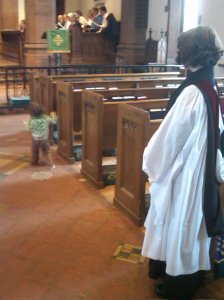
But every once in a while, my own daughter reminds me how my principles do not always coincide with the realities of experience.  This past Sunday, as we were serving communion, my daughter managed to sneak away from her dad, and kneeled next to another parishioner.  When I reverently offered her the host, she abruptly grabbed it from my hand and shoved it enthusiastically into her mouth.  As her parent, my immediate reaction was to be a little embarrassed and to wonder what the other parishioners must think of my parenting skills.  Despite a couple of chuckles, I squashed my embarrassment, and moved on to the next person at the rail.  Later that morning, during the final hymn, my daughter joined me in the aisle as I sang and waited to deliver the morning’s announcements.  As the hymn was wrapping up, she dropped my hand and started shaking her hips in the center aisle, dancing to the hymn with reckless abandon.  Again, my initial instinct was to fret over what parishioners might think about the kind of dancing I was teaching at home.

Later, as I was thinking about the two incidents, several things came to me.  One, I was once again reminded how hard it is to manage children in the context of formal worship.  I am so grateful to the parents who do it every week and who allow us to be blessed by their children.  Two, I realized how hyper aware I am of my role within the church and how that role has some serious implications for my family.  In my ordination vows, the bishop asked me, “Will you do your best to pattern your life and the life of your family in accordance with the teachings of Christ, so that you may be a wholesome example to your people?”  Sometimes, I think that question makes priests and their families feel like they have to be perfect – including in the pew on Sundays.  But what I realized was that my daughter was not shattering our “perfect” image.  She was inviting me to let go of pretenses and be real with our parish.  Being a parent, in fact being a human, is messy, and I do not need to pretend that I somehow have a better hold on being “not messy” simply because I am a priest.

Finally, what I realized on Sunday is that being a “wholesome example” means loving my child in the way that I love all our children at church.  When I could step back from the fact that my child was greedily grabbing Eucharist and dancing a little “inappropriately” in church, I could see the incidents totally differently.  When I could see my child as a child of God, I could see someone who was demonstrating how eager we all should be to receive Christ’s body at the table:  how our longing for Jesus sometimes is downright greedy and aggressive, and grabbing for the bread is a physical way of showing a passionate longing for Christ.  When I could see my child as a child of God, I could see someone who was moved by the Holy Spirit to joyfully dance before the Lord, not unlike David so many years before[i]:  someone who was actually inspired by the music being sung and played, not just dutifully and dispassionately singing the words.  I thought about how her body is a gift from God and how wonderful it was that she was using her body to praise God, even if my uptight-self resisted it.

One of the greatest reasons having children among our midst in church is because they help us get out of ourselves and our need to keep up appearances, and they help us to see the holy in new, exciting, and fresh ways.  So, please keep bringing those little ones.  We all need them to show us the face of Christ.  And for our parents, occasionally they might remind you how they are children of God as much as they are your children as well.

[i] 2 Samuel 6.16

A little help…

18 Wednesday Jun 2014

Posted by jandrewsweckerly in Uncategorized

≈ Leave a comment

Tags

control, God, help, humility, neighbor, parent, relationship, vulnerable

As a parent of two young children, I have had to readjust how I do about pretty much everything.  Grocery shopping is one of the trickiest.  My current method is to put my oldest in the shopping cart seat (luckily she is still small enough for that) and to put my youngest on my chest in a baby carrier.  This mostly allows my hands to be free for pushing the cart, getting items off the shelf and onto the belt, keeping up with my shopping list, and generally entertaining two kids while trying to accomplish the task at hand.  It works, but it also feels like trying to manage a tornado.  I am happy if I remember most everything on my list and get the groceries and family home safely.  But I can only imagine what this chaos looks like to outsiders; and truthfully, I have never taken a moment to observe how others see me.

Courtesy of http://healthland.time.com/tag/humility/

Courtesy of http://healthland.time.com/tag/humility/

So imagine my surprise this week as I was trying to keep my oldest in the cart and my youngest from crying on my chest while unloading our groceries into the car, when, out of the blue, a young woman appeared and asked me if I would like some help loading our car.  I really have no idea what direction she came from, how long she had watched me scrambling, or what made her approach me.  And I must admit, my first thought was to worry about a stranger seeing the other chaos that is my car trunk.  Dumbfounded by the offer, embarrassed by the knowledge that I must have really looked like I needed help, and humbled by the fact that I really could use some help, I hesitantly allowed her to help me.  Before I knew it, the car was loaded and she was gone.  As I got in the car, my brain was filled with questions.  Had I thanked her sufficiently?  Why didn’t I ask her name?  What was her story?  Why did she offer to help me?

But the question that lingered the most was, “Why was I so hesitant to receive her help?”  I have worked for several nonprofit agencies that help those in need.  I have often given lip service to how my children are not just raised by me, but raised by a village.  I often preach about the value of vulnerability within community.  And yet, my immediate reaction to a stranger offering to help me was to insist that I could do it on my own.

Of course, this is often my struggle with God too.  How often have I gone to God in prayer, and then immediately tried to take control again when I felt like I was sufficiently at peace?  How often have I complained to God about an issue and then refused help from someone who was likely sent by God in the first place?  How often have I been willing to wash others’ feet, but not allowed Jesus to wash mine?  My parking lot experience this week reminded me of how much my pride gets in the way of authentic, vulnerable, beautiful relationship with God and my neighbor.  It takes a tremendous amount of trust to allow that kind of intimacy.  But when I do, I continue to be amazed at the ways that both God and my neighbor really do rise to the occasion.

On prayer and parenting…

10 Thursday Apr 2014

Posted by jandrewsweckerly in Uncategorized

≈ Leave a comment

Tags

child, conversation, desperate, God, grace, Jesus, love, methods, parent, prayer, sustains

Courtesy of http://marklovefurniture.com/blog/2013/08/30/prayer-is/

Courtesy of http://marklovefurniture.com/blog/2013/08/30/prayer-is/

One of the more regular inquires I get as a priest is about how to pray.  The truth is there are so many different ways to pray – ranging from formal methods to totally unstructured methods – that our conversations usually have to include what they have tried already and some teaching about what other options are available.  I usually send the person off with a couple of new things to try and encourage them to let me know how it is going.

Since the arrival of my second child, I have been thinking a lot about prayer – or rather, I have been doing a lot of it.  I delivered my child by caesarean section, and I found myself really nervous going into the operating room.  I am not entirely sure why, but I as I sat behind that tall white sheet, with my lower body numb, waiting for the doctors to prep for surgery, I could feel my stress level rising.  That nervousness only heightened once the operation began.  And then, suddenly, before I was even conscious that I was doing it, I found myself praying the Trisagion.  The Trisagion is a prayer found in the Book of Common Prayer.  The words are, “Holy God, Holy and mighty, Holy Immortal One, Have mercy upon us.”  The prayer is traditionally sung or said three times.  I lost count of how many times I said the prayer, but it became a way for me to focus all my nervousness and give it back to God.  Later, I remember thinking about how many times I have taught about mantra prayers, and yet this might have been the first time I really “got” how mantra prayers can be a source of connection to God.

Later, about the time that my daughter was a week old, and I was stealing as much sleep as I could on the couch, I noticed that the blanket I had blindly found in the middle of the night was one that had been gifted to us.  It is a throw blanket with the Lord’s Prayer stitched on it.  As I looked at the words, I started praying the words.  I have always loved the Lord’s Prayer because I can pray it when I have nothing left.  When I am bone-tired, weary, or just feeling overwhelmed, those words have a power over me and whatever situation I find myself in.  It occurred to me, as that blanket was wrapped around my body, how I was metaphorically enveloped in prayer during this unique time.

But to be fully honest, much of my prayer life these last two weeks has included prayers of desperation.  “Please, dear God, let her fall asleep this time.”  “Sweet Jesus, help her to stop crying.”  In my mind, these are not what I have traditionally called prayers that “count.”  They are more calls of despair and bargaining, which is not really how I imagine things “work” with God.  But as I have thought about it this week, I think these are totally legitimate prayers.  Part of a healthy prayer life is an honest, vulnerable conversation with God.  My being honest about how sleep deprived and frustrated I might be at 2 a.m. is not unreasonable – and in fact, God already knows how I am feeling and what I need.  Though I would not argue that this kind of prayer is the only kind of prayer one should utilize in their relationship with God, I think these prayers open up a path to more honest conversation – and hopefully more honest listening to God.

As I think back to all those times I have “taught” others about prayer, these last couple of weeks have certainly shifted some of my thinking about prayer.  The beauty of prayer is that the variety of options is truly a gift to us, and there are certainly different times that different forms of prayer will sustain us.  Whether we pray beautiful, ancient prayers or we offer up desperate ramblings to God, our loving, gracious God is simply happy that we are there – for once remembering Who sustains us, feeds us, and gives us strength.  Thanks be to God!

On worry…

06 Thursday Feb 2014

Posted by jandrewsweckerly in Uncategorized

≈ 2 Comments

Tags

control, God, Jesus, parent, trust, worry

Last week I went to visit my OB for a checkup.  We began to talk about delivery dates, as I am having a cesarean section with our second child.  The doctor selected a date that is about one week before what I expected.  I left the office totally panicked.  I would need to totally readjust my plan for wrapping things up in the office, I would need to contact the supply priest and make sure the Sunday before was still available, and I would need to talk to my mother about flying out earlier to come help us with our four-year old – just to name a few things on my panic list.  Of course, about an hour later, I realized how silly my panic was in the grand scheme of things.  The truth is that I could go into labor at any point, and any “plans” I had made would be thrown out anyway.  The idea that one week was sending me into such a panic was only confirmation that I still hold on to some false idea about the level of control I exert over my life.

Courtesy of http://www.versifylife.com/category/topical/worry/page/2/

Courtesy of http://www.versifylife.com/category/topical/worry/page/2/

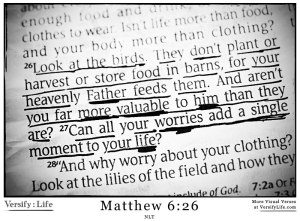
One of my favorite passages of scripture is from Matthew.  “Therefore I tell you, do not worry about your life, what you will eat or what you will drink, or about your body, what you will wear.  Is not life more than food, and the body more than clothing?  Look at the birds of the air; they neither sow nor reap nor gather into barns, and yet your heavenly Father feeds them.  Are you not of more value than they?  And can any of you by worrying add a single hour to your span of life? – Matthew 6:25-27  Although I know the truth of this passage about our relationship between trust and God, I find that I am always returning to it, never fully mastering it.  In fact, I am not even sure that I have partially mastered it.

My only saving grace has been becoming a parent.  I have often joked that God knew what God was doing when God made me a parent.  Perhaps God knew that the only way I would really start to believe that I could trust God was to throw someone in my life whom I have very little control over – a microcosm of the larger world.  That point has been resurfacing several times for me lately.  When school is cancelled because of snow, I have no way of attacking my work in the same way that I would if she were in school.  When the roads become too dangerous for driving on my day off with my daughter (i.e., “errand day”), those groceries that we just cannot live without suddenly become groceries we can live without.  Just today, another school weather-related cancellation day, as I was scrambling around trying to figure out how to busy my daughter while getting a little work done, my daughter asked if she could make Valentine’s Day cards for her classmates.  My immediate thought was, “No, I don’t have time to sit with you and do that.”  But I took a breath and considered her proposal.  One, we would be able to do something together that we would not normally do.  Two, the task would certainly entertain my daughter, which is pretty much golden on a snow day.  Three, making homemade Valentine’s is super cute, and something I never would have made time for otherwise.  So, I exhaled in defeat, and we both gathered the necessary supplies.  And it turns out that making homemade Valentine’s is pretty fun, and can even be a creative outlet for stress reduction.

So today, I am thankful for the God who puts people in my life to force me to be a better person of faith.  I am grateful for God’s awesome and powerful creation, who has certainly taught me a few lessons this winter about the fruitlessness of worry.  And I am blessed by the God who reminds me in small and large ways that I cannot, “worry about tomorrow, for tomorrow will bring worries of its own.  Today’s trouble is enough for today.” – Matthew 6.34

Newer posts →

Recent Posts

  • On the Myth and Magic of Advent…
  • On Risking Failure and Facing Fear…
  • Sermon – Luke 23.33-43, P29, YC, November 23, 2025
  • On Inhabiting Gratitude…
  • Sermon – Luke 20.27-38, P27, YC, November 9, 2025

Archives

  • December 2025
  • November 2025
  • October 2025
  • September 2025
  • August 2025
  • July 2025
  • June 2025
  • March 2025
  • February 2025
  • December 2024
  • November 2024
  • October 2024
  • September 2024
  • August 2024
  • July 2024
  • June 2024
  • May 2024
  • March 2024
  • February 2024
  • January 2024
  • December 2023
  • November 2023
  • October 2023
  • September 2023
  • August 2023
  • July 2023
  • June 2023
  • May 2023
  • March 2023
  • February 2023
  • January 2023
  • December 2022
  • November 2022
  • October 2022
  • June 2022
  • May 2022
  • January 2022
  • December 2021
  • November 2021
  • October 2021
  • September 2021
  • August 2021
  • June 2021
  • May 2021
  • April 2021
  • March 2021
  • February 2021
  • January 2021
  • December 2020
  • November 2020
  • October 2020
  • September 2020
  • August 2020
  • July 2020
  • June 2020
  • May 2020
  • April 2020
  • March 2020
  • February 2020
  • January 2020
  • December 2019
  • November 2019
  • October 2019
  • September 2019
  • August 2019
  • July 2019
  • June 2019
  • May 2019
  • April 2019
  • March 2019
  • February 2019
  • January 2019
  • December 2018
  • November 2018
  • October 2018
  • September 2018
  • August 2018
  • July 2018
  • June 2018
  • May 2018
  • April 2018
  • March 2018
  • February 2018
  • January 2018
  • December 2017
  • November 2017
  • October 2017
  • September 2017
  • August 2017
  • July 2017
  • June 2017
  • May 2017
  • April 2017
  • March 2017
  • February 2017
  • January 2017
  • December 2016
  • November 2016
  • October 2016
  • September 2016
  • August 2016
  • July 2016
  • June 2016
  • May 2016
  • April 2016
  • March 2016
  • February 2016
  • January 2016
  • December 2015
  • November 2015
  • October 2015
  • September 2015
  • August 2015
  • July 2015
  • June 2015
  • May 2015
  • April 2015
  • March 2015
  • February 2015
  • January 2015
  • December 2014
  • November 2014
  • October 2014
  • September 2014
  • August 2014
  • July 2014
  • June 2014
  • April 2014
  • March 2014
  • February 2014
  • January 2014
  • December 2013
  • November 2013
  • October 2013
  • September 2013
  • August 2013
  • July 2013
  • June 2013
  • May 2013
  • April 2013
  • March 2013
  • February 2013
  • January 2013
  • December 2012
  • November 2012
  • October 2012
  • September 2012

Categories

  • reflection
  • Sermons
  • Uncategorized

Meta

  • Create account
  • Log in
  • Entries feed
  • Comments feed
  • WordPress.com

Blog at WordPress.com.

  • Subscribe Subscribed
    • Seeking and Serving
    • Join 394 other subscribers
    • Already have a WordPress.com account? Log in now.
    • Seeking and Serving
    • Subscribe Subscribed
    • Sign up
    • Log in
    • Report this content
    • View site in Reader
    • Manage subscriptions
    • Collapse this bar
 

Loading Comments...