• About

Seeking and Serving

~ seek and serve Christ in all persons

Seeking and Serving

Tag Archives: Pentecost

Sermon – Acts 2.1-21, PT, YC, June 5, 2022

05 Wednesday Oct 2022

Posted by jandrewsweckerly in Sermons

≈ Leave a comment

Tags

hearing, Holy Spirit, languages, light, listen, love, noise, Pentecost, people, Sermon, speak

At Hickory Neck, one of our core values is creativity.  We have an openness to experimentation that has served us well throughout this pandemic.  You might have noticed our Acts reading today was a little different – allowing us to sample the idea of what it might have been like to hear the chorus of languages on that famous Pentecost Day.  In the past, we experimented a little differently – with all the languages at one time, so that a cacophony of noise filled this space.  I LOVED the experience every year.  However, some found the cacophony to be more an experience of noise as opposed to joyful noise.  So, we experimented again this year with another way to stimulate our imagination about this significant day in the life of the Church.

As I have been thinking about our experimentation with hearing today, I stumbled on the work of theologian Willie James Jennings.  Jennings argues about Pentecost, “…we must see more than a miracle of hearing.  …The miracles are not merely in ears.  They are also in mouths and in bodies.”[i]  Jennings argues that just as important as everyone hearing in their own tongues at Pentecost was the miracle of speaking in tongues.  Now I do not know how to recreate our Acts readings by randomly choosing five of you to spontaneously speak another language.  We’ll have to experiment with that next year.  But I am intrigued by why Jennings thinks the speaking is just as important as the hearing.  Jennings argues that when you can speak in the language of another group of people, you can “speak a people.”  He says, “God speaks people, fluently.  And God, with all the urgency that is with the Holy Spirit, wants the disciples of his only begotten Son to speak people fluently too.  This is the beginning of a revolution that the Spirit performs.”[ii]

During a year of volunteer AmeriCorps service, you learn to live a little differently.  I stayed in a campus ministry building on campus for free in exchange for cleaning and locking up the building every night.  I lived on a shoestring budget and managed to get by with support.  One day, I was sitting on the loading dock of the Food Bank where I was working next to older teenager, Jayden.  We had just done a lot of work with fresh produce.  He lived in a group home that was a frequent shopper at the Food Bank.  Together, we sat on the dock, sweaty and exhausted.  As our conversation meandered, we began to talk about our homes – him in the group home and me in the home that was also a job.  When I explained my arrangement to him (which I had admittedly resented sometimes – I mean who likes cleaning toilets and pest control?), he looked dreamily out into the sky in front of us and sighed, “I hope I can find a place like that someday.”  Now, Jayden did not speak a foreign language.  The Holy Spirit did not make another language burst out of my mouth.  But Jayden and I were from very different worlds – me a recent college graduate and him unsure of his fate after he aged out of the group home.  But sitting on that loading dock, the Holy Spirit allowed me to “speak a people” – to break down the walls of language so that we could sit as equals and ponder the wonder of God and express our deepest desires with vulnerability. 

Pentecost is an invitation for the Church to learn to speak a people.  Now that does not mean you need to go sign up for foreign language class – though that certainly would not hurt.  And that does not mean you need to go volunteer for a year – though that would not hurt either.  But what speaking a people means is finding ways to meet people where they are, hear their stories in their own “language,” and share the love of God that you have received so abundantly.  Speaking a people may also mean that you do not use your mouth as much as your body to show forth love and light. 

And just in case you are hearing this invitation today and thinking, “That sounds like the work preachers should be doing, or evangelicals are better at doing,” remember what happened at that festival of Pentecost.  The text tells us, “All of them were filled with the Holy Spirit and began to speak in other languages, as the Spirit gave them ability.”  As scholar Karoline Lewis reminds us, the text says “all” of them.  Not some of them.  All of them were filled with the Holy Spirit.  Just like John the Baptist was filled with the Holy Spirit, and Mary was filled with the Spirit, and Elizabeth, and Zechariah, and Simeon.  All of them were filled.[iii]  And just in case you find yourself saying, “But those were famous people, a long, long time ago.  How can I do that?”  The answer is right there in verse four.  “All of them were filled with the Holy Spirit and began to speak in other languages, as the Spirit gave them ability.”  The Spirit will give you the ability to speak a people.  The Spirit will give you the ability to listen deeply and speak meaningfully.  The Spirit will make a way for those powerful, vulnerable moments of truth and love.  So, when you hear that dismissal today, “Let us go forth into the world, rejoicing in the power of the Spirit, alleluia, alleluia,” your answer can be an emphatic, “Thanks be to God, alleluia, alleluia!”  Amen.


[i] Willie James Jennings, Acts, Belief:  A Theological Commentary on the Bible (Louisville:  Westminster John Knox Press, 2017), 29.

[ii] Jennings, 30.

[iii] Karoline Lewis, Sermon Brainwave:  #847: Day of Pentecost (C) – June 5, 2022, May 29, 2022, as found at https://www.workingpreacher.org/podcasts/847-day-of-pentecost-c-june-5-2022 on June 2, 2022.
Sermon – Acts 1.6-14, E7, YA, May 24, 2020

02 Tuesday Jun 2020

Posted by jandrewsweckerly in Sermons, Uncategorized

≈ Leave a comment

Tags

ambiguity, Ascension, community, empowerment, God, Holy Spirit, Jesus, liminal time, Pentecost, pray, Sermon, waiting

Throughout this time of pandemic, I have struggled with Holy Scripture.  From not being able to wash feet and share in Christ’s last meal on Maundy Thursday, to ringing in the victory of Easter, to watching the disciples be able to touch Jesus or share in communion with him during his bodily appearances after the resurrection, each experience has felt like a stabbing reminder of what we do not have – that we cannot gather, we cannot touch, we cannot share that identity-making holy meal.  But today, as we continue to celebrate Jesus’ ascension, we have finally landed on the perfect Scriptural metaphor for these days.  Thanks be to God!

Of course, I say that not because today’s scripture lesson gives us answers about when we can expect a return to “normal,” (whatever that may mean now), or when this virus will be over, or even when we can safely return to church buildings.  Instead, what our text from Acts recognizes is the brutal truth of this time:  we are in a liminal time.

Now, we have talked about liminal time before.  Liminal time[i] is the time in which we are in the middle of a transition.  Native cultures experienced liminal time most famously in the journey to adulthood.  When young men or young women reached a certain age and maturity, they were sent away from their families and out into the wilderness for a time, a time when they are no longer children, and not yet adults.  Their identity is in flux, their purpose is ambiguous, and their life is on pause.  Liminal time is a time fraught with anxiety, frustration, and confusion.

That kind of transition is where we find our disciples today.  They have spent forty glorious days feeling the victory of Christ’s resurrection, being blessed with further teachings, and being comforted by Christ’s presence.  They are ready.  They confidently ask Jesus today, “Lord, is this the time when you will restore the kingdom to Israel?”  Jesus responds with a promise – that they will receive power when the Holy Spirit comes upon them, and they will be empowered to do their work of witnessing.  But for now, at this moment of climax, confidence, and courage, Jesus says, quite simply, “Wait.”

Now I know I said I was excited about this text because the text is so perfect for this time.  I say that not because this text finally answers all those questions of our liminal time – or even hints at when our anxiety, frustration, and confusion will end.  Instead, what I love about this text is that the text names the very frustrating reality of this time – a time in which we are not longer what we were (a community free to gather how and when we like, doing things like passing the peace, sharing a common cup, and congregating en masse), and yet, we are not yet what we will be – in fact, what we will be is even uncertain.  We are the disciples staring up at the sky, knowing Christ has gone to the father, but frozen in place, not really knowing what is next – waiting.

Karl Barth called the waiting between the Ascension and Pentecost, the days we are experiencing now, the “significant pause…a pause in which the church’s task is to wait and pray.”[ii]  Now, I know what you are thinking.  That’s our Good News?  I should wait and pray?  Telling us to wait and pray seems like a classic platitude, what we say when we do not know what to say.  Will Willimon explains, “Waiting, an onerous burden for us computerized and technically impatient moderns who live in an age of instant everything, is one of the tough tasks of the church.  Our waiting implies that the things which need doing in the world are beyond our ability to accomplish solely by our own effort, our programs and crusades.  Some other empowerment is needed, therefore the church waits and prays.”[iii]  Though the disciples are facing the “significant pause,” the promise of the empowering Spirit is a promise of hope, empowerment, and companionship.  Their waiting and prayer are not for personal comfort during this time of ambiguity, but for empowerment to be obedient.  Instead of praying out of self-pity, they are praying out of determined expectation.

That is our invitation today too – to pray and wait together.  We cannot cram into that Upper Room like the disciples do.  But we can gather – digitally in worship here, in Zoom gatherings, by phone, cards, emails, and texts, even drive-by Coffee Hours.  As David Lose reminds us, in this time of pandemic “God will be with us, comforting, celebrating with, strengthening, and accompanying us in and amid whatever may come.  And God will also be preparing us, preparing us to be God’s emissaries of good news, preparing us to comfort others, preparing us to work for peace, preparing us to live with less fear and more generosity, preparing us to look out for the rights of others, preparing us to strive for a more just community and world.”[iv]  I do not know about you, but I would much rather face the ambiguity of this liminal time with a community who can remind me of God’s promise, helping me see the work of the Spirit.  That is what we do when we pray and wait together.  Our invitation is to accept the gift of this community, gathered virtually for the foreseeable future, and to wait and pray with together.  Amen.

[i] Liminal time is a concept that has been developed by many scholars.  Arnold van Gennep, Victor W. Turner, and Gordon Lathrop all developed the idea of incorporating liminal time into liturgical practice.

[ii] William H. Willimon, Acts, Interpretation:  A Bible Commentary for Teaching and Preaching (Atlanta:  John Knox Press, 1988), 20.

[iii] Willimon, 21.

[iv] David Lose, “Easter 7A:  Important Interludes,” May 25, 2017, as found at http://www.davidlose.net/2017/05/easter-7-a-important-interludes/ on May 26, 2017.

Homily – Acts 2.1-21, Pentecost, YB, May 20, 2018

23 Wednesday May 2018

Posted by jandrewsweckerly in Sermons, Uncategorized

≈ Leave a comment

Tags

baptism, baptismal covenant, cacophony, chaos, church, community, God, Jesus, languages, love, Pentecost, Sermon

33092215_1843823495673902_5618488268858327040_o

Photo credit:  John Rothnie (permission to reuse required)

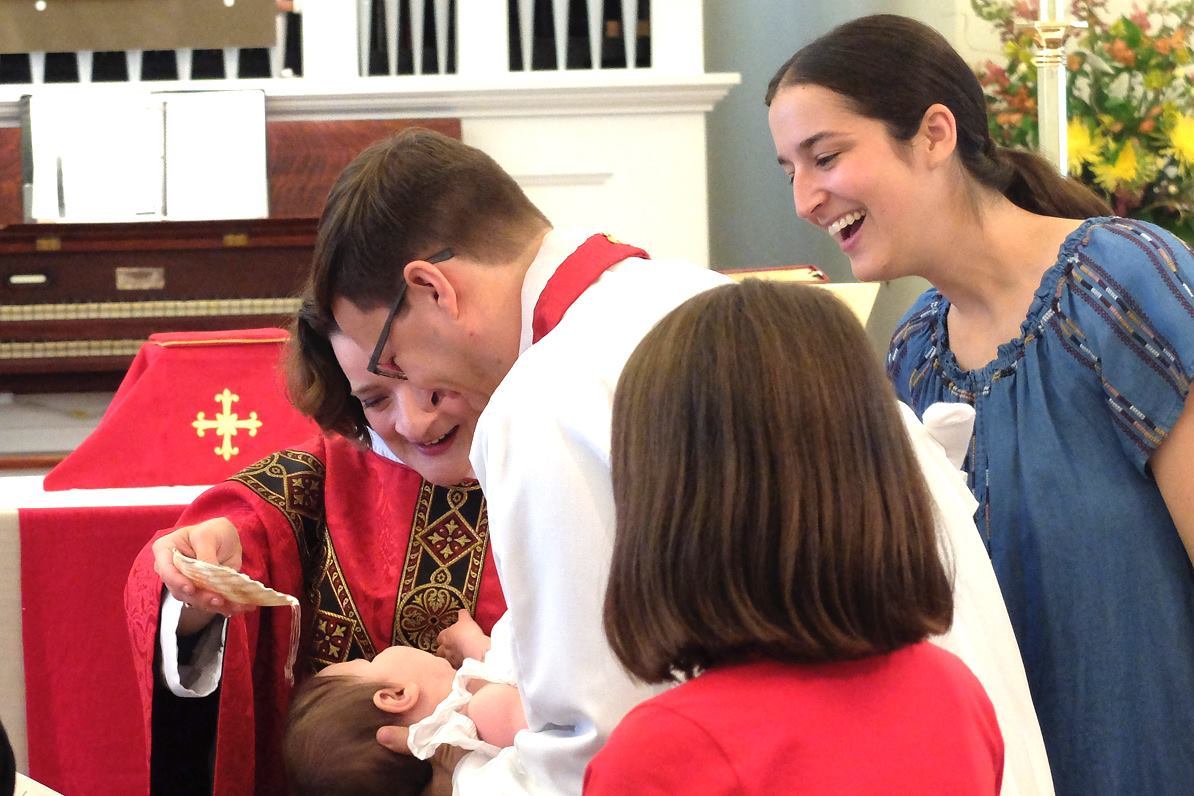
I have been looking forward to this baptism for months.  Olive is one of four babies born at Hickory Neck within a month of each other, and one of five within a five-month period.  Not only did I enjoy watching Olive grow in her mom’s belly, I knew how fun welcoming her to the community would be, and especially how special her baptism would be.  So when the Bauer Family finally settled on Pentecost, I was thrilled – baptizing a baby on feast day adds excitement to an already festive day.

But as the liturgy planning staff met about a month ago, I realized we may have made a huge mistake.  We were talking about the needs for today, and remembered we needed to recruit all our foreign language speakers because Pentecost is the one feast of the year where we really try to simulate the experience of the historically significant day in the life of the faith.  And as we were talking about rotas, translations, and participants, a sudden sense of dread hit me.  “Um, Charlie?” I said.  “Are you sure you want to baptize Olive on Pentecost?  I mean, I love Pentecost, but, especially for strangers to our community, Pentecost is a little weird.  Do you want us to just skip the whole languages part?”  To his credit, Charlie didn’t hesitate.  “What better day to baptize?!?” he said, as though my question were silly.

I have been encouraged by Charlie’s enthusiasm, but the more I thought about his response, the more I questioned his logic.  Don’t get me wrong – I love what we do at Pentecost.  Pentecost is one of the few days of the liturgical year that our scripture really comes to life.  Hearing the cacophony of languages helps you to really imagine yourself there.  But this is the kind of service that I would also say to first-time visitor, “Just so you know, we don’t always do this!”  Because, although I love the cacophony, I wouldn’t want anyone to think today is the norm – that we always break into tongues in the service or that we always like to shock your senses.  Surely if we were going to baptize Olive, we should find a tamer way to welcome her to the community, and not freak out her family and friends from all the ends of the country.

We do this all the time with Church.  If we get the nerve up to ask a friend to Church, and they take us up on the offer, we want them to experience the best of Hickory Neck:  a welcoming environment, beautiful liturgy, a sense of belonging, and a deep connection to the immanent and transcendent God.  But just like when you introduce a new romantic interest to your family, you don’t have them meet everyone in the family at the beginning.  You save crazy Uncle Joe until at least the second or third Christmas, when you know your boy or girlfriend is already in love with you enough to make allowances for the crazy in your family.  The same is true for church – we would much rather you see the beauty of Hickory Neck on a regular Sunday or even on a day like Easter.  There is no need for us to show you some of the really weird parts of our faith, like Pentecost, until you have at least been here for a while.

So why was Charlie so enthusiastic about bringing his extended family to celebrate baptism on this one, crazy, bizarre day in the life of the church?  Was he not thinking this through?  Or was he secretly hoping to ensure his family never comes back?  I started working through why this might be the perfect day for a baptism, thinking through what we learn about the church and membership within.  First, we learn the power of the gospel, of the good news of God in Christ, to reach all peoples, no matter who they are.  Although practically speaking, today’s multilingual reading sounds jarring, what we know about this piece of scripture is that despite the din of noise, everyone heard the good news in their own language.  The gospel is not limited to one group of people or to one tribe or nation; the gospel speak truth to all.  Second, we learn that Jesus’ story is not just for us – Jesus’ story is for all.  Up until this point in our story, Jesus has been keeping his resurrection and ascension to a limited group of people.  But today, that norm implodes.  Jesus’ story is no longer for those nearest and dearest to Jesus – Jesus’ story is for everyone.  Third, we are reminded of our commission from Jesus – to go out into all the world, sharing the good news of God in Christ.  Not just the English-speaking places, not just the places where people look and act like us, not just the places that make us comfortable.  And finally, Pentecost affirms the ways in which God loves us, no matter what.  No matter how loud, crazy, or chaotic our lives become, God is with us, breaking through the din of noise we create and making that noise holy.

Perhaps instead of finding the most proper, polished day to baptize a child of God, today may be the perfect day to teach us all what the life of faith is about.  We all know that when our romantic interest or dear friend finally meets Crazy Uncle Joe, or finally sees us when we are sick or not looking our best, or finally realizes we have some pretty awful flaws, and LOVES US ANYWAY – those are the people we want to keep around.  The same is true for those new to the church or those being initiated into the community of faith – we want you to see us on our craziest days so that you know, no matter what God loves you anyway.  God sees your craziness, your chaos, those parts of yourself that you hide from others, and God not only loves you, God commissions you and makes a way you share that love to the ends of the earth.

That is what we affirm today in our baptismal covenant.  Given the promise of unconditional love from God, we promise in return to live a life in accordance with that unconditional love.  To seek and serve all persons, to strive for justice, to respect the dignity of every human being, to proclaim by word and example the good news of God in Christ, to resist evil and repent, and to keep coming back to the community, breaking bread and joining in the prayers.  The chaos of today, the beauty of baptism today, the reminder of God’s love today are all meant to build us up so that we can get back out into the world.  What better day than today to baptize?!?  Amen.

On Letting Go and Listening…

16 Wednesday May 2018

Posted by jandrewsweckerly in Uncategorized

≈ Leave a comment

Tags

church, control, faithful, God, hear, let go, listen, Pentecost, rain, voice

Our church is currently being blessed with a lot of activity.  This week, the site for the school that will join our property has begun construction.  Footers are ready to be dug and the foundation laid.  Meanwhile, this weekend, we are hosting our second Annual High Fiber Festival.  Volunteers are being recruited, parking layouts are being designed, and signs are being hung for this great event that raises money for outreach ministries.  Both events are wonderful signs of vitality and life at Hickory Neck – and yet both events have been the victim of all sorts of things out of their control.  Permit approvals delayed construction at the school.  Delays in school construction have created challenges for parking at the Festival.  And now rain seems to be threatening progress and success for both.

I have been thinking that both projects seem to be challenging my long-held battle with control.  As I imagine many of us do, I sometimes fall under the illusion that more things are under my control than actually are.  I consider myself a pretty faithful Christian, but when issues like control arise, I realize how far I have to go.  I think that phrase, “Let go and let God,” was written for me!  Lord knows, I cannot control the rain!

That is why I love that we get the Acts lesson for Pentecost this Sunday.  Talk about a people whose life are completely out of control!  If the cross, death, resurrection, and ascension were not enough to make the disciples realize they are not in control, perhaps Pentecost would be.  I imagine the disciples were finally getting their feet on the ground and preparing themselves to take up Jesus’ mantle of spreading the Good News.  But none of them could have prepared for the dramatic event of breaking into tongues all at once.

What I love about Pentecost though is everyone hears in the din of noise.  Despite the chaos and seeming utter loss of control, those gathered can hear clearly.  I wonder if that might be an invitation for us this week – to look at the chaos and situations in our lives that seem out of control and see where we hear God’s voice.  Maybe God’s voice is speaking to us directly.  Maybe God’s voice is speaking to us through a wise friend or confidant.  Maybe God’s voice is speaking to us through strangers or the seeming “coincidences,” of life.  I’d love to hear your stories of where you have heard God this week!

Singing-In-The-Rain-red-umbrella

Photo credit:  https://www.voices.com/blog/4-lessons-singing-in-the-rain/

Sermon – John 17.6-19, Acts 1.15-17, 21-26, E7, YB, May 13, 2018

16 Wednesday May 2018

Posted by jandrewsweckerly in Sermons, Uncategorized

≈ Leave a comment

Tags

Ascension, busy, disciples, Jesus, name, Pentecost, pray, prayer, present, scared, Sermon, wait

I used to belong to a community that had healing prayers every Wednesday at a midday Eucharist.  I never liked to go forward myself, but I was happy to see so many other people go forward for prayers.  Honestly, for the longest time, I did not really understand the whole process.  Were the same people so sick they needed prayers every week?  Were they having prayers for themselves or for other people?  And I had no idea what the priests were saying to them or what they said to the priests.  I was so intimidated by the whole process that I usually just sat in my seat and prayed for those going forward.

Then one day, some stuff was going on in my life I felt overwhelmed by and I finally stood up and got in line with all the other people.  I was so nervous.  I wasn’t sure if I was supposed to tell the priest my whole story, or if I was supposed to ask for something specific, or if I was just supposed to bow my head and wait for the priest to pray.  When I finally reached the priest, he looked at me expectantly.  I mumbled some prayer request that was super short and in no way indicated why I really needed prayers.  But then the priest did something extraordinary.  He prayed for me by name and was able to craft a prayer so thoughtful and generous, that I felt like he could see into my soul and understand what was really weighing me down.  By simply saying my name, I felt known, cared for, understood, and seen – really seen – for the first time in a long time.

I suspect that is what the disciples are looking for at this point in our narrative.  For weeks, Jesus has been making resurrection appearances, teaching the disciples, and talking to them about next steps.  These weeks have been reassuring, lifegiving, and invigorating.  What seemed to be a massive disaster is now a holy victory.  But then, just days ago, Jesus finally leaves them for good as he ascends into heaven.  Before he goes, he tells them to wait for the Spirit to clothe them with power.  We are told they disciples return to the temple, praising God, but in our Acts lesson today, the disciples are busy figuring out their leadership plan.  You see, the establishment of twelve disciples was important to the ancestral roots of the twelve tribes of Israel.  The disciples want to be ready to “witness the messianic kingdom inaugurated by the death and resurrection of Jesus.” [i]

This is what we all do when we are scared.  We busy ourselves.  Jesus tells the disciples to wait for the Holy Spirit, and what do the disciples do?  They start developing a leadership plan, thinking about their presentation to the faith community, and organizing themselves.  None of these things were things Jesus told them to do.  In fact, Jesus told them to wait.  But we are not very good at waiting.  I remember last summer when the Vestry finished our needs assessment about child care and adult day care in Upper James City County, the conclusions were clear.  Both were needed and anything we could do would be a help.  When we finished that final assessment, I remember thinking, “Now what?!?  How in the world are we going to actually do something about either of these issues?”  When we left that meeting, I sensed we all walked away with the same sense of dread.  The community had spoken, but we had no idea how to live into God’s dream for us.  It was like looking over a great chasm with no way to cross over.  I remember wondering what other work we could do to prepare ourselves for something like that.  But I also remember being so clueless about what would come next that I kind of just looked to God with a sense of panic, wondering, “Now what?!?”

That’s why I love the gospel lesson from John today.  The lesson from John does not fit chronologically with where we have been in the Luke-Acts story.  John’s gospel today includes the words of Jesus’ farewell discourse before his passion.  These last verses of John 17 are a part of a prayer that Jesus says after an extensive time of teaching.  The words we hear today are not the words of a desperate prayer said in private by Jesus to God.  The words we hear today are words of prayer said for and about the disciples – said right within their hearing.  The words are not particularly pretty.  In typical John form, they sound circuitous and repetitive – so much so, they can be hard to really hear.  But if we listen closely, Jesus’ words today are an impassioned prayer for the personal care and safety of the disciples, so that the disciples can feel empowered to go out into the world under God’s protection.  “This is not Jesus teaching his disciples how to pray.  This is not only a personal prayer or privatized piety.  After betrayal and predicted denial, after concerned questions and foretold rejection, the disciples do not need another lesson, another miracle, another example.  They need exactly what Jesus does, because Jesus knows — for Jesus to pray for them.”[ii]

Jesus’ prayer is like the priest’s prayer at that healing service.  Jesus sees these scared, confused, anxious disciples and he prays for them by name, reminding them how they are loved, calling down God’s motherly love for the disciples, and asking for a sense of empowerment for each disciple. Although his prayer is not said in those days between the Ascension and Pentecost, the disciples could stand to remember this moment as they wait.  When we steer far from God’s providence, and we start to busy ourselves to hide our anxiety, these are the words we return to to steady ourselves.  Jesus’ words today, called the High Priestly Prayer, are the words of a priest – calling us by name, naming our specific anxieties before God, soothing us by their healing power, and calming us so that we might be able to go out into the world.

But Jesus’ words are not just the words of a priest.  Jesus’ words today are the words of all the faithful – said on behalf of another we name, said in the confidence of a child of God, said in the presence of one receiving prayer.  We can give away the gift of prayer and blessing the disciples needed too.  You may not feel comfortable praying aloud with another person yet.  If so, a prayer, using the person’s name and praying as Jesus does for that person is fine.  But Jesus’ words and actions for the disciples today embolden you to do what Jesus does.  You can ask the other person if you might pray for them – and pray with them right then and there:  whether you are praying for your own child and the concerns they have just voiced to you, whether you are praying for a friend who has finally confessed what is on their heart aloud, or whether you are praying for an acquaintance who cannot express their heart, but who is speaking to you because they know you are a person of faith and they need a priestly prayer from Jesus.  Any of you who have gathered at the side altar for healing prayers, or who have had your name called aloud for prayer knows the power of this work.

Normally, I commission you at the end of every sermon – giving you a task to do out in the world, bringing the good news of God in Christ into the broken world.  But on this Sunday between the Ascension and Pentecost, I invite you to take Jesus word’s seriously:  to pray while you wait for the empowerment of the Spirit.  This is not an invitation to look busy or to use action to cover anxiety this week.  This is an invitation to be present every day, looking around you for those who need your prayer, and then offering that personal, named prayer for those in your path.  As Jesus prayed for the disciples, as the disciples prayed for those with whom they shared the good news, so we continue the age-old practice of deep, personal, abiding prayer with others.  Those prayers for the disciples are prayers for us – Jesus prays for us today.[iii]  Our invitation is to give that comforting, loving, emboldening gift to others.  Your words, your calling another by name, give them power to sit and wait for our God too.  Amen.

[i] David S. Cunningham, “Theological Perspective,” Feasting on the Word, Year B, Vol. 2 (Louisville:  Westminster John Knox Press, 2008), 528.

[ii] Karoline Lewis, “Prayers Needed,” May 6, 2018, as found at http://www.workingpreacher.org/craft.aspx?post=5147 on May 9, 2018.

[iii] David Lose, “Easter 7 B:  Prayer is Love,” May 10, 2018, as found at http://www.davidlose.net/2018/05/easter-7-b-pray-is-love/ on May 10, 2018.

On Presumed Barriers…

31 Wednesday May 2017

Posted by jandrewsweckerly in Uncategorized

≈ Leave a comment

Tags

barriers, communicate, community, connect, connection, different, Holy Spirit, languages, Pentecost, united

Pentecost Languages

Photo credit:  https://www.pinterest.com/dcntgirl/pentecost-sunday/

Most of my travels have been to places where I knew or was learning the language.  And if I did not know the language, a few team members did, so we were able to communicate in at least a basic way.  The exception to that pattern was my trip to Myanmar.  There were eight of us on the team, and none of us spoke Burmese.  Most of the time, that was not a problem because we had a local translator.  But on our first Sunday, we were divided into groups and sent to Anglican churches.  When my partner and I sat down, we were handed a prayer book and a hymnal (familiar accoutrements for Episcopalians).  We even had parishioners nearby who would help us find the page we were on during the service.  But the prayer books and hymnals were completely in Burmese – a very pretty language to look at, but completely indecipherable to an English-speaking American.

So we did all we could do.  We smiled and nodded as others helped us.  We sat and stood as others sat and stood.  We closed our eyes when it was obvious we were praying.  We knew when the sermon was being delivered, even if we couldn’t understand it.  But my favorite part came about two-thirds of the way through the service.  One of the hymns was announced.  We stood up with everyone else and prepared to stand silently again.  Then all of a sudden, the people were singing a tune we knew.  All of the tension and anxiety in my body melted away as a broad smile crossed my face.  I quietly sang the words I could remember in English.  Finally, I felt like a full participant in the body as we worshiped.

This Sunday, we will celebrate Pentecost.  Even though we will be experimenting with using foreign languages at Hickory Neck, I am not sure we will ever grasp the fullness of that first Pentecost experience – the chaos of languages, and yet the clarity of understanding by each in their own tongue.  But what I hope we get a small taste of is the experience of being united by the Holy Spirit.  That Sunday in Myanmar was a bit like that first experience with the Holy Spirit.  In the desire to connect, communicate, and create community, we were able to do that through the power of song.  On this coming Sunday, we will do that through the written word in our native tongues.  What I hope the day challenges us to do going forward is to seek ways to find common languages – to connect, communicate, and create community with people who are unlike us.  Whether they speak another language, hold another faith, are of a different race or socioeconomic class, there are “languages” that can create barriers to true connection.  I suspect the Holy Spirit is with us when we are willing to work through the barriers.  And if my experience in Myanmar gives any clue, the Holy Spirit will work its magic to help us connect, communicate, and create community.  Then our work really begins.

Sermon – Acts 1.6-14, E7, YA, May 28, 2017

31 Wednesday May 2017

Posted by jandrewsweckerly in Sermons, Uncategorized

≈ 2 Comments

Tags

ambiguity, Ascension, church, community, disciples, discomfort, God, Jesus, Kingdom, liminal, Pentecost, pray, promise, Sermon, Spirit, together, wait, waiting

We do it all the time:  waiting.  Waiting is perhaps one of the cruelest experiences of life.  Waiting for the test results that will tell us whether or not we have cancer.  Waiting for a call back after interviewing for our dream job.  Waiting all summer long after graduating high school before we can start new life in college.  The trouble with waiting is that we can feel lost – we are between two realities – the one we know and the one that is to come.  In some ways, simply by finding out we need the test, by applying for the job, or by making the deposit at college, life can never be the same.  Something is changed in our lives by stepping into the unknown.  And yet, we do not have the answer, we have not started the job, and school has not begun.  We are not the new person we know we will be.  We are in-between, in limbo, in no-man’s land.

Scholars call this in-between time liminal time.[i]  Liminal time is the time in which we are in the middle of a transition.  Native cultures experienced liminal time most famously in the journey to adulthood.  When young men or young women reached a certain age and maturity, they were sent away from their families and out into the wilderness for a time.  When their time in the wilderness was done, they returned with full adult status, respect, and responsibility.  They leave a child and return a man or a woman.  Liminal time is that time in the wilderness – where they are no longer children, and not yet adults.  Their identity is in flux, their purpose is ambiguous, and their life is on pause.  Liminal time is a time fraught with anxiety, frustration, and confusion.  Liminal time is a time when things are happening to you, and you have no agency.  Moments of liminality are some of the hardest moments in life.  The comfort of what has been and promise of what is to come is rarely soothing.  All that is left is ambiguity.

That kind of transition is where we find our disciples today.  They have spent forty glorious days feeling the victory of Christ’s resurrection, being blessed with further teachings, and being comforted by Christ’s presence.  They are ready.  They confidently ask Jesus today, “Lord, is this the time when you will restore the kingdom to Israel?”  This has to finally be the time!  Jesus’ answer is anything but satisfying.  Jesus makes a promise – that they will receive power when the Holy Spirit comes upon them, and they will be empowered to do their work of witnessing.  But for now, at this moment of climax, confidence, and courage, Jesus says, quite simply, “Wait.”

The trouble is that when the disciples ask that final question to Jesus, expecting to hear when Jesus will restore the kingdom of Israel, and effectively assume his place on the earthly throne, initiating the reign of the kingdom of God, the answer they get is a bit different.  As N.T. Wright explains, they are asking when “Israel will be exalted as the top nation, with the nations of the world being subject to God through his vindicated people.”  In one sense, that vindication already happened in the death and resurrection of Jesus.  In another sense, we are still waiting for the “time when the whole world is visibly and clearly living under God’s just and healing rule.”  Jesus is not a future king, but the one who has already been appointed and enthroned.  What the disciples are waiting for now is the empowering of the Spirit to go witness this reality.[ii]  The disciples find they are going to have to wait, but what they are waiting for has shifted dramatically.  Their waiting will be fraught with even more ambiguity than expected.

That’s the funny thing about waiting.  Not only do you find all the discomfort that comes from liminal time – the stripping of identity which leaves you naked for a time before you don your new armor.  But also, we all know that in waiting unexpected things happen.  Like the disciples who may have expected one thing to come at the end of their waiting, only to realize something quite different is coming, we too learn that reality shifts while waiting.  Things we thought would matter when we were done waiting stop mattering.  Truths we held to be unshakeable get shaken up while waiting.  Once unappreciated certainties and clarity become longed for realities when we wait.

So what are we to do?  What are we to do in our periods of waiting, in our liminal times?  Karl Barth called the waiting between the Ascension and Pentecost, the days we are experiencing now, the “significant pause…a pause in which the church’s task is to wait and pray.”[iii]  Now, I know what you are thinking.  That’s all you’ve got?  I should wait and pray?  Telling us to wait and pray seems like a classic platitude, what we say to someone who is hurting in ambiguity, and we have no real solace to offer.  Will Willimon explains, “Waiting, an onerous burden for us computerized and technically impatient moderns who live in an age of instant everything, is one of the tough tasks of the church.  Our waiting implies that the things which need doing in the world are beyond our ability to accomplish solely by our own effort, our programs and crusades.  Some other empowerment is needed, therefore the church waits and prays.”[iv]  For the disciples, their waiting is not empty-handed.  Though Jesus has left them, Jesus has left them to sit at the right hand of God.  There is confidence in that knowledge about Jesus.  And though they are facing the “significant pause,” the promise of the empowering Spirit is a promise of hope, empowerment, and companionship.  So their waiting and prayer is not for personal comfort during this time of ambiguity, but for empowerment to be obedient.  They are praying because they know that the coming work of witnessing will be hard work.  Instead of praying out of self-pity, they are praying out of determined expectation.

Perhaps that is why they stay together and pray.  By going to that upper room together, the disciples teach us that community is central to the life of the church and to the practice of prayer – is central to helping us get through those times of waiting.  Like the disciples, “we need each other’s witness and support, challenge and care, in order to live into the possibilities and expectations of God’s realm.”[v]  Now for those of you who have waited for the diagnosis, call back from the potential employer, or start date of college, you know that waiting and praying in community can be hard.  Answering for the fortieth time, “Any news yet?” can be as torturous as your own longing for answers or change.  Perhaps that is why some cultures spend their liminal time alone – so they can avoid all of that communal pressure.  But that is not what the disciples do.  They see this liminal time as a time for all of them – not even just the eleven left, but also the women and others gathered.  If they are going to have to face this significant pause, full of uncertainty and change, they will pray and wait together.

That is our invitation today too – to pray and wait together.  You may not be facing an obvious period of liminal time.  You may not even feel as though you are waiting for something.  But the reality is that we are all waiting.  As David Lose reminds us, “We have no idea of what the remainder of 2017 will bring, let alone 2018.  There will be accomplishments and setbacks, victories and defeats, joys and sorrows, triumphs and tragedies on a personal, communal, national, and global scale.  And in all these things, God will be with us, comforting, celebrating with, strengthening, and accompanying us in and amid whatever may come.  And God will also be preparing us, preparing us to be God’s emissaries of good news, preparing us to comfort others, preparing us to work for peace, preparing us to live with less fear and more generosity, preparing us to look out for the rights of others, preparing us to strive for a more just community and world.”[vi]  I do not know about you, but I would much rather face that ambiguity with a community who can remind me of God’s promise and helping me see the work of the Spirit.  That is what we do when we pray and wait together.  Our invitation is accept the gift of this community, and to wait and pray with together.

[i] Liminal time is a concept that has been developed by many scholars.  Arnold van Gennep, Victor W. Turner, and Gordon Lathrop all developed the idea of incorporating liminal time into liturgical practice.

[ii] N.T. Wright, Acts for Everyone, Part 1 (Louisville: Westminster John Knox Press, 2008), 9-10.

[iii] William H. Willimon, Acts, Interpretation:  A Bible Commentary for Teaching and Preaching (Atlanta:  John Knox Press, 1988), 20.

[iv] Willimon, 21.

[v] Randle R. Mixon, “Pastoral Perspective,” Feasting on the Word, Yr. A, Vol. 2 (Louisville:  Westminster John Knox Press, 2010), 524.

[vi] David Lose, “Easter 7A:  Important Interludes,” May 25, 2017, as found at http://www.davidlose.net/2017/05/easter-7-a-important-interludes/ on May 26, 2017.

Sermon – Acts 2.1-21, Pentecost, YC, May 15, 2016

18 Wednesday May 2016

Posted by jandrewsweckerly in Sermons, Uncategorized

≈ Leave a comment

Tags

Babel, church, context, culture, Episcopal, hearing, Holy Spirit, languages, love, Pentecost, pentecostal, Sermon, tongues, understanding, wind

Though I often share with people that I grew up in the Methodist Church, what that story fails to capture is my earliest experiences in church.  You see, before my father became a United Methodist minister, he, my mother, and I worshiped at a Pentecostal church.  So my first memories of church are quite different from my current experiences in church.  I remember the pastor putting his hand on a person’s forehead and the person crumbling to the ground, presumably slain in the spirit or healed of a malady.  I remember sitting in the pew once with a friend of my parents’ when the woman leaned over to me and whispered, “I’ll be right back.”  She then proceeded to run up and down the aisle, her hands waving in the air.  I do not remember anyone speaking in tongues, but I would not be surprised if that happened.

I have always found the fact that Episcopalians like Pentecost so much fascinating because we are about as far from Pentecostal as any church could get.  I have yet to find an Episcopal Church that encourages running up and down aisles, speaking in tongues, and being slain in the spirit.  That does not mean we do not move.  In fact, we stand, kneel, sit, cross ourselves, bow, and sometimes even genuflect.  You might find a few of us lift our hands in praise, but most of us keep our hands tightly to our sides.  You might find a few of us who will say an unprompted “Amen!” aloud, but they will likely get a few glares.  We are likely to, rather proudly, wear red on Pentecost.  But that is the extent of most Episcopalians “Pentecostalism.”  We like things much more ordered, predictable, and civilized.  In other words, if we are really being honest, Episcopalians are not all that big on Pentecost.

Our aversion to Pentecostal experiences are not all that unfounded.  All one has to do is look at the first Pentecost that we read about in Acts today.  The day the Holy Spirit comes down from heaven is a pretty disorderly, unpredictable, uncivilized day.  Wind whips through people’s hair, fire bursts into flames on people’s heads, and a cacophony of noise ensues that both makes no sense at all, and yet makes perfect sense to each person there.  Although that chaos may sound very similar to anyone with small children in the house, that chaos is not exactly what we have come to expect as civil Episcopalians.

But if we are to get our heads around Pentecost, we have to understand what was really happening on this feast of Pentecost.  The feast of Pentecost was known to most Jews as the feast of Weeks, or Shavuot.  Shavuot is the third of the three great festivals of Judaism.  Shavuot was a joyful celebration, in which the first fruits of the harvest were offered to God.[i]  But Shavuot was not simply an agricultural festival.  Shavuot, or Pentecost, was fifty days after the Passover.  At Passover, the Jews celebrated the saving of the Israelites from the death that came upon the firstborn of the Egyptians.  Fifty days after that dramatic event, the Israelites arrived at Mt. Sinai to receive the law from Moses.  And so, in addition to thanking God for the first fruits of the harvest, praying that the rest of the harvest might be equally bountiful, Pentecost was also “about God giving to [God’s] redeemed people the way of life by which they must now carry out [God’s] purposes.”[ii]

The parallels in and of themselves are uncanny.  At the Passover, the people of God are saved as death passed over their homes.  In Christ, the people of God are saved once again as Christ our Passover is sacrificed for us.  At Shavuot, the people of God are given the new way of life, specifically through the vehicle of Torah, or the Ten Commandments.  At Pentecost this day, we are reminded of the New Commandment given through Jesus that we love the Lord our God and love our neighbors as ourselves.[iii]

So if this day is all about us being given the way of life that we must now live, what do we learn in this chaotic, uncivilized day?  Most remarkably, we see people speaking in tongues they do not know, and yet, all understanding in their native tongues.  That does not mean that all the languages suddenly became one – like making English the official language of Christianity.  Instead, “Pentecost gives power to the band of Jesus followers to speak the languages of the world, to tell the gospel in every language.  The early church [is] to bear witness to the ends of the earth in the languages of the people of the world.”[iv]

I have been thinking a lot about speaking other people’s languages this past week.  Having just moved from Long Island to Williamsburg, I have been keenly aware of language differences over the last month.  Of course, some of our differences in language are more about dialect than anything else – our vowels sound different, or r’s are sometimes dropped.  But a more poignant difference in our language is around culture.  On Long Island, communication is usually concise and incisive.  That may sound rather appealing, but the first time someone tells you how they really feel about you, and the way that they feel is pretty negative, the language can feel like a slap in the face.  Of course, that is not to say Southerners have the market on ideal communication.  I remember many a time growing up when someone said, “Bless your heart,” and their words had nothing to do with a blessing.

As I have been ruminating on those differences this week, I wondered whether those differences go beyond region and perhaps are at the root of many of our challenges today.  I have wondered if part of our country’s problem in communicating with one another is rooted in the fact that we are not speaking the same language.  Of course, most of us can speak English in this country, but even though we speak the same language, we do not speak from the same cultural reality.  There are experiences that I have as a woman that my male brothers will never fully understand.  There are experiences that my African-American brothers and sisters experience that I will never fully understand.  There are experiences that our young adults are having through technology that us older folks will never fully understand.  In some ways, I wonder if in America, we have become more like the people of Babel than the people of Pentecost.

Luckily, we are not beyond God’s power to make our Babel-like ways right.  There are all sorts of tangible ways we can work toward understanding others’ languages.  We have a pretty incredible collection of young adults in this parish.  Being a part of community means that we can reach out to our young people to hear their stories and trials – just as they can learn about our own stories and trials.  Being a part of community means that we can join any number of the outreach ministries of Hickory Neck and learn quite quickly what language and cultural context poverty creates.  Being a part of a community means that we can read authors whose cultural contexts are completely different from ours and learn more clearly why movements like “Black Lives Matter,” might have arisen in the first place.

That is the true invitation of Pentecost:  to step boldly into the chaos of differing languages, knowing that the Holy Spirit will bring about true understanding.  Of course, stepping into that cacophony is scary.  As N.T. Wright says, stepping into the cacophony means getting “out there in the wind, letting it sweep through your life, your heart, your imagination, your powers of speech, and transform you from a listless or lifeless believer into someone whose heart is on fire with the love of God.”[v]  That kind of transformation may not sound like what you were hoping by wearing red today.  But that kind of transformation offers the promise not of calming the cacophony of language all around us, but helping us hear in the midst of the chaos.  God, whose very existence in the form of the Trinity is three distinct persons, yet one, invites us to live as a community differentiated in persons, but untied in love.[vi]  That Pentecostal community will be loud, messy, and hard.  But that community will be life-giving, renewing, and beautiful.  Our invitation today is to step into the wind of the Spirit.  Amen.

[i] Margaret P. Aymer, “Exegetical Perspective,” Feasting on the Word, Yr. C, Vol. 3 (Louisville: Westminster John Knox Press, 2010), 15.

[ii] N.T. Wright, Acts for Everyone, Part 1, Chapters 1-12 (Louisville: Westminster John Knox Press, 2008), 21.

[iii] Aymer, 17.

[iv] Aymer, 17.

[v] Wright, 22.

[vi] Michael Jinkins, “Pastoral Perspective,” Feasting on the Word, Yr. C, Vol. 3 (Louisville: Westminster John Knox Press, 2010), 18.

Speaking my Language

11 Wednesday May 2016

Posted by jandrewsweckerly in Uncategorized

≈ 1 Comment

Tags

church, communicate, culture, hear, Holy Spirit, language, new, North, Pentecost, South, speak, tongues

Pentecost Sunday

Photo credit:  stbarts.org/worship/pentecost-languages/

As many of you know, I was raised in the South.  My San Diego-native husband tells me that when he met me in high school, I had an endearing North Carolina accent.  But after going to college with people from all over the country and living in Delaware, I found that my accent faded.  I tended to pick up phrases and patterns of speech from those around me.  Of course, one call from my Alabama-native mother, and all bets were off.  But about four years ago, my family moved to Long Island with our then two-year-old.  Surrounded by Long Islanders, she quickly started pronouncing vowels differently and dropping r’s.  I am not sure how much of the dialect I assimilated, but my ears certainly adjusted.

What I came to finally understand about all these dialects is that much more important than the sound of words are the culturally different ways people communicate with one another in different regions of the country.  My experience on Long Island was that people were very direct and incisive with their words.  Being from the South, this was more of a shock than the dialect.  In the South, people are indirect and subtle with their language.  Though I was raised to interpret conversations in the South, if I am honest, I found the Long Island way of communicating refreshing.  Although I sometimes felt like I was being slapped in the face by the brutal honesty of another person, when I went home, I knew where I stood.  That was not always the case in the South.  People are almost always polite, but hidden in the politeness are sometimes feeling of resentment or hurt, which cannot be addressed if you do not know how to hear the subtlety.

This Sunday, the Church is celebrating Pentecost.  If you remember the story from Acts, those gathered begin speaking in tongues.  The miracle was not in the speaking of tongues, but in the understanding of tongues by everyone gathered.  Each heard their own language and the message was clearly understood by all.  Having recently returned to the South, I find myself wondering in what ways the Church could be speaking more clearly.  I am not suggesting that one region of the country has the market on clear speech.  What I am suggesting is that as a Church, we are not always great at communicating the power of Christ in our lives.  We either get lost in “church speak,” or we try to academically explain matters of the heart, or, out of fear or discomfort, we do not speak at all.  As we honor the miracle of the work of the Holy Spirit over two thousand years ago, our invitation at Pentecost is to honor the ways in which the Holy Spirit can continue to enliven the church to speak understandably to a new generation.

Sermon – Acts 2.1-21, PT, YB, May 24, 2015

28 Thursday May 2015

Posted by jandrewsweckerly in Uncategorized

≈ Leave a comment

Tags

comfort, disciples, familiarity, fear, God, Good News, Holy Spirit, inside, light, outside, Pentecost, public, Sermon, shadow, shame

There is something quite comforting about coming into the doors of a church.  There is a peace that comes over us when we enter the doors.  Despite the fact that a wooden bench would not be all that comfortable any other time, the sleek, hard pews give us a sense of stability and security.  The familiar motions of the liturgy give us just enough variety to keep us engaged, but enough similarity to give us a sense of comfort.  The distinct texture and taste of the bread and wine in our mouths somehow fill our entire bodies with tranquility.  When those doors close behind us, we feel protected from the outside world – a world that is noisy, harsh, and sometimes cruel.  Inside the doors we find warmth, calm, and serenity.  Slipping into the church is like slipping under a soft blanket that envelops us in security.

We are not unlike those disciples on Pentecost day.  The disciples had made a habit of retreating indoors ever since Jesus died.  Even though the miracle of Easter had happened, almost every time Jesus makes a resurrection appearance, the disciples are behind closed doors.  In fact, on the feast of Pentecost, the disciples were supposed be having a party with the rest of the community to celebrate the giving of God’s law.  But instead, we find them cowering once again in one room behind a bolted door.[i]  I suppose we cannot be too judgmental.  They saw firsthand what happened to Jesus.  Though his ministry had been revolutionary, he was tortured and killed like a common criminal.  Surely anyone associated with him or promoting his ministry and witness would receive similar treatment.  And we cannot forget their shame.  Though they had vied to be at his right and left hand during his ministry, and though they fawned over him when he was making an impact, when push came to shove, they all abandoned him.  And Peter was the worst.  Though he did not betray Jesus like Judas, he basically did the same thing.  In fact, his betrayal may have been worse because he vowed – swore to Jesus and everyone – that he would never, ever betray Jesus.  But he did betray him.  Over and over he denied he even knew the man who was an intimate friend and mentor.  We would probably be hiding behind closed doors too, trying to cover our shame.  Even with all the promises Jesus makes, and the ways he keeps appearing to the disciples, they just cannot seem to get over that hurdle of their shame and fear to step out into the light.

Maybe that is what the community of Christ would have been – a community that gathers in the shadows – had Pentecost not happened.  In the comfort of closed rooms that envelop like a warm blanket, they would whisper stories from the good ol’ days.  They could even develop some rituals just for their members – Jesus had taught them about washing feet and eating the Eucharistic meal.  In fact, maybe they could use that as a recruiting technique.  If word gets whispered around that they are gathering in the quiet, then maybe others will seek them out and ask to join them.  Maybe they do not need to go out like Jesus said and share the good news.  Maybe people will come to them.  They could even figure out a symbol – like a red door – to let everyone know how to find them.

Ah, but you see, God had other things in mind for those disciples.  I wonder sometimes how God ever puts up with us.  God tried for the longest to be in covenant with God’s people.  Over and over again God delivered them from peril.  Over and over again, God renewed God’s covenant with the people, even though they kept breaking that covenant.  Over and over again God chased after the people, longing to gather them like a mother hen.  God even went so far as to send Jesus, to be present among the people in flesh form, and died on a cross to redeem God’s people.  Even after the miracle of the resurrection, after destroying death forever, God’s people still sit hovered in fear, having forgotten all the ways that Jesus wanted them to live boldly.[ii]

And so, on this day, because they clearly could not muster that boldness themselves, something – or someone – breaks down the door – breaks down the walls – and explodes inside the disciples.  A violent, rushing wind fills the room and bursts the doors open.  Different languages – languages they had never spoken before – erupt out of their mouths.  The text says that the people are bewildered, amazed, astonished, and perplexed.  But the Greek text is much more vivid.  The original text says they are “confused, in an uproar, beside themselves, undone, blown away, thoroughly disoriented, completely uncomprehending.”  [You can imagine the chaos from just hearing the chaos of our reading today.]  No longer do the disciples hover in a darkened room.  They are loudly, boldly in the public square talking nonsense – and yet sounding perfectly clear to those gathered.  Even Peter, the one with the most to be ashamed of, the one who probably feels like the deepest failure, on this day manages to become all that Jesus intended for him to be.  When the disciples meet resistance and sneering, Peter stands up and does what he was meant to do all along.  He testifies.  He testifies in public, in the midst of scary chaos, and says the words that have been on his heart since Jesus died.  He proclaims hope, and promise, and fulfillment.  He steps out of the shadows and steps into the light.

How do they do it?  How do the disciples manage to get over their fear and shame and go out into the public square?  Well, they certainly do not do it alone.  The only way they are able to conquer their fear and shame and step boldly into the public square with their testimony is through the Holy Spirit.  Most of us do not really feel comfortable with the Holy Spirit.  We use words like the “Advocate” or the “Comforter” to describe the Holy Spirit.  We think of the Holy Spirit as the one who remains with us after Jesus is gone.  But in our text today, the Holy Spirit is not comforting.  In fact, the Holy Spirit is disturbing, disruptive, and life-changing.  As one scholar says, “The Holy Spirit is as much agitator as advocate, as much provocateur as comforter.”[iii]  In fact, the word in Greek for the Holy Spirit is Paraclete.  That word may be our best way to understand how this all words.  Paraclete is a compound Greek word that literally means, “to come alongside another.”  “In this sense, the Paraclete can be an advocate – to come along side to defend and counsel – or comforter – to come along side to provide comfort and encouragement.  But the one who comes along side might also do so to strengthen you for work, or to muster your courage, or to prompt or even provoke you to action.”[iv]

Last weekend at the Vestry Retreat, our facilitator gave us a challenge at lunch.  She gave us all an assignment.  We had to go up to a stranger in Panera and ask them whether they knew of an Episcopal Church in Plainview.  You should have seen the furrowed brows and the shifting in our chairs most of us did.  You should have heard the bargaining many of us did, promising to do it another day.  We’re not alone in our discomfort.  Tomorrow, you all have been invited to walk with us in the POB Memorial Day Parade to promote St. Margaret’s in the community.  Many of us have valid excuses for not going – the walk is rather long and some of us are out of town for the holiday.  But many of us just do not feel comfortable being the face of the church – giving witness to total strangers.  And that is not the only challenge before us.  Just this week, we posted the baseball schedule for the Little League team we are sponsoring.  The idea is for us not just to have our name in print on a big sign in the outfield.  The idea is also that we meet people where they are – at a baseball field at the POB Community Park on a Saturday afternoon – and just say hi.  We listen to their stories and we share ours.  I know that most of us will not get up the nerve to go sit with a bunch of strangers.  In fact, when we decided to sponsor the team and invite parishioners to go to games, one parishioner told me explicitly, “Oh, St. Margaret’s parishioners won’t go to a game.  They just won’t.”

Today we sit inside, huddled together in a place of comfort and familiarity.  We even painted our doors red and we hope people will find their way to us so that they might enjoy the beauty of St. Margaret’s as we do.  But our church is inviting us again and again to get out of that nostalgic pew, to go out in public, and proclaim the good news.  How in the world will we do it?  Amen.

[i] William H. Willimon, “Taking It to the Streets,” Christian Century, vol. 108, no. 15, May 1, 1991, 483.

[ii] Rob Merola, “Radical Reliance,” Christian Century, vol. 123, no. 11, May 30, 2006, 22.

[iii] David Lose, “Pentecost B: Come Alongside, Holy Spirit!” May 18, 2015, as found on May 20, 2015 at http://www.davidlose.net/2015/05/pentecost-b-come-alongside-holy-spirit/.

[iv] Lose.

Recent Posts

  • On the Myth and Magic of Advent…
  • On Risking Failure and Facing Fear…
  • Sermon – Luke 23.33-43, P29, YC, November 23, 2025
  • On Inhabiting Gratitude…
  • Sermon – Luke 20.27-38, P27, YC, November 9, 2025

Archives

  • December 2025
  • November 2025
  • October 2025
  • September 2025
  • August 2025
  • July 2025
  • June 2025
  • March 2025
  • February 2025
  • December 2024
  • November 2024
  • October 2024
  • September 2024
  • August 2024
  • July 2024
  • June 2024
  • May 2024
  • March 2024
  • February 2024
  • January 2024
  • December 2023
  • November 2023
  • October 2023
  • September 2023
  • August 2023
  • July 2023
  • June 2023
  • May 2023
  • March 2023
  • February 2023
  • January 2023
  • December 2022
  • November 2022
  • October 2022
  • June 2022
  • May 2022
  • January 2022
  • December 2021
  • November 2021
  • October 2021
  • September 2021
  • August 2021
  • June 2021
  • May 2021
  • April 2021
  • March 2021
  • February 2021
  • January 2021
  • December 2020
  • November 2020
  • October 2020
  • September 2020
  • August 2020
  • July 2020
  • June 2020
  • May 2020
  • April 2020
  • March 2020
  • February 2020
  • January 2020
  • December 2019
  • November 2019
  • October 2019
  • September 2019
  • August 2019
  • July 2019
  • June 2019
  • May 2019
  • April 2019
  • March 2019
  • February 2019
  • January 2019
  • December 2018
  • November 2018
  • October 2018
  • September 2018
  • August 2018
  • July 2018
  • June 2018
  • May 2018
  • April 2018
  • March 2018
  • February 2018
  • January 2018
  • December 2017
  • November 2017
  • October 2017
  • September 2017
  • August 2017
  • July 2017
  • June 2017
  • May 2017
  • April 2017
  • March 2017
  • February 2017
  • January 2017
  • December 2016
  • November 2016
  • October 2016
  • September 2016
  • August 2016
  • July 2016
  • June 2016
  • May 2016
  • April 2016
  • March 2016
  • February 2016
  • January 2016
  • December 2015
  • November 2015
  • October 2015
  • September 2015
  • August 2015
  • July 2015
  • June 2015
  • May 2015
  • April 2015
  • March 2015
  • February 2015
  • January 2015
  • December 2014
  • November 2014
  • October 2014
  • September 2014
  • August 2014
  • July 2014
  • June 2014
  • April 2014
  • March 2014
  • February 2014
  • January 2014
  • December 2013
  • November 2013
  • October 2013
  • September 2013
  • August 2013
  • July 2013
  • June 2013
  • May 2013
  • April 2013
  • March 2013
  • February 2013
  • January 2013
  • December 2012
  • November 2012
  • October 2012
  • September 2012

Categories

  • reflection
  • Sermons
  • Uncategorized

Meta

  • Create account
  • Log in
  • Entries feed
  • Comments feed
  • WordPress.com

Blog at WordPress.com.

  • Subscribe Subscribed
    • Seeking and Serving
    • Join 394 other subscribers
    • Already have a WordPress.com account? Log in now.
    • Seeking and Serving
    • Subscribe Subscribed
    • Sign up
    • Log in
    • Report this content
    • View site in Reader
    • Manage subscriptions
    • Collapse this bar
 

Loading Comments...