
• About

Seeking and Serving

~ seek and serve Christ in all persons

Seeking and Serving

Tag Archives: praise

Sermon – Genesis 15.1-6, Hebrews 11.1-3, 8-16, Luke 12.32-40, P14, YC, August 10, 2025

27 Wednesday Aug 2025

Posted by jandrewsweckerly in Sermons

≈ Leave a comment

Tags

Abraham, abundance, barren, concern, fear, God, good, Jesus, praise, promise, Sarah, Sermon, support, worry

We have been in a season of Vacation Bible School.  As I watched our kids learning songs at Vacation Bible School this week, I found myself reminiscing about all the songs I learned as a kid at VBS – Deep and Wide, Jesus Loves Me, and, probably the most fun and robust, Father Abraham, complete with full-body motions and increasing speed.  Watching the joy of our children, and experiencing my own nostalgia for that innocent time of my life left me so grateful for our continued ministry with the children of our community.

Unfortunately, thinking about Father Abraham and his many sons and the admonishment “Let’s just praise the Lord,” collided with our lectionary readings this week.  Though we talk about God’s abundance with our children, our adult selves know all too well the rest of the story – both for Abraham and for ourselves.  Our lesson from Genesis sets the stage.  Abraham is still Abram at this point, and Abram, faithful follower of God who has been promised bountiful descendants is sitting empty handed with Sarai – who is far too old to be bearing children anyway.  Abram laments with God about his hopelessness that the promised abundance will ever come. 

Later we hear from the letter to the Hebrews a recounting of Abraham’s story as an example of what faithfulness means.  We are reminded that not only do Abraham and Sarah face infertility into old age, Abraham has had to leave everything familiar to him, journey to a place he does not even know, living in tents in a foreign land.  In fact, the letter to the Hebrews describes Abraham as “one as good as dead” – as in, given Abraham’s age, and the length of infertility in his marriage, and the data-based expectation that he would have no children – Abraham is as good as dead because there will be no one to keep his name alive.  Barren was not just the state of Abraham and Sarah – barren would have been a reasonable state of their faith in God.

There are times these days that I relate much more to the barrenness of Abraham and Sarah than to the jubilant songs about praising the Lord.  As I talk to workers whose employment is insecure, being reduced, or eliminated altogether, I hear echoes of Abraham’s complaints about barrenness to God.  As I listen to people of color express their vulnerability in these volatile times, I feel a sense of barrenness in our country.  As I hear stories of anxiety from those needing medical coverage or our nonprofits whose funding cuts threaten the very lives of their clients, I hear the barrenness of those who seem like “one as good as dead.” 

So where do we find hope in the bleakness of the barrenness of life?  How do we join the songs of our children, reminding us to “just praise the Lord”?  Some of that hope comes from scripture today too.  In Luke’s gospel, right at the very beginning, and so fast we might miss his words, Jesus says, “Do not be afraid, little flock, for it is your Father’s good pleasure to give you the kingdom… Do not be afraid, little flock, for it is your Father’s good pleasure to give you the kingdom.”  Of course, we know that truth – God promises Abraham abundance over and over again.  The community of the Hebrews celebrated the abundance of Abraham’s many sons when their own faith waivered.  And Jesus tells his followers the same, “Do not be afraid, little flock, for it is your Father’s good pleasure to give you the kingdom.” 

Now, I know words are easy to say, but sometimes hard to believe – even assurances from Jesus about God’s good pleasure of abundance for us.  So, today we are going to do something totally different and try a little exercise from pastor and theologian David Lose.  When you came in today you received a blank notecard.  I want you to take that out and write on one side these words:  God wants to give you all good things.  Got it? 

Now, I want you to turn the card over and write down one fear or worry or concern you would be willing to share – not aloud, and not with your name attached.  Just one fear, worry, or concern you are carrying right now.  As you are thinking about that and writing that fear, worry, or concern down, I will explain what we are going to do with your notecard:  when we get to the offering, the ushers will pass both the offering plates and a basket for your cards.  When you leave today, we will take those baskets, mix up the cards, and invite you to take out a random one.  Your homework for this “week ahead is simply to pray for whomever wrote down the concern on the card you [receive] on the way out.  You don’t need to know who it is, just that it’s a fellow member of the body of Christ who has this concern.  As you are praying for that person, you [will] also know that someone is praying for you.”

Do you have your fear, worry, or concern written down?  Hang on to your card until the offering.  [The hope today through this small exercise is that] you [will] realize that you are not alone.  We all have the promise that God wants to give us the kingdom; we all have trouble remembering and acting on that promise; [and] we all are praying for and supporting each other.”[i]  This is our tangible work this week – to be a community in prayer for one another, working through our resistance to God’s promise to give us the kingdom, and seeing the abundance that will allow us to “just praise the Lord.”  Amen.


[i] David Lose, “Dear Working Preacher:  The Heart of the Matter,” August 5, 2013, as found at https://www.workingpreacher.org/dear-working-preacher/the-heart-of-the-matter on August 7, 2025.

Sermon – Luke 17.11-19, P23, YC, October 9, 2022

19 Wednesday Oct 2022

Posted by jandrewsweckerly in Sermons

≈ Leave a comment

Tags

blessing, bountiful, faith, goodness, grateful, gratitude, healing, health, Jesus, praise, Sermon, stewardship, talent, thanks, time, treasure, wholeness

Every once in a while, when we are having a particularly whiny, complaining, cranky evening at the Andrews-Weckerly household, I will break out the old, “So, what are you grateful for today?” question.  I cannot claim that our family has mastered some Zen-like practice of gratitude.  In fact, we still have to regularly remind each other simply to say, “Thank you!”  And if I am being honest, my question about what we are grateful for is a question based out frustration not out of a sense of habituated thankfulness.

I think that is why today’s Gospel lesson from Luke makes me so uncomfortable today.  Jesus graciously heals ten lepers at once with barely a word or flourish.  One of them, a Samaritan to be clear, returns, praising God in a loud voice, prostrating himself at Jesus’ feet, and thanking Jesus.  But Jesus’ response is where my guilt resides. “Were not ten made clean?  But the other nine, where are they?  Was none of them found to return and give praise to God except this foreigner?” Jesus asks.  How many times have I been one of the nine?  How many times have I experienced blessing, only to focus on another ill in my life?  How many times have I been surrounded by bountiful abundance only to be able to talk about scarcity?

For Jesus, this is unfathomable.  For Jesus, faith and gratitude go hand in hand.  Scholar Kimberly Long describes the issue thus, “…to ‘have faith’ is to live it, and to live [faith] is to give thanks.  It is living a life of gratitude that constitutes living a life of faith…One might almost say, in fact, that ‘faith’ and ‘gratitude’ are two words for the same thing:  to practice gratitude is to practice faith.”[i]  Some of you may be thinking, “Oh, to be faithful I just have to be thankful?  That’s not so hard!”  But how many of us have started a gratitude journal only to get out of the habit?  How many of us have engaged in the Ignatian practice of closing the day with enumerating the blessings of the day, giving thanks to God, only to slip into watching one more episode of your favorite show or reading one more chapter of a book, only to slip off to sleep before remembering to give thanks?  How many of us have had New Year’s resolutions or Lenten disciplines about gratitude only to drop them after a few weeks?

But here is why gratitude and faith are so intimately connected.  Jesus says at the end of this passage today, “…your faith has made you well.”  Now if we understand faith and gratitude as being synonymous, then Jesus does not mean because the Samaritan believes something he is healed.  He means because the Samaritan has embodied gratitude he has been made well.  But Jesus is not simply referring to being healed of leprosy.  The Samaritan’s life of gratitude has made him whole – has made him “truly and deeply well.”[ii]  C.S. Lewis perhaps captured the relationship of gratitude and wholeness most clearly.  He said, “I noticed how the humblest and at the same time most balanced minds praised most:  while the cranks, misfits, and malcontents praised least.  Praise almost seems to be inner health made audible.”[iii] 

Of course, this should not be news to us.  Luke’s gospel is always featuring praising.  As one professor explains, “Praising/thanking/blessing/glorifying God is a recurring theme in [Luke’s] writings – from the shepherds in the fields (2.20), to Simeon and Anna at the presentation in the temple (2.28, 38), to witnesses of Jesus’ miracles (5.25, 7.16, 18.43, etc.), to the centurion at the foot of the cross (23.47), and to both Jews and Gentiles who witness the growth of the church in Acts (4.21, 11.18, 13.48, etc.).  It seems, therefore, that Luke recounts this story not to distinguish one leper from the others but to emphasize the proper response to any act of grace:  thanks and praise to God.”[iv]

Luckily for you, Hickory Neck actually grounds you in praise every Sunday.  When we celebrate the Eucharistic feast, the celebrant says, “Let us give thanks to the Lord our God,” and you respond, “It is right to give him thanks and praise.” [or in the case of Rite I, we say, It is meet and right so to do.]  And then the celebrant affirms your words, saying, “It is right, and a good and joyful thing, always and everywhere to give thanks to you, Father Almighty, Creator of heaven and earth.”[v]  [“It is very meet, right, and our bounden duty, that we should at all times, and in all places, give thanks unto thee, O Lord, holy Father, almighty, everlasting God.]   In fact, the entire Eucharist Prayer is also referred to as the “Great Thanksgiving.” Our whole purpose of gathering on Sundays is to enter into praise of God – and as Luke tells us, we do that to make our beings whole – to make our beings truly and deeply well. 

And because we know doing something out of habit can make us forget why we are doing what we are doing, this month we enter into what we call stewardship season – or perhaps what should be called gratitude season.  This month we will be talking about the bountiful goodness we all experience in this community – the ways in which Hickory Neck is a blessing to us, the ways in which Hickory Neck feeds and shapes our faith lives, and the ways in which Hickory Neck helps us be a blessing to others.  In this month of praise and thanksgiving, we will be talking about how to make our praise tangible:  how the gift of our time, the offering of our talents, and the presentation of our financial giving might be acts of praise and gratitude.  This community has been a place where most of us have experienced transformative healing and wholeness.  Our invitation is to follow the example of the Samaritan and let our acts of gratitude become reflections of how Hickory Neck is helping us be truly and deeply well.  Amen.    


[i] Kimberly Bracken Long, “Pastoral Perspective,” Feasting on the Word, Yr. C, Vol. 4 (Louisville:  Westminster John Knox Press, 2010), 166.

[ii] Long, 166.

[iii] As quoted by John M. Buchanan, “Homiletical Perspective,” Feasting on the Word, Yr. C, Vol. 4 (Louisville:  Westminster John Knox Press, 2010), 165.

[iv] Oliver Larry Yarbrough, “Exegetical Perspective,” Feasting on the Word, Yr. C, Vol. 4 (Louisville:  Westminster John Knox Press, 2010), 169.

[v] BCP, 361.

On Things Ludicrous and Holy…

17 Thursday Dec 2020

Posted by jandrewsweckerly in Uncategorized

≈ Leave a comment

Tags

best, Christmas, church, division, humble, indignation, joy, light, love, pandemic, praise, resurrection, separation

Photo credit: https://loe.org/shows/segments.html?programID=18-P13-00051&segmentID=1

My children are preparing for their winter socially distanced holiday recital, and we have been flooded with a flurry of details, items to purchase, things to organize.  One of the flyers that came this week was for a t-shirt they could buy promoting the recital and the cause that will benefit from the proceeds.  The shirt says, “Best Christmas Ever.”

I was glad my children were not around when I saw the flyer because my immediate response was to scoff – out loud, in my house, looking at a piece of paper with indignation.  Best Christmas Ever?!?  Had the dance studio lost their minds?  What about this Christmas could possibly be the “best”?  Families are separated, some of whom have not seen each other in over a year.  The Coronavirus is rapidly spreading, with the death toll in the United States now over 300,000.  And despite a transition in political power, we remain as divided as ever, struggling to find peace among our brothers and sisters. 

After recovering from self-righteous indignation, I began to think about the approaching Christmas season, and what the Church, and I as her priest, have invited people to do.  We are still inviting our parishioners, friends, and neighbors to join the Holy Family on Christmas Eve and sing songs of praise and thanksgiving.  Although we honor grief and suffering at our Blue Christmas service on December 21, we are still making a claim for hope, for light, and for love.  Even with our church buildings closed again, we are still encouraging the church to gather in their cars for a drive-thru, or by their hearths with their devices to join with the shepherds as we go to see this thing that has come to pass.  Perhaps to an outsider, the work of the Church this next week seems as ludicrous as claiming this Christmas is the Best Christmas Ever.

This week, I find myself humbled.  I know the Church is going to ask a lot of you over this next week.  You may not feel like singing carols, or hearing the familiar story, or watching candles flicker as we pray.  And that’s okay.  But, if it is alright with you, we are going to keep doing it anyway.  The Church has always been full of resurrection people.  We cannot help ourselves once we know the Risen Lord.  And so, when the Christ Child comes next week, we will keep holding on to light, to joy, and to love.  We will keep holding on to the promise that Christ is with us always, even to the end of the age.  We will keep shining the light of the Christ Child, reflecting his light to all.  And we will keep believing and trusting for you until you can come to the place where you can believe and trust yourself.  You do not need to rush.  We will keep holding the light until you are ready to take it up yourself.

On New Songs…

29 Wednesday Jul 2020

Posted by jandrewsweckerly in Sermons, Uncategorized

≈ Leave a comment

Tags

God, grace, gracious, Holy Spirit, Jesus, light, Lord, love, moving, new song, praise, Psalm, reflection, Sermon, sing, suffering

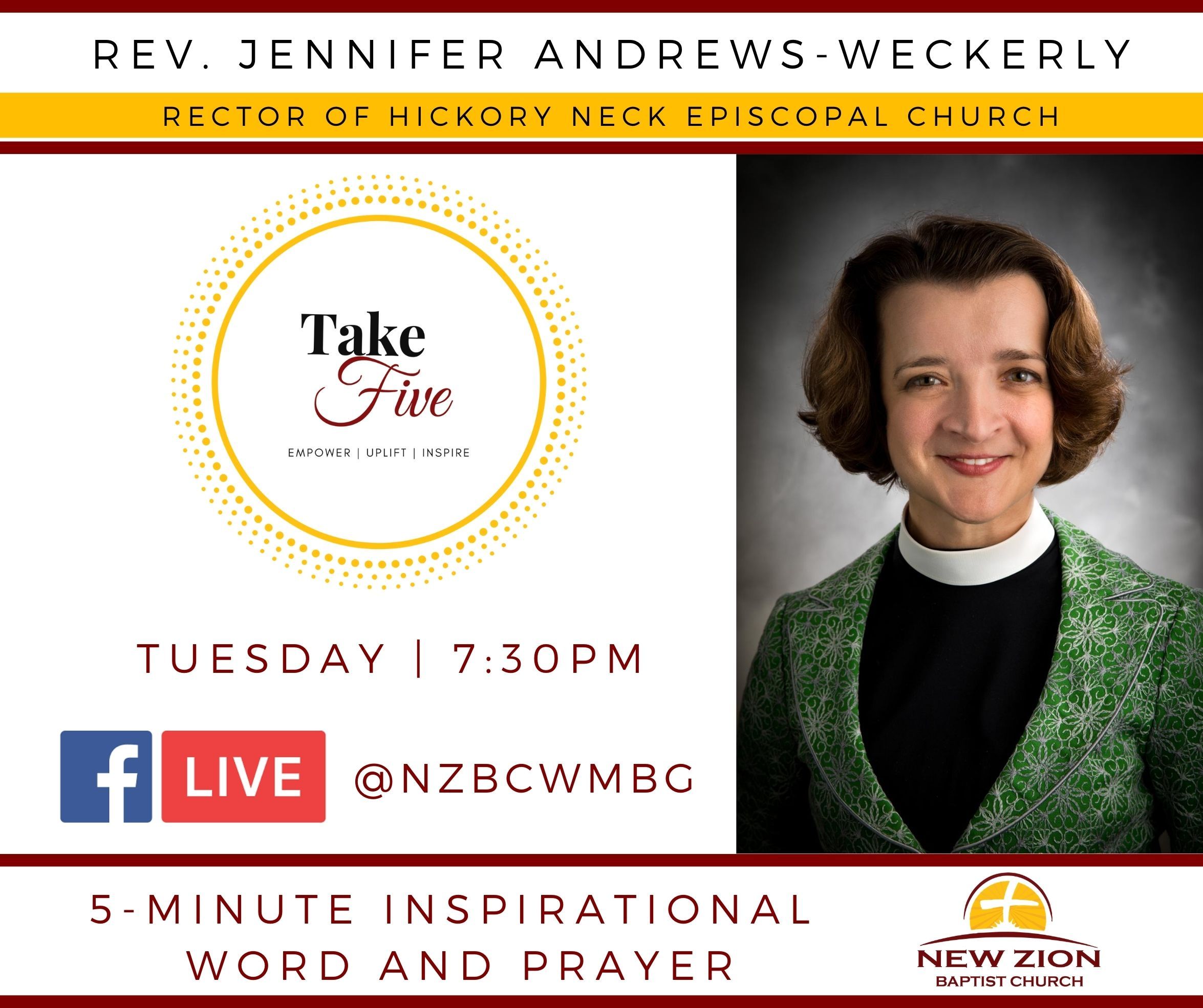
Take Five Speakers-Rev. Jennifer Andrews-WeckerlyThis reflection was offered through the livestream program called “Take Five” at New Zion Baptist Church on July 28, 2020.  This is the text from that talk.

Tonight we turn to Psalm 149, which says, “Praise the Lord.  Sing to the Lord a new song, his praise in the assembly of the saints.  Let Israel rejoice in their Maker; let the people of Zion be glad in their King.  Let them praise his name with dancing and make music to him with tambourine and harp.  For the Lord takes delight in his people; he crowns the humble with victory.  Let the saints rejoice in this honor and sing for joy on their beds.”

Now I know what you may be thinking.  Really?  You want us to talk about praising God?  We’ve got a worldwide pandemic, which our country is becoming one of the worst handlers of in the world, which disproportionately is affecting people of color, and has become so politicized that we are no longer worried about the sanctity of human life, but are instead arguing about rights and the ethics of sacrificing life for some contrived greater good.  Not only that, we are in a crucible around racism, that alternatively gives us great hope for change and makes us despondent about how far we really have to go.  Add to that the emotional, spiritual, financial, and physical toll of this time, a time when we seem incapable of respecting the dignity of every human being, and you want to talk about singing to the Lord a new song?

I don’t know about you, but when I am feeling the weight of the world, and when I am longing for a word from God, an old song is usually where I return.  Every once in a while, when I slow down enough not to just to pray to God, but to actually listen to God, those old timey hymns from my childhood come back.  Their words speak to my ache, or let me wallow in my despair.  They talk about sweet, sweet Spirits, and walks through garden alone with Jesus, and balms in Gilead.  When I talk to Jesus, I want an old song.

But that is not what the psalmist says.  We are not asked to recall the old songs; we are invited to sing a new song.  In fact, seven times in the psalms, we are invited to sing a new song to the Lord.  As a fellow pastor says, “New songs of praise are appropriate for new rescues and fresh manifestations of grace.  As long as God is gracious toward us, as long as he keeps showing us his power, and wowing us with his works, it is fitting that we not just sing old songs inspired by his past grace, but also that we sing new songs about his ever-streaming, never-ceasing grace.”[i]

In this time of utter upheaval, unrest, and unevenness, two things are happening.  One, God is still moving.  The Spirit’s movement may be hard to see or hear in the cacophony of noise.  But I know in talking to New Zion’s leadership, talking to the folks at Hickory Neck Church, and talking to our neighbors here in James City County, Jesus is still moving.  I know that you are finding moments of grace, even in the darkness of this time.  I know that you are seeing shreds of hope, even in what feels like the disappointing failures of our nation.  Two, despite how comforting those old songs are, I am guessing the Holy Spirit has whispering some new songs in your ear.  You may not be sure of the words, and you may be straining to hear the tune.  But in the depths of your heart, where we fear change and we harbor anxiety, we know that only a new song can help get us out of this mess.

So, here’s the good news.  We are not on our own to birth these new songs.  Psalm 40 says, “I waited patiently for the Lord; he turned to me and heard my cry.  He lifted me out of the slimy pit, out of the mud and mire; he set my feet on a rock and gave me a firm place to stand.  He put a new song in my mouth, a hymn of praise to our God.  Many will see and fear the Lord and put their trust in him.”  God put a new song in my mouth, says the psalmist.  Not I, out of my genius, wrote a new song.  Not, I worked hard and put in the time, and out of my labor created a new song.  Not, I listened to what others were singing and sang their songs.  No, the psalmist says, God put a new song in my mouth.  Our invitation tonight is to open ourselves to that new song.  Our invitation is to concede that during this time – a time unlike anything any of us has experienced – God is providing something new – new grace and new songs (which might be even better than that old favorite).  Our invitation tonight is to sing the new song God gives us out in the world – to trust in the wisdom of the words and notes Jesus is giving us and shout them out to a world that desperately needs to hear that new song.

Let us pray.  Holy and creative God, we know that you see our suffering and our cries.  We know that you see us patiently waiting on you to lift us up out of the mud and mire, to put us on a firm place to stand.  Help us to trust that you will put a new song in our mouths – a song to give voice to your ever-streaming, never-ceasing grace.  When we finally hear your new song, help us to sing that song – help us to praise your name with dancing, and make music with tambourine and harp.  Help us to remember that when we sing your new song, we shine your light into the world, helping your transformative, life-giving love take root, and disrupt the injustice of our day.  We praise you, Lord, and we bless you, and we sing a new song with you.  Amen.

[i] David Mathis, “Sing a New Song,” May 4, 2014, as found at https://www.desiringgod.org/articles/sing-a-new-song on July 27, 2020.

Sermon – Luke 2.1-20, CD, YA, December 25, 2019

08 Wednesday Jan 2020

Posted by jandrewsweckerly in Sermons, Uncategorized

≈ Leave a comment

Tags

amazing, Christ Child, Christmas, Christmas Eve, church, glorify, God, love, new, noise, praise, quiet, Sermon, silence, Silent Night, story

This past year I have been learning a lot about Godly Play, the program we use with our smallest children in Sunday School, and more recently, the program we use with the Kensington School too.  At first blush, the program is pretty simple:  we tell Bible stories, using simple props to engage the children visually, we let the children play with the story, and then we wonder about the story along the way.  But when we are telling the story with the Kensington School, we have about fifteen kids, ages two-and-a-half to five years old.  I do not know how much time you have spent with that age group recently, but what that means is working super hard to hold their attention.  Being the loud extrovert that I am, I assumed holding their attention would mean using a loud, commanding voice.  But I have discovered from our seasoned teachers that the opposite is true.  They lower their voices to a slow-paced, almost whisper, and they manage to keep the children on the edges of their seats – as if something amazing is going to happen if they listen really hard.

Oftentimes, when we think of Christmas, we imagine a similar pattern.  When we gather on Christmas Eve, we look forward to savoring the familiar story, imagining being able to hear a pin drop as the beloved story is told again.  Our favorite song on Christmas Eve is usually Silent Night.  The song lulls us to imagining Mary and Joseph blissfully enjoying a silent night of wonder.  But that holy night, and most Christmas Eve services, are anything but quiet.  Bethlehem is inundated with people coming in for the registration.  The fact that there is no room for Joseph and Mary tells us how crowded Bethlehem is.  But Mary and Joseph not only have to tend with homecoming revelers, they also have to contend with the animals over whose abode they have taken.  Add into the mix a screaming newborn, and the idea of a silent night is almost comical.

But Mary and Joseph get even more noise than that.  You see, nearby shepherds hear a cacophony of praise from the heavenly hosts in the middle of the night.  Their night has been anything but quiet too.  Instead of trying to get the animals and themselves back to sleep, they decide to go into town and see this thing which has come to pass.  And so, they spend the night, talking to Mary and Joseph, maybe taking turns trying to soothe the baby Jesus.  When they leave those rudimentary quarters, they leave town praising and glorifying God.  This is no silent night for the shepherds either.

I think that is why I enjoy our celebration on Christmas Day so much.  Silence is in short supply on Christmas Eve.  We sing carols, we hear the giddy laughter of children awaiting gifts, stockings, and cookies, and we chant the mass, singing our traditionally spoken words.  For those of us with small children, even the wee hours of the morning on Christmas Day are loud – filled with cries of elation, joy, and battery-operated toys.  But on Christmas Day, after a noisy night and morning, we make our way to church and find, perhaps for the first time, the silence for which we have been looking.  We do not sing carols.  We do not have to speak over the hubbub of full pews.  Instead we gather in relative quiet, and tell the old story again – but this time with a softness that cannot be found on Christmas Eve.

What I love about finding true silence on Christmas Day is that our morning is structured a lot like I imagine that first holy morning being structured.  Christmas Eve is full of noise – of animals, shepherds, angels, and crying babies.  But that next morning, the dust has settled.  Gone are the shepherds and angels.  The animals have calmed down after too many midnight guests.  I even imagine baby Jesus has given in to sleep, since most newborns get their nights and days reversed for the first few weeks.  Into this relative quiet is when I imagine Mary treasuring all those words and pondering them in her heart.  The night before is just too loud.  The exhausted, travel-weary, physically and emotionally spent Mary gets a moment in the morning to begin to process what God has done in and through her.  After the break of dawn, as the sun rises and the loud revelers and news deliverers have gone, she can have a quiet moment as she rocks or feeds baby Jesus and ponder in her heart this child at her breast.

I do not think that night is silent.  But I understand why our hymnodists would want to talk about silence.  I think that is why I prefer the hymn, “Let all mortal flesh keep silence.”  Instead of depicting a silent night, that hymn invites us to keep silence as a form of reverence.  The first verse says, “Let all mortal flesh keep silence, and with fear and trembling stand; ponder nothing earthly minded, for with blessing in his hand, Christ our God to earth descendeth, our full homage to demand.”  I like the hymn because that is the kind of pondering I imagine Mary does in her heart this morning.  Unlike most new mothers, I do not think she is worried about the impact of birth on her body or even about her humble surroundings.  I imagine her thoughts that morning are consumed with nothing earthly minded.  Instead, I imagine her heart is pondering the blessing of Christ our God descending on earth through her – and the enormity of the event drives her to pay silent homage as she gazes on Jesus’ precious face.

That is what the church invites us to do today as well.  We structure a morning for worship.  The dust of gift wrap, eggnog, and stocking stuffers is settling.  The noise of carols, singing choirs and priests, and antsy children in pews is fading.  The anxiety of preparing for the big event of this day is easing.  And all that is left is a moment to let our mortal flesh keep silent before the Christ Child.  This morning we take a moment to ponder nothing earthly minded, and instead join Mary as she ponders all that has happened in her heart.  We come to church on this holy morning to ponder the miracle of the Christ Child.  We honor the way in which God is ever trying to honor the covenant God has made with us – willing to go to the extreme of taking on human form to care for and preserve us.  Our God’s love knows no bounds.  Humbled by that knowledge, we come to pay God homage.

The question for us in our pondering is what we will do with that love.  Though we make space this morning for silence, we do not remain here all day.  Like any other Sunday, the clergy will dismiss us to go in peace, and serve the Lord.  Anytime we feast at Christ’s table, that is our charge:  to take whatever sustenance we have gained and to go out into the world to do the work that Christ has given us to do.  Certainly that may involve cooking, travel, or more gift giving.  But the news we ponder in our hearts today is much bigger than today.  Today we are commissioned to consider the impact of the birth of the Christ Child on our lives, what our response will be to the God who is so faithful to God’s covenant with us that God would take on human flesh to redeem us.  As our talented Godly Play teachers might pose, I wonder what new work God is crafting in our hearts.  Perhaps this morning, or for at least the next few minutes, you can let your mortal flesh keep silence and ponder with Mary.  And then go out with the shepherds, glorifying and praising God in your work.  Amen.


Sermon – Luke 17.11-19, P23, YC, October 9, 2016

12 Wednesday Oct 2016

Posted by jandrewsweckerly in Sermons, Uncategorized

≈ 1 Comment

Tags

church, compliment, duty, generously, giving, grateful, gratitude, guilt, Jesus, joy, leper, living, obligation, pledge, practice, praise, Sermon, stewardship, Thanksgiving, transformation, turning

I once knew a man who was impossible to compliment.  Whether you wanted to compliment a job well done or good deed, his response was always the same, “It’s not me.  All the glory goes to God.”  His response always left me feeling like I just offered a present that was rejected.  Of course, I totally agreed with what he was saying – none of us is able to do good without the God who empowers us to do so.  And truly, Jesus was not that great at accepting compliments either, especially if you recall all the times he asked people to keep a healing secret or to just go back to work.  But upon receiving a compliment, a simple, “Thank you,” would not have hurt this man.  After a while, I just stopped trying to praise his work or good deeds.

I think that is why I relate to the nine lepers who do not return to Jesus to give him thanks and praise.  There were ten lepers originally – nine who were Jewish and one who was a Samaritan.  We are not sure why the ten are together – the Jews and the Samaritans were enemies and rarely spent time together.[i]  We are told at the beginning of the text that Jesus was passing through a borderland between Samaria and Galilee, so there is a possibility that then ten men banded together through their disease instead of culture.  You see, both Samaritans and those of Galilee would have been seen as impure due to their leprosy.  Being exiled to the borders of their land, they may have found more in common than divided them.  And so, as a group, they shout out to Jesus for healing – careful not to approach him, of course, which would have been improper in their condition.  Respecting their distance, Jesus does not insist they come forward, but instead tells them to go to the priest to show themselves to be healed.  Along the way, they are healed, but they still would have needed to show a priest in order to be restored to their families and friends.[ii]

The Samaritan among them returns and gives praise to God, but the others do not.  We do not know how their journey unfolds.  Presumably they are faithfully doing what Jesus told them to do – going to the priest for restoration.  Perhaps they give praise to God once the priest restores them.  Perhaps they give praise when they are reunited with their families.  Maybe they even show their praise through helping lepers later.  But that is all supposition.  All we get today is Jesus’ criticism of the nine because they neglect to turn and give God praise and thanksgiving.

I have been reflecting on Jesus’ words this week, and what rubs me the wrong way may be the same thing that rubbed me the wrong way when that man I knew always refused praise.  In both cases, whether Jesus, or the man I knew, there is both implicit and explicit criticism of my own practice of gratitude and thanksgiving.  What irritated me about the man’s responses to me was that they made me feel guilty – that perhaps I was not grateful enough to God for the goodness in my life.  The same thing irritates me about Jesus this week – his judgment of the nine makes me feel guilty about the ways I have walked away healed and not given praise to God.

This week we are kicking off our stewardship season in a campaign called, “Living Generously.”  After the service, you will be receiving a packet of information about how you can support the ministry of Hickory Neck, and a pledge card that we will collect in a celebratory ingathering in just four weeks.  Most preachers would have read the text today and thought, “Yes!  The perfect Stewardship text!”  But the more I sat with Jesus’ words, the more I realized that his words actually bring up feelings of dread rather than joy.  Most people associate stewardship with the same sense of guilt that this reading brings up.  We feel guilted into showing gratitude, and so we guiltily look at our budgets and see if we can increase our pledge this year.

The first time I experienced the concept of pledging was when I started regularly attending an Episcopal Church.  In the churches where I grew up, you never had to tell anyone what you were going to give.  The preacher might have talked about a tithe – ten percent of your income.  But the preacher never wanted you to say exactly what you were going to give.  So when the warden of this church started explaining how he wanted us to pledge, I was aghast.  I remember thinking, “That’s private!  I don’t have to tell you how much I am going to give!”  Now, I knew we would probably tithe that year, but the idea of telling someone else about my giving seemed to go against every cultural norm I knew.  Fortunately, I stayed to hear the rest of the warden’s talk.  He explained that the way the church formed the church’s budget was through the knowledge of what income they could expect.  The Vestry would adjust expenses accordingly and try to get the budget balanced.  My outrage faded as I realized how responsible that model seemed.  Thus began my adult journey into pledging.

But that journey into pledging experienced a transformation about eight years later.  We were at a new church, and the priest asked to hold our pledge cards until a particular Sunday.  We did and the funniest thing happened.  In the middle of the service, a banner appeared.  The banner was processed down the aisle, joyful music started playing, and people started following the banner forward.  We placed our pledge in a basket, and I felt something stirring in me.  The priest blessed the pile of pledge cards, and something about stewardship turned in my heart – the pledging, the monthly giving was no longer an obligation or burden – something to be guilted into.  My pledge was a joyful sign of gratitude – a sign blessed by God and affirmed by the community.  And I have to say – it felt good!

In the gospel lesson today, the text says that the Samaritan turns back to Jesus.  That word for turns back is more than just a physical description – the action of turning back is a sign of deep transformation – a reorienting of the Samaritan’s life from duty to gratitude.[iii]  I do not think Jesus was looking for a guilty admission of thanks from the other nine lepers.  What Jesus is looking for is a transformation of the heart – a turning of one’s life away from obligation and duty to joyful gratitude and thanksgiving.

I was reading this week about a woman with an interesting habit.  Whenever someone asked her how she is – that basic question we always ask and anticipate the answer being, “Fine,” – instead she would say, “I’m grateful.”  No matter what is on her plate – stress at work or school, an illness that kept plaguing her, strife at home – her response is always the same, “I’m grateful.”[iv]  As I thought about her response this week, I realized that her response is probably one that took willful practice.  I am sure there were weeks when she really felt grateful.  But there were also probably weeks when she had to say she felt grateful even if she was not sure what there was to be grateful about.  But slowly, slowly, I imagine the practice cultivated a spirit of gratitude.  A practice like that can do exactly what Jesus wants for us all – a turning of the heart to praise and thanksgiving.  I know I will never be able to shift toward the kind of response that the man I knew always gave, rejecting praise altogether.  But learning to say, “I’m grateful,” might be a way for me to get a little closer to the same sentiment.

What that woman is doing, what Jesus is encouraging, and even what our Stewardship campaign is inviting is not a sense of guilt or burden, but a genuine invitation into a life that turns our heart to gratitude and transforms the way we see the world.  Now that does not mean that every time you write the check to fulfill your pledge you will part from that treasure with a joyful heart.  But that practice is a small invitation, every time, for us to turn our hearts and to see not only the God from whom all blessings flow, but to even see the blessings in the first place.  Jesus is not mad at those lepers because they are ungrateful – he is sad for them because they have denied themselves the gift of transformation.  That is the gift that he and the Church offer us every week – the gift of a transformed heart that can change everything.  For that, I’m grateful.  Amen.

[i] Audrey West, “Commentary on Luke 17.11-19,” October 9, 2016, as found at https://www.workingpreacher.org/preaching.aspx?commentary_id=3029 on October 5, 2016.

[ii] Oliver Larry Yarbrough, “Exegetical Perspective,” Feasting on the Word, Yr. C, Vol. 4 (Louisville: Westminster John Knox Press, 2010), 169.

[iii] Margit Ernst-Habib, “Theological Perspective,” Feasting on the Word, Yr. C, Vol. 4 (Louisville: Westminster John Knox Press, 2010), 166.

[iv] David Lose, “Pentecost 21C:  Gratitude and Grace,” October 3, 2016, as found at http://www.davidlose.net/2016/10/pentecost-21-c-gratitude-and-grace/ on October 5, 2016.

Sermon – Acts 16.16-34, E7, YC, May 8, 2016

11 Wednesday May 2016

Posted by jandrewsweckerly in Sermons, Uncategorized

≈ Leave a comment

Tags

Christ, enslaved, faith, freedom, live, Moral Mondays, Paul, power, praise, privilege, protest, Silas, slave, suffering, truth, value, wealth

Thousands of years ago, our people were enslaved.  Once-friendly Egypt got a new pharaoh who saw the sheer number of us, and out of fear, enslaved us.  We lost our freedom, and labored under a brutal new regime.  We longed for better days.  We longed for a return to our homeland, even though our homeland could not have sustained us because of the famine years before.  Every night, our cries went out to God.  One day, God heard us.  God sent us a man by the name of Moses, who dramatically managed to convince Pharaoh to let us go back home.  So we quickly packed our things and ran.  Pharaoh changed his mind and sent his armies after us.  But when we crossed the Sea of Reeds, and Pharaoh’s army drowned, we celebrated.  We were free.

Not long after, the rejoicing stopped.  Freedom did not look like what we thought freedom would look like.  Freedom was hard.  When we were enslaved, we always knew from where our next meal would come.  We knew where we would lay our heads at night.  We knew the routine.  With Moses, we were constantly wandering in the wilderness, wondering where our next meal would come from, searching for water, unsure of what would happen.  Nothing in our journey unfolded as we imagined.  We thought freedom would mean being able to do whatever we wanted, being free of obligation, and not being constrained by anyone or thing other than ourselves.  Pharaoh was admittedly awful, but better the devil you know, right?

Being from a country whose primary value is freedom, sometimes I think we get as confused as our ancestors about what freedom means in the context of being people of faith.  Take our lesson from the Acts of the Apostles today.  There are both people who are free and people who are not.  Those who own the slave-girl are free to collect money for someone else’s performance, and they are free to get someone thrown in jail.  The judges who throw Paul and Silas into jail are also free – free to choose who is punished and who is not.  Finally, we might put the jailer into the free category as well.  He is a man with a steady, respectable job, who has power over those in prison.

Meanwhile, our story has those who are lacking freedom.  The first character we hear about is a slave-girl.  In some ways, this nameless slave is a double slave – a slave to her owners who use her for money and a slave to the spirit of divination inside her.  Paul and Silas also lose their freedom.  They are thrown into jail midway through our story, which clearly puts them in the not-free category.  Plus, the slave-girl calls them “slaves of the Most High God.”

Looking at the characters in Acts, we can see how confusing the definition of freedom can be.  If freedom is a value in and of itself, then the heroes of our story are the slave owners, magistrates, and the jailer.  The owners of the slave girl obviously have social capital and an income source.  They have influence and power, and up until Paul and Silas come along, they have the comforts of wealth.  The judges also have a great deal of respect and power in the community.  They are charged with keeping order in the community and protecting the community’s way of life.  Even the jailer has a clear sense of identity and purpose.  He may not have wealth and prestige, but he has a secure job and a sense of clear identity in the community.

Consciously, we know that we should not identify with these three entities.  But subconsciously, and in a country that does not distinguish between freedom and freedom in Christ, we find ourselves much more aligned with and, quite frankly, longing for the kind of freedom that these three parties have.  Meanwhile, the slave-girl is nothing like what we hope for ourselves.  Being possessed by a spirit and being owned by another individual do not usually make the top of our lists for happiness and fulfillment.  And in no way do we want to be like Paul and Silas, who not only seem to be homeless rebel-rousers, they also are physically brutalized and imprisoned.  We are faithful followers of Christ, but I doubt many of us would take that commitment all the way to jail.

Last week, a friend of mine had that very debate.  She is a priest in North Carolina, and she decided to join the weekly protests that has become known as Moral Mondays.  Moral Mondays have been happening since 2013, as religious leaders and followers across North Carolina have gathered in peaceful protest of the laws being passed that promote unfair treatment, discrimination, and oppression.  Bishop Michael Curry was a frequent protestor and speaker at Moral Mondays before being elected Presiding Bishop.  Last week, my friend decided that she needed to join fellow Christians in protest, but she was uncertain about the possibility of being arrested.  She knew what was happening in the legislature was unjust, but she also had a family and job to think about.  She was unsure about how she could best be of use – by staying long enough to be escorted to jail, or whether her presence at the protest would be enough.

What my friend was on the cusp of understanding is what Paul, Silas, and the slave-girl already know.  The slave-girl already knows the truth that no one else can see – that Jesus is the way to salvation.  And when she shouts that long and loudly enough, she is not only freed of her possession, she is free of the bondage of slavery – because her owners can no longer use her as they did before.  Even Paul and Silas, who are locked in jail, are more free than they seem at first glance.  What person, after being brutally whipped and thrown into a cold cell, can be found praying and singing praises to God in the middle of the night?  Only someone who is so free of the bondage of this world can be able to praise God in the midst of earthly suffering.

If Paul, Silas, and the slave-girl are free, guess who the real enslaved ones in our story are.  Those owners, who seem to have the earthly freedom of wealth, have actually become slaves to their wealth.  They are so enslaved to that wealth that when their source of income is freed, they lash out, bringing pain and suffering down upon others.  They cannot see the gift of freedom and health for the slave-girl; they only see the consequences for themselves.  The magistrates are no freer than the owners.  They are so enslaved to their rigid rules that they cannot see the inherent injustice that the slave-girl has faced for so many years.  Even the jailer is not truly free.  He is so caught up in his identity as a jailer that he is willing to take his life for his job.  He is ready to kill himself for what he thinks is a failure on his part than to see how this job has taken over his sense of identity.[i]

So how do we avoid living like the complaining Israelites, who were physically free, but not yet spiritually free to live as the Lord our God invited them to live?  How do we, in a nation that reveres freedom, avoid being enslaved by the wealth, power, and identity that comes from being free?  The jailer asks the same question to Paul and Silas when he asks, “What must I do to be saved?”  In the paraphrase of our text, Paul’s answer is simple:  Put your entire trust in the Master Jesus. Then you’ll live as you were meant to live.[ii]  Paul and Silas could have easily fled that jail when the earthquake happened.  They could have sped past the jailer, and been focused solely on their own self-preservation.  But we see that there is a peace in Paul and Silas that comes from true freedom – of living how we are meant to live.  Instead of weeping and plotting in that cell, they sing and pray to God.  Instead of running when the doors fling open, they ensure that the jailer is okay.  Instead of demonizing the jailer, they offer him baptism.  This is what true freedom looks like.[iii]

In our freedom, we have become enslaved – in varied and sundry ways, but we are all enslaved by something.[iv]  Paul, Silas, and the slave-girl invite us into another way.  They invite us to live as liberated people who trust in our Lord Jesus Christ.  That true freedom may mean we find ourselves shouting out truth in a peaceful rally.  That true freedom may mean that we find ourselves praising God when no one else is, sacrificing our own comfort so that someone might find theirs.  That true freedom might mean trusting God is acting when we feel like God left the building long ago.  When we claim that freedom, then finally, finally, we will begin living as we were meant to live.  Amen.

[i] David G. Forney, “Pastoral Perspective,” Feasting on the Word, Yr. C, Vol. 2 (Louisville: Westminster John Knox Press, 2009), 526.

[ii] Eugene Patterson, The Message, as found at https://www.biblegateway.com/passage/?search=Acts+16%3A16-34&version=MSG on May 6, 2016.

[iii] L. Gregory Jones, “Come, Lord Jesus,” Christian Century, vol. 109, no. 16, May 6, 1992, 485.

[iv] Ronald Cole-Turner, “Theological Perspective,” Feasting on the Word, Yr. C, Vol. 2 (Louisville: Westminster John Knox Press, 2009), 524.

Sermon – 1 Samuel 1.4-20, 2.1-10, P28, YB, November 15, 2015

19 Thursday Nov 2015

Posted by jandrewsweckerly in Uncategorized

≈ Leave a comment

Tags

anger, God, Hannah, honest, intercession, intimacy, praise, pray, prayer, relationship, Sermon, Thanksgiving, vulnerable

At some point in life, most of us have the experience of having a best friend.  Perhaps we met the person on the playground as a child; maybe we met him in college or at work; perhaps our best friend is a cousin or sibling; or maybe our best friend is our spouse or partner.  Regardless of how we met her, that best friend has seen the best and worst of us.  He has congratulated us when we got a part in the play, when we got a promotion, or when we found new love.  She has consoled us when we failed a test, when our heart was broken, or when a family member died.  He has seen us laugh so hard that we snort or pee in our pants, and he has seen us sob so hard that snot runs down our faces.  She has seen us dressed to the nines, and she has seen us in our stained, ill-fitting sweats.  And our best friend has taken the best and the worst from us too:  we have danced together, yelled at each other, confessed our darkest secrets to each other, and, yes, we have even hated each other at times.  Despite having experienced the very best and very worst of us, we know that she loves us deeply, he always forgives us, and she is always there for us.  The relationship is far from perfect, but the relationship is beautiful.

In many ways, the relationship we have with our best friend is similar to the relationship we have with God.  On our good days, we come to God with our thanksgivings and praise, offering our adoration and humility to God.  On our bad days, we are angry and curse God.  We confess things to God that we confess to no one else:  both those things done and left undone, but also those deep longings and desires that we do not admit to others.  We have cried a thousand tears with God and we have laughed with great mirth.  Although our best friend knows us better than any other human being, God knows even the stuff we are embarrassed or afraid to share with that best friend.  And since our Lord is not human, God’s forgiveness does not know the limits of human forgiveness.  Through the life, death, and resurrection of Jesus Christ, our relationship with other human beings will never quite equal our relationship with God.

Given that intimacy, I am often surprised when people ask me about prayer.  Throughout my ministry I have had people ask me how they should pray, what they should say, or when or where is the best time and place to pray.  I think the challenge is that most of us have some notion of what prayer should look like.  We imagine the pinnacle of brayer being the Zen-like posture of monks in silent prayer.  Or when someone offers a prayer, we assume we should bow our heads, fold our hands, and shush others into silence.  Or when someone asks us to offer the prayer, we scramble to remember common prayer phrases like, “Holy God…Bless us, we pray…you alone are worthy…”  Our prayers sound very little like our everyday speech.  Sometimes, if we are feeling especially uncomfortable, we peek around the room to see what everyone else is doing.  People often ask me how to pray because they do not feel like they are doing it “right,” because their usual method of prayer has become stale or dissatisfying, or because when they pray, God seems far away or even like a stranger.  Or sometimes people come to me about prayer because they are overwhelmed with the suffering of the world:  the poverty, the gun violence, the terror that keeps striking in places like Paris.  How do we pray to God when suffering seems like an endless abyss?

In scripture today, we see Hannah pray twice.  In the first occurrence, Hannah looks nothing like our notions of prayer.  She has been emotionally tortured by Elkanah’s second wife, Peninnah – just like Peninnah does every year when they travel to make their annual sacrifice.  Peninnah is ever fertile and Hannah is barren.  And, probably because Elkanah loves Hannah more, Peninnah throws Hannah’s infertility in her face whenever she can.  Meanwhile, Elkanah is acting like a wounded puppy.  He does not understand why Hannah is so upset – isn’t he enough?  So Hannah escapes to the Temple to pray.  Her prayer is unlikely offered from a pew, while she delicately flips through a prayer book to find some pre-written prayers.  Her prayer is not said reverentially, with a bowed head.  In fact, she does not quietly whisper prayers to God with her eyes closed.  No, when Eli, the temple priest, sees Hannah praying, he accuses Hannah of being drunk in the Temple.  Now I do not know if you have ever been in the presence of a drunken person, but people who are drunk are rarely still and reserved.  No, I imagine Hannah was pacing.  Maybe she was waving her fists at God as the tears spilled down her cheeks.  Maybe there was rage and devastation in her eyes.  The text says that she is silent, but that her lips are moving.  I imagine she was giving God a piece of her mind.  And in fact, the text tells us that she even resorts to bargaining with God – promising to commit his life to the Temple if God gives her a male child.  If Eli thought Hannah looked drunk, the scene could not have been pretty!

The second occurrence of Hannah praying today is found in the Song of Hannah from first Samuel.  Here we see a very different posture of prayer from Hannah.  Instead of ranting and raving in the temple, here we see Hannah giving praise to God for the deliverance of a child.  Hannah is full of gratitude for her own good fortune.  But Hannah’s prayer is bigger than herself too.  She proclaims the Lord to be a liberator – one who frees the oppressed, brings low the privileged, honors the faithful, and cuts off the wicked.  In Hannah’s personal experience with God, she is given a glimpse into the global nature of God.[i]  Hers is revolutionary song because God has heard her prayer and answered her.  We see a very different form of prayer from Hannah the second time than we do from Hannah the first time.

For those of you reading along with A.J. Jacobs’ The Year of Living Biblically, prayer is common topic from the author.  Not a believer himself, Jacobs struggles with prayer.  He does not know what to do or say.  But he feels compelled by the Bible to be in prayer.  One of his spiritual guides suggests that there are four types of prayer – Adoration, Confession, Thanksgiving, and Supplication.[ii]  Jacobs latches on to Thanksgiving at first.  He starts by thanking God for the food that has been prepared, in its many stages.  As he thinks about all the stages – the earth, the farmer, the packager, the person who puts on labels, the grocery stockers, the cashier – his prayer lengthens.  Jacobs also takes on intercessory prayer as a form of prayer – praying strictly for the needs of others.  Jacobs confesses, “It’s ten minutes where it’s impossible to be self-centered.  Ten minutes where I can’t think about my career, my Amazon.com ranking, or that a blog in San Francisco made snarky comments about my latest Esquire article.”[iii]  Slowly, Jacobs’ ideas about and experiences of prayer become transformed.  Prayer is not like what he thought prayer would be like.

That’s the great thing about prayer.  Hannah’s first “drunken” prayer of desperation and self-pity, her second prayer of adoration and revolution, and Jacobs’ ten minutes of intercessions that keep him from being self-centered are totally different.  My prayers in the car on the way to pick up the kids are very different from the prayers our Contemplative Prayer Group offers on Friday nights.  And the prayers of an evangelical pastor, which are accompanied by the creative tinkling of the keyboardist to emphasize and dramatize the preacher’s prayers, are totally different from the chanted prayers of the officiant of Evensong.  There is no single wrong or right way to pray.  And the same person who offers eloquent, beautiful prayers in the day can be the same person who rages against God in the night.

When we allow prayer to be what prayer needs to be, we let go.  Then our prayers become not some preconceived notion of what we think they should be, but become a real conversation between us and the living God.  Whether we are wrapped up in our own suffering, totally ceding our worries to God, or railing at God for the injustice and the inhumanity in this world, something powerful happens in prayer.  Where else can we stomp our feet at God, looking like a drunkard, except at the feet of God?  Ultimately, that is what is most important in our prayer life – being our honest, vulnerable, mercurial selves.  As one priest explains, “…The relationship we’re offered with God is a real one.  A genuine relationship.  The God who made the heavens and the earth wants to know us, and wants us to know [God].  And when we’re excited, we’re to gush out like Hannah breaking out into song.  And when things are falling apart, we’re to gush out like Hannah at Shiloh.”[iv]  God does not care what our prayers look like or even what we say.  God is just glad we show up.  Our invitation this week is to show up.  Amen.

[i] Kate Foster Connors, “Pastoral Perspective,” Feasting on the Word, Yr. B, Vol. 4 (Louisville: Westminster John Knox Press, 2009), 298, 300.

[ii] A. J. Jacobs, The Year of Living Biblically (London:  Arrow Books, 2009), 95.

[iii] Jacobs, 128.

[iv] Rick Morley, “Pouring Out Our Souls – A Reflection on 1 Samuel 1.4-20 & 2.1-10,” November 8, 2012, as found at http://www.rickmorley.com/archives/2052 on November 12, 2015.

Sermon – 2 Samuel 6.1-5, 12b-19, P10, YB, July 12, 2015

17 Friday Jul 2015

Posted by jandrewsweckerly in Uncategorized

≈ Leave a comment

Tags

celebration, church, community, dancing, David, God, grief, hurt, joy, Michal, mourning, praise, restraint, Sermon, silly, social media, sorrow

One of the side bonuses of being a parent of small children is that you have to step up your silliness game.  In general, I am not what most people would call being adept at being silly – I tend to err on the side of being serious and thoughtful.  I am not sure when the loss of silliness happened, but I imagine the loss began as I matured into adulthood.  Even scripture seems to condone this putting away of silliness.  First Corinthians says, “When I was a child, I spoke like a child, I thought like a child, I reasoned like a child; when I became an adult, I put an end to childish ways.”[i]  Most of us embrace the mantra of putting aside childish ways when we mature – except perhaps when we are in the presence of a child.  I learned pretty quickly that harnessing silliness could garner me much parenting success.  Nothing deflates a temper tantrum like a silly face contest.  Nothing distracts a fussy baby like silly noises.  And nothing makes a car of children happier than a parent grooving out to a favorite song on the radio while driving.  Sure, the drivers on either side of the car will look at you like you are crazy – and if you think about them too much, you’ll become too self-conscious to keep up your silly dancing.  But if you can block them out, and dance with abandon, the joy in the car multiplies – and the whole car shakes as you and the children dance in your seats.

Restraint is a value for most of us.  Most of the time, dancing while driving is not really appropriate.  Instead we should be calmly and intently focused on driving.  Most of the time, we expect a certain amount of decorum while working.  The expectations around attire, behavior, and language are quite different at work than they are at home.  And most of the time, we expect a significant amount of restraint from those attending church, especially as Episcopalians.  Though we encourage people to come as they are, there are still certain garments that would raise eyebrows if you wore them to church.  Though we say “Amen,” throughout our services, we have designated times for those amens, and many of us tense up when someone says a spontaneous “Amen.”  Though we often sing songs of praise in church, many of us get uncomfortable if someone embodies that praise, either through clapping, raising their hands, or, heaven-forbid, dancing.

And yet, that is exactly where we find David today in our Old Testament lesson – exuberantly, and without many clothes, dancing before the ark of the Lord.  Before we can understand why David’s actions are so outlandish, we need to understand the fullness of this story.  If you recall, we have been tracking David’s story this summer.  We have seen him from his earliest days, when Samuel anoints him after calling him in from the shepherd’s fields; to his daring battle as a boy with the giant Goliath; to his tenuous relationship with Saul and Saul’s children – who seemed to both love David and fear the threat of David at the same time; to the ultimate demise and death of Saul and Jonathan; and to today’s reading, where David is establishing his rule of the people by bringing the ark of the Lord into the city of Jerusalem – the city of David.  If you remember, the ark of the Lord is known as the container of God’s presence among the people.  They built the ark back in Moses’ day, and most recently, the ark had been stolen by the Philistines.  David retrieves the ark so that the ark can be brought back in the center of the people, marking how David’s rule and God’s presence and favor are tied.[ii]  David’s favor with God leads David to begin his dancing journey of celebration to Jerusalem.

Now lest we think that dancing before the ark is totally normal in those days, we encounter a strange comment by David’s wife, Michal.  The text says, “As the ark of the LORD came into the city of David, Michal daughter of Saul looked out of the window, and saw King David leaping and dancing before the LORD; and she despised him in her heart.”[iii]  You almost miss the line in the long text, but that is partially because we do not get the rest of the story today.  In the verses following what we hear today, David and Michal have a heated conversation about the inappropriateness of a king dancing nearly naked before the common people.  In the end, the text says that Michal never bears a child to David, as if suggesting that she is in the wrong for judging David.

But here this is where I am intrigued.  You see, Michal was the daughter of Saul and the sister of Jonathan, both of whom are now dead.  There is some debate about why Michal despises David,[iv] but I think we must remember that Michal is mourning.  In theory, this is a day for joy, since Michal’s husband is now king.  But Michal has every right to be mourning.  That line, “and she despised him in her heart,” though sharp and jarring, is not unfamiliar to me when I really think about her reaction.

One of the realities of the advent of social media is how quickly news travels.  If you follow social media, you are bombarded with news.  Normally, this is a good thing, because social media allows us to stay in touch with the highlights of friends’ lives from around the world.  Where social media becomes a challenge is when someone is struggling.  I have many friends who have struggled with infertility.  Nothing is worse for someone struggling with infertility than to watch a news feed of friend after friend getting pregnant.  They post the coveted ultrasound picture of a baby.  There are endless congratulations, and follow-up baby-bump pictures.  Everyone is full of joy, except for the person who wants that reality and cannot have it.  Every pregnancy announcement feels like another painful reminder of how you cannot seem to become pregnant.  The same is true about jobs or college acceptances.  The social media community seems adept at celebrating the good, but really struggles with recognizing those who mourn while we simultaneously rejoice.  We prefer to dance instead and forget the bad stuff.

We struggle with that reality in the context of church too.  On our healing prayer Sundays I am acutely aware of that reality.  Though each Sunday is meant to be an Easter celebration, once a month we try to remember how Sunday does not always feel like a celebration.  There are parts of our lives that are not whole or healed.  There are times when we still mourn or long for something else.  There are times when we are just not in the mood to dance, and would much rather have people sit with us in our discomfort than for them to be dancing around praising a God who quite frankly may seem absent, neglectful, or downright mean.[v]

I think that is why I love this story from Second Samuel so much.  When we read about David, we long to be like David – unfettered, totally unself-conscious, and full of joy.  We want to be a people of gratitude, celebration, and praise.  But sometimes, we are more like Michal.  We are not ready for joy, we are not ready for celebration, and we not ready to praise God yet.  And quite frankly, having someone in our face doing just that – or worse, telling us to get over ourselves and start dancing makes us despise them in our hearts too.  But that is what I love about this story.  Michal was not edited out of the story.  This is not a simple story about how we should always praise God.  This is a complex story about how freeing and life-giving praising God can be.  In fact, the joy we get from God can make us dance with abandon, totally liberated from what is socially acceptable.  But, there are also times when we are just not there – and the command to make a joyful noise makes us more angry than willing to yield.  And that’s okay.  Things may not turn out how we want them.  We may need to mourn that reality for a long time.  In this complex reality, the Church stands in solidarity with us all, celebrating what can be celebrated, giving space for hurt and mourning where needed.  We are a community of both Davids and Michals.  And sometimes we identify with one more than the other.  To us all, the Church offers a humble meal, reminding us that there is room for all at God’s table.  Amen.

[i] 1 Corinthians 13.11

[ii] Walter Brueggemann, First and Second Samuel: Interpretation, A Bible Commentary for Teaching and Preaching (Louisville:  John Knox Press, 1990), 250-251.

[iii] 2 Samuel 6.16

[iv] Brueggemann, 251.  Also, see other theories by J. Mary Luti, “Homiletical Perspective,” Feasting on the Word, supplemental essays (Louisville:  Westminster John Knox Pres, 2012), 6.

[v] David G. Forney, “Pastoral Perspective,” Feasting on the Word, supplemental essays (Louisville:  Westminster John Knox Pres, 2012), 3.

Homily – Interfaith Thanksgiving Service, November 26, 2013

27 Wednesday Nov 2013

Posted by jandrewsweckerly in Uncategorized

≈ Leave a comment

Tags

culture, differences, faith, God, interfaith, praise, sacred, secular, Thanksgiving, Thanksgiving Day

I grew up in the South, where being a person of faith meant you were either a Baptist or a United Methodist.  It was not until well after college that I began to meet and really get to know a few individuals of other faiths – learning about both their cultural and religious experiences.  I even had an interfaith clergy support group back in Delaware – during which much of our time was spent discussing differences and similarities in polity and worship.

So I was thrilled when I heard there was an interfaith group here when we moved from Delaware to Plainview two years ago.  I was looking forward to who would be in the room, and finding an instant support group of fellow persons of faith.  So you can imagine my surprise when I, southerner that I was, went to my first meeting and realized that as a Christian, I was a minority in the room.  I do not think I have ever been in a room of clergy when I felt like there were significant portions of the conversation that I just did not understand – whether it was a particular holiday, a way of doing business, a language barrier, or knowing what to order at Ben’s.  I had always thought that interfaith differences were not that significance – if we are all persons of faith, surely that identity creates enough common ground for us to work together.  But the truth is that among the clergy, and perhaps among you as persons of faith, we are so steeped in our religious identity and culture, that we forget how particular that experience is to us – and how foreign that experience is to others.

That is why I love this service so much.  We have found a holiday that we as Americans can all recognize and celebrate – regardless of our faith background.  And yet, we as a community of faithful people gathered here tonight claim this day not as just a secular day to eat copious amounts and gather with family and friends, or even a day we can all commonly agree upon because we are Americans.  We claim this day as a sacred day – because we know that true thankfulness belongs to God – the source of sustenance and life itself.  In the Episcopal Church, we have a special liturgy set aside for Thanksgiving Day.  I never knew that until I became a priest.  In fact, at my first cure, I remember learning about the service and being totally annoyed, thinking, “What, I have to work on Thanksgiving too?!?”  But after my first Thanksgiving service, I knew why the Episcopal Church had set aside time for worship:  because the world around us tries fill this day with “stuff” other than true thanksgiving.  We slave over food, we fret about misbehaving family members, we jostle for position around the TV for the Macy’s parade or the football game, and some of us even go out shopping, especially as the stores try to lure us out of our homes to spend money.

But the community of faith makes another way for us.  The community of faith says that if we are going to dedicate an entire day to thanksgiving, let’s talk about what giving thanks is really about – to whom we really need to give thanks.  Tonight, we turn to scripture.  The palmist says, “It is good to give thanks unto the Lord, and to sing praises unto Thy name, O Most High.”[i]  We say together, “Praise God!  Bless God’s name!  For God is good; God’s steadfast love, [God’s hesed] is eternal; God’s faithfulness is for all generations.”[ii]

To be honest, praise and thanksgiving is not necessarily something that we are always good at doing.  We are really good at complaining to God, or asking God for things, or worrying to God.  But we often forget to truly praise God, to thank God for God’s abundant love and faithfulness.  I am not sure if our prayers to God tend toward being self-centered or we just are simply a culture who tends to complain or want something from God.  And I am not saying those kind of prayers do not have a time and place.  Our God can take all of that from us and more.  But when we turn our prayers to prayers of thanksgiving, we may be amazed at how we, and all that we are worried about, are transformed.  Centering ourselves in gratitude and thanksgiving puts even the direst of situations in perspective.  We remember not only that God is with us, but we also see those around us differently.  Our hearts grow in love and compassion simply by praising and thanking God.

Of course, there are practical implications to giving thanks to God.  Somehow that annoying uncle or nagging mother seems a lot more lovable when our hearts are rooted in this kind of thanksgiving.  Somehow that fallen soufflé or that dry turkey seems much less important than the fact that we have food at all – let alone shelter, warmth, and electricity.  That is the power of thanksgiving for us as a community of faith.  When we turn to God, from whom all blessings flow, we turn our hearts toward generosity as well.  We find ourselves buying extra food to feed our neighbor.  We find ourselves making time to serve others – whether making peanut butter and jelly sandwiches with our interfaith brothers and sisters, or in some other way.  We find ourselves focusing less on ourselves, and more on the wonderful creation God has given to us – and in turn we find ourselves much more well-taken care of than when we were wrapped up in ourselves.

And so tonight, we set the tone for this national holiday.  We proclaim a true day of Thanksgiving – for the abundance of food, for the privilege of rest, for the blessing of life – but mostly for the God that gives us such life, who cares for us more than we deserve, and who loves us more than we can imagine.  We give thanks for a God beyond our full comprehension or knowing, and we give thanks for the interfaith community who, despite all our differences, collectively reminds us to whom we belong.  May your Thanksgiving holiday be a sacred time with the God who created you, sustains you, and loves you.  Amen.


[i] Ps. 92.1

[ii] Ps. 100.4-5

← Older posts

Recent Posts

  • On the Myth and Magic of Advent…
  • On Risking Failure and Facing Fear…
  • Sermon – Luke 23.33-43, P29, YC, November 23, 2025
  • On Inhabiting Gratitude…
  • Sermon – Luke 20.27-38, P27, YC, November 9, 2025

Archives

  • December 2025
  • November 2025
  • October 2025
  • September 2025
  • August 2025
  • July 2025
  • June 2025
  • March 2025
  • February 2025
  • December 2024
  • November 2024
  • October 2024
  • September 2024
  • August 2024
  • July 2024
  • June 2024
  • May 2024
  • March 2024
  • February 2024
  • January 2024
  • December 2023
  • November 2023
  • October 2023
  • September 2023
  • August 2023
  • July 2023
  • June 2023
  • May 2023
  • March 2023
  • February 2023
  • January 2023
  • December 2022
  • November 2022
  • October 2022
  • June 2022
  • May 2022
  • January 2022
  • December 2021
  • November 2021
  • October 2021
  • September 2021
  • August 2021
  • June 2021
  • May 2021
  • April 2021
  • March 2021
  • February 2021
  • January 2021
  • December 2020
  • November 2020
  • October 2020
  • September 2020
  • August 2020
  • July 2020
  • June 2020
  • May 2020
  • April 2020
  • March 2020
  • February 2020
  • January 2020
  • December 2019
  • November 2019
  • October 2019
  • September 2019
  • August 2019
  • July 2019
  • June 2019
  • May 2019
  • April 2019
  • March 2019
  • February 2019
  • January 2019
  • December 2018
  • November 2018
  • October 2018
  • September 2018
  • August 2018
  • July 2018
  • June 2018
  • May 2018
  • April 2018
  • March 2018
  • February 2018
  • January 2018
  • December 2017
  • November 2017
  • October 2017
  • September 2017
  • August 2017
  • July 2017
  • June 2017
  • May 2017
  • April 2017
  • March 2017
  • February 2017
  • January 2017
  • December 2016
  • November 2016
  • October 2016
  • September 2016
  • August 2016
  • July 2016
  • June 2016
  • May 2016
  • April 2016
  • March 2016
  • February 2016
  • January 2016
  • December 2015
  • November 2015
  • October 2015
  • September 2015
  • August 2015
  • July 2015
  • June 2015
  • May 2015
  • April 2015
  • March 2015
  • February 2015
  • January 2015
  • December 2014
  • November 2014
  • October 2014
  • September 2014
  • August 2014
  • July 2014
  • June 2014
  • April 2014
  • March 2014
  • February 2014
  • January 2014
  • December 2013
  • November 2013
  • October 2013
  • September 2013
  • August 2013
  • July 2013
  • June 2013
  • May 2013
  • April 2013
  • March 2013
  • February 2013
  • January 2013
  • December 2012
  • November 2012
  • October 2012
  • September 2012

Categories

  • reflection
  • Sermons
  • Uncategorized

Meta

  • Create account
  • Log in
  • Entries feed
  • Comments feed
  • WordPress.com

Blog at WordPress.com.

  • Subscribe Subscribed
    • Seeking and Serving
    • Join 394 other subscribers
    • Already have a WordPress.com account? Log in now.
    • Seeking and Serving
    • Subscribe Subscribed
    • Sign up
    • Log in
    • Report this content
    • View site in Reader
    • Manage subscriptions
    • Collapse this bar
 

Loading Comments...