• About

Seeking and Serving

~ seek and serve Christ in all persons

Seeking and Serving

Tag Archives: presence

On the Joy of It Not Being about You…

28 Wednesday Aug 2024

Posted by jandrewsweckerly in reflection

≈ 1 Comment

Tags

blessing, community, death, dementia, gift, God, illness, Jesus, joy, light of Christ, peace, presence, visit

Photo credit: https://wexnermedical.osu.edu/blog/visit-someone-in-hospital

One of the privileges of the work I do are visitations.  On countless occasions I have visited someone approaching death, someone in the throes of dementia, or someone just bone-weary with illness, and the immediate response when I walk in the door is a huge smile and the lightening of their countenance. 

I am very clear what that reaction is not.  It is not about me:  I have come to understand that the reaction is much more about the collar I wear and associations that collar has with a beloved church community.  It is also not about me bringing God to the room:  God is already there – my presence just sometimes helps people remember that fact.  And the reaction is definitely not about what I bring:  my visit will not physically change the pending death, the continued dementia, or the ongoing suffering – my work is much more about helping the individual find peace and a sense of connection to God in what can feel like a desert.

Despite all the things those smiles and lighter countenances are not, there is still a shared joy in them.  As the parishioner is reminded of God’s grace and love, so am I.  I too take joy in how being a part of a community can make me feel whole.  I too marvel at God’s presence that has gone before me.  I too can receive the peace of Christ in those desert places.  The gift of the visitation is not just for the visited.  The gift is also to the visitor.

I wonder what ways God is inviting you to be that smile and lightened countenance for others.  As schools restart, I see overwhelmed, weary parents, children, and teachers trying to adjust.  As individuals struggle financially, I see the defeated feelings that manifest themselves in hunched body postures and the diminished capacity for hope.  As a caretaker sits through another appointment or misses another engagement, I see a fatigue unlike any other.  To whom is God inviting you, in your daily journey, to be the light of Christ – to be the reminder that God is already there, that a community awaits, and that glimpses of peace can be found?  It is not about you, to be sure.  But you will be blessed as you do the work of blessing too. 

On Ferry Rides and God…

01 Wednesday May 2024

Posted by jandrewsweckerly in reflection

≈ Leave a comment

Tags

control, ferries, ferry, gift, God, gratitude, Jesus, moment, presence, productive, sacred, senses, thanks, time, travel

Photo credit: https://www.vdot.virginia.gov/about/our-system/ferries/

Yesterday I attended a meeting that requires riding a ferry to attend.  I have always found the ferry a bit of a nuisance.  If timed incorrectly, one can spend almost thirty minutes just waiting to board the ferry.  But even timed correctly, once upon ferry, one must sit for the twenty-minute ride – certainly progressing toward the destination, but not nearly as quickly as it feels when driving.  Something about the taking the ferry feels like a mandatory suspension of time and progress. 

Knowing that reality, I try to plan ahead – with a call to make, emails to read, or a podcast to finish.  I talked to a fellow traveler who has young children at home who used the twenty minutes for a coveted power nap.  And certainly, when I have traveled with my own children, one has the opportunity to go to the upper deck and take in the wonder of creation – an imposed moment of awe and wonder.

Thinking about the various ways one occupies oneself on the ferry had me thinking about the gift of time.  My method of busying myself on the ferry is certainly one of attempting to master control of the uncontrollable.  That mother of young children saw the gift of time as just that – a blessed gift she had not realized she needed.  And my children remind me that every moment is ours to steward – that productivity might include making room for the sacred too – that the sacred might feed my moments of productivity just as much as powering through times of tangible productivity.

I wonder what moments God is gifting you today.  Sometimes our schedules are so full, we may believe that there is no room for a “God moment.”  But that is the funny thing about God.  God permeates all our moments – being there when we are hustling to make a deadline, there when our child is seeking care and compassion – or even just a ride from practice, there when the aging customer in front of us needs a little assistance, and there when a blue bird flutters by seeking the creation we rarely notice.  How might you adjust your senses today to acknowledge the sacred all around you?  How might you give thanks and gratitude for God’s blessings so easily unnoticed?  My prayer is for your awakened senses to the blessing of God’s presence today.

Sermon – Exodus 1.8-2.10, P16, YA, August 27, 2023

30 Wednesday Aug 2023

Posted by jandrewsweckerly in Sermons

≈ Leave a comment

Tags

act, chaos, defiance, fear, forefathers, foremothers, God, good, Miriam, Moses, Pharaoh, presence, Puah, Sermon, Shiphrah, women

This likely comes as no surprise to you, but I come from a long line of strong women.  My paternal grandmother, the matriarch of the family, was so intimidating that most of us grandchildren were a little bit afraid of her.  But she was likely the only minister’s wife of her time who refused to play the stereotypical minister’s wife role, teaching one parish after another how to respect her personhood.  My maternal grandmother was widowed when she had five young children.  I knew her as a gentle, kind soul, but I know she must have been tough as nails to survive that time as a struggling single mother in the rural south.  My mother, who had to restart her own business every time my father was assigned to a new church, managed to help her children and herself thrive in every new place she was planted.  I, in my wisdom, married a man who also came from a long line of strong women – independent, fierce, wise women who navigated all sorts of challenges.  I suppose I should be grateful then for the fierce, smart, sometimes annoyingly stubborn young women we are raising in our own home.  I keep reminding myself that they come by their strength honestly.

But the story from Exodus today reminds us that we all come from a long line of strong women.  We all know the story of one of our most prominent forefathers, Moses.  Saved from a ride in a river basket, called by a burning bush, reigning down plagues until God’s people are freed from slavery, walking God’s people through the Red Sea, guiding the Israelite’s to the Promised Land, delivering our foundational Ten Commandments, and even appearing to Jesus on the Mountain of the Transfiguration.  But Moses would not be any of those things but for the strong five women we hear about today.

Before we hear Moses’ story, today we hear the story of his foremothers.  The reading from Exodus starts ominously, “Now a new king arose over Egypt, who did not know Joseph.”  In other words, the new king, the new pharaoh, does not know the story of how Joseph saved Egypt from famine, and began a symbiotic, peaceful relationship with the Israelites.  Now, the new pharaoh only sees the sheer number of foreigners on his land and he is afraid.  He is afraid they will revolt; he is afraid of their strength in numbers; and in his fear he introduces chaos:  enslavement, oppression, and murderous, violent death.[i] 

In the midst of the chaos and violence Pharaoh causes for the Israelites, two midwives, Shiphrah and Puah, change the course of an administration.  Pharoah calls these two women – women who would normally never even meet a man of such power and influence – to conspire with him for evil.  Doing anything other than his wishes would surely result in not only their own deaths, but also maybe the suffering of their families and loved ones.  But Shiphrah and Puah – who if you notice the text lists by name, while leaving the pharaoh unnamed (a biblical signal of importance)[ii] – Shiphrah and Puah decide they will defy the pharaoh, refusing to murder the male children of the Hebrews.  But not only that, when the pharaoh calls them back into his presence, the women do not cave under pressure, or even seem to be afraid of Pharaoh. Instead, they defy Pharaoh again, making up some crafty story about Hebrew women’s vigorous birthing practices, manipulating pharaoh’s stereotypes and fears of the Hebrews to save children’s lives.

But they are not the only women standing up to the power of Pharaoh.  Moses’ mother knows all Egyptians have been told to cast male Hebrew babies into the Nile.  So, she builds a water-tight basket to shield her son, refusing to cast him off without protection.  Meanwhile, Moses’ sister Miriam refuses to stand by idly either.  She follows her brother’s path, ready to defy Pharaoh too.  Even the pharaoh’s own daughter, who acknowledges Moses must be a Hebrew child condemned to death, refuses to participate in her father’s violence and fear.[iii]  When lowly, seemingly powerless Miriam boldly approaches the royal suggesting a Hebrew woman nurse the child, Miriam secures Moses’ well-being and buys their mother 2-3 more years of relationship before Moses will be adopted into safety.[iv]  Miriam, Moses’ mother, and the pharaoh’s daughter all defy Pharaoh in unique ways.  Without any one of these women’s actions, Moses as we know him today would not exist.[v]  In fact, without any of these women’s defiance, none of us as the people of God would exist today. 

I do not know what kind of chaos to which your life is subject.  I do not know in what ways you may be feeling powerless or incapable of making a difference.  I do not know what fears – sometimes legitimate, life-threatening fears – you are facing today.  But what I can tell you is you are not powerless or incapable of making a difference.  Your fears are not experienced without the presence of God.  And your life has the capacity to be history altering – even if you feel like what you are doing is only one tiny act of change or defiance of the power of evil in the world.  Pharaoh underestimates “…the power of God to work deliverance through the vulnerable – and seemingly powerless – on behalf of the vulnerable.”[vi]  But you, you come from a long line of powerful women.  God is with you as you harness their power for good.  Amen.


[i] Terence E. Fretheim, Exodus:  Interpretation:  A Bible Commentary for Teaching and Preaching (Louisville:  John Knox Press, 1991), 28

[ii] Alice Ogden Bellis, Helpmates, Harlots, and Heroes:  Women’s Stories in the Hebrew Bible (Louisville:  Westminster John Knox Press, 1994), 100.

[iii] Jacqueline E. Lapsley, Whispering the Word:  Hearing Women’s Stories in the Old Testament (Louisville:  Westminster John Knox Press, 2005), 77.

[iv] Lapsley, 78.

[v] Bellis, 101.

[vi] Lapsley, 74.

Sermon – Acts 1.6-14, E7, YA, May 21, 2023

30 Tuesday May 2023

Posted by jandrewsweckerly in Sermons

≈ Leave a comment

Tags

absence, anxiety, apostles, Ascension, experience, focus, God, Holy Spirit, intimacy, Jesus, presence, sabbatical, Sermon, staring, temptation

One of my favorite videos on YouTube is an experiment by the group called SoulPancake.  They asked six pairs of individuals, in various stages of relationship (from total strangers to a couple who has been married 55 years) to sit in two chairs facing one another, and without speaking, look into one another’s eyes for four minutes.  At first the couples are a bit uncomfortable – initially unsettled by the forced silence, but ultimately jarred by what they quickly realize is deep intimacy.  Slowly over the four minutes the couples settle in, their faces transforming from discomfort to curious to deep connection.  You can almost see the sparks of love emerging in their eyes, tension draining from their bodies, and invariably smiles of appreciation spreading across their mouths.[i] 

When Willie James Jennings writes about the ascension of Jesus, one his primary concerns is that in focusing on the heavens, where Jesus used to be, the disciples will forget to focus on one another, on the stranger in need of witness, and on the presence of God.  Jennings worries that the disciples are looking “into the heavens concerned by absence rather than looking forward to see presence.”[ii]  The text from the Acts of the Apostles tells us of the last earthly day of Jesus’ post-resurrection life.  Jesus gives the disciples a commission and is lifted up into the clouds and whisked away.  The text tells us the disciples do exactly what you might imagine – they stand there, staring at the heavens.  I imagine that standing and staring had several iterations:  there was likely the stunned awe of the moment; there may have been some not wanting to leave for fear of missing what might happen next; there may be some immediate second guessing about what this all means; there may be some Peter-esque desire to preserve the sacred location of the profound moment; there may be a sense deep grief, or conversely a sense of profound joy.  Whatever those disciples are doing, they are not at all doing they are supposed to do.  Hence the men in white robes asking their very basic question, “Why do you stand looking up toward heaven?”

You and I are about to engage in the profound and infrequent journey of sabbatical.  The temptations in this time are many.  For either of us, we could easily see this as twelve weeks of frozen time – where we will each gaze upon God, and then simply pick up where we left off in August.  For either of us, we could be prepared to happily engage in sabbatical activities, absorbed in our own mountaintop experiences, forgetting the journey of the other.  For either of us, we could be guided by fear, burying our talent like in the parable in Matthew – just hoping not to risk doing sabbatical the “wrong way” instead of investing our talents to see what return we gain. 

But there is danger in looking up in the heavens into absence as opposed to looking forward to presence.  Alan Hirsch tells us, “the biggest blockage to the next experience of God is often the last experience of God, because we get locked into it.”[iii]  [repeat]  What those men in white knew was that if the disciples stood there lost in themselves or even in the ascended Jesus, they would never get their next experience of God – they would get so locked into the mountaintop experience of Jesus’ ascension, that they would never make their way to the next experience of God – in their case the great gift of the Holy Spirit on Pentecost.

That is our invitation today.  As we stand on the precipice of sabbatical, maybe as we are still reveling in the memory of an outstanding parish-wide retreat this weekend, or wondering what sabbatical activities we want to try, or even feeling a bit of anxiety about what is next, a great whispering is happening nearby, “why are you standing looking up toward heaven?”  Our invitation instead is to resist letting our next experience of God be our last experience of God.  Our invitation is to gather in these next weeks in prayer and community, knowing that the Holy Spirit will do a new thing in all of us.  Our invitation is to walk down the mountain and into the valley of witnessing the gospel of Jesus, looking forward not only for the presence of God, but gazing deeply into the eyes of others.[iv]  This time of sabbatical is not a time to marked by absence, but instead is a time looking forward to see presence.  We can only see that presence if we pull our eyes from heaven and gaze into the sacred we find in one another.  The next experience of God promises to be greater still than our last experience of God.  I can’t wait to hear all about your next experience.  Amen.


[i] Georgia Koch, “How To Connect With Anyone,” SoulPancake, February 12, 2015, as found at https://www.youtube.com/watch?v=Xm-T3HCa618 on May 20, 2023.

[ii] Willie James Jennings, Acts:  Belief:  A Theological Commentary on the Bible (Louisville:  Westminster John Knox Press, 2017), 19-20.

[iii]  Alan Hirsch and Rob Kelly, Metanoia: How God Radically Transforms People, Churches, and Organizations From the Inside Out (Cody, Wyoming:  100 Movements Publishing, 2023).

[iv] John S. McClure, “Homiletical Perspective,” Feasting on the Word, Yr. A, Vol. 2 (Louisville:  Westminster John Knox Press, 2010), 525.

On Pandemics, Rollercoasters, and God…

23 Sunday Jan 2022

Posted by jandrewsweckerly in reflection

≈ Leave a comment

Tags

compassion, coping, emotions, God, pandemic, presence, productive, rollercoaster, tender, thrive

Photo credit: https://theinconstantmuse.com/2016/07/27/rollercoaster-ride/

One of the habits this pandemic has cultivated is thriving in survivalist mode:  dealing with the thing in front of you, then moving to the next, until all the “things” are done.  This requires shelving one’s emotions for another time because they get in the way of what needs to be done.  This kind of operating can be intoxicating because there is a rush that comes from accomplishing things when times are hard – acknowledging that despite how hard things are, you are still being productive and useful.  It can be a useful skill, but a habit that cannot be sustained long-term.

Nowhere have I felt that reality more than in this last week.  In the course of one single week I conducted a funeral for a one-month old infant, I joyfully celebrated the baptism of two life-giving children (one infant and one preschooler), I received the shocking news that my beloved barre and yoga studio would be closing in 24 hours (a place that has been a source of joy, friendship, and health for five years), our family entered into quarantine as we finally succumbed to COVID (we’re all fully vaccinated and boosted), which involved postponing countless major and minor events at church, and finally, learned that a dear friend who is younger than we are was gravely ill from long COVID.  It was not until the end of the week, when COVID finally slowed me down that I realized what a rollercoaster of a week it had been emotionally.

Truth be told, the life of a pastor is regularly a rollercoaster like this.  I frequently have back-to-back meetings:  one for a couple preparing for marriage and one for someone facing divorce.  I can have back-to-back visits:  one for a family with a newborn and one for someone on Hospice.  Even Holy Week has Good Friday and Easter Sunday within days of each other.  Emotional whiplash is a regular occurrence in this field.  But in some ways, the disadvantage of this pandemic is that we all seem to be living in a constant emotional rollercoaster.  You may have read my litany of the last week and thought, “Seems like a typical week in COVID!” 

My prayer for all of us during this rollercoaster of a time is that we be tender with one another.  When we hear good or hard news, remember there are a lot of other things going on in the background – family who cannot be there, conflict among neighbors, or even happy news that seems inappropriately timed.  But especially remember to be tender with yourself.  If you need to congratulate yourself for just surviving and being productive, do it.  If you need to wallow or cry, do it.  And in case you cannot feel it or have lost touch with your relationship with God, remember God is with you in the midst of it all, being more tender with us than we could ever be to ourselves or others.  My prayer is that you feel God’s presence this week.

Sermon – Matthew 10.40-42, P8, YA, June 28, 2020

01 Wednesday Jul 2020

Posted by jandrewsweckerly in Sermons, Uncategorized

≈ Leave a comment

Tags

Bible, Christ, covenant, disciple, God, hospitality, Jesus, love, mirror, missionary discourse, pandemic, power, presence, Sermon, vulnerability

This summer, several parishioners are participating in our 90-Day Bible Reading Challenge.  In supporting each other in our reading, one of the patterns we have noticed is the break-neck pace of reading twelve pages a day means we do not have a lot of time for traditional Bible Study – looking at the original Hebrew or Greek, discerning the historical context of the book, studying the cultural norms of the community, or even delving into the literary devices of the book.  Instead we are drinking from the fire hose of Scripture – capturing the larger narrative God’s covenantal relationship with humankind, but not indulging in the intriguing details.

With a passage like the one we hear in today’s gospel from Matthew, we could easily do the same.  There are only three verses in the text, and they are somewhat repetitive in pattern.  A quick skim brings up an old adage we have learned by heart – welcome the stranger because you may be welcoming Christ himself.  Maybe your mind immediately leapt to a time you saw Christ in a stranger.  Maybe you began thinking about the ministry of hospitality, particularly how strong that ministry is at Hickory Neck.  Maybe you even started to wonder what you could do to be more hospitable, especially during this time of social distancing.

But here’s the thing:  when we slow down our reading, we realize Jesus does not say, “whoever welcomes the stranger welcomes me.”  Jesus says, “Whoever welcomes you welcomes me…”  Often when we think of hospitality, we think of hospitality from the perspective of the host.  Whether we acknowledge the reality or not, we are people of power and privilege, and our notion of hospitality is rooted in how we can offer hospitality to others.[i]  There is nothing inherently wrong with this dynamic – in fact, our sense of obligation to offer hospitality is an answer to Jesus’ call to love neighbor.  But Jesus is not talking about offering hospitality to others from a position of power.  Instead, Jesus is inviting us to give up power and receive others’ hospitality.

If you remember, we have been in the midst of Jesus’ Missionary Discourse[ii] the last several weeks.  Jesus told the disciples to go out, without resources, to do the work of discipleship.  He warned them they would face persecution, and family members would turn against one another.  And today, as Jesus concludes his discourse, he tells them whoever welcomes them, welcomes Jesus.  So not only are the disciples to make themselves vulnerable to the hospitality of others, they will be mirroring Jesus to others.  In other words, in every moment, every interaction, every relationship, encounter, conversation, and conflict among the disciples –the disciples will be witnessing Jesus.[iii]

I do not know about you, but that is a lot of pressure.  Making oneself vulnerable is hard enough.  Making oneself vulnerable means opening up all our flaws, weaknesses, and doubts.  And now, Jesus is saying while we are vulnerable, our homes, our marriages, our workplaces, our extended families, even our friendships are windows into Christ for others.  As Debie Thomas asks, “When we know Jesus is visible in and through us at every moment…[will] we tread more lightly on the earth?  Speak less and listen more?  Reconsider our grudges and grievances?  Choose our words with greater care?  Examine our motivations more closely?”[iv]

There is a lot about this pandemic that has been absolutely awful – devastating, painful, and full of death.  But one of the things that has happened to Hickory Neck in this pandemic represents new life too.  Before we closed our buildings in March, we offered hospitality from our comfort zone – hospitality unparalleled once you walked in those doors – hospitality that made most of us join this church.  But once we moved everything online, the doors and walls of this place lowered – we went out, showing who we are and what we are about to a much broader audience.  Here in this exposed setting, we are carefully, thoughtfully, intentionally showing others what Jesus looks like.  The work is hard and scary, but the reward is great too.  In letting down our walls, we are helping people to see Christ – the same Christ who redeems us, gives us strength, and makes us whole.  But the work of discipleship is not just happening on livestream.  I see this work happening in you – as you call to check in on people in the parish you have not met before because you attend a different service, as you don a mask and attend a rally in support of our African-American brothers and sisters during this raw time, and as you have socially-distanced conversations with neighbors about the power of Christ in your life.  The promise Jesus made at the beginning of his Discourse is still lingering today.  Christ is with us always, even to the end of the age.  His promised presence will allow us to keep letting down walls and being Christ’s mirror in the world.  Our job is to take up the challenge we will hear in our dismissal today:  Go.  Receive God’s love and hospitality.  Serve the Lord as Christ’s mirror.  Amen.

[i] Debie Thomas, “Welcome the Prophet,” June 21, 2020, as found at https://www.journeywithjesus.net/lectionary-essays/current-essay on June 26, 2020.

[ii] Eugene Eung-Chun Park, “Exegetical Perspective,” Feasting on the Word, Year A, Volume 3 (Louisville:  Westminster John Knox Press, 2011), 189.

[iii] Thomas.

[iv] Thomas.

On Being Still…

11 Wednesday Dec 2019

Posted by jandrewsweckerly in Uncategorized

≈ Leave a comment

Tags

Advent, church, consume, God, presence, quiet, resources, still, stress, the Lord, time, watch

advent-candles-2-727x409

Photo credit:  https://www.atonementfriars.org/second-week-of-advent-in-home-retreat/

One of the things I regularly try to teach and model for our family and parish is the value of reining in consumerism during Advent.  It is so easy to get caught up in all the things we want to get our loved ones – creative, funny, thoughtful gifts to show our family, colleagues, and friends how much we appreciate them.  But too often we spend too much, straining our budgets and our emotions instead of creating the spirit of joy giving the gifts intended.

This Advent, I have noticed the same pull happens with our time during Advent.  Between shopping, work parties, school-related events, performances, and community events, we could be busy from sunup to sundown every weekend in December, not to mention weeknights.  Just this past weekend in our town, there was a parade in the morning, events all day, a boat show in the evening, and fireworks on the second evening.  There is a constant invitation to allow our time to be consumed, just like there is an invitation to allow our financial resources to be consumed.

So this past weekend, we chose one thing.  Just one out of the four or five things we wanted to do.  And you know what happened?  Nothing!  We reveled in the one event, savoring and enjoying it.  And then we rested.  We came home and trimmed the hearth, spent time together, and took naps.  It was glorious!

Every year, the church invites us into a quiet, reflective Advent.  Every year it sounds awesome.  I get devotions, or activities to center the family, and about half-way through Advent we fizzle out because we are so exhausted from the running and stress.  It wasn’t until this year, having taken the quieter weekend option that I realized what the church (and yes, even me from the pulpit!) has been inviting us to do.  Be still.  Keep watch.  Take rest in the Lord.  Not just for an hour on Sunday, but the whole of Advent.  How might you make space this year, say “no” to a few things, spend less, and just be still, alert for the presence of God acting in your life?  I suspect if you do, your new favorite season might just become Advent!

GC79: Prayer and Presence

13 Friday Jul 2018

Posted by jandrewsweckerly in Uncategorized

≈ Leave a comment

Tags

asylum, Detention, families, General Convention, God, Hutto, immigration, isolation, prayer, presence, women

36853368_10157022959522565_1614959607975772160_n

Photo credit:  Jennifer Andrews-Weckerly (reuse with permission)

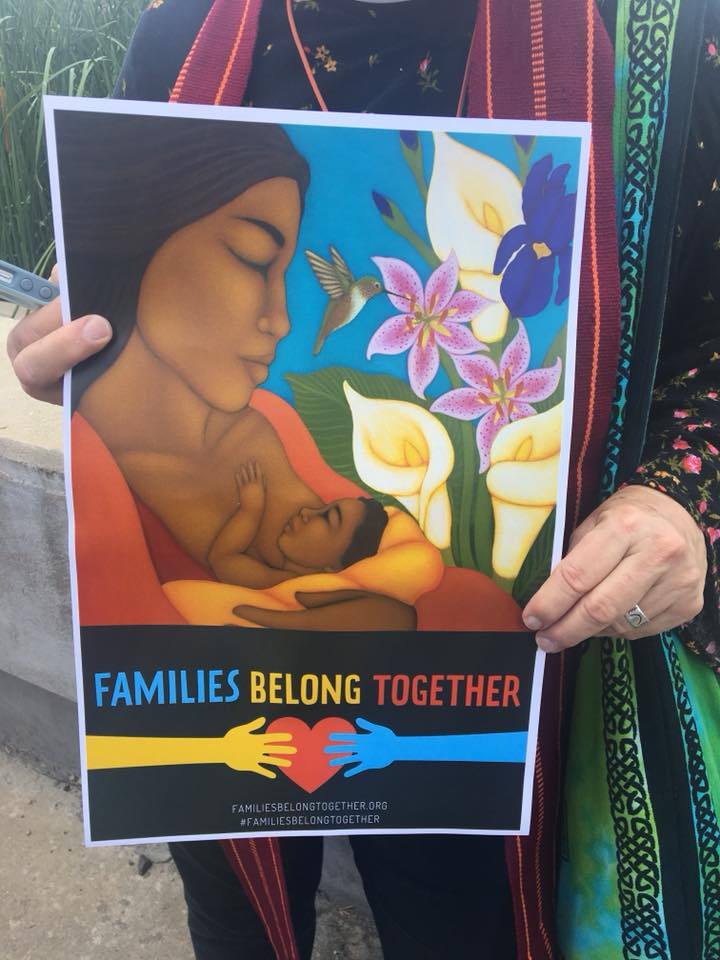
On Sunday of General Convention, the Convention invited us to step out into the world on issues of injustice.  The Bishops gathered to protest against gun violence in the morning.  At midday, we were all invited not to a protest, but a prayer service – a service of solidarity with our sisters seeking asylum in this country.  I was a bit conflicted about the prayer service.  My parishioners have been trying to reconcile their sense of the injustice of families being torn apart at our borders, but with divergent opinions about how immigration and asylum should work in the United States.  I certainly have my opinions about the matter, but I always try to honor the diversity of our community.

Ultimately, I decided that we can always stand to pray.  And so, with a friend and her one-year old daughter, we drove to the Hutto Detention Center for a prayer service.  The Hutto Detention Center was once a prison in Texas.  It is run by a privately-held, for-profit corporation, and hosts women – some of whom have been separated from their children, but all of whom are awaiting help from lawyers as they process asylum petitions.  The day was sweltering hot, and we were in a field by the Center.  Around 1,200 Episcopalians had gathered, with a line of buses surrounding us that had brought many from Austin.  The former identity as a prison was obvious – small, skinny windows, stark, cold walls, high, barbed fences.  Songs were spontaneous at times:  We Shall Overcome, Amazing Grace, This Little Light of Mine.  There were spoken prayers, and impassioned pleas for justice.

I found myself staring out at the building, wondering about the stories, fear, and suffering inside.  I later learned that there have been high occurrences of sexual assault in the Detention Center.  As the child we were with cooed and chattered, I wondered about the hole in my heart I would feel if my children were stripped from me – children I would protect at all costs.  A portion of the crowd walked to the street to get closer and I felt myself drawn to their path.  I wanted a connection with the women inside so deeply.

As we stopped at the entrance, chants began.  “We see you, God loves you.”  “You are not alone.”  Songs followed.  As tense, cold guards stood in front of us (for whom I was grateful and sympathetic toward), I found my grief increasing.  There were rumors that the guards would have pulled the women away from the windows, so it was possible that they would not even hear us.  But as we began to move back to the field, we saw them – women waving in windows, waiving towels behind tall windows.  Later, we would find out from Grassroots Leadership that, “A woman called from Hutto after today’s prayer and told us they were glued to the windows until the last bus left the detention center.  Women inside were crying, saying they knew they weren’t alone after seeing so many people there.”

I know this is a complicated issue for many of us.  But I have to tell you, prayer, relationship, and empathy would certainly get us a long way.  Those are humans, fleeing violence, degradation, and persecution in their home countries, stuck behind cold walls, being persecuted in another country.  And for that, we could all stand to do a lot more praying.

On Making Mary Moments…

31 Wednesday Jan 2018

Posted by jandrewsweckerly in Uncategorized

≈ 2 Comments

Tags

beauty, closure, death, goodbye, grandmother, holy, Jesus, journey, Martha, Mary, meaningful, presence, sit, visit

IMG_9482

Photo Credit:  Jennifer Andrews-Weckerly, January 26, 2018

Over a week ago, I received a call that my grandmother was approaching death.  The suggestion was if I wanted a last visit, I should come sooner rather than later.  Looking at the week ahead, I realized I could go with my children last weekend with minimal impact to their school schedule or my own work obligations.  I was not sure what to expect – whether I would be able to have meaningful conversation or even eye contact with her, or especially how my three- and eight-year olds would respond to her in her current state.  At some point, a family member pastorally suggested I not come, knowing how hard such a long journey for such a brief visit would be.  But something kept pushing me to go, even if the journey seemed fraught with potential difficulty.

There were things that did not happen.  We did not have one last, long, meaningful conversation as I had with my other grandmother.  My grandmother was much too weak and her thoughts much too confused to answer any of my lingering questions about our family.  My children did not get to interact with my grandmother extensively.  They had beautiful moments of tenderness with her, and they played nearby, but they also needed to be kids and move.  I did not leave with a sense of real closure.  No one really knows how long she will be able to thrive.

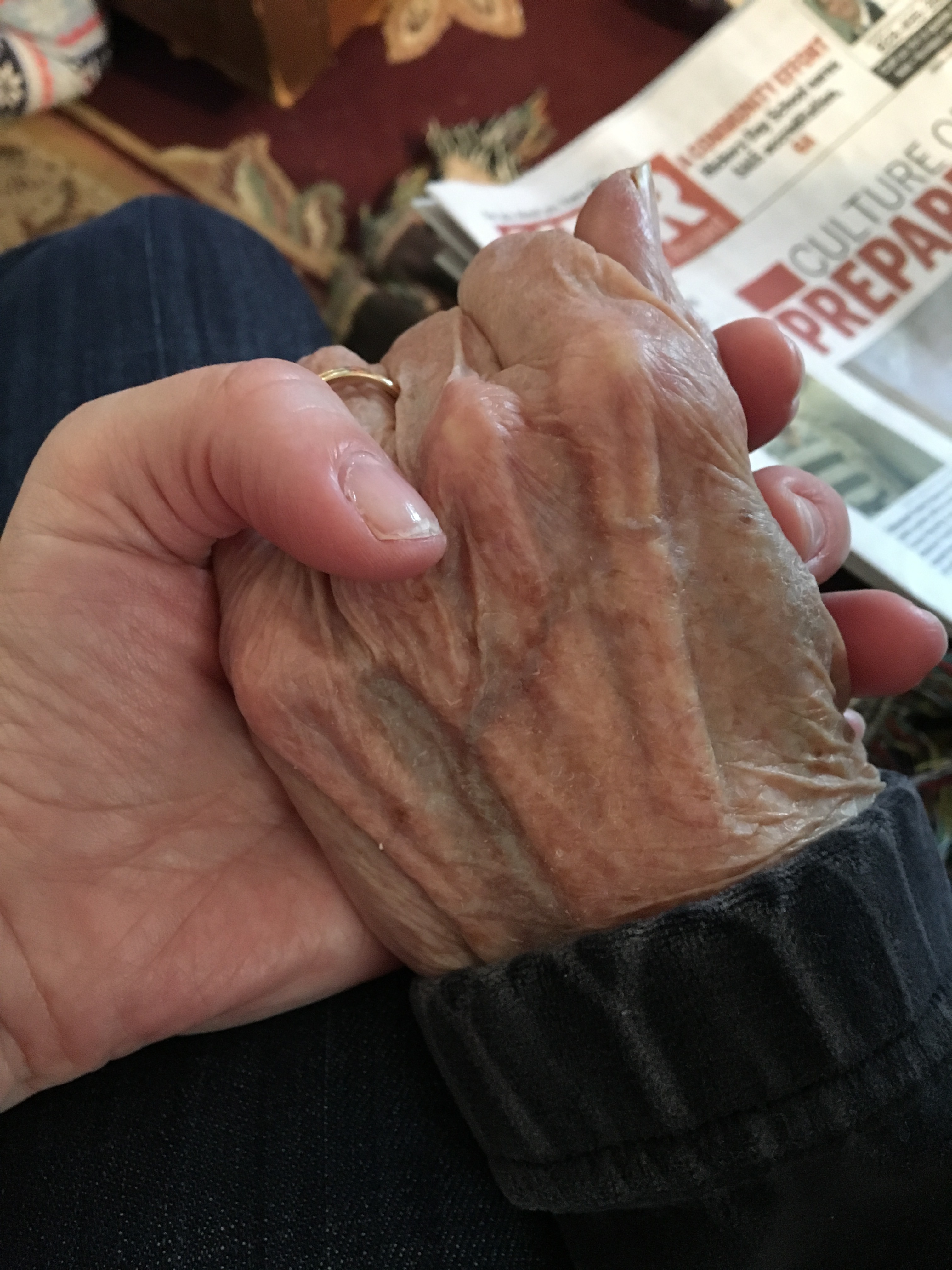
What did happen was a much clearer understanding of why Mary chose to sit at Jesus’ feet, while her sister Martha busied herself with the duties of the home.  For full confession’s sake, I am much more like Martha most days – I am always washing one more dish or finishing one more piece of laundry instead of playing with my kids or hanging out with my husband.  But sitting beside my grandmother, holding her hand, realizing all the things I was not getting, I came to see the beauty of presence.  I do not think I have ever just been still with my grandmother.  I have never looked into her eyes for an extended period of time without saying anything.  I am pretty sure I have never just held her hand.  In the midst of all that could not be said, I felt a different kind of closure.  I could finally see in my larger-than-life grandmother her vulnerability, her desire to love, her humanity.

I left my grandmother last weekend wondering if I might be able to create more space for Mary-type moments in everyday life.  Whether I might put my phone away more often at home and be more present with my family.  How I might stop worrying about my to-do list, and spend more open time with our staff and parishioners.   Whether I might write that note to a suffering friend instead of letting the thought pass.  What Mary-type moments have been missing in your life lately?  When was the last time you sat at the feet of Jesus, or sat at the feet of the holy in others, and stayed for a while?  What might you need to do this week to find your own Mary moment?  I look forward to hearing about your reflections.

The Eye of the Beholder…

28 Wednesday Sep 2016

Posted by jandrewsweckerly in Uncategorized

≈ Leave a comment

Tags

art, busy, Christ, eyes, God, important, intention, museum, perception, presence, see

This summer I had the great pleasure of seeing some great art exhibits.  Though I typically love going to art museums, I rarely make time to go.  Life just gets too busy and other “important” things seem to take precedence.  But what I realized this summer is I should go to art museums more often because the busyness of life easily distracts me from seeing the really important stuff of life.

gala-contemplating-the-mediterranean-sea-which-at-twenty-meters-becomes-the-portrait-of-abraham-lincoln-large-orginal-504x669

Photo credit:  http://thedali.org/exhibit/gala-contemplating-mediterranean-sea/

My first art museum jaunt was to the Salvadore Dali Museum in St. Petersburg, Florida.  I did not really know much about Dali, except his iconic melting clocks.  But his work blew me away.  One of my favorite pieces of his is called, “Gala Contemplating the Mediterranean Sea,” 1976.  He plays with images in the painting so that up close you see a cross, and far away, you see a portrait of Abraham Lincoln.  But it wasn’t until I took a picture with my phone that I could see the second image.  His playfulness with visual perception made me wonder if we don’t all struggle with visual perception in life.  We all run around seeing only a portion of reality.  This partial vision and perception means that we are also constantly missing the presence and activity of God in our lives.  Like Dali’s painting, we can miss the presence of Christ when we are too close or too far away to notice our Savior in the world about us.


002-kehinde-wiley-theredlist

Photo credit:  http://theredlist.com/search-image?q=angel

I had a similar experience when visiting the Virginia Museum of Fine Arts in Richmond.  They have an exhibit by Kehinde Wiley that shakes up our senses about who is traditionally featured in portraits.  My favorite piece of his was a gold-leaf icon-like portrait called “The Archangel Gabriel” 2014.  Everything about the Angel Gabriel is unexpected – his clothing, his hair, his jewelry, and his skin color.  But there is also something entirely familiar about him – a gentleness, trustworthiness, and sense of reassurance.  By reimagining ancient depictions of the Angel Gabriel, Wiley reminds us that God does not always appear in the ways and in the people we expect.  I suspect that we often miss God’s presence simply because we are not looking with the eyes of God.

I wonder how common this pattern is for all of us.  How often do we rush past Christ as we rush through life?  This week, I invite you to do what you need to do to slow down and see God at work in the world about you.  Whether you need to go to an art exhibit, take a yoga class, volunteer with one of our outreach ministries, or just take thirty minutes of quiet or prayer, find a way to shake up your busy routine and look with intention to see the ways in which God is active in your life.  I look forward to hearing about what you learn.

← Older posts

Recent Posts

  • On the Myth and Magic of Advent…
  • On Risking Failure and Facing Fear…
  • Sermon – Luke 23.33-43, P29, YC, November 23, 2025
  • On Inhabiting Gratitude…
  • Sermon – Luke 20.27-38, P27, YC, November 9, 2025

Archives

  • December 2025
  • November 2025
  • October 2025
  • September 2025
  • August 2025
  • July 2025
  • June 2025
  • March 2025
  • February 2025
  • December 2024
  • November 2024
  • October 2024
  • September 2024
  • August 2024
  • July 2024
  • June 2024
  • May 2024
  • March 2024
  • February 2024
  • January 2024
  • December 2023
  • November 2023
  • October 2023
  • September 2023
  • August 2023
  • July 2023
  • June 2023
  • May 2023
  • March 2023
  • February 2023
  • January 2023
  • December 2022
  • November 2022
  • October 2022
  • June 2022
  • May 2022
  • January 2022
  • December 2021
  • November 2021
  • October 2021
  • September 2021
  • August 2021
  • June 2021
  • May 2021
  • April 2021
  • March 2021
  • February 2021
  • January 2021
  • December 2020
  • November 2020
  • October 2020
  • September 2020
  • August 2020
  • July 2020
  • June 2020
  • May 2020
  • April 2020
  • March 2020
  • February 2020
  • January 2020
  • December 2019
  • November 2019
  • October 2019
  • September 2019
  • August 2019
  • July 2019
  • June 2019
  • May 2019
  • April 2019
  • March 2019
  • February 2019
  • January 2019
  • December 2018
  • November 2018
  • October 2018
  • September 2018
  • August 2018
  • July 2018
  • June 2018
  • May 2018
  • April 2018
  • March 2018
  • February 2018
  • January 2018
  • December 2017
  • November 2017
  • October 2017
  • September 2017
  • August 2017
  • July 2017
  • June 2017
  • May 2017
  • April 2017
  • March 2017
  • February 2017
  • January 2017
  • December 2016
  • November 2016
  • October 2016
  • September 2016
  • August 2016
  • July 2016
  • June 2016
  • May 2016
  • April 2016
  • March 2016
  • February 2016
  • January 2016
  • December 2015
  • November 2015
  • October 2015
  • September 2015
  • August 2015
  • July 2015
  • June 2015
  • May 2015
  • April 2015
  • March 2015
  • February 2015
  • January 2015
  • December 2014
  • November 2014
  • October 2014
  • September 2014
  • August 2014
  • July 2014
  • June 2014
  • April 2014
  • March 2014
  • February 2014
  • January 2014
  • December 2013
  • November 2013
  • October 2013
  • September 2013
  • August 2013
  • July 2013
  • June 2013
  • May 2013
  • April 2013
  • March 2013
  • February 2013
  • January 2013
  • December 2012
  • November 2012
  • October 2012
  • September 2012

Categories

  • reflection
  • Sermons
  • Uncategorized

Meta

  • Create account
  • Log in
  • Entries feed
  • Comments feed
  • WordPress.com

Blog at WordPress.com.

  • Subscribe Subscribed
    • Seeking and Serving
    • Join 394 other subscribers
    • Already have a WordPress.com account? Log in now.
    • Seeking and Serving
    • Subscribe Subscribed
    • Sign up
    • Log in
    • Report this content
    • View site in Reader
    • Manage subscriptions
    • Collapse this bar
 

Loading Comments...